kimkat2645e A
Welsh Grammar - Historical and
Comparative. 1913. John
Morris-Jones (1864-1929). Gwefan Cymru-Catalonia.
21-11-2025
.....
|
(delwedd 003) |
Gwefan Cymru-Catalonia A Welsh Grammar – |
|
.....
|
2644e Tudalennau |
Rhan
2: Tudalennau |
Rhan
3: Tudalennau §41- §75 |
Rhan
4: Tudalennau §75- §99 |
Rhan
5: Tudalennau §99- §120 |
Rhan
6: Tudalennau §120- §148 |
Rhan
7: Tudalennau §148- §165 |
Rhan
8: Tudalennau §165- §189 |
Rhan
9: Tudalennau §189- §209 |
Rhan
10: Tudalennau §209- §224 |
Rhan
11: Tudalennau (y mynegai) |
|
Secció
1: Pàgines |
Secció
2: Pàgines |
Secció
3: Pàgines §41- §75 |
Secció
4: Pàgines §75- §99 |
Secció
5: Pàgines §99- §120 |
Secció
6: Pàgines §120- §148 |
Secció
7: Pàgines §148- §165 |
Secció
8: Pàgines §165- §189 |
Secció
9: Pàgines §189- §209 |
Secció
10: Pàgines §209- §224 |
Secció
11: Pàgines (index) |
|
Part
1: Pages |
Part
2: Pages |
Part
3: Pages §41- §75 |
Part
4: Pages §75- §99 |
Part
5: Pages §99- §120 |
Part
6: Pages §120- §148 |
Part
7: Pages §148- §165 |
Part
8: Pages §165- §189 |
Part
9: Pages §189- §209 |
Part
10: Pages §209- §224 |
Part
11: Pages (index) |
Gweler hefyd / Vegeu
també / See also: https://en.wikisource.org/wiki/A_Welsh_Grammar,_Historical_and_Comparative
.....
|
|
|
||||||||||||||||||||||||||||||||||||||||
|
|
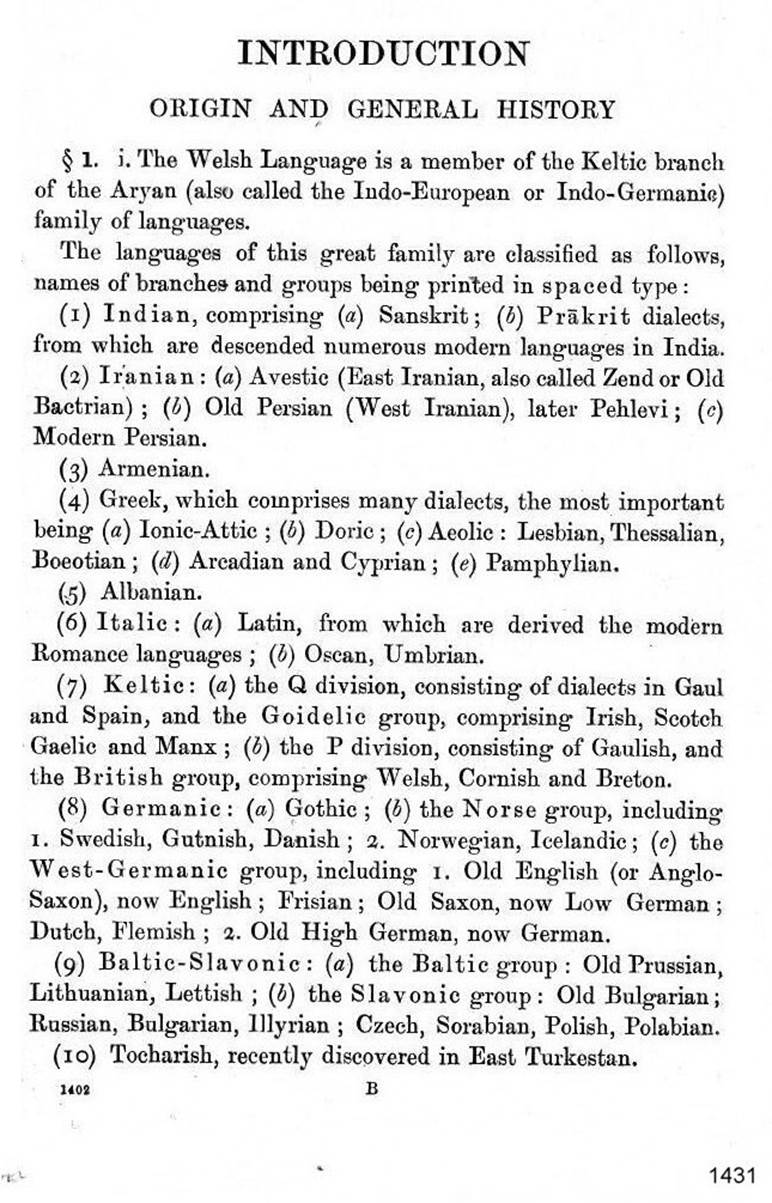
Introduction Origin and general history § 1. i. The Welsh
language is a member of the Keltic branch of the Aryan (also called
the Indo-European or Indo-Germanic)
family of languages. The languages of this great family are classified as follows, names of
branches and groups being printed in spaced type: (1) Indian, comprising (a) Sanskrit;
(b) Prākrit dialects, from which are descended
numerous modern languages in India. (2) Iranian: (a) Avestic (East Iranian, also called Zend
or Old Bactrian); (b) Old
Persian (West Iranian), later Pehlevi;
(c) Modern Persian. (3) Armenian. (4) Greek, which comprises many dialects, the most
important being (a) Ionic-Attic;
(b) Doric; (c) Aeolic:
Lesbian, Thessalian, Boeotian; (d) Arcadian and Cyprian; (e) Pamphylian. (5) Albanian. (6) Italic: (a) Latin, from
which are derived the modern Romance languages; (b) Oscan, Umbrian. (7) Keltic: (a) the Q division, consisting of
dialects in Gaul and Spain, and the Goidelic group, comprising Irish, Scotch
Gaelic and Manx; (b) the P division, consisting
of Gaulish,
and the British group, comprising Welsh, Cornish and Breton. (8) Germanic: (a) Gothic;
(b) the Norse group, including 1. Swedish, Gutnish, Danish;
2. Norwegian, Icelandic; (c) the West-Germanic group, including
1. Old English (or Anglo-Saxon), now English; Frisian; Old Saxon,
now Low German; Dutch, Flemish;
2. Old High German, now German. (9) Baltic-Slavonic: (a) the Baltic group: Old Prussian, Lithuanian, Lettish; (b) the Slavonic group: Old Bulgarian; Russian, Bulgarian, Illyrian; Czech, Sorabian, Polish, Polabian. (10) Tocharish, recently discovered in East
Turkestan. |
||||||||||||||||||||||||||||||||||||||||
|
|
|
||||||||||||||||||||||||||||||||||||||||
|
|
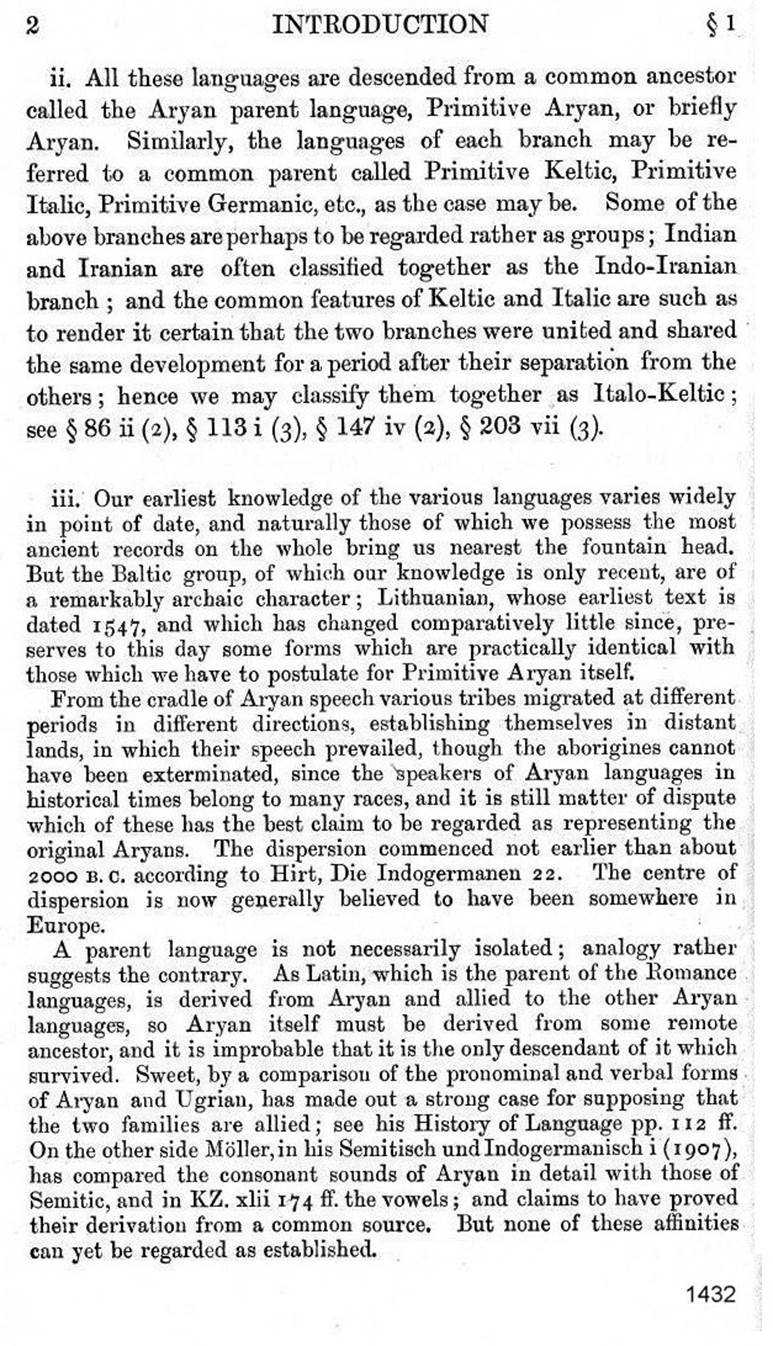
2 INTRODUCTION § 1 ii. All these languages are descended from a common ancestor called
the Aryan parent language, Primitive Aryan, or briefly Aryan. Similarly, the
languages of each branch may be referred to a common parent called Primitive
Keltic, Primitive Italic, Primitive Germanic, etc., as the case may be. Some
of the above branches are perhaps to be regarded rather as groups; Indian and
Iranian are often classified together as the Indo-Iranian branch; and the
common features of Keltic and Italic are such as to render it certain that
the two branches were united and shared the same development for a period
after their separation from the others; hence we may classify them together
as Italo-Keltic; see § 86 ii
(2), § 113 i
(3), § 147 iv
(2), § 203 vii
(3). iii. Our earliest knowledge of the various languages varies widely in
point of date, and naturally those of which we possess the most ancient
records on the whole bring us nearest the fountain head. But the Baltic
group, of which our knowledge is only recent, are of a remarkably archaic
character; Lithuanian, whose earliest text is dated 1547, and which has
changed comparatively little since, preserves to this day some forms which
are practically identical with those which we have to postulate for Primitive
Aryan itself. From the cradle of Aryan speech various tribes migrated at different
periods in different directions, establishing themselves in distant lands, in
which their speech prevailed, though the aborigines cannot have been
exterminated, since the speakers of Aryan languages in historical times
belong to many races, and it is still matter of dispute which of these has
the best claim to be regarded as representing the original Aryans. The
dispersion commenced not earlier than about 2000 b.c. according to Hirt,
Die Indogermanen 22. The centre of dispersion is now generally believed to
have been somewhere in Europe. A parent language is not necessarily isolated; analogy rather suggests
the contrary. As Latin, which is the parent of the Romance languages, is
derived from Aryan and allied to the other Aryan languages, so Aryan itself
must be derived from some remote ancestor, and it is improbable that it is
the only descendant of it which survived. Sweet, by a comparison of the
pronominal and verbal forms of Aryan and Ugrian, has made out a strong case
for supposing that the two families are allied; see his History of Language
pp. 112 ff. On the other side Moller, in his Semitisch und Indogermanisch i
(1907), has compared the consonant sounds of Aryan in detail with those of
Semitic, and in KZ. xlii 174 ff. the vowels; and claims to have proved their
derivation from a common source. But none of these affinities can yet be
regarded as established. |
||||||||||||||||||||||||||||||||||||||||
|
|
|
||||||||||||||||||||||||||||||||||||||||
|
|
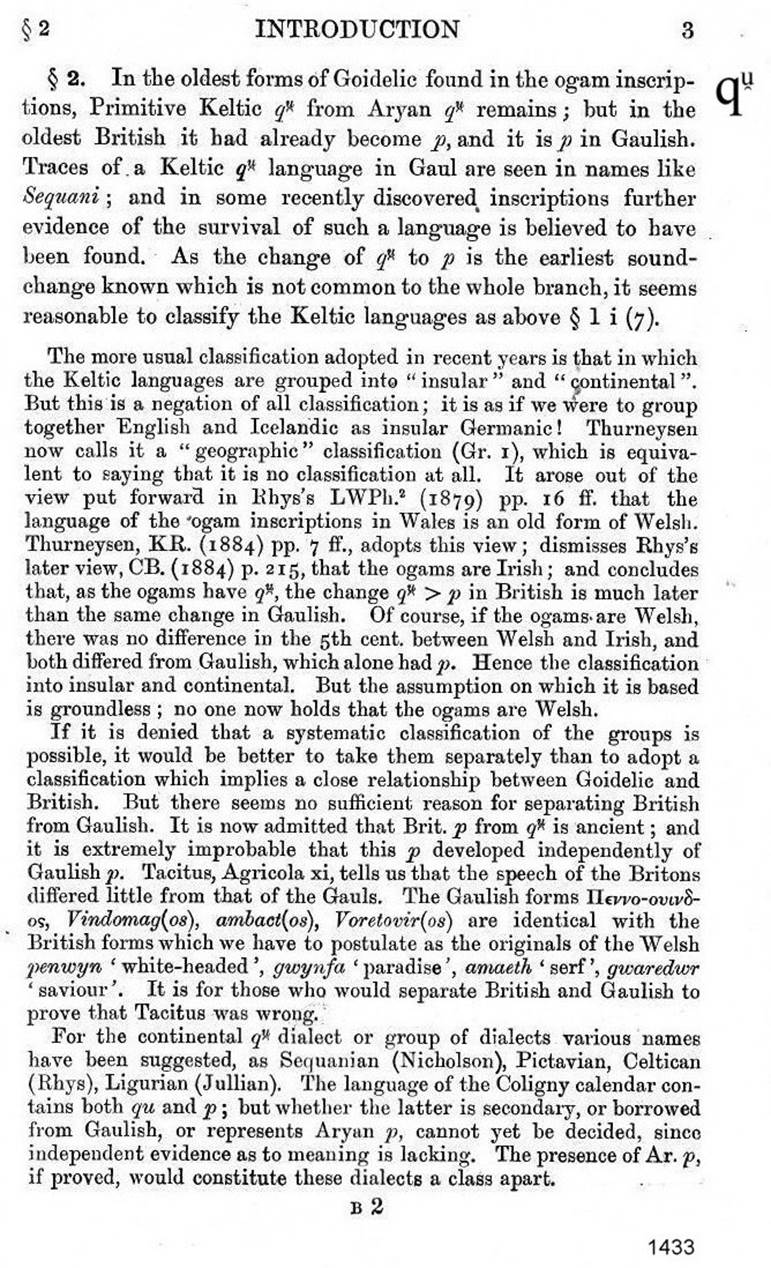
§ 2 INTRODUCTION 3 § 2. In the oldest forms of Goidelic found in the ogam
inscriptions, Primitive Keltic qu̯ from Aryan qu̯ remains; but in the oldest British it had already become p,
and it is p in Gaulish. Traces of a Keltic qu̯ language in Gaul are seen in names like Sequani; and
in some recently discovered inscriptions further evidence of the survival of
such a language is believed to have been found. As the change of qu̯ to p is the earliest soundchange known which is
not common to the whole branch, it seems reasonable to classify the Keltic
languages as above § 1 i
(7). The more usual classification adopted in recent years is that in which
the Keltic languages are grouped into "insular" and
"continental". But this is a negation of all classification; it is
as if we were to group together English and Icelandic as insular Germanic!
Thurneysen now calls it a "geographic" classification (Gr. 1),
which is equivalent to saying that it is no classification at all. It arose
out of the view put forward in Rhys's LWPh.² (1879) pp. 16 ff. that the language
of the ogam inscriptions in Wales is an old form of Welsh. Thurneysen, KR.
(1884) pp. 7 ff., adopts this view; dismisses Rhys's later view, CB. (1884)
p. 215, that the ogams are Irish; and concludes that, as the ogams have qu̯, the change qu̯ > p in British is much later than the same
change in Gaulish. Of course, if the ogams are Welsh, there was no difference
in the 5th cent. between Welsh and Irish, and both differed from Gaulish,
which alone had p. Hence the classification into insular and
continental. But the assumption on which it is based is groundless; no one
now holds that the ogams are Welsh. If it is denied that a systematic classification of the groups is
possible, it would be better to take them separately than to adopt a
classification which implies a close relationship between Goidelic and
British. But there seems no sufficient reason for separating British from
Gaulish. It is now admitted that Brit. p from qu̯ is ancient; and it is extremely improbable that this p developed
independently of Gaulish p. Tacitus, Agricola xi, tells us that
the speech of the Britons differed little from that of the Gauls. The Gaulish
forms
Πεννο-ουινδος, Vindomag(os), ambact(os), Voretovir(os) are
identical with the British forms which we have to postulate as the originals
of the Welsh penwyn 'white-headed', gwynfa 'paradise', amaeth 'serf', gwaredwr 'saviour'.
It is for those who would separate British and Gaulish to prove that Tacitus
was wrong. For the continental qu̯ dialect or group of dialects various names have been suggested,
as Sequanian (Nicholson), Pictavian, Celtican (Rhys), Ligurian (Jullian). The
language of the Coligny calendar contains both qu and p;
but whether the latter is secondary, or borrowed from Gaulish, or represents
Aryan p, cannot yet be decided, since independent evidence as to
meaning is lacking. The presence of Ar. p, if proved, would
constitute these dialects a class apart. |
||||||||||||||||||||||||||||||||||||||||
|
|
|
||||||||||||||||||||||||||||||||||||||||
|
|
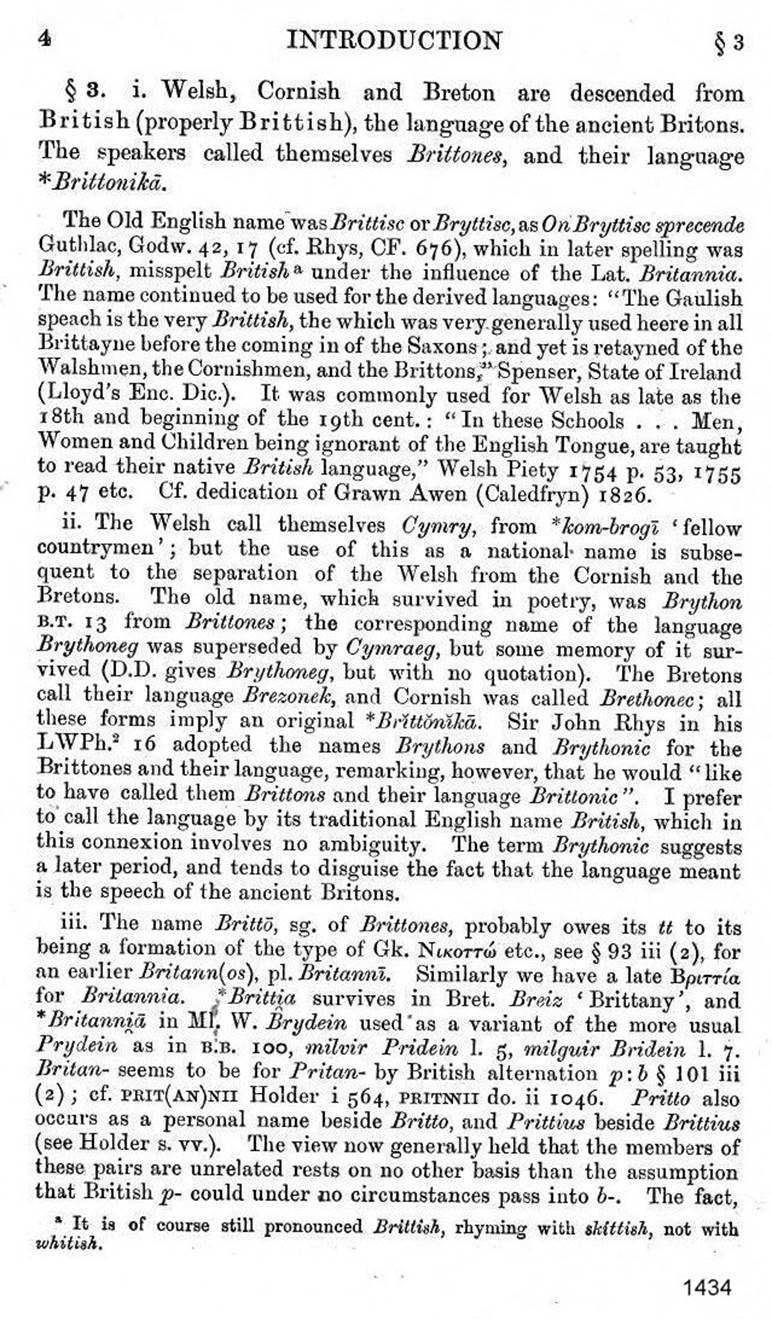
4 INTRODUCTION § 3 § 3. i. Welsh, Cornish and Breton are descended
from British (properly Brittish), the language of the ancient
Britons. The speakers called themselves Brittones, and their
language *Brittonikā. The Old English name was Brittisc or Bryttisc,
as On Bryttisc sprecende Guthlac, Godw. 42, 17 (cf. Rhys,
CF. 676), which in later spelling was Brittish, misspelt British[1] under
the influence of the Lat. Britannia. The name continued to be
used for the derived languages: “The Gaulish speach is the very Brittish,
the which was very generally used heere in all Brittayne before the coming in
of the Saxons; and yet is retayned of the Walshmen, the Cornishmen, and the
Brittons,” Spenser, State of Ireland (Lloyd’s Enc. Dic.). It was commonly
used for Welsh as late as the 18th and beginning of the 19th cent.: “In these
Schools…Men, Women and Children being ignorant of the English Tongue, are
taught to read their native British language,” Welsh Piety 1754 p. 53, 1755 p. 47 etc. Cf. dedication of Grawn Awen
(Caledfryn) 1826. ii. The Welsh call themselves Cymry, from *kom-brogī ‘fellow
countrymen’; but the use of this as a national name is subsequent to the
separation of the Welsh from the Cornish and the Bretons. The old name, which
survived in poetry, was Brython b.t. 13 from Brittones;
the corresponding name of the language Brythoneg was
superseded by Cymraeg, but some memory of it survived (D.D.
gives Brythoneg, but with no quotation). The Bretons call their
language Brezonek, and Cornish was called Brethonec;
all these forms imply an original *Brĭttŏnĭkā.
Sir John Rhys in his LWPh.² 16 adopted the names Brythons and Brythonic for
the Brittones and their language, remarking, however, that he would “like to
have called them Brittons and their language Brittonic”.
I prefer to call the language by its traditional English name British,
which in this connexion involves no ambiguity. The term Brythonic suggests
a later period, and tends to disguise the fact that the language meant is the
speech of the ancient Britons. iii. The name Brittō, sg. of Brittones,
probably owes its tt to its being a formation of the type of
Gk. Νικοττώ etc., see § 93 iii
(2), for an earlier Britann(os), pl. Britannī.
Similarly we have a late Βριττία for Britannia.
*Brittia survives in Bret. Breiz ‘Brittany’, and
*Britanni̯ā, in Ml. W. Brydein used
as a variant of the more usual Prydein as
in b.b. 100, milvir Pridein l. 5, milguir
Bridein l. 7. Britan- seems to be for Pritan- by
British alternation p:b § 101 iii
(2); cf. prit(an)nii Holder i 564, pritnnii do. ii
1046. Pritto also occurs as a personal name beside Britto,
and Prittius beside Brittius (see Holder s.
vv.). The view now generally held that the members of these pairs are
unrelated rests on no other basis than the assumption that British p- could
under no circumstances pass into b‑. The fact,
|
||||||||||||||||||||||||||||||||||||||||
|
|
|
||||||||||||||||||||||||||||||||||||||||
|
|
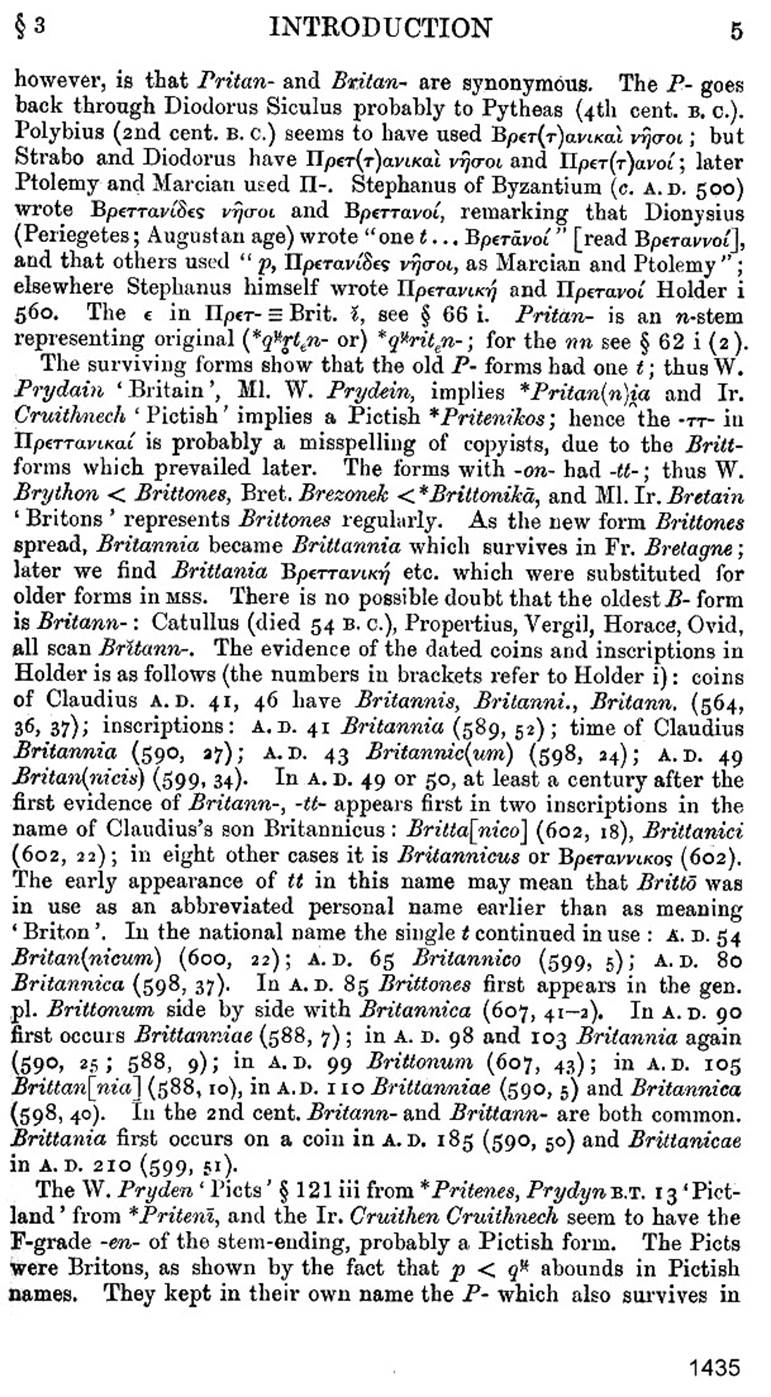
§ 3 INTRODUCTION 5 however, is that Pritan- and Britan- are
synonymous. The P- goes back through Diodorus Siculus
probably to Pytheas (4th cent. b. c.). Polybius (2nd
cent. b. c.) seems to have used
Βρετ(τ)ανικαὶ νῆσοι; but Strabo and Diodorus have
Πρετ(τ)ανικαὶ νῆσοι and
Πρετ(τ)ανοί; later Ptolemy and
Marcian used Π‑. Stephanus of Byzantium (c. a. d. 500)
wrote Βρετ(τ)ανίδες
νῆσοι and
Βρετ(τ)ανοί, remarking that
Dionysius (Periegetes; Augustan age) wrote “one t…Βρετᾱνοί” [read
Βρεταννοί], and that others used
“p, Πρετανίδες
νῆσοι, as Marcian and Ptolemy”; elsewhere Stephanus
himself wrote Πρετανίκή and
Πρετανοί Holder i 560. The ε in
Πρετ- ≡ Brit. ĭ, see § 66 i. Pritan- is
an n-stem representing original (*qu̯r̥tₑn- or) *qu̯ritₑn‑; for the nn see § 62 i (2). The surviving forms show that the old P- forms had
one t; thus W. Prydain ‘Britain’, Ml. W. Prydein,
implies *Pritan(n)i̯a and Ir. Cruithnech ‘Pictish’ implies a Pictish
*Pritenikos; hence the ‑ττ- in
Πρεττανικαὶ is probably a misspelling of copyists, due to the Britt- forms
which prevailed later. The forms with ‑on- had ‑tt‑;
thus W. Brython < Brittones, Bret. Brezonek <
*Brittonikā, and Ml. Ir. Bretain 'Britons'
represents Brittones regularly. As the new form Brittones spread, Britannia became Brittannia which
survives in Fr. Bretagne; later we find Brittania Βρεττανική
etc. which were substituted for older forms in mss. There is no possible
doubt that the oldest B- form is Britann‑:
Catullus (died 54 b. c.), Propertius, Vergil, Horace, Ovid, all
scan Brĭtann‑. The evidence of the dated coins and
inscriptions in Holder is as follows (the numbers in brackets refer to Holder
i): coins of Claudius a. d. 41, 46 have Britannis, Britanni., Britann. (564,
36, 37); inscriptions: a. d. 41 Britannia (589,
52); time of Claudius Britannia (590,
27); a. d. 43 Britannic(um) (598,
24); a. d. 49 Britan(nicis) (599, 34).
In a. d. 49 or 50, at least a century after the first evidence
of Britann‑, ‑tt- appears first in
two inscriptions in the name of Claudius’s son Britannicus: Britta[nico]
(602, 18), Brittanici (602, 22); in eight other cases it
is Britannicus or
Βρεταννικος (602). The
early appearance of tt in this name may mean that Brittō was
in use as an abbreviated personal name earlier than as meaning ‘Briton’. In
the national name the single t continued in
use: a. d. 54 Britan(nicum) (600,
22); a. d. 65 Britannico (599,
5); a. d. 80 Britannica (598, 37).
In a. d. 85 Brittones first appears in the
gen. pl. Brittonum side by side with Britannica (607,
41–2). In a. d. 90 first occurs Brittanniae (588,
7); in a. d. 98 and 103 Britannia again (590,
25; 588, 9); in a. d. 99 Brittonum (607, 43);
in a. d. 105 Brittan[nia] (588, 10),
in a. d. 110 Brittanniae (590, 5) and Britannica (598,
40). In the 2nd cent. Britann- and Brittann- are
both common. Brittania first occurs on a coin
in a. d. 185 (590, 50) and Brittanicae in a. d. 210
(599, 51). The W. Pryden ‘Picts’ § 121 iii from
*Pritenes, Prydyn b.t. 13 ‘Pictland’ from *Pritenī,
and the Ir. Cruithen Cruithnech seem to have the
F-grade ‑en- of the stem-ending, probably a Pictish
form. The Picts were Britons, as shown by the fact that p < qu̯ abounds in Pictish names. They kept in their own name the P- which
also survives in |
||||||||||||||||||||||||||||||||||||||||
|
|
|
||||||||||||||||||||||||||||||||||||||||
|
|
6 INTRODUCTION §§ 4, 5 W. Prydain 'Britain', and so came to be distinguished
from the Southern Britons, who called themselves Brittones. Picti,
which is not known to occur before a. d. 297, seems to be a
Latin translation of *Pritenes explained as meaning 'figured'
(: W. pryd 'form', Ir. cruth), just as
W. Brithwyr 'Picts' is a translation of Picti.
This explanation of *Pritenes is probably only a piece of popular
etymology; but even if it had some old tradition behind it, the name is
equally applicable to the other Britons, for they all painted or tattooed
themselves, Caesar b.g. v 14, Herodian iii 14, 7. Indeed the
objection to accepting it as the true explanation is that at the time when it
was first applied it could not be distinctive. The etymology of a proper name is always uncertain, except when,
like Albion, it hardly admits of more than one meaning, and that
meaning fits. Britain like Albion must have
been a name given to the island by its Keltic invaders, and Albion suggests
the feature most likely to impress them. There is an Italo-Keltic root of
some such form as *qu̯rēi- which means 'chalk' or 'white earth', giving Lat. crēta,
and W. pridd 'loam', Irish crē; the attempt
to derive the Welsh and Irish words from the Latin is a failure—the root must be Keltic as well as Italic; and it may have yielded the
name Pritannia meaning 'the island of the white cliffs'. § 4. i. Gaulish and British are known to us through names on
coins, and words and names quoted by Greek and Latin authors. No inscriptions
occur in British, but British names are found in Latin inscriptions. A number
of inscriptions in Gaulish have been preserved. Goidelic is known from the
ogam inscriptions, of which the oldest date from the 5th century. ii. The scanty materials which we possess for the study of Gaulish and
British are sufficient to show that these languages preserved the Aryan
case-endings, and were at least as highly inflected as, say, Latin. The great
change which transformed British and converted it into Welsh and its sister
dialects was the loss of the endings of stems and words, by which, for
example, the four syllables of the British Maglo-cŭnos were
reduced to the two of the Welsh Mael-gwn. By this reduction
distinctions of case were lost, and stem-forming suffixes became a new class
of inflexional endings; see § 113, § 119 i. § 5. The history of Welsh may be divided into periods as follows: (1) Early Welsh, from the time when British had definitely become
Welsh to the end of the 8th century. Of the forms of this |
||||||||||||||||||||||||||||||||||||||||
|
|
|
||||||||||||||||||||||||||||||||||||||||
|
|
§ 5 Introduction 7 period we have only echoes, such as the names found in Bede, § 113 i
(4). (2) Old Welsh (O. W.), from the beginning of
the 9th to the end of the 11th century. The remains of this period are a
number of glosses, and some fragments of prose and anonymous verse. But
O. W. forms are preserved in later copies in the genealogies, the Book
of Llandâf, the Laws, the Book of Aneirin, etc. (3) Medieval Welsh (Ml. W.), from the
beginning of the 12th to the end of the 14th century and somewhat later. The
orthography varied much during this period, and was at first in an unsettled
state. It will be convenient to refer to the language of the 12th and early
13th century as Early Ml. W., and to that of the 14th and early 15th as
Late Ml. W. (4) Modern Welsh (Mn. W.), from Dafydd ap Gwilym to the present day.
Though D. ap Gwilym wrote before the end of the 14th century, he inaugurated
a new period in the history of the language, and is in fact the first of the
moderns. The bards of the 15th and 16th centuries wrote the bulk of their poetry
in the cywydd metre
popularized by Dafydd; and the forms used by him, with some alterations of
spelling (ai, au for ei, eu § 79),
were preserved unchanged, having been stereotyped by the cynghanedd.
The language of this body of poetry may be called Early Mn. W. At the introduction of printing, Wm. Salesbury attempted in his works,
including the New Test. (1567), to form a new literary dialect, in which the
orthography should indicate the etymology rather than the sound. His practice
was to write Latin loanwords as if no change had taken place in them except
the loss of the ending, thus eccles for eglwys 'church', descend for disgyn ‘to
descend’; any native word with a superficial resemblance to a Latin synonym
was similarly treated, thus i ‘his, her’ was written ei because
the Latin is eius (perhaps eu ‘their’
suggested this). But Dr. Morgan in his Bible
(1588) adopted the standard literary language as it continued to be
written by the bards, though he retained some of Salesbury’s innovations
(e.g. ei for i ‘his’). Some dialectal forms
used by Morgan (e.g. gwele for gwelai ‘saw’ § 6 iii)
were replaced by the literary forms in the revised Bible
(1620), which became the standard of later writers. Thus |
||||||||||||||||||||||||||||||||||||||||
|
|
|
||||||||||||||||||||||||||||||||||||||||
|
|
8 INTRODUCTION § 6 Late Mn. W., which begins with the Bible, though influenced to some
extent by Salesbury, is based upon Early Mn. W., and forms a
continuation of it. In the 19th century several neologisms were introduced,
chiefly under the influence of Pughe; the language of this period will be
referred to, when necessary, as Recent Welsh. § 6. i. The spoken language has four main dialects, as follows: (1) Venedotian, the dialect of Gwynedd or North West Wales.
(Gwyn. dial.) (2) Powysian, the dialect of Powys, or North East and Mid Wales.
(Powys dial.) (3) Demetian, the dialect of Dyfed or South West Wales. (4) Gwentian, the dialect of Gwent and Morgannwg, or South East
Wales. N. W. is used as an abbreviation for 'North Wales' or 'North Walian',
S. W. for 'South Wales' or 'South Walian'. ii. The two N. W. dialects differ from the two S. W. chiefly
in the choice of words to express some common ideas, the most noticeable
difference being the use of o, fo in N. W.,
and e, fe in S. W., for the pronoun 'he' or
'him'. iii. In the final unaccented syllable the diphthongs ai and au are
mostly levelled with e in the dialects. In Powys and Dyfed,
that is, in an unbroken belt from North East to South West, the three are
sounded e; thus cader, pethe, bore for cadair 'chair', pethau 'things', bore 'morning'.
In Gwynedd and Gwent they are sounded a, as cadar (Gwent cá|tar), petha, bora.
When ai is significant (e.g. as denoting the plural) it
is ai in Gwynedd, i in Gwent,
sometimes i in Powys, as Gwynedd defaid 'sheep', llygaid (when
not ll'gada) 'eyes'; Gwent defid, llý|cid;
Powys defed, llygid; Dyfed defed, llyged. Dialectal forms, chiefly Demetian and Powysian ‑e,
begin to appear in the mss. of the 15th century; but the rhymes of
the bards of the 15th and 16th centuries, with the exception of some
poetasters, always imply the literary form, which is still used in the
written language except in a few words. See § 31 ii. |
||||||||||||||||||||||||||||||||||||||||
|
|
|
||||||||||||||||||||||||||||||||||||||||
|
|
Phonology Orthography and pronunciation The Alphabet. § 7. i. Welsh, in all its periods, has been written in the Latin
alphabet. The ogam inscriptions are Irish. The letters of the ogam alphabet
consist of scores and notches on the edge of the stone; one to five scores,
cut at right angles to the edge on either side, or obliquely across it, form
15 consonants; one to five notches on the edge form 5 vowels. The "alphabet
of Nemnivus", contained in ox., dated 812, and reproduced by Ab
Ithel in Dosp. Ed. 10, 11, is stated in the ms. to have been formed
by Nemnivus "ex
machinatione mentis suae" in answer to a Saxon's taunt that the Britons
had no letters. Most of the signs are forms of Latin characters made to
imitate runes; two (ᚾ n and ᚢ u) are runes, while others seem to be arbitrary
inventions. There is no evidence of the use of this alphabet. The
"winged alphabet" given by Ab Ithel ibid. 12 consists of two
classifications of Scandinavian tree-runes, the top line representing the two
schemes of classification. The reason given for supposing the scribe to be a
Welshman is too ridiculous to need refutation. Among the "traditions" invented by the Glamorgan bards in
support of their claim to be the successors of the druids was the
"wooden book"; though all the accounts of it are in Iolo
Morgannwg's handwriting, contemporary evidence of its existence in the
early 17th cent. is afforded by Rhys Cain's satirical englyn (Ab
Iolo, Coel. y B. 50); but it cannot be traced further back. The 'bardic
alphabet' called coelbren y beirdd was a conventional
simplification of ordinary characters adapted for cutting on wood; its
letters are derived from the handwriting of the period, as |
||||||||||||||||||||||||||||||||||||||||
|
|
|
||||||||||||||||||||||||||||||||||||||||
|
|
10 PHONOLOGY § 7 of Gelli Lyfdy compiled two collections of the alphabets known to
him p 307, Ỻ 144, but neither contains anything like the coelbren.
No ms. is written in it, for the simple reason that it was easier
to write ordinary characters than the coelbren caricature of them. The
writing in p 54 pp. 359 ff., stated in the r. to be in
"'bardic' characters, which are widely different from Roman
characters", bears no resemblance to the coelbren, and is no more
"widely different from Roman characters" than the coelbren itself
is; it is the hand of an illiterate person; the letters are written separately,
but all are clumsy copies of the script characters of the period, mostly
formed with awkward curves, the antithesis of the coelbren angles. There is a
somewhat similar scribble written upside down on the bottom margin
of b.ch. = p 29, p. 19.—The wooden book consisted of
squared inscribed sticks in a frame; it was called peithynen from
its resemblance to a weaver's reed, and not the reverse, as Iolo asserted,
for peithyn(en) comes regularly from Lat. acc. pectin-em 'comb,
weaver's reed'. The absurdity of the supposition that such a device ever
served any serious purpose of literature is manifest when one considers what
a cartload of wooden books would be required to carry the contents of a small
manuscript volume. ii. The earliest Welsh alphabet given as such is that found in
the r.g. col. 1117: a, b, c, d, e, f, g, h, i, k, l, m, n, o, p, q, r, s, t, v, x, y, w, ỻ. It contains q, which is not used in Welsh, and omits all
the digraphs except ll; they could not be included in the
traditional number, 24. Sir J. Price's alphabet in y.l.h. (1546) is as
follows: a, b, c, d, ď, e, ff, f, g, h, i, k, l, lh, m, n, o, p, r, rh, s, t, v = u, v, y, w. W. Salesbury gives the following
alphabet in his Playne and Familiar Introductiõ, 1567 (written in
1550): A, b, c, ch, d, dd, e, f, ff, g, h, i, k, l, ll, m, n, o, p, r, s, t, th, v, u, w, y.
He distinguishes between u and v, using the
latter for Eng. v, Welsh f. G.R., (1567), who uses ḍ, ḷ, ụ for dd, ll, w,
gives the following alphabet: a, b, c, ch, d, ḍ, e, f, g, i, h, l, ḷ, m, n, o, p, r, s, t, th, u, ụ, y,
omitting ng and ph (both of which he uses,
the latter to the exclusion of ff), to make the number 24. S.V., (1568), gives the following alphabet of 24 letters: a, b, d, dd, e, f, ff, g, i, k, l, ll, m, n, o, p, r, s, t, v, w, y, ch, th,
adding that h is the sign of a breathing, j 9/3. J.D.R., (1592), used h to form all his digraphs,
thus bh = f, dh = dd, gh = ng.
His alphabet is as follows: a, b, bh, c, ch, d, dh, e, g, gh, ghh, h, i, lh, l, m, mh, n, nh, o, p, ph, rh, r, s, t, th, u, The alphabet of the present day is first met with in D. (1621), with
the single difference that D. has two forms of the letter y;
thus, a, b, c, ch, d, dd, e, f, ff, g, ng, h, i, l, ll, m, n, o, p, ph, r, s, t, th, u, w, y/ỿ. It omits mh, nh, ngh, rh.
The names now given to the letters are, in the above order, in Welsh spelling
(all vowels not marked long to be |
||||||||||||||||||||||||||||||||||||||||
|
|
|
||||||||||||||||||||||||||||||||||||||||
|
|
§§ 8, 9 THE VOWELS 11 read short): ā, bī, ec, ech, dī, edd, ē, ef, eff, eg, eng, āets, ī, el, ell, em, en, ō, pī, yff or ffī, er, es, tī, eth, ū, wˉ, ȳ. The names ha, he, hi given
to the letter h by some writers on Welsh grammar and
orthography[1] are
figments. The name is āets, borrowed from Eng. or Fr.
(Eng. aitch, Fr. ache, Span. atche): H. arall it sy—Harri Wyth yw 'r dyn a 'th eura di.—T.A., c. i 340. 'Thou hast another H.—Henry the Eighth is the man who will ennoble
thee.' The first line is to be read Aets arall it sy
Harri, as shown by the cynghanedd: t s r—t s r. Lhuyd, (1707). used χ for ch, λ for ll,
and ꝺ for dd. The last has survived in the form ẟ in ordinary handwriting, but manuscript ẟ is printed dd. § 8. The orthography of Mn. W. is almost purely phonetic: each
letter of the alphabet has one standard sound, except y which
has two. It will therefore be convenient to give the values of the letters in
the modern alphabet, and then, rising the modern characters to represent the
sounds of the language, to show in detail how each sound was written in
earlier periods, noting any changes which have taken place in the sounds
themselves. The Vowels. § 9. The letters a, e, i, o, u, w, y represent
vowel sounds. The following diagram shows the approximate relative positions
of the vowels at the present day. ɥ and ỿ denote the two sounds of y. Vowels pronounced with
rounded lips are enclosed in brackets. The more open the sound the less the
rounding.
The vowel sounds i, e, a, o, w,
except in certain diphthongal combinations, have probably undergone no
material change from
|
||||||||||||||||||||||||||||||||||||||||
|
|
|
||||||||||||||||||||||||||||||||||||||||
|
|
12 PHONOLOGY §§ 10–14 the O. W. period to the present day; the sounds a, e, o,
have always been represented by the characters a, e, o,[1] and
the sound i always by i, with some exceptions in
Early Ml. W., § 16 ii
(2). § 10. The sound of a is that of the English a in father.
It occurs long as in tad 'father', medium as in tá|dol 'fatherly',
and short as in mam 'mother'. The sound does not occur short in English, the a of
Eng. man being a more forward sound, which may be denoted
by æ. This sound æ is heard in Welsh in a narrow
strip stretching from the English border to Harlech, and in Glamorganshire. § 11. The sound of e, when long or medium, is the
middle e, as in the Eng. men, let;
thus gwên 'smile', gwé|nu 'to
smile'; when short it is generally more open, tending towards the Eng. e in there;
thus gwenn 'white'. For its sound in diphthongs, see §§ 29, 79. § 12. The sound of i is the close i of
the French fini, si, or the North Eng. i in king, machine.
The Southern Eng. i is more open. It occurs long as in gwîn 'wine',
medium as in gwí|noedd 'wines', short as in prin 'scarcely'. § 13. The sound of o, when long or medium, is the
middle o, midway between the close o in
Eng. note and the open o in not;
thus tôn 'tune', tó|nau 'tunes';
when short it is more open, tending towards the o of not,
as tonn 'wave', tŏˊnnau 'waves'. § 14. i. The sound of w is that of the
French ou in sou, or the North Eng. oo in food, book.
The Southern Eng. sound is more open. It occurs long as in gŵr 'man',
medium as in gẃ|rol 'manly', short as in trwm 'heavy'. ii. (1) The sound w was written u in
O.W., and thus could not be distinguished (except by the context) from the
sound u, § 15 i,
which was also written u (though sometimes i, 15 ii). (2) In Early Ml. W., the sound w, both vocalic
and consonantal was written u (or v) and w,
and as the former also represents the sound u, and both represent
the sound f, the spelling is often ambiguous. In Late Ml. W.
the uncertainty is partly removed by the restriction of w and
the use of ỽ (a peculiar shape
|
||||||||||||||||||||||||||||||||||||||||
|
|
|
||||||||||||||||||||||||||||||||||||||||
|
|
§ 15 THE VOWELS 13 of v) to represent the w sounds. The
characters w and ỽ represent both w and w̯ almost indifferently. Theoretically perhaps w stood
for w̯, and the r.b. scribe wishing to distinguish between gw̯ŷr 'men' and gŵɥr 'knows' writes them gwyr, gỽyr respectively, r.g. 1118; there seems to be a slight
predominance of the w̯ value for w, but no systematic distinction is made
between the sounds, whole pages frequently occurring, e.g., in w.m.,
where ỽ is used exclusively for both. ☞ In this work Late Ml. W. ỽ is transcribed w, as nothing is gained by reproducing
a distinction which would often be misleading if taken to have a phonetic
significance. (3) In Mn. W. the sound is represented by w. G.R. uses ụ; and J.D.R. a peculiar character based
on ɓ, a late script form of ỽ; § 7 ii. § 15. i. (1) In Late Mn. W. the sound of u,
long, medium, and short, is the same as the clear sound of y, § 16 i;
thus the words hûn 'sleep' and hŷn 'older'
have now absolutely the same sound. But in O. and Ml. W. u had
the sound of the French u, that is, an i pronounced
with rounded lips. In accented syllables it retained this sound down to the
end of the 16th cent., as is shown by the fact that J.D.R. (pp. 33, 34)
describes both u and ɥ, and distinguishes between them with a phonetic truth which could
only be derived from actual acquaintance with both as living sounds. (2) In the final unaccented syllable the original u sound
became ɥ as early as the 14th cent.; see ZfCP. iv 118. Hence we
find u and y confused from the 14th century
on. Kymry 'the Welsh, Wales' often appeared as Cymru;
see y Cymru 'the Welsh', G.R. p. [v] ; M.Ỻ. (3 Ader.—Title). Later, the misspelling Cymru came
to be used for 'Wales', the true form Cymry being retained
as the pl. of Cymro. In the 3rd pl. of prepositions, arnunt 'on
them', etc., in dywedud 'to say', anoddun 'deep', credadun 'believer', arofun 'intend', munud 'minute', y is
in Late Mn. W. wrongly written for u; for testun 'text', ysgrythur 'scripture',
see § 82 iii
(3). The converse error was frequent in the 16th cent., Dr. M.
writing fellu, i fynu, gorthrymmudd, etc. The view that the distinction survived in monosyllables down to a late
date is corroborated by the fact that out of about 140 monos. in use
containing either u or ɥ only one, crud 'cradle' (crut Ỻ.A. 72, r.p. 1418), is now commonly misspelt; and even
this misspelling is due to Pughe's bringing the word under the same head
as cryd |
||||||||||||||||||||||||||||||||||||||||
|
|
|
||||||||||||||||||||||||||||||||||||||||
|
|
14 PHONOLOGY § 16 'quaking, fever' obviously on a false etymological theory. D.D. and
Richards have crud 'cradle', cryd 'fever'. ii. The O. and Ml. W. sound above described was written u.
It was therefore not distinguished in writing in the O. and Early Ml. period
from the sound w which was also written u. We
may call O. W. u the front u, or ü,
when it corresponds to Mn. W. u, and the back u when
it represents Mn. W. w. It is certain that the two sounds
were as distinct then as they were later, for in O.W. we find the ü sound
written i, as in scipaur juv. 'barn',
Mn. W. ysgubor. Still earlier evidence of ü is
furnished by Bede's spelling Dinoot of a name which was
later Dunawd. § 16. i. y has two sounds, the clear and the
obscure. The clear sound of y is a peculiar i-sound
very difficult to acquire. It is a dull i produced further
back than ordinary i. The sound is very similar to French u in
its effect upon the ear, and has the same absolute pitch; but it is produced
quite differently. The French u is an i pronounced
with rounded lips, but the Welsh ɥ is an i pronounced further back, but with open
lips; see the diagram, § 9.
Ml. W. had both sounds, written u and y respectively;
but gradually the rounded sound, which was written u, was
replaced by the unrounded sound, though still continuing to be written u,
the result being that Welsh has now the unrounded sound only, written u and y. The sound ɥ is long as in dŷn 'man' or short as
in brɥn 'hill'. It cannot be medium except when written as u,
as in úno 'to unite', and in the word gɥda for gɥd a, § 82 ii
(2). In S. W. dialects both u and ɥ are sounded as i or nearly so. The obscure sound of y is the sound of the Eng. o in ivory.
It is medium or short in the penult, or short in an unaccented syllable. It
is long in the penult before a vowel or h as cý-oedd, cý-hoedd,
and in the name of the letter y. ☞ In this grammar the character y is used as in ordinary written Welsh to represent both the clear
and the obscure sound; but when it is required to distinguish between them,
the character ɥ is used to denote the clear, and ỿ to denote the obscure sound.—Note that y is the
clear ɥ in the diphthong w͡y, and when circumflexed, ŷ. |
||||||||||||||||||||||||||||||||||||||||
|
|
|
||||||||||||||||||||||||||||||||||||||||
|
|
§ 16 THE VOWELS 15 A special character for the sound ỿ was used by some 16th century scribes, and is regularly employed
by J.D.R. and Dr. Davies in their grammars. A distinctive character is also
needed for the clear sound; and ɥ is convenient because it suggests u which has
now the same sound. Note. The idea that y has borrowed its clear
sound from u, which, as we have seen, is the exact reverse of the
truth, has led some writers to call ỿ the primary, and ɥ the secondary sound of y. The former is of course
secondary, being the obscured form of ɥ and other sounds. ¶ On the use of the two sounds of y see § 82. ii. (1) In O. W. the sounds of y are denoted by i,
and are therefore not distinguished in writing from the sound i.
That ɥ and i were then distinct requires no further proof
than that they are different in origin, and if the difference had been lost
it could not have been recovered. (2) In Early Ml. W. mss., as in the b.b., y and i are
used indifferently to express the i sound and the sounds
of y. In b.ch. (= a.l. ms. a.) y is
used in some parts almost to the exclusion of i, as brenyn, tyr for brenin 'king', tir 'land'; yx p. 9
for ix 'nine' (printed nau in a.l. i
18!) shows that the scribe treated y and i as
identical. In some early mss. the sounds of y were
represented by e; see the passage in ancient orthography
in a.l. ii 36–8, where ỿ lle, ỿ dɥn appear as elle, eden 'the place',
'the man'. (3) In Late Ml. mss., as in Mn. W., the sounds ɥ, ỿ are written y, and are not confused with i which
is written i (except that y also
represents i̯, § 25 iii). In a few monosyllables of frequent occurrence, ɥ by constant repetition advanced to the easier front position
of i towards the end of the Ml. period. These are y 'to', y 'his'
or 'her', ny, nyt 'not'. The latter often
appears as ni, nit in w.m., see 46, 48,
showing the thinning of the vowel to be so early. That the sound was
once ɥ is shown by the fact that ny̆d, written nɥdd (dd ≡ double d, not ẟ) by J.D.R. in 1592, may still be heard in Anglesey. ☞ In this grammar the Ml. W. y 'to' and y 'his' or 'her' are dotted
thus, ẏ, to distinguish them from the article y ≡ ỿ. As the ẏ was probably sounded i some time before it came
to be so written, it may be read i. [There can be no confusion
with ẏ ≡ i̯, which never stands by itself, § 25 iii.] iii. Though not indicated in writing, the difference
between ɥ and |
||||||||||||||||||||||||||||||||||||||||
|
|
|
||||||||||||||||||||||||||||||||||||||||
|
|
16 PHONOLOGY § 16 ỿ goes back to the O. W. period. That O. W. i represented
not only the clear ɥ but also the obscure ỿ is shown by such forms as cimadas (= cỿfaddas) m.c. Here cyf- comes from *kom‑;
the ỿ results from the indistinct pronunciation of o, § 65 iv
(2), and was never sounded ɥ; hence the written i must have meant ỿ. See also § 40 iii
(2). In Ml. mss. generally, as in Mn. W., no distinction
is made between ɥ and ỿ. But in some parts of b.ch., e stands for ỿ, and y for ɥ regularly; thus Ylety yu ety muyhaf ene tref akemeruedaf
ac y kyd ac ef erey auenno or teylu, a.l. i 12 ≡ ɥ letɥ ɥw ỿ tɥ mwɥhaf ỿnỿ dref a chỿmherfeẟaf, ag ɥ gɥd ag ef ỿ r͑ei a vỿnno o'r teilu, 'His lodging is the largest and most central house in the town, and
with him such as he may please of the household.' The scribe's observance of
the rule is remarkable; and though there are many slips due to mechanical
copying, his spelling in some cases helps to decide the sound in obsolete
forms. iv. (i) In Early Ml. W. ɥ and ỿ were probably nearer e than at present. If we
assume the line a—ɥ more inclined towards the line a—i in
the diagram p. 11 above,
it will be seen at a glance not only why both were written e at
that time, but why the b.ch. scribe uses y to
represent both i and ɥ, and e to represent both e and ỿ. (2) The sounds ɥ and ỿ in these forward positions were less stable, being not merely
felt to be near enough to e to be represented by e in
writing, but also liable to be confused with e in speech.
Some examples of this confusion survived, and are met with in the later
language: (α) Interchange of ỿ and e: Mỿrddin, Merddin D.G. 471; tỿmestl, temestl G. 153; ỿstɥn f. 24, estɥn; cỿbỿddiaeth, a chebỿẟẏaeth Ỻ.a. 144; ẏ bellỿnnic Ỻ.a. 126, 146, pellennig; ketỿmdeith, cỿdỿmaith; ỿnnill, ennill; cỿnfigen, cenfigen; Tâl-ỿ-boli̯on m.a. i 315a, explained as tâl ebolẏon w.m. 45; Pen-e´-goes for *Pen-ỿ´-goes, see § 46 ii
(3).—(β) Interchange of ɥ and e: velle Ỻ.a. 148 for fellɥ; Late Mn. W. wele 'behold' for (a) welɥ 'dost thou see?' § 173 iii (3); Mercher for Merchɥr b.a. 17, b.b. 48, see § 69 v; hwdɥ c.m. 31, hwde r.m. 173; mɥwn, mewn; Llɥɥn, Lleɥn. Dial. edrech for edrych, ‑ech for ‑ɥch 2nd sg. pres. subj. § 176 iv.—(γ)
In Ml. W. ɥ hun 'himself, herself' is written e hun, the e modification
being preferred owing to the difficulty of sounding unrounded ɥ and rounded ü in consecutive syllables,
cf. § 77 viii.
Dissimilation also occurs in e Iwerẟon w.m. 59 for ɥ Iwerẟon. Similarly te|ɥrn for *tɥ|ɥrn § 103 ii
(1); diell for di-hyll § 146 ii
(2). In Breton *y has generally become e;
thus nevez = W. newydd; pemp =
W. pɥmp; kevrann = W. kyvran; ened =
W. ỿnɥd. (3) ỿ before a nasal tended to be lowered towards a, and
is sometimes written a in the b.ch., as cantaf a.l. i
84 for cỿntaf; kannal, do. 154 for kỿnnal; kafreiht do. 130 for kỿṽreith. Hence ỿ and a interchange before a nasal: Yngharad, Angharad; ymherawdr, amherawdr; ỿmddifad, amddifad; canhorthwy, cỿnhorthwy; mỿnach, manach, etc. Unaccented a is sometimes weakened to ỿ in the dialects, but |
||||||||||||||||||||||||||||||||||||||||
|
|
|
||||||||||||||||||||||||||||||||||||||||
|
|
§ 16 THE VOWELS 17 examples are rare in lit. W.: rhỿglỿddu ‘to merit’, for rhaglỿddu, see r͑aclỿẟei w.m. 428. (4) In Mn. W. since ỿ has become quite neutral, it is apt in some cases to be coloured
by neighbouring sounds: after w̯ or followed by w in the ultima, it
becomes w, § 66 ii.
When immediately followed by another vowel it is assimilated to it, § 82 ii
(3). v. (1) In Ml. W. an inorganic y is written between
two consonants at the end of a word in the following groups: 1. cons. + r, l or n;
2. rm, rf, lm, lf; 3. ẟf; 4. rarely rch, lch; thus pobyl for pobl ‘people’, vy
manryf w.m. 59 for fy marf ‘my beard’. In
O. W. it appears as i, as in reatir juv.,
Mn. W. rhaeadr ‘cataract’, but is of rare occurrence,
being usually omitted as in Mn. W., thus cruitr, discl juv. datl, scribl ox.
It occurs medially as i in centhiliat juv.
‘singer’ for centhliat, as o in cenitolaidou ox.,
Mn. W. cenedlaethau ‘generations’. In Early Ml. W.
it appears as i, y, and e, as perygil b.b. 31
‘danger’, cathil do. 16 ‘song’, autyl do.
15 ‘ode’, coloven a.l. i 10 ‘column’. It occurs
sometimes in initial groups: o gynaud b.b. 84 ‘of
flesh’; keleuuet a.l. i 40 ≡ clỿwed ‘to hear’. (2) The sound intended to be represented was the glide between the
consonants, which was becoming perceptible as a dull sound resembling ỿ. It was naturally written i in O. W., e in b.ch.,
these being the signs for ỿ, see iii above. It was not written where no audible glide developed,
as in nt, rth, rẟ, and was rare where the glide was voiceless, as before ch.
It did not form a full syllable in Ml. W., at least in the standard
pronunciation, for (α) it is occasionally written in groups where it is
generally omitted, and which seem never to have been syllabic, as in meirych w.m. 41
≡ meirch r.m. 28 ‘horses’; (β) it is
sometimes found medially where it could not be syllabic, as in kenedyloeẟ Ỻ.a. 11 ≡ kenedloeẟ Ỻ.a. 169 ‘nations’, dadeleu a.l. i 20 ≡ dadleu ‘lawsuit’;
(γ) it does not affect the accentuation ; thus in có|lofyn gweẟ ḗ|ofyn y gwe|ẟī́|eu,—r.p. 1239 ‘Upholder in fearless manner of prayers’, the e of ḗofyn is accented to correspond to the i of gweẟī́eu; (δ) it does not count as a syllable in Ml. verse; the above is
a line of nine syllables; in the following cywydd couplet the cynghanedd
requires chalych to be read as an absolute monosyllable, as
it is pronounced at the present day: Pwy a allei, pei pennsaer, peintẏaw a chalych pwynt vy chwaer?—I.G., r.p. 1408. ‘Who could, though he were a master, paint with chalk my sister’s
mien?’ ☞ In the quotations in the present work this non-syllabic y is represented thus, ɏ. (3) In Mn. lit. W. the epenthetic ɏ is simply dropped; thus pobl, ffenestr, ofn.
The non-syllabic pronunciation continued to be the only one admissible in
cynghanedd, and so remained the standard literary form; and the mute y came
to be dropped in writing to prevent ambiguity. [In one form of cynghanedd,
however, exemplified by— |
||||||||||||||||||||||||||||||||||||||||
|
|
|
||||||||||||||||||||||||||||||||||||||||
|
|
18 PHONOLOGY § 17 Da osódiad hyd i sawdl.—D.N., g. 158, ‑l answers a syllable ‑iad in the
cynghanedd, though it does not count as a syllable in the metre, an
inconsistency which shows that such a word as this, treated as a monosyllable
in verse generally, sounded like a disyllabic when it ended a sentence.] In the spoken language, when the word was disyllabic the final liquid
was lost, thus perig, ffenest for perigl ‘danger’, ffenestr ‘window’,
or metathesized as in ewyrth for ewythr ‘uncle’.
In monosyllables the glide was assimilated to the vowel of the syllable or
the second element of its diphthong and became syllabic; thus pobol, cefen, llwɥbɥr, sowdwl, bara’ for pobl ‘people’, cefn ‘back’, llwybr ‘path’, sawdl ‘heel’, barf ‘beard’.
Some examples of this assimilation already appear in Late Ml. W.,
as budur Ỻ.a. 18 ‘dirty’, kwbwl c.m. 87 ‘all’, vy
maraf r.m. 42 ‘my beard’.—The colloquial syllabic pronunciation is
the one generally implied in recent verse in the free metres; thus Anne
Griffiths’s Llwybr cwbl groes i natur, though so printed in all
hymn-books, is intended to be sung Llẃybyr | cẃbwl | gróes
i | nátur. But in N. W. dialects the parasitic
vowel did not arise in groups containing f; thus in the greater
part of N. W. ofn, ‘fear’, cefn ‘back’, llyfr ‘book’, barf ‘beard’
are purely monosyllabic to this day. Forms like march, calch are
everywhere monosyllabic. ¶ For prosthetic ỿ- see § 21 iii, § 23 ii, § 26 vi
(4). The Consonants. § 17. The values of the letters representing consonants in the
Mn. alphabet are as follows: i. Voiceless explosives (tenues): p ≡
English p; t, normally more dental than Eng. t,
but varying to Eng. t; c ≡ Eng. k,
having two sounds, front c (k̑) before i, e, like k in
Eng. king, back c (q) before a, o, w, u ỿ, like c in Eng. coal. ii. Voiced explosives (mediae): b ≡ Eng. b; d corresponding
to W. t as above; g front and back (g̑, ɡ], like Eng. give, go. iii. Voiceless spirants: ff or ph ≡
Eng. f, labiodental; th ≡ Eng. th in thick (which
may be denoted by þ); ch ≡ Scotch ch in loch,
German ch in nach (χ),
but not German ch in ich (χ̑). Even after e and i, as in llēch ‘slate’, gwīch ‘squeak’,
the ch is the back sound χ. i + back χ is an awkward combination, and becomes difficult in
the short time available when the i is the second element of
a diphthong; hence baich, braich are generally
pronounced băɥχ, brăɥχ (with the short a of the original diphthong).
This pronunciation is condemned by D., p. 10; but the spelling ay is
common earlier, e.g. J.D.R. 271. But beichiau, breichiau are
so sounded, with back χ (not χ̑). |
||||||||||||||||||||||||||||||||||||||||
|
|
|
||||||||||||||||||||||||||||||||||||||||
|
|
§ 17 THE CONSONANTS 19 iv. Voiced spirants: f ≡ Eng. v,
labiodental; dd ≡ Eng. th in this (ẟ). O.W. had also the guttural voiced spirant, which may be represented
by ᵹ, corresponding to ch; see § 19 i. v. Voiceless nasals: mh; nh; ngh.
The nasals can only be made voiceless by a strong emission of breath, which
causes a distinct aspirate to be heard as a glide after the consonant.
Thus nh is somewhat similar to Eng. nh in inhale. vi. Voiced nasals: m; n; ng.
The last has two positions corresponding to those of g, namely
front ŋ̑, back ŋ. vii. Voiceless liquids: ll; rh. The
former is a voiceless l pronounced on one side. It is
produced by placing the tongue in the l position, raising it
so as to close the passage on one side, and blowing between it and the teeth
on the other. The common imitation thl conveys the effect of
the “hiss” (voiceless spirant) in the th, and gives the side
effect in the l. But ll is of course a simple
sound, which may be described shortly as a “unilateral hiss”. The sound
of rh is the Welsh trilled r made voiceless
by a strong emission of breath, causing an audible aspirate glide after it.
Briefly, it is r and h sounded together. viii. Voiced liquids : l; r. The latter
is trilled like the strong Scotch r, or the Italian r.
The trilled r is a difficult sound to acquire; young
children usually substitute l for it. A few never acquire
it, but substitute for it a guttural r (≡ ᵹ). This is almost the only defect of speech to be found among speakers
of Welsh; it is called tafod tew ‘thick tongue’. ix. Sibilant: s. Welsh has no z; such a
pronunciation as zêl ‘zeal’ is pure affectation;
unsophisticated persons say sêl, selog. Before i̯ as in eisi̯au, s now tends to become Eng. sh, and in
some S.W. dialects after i. But many old speakers cannot
pronounce shibboleth at all. Standard Welsh s is
the ss in hiss. x. Aspirate: h. The aspirate is distinctly sounded, and is
never misused except in Gwent and Glamorgan. It is really the voiceless form
of the vowel which follows it, or the glide between a voiceless nasal or
liquid and a vowel. xi. Semi-vowels: i; w. As these letters also
represent vowel sounds, they will be marked i̯, w̯ in this work where it is necessary to point out that they are
consonantal. i̯ is the sound of the Eng. y in yard; w̯ is the Eng. w in will. |
||||||||||||||||||||||||||||||||||||||||
|
|
|
||||||||||||||||||||||||||||||||||||||||
|
|
20 PHONOLOGY § 18 ¶ Welsh w̯ is the same sound as that which is written u̯ in the hypothetic forms of Ar., Kelt., Brit., etc. Thus Mn.
W. w̯ir ‘indeed’ is identical with the first syll. of Kelt. *u̯īr-os ‘true’ < Ar. *u̯ēr-os. § 18. i. The characters p, t, c had
the values in O.W. of modern p, t, c.
They also represented the mutated sounds b, d, g,
see § 103 iii;
as in scipaur juv. ≡ scubawr,
Mn. W. ysgubor ‘barn’, creaticaul ox. ≡ creadigawl,
Mn. W. creadigol ‘created’. When they have this value
they are sometimes doubled; thus in m.c. we find catteiraul,
Mn. W. cadeiriol ‘cathedral’ adj., carrecc,
Mn. W. carreg ‘stone’, hepp,
Ml. W. heb ‘says’. Possibly this is due to the
influence of Irish spelling. [In Old Ir. original *nt > *d-d written t and
sometimes tt.] ii. In Ml. W. p, t, c no
longer represent b, d, g medially,
but finally after a vowel they continued to do so even down to the Mn.
period. The facts are briefly as follows: In the b.b., late 12th cent.,
the final labial is written p, but often b (mab 27,
28, 29); the dental is always d, because t is
used for the soft spirant ẟ; the guttural is always c. In the 14th cent. the labial
very generally appears as b, though often as p; the
dental is always t, the guttural always c. In the
15th cent. (e.g. Ỻ 28) we have b, d, c. In the
1620 Bible b, d, g, but c in
many forms, unic, lluddedic, etc. The final c is
still written in ac and nac, which should
be ag, nag, § 222 i
(1), ii (3). On
the sound of the consonant in these cases see § 111 v
(4). Finally after a consonant p, t, c have
always represented the voiceless sounds. iii. In Ml. W. and Early Mn. W., initial c is
generally written k. The chief exceptions are the
combinations cl, cr. Medially we find c, k, cc, ck.
Finally after a consonant, though we generally have c, we also
find k (or even ck); as grafangk, oerdrangk r.p.
1321, diag̃k etc. do. 1314, digelk do.
1364, Iork r.b.b. 397, carbunck, Ỻ.a. 170. In these words the sound was, and is, voiceless. Note that
after a vowel, where the sound is now g, it is never
written k in Ml. W. Thus k, which
represents the tenuis only, is clearly distinguished from c,
which also finally represents the media. Note. In O. W. and the earliest Ml. W., as in l.l. (about
1150), c alone is used; k appears
in b.b. and was general in Ml. and Early |
||||||||||||||||||||||||||||||||||||||||
|
|
|
||||||||||||||||||||||||||||||||||||||||
|
|
§ 19 THE CONSONANTS 21 Mn. W. G.R. discarded k on the principle of “one
sound one letter”, p. 20. But the decisive factor in its banishment from
the Welsh alphabet was its replacement by c in Salesbury’s
N.T., published the same year (1567). This being one of the many innovations
“quarrelled withall” in his orthography, Salesbury, in the Prayer Book of
1586 gave his reason for the substitution: “C for K, because the printers
haue not so many as the Welsh requireth,” Llyfryddiaeth 34. It is curious to
note that a letter which was thus superseded because of its greater
prevalence in Welsh than in English was classed 160 years later among
“intruders and strangers to the Welsh language”, Gormesiaid a
dieithriaid i’r Iaith Gymraeg, S.R. (1728) p. 1. § 19. i. The characters b, d, g,
in O.W. represented initially the modern sounds b, d, g;
but medially and finally they stood for the mutated sounds f, ẟ, ᵹ, as in gilbin juv., Mn. W. gylfin ‘beak’, guirdglas m.c. ≡ gw̯ỿrẟᵹlas, Mn. W. gwyrddlas ‘greenish blue’. Medially and
finally f was also represented by m, though in this
case the spirant was doubtless nasalized then, as it is still normally in
Breton; thus nimer ox. ≡ niṽer, Mn. W. nifer ‘number’, heitham ox.,
Mn. W. eithaf ‘extreme’. ii. (1) In Ml. W., b represented the sound b,
but no longer the sound f. (2) The sound f was written in Early
Ml. W. u or v, w and f;
thus in b.b., niuer 7 ≡ nifer; vaur 21
≡ fawr ‘great’; sew 45 ≡ sef ‘that
is’; dihafal 20 ≡ dihafal ‘unequalled’.
We also find ff, as affv 21 ≡ a fu ‘who
has been’, bariffvin 53 ≡ barfwyn ‘white-bearded,’ tiff 50
≡ tyf ‘grows’. As u and v also represented the
vowel ü, and as u, v, and w represented w as
well, the orthography of this period is most confusing. (3) In Late Ml. W. the sound f was written
medially u or v and fu; finally
it was represented by f regularly (the few exceptions which
occur, e.g. in w.m., being due to mechanical copying). Thus, Ỻ.a., vy 2 ≡ fy ‘my’; llauur 3 ≡ llafur ‘labour’; kyfuoethawc 55,
Mn. W. cyfoethog ‘rich’; gyntaf 3
‘first’, dywedaf 3 ‘I say’, ef 3 ‘he’,
etc. u and v continued to be used
medially for f during the Early Mn. period; but G.R.
has f everywhere, and was followed by Dr. M. in the
1588 Bible, which fixed the Late Mn. orthography. As u and v also represented the
vowel ü, the word fu may be found written vv, vu, uv, uu.
But there is much less confusion than in the |
||||||||||||||||||||||||||||||||||||||||
|
|
|
||||||||||||||||||||||||||||||||||||||||
|
|
22 PHONOLOGY § 19 earlier period, for (1) w is distinguished from ü;
(2) finally u and f are distinguished;
thus nev means neu ‘or’, not nef ‘heaven’. The distinction between the characters u and v is
a modern one; double v (i.e. w) is still called
“double u” in English. ☞ In the quotations in this grammar the letter u or v (for it was one letter with two
forms) is transcribed u when it stands for the vowel,
and v when it represents the consonant f,
irrespective of the form in the MS., which depended chiefly on the
scribe’s fancy at the moment. (4) The sound which is now the labiodental f (≡
Eng. v) was in O. W. and probably also in Ml. W. a
bilabial ƀ, like the South German w. It was the soft mutation
of b or m, and resulted from these bilabial
sounds being pronounced loosely so that the breath was allowed to escape,
instead of being stopped, at the lips. It was sometimes confused with w̯, § 26 v;
and was so soft that it might, like w̯, be passed over in cynghanedd, e.g. pwynt vy
chwaer p. 17 above;
see Tr. Cym. 1908–9, p. 34. iii. (i) The letter d in Ml. W. stands for
both d and dd (ẟ). (2) In some Early Ml. mss., of which the most important is
the b.b., the sound ẟ when it is an initial mutation is generally represented by d,
but medially and finally is represented rather illogically by t;
thus b.b., dy divet 19 ≡ dy ẟiweẟ ‘thy end’; imtuin 32 ≡ ymẟwyn ‘to behave’; guirt 33 ≡ gw̯yrẟ ‘green’; betev 63 ≡ beẟeu ‘graves’. Medially, however, we also have d,
as adaw 41 ≡ Aẟaf ‘Adam’; and occasionally, by a slip, finally, as oed 1
≡ oeẟ ‘was’ (conversely, by a rare slip, final t ≡ d,
as imbit 70 ≡ ym myd ‘in the world’).
In b.ch. usage is still looser. (3) In the Late Ml. period the sound ẟ is represented by d, rarely by dd, see Ỻ.a. p. xxii. Initially and medially d and ẟ cannot be distinguished at this period, but finally they can, since
final d is written t, § 18 ii,
so that final d must mean the sound ẟ. But it often happens that ‑d for ‑d and ‑t for
‑ẟ are copied from an earlier ms. While w. is distinctly Late Ml. W. in the representation
of w, i, y, it has ‑d for ‑d and
medial and final t for ẟ; also occasionally dd, as ar dderchet 120a
≡ arẟercheẟ. (4) dd came generally into use in the 15th cent. In
the 16th Sir J. Price, 1546, used d̛; G.R., 1567, used ḍ; Salesbury, 1567, |
||||||||||||||||||||||||||||||||||||||||
|
|
|
||||||||||||||||||||||||||||||||||||||||
|
|
§ 20 THE CONSONANTS 23 used dd and d̛; Dr. M. in the Bible,
1588, used dd, which in spite of J.D.R.’s dh, 1592,
has prevailed. ☞ In this grammar Ml. W. d when it stands for dd (ẟ) is transcribed ẟ. iv. (1) In Ml. W. the letter g stands initially
and medially for the sound g. The voiced spirant ᵹ had then disappeared. (2) But g is also used as well as ng for
the sound ng (ŋ) (as in Eng. song).
When final, g must mean the nasal, for the explosive is
written c, § 18 ii;
thus llog b.b. 90, w.m. 180, r.m. 87
must be read llong ‘ship’. ☞ In this work Ml. g when it represents the nasal ng (ŋ)
is transcribed g̃. (3) Medially ng sometimes stands for n|g (pronounced ŋg like
the ng in the Eng. finger); thus Bangor,
pronounced Baŋgor. The simple sound represents
original ŋg as in angel (≡ aŋŋel § 54 i (2))
< Lat. angelus (≡ aŋgelus); the
composite sound occurs where the nasal and explosive came together later, and
the g is the soft mutation of c, as in Ban-gor,
radical cor; un-glust ‘one-eared’, clust ‘ear’.
In O. W. the composite sound appears as nc, as uncenetticion m.c. ≡ un-genedigion,
gloss on ‘solicanae’. Cf. Bede’s Bancor, doubtless the Early W.
spelling. § 20. i. (i) The sound ff is represented in O.W.
by f, as finn, fionou m.c. = ffɥnn ‘sticks’, ffionou ‘roses’; sometimes medially
by ph as in ciphillion m.c. ‘sprouts’, grephiou m.c. ‘pencils’, Griphiud a.c. 814, § 36 ii,
and p or pp as Gripiud b.s.ch.
1, Grippi(ud) gen. xxx. (2) In Ml. W. the sound ff is represented initially
by f, both when it is radical and when it is a mutation of p,
though in the latter case ph is perhaps more usual; rarely
we have ff; thus ban foher b.b. 5 ‘when
they are put to flight’, fort do. 33 ≡ fforẟ ‘way’, ny forthint do. 34 ‘they did not
cherish’, ny phercheiste do. 21 ‘thou hast not
respected’; A fa le e maynt a.l. i 160, ms.
a., a phy … ms. d., ‘and where they are’; heb ẟant yn ẏ fenn w.m. 453 … yn ẏ phenn r.m. 101 ‘without a tooth in her head’; ffoes b.b. 44
‘fled’. Medially and finally it is generally ff, as diffuis b.b. 35
≡ diffwys ‘steep’, proffuid do. 85 ‘prophet’, grofft r.m. 52
‘croft’, anffurvaw do. 29 ‘to disfigure’, gorffen do.
5 ‘to finish’, sarff do. 186 ‘serpent’, hoff w.m. 72
‘desirable’. It also appears as ph, as corph b.b. 20
‘body’, (g)orphen do. 76 ‘end’; and often as f,
as deu gorf r.m. 5 ‘two bodies’, anfurɏf do. |
||||||||||||||||||||||||||||||||||||||||
|
|
|
||||||||||||||||||||||||||||||||||||||||
|
|
24 PHONOLOGY § 21 29 (≡ anffurf) ‘disfigurement’, yn braf w.m. 53
(≡ yn braff) ‘strong’, groft do. 73
‘croft’. (3) In Mn. W. ff and ph are used,
the latter generally as a mutation of p only; but G.R. and
J.D.R. use ph exclusively. Many modern writers use ph in all positions where
they perceive that it is derived from p, as in corph <
Lat. corpus, writing ff where it does not appear
to them to be so derived, as in cyff ‘stem, trunk’, ffon ‘stick’.
It is mostly a distinction without a difference: cyff comes
from Lat. cippus, and ffon is from Pr. Kelt. *spond‑, § 96 iv (1).
The attempted differentiation is a useless one; and as the etymology of too
many words is still uncertain, it cannot be carried out. It is better,
therefore, to write ff always where the sound is immutable,
and ph only as a conscious mutation of initial p;
thus corff, cyff, ffon; chwe
phunt, chwephunt ‘£6’, gwragedd a phlant ‘women
and children’, blith draphlith ‘higgledy-piggledy’. ii. (1) The sound th (þ) is represented in
O. W. by th, as brith juv. ‘variegated’;
by d, as papedpinnac m.c. ≡ pa
beth bynnag ‘whatsoever’; by t after r,
as gurt ox. ≡ gwrth,
Mn. W. wrth ‘against’; and by þ, as papeþ juv. ≡ pa
beth ‘what’. (2) In Ml. W. the sound is generally written th, though in
some early mss., as b.ch., sometimes t (after r)
as kemyrt a.l. i 4 ≡ kỿmɥrth ‘took’. In Mn. W. it is always written th. Such a form as perffeidẏaw Ỻ.a. 19 is no exception to the rule. The th had been
voiced to dd, and the word was perffeiddi̯aw. It is so written in Early Mn. W., and the Late
Mn. W. perffeithio is a re-formation. See § 108 iv (2). iii. (1) The sound ch (χ) is written ch in
O. W., as bichan ox. ≡ bỿchan ‘little’. Once we have gch, in iurgchell m.c. ‘fawn’,
Mn. W. i̯ỿrchell. (2) The sound is written ch consistently in Ml. and
Mn. W., and there seem to be no variations to note. § 21. i. The sounds mh, nh, and ngh were
written mp, nt, and nc in
O. W.; and mp, nt and nc, ngk,
or gk in Ml. W. These combinations continued to be
written throughout the Ml. period, though the modern signs appear as early
as w.m. or earlier; see § 107. |
||||||||||||||||||||||||||||||||||||||||
|
|
|
||||||||||||||||||||||||||||||||||||||||
|
|
§ 22 THE CONSONANTS 25 In Early Ml. W. we also find m for mh, n for nh,
and g for ngh; see § 24 i. ii. The letters m, n, ng have
always represented the sounds m, n, ŋ;
but m also represented ṽ in O. W., § 19 i; ng may
represent ŋg in Ml. and Mn. W.; and ŋ was
also written g in Ml. W.; § 19 iv. iii. Initial n has sometimes a prosthetic ỿ‑; as yrwng e yniver ef ac yniver
y llys … yr yniveroeẟ w.m. 40 ‘between his host and the host of the court … the
hosts’. It is also written a as anadreẟ c.m. 21 ‘snakes’, anniver w.m. 65. § 22. i. In O. W. the sound ll was
written l initially, and ll medially and
finally; as leill ox. ‘others’, lenn m.c. ‘cloak’ guollung juv. ≡ gw̯ollwng ‘release’. In dluithruim juv., if rightly
analysed into llwyth ‘weight’ and rhwyf ‘oar’,
we have dl- for þl‑, the usual imitation
of the ll sound, § 17 vii,
proving the sound to be as old as the 9th cent., though then usually
written l- initially. The imitation thl is
common in the earliest Norman records, but has not been used by Welsh
writers. ii. In Ml. W. the ll sound is represented
by ll; in some mss., e.g. the r.b., it is ligatured
thus ỻ, enabling it to be distinguished from double l as
in callon r.m. 106 ‘heart’, Iollo r.p. 1369,
1407, kollyn r.b. 1073 ‘pivot’, which we now
write calon, Iolo, colyn, § 54 ii.
The ligatured capital Ỻ has been used from the Ml. period to the present day in
lettering done by hand. iii. In Mn. W. ll is used. Several attempts have been made from time to time to find substitutes:
G.R. used ḷ, Sir J. Price and J.D.R. used lh; Ed. Lhuyd used lh and λ;
but ll has held the field. iv. The sound rh was written r in
O. and Ml. W. The scribes use r for rh even
when the h has a different origin, and sometimes even when
it belongs to another word, as in y gwanwyn araf r.b.b. 194
for y gwanwyn a’r haf ‘the spring and summer’. ☞ Ml. W. r for rh is transcribed r͑ in our quotations. v. In the late 15th and early 16th cent. the sound rh was
represented by rr and R; it was not until the
middle of the 16th cent. that the present digraph rh, which seems
to us so obvious and natural a representation of the sound, came into general
use. |
||||||||||||||||||||||||||||||||||||||||
|
|
|
||||||||||||||||||||||||||||||||||||||||
|
|
26 PHONOLOGY § 23 vi. The sounds l and r have always
been represented by the letters l and r. § 23. i. The sound s has always been
written s. In O. W. it is sometimes doubled as in drissi juv. ≡ drỿssi ‘thorns’, iss m.c., Ml. W. ys ‘is’.
In Ml. W. it is usually doubled medially between vowels, as in Iessu b.b. 25,
50, Ỻ.a. 1, 19, etc., Saesson b.b. 48, messur b.b. 3
‘measure’, etc., but sometimes written single as in Saeson b.b. 60.
Initial ss also occurs, as ssillit b.b. 99
≡ syllyẟ, Mn. W. sylli ‘thou gazest’. z for s is
rare: tryzor Ỻ.a. 17 ‘treasure’. ii. Initial s followed by a consonant has
developed a prosthetic ỿ- (written y, e, i, etc. § 16),
as in ỿsgol ‘school’. It is not derived from the late Lat. prosthetic i- as
in iscola, since Corn., Bret., Ir. scol do not
show it, and it appears in native words in W., as ystrad. It
arose in W. for the same reason as in late Lat., a syllabic pronunciation
of s- after a consonant. The earliest recorded examples
are Istrat, Estrat, beside Strat in l.l. see
its index s.v. Istrat. In the spoken language it is not heard
except in words in which it is accented, as ỿ́sgol, ỿ́strad, ỿ́sbrɥd, etc., and sometimes in derivatives of these, as ỿsgóli̯on; but sgúbor, stródur, sgrífen, strɥ̄́d. In O. W. it is not written: scipaur juv., strotur m.c., scribenn m.c. In
Early Ml. W. we have gwastavel a.l. i 4 ≡ gwas-stavell for
the later gwas ystavell w.m. 183, r.m. 85. In
the oldest verse it does not count as a syllable: Stavell Gynẟylan ys tywyll heno (10 syll.) r.p. 1045. ‘The hall of Cynddylan is dark to-night.’ In later verse it usually
counts after a consonant and not after a vowel: Mi Iscolan yscolheic (≡ Mi ’Scolan ỿscolhe|ïc, 7 syll.) b.b. 81. ‘I am Yscolan the clerk.’ But in b.b. 91 we seem to
have scolheic after wyd, see § 41 iii
(2). Mae sgrifen uwchben y bedd.—L.G.C. 20. ‘There is a legend above the tomb.’ Damasg a roed am i sgrîn.—T.A., a 31101/115. ‘Damask was spread over his coffin.’ Ac ysgrîn i geisio gras.—D.G. 60. ‘And a coffin to seek grace.’ The ỿ- was general in late Ml. mss., but it is possible that when
unaccented the actual spoken sound consisted of a gradual beginning of
the s, which like a vowel preserved the r of the
article, etc. G.R., 1567, says that yr is used before st, sc, sp,
as yr stalwyn, though some |
||||||||||||||||||||||||||||||||||||||||
|
|
|
||||||||||||||||||||||||||||||||||||||||
|
|
§§24, 25 THE CONSONANTS 27 write yr ystalwyn, p. 68. He himself also
writes ag scrifennu, p. 69, etc. In the 1620 Bible we
find sceler, sclyfaeth, scrifennedic,
but yscubor, yspeilio, yscrifen, each
word generally written in the same way whether it follows a vowel or a
consonant. The r of the article is retained before forms
without ỿ‑, as yr scrifenyddion Barn. v 14, Matt.
vii 29. The ỿ- is introduced more freely in the 1690 edition; but its insertion
everywhere is late, and of course artificial, since it never became general
in natural speech. § 24. i. The letter h has always been employed
to denote the aspirate; but it was not used to represent the aspirate glide
after r͑ until the modern period, § 22 iv;
and in some Early Ml. mss. mh, nh and ngh were
written m, n and g, as emen (≡ymhen) a.l. i 84, eurenynes (≡ y
vrenhines) do. 4; vy g̃erenhyt w. 3a (≡ vy
ngherennhyẟ); yg̃ g̃adellig̃ do. 9a (≡ yng
Nghadelling). ii. In O. and Ml. W. h seems also to have been used
to denote a voiced breathing ; see § 112. § 25. i. Consonantal i̯ is represented in O. W. by i, as iar juv. ≡ i̯âr ‘hen’, hestoriou ox., pl. of hestawr, cloriou ox.,
Mn. W. clori̯au ‘boards’, mellhionou m.c., Mn. W. meilli̯on ‘clover’. Before ‑oü it is also found
as u (once iu), as enmeituou ox.,
Mn. W. amneidiau ‘beckonings’, damcirchinnuou juv. ‘circuits’; dificiuou juv. ‘defects’;
here it was probably rounded into ü in anticipation of the
final ü; cf. § 76 iii
(3). Where it is the soft mutation of front g̑ it appears as g in O. W., as in Urbgen in
Nennius ≡ Urfi̯en, Mn. W. Uri̯en; Morgen gen. xxv ≡ Mori̯en. Here the i̯ was doubtless heard with more friction of the breath being the
spirant ᵹ̑ corresponding to front g̑; see § 110 ii. ii. In Early Ml. W. i̯ is represented by i, except
in mss. where y is used for i, § 16 ii
(2); thus tirion b.b. 26, pl. of tir ‘land’, dinion do.
45 (≡ dỿni̯on) ‘men’. iii. In late Ml. W. it is represented initially by i,
rarely by y; as Iessu, b.b. 25, 50, Ỻ.a. 1, 19, etc., Ieuan Ỻ.a. 78, iarll, iarlles w.m. 136
‘earl, countess’, iawn r.m. 16 ‘right’, ẏawnhaf do. 24 ‘most proper’, Yessu, Yiessu, Ỻ.a. 100. Medially it is written y, as dynnẏon w.m. 32 ‘men’, bedyẟẏaw do. 32 ‘to baptize’, meẟylẏaw do. 34 ‘to think’, etc., etc., rarely as i, as ymbilio r.m. 3
‘he may entreat.’ ☞ When y represents i̯ it will be dotted as above in the quotations in this book. |
||||||||||||||||||||||||||||||||||||||||
|
|
|
||||||||||||||||||||||||||||||||||||||||
|
|
28 PHONOLOGY § 26 iv. In Mn. W. i̯ is written i; but often j in the
18th cent., see e.g. Llyfryddiaeth 1713, 4; 1748, 4, 8; 1749, 2. v. Voiceless i̯ occurs where the word or syllable preceding i̯ causes aspiration, and is written hi (also hy in
Ml. W.), as ẏ hiarllaeth R.M. 178 ‘her earldom’, kennhẏadu Ỻ.A. 79 ‘to consent’. If pronounced tensely hi̯ becomes the palatal spirant χ̑ as in the German ich, but this does not occur in Welsh: hi̯ remains a voiceless semi-vowel. Cf. § 17 iii. § 26. i. Consonantal w̯ is written gu in O. W. as in petguar ox.
≡ pedw̯ar ‘four’. See § 112 ii
(1). ii. In Early Ml. W. w̯ is represented by u, v, and w;
in Late Ml. W. by w and ỽ. Its representation is the same as that of the vowel w;
see § 14 ii
(2). In Mn. W. it is written w. The letter w sometimes appears in the form uu,
as in keleuuet a.l. i 40 (≡ cɏlỿwed) ‘to hear’. iii. Initial w̯- had become gw̯- in the Early Welsh period; see § 112 ii
(1); but it is w̯- under the soft mutation, thus gw̯allt ‘hair,’ dỿ wallt ‘thy hair’. Initial gw̯ may come before l, r or n,
as in gw̯lad ‘country’, gw̯raig ‘wife’, gw̯nâf ‘I do’, each one syllable. The initial combinations are
practically gl, gr or gn pronounced
with rounded lips, the rounding taking place simultaneously with the
formation of the g, so that the off-glide of the g is
heard as w̯. When the g is mutated away the initial is l, r or n with w̯ as an on-glide; thus dỿ w̯lad ‘thy country’ sounds like dỿw̯ lā́d, except that the syllabic division is dỿ | w̯lā́d. iv. In Ml. and Early Mn. W. final w after a
consonant was consonantal; see § 42.
Now the w is made syllabic. The exceptions to the rule were forms in which ‑w represents
earlier ‑w͡y, as hwnnw; Mn. W. acw, Early
Ml. W. raccw, Ml. W. racko; assw, gwrw, banw § 78 i (2).
It may have been made consonantal in the last three by analogy, coming
after s, r, single n. v. Medial w̯ is liable to interchange with f; thus cawod, cafod ‘shower’; cyfoeth, cywaeth § 34 iv; diawl ‘devil’
for *diafl. The old verbal noun from lliw ‘colour’
is llifo ‘to dye’, a newer formation is lliwio ‘to
colour’. The reason for the interchange is that f was once a
bilabial, ƀ, § 19 ii
(4), and so, very similar to w̯, being in effect w̯ with friction of the breath at the lips instead of at the back. vi. (1) Voiceless w̯, by being pronounced tensely, has become |
||||||||||||||||||||||||||||||||||||||||
|
|
|
||||||||||||||||||||||||||||||||||||||||
|
|
§ 26 THE CONSONANTS 29 a rounded ch, written chw. It is the result of
pronouncing voiceless w̯ with the mouth-passage narrowed at the back so as to produce
audible friction, which is heard as ch (χ) accompanying
the w̯. In S.W. dialects the loose voiceless w̯ (written wh or hw) prevails
initially. In O.W., in juv. and m.c., chw̯i ‘you’ appears as hui; later this word was
everywhere chw̯i, the ch being still heard even in S.W. (though now
unrounded in this word, thus chi). Initial chw prevails
in Ml. W. and later, as chuerv b.b. 83, 84 ≡ chw̯erw̯ ‘bitter’, chuec do. 84 ‘sweet’, chuant do.
34 ‘lust’; chwythu w.m. 47 ‘to blow’, chwaer do.
41 ‘sister’, chwedɏl do. 42, r.m. 29 ‘tale’, chwythat Ỻ.A. 9 ‘breath’, chwant do. 11 ‘lust’, and so
generally in Mn. W.; but wh frequently occurs in
Ml. mss. and sometimes in Early Mn. poets, as whechet Ỻ.A. 147 ‘sixth’, whennychu do. 149 ‘to
desire’, whaer r.m. 28, whedl g. 147. (2) Initial rounded ch is heard with w̯ as an off-glide, as in chw̯aer; final rounded ch has w̯ as an on-glide, as in iwch ‘to you’, ewch ‘go
ye’. In the latter case the sound is ch in all the dialects,
not h.
(4) Initial chw̯ has often a prosthetic ỿ‑, as ỿchwaneg ‘more’, ychwanegu w.m. 44 ‘to add’. (5) Final rounded ‑ch, of whatever origin,
becomes unrounded if the syllable is unaccented; thus welewch w.m. 50
‘ye saw’ is welech. But ‑ɥw̯ch gave ‑wch, as in cerwch ‘ye
love’ for *cerɥw̯ch, see § 173
viii; so peswch for *pesɥwch: pas, § 201 iii
(2). The form ydych is due to the analogy of ydym;
so Late Mn. W. gennych after the 1st pl. for Ml. and
Early Mn. gennwch. Note. Transcription.—By means of the devices mentioned in the above sections
(the use of ẟ, g̃, r͑, etc.) the forms of Late Ml. W. can generally be transcribed so
as to indicate the approximate sound while preserving the exact spelling of
the ms. But, as we have seen, the orthography of O. and Early
Ml. W. is so irregular that no such plan is possible. Accordingly, for
these periods, the form in the ms. is given, followed, where
necessary, by a transcription introduced by the sign ≡, giving the
probable sound in modern characters. The works of Early Mn. poets are often found in
late mss. and |
||||||||||||||||||||||||||||||||||||||||
|
|
|
||||||||||||||||||||||||||||||||||||||||
|
|
30 PHONOLOGY § 27 printed books containing not only dialectal forms inconsistent with the
forms implied by the rhymes of the bards, but also late inventions, such
as ei, eich, etc. In these cases the spelling has
been standardized in the quotations in this work. The spelling of
the ms. is here of no importance, as the cynghanedd, rhyme or metre
is in every case relied on as showing the exact form used by the author. All quotations are given with modern punctuation, including the
insertion of the apostrophe, and the use of capital letters. Sounds in Combination. Syllabic Division. § 27. i. In Welsh a single consonant between two vowels belongs
normally to the second syllable; thus ca|nu ‘to
sing’, gw̯e|le|dig ‘visible’; when there are two or more
consonants the first belongs to the first syllable, as can|tor ‘singer’, can|i̯ad ‘song’, tan|w̯ɥdd ‘fire-wood’, can|tref ‘hundred
(district)’. A double consonant belongs to both; thus in can|nu ‘to
whiten’, the first syllable ends after the stoppage of the mouth-passage for
the formation of the n, and the second begins before the opening
of the passage which completes the formation of the consonant. Thus a double
consonant implies not two independent consonants, but a consonant in which
the closing of the passage takes place in one syllable and the opening in the
next, and both count. This is seen most clearly in a word like drỿcin ‘storm’, where the c closes as a velar q and
opens as a palatal k̑ (drỿ́q|k̑in), and yet is not two complete consonants. The consonants p, t, c, m, s, ng, ll,
are double after accented vowels, though written single; thus ateb,
canasant ≡ at|teb, ca|nas|sant.
See § 54. ii. A consonant which is etymologically double is simplified
after an unaccented syllable; as cy|né|fin r.m. 183
‘familiar’ (cyn-nef-in < *kon-dom-īno‑:
Lat. domus); whe|ný|chu r.b.b. 89
(from chwant) ‘to desire’; ym|gy|núll|aw,
do. 49 (from cynnull) ‘to gather together’. But
this phonetic rule is not regularly observed in writing, except in the final
unaccented syllable, cắlonn ‘heart’ (pl. calónnau), Cálann (from
vulg. Lat. Kaland‑) etc., being generally written calon, Calan,
etc. iii. In modern writing the division of syllables where required, as at
the end of a line, is made to follow the etymology rather than the |
||||||||||||||||||||||||||||||||||||||||
|
|
|
||||||||||||||||||||||||||||||||||||||||
|
|
§§ 28, 29 SYLLABIC DIVISION 31 sound; thus it is usual to divide can-u ‘to sing’
so, can being the stem and u the ending,
instead of ca-nu, which is the true syllabic division. In the
case of more than one written consonant the division is usually made to
follow the sound; thus, can-nu ‘to whiten’, plen-tyn ‘a
child’, the etymological division being cann-u, plent-yn.
Ml. scribes divided a word anywhere, even in the middle of a digraph. In this grammar syllabic division is indicated when required by | as
above; and the hyphen is used to mark off the formative elements of words,
which do not necessarily form separate syllables. Diphthongs. § 28. A diphthong consists of the combination in the same
syllable of a sonantal with a consonantal vowel. When the sonantal element
comes first the combination is a falling diphthong. When the consonantal
element comes first it is a rising diphthong. “Diphthong” without
modification will be understood to mean falling diphthong. Falling Diphthongs. § 29. i. In O. W. falling diphthongs had for their second
element either i, front u, or back u. The
O. W. diphthongs with their Ml. and Mn. developments are as follows:
ii. (1) As i in O. W. represented
both i and ɥ the exact value of the second element in O. W. ai, oi, ui cannot
be fixed; but it was probably receding in the direction of ɥ. In w͡y it has remained ɥ. The former diphthongs are generally written ae and oe;
but the spellings ay, oy are commonly met with
in Early Ml. W., and sometimes in mss. of the Mn. period;
as guayt ‘blood’, coyt ‘timber’, mays ‘field’ l.l. 120; croyn ‘skin’ a.l. i.
24, mays do. 144; Yspayn ‘Spain’, teyrnassoyẟ ‘kingdoms’ p 9 r. In r.m. 118 |
||||||||||||||||||||||||||||||||||||||||
|
|
|
||||||||||||||||||||||||||||||||||||||||
|
|
32 PHONOLOGY §§ 30, 31 we have haearn, in 119 hayarn ‘iron’.
Though now always written ae, oe, the sound in
N. W. is still distinctly aɥ, oɥ; thus maes, coed are read mā́ɥs, cṓɥd. In Mid and S. Wales the sound approaches the spelling ae, oe.
In parts of S. W. the diphthongs are simplified into ā,
ō in the dialects: mā́s, cṓd. In Pembrokeshire oe becomes w̄́-ë and
even w̯ḗ. (2) Ml. W. ae and oe are derived
not only from O. W. ai and oi, but also
from O. W. disyllabic a|e and o|e;
thus saeth < sa|eth <
Lat. sagitta; maes < ma|es (rhyming
with gormes, b.t. 25) < *maᵹes; troed pl. traed (rhyming
with vrithret / bryssẏet r.p. 1042) from *troget‑, *traget‑, § 65 ii
(1). They may also represent a contraction of a|ɥ, o|ɥ as in dā́ed § 212 iv, trṓent, § 185 i
(1). iii. Ml. W. ei had an open and a close e according
to position; these developed into Mn. W. ai and ei;
see § 79 i.
The present sound of the form ei is əi̯, where ə is an obscure vowel which is hardly,
if at all, distinct from ỿ. iv. O. W. ou (≡ oü) occurs
once as au, in anutonau juv. ‘perjuria’,
which in ox. is anutonou. The o was
unrounded in Ml. W., becoming an indistinct vowel, open and close,
written e; the two forms became Mn. W. au and eu;
see § 79 ii. v. O. W. au and eu (back u)
have remained the same phonetically, the back u being
written w in the later language. O. W. iu represented
three distinct diphthongs according as i represented i or
either sound of y. The diphthongs ɥw and ỿw are even now of course both represented by a single group yw in
ordinary writing. The rules for distinguishing between them are those that
apply to ɥ and ỿ generally; § 82 ii
(4). vi. O. W. ou (back u) represents the
diphthong ỿw, written yw and also ow at a later
period, § 33 iii
(2). Thus diguolouichetic ox.; Ml. W. llỿwỿchedic r.m. 84 ‘shining’, llỿwɥch r.p. 1153, which appear beside llewɥch r.p. 1154, Mn. W. llewɥch corr. into llewɥrch ‘light’; § 76 vi, viii. § 30. The diphthongs ae or aɥ and oe or oɥ followed by w̯ form the falling triphthongs aew, oew or aɥw, oɥw, in gw̯aɥw ‘spear’, gloɥw ‘bright’, hoɥw ‘sprightly’, croɥw ‘clear’, which remain strictly monosyllabic in the cynghanedd of
the Early Mn. bards. In late pronunciation the w is made
syllabic, except when a syllable is added, as in the pl. gloɥw̯on which is still disyllabic. In dāɥwch, contracted from dā ɥw̯ch, the āɥw has now been simplified into ā́w;
see § 212 iv. § 31. i. Unaccented ae in the final syllable was
often reduced to e in the Ml. period, especially in verbal
forms and proper names; as in adwen for adwaen ‘I
know’, chware for chwarae ‘to play’, Ithel for Ithael,
O. W. Iudhail (≡ i̯üẟ-hail). |
||||||||||||||||||||||||||||||||||||||||
|
|
|
||||||||||||||||||||||||||||||||||||||||
|
|
§ 32 FALLING DIPHTHONGS 33 Pan aeth pawb allan ẏ chware r.m. 116 ‘When everybody went out to
play’; see also r.m. 15, 38, 84, 87, 153, etc. Lloches adar i chwarae, Llwyn mwyn, llyna’r llun y mae.—D.G. 37. ‘A retreat for birds to play, a pleasant grove, that is the manner [of
place] it is.’ See also D.G. 40, 58, 465 (misprinted ‑au in
169). Nid gŵr heb newid gware: Nid llong heb fyned o’i lle.—G.Gl. c. i 197. ‘He is not a man, who does not change his pastime; it is not a ship,
that does not move from its place.” For examples of adwen, see § 191 ii
(2). ii. (1) The simplification of final unaccented ai and au to e are
dialectal and late. Such forms as llefen for llefain, gwele for gwelai are
avoided by the Early Mn. bards in their rhymes, but they begin to appear
in mss. in the late 15th cent., and were common in the 16th and
17th cent. But the literary forms never fell out of use, and ultimately
supplanted the dialectal forms in the written language, though some of the
latter have crept in, as cyfer for cyfair,
Ml. W. kyveir § 215 iii
(9), ystyried for ystyriaid § 203 iii
(2). (2) The levelling in the dialects of the sounds mentioned gave
rise to uncertainty as to the correct forms of some words. The word bore ‘morning’
began to be wrongly written boreu or borau in
the 15th cent.[1];
see g. 190. The forms camrau, godreu, tylau are
later blunders for the literary forms camre ‘journey’, godre ‘bottom
edge’, pl. godreon, r.m. 147, and tyle ‘hill;
couch’. The new ychain for ychen ‘oxen’ § 121 iii is
due to the idea that ‑en is dialectal. In
Gwynedd ỿchain is heard, but is a dialectal perversion like merchaid for merched. Tesog fore gwna’r lle ’n llon, Ac annerch y tai gwynion.—D.G. 524. ‘On a warm morning make the place merry, and greet the white houses.’
See bore b.b. 31, 55, 82, 92, 108, w.m. 56,
73, etc. Ni adewais lednaia le Ynghymry ar fy nghamre.—I.G. 201. ‘I left no noble place in Wales on my journey.’ See kamre, r.p. 1269. Lluwch ar fre a godre gallt, A brig yn dwyn barúg-wallt.—D.G. 508. ‘Snowdrift on hill and foot of slope, and branch bearing hair of
hoar-frost.’ See also r.p. 1036. A phan edrychwyt y dyle r.m. 146 ‘And when the couch was
examined.’ § 32. The diphthong ai is wrongly written ae by
most recent writers (under the influence of Pughe) in the words afi̯aith
|
||||||||||||||||||||||||||||||||||||||||
|
|
|
||||||||||||||||||||||||||||||||||||||||
|
|
34 PHONOLOGY § 33 ‘delight’, araith ‘speech’, cyffaith ‘confection’, disglair ‘bright’, goddaith ‘conflagration’, gweniaith (or gweiniaith)
‘flattery’, rhyddiaith ‘prose’, talaith ‘crown;
realm’. See § 202 iv
(1). The word diffaith, Ml. W. diffeith,
‘waste, wild, evil’ (from Lat. defect-us) is generally written so
in the good periods (e.g. diffeith b.b. 106, r.m. 183);
but some early examples occur of a new formation from ffaeth ‘cultivated’
(from Lat. factus), r.p. 1047, l. 2. Yn y nef mae ’n un afiaith Yn sôn archangylion saith.—Gr.H. g. 101. ‘In heaven in pure rapture there speak archangels seven.’ See D.G.
358, where afiaith is printed afiaeth in
spite of its rhyming with gobaith. See also g. 122. Ef a gâr awdl ac araith, Ef a ŵyr synnwyr y saith.—H.D. p 99/469. ‘He loves song and speech, he knows the meaning of the seven
[sciences].’ See g. 118; areith b.b. 9, 15. Disgleir ẟiweir Veir vorwyn.—Ca., r.p. 1247. ‘Bright chaste virgin Mary.’ Coed osglog, caeau disglair, Wyth ryw ɥ̄́d, a thri
o wair.—D.G. 524. ‘Branching trees, bright fields, eight kinds of corn and three of
hay.’ See D.G. 54, 120, 209, 404. See b.cw. 8, early editions of
Bible, etc. Fal goddaith yn ymdaith nos.—D.G. 13. ‘Like a bonfire on a night’s march.’ See goẟeith r.p. 1042, b.b. 73. Gwenwyn ydiw eu gweiniaith, Gwynt i gyd gennyt eu gwaith.—I.F. m 148/721. ‘Their flattery is poison, to thee their work is all wind.’ Twysog yw, enwog i waith, Teilwng i wisgo talaith.—E.U. ‘He is a prince whose work is famous, worthy to wear a crown.’ Troes dilyw tros y dalaith, Torri ar rif tyrau’r iaith.—Gu.O. a 14967/62. ‘A deluge has overflowed the realm, thinning the number of the
nation’s towers.’ See g. 80, 87, 199, 218, 257. Tro ’n d’ôl at yr hen dalaith; Digon yw digon o daith.—E.P. Ỻ 124/283 r. ‘Turn back to the old country; enough is enough of travel.’ § 33. Late Contractions. i. (1) We have seen that a-e and o-e were
contracted early into ae and oe; § 29 ii
(2). This contraction also took place later, as in Cymrā́eg ‘Welsh’, Groeg |
||||||||||||||||||||||||||||||||||||||||
|
|
|
||||||||||||||||||||||||||||||||||||||||
|
|
§ 33 FALLING DIPHTHONGS 35 ‘Greek’, and in verbal forms such as aed ‘let him
go’, rhoed ‘let him give’, rhoes ‘he gave’; see § 185. In r.p. 1189 Gro-ec is a disyllable rhyming
with chwec, ostec, Cym|ra|ec, tec; in the r.g. 1119 it is
stated to be a monosyllable; D.G. uses it as a monosyllable, 53, as well
as rhoes 6 ‘gave’, troes 68 ‘turned’,
gwnaed 149 ‘let her do’, doed 145, 228 ‘let him come’, ffoes 191
‘fled’, but ffó|es 61. He uses Cym|rá|eg as
a trisyllable rhyming with teg, 2, 179; so
G.Gr., d.g. 243. This form persisted in the 15th cent.; as Cymro da i Gym|rā́|eg, Cymered air Cymru deg.—G.Gl., m 146/281. ‘A Welshman of good Welsh, let him take the praise of fair Wales.’ In the 15th cent., however, we meet with the contracted form; see
T.A. g. 251. Later, this was usual: Da i̯ Gym|rā́eg, di-gymar ṓedd, Di-dláwd ym mhob dadl ỿ́doedd.—W.Ỻ. 120 (m.S.B.). ‘Good [in] his Welsh, incomparable was he, resourceful in all debate.’ (2) The contraction of the accented penult with the ultima results in
an accented ultima § 41 iii.
But in newly-formed compounds, contracted forms such as maes, troed are
treated like other monosyllables, and the accent falls on the penult;
thus glỿ́n-faes D.G. 135 ‘vale’, méin-droed do. 262 ‘slender
foot’, déu-droed ‘two feet’. ii. The r.g., 1119, states that ey is always a
disyllable. This is not necessarily the case in the penult, for in such forms
as keɥrɥẟ, § 122 ii
(3), pl. of kaer ‘fort’, treɥthɥch r.p. 1153 from traethaf ‘I treat’, etc.,
it is an old affection of ae. In other cases, however, the
diphthong is late, and the disyllabic form is used in poetry down to the 16th
cent. Thus: Lloer yvi a dawn llawer dŷn, Lleuad rhïanedd Llë|ɥn.—G.Gl., m 148/191. ‘She is the moon and the grace of many women, the moon of the ladies
of Lleyn.’ See also I.G. 388, 405. Salbri ieuanc sêl brë|ɥr Sydd i gael swyddau a gw̯ŷr.—Gu.O. a 14967/94. ‘Young Salesbury of the stamp of a chieftain [is he] who is to have
offices and men.’ Nid âi na chawr na dyn chw̯ɥrn, Heb haint Dmv, a’n pen të|ɥrn.—T.A. c. ii 81. ‘Neither a giant nor a violent man, without the scourge of God, could
take our liege lord.’ See g. 176, f. 14, 33. See hë|ɥrn / të|ɥrn / kedɥrn r.p. 1226. |
||||||||||||||||||||||||||||||||||||||||
|
|
|
||||||||||||||||||||||||||||||||||||||||
|
|
36 PHONOLOGY § 33 The contracted form sometimes occurs; as Penfar heɥrn pan fo’r hirnos.—D.G. 267. ‘A head-dress of iron spikes when the night is long.’—To the holly. The name Lleyn is now pronounced Llɥ̄́n, and regarded as an exception to the rule that Welsh is written
phonetically. Llŷn, as the name should be spelt, is a
contraction of Llyyn, which also occurs, r.b.b. 307,
342; and has been written in the contracted form from the 16th cent. The
contraction is as old as the 14th, for we find llyyn in r.p. 1360,
where the metre proves the sound to be llɥ̄́n. O Lŷn i Dywyn, yn dau, O Dywyn i dir Deau.—W.Ỻ., g. 297. ‘From Llŷn to Towyn, we two, from Towyn to the kind of the
south.’ iii. (1) The Mn. W. diphthongs oi, ou and ow are
always late contractions; as in rhoi for rho|ï from rhoddi ‘to
give’; ymarhóus c.c. 330 for ymarho|us ‘dilatory’; rhowch for rho|wch ‘give
ye’; rhoist for rho|eist ‘thou
gavest’; rhôi for rho|ei ‘he gave’. These contractions occur in common words in the 14th cent.; see roi r.p. 1206,
1210, rhoi D.G. 206, 521, 524, rhois do.
206, rhoist do. 2, r.p. 1211; rout (printed roit)
D.G. 206, rôi, rown do. 243. But uncontracted forms occur
even later; tró|ais D.G. 307, tró|ï I.G., cyffró|ï L.G.C., d. 16. (2) The diphthong ow is pronounced with
the o unrounded, thus əw, where the ə is
closer than the first element in the Eng. ow, and is scarcely
distinguishable from the obscure ỿ; in fact the ỿw in cỿwydd and the ow in rhowch are
identical. Hence in the 15th, 16th and 17th cent. the old diphthong ỿw was often written ow; as in cowydd or kowydd for cỿwɥdd, see Mostyn r. pp. 2, 3, etc., 26, 27, etc. etc. iv. A late contraction may take the form of one of the old
diphthongs, or even of a simple vowel; as gla|nháu for gla|nhá|u ‘to
clean’; plau r.p. 1222 for plá|eu ‘plagues’; di|léu for di|lé|u ‘to
delete’; aw̯n for á|wn ‘we go’; gla|nhā́d for gla|nhá|ad ‘cleansing’;
(g)wnai w.m. 54, 250 for gwna|ei ‘did’,
cf. b.b. 64; cỿ|tûn for cỿ|tú|un ‘united’; bûm for bú|um ‘I
have been’; gwy|bū́m for gwy|bú|um ‘I
knew’; cau for cáe|u ‘to shut’. These forms
occur uncontracted in Ml. W.: gunaun b.b. 81 (≡ gw̯na|wn rhyming with wn) ‘I would do’; yn gyttuun r.b.b.
238; cayu Ỻ.A. 167 (≡ cáy|u), kaeu w.m. 24
(≡ káe|u). Uncontracted forms are met with as late as the
16th cent. Dy garu a wybū́|um; Darllain dy bylgain y bûm.—H.S. 5. |
||||||||||||||||||||||||||||||||||||||||
|
|
|
||||||||||||||||||||||||||||||||||||||||
|
|
§ 34 FALLING DIPHTHONGS 37 ‘I have known [what it is] to love thee; I have been reading thy
vigil.’ See D.G. 38. v. A late contraction usually takes place when a word ending in a
vowel is followed by i ‘his’ or ‘her’, Ml. y,
and often when it is followed by the preposition i ‘to’,
Ml. y. Ac, ag lose their final consonant and
form a diphthong with the former, as a’i̯ Ml. W. ae, ay ‘and his, with
his’, but not with the latter: ac i ‘and to’. Ancr wyf fi’n cyweirio i̯ fedd.—7 syll. § 44 vi. Da i̯ Gymraeg, di-gymar oedd.—7 syll., i above. Nos da i̯ walch onest y Waun.—7 syll. g. 177. ‘Good night to the honest fellow of Chirk.’ Rising Diphthongs. § 34. i. The rising diphthongs in the Mn. language are as
follows:—
In Ml. W. i̯ is generally written y, § 17.
The combinations i̯i, i̯ɥ, i̯u, w̯w do not occur in Mn. W. They occur in verbal forms in
Ml. W. but are generally simplified; see § 36 i, ii. ii. When i̯ or w̯ comes before a falling diphthong the combination becomes a mixed
triphthong; as i̯ai in i̯aith ‘language’; i̯au in teithi̯au ‘journeys’; w̯aw in gw̯awd ‘song, mockery’; iw͡y in meddyli̯w͡yd ‘it was thought’, neithi̯w͡yr, D.G. 424 (now generally neithi̯wr § 78 i (2))
‘last night’. We have a tetraphthong in the old pronunciation of gw̯aɥw (or gw̯aew) § 30. iii. When an unaccented i comes before any other
vowel the two are frequently contracted into a rising diphthong; thus di|ó|ddef ‘to
suffer’ becomes a disyllable di̯ó|ddef D.G. 137. Some early examples occur, as er|i̯ṓed ‘ever’ for *er | i | ṓed ‘since his time’. di̯ṓer ‘by heaven’ § 224 iv
(2) is a monosyllable, as the metre shows in r.p. 1206,
D.G. 46, 51. di̯awl ‘devil’ must have been contracted into a monosyllable in
O. W. |
||||||||||||||||||||||||||||||||||||||||
|
|
|
||||||||||||||||||||||||||||||||||||||||
|
|
38 PHONOLOGY § 35 when the accent fell regularly on the ultima; otherwise it would have
become *dī́|awl. iv. The rising diphthongs w̯a and w̯o are frequently interchanged; as gw̯atw̯ar w.m. 185, gw̯atw̯or D.G. 136 ‘to mock’; marw̯ar Ỻ.A. 39, marw̯or ‘embers’ (cf. maroryn § 36 iii); caw̯ad, caw̯od ‘shower’; pedw̯ar, pedw̯or ‘four’. Pedw̯or trysor tir Iesu.—H.R., c 7/114. ‘The four treasures of the land of Jesus.’ The change takes place both ways; w̯a becomes w̯o in caw̯ad r.m. 180, r.p. 1223, D.G. 57 (rhyming with brad)
and caw̯odydd or cafodydd D.G. 305 (penult rhyming with bod); w̯o becomes w̯a in cỿnaw̯an c.m. 21 for cỿnaw̯on pl. of ceneu § 125 iii; dyw̯ad for dyw̯od from dyfod § 193 ix
(3). v. (1) The rising diphthongs w̯ɥ and w̯ỿ are of course not distinguished in ordinary writing, both being
represented by wy; see § 82 ii
(5). Note then that wy represents three distinct
diphthongs, the falling w͡y as in mŵyn ‘gentle’, sw͡yno ‘to charm’; the rising w̯ɥ, short in gw̯ɥnn ‘white’, long in gw̯ŷr ‘men’; the rising w̯ỿ as in tỿw̯ỿnnu ‘to shine’. See § 38. (2) In ordinary writing the falling iw̯ and the rising i̯w are also not distinguished. See § 37. §35. i. Many stems end in i̯, which appears before all inflexional endings beginning with a vowel
(with the exceptions mentioned in § 36),
but is dropped when the stem has no ending; thus mỿfỿri̯af ‘I meditate’, mỿfỿri̯ant ‘they meditate’, mỿfỿri̯o ‘to meditate’, mỿfỿri̯ol ‘meditating’, but mỿfɥr ‘meditation’. In words borrowed from Lat. the i̯ can be traced to its source in short ĭ;
thus mỿfɥr < memoria; sɥnn, sỿni̯af < sentio; ỿstɥr, ỿstỿri̯af < historia. In native words it represents
original i̯, as in dŷn ‘man’ pl. dỿni̯on from Kelt. *doni̯os: Ir. duine § 100 iv;
cf. also § 201 iii
(6). In a few new formations the i̯ is ignored as in di-ỿstỿru ‘to ignore’, dỿnol ‘human’ a new formation which has replaced Ml. W. dỿnẏawl Ỻ.A. 12, 24, 38, etc. ii. (1) In Mn. lit. W. i̯ generally appears after syllables having ei, as
in ysbeili̯af ‘I rob’ (ysbail ‘spoil’ < Lat. spolium); teithi̯af ‘I journey’ (taith ‘journey’), geiri̯au ‘words’ (gair ‘word’), neithi̯w(y)r ‘last night’, Ml. W. neithwyr § 98 i (3).
In these cases the i̯ is omitted in S. W. dialects and most Ml. mss., as |
||||||||||||||||||||||||||||||||||||||||
|
|
|
||||||||||||||||||||||||||||||||||||||||
|
|
§ 36 RISING DIPHTHONGS 39 keinhauc b.b. 54 ≡ keinhawc b.t. 28; but
the oldest Ml. prose mss. (the early mss. of the laws)
and Mn. lit. W. follow the practice of the N. W. dialects and insert the
i̯, as keynẏauc a.l. i 24 ms. a., cf. 22 mss. b., d.,
Mn. W. ceini̯og ‘penny’. (2) There are, however, several exceptions to this rule besides
those mentioned or implied in § 36.
The i̯ is omitted before the substantival terminations ‑en,
‑es, ‑edd; as deilen (M.Ỻ. i 155 has the unusual deili̯en) ‘leaf’, bugeiles ‘shepherdess’, cyfeilles (printed cyfeillies in d.g. 75)
‘amie’, meithedd ‘lengthiness’; before endings of
comparison, as meithed, meithach, meithaf (maith ‘long’), meined,
meinach, meinaf (main ‘slender’), except rheit-i̯ed, ‑i̯ach, ‑i̯af § 149 i,
stems in ‑eidd- as manweiẟẏach Ỻ.A. 8 ‘finer’, pereiddi̯af ‘sweetest’, and some stems in ‑eith- as perffeithi̯af ‘most perfect’; before the pl. endings ‑edd, ‑oedd,
as ieithoedd ‘languages’; in a few isolated words as teilo ‘to
manure’ (but teẏlẏaw in b.ch. 102), adeilad ‘building’
(but adeilẏat in r.p. 1220), cymdeithas ‘society’, eiddo ‘property’. (3) Medial ei before a consonant originally
simple must be due to affection by i̯ after the consonant; and the i̯ in ysbeili̯af etc. is the affecting i̯ preserved. ‑eith- generally represents *‑ekt- a
verbal noun and adj. formation, as in perffeith ‘perfect’,
and the i̯ in perffeithi̯o is probably analogical, § 201
iii (6). From these the i̯ has tended to spread. But there is necessarily no original
reason for it when ei comes from ‑ek- or ‑eg‑;
hence the exceptions meithach, cymdeithas, teilo (tail <
*tegl- § 104 ii
(1)), etc. iii. i̯ is also added to many stems having i or u;
as cil ‘back’, pl. cili̯au cili̯af ‘I retreat’; tir ‘land’, old poetic pl. tiri̯on b.b. 26, r.p. 1144, tiri̯o ‘to land’, tiri̯og ‘landed’ (but pl. tiredd, tiroedd); grudd ‘cheek’,
pl. gruddi̯au; llun ‘form’, pl. lluni̯au, lluni̯o ‘to form’, lluni̯aidd ‘shapely’; ystudẏaw, llavurẏaw Ỻ.A. 11 ‘to study’, ‘to labour’. In some of these cases also
the i̯ is lost in S. W. dialects. iv. Many stems end in w̯ which forms rising diphthongs with the vowels of all endings,
except with w § 36
i; thus galw̯ ‘to call’, galw̯af ‘I call’, gelw̯aist ‘thou calledst’, gelw̯ynt ‘they called’, etc. § 36. i. w̯ drops before w, and i̯ drops before i. The semivowel is sometimes written
(as w or y) in Ml. W., but is often |
||||||||||||||||||||||||||||||||||||||||
|
|
|
||||||||||||||||||||||||||||||||||||||||
|
|
40 PHONOLOGY § 36 omitted. Thus while b.m. 51 has mi a gadwwn, mi ae
kadwwn, the older w.m. 71 has in the same passage mi a
gadwn, mi ay cadwn. Similarly we have vedyẟẏit in Ỻ.A. 48 but bedyẟir earlier, p. 42. The syllable closed by the w̯ or i̯ remains closed after its loss; thus cad|w̯wn, be|dydd|i̯ir became căd|wn, be|dy̆dd|ir (not cá|dwn,
be|dý|ddir). By re-formation the w̯ is sometimes restored in the spoken lang. in forms like ber|w̯wch ‘boil ye’ impve., on account of the strength of the analogy
of ber|w̯i, ber|w̯af, ber|w̯oẟ, etc. But the lit. and ordinary form is bĕr|wch, and
the absence of w̯w in the traditional pronunciation accounts for the well-known W.
pronunciation of E. wood as ’ood, etc. ii. i̯ drops before ɥ and u in monosyllables and final syllables;
as ɥrch a.l. i 20, Ỻ.A. 67 for *i̯ɥrch pl. of i̯wrch ‘roebuck’; udd ‘lord’ < O. W. I̯ud- (‘*warrior’); peidɥnt r.m. 90 (from peidẏaw ‘to cease’, cf. peidẏw͡ys r.m. 98); Mareduẟ r.p. 1194 for *Maredi̯uẟ, O. W. Morgetiud gen. xiii (≡ Morᵹeti̯üẟ), Gruffudd < O. W. Griphiud (≡ Griffi̯üẟ). It is often found written in Ml. W., as ystyrẏych r.p. 1153 ‘thou mayst consider’, hilẏynt Ỻ.A. 11 ‘they would breed’, llafvurẏus do. 28 ‘laborious’, meẟylẏut w.m. 103 ‘thou wouldst think’; but the spelling is perhaps
theoretical; see below. Initial i̯u in polysyllables has given i, as in Iddew ‘Jew’
for *i̯uẟew; Ithel < *i̯uẟ-hael, O. W. Iudhail. See Iẟew p 14/1 r. (13th cent.); itewon (t ≡ ẟ) b.b. 102; so in Ỻ.A. see its index, and in r.b., see r.b.b. index.
Salesbury wrote Iuddew, which he inferred from the derivation.
The Bible (1588 and 1620) has Iddew; but late editors have
adopted Salesbury’s unphonetic spelling. D. includes i̯u among rising diphthongs; but his only example is the
artificial Iuddew. It is seen that i̯u became u in the syllables which were accented
in O. W., and i in syllables unaccented at that
period, § 40.
The simplification must therefore have taken place before the shifting of the
accent; and Ml. W. forms with ẏu (≡ i̯u) are analogical formations, and perhaps artificial. iii. w̯ sometimes drops before o; as in the prefixes go‑,
gor- for gw̯o‑, gw̯or‑; thus Ml. and Mn. W. goleuni ‘light’,
O. W. guolleuni juv. But analogy has tended to restore
it; thus while we find athraon m.a. i 256, ii 319
for athrawon Ỻ.A. 112, r.m. 19, r.p. 1234 ‘teachers’, canaon b.a. 38, m.a. i
261, 315 for kanawon r.b.b. 147 ‘whelps’, lleot h.m. ii
234, 235 for llewot Ỻ.A. 10 |
||||||||||||||||||||||||||||||||||||||||
|
|
|
||||||||||||||||||||||||||||||||||||||||
|
|
§ 37 RISING DIPHTHONGS 41 ‘lions’, maroryn Ỻ.A. 25 for marworyn D.G. 363 ‘ember’, it
generally remained in these words. Late examples of its loss:
Ml. W. etwo (varying with etwa by § 34 iv)
gives etto r.p. 1357, Mn. W. eto (≡ etto)
‘again’. So penwag became *penwog whence pennog ‘herring’,
the pl. retaining the w̯: penw̯aig L.G.C. 158, Ml. W. penw̯eic a.l. i 66. *gwolchi ‘to wash’ gave golchi, whence gylch ‘washes’;
but in Ml. W. the latter was gwylch, as y dwfvyr a wylch pob
peth Ỻ.A. 18 ‘water washes everything.’ Môr a wylch mwyn amgylch Môn.—Ca., r.p. 1244. ‘The sea washes the sweet coast of Môn.’ iv. i̯ drops before w̯ owing to the extreme difficulty of pronouncing the combination,
but it remains before vocalic w; thus gweithi̯wr ‘worker’, gweithi̯w͡yd ‘was worked’, but gweithw̯ɥr ‘workers’ (not *gweithi̯w̯ɥr).—Of course vocalic i remains in all cases: ysbī́-wr ‘spy’,
pl. ysbī́-w̯ɥr. v. i̯ drops after w̯ following a consonant, or following a diphthong; thus ceidw̯ad for *ceidw̯i̯ad ‘keeper, saviour’, geirw̯on for *geirw̯i̯on, pl. of garw̯ ‘rough’, hoyw̯on for *hoyw̯i̯on, pl. of hoyw̯ ‘sprightly’. But when w̯ follows a simple vowel the i̯ remains, as in glew̯i̯on, pl. of glew ‘bold’, glaw̯i̯o ‘to rain’. It is kept in gw̯i̯alen when contracted (as in D.G. 60) for gw̯i|á|len, § 75 vi
(2). vi. i̯ drops after u, as in duon for *dui̯on, pl. of du ‘black’, goreuon for *goreui̯on pl. of goreu ‘best’. vii. i̯ drops after r or l following a
consonant, as meidrol for meidri̯ol ‘finite’ (veidrẏawl r.p. 1233, veidrawl do. 1234), budron for
*budri̯on, pl. of budr ‘dirty’, crwydrad for crwydri̯ad ‘wanderer’, meistraid for meistri̯aid ‘masters’, teimlo for *teimli̯o ‘to feel’, treiglo for treigli̯o ‘to roll’. This rule is not always observed. In some late Bibles crwydrad has
been altered into crwydriad. We also find meistriaid in
Mn. W.; dinistri̯o always retains i̯, and mentri̯o occurs for mentro. Ambiguous Groups. § 37. i. As above noted iw in ordinary writing
represents both the rising diphthong i̯w and the falling diphthong iw̯. |
||||||||||||||||||||||||||||||||||||||||
|
|
|
||||||||||||||||||||||||||||||||||||||||
|
|
42 PHONOLOGY § 37 ii. iw in the ultima followed by a consonant is i̯w, as i̯wrch ‘stag’, rhodi̯wch ‘walk ye’, cofi̯wn ‘we remember’, wỿrddi̯wn ‘a myriad’. The only exceptions are the Mn. forms iw̯ch for Ml. ɥw̯ch ‘to you’, and niw̯l for Ml. nɥwl § 77 v, § 90. The Demetian disyllabic ni|wl (D.D. s.v., D.G.
150 nī́-wl / nā́-wyr) is
< *niw̯wl < *niw̯ɏl < nɥwl with irregular epenthetic vowel § 16 v (3) (ỿ > w after w̯ § 66 ii
(2)). Nifwl existed beside *niw̯wl. But the standard form appears to be a monosyllable (D.G. 70 níw̯l / nṓs); and all the derivatives are from niw̯l‑, as niwliog or niwlog ‘misty’, niwlen ‘a
veil of mist’. Initial i̯ŵ became *ü̯ŵ and then üw̯ in uwd ‘porridge’ < Ml. W. iwt (≡ i̯ŵd) r.b. 1061, Bret. iot; but i̯wrch remained because it is easier so than if another consonant were
added to the group at the end of the syllable. iii. In all other cases iw is iw̯; thus (1) finally, as in i’w̯, Ml. yw̯ ‘to his’, rhiw̯ ‘hill’, briw̯ ‘wound’, edliw̯ ‘to reproach’, heddiw̯ ‘to-day’. There is no exception to the rule in lit. W. In the Powys
dialect heddiw is sounded heddi̯w, and in Gwynedd heiddi̯w; but the Demetian heddi’ implies heddiw̯. The bards always rhymed it as heddiw̯, till it came to be written heddyw in the 15th cent.
(one example in r.p. 1286), an artificial restoration, see § 77 v. Nid oes fyd na rhyd na rhiw̯ Na lle rhydd na llawr heddiw̯.—D.G. (to the snow), 408. ‘There is no world or ford or hill or any free place or ground
to-day.’ See also D.G. 16, 26, 82, 86, 126, 153, 194, etc. Ni fu hawdd nofio heddiw̯ I un a ffrwd yn i ffriw̯.—T.A., f. 22. ‘It has not been easy to swim to-day for one with the stream in his
face.’ (2) In the penult or ante-penult, as diw̯edd ‘end’, ni|w̯eidio ‘to harm’, ciw̯dod ‘race, people’. Exceptions are the borrowed words si̯wrnai ‘journey’, si̯ŵr ‘sure’, and di̯wrnod ‘day’ when contracted, as in Gr.O. 88, for di|ẃrnod for
Ml. W. diw̯ỿrnawd, w. 1a (generally in Ml. W. diw̯arnawt, a S. W. form). iv. iw is disyllabic when it is formed by adding a
syllable beginning with w to a syllable ending in i;
thus gweddi ‘prayer’, gweddī́-wn ‘let
us pray’, gweddī́-wr ‘suppliant’. In such words
the i is generally written in Mn. W. with a diaeresis—gweddïwr. |
||||||||||||||||||||||||||||||||||||||||
|
|
|
||||||||||||||||||||||||||||||||||||||||
|
|
§ 38 AMBIGUOUS GROUPS 43 v. The combination iwy has four sounds: (1) the mixed
triphthong i̯w͡y, as in neithi̯w͡yr, § 34 ii.
It occurs in verbal forms when the terminations ‑w͡yf, ‑w͡yd, ‑w͡ys are added to stems in i̯, § 35;
as rhodi̯w͡yf ‘I may walk’, tybi̯w͡yd ‘it was thought’. (2) ī́w͡y disyllabic. It occurs when the above endings are added to stems
in vocalic i, as gweddī́w͡yf (3 syll., see example in § 201 ii
(2)); and in compounds of di- with stems having w͡y, as in di-w͡yr ‘not bent’ (gŵyr ‘bent’). (3) iw̯ɥ or (4) iw̯ỿ according to position, as in lliw̯ɥdd g. 164 ‘painter’, pl. lliw̯ỿddi̯on; diw̯ɥd ‘diligent’ spv. diw̯ỿtaf. These sounds may occur either when iw̯ is followed by ɥ or ỿ or when i is followed by w̯ɥ or w̯ỿ in word-formation. § 38. i. The distinction between the falling diphthong w͡y and the rising diphthong w̯ɥ, both written wy, is an important one. The difference
between them is seen most clearly in monosyllables such as gŵɥr ‘he knows’, gw̯ɥ̂r ‘men’. In other positions they are liable to be confused in the
dialects, and in a few cases we find confusion even in lit. W. In ordinary written W. the falling diphthong when long is denoted
by ŵy (only used initially and after g, ch),
but when short or unaccented there is no method in ordinary use by which it
can be distinguished; in that case it is printed w͡y, where necessary, in this book. The rising diphthong is indicated by
marking the w̯ a consonant. ii. In monosyllables wy represents the falling
diphthong except when preceded by g or ch;
thus dŵɥn ‘to bring’, brŵɥn ‘rushes’, cŵɥn ‘complaint’, clŵɥd ‘hurdle’, llw͡ybr ‘path’, hŵɥnt ‘they, them’, cw͡ymp ‘fall’. Words beginning with g or ch have
usually the rising diphthong, as gw̯ɥn ‘white’, gw̯ɥrdd ‘green’, gw̯ŷdd ‘trees’, chw̯ɥrn ‘roaring’, chw̯ŷth ‘blows’; the exceptions are Gŵɥ ‘the Wye’, gŵɥdd ‘goose’, gŵɥdd ‘presence’, gŵɥl ‘vigil, holiday’, gŵɥl ‘modest’, gŵɥll ‘goblin’, gŵɥr ‘knows’, ''gŵɥr ‘a bend’, gw͡ystl ‘pledge’, gŵɥth ‘anger’, chŵɥdd ‘swelling’. Note the following words which conform to the rule, though spelt like
some of the above-mentioned exceptions: gw̯ŷdd ‘trees’, gw̯ŷl ‘sees’ § 173 iv
(1), gw̯ɥll ‘darkness’. iii. When a word has the falling diphthong ŵɥ in its simple form, the diphthong remains so in all derivatives;
thus mŵɥn |
||||||||||||||||||||||||||||||||||||||||
|
|
|
||||||||||||||||||||||||||||||||||||||||
|
|
44 PHONOLOGY § 38 ‘gentle’, mw͡ynach ‘gentler’, mw͡ynhau ‘to enjoy’; cŵɥn ‘complaint’, pl. cw͡yni̯on, v.n. cw͡yno ‘to complain’. Similarly the rising diphthong remains rising,
the ɥ becoming ỿ according to rule, § 82 ii
(5); thus gw̯ɥn ‘white’, gw̯ỿnnach ‘whiter’, gw̯ỿnnu ‘to whiten’. In N. W. dialects w͡y has come to be sounded w̯ɥ in the penult after c, g or ch,
as cw̯ɥno for cw͡yno ‘to complain’; gw̯ɥddau for gw͡yddau ‘geese’; chw̯ɥddo for chw͡yddo ‘to swell’. But original w̯ɥ, which in the penult is properly w̯ỿ, has become w in all dialects, as chwthu for chw̯ythu ‘to blow’, chwrnu for chw̯ỿrnu ‘to roar’, gwnnu for gwỿnnu ‘to whiten’; see § 66 ii. iv. When a word in its radical form begins with wy the
diphthong is the falling one; thus ŵɥ ‘egg’, ŵɥth ‘eight’, w͡ythnos ‘week’, w͡ybr ‘sky’, w͡ylo ‘to weep’, ŵɥl ‘weeps’, w͡yneb ‘face’. w͡ybr, w͡ylo and w͡yneb are frequently mispronounced; and in N. W. dialects
the w of w͡yneb having been made consonantal a g has been
prefixed to it giving gw̯ɥneb. This vulgarism hardly occurs before the 19th cent. Rhaid im ddŵɥn pridd ar f’w͡yneb[1] Rhag bod i’m adnabod neb.—D.G. 307. ‘I must bear earth upon my face, so that no one shall know me.’
See wrth f’w͡yneb D.G. 23, yn f’w͡yneb do. 442. Amlwg fydd trŵɥn a’r w͡yneb;[1] Afraid i ni nodi neb.—E.P. 212. ‘Plain is the nose on a face; we need mention no one.’ A’r anadl oll a’r w͡yneb[2] Fal aroglau si̯opau Si̯êb.—D.G., 330. ‘And all the breath and face like the perfume of the shops of
Cheapside.’ See also g. 49. Os w͡yneb[2] i̯arll sy ’n y bedd, I̯arll a aned erllynedd.—D.N., c. i 161. ‘If an earl’s face is in the grave, an earl was born last year.’ So always in the Bible; see fy w͡yneb[3] Gen. xliii 3, Ex. xxxiii 20, Lev. xvii 10, etc.; eu hw͡ynebau,[3] Gen. xlii 6, etc. An early indication of
the mispronunciation is found in y wynebeu, b.cw. (1703),
p. 7, which should be yr w͡ynebeu, but has not yet become y gw̯ynebeu. v. Final wy is always the falling diphthong; as pwɥ ‘who?’ Conw͡y, Myfanw͡y, arlw͡y ‘a spread’, dirw͡y ‘fine’, llỿw͡y ‘beautiful’,
|
||||||||||||||||||||||||||||||||||||||||
|
|
|
||||||||||||||||||||||||||||||||||||||||
|
|
§ 38 AMBIGUOUS GROUPS 45 Taw͡y; also medial wy followed by a vowel, as mw͡yar ‘blackberries’, gw͡yar ‘gore’. Tlawd a ŵyr talu dirw͡y: Ni thelir math Lowri mŵy.—T.A., a 14879/20. ‘The poor are accustomed to pay forfeit; they will never more forfeit
such a one as Lowri.’ But in the Ml. 2nd sg. pres. ind. of verbs with w̯ stems, as in gelw̯ɥ ‘thou callest’, kedw̯ɥ ‘thou keepest’ § 173 iii
(1), Mn. W. gelw̯i, cedw̯i, the diphthong is of course the rising one. vi. When a word has wy in the last syllable
and a in the penult, the wy is the falling
diphthong; thus arw͡ydd ‘sign’, arglw͡ydd ‘lord’, annw͡yd ‘cold’, addw͡yn D.G. 355 ‘gentle’, cannw͡yll ‘candle’, gwanw͡yn ‘spring’, cadw͡yn ‘chain’, annw͡yl ‘dear’; aw͡yr ‘air’, aw͡ydd ‘desire’, see x below.
Except in compounds, such as tanw̯ɥdd ‘firewood’, etc.; see § 83 iii. Rhaid i’r gwan ddal y gannw͡yll I’r dewr i wneuthur i dŵɥll.—E.P. 235. ‘The weak must hold the candle for the bold to do his deceit.’ Oer gennych eira gwanw͡yn: Oerach yw ’myd er ỿch mŵɥn.—T.A., c. i 342. ‘Cold you deem the snow of spring: colder is my plight because of
you.’ See D.G. 321, 408, 525. Aur a gâd yn ddwɥ gadw͡yn, A’i roddi’n faich i’r ddyn fŵɥn.—D.G. 64. ‘Gold was brought in two chains, and laid as a burden on the gentle
maiden.’ See also g. 250. Dyfynnodd i’w dai f’ annw͡yl— Da o le mae ’n dala i ŵɥl.—H.D., p 99/430 ‘He has summoned to His mansions my dear one—it is a good place where
he is keeping his holiday.’ See § 54 i (3). vii. wy is the falling diphthong when it is derived
from Kelt. ei corresponding to Irish īa or ē,
as pŵɥll ‘thought’, Ir. cīall, gŵɥdd ‘goose’, Ir. gēd, gw͡ystl ‘pledge’, Ir. gīall, etc.; or when it is
derived from Latin ē, ig or ī, as
in rhŵɥd ‘net’ from rēte, cŵɥr ‘wax’ from cēra, eglw͡ys ‘church’ from ecclēsia, egw͡yddor ‘alphabet’ from ābēcēdārium, gwenw͡yn ‘poison’ from venēnum, dŵɥs ‘intense’ from dēnsus, sŵɥn ‘charm’ from signum; sỿ́nnw͡yr ‘sense’ from sentīre. Rule vi may be verified
in many words |
||||||||||||||||||||||||||||||||||||||||
|
|
|
||||||||||||||||||||||||||||||||||||||||
|
|
46 PHONOLOGY § 38 by applying the test of derivation; e. g. cannw͡yll from candēla, cadw͡yn from catēna,[1] parádw͡ys from paradīsus. Geiriau da a gwŷr i’w dŵɥn A ddinistr y ddau wenw͡yn.—D.I.D., f. 11. ‘Good words and men to bring them will destroy the two poisons.’ Y doeth ni ddywaid a ŵɥr; Nid o sôn’ y daw synnw͡yr.—G.I.H., g. 144. ‘The wise does not say what he knows; it is not from talk that sense
comes.’ See also g. 111, 175, 234, 296. viii. wy is the falling diphthong in the substantival
terminations ‑rw͡ydd ‘‑ness’, ‑w͡ys ‘‑ians’, and in the verbal terminations ‑w͡yf, ‑w͡ys, ‑w͡yd, but is the rising one in ‑w̯ɥr pl. of ‑wr ‘‑er’. The ending ‑w͡ys ‘‑ians’ added to names of places is probably derived from
the Latin ‑ēnses. Hyd Iork y bu hydref dŵɥs, A’r gwanwɥn ar y Gwennw͡ys.—L.G.C. 421. ‘As far as York it has been a very autumn, while it was spring to the
men of Gwent.’ ix. The following words may be mentioned as those most commonly
mispronounced: wy is the falling diphthong in cerw͡yn ‘vat’, disgw͡yl ‘look, expect’, Gw͡ynedd ‘Venedotia’, Gw͡yndɥd, id., morw͡yn ‘maiden’, terw͡yn ‘fervent’; it is the rising diphthong in oherw̯ɥdd ‘because of’, cychw̯ɥn ‘rise, start’, erchw̯ɥn ‘protector, [bed]-side’, dedw̯ɥdd ‘happy’. See terw͡yn / gŵyn / brŵyn r.p. 1206; cerw͡yn / coll-lw͡yn D.G. 347. Y ferch addfw͡yn o W͡ynedd, Sy ymysg osai a medd.—D.G. 314. ‘The gentle maid of Gwynedd, who lives in the midst of wine and mead.’
See also L.G.C. 219. Mi a euraf bob morw͡yn O eiriau maiol er i mŵɥn.—D.G. 281. ‘I will gild every maiden with words of praise for her sake.’ See also
D.G. 126, 236, 297, 298, 356, and g. 119, 229, 243. Ar i farch yr âi f’ erchw̯ɥn Yn y llu ddoe’n llew o ddŷn.—T.A. g. 234.
|
||||||||||||||||||||||||||||||||||||||||
|
|
|
||||||||||||||||||||||||||||||||||||||||
|
|
§ 39 AMBIGUOUS GROUPS 47 ‘On his steed went my protector in the host yesterday, a man like a
lion.’ See also L.G.C. 143, D.G. 510. The word kyfrw̯ɥs ‘shrewd’ (rhyming with henwerɥs and ynɥs in b.t. 78, and with prisc ≡ prys and chuis ≡ chw̯ŷs in b.b. 57) is now sounded kyfrw͡ys on account of the difficulty of the consonantal group frw̯. The word celw̯ɥdd has undoubtedly the rising diphthong; see kelw̯ɥẟ / kynnɥẟ r.p. 1223, cf. 1251, and D.G. 338; probably gŵɥdd / gelwydd, D.G. 256, is a misreading, but this form
occurs in the 16th cent., see f. 36. x. w͡y after a vowel has generally been changed to w̯ɥ, except in verbal terminations. Thus aw͡yr / hŵɥr / llŵɥr r.p. 1029, and generally so rhymed, see D.G. 395, 416, is
now pronounced aw̯ɥr, and the rhyme with ɥr occurs already in the 13th cent.: aw̯ɥr / sɥr b.t. 23, G.Y.C. r.p. 1418. Similarly aw͡yẟ / rŵɥẟ / arw͡yẟ r.p. 1180 is later a-w̯ɥdd. Pow͡ys L.G.C. 381 is pronounced Pow̯ɥs § 192 ii
(2); tyw͡yll as in tywill / canvill b.b. 30, tyw͡yll / gannw͡yll / pw͡yll r.p. 1045, tyw͡yll / amw͡yll D.G. 267, tŵɥll / tyw͡yll do. 117, 283 is now tỿw̯ɥll, and already in D.G. rhymes with hyll 71, 285, 421,
and with cyll 173, 185; ew͡yn r.p. 1036, later ew̯ɥn ‘foam’. On the other hand glanhā́-w͡yd ‘was cleansed’ and all similar inflected forms are still so
pronounced. Lat. ăvĭdus would have given *ew̯ydd in Welsh; aw̯ɥdd cannot be derived from it, see § 76 iii, iv. Accentuation. § 39. i. In a polysyllabic word, one syllable is always
pronounced with more emphasis than the others; this is called the syllable
bearing the principal accent, or, simply, the accented syllable. In Welsh the
accent is a stress accent. A syllable may be emphasized either by raising the tone of voice or by
a more forcible utterance. The two things may go together; but speakers of
various languages unconsciously adopt one or the other as their principle of
accentuation. The first produces musical or pitch accent, the second produces
expiratory or stress accent. In Pr. Aryan the accent before the dispersion is
believed to have been predominantly pitch, though vowel gradation, § 63,
points to the working of a strong stress accent. In Keltic, as in Italic and Germanic,
the accent became predominantly stress, and has remained so, though its
position has varied greatly. ☞ The syllable bearing the principal accent is denoted by an acute
accent ´ placed above its vowel. ii. The remaining syllables of the word are also pronounced with
varying emphasis, but this may generally be disregarded, and they may all be
considered as unaccented syllables. In |
||||||||||||||||||||||||||||||||||||||||
|
|
|
||||||||||||||||||||||||||||||||||||||||
|
|
48 PHONOLOGY § 40 some cases, however, one of them may attain a decided prominence in
comparison with the others; such a syllable may be said to bear a secondary
accent. ☞ The vowel of the syllable bearing the secondary accent is denoted
where necessary by the grave accent `. iii. Most monosyllables are stressed, but many frequently-recurring
monosyllables bear no stress, but are pronounced in conjunction with another
word. These are proclitics, which precede the accented word,
and enclitics, which follow it. The Welsh proclitics are the article y, yr, the prefixed
pronouns fy, dy, etc., which are always unstressed. Usually also
the relatives a, yẟ, yr, y, the negative, interrogative and affirmative particles, most
conjunctions as the a in bara a chaws ‘bread
and cheese’, and often prepositions as the rhag in rhag
ofn ‘for fear’. The Welsh enclitics are the auxiliary pronouns i, di, etc.
They are often written in mss. where they do not count in the
metre, as in Arduireaue tri b.b. 36 (Arẟwyrëaf-i drf) for Arddwyreaf dri (5 syll.) ‘I will exalt Three’.
These may however be accented for emphasis. § 40. i. In Mn. W. all polysyllables, with a few exceptions named
in § 41,
are accented on the penult; as cá|naf ‘I sing., cán|i̯ad ‘a song’, can|i̯á|dau ‘songs’. ii. The position of the accent was certainly the same in the Late Ml.
period. This is proved by the fact that in the 14th cent. the cynghanedd was
fully developed in its modern form in which the penultimate accent plays an
important part, ZfCP. iv 123 ff. iii. (1) But certain vowel values point to a period when the
accent fell generally on the ultima. The evidence seems to show that this was
the case in O. W., and that the transition took place in the Early
Ml. W. period. (2) The clear sound ɥ occurs in the ultima only; the obscure sound ỿ, which must have been the sound when unaccented, occurs in all other
syllables. Hence the ultima must at one time have borne the accent. In
monosyllables which have always been unaccented such as the article yr,
y, the sound is ỿ; but in those which have always been accented, such as dyẟ ‘day’, it is ɥ. There has been no shifting of the accent in ỿ dɥ̄́ẟ ‘the day’, which therefore preserves the accentuation that
resulted in the vowel sequence ỿ…ɥ. Hence a word like mỿ́nɥẟ, which contains this sequence, must once have been accented *mỿnɥ̄́ẟ. |
||||||||||||||||||||||||||||||||||||||||
|
|
|
||||||||||||||||||||||||||||||||||||||||
|
|
§ 41 ACCENTUATION 49 Similarly Brit. ŭ remains (written w)
in the ultima; but appears as ỿ in other syllables, § 66 i;—ȩi remained and became ai in the ult., but
became ẹi giving ei (≡ əi)
in the penult, § 79;—Brit. ā is aw in
the ult., o in the penult, § 71 i;—uw in
the ult. is u in the penult, § 77 x;
from i̯ü we find ü in the ult. and monosyllables, the
easier i in the penult, § 36 ii. (3) In one or two words the vowel of the old penult has dropped
since the separation of W. and Bret.; thus W. crȳ́ẟ ‘shoemaker’ < *cerȳ́ẟ < Brit. *kar(p)íi̯ō: Bret. kere, § 86 i (5);—W. ysbryd <
*spryd < *spyrýd < Lat. spiritus:
Bret. spered. On the other hand in some words an intrusive vowel developed before
the accented syllable; Ml. W. dyly ‘deserves, owes’
comes through *dylý < *dlyᵹ, § 199 ii
(2); the ỿ spread from this to other forms of the verb.—Ml. W. taraw ‘to
strike’, tereu ‘strikes’ < *taráw, *tereu <
*traw, *treu. The vowel did not spread from these to trawaf;
the late Mn. tarawaf is an artificial lit. form, § 202 i
(3). (4) The accent in ýsgol, ýstrad, etc., now falls on a
syllable that at one time had no existence. It is obvious that the shifting
took place after the introduction of the prosthetic vowel. There is no
evidence of that vowel in O. W. In the earliest Ml. W. we
find Istrat and Strat, § 23 ii.
The latter may be an archaic spelling, but it seems to show that the accent
was on the a. We may therefore infer that the transition took
place in the Early Ml. period. In some words the prosthetic vowel was never
firmly established; and the accent remains in its original position in
these, § 41 i. iv. In Brit. the accent was apparently free as in Pr. Ar. As
unaccented ā was shortened, it is seen that in *brā́teres (> broder)
the accent was on the ante-penult; as ā which remained
accented gives aw, the accent to give o must
have shifted to the er in O. W., according to the
general rule at that period. By the second shifting it went back to its
original position, the new penult. Two shiftings must be assumed to explain
such a form as ýsbryd, which involves a shifting from *(y)sprýd,
which in turn implies a shifting from spírit-us.—It will be seen
in the following pages that British cannot have shared the fixed initial
accentuation of Goidelic. § 41. In some words in Mn. W. the accent falls on the
ultima. These are i. A few disyllables in which the first syllable is (1) ỿs- or (2) ỿm‑; as (1) ysgrī́n ‘shrine, coffin’, § 23 ii, ystrŷd ‘street’, ysgrḗch ‘screech’, ystṓr ‘store’; (2) ymwḗl ‘do thou visit’, ymā́d ‘do thou
leave’. But most words with these initial syllables are accented regularly,
as ýsgol ‘school’, ýsbryd ‘spirit’, ýsgwyd ‘to
shake’, ýmdaith ‘journey’, ýmgudd D.G. 374
‘hides’. In some cases we have both accentuations, see ýmwel below; |

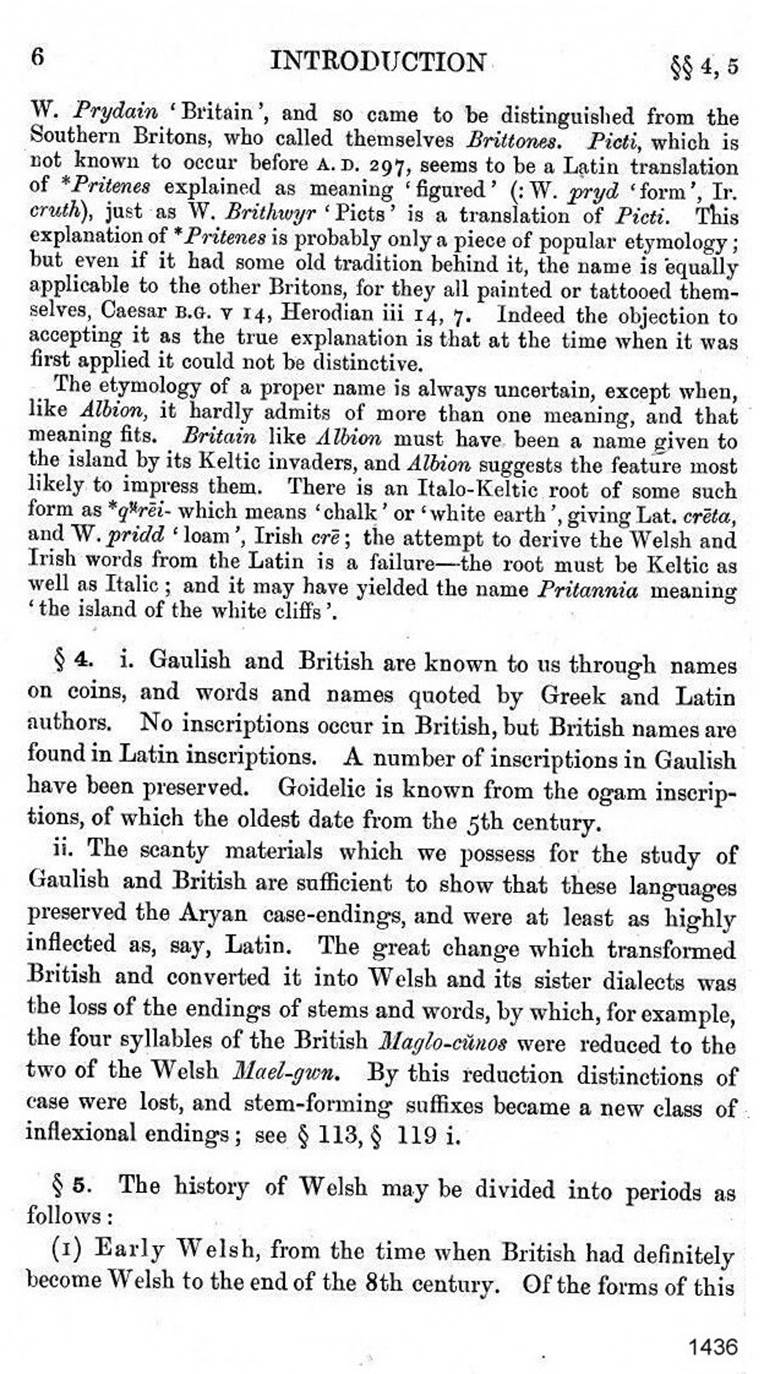





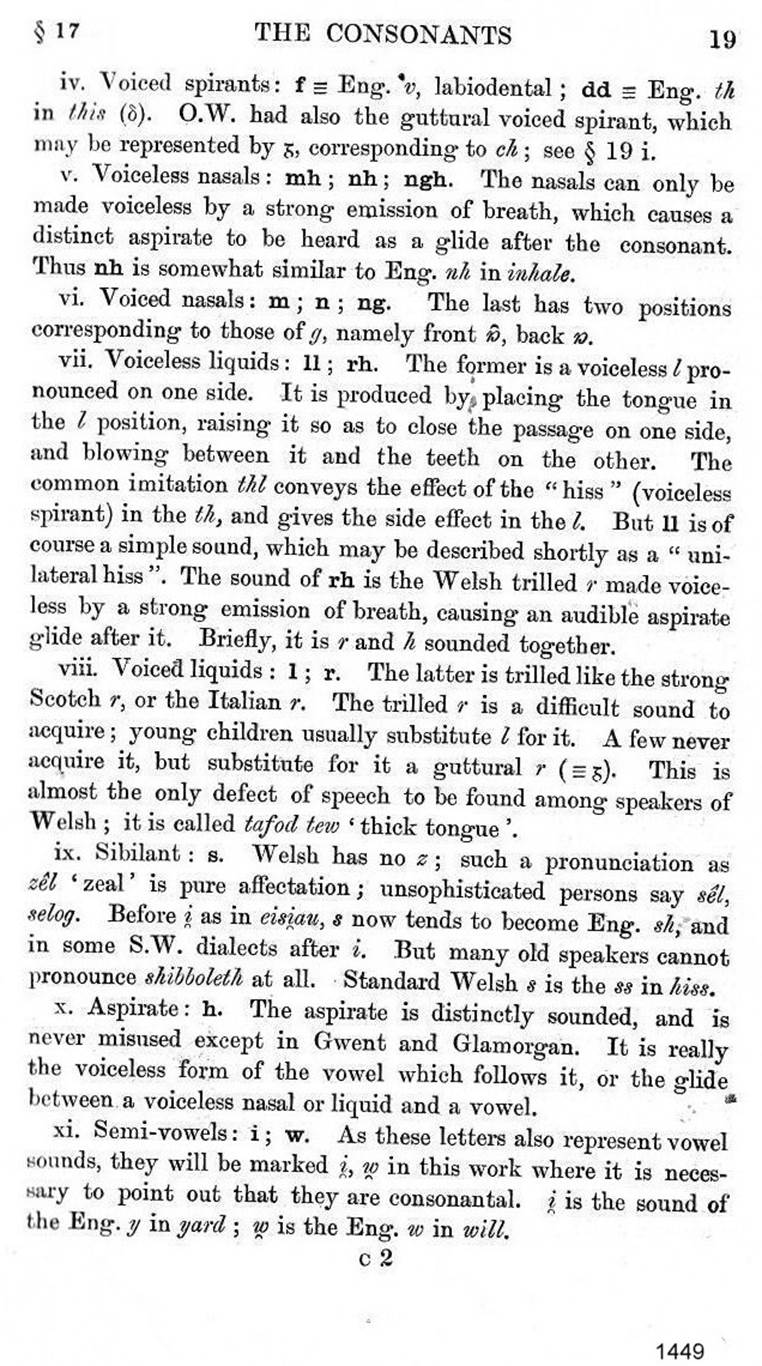


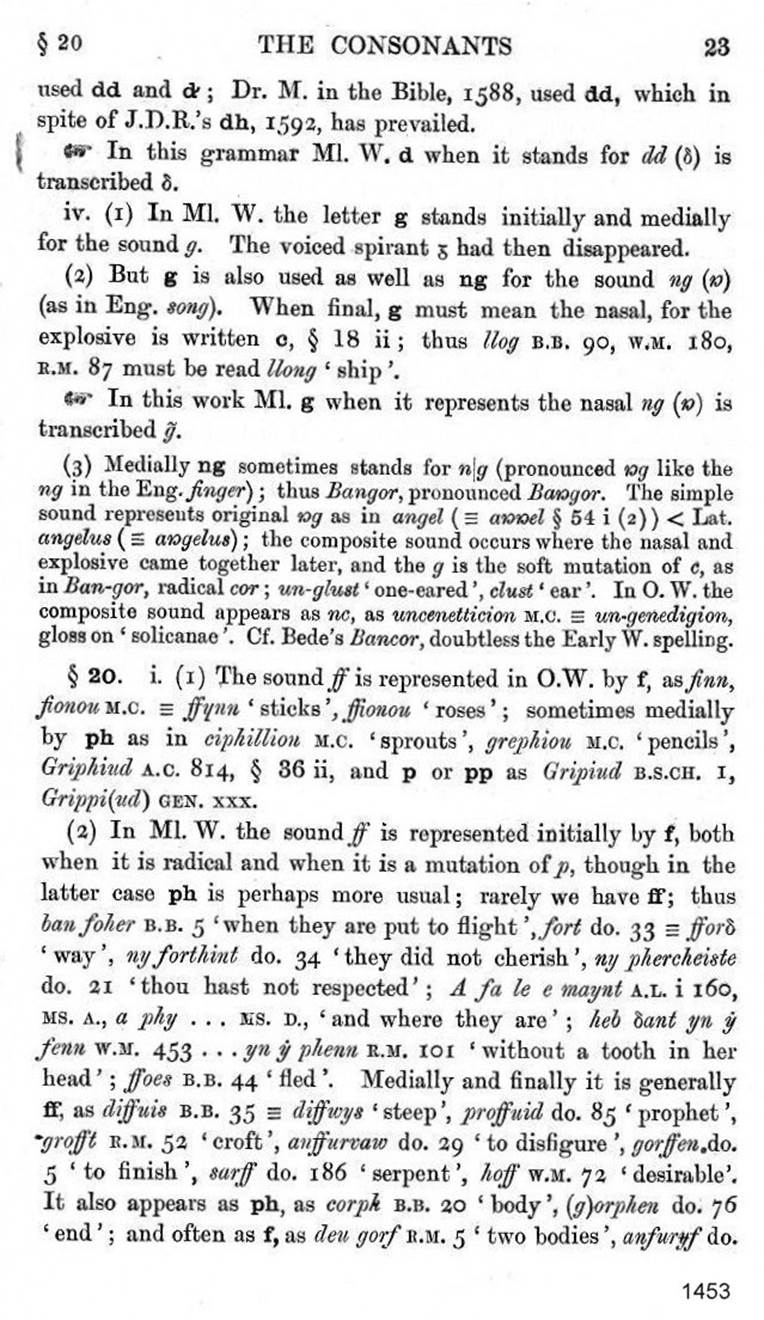


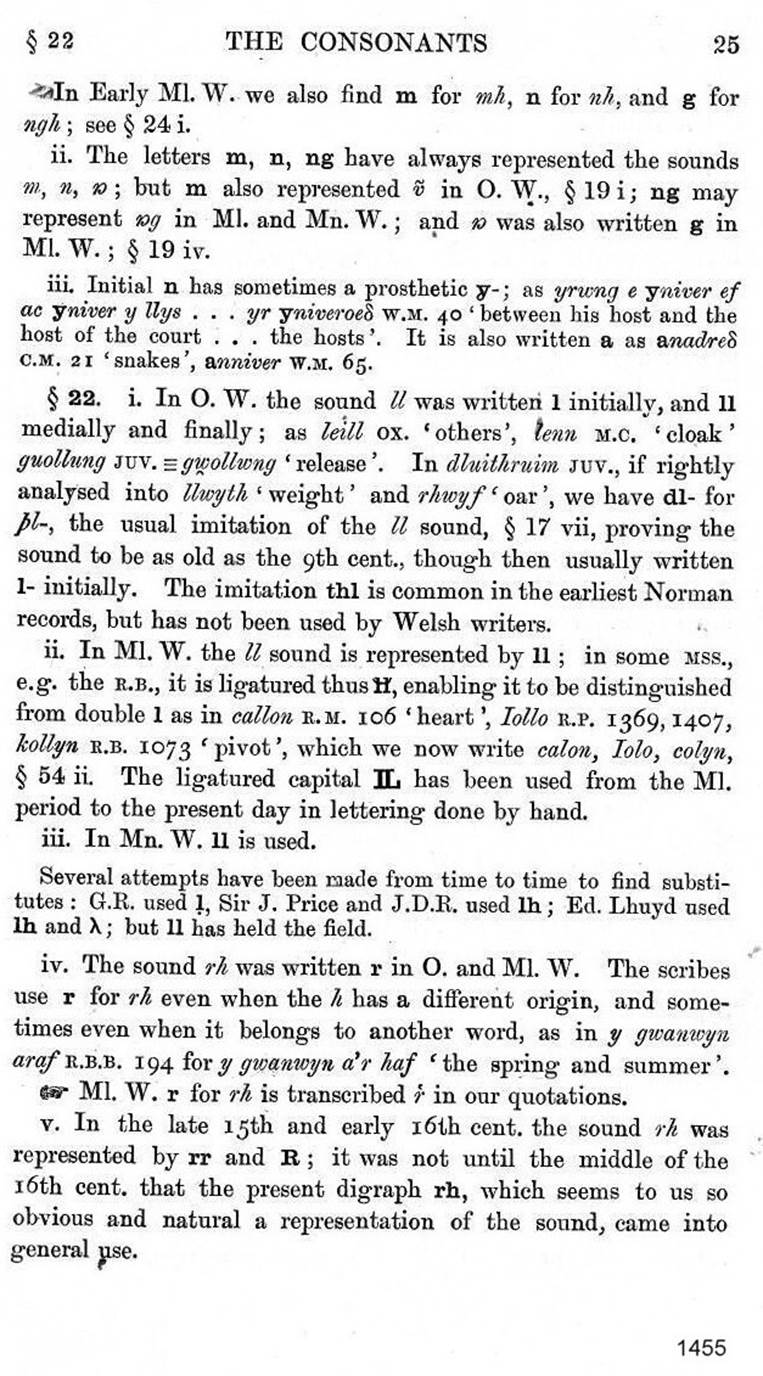

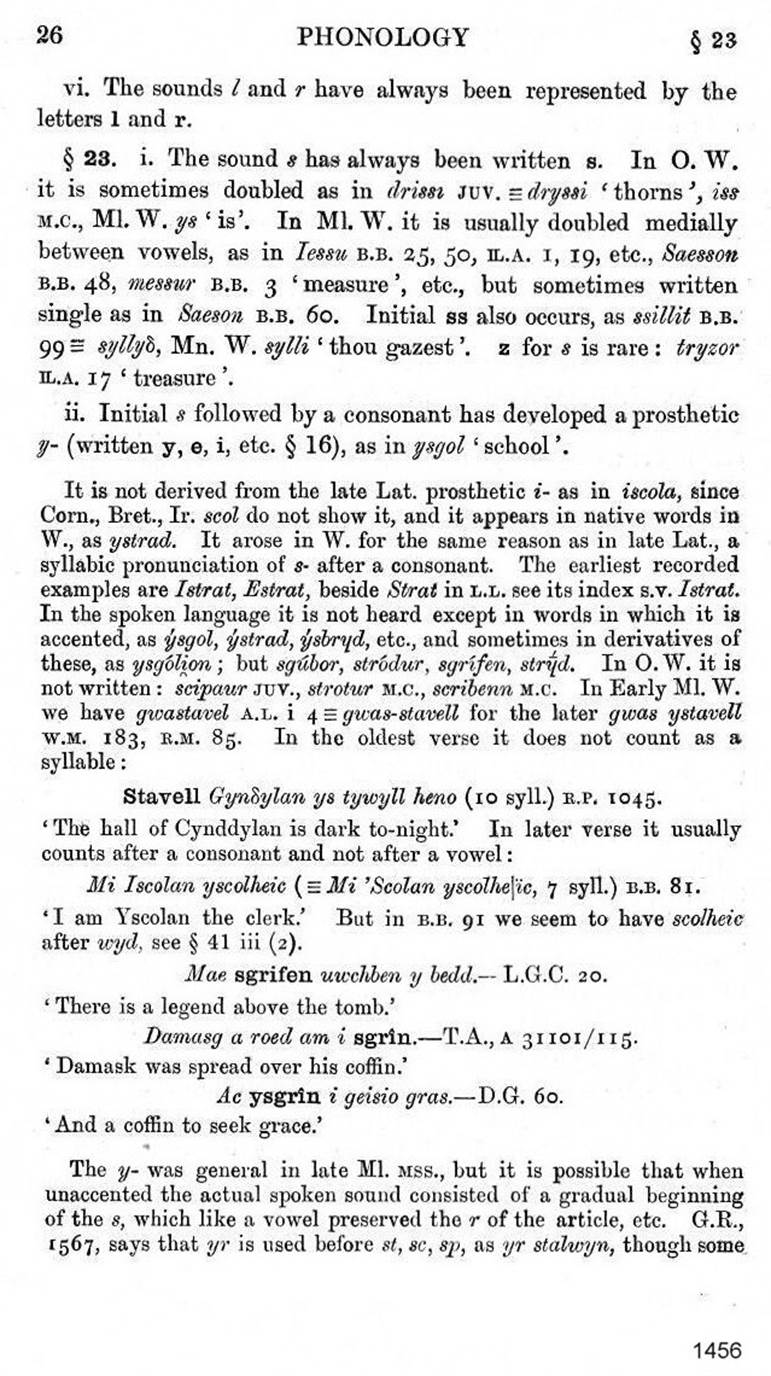

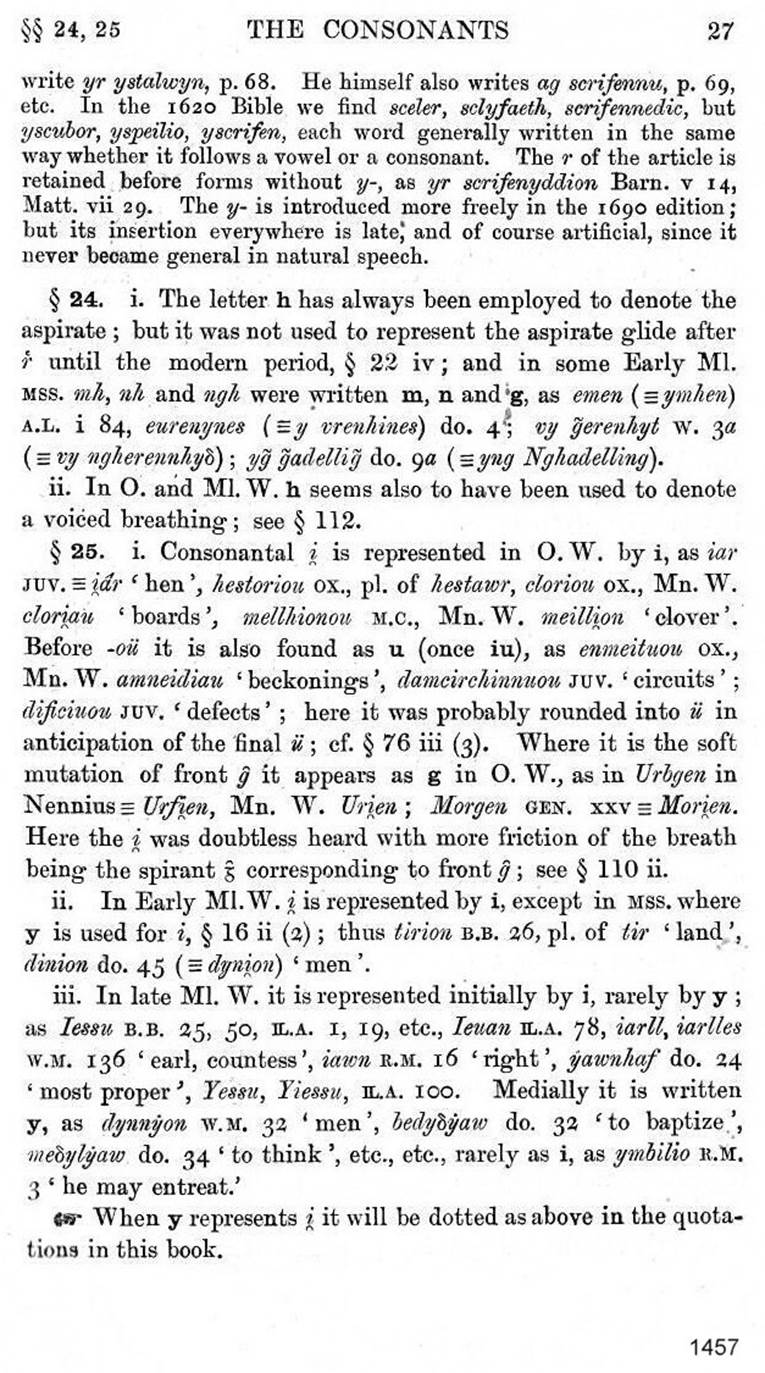

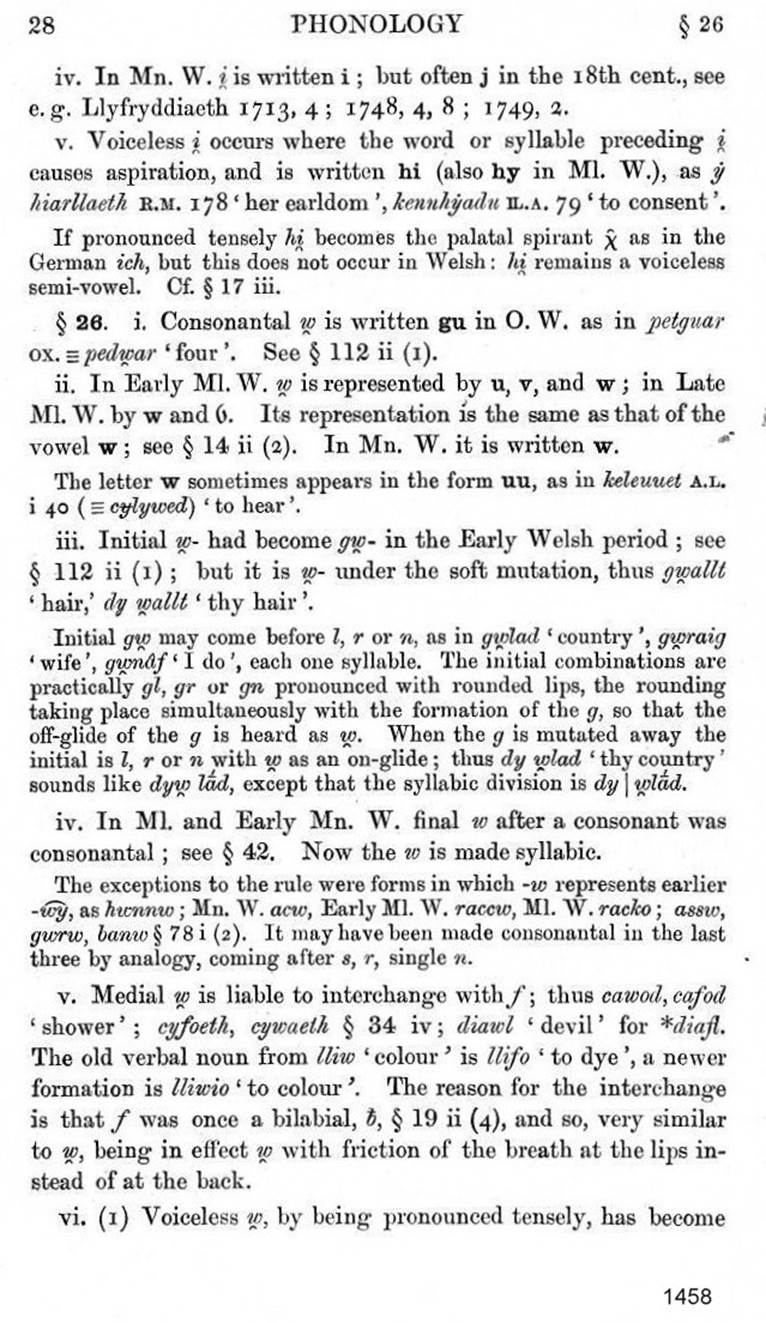


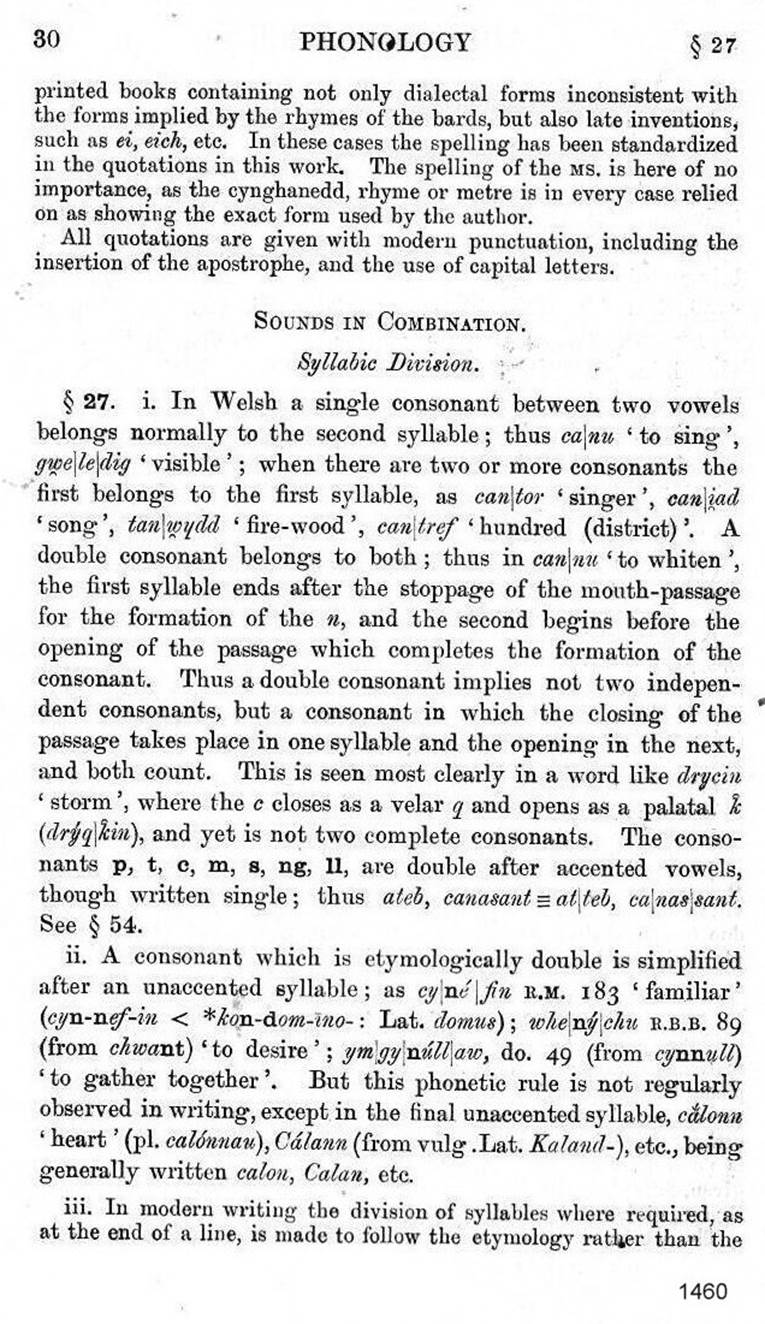


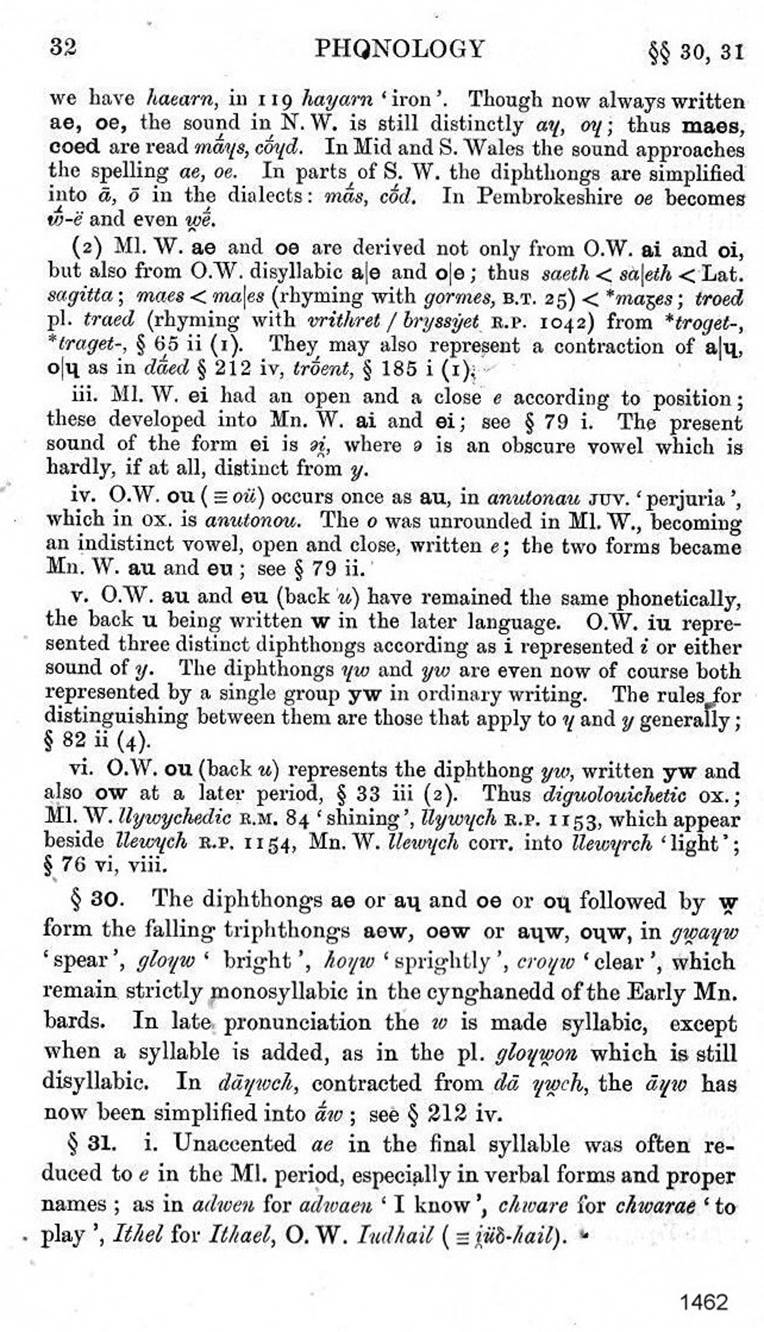
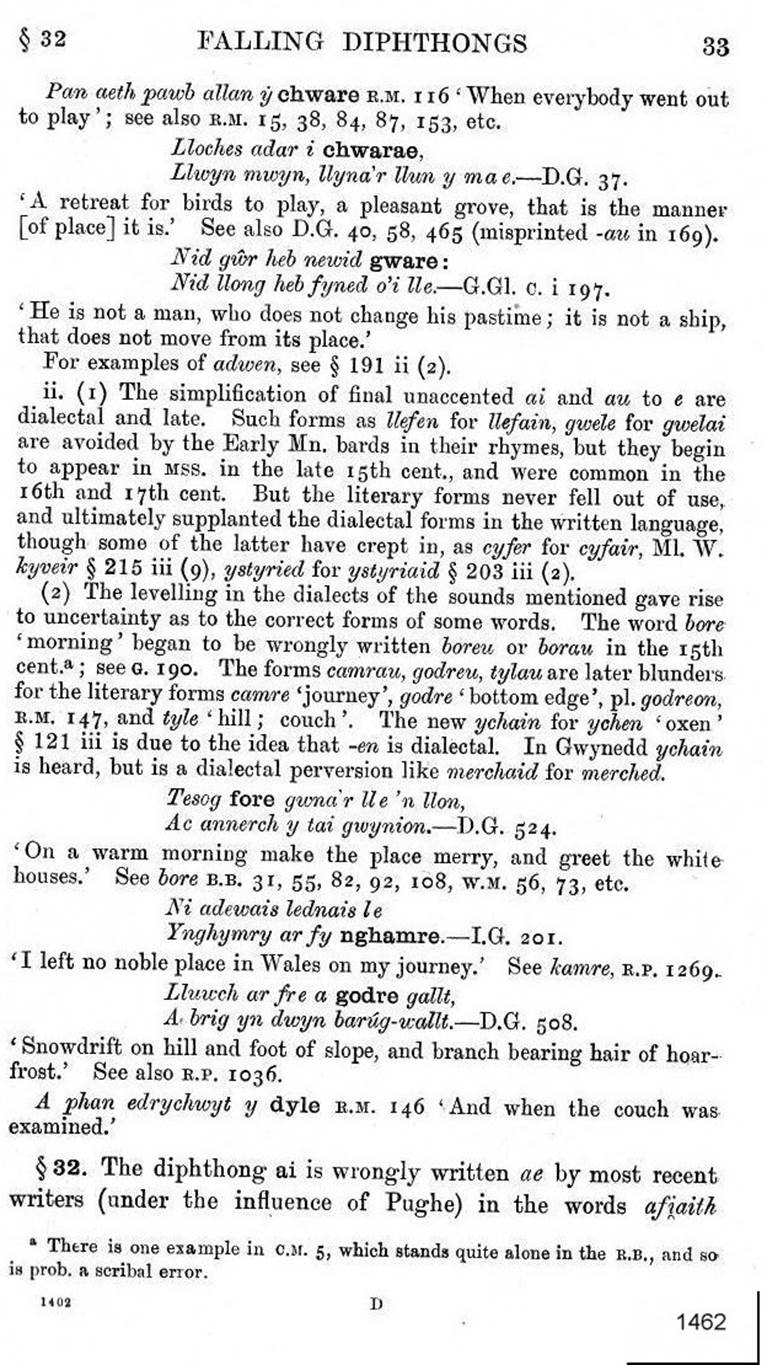
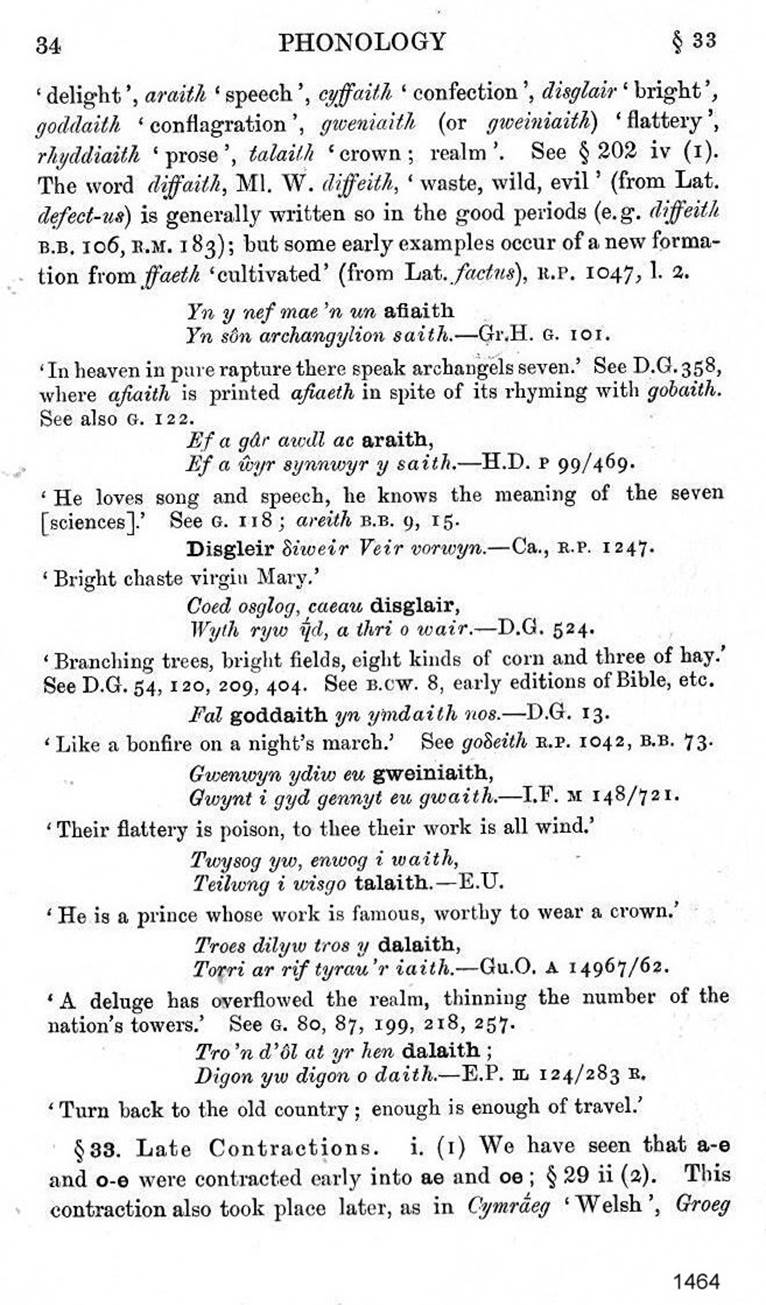



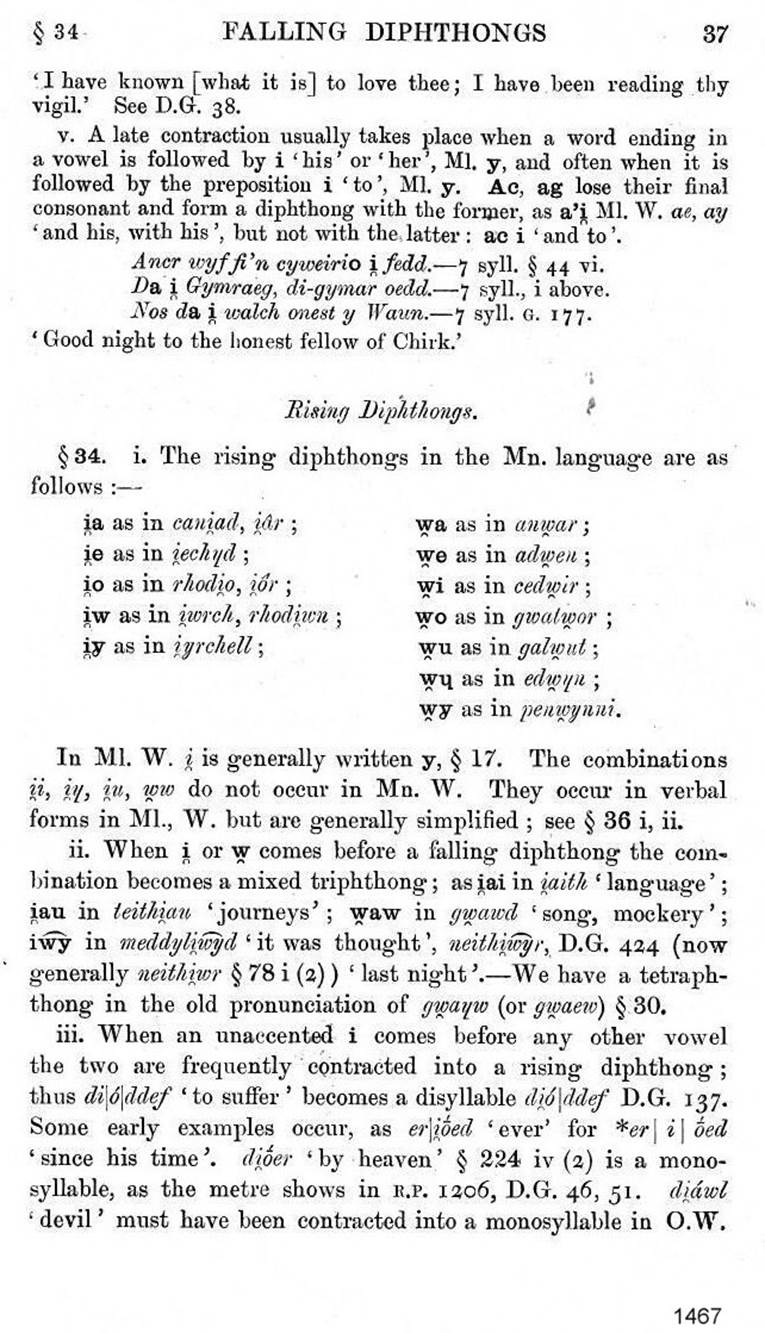

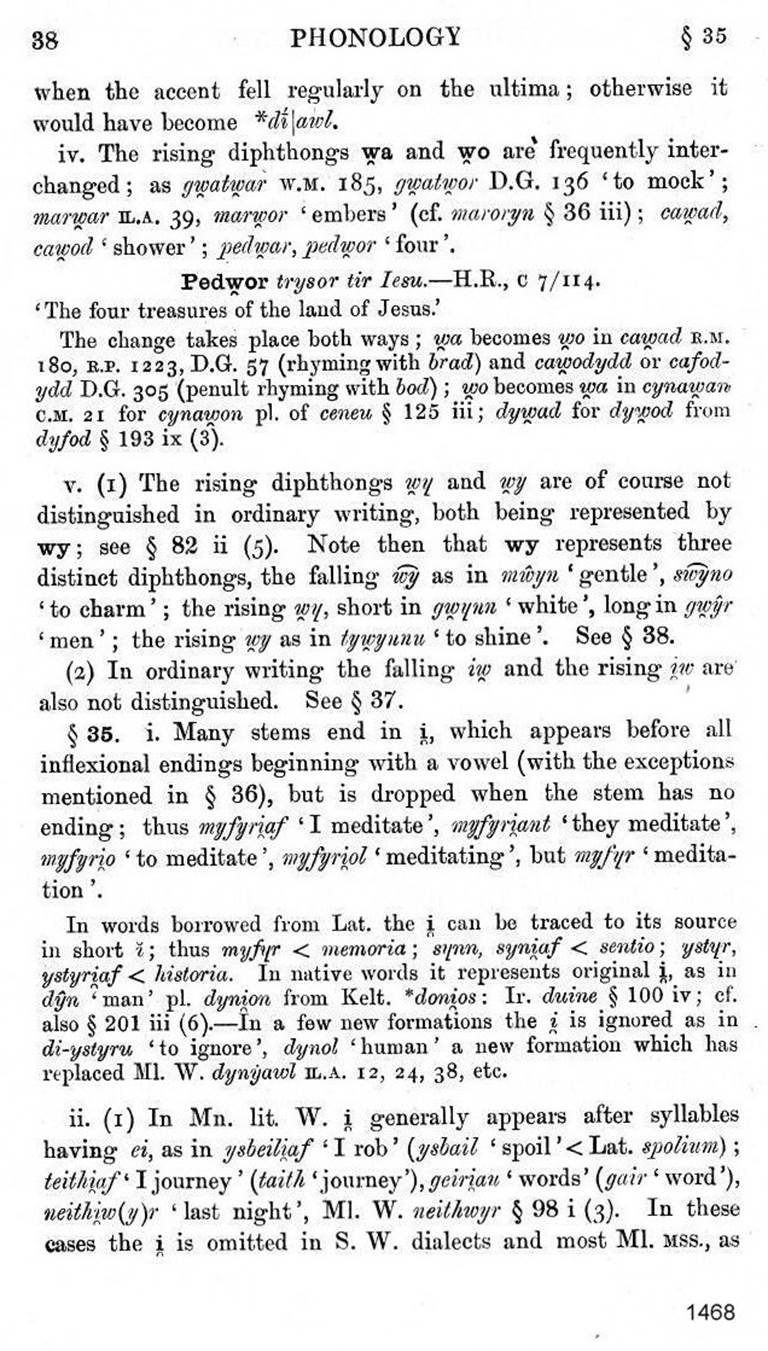


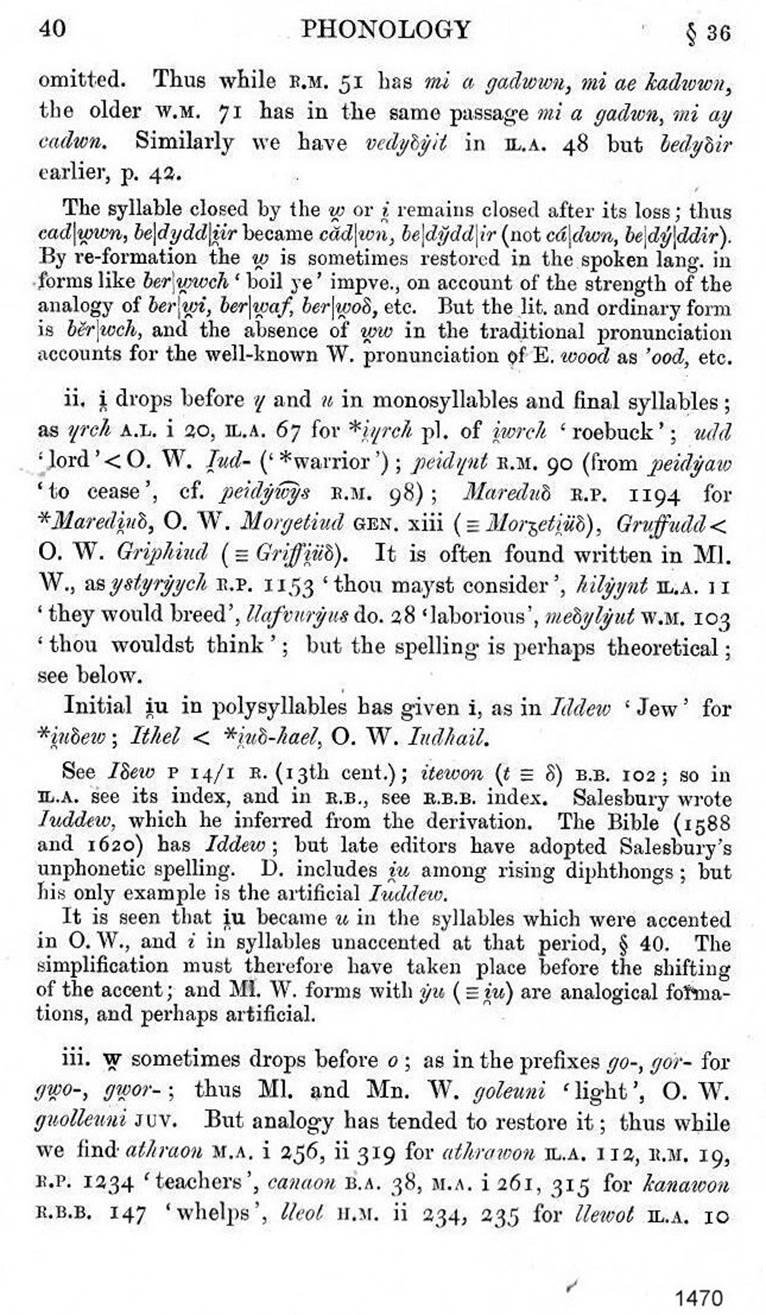
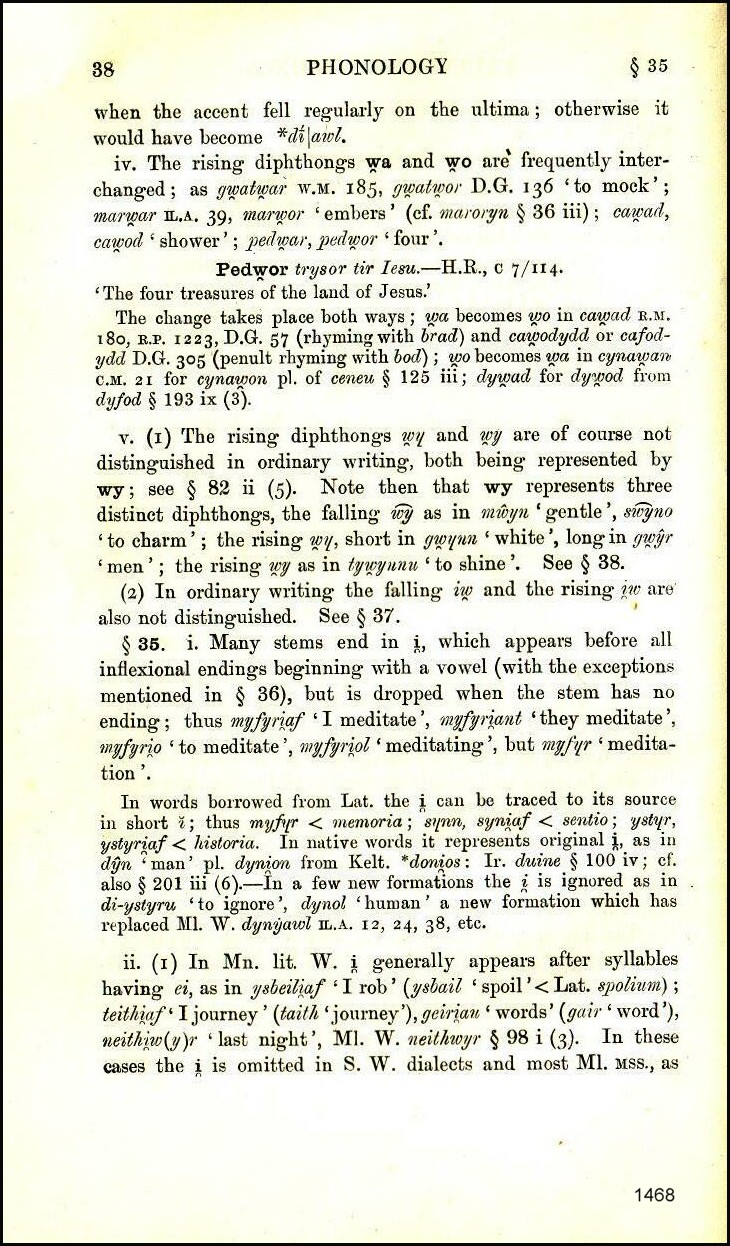
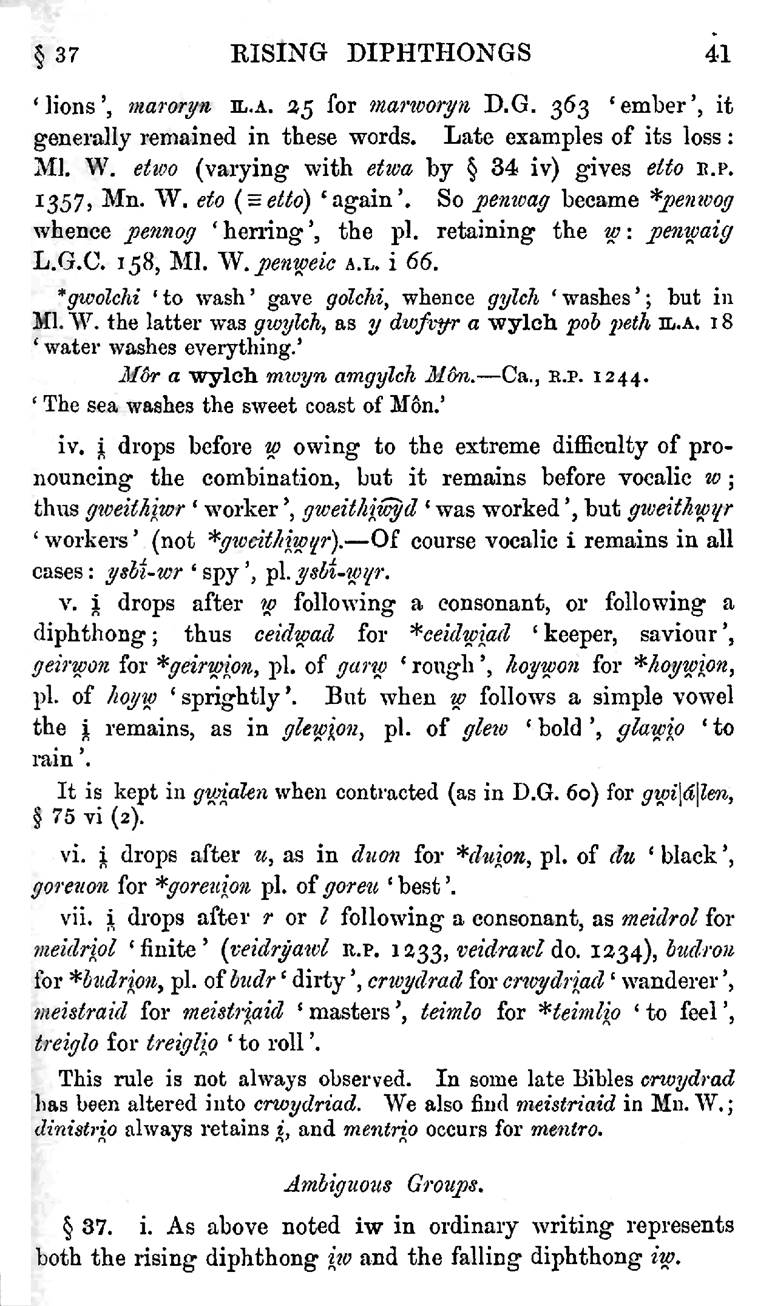

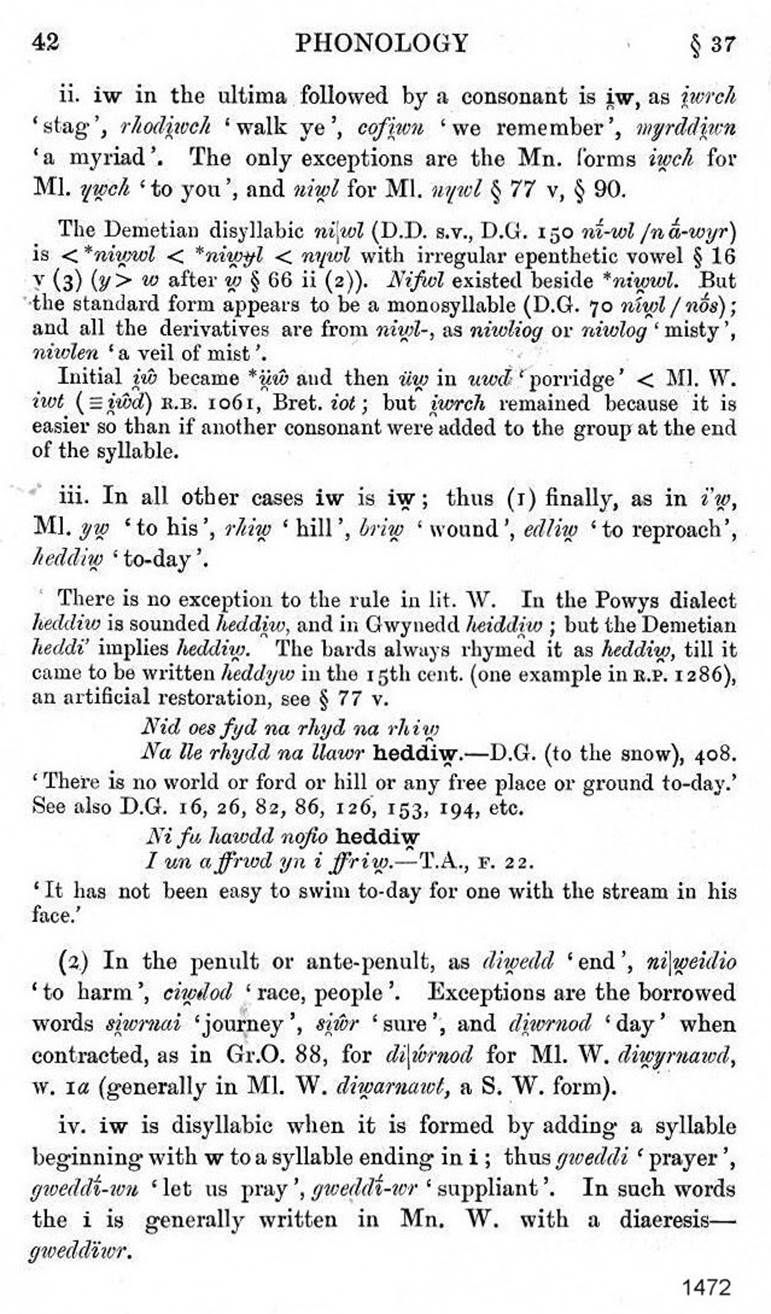

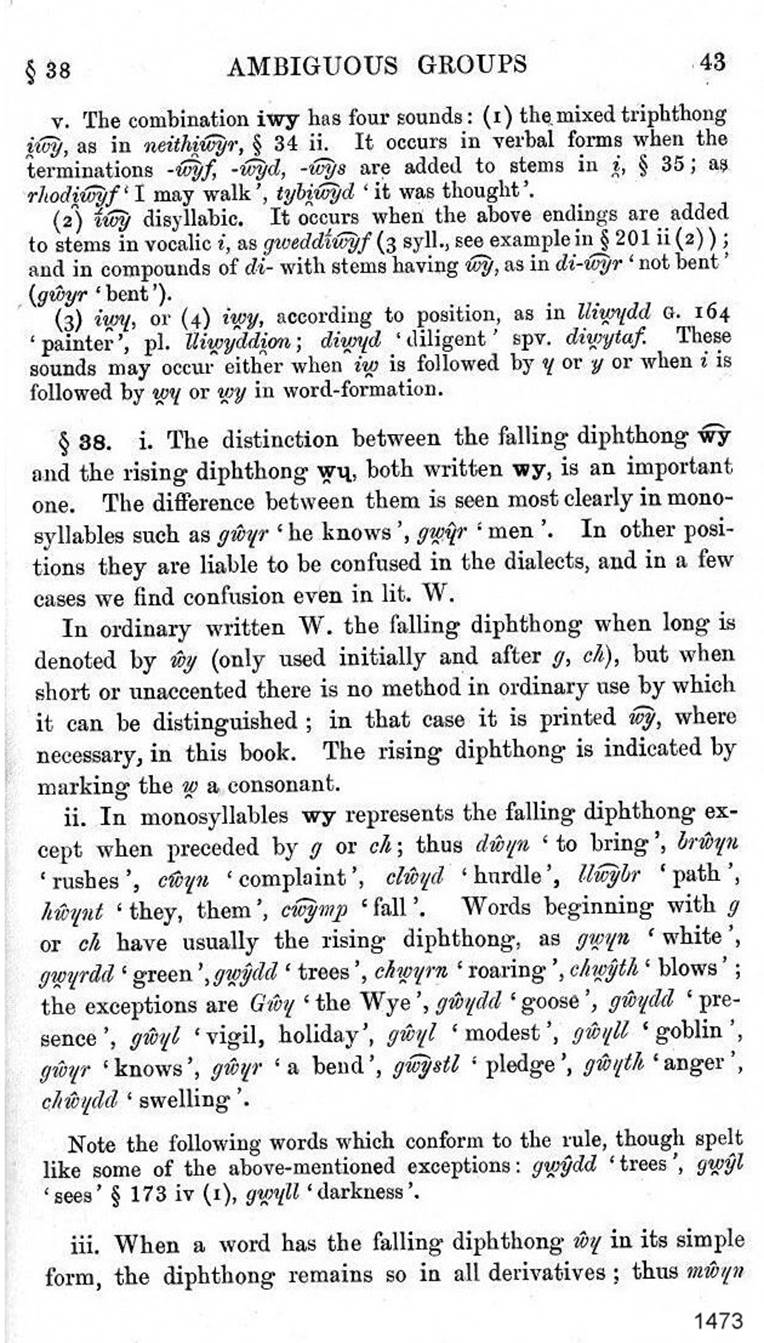
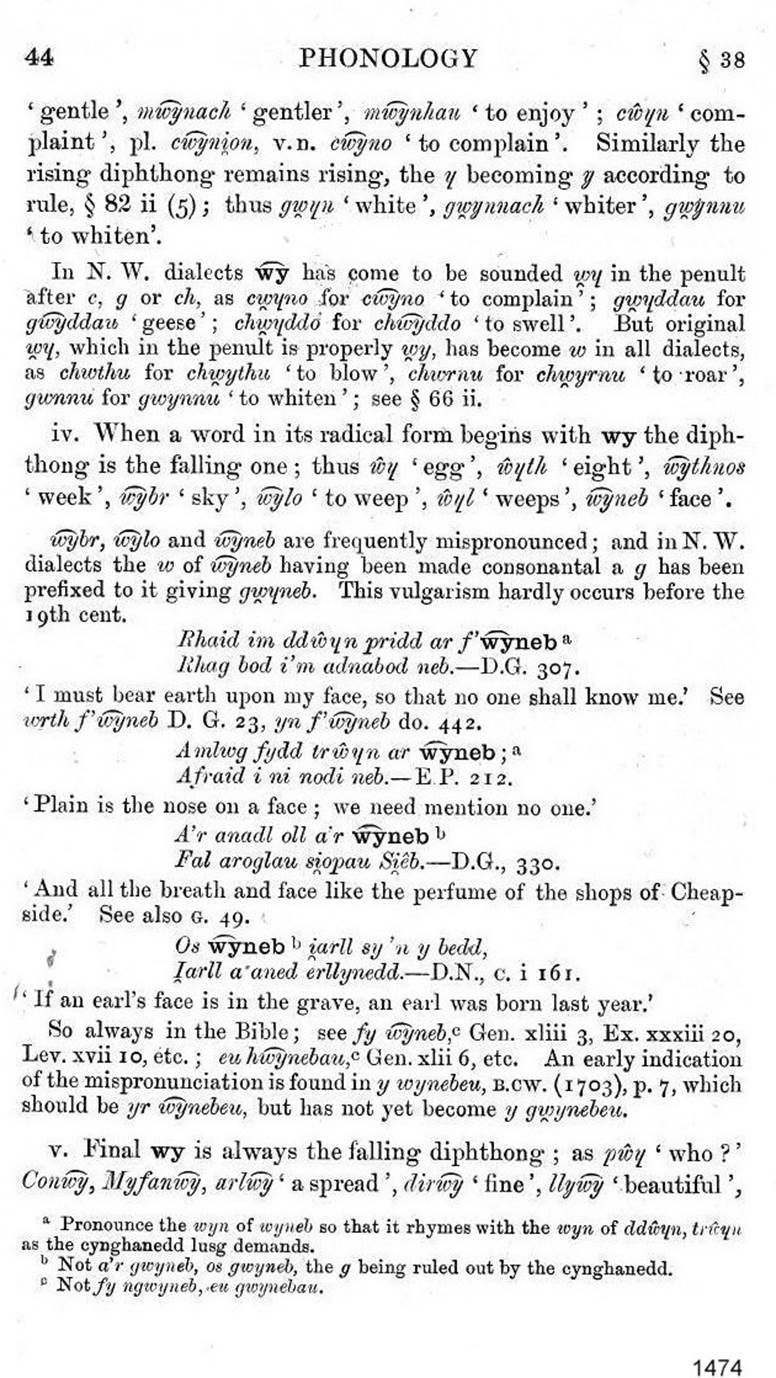

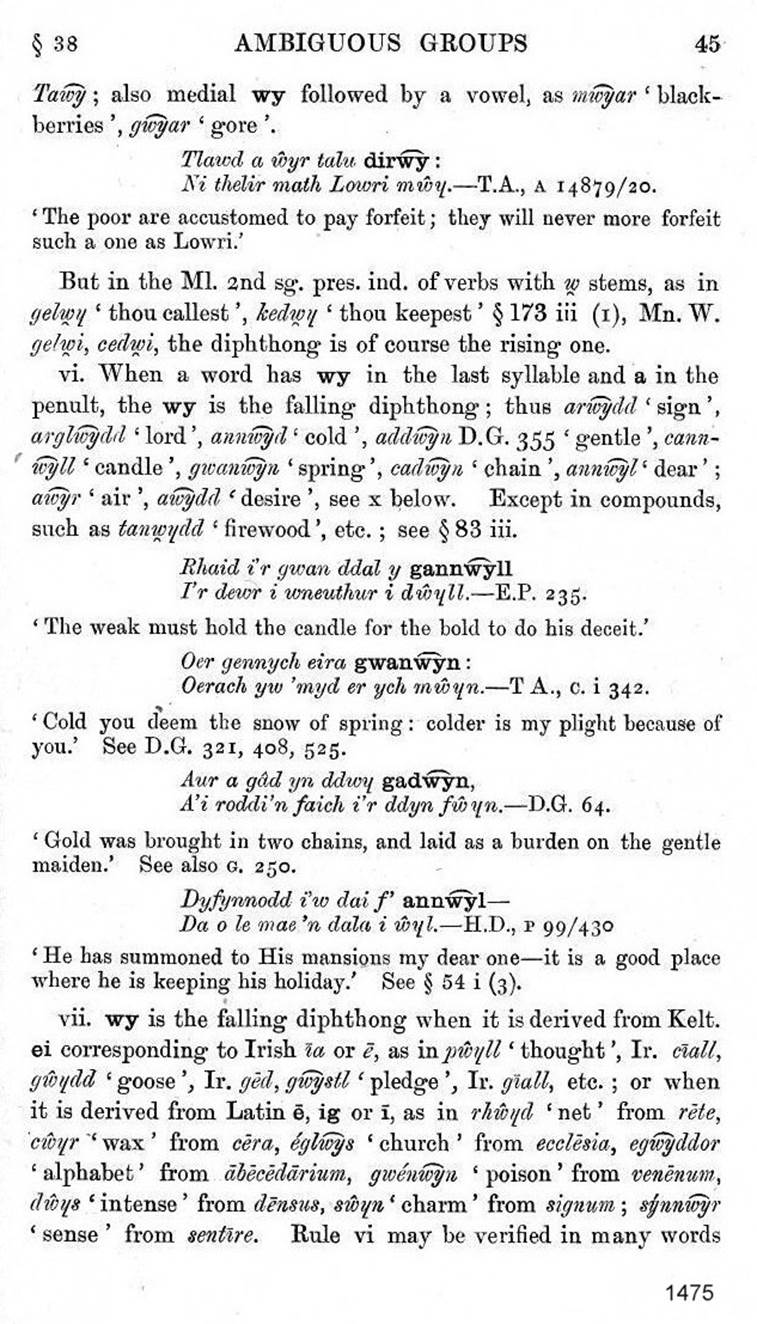

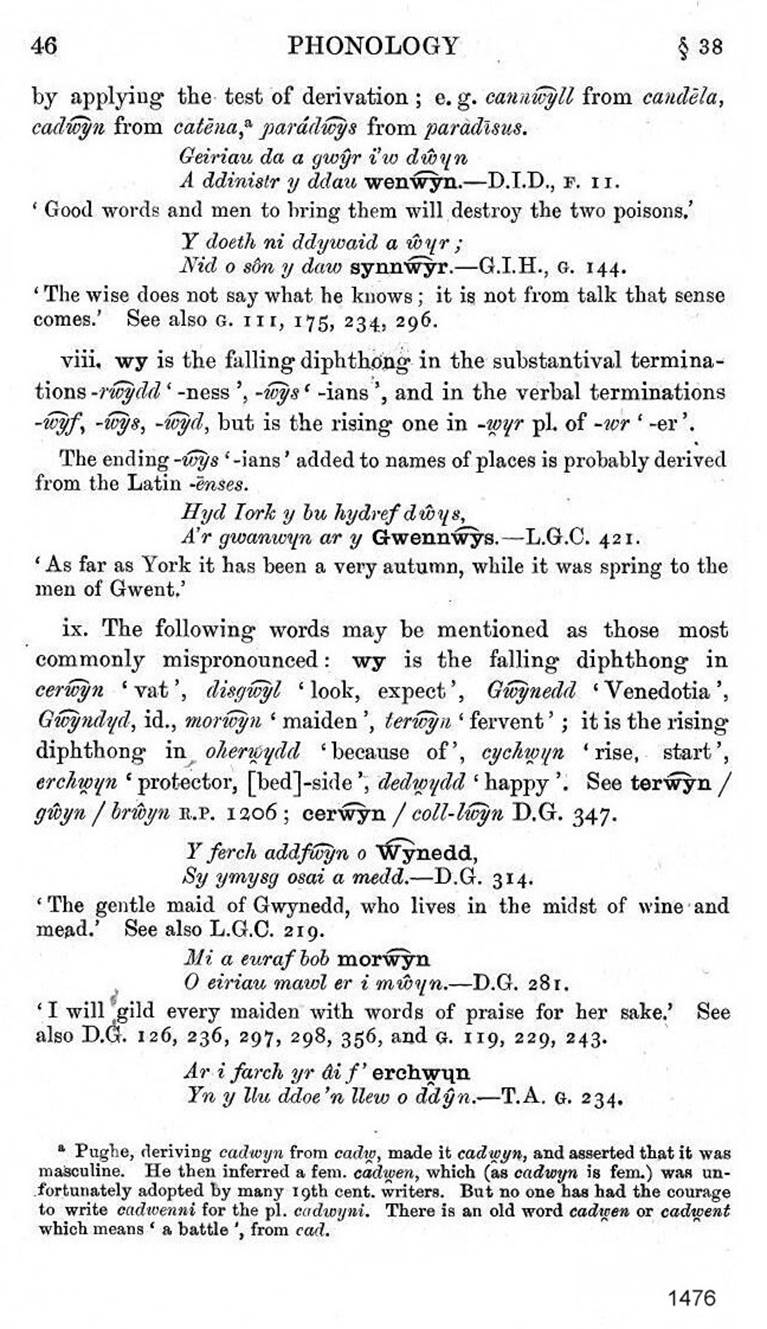

![[1]](https://en.wikisource.org/wiki/Page:Morris-Jones_Welsh_Grammar_0004.png#cite_note-1)
![[1]](https://en.wikisource.org/wiki/Page:Morris-Jones_Welsh_Grammar_0011.png#cite_note-1)
![[1]](https://en.wikisource.org/wiki/Page:Morris-Jones_Welsh_Grammar_0012.png#cite_note-1)
![[1]](https://en.wikisource.org/wiki/Page:Morris-Jones_Welsh_Grammar_0033.png#cite_note-1)


![[1]](https://en.wikisource.org/wiki/Page:Morris-Jones_Welsh_Grammar_0044.png#cite_note-a-1)
![[2]](https://en.wikisource.org/wiki/Page:Morris-Jones_Welsh_Grammar_0044.png#cite_note-b-2)
![[3]](https://en.wikisource.org/wiki/Page:Morris-Jones_Welsh_Grammar_0044.png#cite_note-c-3)
![[1]](https://en.wikisource.org/wiki/Page:Morris-Jones_Welsh_Grammar_0046.png#cite_note-1)
RHAN NESAF: 2646e
Mae rhan o’r trawsysgriad wedi ei cymeryd
oddiar ar duladen Wikisource “A Welsh Grammar, Historical and Comparative”
https://en.wikisource.org/wiki/A_Welsh_Grammar,_Historical_and_Comparative
Trwydded Briodoli a Rhannu'n Gyfartal
Cyffredinion Creadigol (Creative Commons Attribution-ShareAlike License):
https://creativecommons.org/licenses/by-sa/3.0/
xxxxx
Sumbolau:
a A / æ Æ / e E / ɛ Ɛ / i
I / o O / u U / w W / y Y /
…..
…..
MACRON: ā Ā / ǣ Ǣ /
ē Ē / ɛ̄ Ɛ̄
/ ī Ī / ō Ō /
ū Ū / w̄ W̄ / ȳ Ȳ /
MACRON + ACEN DDYRCHAFEDIG: Ā̀ ā̀
, Ḗ ḗ, Ī́ ī́
, Ṓ ṓ , Ū́ ū́,
(w), Ȳ́ ȳ́
MACRON + ACEN
DDISGYNEDIG: Ǟ ǟ , Ḕ ḕ,
Ī̀ ī̀, Ṑ ṑ, Ū̀
ū̀, (w), Ȳ̀ ȳ̀
MACRON ISOD: A̱ a̱ , E̱ e̱ ,
I̱ i̱ , O̱ o̱, U̱ u̱, (w),
Y̱ y̱
BREF: ă Ă / ĕ Ĕ / ĭ Ĭ / ŏ Ŏ / ŭ
Ŭ / B5236:  B5237:
BREF GWRTHDRO ISOD: i̯, u̯
CROMFACHAU: ⟨ ⟩ deiamwnt
A’I PHEN I LAWR: ∀, ә, ɐ (u+0250) https:
//text-symbols.com/upside-down/
…..
…..
ˡ ɑ ɑˑ aˑ a: / æ æ: / e eˑe:
/ ɛ ɛ: / ɪ iˑ i:
/ ɔ oˑ o: / ʊ uˑ u:
/ ə / ʌ /
ẅ Ẅ / ẃ Ẃ / ẁ Ẁ / ŵ Ŵ /
ŷ Ŷ / ỳ Ỳ / ý Ý / ɥ
ˡ ð ɬ ŋ ʃ ʧ θ ʒ ʤ /
aɪ ɔɪ əɪ uɪ ɪʊ aʊ ɛʊ əʊ / £
ә ʌ ẃ ă ĕ ĭ ŏ ŭ ẅ
ẃ ẁ Ẁ ŵ ŷ ỳ Ỳ
…..
…..
Hwngarwmlawt: A̋ a̋
g yn
yn  aith δ δ
…..
…..
ә ʌ ẃ ă ĕ ĭ ŏ ŭ ẅ
ẃ ẁ ŵ ŷ ỳ
Ә Ʌ Ẃ Ă Ĕ Ĭ Ŏ Ŭ Ẅ
Ẃ Ẁ Ẁ Ŵ Ŷ Ỳ Ỳ
…..
….
Hwngarwmlawt: A̋ a̋
g yn
yn  aith δ δ
…..
…..
ʌ ag acen ddyrchafedig / ʌ with acute accent: ʌ́
|
Shwa ag acen ddyrchafedig Xwa amb accent agut Schwa with acute |
|
|
DejaVu Serif |
…..
wikipedia,
scriptsource.[]org
https://[ ]en.wiktionary.org/wiki/ǣ
…..
Y TUDALEN HWN /THIS PAGE / AQUESTA PÀGINA:
http://
[]www. []kimkat.org/amryw/1_gramadeg_2_1913_jmj_welsh_grammar_02_1-49_2645e,htm
Adolygiadau diweddaraf: Dÿdd Mawrth 2005-11-20; Dÿdd Mercher 2007-04-11
Sumbolau arbennig: ŷ ŵ
Ble’r wyf i? Yr ych chi’n ymwéld ag un o dudalennau’r Gwefan
“CYMRU-CATALONIA”
On sóc? Esteu visitant una pàgina de la Web “CYMRU-CATALONIA” (=
Gal”les-Catalunya)
Weør àm ai? Yùu àar vízïting ø peij
fròm dhø “CYMRU-CATALONIA” (= Weilz-Katølóuniø) Wéb-sait
Where am I? You are visiting a page from the
“CYMRU-CATALONIA” (= Wales-Catalonia) Website
CYMRU-CATALONIA
o ymwelyr i’r Adran Gramadeg oddi
ar 01 Medi 2005
Edrychwch ar fy Ystadegau / View My
Stats