kimkat2651e A Welsh Grammar -
Historical and Comparative. 1913.
John
Morris-Jones (1864-1929).
2650k
Gwefan Cymru-Catalonia.
21-11-2025


.....
|
(delwedd 003) |
Gwefan Cymru-Catalonia A Welsh Grammar - Historical and
Comparative |
|
.....
.....
|
2644e Tudalennau |
Rhan 2: Tudalennau |
Rhan 3: Tudalennau §41- §75 |
Rhan 4: Tudalennau §75- §99 |
Rhan 5: Tudalennau §99- §120 |
Rhan 6: Tudalennau §120- §148 |
Rhan 7: Tudalennau §148- §165 |
Rhan 8: Tudalennau §165- §189 |
Rhan 9: Tudalennau §189- §209 |
Rhan 10: Tudalennau §209- §224 |
Rhan 11: Tudalennau (y mynegai) |
|
Secció 1: Pàgines |
Secció 2: Pàgines |
Secció 3: Pàgines §41- §75 |
Secció 4: Pàgines §75- §99 |
Secció 5: Pàgines §99- §120 |
Secció 6: Pàgines §120- §148 |
Secció 7: Pàgines §148- §165 |
Secció 8: Pàgines §165- §189 |
Secció 9: Pàgines §189- §209 |
Secció 10: Pàgines §209- §224 |
Secció 11: Pàgines (index) |
|
Part 1: Pages |
Part 2: Pages |
Part 3: Pages §41- §75 |
Part 4: Pages §75- §99 |
Part 5: Pages §99- §120 |
Part 6: Pages §120- §148 |
Part 7: Pages §148- §165 |
Part 8: Pages §165- §189 |
Part 9: Pages §189- §209 |
Part 10: Pages §209- §224 |
Part 11: Pages (index) |
Gweler hefyd / Vegeu també / See also: https://en.wikisource.org/wiki/A_Welsh_Grammar,_Historical_and_Comparative
.....
|
|
|
|
||||||||||||||||||||||||||||||||||||||||||||||||||||||||||||||||||||||||||||||||||||||||||||||||||||||||||||||||||||||||||||||||||||||||||||||||||||||||||||||||||||||||||||||||||||||||||||||||||||||||||||||||
|
|
|
300 Accidence § 165 the other’. With an adj. or rel. clause, and in negative sentences, the first term is yr un ‘the one’, pl. y rhai, Ml. y r͑ei ‘the ones’. Subst. indef.: un … arall ‘one … another’; pl. rhai … eraill, Ml. r͑ei … ereill ‘some … others’. In the following list of adjectival forms gŵr, gwŷr, gwraig show the position and initial mutation of the noun: Adj. def.: y naill ŵr … y gŵr arall ‘the one man … the other man’; y naill wraig … y wraig arall; y naill wŷr … y gwŷr eraill. For y naill Ml. W. has y neill or y lleill, and for eraill, ereill, also used in Mn. W. Adj. indef.: rhyw ŵr … gŵr arall ‘a certain man … another man’; un gŵr … gŵr arall ‘one man … another man’; rhyw wraig … gwraig arall; un wraig … gwraig arall; rhyw wŷr … gwŷr eraill; Mn. W. rhai gwŷr … gwŷr eraill. Ml. W. ereill, also used in Mn. W. § 81 iii (1). y naill (and Ml. y lleill) adj. ‘the one’ and rhyw form compounds with their nouns, which are lenited § 155 ii (1), iii (7). The compound is often a strict one as y néillffordd, rhýwbeth. As ‑ll causes provection of mediae, an initial tenuis after neill, lleill generally appears unmutated in Ml. W., as y neillparth for y neillbarth, etc., § 111 vi (2); but analogy generally restores the mutation in Mn. W., especially when the compound is loose, as y naill beth a’r llall ‘the one thing and the other’; but neilltu, see ib. Subst.: yn gyflytn y llaẟawẟ y neill o’r gweisson, ac yn y lle y llaẟawẟ y llall r.m. 191 ‘he quickly slew one of the youths, and forthwith slew the other'; yny orffei y lleill ar y llall r.m. 262, w.m. 408 ‘until the one overcame the other’; a’r un y byẟei borth ef iẟi a gollei y gware, a’r llall a ẟodei awr w.m. 174–5 ‘and the one that he supported lost the game, and the other gave a shout’.—r͑ei ohonunt yn wylaw, ereill yn udaw, ereill yn cwynaw Ỻ.A. 152 ‘some of them weeping, others moaning, others crying’; i un, … ac i arall … ac i arall … etc. 1 Cor. xii 8–10; the second term may of course be repeated when indef. Adj.: o’r lleill ḅ parth … ac o’r parth arall w.m. 421–2 ‘on the one hand … and on the other hand’ (b beginning barth deleted by underdot); am nat oeẟ kyn ẟiogelet y neillfforẟ a’r llall s.g. 29 ‘because the one way was not as safe as the other’.—Or bwytey mywn un amser yn y dyẟ, a symut hynny ẏ amser arall m.m. 33 (from r.b.) ‘if thou eatest at one time in the day, and changest that to another time’; ryw ẟyn cynbhigennus … undyn arall J.D.R. [xxii] ‘a jealous man … any other man’; Mn. W. rhai dynion … eraill rh. b.s. 87 “some men … others”; the use of rhai before a noun seems to be |
||||||||||||||||||||||||||||||||||||||||||||||||||||||||||||||||||||||||||||||||||||||||||||||||||||||||||||||||||||||||||||||||||||||||||||||||||||||||||||||||||||||||||||||||||||||||||||||||||||||||||||||||
|
|
|
|
||||||||||||||||||||||||||||||||||||||||||||||||||||||||||||||||||||||||||||||||||||||||||||||||||||||||||||||||||||||||||||||||||||||||||||||||||||||||||||||||||||||||||||||||||||||||||||||||||||||||||||||||
|
|
|
§ 165 Pronouns 301 ii. (1) The first alternative may be a noun or personal or demonstrative pronoun, as ti ac arall ‘thou and another’ (i.e. such as thou), hyn a’r llall ‘this and that’. Câr yn cyhuddo arall! Hawdd i’r llaw gyhuddo’r llall.—T.A., c. ii 78. ‘A kinsman accusing another!’ [It is] easy for the hand to accuse the other.’—kanys yr hynn a vynnei hwnn nys mynnei y llall s.g. 49 ‘for that which this [one] desired the other desired not’. In these cases the second term subst. pl. may be (y) rhai eraill ‘(the) others’: mwy … oeẟ honno no’r rei ereill oll w.m. 180 ‘that [ship] was larger than all the others’; llog̃ a oeẟ vwy noc un o’r rei ereill do. 185; cf. Ỻ.A. 102. (2) The first alternative may be implied, as in other languages; as y dydd arall M.Ỻ. i 178 ‘the other day’; y nos arall r.p. 1362, D.G. 25 ‘the other night’; Gad i eraill gadw arian T.A. f. 6 ‘let others hoard money’. iii. All the forms of the first term except y naill subst. may be used without a sequel as ordinary pronominalia meaning ‘one, some’; thus (1) Adj. y naill ‘one’ in y naill hanner ‘one half’ (now generally ‘about a half’), y naill du or y neilltu ‘one side’ (hence neilltuo ‘to retire’ etc.); neill-law see example. Eisteẟ a oruc Peredur ar neill law yr amherodres w.m. 164 (neill-law r.m. 231) ‘Peredur sat beside the empress’, lit. ‘on one side of the e.’ ond pan êl o’r neilltu Diar. xx 14; see Gen. xxx 40; Barn. vii 5; 2 Sam. iii 27; etc. (2) Subst. un ‘one’, pl. rhai, Ml. r͑ei ‘some’; often with qualifying adjectives un da ‘a good one’, rhai drwg ‘bad ones’. Also yr un ‘the one’, pl. y rhai, Ml. y r͑ei ‘the ones’; these are chiefly used with adjectives as yr un drwg ‘the evil one’, or with a relative clause § 164 iv (1); and yr un instead of the indef. un in negative sentences, as— Pa obeith yssyẟ ẏ’r gler? Nyt oes yr un Ỻ.A. 40 ‘What hope is there for the bards? There is none.’ Cf. s.g. 17, l. 10. Adj. yr un [m. rad., f. soft] ‘the same’, followed, if necessary, by ac (ag), a ‘as’. Also un [soft], forming compounds strict or loose with nouns; the compound is an adj. meaning ‘of the same…’, § 149 ii (3). |
||||||||||||||||||||||||||||||||||||||||||||||||||||||||||||||||||||||||||||||||||||||||||||||||||||||||||||||||||||||||||||||||||||||||||||||||||||||||||||||||||||||||||||||||||||||||||||||||||||||||||||||||
|
|
|
|
||||||||||||||||||||||||||||||||||||||||||||||||||||||||||||||||||||||||||||||||||||||||||||||||||||||||||||||||||||||||||||||||||||||||||||||||||||||||||||||||||||||||||||||||||||||||||||||||||||||||||||||||
|
|
|
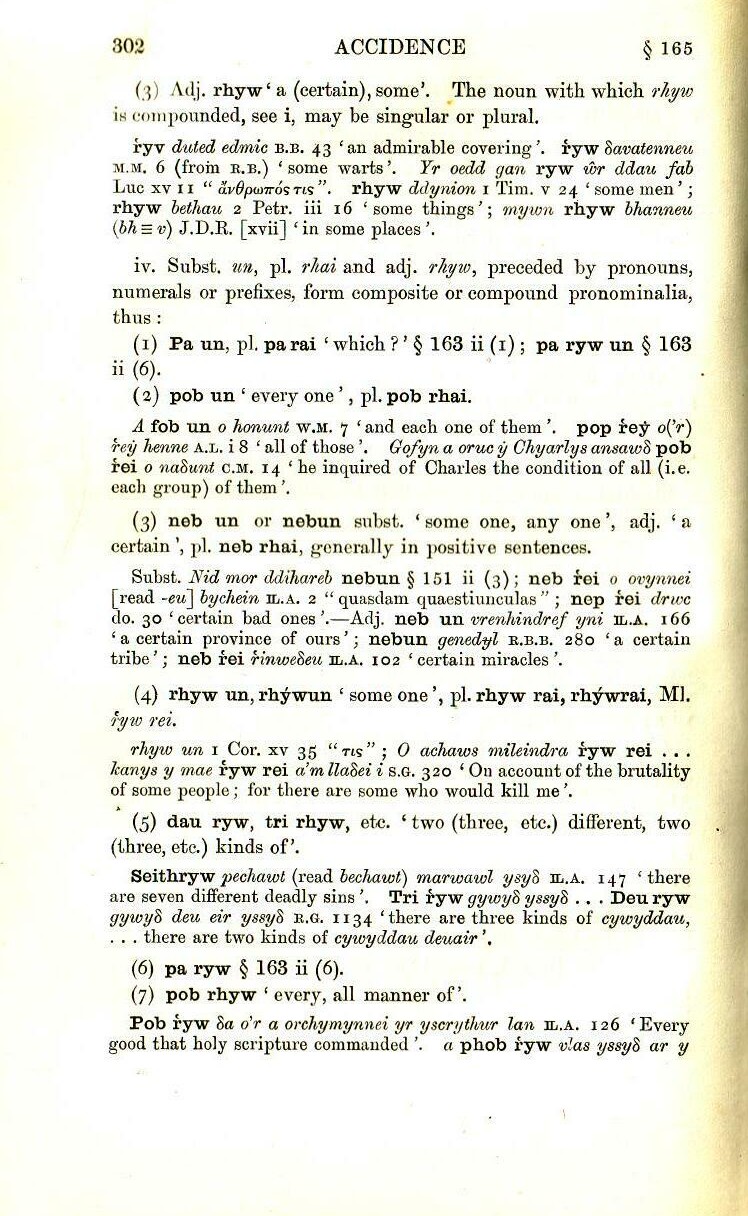
302 ACCIDENCE § 165 (3) Adj. rhyw ‘a
(certain), some’. The noun with which rhyw is compounded,
see i, may be
singular or plural. r͑yv duted edmic b.b. 43 ‘an
admirable covering’. r͑yw ẟavatenneu m.m. 6
(from r.b.) ‘some warts’. Yr oedd gan ryw ŵr
ddau fab Luc xv 11 “ἄνθρωπός τις”. rhyw ddynion 1
Tim. v 24 ‘some men’; rhyw bethau 2 Petr. iii 16
‘some things’; mywn rhyw bhanneu (bh ≡ v)
J.D.R. [xvii] ‘in some places’. iv.
Subst. un, pl. rhai and adj. rhyw, preceded
by pronouns, numerals or prefixes, form composite or compound pronominalia,
thus: (1) Pa
un, pl. pa rai ‘which?’ § 163 ii
(1); pa ryw un § 163 ii
(6). (2) pob
un ‘every one’, pl. pob rhai. A fob un o honunt w.m. 7
‘and each one of them’. pop r͑ey o(’r) r͑eẏ henne a.l. i 8 ‘all of those’. Gofyn
a oruc ẏ Chyarlys ansawẟ pob r͑ei o naẟunt c.m. 14 ‘he inquired of Charles the
condition of all (i.e. each group) of them’. (3) neb
un or nebun subst. ‘some one, any one’, adj. ‘a
certain’, pl. neb rhai, generally in positive sentences. Subst. Nid
mor ddihareb nebun § 151 ii
(3); neb r͑ei o
ovynnei [read ‑eu] bychein Ỻ.A. 2 “quasdam quaestiunculas”; nep
r͑ei drwc do.
30 ‘certain bad ones’.—Adj. neb un vrenhindref yni Ỻ.A. 166 ‘a certain province of
ours’; nebun genedɏl r.b.b. 280 ‘a certain tribe’; neb
r͑ei r͑inweẟeu Ỻ.A. 102 ‘certain miracles’. (4) rhyw
un, rhýwun ‘some one’, pl. rhyw rai, rhýwrai, Ml. r͑yw rei. rhyw un 1 Cor. xv 35
“τις”; O achaws mileindra r͑yw rei … kanys y mae r͑yw rei a’m llaẟei i s.g. 320 ‘On account of the brutality
of some people; for there are some who would kill me’. (5) dau
ryw, tri rhyw, etc. ‘two (three, etc.) different, two (three, etc.) kinds
of’. Seithryw pechawt (read bechawt) marwawl
ysyẟ Ỻ.A. 147 ‘there are seven different deadly sins’. Tri r͑yw gywyẟ yssyẟ … Deu ryw gywyẟ deu eir yssyẟ r.g. 1134 ‘there are three
kinds of cywyddau, … there are two kinds of cywyddau
deuair’. (6) pa
ryw § 163 ii
(6). (7) pob
rhyw ‘every, all manner of’. Pob r͑yw ẟa o’r a orchymynnei yr yscrythur lan Ỻ.A. 126 ‘Every good that holy
scripture commanded’. a phob r͑yw vlas yssyẟ ar y |
||||||||||||||||||||||||||||||||||||||||||||||||||||||||||||||||||||||||||||||||||||||||||||||||||||||||||||||||||||||||||||||||||||||||||||||||||||||||||||||||||||||||||||||||||||||||||||||||||||||||||||||||
|
|
|
|
||||||||||||||||||||||||||||||||||||||||||||||||||||||||||||||||||||||||||||||||||||||||||||||||||||||||||||||||||||||||||||||||||||||||||||||||||||||||||||||||||||||||||||||||||||||||||||||||||||||||||||||||
|
|
|
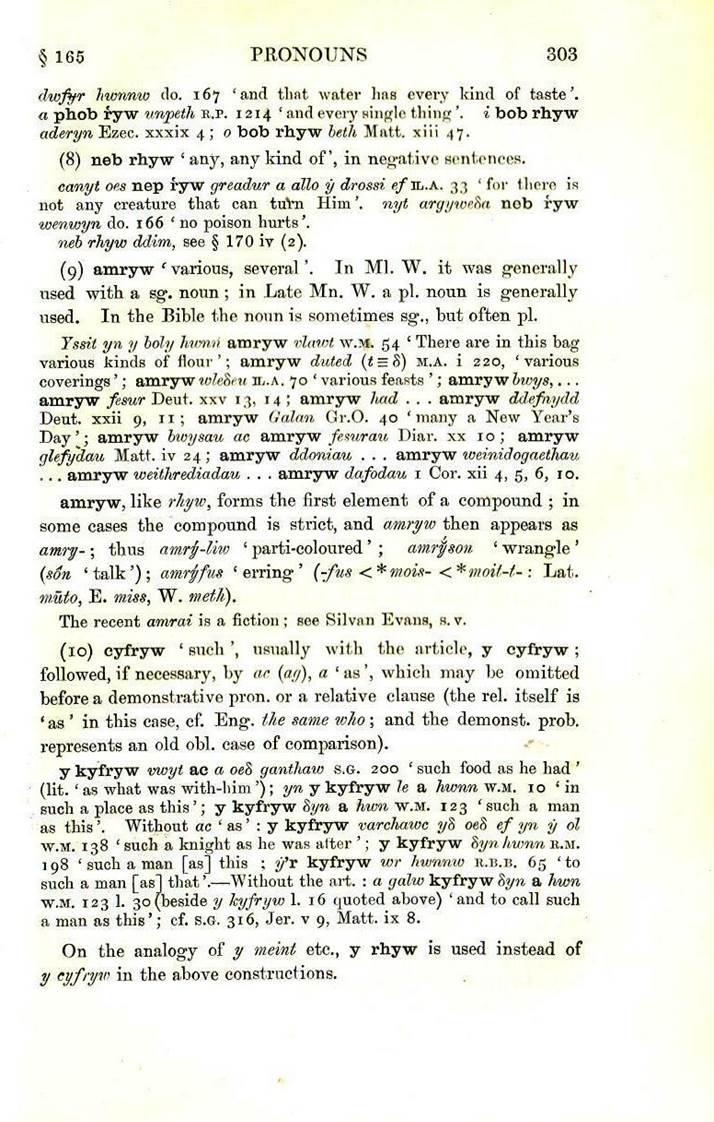
§ 165 PRONOUNS 303 dwfɏr hwnnw do. 167 ‘and that water has every kind of
taste’. a phob r͑yw unpeth r.p. 1214 ‘and
every single thing’. i bob rhyw aderyn Ezec.
xxxix 4; o bob rhyw beth Matt. xiii
47. (8) neb
rhyw ‘any, any kind of’, in negative sentences. canyt oes nep r͑yw greadur a allo ẏ drossi ef Ỻ.A. 33 ‘for there is not any creature that
can turn Him’, nyt argyweẟa neb r͑yw wenwyn do. 166 ‘no poison
hurts’. neb rhyw
ddim, see § 170 iv
(2). (9) amryw ‘various,
several’. In Ml. W. it was generally used with a sg. noun; in Late Mn. W. a
pl. noun is generally used. In the Bible the noun is sometimes sg., but often
pl. Yssit yn y
holy hwnn amryw vlawt w.m. 54
‘There are in this bag various kinds of flour’; amryw duted (t ≡ ẟ) m.a. i 220, ‘various
coverings’; amryw wleẟeu Ỻ.A. 70 ‘various feasts’; amryw bwys,
… amryw fesur Deut. xxv 13, 14; amryw had … amryw ddefnydd Deut.
xxii 9, 11; amryw Galan Gr.O. 40 ‘many a New
Year’s Day’; amryw bwysau ac amryw fesurau Diar.
xx 10; amryw glefydau Matt. iv 24; amryw ddoniau … amryw weinidogaethau … amryw weithrediadau … amryw dafodau 1
Cor. xii 4, 5, 6, 10. amryw, like rhyw, forms the first
element of a compound; in some cases the compound is strict, and amryw then
appears as amrỿ‑; thus amrỿ́-liw ‘parti-coloured’; amrỿ́son ‘wrangle’ (sôn ‘talk’); amrỿ́fus ‘erring’ (‑fus <*mois- <
*moit‑t‑: Lat. mūto, E. miss,
W. meth). The
recent amrai is a fiction; see Silvan Evans, s. v. (10) cyfryw
‘such’, usually with the article, y cyfryw; followed, if
necessary, by ac (ag), a ‘as’, which
may be omitted before a demonstrative pron. or a relative clause (the rel.
itself is ‘as’ in this case, cf. Eng. the same who; and the demonst.
prob. represents an old obl. case of comparison). y kyfryw vwyt ac a
oeẟ ganthaw s.g. 200
‘such food as he had’ (lit. ‘as what was with-him’); yn y
kyfryw le a hwnn w.m. 10
‘in such a place as this’; y kyfryw ẟyn a hwn w.m. 123
‘such a man as this’. Without ac ‘as’: y kyfryw varchawc
yẟ oeẟ ef yn ẏ ol w.m. 138
‘such a knight as he was after’; y kyfryw ẟyn hwnn r.m. 198 ‘such a man [as]
this’; ẏ’r kyfryw wr
hwnnw r.b.b. 65 ‘to such a man [as] that’.—Without the
art.: a galw kyfryw ẟyn a hwn w.m. 123
l. 30 (beside y kyfryw l. 16 quoted above) ‘and to
call such a man as this’; cf. s.g. 316, Jer. v 9, Matt. ix 8. On the analogy
of y meint etc., y rhyw is used instead
of y cyfryw in the above constructions. |
||||||||||||||||||||||||||||||||||||||||||||||||||||||||||||||||||||||||||||||||||||||||||||||||||||||||||||||||||||||||||||||||||||||||||||||||||||||||||||||||||||||||||||||||||||||||||||||||||||||||||||||||
|
|
|
|
||||||||||||||||||||||||||||||||||||||||||||||||||||||||||||||||||||||||||||||||||||||||||||||||||||||||||||||||||||||||||||||||||||||||||||||||||||||||||||||||||||||||||||||||||||||||||||||||||||||||||||||||
|
|
|
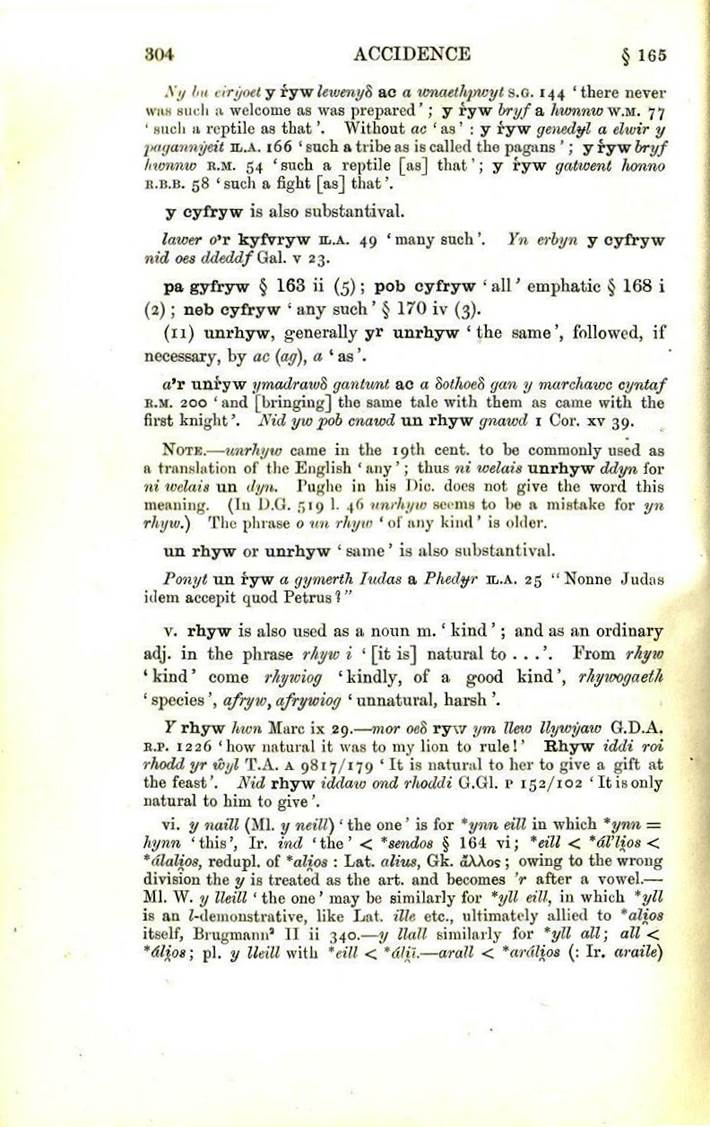
304 ACCIDENCE § 165 Ny bu eirẏoet y r͑yw lewenyẟ ac a wnaethpwyt s.g. 144 ‘there never was such a welcome as was prepared’; y r͑yw bryf a hwnnw w.m. 77 ‘such a reptile as that’. Without ac ‘as’: y r͑yw genedɏl a elwir y pagannẏeit Ỻ.A. 166 ‘such a tribe as is called the pagans’; y r͑yw bryf hwnnw r.m. 54 ‘such a reptile [as] that’; y r͑yw gatwent honno r.b.b. 58 ‘such a fight [as] that’. y cyfryw is also substantival. lawer o’r kyfVryw Ỻ.A. 49 ‘many such’. Yn erbyn y cyfryw nid oes ddeddf Gal. v 23. pa gyfryw § 163 ii (5); pob cyfryw ‘all’ emphatic § 168 i (2); neb cyfryw ‘any such’ § 170 iv (3). (11) unrhyw, generally yr unrhyw ‘the same’, followed, if necessary, by ac (ag), a ‘as’. a’r unr͑yw ymadrawẟ gantunt ac a ẟothoeẟ gan y marchawc cyntaf r.m. 200 ‘and [bringing] the same tale with them as came with the first knight’. Nid yw pob cnawd un rhyw gnawd 1 Cor. xv 39. Note.—unrhyw came in the 19th cent. to be commonly used as a translation of the English ‘any’; thus ni welais unrhyw ddyn for ni welais un dyn. Pughe in his Dic. does not give the word this meaning. (In D.G. 519 l. 46 unrhyw seems to be a mistake for yn rhyw.) The phrase o un rhyw ‘of any kind’ is older. un rhyw or unrhyw ‘same’ is also substantival. Ponyt un r͑yw a gymerth Iudas a Phedɏr Ỻ.A. 25 “Nonne Judas idem accepit quod Petrus?” v. rhyw is also used as a noun m. ‘kind’; and as an ordinary adj. in the phrase rhyw i ‘[it is] natural to…’. From rhyw ‘kind’ come rhywiog ‘kindly, of a good kind’, rhywogaeth ‘species’, afryw, afrywiog ‘unnatural, harsh’. Y rhyw hwn Marc ix 29.—mor oeẟ ryw ym llew llywẏaw G.D.A. r.p. 1226 ‘how natural it was to my lion to rule!’ Rhyw iddi roi rhodd yr ŵyl T.A. a 9817/179 ‘It is natural to her to give a gift at the feast’. Nid rhyw iddaw ond rhoddi G.G1. p 152/102 ‘It is only natural to him to give’. vi. y naill (Ml. y neill) ‘the one’ is for *ynn eill in which *ynn = hynn ‘this’, Ir. ind ‘the’ < *sendos § 164 vi; *eill < *ál’li̯os < *álali̯os, redupl. of *ali̯os: Lat. alius, Gk. ἄλλος; owing to the wrong division the y is treated as the art. and becomes ’r after a vowel.—Ml. W. y lleill ‘the one’ may be similarly for *yll eill, in which *yll is an l-demonstrative, like Lat. ille etc., ultimately allied to *ali̯os itself, Brugmann² II ii 340.—y llall similarly for *yll all; all < *áli̯os; pl. y lleill with *eill < *áli̯ī.—arall < *aráli̯os (: Ir. araile) |
||||||||||||||||||||||||||||||||||||||||||||||||||||||||||||||||||||||||||||||||||||||||||||||||||||||||||||||||||||||||||||||||||||||||||||||||||||||||||||||||||||||||||||||||||||||||||||||||||||||||||||||||
|
|
|
|
||||||||||||||||||||||||||||||||||||||||||||||||||||||||||||||||||||||||||||||||||||||||||||||||||||||||||||||||||||||||||||||||||||||||||||||||||||||||||||||||||||||||||||||||||||||||||||||||||||||||||||||||
|
|
|
§ 166 Pronouns 305 by dissim. for *aláli̯os § 102 iii (2); pl. ereill < *aráli̯ī; see § 100 iii (2), (3).—Note the contrasted accentuation *ál(a)li̯os > *eill ‘one’: *aláli̯os > arall ‘other’.—un ‘one’ § 75 ii (1).—rhyw < *rii̯ó‑; rhai < *rii̯ī́ § 75 v; *rii̯o- < *pri‑o- = ‑prio- in Lat. proprius: Lat. prīvus, Umbr. prever ‘singulis’, preve ‘singillariter’. Osc. preivatud ‘privato. reo’ (the ‑v- in these is a suff.); the orig. meaning is ‘proper, particular’; rhyw ẟyn ‘a particular man’; rhyw i ‘proper to…, natural to…’; rhyw ‘a particular kind’; etc.; *pri‑o- may be an adj. derived from the prep. *pri (: *prei, *prai) ‘before’ (‘prominent’ > ‘characteristic’), spv. Lat. prīmus. § 166. i. ‘Each other’ is expressed by pawb i gilydd or pob un i gilydd, literally ‘each his fellow’ or ‘each one his fellow’. ac y tag̃noveẟwyd pawb o naẟunt ae giliẟ w.m. 451 ‘and each of them was reconciled to the other’. Llawen vu pob un wrth ẏ giliẟ o honunt do. 9 ‘Each of them welcomed the other’. (For the form giliẟ see § 77 iii; it is of course the spoken sound at the present day.) Yn iach weithian dan y dydd Y gwelom bawb i gilydd.—S.T., c.c. 186. ‘Farewell now until the day when we shall see each other,’ lit. ‘each his fellow’. In the 15th century pawb or pob un came to be omitted, and i gilydd alone thus came to mean ‘each other’. Ni a gawn drwy flaenau’r gwŷdd Roi golwg ar i gilydd.—Gut.O., a 14997/15. ‘We shall see each other through the branches of the trees.’ Ni a ddylem garu i gilydd a.g. 25 ‘we ought to love one another’. In the familiar Salesburian orthography i gilydd is of course ei gilydd ‘his fellow’. As the antecedent is generally pl., the i was mistaken in the spoken lang. for i ‘their’ (written eu); and after the 1st and 2nd pl. ỿn and ỿch are substituted for it on the analogy of the construction of hun ‘self’; thus in the recent period ein, eich, eu are written before gilydd, which owes its g- to the fact that the pron. before it was the 3rd sg. m. i ‘his’. Wm.S. and Dr. M. sometimes misspell the pron. as eu (Salesbury often confuses his own invention ei with eu; the spoken form of both was i then as now). In the 1620 Bible the 3rd sg. m. pron. is correctly written in the orthography adopted in it: ar garu o honoch ei gilydd Ioan xiii 34; os bydd gennych gariad i’w gilydd do. 35; Byddwch yn vn-fryd â’i gilydd Rhuf. xii 16; Anherchwch ei gilydd 1 Petr v 14; Anwylyd carwn ei gilydd 1 Ioan iv 7, see 11, 12. In 1402 |
||||||||||||||||||||||||||||||||||||||||||||||||||||||||||||||||||||||||||||||||||||||||||||||||||||||||||||||||||||||||||||||||||||||||||||||||||||||||||||||||||||||||||||||||||||||||||||||||||||||||||||||||
|
|
|
|
||||||||||||||||||||||||||||||||||||||||||||||||||||||||||||||||||||||||||||||||||||||||||||||||||||||||||||||||||||||||||||||||||||||||||||||||||||||||||||||||||||||||||||||||||||||||||||||||||||||||||||||||
|
|
|
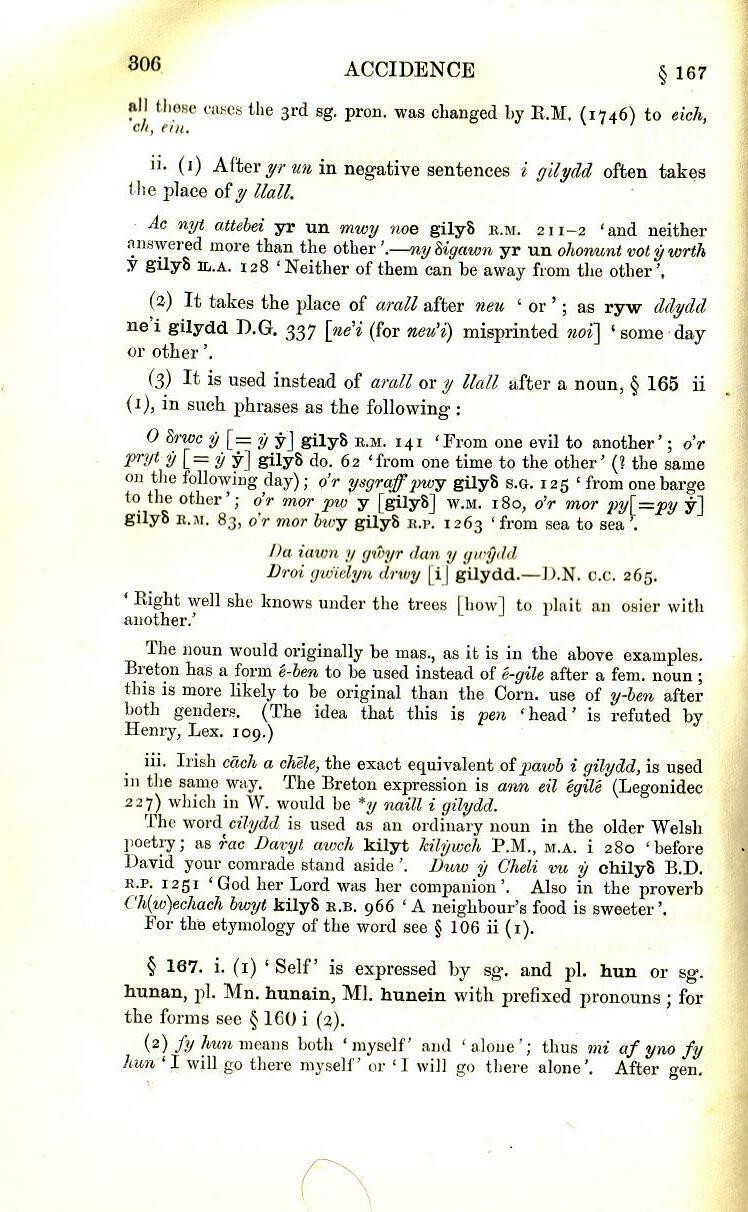
306 Accidence § 167 all these cases the 3rd sg. pron. was changed by R.M. (1746) to eich, ’ch, ein. ii. (1) After yr un in negative sentences i gilydd often takes the place of y llall. Ac nyt attebei yr un mwy noe gilyẟ r.m. 211–2 ‘and neither answered more than the other’.—ny ẟigawn yr un ohonunt vot ẏ wrth ẏ gilyẟ Ỻ.A. 128 ‘Neither of them can be away from the other’. (2) It takes the place of arall after neu ‘or’; as ryw ddydd ne’i gilydd D.G. 337 [ne’i (for neu’i) misprinted noi] ‘some day or other’. (3) It is used instead of arall or y llall after a noun, § 165 ii (1), in such phrases as the following : O ẟrwc ẏ [= ẏ ẏ] gilyẟ r.m. 141 ‘From one evil to another’; o’r pryt ẏ [= ẏ ẏ] gilyẟ do. 62 ‘from one time to the other’ (? the same on the following day); o’r ysgraff pwy gilyẟ s.g. 125 ‘from one barge to the other’; o’r mor pw y [gilyẟ] w.m. 180, o’r mor py [= py ẏ] gilyẟ r.m. 83, o’r mor bwy gilyẟ r.p. 1263 ‘from sea to sea’. Da iawn y gŵyr dan y gwŷdd Droi gwïelyn drwy [i] gilydd.—D.N. c.c. 265. ‘Right well she knows under the trees [how] to plait an osier with another.’ The noun would originally be mas., as it is in the above examples. Breton has a form é-ben to be used instead of é-gile after a fem. noun; this is more likely to be original than the Corn. use of y-ben after both genders. (The idea that this is pen ‘head’ is refuted by Henry, Lex. 109.) iii. Irish cāch a chēle, the exact equivalent of pawb i gilydd, is used in the same way. The Breton expression is ann eil égilé (Legonidec 227) which in W. would be *y naill i gilydd. The word cilydd is used as an ordinary noun in the older Welsh poetry; as r͑ac Davyt awch kilyt kilẏwch P.M., m.a. i 280 ‘before David your comrade stand aside’. Duw ẏ Cheli vu ẏ chilyẟ B.D. r.p. 1251 ‘God her Lord was her companion’. Also in the proverb Ch(w)echach bwyt kilyẟ r.b. 966 ‘A neighbour’s food is sweeter’. For the etymology of the word see § 106 ii (1). § 167. i. (1) ‘Self’ is expressed by sg. and pl. hun or sg. hunan, pl. Mn. hunain, Ml. hunein with prefixed pronouns; for the forms see § 160 i (2). (2) fy hun means both ‘myself’ and ‘alone’; thus mi af yno fy hun ‘I will go there myself’ or ‘I will go there alone’. After gen. |
||||||||||||||||||||||||||||||||||||||||||||||||||||||||||||||||||||||||||||||||||||||||||||||||||||||||||||||||||||||||||||||||||||||||||||||||||||||||||||||||||||||||||||||||||||||||||||||||||||||||||||||||
|
|
|
|
||||||||||||||||||||||||||||||||||||||||||||||||||||||||||||||||||||||||||||||||||||||||||||||||||||||||||||||||||||||||||||||||||||||||||||||||||||||||||||||||||||||||||||||||||||||||||||||||||||||||||||||||
|
|
|
§ 168 PRONOUNS 307 prefixed or infixed pronouns it means ‘own’, as fy llyfr fy hun ‘my own book’. (3) fy hun, dy hun, etc. always stand in an adverbial case, meaning literally ‘by myself’, etc.; they do not replace a pronoun or pronominal element, but supplement it. Thus euthum fy hun ‘I went by myself’ (not *aeth fy hun ‘myself went’); fy nhŷ fy hun ‘my own house’ (not *tŷ fy hun ‘the house of myself’); amcanodd ei ladd ei hun Act. xvi 27; cf. 1 Ioan i 8; Iago 122; 2 Tim. ii 13; efe a’i dibrisiodd ei hun Phil. ii 7; similarly arnat dy hun 1 Tim. iv 16 (not *ar dy hun); ynddo ei hun Es. xix 17 (not *yn ei hun); drostun e‑hunein Ỻ.A. 37 (not *dros e hunein), etc. The reflexive ym‑ counts as a pronoun: ymroẟi e‑hun Ỻ.A. 120, cf. 89 and a.l. i 176. (In colloquial Welsh i hun is used alone as the object of a verb or v.n., as wedi lladd i hun instead of wedi i ladd i hun, and this neologism occurs in recent writings; but in other connexions the old construction survives, thus mi af fy hun, arnat dy hun etc.) But after a conjunction joining it to another clause the pronoun which it supplements is not necessarily expressed; thus nyt archaf inheu ẏ neb govyn vy iawn namyn my hun r.m. 64 ‘I will bid no one demand my indemnity but myself; nad oes o’r tu yma ’r un ond fy hunan b.cw. 68 ‘that there is on this side none but myself; yn uch no my‑hun Ỻ.A. 67 ‘higher than myself’.—When put at the head of the sentence fy hun etc. are followed by the adverbial rel. y (yẟ, yr), as vy hun yr af I.D. 35 lit. ‘[it is] myself that I will go’; canys ei hunan y gelwais ef, ac y bendithiais, ac yr amlheais ef Es. li 2. ii. un ‘one’ has a derivative *un-an lost in W. but surviving in Corn. onon, onan, Bret. unan; this and the fact that hun, hunan express ‘alone’ make it probable that the ‑un in these is the numeral. But Corn. ow honan, Ml. Bret. ma hunan show that the h‑ in W. fy h‑unan is not merely accentual. Before u it may represent either *s‑ or *su̯‑; thus hun may be from *su̯’oinom < *su̯e oinom (limiting accusative); the reflexive *su̯e might stand for any person at first (Brugmann² II ii 397), but personal pronouns were afterwards prefixed, thus *me su̯’oinom > my hun. The u in Ml. mu etc. is due to assim. to the u of hun. 168. i. (1) Subst. pawb ‘everybody’. Though sometimes treated as pl., e.g. pawb a debygynt w.m. 463 ‘everybody thought’, pawb a’m gadawsant 2 Tim. iv 16, pawb is, like Eng. everybody, properly sg., and is mas. in construction: Pawb ry-gavas ẏ gyvarws w.m. 470 ‘everybody has received his boon’. So in a large number of proverbial sayings: Pawb a’i chwedl gantho ‘everybody with his story’; Rhydd i bawb i farn ‘free to everybody [is] his opinion’; Pawb drosto ’i hun ‘each for himself’. (2) Adj. pob [rad.] ‘every’. It sometimes forms improper compounds with its noun; as popeth (≡ poppeth for pobpeth) |
||||||||||||||||||||||||||||||||||||||||||||||||||||||||||||||||||||||||||||||||||||||||||||||||||||||||||||||||||||||||||||||||||||||||||||||||||||||||||||||||||||||||||||||||||||||||||||||||||||||||||||||||
|
|
|
|
||||||||||||||||||||||||||||||||||||||||||||||||||||||||||||||||||||||||||||||||||||||||||||||||||||||||||||||||||||||||||||||||||||||||||||||||||||||||||||||||||||||||||||||||||||||||||||||||||||||||||||||||
|
|
|
308 Accidence § 168 beside pob peth ‘everything’; pobman beside pob man ‘every place’; poparth g. 234 beside pob parth ‘every part’; o boptu besides o bob tu ‘on each side’. The mutated form bob, by dissimilation of the consonants appears, though very rarely, as bod, in late Ml. orthography bot: as ẏ bot un ohonunt Ỻ.A. 3 ‘to each one of them’. N.W. dial. bṓd ỿg ū́n ‘each and all’, lit. ‘and one’; earlier bod ag un Ỻ.M. 9, T. i 346. 'pob un, pob rhyw § 165 iv, pob cyfryw ‘every such’, as pob cyfryw orfoledd Iago iv 16 ‘all such rejoicing’. But ordinarily pob cyfryw means ‘every’ emphatic, ‘all manner of’, the cyf- having the intensive meaning § 156 i (9) (b). It is followed by o ‘of’ after pob (not by ag- ‘as’ after cyf‑, so that the cyf- is not comparative). pob kyfryw ẟyn eithɏr Awt r.p. 1245 ‘every single person but Awd’. Yr r͑ei hynn oeẟ gyfrwys … ym pob kyvryw arveu c.m. 10 ‘these were skilful in all manner of arms’. Pa le i mae Christ? Ymhob cyfriw le c.c. 319 ‘Where is Christ? In every single place’. Pob cyfriw beth coll. ‘every single thing’.—o bop kyfryw vwydeu o’r a rybuchei ehun s.g. 10 ‘of all viands which (lit. of those which) he himself desired’. Cf. r.m. 8, r.b.b. 50. (3) pawb, Ir. cāch, gen. cāich < Kelt. *qu̯āqu̯os; the second element is probably the interr. and indef. *qu̯os and the first, *qu̯ā‑, an adverbial form of the same (Thurneysen Gr. 293). pob, Ir. cach is the same, with the vowel shortened before the accent, which fell on the noun. The shortening is independent in W. and Ir.; the W. o (like aw) implies Brit, ‑ā‑, § 71 i (2). Similarly Bret. pep < *peup with *eu < ‑ā‑. The Ir. cech is an analogical formation; see Thurneysen ibid. ii. (1) Adj. yr holl [soft] ‘all the’, fy holl [soft], etc., ‘all my’. Before a definite noun the article or its equivalent is omitted: holl Gymry r.b.b. 340 ‘all Wales’; holl lyssoeẟ y ẟayar w.m. 6 ‘all the courts of the earth’ (lyssoeẟ being made definite by the dependent gen.). A wybyb yr holl seint a wnneuthum i yma Ỻ.A. 71 ‘Will all the saints know what I have done here?’ a’r holl bethau hyn Matt. vi 33 ‘and all these things’; dy holl ffyrdd Ps. xci 11. A compound of holl of the form hollre Ỻ.A. 166, holre do. 165, y rolre (= yr olre) b.b. 71 is used much in the same way, but is rare. The derivative hollol ‘entire’ is an ordinary adj. following its noun, but is used chiefly with yn as an adverb: a hynny yn hollawl Ỻ.A. 162 ‘and that wholly’; cf. Ps. cxix 8; Gen. xviii 21, etc. |
||||||||||||||||||||||||||||||||||||||||||||||||||||||||||||||||||||||||||||||||||||||||||||||||||||||||||||||||||||||||||||||||||||||||||||||||||||||||||||||||||||||||||||||||||||||||||||||||||||||||||||||||
|
|
|
|
||||||||||||||||||||||||||||||||||||||||||||||||||||||||||||||||||||||||||||||||||||||||||||||||||||||||||||||||||||||||||||||||||||||||||||||||||||||||||||||||||||||||||||||||||||||||||||||||||||||||||||||||
|
|
|
§ 168 Pronouns 309 (2) oll. This is always used in an adverbial case (of measure), and generally follows the word or phrase which it limits, though in poetry it may precede it. Kemry oll a.l. i 2 ‘all Wales’, lit. ‘Wales wholly’; y byd oll g. 294 ‘the whole world’, lit. ‘the world wholly’; gwadu oll y dadɏl a.l. i 396 ‘to deny wholly the plea’; Nyni oll Es. liii 6. It cannot be used in the nom. or acc. case, but is always adverbial, limiting the pronominal element which is subj. or obj., and which must be expressed; thus aethant oll ‘they went wholly’ (not *aeth oll ‘all went’); arnaẟunt oll r.m. 113 ‘on them altogether’, Mn. W. arnunt oll (not *ar oll), etc.; cf. fy hun § 167 i (3). Note.—In Recent written Welsh a neologism yr oll has arisen to express ‘the whole’, instead of y cwbl which is the form used in the natural spoken language, yr oll is even substituted for oll in late editions of earlier works; thus Ti sy ’n trefnu oll dy hun Wms. 555 appears in recent hymn-books as Ti sy ’n trefnu ’r oll dy hun. (Of course yr + oll gives yr holl the adjectival phrase, see below.) (3) W. oll < Kelt. *oli̯od (limiting accus.); Ir. uile < Kelt. *olii̯os; probably cognate with Eng. all, Germ. all, Goth. alls < *ol-no‑s. The h- of holl is caused by the ‑r of the article before the accented vowel § 112 i (2), and was transferred to cases where the article was not used. But the adverbial oll remained, since the article never occurred before this. hollre seems to be compounded of holl and gre < *greg‑: Lat. greg‑; as in camre § 127. iii. (1) Subst. cwbl ‘the whole’, followed by o ‘of’. Ef a ẟoy am dy benn cwbɏl o’r govut w.m. 80 ‘all the retribution would have come upon thy head’; cwbɏl a geveis i o’m hamherodraeth do. 190 ‘I have recovered the whole of my empire’; kaeawẟ kwbɏl o ẟrysseu … y neuaẟ s.g. 5 ‘closed all the doors of the hall’; kwbɏl o’r wirioneẟ do. 161 ‘the whole of the truth’; yn ôl cwbl o gyfraith Moses 2 Bren. xxiii 25; cf. Nah. i 5. In Late Mn. W. the article came to be put before cwbl; this appears already in the Bible : Gen. xiv 20 (1620); in late edns. in Ex. xxiii 22, 2 Chron. xxxii 31. (2) Adj. cwbl [soft] ‘complete’. cwbɏl waradwyẟ a geveis w.m. 42 ‘[it is] a thorough insult that 1 have had’; cwbɏl weithret, cwbɏl sarhaet a.l. i 526 ‘the complete act, the full fine’; cwbl ddiwydrwydd 2 Pedr i 5. It is also used after its noun: kanny bu weithret cwbɏl a.l. i 526 ‘since there was not a complete act’; cymodlonedd cwbl m.a. i 348 ‘complete reconciliation’. Adv. yn gwbl, o gwbl ‘wholly’: ac ereẏll en kubɏl a ẟẏleassant |
||||||||||||||||||||||||||||||||||||||||||||||||||||||||||||||||||||||||||||||||||||||||||||||||||||||||||||||||||||||||||||||||||||||||||||||||||||||||||||||||||||||||||||||||||||||||||||||||||||||||||||||||
|
|
|
|
||||||||||||||||||||||||||||||||||||||||||||||||||||||||||||||||||||||||||||||||||||||||||||||||||||||||||||||||||||||||||||||||||||||||||||||||||||||||||||||||||||||||||||||||||||||||||||||||||||||||||||||||
|
|
|
310 Accidence § 169 a.l. i 2 ‘and others they entirely abrogated’; y byẟei eur o gwbɏl r.m. 62 [where iron should be] ‘there was gold throughout’, cf. r.b.b. 280. In neg. sentences o gwbl ‘at all’ is in common use in spoken W. (pron. ṓ gẃbwl). (3) W. cwbl, Corn. cowl, cowal probably represent *cwvl § 111 vii (4) < *kom-(p)lu‑(s): Gk. πολύς, W. llawer § 169 ii (3), the prefix having its intensive meaning, as in com-plete, etc., § 156 i (9) (b). § 169. i. (1) Subst. y sawl sg. ‘such’, pl. ‘as many’, used only before relative clauses, the rel. expressing ‘as’, § 165 iv (10). Y sawl ae gwelei kyflawn vyẟei oe serch r.m. 117 ‘such as saw her was filled with her love’; gwelet y sawl a welei o velineu w.m. 161 ‘to see as many as he saw of mills’. Y sawl a’m car ant i a garaf inneu Diar. viii 17. Rarely sawl with a dependent genitive: a r͑wy o sawl y r͑ei yssyẟ r.p. 1252 ‘and more of the like of those that ar’. (2) Adj. y sawl [soft] ‘as many’, usually with a pl. noun and without ac; but the noun may be sg. and ac expressed; cf. § 165 iv (10). Ac ny ellit dwyn bwyt ý’r sawl vilẏoeẟ yssyẟ yma, ac o achaws hynny y mae y sawl velineu (hynn) w.m. 162 (E.M. 229) 'and food could not be brought to as many thousands as are here, and [it is] for that reason that there are so many mills ([as] these); y sawl vorynyon racko s.g. 33 ‘as many maidens [as those] yonder’. y sawl ryveẟawt ac yssyẟ yn y wlat honn s.g. 18 ‘as many a wonder as there is [lit. as which is] in this land’. (3) The original meaning seems to be ‘such’; hence probably sawl < *s‑tāl‑: Lat. tālis, with Kelt. prefixing of s- § 101 ii (1). ii. (1) Subst. llawer sg. ‘much’, pl. ‘many’, followed, if need be, by o ‘of’. Also pl. llaweroedd ‘multitudes’. A guedy byrẏer llawer yndi w.m. 21 ‘and when much has been thrown into it’, i.e. much food; llauer nys guir ae gowin B.B. 68 ‘many who do not know ask it’; a llawer o vein gwerthvawr ereill Ỻ.A. 166 ‘and many other precious stones’; llawer a ddichon taerweddi y cyfiawn Iago v 16; fy ngwas cyfiawn a gyfiawnhâ lawer Es. liii 11. In an adverbial case (of measure) llawer [rad.] before a cpv. and lawer after a cpv. signify ‘much’ adv.: llawer gwell ‘much better’; llawer iawn gwell Phil. i 23 ‘very much better’; mwy lawer Ỻ.A. 68 ‘much greater’; a muy Wydẏon noc ynteu lawer w.m. 106 ‘and Gwydion [regretted] more than he, much’; mwy oeẟ ef lawer no hynny do. 229 ‘he was bigger much than that’. But o lawer is perhaps more common after the cpv., as in the last two passages in r.m. 77, 166. |
||||||||||||||||||||||||||||||||||||||||||||||||||||||||||||||||||||||||||||||||||||||||||||||||||||||||||||||||||||||||||||||||||||||||||||||||||||||||||||||||||||||||||||||||||||||||||||||||||||||||||||||||
|
|
|
|
||||||||||||||||||||||||||||||||||||||||||||||||||||||||||||||||||||||||||||||||||||||||||||||||||||||||||||||||||||||||||||||||||||||||||||||||||||||||||||||||||||||||||||||||||||||||||||||||||||||||||||||||
|
|
|
§ 169 Pronouns 311 (2) Adj. llawer [rad.] ‘many a’ followed by a sg. noun. a llawer damwein a ẟigawn bot w.m. 28 ‘and many an accident may happen’. Llawer merch weddw o’i pherchen, Llawer gŵr mewn llurig wen.—D.Ỻ., tr. 249. ‘Many a woman widowed of her lord, many a man in a white corselet.’ (3) W. llawer < *(p)luu̯eros formed by adding the cpv. suffix ‑ero- to *plu‑, *p(a)lu- < *pₑlu‑ Gk. πολύς < *pₑlu‑. iii. (1) Subst. llḯaws ‘many, a multitude’; lluosydd id. llẏaus b.b. 5 (ẏ ≡ i); yn llvyr ẏ guyr lluossit b.b. 66 (‑it ≡ ‑yẟ) ‘thoroughly does a multitude know it’. Na ddilyn liaws i wneuthur drwg Ex. xxiii 2; lliaws o flynyddoedd Job xxxii 7. With a dependent genitive: lliaws dy dosturiaethau Ps. li 1. (2) Adj. llḯaws [soft] ‘many a, much’, with a sg. or a pl. noun; this is the noun llḯaws compounded with another noun. The adj., used as a complement, is Ml. W. lluossawc, Mn. W. lluosog. Lliaws gurẏaw r.p. 1216 ‘much suffering’; Ceveis i liaws awr eur a phali M. m.a. i 192 ‘I had many a time gold and silk’; o lïaws eirchẏeid m.a. i 259 ‘of many suppliants’; i lios lu § 71 ii (1); Mor lluosog yw dy weithredoedd Ps. civ 24. (3) llḯaws < *plēiōs-tā(t)s. The longer forms have u as lluossauc r.p. 1043, lluossogrwyẟ w.m. 34, r.m. 22, lluosog in 1620 Bible. These are not formed from llïaws but from an old adj. *plēiŏsto‑s) see § 74 i (2), § 75 iii (3) and § 76 ix (2). iv. (1) Subst. peth ‘some, a certain quantity’. Dywedadwy yw rac llaw o beth o vucheẟ Veuno Ỻ.A. 118 ‘[the story] is to be told in what follows of some of the life of Beuno’; ac wrth hau, peth a syrthiodd ar ymyl y fford … a pheth arall, etc. Luc viii 5–8. In an adverbial case, beth ‘to some extent, for some time’: Dir yw in dario ennyd, Ac aros beth gwrs y byd.—D.Ỻ., Ỻ 120/258 r. ‘We must tarry a little, and await awhile the course of events.’ (2) peth is the interrogative pronoun § 163 i (3) used indefinitely (cf. Gk. τις); from ‘some, something’ it came to mean ‘thing’, and thus became an ordinary noun, pl. pethau; see § 163 vi. v. (1) Subst. bychydic, ychydig ‘a little, a few’. bychydic a dal vy nghyngor i ẏ ti s.g. 43 lit. ‘[it is] little that |
||||||||||||||||||||||||||||||||||||||||||||||||||||||||||||||||||||||||||||||||||||||||||||||||||||||||||||||||||||||||||||||||||||||||||||||||||||||||||||||||||||||||||||||||||||||||||||||||||||||||||||||||
|
|
|
|
||||||||||||||||||||||||||||||||||||||||||||||||||||||||||||||||||||||||||||||||||||||||||||||||||||||||||||||||||||||||||||||||||||||||||||||||||||||||||||||||||||||||||||||||||||||||||||||||||||||||||||||||
|
|
|
312 Accidence § 170 my advice avails to thee’ i.e. my a. is worth little. Pa obeith yssyẟ ẏ’r porthmyn? Ychydic Ỻ.A. 40 ‘what hope is there for the merchants? A little’. ychydig o nifer Ezec. v 3; ychydig o honaw Job iv 12. (2) Adj. ychydig [soft] sg. ‘a little’, pl. ‘a few’. ychydig gysgu, ychydig hepian, etc. Diar. vi 10; ychydig win 1 Tim. v 23.—ychydig bechodau T.A. c 16/13 ‘a few sins’; ychydig ddyddiau Gen. xxix 20; ychydig bethau Dat. ii 14. (3) ychydig is for fychydig mut. of bychydic: W. bychod ‘small quantity’, bychodedd ‘scarcity, poverty’; Corn. boches ‘a little’, bochesog, bochodoc ‘poor’, Ir. bocht ‘poor’: *buk-so‑t‑, *buk-to‑: with Kelt, b- for *p- to Lat. paucus? § 101 iii (2). (4) Subst. odid ‘a rarity’. odit a vo molediw r.p. 1041 ‘a rarity [is he] who is worthy of praise’; ac odit o’r r͑ei hynny ysyẟ yn gristonogyon Ỻ.A. 165 “quarum paucae [lit. paucitas] sunt Christianae”; odid elw heb antur prov. ‘a rarity [is] (i.e. there is rarely) profit without enterprise’. ond odid ‘probably’, literally ‘excepting a rarity’. (5) odid: Lat. paucus, E. few § 76 ii (3). vi. (1) Adj. aml [soft] sg. ‘many a’, pl. ‘many’; ambell [soft] ‘an occasional’. Aml iawn waedd am Elin wen, Ami eisiau am elusen.—T.A., c. ii 83. ‘Full many a cry for fair Elin, many a need for charity.’ Ond o hirbell ymgellwair (O bai well ym) ymbell air.—I.D. 23. ‘But from afar bantering (if it were better for me) an occasional word.’ y mae rhai a graffant ar ymbell air M.K. [vii] ‘there are some who will look at an occasional word’. Aml ddrygau Ps. xxxiv 19, dy aml drugareddau di Dan. ix 18; ambell dro ‘occasionally’. The dialectal i sometimes heard before the noun is a recent intrusion (? corruption of iawn as in the first example). Both these words are used as ordinary adjectives, and are compared; see Silvan Evans s.vv. (2) aml < Brit *amb’lu‑s for *ambilus < *m̥bhi-(p)lu‑, with *plu- for *pₑlu‑: W. llawer ‘many’, Gk. πολύς, see ii (3) above. ambell < *ambi-pell- ‘mutually far’; for the prefix see § 156 i (4) (b); for the stem § 89 i. § 170. i. Subst. neb ‘any one’, dim ‘anything’, are used chiefly with negatives; as ni welais neb ‘I did not see anybody’; |
||||||||||||||||||||||||||||||||||||||||||||||||||||||||||||||||||||||||||||||||||||||||||||||||||||||||||||||||||||||||||||||||||||||||||||||||||||||||||||||||||||||||||||||||||||||||||||||||||||||||||||||||
|
|
|
|
||||||||||||||||||||||||||||||||||||||||||||||||||||||||||||||||||||||||||||||||||||||||||||||||||||||||||||||||||||||||||||||||||||||||||||||||||||||||||||||||||||||||||||||||||||||||||||||||||||||||||||||||
|
|
|
§ 170 PRONOUNS 313 heb Dduw, heb ddim ‘without God, without anything’. Also in conditional sentences, as o phecha neb 1 Ioan ii 1 ‘if any man sin’; in questions; in comparisons; etc. A derivative nebawd occurs: nebaud b.b. 21, 43 ‘any one’, ny gwybyẟ nebawt b.t. 19 ‘no one will know’. ii. Owing to constant association with negatives neb and dim came to be used in certain phrases for ‘nobody’ and ‘nothing’. As a rule it is the verb that requires the negation; thus ‘he gave me nothing’ is logically ‘he did not give me anything’ ni roes ef imi ddim, since there was no giving. But the verbal idea may be positive, as in ‘it is given for nothing’; this has to be expressed by fe’i rhoddir am ddim, where dim has to stand for ‘nothing’. dim is thus used as early as the 14th cent.; see Ỻ.A. 60, 89. But there seem to be no Ml. examples of neb ‘nobody’. iii. dim and neb are positive in positive sentences in the phrases— (1) pob dim ‘everything’: Pob dim kywrein … goruc Kelvyẟ B.D., r.p. 1251 ‘every cunning thing the Artist made’. Duw, madden bob dim iddaw I.F. m 148/329 ‘God forgive him everything’. Cf. 1 Cor. xiii 7; Deut. iv. 7, xxviii 47, 48; Col. i 16. (2) y neb ‘the one, he’ before a relative § 162 vii (1): twyllwr yw y neb a aẟefvo kyfvrinach arglwyẟ ẏ’r nep a wypo ẏ vot yn elyn iẟaw Ỻ.A. 26 ‘he who betrays a lord’s secret to him whom he knows to be his enemy is a traitor’. Cf. Ỻ.A. 28, 32, 33, 34, etc. Y neb a atalio ei yd, y bobl a’i melldithia Diar. xi 26. (3) neb un § 165 iv (3). iv. (1) neb is used adjectivally, thus neb [rad.] ‘any’: ni bu yma neb amarch f. 14 ‘there has been no disrespect here’. It is rarely adjectival except in the following phrases: (2) neb un above; neb rhyw § 165 iv (8); neb r͑yw ẟim ‘anything at all’, w.m. 64, 65, r.m. 46, 47; neb dyn ‘any man’ Ỻ.A. 126. (3) neb cyfryw [soft] ‘any at all’, cf. § 168 i (2). Kanyt oes neb kyfryw rym … y gallem ni vynet r.b.b. 178 ‘for there is no power by which we might go’. (4) nĕ́mawr, nĕ́mor (for *neb mawr), with a negative ‘not much, not many, but little’. |
||||||||||||||||||||||||||||||||||||||||||||||||||||||||||||||||||||||||||||||||||||||||||||||||||||||||||||||||||||||||||||||||||||||||||||||||||||||||||||||||||||||||||||||||||||||||||||||||||||||||||||||||
|
|
|
|
||||||||||||||||||||||||||||||||||||||||||||||||||||||||||||||||||||||||||||||||||||||||||||||||||||||||||||||||||||||||||||||||||||||||||||||||||||||||||||||||||||||||||||||||||||||||||||||||||||||||||||||||
|
|
|
314 Accidence § 170 ny weleiste
eto nemawr o
boeneu uffernn Ỻ.A. 154 ‘so far thou hast seen but little of the pains of hell’. Adjectival,
with neg., nemor ddim ‘hardly anything’, nemor un ‘hardly
any one’. yn emawr s.g. 27, yn ymor c.m. 55,
with prosthetic ỿ § 21 iii. (5) nĕ́pell (for
*neb pell), with a neg. ‘not far’. er nad yw
efe yn ddiau neppell oddiwrth
bob un o honom Act. xvii 27; yn epell s.g. 219. v. (1) dim is
probably never an adj.; a noun following it is a dependent genitive, as— heb ẟim llywenyẟ Ỻ.A. 147 ‘without anything of joy’
i.e. without any joy; heb allel gwneuthur dim lles s.g. 37
‘without being able to do any good’; na wna ynddo ddim gwaith Ex.
xx 10; cf. Ps. xxxiv 10. (2) But
before a definite noun or pron. o ‘of’ is used after dim: ny wyẟant ẟim ohonunt Ỻ.A. 8 ‘they know nothing of them’; ac
nyt oeẟ dim ohonaw yno r.m. 18 ‘and there was
nothing of him there’ i.e. he was not there; ny warandawei ẟim o’r attep w.m. 53 ‘he would not listen to
anything of the reply’ i.e. to the reply. ẟim o was of
very frequent occurrence, and was reduced to mo in the spoken
lang. (chiefly N.W.) as early as the 14th cent, if D.G. 496 is authentic. Cf.
E.P. 271, Diar. xxii 22, 28, Job xxxvii 23, b.cw. 18 l. 1. Odid i Dduw,
doed a ddêl, Fyth ddewis mo vath Howel.—W.Ỻ. 45. ‘Scarcely will
God, come what may, ever choose such a one as Howel.’ (3) Used
in an adverbial case ẟim signifies
‘at all’, etc. Nac ef ẟim. Ỻ.A. 48 ‘not at all’; cf. 1 Cor. xv 29, 1
Thes. v 3. This
adverbial ddim is nearly as frequent in the spoken lang.
as pas after a neg. in French. vi. (1)
W. neb, Ir. nech ‘any one’ (gen. neich)
< Kelt. *nequ̯os: Lith. nekàs ‘something’, nekùrs ‘quidam’.
It is believed that the *ne- is the neg. particle, so that the meaning
was originally neg., and became positive by the use of another neg. in the
sentence (cf. Fr. nul). But it is possible that this *ne- is
positive, and is a form of the n-demonstrative: Lat. ego-ne,
see Walde² 255 (where Lith. ne-kùrs is so explained, though
differently in 510). (2) W. dim:
Ir. dim ‘something’, as in ni di nacca dim, acht is
du dim ‘it is not from no thing, but is from something’.—The
W. dim is written with i in
Ml. mss. which distinguish i and ɥ; and dim in “proest”
with grym m.a. i 374 shows that its vowel was not ɥ in the |
||||||||||||||||||||||||||||||||||||||||||||||||||||||||||||||||||||||||||||||||||||||||||||||||||||||||||||||||||||||||||||||||||||||||||||||||||||||||||||||||||||||||||||||||||||||||||||||||||||||||||||||||
|
|
|
|
||||||||||||||||||||||||||||||||||||||||||||||||||||||||||||||||||||||||||||||||||||||||||||||||||||||||||||||||||||||||||||||||||||||||||||||||||||||||||||||||||||||||||||||||||||||||||||||||||||||||||||||||
|
|
|
§ 171 Pronouns 315 early 13th cent.[1] The v.n. diddymu is a late 16th cent. word formed from diddim on the false assumption that it stands for diddym as dibin does for dibyn § 77 iii, whence dibynnu; a more correct, and prob. older, form is diddimio M.K. [40]. In the laws dyn diẟim means ‘a man without assets’, see a.l. ii 36. Hence we may suppose W. dim < *dī-smen ‘share, part, fraction’, √dāi- ‘divide’, R1a *dai‑, R2 *di‑, R3 dī- § 63 vii (5): Gk. δαίομαι, δαίς, Skr. dáyate ‘divides, allots, possesses’, dítiḥ ‘distribution’ (E. time < Pr. Germ. *tīman- ‘period’ < *dī‑); heb ddim lit. ‘without a fraction’. A dimin. (or obi. case) dimyn occurs in kymeint timmyn r.p. 582 ‘every jot’ (cf. kymein hun § 106 iii (2)); whence perhaps Mn. bob tipyn (by dissim. mm > bb, which gives pp). Verbs § 171. i. (1) The Welsh verb has three moods, the indicative, the subjunctive and the imperative. (2) The indicative mood has four tenses, the present, the imperfect, the past (aorist or perfect), and the pluperfect. (3) The subjunctive mood has two tenses, the present and imperfect. (4) The imperative mood has one tense, the present. ii. (1) The pres. ind. is often future in meaning. In the spoken language the future is the usual meaning; the present sense is retained only in a few common verbs such as gwelaf ‘I see’, clywaf ‘I hear’, medraf ‘I can’, tybiaf ‘I think’. (Ordinarily the present meaning is expressed periphrastically.) (2) The impf. indic. is seldom a mere impf. in meaning; usually it expresses Eng. ‘would’ or ‘could’. The impf. is derived from the Ar. optative, and preserves its original meaning. It is used now in spoken W. as it is used in Homer and the Rig-Veda. Taking Meillet’s examples (Intr.² 193): Vedic kāmáyeta rā́jā samrā́ḍ bháviṭum ‘a king would like to be a supreme ruler’ = W. carai brenin fod yn benadur, cf. Mi wn ple mynnwn fy mod D.G. 501 ‘I know where I should like to be’, Mynnwn, pe nef a’i mynnai do. 288 ‘I would, if heaven would, [that ...]'; χερμάδιον…ὃ οὐ δύο γ’ ἄνδρε φέροιεν, E 303 = W. maen … ni chodai deu-ddyn, cf. Ni thynnai saith einioes hwn T.A.
|
||||||||||||||||||||||||||||||||||||||||||||||||||||||||||||||||||||||||||||||||||||||||||||||||||||||||||||||||||||||||||||||||||||||||||||||||||||||||||||||||||||||||||||||||||||||||||||||||||||||||||||||||
|
|
|
|
||||||||||||||||||||||||||||||||||||||||||||||||||||||||||||||||||||||||||||||||||||||||||||||||||||||||||||||||||||||||||||||||||||||||||||||||||||||||||||||||||||||||||||||||||||||||||||||||||||||||||||||||
|
|
|
316 Accidence § 171 A 14975/107 ‘seven (men) could not take his life’; θεός γ’ ἐθέλων … ἀμείνονας … ἵππους δωρήσαιτο, K 556 = W. rhoisai (plup.) duw ewyllysgar well meirch; Vedic yát páceyuḥ kravyā́daṃ kuryuḥ = W. pes pobynt gwnaent [y tân] yn gnawd-ysol (carnivorous), etc. It denotes a possible or hypothetical as opposed to an actual thing; cf. O na welwn Wms. 508 ‘Oh that I am unable to see’ i.e. would that I saw! The impf. use comes through forms like gwelai ‘he could see’ > ‘he saw’, as in ef a welei lannerch … ef a welei carw etc. w.m. 1. The form oeẟ ‘would be’ w.m. 17, l. 29, has passed over entirely to the impf. sense, and forms periphrastic impfs. in the spoken lang., which does not use the impf. of other verbs in that sense. In speaking, we do not say fe safai ’r dref or y bryn ‘the town stood on the hill’ as the expression of a fact, but we do say fe safai Dafydd yn segur am oriau ‘D. would stand idle for hours’ expressing a possibility; we say fe welai rywbeth ‘he saw something’ (could see), but not fe safai yno ‘he stood there’ (was standing). (3) The past is in the vast majority of cases aorist in meaning, as it is predominantly in derivation. It may however have a perfect meaning, as some verbs have perfect instead of aorist forms, as treuliais fy nghlod D.G. 138 ‘I have spent my reputation’. (4) The plup. ind. is very rarely plup. ind. in meaning; it usually means ‘would have’, ‘could have’, etc.; see (2). (5) The pres. subj. in a principal sentence expresses a wish. In a dependent sentence it expresses a general, as opposed to a particular, contingency; thus doed a ddêl ‘come what may come’, as opposed to y byd a ddaw ‘the world which will come’. (6) The impf. subj. is used in dependent clauses only; it either stands in the protasis before the impf. ind., or represents the past of the pres. subj. The uses of the tenses can only be dealt with fully in the Syntax. iii. (1) Each tense is inflected for the three persons of the sg. and pl. (2) Each tense has in addition an impersonal form, whose implied indefinite subject means ‘some one, some, they’, Fr. ‘on’, Germ. ‘man’; as dywedir ‘they say, there is a saying, on dit’. The impersonal form is generally spoken of as a “passive”; but as it takes after it pronouns in the accusative case, it cannot be parsed as a passive. Thus fe’m cerir or cerir fi ‘on m’aime’ (not *cerir i ‘I am loved’). The older grammarians pretended to inflect it for the different persons by adding accusative affixed pronouns § 160 iii (1); |
||||||||||||||||||||||||||||||||||||||||||||||||||||||||||||||||||||||||||||||||||||||||||||||||||||||||||||||||||||||||||||||||||||||||||||||||||||||||||||||||||||||||||||||||||||||||||||||||||||||||||||||||
|
|
|
|
||||||||||||||||||||||||||||||||||||||||||||||||||||||||||||||||||||||||||||||||||||||||||||||||||||||||||||||||||||||||||||||||||||||||||||||||||||||||||||||||||||||||||||||||||||||||||||||||||||||||||||||||
|
|
|
§172 Verbs 317 as cerir fi, cerir di, cerir ef, etc., though Dr. Davies confesses that “omnia verba passiua ad naturam impersonalium quam proxime accedunt” D. 101. It has been argued that a substantival object has a soft initial, as gwêl ẟyn ‘he sees a man’; but this is a late use; the soft is rarely found after the 3rd sg. in Early Mn. poets. It arose to distinguish the subject from the obj., but in the case of the impersonal there is no ambiguity. Intransitive verbs including the verb ‘to be’ are frequently used in the impersonal, and the forms are not felt to be in any way different from transitive impersonals except that a trans. verb requires an object: cychwynnir am ddau ‘a start will be made at two’. The impersonal with its object is generally most conveniently translated into English by a passive with its subject, thus cerir fi ‘I am loved’; but this should not blind us to the construction in Welsh. iv. (1) Each verb has also a verbal noun and most have verbal adjectives. (2) The verbal noun is not strictly an infinitive; it governs the genitive, not the accusative, case. It may be used, like an abstract noun, with the article or an adj., as the subject or obj. of a verb or the obj. of a preposition; but it is sufficiently distinct from an ordinary abstract noun by reason of certain constructions in which it cannot be replaced by the latter. See e.g. § 204 ii. (3) Verbal adjectives are used like ordinary adjectives, and have not developed the peculiar uses of participles. The Regular Verb. § 172. i. The regular verb caraf ‘I love’ is conjugated as follows; Ml. forms are given in spaced type: Indicative Mood. Present Tense.
|
||||||||||||||||||||||||||||||||||||||||||||||||||||||||||||||||||||||||||||||||||||||||||||||||||||||||||||||||||||||||||||||||||||||||||||||||||||||||||||||||||||||||||||||||||||||||||||||||||||||||||||||||
|
|
|
|
||||||||||||||||||||||||||||||||||||||||||||||||||||||||||||||||||||||||||||||||||||||||||||||||||||||||||||||||||||||||||||||||||||||||||||||||||||||||||||||||||||||||||||||||||||||||||||||||||||||||||||||||
|
|
|
318 Accidence § 172 Imperfect Tense.
Aorist Tense.
Pluperfect Tense.
Subjunctive Mood. Present Tense.
Imperfect Tense.
Imperative Mood. Present Tense,
|
||||||||||||||||||||||||||||||||||||||||||||||||||||||||||||||||||||||||||||||||||||||||||||||||||||||||||||||||||||||||||||||||||||||||||||||||||||||||||||||||||||||||||||||||||||||||||||||||||||||||||||||||
|
|
|
|
||||||||||||||||||||||||||||||||||||||||||||||||||||||||||||||||||||||||||||||||||||||||||||||||||||||||||||||||||||||||||||||||||||||||||||||||||||||||||||||||||||||||||||||||||||||||||||||||||||||||||||||||
|
|
|
§ 173 Verbs 319 Verbal Noun. karu; caru Verbal Adjectives. karedic, karadwy; caredig, caradwy. ii. Stems ending in ‑i̯- (Ml. W. ẏ) drop the i̯ before i, y, and u; as rhŏ́di̯af, rhŏ́dir, rhŏ́dynt, rhŏ́dut; sŏ́ni̯af, sŏ́nnir, etc.; and stems in ‑w̯- drop the w̯ before w as cắdw̯af, cắdwn; see § 36 i, ii. Notes and Additional Forms. § 173. Pres. Ind.—i. In the 2nd sg. and pl. and the imps., a and aw in the stem are affected; thus Mn. W. teli ‘thou payest’, ceni ‘thou singest’, gw̯randewi ‘thou listenest’, gw̯randéwch for gw̯randéw̯wch ‘ye listen’, gofelir ‘care is taken’, amcenir ‘an attempt is made’. ii. The 1st sg. ends in ‑af; in b.b. written ‑aw, as dywedaw, kyuodaw, credaw 82 (≡ dywedaf, cyfodaf, credaf); in O.W., ‑am (≡ aṽ), as ni choilam ox. 22b ‘I do not believe’. Traces of an ending ‑if occur: gwneif B.A. 1 ‘I will do’, kuynhiw b.b. 100 ‘I complain’, kynn mudif lle r.p. 1037 ‘before I change [my] place’, cenif, dygif m.a. i 191 ‘I sing, I bring’; cf. Bret. fut. kaninn. iii. (1) The Ml. ending ‑y of the 2nd sg. remains in D.G., see ceny 186, rhedy 132, and is sometimes met with later; but in Mn. W. generally it became ‑i, see § 77 iv. (2) The Ml. ‑y itself seems to be for ‑yẟ = Bret. ‑ez by loss of ‑ẟ, § 110 iv (3); the form ‑yẟ occurs in Early Ml. verse: ymwaredit b.b. 19 (where ‑it ≡ ‑yẟ) ‘savest thyself’, digonit ib. ‘committest’, guneit do. 23 ‘makest’; roẟyẟ b.t. 57 ‘givest’, mal y kynnullyẟ yt wesceryẟ ib. ‘as thou gatherest thou scatterest’. Before di the ‑ẟ was lost early: nerthiti ox. gl. hortabere, Ml. W. nerthy di ‘thou strengthenest’ (cf. diwedyẟ for *diweẟ-dyẟ § 110 iv (2)). (3) In some expressions in common use forms without an ending occur; thus beside wely dy yna w.m. 36 we have wel dy yna r.m. 23 ‘seest thou there?’ wel dy racco w.m. 59, etc. § 221 iv (2). So os mɥn di E.M. 93 ‘if thou wilt’; and dial, fɥ́n di ‘wilt thou?’ glɥ́w di ‘dost thou hear?’ Without di we have os mɥ́n D.G. 113 ‘if thou wilt’. iv. (1) The standard form of the 3rd sg. has no ending. The vowel of the stem undergoes the ultimate i-affection § 83 ii; thus daliaf ‘I hold’, deil ‘holds’;—archaf ‘I bid’, eirch ‘bids’;—galw̯af ‘I call’, geilw̯;—safaf ‘I stand’, saif;—paraf ‘I cause’, pair, peir;—gannaf ‘I am contained’, v.n. genni ‘to be contained’ (< *ꬶhn̥d‑: Lat. pre‑hendo, Gk. χανδάνω), 3rd sg. gain, see example; in Ml. W. (g)ein r.p. 1055, see vi (3) below, also geing by § 106 i (2), whence ng spread to other forms;—agoraf ‘I open’, egyr;—collaf ‘I lose’, |
||||||||||||||||||||||||||||||||||||||||||||||||||||||||||||||||||||||||||||||||||||||||||||||||||||||||||||||||||||||||||||||||||||||||||||||||||||||||||||||||||||||||||||||||||||||||||||||||||||||||||||||||
|
|
|
|
||||||||||||||||||||||||||||||||||||||||||||||||||||||||||||||||||||||||||||||||||||||||||||||||||||||||||||||||||||||||||||||||||||||||||||||||||||||||||||||||||||||||||||||||||||||||||||||||||||||||||||||||
|
|
|
320 Accidence § 173 cyll;—torraf ‘I break’, tyrr, written tyr;—atebaf ‘I answer’, etyb;—gwelaf ‘I see’, gwŷl, in Late Mn. W. gwêl;—cynhaliaf ‘I hold’, cynnail, cynneil;—gwaharddaf ‘I prohibit’, gwéheirdd D.G. 20;—ataliaf ‘I withhold’, eteil;—gwasgaraf ‘I scatter’, gwesgyr and gwasgar;—tawaf ‘I am or become silent’, teu, tau;—(g)adawaf ‘I leave’, edeu, gedy;—tarawaf ‘I strike’, tereu b.b. 63, tery;—gw(a)randawaf ‘I listen’, gwerendeu, gwrendy;—gosodaf ‘I set’, gesyd;—cyrhaeddaf ‘I reach’, cyrraidd;—sorraf ‘I sulk’, syrr, written syr;—somaf (si̯omaf) ‘I disappoint, cheat’, sym;—dïolchaf ‘I thank’, dḯylch;—parchaf ‘I respect’, peirch b.b. 50, b.t. 17, G.Gr. d.g. 254;—arbedaf ‘I spare’, erbyd Diar. vi 34, E.P. 269 (but arbed Es. lv 7);—rhangaf fodd ‘I please’, reingk boẟ s.g. 277. Ni ain o fewn main y mur, Ni bu ’n f’oes neb un fesur.—T.A., a 14967/91b. ‘There is not contained within the stones of the wall, there has not been in my time, any one of the same stature.’ Am na ain d’aur mewn un dwrn.—T.A. a 14975/16. ‘Because thy gold will not go into one hand’ (is more than a handful). A fo doeth efo a dau; Annoeth ni reol enau.—G.I.H., tr. 87. ‘[He] who is wise is silent; the unwise does not control [his] mouth.’ Pan vynner iẟi tewi hi a teu r.m. 122 ‘when one wishes it (a certain harp) to be silent, it is silent’. fel y tau dafad Es. liii 7 ‘as a sheep is dumb’. O syr, lle gwesgyr gwasgwyn, O’m dawr, Gwyn ap Nudd i’m dwyn.—D.G. 246. ‘If he sulks, where he scatters [his] gasconade, G. ap N. take me if I care.’ Nid yw anair ond ennyd; Ni sym twyll mo bwyll y byd.—E.P. 271. ‘Calumny is but [for] a while; deceit will not cheat the good sense of the world’; ny’m sym r.p. 1198 ‘will not disappoint me’. I Dduw Madog a ddḯylch Gan i chwaer hael cael y cylch.—D.G. 292. ‘Madoc thanks God that he has had the ring from his generous sister.’ Cf. 167, L.G.C. 70. (2) In many verbs which have a, the vowel is unaffected; thus câr ‘loves’, cân ‘sings’, tâl ‘pays’, gad ‘leaves’; also in some with e, as cymer ‘takes’, adfer ‘restores’, arfer ‘uses’. Some verbs with a have both the affected and unaffected form; thus gallaf ‘I can’, geill Ỻ.A. 169, D.G. 29, or gall E.P. 259; dïalaf ‘I avenge’, dïail D.G. 162, G.G1., p 108/41 B., dḯal L.Môn § 186 ii; chwarddaf ‘I laugh’, chweirẟ r.p. 1240, chwardd D.G. 402, L.G.C. 379, Job xli 29, Ps. ii 4; barnn Ỻ.A. 64 ‘judges’, beirn r.p. 1321. |
||||||||||||||||||||||||||||||||||||||||||||||||||||||||||||||||||||||||||||||||||||||||||||||||||||||||||||||||||||||||||||||||||||||||||||||||||||||||||||||||||||||||||||||||||||||||||||||||||||||||||||||||
|
|
|
|
||||||||||||||||||||||||||||||||||||||||||||||||||||||||||||||||||||||||||||||||||||||||||||||||||||||||||||||||||||||||||||||||||||||||||||||||||||||||||||||||||||||||||||||||||||||||||||||||||||||||||||||||
|
|
|
§ 173 Verbs 321 (3) The vowel of the stem, if mutable, is of course mutated when the ending is dropped in the 3rd sg.; thus cỿrchaf ‘I make for’, cɥrch; dỿgaf ‘I bring’, dwg ‘brings’; ceisiaf ‘I seek’, Mn. W. cais ‘seeks’, Ml. keis, § 81 iii (1). In many cases ‑o- is a mutation of ‑aw-, the latter appearing in the 3rd sg., thus toddaf ‘I melt’, tawdd ‘melts’; boddaf ‘I drown, or am drowned’, bawdd ‘drowns’; holaf ‘I ask’, hawl ‘asks’. But in disyllabic stems, when the unaccented ‑aw- in the ult. became ‑o-, it was in some cases treated on the analogy of original ‑o- and affected to y; thus adroẟaf ‘I narrate’, adrawẟ b.a. 1 ‘narrates’, later edryẟ r.p. 1253; halogaf ‘I defile’ (denominative from halawc, Mn. W. halog), helyc Ỻ.A. 34 ‘defiles’. In the 16th cent. dichyn was used, § 196 ii, but was supplanted later by the original form dichon ‘can’, Ml. W. dichawn. The substitution of ‑ɥ as in tery c.m. 32 for the affected ‑eu of tereu, etc., see (1), is due to the same analogy; see § 83 ii. A similar analogy gave rise to gwerchyd D.G. 175 ‘guards’ from the v.n. gwarchod for gwarchawd metath. for gwar-chadw̯; the old 3rd sg. was gwer-cheidw̯. v. (1) Verbs with stems in ‑ha- had the vowel unaffected in the 3rd sg.; the affected forms bwyty ‘eats’, pery D.G. 441 ‘lasts’ are late; the original 3rd sg. of bwytá-af ‘I eat’ is bwyta w.m. 456 ‘eats’, ef a vwytta Ỻ.A. 170, and of parhá-af is pár(h)a, as parha b.t. 40 ‘lasts’, ny phara r.p. 1046, w.m. 86 ‘does not last’, ni phara T.A. g. 236. The accent falls regularly on the penult; and the ‑h- after it was lost, § 48 ii, as in pára, but not before changing a media to a tenuis as in bẃyta ‘eats’ (: bwyd ‘food’). (2) The ‑(h)a of the 3rd sg. is thus the unaffected stem-forming suffix, but it came to be mistaken for a personal ending; and as ‑ha- forms the stems of denominatives, ‑(h)a seemed to be a 3rd sg. ending of denominatives, and was used to form the 3rd sg. of denominatives generally. This may have originated in doublets like neshá-af, v.n. neshá-u and nés-af, v.n. nésu ‘to approach’ (: nes ‘nearer’); the 3rd sg. of the first is regularly nés-(h)a, which, being very naturally taken to be the 3rd sg. of the second, suggested a 3rd sg. ending ‑(h)a. For exactly the same reasons it became a 2nd sg. imperative ending, and is used as such in all verbs in which it appears in the 3rd sg. pres. ind. In older examples the form is ‑ha, the ‑h- hardening a media or remaining as an ‑h‑; such examples survive in Ml. W. side by side with others in which the ending has come to be regarded as ‑a simply. Thus we find gwata r.p. 1382 ‘denies’, oetta impv. r.p. 1254 ‘delay’, gwatta m.a. i 319a ‘denies’, ehetta do. 319b ‘flies’, tremycca Ỻ.A. 150 ‘despises’, poenha do. 28 ‘punishes’, dielwha do. 147 ‘ruins’ (makes worthless), gwyhwa do. 148 ‘withers’, cerẟha do. 168 ‘goes’, gweẟha do. 165 ‘beseems’, side by side with gwada r.p. 1256 ‘denies’, oeda impv. do. 1285 ‘stay’, llettya do. 1254 ‘lodges’, ogana ib. ‘satirizes’, a gylchyna m.a. i 319b ‘surrounds’, a boena Ỻ.A. 147, kerdda do. 165, kerẟa do. 167, gw̯eẟa r.p. 1272. In the last examples simple ‑a has become a 3rd sg. ending. |
||||||||||||||||||||||||||||||||||||||||||||||||||||||||||||||||||||||||||||||||||||||||||||||||||||||||||||||||||||||||||||||||||||||||||||||||||||||||||||||||||||||||||||||||||||||||||||||||||||||||||||||||
|
|
|
|
||||||||||||||||||||||||||||||||||||||||||||||||||||||||||||||||||||||||||||||||||||||||||||||||||||||||||||||||||||||||||||||||||||||||||||||||||||||||||||||||||||||||||||||||||||||||||||||||||||||||||||||||
|
|
|
322 Accidence § 173 (3) It is added to nearly all denominative stems which represent a noun or adj. without a suffix; thus hw̯yẟa Ỻ.A. 148 (: hŵyẟ, chŵyẟ ‘a swelling’), a ge(i)thiwa ib. (: keithiw ‘captive’), argyweẟa do. 166 (: argyweẟ ‘harm’), saetha r.p. 1272 ‘shoots’ (: saeth ‘arrow’), amcana 1285 (: amcan ‘design’), gwarchaea ib. (: gwarchae ‘fortification’), dilyssa ib. dilyssa 1254 (: dilys ‘certain’), llaessa 1254 (: llaes ‘slack’), sura r.m. 123 (: sur ‘sour’), a gospa Ỻ.A. 30 (: cosp ‘punishment’), gwassannaetha do. 28 (: gwasanaeth ‘service’), kyfvɏrgolla do. 35 (: cýfr-goll § 156 i (9)), breinia m.a. i 318a (: braint ‘privilege’), yssiga ib. (: ysig ‘crushed’), diwedda do. 3186 (: diwedd ‘end’), cynnydda 319a (: cynnydd ‘increase’), mynycha 319b (: mynych ‘frequent’), lwydda ib. (: llwydd ‘prosperity’), a gocha r.b.b. 146 (: coch ‘red’), kyflea r.p. 1286 (: cyf-le ‘situation’), metha 1253 (: meth ‘failure’). (4) It is also added to some stems not obviously denominative; thus cerddaf ‘I walk, go’ has 3rd sg. cerẟa in Ml. W., see examples above, and in Mn. W., see Diar. iii 28, vi 3, but a gerẟ b.t. 15; so sathra Ỻ.A. 147 ‘tramples’, but sathɏr b.b.b. 144; damuna Ỻ.A. 148 ‘wishes’ (the noun is damunet ‘wish’), traetha b.b. 8 ‘relates’ (noun traethawd ‘treatise’ < Lat. tractāt-us). (5) It is added to stems in ‑i̯- mostly denominatives; as tykẏa w.m. 14, Mn. W. tỿ́ci̯a ‘avails’ (: twg ‘success’ < *tu‑k‑, √teu̯ā- ‘increase’) used only in the 3rd pers., § 196 v, llywẏa r.p. 1285 ‘governs’, Mn. W. llywi̯a ‘steers’ (: llyw ‘rudder’), hwyli̯a m.a. i 318a, Mn. W. hwyli̯a ‘sails, governs’ (: hwyl ‘sail’, cf. Lat. gubernāre ‘steer, govern’), cili̯a do. 319b ‘recedes’ (: cil ‘back’), rhodi̯a Ps. i 1 (: rhawd ‘course’ < *rōt‑, L°-grade of √ret- ‘run’), Mn. W. preswyli̯a ‘resides’ Ml. W. presswyla Ỻ.A. 169 (: presswyl ‘residence’), distrywi̯a (: distryw ‘destruction’). But some i̯-stems do not take it: dali̯af, deil (not dali̯a), ceisiaf ‘I seek’, cais (not ceisi̯a), peidi̯af ‘I cease’, paid (not peidi̯a), meiddiaf, beiddiaf ‘I dare’, maidd, baidd, ‘dares’. (6) It is added to denom. stems in ‑ych‑; as gwledycha Ỻ.A. 169, m.a. i 318a ‘governs’, fflammycha do. 318b ‘flames’, except whennych r.m. 123, chwen(n)ych Ỻ.A. 73 ‘desires’ (: chwant ‘desire’). (7) Lastly, it is added redundantly to ‑ha- itself, as mwynhaa m.a. i 317b, Mn. W. mwynhā́ ‘enjoys’, kyt-lawenhaa Ỻ.A. 72, Mn. W. llawenhā́ ‘rejoices', dynessaa r.b.b. 148, Mn. W. neshā́ ‘approaches’, arwyẟockaa do. 144, Mn. W. arwyẟocā́ ‘signifies’, Mn. W. glanhā́ ‘cleans’, edifarhā́ ‘repents’, etc., etc. (8) A few verbs have two forms, one with and one without ‑(h)a; as plycca impv. r.m. 97 ‘fold’, plyc b.t. 18 ‘bends’ (plygaf ‘I bend’, plyg ‘fold’); tybia D.I.D. tr. 98, tyb T.A. f. 16 ‘imagines’ (tybiaf ‘I imagine’, tyb ‘thought, fancy’); a dwylla Jer. ix 5, a dwyll Ỻ.A. 147 ‘deceives’ (twyllaf ‘I deceive’, twyll ‘deceit’); gweinyẟa r.p. 1254 ‘serves’, gweinyẟ do. 1238; barn iv 2, barna Ps. cxxxv 14. vi. (1) Sg. 3. ‑id, used where there was no preverb, is found in Ml. W., and survived in proverbs, and rarely in verse; like the fut. ‑(h)awd it became ‑(h)id; thus O. W. prinit (without ‑h‑) ox. 22b |
||||||||||||||||||||||||||||||||||||||||||||||||||||||||||||||||||||||||||||||||||||||||||||||||||||||||||||||||||||||||||||||||||||||||||||||||||||||||||||||||||||||||||||||||||||||||||||||||||||||||||||||||
|
|
|
|
||||||||||||||||||||||||||||||||||||||||||||||||||||||||||||||||||||||||||||||||||||||||||||||||||||||||||||||||||||||||||||||||||||||||||||||||||||||||||||||||||||||||||||||||||||||||||||||||||||||||||||||||
|
|
|
§173 Verbs 323 ‘buys’; Ml. W. ottid b.b. 89 ‘falls’ (of snow), meccid do. 90 ‘nourishes'; Trenghit golut, ny threingk molut r.b. 1082 ‘wealth perishes, fame perishes not’; Tyfid maban, ny thyf i gadachan ‘an infant grows, its swaddling cloth does not grow’; Dirmycid merch … ŵr ni welo G.Gr. p 77/194 ‘a woman despises a man whom she does not see’. ‑yd occurs in ë-yt (rh. with byt ‘world’) r.p. 1055 ‘goes’. It seems to be confused with ‑id in megyt, meckyt r.p. 1029 ‘nourishes’, gwlychyt do. 1032 ‘wets’. (2) An ending ‑(h)awd of the 3rd sg. occurs in Early Ml. W. with a future meaning: bithaud (≡ byẟhawd) b.b. 7 ‘will be’, r͑eddaud (dd ≡ tt for dh) do. 58 ‘will run’, dirchavaud do. 61 ‘will arise’, parahaud do. 100, parahawt b.t. 23 ‘will continue’, gyrhawt b.t. 13 ‘will drive’. These forms were survivals, and appear sometimes to be misused as passives under the influence of the ‑t impersonals: cluttaud b.b. 10 ‘will be brought’, briuhaud do. 58 ‘will be broken’. (3) There are traces of a 3rd sg. in ‑yẟ, as ny wneyẟ gwir ny ein ymro r.p. 1055 ‘he who does not do justice will not be suffered [lit. contained] in a country’; kyn noc y daw rwng ẏ ẟwylaw y gwesgeryẟ do. 1049 ‘[it is] before it comes between his hands that he scatters it’. This is quite distinct from ‑yd above, and comes, as seen, after relatives. There is no sufficient ground for the assumption, Arch. Camb. 1873 150, of a 3rd sg. ‑haw; for chaffaw b.b. 8 ≡ chaffaf 1st sg., see ii above, gwnaw sk. 126 is an error for gwnaho b.t. 16 l. 2; a wnaỽ b.t. 30 l. 18 is prob. a sc. error for wnaaỽt; the other examples are from untrustworthy texts. (4) In the dialects an ending ‑iff, in Gwynedd ‑ith, is in common use. D. 85 regards it as falsely deduced from caiff, “Vt Ceriff pro Car, Periff pro Pair … Quæ nunquam sine indignatione audio.” (As ‑iff is not a syllable in caiff the suggested deduction is improbable.) vii. Beside the usual ‑wn of the 1st pl., we seem to have a 1st pl. pres. ‑en once in the O.W. cet iben juv. sk. ‘we drink together’. viii. The affection of the stem vowel in the 2nd pl. cerwch shows that ‑wch must be for ‑yw̯ch § 26 vi (5). A trace of this form occurs in chedyw̯ch Ỻ.A. 157 ‘ye keep’ dissim. for *chedw̯yw̯ch; the usual form is cedwch for cedw̯wch: cadwaf ‘I keep’. ix. (1) Corresponding to the 3rd sg. in ‑hawt, a 3rd pl. in ‑hawnt occurs rarely in the earlier periods: cuinhaunt juv. gl. defleb(unt), gwnahawnt b.t. 13 ‘they will make’. (2) In O.W. a 3rd pl. pres. ‑int occurs, as limnint juv. gl. tondent, scamnhegint juv. gl. levant, nertheint juv. gl. armant. Some examples occur in the early poetry: diwrissint kedwyr … mi nyd aw b.b. 108 ‘warriors hasten … I go not’; vyẟ … pan ẟyorf(yẟ)yn b.t. 13 ‘will be when they conquer’, discynnyn ib. ‘they will descend’. x. ☞ The final ‑t of the 3rd pl. of this and of every other tense is often dropped in poetry, even in Early Ml. W., § 106 iii (2): tirran (≡ tỿrran) b.b. 2 ‘they muster’, dygan ib. ‘they bring’, darparan |
||||||||||||||||||||||||||||||||||||||||||||||||||||||||||||||||||||||||||||||||||||||||||||||||||||||||||||||||||||||||||||||||||||||||||||||||||||||||||||||||||||||||||||||||||||||||||||||||||||||||||||||||
|
|
|
|
||||||||||||||||||||||||||||||||||||||||||||||||||||||||||||||||||||||||||||||||||||||||||||||||||||||||||||||||||||||||||||||||||||||||||||||||||||||||||||||||||||||||||||||||||||||||||||||||||||||||||||||||
|
|
|
324 Accidence § 174 do. 5 ‘they
prepare’, vidan (≡ vỿẟan) ib. ‘they will be’; other tenses: deuthan do.
2 ‘they came’, wnaethan do. 4 ‘they did’, darvuan do.
6 ‘they perished’, cuitin (≡ cwyẟyn) do. 95 ‘they fell’. The ‑t is
lost in the spoken language. xi. (1)
Beside the impers. in ‑ir, a form in ‑(h)awr,
corresponding to the 3rd sg. in ‑hawt, occurs in Early
Ml. W.; as talhaur b.b. 31 ‘there will be
payment’, ffohawr b.t. 16 ‘there will be flight’, dialawr ib.
‘there will be vengeance’, dyrehawr do. 33 ‘will be
mustered’, agorawr w.m. 456 ‘will be opened’; Dygɏn yw aẟaw a garawr r.b. 1062 ‘it is hard
to promise what is loved’; Heul yn Ionawr ny mat welawr, M(a)wrth
a Whefrawr ae dialawr r.b. 970 ‘Sun in January is
not good to be seen, [in] March and February there will be retribution for
it’. (2) The
ending ‑(h)er has a fut. ind. meaning in Early
Ml. W., as moch guelher y niuer b.b. 2
‘soon will the host be seen’; nyth atter ti ẏ mywn w.m. 457 ‘thou shalt not be
admitted’. (3) In the
early poetry an impersonal in ‑itor, ‑etor, ‑ator, ‑otor occurs: kenhittor
kirrn b.b. 52 ‘horns will be sounded’, canhator b.t. 75
‘will be sung’, megittor b.b. 62 ‘will be brought
about’, r͑ewinetor b.t. 68
‘will be ruined’, traethattor, molhator do.
23, brithottor b.b. 33 ‘are variegated’. Forms
in ‑etawr also occur: dygetawr b.t. 10
‘will be brought’, galwettawr do. 41 ‘will be called’; in
these the ending has come under the influence of ‑hawr. 174. Imperf.
Ind.—i. The 2nd sg. ending in Ml. W. is ‑ud, as dianghut r.p. 1037
‘thou wouldst escape’. In Early Mn. W. this remains, as wyddud, atebud rhyming
with mud in D.G. 460; but ‑ud di became ‑it
ti § 111 ii, § 77 ix;
hence Late Mn. W. carit. The ‑i- not being
original does not affect the ‑a‑; cerit is
an artificial form: “secunda sing. fit etiam sine mutatione vocalis, &
fortasse rectiùs, Carit” D. 89. In the dialects the vowel of the
2nd pl. is introduced, as caret; and this debased form occurs in
recent writings. ii. In the
early poetry a 3rd sg. ‑i is found, affecting ‑a- in
the stem (as well as the usual ‑ei, not affecting);
thus ef gelwi b.a. 22 ‘he called’, ef lleẟi ib. ‘he slew’ (beside pan elei ib.
‘when he went’), ny cheri do. 26 ‘he loved not’
(beside ef carei ib. ‘he loved’), eiẟuni do. 16 ‘he desired’, klywi ib.
‘he heard’, a weli b.b. 45 ‘whom he saw’. For the 3rd sg.
in ‑i̯ad see § 191 ii
(3). iii. (1)
The vowel of the pl. endings is ‑e‑, which regularly
becomes ‑y- before ‑nt, § 65 iii
(1). The introduction of the ‑y- into the 1st and
2nd as in hoffym Gr.H. g. 98 (for hoffem)
is rare, and doubtless artificial. On the other hand the ‑y- of
the 3rd has tended to be replaced by the ‑e- of the
1st and 2nd since the 15th cent., e.g. nis terfynen’ L.G.C.
244 ‘they would not end him’ (usually L.C.C. has ‑yn(t): a
berynt 186, a’m ceryn’ 206). In Late Mn. W.
the re-formed ‑ent became the usual ending,
though ‑ynt remained in use in poetry, e.g. E.F. 36,
287, 316. (2) In Ml.
W. a re-formed 3rd pl. ‑eint, with the vowel of the 3rd |
||||||||||||||||||||||||||||||||||||||||||||||||||||||||||||||||||||||||||||||||||||||||||||||||||||||||||||||||||||||||||||||||||||||||||||||||||||||||||||||||||||||||||||||||||||||||||||||||||||||||||||||||
|
|
|
|
||||||||||||||||||||||||||||||||||||||||||||||||||||||||||||||||||||||||||||||||||||||||||||||||||||||||||||||||||||||||||||||||||||||||||||||||||||||||||||||||||||||||||||||||||||||||||||||||||||||||||||||||
|
|
|
§ 175 Verbs 325 sg., occurs; as y wawt a ganeint Ỻ.A. 95 ‘the song which they sang’, a ẟeueint … a syrthẏeint do. 97 ‘which came, [tears] which fell’, achubeint w.m. 466 ‘they seized’. It is sometimes found in Early Mn. verse: anrhegaint D.G. 24 ‘they presented’, oedaint, fyddaint, rhedaint do. 25; occasionally later: rhedeint b.cw. 23. 175. Aor. and Plup. Ind.—i. The 3rd sg. aor. has a number of endings: (1) Ml. W. ‑awẟ, Mn. W. ‑odd, is common in Ml. W., and almost supplanted all other endings in the Late Mn. period. Ml. W. examples: kerẟauẟ w.m. 9 ‘walked’ (beside a gerẟwys do. 8), cymhellauẟ do. 17 ‘incited’, wharyawẟ do. 163 ‘played’, parawẟ ib. ‘caused’ see (4), gofynnawẟ do. 164 ‘asked’, diskynnawẟ do. 422 ‘descended’, r͑wymawẟ ib. ‘bound’, frwynglymawẟ ib. ‘fastened by the reins’, dechreuawẟ r.b.b. 117 ‘began’, dewissawẟ do. 319 ‘chose’. ‑oẟ already appears in Late Ml. W.: parhaoẟ, arveroẟ, llaẟoẟ c.m. 92 ‘lasted, used, killed’, brathoẟ do. 93 ‘stabbed’. (2) ‑as, in cavas b.b. 66, w.m. 10 ‘got’, gwelas b.b. 101, w.m. 13 ‘saw’. It survived as the regular ending in these two verbs in Ml. W.; in Early Ml. W. other verbs take it, bradas, twyllas b.b. 81 ‘betrayed, deceived’, erects G. m.a. i 196 ‘created’, gallas B.V. do. 372 ‘could’. In cafas it survived in Early Mn. W.: Pwy mewn gaeaf a gafas Fis Mai yn dwyn lifrai las?—D.G. 265; cf. 116. ‘Who in winter [ever] found a May-month wearing green livery?’ (3) ‑es is added to stems having ‑o- or ‑oe‑; as dicones juv. sk. ‘wrought’, r͑otes (t ≡ ẟ) b.b. 42, r͑oẟes w.m. 9 ‘gave’, torres w.m. 94 ‘broke’, arhoës do. 47 ‘waited’, ffoës r.m. 152 ‘fled’, ymhoeles r.b.b. 199 ‘returned’. It is common in Mn. W., more especially in the earlier period: ffoës D.G. 61, si̯omes G.G1. c. i 196 ‘deceived’, colles I.T. f. 43 ‘lost’, codes do. 45 ‘rose’, rhoddes Phil, ii 9 ‘gave’, torres Gr.O. 41 ‘broke’. It survives in the spoken lang. in contracted forms rhoes, troes.—Contrary to analogy it replaced ‑as in gwelas in Late Ml. and Early Mn. W., as gweles r.b.b. 130, D.G. 279, T.A. g. 235. (4) ‑is is added to stems having ‑a- (which it affects to ‑e‑), or ‑aw- ( > ‑ew‑): treg̃his b.b. 21 ‘perished’, cedwis do. 43 ‘kept’, erchis Ỻ.A. 2 ‘bade’, dienghis w.m. 56 ‘escaped’, peris do. 57 ‘caused’, ettellis (l‑l, vb. atali̯af) r.b.b. 174 ‘withheld’, cynhellis (l‑l, vb. cynhali̯af) do. 257 ‘held’, edewis r.m. 169 ‘left’, eẟewis r.b.b. 171 ‘promised’. Also dechreuis w.m. 27, r.m. 17 ‘began’ (beside dechreuwys w.m. 413, r.m. 267). It is occasionally met with in Early Mn. W., as gadewis D.G. 61. Ni wn a fûm yn iawn fis Heb hiraeth,—hi a’i peris.—I.D. 20. ‘I do not know that I have been well for a month without longing, [it is] she that caused it.’ (5) ‑w͡ys is perhaps the commonest ending in Ml. W.: pechuis b.b. 41 |
||||||||||||||||||||||||||||||||||||||||||||||||||||||||||||||||||||||||||||||||||||||||||||||||||||||||||||||||||||||||||||||||||||||||||||||||||||||||||||||||||||||||||||||||||||||||||||||||||||||||||||||||
|
|
|
|
||||||||||||||||||||||||||||||||||||||||||||||||||||||||||||||||||||||||||||||||||||||||||||||||||||||||||||||||||||||||||||||||||||||||||||||||||||||||||||||||||||||||||||||||||||||||||||||||||||||||||||||||
|
|
|
326 Accidence § 175 ‘sinned’, guiscvis do. 43 ‘wore’, treulwys w.m. 9 ‘spent’, cyrchwys ib. ‘made for’, meẟylẏwys do. 10 ‘thought’, diffygẏwys do. 12 ‘failed’, trigẏwys r.m. 92 ‘resided’, gallwys do. 108 ‘could’, mynnwys r.b.b. 200 ‘desired’. It was simplified early to ‑ws § 78 i (2), as bendigus b.b. 36 ‘blessed’, ffruincluymus (read ‑clymus) do. 93; cerẟws p14/6 r. (mid-13th cent.) ‘walked’, claẟws p 14/14 r. ‘buried’, kemerrws p 29/31 r. ‘took’. The form ‑w͡ys disappeared, but ‑ws is sometimes met with in Mn. lit. W., and became the usual ending in parts of S.W. Hadlyd liw hudol o dlws, Hudolion a’i hadeilws.—D.G. 447. ‘Perished colour enchantingly beautiful, it is enchanters that built it.’ (6) ‑t in t-aorists, see iii (1). ii. (1) The above are strictly stem-forming suffixes, with no personal ending, added to the pres. stem. The 1st sg. has ‑as affected to ‑eis; the 2nd sg. has the same with added ‑t; the pl. has a similar suffix, which takes three forms, to which the personal endings ‑am, ‑awch, ‑ant are added. The forms of the suffix are Ml. W. ‑ass‑, ‑yss- and ‑ss‑, Mn. W. ‑as‑, ‑s‑. (2) ‑ass- and ‑yss- are not sharply distinguished: thus dywedassam r.m. 44 = dywedyssam w.m. 61 ‘we mentioned’, collassam r.m. 52 = collyssam w.m. 72 ‘we have lost’, cilẏassant, torrassant r.m. 36 = cẏlyssant, torryssant w.m. 52 ‘they retreated, they broke’. Both forms occur throughout the Ml. period, ‑ass- encroaching in later mss. as the examples show. Later ‑yss- disappeared, and in Late Mn. W. ‑as- alone is used. (3) ‑s(s)- is used after ‑l- and ‑r- and after the diphthongs ‑aw‑, ‑yw‑, ‑eu‑: gwelsom w.m. 50, r.m. 35 ‘we saw’, cymersant w.m. 169 (= cymerassant r.m. 235) ‘they took’, adcorssant b.b. 46 ‘they returned’, ymadawssam h.m. ii 292, Ỻ.A. 148 ‘we left’, clywssont w.m. 33 ‘they heard’, dechreussant do. 41, 72 ‘they began’, beside dechreuyssant 44. In Mn. W. it is regularly found in gwelsom, and always after ‑aw- as gwrandawsom; sometimes in other cases, as talsom, cymersom. In the dialects the ‑s- form became general. (4) Beside the usual ‑am, ‑awch, ‑ant in Ml. W., ‑om and ‑ont are often found, and are specially frequent in the w.m.; ‑och is very rare: doethoch w.m. 161 (= doethawch r.m. 228) ‘ye came’. In Mn. lit. W. ‑om, ‑och, ‑ant are the usual endings. In the spoken lang. mostly ‑on, ‑och, on’. (5) In the old poetry there are traces of the 3rd sg. ending ‑id, as in the pres. § 173 vi (1), as delẏessit Ieuan … vab Duw … yn dwfɏr echwyẟ r.p. 1184 ‘John held the Son of God in the water of baptism’ (the context shows that it is not impers. plup.), prinessit (read prynessit) ib.; also ‑yd, as keressyt r.p. 1168, pregethyssit (/kyt) b.t. 54. iii. (1) A 3rd sg. ending ‑t added to the pres. stem is found in some verbs, as cant b.a. i, w.m. 120, r.m. 196 ‘sang’ (not cânt as wrongly assumed by some recent copyists), gwant r.m. 81, w.m. 111 ‘pierced’; *‑er‑t- regularly becomes ‑yrth § 65 iii (2), hence diffirth, kymirth b.b. 40 |
||||||||||||||||||||||||||||||||||||||||||||||||||||||||||||||||||||||||||||||||||||||||||||||||||||||||||||||||||||||||||||||||||||||||||||||||||||||||||||||||||||||||||||||||||||||||||||||||||||||||||||||||
|
|
|
|
||||||||||||||||||||||||||||||||||||||||||||||||||||||||||||||||||||||||||||||||||||||||||||||||||||||||||||||||||||||||||||||||||||||||||||||||||||||||||||||||||||||||||||||||||||||||||||||||||||||||||||||||
|
|
|
§ 175 Verbs 327 ‘saved, took’, with a-affection differth r.b.b. 213, kymerth w.m. 9, see § 181 vii (1). (2) These 3rd sg. aor. forms had come to be regarded in Kelt, as aor. stems, and other persons were formed from them, § 181 vii (1); thus keint b.t. 33 ‘I sang’, keintum w. 18a ‘I sang’, ceuntost b.b. 21 ‘thou hast sung’; gweint m.a. i 194a ‘I charged’ (in battle). iv. (1) The impersonal, like the 3rd sg., has various endings. Verbs which take ‑as, ‑es, ‑is, ‑wys in the 3rd sg. have ‑ad, ‑ed, ‑id, ‑w͡yd respectively in the impersonal. (2) ‑ad in caffat r.m. 141 ‘was had’, cahat w.m. 40, r.m. 27 ‘was had', contracted cat r.b.b. 396, Mn. W. cad D.G. 189, etc. ‘was had’, see § 188 i (6), and in gwelat w.m. 51, r.m. 36 ‘were (was) seen’. In the old poetry it is seen in other verbs, as artuad (t ≡ ẟ) b.b. 23 ‘was blackened’ se-suinad ib. ‘was conjured (?)’ (redupl. perf.?) (3) ‑ed, after ‑o‑, ‑oe‑: anvonet w.m. 84 ‘were sent’, collet do. 472 ‘was lost’, dodet do. 32 ‘was put’, r͑oẟet do. 33 ‘was given’ Mn. W. rhodded f.n. 28, poened c.c. 11, hoeli̯ed p 49/54b, etc. It is also found in ganet w.m. 28, Mn. W. ganed ‘was born’; and in Early Mn. W. gweled D.E. Ỻ 163/119 ‘was seen’ for Ml. gwelat, like gweles for gwelas i (3); Ml. W. r͑ived m.a. i 373, llaẟed do. 220. (4) ‑id, after ‑a‑, ‑aw‑: y delit … ac y carcharwyt r.b.b. 338 ‘was caught and imprisoned’, edewit w.m. 58 ‘were left’, eẟewit r.m. 162 ‘was promised’. Only the context, as seen in the first example, shows that this is not the imperf., which ends in ‑id in all verbs. In Mn. W. ‑id aor. gave place to ‑wyd to avoid the ambiguity: dali̯wyd ‘was caught’, gada(w)wyd ‘was left’. (5) ‑wyd, as in magwyt w.m. 33 ‘was reared’, gollyngwyt, r͑yẟhawyt do. 25 ‘was released, was set free’, cyweirwyt do. 26 ‘was prepared’, treulwyt ib. ‘was spent’, gommeẟwyt ib. ‘was refused’, etc., etc. This is the usual ending in Mn. W., and has superseded the others except in a few forms like ganed ‘was born’, rhoed ‘was put’, etc.—Reduced to ‑wt § 78 i (2), whence dial. cawd § 188 i (6). (6) The *‑t‑ of this suffix came without an intervening vowel after some roots ending in ‑d‑, early enough to give "W". ‑s for the group ‑dt- § 87 ii. Thus llas w.m. 89 ‘was killed’, also in Early Mn. W. and later, beside llaẟwyt H.D. p 67/277 r.; klas D.E. j 17/478 r. ‘was buried’, usually claẟwyt w.m. 89; gwŷs D.G. 236 ‘is known’. Ef a’m llas i a’m nasiwn Yr awr y llas yr iarll hwn.—G.G1., c. i 193. ‘I was slain and my nation the hour that this earl was slain.’ (7) Some verbs take ‑pwyd, which is generally added to the perf. or aor. stem; thus aethpwyt w.m. 59 ‘there was a going’, deuthpwyt do. 141 or doethpwyt do. 96 ‘there was a coming’, gwnaethpwyt do. 32 ‘was done’. In these three verbs the form persisted and is the standard Mn. form, as used e.g. in the Bible; but in Recent W., dial, and quasi-dial. forms aed, deuwyd (dial. dowd), gwnaed are also found. Other examples are ducpwyt w.m. 28 ‘were brought’ (perf. st. dug‑ |
||||||||||||||||||||||||||||||||||||||||||||||||||||||||||||||||||||||||||||||||||||||||||||||||||||||||||||||||||||||||||||||||||||||||||||||||||||||||||||||||||||||||||||||||||||||||||||||||||||||||||||||||
|
|
|
|
||||||||||||||||||||||||||||||||||||||||||||||||||||||||||||||||||||||||||||||||||||||||||||||||||||||||||||||||||||||||||||||||||||||||||||||||||||||||||||||||||||||||||||||||||||||||||||||||||||||||||||||||
|
|
|
328 Accidence § 176 § 194 iii), gorucpwyt w.m. 452 ‘was done’, clywspwyt r.b.b. 178 ‘was heard’, dechreuspwyt s.g. 291, canpwyt § 182 iv (4). It is added to the present stem in dalpwyt r.b.b. 388 ‘was caught’, kynnicpwyt do. 398 ‘was offered’, gatpwyt do. 399 ‘was left’, dywetpwyt w.m. 52 beside dywespwyt do. 189 ‘was said’. v. (1) The pluperfect is formed by adding the personal endings of the imperfect to the aorist stem. The impers. ‑it and 3rd pl. ‑ynt affect ‑aw- in the penult, thus adewssynt r.b.b. 180 ‘they had left’, edewssit r.m. 288 ‘had been left’. But ‑ass- usually remains unaffected: buassynt w.m. 89 (beside buessynt Ỻ.A. 19) ‘they had been’, anvonassit r.b.b. 306 ‘had been sent’, mynnassit r.m. 13 = mynyssit w.m. 20 ‘had been desired’, collassynt r.m. 42 = collyssynt w.m. 60. D.G. 279 has dygesynt (if weles before it is the correct reading; if welas, it would be dygasynt) for tebygesynt; the plup. of this verb is often syncopated, tygaswn etc. D. 134. (2) Some verbs have a plup. formed by adding oeẟwn, oeẟut etc. to the aor. stem: cawssoeẟwn etc. § 188 i (7), r͑oessoeẟ § 186 iii, as well as athoed etc. § 193 vi (5). (3) An impers. of the plup. formed by adding ‑adoeẟ, ‑ydoeẟ to the pres. stem occurs in some verbs: ganadoeẟ § 197 ‘had been born’, aẟawadoeẟ g.c. 122 ‘had been promised’, managadoeẟ m.a. ii 103 ‘had been mentioned’, magadoet, defnytadoet (t ≡ ẟ) do. i 254. § 176. Pres. and Impf. Subj.—i. (1) The subj. stem is formed by a suffix ‑h- which is added to the pres. ind. stem and hardens a media to a tenuis; thus nottwyf w.m. 479: nodaf ib. ‘I specify’. After vowels and sonants the ‑h- disappears because it follows the accent § 48 ii, but it is often written in Early Ml. W. as gwnaho b.t. 16, gunelhont b.b. 60. In Early Mn. W. the tenuis generally remained, and survived later in a few expressions as gato in na ato Duw ‘God forbid’: gadaf ‘I permit’. But from the 16th cent, the ind. stem has mostly been used, and the media restored, as in Dyn a godo Duw’n geidwad S.T. g.b. [375] ‘A man whom God raises as a saviour’. (2) Some verbs have special subj. stems, as el‑: af ‘I go’, etc. § 193 vii; b‑: wyf ‘I am’ § 189; Early Ml. W. duch, gwares § 183 iii (1). ii. The ending of the 3rd sg. pres. is ‑o: talo w.m. 9 (: talaf ‘I pay’), adnappo do. 36 (adwaen § 191), dycco do. 465 (: dygaf ‘I bear’). This is a simplification of ‑oe, which survives in creddoe (dd ≡ tt < dh) b.b. 53 (: credaf ‘I believe’), see § 78 i (1). The form ‑w͡y is a variant of ‑oe § 183 ii (1), and the former not uncommonly occurs in Early Ml. W., as gwelhvy b.b. 74 ‘may see’, achupvy do. 75 (: achubaf ‘I seize’), nottvy do. 76 (: nodaf ‘I specify’), guledichuy do. 59 ‘may rule’, canhwi do. 48 ‘may sing’. iii. (1) The 1st sg. ends in ‑w͡yf: cattwyf w.m. 125 for *catw̯w͡yf (: cadwaf ‘I keep’), ymgaffwyf a ib. ‘I may meet’, etc. This is the usual form in Ml. and Mn. W. The occurrence of ‑of is compara- |
||||||||||||||||||||||||||||||||||||||||||||||||||||||||||||||||||||||||||||||||||||||||||||||||||||||||||||||||||||||||||||||||||||||||||||||||||||||||||||||||||||||||||||||||||||||||||||||||||||||||||||||||
|
|
|
|
||||||||||||||||||||||||||||||||||||||||||||||||||||||||||||||||||||||||||||||||||||||||||||||||||||||||||||||||||||||||||||||||||||||||||||||||||||||||||||||||||||||||||||||||||||||||||||||||||||||||||||||||
|
|
|
§ 177 Verbs 329 tively rare: gwiscof w.m. 97 (= gwisgwyf r.m. 71), cysgof h.m. ii 137, gofynnof do. 260. This is probably a re‑formation from the 3rd sg. (2) The 3rd pl. ending is ‑ont; rarely in Ml. W. ‑w͡ynt, as in elwynt B.A. 2, 3 (: af ‘I go’), and ‑oent, as pan venoent a.l. i 22 ‘when they desire’. All are prob. formed from the 3rd sg. (3) The 1st and 2nd pl. end in ‑om, ‑och: diwyccom, digonhom b.b. 30, crettoch r.m. 131. (4) The impers. ends in ‑er; but there are examples of a form in ‑w͡yr: r͑othwyr b.t. 1 for the usual r͑oẟer ‘may be given’. iv. The 2nd sg. ending is ‑ych: r͑oẟych w.m. 4 ‘thou givest’ (mayest give), gwypych do. 14 ‘thou knowest’, gellych do. 151 (: gallaf ‘I can’). In Late W. a dialectal form ‑ech sometimes occurs, § 16 iv (2) (β), as lletteuech Ruth i 16, gweddïech Matt. vi 6, poenech Marc v 7. In the present dialects the subj. is seldom used except in the 3rd sg. and pl.; and some recent writers have used ‑ot for the 2nd sg. Even ‑ost has been written; in Wms.’s verse Marchog, Iesu the last line Tyrd am hynny maes o law 849 appears in recent hymnbooks as Pan y byddost ti gerllaw.—gellyt ZE. 512 is a misreading of gellych r.m. 220. v. The impf. subj. is formed by adding the personal endings of the impf. to the subj. stem; thus (subj.) bei dywettut ti … (ind.) minheu a ẟywedwn w.m. 118–9 ‘if thou wouldst say … I would say’. In Late W., owing to the levelling of the subj. with the ind. stem, the distinction between the moods is not preserved in the impf., except in af, gwnaf, dof, wyf, which have special subj. stems; see i (2) above. § 177. Pres. Impv.—i. (1) The 2nd sg. is the bare stem of the pres. ind. It differs from the 3rd sg. pres. ind. in never having its vowel affected; thus deil ‘he holds’, dal ‘hold!’ tau ‘is silent’, taw ‘be silent!’ pair Zech. x 1 ‘causes’, pâr Ps. xxv 4 ‘cause!’ (2) Verbs which have ‑a in the 3rd sg. pres. ind. take it also in the 2nd sg. impv.: kerẟa w.m. 83, r.m. 60, llunnya w.m. 25, r.m. 16, etc., see § 173 v. ii. (1) The 3rd sg. ends in ‑ed: kymeret w.m. 30, r.m. 19 ‘let her take’, aet un w.m. 13, r.m. 9 ‘let one go’, gadawed, dychweled Es. lv 7. (2) A 3rd sg. in ‑id added to the subj. stem is also met with: elhid b.b. 101 (: af ‘I go’), r͑othid do. 93 ‘may he give’, gwrthleẟit Duw Ỻ.A. 26 ‘may God ward off’, Trowyr (≡ trỿ-w̯yr), getid Duw’r ieuaf G.Gl. m 146/185 ‘three men, God spare the youngest’, gettid Mair D.N. g. 154, Telid Duw iddynt M.K. [viii] ‘let God repay them’. iii. The 3rd pl. ending is ‑ent: diskynnent w.m. 22 ‘let them descend’, katwent a.l. i 138 ‘let them keep’, traethent Ỻ.A. 159 ‘let them speak’, deuent (rh. with stent) L.G.C. 66 ‘let them come’. This is obviously formed from the 3rd sg. in ‑ed (since orig. ‑ent would have become ‑ynt). There is also a 3rd pl. bint Ỻ.A. 81 ‘let them be’ formed from bid. In the Bible a 3rd pl. in ‑ant is used: gwybyddant Ps. lix 13 ‘let them know’, dychwelant do. 14 ‘let them return’. This is a late re-formation following the analogy of the 1st and 2nd pl. which are taken over from the pres. ind. In spite of the use of |
||||||||||||||||||||||||||||||||||||||||||||||||||||||||||||||||||||||||||||||||||||||||||||||||||||||||||||||||||||||||||||||||||||||||||||||||||||||||||||||||||||||||||||||||||||||||||||||||||||||||||||||||
|
|
|
|
||||||||||||||||||||||||||||||||||||||||||||||||||||||||||||||||||||||||||||||||||||||||||||||||||||||||||||||||||||||||||||||||||||||||||||||||||||||||||||||||||||||||||||||||||||||||||||||||||||||||||||||||
|
|
|
330 Accidence § 178 this form in the Bible, the older form persisted in the late period: Angylion doent … Rhoent eu coronau Wms. 320 ‘Let angels come, let them put their crowns.’ iv. The 1st and 2nd pl. have taken the forms of the pres. ind.; but an earlier 1st pl. in ‑em occurs rarely, § 184 ii (1). Origins of the Welsh Verb. The Aryan Verb. § 178. i. In order to trace the development of the Welsh verb, some account, though it be in the briefest outline, must be given of the Ar. verbal system. For a fuller, but still concise and most instructive description, see Meillet, Intr.² pp. 165–219. ii. Stem form.—Two kinds of stem may be distinguished. Thematic forms were those ending in the thematic vowel ‑e‑: ‑o‑; it was ‑o- in the 1st sg. and 1st and 3rd pl., and ‑e- in the 2nd and 3rd sg. and 2nd pl. Athematic forms were those ending in a consonant or long vowel. iii. Personal endings.—(1) The Ar. verb had personal endings for each of the three persons of the sg., dual and pl. These were either primary or secondary; and the primary endings differed to some extent for thematic and athematic stems. There were special endings for the perfect. In the following list I omit the dual; and as the thematic vowel cannot be separated from the ending in some primary forms, I insert the vowel before the ending throughout, separating it by a hyphen, where possible, from the personal ending proper: all the persons of thematic stems are thus put on the same level. (2) Active voice. Primary.—Thematic: sg. 1. ‑ō, 2. ‑ēis, 3. ‑ēit; pl. 1. ‑o‑mesi, ‑o‑mosi, ‑o‑mē̆s, ‑o‑mō̆s, 2. ‑e‑the, 3. ‑o‑nti. Athematic: sg. 1. ‑mi, 2. ‑si, 3. ‑ti; pl. 1. ‑mesi, ‑mosi, ‑mē̆s, ‑mō̆s, 2. ‑the, 3. after a consonant ‑enti, ‑n̥ti, after a vowel ‑nti. Secondary.—Thematic: sg. 1. ‑o‑m, 2. ‑e‑s, 3. ‑e‑t; pl. 1. ‑o‑mē̆, ‑o‑mō̆, 2. ‑e‑te, 3. ‑o‑nt. Athematic: sg. 1. after a vowel ‑m, after a cons, ‑m̥, 2. ‑s, 3. ‑t; pl. 1. ‑mē̆, ‑mō̆, 2. ‑te, 3. after cons, ‑ent, ‑n̯t, after vow. ‑nt. (3) Middle voice (medio-passive); 1st and 2nd pl. omitted. Primary.—Thematic: sg. 1. ‑o‑mai, ‑ōi, 2. ‑e‑sai, 3. ‑e‑tai, pl. 3. ‑o‑ntai. Athematic: sg. 1. ‑mai, 2. ‑sai, 3. ‑tai, pl. 3. ‑ntai. Secondary.—Thematic: sg. 2. ‑es‑o, 3. ‑e‑to, pl. 3. ‑o‑nto. Athematic: sg. 2. ‑so, ‑thēs, 3. ‑to, pl. 3. ‑nto. (4) Perfect. The following endings only need be mentioned. Active: sg. 1. ‑a, 3. ‑e. |
||||||||||||||||||||||||||||||||||||||||||||||||||||||||||||||||||||||||||||||||||||||||||||||||||||||||||||||||||||||||||||||||||||||||||||||||||||||||||||||||||||||||||||||||||||||||||||||||||||||||||||||||
|
|
|
|
||||||||||||||||||||||||||||||||||||||||||||||||||||||||||||||||||||||||||||||||||||||||||||||||||||||||||||||||||||||||||||||||||||||||||||||||||||||||||||||||||||||||||||||||||||||||||||||||||||||||||||||||
|
|
|
§ 179 Verbs 331 (5) The
characteristic of the primary endings is final ‑i. The
difference in the sg. between primary thematic and athematic forms may have
arisen by phonetic change in the parent language; thus we should expect
themat. sg. 2. ‑esi, but (though Skr. has bhár-asi)
the Ar. form seems to have been ‑ēis; possibly by
metath. and compensatory lengthening, but this is quite uncertain. iv. Mood
and Tense Stems.—(1) The present stem was rarely the simple root. In most
cases it was either the reduplicated root, the root with thematic vowel, the
root with stem‑forming suffix, or the root with the infix ‑n- or ‑ne‑. The present
stem with primary endings formed the pres. ind.; as *dí-dō-mi (Gk. δίδωμι)
‘I give’, √dō‑; *bhér-o‑nti (Gk.
Dor. φέροντι) ‘they bear’, √bher‑. The present
stem with secondary endings, and with the augment before it, formed a past,
as *é bher-o‑m (Gk. ἔφερον) ‘I
bore’. This augmented past is called imperfect, because it is imperfect
in meaning in Gk. In Skr. it is merely a past. (2) The
stem of the s‑aorist was formed with ‑s- (athematic);
of the future with ‑e- or ‑se- (thematic);
of the optative with ‑i̯ē- etc.; these
formations are noticed below. (3) The
simple root with or without the thematic vowel formed aorist stems as
follows, all the endings being secondary: firstly, R‑grade of √ +
them. vowel, as *é liqu̯-o‑m (> Gk. ἔλιπον), √leiqu̯‑; this may be called the thematic
aorist;—secondly, F‑grade of √ (at least in sg.), athematic, as *é
bheid‑m̥ (> Skr. ábhedam), √bheid- ‘split’;
this is called the root-aorist. v. The Augment was
a separable accented preverb denoting past time. It was lost entirely except
in Gk., Armenian and Indo‑Iranian. The augment is
always followed by forms with secondary endings. These forms were also used
without the augment; they are then called injunctive; thus Skr.
Ved. bhárat ‘bore’, Gk.
Hom. φέρω ‘bore’ < Ar. *bhere‑t beside
impf. ábharat, ἔφερε < *é bhere‑t. Injunctive
forms are either past or pres. in meaning; the augment makes them definitely
past. The Welsh
Verb. §
179. Pres. Ind.—i. In Ar. the verb was unaccented when it followed a
preverb such as a negative particle, or a preposition later compounded with
it. This was undoubtedly the rule in Kelt. (despite deviations in Ir.), as
it was in Italic. In the pres. ind. in Kelt. in the 3rd sg. the accented verb
had the primary ending, that is, the regular present ending, but the unaccented
verb had the secondary suffix, that is, the injunctive form. Thus the W.
proverb Trenghit golut, ny threingk molut § 173 vi
(1) represents Kelt. *traŋkī́-ti u̯ò…, né ttraŋkī‑t mò… It has been suggested
that this reflects the original use of the Ar. primary and secondary endings;
and it |
||||||||||||||||||||||||||||||||||||||||||||||||||||||||||||||||||||||||||||||||||||||||||||||||||||||||||||||||||||||||||||||||||||||||||||||||||||||||||||||||||||||||||||||||||||||||||||||||||||||||||||||||
|
|
|
|
||||||||||||||||||||||||||||||||||||||||||||||||||||||||||||||||||||||||||||||||||||||||||||||||||||||||||||||||||||||||||||||||||||||||||||||||||||||||||||||||||||||||||||||||||||||||||||||||||||||||||||||||
|
|
|
332 Accidence § 179 certainly accords with the fact that the augment, an accented preverb, is always followed by forms with secondary endings. ii. The Ar. athematic stems, excepting those of a few common verbs, ended mostly in the long vowels ‑ā‑, ‑ē‑, ‑ō‑. As medial ‑ō- became ‑ā‑, and ‑ē‑ became ‑ī‑ in Kelt., these characteristics were reduced to two, ‑ā- and ‑ī‑. The vowel had F-grade in the sg., R-grade in the pl., as in Gk. ἵστημι < *sí-sthā-mi, pl. 2. ἵστατε < *sí-sthə-the. The Kelt, forms of the 1st sg. pres. were therefore *‑ā-mi, *‑ī-mi. As the form was mostly unaccented, and unaccented ‑ā- > Brit, ‑a- § 74, the prevailing Brit, forms were *‑a-me, *‑ī-me. These give the W. ‑af, -if, the latter comparatively rare, § 173 ii, and now obsolete. Examples: (1) Ar. *dí-dō-mi ‘I give’ > Kelt. *(p)ró (di‑)dā-mi > Brit. *ró-da-me > W. rhoẟaf ‘I give’;—(2) Ar. *dhí-dhē-mi ‘I put’ > Kelt. *(p)ró (di‑)dī-mi > Brit. *ró-dī-me, which would give W. *rhoẟif ‘I put’. But the latter ending was rare, and was supplanted by ‑af, the result being, in this case, that two verbs became one: rhoẟaf ‘I give, I put’. The reduplicating syllable was probably lost by haplology. Only the vowel of the syllable dropped in dodaf ‘I give, I put’ < *dó-tāme or *dó-tīme < *dó d(i)-dōmi or *dó dh(i)-dhēmi: Gk. δίδωμι or τίθημι. Usually dodaf is ‘I put’; for dod ‘give’ see Ps. lxxii 1, Gr.O. 87. iii. (1) The accented forms of the 3rd sg. *‑ā́-ti, *‑ī-ti give the W. strong forms ‑awd, ‑id. These are used at the head of the sentence, like accented verbs in Skr. The introduction of ‑h- before the ending in Ml. W., where not etymological as in trenghit (ngh < ŋk), is analogical, and partly artificial. The second form tended to oust the first in this case, as seen in O.W. prinit ‘buys’ for *prinaut < Brit. *prinā́-ti: Ir. cren(a)id; see § 201 i (4). The ‑id form with the initial of the affixed pron. fo, thus *‑id‑f, gave *‑it‑ff and then ‑iff, the dial. ending, by loss of the t as in the 2nd pl., see § vii. The West Gwyn. ‑ith has recent th for ff. Ml. W. ‑yd in ëyt, § 173 vi (1), is from *‑etī < *‑e‑tai the middle 3rd sg. ending: Gk. φέρεται; see § 193 x (1). (2) But the usual form of the 3rd sg. in W. is the stem without or with vowel affection; this comes from the unaccented injunctive form; thus câr loves < Brit. *kara‑t; rhydd ‘puts’ < Brit. *ró-dī‑t. The latter, being more distinctive, spread; thus rhydd ‘gives’ instead of *rhodd < *ró-da‑t. iv. (1) The Ar. thematic endings *‑ō, *‑ēis, *‑ēit would become *‑ū, *‑īs, *‑īt in Kelt.; and these in W. would all drop after affecting the vowel. The 1st and 2nd sg. so formed were lost because they were not distinctive; but prob. the 3rd sg. added to the number of affected stems forming the W. 3rd sg. (2) The thematic injunctive ending ‑et of unaccented verbs dropped without affecting the vowel; thus Ar. inj. *bher‑e-t ‘bears’ gives Kelt. *kóm beret > W. cymer ‘takes’, and Kelt. *áti beret > W. adfer ‘restores’, etc. It is found not only in compound, but in simple verbs, as cêl ‘conceals’ < *kelet, rhed ‘runs’ < *retet, etc., because |
||||||||||||||||||||||||||||||||||||||||||||||||||||||||||||||||||||||||||||||||||||||||||||||||||||||||||||||||||||||||||||||||||||||||||||||||||||||||||||||||||||||||||||||||||||||||||||||||||||||||||||||||
|
|
|
|
||||||||||||||||||||||||||||||||||||||||||||||||||||||||||||||||||||||||||||||||||||||||||||||||||||||||||||||||||||||||||||||||||||||||||||||||||||||||||||||||||||||||||||||||||||||||||||||||||||||||||||||||
|
|
|
§ 179 Verbs 333 the unaccented was, as in the case of athematic stems, the commoner form; e.g. ni chēl grudd gystudd colon prov. ‘the cheek does not hide the sorrow of the heart’. (3) There is no *‑ed, since the them. prim, ending was ‑ēit, not *‑eti § 179 iii (5). The strong form of the above verbs is taken over from the ‑ī‑ conjugation; as rhedid car gan anwaered prov. ‘a car will run down hill’. (So Ir. berid for *beri, with anal, ‑d.) v. The W. 3rd pl. ‑ant is from Kelt, ‑anti < Ar. *‑ə‑nti which was common to the ‑ā‑ and ‑ī‑ conjugations; see ii above. There is no trace of the thematic *‑o‑nti, because ‑ont came to be associated with other tenses. The O.W. ‑int, Ml. W. ‑ynt, may represent the athem. *‑enti or the middle *‑ontai, more probably the latter; ‑(h)awnt is certainly formed after ‑(h)awt. vi. The 2nd sg. ‑yẟ (which is the oldest form of the ending ‑y, later ‑i) seems to come from accented forms of iteratives in ‑éi̯e, or denominatives and deverbatives in ´‑i̯e- the commonest stem-suffix in the Ar. languages. In Kelt, from *karo‑s ‘dear’ the i̯e-denom. would be *karé-i̯ū, *karé-i̯īs, *karé-i̯īt; all these would give W. keryẟ. But the 1st and 3rd sg. had more distinctive endings, and ‑yẟ survived in the 2nd only, though there are traces of it in the 3rd, see § 173 vi (3). The latter occur in relative sentences, where the verb was prob. accented, as in Skr. The accented 2nd sg. is frequently used, and answered by accented na and the unacc. 1st sg. vii. The 1st and 2nd pl. in W. are re-formations, and it is useless to attempt to derive them from Kelt, forms. The Kelt. 2nd pl. was, them. *‑e-te, athem, *‑a-te. The former would give W. *‑ed (Ml. Bret. ‑et); to this was added the initial of the affixed pron. chwi, thus *caret‑chw̯ > *carewch by loss of t, cf. iii (1); at this stage a 1st pl. *caren was formed on the analogy of the 2nd pl., with the initial of the aff. pron. ni ‘we’; this form is attested in O.W. iben, and survives to this day in West Gwyn. in caran beside carwn ‘we love’ (Gwyn. ‑an = ‑en). As the 2nd pl. clashed with the impf. it was re-formed with the vowels of the 2nd sg. thus *cerywch > cerwch ‘ye love’; subsequently the vowel of this ending intruded into the 1st pl., giving carwn ‘we love’. A statement in the 2nd pers. is always answered in the 1st, hence the influence of the forms on one another in the less used pl. viii. (1) In Pr. Ar. an ending *‑r- formed impersonals. It survived only in Indo-Iranian and Italo-Keltic. In Skr. it takes the form ‑uḥ (before a vowel ‑ur) in the active, and ‑re, ‑ire in the middle; ‑uḥ represents *‑r̥ or *‑r̥s, Meillet Intr.² 203. These endings in Skr. form the 3rd pl.; this is natural enough when one considers that there is only a shade of distinction in meaning between the impers. dywedir ‘on dit’ and the 3rd pl. dywedant ‘they say’. (2) In Italo‑Kelt. it was used in two ways; first, it might be added to the tense-stem, as Umbrian subj. ferar ‘on portera’, pres. ind. ier ‘on va’, Oscan subj. sakrafír (with últiumam for object) ‘cysegrer’. Secondly it was added to the 3rd sg. or pl. middle, and then extended |
||||||||||||||||||||||||||||||||||||||||||||||||||||||||||||||||||||||||||||||||||||||||||||||||||||||||||||||||||||||||||||||||||||||||||||||||||||||||||||||||||||||||||||||||||||||||||||||||||||||||||||||||
|
|
|
|
||||||||||||||||||||||||||||||||||||||||||||||||||||||||||||||||||||||||||||||||||||||||||||||||||||||||||||||||||||||||||||||||||||||||||||||||||||||||||||||||||||||||||||||||||||||||||||||||||||||||||||||||
|
|
|
334 Accidence § 179 to other persons in deponent verbs in Ir., and deponent or passive in Lat., as Lat. itur, Osc. vincter ‘vincitur’, Umbr. emantur ‘emantur’. On the impersonal use of the Lat. passive see Ernout MSL. xv 273–333. (3) In Kelt. the ending may be taken to have been *‑re (also *‑ro?). The Brit. shorter forms of the ‑ā‑, ‑ī‑, and thematic conjugations in the pres. were *‑ā́-re, *‑ī́-re and *‑e-re respectively. These give the W. pres. impers. ‑awr, ‑ir and ‑er. The second survives to this day, see ix (2), and is in common colloquial use. The first was used in Early Ml. W., and the third occurs also, but was obsolescent owing to its clashing with the subj. form. The ‑h- sometimes seen before ‑awr and ‑er is an intrusion from the subj. (4) Longer forms, with *‑re added to the 3rd sg. middle secondary endings would be *‑ā̆‑to‑re, *‑ī̆‑to‑re and *‑e‑to‑re. These give the W. ‑ator or ‑otor, ‑itor and ‑etor. The dental should be ‑d‑, which occurs in dygedawr b.t. 75; the ‑t- is partly due to the intrusion of subj. ‑h‑, partly a mistranscription of O.W. ‑t‑, as these forms were obsolete at the dates of our MSS. Since the above was written an O.W. example has come to light in cephitor cp., with one ‑t‑ as in retec ib., Ml. W. r͑edec. ix. (1) The reason why the Welsh pres. has always had a fut. meaning is that it contains beside the pres. the Ar. ‑e- future, generally called subjunctive. This tense is formed by adding the thematic vowel e/o to the pres. stem. In the case of thematic stems the effect was to lengthen the thematic vowel throughout. In the sg. this would make no difference (Gk. subj. φέρω. ind. φέρω; the subj. φέρῃς is a re‑formation; orig. *bhérēis would give *φέρεις in the ind.). In long-vowel stems the added thematic vowel simply converted them to thematic stems, as Gk. subj. διδῶ beside ind. δίδωμι; this introduces no new element. The 3rd pl. fut. *‑ōnti (Gk. Dor. φέρωντι) would have its vowel shortened § 74 iv, and so would not differ from the pres. (2) In the impers. the fut. form for thematic stems would be *‑ē‑re > Kelt. *‑ī‑re, beside the pres. *‑e‑re. All thematic stems therefore would have a fut. in ‑ir beside the pres. in ‑er. This shows why ‑ir became the prevailing pres.-fut. form. (3) In consonantal athematic verbs the distinction between pres. and fut. is much clearer; thus the pres. stem *es- ‘be’ has fut. stem *ese‑; the former gives the Ar. pres. *és-mi, *és-(s)i, *és-ti (> Skr. ásmi, ási, ásti); the latter gives the Ar. fut. 1. *és-ō (> Lat. ero), 2. *és-ēis, 3. *es-ēit, injunctive *es-et (> Skr. asat, Lat. erit). The W. pres. is a mixture of pres. and fut. forms. The Kelt. fut. *ésū, *ésīs, *ésīt would give *oe for the three persons; of this a trace survives in oe‑f b.b. 50 ‘I am’. The pres. sg. 2. *ése (< Ar. *ési) and 3. inj. *eset would give *wy, whence sg. 1. wy‑f, 2. wy‑t, 3. *wy rnetath. to yw § 78 iv; in pi-eu ‘whose is?’ it is weakened to ‑eu, § 78 iii, § 192. The Ar. 3rd sg. pres. *ésti survives in W. ys, which has become impersonal. The W. 3rd pl. ynt (for *hynt) comes from Ar. 3rd pl. pres. *s‑enti (*s- is V-grade of √es‑). The W. 1st pl. ym (Ir. ammi) |
||||||||||||||||||||||||||||||||||||||||||||||||||||||||||||||||||||||||||||||||||||||||||||||||||||||||||||||||||||||||||||||||||||||||||||||||||||||||||||||||||||||||||||||||||||||||||||||||||||||||||||||||
|
|
|
|
||||||||||||||||||||||||||||||||||||||||||||||||||||||||||||||||||||||||||||||||||||||||||||||||||||||||||||||||||||||||||||||||||||||||||||||||||||||||||||||||||||||||||||||||||||||||||||||||||||||||||||||||
|
|
|
§ 180 Verbs 335 implies a Kelt. **ésmesi, a confusion of pres. *smesi and fut. *ésomesi. The W. 2nd pl. ych is, as usual, a new form made to match. As byẟaf used for the fut., wyf has lost its fut. meaning except in certain idioms, as yr wyfyno yfory ' I shall be there to-morrow '. § 180. The Imperfect—i. As above intimated, § 171 ii (2), the W. impf. comes from the Ar. optative. This was formed by means of a suffix *‑ii̯ē‑, *‑i̯ē- with secondary endings. ii. (1) In athematic verbs the suffix *‑i̯ē- was F-grade and accented in the sg.; the preceding vowel had R- or V-grade; thus 3rd sg. Gk, τιθείη < *dhi-dhe-i̯ēt (ei̯ R1e of ēi̯), Skr. dadhyā́t < *dhe-dh‑i̯ḗt, the Skr. preserving the original accentuation. (2) In Kelt. the ē became ī, so that the forms would be *‑a-i̯ī́t, *‑e‑i̯ī́t; these were levelled as *‑i‑i̯ī́t in Brit. and this gives ‑ai, § 75 iv, v (2); thus Kelt. *kara-i̯ī́t > W. carai ‘would love’. This form would also result from the 1st and 2nd sg. forms *‑a-i̯ēm, *‑a-i̯ēs; hence the endings for those persons were selected from thematic verbs. (3) The consonant stem *es‑ ‘be’ gave Ar. *s‑(i)i̯ē‑t, which gives Skr. siyā́t or syā́t, O. Lat. siet; in Kelt. it would be *sii̯ī́t. Coming generally after a preverb, or after its complement, it was unaccented; and *´siiīt gives regularly W. (h)oeẟ ‘would be, was’ § 75 iv (2); the h- is seen in yttoeẟ < *yd-hoeẟ < *íta sii̯īt ‘there would be’ § 219 ii. The whole tense oeẟwn etc. was built from the 3rd sg. iii. (1) In thematic verbs the suffix ‑i̯ē‑ had its V-grade ‑i̯‑, which formed a diphthong with the thematic vowel, which was always ‑o‑; thus the optative of *bhérō ‘I bear’ was sg. 1. *bhéroi̯‑m̥ > Skr. bháreyam (for *bharayam). In Kelt. it would be *béroi̯‑m̥ > Brit. *béroi-an(n) > W. *cy-merw͡y‑n > cymerwn. The only possible explanation of ‑wn is that it is for *‑w͡yn, see § 78 i (2); on *oi > w͡y § 75 ii (2); on the retention of ‑n § 113 i (1). (2) The W. 2nd sg. ‑ud comes regularly from the 2nd sg. middle *‑oi-thēs. The ending *‑thēs (: Skr. ‑thāḥ) is represented in the ‑the‑r of Ir. deponents; and ‑ud spread from deponent to all verbs in W. because it was distinctive. iv. (1) In athematic verbs, in the middle voice where the ending was syllabic, the suff. became R-grade *‑i̯ə‑; this coming before the accent remains as ‑i̯a‑; thus in the deponent verb gwnn ‘I know’ the 3rd sg. impf. is gwyẟi̯ad for *gwẟi̯ad regularly representing the 3rd sg. opt. mid. *u̯id-i̯ə-tó. (2) In long-vowel stems the reduced stem-ending and suffix would thus be *ə-i̯ə; by § 63 vii (5) this should give *ii̯ə > ‑ī‑, which is the usual form (though other reductions are possible), as in Skr. da-dī-tá < *de-dī-to, √dō‑. Thus the 3rd sg. opt. mid. of Kelt. *karā-mi would be *kar-ī-tó, which gives regularly W. cerid, the impers. of the imperf. ind. This middle was undoubtedly a passive in Kelt., and was assimilated in its use to the impers. pres. in ‑r after the ‑r form for this tense, namely *‑ir, had gone out of use owing to its clashing with the pres. |
||||||||||||||||||||||||||||||||||||||||||||||||||||||||||||||||||||||||||||||||||||||||||||||||||||||||||||||||||||||||||||||||||||||||||||||||||||||||||||||||||||||||||||||||||||||||||||||||||||||||||||||||
|
|
|
|
||||||||||||||||||||||||||||||||||||||||||||||||||||||||||||||||||||||||||||||||||||||||||||||||||||||||||||||||||||||||||||||||||||||||||||||||||||||||||||||||||||||||||||||||||||||||||||||||||||||||||||||||
|
|
|
336 Accidence § 181
v. (1) In
the 1st and 2nd pl. of athematic stems the Ar. form was *‑i̯ə‑: *‑i‑. We can probably
assume for Kelt. *kár(a)-i̯ə-me; the m was doubled on the
analogy of the aor.; and post-tonic *i̯a > i̯e > e in W., § 65 vi
(1); hence W. carem. Similarly 2nd pl. *caret + chw̯- > karewch, carech. (2) The
3rd pl. ending was *‑i̯ént (for *‑i̯ḗnt). The form *‑a‑i̯ént gives
W. ‑i § 75 v (1);
as tri ugeint canhwr a sevi b.t. 55 ‘6000 men stood’;
hence the rare “3rd sg.” ‑i. The 3rd pl. ‑ynt seems
to be a middle form < *‑ento < *‑i̯ə‑nto (or *‑into <
*‑ī‑nto), which spread because it had the 3rd pl.
sign ‑nt. vi. (1)
The impf. subj. is the optative of the s‑aorist,
cf. Lat. vīderīmus < *u̯eid-is-ī‑m‑. Thus Kelt. *kara-sii̯īt > Ml.
W. karhei. (2) The plup. is
an optative formed from the new Kelt. ss‑aorist. Thus Brit.
*karassii̯ī́t > carassai. The plup. is held
to be a Brit. innovation. Strachan’s examples of the impf. subj. being
replaced by the plup. in later texts, quoted in b.b. 157, prove
nothing as to the antiquity of the plup.; its existence in Bret. shows that
it goes back at least to Brit., so that the evidence of Ml. texts is irrelevant.
We also find the plup. in early texts where we should expect to find the
impf. subj. as ri-uelssud b.b. 20. The fact is that the
two aorists were not very sharply distinguished. § 181. The
Aorist.—i. The Welsh aorist comes from a Keltic re-formation of the ‑s- aorist.
The orig. Ar. formation seems to have been (1) L‑grade of √ + ‑s‑
(in Kelt. R‑grade in the pl.), or (2) F‑grade of V + ‑is‑.
The endings are secondary. ii. (1)
With long-vowel stems the suffix is ‑s‑; thus
Skr. á-prā-sam < *é plē‑s‑m̥, √pelē‑ ‘fill’,
Gk. ἐφίλη-σ‑α (intervocalic ‑σ- restored
from cons. stems ‑ψα, etc.). Thus Kelt. *kárā‑s‑m̥ ‘I loved '. Bearing in mind
that st > ss and that sm > mm the
whole Kelt. tense may be restored thus: sg. 1. *kárāsm̥, 2. *kárāss, 3. *kárāss,
pl. 1. *ká-rammo, 2. *kárasse, 3. *kárasn̥t. (2) This
tense was wholly reconstituted in Kelt., with stem sg. *kárāss‑,
pl. *kárass‑. The 1st and 2nd sg. were made anew with thematic
endings; thus 1. *kárāssū, 2. *kárāssīs (inj. ‑es).
The 1st pl. became *kárassammo instead of *kárammo; then
followed 2. *kárassate instead of *kárasse. Unaccented ā was
shortened in Brit, and Ir. and these formations gave regularly Ir. sg.
1. ro-charus (2. ro-charais), pl. 1. ro-charsam,
2. ro-charsaid, and W. sg. 1. kereis, 2. kereis + t,
pl. 1. karassam, 2. *karassat + chw̯- > karassawch. The ending
of the 3rd pl. was made primary; thus *kárassanti > Ir. carsait,
W. karassant. As a variant the thematic vowel was brought into
the |
||||||||||||||||||||||||||||||||||||||||||||||||||||||||||||||||||||||||||||||||||||||||||||||||||||||||||||||||||||||||||||||||||||||||||||||||||||||||||||||||||||||||||||||||||||||||||||||||||||||||||||||||
|
|
|
|
||||||||||||||||||||||||||||||||||||||||||||||||||||||||||||||||||||||||||||||||||||||||||||||||||||||||||||||||||||||||||||||||||||||||||||||||||||||||||||||||||||||||||||||||||||||||||||||||||||||||||||||||
|
|
|
§ 181 Verbs 337 pl. also; thus Brit. *kárass-o-mmos, *kárass-o-nti giving W. karassom, karassont; from these followed carasoch. iii. To the 3rd sg. two things happened, (1) It remained unchanged; thus *kárăss > W. *kar, which was extended to karawẟ to distinguish it from the pres.; for ‑awẟ see § 182 iii. The Ir. ro-char implies *karass with short a from the pl. (2) It was re-formed with the thematic vowel, following the 1st and 2nd sg.; thus *kárāsset; or with ‑a- from the pl. as *kárāssat. Either of these would give W. *karas (caf-as § 175 i (2)). The first gives Ir. carais. iv. The treatment of ‑ī- stems was precisely similar. The stem-ending in the sg. was *‑īss‑; this survives in the W. 3rd sg. peris. In the 1st and 2nd sg. it was replaced by ‑eis of ‑ā- stems; but in Gwyn. dial. ‑is survives in these persons also. In the pl. the stem-ending was ‑ass‑, as for ‑ā- stems, the ‑a- representing ə, the R-grade of the ‑ē- from which the ‑ī- is derived. v. (1) Consonant stems formed the aorist with *‑is‑, cf. Lat. vid-is-tis, which developed similarly, and gives W. ‑ỿss- in eisteẟyssant, etc. In the 3rd sg. it appears in W. as ‑es from *‑iss‑at. In the 1st and 2nd sg. it was replaced by ‑eis. (2) The *‑iss- suffix seems to have intruded into the thematic conjugation; thus Brit. *kóm bere-iss-at > W. kymerwys, kymerws. vi. The impersonal forms ‑ad, ‑id, ‑ed, ‑wyd seem to have been formed on the analogy of the impf. impersonal, with the vowels of the 3rd sg. aor. vii. (1) The root-aorist, § 178 iv (3), was treated similarly in Kelt. Thus for the root *qan‑ ‘sing’ the orig. Kelt, root-aor. would be sg. 1. *kan-m̯, 2. *kan‑s, 3. *kan‑t. The 3rd sg. became the stem, and the new tense formed from it was sg. 1. *kantū, 2. *kantīs, 3. *kantet or *kantat. These forms gave W. sg. 1. keint, 2. *keint, 3. kant. To the 1st and 2nd sg. the perfect endings ‑um, ‑ost, § 182 iv (1), were added, § 175 iii (2).—gwant ‘wounded’ from gwanaf < *gwonaf: Ir. gonim, √ꬶu̯hen‑, is probably formed on the analogy of cant. The root *bher‑ has this aor., which survives only in the 3rd sg. in W.; thus W. kymyrth < *kóm bertet or kymerth < *kóm bertat, § 175 iii (1). (2) Other examples that survived are from roots ending in gutturals: dyrreith b.t. 54 ‘returned’ < *do-(p)ro-rek-t-et, √reg̑‑: W. dyre ‘come!’ § 193 x (8);—maeth b.t. 74 l. 1 ‘nursed’ < *makt‑ < *māk‑t‑, √māk̑‑: magaf ‘I nourish’. The root *u̯ereꬶ‑ ‘work’ had sg. 1. *u̯rek-t-ū, 3. *u̯rek-t-et giving W. gwrith, gwreith; the former occurs in ef gwrith b.t. 26 (? 3rd sg.); the latter seems to occur in gwnaeth [read gw(r)eith] gwynnẏeith gwreith e law b.a. 2 lit. ‘work of vengeance wrought his hand’; but this verb (gwnaf) being in the pres. conjugated like af, this tense was assimilated to the perf. of af, and became sg. 1. gwneuthum. 3. gwnaeth. The quotation shows that scribes changed old gwreith to gwnaeth, the wrong gwreith, viz. the noun, being changed here. In Bret. the old form survived: Ml. Bret. sg. 3. grez. |
||||||||||||||||||||||||||||||||||||||||||||||||||||||||||||||||||||||||||||||||||||||||||||||||||||||||||||||||||||||||||||||||||||||||||||||||||||||||||||||||||||||||||||||||||||||||||||||||||||||||||||||||
|
|
|
|
||||||||||||||||||||||||||||||||||||||||||||||||||||||||||||||||||||||||||||||||||||||||||||||||||||||||||||||||||||||||||||||||||||||||||||||||||||||||||||||||||||||||||||||||||||||||||||||||||||||||||||||||
|
|
|
338 Accidence § 182 § 182. The Perfect.—i. In Pr. Ar. the vowel-grade of the root was F° in the 1st sg., and L° in the 3rd sg., as Skr. cakára ‘I made’ < *qeqora, cakā́ra ‘he made’ < *qeqore.—Ml. W. kigleu ‘I have heard, he has heard’, Ir. ro-chūala, ro-chūalae. The W. form implies the 1st sg. k̑ū́-k̑lou̯-a: Skr. s̑u‑s̑ráva; for the long ū of the reduplicator cf. Skr. tū-tava, √teu̯- ‘be strong’. See § 194 v (4). ii. (1) The following old perfects are 3rd sg. only, and show L°-grade of the root: √u̯ereꬶ- ‘work’ gave *u̯e-u̯rōꬶe > Brit. *u̯o-u̯rā́ge > Ml. W. guoreu, goreu ‘did’ (u̯ lost by dissim., āg > eu § 71 iii);—√ret- ‘run’ gives gwa-red-af ‘I succour’; perf. sg. 3. *re-rōt-e > Brit. *u̯o-(re)rā́te > Ml. W. gwarawt ‘succoured’;—√u̯et/d- ‘say’ gives dy-wed-af ‘I say’; perf. sg. 3. Brit. *do-u̯ā́t-e or *dó-u̯at-e > Ml. W. dywawt or dywat, dywot ‘said’ (unacc. ā shortened § 74; wa: wo § 34 iv). (2) √deuk- had R-grade *duk- in the Brit. pres., giving W. dyg-af (: Lat. dūco < O. Lat. douco, F°-grade); perf. sg. 1. *du-douk-a > W. *dy-ẟuc, 3. *du-dōuke > W. dy-ẟuc b.t. 4, 52. The tense was re-formed with the perf. endings ‑um, ‑ost § iv (1), § 194 iii (2).—The verb amygaf ‘I defend’ has similarly a 3rd sg. perf. amuc § 194 iv (2). iii. In verbs like eisteẟaf ‘I sit’, gorweẟaf ‘I lie’, arweẟaf ‘I carry’, go(r)ẟiweẟaf ‘I overtake’, etc., the form of the above perf. is seen in goẟiwawẟ w.m. 42 ‘overtook’; this being re-formed as gorẟiweẟawẟ r.m. 29 (so eisteẟawẟ w.m. 188, etc.), the ‑awẟ seemed to be a 3rd sg. past ending; and was added to suffixless aorists like *kar § 181 iii (1) giving karawẟ, Mn. W. carodd ‘loved’. iv. (1) Deponent verbs in Brit, had periphrastic perfects formed like those of Lat. deponents. Thus √ag̑‑: perf. sg. 1. *aktos esmi > *aktoimmi > aethum, euthum; 2. *aktos (e)si > *aktossi > *aethos + t = aethost; 3. *aktos ’st > *aktosst > aeth ‘went’. From these forms 1st and 2nd sg. endings ‑um, ‑ost were deduced, and added to other formations, such as the root-aor. keint and the perf. duc. This perf. itself was completed in the pl. by the addition of the aor. endings ‑am, ‑awch, ‑ant. (2) The Ml. plup. is sg. 3. athoeẟ for *aethoeẟ, which represents *akto(s) sii̯īt. The diphthong ae was simplified prob. by dissim. with the diphthong oe. The second perf. athwyf etc. seems to be a new creation formed on the analogy of the plup. (3) The impers. llas ‘was slain’ is an example of this formation. It is not a root-aor. as it has R-grade of √qolād‑. It is probably a perf. passive; thus *slad-tos (e)st > *slass-osst > llas ‘was slain’. This passive has a pl. llesseint b.b. 63 ‘were slain’ which seems to be re-formed like impfs. in ‑ynt § 174 iii (2), for *llessynt < *slassī senti; lleẟessynt b.a. 9 ‘were slain’ seems to be another re-formate. (4) The impers. of the above perf. is formed by adding the impers. *bw͡yt of the verb ‘to be’ to the stem; thus aeth-pwyt, etc. This was extended to root-aorists, as *kant‑pwyt > kanpwyt, perfects, as duc-pwyt, and presents; § 175 iii (7). The form *bwyt does not occur elsewhere; prob. the whole formation is new. |
||||||||||||||||||||||||||||||||||||||||||||||||||||||||||||||||||||||||||||||||||||||||||||||||||||||||||||||||||||||||||||||||||||||||||||||||||||||||||||||||||||||||||||||||||||||||||||||||||||||||||||||||
|
|
|
|
||||||||||||||||||||||||||||||||||||||||||||||||||||||||||||||||||||||||||||||||||||||||||||||||||||||||||||||||||||||||||||||||||||||||||||||||||||||||||||||||||||||||||||||||||||||||||||||||||||||||||||||||
|
|
|
§§ 183, 184 Verbs 339 § 183. Pres. Subjunct.—i. The pres. subj. represents the Ar. fut. with suffix ‑se- (fut. in ‑e- of ‑s- aor.), which gives Italic subj. also: Lat. faxit. The W. forms are chiefly those of the ‑ā- conjugation. The accent in the sg. seems to have been on the ā.—In the b.b. it seems sometimes to be a mere fut., e.g. vvnahont 61 ll. 14–15. ii. (1) Stem *karā-se- gives sg. 1. *karā́sō > *karā́sū > *karāi̯ī > W. *karwy; ‑f was added to distinguish it from the 3rd sg.; the 3rd sg. *karā́-sīt > karwy, and the unacc. injunct. *karaset, the usual form > *karoe > karo, § 75 i (2), (3), § 78 i (1); pl. 1. *kara-so-mos, with m doubled after the aorist pattern, gave kar-hom; pl. 3. *kara-sonti gave kar-hont. (2) Impers. *kara-se-re > kar-her § 75 i (2). The form r͑othwyr § 176 iii (4) is most probably made from the 3rd sg. r͑othwy. (3) According to the above the ‑h- belongs to the pl. and impers. only; in the sg., therefore, it is an intrusion. In Ml. Bret, it is not usual in the sg. but occurs regularly in the pl. iii. (1) In consonant stems the ‑s- came immediately after the cons.; few examples survive because the conjugation had become vocalic in the indic.—√u̯ereg- ‘work’; pres. ind. *u̯rag-at > W. gw̯na ‘does’, subj. *u̯rek-se‑t > gunech l.l. 120 ‘may do’, ny ofyn ẏ neb a wnech b.t. 64 ‘he asks no one what he may do’;—√deuk‑: pres. ind. *duk-at > W. dwg ‘brings’, subj. *deuk-se‑t > duch b.b. 40, later duwch b.t. 28;—√ret‑: subj. *u̯o-ret-se‑t > gwares § 194 ii. The vowel of the root is seen to be F‑grade in this tense. (2) Corresponding to the 3rd sg. gwnech the 2nd sg. *u̯rek-sīs would give *gwnych; this being re-formed as *gwne-ych and gwnel-ych, the latter form would naturally spread to el-ych and del-ych; and as these are three of the commonest verbs in the language, the ending ‑ych might spread from them to all verbs, as being the only distinctive form of the 2nd sg. pres. subj. § 184. The Imperative.—i. The 2nd sg. has always represented the bare pres. stem. Thus W. câr ‘love thou’ < Kelt. *karā; W. kymer ‘take’ < *kóm bere < Ar. *bhere: Gk. φέρε. ii. (1) For the other persons the optative seems to have been once in use: ystyrẏem b.t. 33 ‘let us consider’. The 3rd sg. forms are difficult. In Ir. the endings are ‑at, ‑et; the lost vowel cannot be the ‑ō of Lat. ‑tō, or the ‑u of Skr. ‑tu (Thurneysen Gr. 351); it must be ‑o or ‑a. The forms are the same in Ir. for active and deponent verbs; this suggests that the ending was the middle secondary *‑to. In Ir. also the forms are the same as those of the impf.; the mid. forms of the 3rd sg. opt. *‑i̯ə‑to, *‑ī-to (W. gwyẟiad, cerid) would give ‑ed, ‑id if in the former the accent were shifted to the stem. The 3rd pl. may have been *‑ynt (Corn. ‑yns beside ‑ens), the form in the impf.; but it was re-formed with the vowel of ‑ed, rarely of ‑id as in bint § 189 ii (5). (2) The 1st and 2nd pl. took the forms of the pres. ind. early; and in the late period the 3rd followed. |
||||||||||||||||||||||||||||||||||||||||||||||||||||||||||||||||||||||||||||||||||||||||||||||||||||||||||||||||||||||||||||||||||||||||||||||||||||||||||||||||||||||||||||||||||||||||||||||||||||||||||||||||
|
|
|
|
||||||||||||||||||||||||||||||||||||||||||||||||||||||||||||||||||||||||||||||||||||||||||||||||||||||||||||||||||||||||||||||||||||||||||||||||||||||||||||||||||||||||||||||||||||||||||||||||||||||||||||||||
|
|
|
340 Accidence § 185 Contracted Forms. § 185. i. (1) Verbs whose stems end in ‑o- or ‑a- (mostly from Brit, ‑og- or ‑od- and ‑ag-) have many contracted forms, more especially in the Mn. language. The following tables show all the possible contractions; the accent is marked in each case, and the accented vowels which are long in the present pronunciation are so marked, all others being short. Forms that are never contracted are distinguished by a hyphen, as parhḗ-ais. Any other form may occur uncontracted; thus trṓ-af as well as trōf occurs in Mn. W. Exx. trṓf for trṓ-af ‘I turn’ (paratṓf for paratṓ-af ‘I prepare’); parhā́f for parhā́‑af ‘I continue’ (glanhā́f for glanha-af ‘I clean’).
|
||||||||||||||||||||||||||||||||||||||||||||||||||||||||||||||||||||||||||||||||||||||||||||||||||||||||||||||||||||||||||||||||||||||||||||||||||||||||||||||||||||||||||||||||||||||||||||||||||||||||||||||||
|
|
|
|
||||||||||||||||||||||||||||||||||||||||||||||||||||||||||||||||||||||||||||||||||||||||||||||||||||||||||||||||||||||||||||||||||||||||||||||||||||||||||||||||||||||||||||||||||||||||||||||||||||||||||||||||
|
|
|
§ 185 Verbs 341 Subjunctive
Mood. Present Tense.
Imperative
Mood. Present Tense.
Verbal Nouns. trói (paratói), pára, parháu (glanháu) Verbal
Adjectives. tro-édig, tro-ádwy, trṓ (2) It is
doubtful whether ‑er occurs contracted; the 3rd sg.
impv. in ‑ed is mostly uncontracted. (3) The
contracted forms ‑ṓi, ‑ā́i of the
3rd sg. impf. are often pronounced and written ‑oe, ‑ae,
see § 52 iii
(3). (4) The
aor. stem ‑oes- is generally misspelt ‑ois- in
Recent W.; thus troesom Es. liii 6, paratoesant 1
Bren. xviii 26 (so in 1620) appear as troisom and parottoisant!
in recent bibles. (5) On the
3rd sg. pres. para, pery see § 173 v
(1). ii. Stems
ending in w̯-diphthongs have contracted forms when the endings ‑wn or ‑wch follow;
thus táwn for táw-wn ‘let us be
silent’, téwch for téw-wch ‘be ye
silent’; gw̯randéwch for gw̯randéw-wch ‘listen ye’; clỿ́wn for clỿ́w-wn ‘we hear’, clỿ́wch (re-formed clɥ́wch) for clỿ́w-wch ‘ye hear’ or ‘hear ye’. iii. Other
vowels and diphthongs are not contracted; e.g. gweddī́-ir ‘there
will be prayer’, cáe-ent (cáy-ent) ‘let them
shut’, béi-id ‘fault was found’, dilḗ-er ‘may be deleted’, cynorthẃy-ynt ‘they
assisted’. But for ‑ā́-odd in the 3rd sg.
aor. |
||||||||||||||||||||||||||||||||||||||||||||||||||||||||||||||||||||||||||||||||||||||||||||||||||||||||||||||||||||||||||||||||||||||||||||||||||||||||||||||||||||||||||||||||||||||||||||||||||||||||||||||||
|
|
|
|
||||||||||||||||||||||||||||||||||||||||||||||||||||||||||||||||||||||||||||||||||||||||||||||||||||||||||||||||||||||||||||||||||||||||||||||||||||||||||||||||||||||||||||||||||||||||||||||||||||||||||||||||
|
|
|
342 ACCIDENCE § 186 we sometimes find -ā́dd in the Late Mn. period, e.g. cashâdd E.P. 222 for cashā́odd, gwellhā́dd C.C. 338; cf. cā́dd § 188 i (6). § 186. i. The full form rhoddaf ‘I give, put’, v.n. rhoddi, survives throughout as a literary form in Mn. W.; but in the living language the -ẟ- had already disappeared in the Ml. period, and the verb is also conjugated like trṓ-af, trṓf, in Ml. and Mn. W.; as roet (1 syll.) R.P. 1217 ‘was given’, roy A.L. i 6 ‘to give’; see § 110 iv (2) and § 33 iii (1). In the 3rd sg. pres. ind. rhydd the -ẟ survives in the spoken lang. (and is sometimes wrongly transferred to try); but rhy is used commonly in lit. W. as Duw a ry gwymp i'r drwg ŵr H.A. F. 10 ‘God will give the evil man a fall’. For rhy however, the compound dỿ́-rɥ is often found ; and dỿ́-ro for the and sg. pres. impv. rho ; by assim. of ỿ, dỿro became doro W.M. 53, 478, which is the form used in Gwynedd. The bards use forms with and without -ẟ- indifferently: Rhoddi gwin yn rhwydd a gaid, Rhannu a rhoi i weiniaid. — D.I.D., G. 179. ‘There was a generous giving away of wine, a distributing and giving to the weak.’ ii. In the subj. mood, we have r̔o-ho A.L. i 6, contracted to r̔o W.M. 23; and *r̔oẟ-ho giving rhoddo (r̔oto, -t- ≡ -ẟ-, B.B. 29), or rhotho by the comparatively rare change of ẟh to th (≡þ) § 111 iii (2). A ro gam i wraig o Iâl, Fo ry Duw rai a'i dial. — L. Mon, A 31059/78. ‘Whoever deals injustice to a woman of Yale, God will provide those who will avenge her.’ Maer Rhuthun im a'i rhotho. T.A., A 14976/169. ‘May the Mayor of Ruthin give it [the bow] to me.’ iii. Beside the aor. 1st and 2nd sg. r̔oẟeis, r̔oẟeist (r̔oteist, -t- ≡ -ẟ-, B.B. 30), a perfect was formed for these persons by adding -um, -ost to the aor. stem r̔oes-; see 182 iv (i); thus r̔oessum W.M. 63, Ỻ.A. 124 ‘I have given’. There is also a plup. 3rd sg. r̔oessoeẟ, 3rd pl. r̔oessoeẟynt; this survived in Early Mn. W. but seems to be used as a perf.: |
||||||||||||||||||||||||||||||||||||||||||||||||||||||||||||||||||||||||||||||||||||||||||||||||||||||||||||||||||||||||||||||||||||||||||||||||||||||||||||||||||||||||||||||||||||||||||||||||||||||||||||||||
|
|
|
|
||||||||||||||||||||||||||||||||||||||||||||||||||||||||||||||||||||||||||||||||||||||||||||||||||||||||||||||||||||||||||||||||||||||||||||||||||||||||||||||||||||||||||||||||||||||||||||||||||||||||||||||||
|
|
|
§§ 187, 188 Verbs 343 Llaw Rys nid llai a roesoeẟ.—H.D., p 99/482. ‘The hand of Rhys has given no less.’ Other Late Ml. forms are r͑oẟassoeẟ, r͑ossoeẟ, Cymmrodor ix 77. Gwent rysoeddyd h.g. 30. iv. On the origin of rhoddaf, see § 179 ii. § 187. i. arhoaf w.m. 17 ‘I wait’, contr. arhṓf, is conjugated like tro-af, trṓf, except that the v.n. is arhos w.m. 17, Mn. W. aros; thus Mn. W. ind. pres. sg. 1. arhṓf, 2. arhói, 3. éry; pl. 1. arhówn, 2. arhówch, 3. arhṓnt; impv. sg. 2. áro ‘stay!’ Ml. W. arho w.m. 17, aro do. 125; etc.  gwaew hir gwae a’i héry.—I.H.S. 26. ‘Woe to him who awaits him with a long spear.’ Neidia goruwch hen adwy I’r maes, ac nac aro mwy.—D.G. 30. ‘Jump over an old gap into the field, and stay no longer.’ Nid arhṓn’ hwy draean hyn.—I.F., m. 148/721. ‘They will not remain one third of this [time].’ ii. The above conjugation persisted well into the Late Mn. period, e.g. arhoent b.cw. 23, arhowch do. 102; but in the late 15th cent, a new formation sprang up in which the v.n. aros is substituted for the stem aro‑, giving arhosaf, etc. The earliest examples I have noted are in I.F. Od ymddengys Rhys arhosaf.—I.F., m 148/301. ‘If Rhys appears, I will stay.’ So Arhoswch farn, rhoesoch fedd I.F. p 83/33, pan arhoser do. P 100/79. iii. The only possible original of the ‑s of aros is either ‑d‑t- or ‑s‑t- (the v.n. suffix being *‑tu‑). The latter would imply ‑os- for the orig. stem; but where ‑s- came between vowels in Brit., the vowel before it was either lost, or contracted with the following vowel in Brit. itself, so that we could not have arho-af. We must therefore assume that ‑ẟ- has disappeared in this word as in rho-af (the ẟ of rhoẟaf being more or less artificial); hence arho-af for *ar-hoẟ-af < *ari-sod‑, √sed- ‘sit’; and aros < *ari-soss- < *pₑri-sod-tu- ‘sit before’; § 63 ii, § 110 iv (2). § 188. i. (1) caffaf ‘I shall get’ has stem kaff‑, kah- or ka- in Ml. W., and ca- in Mn. W. with ‑ff- in 3rd sg. pres. ind. and in subj.; and is conjugated regularly, except in the aor. The forms that occur are as follows. |
||||||||||||||||||||||||||||||||||||||||||||||||||||||||||||||||||||||||||||||||||||||||||||||||||||||||||||||||||||||||||||||||||||||||||||||||||||||||||||||||||||||||||||||||||||||||||||||||||||||||||||||||
|
|
|
|
||||||||||||||||||||||||||||||||||||||||||||||||||||||||||||||||||||||||||||||||||||||||||||||||||||||||||||||||||||||||||||||||||||||||||||||||||||||||||||||||||||||||||||||||||||||||||||||||||||||||||||||||
|
|
|
344 Accidence § 188 (2) Indic. pres.: Ml. W. kaffaf w.m. 459, cahaf h.m. ii 126, caf w.m. 3; keffy w.m. 3, 23, 80, etc. (spelt kyffy 3, 460), kehy r.m. 120, key do. 293, 57, 118; ceif w.m. 25, 43 ≡ ceiff r.m. 16, 30; caffwn w.m. 34, cawn do. 84, r.m. 61; ceffwch r.m. 19, cewch w.m. 29; caffant w.m. 183; keffir w.m. 83, r.m. 60, keir w.m. 85, keffitor a 14869/56, O.W. cephitor CP. Mn. W. cāf; céi, cái; céiff, cáiff; cáwn; cewch; cā́nt; céir, cáir, § 81 iii (1). (3) The impf. in Ml. W. has kaff- or ka- in the indic.: cawn w.m. 394, r.m. 251, caffut w.m. 396, r.m. 253; subj.: pei caffwn w.m. 18, r.m. 12. In Mn. W. cáwn, cā́ut, cā́i, etc., and sometimes caffwn etc. in the subj. (4) The pres. subj. seems to have kaff- chiefly: caffwyf w.m. 454 (twice); keffych do. 480 (4 times); kafont, kafoent (f ≡ ff) b.ch. 4, etc.; but caho Ỻ.A. 150, caont do. 48. Mn. W. has caff- only. (5) Impv.—The vb. implies an absolutely passive ‘getting’ or ‘catching’ (as ‘catching’ a cold), and so has never been used in the impv. except in the 3rd pers. (or impers.), in which case the command is not addressed to the subject, and its carrying out is independent of his will. The forms are Mn. W. 3rd sg. caffed, caed, 3rd pl. caffent, caent; impers. caffer. (6) Aorist.—The Ml. W. forms (all of very frequent occurrence except the 2nd pl.) are, sg. 1. keveis, 2. keveist, 3. kavas; pl. 1. kawssom, ‑am, (2. kawssawch), 3. kawssant, ‑ont; impers. kaffat, kahat. (The apparent contraction a geis r.m. 253 is almost certainly a scribal error for a ge(ve)is, cf. w.m. 395.) The Mn. W. forms are sg. 1. cefais, 2. cefaist, 3. cafas § 175 i (2), later cafodd; pl. 1. cawsom, 2. cawsoch, 3. cawsant. In the 14th cen., the following contracted forms are found, sg. 1. ces D.G. 124, G.Gr. d.g. 254; sg. 3. cas D.G. 294; impers. a gat r.p. 1299, cad D.G. 189, 409, 429, 430. Later are found cḗs; cḗst; cā́s and cā́dd D. 130, cadd M.K. [61]; impers. cafad B.Br. f. 6, cā́d; cā́ed (prob. orig. a false spelling of cā́d); cafwyd (cáwd c.c. 271, a dial, form used in late verse § 175 iv (5)). (7) Pluperf.—The forms are Ml. kawsswn, etc., Mn. cawswn, etc., conjugated regularly. In Ml. W. is also found a plup. formed with ‑oeẟ: sg. 1. kawssoeẟwn s.g. 278; sg. 2. cawssoeẟut do. 247; sg. 3. kawssoeẟ do. 303, cawssoeẟei h.m. ii 170, cawssoeẟ-ẏat s.g. 30, ‑at h.m. ii 224; pl. 3. kawssoeẟynt s.g. 11. It is seen that the forms are found in Late Ml. mss. They are also used occasionally by Early Mn. bards, e.g. cawsoedd L.G.C. 18. (8) Verbal Noun.—Ml. W. caffael w.m. 12, kaffel r.m. 8, 141, cael w.m. 13, r.m. 8 (once, caffu b.b. 53). Mn. W. caffael, caffel, cā́el. There is no *cavael; the form cafael w.m. 60 ≡ kaffael r.m. 43. Nettlau’s cauael does not exist; the word is gauael (≡ gavael) r.m. 7, see below. ii. (1) gafaelaf ‘I take hold’ is conjugated regularly in Ml. and Mn. W. with the v.n. gavael as stem. |
||||||||||||||||||||||||||||||||||||||||||||||||||||||||||||||||||||||||||||||||||||||||||||||||||||||||||||||||||||||||||||||||||||||||||||||||||||||||||||||||||||||||||||||||||||||||||||||||||||||||||||||||
|
|
|
|
||||||||||||||||||||||||||||||||||||||||||||||||||||||||||||||||||||||||||||||||||||||||||||||||||||||||||||||||||||||||||||||||||||||||||||||||||||||||||||||||||||||||||||||||||||||||||||||||||||||||||||||||
|
|
|
§ 188 Verbs 345 (2) The Ml. W. inflected forms are mostly those of the compound ym-afaelaf; e.g. 3rd sg. pres. ind. ymeveil w.m. 70, 71; 3rd sg. aor. ymavaelawẟ r.m. 50. (3) The verbal noun is gavael w.m. 11, r.m. 7, ymavael r.m. 142, ymavel ib.; Mn. W gafael, gafel, ymafael, ymafel. (4) Other forms of the verb occur in Late Mn. W.: ymaflaf, 3rd sg. pres. ind. ymeifl, v.n. ymaflyd; and ymaelaf, v.n. ymaelyd; and re-formations from the form gafel of the v.n. occur dialectally, as gafelaf etc. iii. dyrchafaf ‘I raise, lift up’ is conjugated regularly. It is also written drychafaf. The form derchafaf occurs in mss. which use e for ỿ as m.a. ii 316. The v.n. is dyrchavael w.m. 39 or dyrchavel r.m. 271; in Late Mn. W. this is superseded by dyrchafu; v. adj. dyrchafedig ‘exalted’. The 3rd sg. pres. ind. is Ml. W. dyrcheif h.m. ii 274 or drycheif r.b.b. 144, Mn. W. drychaif g. 138, there printed dyrchaif the usual form. There is also in Ml. W. dyrchevid b.b. 82 ‘raises’. The 2nd sg. impv. is dyrchaf s.g. 23, L.G.C. 144, becoming dyrcha Ps. iv 6 by the loss of ‑f § 110 iii (5). From this a 3rd sg. pres. ind. dyrcha came into use in Late Mn. W., e.g. Ps. xxvii 6, Gr.O. 88; which some recent writers have improved to dyrch, with v.n. dyrchu! ¶ A list of the forms of the above three verbs occurring in r.m. and part of h.m. ii is given by Max Nettlau in Cymmrodor ix 111 ff., but is inaccurate in some details, e.g. i (8) above. iv. The facts in i show that the stem of caffaf is caff- or cah‑. The form cav- occurs in the aor. sg. only, and must have been deduced from the pl. at the stage between cawsant and *caffsant from the orig. caff‑. In Bret. kaf- (≡ kaff‑) remains in forms ordinarily unvoiced, and kav- is extended to others; but forms like kef (= W. ceiff), beside kav, survive to bear witness to the original stem kaf- in Bret. also. caffael and gavael seem to contain the doublet *qap‑: *ꬶhabh- § 101 iii (2). The v.n. gavael has its exact equivalent in Ir. (ath‑)gabāil from *gab-ag-li- formed with suff. ‑li- from a compound of *ꬶhabh- and *ag̑- § 203 i (4). The vb. in Ir. is gabim, and the W. gafaelaf prob. replaces an old *gaf-af equivalent to the Ir. (Dialectal gafaf is no doubt new.) The W. stem caff- or cah- represents *qap‑s‑, § 96 iv (3); hence caffaf from the fut. *qapsō, with the usual reconstruction which gives e.g. ad-feraf from *bherō. The pres. caffaf, caf is always fut. in meaning; and recent writers have used a fictitious 3rd sg. ca ‘gets’ because caiff means ‘will get’. (The pres. sense can only be expressed periphrastically: yr wyf yn cael ‘I am getting’.) The v.n. caffael, cael is perhaps formed on the analogy of gafael. It may be objected that dyrchafaf ‘I raise, lift up’ shows stem *cav‑. But there is no reason whatever for the supposition that this |
||||||||||||||||||||||||||||||||||||||||||||||||||||||||||||||||||||||||||||||||||||||||||||||||||||||||||||||||||||||||||||||||||||||||||||||||||||||||||||||||||||||||||||||||||||||||||||||||||||||||||||||||
|
|
|
|
||||||||||||||||||||||||||||||||||||||||||||||||||||||||||||||||||||||||||||||||||||||||||||||||||||||||||||||||||||||||||||||||||||||||||||||||||||||||||||||||||||||||||||||||||||||||||||||||||||||||||||||||
|
|
|
346 Accidence § 189 verb has anything to do with the others. The prefix dyr- must represent *do-(p)ro- § 156 i (13), which cannot give ‑ch- from k- or g‑. The root seems to be *sqabh- ‘fix, hang’: Skr. skabhnā́ti ‘fixes, supports’, O.Bulg. skoba ‘fibula, clasp’, Lith. kabù ‘I hang’. *sqabh- gives ‑chaf- regularly, § 96 iii (4). The v.n. dyrchafael may be a similar formation to gavael, or, as is more likely, formed like gadael and gallael on its analogy, § 203 i (2). Irregular Verbs. The Verb ‘To Be’. § 189. i. The following table shows the Ml. W. forms of the verb ‘to be’. Nearly all are used in Mn. W., so that it is unnecessary to repeat them for that period. Forms that became obsolete in Mn. W. are marked †; where the Mn. form or spelling differs it is given in ( ). Indicative Mood. Present Tense.
Consuetudinal Present and Future.
|
||||||||||||||||||||||||||||||||||||||||||||||||||||||||||||||||||||||||||||||||||||||||||||||||||||||||||||||||||||||||||||||||||||||||||||||||||||||||||||||||||||||||||||||||||||||||||||||||||||||||||||||||
|
|
|
|
||||||||||||||||||||||||||||||||||||||||||||||||||||||||||||||||||||||||||||||||||||||||||||||||||||||||||||||||||||||||||||||||||||||||||||||||||||||||||||||||||||||||||||||||||||||||||||||||||||||||||||||||
|
|
|
§ 189 Verbs 347 Imperfect.
Consuetudinal Imperfect. Sg. 1. byẟwn, etc. regular. Perfect.
Pluperfect. Sg. 1. buasswn (buaswn, baswn), etc. regular; pl. 3. buyssynt, beside buassynt, ‑essynt § 175 iv (1). Also sg. 3. †buei, etc. Subjunctive Mood. Present Tense.
Imperfect Tense.
|
||||||||||||||||||||||||||||||||||||||||||||||||||||||||||||||||||||||||||||||||||||||||||||||||||||||||||||||||||||||||||||||||||||||||||||||||||||||||||||||||||||||||||||||||||||||||||||||||||||||||||||||||
|
|
|
|
||||||||||||||||||||||||||||||||||||||||||||||||||||||||||||||||||||||||||||||||||||||||||||||||||||||||||||||||||||||||||||||||||||||||||||||||||||||||||||||||||||||||||||||||||||||||||||||||||||||||||||||||
|
|
|
348 Accidence § 189 Imperative Mood. Present.
. Verbal Noun. bot (bod) ¶ For a list of Ml. forms, with references, by Dr. J. G. Evans, see bb. 109 ff. ii. Notes.—(1) Pres. ind.—Forms with ytt- (yt‑) appear in poetry in Mn. W. but are comparatively rare. Trist fu’r glêr tros dy fawr glwyf, Trist éto trosot ýtwyf.—G.G1., m 146/161. ‘Sad have been the minstrels for thy sore sickness, sad still am I.’ The 3rd sg. ydiw was so written up to the 16th cent.; and rhymes with words in ‑iw, as friw/ýdiw D.G. 35, cf. 119, 144, 193, etc., and g. 186, 193, 203, 206, 235, 247, also with yw (≡ iw); see § 77 v. The Late Mn. ydyw is an etymological spelling, and is read ỿ́diw, except by a few affected persons. The N.W. dial. form is ỿ́di (and, in answering questions only, ń̥di, a curious attempt to sound ỿ with the tongue in the d position). S.W. dial., in questions and answers, ódi. ydys is sounded ỿ́dɥs; on ys see § 82 ii (1). In Mn. W. ỿd- and the rare ỿt- come only before monosyllabic forms, and always take the accent, †yssydynt w.m. 457 is formed from yssit § 162 vi (1). The Late Mn. spelling mai of the conj, form seems to come from mai ḗ § 219 vi (1); elsewhere the pronunciation is mae ≡ maɥ or ma’; the form mai owes its adoption to the popular notion that a conjunction ‘that’ must differ from a verb ‘is’. The word means, not ‘that’, but ‘that it is’; as gwn mae Dafydd a’i gwnaeth ‘I know that it is D. who made it’. (2) The consuetudinal pres. is in use in that sense in the spoken lang. (in N.W.), but the fut. is a commoner use. The form bit (bid) is mostly impv., see (5); but it is sometimes indic. even in Mn. W., owing doubtless to the survival of proverbs such as bid anwadal ehud ‘the fool is changeable’; thus Bid gwaeth gwybodau a gair Beirdd gwedi bardd y gadair.—Gu.O., M 146/450 (m. D.E.) ‘The sciences and renown of bards are worse after the [death of] the bard of the chair.’ Cf. bid sicr ‘it is certain, to be sure, of course’. The forms †bi b.t. 12, †byẟhawt w.m. 456, etc. are fut. only. |
||||||||||||||||||||||||||||||||||||||||||||||||||||||||||||||||||||||||||||||||||||||||||||||||||||||||||||||||||||||||||||||||||||||||||||||||||||||||||||||||||||||||||||||||||||||||||||||||||||||||||||||||
|
|
|
|
||||||||||||||||||||||||||||||||||||||||||||||||||||||||||||||||||||||||||||||||||||||||||||||||||||||||||||||||||||||||||||||||||||||||||||||||||||||||||||||||||||||||||||||||||||||||||||||||||||||||||||||||
|
|
|
350 Accidence § 189 The Bret. form is ema, ma, Corn. yma, ymma, ma, pl. ymons; the last form confirms the assumption of oe by preserving the o. (3) oes occurs after nyt (nid), nat (nad), the interr. part. a, and od ‘if’, in each case when the subject is indefinite. nyt oes represents *nitaisti < *n’ ita esti ‘there is not’. The positive *esti ita ‘there is’ > *estīta > yssit. Similarly ossit ‘if there is’ < *ā ’stīta § 222 v (1). In Ml. W. yssit is only a survival, having been generally replaced by y mae. As nid oes means literally ‘there is not’, it is natural that its subject should be indefinite. But early examples of a definite subject occur: cinnit hoys ir loc guac hinnuith in pag. reg. cp. ‘though there is not that empty place in the regular page’; nat oes hi w.m. 470 ‘that there is not [such a one as] she’; in r.m. 113 this becomes nat ydiw y vorwyn ‘that the maid is not’. (4) yssyẟ, syẟ, etc. < *estíi̯o < *estí i̯o § 162 vi (1). ys < *esti § 179 ix (3)—panyw ‘that it is’ § 222 x (2). (5) oeẟ see § 75 iv (2), § 180 ii (3), yttoeẟ § 180 ii (3), q.v. iv. (1) From √bheu̯ā- ‘be’ there was an iterative derivative *bh(u̯)ii̯ō which gives Ir. bīuu ‘I am wont to be’, Lat. fīo. The three persons of the sg. *bhu̯íi̯ō, *bhu̯íi̯ēis, *bhu̯íi̯ēit would all give W. byẟ, which was afterwards inflected byẟaf, byẟy, byẟ by analogy. In Kelt., Ital., Germ., there are also athematic forms of this verb; thus there were sg. 2. *bhu̯ī-si > Lat. fīs, 3. *bhu̯ī-ti > Lat. fīt, W. bid. [Lat. fīo takes its long ī from these.] The Early Ml. W. fut. bi is a future of this form, representing *bhu̯ī-sēit (or *bhu̯ī-ēit?). The forms byẟhawt, biawt are of course formed by adding ‑(h)awt to byẟ, bi. (2) The opt. of *bh(u̯)ii̯ō, sg. 1. *bh(u̯)íi̯oi‑m̥ might give byẟwn, but prob. the whole tense is a later formation from byẟ. (3) The perf. bu-um, etc. is obviously formed from the 3rd sg. by the addition of the perf. endings ‑um, etc. § 182 iv (1). The 3rd sg. bu, Ir. bōi, bāi represent Kelt. *(be‑)bāu̯e < Ar. *bhe-bhōu̯e: Av. bavāva; § 76 iii (5). (4) The pres. subj. bwy(f) represents the ‑se- fut. of √bheu̯ā‑; thus *bh(u̯)ā-sō > bwy etc. § 183 ii. The impf. subj. sg. 3. bei < *bii̯ī́t < *bai̯ī́t < *bh(u̯)ə-si̯ḗt. From bei was deduced bwn as in bei et-vwn ii (3); but later bewn, as if bei were *be-ei; in Mn. W. when bei had become bai, the 1st sg. became bawn; and in the late period bai itself came on the analogy of this to be treated as bâi and sometimes written bae, see § 185 i (3). The initial p- is for *b-h- with ‑h- from pl. forms; see § 183 ii (3). (5) The impv. sg. 2. byẟ is from *bh(u̯)íi̯e the crude stem of *bh(u̯)íi̯ō. The 3rd sg. bid is from *bh(u̯)ītó the 3rd sg. opt. mid. of stem *bhu̯ā‑; see § 184 ii (1) and § 180 iv (2). The 3rd sg. boed or poed is a re-formation from the subj. stem. The pl. forms are obvious re-formations. (6) The v.n. bod implies Brit. *butā, which (as there is both in Ir. also) may be a Kelt. formation beside *bhu-t‑is which gives Ir. buith: Gk. φύσις. Like other v.n.’s bod has been made mas.; but in compounds it remains f., as ha-fod, eistedd-fod, preswyl-fod. |
||||||||||||||||||||||||||||||||||||||||||||||||||||||||||||||||||||||||||||||||||||||||||||||||||||||||||||||||||||||||||||||||||||||||||||||||||||||||||||||||||||||||||||||||||||||||||||||||||||||||||||||||

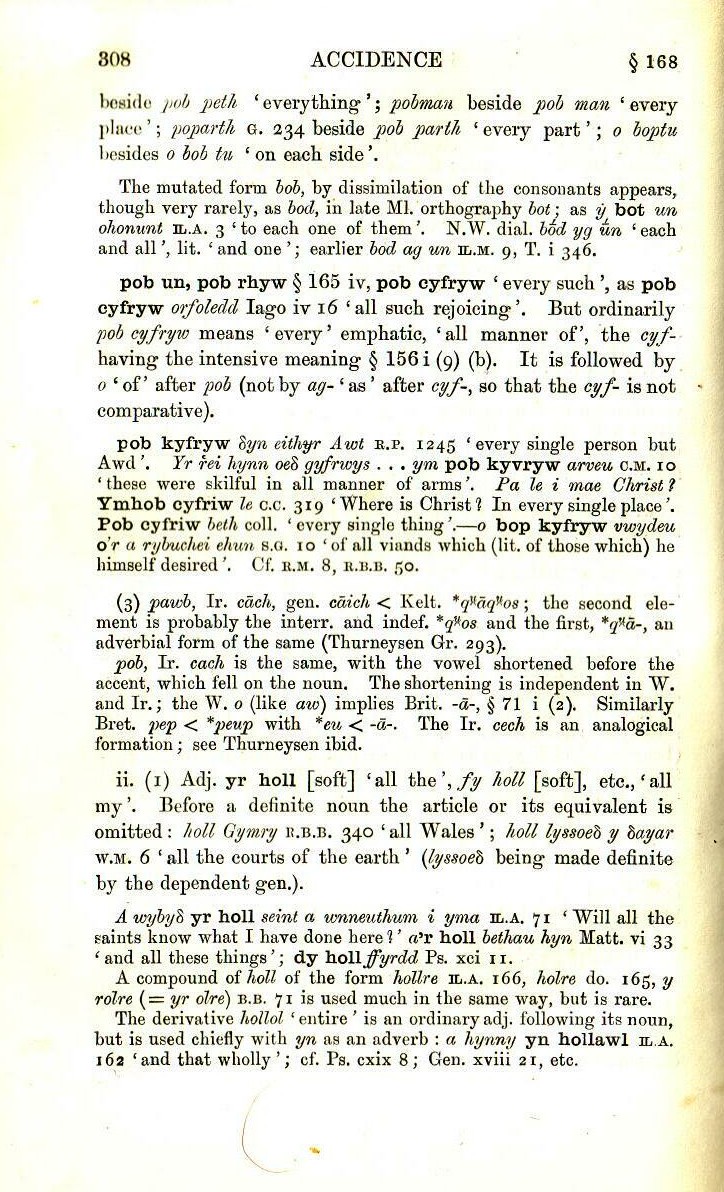


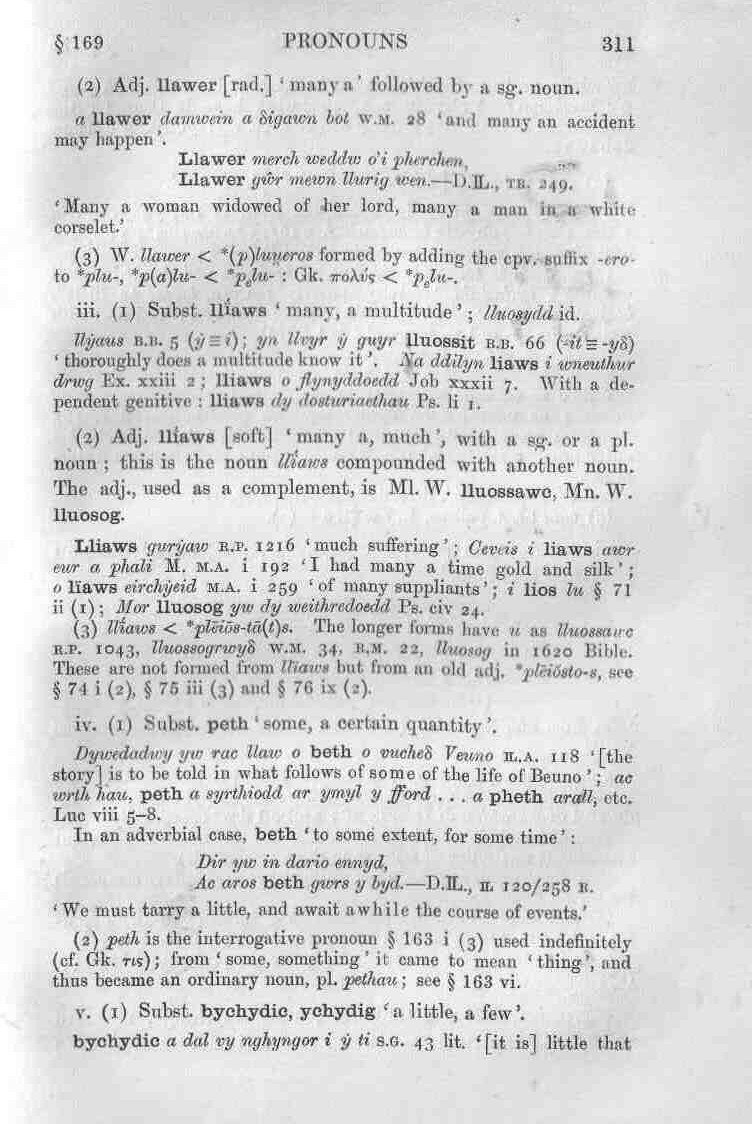

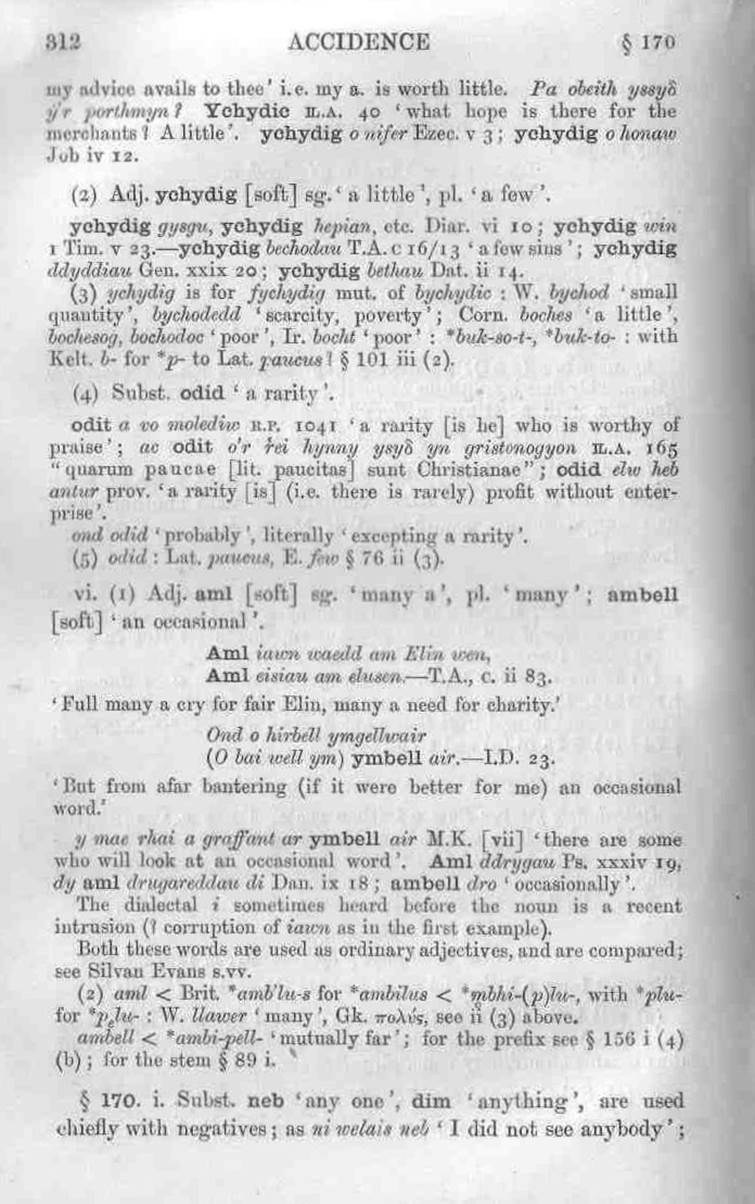

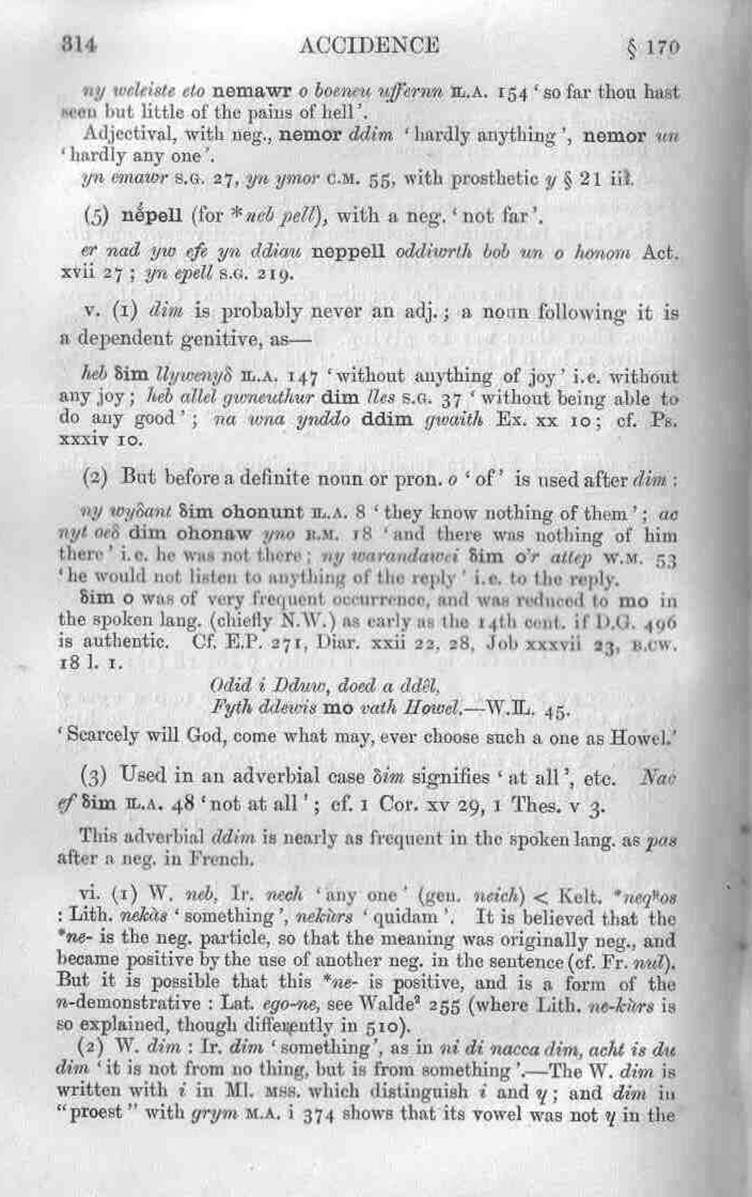
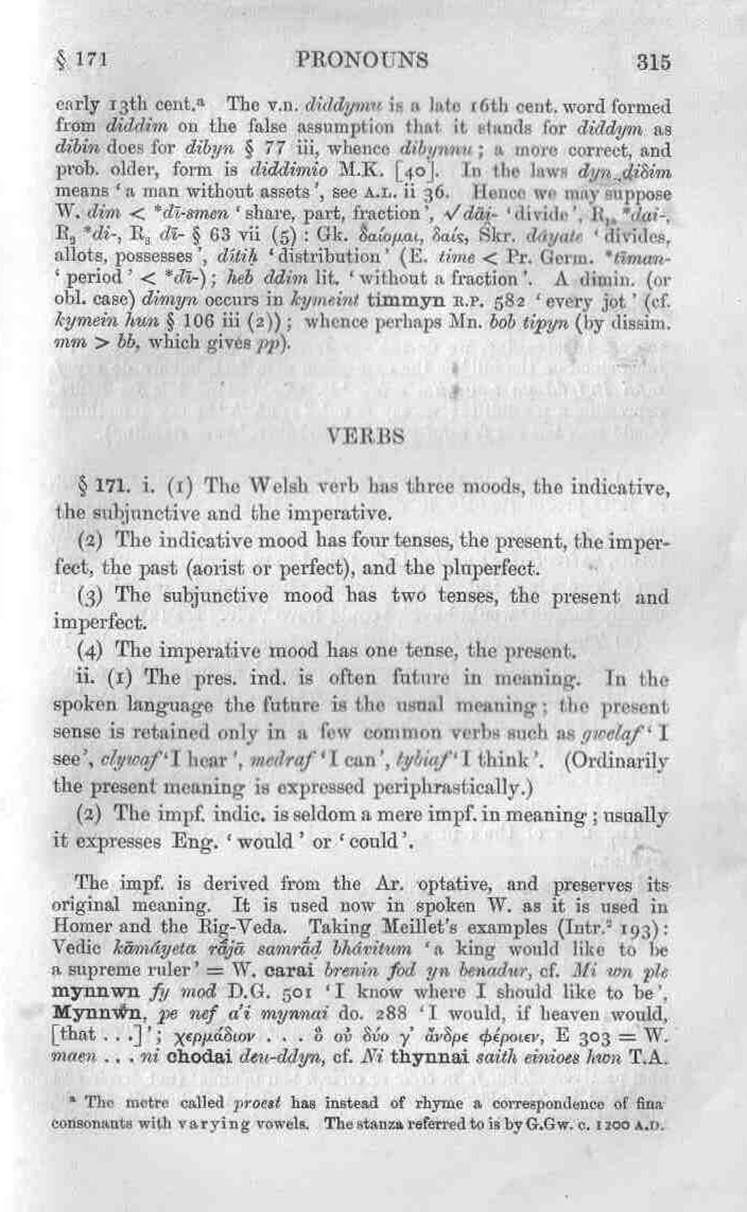
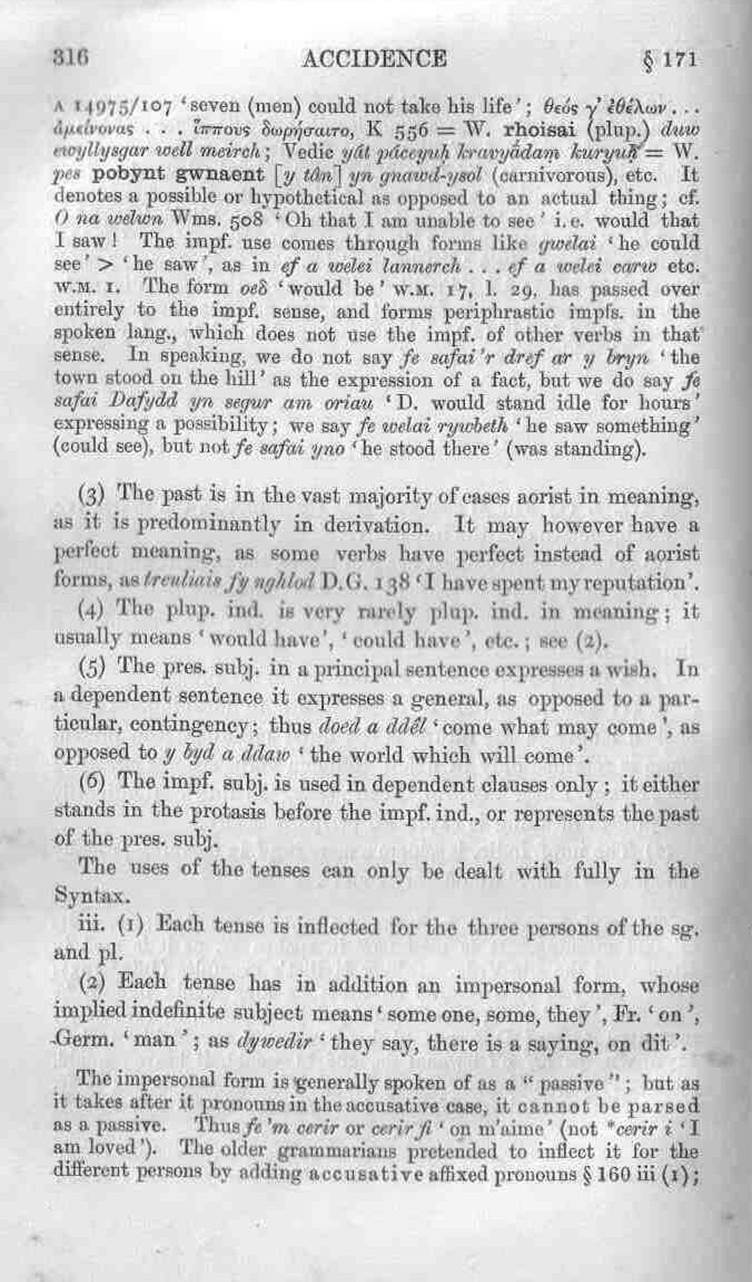

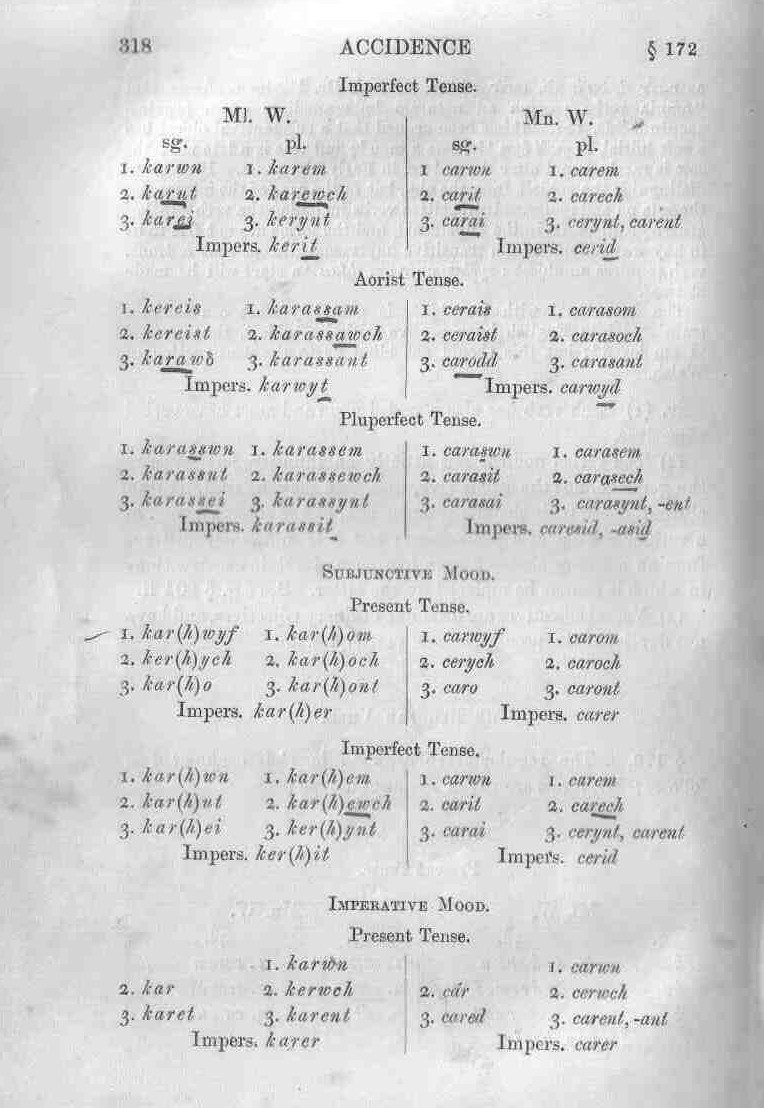
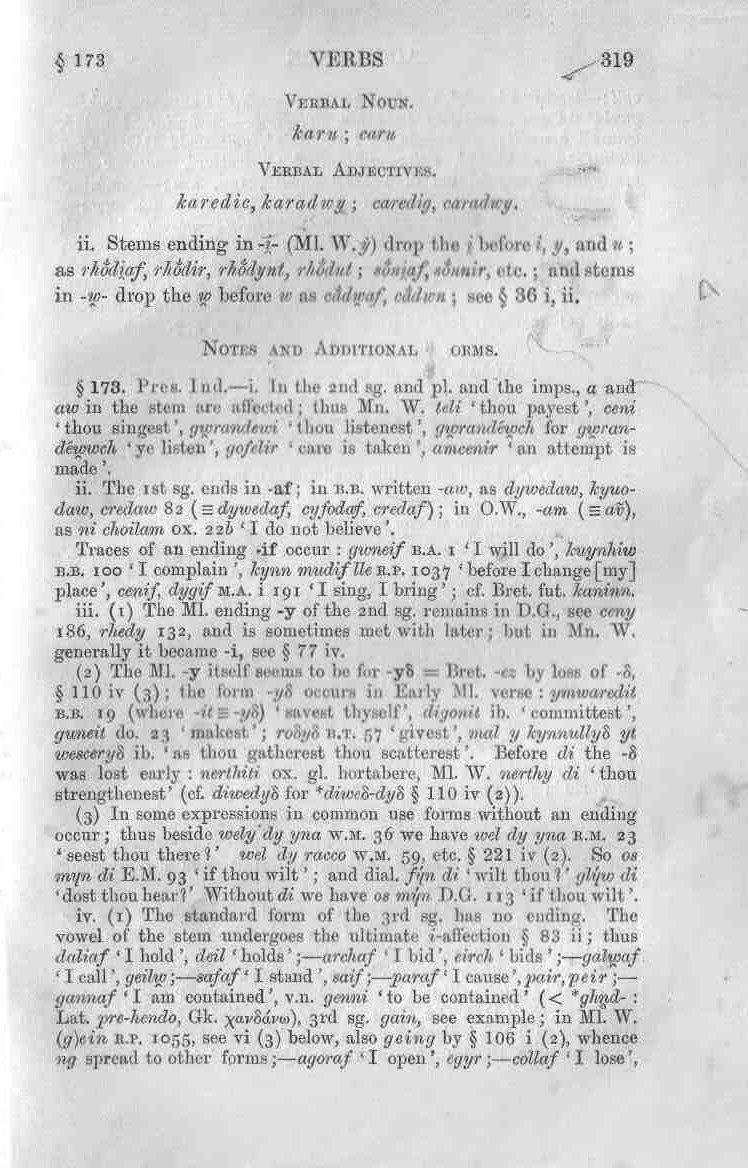
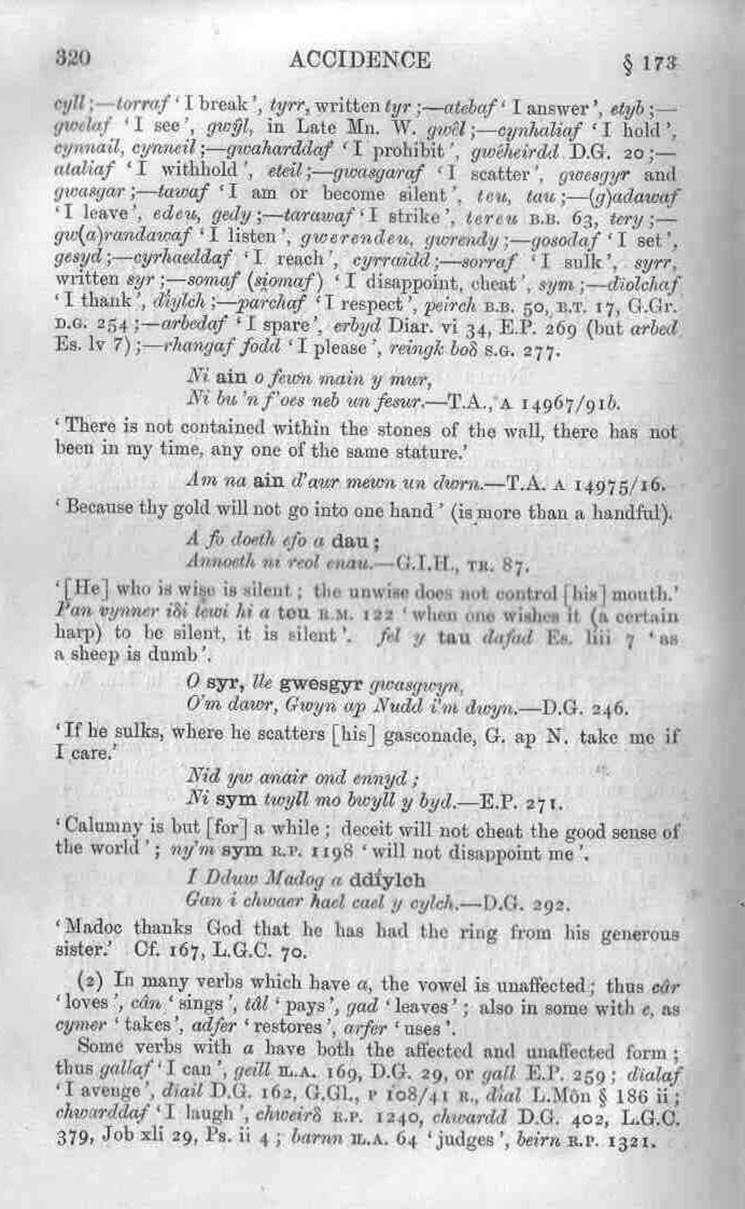
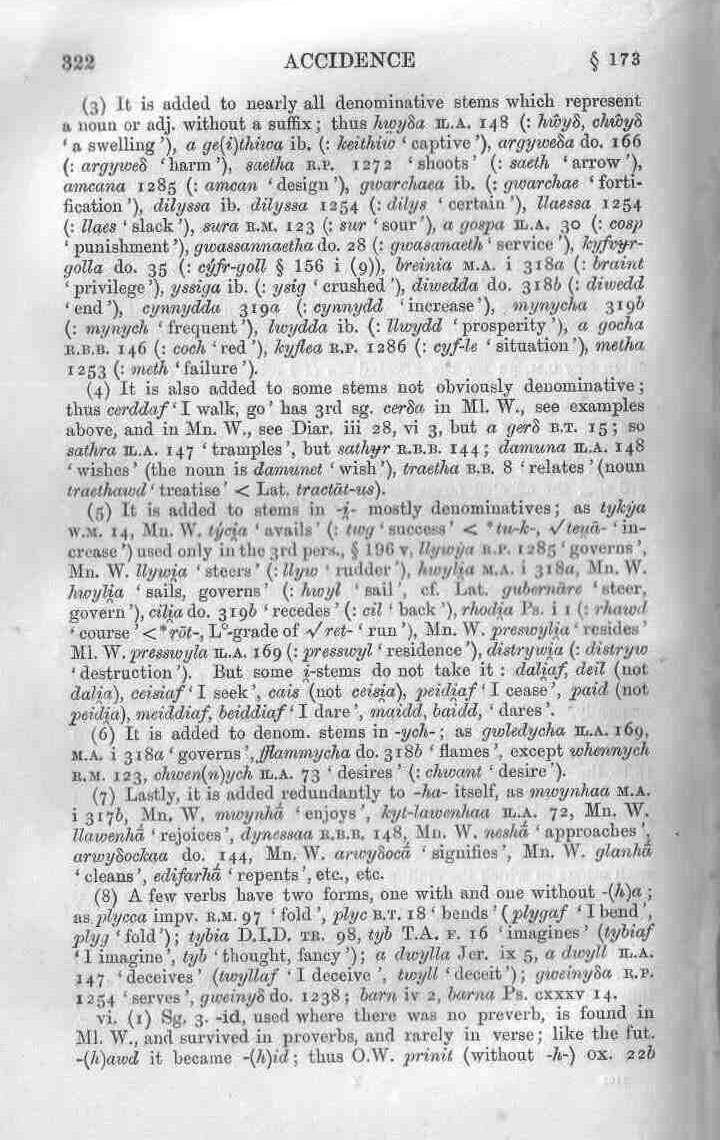
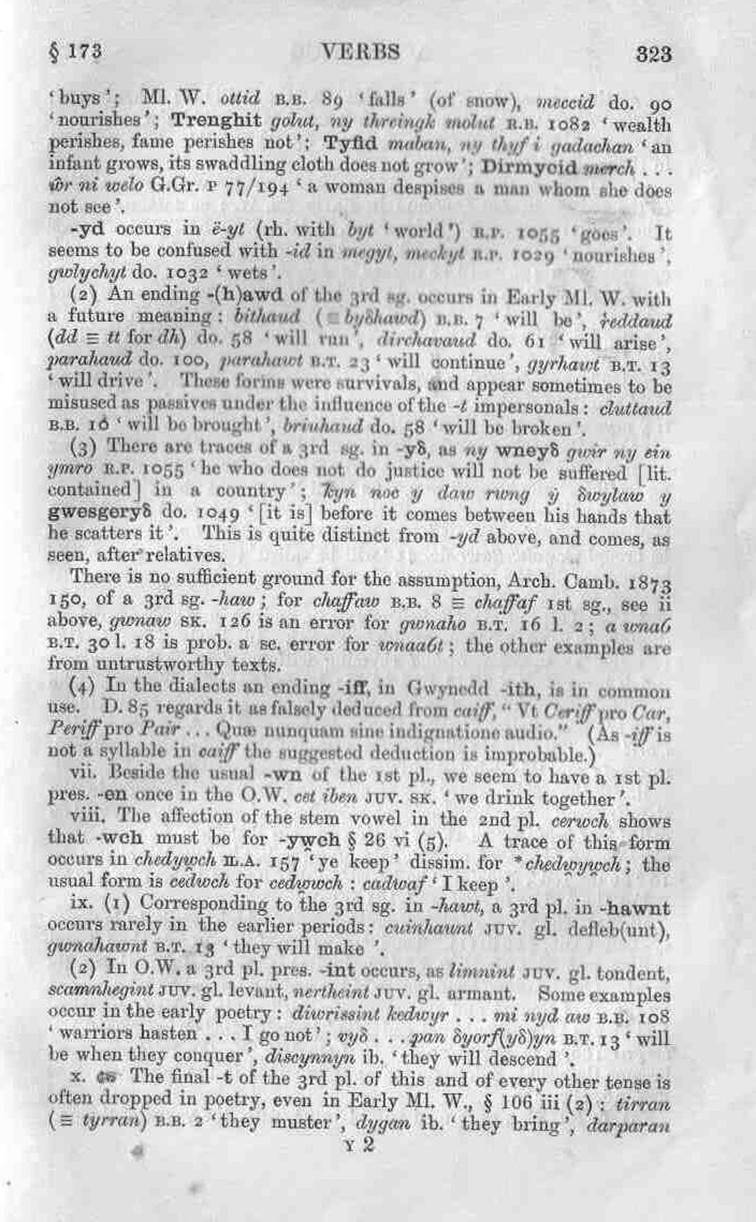
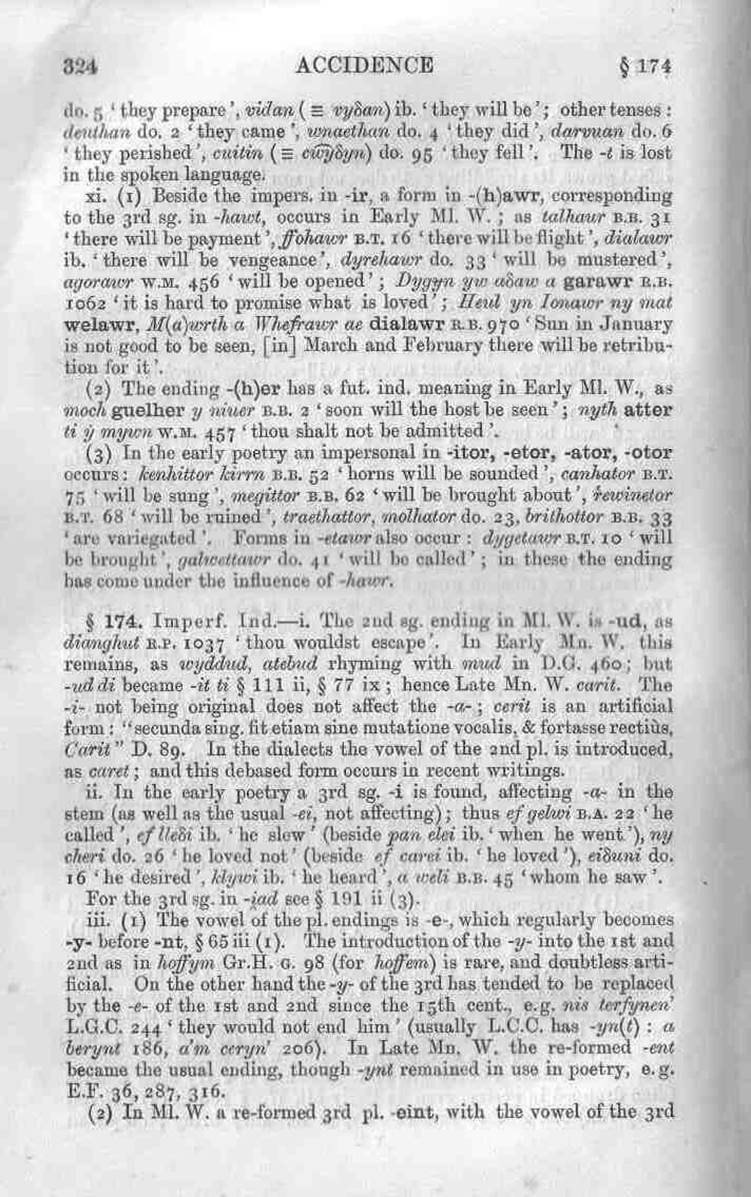
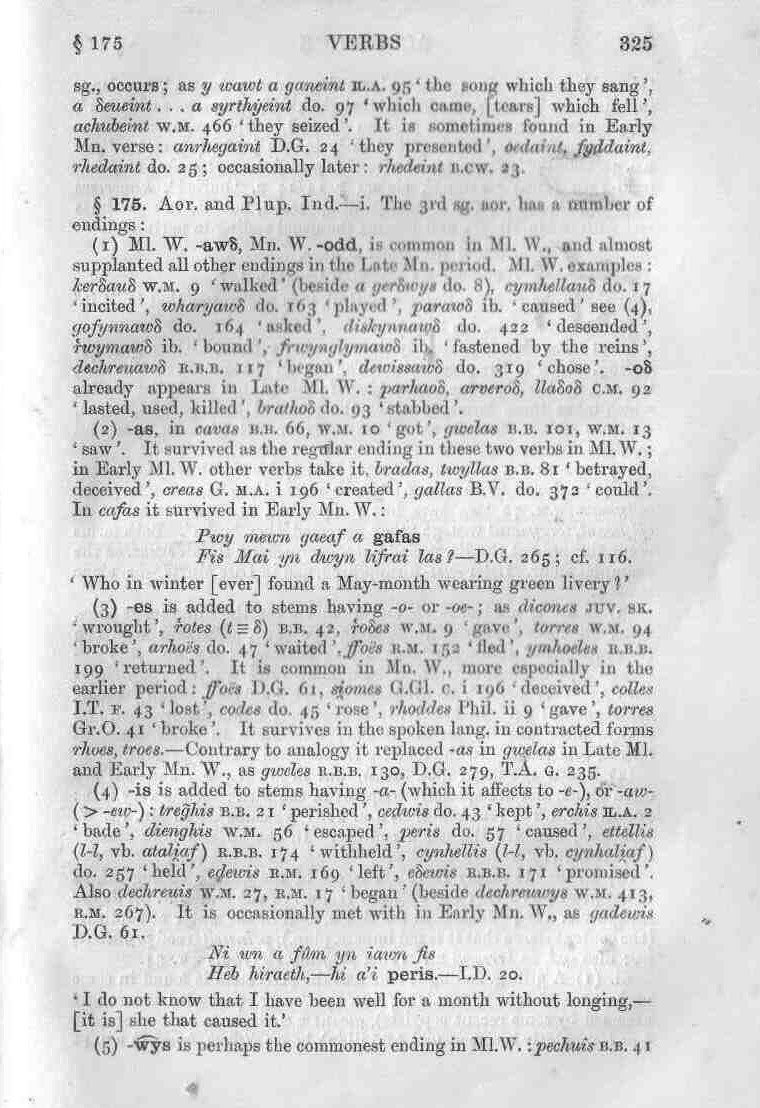
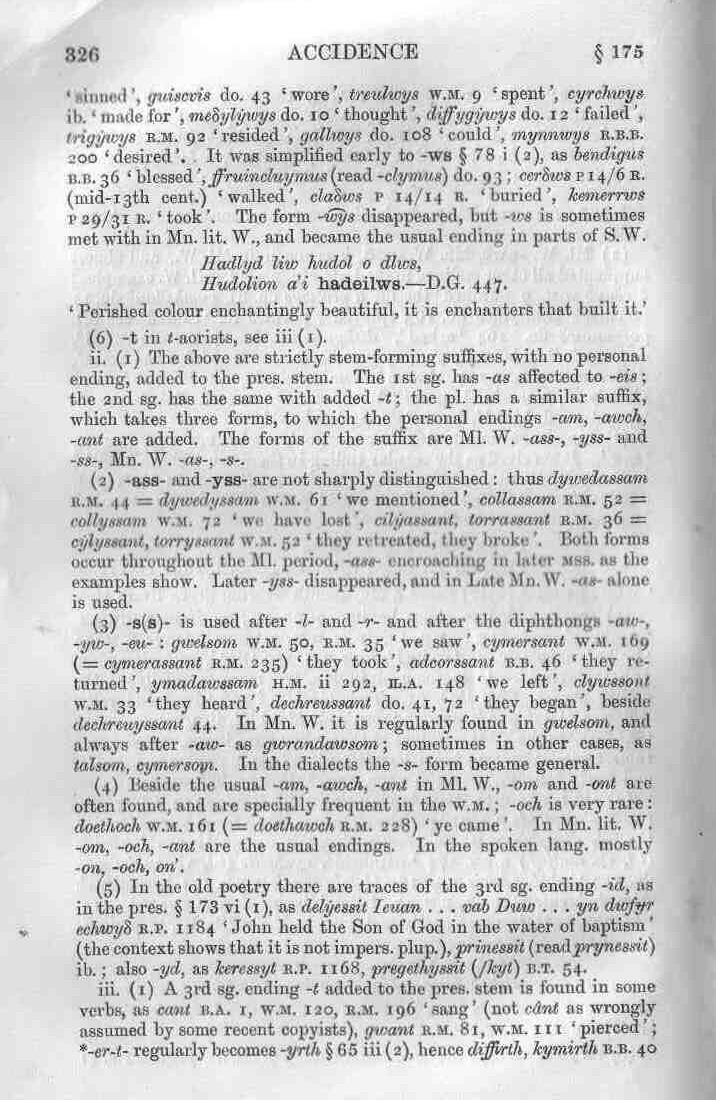

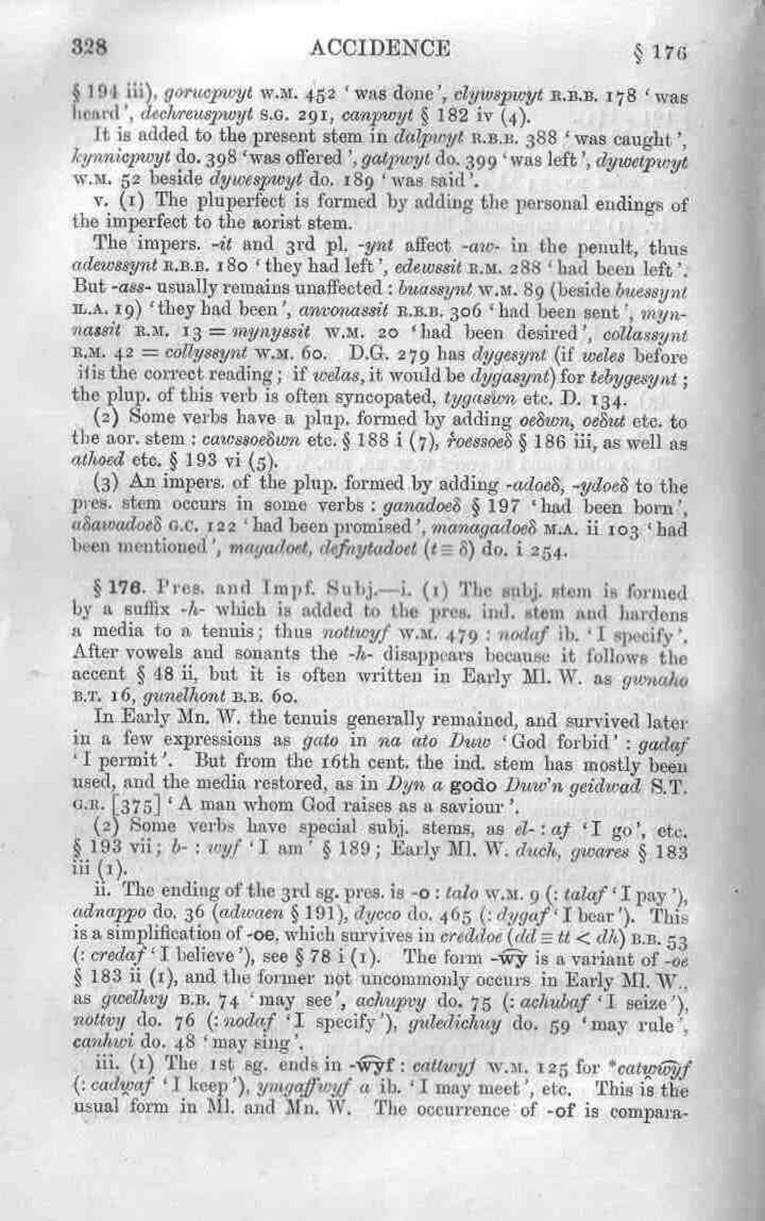



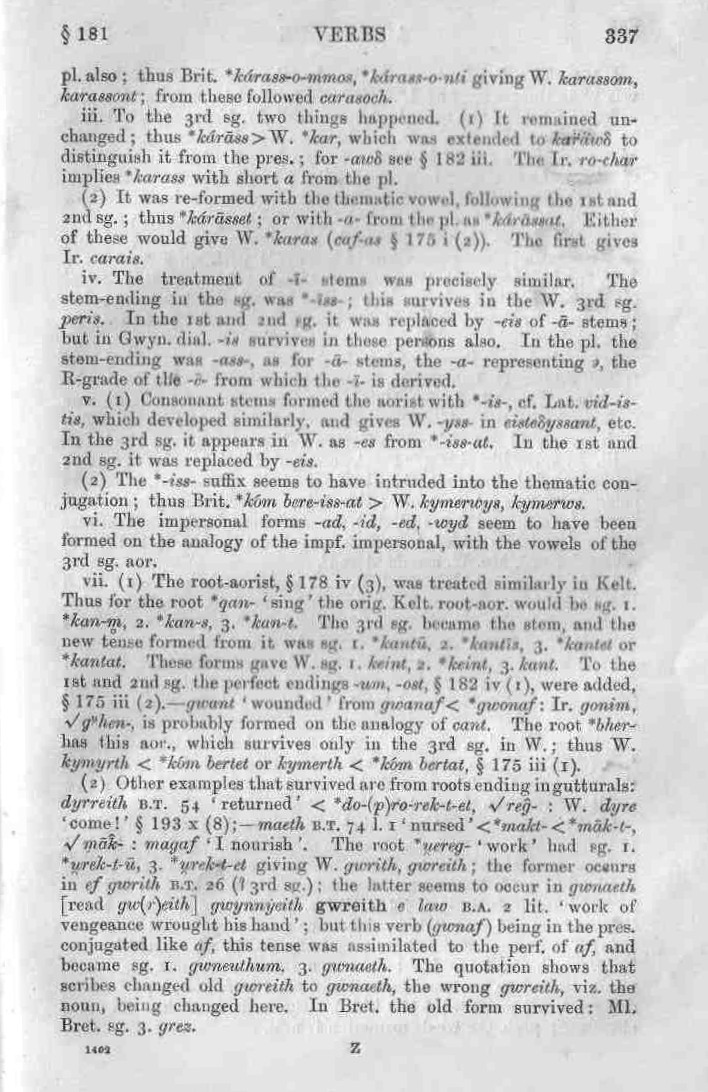
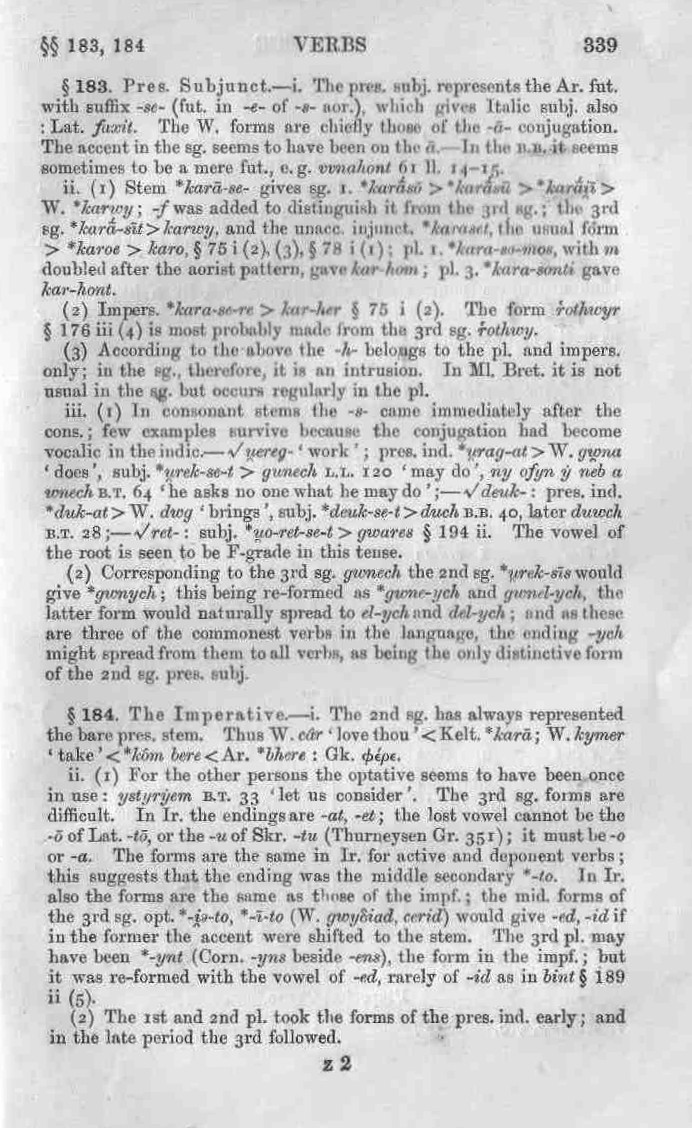
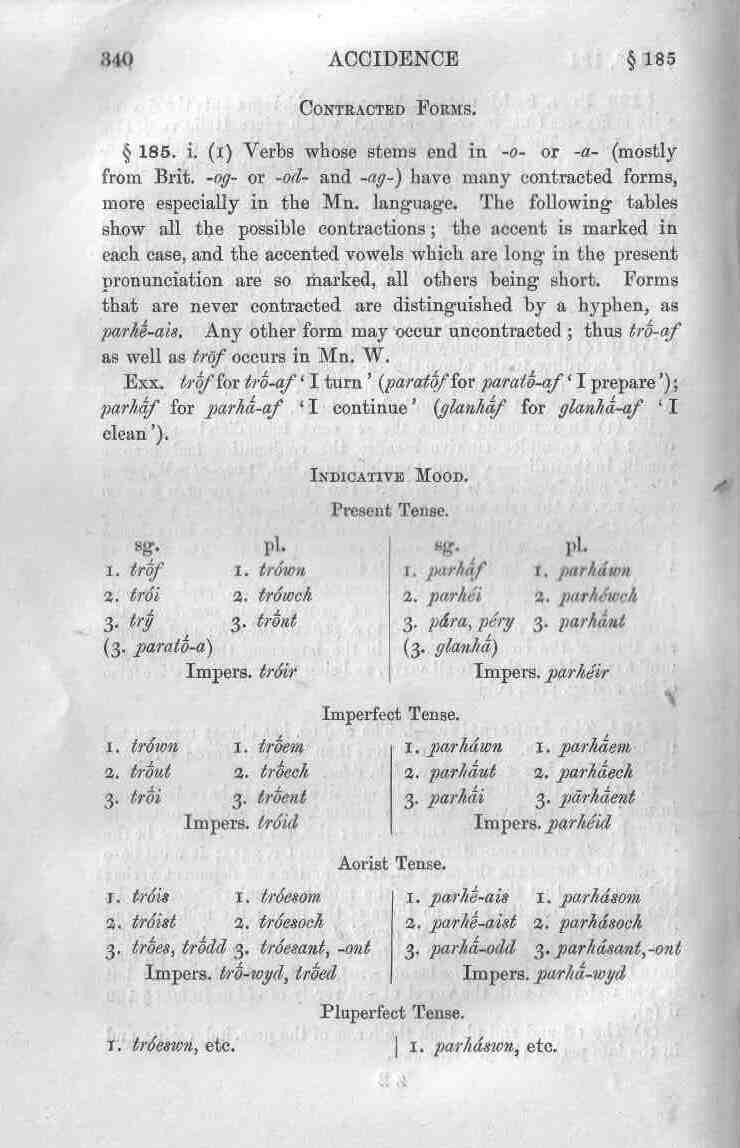
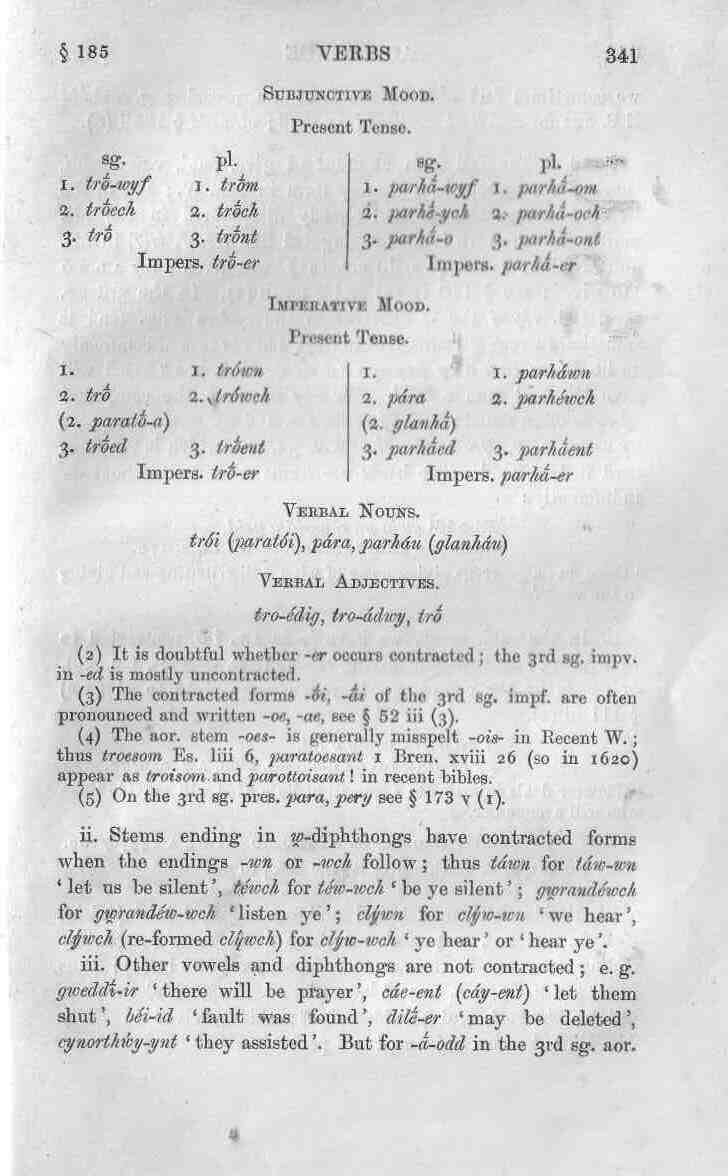
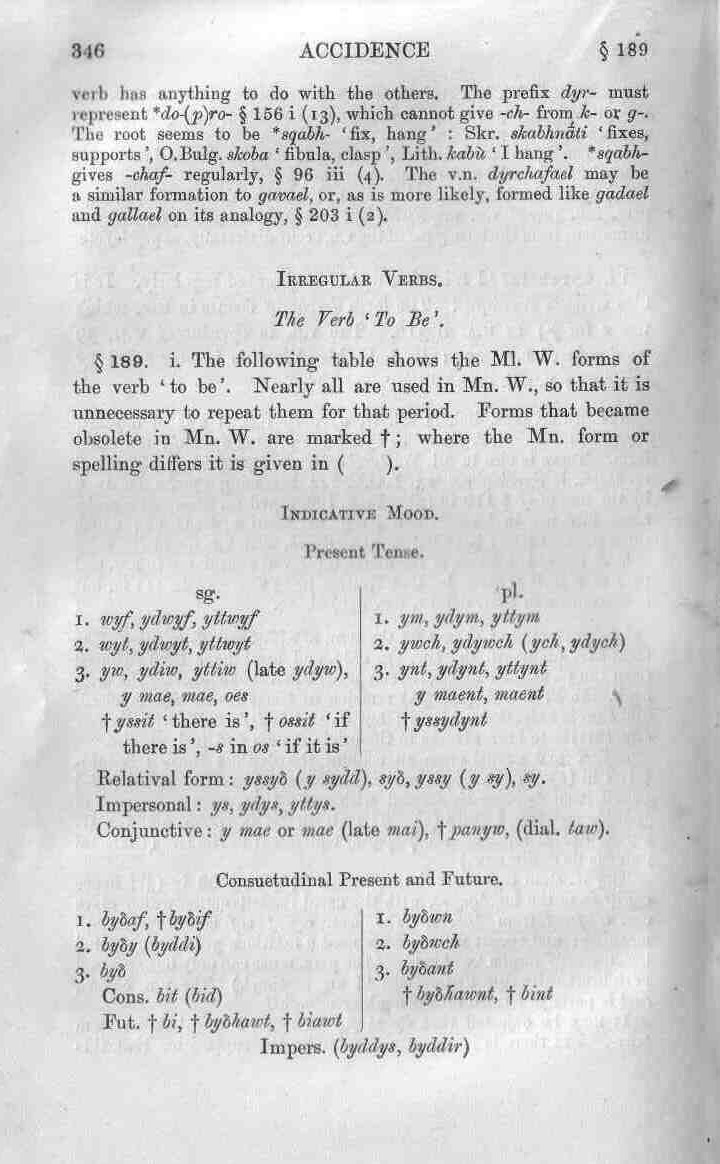

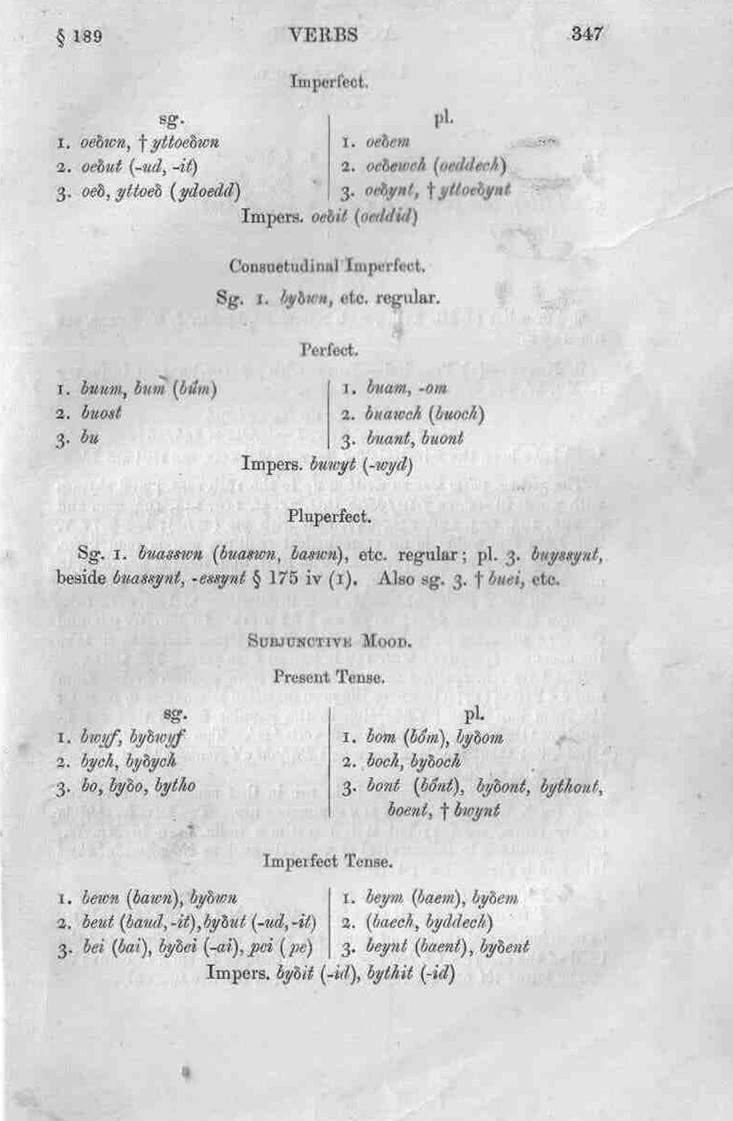
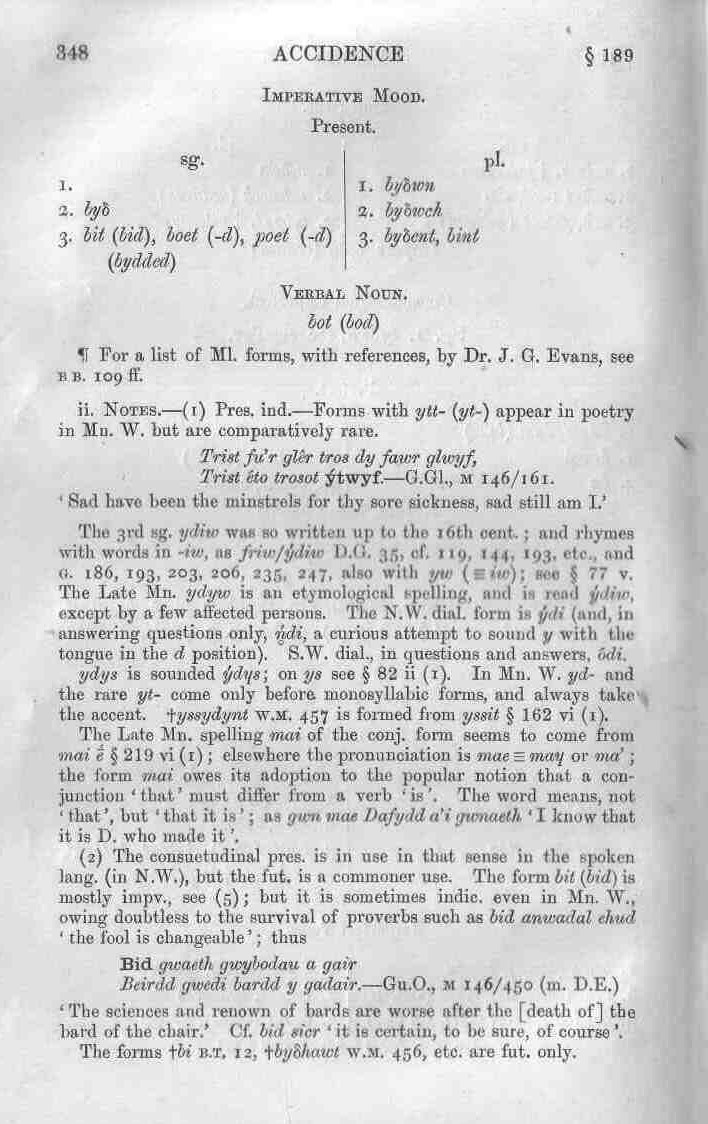
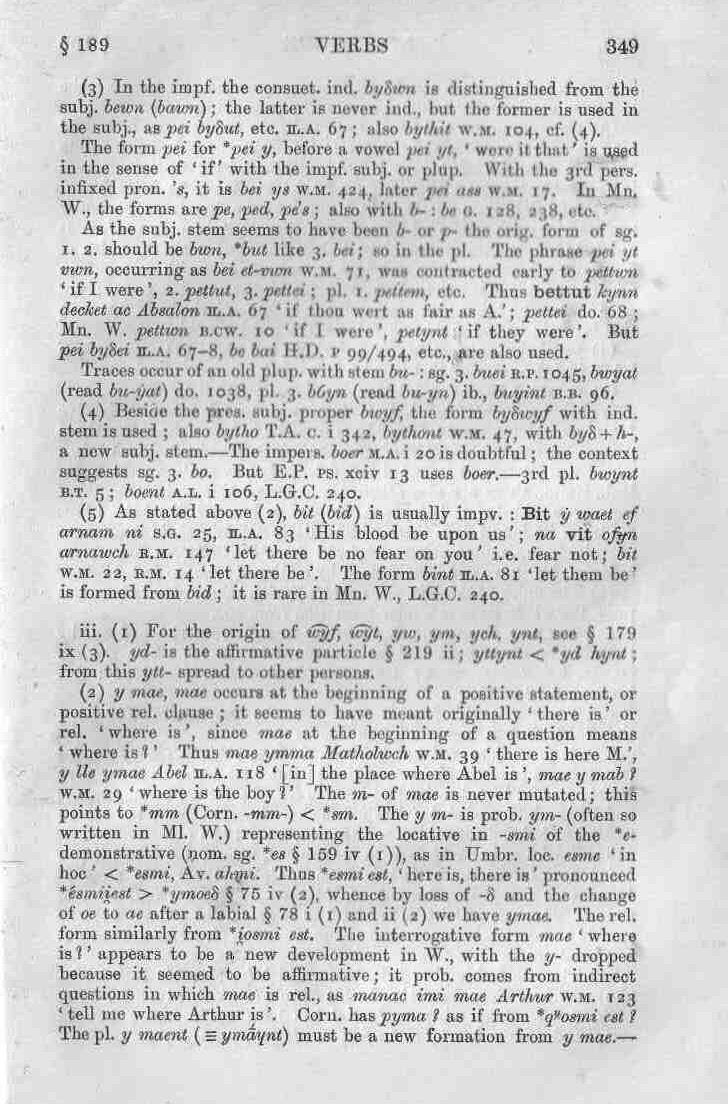
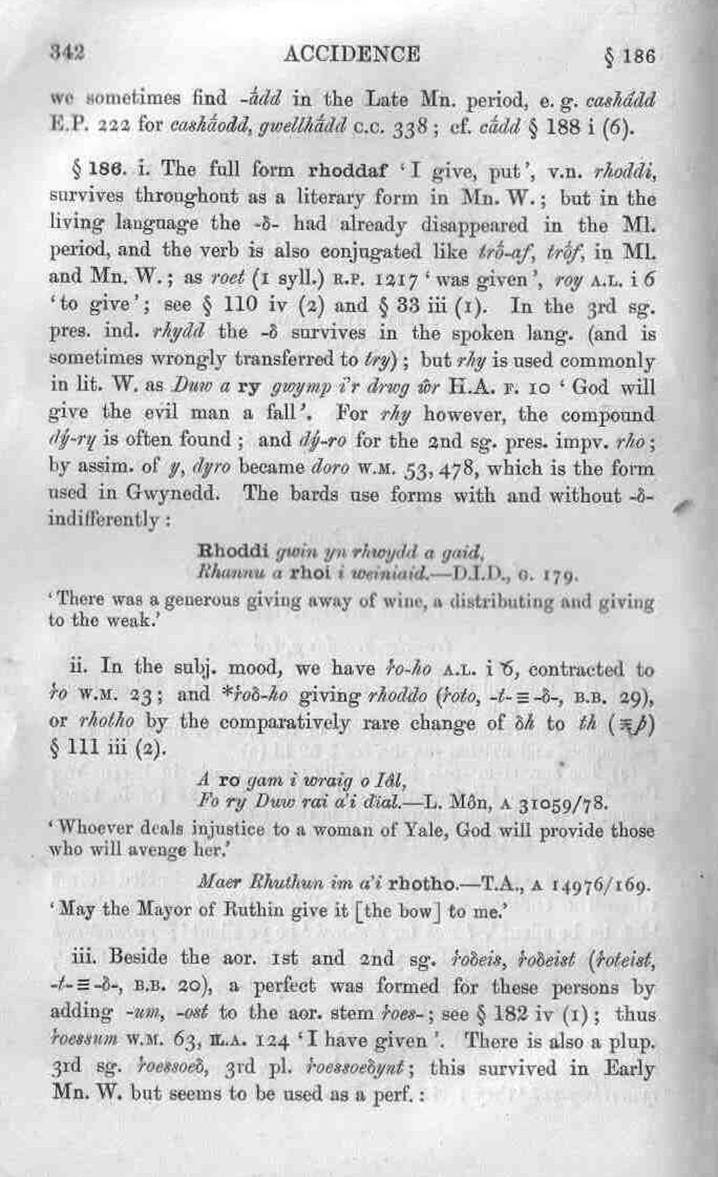
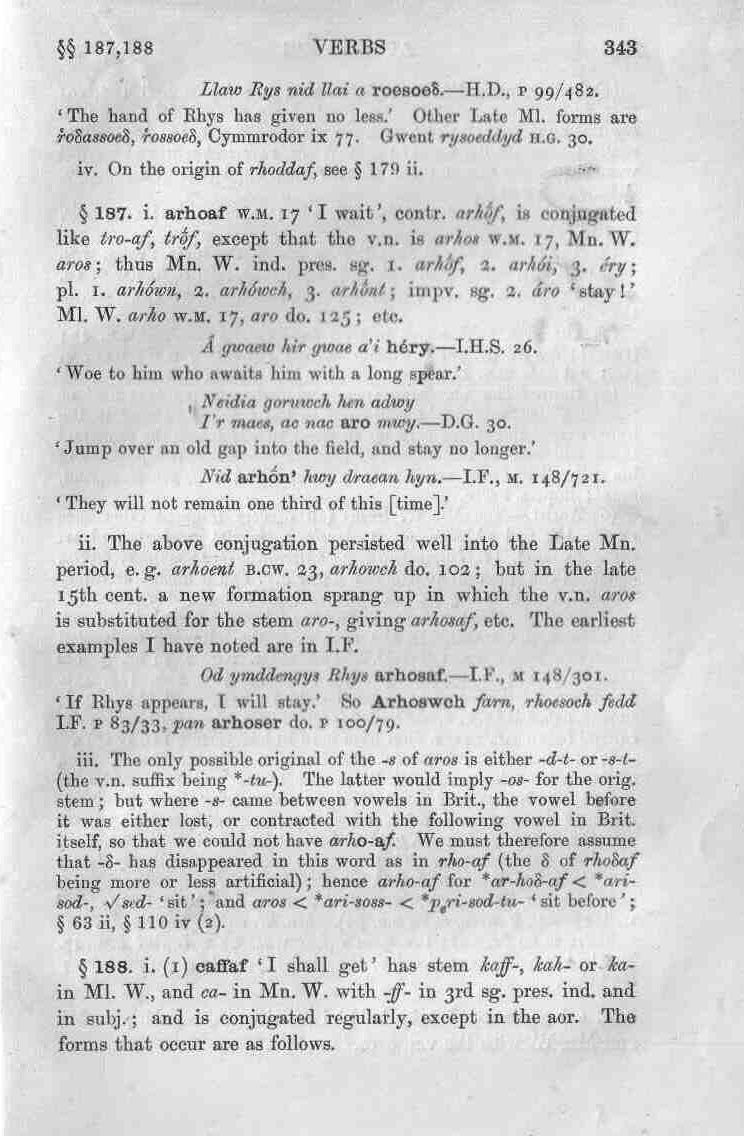
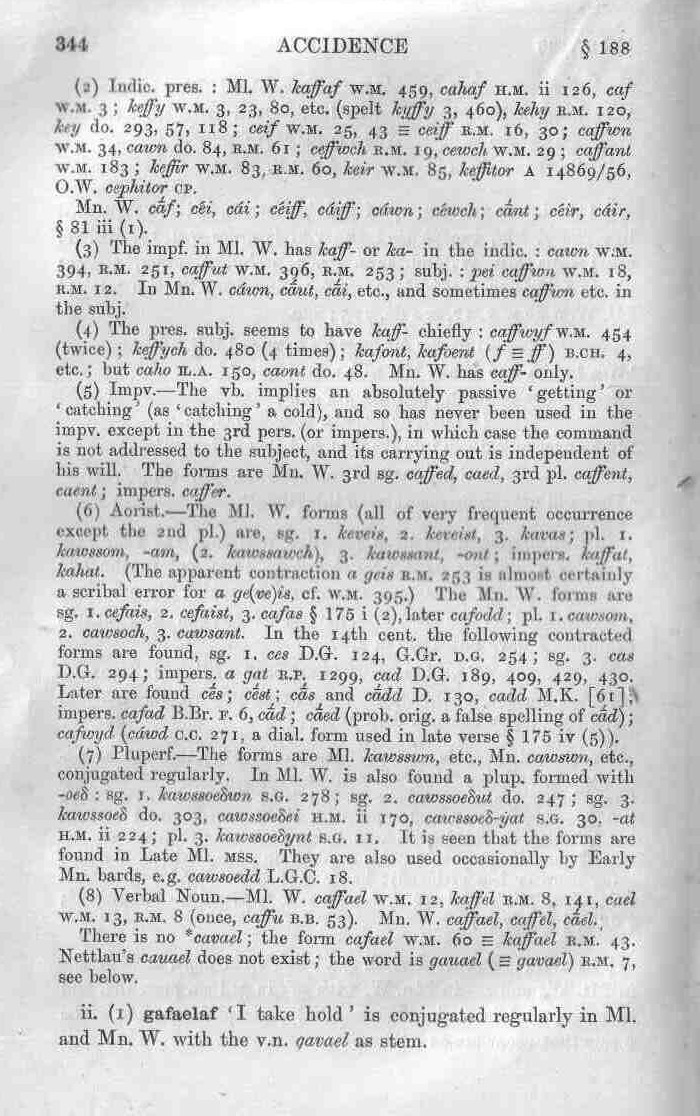
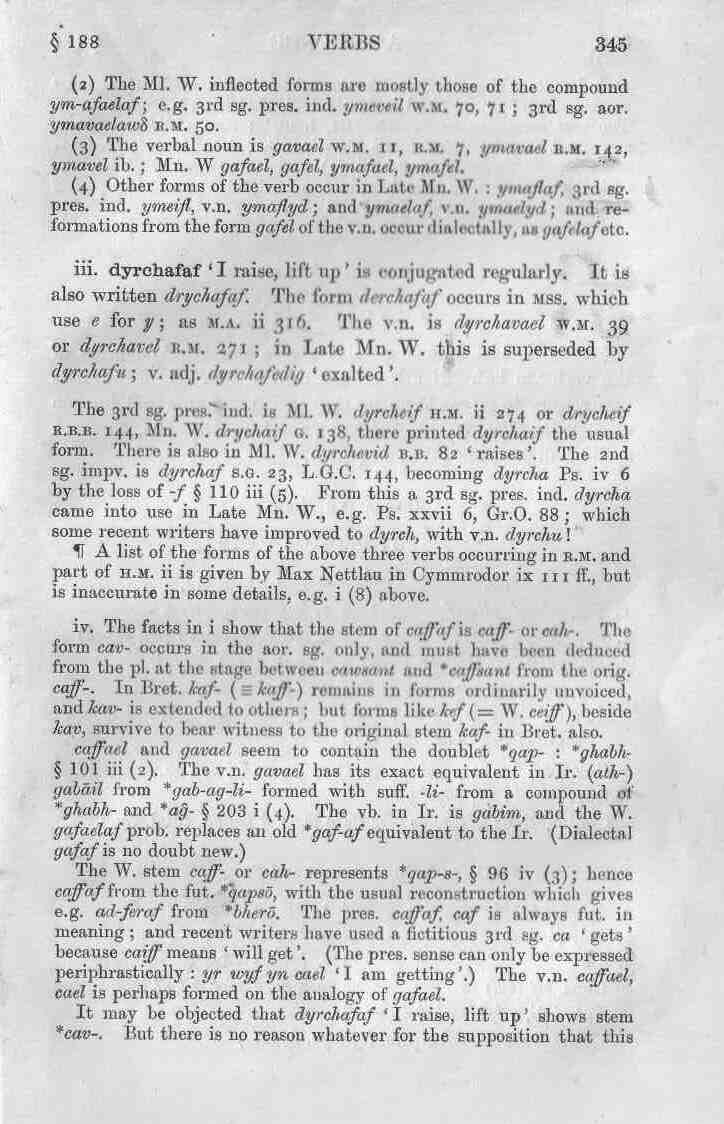
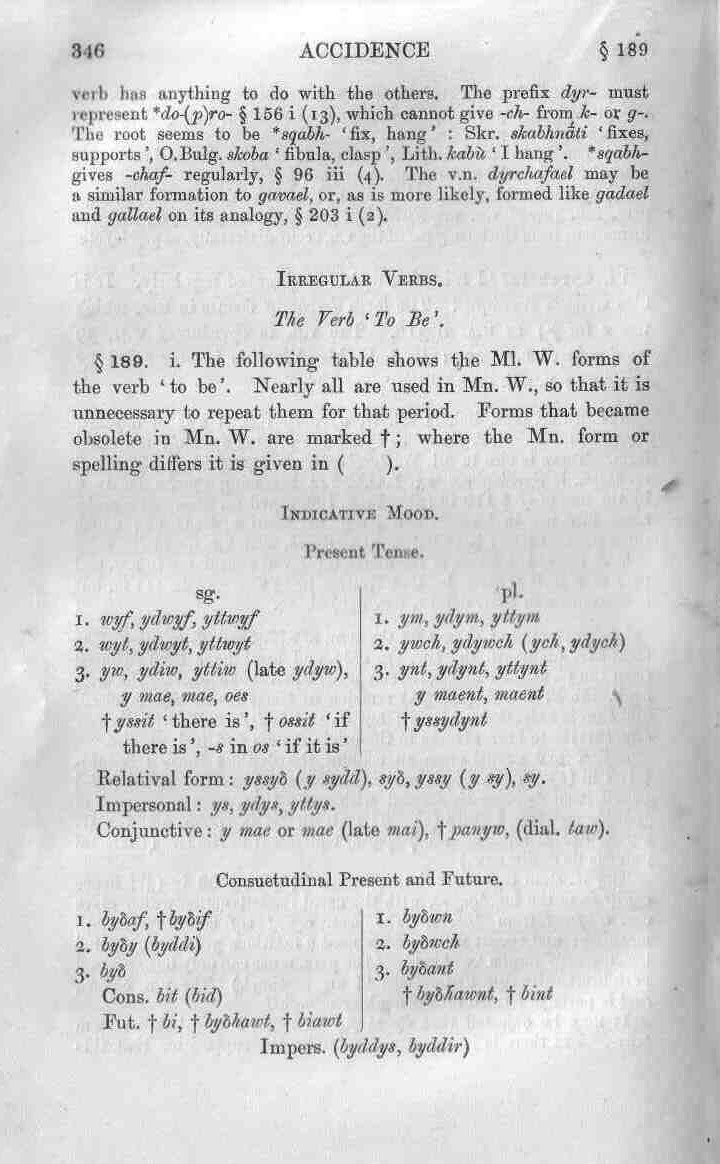
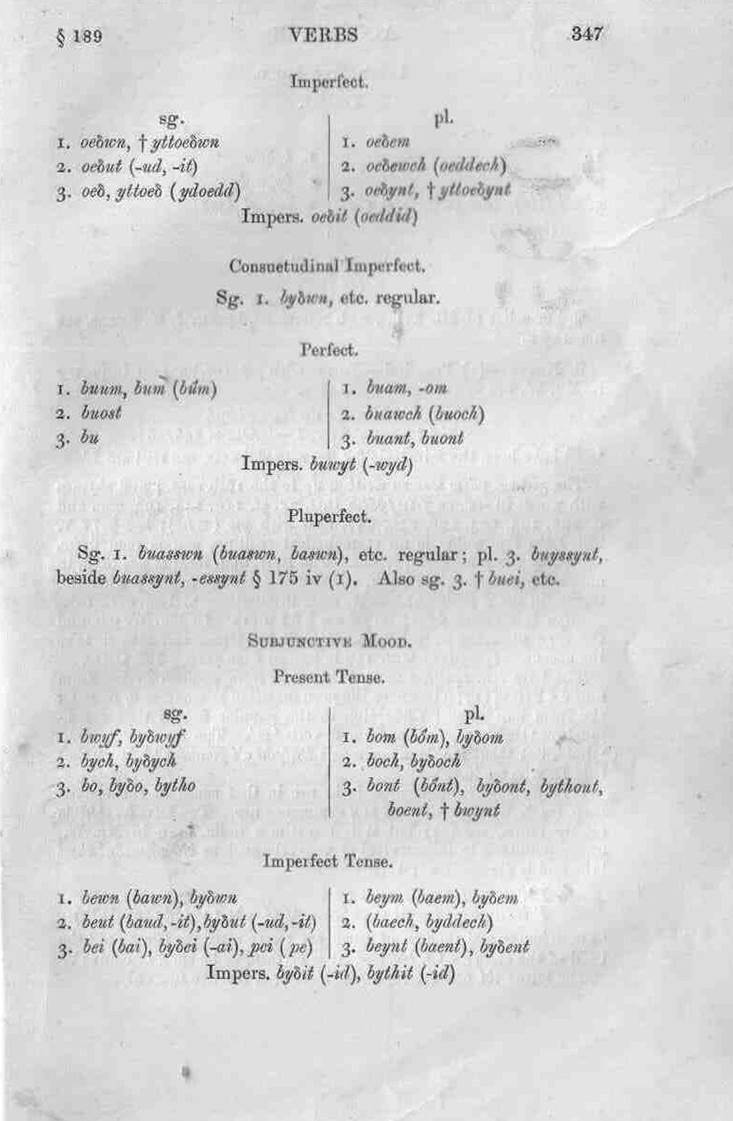
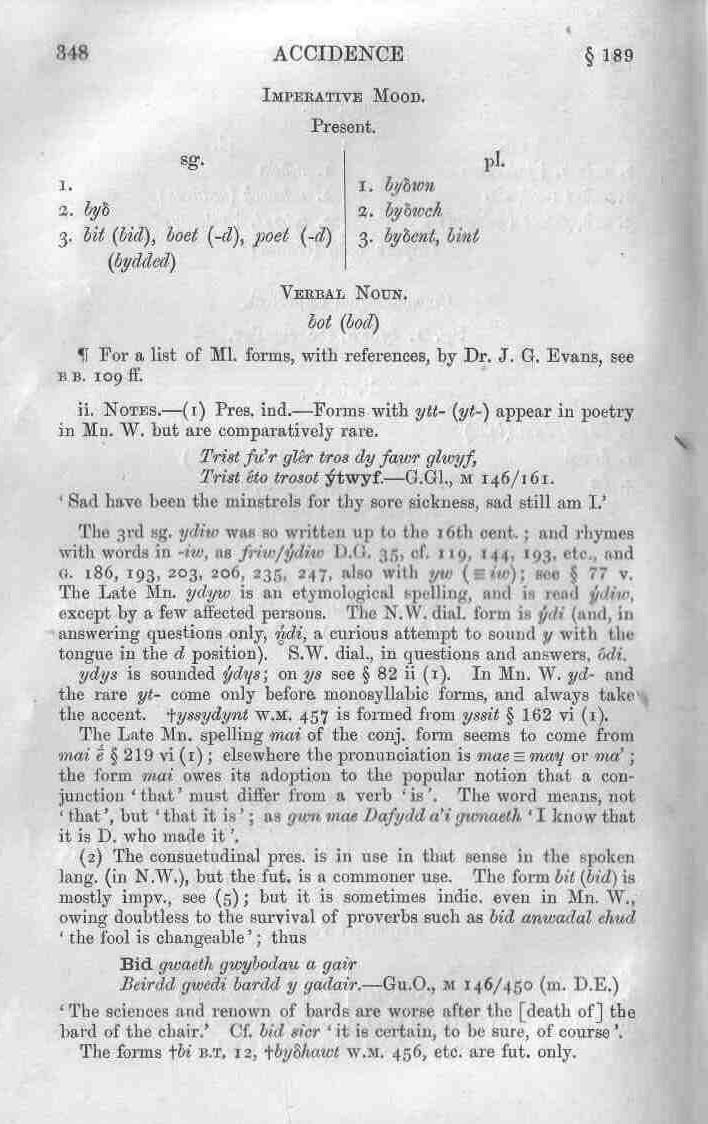
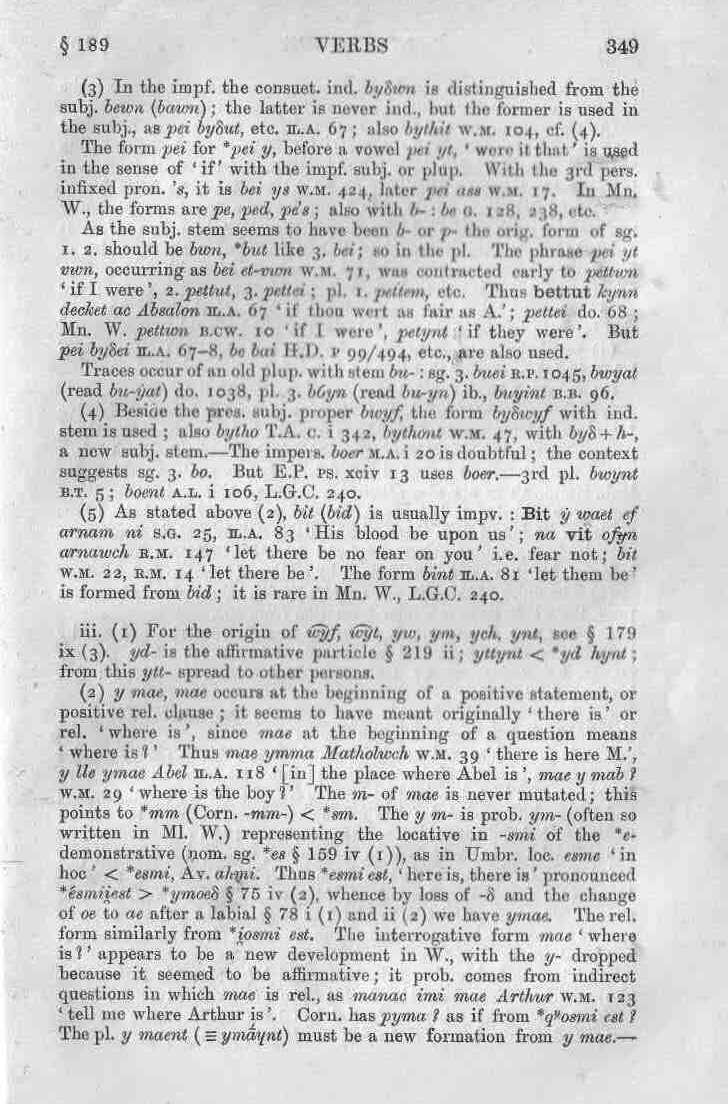
![[1]](https://en.wikisource.org/wiki/Page:Morris-Jones_Welsh_Grammar_0315.png#cite_note-1)

Y DUDALEN
NESAF: 2652e
Sumbolau:
a A / æ Æ / e E / ɛ Ɛ /
i I / o O / u U / w W / y Y /
…..
…..
MACRON: ā Ā / ǣ Ǣ /
ē Ē / ɛ̄ Ɛ̄
/ ī Ī / ō Ō /
ū Ū / w̄ W̄ / ȳ Ȳ /
MACRON + ACEN DDYRCHAFEDIG: Ā̀ ā̀ , Ḗ ḗ,
Ī́ ī́ , Ṓ ṓ , Ū́
ū́, (w), Ȳ́ ȳ́
MACRON + ACEN DDISGYNEDIG: Ǟ ǟ , Ḕ ḕ,
Ī̀ ī̀, Ṑ ṑ, Ū̀
ū̀, (w), Ȳ̀ ȳ̀
MACRON ISOD: A̱ a̱ , E̱ e̱ , I̱ i̱ ,
O̱ o̱, U̱ u̱, (w), Y̱ y̱
BREF: ă Ă / ĕ Ĕ / ĭ Ĭ / ŏ Ŏ / ŭ Ŭ
/ B5236:  B5237:
BREF GWRTHDRO ISOD: i̯, u̯
CROMFACHAU: ⟨ ⟩ deiamwnt
A’I PHEN I LAWR: ∀, ә, ɐ (u+0250) https:
//text-symbols.com/upside-down/
…..
…..
ˡ ɑ ɑˑ aˑ a: / æ æ: / e eˑe:
/ ɛ ɛ: / ɪ iˑ i: / ɔ oˑ o:
/ ʊ uˑ u: / ə / ʌ /
ẅ Ẅ / ẃ Ẃ / ẁ Ẁ / ŵ Ŵ /
ŷ Ŷ / ỳ Ỳ / ý Ý / ɥ
ˡ ð ɬ ŋ ʃ ʧ θ ʒ ʤ /
aɪ ɔɪ əɪ uɪ ɪʊ aʊ ɛʊ əʊ / £
ә ʌ ẃ ă ĕ ĭ ŏ ŭ ẅ ẃ
ẁ Ẁ ŵ ŷ ỳ Ỳ
…..
…..
Hwngarwmlawt: A̋ a̋
g yn
yn  aith δ δ
…..
…..
ә ʌ ẃ ă ĕ ĭ ŏ ŭ ẅ ẃ
ẁ ŵ ŷ ỳ
Ә Ʌ Ẃ Ă Ĕ
Ĭ Ŏ Ŭ Ẅ Ẃ Ẁ Ẁ Ŵ Ŷ Ỳ Ỳ
…..
….
Hwngarwmlawt: A̋ a̋
g yn
yn  aith δ δ
…..
…..
ʌ ag acen ddyrchafedig / ʌ with acute accent: ʌ́
|
Shwa ag acen ddyrchafedig Xwa amb accent agut Schwa with acute |
|
|
DejaVu Serif |
…..
wikipedia,
scriptsource.[]org
https://[ ]en.wiktionary.org/wiki/ǣ
…..
Y TUDALEN HWN /THIS PAGE / AQUESTA PÀGINA:
http://
[]www. []kimkat.org/amryw/1_gramadegau/gramadeg_2_1913_jmj_welsh_grammar_08_300-349_2651e.htm
____________________________________
Adolygiadau diweddaraf: Dÿdd
Mawrth 2005-11-20; Iau 2007-04-12
Sumbolau
arbennig: ŷ ŵ
Ble’r wyf i? Yr ych chi’n ymwéld ag un o dudalennau’r Gwefan
“CYMRU-CATALONIA”
On sóc? Esteu visitant una pàgina de la Web “CYMRU-CATALONIA” (=
Gal”les-Catalunya)
Weør àm ai? Yùu àar vízïting ø peij
fròm dhø “CYMRU-CATALONIA” (= Weilz-Katølóuniø) Wéb-sait
Where am I? You are visiting a page from the
“CYMRU-CATALONIA” (= Wales-Catalonia) Website
CYMRU-CATALONIA