kimkat2648e
A Welsh Grammar - Historical and Comparative. 1913. John Morris-Jones (1864-1929). Gwefan Cymru-Catalonia.
21-11-2025
.....
|
(delwedd 003) |
Gwefan Cymru-Catalonia A Welsh Grammar - Historical and
Comparative RHAN 5 |
|
.....
|
2644e Tudalennau |
Rhan 2: Tudalennau |
Rhan 3: Tudalennau §41- §75 |
Rhan 4: Tudalennau §75- §99 |
Rhan 5: Tudalennau §99- §120 |
Rhan 6: Tudalennau §120- §148 |
Rhan 7: Tudalennau §148- §165 |
Rhan 8: Tudalennau §165- §189 |
Rhan 9: Tudalennau §189- §209 |
Rhan 10: Tudalennau §209- §224 |
Rhan 11: Tudalennau (y mynegai) |
|
Secció 1: Pàgines |
Secció 2: Pàgines |
Secció 3: Pàgines §41- §75 |
Secció 4: Pàgines §75- §99 |
Secció 5: Pàgines §99- §120 |
Secció 6: Pàgines §120- §148 |
Secció 7: Pàgines §148- §165 |
Secció 8: Pàgines §165- §189 |
Secció 9: Pàgines §189- §209 |
Secció 10: Pàgines §209- §224 |
Secció 11: Pàgines (index) |
|
Part 1: Pages |
Part 2: Pages |
Part 3: Pages §41- §75 |
Part 4: Pages §75- §99 |
Part 5: Pages §99- §120 |
Part 6: Pages §120- §148 |
Part 7: Pages §148- §165 |
Part 8: Pages §165- §189 |
Part 9: Pages §189- §209 |
Part 10: Pages §209- §224 |
Part 11: Pages (index) |
Gweler hefyd / Vegeu també / See also: https://en.wikisource.org/wiki/A_Welsh_Grammar,_Historical_and_Comparative
.....
|
|
|
|
||||||||||||||||||||||||||||||||||||||||
|
|
|
150 PHONOLOGY § 99 *tronq‑, see vi (3)) : Lat. stercus, Bret. stroñk ‘excrement’. It is seen that the loss is later than the change onk > unk § 65 iii (1) ; it also takes place in Lat. loanwords, as W. pwyth ‘stitch’ < punctum; but in the later of these the first explosive drops, as in sant < sanctus. (4) When two explosives came before a liquid or nasal, the group remained in Pr. Kelt.; thus W. eithr ‘except’, Ir. echtar < *ektro‑s: Lat. exterus, extrā, Osc. ehtrad (‑x- for *‑c- is a Lat. innovation, Walde² 263);—W. aethn-en ‘aspen’ < *aktn- < *aptn‑: Lith. apuszė ‘aspen’, O. H. G. apsa, O. E. æps, E. asp: Lat. pōpulus < *ptō̆ptol‑, Gk. πτελέα ‘elm’. But a double explosive before a sonant was not distinguished in Ar. from a single; thus ettre was not distinct from etre, Meillet, Intr.² 102. In Homer and the Veda the first syllable is metrically long; in Plautus and Aristophanes, short; ordinarily in Gk. and Lat., doubtful. In old Kelt. formations we have one t for two, as in Gaul. Atrebates, W. adref ‘homewards’ < *atreb- < *attr- < *ad‑tr‑. In later formations the double consonant remained, as in W. athrist ‘sad’ < *attrīstis < *ad- + Lat. trīstis. kr, tr may develop as kkr, ttr in W. as in ochr, rhuthr § 104 iii (2). A double media in Brit. is treated regularly as a single tenuis in W., as in edrych ‘to look’ < *etr- < *ed‑dr- < *ad‑dr- or *eg‑dr‑; once as a double tenuis; see l. c. vi. (1) A group of the form nt or nd, followed immediately or mediately by a liquid or nasal, has tended from an early period in Kelt. to become a double explosive tt or dd with nasalization of the preceding vowel. In Ir. the double consonant was simplified before the sonant; see cēol, abra, cobrith (b ≡ ƀ) below. The change, being a case of dissimilation of the continuants, does not take place regularly, § 102 i; it often exists side by side with the regular development of the group. Thus O.W. ithr ‘between’, Bret, etre, Van. itre, Ir. eter (not *ēt- the regular Ir. for *ent‑) beside Bret. eñtre, Corn. yntre: Lat. inter, Skr. antár;—W. athrugar ‘pitiless’ < *ąttr- beside Ir. ētrōcar < *entr‑, both < *n̥-trougākaros;—W. cathl ‘song’ < *kąttlo‑, Ir. cēol id. < *kęt(t)lo‑, O. W. centhliat, centhiliat (en ≡ ę) gl. canorum, beside Ir. cētal < *kentlo‑, Bret. keñtel ‘lesson’;—W. allwedd f. ‘key’ for *alchwedd, Bret. alc’houez metath. for *achlweẟ < *n̥-ql(ə)u̯-íiā (‘unlocker’, |
||||||||||||||||||||||||||||||||||||||||
|
|
|
|
||||||||||||||||||||||||||||||||||||||||
|
|
1 : 1681 |
§ 100 THE ARYAN CONSONANTS 151 cf. agoriad ‘opener’ used instead in N. W.), also allwydd m. < ‑íios: Lat. claudo, clāvis, Gk. κληίς, etc.;—W. achles ‘shelter’ < *n̥-kl̥-stā (n̥- ‘in’), √k̑el- ‘hide’: O. H. G. hulst ‘cover’, W. clyd § 63 iii;—W. achenog ‘needy’, achen ‘need’, beside W. anghenog, angen, Ir. ēcen ‘need’ < *n̥k-en‑: Gk. ἀνάγκη. Mediae: W. adyn ‘wretch’ < *ąddoni̯os < *n̥-doni̯os ‘not-man’, beside the later annyn ‘wretch’, annynol ‘inhuman’, Mn. Ir. anduine;—W. agor ‘to open’ < *ąggor- < *n̥-ghor- (n̥- negative), beside egor id. < *eggor- (pref. *ek‑), √g̑her- ‘enclose’: Lat. hortus, Gk. χόρτος, W. garth;—W. w͡ybren ‘cloud, sky’, O. Corn. huibren, Ml. Corn. ebron, Bret. Van. ebr, beside Ir. imrim ‘storm’: Lat. imber, § 100 v;—W. hebrwng ‘to accompany, convey’, O. Corn. hebrenchiat, Mn. Corn. hembronk, Ml. Bret. hambrouk < *sem-broŋk‑: Skr. sam- ‘with’, Goth. briggan, E. bring;—Bret. abrant ‘eyebrow’, Corn. abrans < *abbr‑, Ir. abra < *abr‑, beside W. amrant < *am-brant- (n̥- ‘in’): Lat. gen. front-is;—Ir. cobrith ‘help’, beside W. cymryd ‘to take’ < *kom-bhr̥‑t‑. The nasalized vowel sometimes develops a new nasal, resulting in a new nd, etc., which does not become nn; thus W. enderig ‘steer’, O. W. enderic gl. vitulus, beside W. anner ‘heifer’ which contains old nd; Gwyn. dial, ắŋ-gar ‘hot breath, steam’ for lit. W. ager ‘steam’ < *ągger‑, beside angerdd (ng ≡ ŋŋ) < *‑aŋger‑, all < *n̥-ɡu̯her- § 92 v. Similarly ltr > *ttr > thr in athro § 76 v (5). (2) It has been conjectured that an explosive + n sometimes became a double explosive in Kelt.; Pedersen, Gr. i 158, suggests that this took place immediately before the accent. Thus Ir. brecc, W. brych ‘speckled’ < *brikkos < *bhr̥knós: Gk. περκνός § 101 iii (2); as ‑cc occurs in Ir., the doubling here is not Brit. r̥kk < r̥k § 61 i (1);—W. crwth a kind of fiddle, croth ‘womb’, Ir. cruit ‘harp, hump’ < *qrutn‑: Lith. krūtìs ‘woman’s breast’, krūtìnė ‘breast’.—But many doublings attributed to this cause are due to other causes; see Thurneysen Gr. 88. (3) It seems as if n + explosive coming after a sonant might become a double explosive, as in W. rhoch ‘snore’: Gk. ῥόγχος, ῥέγκω § 97 v (3). We have nk > kk > c’h after a nasal in the Bret. mutation after ma ‘my’, nao ‘nine’, as va c’haloun ‘my heart’, nao c’hant ‘900’; but the development is regular in W. § 100. i. (1) Ar. i̯- (Lat. j‑, Gk. ῾, Germ. j, Lith. j, Skr. y‑) remained in Pr. Kelt.; it disappears in Ir., but remains in W. Thus W. i̯euanc, Bret. iaouank, Corn. iouenc, Ir. ōac, ōc: Lat. |
||||||||||||||||||||||||||||||||||||||||
|
|
|
|
||||||||||||||||||||||||||||||||||||||||
|
|
|
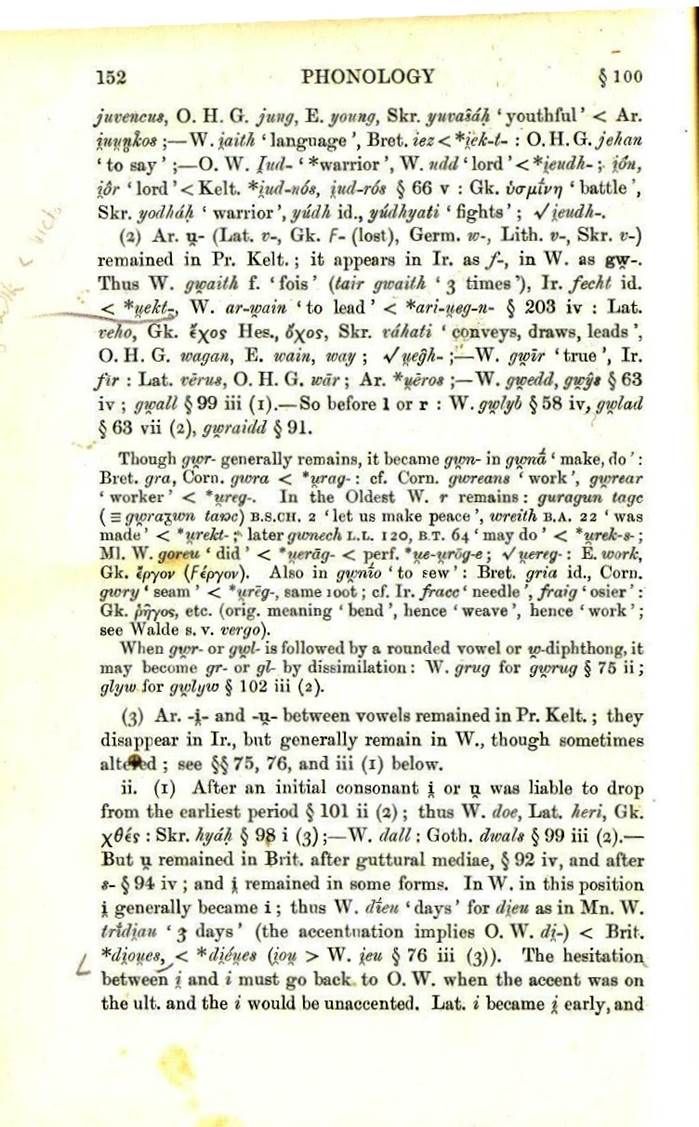
152 PHONOLOGY § 100 juvencus, O. H. G. jung, E. young, Skr. yuvas̑áḥ ‘youthful’ < Ar. i̯uu̯n̥k̑os;—W. i̯aith ‘language’, Bret. iez < *i̯ek‑t‑: O. H. G. jehan ‘to say’; O. W. I̯ud- ‘*warrior’, W. udd ‘lord’ < *i̯eudh‑; i̯ôn, i̯ôr ‘lord’ < Kelt. *i̯ud-nós, i̯ud-rós § 66 v: Gk. ὑσμῑ́νη ‘battle’, Skr. yodháḥ ‘warrior’, yúdh id., yúdhyati ‘fights’; √i̯eudh‑. (2) Ar. u̯- (Lat. v‑, Gk. ϝ- (lost), Germ. w‑, Lith. v‑, Skr. v‑) remained in Pr. Kelt.; it appears in Ir. as f‑, in W. as gw̯‑. Thus W. gw̯aith f. ‘fois’ (tair gwaith ‘3 times’), Ir. fecht id. < *u̯ekt‑, W. ar-w̯ain ‘to lead’ < *ari-u̯eg‑n- § 203 iv: Lat. veho, Gk. ἔχος Hes., ὄχος, Skr. váhati ‘conveys, draws, leads’, O. H. G. wagan, E. wain, way; √u̯eg̑h‑;—W. gw̯īr ‘true’, Ir. fīr: Lat. vērus, O. H. G. wār; Ar. *u̯ēros;—W. gw̯edd, gw̯ŷs § 63 iv; gw̯all § 99 iii (1).—So before l or r: W. gw̯lyb § 58 iv, gw̯lad § 63 vii (2), gw̯raidd § 91. Though gw̯r- generally remains, it became gw̯n- in gw̯nā́ ‘make, do’: Bret. gra, Corn. gwra < *u̯rag‑: cf. Corn. gwreans ‘work’, gw̯rear ‘worker’ < *u̯reɡ‑. In the Oldest W. r remains: guragun tagc (≡ gw̯raᵹwn taŋc) b.s.ch. 2 ‘let us make peace‘, wreith b.a. 22 ‘was made’ < *u̯rekt‑; later gwnech l.l. 120, bt. 64 ‘may do’ < *u̯rek‑s‑; Ml. W. goreu ‘did’ < *u̯erāg- < perf. *u̯e-u̯rōɡ-e; √u̯ereg‑: E. work, Gk. ἔργον (ϝέργον). Also in gw̯nī́o ‘to sew’: Bret. gria id., Corn. gwry ‘seam’ < *u̯rēɡ‑, same root; cf. Ir. fracc ‘needle’, fraig ‘osier’: Gk. ῥῆγος, etc. (orig. meaning ‘bend’, hence ‘weave’, hence ‘work’; see Walde s. v. vergo). When gw̯r- or gw̯l- is followed by a rounded vowel or w̯-diphthong, it may become gr- or gl- by dissimilation: W. grug for gw̯rug § 75 ii; glyw for gw̯lyw § 102 iii (2). (3) Ar. ‑i̯- and ‑u̯- between vowels remained in Pr. Kelt.; they disappear in Ir., but generally remain in W., though sometimes altered; see §§ 75, 76, and iii (1) below. ii. (1) After an initial consonant i̯ or u̯ was liable to drop from the earliest period § 101 ii (2); thus W. doe, Lat. heri, Gk. χθές: Skr. hyáḥ § 98 i (3);—W. dall: Goth. dwals § 99 iii (2). But u̯ remained in Brit. after guttural mediae, § 92 iv, and after s- § 94 iv; and i̯ remained in some forms. In W. in this position i̯ generally became i; thus W. dī́eu ‘days’ for di̯eu as in Mn. W. trĭ́di̯au ‘3 days’ (the accentuation implies O. W. di̯‑) < Brit. *di̯ou̯es, < *di̯éu̯es (i̯ou̯ > W. i̯eu § 76 iii (3)). The hesitation between i̯ and i must go back to O. W. when the accent was on the ult. and the i would be unaccented. Lat. i became i̯ early, and |
||||||||||||||||||||||||||||||||||||||||
|
|
|
|
||||||||||||||||||||||||||||||||||||||||
|
|
|
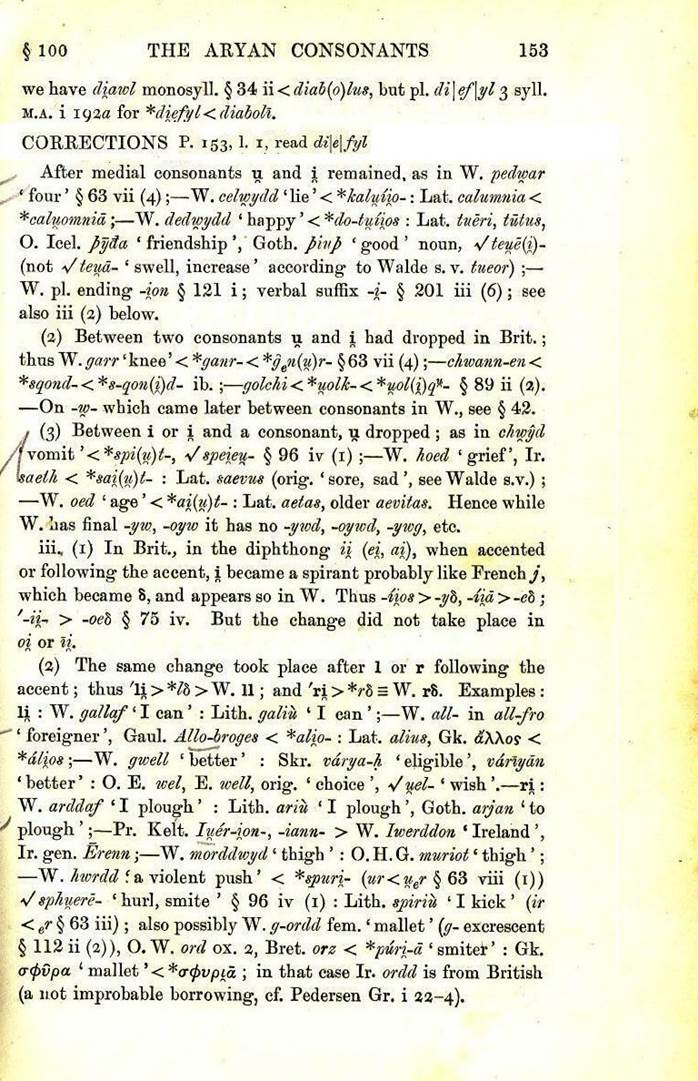
§ 100 THE ARYAN
CONSONANTS 153 we have diawl
monosyll. § 34 ii < diab(o)lus,
but pl. di|ef|yl[W
1] 3 syll. m.a. i 192a for *di̯efyl < diabolī. After medial
consonants u̯ and i̯ remained, as in W. pedw̯ar ‘four’ 63 vii
(4);—W. celwydd ‘lie’ < *kalu̯íi̯o‑:
Lat. calumnia < *calu̯omniā;—W. dedwydd ‘happy’
< *do-tu̯íi̯os: Lat. tuēri, tūtus,
O. Icel. þȳða ‘friendship’, Goth. þiuþ ‘good’
noun, √teu̯ē(i̯)- (not √teu̯ā- ‘swell,
increase’ according to Walde s. v. tueor);—W. pl. ending ‑i̯on § 121 i;
verbal suffix ‑i- § 201 iii
(6); see also iii
(2) below. (2) Between
two consonants u̯ and i̥ had dropped in Brit.; thus W. garr ‘knee’ < *ganr- <
*g̑ₑn(u̯)r- § 63 vii
(4);—chwann-en < *sqond- < *s‑qon(i̯)d- ib.;—golchi <
*u̯olk- < *u̯ol(i̯)qu̯- § 89 ii
(2).—On ‑w̯- which came later between consonants in W., see § 42. (3) Between i or i̥ and a consonant, u̥ dropped; as in chw̯ŷd ‘vomit’ <
*spi(u̯)t‑, √spei̯eu̯- § 96 iv
(1);—W. hoed ‘grief’, Ir. saeth < *sai̯(u̯)t‑: Lat. saevus (orig.
‘sore, sad’, see Walde s.v.);—W. oed ‘age’ < *ai̯(u̯)t‑: Lat. aetas,
older aevitas. Hence while W. has final ‑yw, ‑oyw it
has no ‑ywd, ‑oywd, ‑ywg,
etc. iii. (1)
In Brit., in the diphthong ii̯ (ei̯, ai̯), when accented or following the
accent, i̯ became a spirant probably like French j, which
became ẟ, and appears so in W. Thus ‑íi̯os > ‑yẟ, ‑íi̯ā > ‑eẟ; ´‑ii̯- > ‑oeẟ § 75 iv.
But the change did not take place in oi̯ or īi̯. (2) The
same change took place after l or r following
the accent; thus ´li̯ > *lẟ > W. ll; and ´ri̯ > *rẟ ≡ W. rẟ. Examples: li̯: W. gallaf ‘I can’:
Lith. galiù ‘I can’;—W. all- in all-fro ‘foreigner’,
Gaul. Allo-broges < *ali̯o‑: Lat. alius, Gk. ἄλλος < *álios;—W. gwell ‘better’:
Skr. várya‑ḥ ‘eligible’, várīyān ‘better’: O.
E. wel, E. well, orig. ‘choice’, √u̯el- ‘wish’.—ri̯: W. arddaf ‘I plough’:
Lith. ariù ‘I plough’, Goth. arjan ‘to
plough’;—Pr. Kelt. Iu̯ér-i̯on‑, ‑iann- > W. Iwerddon ‘Ireland’,
Ir. gen. Ērenn;—W. morddwyd ‘thigh’: O. H.
G. muriot ‘thigh’;—W. hwrdd ‘a violent
push’ < *spuri̯- (ur < u̯ₑr § 63 viii
(1)) √sphu̯erē- ‘hurl, smite’ § 96 iv
(1): Lith. spiriù ‘I kick’ (ir < ₑr § 63 iii);
also possibly W. g‑ordd fem. ‘mallet’ (g- excrescent § 112 ii
(2)), O. W. ord ox. 2, Bret. orz <
*púri̯-ā ‘smiter’: Gk. σφῦρα ‘mallet’ <
*σφυρι̯ᾱ; in that case Ir. ordd is from British (a not
improbable borrowing, cf. Pedersen Gr. i 22–4).
|
||||||||||||||||||||||||||||||||||||||||
|
|
|
|
||||||||||||||||||||||||||||||||||||||||
|
|
|
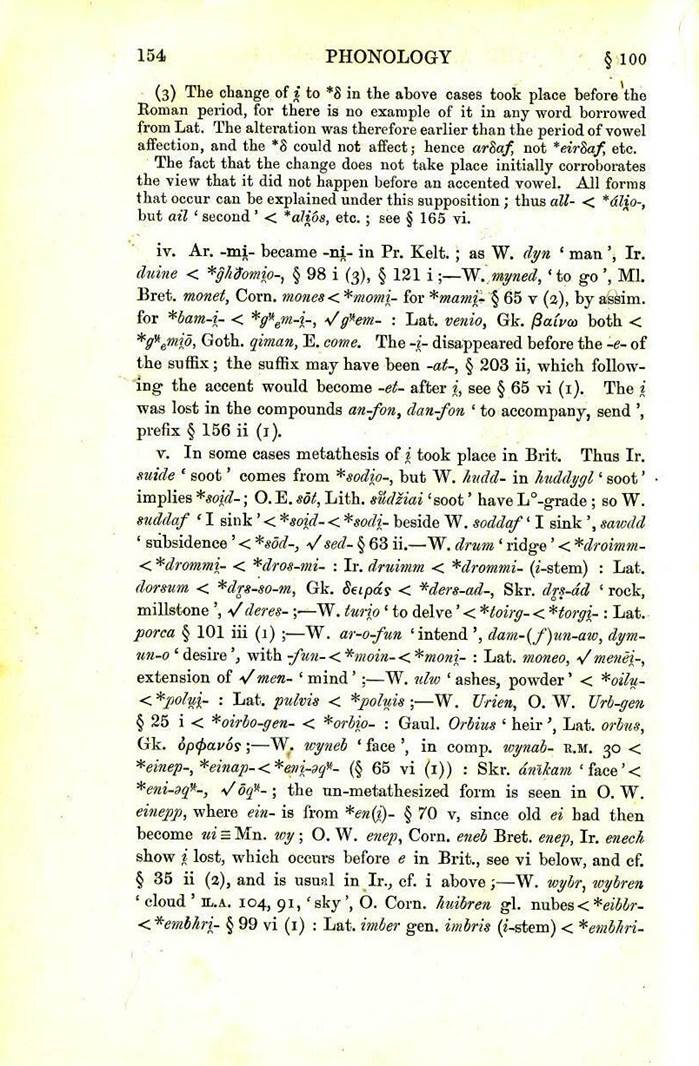
154 PHONOLOGY § 100 (3) The change of i̯ to *ẟ in the above cases took place before the Roman period, for there is no example of it in any word borrowed from Lat. The alteration was therefore earlier than the period of vowel affection, and the *ẟ could not affect; hence arẟaf, not *eirẟaf, etc. The fact that the change does not take place initially corroborates the view that it did not happen before an accented vowel. All forms that occur can be explained under this supposition; thus all- < *áli̯o‑, but ail ‘second’ < *ali̯ós, etc.; see § 165 vi. iv. Ar. ‑mi̯- became ‑ni̯- in Pr. Kelt.; as W. dyn ‘man’, Ir. duine < *g̑hðomi̯o‑, § 98 i (3), § 121 i;—W. myned, ‘to go’, Ml. Bret. monet, Corn. mones < *momi̯- for *mami̯- § 65 v (2), by assim. for *bam‑i̯- < *ɡu̯ₑm‑i̯‑, √ɡu̯em‑: Lat. venio, Gk. βαίνω both < *ɡu̯ₑmi̯ō, Goth. qiman, E. come. The ‑i- disappeared before the ‑e- of the suffix; the suffix may have been ‑at‑, § 203 ii, which following the accent would become ‑et- after i̯, see § 65 vi (1). The i̯ was lost in the compounds an-fon, dan-fon ‘to accompany, send’, prefix § 156 ii (1). v. In some cases metathesis of i̥ took place in Brit. Thus Ir. suide ‘soot’ comes from *sodi̯o‑, but W. hudd- in huddygl ‘soot’ implies *soi̯d‑; O. E. sōt, Lith. sů́džiai ‘soot’ have L°-grade; so W. suddaf ‘I sink’ < *soi̯d- < *sodi̯- beside W. soddaf ‘I sink’, sawdd ‘subsidence’ < *sōd‑, √sed- § 63 ii.—W. drum ‘ridge’ < *droimm- < *drommi̯- < *dros‑mi‑: Ir. druimm < *drommi- (i-stem): Lat. dorsum < *dr̥s-so‑m, Gk. δειράς < *ders-ad‑, Skr. dr̥ṣ-ád ‘rock, millstone’, √deres‑;—W. turi̯o ‘to delve’ < *toirg- < *torgi̯‑: Lat. porca § 101 iii (1);—W. ar-o-fun ‘intend’, dam-(f)un-aw, dym-un-o ‘desire’, with ‑fun- < *moin- < *moni̯‑: Lat. moneo, √menēi̯‑, extension of √men- ‘mind’;—W. ulw ‘ashes, powder’ < *oi̯lu- < *polu̯i̯‑: Lat. pulvis < *polu̯is;—W. Urien, O. W. Urb-gen § 25 i < *oirbo-gen- < *orbi̯o‑: Gaul. Orbius ‘heir’, Lat. orbus, Gk. ὀρφανός;—W. wyneb ‘face’, in comp. wynab- r.m. 30 < *einep‑, *einap‑ < *eni̯-əqu̯- (§ 65 vi (1)): Skr. ánīkam ‘face’ < *eni-əqu̯-, √ōqu̯‑; the un-metathesized form is seen in O. W. einepp, where ein- is from *en(i̯)- § 70 v, since old ei had then become ui ≡ Mn. wy; O. W. enep, Corn. eneb Bret. enep, Ir. enech show i̯ lost, which occurs before e in Brit., see vi below, and cf. § 35 ii (2), and is usual in Ir., cf. i above;—W. wybr, wybren ‘cloud’ Ỻ.A. 104, 91, ‘sky’, O. Corn. huibren gl. nubes < *eibbr- < *embhri- § 99 vi (1): Lat. imber gen. imbris (i-stem) < *embhri- |
||||||||||||||||||||||||||||||||||||||||
|
|
|
|
||||||||||||||||||||||||||||||||||||||||
|
|
|
§ 101 The Aryan consonants 155 (: Gk. ἀφρός ‘foam’, Ir. imrim ‘storm’); without metathesis and with i̯ lost, Bret. Van. ebr, Corn. ebron, ebbarn; again, with metath., W. nwyf-re ‘sky’ < *neib- < *nebhi̯o‑; the root is *enebh‑, of which *embh- is FV, and *nebh- is VF; with ‑l- suffix, § 90. (W. nef ‘heaven’ is however from √nem- ‘curve’ hence ‘vault’, as shown by Bret. neñv, Ir. nem; also seen in W. nant ‘vale’ < *nm̥‑t‑.) vi. i̯ drops before i or e, see iv, v, above; cf. § 75 ii (2). Interchange of consonants Consonant Alternation. § 101. i. Comparison of the derived languages points to certain alternations of consonants in Pr. Aryan; they are mostly the result of dialectal variation, and of the accidents of consonant combination. The same causes produced the same results after the dispersion; and while some of the alternations mentioned below may be primitive, others are certainly later, and some comparatively recent. Three kinds of alternations may be distinguished: (1) the consonant alternates with zero; (2) the manner of articulation varies; (3) the place of articulation varies. ii. The cases where the consonant alternates with zero are the following: (1) Initial s- before a consonant is variable; thus Gk. στέγος, Lith. stógas ‘roof’, Skr. sthágati ‘conceals’: Gk. τέγος, Lat. tego, W. to ‘roof’; √(s)theɡ‑,—Ir. scaraim, W. ysgaraf ‘I separate’ Lith. skiriù id.: Lat. caro ‘flesh’, orig. ‘piece (of flesh)’, Gk. κείρω, Skr. kr̥ntáti ‘cuts’: √(s)qer‑;—W. chwech ‘six’ < *su̯ek̑s: Armen. vec̣ < *u̯ek̑s;—Lat. spargo, E. sprinkle: Gk. περκνός, W. erch ‘speckled, grey’ < *perq‑, § 97 v (3). This treatment of s- persisted long after the dispersion; and many of the examples found are undoubtedly cases of the dropping or the adding of s- in the derived languages. In Kelt. s- seems to have been added and dropped with a freedom hardly equalled elsewhere.—As ‑s was an extremely common ending in Ar., it is natural to suppose that ‑s st- would be confused with ‑s t‑, so that it would not always be easy to decide whether the initial had s- or not. But some scholars regard the s- as a “preformative” or more or less meaningless prefix; see Schrijnen KZ. xlii 97 ff. (2) A consonantal sonant after an initial consonant was sometimes dropped. Thus W. chwech, Gk. ῾ϝεξ < *su̯ek̑s: Lat. sex, Goth. saihs < *sek̑s;—Gk. πλατύς, W. llydan, √plethē- ‘spread out, stretch’: without ‑l‑, Lat. patēre, Gk. πετάννυμι, W. edau ‘thread’;—W. brau ‘brittle’ |
||||||||||||||||||||||||||||||||||||||||
|
|
|
|
||||||||||||||||||||||||||||||||||||||||
|
|
|
156 PHONOLOGY § 101 < *bhrāɡ‑, Lat. frango, E. break: Skr. bhanákti ‘breaks’, Ir. com-boing ‘confringit’, Armen. bek ‘broken’;—W. cryg ‘hoarse’ < *qri‑q‑, ysgrech ‘scream’ < *s‑qriq-nā, Gk. κρίζω, κριγή, E. shriek, Lat. crīmen, √qrei‑: without ‑r‑, W. cwyn ‘complaint’ < *qei-no‑, Ir. cōinim ‘I mourn’, Germ. heiser ‘hoarse’, O. E. hās > E. hoarse (intrusive r);—W. craff ‘sharp’, crafu ‘to scratch’, crach ‘scabs’, E. scrape: without ‑r‑, W. cafn ‘trough’ (scooped out), E. scab, shave, shape, Gk. σκάπτω, σκάφος, Lat. scabo, Lith. skabùs ‘sharp’: *sqra‑b‑/‑bh‑/‑p‑;—Lat. brevis < *breg̑hu̯is, Gk. βραχύς < *br̥g̑hus: without ‑r‑, Ir. berr, W. byrr, Corn. ber, Bret. berr ‘short’ < *bek’-s-ro‑s (with ‑ro- suff. like W. hīr ‘long’ < *sē-ro-s); Ir. bec(c) ‘small’ < *beggos with dimin. gemination; W. bach ‘small’ < *bₑg̑h(u)so‑; bychan ‘small’, O. W. bichan, Bret., Corn., bichan < *biksogno- < *briks- < *br̥g̑h(u)so‑; bechan < *beg̑h(u)so‑, assumed to be f. in W.—Later examples of lost ‑r- are E. speak: O. E. sprecan, Germ. sprechen;—W. gw̯aith ‘work’: (g)w̯reith § 100 i (2);—Guto (t ≡ tt) hypocoristic form of Gruffudd. (3) Between initial s- and a sonant, a labial or guttural was liable to drop; thus spr: sr, and sql: sl, etc., Siebs, KZ. xxxvii 285 ff.—W. cleddyf ‘sword’, ar-choll ‘wound’ § 156 i (6), clais ‘bruise’ < *qləd-ti‑, claddu ‘to bury’, √qolād- ‘strike, cut, dig’: W. lladd ‘kill, cut off, mow’, Ir. slaidim ‘I strike, cut’ < *slad- < *sqləd‑;—W. ffrwd ‘stream’, ffrydio ‘to gush’ < *spru‑t‑, Germ. Sprudel ‘fount, gush, flow of water’: W. rhwd, rhewyn, etc., § 95 i, < *sru‑;—W. ffroen f. ‘nostril’, Ir. srōn f. ‘nose’ < *sprugnā; without s- (p…g > t…g 86 ii (3)), W. trwyn m. ‘nose’ < *prugno‑s, trywyẟ ‘scent’ < *prugíi̯o‑: Gk. ῥύγχος ‘pig’s snout’ < *srunɡhos § 97 v (3).—So prob. Lat. scaevus, W. chwith § 96 iii (2) < *sq‑, by (2) above for *sql‑: Lat. laevus, Gk. λαιός < *sl‑; by (2) *sl- > *s‑, whence W. asswy < *ad-sou̯i̯‑, Skr. savyáḥ; as sk̑- alternates with sq‑, see iv (1), the simple root is perhaps *k̑lei‑: Lat. clīno, clīvus, W. cledd ‘left (hand)’, go-gledd ‘north’. So perhaps Lat. lact- for *slact- for *sqlact‑: Gk. γάλα, W. glas-dwr § 63 vii (3);—W. ffreu b.b. 37 ‘fruit’ < *sprāg‑: Lat. frāgum < *srāg‑. (4) A semivowel after a long vowel was often dropped: Skr. aṣṭā́u ‘eight’, Goth. ahtau: Skr. aṣṭā́, Gk. ὀκτώ, Lat. octō. The reduced grade may come from either form ; see √uerē(i̯)- § 63 vii (5). Other sonants might disappear finally after long vowels, as Gk. κύων: Skr. s̑vā́ ‘dog’, Lith. szů̃, Ir. cū, W. ci;—Gk. μήτηρ: Skr. mātā́. iii. While the place of articulation remained the same, the mode of articulation might vary. (1) At the end of a root a tenuis frequently alternated with a media. Thus O. E. dȳfan, E. dive < *dheup‑: W. dwfn ‘deep’, Gaul. dubno‑, Lith. dubùs ‘deep’ < *dhub‑, √dheup/b‑;—Lat. gen. pācis: Lat. pango √pā̆k̑/g̑‑;—Lat. sparg-o: Gk. περκ-νός, W. erch, ii (1) above;—Lat. plancus, W. talch: E. flake, √pelāq/ɡ- § 86 ii (3);—Lat. |
||||||||||||||||||||||||||||||||||||||||
|
|
|
|
||||||||||||||||||||||||||||||||||||||||
|
|
|
§ 101 INTERCHANGE OF CONSONANTS 157 lūceo, Gk. λευκός, W. llug ‘light’: W. go-leu ‘light’, Gaul. Lugu‑, √leuq/ɡ‑—So Lat. porca, W. rhych ‘furrow’ < *pr̯k̑: W. turio ‘to delve’ < *torg̑i̯- (t- for p- § 86 ii (3)); W. tyrchio ‘to delve’ is a late form from twrch = Lat. porcus, prob. allied to the above words despite Armen. herk ‘newly ploughed land’ which implies ‑q‑; (Lith. par̃szas ‘pig’ implies ‑k̑‑); see § iv (1). In the same position an aspirated media alternated with a media:—W. oen ‘lamb’, O. E. ēanian ‘yean’ < *aɡu̯hn‑: Gk. ἀμνός < *aɡu̯n‑: Lat. agnus ambiguous;—Skr. budhná‑ḥ ‘bottom’, Gk. πυθμήν < *bhudh‑: O. E. botm < *bhud‑: W. bôn ‘bottom’ < Kelt. *budn‑ó- ambiguous. An aspirated tenuis alternated with an aspirated media:—Skr. nakhá‑ḥ ‘nail’: Ir. ingen, W. ewin, Lat. unguis, Lith. nãgas ‘nail’. (2) Initially a tenuis alternated with an aspirated media, more rarely with a media. Thus W. craidd, Lat. cord‑, Gk. καρδία, Lith. szirdìs, E. heart, Sk. s̑rad‑, all from k̑‑: Skr. hŕ̥d‑, Av. zərədā, from *g̑h‑;—Ir. cingim ‘I go, stride’, W. rhy-gyngu ‘to amble’, Ir. cēimm ‘stride’, W. cam id. < *k̑n̥ɡh-smen‑: Germ. Gang, E. gang-way, Gk. κοχώνη for *καχώνη < *g̑hn̥ɡh‑, Lith. žengiù ‘I step, stride’ < *g̑henɡh‑; cf. √sk̑eɡ- § 96 iii (1);—Lat. porcus, Ir. orc, torc, W. twrch, O. H. G. far(a)h < *p‑: O. H. G. barah, O. E. bearh < *bh‑;—O.Lat. dingua, O. H. G. zunga, E. tongue < *d‑: Ir. tenge, W. tafod, Corn. tavot, Bret. teod < *t‑, see § 92 v, § 97 v (2);—W. erch ‘grey, speckled’, Gk. περκνός: W. brych, brith ‘speckled’, bwrw ‘cast, sprinkle’, see § 97 v (3). As in the last equation, several examples occur in W. and Ir. of b- for p- pointing to the alternation of p‑: b(h)- before the disappearance of p- in Kelt. Thus Lat. pūs, puter, Gk. πῦον, πῡ́θομαι, Goth. fūls, E. foul, Skr. pū́yati ‘putrefies, stinks’, √peu(āˣ)‑, pēu‑: W. baw ‘dirt’ < *b(h)eu‑, budr ‘dirty’ < *b(h)eu‑tr‑; also with i̯ for u̯, iv (1), Lat. paedor < *pai̯‑d‑, √pēi̯‑: W. baeddu ‘to dirty’ < *b(h)ai‑d- (‑d- present);—Lith. plùskos ‘hair’, O. E. flēos, E. fleece, Ger. Fliess, √pleus‑: W. blew ‘hair’ (mostly of animals, not of man’s head in W., as in Corn, and Bret.) < *b(h)leus‑;—Lat. pasco, Gk. πατέομαι, Goth. fōdjan, E. food, W. yd ‘corn’, Ir. ith id., Skr. pitú‑ḥ ‘food’, √pā(i̯)‑: O. W. bit ‘food’ < *b(h)it‑, Ir. bïad id. < *b(h)ii̯‑, W. bwyd do. < *b(h)ei‑t‑;—Lat. piget, Lith. peĩkti ‘to blame’, O. E. ficol, E. fickle, √peiq/ɡ‑: W. bai ‘blame, fault’ < acc. *b(h)igi̯m̥;—Gk. πέπρωται, ἔπορον, Lat. pars, W. rhan, √perō- § 63 vii (2): W. barn ‘judgement’ < *b(h)ₑr’n‑, brawd id., Ir. brāth id. < *b(h)r̥̄t- (for meaning cf. Germ. Teil ‘part’: Urteil ‘judgement’). The above alternation may be accompanied by a similar alternation medially; thus Lat. caper, Gk. κάπρος, W. caer-i̯wrch ‘roebuck’, all < *qap(e)r‑: W. gafr ‘goat’, Ir. gabor, gabur, Gaul. Gabro- < *g(h)ab(h)r‑;—Lat. capio, Goth. hafjan, W. caffel ‘to get’ < *qap‑: Lat. habeo, W. gaf-el ‘to take hold (of)’ < *ɡhabh‑. There seems to have been a later tendency to substitute a media for a tenuis initially before a sonant in Brit. and Goidelic; as in Brit. Britan- for *Pritan- § 3 iii;—so W. brig ‘top (of a tree), crest |
||||||||||||||||||||||||||||||||||||||||
|
|
|
|
||||||||||||||||||||||||||||||||||||||||
|
|
|
158 PHONOLOGY § 101 (of a wave), hair of the head, border (of a country)’, briger ‘hair of the head’ < *brīk- for *prīk‑, metath. for *krīp- > W. crib ‘comb, crest, ridge (of a roof)’: Ir. crīch ‘boundary of a country’ < *qrī-q-u̯o- broken redupl., √qerēi- ‘separate, divide, cut off’: Lat. crēna ‘notch’, crista ‘crest’, crīnis ‘hair of the head’;—Ir. droch ‘wheel’: W. tro ‘turn’;—Ir. gēc: W. cainc ‘branch’ < *k̑n̥q‑: Skr. s̑ā́khā ‘branch’;—W. gast ‘bitch’: ci ‘dog’ § 96 ii (3).—Cf. W. Grawys, Garawys ‘Lent’ § 138; < Lat. quadragēsima. Still later is the softening of the initial of an adverb, and of a proclitic, as dy ‘thy’; these are regarded as mutated forms, and are not mutated further (except occasionally by false analogy). (3) Alternations like the above occur also in suffixes; as *‑tro‑: *‑dhro- and *‑tlo‑: *‑dhlo‑. (4) Though l and r are not mixed indiscriminately, several doublets occur in which they alternate, as √g̑hu̯er- / g̑hu̯el- § 92 iv. These alternations may have originated, as suggested by Meillet, Intr.² 143, in reduplicated forms in which, by dissimilation, r may become l, or even n. Thus √ɡu̯erē- ‘devour’ gives *ɡu̯er-ɡu̯el‑, *ɡu̯ₑn‑ɡu̯r‑, etc., also with ɡ for ɡu̯ by dissim.; thus Gk. βιβρώσκω, Lat. vorāre, W. barus ‘greedy’ < *ɡu̯ₑr‑: (broken redupl.) Gk. ἔβροξε, Ml. H. G. krage, Ir. brāge, W. breuant ‘windpipe’ < *ɡu̯r̥̄ɡ-n̯t‑: (full redupl.) Lat. gurgulio, O. H. G. querechela, Gk. γάγγραινα: Lat. gula. iv. The place of articulation might vary. (1) The different gutturals sometimes alternate. Thus, q/k̑: √leuq/k̑‑: Skr. rócate ‘lights, shines’, roká‑ḥ ‘bright’, Lith. láukti ‘to expect’, with *‑q‑: Skr. rús̑ant- ‘bright, white’, Lith. lúszis ‘lynx’ with *‑k̑‑;—the suffix *‑qo‑: *‑k̑o‑, as Skr. maryaká‑ḥ (márya‑ḥ ‘young man’) with *‑q‑: Skr. yuvas̑á‑ḥ (yúvan- ‘young’) with *‑k̑‑: Lat. juvencus, W. ieuanc ambiguous;—√ak̑‑/oq- § 63 v (2);—√k̑ei‑: √qōi‑: √qu̯ei̯ē‑, see Walde s.v. civis. For a large number of examples see Brugmann² I 545 ff. After s‑, ‑q- predominates, § 84 Note 2; and k̑/q alternate, as Skr. chinátti ‘cuts, severs’ < *sk̑‑: Lith. skë́dziu ‘I separate’ < *sq‑, √sk̑(h)eid‑/sq(h)eid‑. ɡu̯h/g̑h:—Lat. fī-lum ‘thread’ < *ɡu̯hī‑: W. gī-au ‘nerves, sinews’ < *g̑hī‑;—W. gw̯res, Gk. θερμός, etc. < *ɡu̯h‑, § 92 iii: Lith. žarýjos ‘glowing coals’, Alb. zjar̄ ‘fire’ < *g̑h‑;—W. gw̯elw ‘pale’, Lith. geltas ‘tawny’ < *ɡu̯h‑: Lith. želiù green, W. glas ‘green’ < *g̑h, § 92 iii. Exactly the same change of position as the last is involved in the alternation of u̯ and i̯, which occurs in some roots, as √g̑hēu‑: √g̑hēi‑ ‘yawn’. (2) The Ar. consonant series p, t, k, q, qu̯ is not a line with p and qu̯ as loose ends, but as it were a circle, in which p and qu̯ approach one another. qu̯ combines the back with the lip position, and the shifting of the stop to the latter position makes it p. It is not surprising therefore that qu̯ became p in some languages as W., Osc.-Umb., Gk., or that under certain conditions p > qu̯, § 96 iv. Already in Ar. there seem to be some cases of p alternating with qu̯, and even |
||||||||||||||||||||||||||||||||||||||||
|
|
|
|
||||||||||||||||||||||||||||||||||||||||
|
|
|
§ 102 INTERCHANGE OF CONSONANTS 159 with q; this takes place before l, and before r when it is a variant of l. Thus we have the parallel roots *pel‑, *quⁿel‑, *qel- ‘to turn’, also with r, *qu̯er. Examples:—*pel‑: Lat. poples ‘bend of knee’, Ir. imb-el, W. ym-yl ‘rim, edge’ < *m̥bi-pel‑, W. cyf-yl ‘border, vicinity’ < *kom-pel‑, ol-wyn ‘wheel’, Gk. πέλομαι < *pel- (since qu̯e > τε § 89 i);—*qu̯el‑: Lat. colo, incola, Gk. τελέθω, πολεύω, W. dy-chwel-af ‘I return’ < *do-squ̯el‑; redupl. Gk. κύκλος, O. E. hweohl, E. wheel;—*qel‑: Gk. κελλόν· στρεβλόν Hes., Lat. coluber;—qer‑: Lat. curvus, Gk. κορώνη, Ir. cor ‘circle’, W. côr ‘circle, close’, cored ‘round weir’, Ml. W. at-coraf ‘I return’, Ir. cruind, W. crwnn ‘round’.——So the roots *spel‑, *squ̯el‑, *sqel‑, *sqer- ‘to split, separate, scatter’; thus *spel‑: O. H. G. spaltan, E. split, Skr. sphāṭáyati ‘splits’, Bret. faouta ‘to split’, W. ffloehen ‘splinter’, hollti ‘to split’ § 96 iv (1);—*squ̯el‑, *sqel‑: Lith. skeliù ‘I split’, Bret. skula, W. chwalu ‘to scatter’, Ir. scāilim ‘I scatter’;—*sqer‑: Lith. skiriù, W. ysgar, etc. ii. (1); also in the sense of ‘snatching’; with p, Lat. spolium: with q, W. ysglyfio ‘to snatch’, ysglyfaeth ‘prey’ < *sql̥‑m‑.——So Gk. πλεύμων, πνεύμων ‘lung’, Lat. pulmo (for *plumō), O. Bulg. plušta, O. Pruss. plauti ‘lung’, the ‘light’ member (cf. E. lights ‘lungs’), W. lluman ‘banner’ < *pleus-mₑn‑: Skr. klóman- ‘right lung’ < *qleumon‑, W. ysgyfaint dual ‘lungs’ < *s‑qumₑn- (l lost ii (2), see also § 121 iv), Bret. skevent, Ml. Ir. scaman (? < Brit.), Ml. W. yscun b. b. 4 ≡ ysgwn ‘light, soaring’, O. W. scamn‑, W. ysgawn, ysgafn, Bret. skañv ‘light’ < *s‑qumn- § 76 vii (4); W. cwhwfan for *cỿ-chw̯ỿfan ‘to wave in the breeze, flutter’ < *ko-squmon‑, chw̯ŷf ‘waving’ < *squmō: √pleu‑/(pneu‑) ‘float, waft’. (3) The change of p to t, which sometimes occurs is doubtless always secondary, as in Skr. ṣṭhī́vati ‘spews’ (: Lat. spuo, E. spew) where the ṭ is due to the following palatal, cf. Gk. πτύω < *pi̯ūi̯ō. In Kelt, p became qu̯ before qu̯, but sometimes t before a palatal or velar § 86 ii (3), perhaps a compromise between the labial and guttural positions. Assimilation, Dissimilation and Metathesis. § 102. i. Assimilation, dissimilation and metathesis of consonants have taken place at all periods; most of the examples occurring have arisen since the Ar. dispersion. In many cases the change has become a phonetic law; but most of the changes, especially of dissimilation and metathesis, occur only accidentally. ii. (1) Assimilation of joined consonants: (a) Ar. pd > bd etc. § 93 i; sd > zd § 97; ghþ > ghð § 98.—(b) In most of the derived languages mt > nt, etc. § 84, Note 3.—(c) In Kelt. tk > kk, etc. § 93, ii (2), (3); nl > ll, nr > rr, ln > l § 99 iii; lẟ > ll § 100 iii (2).—(d) In W. nt > nnh etc. § 106, llt > ll § 105; dẟ > d‑d > t § 111 vii (2); lᵹ > l l § 110 ii (2). In Late Mn. W. nff > nth in benthyg < Ml. W. benffic < Lat. beneficium. |
||||||||||||||||||||||||||||||||||||||||
|
|
|
|
||||||||||||||||||||||||||||||||||||||||
|
|
|
160 PHONOLOGY § 102 (2) Assimilation of separated consonants: Italo-Kelt. p…qu̯ > qu̯…qu̯ § 86 ii (2).—Kelt. b…m > m…m in *momi̯at- > W. myned § 100 iv. iii. (1) Dissimilation of joined consonants: (a) Ar. tt > tˢt § 87 ii.—(b) When two continuants come together there is often a tendency to alter one of them either to an explosive or to a semi-vowel: thus in Brit. ml- > bl‑, mr- > br- § 99 ii (1); in W. nẟ > nd as in bendith ‘blessing’, sẟ > sd, lẟ > ld > lld, llẟ > lld § 111 vii (2); ẟl > dl as in bodlon, ẟr > dr as in cadr § 111 vii (1); mχ > mc as in amcan § 156 i (4); nṽ > nw̯ as in O. W. anu § 99 iv (1), rv > rw̯ as in syberw̯ § 105 ii, fl > wl § 104 v. In many cases the spirant disappeared: fn > n § 110 iii (4), ẟn > n § 104 iv (1).—(c) In W. mni̯ > ml in teimlo ‘to feel’ < *teimni̯o < *tamn- < *tang-smen‑: Lat. tango. (2) Dissimilation of separated consonants: (a) Already in Ar. r…r > r…l etc. § 101 iii (4); and tr…r > t…r in *tisores ‘three’ fem. > W. tair, Skr. tisráḥ § 69 iv.—(b) In Kelt. gn…n > gl…n in *glūn- > W. glin ‘knee’ § 63 vii (4); l…l > r…l in *arali̯os > W. arall ‘other’, Ir. araile.—(c) In W. gw̯…w̯ > g…w̯ in glyw ‘lord’ < *gw̯lyw̯ < *u̯li-u̯o‑s, VR of √u̯elē(i)- § 63 vii (2); gw̯…v > g…v in greẟf ‘instinct’ (greẟfu ‘to be inbred’) < *u̯r̥d-mā: Ir. frēm § 91; r…r > r…l in Chwefrol § 138 i (2); l…l > l…r in llefrith ‘new milk’ for *lle-flith < *lo-vlith ‘*calf-milk’; th…th > t…th in gwrtaith ‘manure’ < *u̯er-tek‑t, √theg- § 92 i; l…ẟ > l…d in late Mn W. machlud for Ml. W. ymachluẟ etc. § 111 vii (3); ẟ…l > d…l in pedol ‘horseshoe’ for *peẟawl < Lat. pedālis. iv. (1) Metathesis of joined consonants: (a) Nasalized stems may be the result of the metathesis in Ar. of the suffix ‑n- with the last consonant of the root; thus *juɡ‑n- > *junɡ- > Lat. jungo, √jeuɡ‑; if so, forms like Skr. yunákti ‘joins’ are analogical formations which arose in imitation of forms with n as part of the root; but the effect is the same as that which would be produced by an Ar. infix ‑ne‑.—(b) In Brit. di̯ > i̯d, etc. § 100 v.—(c) In W. lg > gl in annwyl ‘dear’ < *induglens < Lat. indulgens; chl > lch in allweẟ ‘key’ for *alchweẟ, Bret. alchouez, for *achl- § 99 vi (1); nm > mn in amnaid ‘nod’ < O. W. enmeit § 95 ii (3); dn > nd in andaw ‘listen’ for *adnaw § 76 iii (1), andwyo § 76 iv (4). (2) Metathesis of separated consonants: (a) Ar. *bhudh/d- ‘bottom’ and *dhub- ‘deep’, if not originally the same, are confused in the derived languages: W. annwfn ‘hell’ < *n̥-dub‑n- for *n̥-bud‑n- ‘bottomless’: Gk. ἄ-βυσσος; cf. O. Bulg. dŭno ‘bottom’ and Armen. andundk῾ “ἄβυσσος” with d…d for b…d by assimil.—(b) In Kelt. n…r > r…n in Gaul. Taranis ‘Juppiter tonans’, Taranu-, W. taran ‘thunder’, Ir. toran ‘din’, < *taran‑, *toran- for *tₑnər- *tonər‑: Brit. (-Lat.) Tanar-o Chester insc. (re-metath.?), O. E. þunor, E. thunder, Lat. tono, Gk. στένω √(s)tenā‑; b…g > g…‑b in Ir. goba, W. gof ‘smith’ < Kelt. *gobann- for *bog- < *bhog‑: Gk. φώγω, E. bake < *bhog-, Germ. backen < *bhog‑n-, Lat. focus |
||||||||||||||||||||||||||||||||||||||||
|
|
|
|
||||||||||||||||||||||||||||||||||||||||
|
|
|
§ 103 Interchange of consonants 161 √bhō̆k/g‑; in early Kelt. before the loss of p, k … p > p … k in W. archen ‘shoe’, Bret. archen < *park- for *karp- < *qₑr’p- √qerāˣp- ‘shoe’ § 86 i (5).—(c) In Brit. n … l > l … n in W. telyn f. ‘harp’, Bret. telen, Corn. telein < *telenī for *ten-el-ī, √ten- ‘stretch’: W. tant ‘harpstring’, Lat. tendo, Gk. τείνω, etc.—(d) In W. l … ẟ > ẟ … l in meẟal ‘soft’ for *melaẟ < *meləd‑: Lat. mollis < *moldu̯is, Skr. mr̥dú‑ḥ ‘soft’, etc. √melāˣ‑; and in eiẟil ‘feeble’ for *eiliẟ, § 156 i (2): ymlā́ẟ § 204 i, √lēd- ‘weary, weak’. British and Latin consonants in Welsh The Soft Mutation. § 103. i. (1) Brit. and Lat. p, t, k, b, d, g, m between vowels became b, d, g, f, ẟ, ᵹ, f respectively in W. Thus W. Cyndaf < Brit. Cunotam(os);—W. saeth ‘arrow’ < *saᵹeth < Lat. sagitta;—W. deg ‘ten’ < Brit. *dekan < Ar. *dek̑m̥;—W. cybydd ‘miser’ < Lat. cupidus;—W. llafur ‘labour’ < Lat. labōrem. Numerous examples occur in the above sections. The change is called the “soft mutation”. (2) As the same changes took place generally between a vowel and a sonant (see the details § 104), and as every initial consonant must be followed by a vowel or a sonant, it follows that where the preceding word ended in a vowel the initial is changed as above; thus while Brit. *oinos markos gave un march ‘one horse’, Brit. *oinā mammā gave un fam ‘one mother’, not *un mam. (3) The conditions are, however, not quite the same initially as medially. Medially ‑sk- became ‑χχ- by the reaction of the two sounds on one another before the period of the present changes. But in the case of final ‑s and initial k- no reaction took place in the earlier period, and the sounds came down to later Brit. unchanged. It was then too late for sk to give χχ as shown by the retention of Lat. sc, see (5), and of Brit. medial sk from ksk etc. § 96 iii (5); thus the k- remained, and the final syllable with its ‑s ultimately disappeared. For similar reasons final ‑s preserved an initial media or m- intact. Hence we have the radical consonant after words or classes of words which ended originally in ‑s, such as mas. sg. nouns or adjectives; thus *díi̯ēus dagos > dydd da ‘good day’. |
||||||||||||||||||||||||||||||||||||||||
|
|
|
|
||||||||||||||||||||||||||||||||||||||||
|
|
|
162 PHONOLOGY § 103 But when the final syllable of the first word was accented, its ‑s combined with an initial tenuis, which thus became a spirant. For this reason we have the spirant mutation of a tenuis after Ml. W. ɥ ‘her’ (now written ei) < *esi̯ā́s = Skr. asyā́ḥ ‘her’; tri ‘three’ < Brit. *trei̯és (for *tréi̯es would have given *trydd); a ‘with’ and a ‘and’ < Brit. *aggós § 213 iii (1), § 222 i (3). On the mutation after ni, see § 217 iv (1); after chwe § 108 iii. tair and pedair had the same accentuation, and in Bret. ter, peder, and also pevar (= pedwar), cause the spirant mutation. The radical has been substituted in W., as in the majority of cases where the spirant occurred from the above cause. (4) After final ‑s initial l and r were unvoiced; cf. sl- > ll‑; sr- > rh‑, § 95 i; but between vowels l and r underwent no change. Thus we have ll and rh now in those positions where the radical occurs of the consonants mentioned in (1) above, and l and r in those positions where the said consonants are softened. Welsh grammarians therefore speak of ll, rh as “radical”, and l, r as “mutated” consonants. Though the reverse is historically the case, it is convenient to retain the old terminology in dealing with the interchange of the sounds in the present language. Note. The term “soft mutation”, first applied to the change where it occurred initially, is due to Dr. Davies, who called it “forma mollis” D. 26. It has also been called “vocal” and “middle”. The latter name, used by Rowland, owes its origin to the term “forma media” used by Davies as a name for the change of the tenues to the mediae; as applied to the six others it is meaningless. Continental scholars use “Lenition” as a term embracing the Welsh “soft mutation” and the corresponding Irish “aspiration”. (5) Lat. sp, st, sc remained, as Ml. W. yspeil < spolium § 69 iv (1), ystyr < historia ib., escyn < ascend‑. An explosive before the group dropped in W., as in estron < extrāneus; so after the loss of an intervening vowel, as W. esgob < episcopus, W. esgud ‘active’ < exsecūtus. See further § 111 vi (2). Except where c dropped as above Lat. x > i̯s, 108 v. ii. (1) Medially between vowels ᵹ, the soft mutation of g, disappeared completely after the O. W. period; as in saeth i (1);—maes < *maᵹes § 29 ii (2): Gaul. ‑magus;—teyrn ‘ruler’ < *tyyrn |
||||||||||||||||||||||||||||||||||||||||
|
|
|
|
||||||||||||||||||||||||||||||||||||||||
|
|
|
§ 103 THE SOFT MUTATION 163 < tigirn‑; also finally, as da ‘good’ < *dag- § 63 v (2);—ty ‘house’ < tigos § 65 ii (3);—bro < *mrog- § 99 ii (1);—bre (prob. f.) ‘hill’, Corn. bre f. < *brigā, Gaul. ‑briga < *bhr̥ɡh‑: Germ. Berg;—bore ‘morning’, O. W. more in b.a. 17 l. 20, Bret. beure < acc. *mārig-an (< *‑m̥): Ir. imbārach, Mn. Ir. mārach < *mārig‑: Kelt. *mārig- < *mōriɡh- L°R₂ of √merē(i)q/ɡh‑: Skr. márīciḥ ‘ray of light’, Goth. maurgins, E. morn.—Already in O. W. we find nertheint (< ‑eᵹint), beside scamnhegint (g ≡ ᵹ). ig gives y, affected to e, as above; it is often assimilated to the following vowel, as in dylḗd < Ml. W. dylyet < *dliget- § 82 ii (3); Ml. W. breenhin ‘king’ < *brigant-īn‑: Skr. acc. br̥hánt-am, gen. br̥hat-áḥ ‘high, great’ < *bhr̥ɡh-ént‑, ‑n̥t‑. Before ei it was lost, as in braint ‘privilege’, Ml. W. breint < O. W. bryeint l.l. 120 < *briganti̯‑; Ml. W. Seint < *Sigonti̯on ‘Segontium’.—w͡y comes not from ig, but from eig, as in mod-rwy ‘ring’ < F-grade *reig‑, as in rhwym § 95 ii (2); mor-dwy ‘sea-voyage’ < *teig‑, Ir. tīagu ‘I go’: Gk. στείχω; so canhorthwy ‘assistance’ < *kanta-u̯er-teig-, lit. ‘*go over with’.—āg gave eu, au, § 71 iii. Initially ᵹ disappeared completely; but as the initial of the second element of a compound it often became ᵹ̑ > i̯ after a dental (d, ẟ, n, l, r), as Llwyd-i̯arth < *leito-garto- § 95 iv (3); Pen-i̯arth < *penno-garto‑, mil-i̯ast D.G. 278 beside mil-ast ‘greyhound bitch’; arw-floedd-i̯ast § 157 ii (1); Mor-i̯en, O.W. Mor-gen *‘sea-born’; Ur-i̯en, O. W. Urb-gen § 100 v. For ᵹ before and after sonants see § 104 ii, § 105 ii, § 110 ii. (2) The soft mutation of m was originally the nasalized spirant ṽ. The nasalization generally remains medially in Bret., but disappeared in W. towards the end of the O. W. period. As f was thereafter the soft mutation of both b and m, there has always been the possibility of its being referred to the wrong radical. This probably accounts for the substitution in some cases of one for the other, as in bawd ‘thumb’, O. W. maut f. (y fawd ‘the thumb’), still with m- in mod-rwy orig. ‘thumb-ring’. In a few cases m- and b- interchange, as bath and math (y fath ‘the kind of’), baeddu and maeddu ‘to dirty’. Nid adwaen, iawn yw dwedyd, Weithian i bath yn y byd.—G.I.H. ‘I know not, it is right to say it, her like now in the world.’ |
||||||||||||||||||||||||||||||||||||||||
|
|
|
|
||||||||||||||||||||||||||||||||||||||||
|
|
|
164 PHONOLOGY § 104 Och imi! pe marw chwemwy, O bydd i math mewn bedd mwy.—D. N., f.n. 90, c.c. 267. ‘Woe is me! though six times more died, [I doubt] if her like will ever more be in a grave.’ In bore for more we may have dissim., as in mr- > br‑. iii. In O. W. softened consonants were represented by the corresponding radicals; see § 18 i, § 19 i. It would be wrong to conclude from this that the softening had not then taken place, for its occurrence initially is due in almost every case to a vocalic ending which was then already lost. The difference between the radical m in un march and the soft f in un fam cannot be accounted for if assumed to have taken place since the O. W. period when ‘one’ was un; it must be referred to the Brit. m. *oinos, f. *oinā. The O. W. spelling was doubtless a survival from the time when the mutated consonant could still be regarded as a debased pronunciation of the radical. On the Ml. final tenues see § 111 v. § 104. i. The mutable consonants, p, t, k, b, d, g, m normally underwent the soft mutation between a vowel and a sonant; thus pr > br in W. Ebrill < Lat. Aprīlis; W. go-bryn-af ‘I merit’ < Brit. *u̯o-prinami, √qu̯rei̯ā- § 201 i (4);—pl > bl in W. pobl < Lat. pop’lus;—tn > dn in W. edn ‘bird’ < *pet-no- § 86 i;—tu̯ > dw in W. pedwar < Brit. *petu̯ares § 63 vii (4);—kr > gr in W. gogr, gwagr ‘sieve’ < *u̯o‑kr‑, √qerēi̯‑: Lat. crībrum;—br > fr in W. dwfr ‘water’ § 90;—bn > fn in W. dwfn ‘deep’ ib.; W. cefn ‘back’ < *kebn‑: Gaul. Cebenna ‘les Cévennes’ (*qeb- allied to *qamb/p- § 106 ii (1));—dm > ẟf, see iv (2). ii. (1) g before l, r, n gave ᵹ̑, which became i̯ forming a diphthong with the preceding vowel. The Mn. developments are as follows: ag > ae; eg > ei or ai; ig > i; og > oe; ug > w͡y; āg > eu or au; īg > i. Thus W. aer ‘battle’, Ir. ār ‘slaughter’ < *agr‑: Gk. ἄγρᾱ;—W. draen ‘thorn’ < *dragn- < *dhrₑghn‑: Gk. τρέχνος;—W. tail ‘manure’ < *tegl- § 35 ii (3), √(s)theɡ- ‘cover’ § 92 i, cf. gwrtaith ‘manure’ < *u̯er-tekt‑;—W. oen ‘lamb’, Ir. ūan < *ognos § 65 ii (2); W. oer ‘cold’, Ir. ūar < *ogr‑: Gaul. (Seq.) Ogron… name of a month;—W. annwyl § 102 iv (1);— |
||||||||||||||||||||||||||||||||||||||||
|
|
|
|
||||||||||||||||||||||||||||||||||||||||
|
|
|
§ 104 THE SOFT MUTATION 165 W. ceulo < *cāgl- § 71 iii. Examples of gm are uncertain. On swyn < Lat. signum see § 72 ii. Following the accent, g after a became ᵹ and disappeared; as in the suffix ‑agno‑, < *´‑o-gno- (*‑o- is the stem vowel, which becomes a in Ir., and when unacc. before g in Brit.), as seen in Brit.-Lat. Maglagni, Corbagni, Broccagni giving W. Maelan, Carfan, Brychan; Ir. -ān as Broccān; so O. W. bichan, W. bychan, Ir. becān. For the affected forms of the above groups see §§ 69, 70. (2) gi̯ > ᵹ̑ > i̯; thus W. cae ‘enclosure, field’ < *kagi̯o‑, Gaul. 5th cent. caium, whence Fr. quai, √kagh‑/kogh‑: Lat. cohus, E. hedge, Germ. Hecke;—Ml. W. daeoni ‘goodness’ < *dag-i̯ono-gnīm- (re-formed as da-ioni in Mn. W.). It is seen that the vowel is not affected by the i̯, but it may be by a following ī < ō; thus W. llai, Ml. W. llei ‘less’, Ir. laigin, both < *lagi̯ōs < *lₑɡh(u̯)i̯ōs: Lat. levis, Gk. ἐλαχύς;—W. ‑(h)ai, Ml. ‑(h)ei < *‑sagi̯ō § 121 i, § 201 iii (4).—So igi̯ affected by a gave egi̯ becoming ‑ei, ‑ai, as W. tai, Ml. tei ‘houses’ < *tigi̯a < *tigesa, pl. of *tigos ‘house’;—W. carrai ‘lace’ < Lat. corrigia. When unaffected, igi̯ gave ii̯ > ī; as in brī ‘honour’ < *brigi̯o‑: brenin, braint § 103 ii (1); and llī́on in Ml. W. Kaer-llion < *ligi̯ŏnos, Brit. gen. for Lat. legiōnis. Similarly ogi̯ > oe > ‑o, § 78 i (1), in to ‘root’ < *togi̯o‑: Ir. tuige gl. stramen, and amdo ‘shroud’ < *m̥bi-togi̯o‑: Ir. im-thuige ‘clothing’: Lat. toga, √(s)theɡ‑.—ugi̯ > w͡y > -w, § 78 i (2), in llw ‘oath’ < *lugi̯on: Ir. luige, lugae < *lugii̯on. (Ml. W. pl. llyeu, llyein, Mn. llwon, dial. llyfon are all analogical formations.) (3) gu̯ > ᵹu̯ > w: W. tew ‘thick’ < *tegu̯- § 76 viii (2).—ogu̯i̯, > ou̯i̯ > eu in euod ‘worms in sheep’ < *ogu̯i̯- < Ar. *oɡu̯hi̯‑: Gk. ὄφις, Skr. áhiḥ ‘snake’. iii. (1) Before n Brit. k > χ̑ > i̯, so that kn gives the same result as gn; thus W. dwyn ‘to bring’ < *duk‑n- § 203 iv (3);—braenu ‘to rot’ < *brakn- < *mrəq‑n- § 99 ii (1);—croen ‘hide, rind’ < *krokn‑, Bret. croc’hen, Ir. crocenn < *krokn- (kn > kk) < *qroq‑, VF° of *qereq- broken redupl. of √qer- ‘divide, rip’: Lat. corium, cortex, O. Bulg. (s)kora ‘rind’, korĭcĭ a kind of vessel, W. cwrwgl ‘coracle’;—W. gwaun < *u̯ākn- < *u̯o-akn‑: W. ochr see below;—W. tīn ‘buttock’ < *tīknā < *tūqnā, Ir. tōn < *tūknā: E. thigh O. H. G. dioh. This may be due to gemination of k, |
||||||||||||||||||||||||||||||||||||||||
|
|
|
|
||||||||||||||||||||||||||||||||||||||||
|
|
|
166 PHONOLOGY § 104 see (2) below; in many cases kn > gn regularly; thus W. sugno ‘to suck’ < *seuk‑n‑, √seuq/ɡ‑: Lat. sūcus, sūgo, E. suck, etc.;—W. dygn ‘grievous’ < *dikn- < *deŋgn‑: Ir. dingim ‘I press down’, O. E. tengan ‘to press’;—W. rhygnu ‘to rub’ < *rukn‑: Gk. ῥυκάνη;—W. dogn ‘portion, dose’ < *dok‑n‑, √dek̑‑: Gk. δέκομαι, δοκάνη· θήκη. (2) Before r, k, t give g, d regularly, as in gogr i above;—chwegr < *su̯ekr- § 94 iv;—W. deigr ‘tear’ < *dakrū § 120 iii (1);—W. aradr < Ar. *arətrom § 87 i;—W. modryb § 69 ii (4); etc. But W. ochr ‘edge, side’ beside Ir. ochar < *okr‑, √ak̑‑/oq‑, W. rhuthr ‘rush’ beside Ir. rūathar < *reu-tro‑, √reu̯‑: Lat. ruo, imply kkr, ttr for kr, tr § 99 v (4). Compounds like go-chrwm: crwm ‘bent’ may owe their ch to this, or to s before k. An example of k < gg giving the same result is Ml. W. achreawdɏr b.t. 9 ‘gathering’ < Lat. aggregātio, with excrescent ‑r; cf. cyngreawdr < congregātio in Cyngreawdɏr Fynydd (‘Mount of Assembly’) ‘The Great Orme’.[1] Similarly g before r may be treated as gg and give g, as in llygru ‘to injure, violate, corrupt’: Gk. λυγρός, Lat. lugeo, Skr. rujáti ‘breaks’, Lith. lúžti ‘to break’, √leuɡ/g̑‑. iv. (1) Brit. dn > W. n (not *nn); as in W. bôn ‘stem’ < *bud-nó‑, bonedd ‘nobility’ < *budníi̯ā: Ar. *bhudh- ‘bottom’ § 102 iv (2);—W. blynedd < *blidníi̯ās § 125 v (i). (2) Brit. dm > W. ẟf; as W. greddf ‘instinct’ § 102 iii (2);—W. deddf ‘law’ < *dedmā < *dhedh-mā, √dhē‑: Gk. τεθμός, θεθμός < *dhedh-mos;—W. add-fwyn etc. § 93 ii (3), q. v. (3) Brit. dl, dr after a back vowel became ẟl, ẟr; the ẟ remained after the accent, and was provected to d, as hadl, cadr § 111 vii (1), and disappeared before the accent, as in iôr < *i̯ud-rós § 66 v. After a front vowel dl, dr > gl, gr, and developed accordingly, ii (1); thus W. cadair, Ml. kadeir < Lat. cat(h)edra;—W. eirif ‘number’ < *ed-rīm- < *ad-rim‑[W 1]: Ir. āram;—W. i waered ‘downwards’ < *di woiret < *do upo-ped-ret‑; gwael ‘base’ < *upo-ped-los, √ped- ‘foot’;—W. aelwyd ‘hearth’, Bret. oaled, O. Corn. oilet < *aidh-l-eti̯‑: Gk. αἴθαλος ‘soot’, Lat. aedes, √aidh- ‘burn’, cf. § 78 ii (3). v. bl > fl or w̯l, as in gafl ‘fork’: Ir. gabul, Lat. gabalus
|
||||||||||||||||||||||||||||||||||||||||
|
|
|
|
||||||||||||||||||||||||||||||||||||||||
|
|
7 : 1697 |
§§ 105, 106 THE SOFT MUTATION 167 < Kelt.; Ml. W. nywl § 90, di̯awl § 100 ii (1).—ml, mr § 99 ii.—mn § 76 vii, § 99 iv. Other groups of explosive + sonant are regular. § 105. i. After r Brit. and Lat. p, t, k become respectively ff, th, ch; thus W. corff < Lat. corpus;—W. gorffwys § 89 ii (2);—W. porth < Lat. portus;—W. archaf § 63 iii, etc. lk > lch, as W. golchi § 89 ii (2);—W. calch < Lat. calc-em.—lp > lff, as W. Elffin < Gallo-Lat. Alpīnus.—lt > llt, as in Ml. W. kyfeillt ‘friend’ = Ir. comalte ‘foster-brother’ < *kom-alt(i)i̯os; W. allt ‘declivity; grove’ < *alt‑, √al- ‘grow, nourish’: Lat. alo, altus; medially it becomes ll as in W. cyllell ‘knife’ < Lat. cultellus; W. di-wylli̯o ‘to cultivate’: gwyllt ‘wild’ § 92 iv; except in re-formations, as in hollti ‘to split’ from hollt § 96 iv (1); the t is sometimes lost finally in an unstressed syllable, as in Mn. W. cyfaill, Ml. and Mn. deall § 75 vi (4). ii. rb > rf, as in W. barf ‘beard’ < Lat. barba; also rw̯, as in sýberw̯ ‘proud’ < Lat. superbus.—rd > rẟ, as in bardd < Brit. *bardos (βαρδοί· ἀοιδοὶ παρὰ Γαλάταις, Hesych.).—Medially rg > ri̯ as in ari̯an ‘silver’ = Ir. airget < Kelt. *argn̥t-om: Lat. argentum, Skr. rajatá‑m: Gk. ἄργυρος, √areg̑‑. Finally rg > ‑r, ‑rỿ, ‑ra, ‑rw̯ § 110 ii. lb > lf, as in gylfin ‘beak’, O. W. gilbin: Ir. gulban id. < Kelt. *gulb‑.—Medially lg > li̯, as in dali̯af § 110 ii (2); for final lg see ib.—Medially ld > ll as in callawr ‘caldron’ < Lat. ´caldārium;—finally llt as in swllt ‘money, shilling’ < Lat. sol’dus. iii. rm > rf or rw̯ § 99 ii (2);—lm > lf, ib.;—nm > nf or nw̯ § 99 iv (1). The Nasal Mutation. § 106. i. (1) A nasal before an explosive was assimilated to it in position where it differed; thus Ar. k̑m̥tóm ‘100’ > Brit. *kanton; Ar. *penqu̯e ‘5’ > Kelt. *qu̯eŋqu̯e > Brit. *pempe. This may be assumed to have taken place in Late Brit. when the nasal ended one word and the explosive began the next if the syntactical connexion was a close one. Subsequently a media, or (later) a tenuis, was assimilated to the nasal, becoming itself a nasal. This is called the “nasal mutation” of the explosive. |
||||||||||||||||||||||||||||||||||||||||
|
|
|
|
||||||||||||||||||||||||||||||||||||||||
|
|
: 1698 |
68 PHONOLOGY § 106 The order of the changes was the following: yn ‘in’ + Bangor first became ym Bangor, and then ym Mangor. The recent spelling yn Mangor is therefore not only a misrepresentation of the present sound, but a falsification of its history. (2) There is a sporadic assimilation of n to i in the groups ĭn or ein, the n becoming ŋ̑; thus pringhaf r.p. 1278, spv. of prĭn ‘scarce’ ib. 1280 (< *qu̯rīt-sno‑s: prid ‘precious’, √qu̯reiā- ‘buy’); meithring (‑iŋ̑) D.G. 69 for meithrin ‘to nourish’; Einion is often written Eingion or Eingnion ≡ eiŋ̑on, which has become eŋŋan in Gwynedd, e.g. Llan-engan near Pwllheli. ii. (1) Brit. mb, nd, ŋg became respectively mm, nn, ŋŋ: they remain so in W., mm being generally written m; nn finally written -n (but -nn in monosyllables in Ml. W.); ŋŋ written ng (and Ml. W. gg or g); see § 51 iv, § 54 i (2). Thus W. cwm ‘valley’ < Brit. *kumbo-, √qeub/p- ‘curve’: Lat. cūpa, ‑cumbo, Gk. κύμβος, etc.;—W. cam ‘bent, crooked’ < Brit. *kambo-: Gaul. Cambo-dūnum, Gallo-Lat. cambiāre: Lat. campus (orig. ‘vale’), Gk. καμπή, κάμπτω, √qamb/p- ‘curve’;—W. twnn ‘bruised, broken’ f. tonn < Brit. *tund-os, -ā: Lat. tundo, Skr. tundate ‘strikes’, √(s)teu‑d‑;—W. tonn ‘wave’ < Brit. *tundā < *tum-dā: Lat. tumeo, W. tyfu, √teu̯āˣ- ‘swell’;—W. cann ‘white’, cannu ‘to whiten’, llóer-gan ‘moon-lit’ < *qand‑: Lat. candeo, Gk. κάνδαρος < *qand‑, beside W. cynneu ‘to kindle’, cynne ‘a burning’, cynnud ‘firewood’, Ir. condud < *qond‑: Skr. cand‑, s̑cand‑ ‘shine’ < *(s)qend‑: √sqand‑/sqend‑;—W. llong ‘ship’ < Lat. longa;—W. angel < Lat. angelus.—So before a sonant, as Cymro pl. Cymry < Brit. *kom-brog-os, ‑ī;—W. amrwd ‘raw’: brwd § 63 vii (4);—Cyngreawdr § 104 iii (2);—except where the nasal has become a media § 99 vi (1).—The double nasal was simplified after an unaccented syllable § 27 ii, and before a sonant § 54 i (3). Kelt. ngu̯ (< Ar. nɡu̯h) was unrounded and gave ŋŋ, as in llyngyr, angerdd § 92 v. When ŋŋ came before a sonant, including u̯, it was first simplified to ŋ and then lost, as in ewin, tafod, see ib. So we have nawraẟ r.p. 1331, g.r. [372] ‘nine degrees’ < Brit. *nou̯aŋ-grad- (navg̃raẟ b.b. 42 may have old ŋ, but is prob. analogical);—W. cyni (one n) ‘trouble’ < *koŋnīm- < *kon-gnī-mu- § 203 vii (4);—W. aren ‘kidney’, Ir. āru < *aŋr- < Kelt. *aŋgu̯r- < *anɡu̯hr-, √aneɡu̯h‑: Gk. νεφρός, Lat. Praenest. nefrōnēs, Lanuv. nebrundinēs |
||||||||||||||||||||||||||||||||||||||||
|
|
|
|
||||||||||||||||||||||||||||||||||||||||
|
|
|
§ 106 THE NASAL MUTATION 169 (: Lat. inguen with gu̯, Walde s.v.). But after e or i and before r or l, the ŋ became ŋ̑ and gave ḭ, as in eirin Deut. xxiii 1 for *eiryn, § 77 iii, < *eŋryn pl. of aren above;—W. cilydd ‘mate’ < *ciŋ̑lyẟ (ii̯ > W. i not y, cf. § 104 ii (2)) < *keŋglii̯os (§ 65 iii (1)) = Ir. cēle < *keŋglii̯os: Ir. cingim ‘I go’, W. cam ‘stride’, see § 101 iii (2); for meaning, cf. Ml. W. keimat ‘mate’ < cam. The rule only applies to old formations where the ŋŋ already existed in Brit.; in newer formations, and Lat. derivatives ŋ remains, as Cyngreawdr above. (2) The above changes took place before the loss of Brit. syllables, for nd coming together after the loss of a syllable remains, as in trindod < Lat. trīnitāt-em. Initial mediae were assimilated to final nasals before the latter were lost; e.g. naw mlynedd ‘nine years’ < *nou̯am mlidníi̯as < *neu̯n̥ bl‑. Every Brit. nd became nn, so we have no words ending in nd except where a vowel has been lost in the Mn. period between the sounds, as in ond etc. § 44 vi; see iii (4). iii. (1) Brit. mp, nt, ŋk remained finally as in W. pump, pymp < Brit. *pempe; W. cant < Brit. *kanton; W. ieuanc < Brit. *i̯ouaŋkos § 100 i (1). For exceptions see (2). Medially they became mmh, nnh, ŋŋh respectively, as in Ml. W. ymherawdɏr < Lat. imperātor; W. cynhesu ‘to warm’ < Brit. *kon-tess‑, √tep‑, § 96 ii (5); W. angheuol ‘deadly’ < Brit. *aŋkou̯‑, √anek̑‑: Lat. neco, Gk. νέκυς, νεκρός, etc. After an unaccented vowel the nasal is simplified as in the above examples, § 27 ii; after an accented vowel the aspiration was lost, as in cynnes ‘warm’, angeu (≡ aŋŋeu) ‘death’ § 48 ii, iv. (2) Final nt, mp are mutated in gan ‘with’ ≡ gann § 211 iv (1); in cant ‘100’, pump ‘5’ which appear as cann, pum before nouns; in ugeint ‘20’ which appears as ugeẏn as early as a.l. ms. a. see i 4, 8, 12, etc., and is ugain in Mn. W.; in arẏant a.l. i 6, now ari̯an ‘silver’; in diffrint (i ≡ y) b.b. 91 ‘vale’ ( < *dyfr-hynt ‘water-way’),already diffrin in b.b. 74, Mn. W. dỿffrɥn; in cymaint sometimes, especially in the phrase cymain un Eph. v 33; and often in poetry, as always in the spoken language, in the 3rd pl. of verbs and prepositions § 173 x, § 208 iii (2). It is seen in these examples that the h of the nasal mutations of t and p is lost finally; this is because it follows the accent of the word, see (1) above. But the aspirate was often retained before a word beginning with an accented vowel, as kymein hun Ỻ.A. 116 ‘every one’; can hwr w.m. 136 ‘100 men’; Pum heryr ‘5 eagles’ G.Gl. m 1/606. |
||||||||||||||||||||||||||||||||||||||||
|
|
|
|
||||||||||||||||||||||||||||||||||||||||
|
|
|
170 PHONOLOGY § 106 Gwledd
echdoe a doe’n i dy, Gwledd cann hannedd cyn hynny.—G.Gl. m 146/278. ‘A feast yesterday
and the day before in his house, the feast of a hundred dwellings before
that.’ Llyfr Ofydd
a fydd i ferch, Ag yn hwn ugain hannerch.—B.Br., Ỻ.H. ii 99. ‘The maid shall
have a book of Ovid, and in it a hundred greetings.’ Final ‑ŋc was
often mutated in Ml. W. where the tenuis was generally retained, and survives
in Mn. W.; e.g. ceing w.m. 108, Mn. W. cainc ‘branch’. ŋc is
often written ngc (cf. § 18 iii),
but nc is adequate and unambiguous, as nk in
Eng. bank. (3) Medial nt,
etc. remain when originally followed by h as in cyntedd ‘porch’
for *cynt-heẟ < *kintu-sed- § 63 ii; cyntaf ‘first’
< *cynt-haf < *kint-isamos; and in newer formations,
as plentyn ‘child’ from plant, llanciau ‘lads’,
sg. llanc. Some vocables, with mutation in Ml. W., are re-formed
without mutation in Mn. W., as amranneu w.m. 41, amrantau Job
xvi 16; seinnẏeu § 128 ii,
Mn. W. seintiau ‘saints’; gwynnoeẟ Ỻ.A. 5, gwyntoedd Matt.
vii 25; heinẏeu Ỻ.A. 123, heintiau Luc
xxi 11; ceig̃heu, ceingeu Ỻ.A. 144, ceingciau Can.
vii 8. (4) The
nasal mutation of the tenues does not date from the Brit. period, for the
nasal endings of *nouan ‘nine’, *dekan ‘ten’, etc.,
while they mutated initial mediae, did not mutate initial p, t, k;
thus naw cant ‘900’, deg pwys ‘10 lbs.’ The
mutation of the tenues was caused by nasals which survived the loss of the
Brit. endings; it takes place after the prefixes an‑, cyn‑,
and in other cases where mp, nt, ŋk occurred
medially. There is no
trace in O. W. of an wnmutated media; we find e.g. am- for
Mn. W. am- < *m̥bi‑, scribenn m.c. <
Lat. scrībend‑, crunn- m.c. ‘round’
(: Ir. cruind), etc., but no mb, nd. But
the tenues are found unmutated, as in tantou, Mn. W. tannau,
sometimes mutated as in bronannou m.c., pl. of breuant ‘windpipe’.
In pimphet ox. ‘fifth’, hanther ox. ‘half’
is perhaps reflected the transition stage in which, as the p and t were
disappearing, the h was becoming more noticeable; see § 107 v
(1). In any case it is safe to conclude that this mutation came about in
the O. W. period. In Ml. W. the
tenuis is mutated, as in breenhin b.b. 75, § 103 ii
(1), ag̃heu, ag̃hen b.b. 23, emen etc. § 24 i.
Though |
||||||||||||||||||||||||||||||||||||||||
|
|
|
|
||||||||||||||||||||||||||||||||||||||||
|
|
|
§ 107 THE NASAL MUTATION 171 often written unmutated after a prefix and after yn, there is evidence that it was in fact mutated, § 107 iii, v. iv. The nasal mutation of an explosive does not mean its disappearance, but its conversion into a nasal by the loosening of its stop. In annoeth ‘unwise’ < Brit.-Lat. *an-doct- the d became a continuation of the n, so that nn represents an n which is continued during the time it took to pronounce the original nd. As the W. tenues are really aspirated, that is t ≡ t‑h, see § 84 Note 1, when the stop was loosened the aspirate remained; thus nt, properly nt‑h, became nnh. That Early Ml. W. nh as in synhuir § 48 iv is short for nnh, is proved (1) by such spellings as morcannhuc, brennhin l.l. 120, and (2) by the fact that when it lost its aspirate after the accent it appeared as nn, as synnwyr r.m. 13, w.m. 20, while breenhin in which nn had become n after the long vowel, is brenin (not *brennin), and an original single n + h always gives n, as in glánaf for glánhaf, superlative of glân ‘clean’. It is clear therefore that the mutation of nt is strictly n‑nh, not n‑h. § 107. i. While initial mediae are nasalized after several numerals, initial tenues are nasalized only after yn ‘in’ and fy ‘my’, and this mutation is not original after fy. ii. Taken in conjunction with the following noun, yn ‘in’ ( < Brit. *en) has a secondary accent, but fy ‘my’ (< Brit. *men < Ar. *mene gen. sg. of the 1st pers. pron.) is wholly unaccented—the emphasis when required is thrown on an auxiliary pronoun : ‘my head’ is not *fy mhen, but fy mhen i. This difference between yn and fy is old, for Brit. *en has kept its ‑n, but *men (already a proclitic in Brit. § 113 ii) had lost its ‑n before the O.W. period. This is clearly seen is phrases where the following word began with a vowel or an immutable initial; thus yn: ynn lann l.l. 120, in alld b.b. 64, in llan do. 63, 64, yn amgant do. 66, in llurv do. 65, etc.; but fy: mi-hun m.c., vy argluit b.b. 51, wi-llav-e (≡ fy llaw i) do. 50, vy llen do. 59, 62, etc. Thus yn before a consonant is necessarily a closed syllable, closed by its ‑n, while fy is an open syllable, ending with its vowel. The O.W. ny l.l. 120 ‘in its’ is probably n̥ y, with syllabic n̥ or n̥n, a pronunciation still often heard. iii. After yn in Early Ml. mss., b and d are generally mutated, |
||||||||||||||||||||||||||||||||||||||||
|
|
|
|
||||||||||||||||||||||||||||||||||||||||
|
|
|
172 PHONOLOGY § 107 and probably g is to be read ŋ. Thus in b.b. we find innechreu 29, innvfin (≡ yn nwfn) 87, inyffrin 65, inyganhvy 47, yg godir, ygodir 63; in a.l. ms. a. eniokel (≡ yn niogel) i 46, 50, emon e kolouen (≡ ỿm môn ỿ golofn) i 10. Non-mutation is rarer: ym brin b.b. 33, in diffrin 47, 48. On the other hand p, t, c are rarely mutated, the usual forms being in tyno, im pop b.b. 33, ym pob 87, im pen 42, 57, impell 82, yg coed, 49; en ty e-clochyd a.l. i 52, en-tal e-ueig̃ 72. But examples of mutation also occur, mh, nh, ngh appearing at first as m, n, g 24 i, as ymlith b.b. 20, in hal art do. 49, eghyd (≡ ỿnghɥ̄́d) a.l. i 40, emop lle do. 60. These examples show that the mutation had already taken place, and that the written radical was a survival of O.W. spelling. It is to be noted that the n of yn is in every case assimilated in position to the explosive, even where that is unmutated. So before m, as im mon b.b. 61, im minit eidin do. 95. iv. Since yn kept its nasal, it is natural that it should mutate tenues as well as mediae; but as fy lost its nasal ending early, we should expect it to mutate the mediae but not the tenues, like naw, which gives naw mlynedd ‘9 years’, but naw pwys ‘9 Ibs.’ In O.W. and Early Ml. W. this is, in fact, the case. Thus in O. W. we have mi-telu ‘my household’, mi coueidid ‘my company’, juv. sk. (9th cent.); and in b.b. we find vy tud 13, vy perchen, vy parch 42, wy clun 49, vy pen, vy crawn 62, vy penhid 81, vy ki 99 ; the form wympechaud 83 is a rare exception, and in no case is the tenuis nasalized. But b and d are generally nasalized in b.b., g being also probably for ŋ; thus vy nruc 24, wy-uragon 51, vi-mrid (≡ fy mryd) 82, wi-nvywron (≡ fy nw͡yfron) 100, wy-nihenit 50, vy martrin 67. The occurrence of a number of examples like vy martrin 67, wy duu 82, vy dewis, vy Devs 42, is probably due to the influence of the regular non-mutation of p, t. We do not seem to meet with such forms as vyn drwc, vym bryd which appear in later mss.; vy is written as an open syllable, and p, t, k are not mutated after it. The later mutation of these is analogical; the mutation caused by fy in the mediae was extended to the tenues in imitation of the complete and consistent system of mutation after yn. But in spite of the levelling of the mutation after the two |
||||||||||||||||||||||||||||||||||||||||
|
|
|
|
||||||||||||||||||||||||||||||||||||||||
|
|
|
§ 107 THE NASAL MUTATION 173 words, the difference between the words themselves—the closed yn and the open fy—remained, and persists in the ordinary spelling of to-day, as in yn nhy fy nhad ‘in my father’s house’. v. (1) The representation of the nasal initial mutation after yn and fy has presented considerable difficulty to writers of the language. In Late Ml. W. mss. p, t, k appear unmutated, and fy is treated as fyn; thus yn ty vynntat i Ỻ.A. 35. That this is a conventional spelling is shown by the fact that scribes so rendered forms already mutated in their copies. Thus where a.l. ms. a. has emen i 84, the later ms. b. has em pen. Similarly the r.b. scribe writes down the radical of a consonant mutated in the same passage in the w.b., as vyg̃hof w.m. 104 = vyg̃ cof r.m. 76, vymhechawt w.m. 399 = vym pechawt r.m. 255, etc. Further, the cynghanedd always implies the mutated form; as yn-trugareẟ yn r͑ i gwirion,—r.p. 1216; o syrth ym-perigɏl swrth a mharawt,—do. 1250; where ntr is to be read nhr to correspond to nr͑, and mp must be mh to answer mh. In w.m. and w. we sometimes find a survival of the curious transitional form met with in O. W. § 106 iii (4); thus ymphen w.m. 256, vyg̃chret do. 390; vyg̃ khof w. 7b. The last example shows that what is meant is not the voiceless spirant, for χ is never written kh. (2) The mediae b, d also are frequently written unmutated, especially after yn; thus yn diben w.m. 129 made yn niben in r.m. 202; conversely ymlaen w.m. 54 made ym blaen in r.m. 38; both have ymon colofɏn w.m. 181, r.m. 84. Here again the cynghanedd belies the non-mutation, as in yg-karchar yn-daear yn yt,—r.p. 1168, where we must read yn naear (to give ná/ný as required by the cynghanedd sain). With yn, g is generally doubled, as in yg̃g̃ovot, yg̃g̃wyẟ w.m. 123, but is sometimes single, esp. before w̯, as in yg̃uales w.m. 57; in all cases it is doubtless to be read ŋ. After fy the single nasal is used; thus in w.m. we have vy mot 32, vy marɏf 59, vy mrawt 62, vy-g̃wreic 62, vy ni waradwyẟaw 43; more rarely the nasal and mute, as vym-brawt 51, vyn da 459. It is seen that in spite of inconsistencies, the difference between closed yn and open fy is unconsciously reflected in these spellings. (3) In mss. of the 15th and 16th cent. the consonant is regularly mutated, and the two words are generally joined; thus in the Report on the Peniarth mss., we find ynghaer llion 50/90, ymyellt, ynghaer 53/126, ymorgannwg 54/37, vymod 54/21, vyngwallt 54/280, ymhob 54/209, vymhennadur 57/27. Sometimes the words are separated; thus yn nef 75/172; ym hob 54/250, 61/18, 67/330; y mendith (’y for fy) 54/78 ; vy nolur 56/72. (4) Salesbury wrote vi-dew, vi-popul for fy Nuw, fy mhobl, “to saue the word the les maimed,” as he explains (1586 Pb. Preface). G.R. |
||||||||||||||||||||||||||||||||||||||||
|
|
|
|
||||||||||||||||||||||||||||||||||||||||
|
|
|
174 PHONOLOGY § 107 mutated the
consonants and joined the words, fynhy 41, ynnhy 79;
he states that m is double—“ymhob a leissiir ymmhob”
80 (see 54 i (2)).
His reason for joining fy appears to be that ng cannot
be initial, “canys rhy anoẟ yw sillafu fy ngwaith, fy nghaws” 42. Dr. Morgan separated the words in
the case of n and m; as fy nhŷ Job
xix 15, yn nhŷ do. i 13, fy mhen xxix
3, ym mha beth vi 24; but he appears to think like G.R.
that ng cannot be initial, and writes fyng-halon xxxvii
i, yng-hilfach xxxviii 16, thus missing the distinction
which he elsewhere observes between yn and fy,
and wrongly representing fy as a closed syllable. The
prejudice against initial ng was overcome in the 1620 Bible,
and fy nghalon was written as freely as fy nhy.
That settled the matter as far as fy was concerned. But the
representation of yn in the same combination still presented
a difficulty. The ng (≡ ŋ) was part
of the preposition yŋ; at the same time ngh or ng was
the initial of the noun, and Dr. M.’s hyphen in the middle of the
trigraph ngh was absurd ; the 1620 Bible therefore
used ynghilfachau, returning to the ms. forms.
Here ng does double duty, the inconvenience of which appears
when the noun requires a capital initial. Dr. M. wrote yng-Hrist;
M.K. has yngHymry p. [iv]; the 1620 Bible ynGhrist 1
Cor. xv 18, 19, 22; so in the Bibles of 1677 and 1690. Later, we find yng
Haerlŷdd T.J. title (1688); yn Ghymru rh.b.s. dedic.
(1701); Yngroeg S.R. 16 (1728). In all these the capital is
misplaced by being either put in the middle of the trigraph or transferred to
the preposition. The form yn Ngh- which appears about this
time, see b.cw. Ixxv, grew out of yn Gh- because
it was felt that the initial was Ngh‑; it is objectionable
because n is not accepted as a symbol for ŋ except
before k or g. The later form y’
Ngwynedd d.g. 41 (1789) misrepresents the preposition as an
open syllable. Pughe adopted yn Ng‑, yn M‑,
because, in the teeth of all the facts, he denied that the n of yn was
mutable. This unphonetic spelling, which stultifies the history of the nasal
mutation, § 106 i,
has predominated since his day. J.J.
wrote yng ŋolau p 312/iv/1 r., and Dr.
Davies pointed out in 1621 that ynghanol was short for yng-nghanol D.
202; but it was not until about a hundred years later that the form yng
Ng(h)- came into regular use. We find yng Nghrist in
the 1717 Bible, and subsequently in those of 1727, 1746, 1752, and nearly all
later editions. This form has been used and advocated by most of the Welsh
scholars of the 19th cent., including Iolo Morgannwg (who denounces “dull
ffiaidd Mr Owen Pughe” c.b.y.p. 237), R. I. Prys, T. Stephens,
T. Rowland, and Silvan Evans. (5) Fy being
unaccented, the following nasal, though of double origin, is simplified, and
belongs to the second syllable § 27 ii, i;
thus the syllabic division is fy|núw. As words are
separated in modern orthography, the usual spelling fy Nuw is
in every way correct. Similarly fy merch, fy ngardd.
But yn is accented, and the double consonant remains,
extending to both syllables § 27 i;
hence ýn|núw, ordinarily and correctly written yn
Nuw. In the same way we have |
||||||||||||||||||||||||||||||||||||||||
|
|
|
|
||||||||||||||||||||||||||||||||||||||||
|
|
|
§ 108 THE NASAL MUTATION 175 ym Mangor, yŋ Ŋwynedd. With our present alphabet we have to write the last yng Ngwynedd; so yng Nghadelling. It is objected to this that it is clumsy; but that is the fault of the alphabet. It is the only way of expressing the sound fully and correctly, and is the exact equivalent in modern characters of the Ml. W. yggwyned w.m. 108, yg gadellig w. 90, § 24 i. (6) There are, however, a number of adverbial and prepositional expressions, in which yn, followed by the nasal mutation, is wholly unaccented. In this case the nasal is single, as after fy; and the preposition is naturally joined to its noun, exactly like the in in the Eng. indeed. These expressions are ynghyd, ynghylch, ynglŷn, yngholl, ynghudd, ymhell, ymhlith, ymysg, ymron, ymlaen, ymhen, yngham, ymhellach, ynghynt, etc. No principle of accentuation is violated in this spelling, as asserted by Silvan Evans, Llythyraeth 50, who recommends yng nghyd etc. See above § 47 ii. The Spirant Mutation. § 108. i. Brit. or Lat. pp, tt, kk gave W. ff, th, ch respectively. Thus W. cyff ‘stem’ < Lat. cippus; Brython < Brit. Brittones; pechod < Lat. peccātum; hwch: Ir. socc, etc., § 93 iii (2). It occurs when an initial tenuis follows an explosive in word-composition, as in achas § 93 ii (2), athech § 93 iii (1), athrist § 99 v (4). This is called the “spirant mutation” of the tenuis. ii. In Brit. s + tenuis had already become a double spirant § 96 i; and original oxytones ending in ‑s caused the spirant mutation of a following initial tenuis § 103 i (3), as tri chant ‘300’. In this case th- and ph- were chosen as the mutations of t- and p‑, as their relation to the radicals is clearer than that of the alternative forms s, χu̯. iii. The spirant mutation after chwe ‘six’ is irregular. From Kelt. *su̯eks kantom we should expect *chwe cant, since ksk gives sk, and final ‑s would drop. But the independent form of *su̯eks was already *χu̯eχ in Brit.; and we may assume that this was generalized, so that the ch- in chwe chant comes from ‑χ k‑. iv. (1) Brit. or Lat. kt > *χ̑t > *χ̑þ > i̯þ; the i̯ forms i-diphthongs § 29 i, cf. § 104 ii (1); thus akt > aeth; okt > oeth; ukt > w͡yth; ekt > eith, Mn. aith; ikt > īth. Thus W. caeth < Brit. *kaktos § 86 ii (1); doeth < Lat. doctus; ffrwyth < Lat. fructus; saith Brit. *sehtan < Ar. *septm̥; perffaith < Lat. perfectus; brith < Brit. *briktos < *bhr̥ktos § 101 iii (2); eithin |
||||||||||||||||||||||||||||||||||||||||
|
|
|
|
||||||||||||||||||||||||||||||||||||||||
|
|
|
176 PHONOLOGY § 109 ‘furze’ < *ektīn- < *ak-tīn‑, √ak̑‑/oq‑; seithug ‘fruitless’; < *sek-tonk- < *sequ̯- ‘without’ + *teu‑q‑, √teu̯āˣ- ‘increase’ ; eithaf ‘extreme’ < *ek-tₑm-os: Lat. extimus. (2) In Ml. W. there was a tendency to voice this th to ẟ, as in perffeiẟẏaw Ỻ. A. 19 from perffeith, now re-formed as perffeithio ‘to perfect’; arhwaeddont do. 32 ‘they may taste’ (: chweith ‘taste’). The ẟ survives in cynysgaeẟu from cynysgaeth ‘endowment’. In aeth + vb. ‘to be’ forming old perfects and pluperfects, the diphthong was simplified, giving ath‑, affected to eth‑, as ethyw Ỻ.A. 82, more commonly eẟyw ‘went’; so aẟoeẟ ‘had gone’, etc., § 193 vi (3), (5).—Final ẟ so produced disappeared in heno, yna, etc. § 78 i (1). v. Lat. x >*χ̑s > i̯s; thus ax > aes, etc. ; as W. llaes ‘trailing’ < laxus; pais, Ml. W. peis < pexa (tunica); coes ‘leg’ < coxa. So Saeson < Saxones, Sais < Saxō § 69 ii (2). Similarly Brit. ‑ks- from ‑nks- etc., § 96 iii (6). Initial Mutation. § 109. We have seen that Welsh has nine mutable consonants. Initially the radical and mutated forms exist side by side in the living language. The use of the various mutations is determined by syntactical rules which have sprung from generalizations of prevalent forms. Thus an adjective after a fem. sg. noun has its soft initial because most fem. sg. nouns ended in a vowel. The following table shows all the mutations of the nine mutable consonants:
The words “No change” in the table mean that the consonants under which they are placed retain their radical forms in those positions where the others undergo the respective mutations. Thus after yn, which nasalizes the explosives, m, ll, and |
||||||||||||||||||||||||||||||||||||||||
|
|
|
|
||||||||||||||||||||||||||||||||||||||||
|
|
|
§110 INITIAL MUTATION 177 rh remain unchanged; and words which cause the tenues to become spirants do not alter the other six. This is always understood when the nasal or spirant mutation is named, and there is no need to particularize except in case of irregularity. Strictly speaking, of course, words which caused the nasal and spirant mutations changed I, r to II and rh. But for practical purposes it is simpler to treat the changes as above; see § 103 i (4). Later Consonant Changes. § 110. i. The soft mutations of b, d, g, m have all tended to be softened to the vanishing point. Being very soft “buzzes” ẟ and f were liable to be confused; and so we find one substituted for another as in cuddygl (kuẟygɏl w.m. 140, r.m. 211) ‘cell’ for *cufygl < Lat. cubic’lum (prob. influenced by cudd ‘hidden’); Eiẟẏonyẟ r.p. 1287 for Eifionydd (eiwonit b.b. 69) ; Late Mn. W. Caer Dydd for Caer Dyf ‘Cardiff’; or two metathesized, as in clefyẟeu r.m. 182 for cleẟyveu do. 126, and in clefytaud (t ≡ ẟ) b.b. 48 for cleẟyfawd: W. cleddyf, § 76 viii (2) (Ir. claideb ‘sword’ < W.).—S.V. (P.Ỻ. xci) says of the line Kawn vedd rhad kyneddvau Rhys (by H.K., see c.c. 344) that it pleases the ear though it violates the rule. The ear does not notice the inversion v ẟ / ẟ v. ii. (1) The soft mutation of g has uniformly disappeared as an initial sound. Thus *dy ᵹardd has become dy ardd ‘thy garden’. Medially it disappears or becomes i̯ before a vowel, or before I, r or n § 103 ii (1), § 104 ii. Medial nᵹn > n, as in ynad § 62 ii; cf. § 106 ii (1). (2) Medially after I or r it appears as i̯, § 105 ii, which is lost before y, as in cŏ́lyn < O.W. colginn § 54 ii. This palatalization of ᵹ to ᵹ̑ > i̯ after a liquid is comparatively late, for it does not take place finally; in that position ᵹ remained dark, and became non-syllabic ỿ, as in Ml. W. daly (1 syll.) ‘to hold’; this was either assimilated to the l as in N. W. dăl (<*dal-l, double I, not ỻ), or was lowered to a and became syllabic, as in S. W. dala; from Brit. *dalg- < *dₑl’gh‑, √delāˣgh‑: Skr. dīrgháḥ ‘long’, Lat. indulgeo, longus. Medially it is i̯ from the same stem, as in dali̯af ‘I hold, maintain, continue’. So we have Ml. W. hely ‘to hunt’, N. W. hĕl ‘collect’, S. W. hela; Ml. W. boly bag, belly ', N. W. bŏl, S. W. bola; Ml. W. gwaly, Mn. W. gwala ‘sufficiency’; Ml. W. eiry 'snow', Mn. W. (N. and S.) eira, and eir in eir-law ‘sleet’, ces-air ‘hail’; Ml. W. llary ‘generous’ < Lat. largus, Mn. W. llari̯aidd. The form ‑a appears in writing as early as the b.b., e.g. llara 7, where, however, the word counts as only one syllable in the metre. |
||||||||||||||||||||||||||||||||||||||||
|
|
|
|
||||||||||||||||||||||||||||||||||||||||
|
|
|
178 PHONOLOGY § 110 In the 16th cent. the sound of ‑y in the above Ml. W. forms was not known. J.D.R. writes it y (≡ ɥ), p. 136; but Dr. Davies compares it with Eng. final mute -e, as in take, and writes it ỿ, as bolỿ, helỿ D. 19. The correctness of this transcription is -confirmed by the b.ch., where it appears as e (≡ ỿ, § 16 iii), as dale a.l. i 20 ≡ dalỿ. [ᵹ > ỿ > a forms an interesting parallel to the supposed Pre-Ar. ᵹ giving ə and then mostly a.] (3) Lat. virgo > W. gw̯yry (1 syll.) D.G. 156, Ỻ.A. 84, 87, 90, etc., whence gwyrdawt r.b.b. 119, though we have also gweryndawt Ỻ.A. 17, 50, 84, b.b. 40, direct from virginitātem. In b.b. 70 occurs the pl. gwirion < Brit. *u̯irgones. Later we find morwyn wyra a.l. i 518; Gwynedd dial. menɥn gw̯ɥrẟ (for *gwɥr-r cf. dal-l) ‘unsalted butter’, Dyfed menyn gw̯ɥra, Rhys CC. 46. We also have gwyrf (1 syll.) D.G. 118, gwyrɏf vireindawl (4 syll.) r.p. 1199, and gweryẟ (2 syll.) r.p. 1200, D.G. 137, pl. gweryẟon (3 syll.) r.p. 1199, b.b. 71. The latter cannot be derived from virgo; no medial syllabic irrational y is known in Early Ml. W.; gweryẟ must be Kelt. and may represent *ɡu̯heríi̯ō, pl. *ɡu̯heríi̯ones: Ir. gerait ‘virgin’, gerait (i. mac bec) ‘little boy’ O’Dav.: redupl., Gk. παρθένος < *ɡu̯hr̥-ɡu̯hén- (not: Skr. pr̥thukaḥ ‘boy, calf’, since *th > Gk. τ), Lat. virgin- < *ɡu̯er-ɡhen‑, dissim. for *ɡu̯her-ɡu̯hen‑, and perhaps W. gwyrf < *ɡu̯herɡu̯hō, which fits exactly, § 92 iii. Dr. Davies wrongly takes Ml. W. gwyryf as a disyllable gwy|ryf, which it may have become dialectally, § 16 v (3). The biblical pl. gwyryfon is formed from the new disyllable. (4) In bwrw < *burg- § 97 v (3), llwrw < *lurg- < *lorg- § 215 ii (7), the ‑ᵹ was rounded by the preceding w, and became ‑w̯. In derived forms, however, it became i̯ regularly; as Ml. W. bỿrẏaf ‘I cast down’, now bwri̯af. (5) In hy ‘bold’ (< *hyᵹ < *sig- < *sego‑: § 92 i) a final f is now wrongly written. The f is not pronounced, and there is no evidence of it in Ml. W. or the poets; see hy b.b.b. 265, D.G. 42, 269, 313, etc. It does not occur in old derivatives: kyn-hyet s.g. 277, hy-der, hy-dab. In the dialects, however, f is inserted in new derivatives, as hyf-dra, hyfach, which, like llefydd, brofydd, dial. pl. of lle, bro, are due to false analogy. Other spurious forms like hyf occur in late mss., such as daf, llef, brof for da, lle, bro. In none of these is the f an old substitution for ᵹ; they are sham-literary forms made on the analogy of tref for the spoken tre’. iii. (1) Final f was lost before the Ml. period after aw, as in llaw ‘hand’ < *llawf < Kelt. *lāmā < Ar. *pl̥̄mā § 63 vii (2);—rhaw ‘spade’ < *rhawf < *rā-mā, √arā- § 63 ix. When a syllable is added and aw is replaced by o § 81 i, the f reappears, as in llof-rudd ‘murderer’, lit. ‘red-handed’, llof-yn D.G. 107 ‘wisp’, lloffa ‘to glean’ < *llof-ha, rhofiau ‘spades’. So praw Ỻ.A. 24, r.p. 1215 ‘proof’ for prawf a back-formation from provi Ỻ.A. 38, 72 < Lat. probo. The re-introduction of f in praw is artificial, and inconsistent with the N.W. pron. prāw, § 52 iii, Exc. (1). |
||||||||||||||||||||||||||||||||||||||||
|
|
|
|
||||||||||||||||||||||||||||||||||||||||
|
|
|
§ 110 LATER CONSONANT CHANGES 179 Na wrthod, ferch, dy berchi; Na phraw ymadaw â mi.—D.G. 108; see 238, 240. ‘Refuse not, lady, to be honoured; do not try to leave me.’ It was lost after iw̯ in Rhiwabon ‘Ruabon’ for r͑iw vabon r.b. 1066, and after w in tw ‘growth’, dŵr ‘water’, reappearing in tỿfu ‘to grow’, dỿfroedd ‘waters’, in which w is mutated to ỿ. It disappeared regularly after u, as in plu ‘feathers’ sg. pluen < Lat. plūma;—cu ‘dear’, O.W. cum (m ≡ ṽ), Corn. cuf, Bret. kuñ, kuñv, Ir. cōim < *koi‑m‑, √k̑ei-: Skr. s̑éva‑ḥ ‘dear’ < *k̑ei-u̯‑os, Lat. cīvis;—du ‘black’, Corn. duv, Ir. dub < *dhubh‑, √dheubh‑: Gk. τυφλός;—so in derivatives cu-dab, cu-ed, du-ach, etc. f being originally bilabial, § 19 ii (4), when it followed w̯, w or u (≡ ü), it was in effect little more than the narrowing of the lip-rounding at the end of the syllable, and so came to be disregarded. For a similar reason, when f followed m, it was also lost or assimilated, as in mámaeth for *mám-faeth ‘foster-mother’; im ’y hun for im fy hun ‘for myself’. Ni byddai bwn, heb ddau bâr, Im ’y hunan o’m heiniar.—I.D. tr. 138; cf. E.P. 277. ‘Without two pairs [of oxen] there would not be [even] a burden for myself of my crop.’ It remained in cam-fa ‘stile’ (Gwyn. dial. camẟa, Dyfed canfa by dissim.). (2) Initial f often disappears in fy ‘my’, especially in poetry, the following nasal mutation showing that ’ỿ means ‘my’ not ‘the’; as yg̃korn (≡ ’y nghorn) ym neẟeir b.t. 35 ‘my horn in my hand’; ’Y mam r.m. 194, l. 5 ‘my mother’ (‘the mother’ is y fam); so ’Y myd wen § 136 iii, ’y mun D.G. 17 ‘my girl’, ’y nghefn, ’y mraint, do. 274, etc.—It is lost in vab ‘son’ in patronymics, as Hywel ab Einion; in ychydig for fychydig, rad. bychydig. Déuaf—myfi yw d’ ë́os— Dïau, ’ỿ nŷn, o daw nos.—D.G. 114. ‘I will come—[for] I am thy nightingale—assuredly, my lady, if night comes.’ (3) Medial f drops after an explosive, when followed by a rounded vowel or a liquid, as in testun ‘text’ for *testfun < Lat. testimōnium. Hence in compounds, where it is the initial of the second element, it is often lost, as in Bod-órgan for *Bod Forgan (‘Morgan’s dwelling’), Bod-ẃrog for *Bod Fwrog, etc.; Bendigéidran § 45 i (2) for Bendigéid-Vran (Bendigeitvran, first written without the v in r.m. 26, and v inserted above the line). Between a consonant and liquid it dropped early in some cases as in yr llynedd, Gwenlliant § 111 i (1) and Hydref do. vii (1). Rarely before an explosive, as in agwyẟawr for *afgwyẟawr § 74 i (1). (4) Final fn in unaccented syllables is generally reduced to n, especially after rounded vowels, as in eon for eofn ‘fearless’ § 156 i |
||||||||||||||||||||||||||||||||||||||||
|
|
|
|
||||||||||||||||||||||||||||||||||||||||
|
|
|
180 PHONOLOGY § 110 (15); únon Gr. O. 118 for ún-ofn ‘one fear’; annwn for annwfn ‘hell’; dodren in the dialects, and sometimes in the bards, for dodrefn § 82 ii (3); colon for colofn, see example; ysgafn ‘light’ retains its f in N.W. dial.; in S.W. ysgawn or ysgon is used. Val Samson wrth golon gynt A fu’n rhwym yw fy nhremynt.—G.Gl. p 83/59. ‘Like Samson, who was bound to a column of old, is my condition.’ Final fl gave I in S.W. côl L.G.C. 280, for cofl ‘bosom, embrace.’ (5) Final f began to disappear very early in the spoken language; we already find gwartha for gwarthaf in l.l. 196. Its earliest regular loss (apart from the cases cited in (1) above) occurred after i, as in the v. n. termination ‑i, e.g. moli ‘to praise’ for *molif, O.W. molim juv. sk.; lli for llif ‘flood’; divri r.p. 1149 for difrif ‘serious’; cyfri D.G. 4 for cýf-rif ‘to count’. But in the 14th cent. it had come to be freely dropped after any vowel, as the following rhymes show: ne’/bore G.Gr. d.g. 238, ydwy’/mwy D.G. 72, cry’/lesu do. 474, ha’/Efa do. 157; so wna’ D.G. 72, kynta’ r.p. 1277. The word is treated in every way as a word ending in a vowel; thus it is followed by ’n for yn, ’r for y or yr, etc., as ofnwy’r D.G. 321 for ofnwyf y; ydwy’n for ydwyf yn § 125 iii ex. 1; Tre’rkastell r.p. 1210 for Tref y Castell. Final f is not known to drop in the old words glaif ‘sword’, of ‘raw’, blif ‘catapult’ or in lit. W. llef ‘cry’, sef ‘that is’. It is still retained in the spoken language in dof ‘tame’, rhwyf ‘oar’, bref ‘bleat’, prif ‘chief’, Taf ‘Taff’, and in borrowed words, as braf ‘fine’: Fr. brave, E. brave. iv. (1) Initial ẟ in O. W. di ‘to’ disappeared, giving Ml. W. ẏ, Mn. W. i, ‘to’ § 65 iv (2). (2) Medial ẟ disappears in mewn: Ir. medōn § 215 iii (1); in the verb rhoddaf, v.n. rhoddi ‘to give’, which became rho-af > rhôf, v.n. rhoi; see rhoist, etc. § 33 iii (1); but the ẟ also persisted in the written language; see § 186. Similarly arhoaf for *arhoddaf § 187 iii. Medial ẟ also disappears in tỿddɥn > tyn in place-names of the form Tɥn-ỿ-mā́es (*tỿɥn > *tɥɥn, *tɥ̄n, tɥn). Medial ẟ is sometimes lost as the initial of the second element of a compound; thus rheg-ofydd (rec ouyt m.a. i 324, 344) ‘lord of gifts’ for rheg-ẟofydd (recẟovyẟ w.m. 452, r.m. 100); Duw Ofydd for Duw Ddofydd, Cred-ofydd for Cred-ẟofydd, etc. It was also lost before an explosive, as in Blegywryt a.l. i 338 (ms. l.) for Bleẟ-gywryd (Bledeuurit l.l. 222); diwédydd (diwedit b.b. 90) ‘evening’ for *diwéẟ-dyẟ; gwybed ‘flies’ for gwyẟbed (gwyẟbet r.m. 54). (3) Final ẟ was lost in
the relative ydd before a consonant, § 162 i.
It disappeared early in the 2nd sg. pres. ind. of verbs, § 173 iii
(2). It dropped in yssyẟ ‘who
is’ (often issi ≡ yssȳ́ in b.b.),
though sydd may still be heard as well as sy.
Sometimes in naw Duw! f.n. 63 for nawẟ Duw! ‘God’s
protection!’ (i.e. God help us!). In i fynydd |
||||||||||||||||||||||||||||||||||||||||
|
|
|
|
||||||||||||||||||||||||||||||||||||||||
|
|
|
§ 111 LATER CONSONANT CHANGES 181 ‘up’ the final ‑ẟ was lost early, though it is sometimes found written in Ml. W., as kyvodi ẏ vynyẟ Ỻ.A. 111, and survives to this day in parts of Dyfed. With its ẟ, i fyny lost all trace of its original signification, as seen in the unconscious repetition in ẏ vyny ẏ vynyẟ Oliver r.p. 1280 ‘up to Mount Olivet’. The final ‑ẟ of eisteẟ also disappeared very early; it is eiste in the b.b. and b.ch. So in w.m., e.g. 4 times in col. 449, in each case changed to eisteẟ in r.m. 293–4. The ‑ẟ is deduced from eisteẟaf, etc., and its re-insertion finally is artificial; it is not sounded in eiste in the spoken language. Final ‑ẟ also disappeared in hwnnw etc. § 78 i (1). v. (1) The final ‑r of the article yr was lost before a consonant after the O. W. period; see § 114 iii. So ‑r after a consonant in brawd § 113 i (1). (2) Final ‑nn was sometimes lost in unaccented syllables; as cyfa ‘whole’, Ml. W. kyfa r.p. 1285 for cyfan(n), cf. kyfannu w.m. 129; yma ‘here’ for yman(n) § 220 ii (11); (e)felly ‘so’ < *hefel hynu ‘like this’, cf. fell hýnn § 215 iv (2); Ml. W. ky- for kynn ‘as’ before the eqtv. § 147 iv (4); ‑fa for ‑fann § 143 iii (16). The tendency was arrested, and ‑nn generally remains; it had not gone far in kynn before it was checked, and ‑n(n) was restored. The loss also occurs in Corn. and Bret., so that it must be referred to an early peculiarity in the pronunciation of ‑nn. Provection. § 111. i. (1) When n or r came before a liquid after the loss of an intervening vowel, the liquid became voiceless; thus nl > nll; rl > rll; nr > nrh; rr > rrh. Examples: gwinllan ‘vineyard’ < *gwin-lann < *vīno-landā; hirllaes ‘long trailing’ for *hir-laes; penrhyn ‘promontory’ for *penn-ryn; an-rheg § 156 ii (1); Henllan, Henllys, etc. Also in combinations in which no vowel had intervened, as gôr-!lanw̯ ‘high tide’, an-llygredig ‘incorruptible’. So initially: yn llawn for yn lawn ‘full’; yn rhad, mor llawn, mor rhad (yn and mor generally cause lenition of adjectives) ; so pur llawn ‘very full’; hēn llew Job iv 11 (1620), hēn llys p 121/35 r. This change had taken place before the loss of ᵹ and ẟ as described in § 110, and did not take place later. So where ᵹ or ẟ originally stood between the sounds it did not occur. Thus we have Cýn-las < *Cyn-ᵹlas < Cuno-glasos; tôr-Ian ‘brink’ < *torr-ᵹlann ‘broken bank’; Hâr-lech < Harẟ-lech w.m. 38; cór-lan ‘fold’ < *corẟ-lann. Thus yn Iân, mor Iân from glân ‘clean, fair’; and while we have y llăn ‘the hamlet’ from *yr lann from llann ‘enclosure’, we have y Iăn ‘the bank’ from *yr ᵹlann from glann ‘bank’, both nouns being fem. But f appears in some cases to have dropped out early enough to allow of the change; as in y llynedd more fully yr llynedd for *yr flyneẟ; Gwenllïan < *gwenn-flïant. (2) l was palatalized and became ll in two positions: (α) after Brit. |
||||||||||||||||||||||||||||||||||||||||
|
|
|
|
||||||||||||||||||||||||||||||||||||||||
|
|
|
182 PHONOLOGY § 111 ei, Lat. ē; thus cannw͡yll < Lat. candēla; tŵyll ‘deceit’ < Lat. tēla; tywyll ‘dark’ § 38 x for *tyw̯-w͡yll § 76 vii (2) < *temeil- < *temes-elo-s: Bret. teval, teñval for *teñvol, Corn. tiwul, Ir. temel: Lat. tenebrae < *temesrai, Skr. tamasáḥ ‘dark-coloured’; but not after Brit. ai, e. g. coel ‘omen’ < *kail- < *qai̯(u̯)l‑: O. H. G. heilisōn ‘augurari’: Ir. cēl < *keil‑.—(β) Between two i’s, as in Ebrill < Lat. Aprīlis; pebyll ‘tent’ < Lat. pāpilio. ii. (1) When b‑b, d‑d, g‑g came together after the loss of a vowel they became double p, t, c respectively, simplified before the accent, and before a sonant ; as in Catéyrn for Catté|ɥrn < *Cad-diᵹirn- < Brit. Cato-tigirn- (Rhys no. 47); meitin < *meid-din < Lat. mātūtīnum § 70 v; wynepryd ‘countenance’ < *wyneb-bryd; and in the example bywiócledd < bywiog gledd: A’m bẃcled a’m bywiócledd Yn arfau maen ar fy medd.—G.Gl., m 146/198. ‘And my buckler and live sword as weapons of stone [carved] on my grave.’ When the explosives came together in different words they resulted in a double consonant, voiced at the implosion, but voiceless with the new impulse at the explosion. This change is not now represented in writing ; but in mss. and early printed books ‑d d- etc. frequently appear as ‑d t- etc. ; thus Nid Toethineb heb len p 54/356 r. ‘There is no wisdom without learning’; Gwnaed tuw ag enaid howel p 63/7 r. ‘Let God do with the soul of Howel’; Ygwaed ta a vac tëyrn p 52/22 ‘Good blood begets a king’; Glowed tim ond y glod tau c.c. 342 ‘To hear anything but thy praise’; i’r wlad tragwyddol b.cw. 86 ‘to the eternal land’; Y Ddraig côch ddyry cychwyn g. 177 ‘The Red Dragon gives a leap’. “Two /b/ standeth in force of /p/….mab byχan most be pronounced as if ytt were wrytten mab pyχan” J. J. Ỻ 144/51. In all cynghanedd prior to the 19th cent. such a combination corresponds to a tenuis. The writers of the recent period sometimes treat it as a media. (2) ẟẟ became th in nyth, syth, etc. § 97 ii; cf. dial. rhōth for *rhoẟẟ < rhoẟoẟ ‘gave’. Similarly ᵹᵹ became ch in dichon § 196 ii (2). But generally two voiced spirants remained, written single, as in prifarẟ for prif-farẟ ‘chief bard’. iii. (1) When a media was followed by h the two became a double tenuis; thus ateb (t ≡ tt) ‘reply’ < *ad-heb < *ati-sequ̯‑, √sequ̯- ‘say’; drycin ‘storm’ § 27 i < *dryg-hin; gw̯lypaf ‘wettest’ for *gw̯lyb-haf § 147 ii. When the sounds came together in different words they gave the double sound dt etc., see ii (1) above; and in all standard cynghanedd ‑d h- corresponds to t, ‑b h- to p, ‑g h- to c; as Oer yw heb hwn, ŵr hy pert Gr.H. G. 99. (2) Similarly in some cases fh > ff; ẟh > th; as in lloffa ‘to glean’ § 110 iii (1), § 201 iii (4); diwethaf ‘last’ § 149 i; rhotho § 186 ii; |
||||||||||||||||||||||||||||||||||||||||
|
|
|
|
||||||||||||||||||||||||||||||||||||||||
|
|
|
§ 111 LATER CONSONANT
CHANGES 183 bytho § 189 ii
(4). So fr‑h > ffr in dyffryn § 106 iii
(2); f‑rr > f‑rh > ffr in cyffredin § 156 i
(9). But as a rule the groups remain, as dyddháu, dyfrháu;
and ‑f h‑, ‑ẟ h- do not correspond to ff, th in
cynghanedd. iv. When
two similar consonants, whether explosives or spirants, one voiced and the
other voiceless, came together, they became a double voiceless sound
medially, simplified where double consonants are usually simplified, as
before a consonant; thus pópeth (p ≡ pp)
< *pób-peth ‘everything’; gwrthrych ‘object’
< *gwrth-ẟrych. In ordinary
pronunciation the result is the same when the sounds occur in different
words; and in Ml. W. mss. ‑th ẟ- frequently appear as th only;
thus athiweẟ Ỻ.A. 157 for a’th ẟiweẟ ‘and thy end’; Athelw
athwylaw ar llet r.p. 1220 ‘And Thy image with
Thy hands extended’; cf. 1205 l. 34, 1321 l. 32; similarly weinllian
tec 1424 for (G)wenllïant deg; cereint ᵗḍuw 1220 (d deleted by dot, t substituted). v. (1)
When two unlike mediae came together, the group was unvoiced at the implosion,
but not necessarily at the explosion. In Ml. W. both are usually written as
tenues; thus dicter r.p. 1209, atkessynt 1309, hepcor 1230, dywetpwyt w.m. 96, ducpwyt do.
183, attpawr b.b. 35. The second is,
however, often written as a media, as o wacder r.p. 1280, atborẏon do. 1208, kytbar do.
1300, llygatgall do. 1308. In the 1620 Bible
we have atcas, datcuddiad,
etc.; but the more usual spelling later was atgas, datguddiad,
etc., which perhaps represents the sound more accurately. When however the
second consonant was a dental it tends more to be voiceless. In the Bible we
find such forms as digter for dicter,
the g being due to dig. In cynghanedd either consonant
may correspond to a tenuis or a media. Pughe’s etymological spellings adgas, udgorn, hebgor,
etc., misrepresent the sound, which is as nearly as possible atgas, utgorn, hepgor. (2) A media was frequently, though not necessarily, unvoiced before l, r, m, n, ẟ, f and even w̯, i̯. Thus in Ml. W. we find llwtlaw r.p. 1222 ‘Ludlow’, atrawẟ 1251, tatmaetheu r.m. 24, atnewyẟwys 93, wreicẟa 23, dynghetven 73, atwen 245, lletẏeith r.p. 1222. But while r.m. has grwytraw 86, the older w.m. has in the same passage grwydraw 183. In r.p. 1269, 1303 we have sygneu ‘signs’ but in 1214, 1215 it is written sycneu. Indeed the r.b. scribe, who had no ear for cynghanedd, writes tenuis and media where they should correspond; as heidẏaw/ehetẏat r.p. 1283, chenedloeẟ/chynatleu 1204, dilitẏa/dy aelodeu 1216. In the last example the sound is certainly d, as aelodeu cannot have t. It might therefore be supposed that the sound was always a media, and that to write it a tenuis was a mere orthographical convention. But though the sound is now generally a media, there is evidence that it might be, and often was, a tenuis: (α) D.G. has such correspondences as Dadliti̯a ’r/diwyd latai p. 19, neiti̯wr/natur 133; and (β) the tenuis has survived in a number of examples, as Coetmor (for coed-mor < coed mawr); tycio ‘to prevail’ < twg ‘prosperity’ < *tuq‑, √teu̯āˣ‑, cf. § 108 iv; eto for etw̯o < edwaeth |
||||||||||||||||||||||||||||||||||||||||
|
|
|
|
||||||||||||||||||||||||||||||||||||||||
|
|
|
184 PHONOLOGY § 111 § 220 ii (7); ysgatfydd ‘perhaps’; Llan Decw̯yn; caneiti̯o ‘to brighten’ (of the moon) < cannaid; cartref, pentref. (3) The mediae were unvoiced before voiceless consonants; thus atsein b.t. 20, datsein r.m. 289, Botffordd g. 102. In Late Mn. orthography etymological spellings prevail, as adsain Ezec. vii 7, Bodffordd. The latter, the name of a place in Anglesey, is always sounded Botffordd, in spite of the spelling with d. (4) It is seen from (1), (2) and (3) above that a media is liable to be unvoiced before any consonant in the middle of a word. But we have seen in the preceding subsections that a change which took place medially also occurred when the group belonged to different words. Hence final mediae must frequently have been sounded as tenues before an initial consonant; and this is very probably the reason why they were so commonly written as tenues, the pre-consonantal form being generalized in writing. The facts are briefly summarized in § 18 ii. But before an initial vowel it is certain that a final explosive, though written as a tenuis, was in fact a media in the 14th cent. In the following examples from r.p. (which might easily be multiplied) it is seen that the final t or c in heavy type must be pronounced d or g to correspond to a media in the other part of the line: Digystuẟ | anrec am (dec ystwyll 1202, Glot oleu | yn (glew dalu 1203, Gwledic eurswllt | vu (gwlat a gorseẟ 1208; so before a liquid: Temɏl ẏgrist | teu amlwcrat 1200. Such a slip as Set libera nos a malo Ỻ.A. 150 shows that the scribe was in the habit of writing final t where the sound was d. Cf. also § 18 iii. That the written tenuis does not mean that the vowel was short in a monosyllable like gwac now gw̯āg is proved by such a spelling as yn waac…y gadeir waac w.m. 449, r.m. 293. Cf. § 55 i. The final media before an initial consonant, however, corresponds to a tenuis in much later cynghanedd, especially when the initial is voiceless: Hebswydd | mor (hapus a hwn g. 239 Brigffydd | a bairkoffa hwn, etc., P.Ỻ. Ixxix. Though the explosive is now a media before an initial consonant as well, we have a trace of the tenuis in ap for ab (for fab § 110 iii (2)), as in ap Gwilym beside ab Edmwnd. (5) Since the explosive was a tenuis before a
consonant we have ‑p m- and ‑t n‑;
these combinations were mutated to mh and nh in
the following examples, the voicelessness of the tenuis being retained after
its assimilation: Amhadawc p 61/18 r. for Ap
Madawc, Amhredydd c.c. 334 for Ap Mareduẟ, am mydron b.b. 94
(m ≡ mh § 24 i),
etc.; prynhawn w.m. 70, r.m. 50, Ỻ.A. 121 for pryt
nawn w.m. 162, r.m. |
||||||||||||||||||||||||||||||||||||||||
|
|
|
|
||||||||||||||||||||||||||||||||||||||||
|
|
|
§ 111 LATER CONSONANT CHANGES 185 229. The late spelling prydnawn is an artificial reconstruction; the spoken language preserves the traditional pronunciation prynháwn. Ag un lliw, gannwyll awyr, Y barnwn haul brynhawn hwyr.—I.D. 7. ‘And of the same colour I judged the late evening sun,—the candle of the sky.’ Cf.brynhawn/bery’ n hir D.G. 73, Barn hen/brynhawn do. 428. vi. (1) A media was unvoiced after nasal + tenuis. The following cases occur: ŋk‑d' > ŋkt or ŋt, as in ieuenctid ‘youth’ also written ieuengtid;—nt‑g > ŋk, as in difancoll D.G. 387 ‘perdition’ < *difant-goll; deincryd D.G. 385, r.p. 1157 ‘gnashing of teeth’ < *deint-gryd. (2) A media was generally unvoiced after a voiceless spirant; as glastwfɏr r.m. 146 for glasdwfr § 96 ii (5); neillparth do. 148 for neillbarth; dywespwyt do. 90 ; gwnaethpwyt do. 89; gwallco b.cw. 37 for gwallgof; alltud for all-dud. On the other hand p and c are voiced, sometimes even in Ml. W., after s; thus while we have yskyn r.m. 11, kyscu do. 21, yspryt Ỻ.A. 99, we also find disgynnent r.m. 14, goresgyn do. 91, ysbryt Ỻ.A. 3, esgussawd w. 1a, pasgadur ib. Though the tenuis was commonly written up to the 18th cent., Dr. Davies’s orthography has generally prevailed since the appearance of his dictionary; in this the media is written except in the groups st, llt, cht, fft, thp. (3) An initial media is sometimes found written as a tenuis after a voiceless spirant: Canys collyg̃hy w.m. 78 changed to Kan nys gollynghy in r.m. 56; Bei ys cuypun b.b. 81 ‘If I knew’; os kovyn a.l. ii 18 ‘if he asks it’; seith pechawt Ỻ.A. 143 for seith bechawt s.g. 36 ‘seven sins’; a’th caledrwydd rh.b.s. 74 ‘and thy hardness.’ vii. (1) ẟl > dl, as in bodlon ‘satisfied’ < *boẟ-lawn. The recent spelling boddlon is a reconstruction due to Pughe; the natural pronunciation is bodlon (S. W. bŏ́lon); cf. Fodlon im dan fedw̯lwyn ir D.G. 172 ‘contented with me under fresh birch-trees’; Bodloni bydol annyn Gr.O. 34 ‘to satisfy a worldly wretch’; hadl ‘lying in ruins’ for *haẟl < *sₑd-lo‑, √sed- ‘settle’ § 63 ii. Similarly ẟr > dr, as in cadr ‘puissant’ for *caẟr: Gaul. Belatu-cadrus ep. of Mars, O. Bret. cadr gl. decoreo, Bret. cazr, kaer ‘handsome’: Gk. κεκαδμένος, Skr. s̑ās̑ad- ‘distinguish oneself’. It took place after the loss of f; thus Hydref ‘October’ < hyẟfref (heẟvref a.l. i 24, calan hyddfref m.a. i 346b ‘Oct. 1st’), dedryd ‘verdict’ < *deẟf-fryd. On the other hand d ( < orig. t) is sometimes treated as ẟ before a sonant, and in S. W. dial, has remained ẟ or disappeared. Thus cenedl is kenetɏl in b.b. 10, 16, where t ≡ ẟ, but in O. W. is cenetl b.s.ch. 2, where t ≡ d (S. W. dial. cenel); hoedl (with d < t, cf. Late Brit. Vennisetli, and see § 63 vii (5)) is treated as hoeẟl by Casnodyn, hoeẟɏl/heẟwch r.p. 1248, cf. 1234, 1241, but G.M.D. has hyder/hoedɏl do. 1320, cf. 1212; so I.G., Hudol/hoedl 310. S. W. hw̯eẟel for chwedl cannot mean that the suff. was *‑dhlo‑, for ‑edl- would give |
||||||||||||||||||||||||||||||||||||||||
|
|
|
|
||||||||||||||||||||||||||||||||||||||||
|
|
|
‑eil § 104 iv (3). So S. W. gwaẟan for gwadn ‘sole’ has orig. t, since dn gives n; gwadn < *u̯o‑t‑n- < *u̯o‑dd-no- < *upo-bd-no- ‘*under foot’, √ped‑. The late change of drum, drem to trum, trem is probably due to the soft mutation ẟr- becoming dr‑, and the d- being then mistaken for the soft mutation of t‑. It certainly is not a phonetic law that dr- should become tr‑, for drwg, drych, drain, drud, etc., all retain dr‑. (2) ẟ > d after s, t, d, and in old formations after l, ll, n; thus treisdwyn for *treis-ẟwyn ‘a taking by force’, dreis-dwyn/dristyt r.p. 1288; atal ‘to withhold’ < *ad-dalᵹ < *ad-ẟalᵹ < *ati-dalg‑; llygeitu for llygeid-ẟu, etc.; bendith for *ben-ẟith < Lat. benedictio; melltith or melldith for *melẟith < Lat. maledictio. This change also takes place initially; thus nos da ‘good night’ § 146 iii (2), nos du Diar. vii 9 ‘black night’, for *nos ẟ- (nos being f.—the orig. mutation was rad. after *no(k)ts, but this cannot be assumed to have survived); so yr wythnos diwethaf ‘last week’; tros Dafydd g. 237, tros daear e. xiv for tros ẟ‑; Bleẟyn tu r.p. 1284 for Bleẟynt du for Bleẟynt ẟu; lleian du D.G. 20 ‘black nun’; Siwan du L.G.C. 319, 321 ‘black Joan’; holl daear do. 446. Pan aeth Tomos ap Rhoser At Duw a’r saint trwy y sêr.—L.G.C. 38. ‘When Thomas ap Rhosser went up to God and the saints through the stars.’ Llyma ’r blaid lle mae’r blodau A ’r holl dawn o’u rhyw ill dau.—T.A., c. ii 83. ‘This is the band [of children] in whom are the flowers and all the gift of their [the parents’] two natures.’ Yna nosa, myn Iesu, Einioes dyn inegis nos du.—G.GL, c 7/44. ‘Then, by Jesus, man’s life darkens like black night.’ (3) ẟ > d before or after the above sounds, and continuants such as m, f, even when separated from them, see § 102 iii (2); as Late Mn. W. machlud < ym-achludd § 44 v < Lat. occlūdo; Late Mn. W. gormod for gormoẟ the usual form in the bards; Maesyfed ‘Radnor’ for Maes Hyfeiẟ; didol < *di-ẟawl § 156 i (11), pedol § 102 iii (2). The change, being a form of dissimilation, is only accidental. (4) The change of ᵹ to g and of f to b under similar conditions is rare: arglwyẟ 'lord' beside arlwyẟ (both in w.m. 160) < *ar-ᵹw̯lw͡yẟ < *pₑri-u̯lei- VR1e of √u̯elēi‑; cf. glyw § 102 iii (2); cwbl for *cwfl § 168 iii (3); parabl ‘saying’ for *parafl < Lat. parabola; cabl ‘calumny’ for *cafl < *kaml- met. for *kal’men: Lat. calumnia § 100 ii (1); so Bret. cablus, Corn. cabal. § 112. i. (1) In O. W. and Early Ml.W. an initial vowel or a medial vowel in hiatus seems to have been pronounced with a distinct breathing which is often represented by h. This breathing was voiced, |
||||||||||||||||||||||||||||||||||||||||
|
|
|
|
||||||||||||||||||||||||||||||||||||||||
|
|
|
§ 112 LATER CONSONANT CHANGES 187 and so differed from h < s, which was voiceless. Examples are, initial: O. W. ha, hoc ox. ‘and’; heitham do., Ml. and Mn. W. eithaf § 108 iv (1);—Ml. W., from a.l. i, huydvet (wythfed) 58; huchof ib. ‘above me’; hun din (un dyn) 124 ‘one man’; yr hun (yr un) 256; huiui (wyf i) 114; er hyd (yr ɥd) 326 ‘the corn’; ohyd (o ɥd) 82 ‘of corn’; hercki (erchi) 152; hodyn (odyn) 78, etc. Medially it occurs not only where a soft spirant had disappeared, as in diheu r.m. 181 < *di-ᵹeu, Mn. W. dïau ‘truly’; rohi a.l. i 118 < roẟi; but also where no consonant ever existed, as in diheu Ỻ.A. 21 ‘days’; dihag̃ei r.b.b. 48 ‘escaped’. (2) Although this breathing has generally been smoothed away, it was liable to become voiceless before an accented vowel, and in that case it survived as h; thus medially in dihangol ‘escaped, safe’; initially, after a vowel in pa hám for *pa am ‘what for’, pa hachos Ỻ.A. 123, pa hawr do. 13; after r in un ar hugain ‘21’, yr holl § 168 ii (3); in all positions in hogi ‘to whet’ for *ogi < *āk‑, √ak̑‑/oq‑: W. agalen ‘whetstone’. This occurs in several cases in which an initial accented vowel was followed by two consonants, so that it was pronounced rather forcibly; thus W. hagr ‘ugly’ for *agr, Bret. akr, hakr, √ak̑‑/oq‑;—W. hardd ‘handsome’ for *arẟ ‘high’: Ir. ard, Lat. arduus, cf. Harẟ-lech orig. quite evidently ‘high rock’;—so sometimes henw̯ ‘name’ (henw̯ ‘noun’ r.g. 1121), generally with h- in Gwyn. dial., but anwédig without it: Bret. hañv, hanu, hano, Corn. hanow; O. W. anu, Ir. ainm, see p. 81. (3) On the other hand initial h (< s) might come to be confused with the soft breathing, and so disappear before an unacc. vowel, as in eleni ‘this year’ < *he-fleni: Bret. hevlene, with the same prefix as heẟiw ‘to-day’; yvelly w.m. 41 for *hefelly, see § 110 v (2); O. W. anter-metetic gl. semiputata (hanner mededig). (4) In O. W. the breathing is found (rarely) before a suffix where it was clearly marked off from the stem, as in casulheticc (casul-edig) m.c., but no trace of a breathing in such a position remains. We have, however, a medial h before an accented vowel under the following conditions:—(α) Where the vowel is followed by two consonants, as cenhédloedd Ps. ii 1; kynhel-lis r.b.b. 234, cynhali̯aeth (l‑l and li̯ < *lᵹ); cymhedrawl m.a. ii 343 (cymedrawl ib. 355); cynhyrchol Marc iv 8; but this never became a strict rule; it is carried somewhat further in the recent than in earlier periods: cynneddfau Diar. xxxi cyn. (1620), cynheddfau in late edns.—(β) Where n stands for ẟn, as in bonhéddig from bonedd < *budníi̯ā, as if the ẟ had left a soft breathing; blynyddoedd is a late formation § 122 iv (2) and has no h.—(γ) Where r comes after n, as in anrheithi; this occurs even after the accent, as anrhaith § 111 i (1). An h which has always been voiceless
occurs before the accent (a) in the nasal mutation of p, t, c §106 iii (1),
as danheddog for *dant-eẟawc; kymhellawẟ r.b.b. 327
< Lat. compell‑; anghenus < *aŋk‑; angheuol <
*aŋk‑, etc.; probably plannhedeu §48 i followed
the analogy of planhigi̯on <
*plant‑; canhwylleu r.b.b. 380 seems to be
due to the treat- |
||||||||||||||||||||||||||||||||||||||||
|
|
|
|
||||||||||||||||||||||||||||||||||||||||
|
|
|
188 PHONOLOGY § 113 ment of Lat. nd as nt, cf. Corn. cantuil, Bret. cantol.—(b) For original s, as in anheẟeu w.m. 81, cyfanheddu do. 73, Anheẟu mewn crwyn hyẟod Ỻ., from ann(h)eẟ < *n̥do-sed- § 63 ii; glanháu, parháu etc. § 201 iii (4); probably ‑he- in iscolheic b.b. 91, pl. yscolheigon r.b.b. 235, Mn. W. sg. ysgolháig is the suffix ‑ha- < *sag- see ib. ‑s- between sonants disappeared, e.g. amynedd § 95 ii (3); but kenhadeu § 48 i may contain a reflection of it: kennad ‘message, messenger’ < *k̑ens-n‑ətā, √k̑ens- ‘speak with authority, etc.’ see Walde² 151: Lat. censeo, W. dangos § 156 ii (1).—The h which provects mediae always comes from s; in no case is provection caused by an “accentual h”, or h developed from a soft breathing. ii. (1) The semivowels i̯, w̯, ü̯ seem to have been pronounced in Early Ml. W. with friction of the breath, which is often represented by h before i or u, especially in the b.ch. Thus yhu (yw) a.l. i 6; Mahurth (Mawrth) 64; entehu (ynteu) 130; nehuat (neuaẟ) 78; arnehy (arnei) 100. More rarely it occurs between two u’s (uu = w), or two i’s, as in arnauhu (arnaw) 132; doissihion (doythi̯on) 124. With w̯ such a breathing would be equivalent to back ᵹ, and at an earlier period it was represented by g, which survives in enguy a.l. i 100 for enw̯i ‘to name’ (which never had the media g, as the w̯ is from m); this also may stand between two u’s in this ms., as dim or auguenel (a w̯nel) dyn medu b.ch. 120 ‘anything that a drunken man does’; auguenelhont (a w̯nelhont) do. 118. In O. W. w̯ is written gu as in petguar ox. for pedwar ‘4’. The sound of w̯, then, was virtually ᵹu̯; this after h < s became χu̯, written chw- § 26 vi, § 94 iv. Initially on the analogy of g: ᵹ it became gu̯ in the position of a radical consonant, remaining ᵹu̯ as a soft mutation; later gw̯‑: w̯‑. This had taken place before the separation of Bret. and Corn. (2) The breathing before a vowel might also take the form ᵹ, so as to give a new initial g‑; thus *orẟ § 100 iii (2) > gorẟ f. b.t. 7 through *ᵹorẟ, this being taken for the soft mutation after the art., as in ir guit (≡ ỿr ᵹw͡yẟ) f. b.b. 97 ‘the goose’. Later gallt for allt f. ‘slope’; gerfydd beside herw̯ydd for erw̯yẟ § 215 ii (5). The Mn. godidog g. 252 for odidog ‘rare’, and N.W. dial. gonest for onest probably involve a confusion of initial o- with the prefix go- § 156 i (16). (3) Conversely initial g is sometimes lost, as in euog ‘guilty’ for geuog (geuawc Ỻ.A. 155 “mendaces”, gau ‘false’); elor f. ‘bier’ for gelor m.a. i 205a, met. for *gerol < Lat. gerula (elawr g. 234 is factitious). Loss of Syllables. § 113. i. (1) The last syllable of every Brit. word, or Lat. word borrowed in the Brit. period, which contained more than one syllable, is lost in W. Thus W. gwynn f. gwenn ‘white’ < Brit. *u̯indos f. *u̯indā, W. ciwed < Lat. cīvitas, W. ciwdod < Lat. cīvitātem, § 115 i. The syllable doubtless became unaccented |
||||||||||||||||||||||||||||||||||||||||
|
|
|
|
||||||||||||||||||||||||||||||||||||||||
|
|
|
§ 113 LOSS OF SYLLABLES 189 in all cases; its vowel then became indistinct, and was ultimately lost, with the final consonant, except when the latter was a sonant. Brit. final ‑l is unknown, and ‑m had become ‑n; the only final sonants therefore were ‑r and ‑n. When the syllable ended in one of these it seems to have become *‑r̥ or *‑n̥, which became non-syllabic. Final ‑r remained, as in W. chwaer < Brit. *su̯esīr < *su̯esōr, § 75 vii (2); W. ymherawdr < Lat. imperātor; but in common words it disappeared after a consonant in W., as in brawd ‘brother’ for *brawdr (= Bret. breur) < Brit. *brāter. Final ‑n nasalized a following initial media § 106 ii (2), and was lost before other initial consonants. In the comparative it attached itself to the following o, as in glanach no ‘cleaner than’ for *glanachn o § 147 iv (3). It survived after a vowel in namen § 78 ii (1), cymerwn § 180 iii (1). A sonant coining before the final vowel also remained, as in ffenestr < Lat. fenestra, perigl < Lat. perīc’lum; later this was liable to drop where the new ultima was unaccented § 16 v (3), and probably the vacillation between liquid and zero accounts for the development of excrescent liquids in some words: tymestl < Lat. tempestas, achreawdɏr § 104 iii (2). (2) The vocalic ending of the first element of a compound, § 155 ii (1), became an obscure vowel, and disappeared; thus Brit. Maglo-cunos > W. Maelgwn; Brit. *Katu-mannos > W. Cadfan; Brit. Mori-dǖnon > W. Myrddin; Lat. bene-dictio > W. bendith. Similarly the vowel before the suffixes ‑tāt‑, ‑tūt‑, ‑tero‑, etc., as ciwdod < Lat. acc. cīvitātem, gwendid ‘weakness’ < Brit. acc. *u̯anno-tǖtan; and the ‑i- in the spv. suffix *‑isamos, as tecaf ‘fairest’ for *teghaf < *tek-isamos. In many words of four or more syllables the vowel of the second syllable was elided, as Ml. W. agwyẟawr < Lat. ābēcēdārium, meitin < mātūtīnum, Saesneg < *Saxonikā, etc. Stems in ‑ā- had ‑o- in composition; thus Kelt. *teutā ‘people’ was Teuto- in compounds; and ā̆ in the second syllable generally remains in nouns, as in Caradog < Brit. Caratā́cos, ffnrfafen < Lat. firmāmentum. But in many formations ‑a- in the ante-penult was lost, as in Ml. W. karhont < *karasonti § 183 ii (1), and the suff. ‑gar < *‑ākaros § 153 (8). The loss of the root vowel in such forms as allweẟ < *n̥-ql’u̯‑íi̯ā § 99 vi (1), dedw̯yẟ < *do-t’u̯‑íi̥os § 100 ii (1) had probably already taken |
||||||||||||||||||||||||||||||||||||||||
|
|
|
|
||||||||||||||||||||||||||||||||||||||||
|
|
|
190 PHONOLOGY § 113 place in Brit. So in some cases the ‑i- of the spv., as in Ml. W. nessaf < *ned’samos § 148 i (1). Disyllabic and compound prefixes are treated like the first element of a compound; thus Kelt. *ari- > Brit. *are- > W. ar‑; Brit. *kanta- > W. cannh- § 156 i (6), (7); *kom-(p)ro- loses its ‑o- and gives cyfr- as in cyfr-goll; so *u̯or-en-sed- loses its ‑e- and gives gorsedd ‘high seat’, as if from *u̯ore-ssed‑. (3) The inscribed stones (5th to 7th cent.) do not throw much light on the above changes. The ogam inscriptions are Goidelic, and those written in Roman letters are in bad Latin, while many of the names even in the latter are Goidelic in form. In some cases a name has the Lat. nom. ending ‑us, as Catamanus Rhys no. 6 (LWPh.² 364), Aliortus no. 14, Veracius g, but most have the Lat. gen. ending ‑i, as Cunogusi hic jacit 5 ‘[the body] of C. lies here’. The names and the following maqu̯qu̯i of the ogams show that ‑i is gen., and not a debased form of the Brit. nom. ‑os. (The ogam ‑i is the Kelt. gen. suffix *‑ī, being the Italo-Kelt. gen. of ‑o- stems.) As a rule the Lat. fili agrees, but often does not, thus Dervaci filius Justi ic jacit 37. Fem. nouns end in ‑e, which is doubtless the ordinary late Lat. ‑e for ‑ae, though the noun in apposition stands in the nom., as Tunccetace uxsor Daari hic jacit 77, et uxor eius Caune 20. A nom. in ‑a appears in Avitoria filia Cunigni Eglwys Cymun insc. Possibly a Brit. nom. ending in ‑o for ‑os occurs in Aliortus Elmetiaco hie jacet Rhys 14 (the only stone with jacet) and Vitaliani Emereto 76. In a few cases no ending occurs: Etterni fili Victor 71, in which the legend is complete, and Victor is gen.; Velvor filia Broho 32. These and the false concords seem to indicate that the case endings were lost in the spoken language. The stem-vowel u appears as ‑u- and ‑o‑, as Catu-rugi Rhys 60, Cato-tigirni 47; and ‑o- appears as ‑o‑, ‑u‑, ‑e‑, ‑i‑, as Cuno-gusi 5, Vendu-magli 45, Vinne-magli 21, Vende-setli 12, Venni-setli 67, pointing to ‑ə- for which the Roman alphabet has no symbol. The form ‑a- for ‑u- or ‑o‑, as in Cata-manus 6, is Goidelic; cf. in bilingual stones Cuno-tami in Roman characters, Cuna-tami in ogam 75; Trene-gussi in Roman, Trena-gusu in ogam 73. In some cases the stem-vowel was preserved, and forms containing it survive beside forms in which it is lost; thus Dumnagual beside Dumngual both in gen. v. That the former is not merely an archaic spelling of the latter is shown by the survival of both in the Mn. language: Mal mab i Ddyfnwal Moel-mū́d Yw Phylip braff i olud … Mae yn llaw hil Dyfnawal Yr erwi maior a’r aur mâl.—L.G.C. 209. ‘Like a son of Dyfnwal Moelmud is Philip of vast wealth. In the hand of the descendant of Dyfnawal are the broad acres and the milled |
||||||||||||||||||||||||||||||||||||||||
|
|
|
|
||||||||||||||||||||||||||||||||||||||||
|
|
|
§ 113 LOSS OF SYLLABLES 191 gold.’ Other similar doublets are Tudwal and Tudawal r.p. 1394, Dingad and Dinogat b.a. 22. The aw in Dyfnawal is the regular development of ou̯ before a vowel, see § 76 iii (1); before another consonant the ‑o- remains, as seen in Dinogat. (4) The forms used in writing are always traditional, and in the above inscriptions the names have probably archaic forms preserved with the Latin in which they are embedded, since other evidence points to the loss of the terminations at this period. The re-formations consequent on the loss of the endings are largely the same in Bret. and W.; thus W. ‑au, Bret. ‑ou represents the pl. ‑ou̯es of u-stems, § 120 i; these stems could not have been very numerous, and the addition of W. ‑au and Bret. ‑ou to nouns of all classes denoting common objects, and to tad, mam and others, can hardly be an accidental coincidence, and is clearly subsequent to the breakdown of the Brit. declension. It seems therefore probable that the new language was in an advanced stage of development before the separation of the two dialects. In the oldest ms. of Bede, a.d. 737, the stem-vowels and terminations are completely lost, as in Car-legion, Ban-cor, Dinoot. The reduction was therefore an established fact in the early 8th cent. (5) The vowel of the penult is sometimes lost after a diphthong, apparently when the accent originally fell on the ultima, as in claer < *klii̯arós § 75 vi (1); haul < *sāu̯eli̯ós § 76 v (1); so probably cawr < *kou̯arós § 76 iii (4). With haul ‘sun’ < *sau’li̯ós < *sāu̯eli̯ós contrast the disyllable huan ‘sun’ < *sā́u̯anos < *sā́u̯ₑnos (with n-suff. like E. sun, cf. Walde² 721); affected au, short because unaccented, gives W. au § 76 v (1); and accented ā́u gives W. u § 76 iii (5); see § 76 v Note, p. 108. ii. In a disyllabic proclitic a final short vowel might disappear in the Brit. period; thus Ar. *mene ‘my’ > *men, and caused the nasal mutation, § 107 ii, iv. iii. (1) The final consonant of a monosyllabic proclitic was lost in W.; thus Brit. *men ‘my’ gave W. fy ‘my’; but not till after it had mutated the following initial (in this case causing the nasal mutation of mediae § 107 iv). (2) But the consonantal ending of an accented monosyllable was in general retained; thus W. chw̯ech ‘six’ < Kelt. *su̯eks (but chwe before a noun); W. nos ‘night’ < Brit. *noss < *nots < *noqu̯ts § 96 ii (5); W. moch ‘early’: Lat. mox; W. yn ‘in’ < Brit. *en < Ar. *en. |
||||||||||||||||||||||||||||||||||||||||
|
|
|
|
||||||||||||||||||||||||||||||||||||||||
|
|
|
§ 114. i. The definite article is ỿr, ’r or ỿ. There is no indefinite article in Welsh. ii. The full form ỿr is used before a vowel or h, as ỿr afon ‘the river’, ỿr haul ‘the sun’, dwfr ỿr afon, gwres ỿr haul; the ỿ is elided after a vowel, as i’r afon ‘into the river’, o’r tɥ ‘from the house’; before a consonant the r is dropped, unless the ỿ has been elided as above, as ỿn ỿ tɥ ‘in the house’. w̯- counts as a consonant: ỿ w̯aedd ‘the cry’; i̯- as a vowel in Mn. W. ỿr i̯aith ‘the language’; in Ml. W. as a vowel or a consonant, as ỿr i̯arll r.m. 188 l. 25; 189 ll. 13, 30; 190 l. 7; ỿ iarll 189 ll. 2, 20. As initial wy is w͡y § 38 iv, we have in the standard language yr ŵy ‘the egg’, yr ŵyr ‘the grandson’, yr ŵyth ‘the eight’, yr w͡ythnos ‘the week’, yr w͡ylo ‘the weeping’, yr w͡yneb ‘the face’, yr w͡ybren ‘the sky’. Similarly yr W͡yddfa ‘Snowdon’, yr W͡yddgrug ‘Mold’, with radical gw͡y- fem., see v. iii. O. W. has only the first two forms, written ir and r; thus ir tri ox. ‘the three’, ir pimphet do. ‘the fifth’, ir bis bichan do. ‘the little finger’, ir mant do. ‘the thumb’, ir guolleuni juv. ‘the light’, or deccolion m.c. gl. decadibus, or bardaul leteinepp m.c. gl. epica pagina, dir escip l.l. 120 ‘to the bishops’. After a diphthong we have ir, as nou ir emid m.c. ‘that of the brass’. The form ỿ is in regular use in early Ml. W., as E betev ae gulich y glav b.b. 63 ‘the graves which the rain wets’. In Ml. W. r is used after a ‘and; with’, o ‘from’, ẏ ‘to’, na ‘nor’, no ‘than’; but usually y or yr after other words ending in vowels, as kyrchu y llys, … a chyrchu y bordeu w.m. 5, llyna y llys do. 6, etc. The reason is probably that the article, as a proclitic, was generally joined to the following word, thus yllys ‘the court’, so that these groups became isolated in the scribe’s mind, and were written in their isolated forms. On the other hand, the article could not be separated from the above monosyllables (cf. yny which is the regular form of yn y ‘in the’), hence after these it assumes its post- |
||||||||||||||||||||||||||||||||||||||||
|
|
|
|
||||||||||||||||||||||||||||||||||||||||
|
|
|
§ 114 THE ARTICLE 193 vocalic form. It was undoubtedly spoken r after all vowels then as now, except when a pause came between the words; for we find early examples of r even after diphthongs; thus kir llaw r eirccheid b.b. 10 ‘beside the suppliants’, mi yw r iarll w.m. 137 ‘I am the earl’, gwirẏon yw r vorwyn do. 138 ‘the maid is innocent’, erglyw r pobloeẟ r.p. 1201 ‘the peoples will hearken’. In some cases y is written where the metre requires r as Pa gur yw y porthawr? b.b. 94 ‘What man is the porter?’, where we should have yw r, as the line is 5 syll. Sometimes yr is written before a consonant: Pieu ir bet b.b. 66 for pieu’r beẟ ‘whose is the grave?’; llyma yr weẟ r.m. 2 for llyma’r weẟ ‘this is the manner’. In the early Mn. bards ’r is regular, esp. after pure vowels; and it is general in later prose, e.g. the 1620 Bible, though not without exception here. Pughe attempted to substitute y for it everywhere, and under his influence y was adopted in many late edns. of the Bible, except after a, o, i, na. This preference for y is chiefly due to the mistaken notion that r forms no part of the word, but was put in before vowels “for the sake of euphony”. We have seen above that the article is yr, and of the clipped forms ’r is older than y. iv. The Ir. article is ind, after prepositions sind, from Kelt. *sendos, which gives W. hynn ‘this’, see § 164 vi. This occurs in W. in yn awr ‘now’, lit. ‘this hour’ (O. Bret. annaor, Ir. ind or sa), and y naill for *yn aill § 165 (Bret. ann eil § 166 iii, Ir. ind-ala). The art. in Corn. is en or an; in Ml. Bret. an; in Mn. Bret. ann before vowels, t‑, d‑, n- and h‑, al before l‑, ar before other consonants (so the Bret. indef. art. eunn, eul, eur, from un ‘one’). Pedersen Gr. i 153 ff. quotes late examples of n > r after a cons. in Ir. dialects and Bret., and one or two cases of the change before a cons. as Ml. Ir. marbad for O.Ir. mainbad, Bret. mor-go ‘horse collar’ for *mon-go (obviously cases of dissim. of nasals). No such change as n > r is known in Welsh, which prefers to change r to the easier n § 100 i (2). W. yr can only be identified with Ir. ind by a rule made ad hoc; this is the only form of the art. in W. (yn awr is not ‘the hour’ but ‘this hour’); the ‑r abounds in the earliest period, and cannot be compared with Bret. ‑r, which is late, and may have spread from ar before r‑. The fact that there is a demonst. pron. ar in W. used before the rel., see § 164 v, makes the derivation of yr from hynn still less probable. There is no reason why the W. and Ir. articles should be the same word; the use of a demonst. as art. is much later than the separation of the P and Q groups. Gaulish has no art.; Pedersen Gr. ii 177 quotes σοσιν νεμητον ‘this temple’ as an example of the art. in Gaul., which is as if one were to quote in hoc tumulo from a Lat. inscr. as an example of the Latin “article” hic. Though common in the O. W. glosses and prose fragments, the art. seldom occurs in the early poetry; it is not found in juv. sk., and is rare in the b.a.: Gwyr a aeth Gatraeth ‘[the] men who went to Catraeth’. It does not occur in O. Corn. or O. Bret., see Loth Voc. |
||||||||||||||||||||||||||||||||||||||||
|
|
|
|
||||||||||||||||||||||||||||||||||||||||
|
|
|
194 Accidence § 115 38 (ann is the demonst. in annaor above). Brit. no doubt had several demonstratives used before nouns; but the adoption of one to be used as an art. seems to be later than the separation of W., Corn, and Bret., and independent in each. The origin of the W. yr is not clear. Brit. had an l-demonstrative seen in Ml. W. y lleill beside y neill § 165 vi, cf. yll § 160 i (2); and ‑l is more likely than ‑n to have become ‑r. But yr may come from a demonst. with locative ‑r- suffix, as in E. here, there, which might be declined with stem ‑ro‑, cf. Lat. suprā; yr < *is-ros? cf. Lat. ille < [W 1]is-le. v. The initial consonant of a fem. sg. noun (except ll- and rh-) undergoes the soft mutation after the art. Note initial gw͡y‑: yr ŵyl ‘the holiday’, yr ŵydd ‘the goose’; initial gw̯y‑: y w̯yrth ‘the miracle’, y w̯ŷs ‘the summons’. The mutation shows that the art. had the o/ā-declension in Brit. Nouns § 115. i. The old Keltic declension is lost in W., §§ 4, § 113; a noun has one form for all cases. This is usually derived from the old nominative, as ciwed ‘rabble’ < Lat. cīvitas; sometimes from the accusative, as ciwdod ‘people’ < cīvitātem. (In W., ciwed and ciwdod are different words, not different cases of the same word.) Traces of the oblique cases survive in adverbial and prepositional expressions, §§ 215, 220. ii. The noun in W. has two numbers, the singular and the plural. Traces of the use of the dual are seen in deurudd ‘cheeks’, dwyfron ‘breasts’, dwylaw ‘hands’; the last has become the ordinary pl. of llaw ‘hand’. The dual of o-stems may have given the same form as the sg., as in Ir., where we have fer ‘man’ < *u̯iros, and fer ‘(two) men’, apparently from *u̯irŏ, as *u̯irō would have given *fiur (cf. Gk. δύο, Vedic voc. ‑a; but W. dau implies ‑ō in *dúu̯ō itself). Thus W. dau darw ‘two bulls’ (deudarw̯ p. 52), déu-wr L.G.C. 185 ‘two men’ (‑wr keeps its sg. form while the pl. became gwŷr § 66 iii (1)). But in nouns with consonant stems the dual must have taken the same form as the pl.; thus Ar. *uqsō > W. ych ‘ox’, but the dual *uqsene and the pl. *uqsenes both gave ychen; so we have Ml. W. deu ychen r.m. 121 ‘two oxen’, deu vroder do. 26 ‘two brothers’; and, by analogy, dwy wrageẟ a.l. ii 98 ‘two women’. In Late Mn. W. the sg. form only is used. On p. xxvii the author adds “*” here. |
||||||||||||||||||||||||||||||||||||||||
|
|
|
|
||||||||||||||||||||||||||||||||||||||||
|
|
|
§§ 116, 117 NOUNS 195 The dual, whether it agreed in form with the sg. or the pl., formerly preserved the effect of its old vocalic ending in the soft mutation of a following adj., as deu wyẟel vonllwm w.m. 56 ‘two bare-backed Irishmen’, y ddwy wragedd rywiogach L.G.C. 127 ‘the two women [who are] kinder’. iii. In W. the noun has two genders only, the masculine and the feminine. The following traces of the old neuter survive: (1) nouns of vacillating gender § 142 i.—(2) The neut. dual in Kelt. had been reformed with ‑n on the analogy of the sing., e.g. Ir. da n‑droch ‘2 wheels’; hence in W. after dau, some nouns, originally neuter, keep p‑, t‑, c- unmutated § 106 iii (4); thus dau cant or deucant ‘200’, dau tu or deutu ‘both sides’; and by analogy dau pen or deupen ‘two ends’. Number. § 116. The plural of a noun is formed from the singular either by vowel change or by the addition of a termination, which may also be accompanied by vowel change. But where the singular has been formed by the addition to the stem of a singular termination, this is usually dropped in the plural, and sometimes a plural termination is substituted for it, in either case with or without change of vowel. There are thus seven different ways of deducing the pl. from the sing.: i. change of vowel; ii. addition of pl. ending; iii. addition of pl. ending with vowel change; iv. loss of sg. ending; v. loss of sg. ending with vowel change; vi substitution of pl. for sg. ending; vii. substitution of pl. for sg. ending with vowel change. Parisyllabic Nouns. § 117. i. The vowel change that takes place when the pl. is formed from the sg. without the addition or subtraction of an ending is the ultimate i-affection; see § 83 ii. This was originally caused by the pl. termination ‑ī of o-stems; thus *bardos gave barẟ ‘bard’, but *bardī gave beirẟ ‘bards’; and also by ‑ī of neut. i-stems, as in mŷr ‘seas’ < *morī § 122 ii (4); possibly -ū of neut. u-stems, but original examples are doubtful. Later, when the cause of the affection had been forgotten, it came to be regarded merely as a sign of the pl., and was extended to all classes of stems. |
||||||||||||||||||||||||||||||||||||||||
|
|
|
|
||||||||||||||||||||||||||||||||||||||||
|
|
|
196 ACCIDENCE § 117 Examples: Ml. and Mn. W. march ‘horse’, pl. meirch; tarw̯ ‘bull’, pl. teirw̯; carw̯ ‘deer’, pl. ceirw̯; gwalch ‘hawk’, pl. gweilch; alarch ‘swan’, pl. eleirch, elyrch; salm ‘psalm’, pl. Ml. seilɏm Ỻ.A. 107, beside salmeu r.p. 1303, Mn. salmau; llygad ‘eye’, pl. Ml. llygeit, Mn. llygaid; dafad ‘sheep’, pl. Ml. deveit, Mn. defaid; brân ‘crow’, pl. Ml. brein, Mn. brain; Ml. manach, Ml. and Mn. mynach ‘monk’, pl. Ml. meneich, myneich, Mn. menych, myneich (late mynachod); paladr ‘beam, ray’, pl. peleidr, pelydr; Mn. bustach ‘bullock’, pl. bustych; Ml. and Mn. maen ‘stone’, pl. Ml. mein, Mn. main Dat. xvii 4 (later meini); cyllell ‘knife’, pl. cyllyll; castell ‘castle’, pl. cestyll; gwaëll ‘knitting needle’, pl. gwëyll D.G. 458; kerẟ ‘song’, pl. kyrẟ r.p. 1245 (poet.); môr ‘sea’, pl. mŷr D.G. 146 (poet.; in prose generally moroedd); porth ‘gate’, pl. pyrth; Cymro, pl. Cymry; esgob ‘bishop’, pl. esgyb, see § 129 i (1); amws w.m. 472 (‘horse’, pl. emys do. 85; asgwrn ‘bone’, pl. esgyrn; croen ‘skin’, pl. crŵyn; oen ‘lamb’, pl. ŵyn; croes ‘cross’, pl. crwys, later croesau, but crwys as late as Wms. 102. Ni roddwn yn Hiraddug Fy eleirch er dengmeirch dug.—D.I.D., m 148/676 r., d. 36. ‘I would not exchange my swans in Hiraddug for ten of a duke’s horses.’ M’redudd Fychan lân i lys, Oedd ami i dda a’i emys.—G.Gl., m 146/188. ‘Maredudd Fychan of the bright court, many were his goods and his horses.’ Myneich a rhent, main a chrwys, Mintai rugl mewn tair eglwys.—G.Gl., m 146/271. ‘Monks with a rental, [and] stones and crosses, a prosperous community in three churches.’ There does not seem to be an example of aw > eu in a pl. noun; but another affection aw > yw (§ 76 v (2)) occurs in alaw ‘water-lily’, pl. elyw b.t. 32. ii. haearn ‘iron’ has pl. heyrn, and rhaeadr ‘cataract’ has rhëydr, rhyeidr § 69 ii (3), § 75 vi (3); pennog ‘herring’ has penwaig § 36 iii; i̯wrch ‘roebuck’ has ɥrch § 36 ii, later i̯yrchod g. 167; gŵr ‘man’ is for *gw̯ŵr and has pl. gw̯ɥ̂r § 66 iii (1), and so its compounds, as pregethwr ‘preacher’, pl. pregethw̯yr; gwrda ‘goodman’, pl. gw̯ɥrda. |
||||||||||||||||||||||||||||||||||||||||
|
|
|
|
||||||||||||||||||||||||||||||||||||||||
|
|
|
§ 118 NOUNS 197 D. 38 gives ieirch rh. with lleneirch; but the pl. of llannerch ‘glade’ is llennyrch; the correct reading seems to be ɥrch/llennyrch see I.G. 287. iii. Anomalous vowel changes occur in—(1) troed ‘foot’, pl. traed § 65 ii (1); and tɥ̂ ‘house’, pl. Ml. tei, Mn. tai § 104 ii (2). The compounds of the latter have ‑tei Mn. ‑tai, or ‑tyeu Mn ‑tyau; as Mordei b.a. 1, gwindei r.p. 1202 ‘banqueting houses’; llettyeu r.p. 1274 ‘lodgings’, clafdyeu do. 1269 ‘hospitals’, hundyeu w.m. 5 ‘sleeping rooms’. In Gwynedd ‑dai is generally accented, as beu-dắi ‘cow-houses’, pop-tắi ‘ovens’, gweith-dắi ‘workshops’; but eleuséndai ‘alms-houses’. (2) Ml. W. biw ‘ox’ (e.g. karcharaur goruit, cul biw b.b. 90 ‘the horse is a prisoner, the ox is lean), pl. bu (e.g. can-mu w.m. 455 ‘100 oxen’); biw is also frequently pl., e.g. b.t. 59. biw < Brit. *būu̯s < *ɡu̯ōus; bu < *bāu̯es < *ɡu̯ōu̯es; pl. biw from a re-formed *būu̯es. (3) Other cases are carreg, pl. cerrig (for cerryg) § 77 i; crogen, cragen, pl. cregin (for cregyn) § 77 ii; asyn ‘ass’, Ml. pl. essynn w.m. 81, h.m. ii 226 (the irregularity is in the sg., where the orig. a was restored), Mn. pl. asynnod; llo ‘calf’ pl. lloi for llo-ï b.t. 59. iv. Ml.W. pebyll m. ‘tent’ § 70 i (pl. pebylleu), Mn. pebyll sg. W.Ỻ. 216, is treated as pl. in the Bible, with a new sg. pabell f., from Wm.S.’s hypothetic pabell hwn glossing y pebyll hynn sg. 2 Cor. v 4. It is generally supposed that amws is a similar, but natural and early, analogical sg. from emys assumed to be pl. < admissus (rather *ammissus since ‑dm- > ẟf) for admissārius, but such an error is unlikely at an early period when the word was in common use ; e…y in the sg. is not unusual, e.g. ceffyl. § 118. i. In many parisyllabic nouns, after the loss of the Brit. endings, the pl. was not distinguished from the sg. by affection as above. These were (1) neut. nouns, whose pl. ending ‑ā did not affect; thus Brit. *arganton, pl. *argantā > W. arian, which is sg. and pl. § 133 ii.—(2) Nouns in which the vowel is not capable of i-affection (Brit. ĭ, ā, etc.) ; thus Lat. piscis, pl. pisces > W. pysc ‘fish’ sg. r.m. 131, usually pl.—(3) |
||||||||||||||||||||||||||||||||||||||||
|
|
|
|
||||||||||||||||||||||||||||||||||||||||
|
|
|
198 ACCIDENCE §§ 119, 120 Nouns in which
the vowel is affected in the sg. and pl.; thus Brit. *u̯radi̯os, pl. *u̯radi̯ī > W. gwraidd ‘root’ or ‘roots’. ii. As it
is inconvenient to have the same form for sg. and pl., new distinctions grew
up. These took three forms: (1) Nouns belonging to the first of the above
classes had their vowel affected to form a pl.; probably some of those
mentioned in § 117 i are
examples of this.—(2) A pl. termination was added; thus as Lat. medicus, medicī had
both become meẟyg, a new pl. meẟygon was formed; and for pl. pysg a
collective pyscawt Mn. W. pysgod was
used, § 123 iii.—(3)
A sg. termination, m. ‑yn(n), f. ‑en(n)
was added; thus gwraidd in the sg. became gwreiddyn;
and as pysg continued to be used as a pl., a new sg. pysgodyn was
formed from the pl. pyscawt. Imparisyllabic
Nouns. § 119. The
W. pl. terminations are the Brit, stem-endings of imparisyllabic nouns, which
were lost in the sg. representing the old nom. sg., but survived in the pl.
after the loss of the pl. endings *‑es, neut. *‑a, § 113 i.
Thus Lat. latrō and its Brit. pl. *latrŏnes gave
W. lleidr, pl. lladron, by regular sound-change; then
the ‑on of the latter and similar nouns naturally came
to be regarded as a pl. ending, and was added to nouns of other declensions
where a pl. sign was needed, as to meddyg, see above. Such
additions were made on some analogy, mostly of meaning, sometimes of form. u-stems. § 120. i.
Mn. W. ‑au, Ml. W. ‑eu, O. W. ‑ou comes
from Brit. *´‑ou̯es, *´‑ou̯a the pl. endings of u-stems;
thus Brit. *katus, pl. *kátou̯es, gave W. cad ‘battle’,
pl. cadau. This termination spread and became the commonest in W.
(and Bret.). It was added to— (1) most names of common objects; as penn-eu w.m. 41, Mn. W. pennau ‘heads’; clust-eu ib., Mn. clusti̯au ‘ears’; guefl-eu ib., Mn. gweflau ‘lips’; amrann-eu ib., r.p. 1270, Mn. amrannau, late amrantau, sg. amrant ‘eyelid’; arv-eu w.m. 7, Mn. arfau ‘arms’; tlyss-eu do. 37, Mn. tlysau, sg. tlws ‘jewel’; loggou l.l. 120 (gg ≡ ŋŋ), llongeu w.m. 39, Mn. llongau ‘ships’; badeu w.m. 39, Mn. |
||||||||||||||||||||||||||||||||||||||||
|
|
|
|
||||||||||||||||||||||||||||||||||||||||
|
|
|
§ 120 NOUNS 199 badau ‘boats’; tonnou juv., Ml. tonneu, Mn. tonnau ‘waves’; pebylleu w.m. 44 ‘tents’; betev (t ≡ ẟ) b.b. 63, Mn. beddau ‘graves’; fruytheu, llannev do. 56, Mn. ffrwythau ‘fruits’, llannau ‘churches’, etc. So drysau ‘doors’, cadeiriau ‘chairs’, canhwyllau ‘candles’, llyfrau ‘books’, etc. etc. The chief exceptions are nouns taking ‑i, see § 122 ii (2), and names of implements taking -ion, § 121 ii (2). (2) Some nouns denoting persons, as tadau ‘fathers’; mamau ‘mothers’; kenhadeu w.m. 184 ‘messengers’, Late Mn. W. cenhadon; meicheu w.m. 25 ‘sureties’, now meichiau; dwyweu r.b.b. 67 ‘gods’, Mn. W. duwiau; fem. nouns in ‑es, as breninesau ‘queens’, etc. (3) A few names of animals, as hebogeu w.m. 12 ‘hawks’; keffyleu w.m. 119; keilogeu Ỻ.A. 165; bleiddiau § 123 iv (4). (4) Many abstract nouns, as drygau ‘evils’; brodẏeu r.p. 1238 ‘judgements’; poeneu w.m. 49, poenau ‘pains’; gofidiau ‘sorrows’; meddylẏeu § 121 ii (3) ‘thoughts’, etc.; and abstract derivatives in ‑ad or ‑iad, ‑aeth, ‑as, ‑der, ‑did, ‑dod, ‑edd, ‑yd; as bwriadau ‘intentions’, gweledigaethau ‘visions’, priodasau ‘weddings’, mwynderau ‘delights’, gwendidau ‘weaknesses’, pererindodau ‘pilgrimages’, troseddau ‘transgressions’, clefydau ‘fevers’. Also some names of times, seasons, etc., after dieu § 132 (2): oriau ‘hours’; bore-eu r.p. 1290 ‘mornings’; nosseu c.m. 1, sg. nos ‘night’, wythnosau ‘weeks’; but misoedd, blynyddoedd § 122. (5) The neologists of the 16th cent. took aroglau ‘smell’ for a pl., in spite of popular usage which treats it as sg. to this day. They manufactured a sg. arogl and a v.n. arogli, vb. aroglaf, which with various derivatives are used in the Bible. But the word is aroglau, see arogleu Ỻ.A. 81 translating “odor” 232, vb. arogleuaf b.t. 79, v.n. arogleuo, present-day coll. ’ogleuo. ii. When ‑au is added to a stem
ending in i̯, § 35,
the combination is ‑iau; e.g. O.W. hestoriou, cloriou, enmeituou, dificiuou § 25 i,
Ml. W. gruẟẏeu w.m. 140,
Mn. W. gruddi̯au ‘cheeks’; glivẏeu w.m. 434, glini̯au ‘knees’. In
Mn. W. i̯au is
used after ‑ei‑, as geiri̯au ‘words’ § 35 ii.
It came to be generally used to form new plurals, especially of borrowed
words, e.g. words in ‑p, ‑t, ‑c, § 51 ii,
as heti̯au ‘hats’, capi̯au ‘caps’, brati̯au ‘aprons’ (but
Ml. W. bratteu w.m. 23 ‘rags’), carpi̯au ‘rags’, llanci̯au ‘youths’,
etc. |
||||||||||||||||||||||||||||||||||||||||
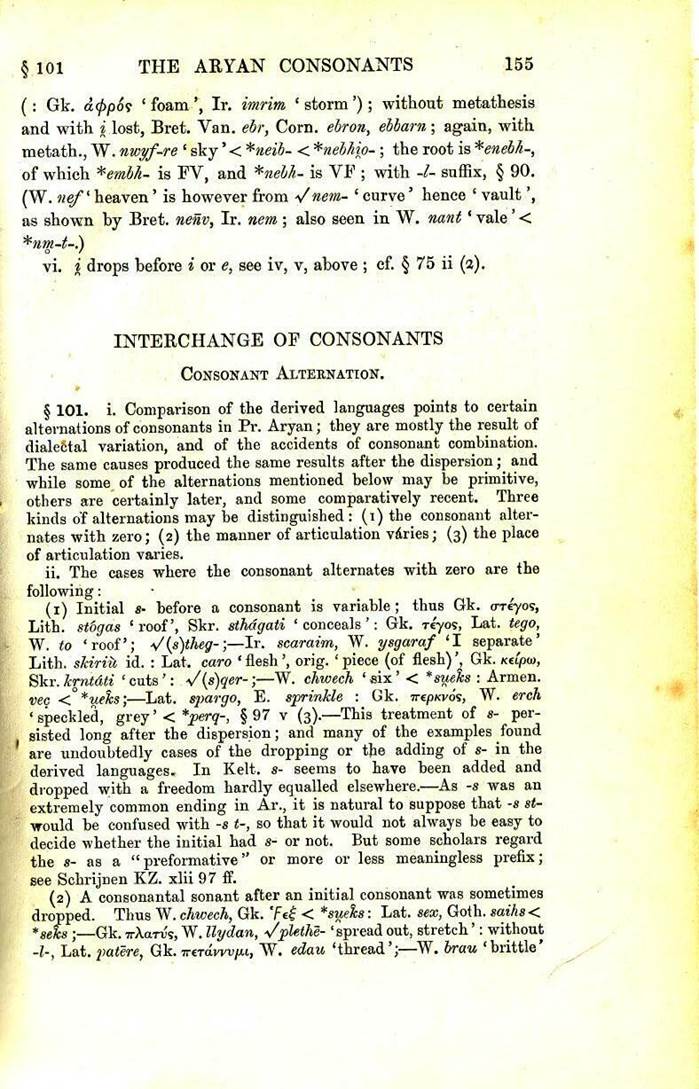
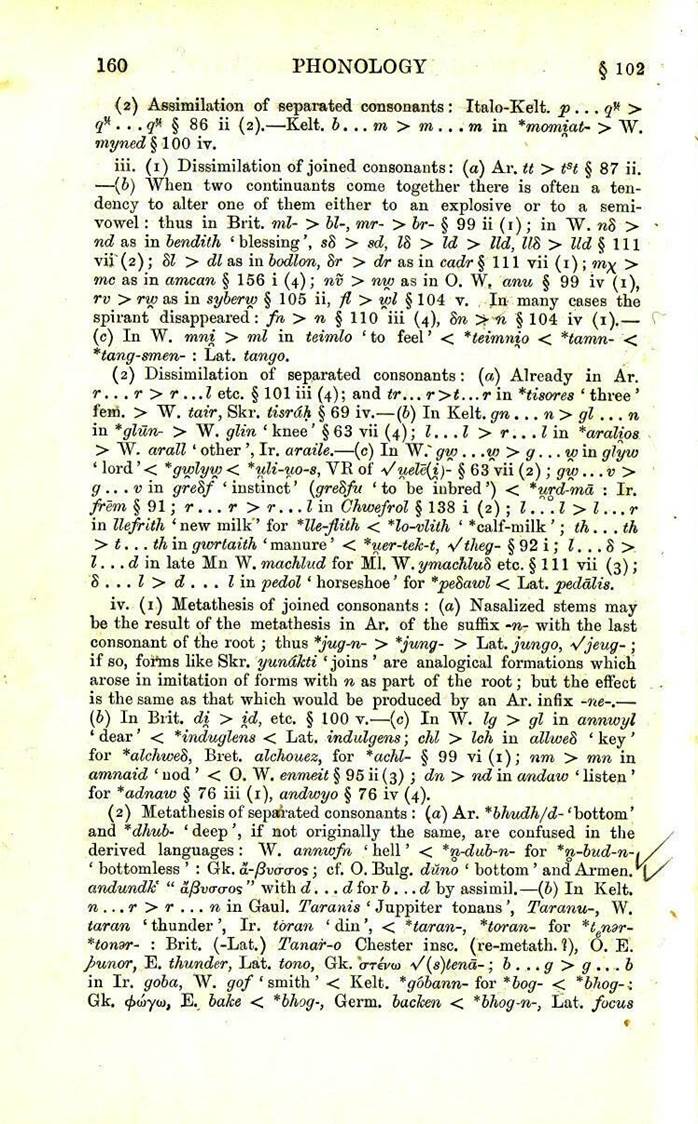
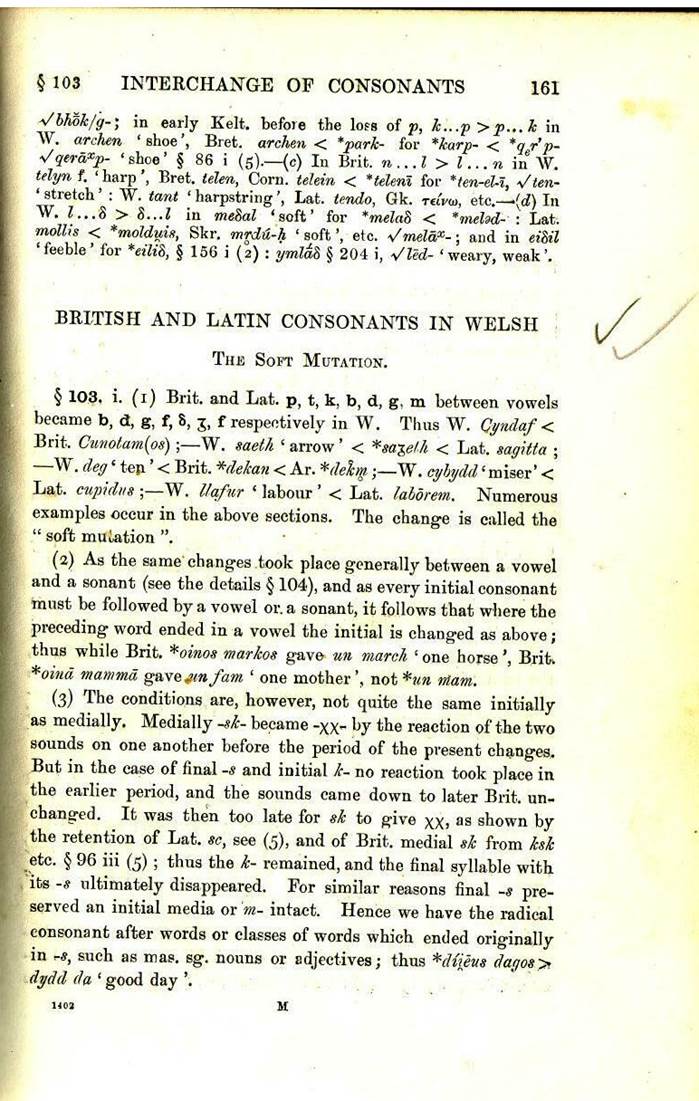
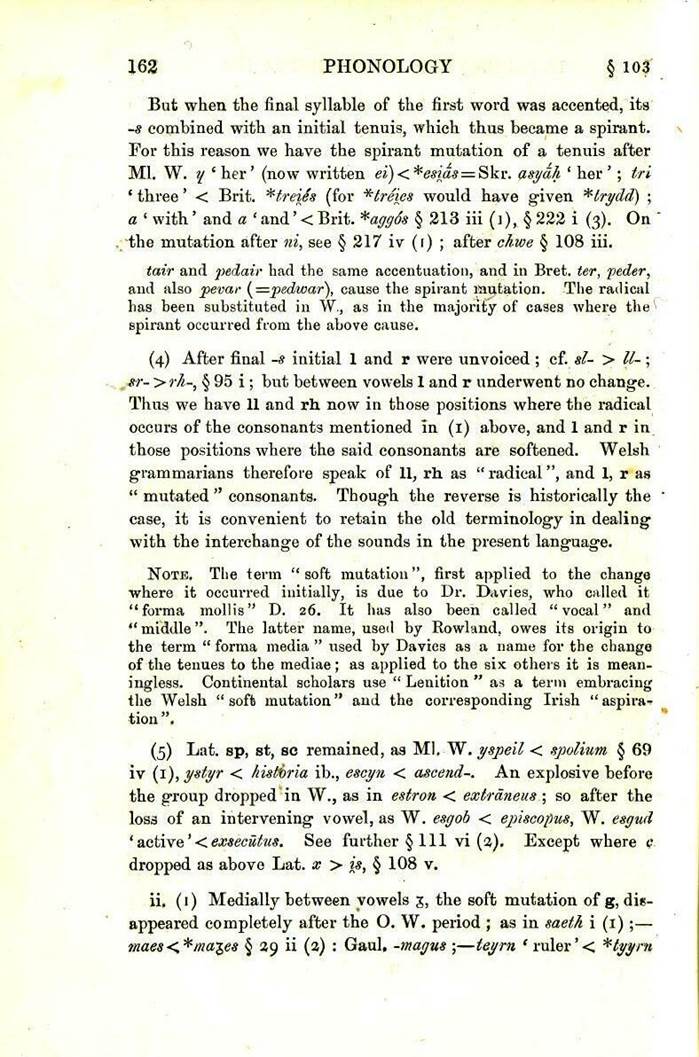
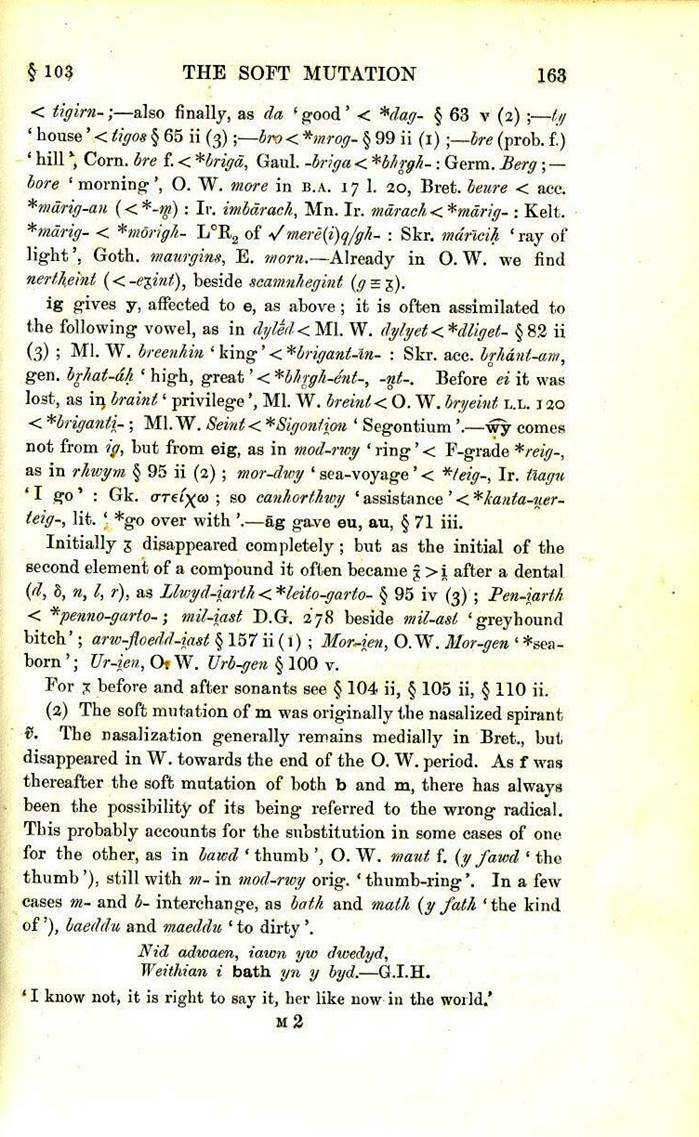




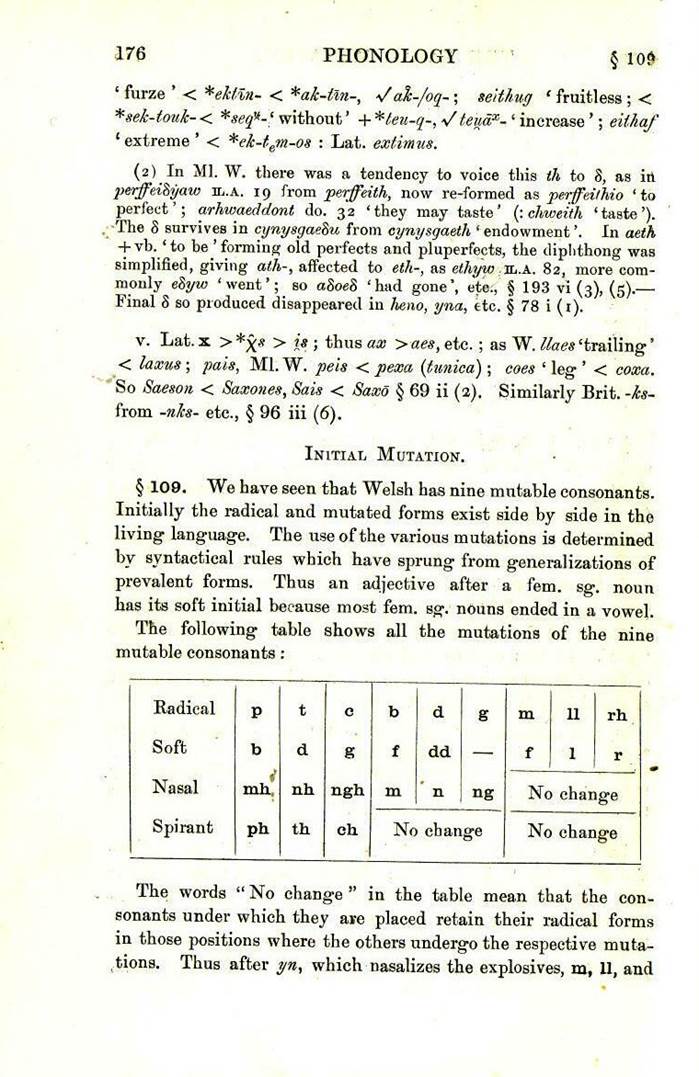


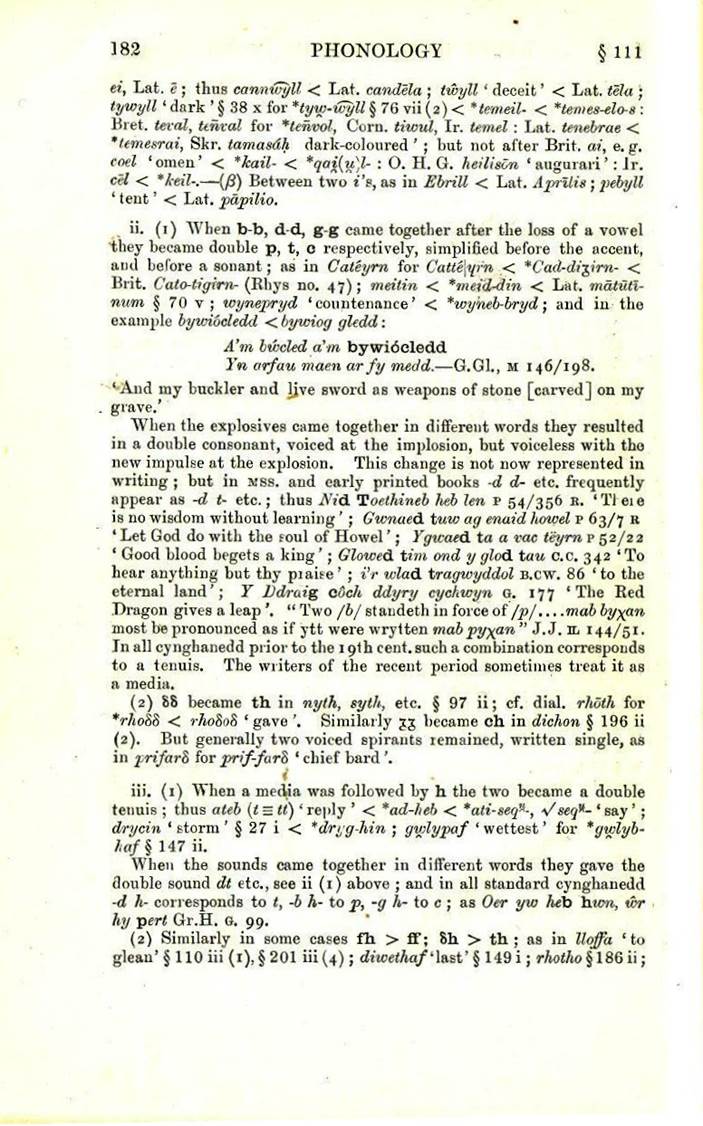

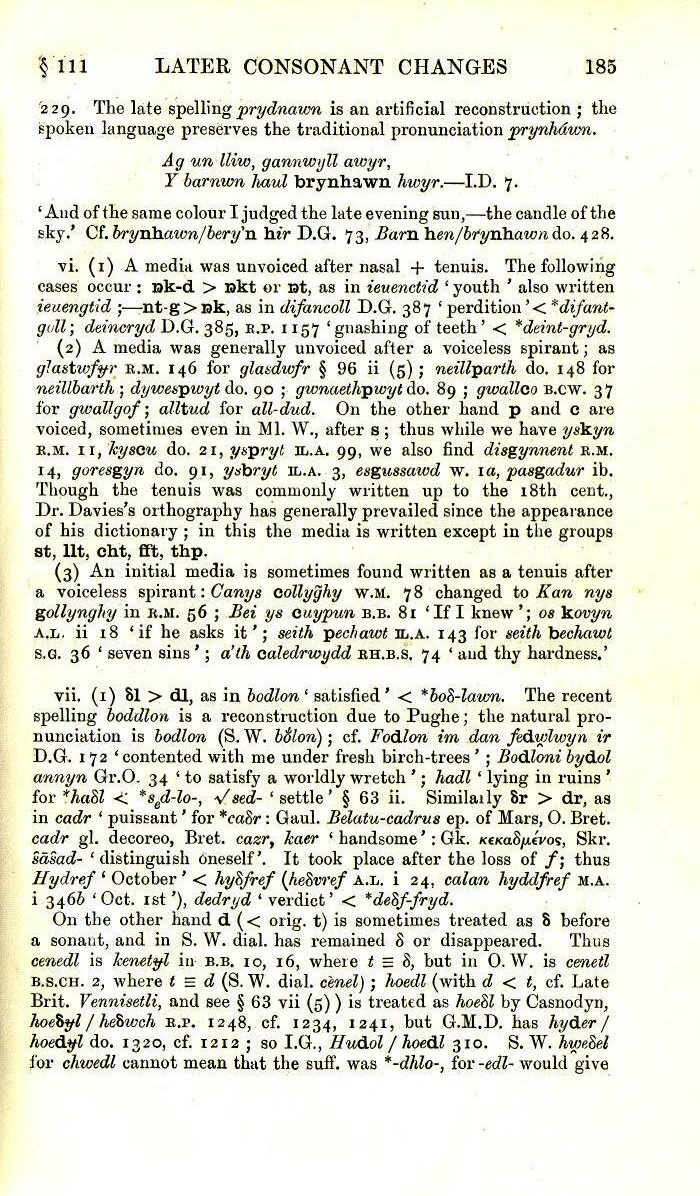
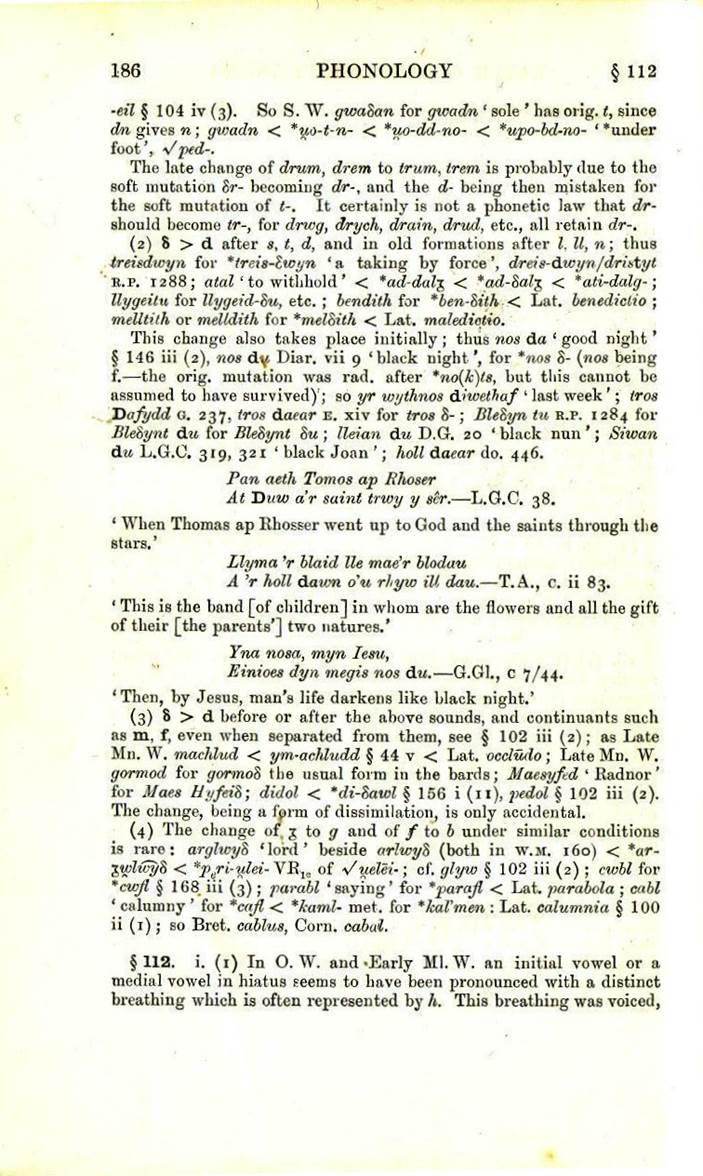


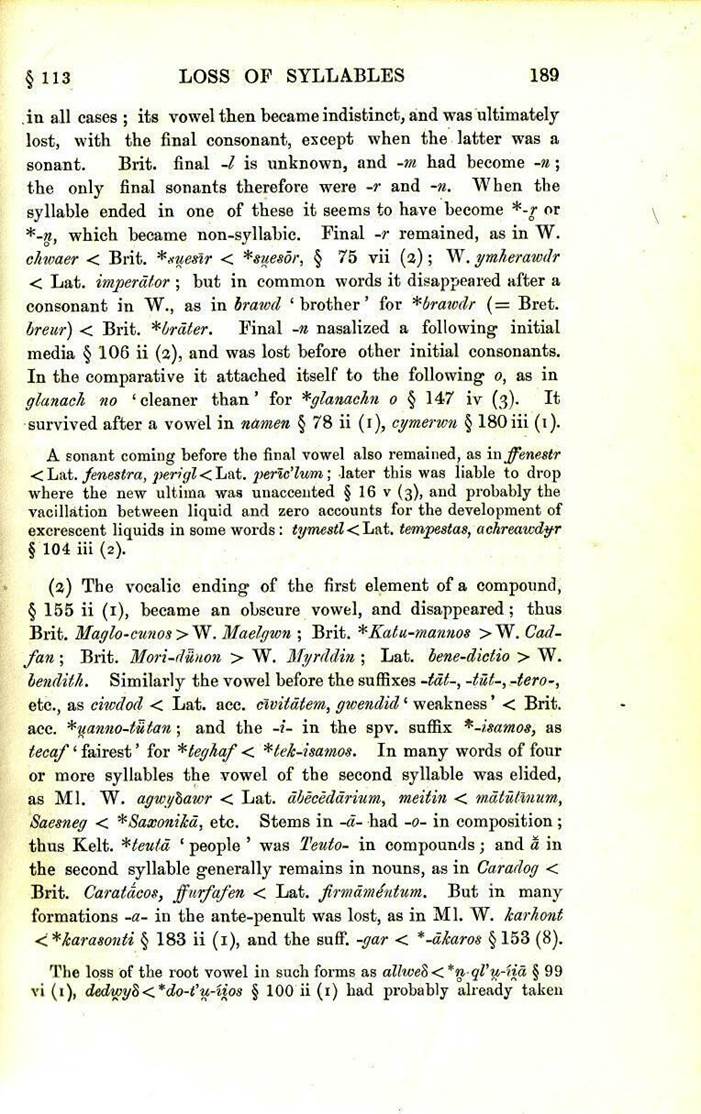
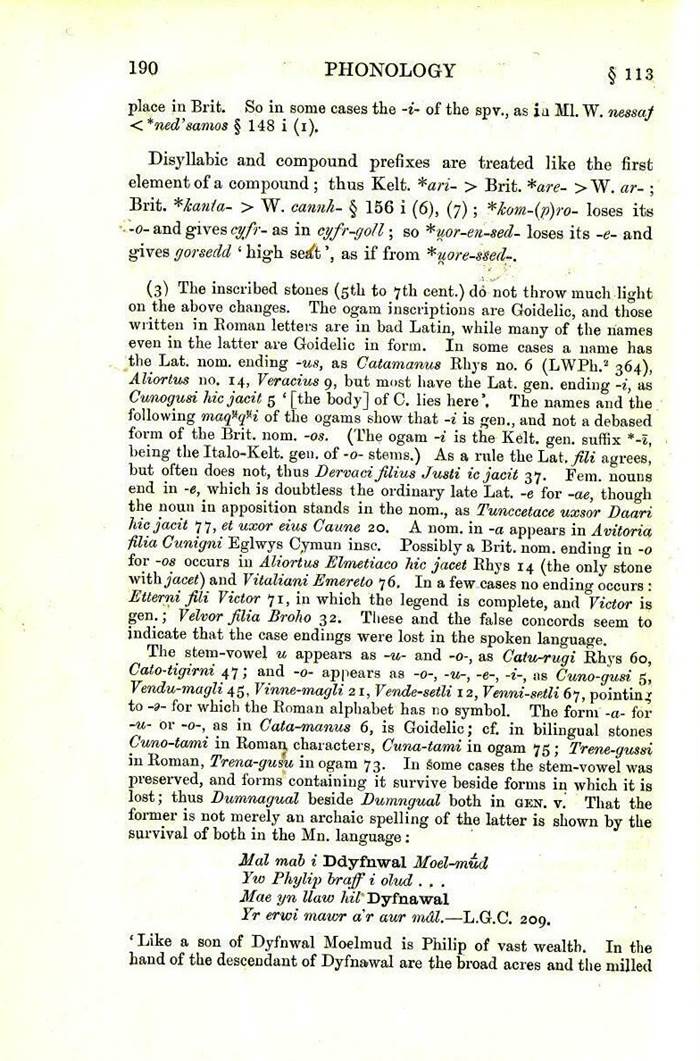


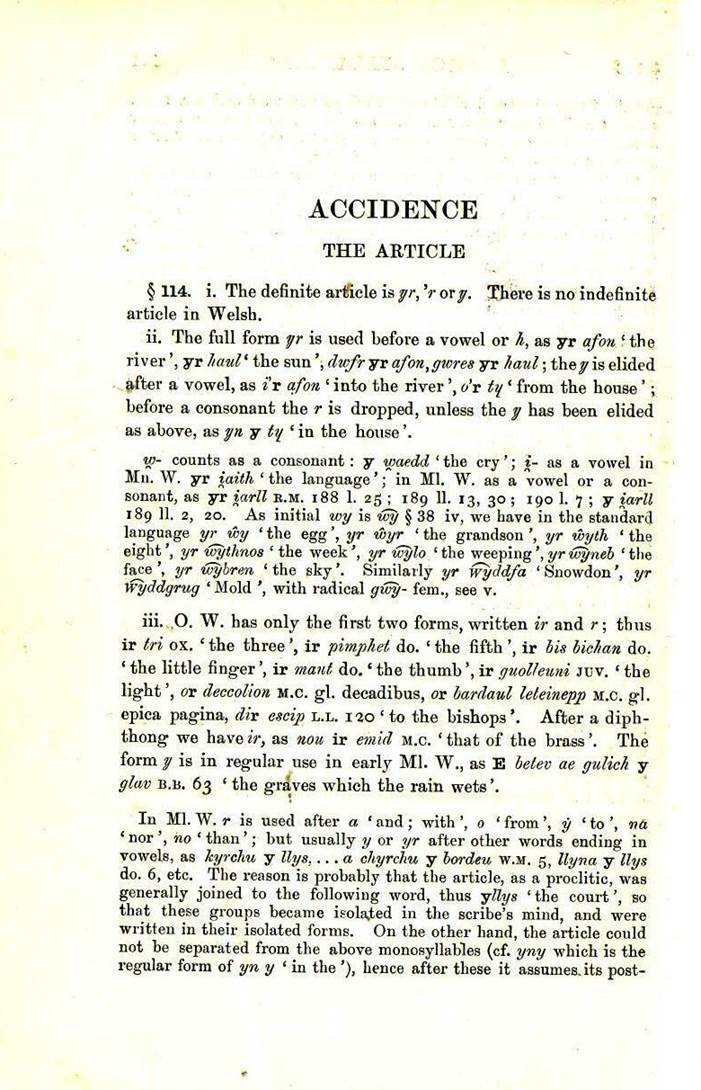
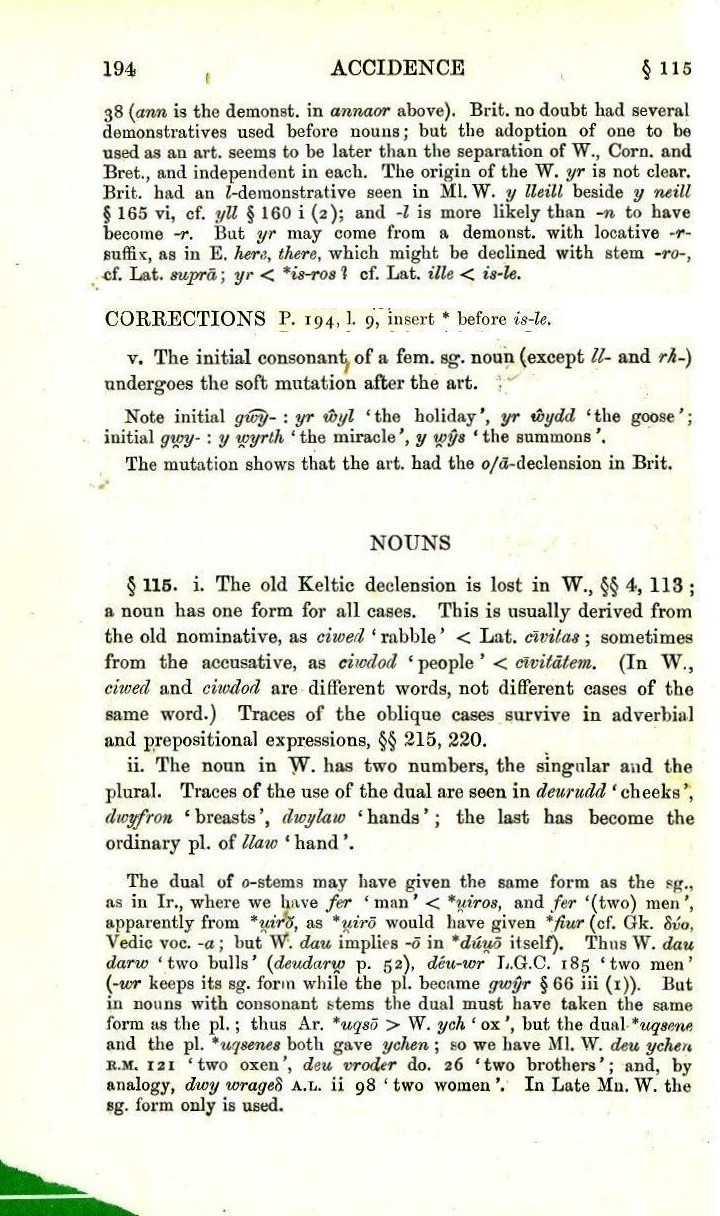



![[W 1]](https://en.wikisource.org/wiki/Page:Morris-Jones_Welsh_Grammar_0153.png#cite_note-1)


![[1]](https://en.wikisource.org/wiki/Page:Morris-Jones_Welsh_Grammar_0166.png#cite_note-1)
![[W 1]](https://en.wikisource.org/wiki/Page:Morris-Jones_Welsh_Grammar_0166.png#cite_note-2)


![[W 1]](https://en.wikisource.org/wiki/Page:Morris-Jones_Welsh_Grammar_0194.png#cite_note-1)

Y DUDALEN NESAF: 2429e
Sumbolau:
a A / æ Æ / e E / ɛ Ɛ / i
I / o O / u U / w W / y Y /
…..
…..
MACRON: ā Ā / ǣ Ǣ /
ē Ē / ɛ̄ Ɛ̄
/ ī Ī / ō Ō /
ū Ū / w̄ W̄ / ȳ Ȳ /
MACRON + ACEN DDYRCHAFEDIG: Ā̀ ā̀
, Ḗ ḗ, Ī́ ī́
, Ṓ ṓ , Ū́ ū́,
(w), Ȳ́ ȳ́
MACRON + ACEN
DDISGYNEDIG: Ǟ ǟ , Ḕ ḕ,
Ī̀ ī̀, Ṑ ṑ, Ū̀
ū̀, (w), Ȳ̀ ȳ̀
MACRON ISOD: A̱ a̱ , E̱ e̱ ,
I̱ i̱ , O̱ o̱, U̱ u̱, (w),
Y̱ y̱
BREF: ă Ă / ĕ Ĕ / ĭ Ĭ / ŏ Ŏ / ŭ
Ŭ / B5236:  B5237:
BREF GWRTHDRO ISOD: i̯, u̯
CROMFACHAU: ⟨ ⟩ deiamwnt
A’I PHEN I LAWR: ∀, ә, ɐ (u+0250) https:
//text-symbols.com/upside-down/
…..
…..
ˡ ɑ ɑˑ aˑ a: / æ æ: / e eˑe:
/ ɛ ɛ: / ɪ iˑ i:
/ ɔ oˑ o: / ʊ uˑ u:
/ ə / ʌ /
ẅ Ẅ / ẃ Ẃ / ẁ Ẁ / ŵ Ŵ /
ŷ Ŷ / ỳ Ỳ / ý Ý / ɥ
ˡ ð ɬ ŋ ʃ ʧ θ ʒ ʤ /
aɪ ɔɪ əɪ uɪ ɪʊ aʊ ɛʊ əʊ / £
ә ʌ ẃ ă ĕ ĭ ŏ ŭ ẅ
ẃ ẁ Ẁ ŵ ŷ ỳ Ỳ
…..
…..
Hwngarwmlawt: A̋ a̋
g yn
yn  aith δ δ
…..
…..
ә ʌ ẃ ă ĕ ĭ ŏ ŭ ẅ
ẃ ẁ ŵ ŷ ỳ
Ә Ʌ Ẃ Ă Ĕ Ĭ Ŏ Ŭ Ẅ
Ẃ Ẁ Ẁ Ŵ Ŷ Ỳ Ỳ
…..
….
Hwngarwmlawt: A̋ a̋
g yn
yn  aith δ δ
…..
…..
ʌ ag acen ddyrchafedig / ʌ with acute accent: ʌ́
|
Shwa ag acen ddyrchafedig Xwa amb accent agut Schwa with acute |
|
|
DejaVu Serif |
…..
wikipedia,
scriptsource.[]org
https://[ ]en.wiktionary.org/wiki/ǣ
…..
Y TUDALEN HWN /THIS PAGE / AQUESTA PÀGINA:
http://
[]www. []kimkat.org/amryw/1_gramadeg/gramadeg_2_1913_jmj_welsh_grammar_05_150-199_2648e,htm
____________________________________
Adolygiadau diweddaraf: Dÿdd
Mawrth 2005-11-20; Mercher 2007-04-11
Ble’r wyf i? Yr ych chi’n ymwéld ag un o dudalennau’r Gwefan
“CYMRU-CATALONIA”
On sóc? Esteu visitant una pàgina de la Web “CYMRU-CATALONIA” (=
Gal”les-Catalunya)
Weør àm ai? Yùu àar vízïting ø peij fròm
dhø “CYMRU-CATALONIA” (= Weilz-Katølóuniø) Wéb-sait
Where am I? You are visiting a page from the
“CYMRU-CATALONIA” (= Wales-Catalonia) Website
CYMRU-CATALONIA