kimkat2653e A Welsh Grammar - Historical and Comparative. 1913.
John Morris-Jones (1864-1929).
2650k Gwefan Cymru-Catalonia.
21-11-2025

.....
|
(delwedd 003) |
Gwefan Cymru-Catalonia A
Welsh Grammar - Historical and Comparative |
|
.....
|
2644e Tudalennau |
Rhan 2: Tudalennau |
Rhan 3: Tudalennau §41- §75 |
Rhan 4: Tudalennau §75- §99 |
Rhan 5: Tudalennau §99- §120 |
Rhan 6: Tudalennau §120- §148 |
Rhan 7: Tudalennau §148- §165 |
Rhan 8: Tudalennau §165- §189 |
Rhan 9: Tudalennau §189- §209 |
Rhan 10: Tudalennau §209- §224 |
Rhan 11: Tudalennau (y mynegai) |
|
Secció 1: Pàgines |
Secció 2: Pàgines |
Secció 3: Pàgines §41- §75 |
Secció 4: Pàgines §75- §99 |
Secció 5: Pàgines §99- §120 |
Secció 6: Pàgines §120- §148 |
Secció 7: Pàgines §148- §165 |
Secció 8: Pàgines §165- §189 |
Secció 9: Pàgines §189- §209 |
Secció 10: Pàgines §209- §224 |
Secció 11: Pàgines (index) |
|
Part 1: Pages |
Part 2: Pages |
Part 3: Pages §41- §75 |
Part 4: Pages §75- §99 |
Part 5: Pages §99- §120 |
Part 6: Pages §120- §148 |
Part 7: Pages §148- §165 |
Part 8: Pages §165- §189 |
Part 9: Pages §189- §209 |
Part 10: Pages §209- §224 |
Part 11: Pages (index) |
Gweler hefyd / Vegeu també / See also: https://en.wikisource.org/wiki/A_Welsh_Grammar,_Historical_and_Comparative
.....
|
*** |
|
|
||||||||||||||||||||||||||||||||||||||||||||||||||||||||||||||||||
|
|
|
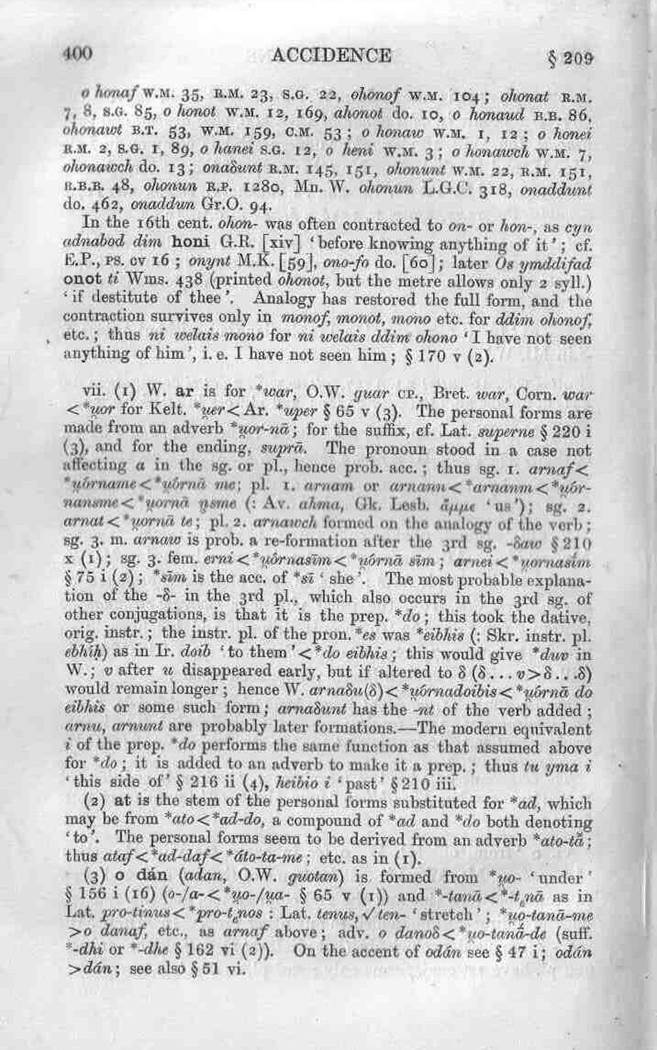
400 Accidence § 209 o honaf w.m. 35, r.m. 23, s.g. 22, ohonof w.m. 104; ohonat r.m. 7, 8, s.g. 85, o honot w.m. 12, 169, ahonot do. 10, o honaud b.b. 86, ohonawt b.t. 53, w.m. 159, c.m. 53; o honaw w.m. 1, 12; o honei r.m. 2, s.g. 1, 89, o hanei s.g. 12, o heni w.m. 3; o honawch w.m. 7, ohonawch do. 13; onaẟunt r.m. 145, 151, ohonunt w.m. 22, r.m. 151, r.b.b. 48, ohonun r.p. 1280, Mn. W. ohonun L.G.C. 318, onaddunt do. 462, onaddun Gr.O. 94. In the 16th cent. ohon- was often contracted to on- or hon‑, as cyn adnabod dim honi G.R. [xiv] ‘before knowing anything of it’; cf. E.P., ps. cv 16; onynt M.K. [59], ono-fo do. [60]; later Os ymddifad onot ti Wms. 438 (printed ohonot, but the metre allows only 2 syll.) ‘if destitute of thee’. Analogy has restored the full form, and the contraction survives only in monof, monot, mono etc. for ddim ohonof, etc.; thus ni welais mono for ni welais ddim ohono ‘I have not seen anything of him’, i.e. I have not seen him; § 170 v (2). vii. (1) W. ar' is for *war, O.W. guar cp., Bret. war, Corn. war < *u̯or for Kelt. *u̯er < Ar. *uper § 65 v (3). The personal forms are made from an adverb *u̯or-nā; for the suffix, cf. Lat. superne § 220 i (3), and for the ending, suprā. The pronoun stood in a case not affecting a in the sg. or pl., hence prob. acc.; thus sg. 1. arnaf < *u̯órname < *u̯órnā me; pl. 1. arnam or arnann < *arnanm < *u̯órnansme < *u̯ornā n̥sme (: Av. ahma, Gk. Lesb. ἄμμε ‘us’); sg. 2. arnat < *u̯ornā te; pl. 2. arnawch formed on the analogy of the verb; sg. 3. m. arnaw is prob. a re-formation after the 3rd sg. ‑ẟaw § 210 x (1); sg. 3. fern. erni < *u̯órnasīm < *u̯ornā sīm; arnei < *u̯ornasī́m § 75 i (2); *sīm is the acc. of *sī ‘she’. The most probable explanation of the ‑ẟ- in the 3rd pl., which also occurs in the 3rd sg. of other conjugations, is that it is the prep. *do; this took the dative, orig. instr.; the instr. pl. of the pron. *es was *eibhis (: Skr. instr. pl. ebhíḥ) as in Ir. doib ‘to them’ < *do eibhis; this would give *duv in W.; v after u disappeared early, but if altered to ẟ (ẟ…v > ẟ…ẟ) would remain longer; hence W. arnaẟu(ẟ) < *u̯órnadoibis < *u̯órnā do eibhis or some such form; arnaẟunt has the ‑nt of the verb added; arnu, arnunt are probably later formations.—The modern equivalent i of the prep. *do performs the same function as that assumed above for *do; it is added to an adverb to make it a prep.; thus tu yma i ‘this side of’ § 216 ii (4), heibio i ‘past’ § 210 iii. (2) at is the stem of the personal forms substituted for *ad, which may be from *ato < *ad-do, a compound of *ad and *do both denoting ‘to’. The personal forms seem to be derived from an adverb *ato-tā̆; thus ataf < *ad-daf < *áto-ta-me; etc. as in (1). (3) o dán (adan, O.W. guotan) is formed from *u̯o- ‘under’ § 156 i (16) (o‑/a- < *u̯o‑/u̯a- § 65 v (1)) and *‑tanā < *‑tₑnā as in Lat. pro-tinus < *pro-tₑnos: Lat. tenus, √ten- ‘stretch’; *u̯o-tanā́-me > o danaf, etc., as arnaf above; adv. o danoẟ < *u̯o-tanā́-de (suff. *‑dhi or *‑dhe § 162 vi (2)). On the accent of odán see § 47 i; odán > dán; see also § 51 vi. |
||||||||||||||||||||||||||||||||||||||||||||||||||||||||||||||||||
|
*** |
|
|
||||||||||||||||||||||||||||||||||||||||||||||||||||||||||||||||||
|
|
|
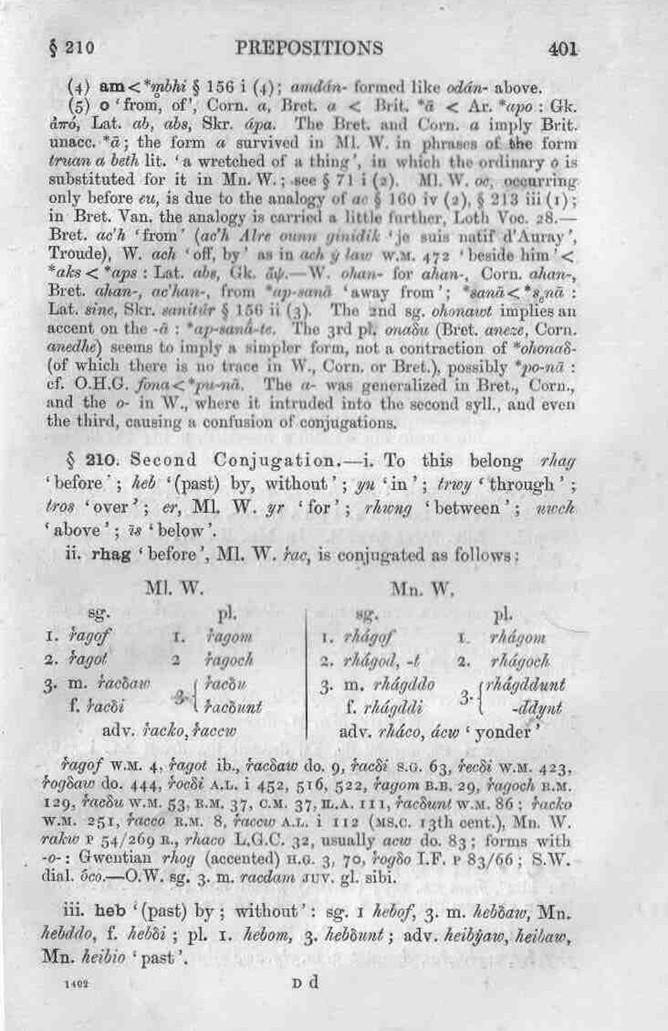
§ 210 Prepositions 401 (4) am < *m̥bhi § 156 i (4); amdán- formed like odán- above. (5) o ‘from, of’, Corn. a, Bret. a < Brit. *ā < Ar. *apo: Gk. ἀπό, Lat. ab, abs, Skr. ápa. The Bret. and Corn. a imply Brit. unacc. *ā; the form a survived in Ml. W. in phrases of the form truan a beth lit. ‘a wretched of a thing’, in which the ordinary o is substituted for it in Mn. W.; see § 71 i (2). Ml. W. oc, occurring only before eu, is due to the analogy of ac § 160 iv (2), § 213 iii (1); in Bret. Van. the analogy is carried a little further, Loth Voc. 28.—Bret. ac’h ‘from’ (ac’h Alre ounn ginidik ‘je suis natif d’Auray’, Troude), W. ach ‘off, by’ as in ach ẏ law w.m. 472 ‘beside him’ < *aks < *aps: Lat. abs, Gk. ἄψ.—W. ohan- for ahan‑, Corn. ahȧn‑, Bret. ahan‑, ac’han‑, from *ap-sanā ‘away from’; *sanā < *sₑnā: Lat. sine, Skr. sanitúr § 156 ii (3). The 2nd sg. ohonawt implies an accent on the ‑ā: *ap-sanā́-te. The 3rd pl. onaẟu (Bret. aneze, Corn. anedhe) seems to imply a simpler form, not a contraction of *ohonaẟ- (of which there is no trace in W., Corn. or Bret.), possibly *po-nā: cf. O.H.G. fona < *pu-nā. The a- was generalized in Bret., Corn., and the o- in W., where it intruded into the second syll., and even the third, causing a confusion of conjugations. § 210. Second Conjugation.—i. To this belong rhag ‘before’; heb ‘(past) by, without’; yn ‘in’; trwy ‘through’; tros ‘over’; er, Ml. W. yr ‘for’; rhwng ‘between’; uwch ‘above’; is ‘below’. ii. rhag ‘before’, Ml. W. r̔ac, is conjugated as follows:
r̔agof w.m. 4, r̔agot ib., r̔acẟaw do. 9, r̔acẟi s.g. 63, r̔ecẟi w.m. 423, r̔ogẟaw do. 444, r̔ocẟi a.l. i 452, 516, 522, r̔agom b.b. 29, r̔agoch r.m. 129, r̔acẟu w.m. 53, r.m. 37, c.m. 37, Ỻ.A. 111, r̔acẟunt w.m. 86; r̔acko w.m.} 251, r̔acco r.m. 8, r̔accw a.l. i 112 (ms.c. 13th cent.), Mn. W. rakw p 54/269 r., rhaco L.G.C. 32, usually acw do. 83; forms with ‑o‑: Gwentian rhog (accented) h.g. 3, 70, r̔ogẟo I.F. p 83/66; S.W. dial. óco.—O.W. sg. 3. m. racdam juv. gl. sibi. iii. heb ‘(past) by; without’: sg. 1 hebof, 3. m. hebẟaw, Mn. hebddo, f. hebẟi; pl. 1. hebom, 3. hebẟunt; adv. heibẏaw, heibaw, Mn. heibio ‘past’. |
||||||||||||||||||||||||||||||||||||||||||||||||||||||||||||||||||
|
*** |
|
|
||||||||||||||||||||||||||||||||||||||||||||||||||||||||||||||||||
|
|
|
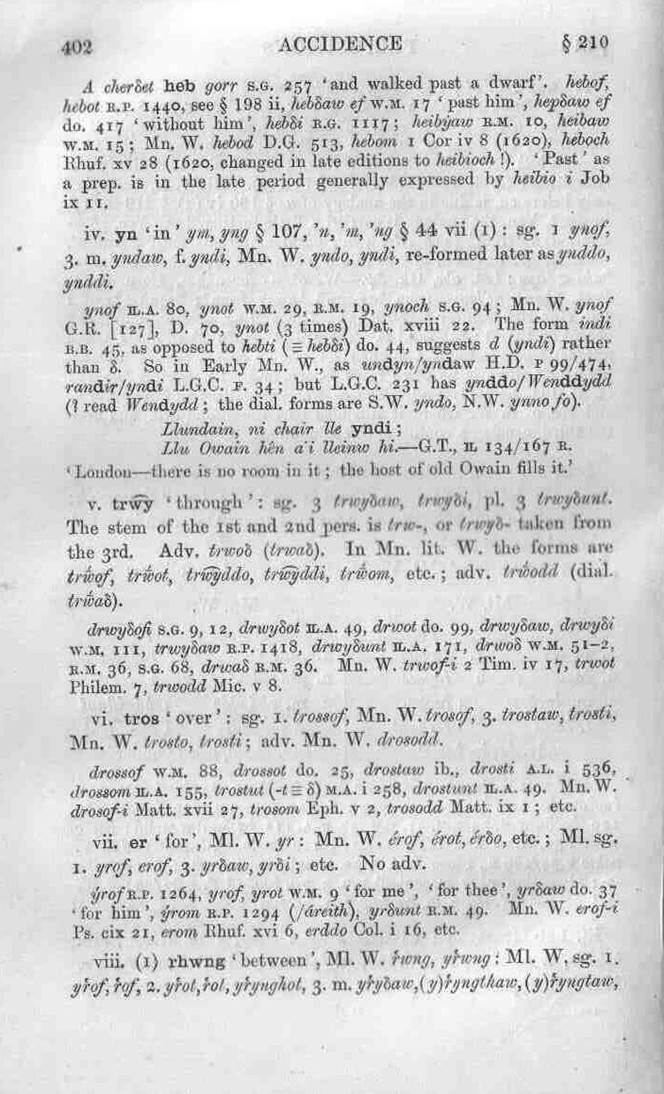
402 Accidence § 210 A cherẟet heb gorr s.g. 257 ‘and walked past a dwarf’. hebof, hebot r.p. 1440, see § 198 ii, hebẟaw ef w.m. 17 ‘past him’, hepẟaw ef do. 417 ‘without him’, hebẟi r.g. 1117; heibẏaw r.m. 10, heibaw w.m. 15; Mn. W. hebod D.G. 513, hebom 1 Cor iv 8 (1620), heboch Rhuf. xv 28 (1620, changed in late editions to heibioch!). ‘Past’ as a prep. is in the late period generally expressed by heibio i Job ix 11. iv. yn ‘in’ ym, yng § 107, ’n, ’m, ’ng § 44 vii (1): sg. 1 ynof, 3. m.yndaw, f. yndi, Mn. W. yndo, yndi, re-formed later as ynddo, ynddi. ynof Ỻ.A. 80, ynot w.m. 29, r.m. 19, ynoch s.g. 94; Mn. W. ynof G.R. [127], D. 70, ynot (3 times) Dat. xviii 22. The form indi b.b. 45, as opposed to hebti (≡ hebẟi) do. 44, suggests d (yndi) rather than ẟ. So in Early Mn. W., as undyn/yndaw H.D. p 99/474, randir/yndi L.G.C. f. 34; but L.G.C. 231 has ynddo/Wenddydd (? read Wendydd; the dial. forms are S.W. yndo, N.W. ynno fo). Llundain, ni chair lle yndi; Llu Owain hên a’i lleinw hi.—G.T., Ỻ 134/167 r. ‘London—there is no room in it; the host of old Owain fills it.’ v. trwy ‘through’: sg. 3 trwyẟaw, trwyẟi, pl. 3 trwyẟunt. The stem of the 1st and 2nd pers. is trw‑, or trwyẟ- taken from the 3rd. Adv. trwoẟ (trwaẟ). In Mn. lit. W. the forms are trw̄́of, trw̄́ot, trw͡yddo, trw͡yddi, trw̄́om, etc.; adv. trw̄́odd (dial. trw̄́aẟ). drwyẟofi s.g. 9, 12, drwyẟot Ỻ.A. 49, drwot do. 99, drwyẟaw, drwyẟi w.m. 111, trwyẟaw r.p. 1418, drwyẟunt Ỻ.A. 171, drwoẟ w.m. 51–2, r.m. 36, s.g. 68, drwaẟ r.m. 36. Mn. W. trwof‑i 2 Tim. iv 17, trwot Philem. 7, trwodd Mic. v 8. vi. tros ‘over’: sg. 1. trossof, Mn. W. trosof, 3. trostaw, trosti, Mn. W. trosto, trosti; adv. Mn. W. drosodd. drossof w.m. 88, drossot do. 25, drostaw ib., drosti a.l. i 536, drossom Ỻ.A. 155, trostut (‑t ≡ ẟ) m.a. i 258, drostunt Ỻ.A. 49. Mn. W. drosof‑i Matt. xvii 27, trosom Eph. v 2, trosodd Matt. ix 1; etc. vii. er ‘for’, Ml. W. yr: Mn. W. érof, érot, érẟo, etc.; Ml. sg. 1. yrof, erof, 3. yrẟaw, yrẟi; etc. No adv. ýrof r.p. 1264, yrof, yrot w.m. 9 ‘for me’, ‘for thee’, yrẟaw do. 37 ‘for him’, ýrom r.p. 1294 (/áreith), yrẟunt r.m. 49. Mn. W. erof‑i Ps. cix 21, erom Rhuf. xvi 6, erddo Col. i 16, etc. viii. (1) rhwng ‘between’, Ml. W. r̔wng, yr̔wng: Ml. W. sg. 1. yr̔of, r̔of, 2. yr̔ot, r̔ot, yr̔ynghot, 3. m. yr̔yẟaw, (y)r̔yngthaw, (y)r̔yngtaw, |
||||||||||||||||||||||||||||||||||||||||||||||||||||||||||||||||||
|
*** |
|
|
||||||||||||||||||||||||||||||||||||||||||||||||||||||||||||||||||
|
|
|
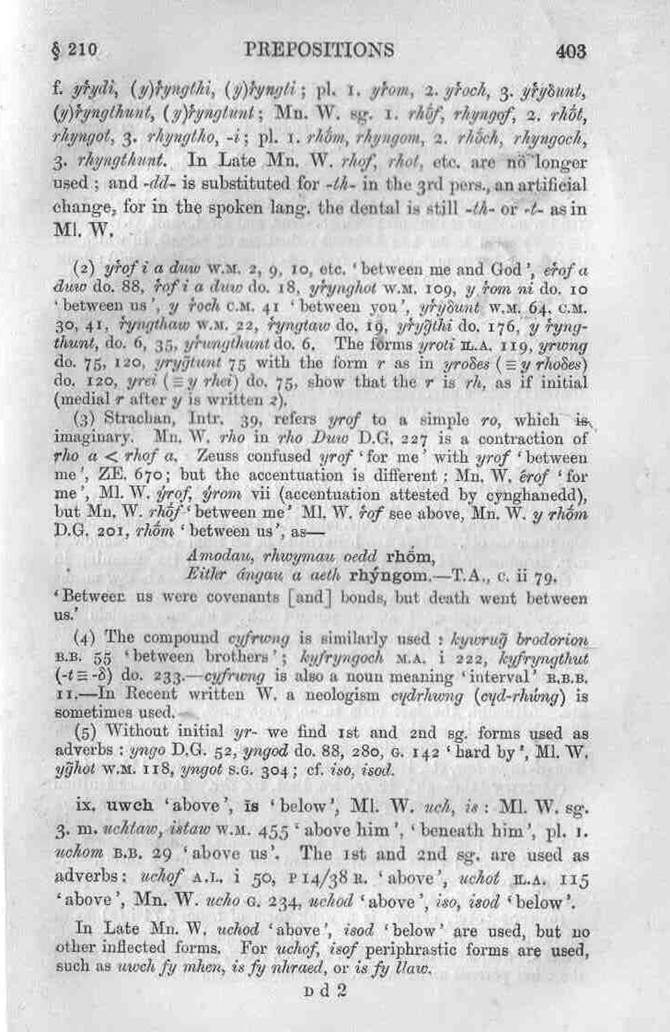
§ 210 Prepositions 403 f. yr̔ydi, (y)r̔yngthi, (y)r̔yngti; pl. 1. yr̔om, 2. yr̔och, 3. yr̔yẟunt, (y)r̔yngthunt, (y)r̔yngtunt; Mn. W. sg. 1. rhṓf, rhyngof, 2. rhṓt, rhyngot, 3. rhyngtho, ‑i; pl. 1. rhṓm, rhyngom, 2. rhṓch, rhyngoch, 3. rhyngthunt. In Late Mn. W. rhof, rhot, etc. are no longer used; and ‑dd- is substituted for ‑th- in the 3rd pers., an artificial change, for in the spoken lang. the dental is still ‑th- or ‑t- as in Ml. W. (2) yr̔of i a duw w.m. 2, 9, 10, etc. ‘between me and God’, er̔of a duw do. 88, r̔of i a duw do. 18, yr̔ynghot w.m. 109, y r̔om ni do. 10 ‘between us’, y r̔och c.m. 41 ‘between you’, yr̔yẟunt w.m. 64, c.m. 30, 41, r̔yngthaw w.m. 22, r̔yngtaw do. 19, yr̔yg̃thi do. 176, y r̔yngthunt, do. 6, 35, yr̔ungthunt do. 6. The forms yroti Ỻ.A. 119, yrwng do. 75, 120, yryg̃tunt 75 with the form r as in yroẟes (≡ y rhoẟes) do. 120, yrei (≡ y rhei) do. 75, show that the r is rh, as if initial (medial r after y is written ꝛ). (3) Strachan, Intr. 39, refers yrof to a simple ro, which is imaginary. Mn. W. rho in rho Duw D.G. 227 is a contraction of rho a < rhof a. Zeuss confused yrof ‘for me’ with yrof ‘between me’, ZE. 670; but the accentuation is different: Mn. W. érof ‘for me’, Ml. W. ýrof, ýrom vii (accentuation attested by cynghanedd), but Mn. W. rhṓf ‘between me’ Ml. W. r̔of see above, Mn. W. y rhṓm D.G. 201, rhṓm ‘between us’, as— Amodau, rhwymau oedd rhṓm, Eithr ángau a aeth rhýngom.—T.A., c. ii 79. ‘Between us were covenants [and] bonds, but death went between us.’ (4) The compound cyfrwng is similarly used: kywrug̃ brodorion b.b. 55 ‘between brothers’; kyfryngoch m.a. i 222, kyfryngthut (‑t ≡ ‑ẟ) do. 233.—cyfrwng is also a noun meaning ‘interval’ r.b.b. 11.—In Recent written W. a neologism cɥdrhwng (cɥd-rhẃng) is sometimes used. (5) Without initial yr‑ we find 1st and 2nd sg. forms used as adverbs: yngo D.G. 52, yngod do. 88, 280, g. 142 'hard by ', Ml. W. yg̃hot w.m. 118, yngot s.g. 304; cf. iso, isod. ix. uwch ‘above’, īs ‘below’, Ml. W. uch, is: Ml. W. sg. 3. m. uchtaw, istaw w.m. 455 ‘above him’, ‘beneath him’, pl. 1. uchom b.b. 29 ‘above us’. The 1st and 2nd sg. are used as adverbs: uchof a.l. i 50, p 14/38 r. ‘above’, uchot Ỻ.A. 115 ‘above’, Mn. W. ucho g. 234, uchod ‘above’, iso, isod ‘below’. In Late Mn. W. uchod ‘above’, isod ‘below’ are used, but no other inflected forms. For uchof, isof periphrastic forms are used, such as uwch fy mhen, is fy nhraed, or is fy llaw. |
||||||||||||||||||||||||||||||||||||||||||||||||||||||||||||||||||
|
*** |
|
|
||||||||||||||||||||||||||||||||||||||||||||||||||||||||||||||||||
|
|
|
404 Accidence § 210 x. (1) The ‑o- of the 1st and 2nd pers. endings of this conjugation prob. represents the ending ‑o of the prep. in Brit. Although the thematic vowel ‑o was not a case ending in Ar. it was a common ending of adverbs and preps., e.g. *apo, *upo, *pro, and may have spread in Kelt. Hence perhaps *proko me > Brit. *rokome > W. (*rhogof), rhagof. For the 3rd pl. ‑ẟunt see § 209 vii (1); 3rd sg. ‑ẟi < *´‑do-sī § 75 ii (2), where *sī is the instr. sg. of *sī ‘she’. The 3rd sg. m. ‑ẟaw is difficult; Ml. W. ‑ẟaw, and Bret. ‑zañ, O.W. ‑dam (≡ ‑ẟaṽ) seem to be two different reductions of *‑ẟauṽ, in which au (aw) must be from *‑ou- not from ‑ā- (since ām > Bret. euñ); both *‑ẟawf and Corn. ‑tho may be from *‑do-emi § 75 ii (2); *e‑mi, instr. in *‑mi of *es ‘he’. (2) rhag < *prokos: Lat. reci-procus, procul < *procolos, dim. of *prokos; unacc. ok > ak in Brit. § 65 ii (1); dialectal rhog, rhogẟo, etc. < *prók‑. The form before a noun seems to have ended in ‑s causing the rad. initial: Brit. *rokos unacc.; personal forms as above (1). The adv. r̔accw, r̔acco ‘yonder’ has a suffix *‑hw or *‑ho, prob. with loss of ‑nn (as yma ‘here’ etc. § 110 v (2)), for *‑hwnn or *honn < *som-de or *som-da ‘there’ suff. *‑dhe or *‑dha § 162 vi (2), cf. hwnt § 220 ii (5); thus Brit. *roko sonde ‘in front there’ > r̔accw. Initial r- was prob. first lost after consonants: y gw̄́r racw > y gŵr acw, y brýn racw > y bryn acw, *dracw > dacw, etc. (3) heb ‘(past) by, without’, Ir. sech id., Bret., Corn. heb ‘without’: Av. hača ‘away from’, O.Pers. hačā id.: Lat. secus, Skr. sácā ‘at, in the presence of’. These are believed to be all from √sequ̯- ‘follow’; e.g. Brugmann² II ii 894 ff. The development of the meaning in Kelt. and Iran. is not quite clear. In W. heb with the vb. wyf means ‘not having attained’: yr wyf heb fy nghinio ‘I have not had my dinner’, perhaps < ‘*I am in pursuit of’. This may explain the sense of ‘lacking’. ‘Past’ and ‘away from’ may be from ‘proceeding’. The adv. heibi̯aw (Bret. ebiou) seems to be a cpv. of the adj. *sequ̯os; it might represent a loc. *sequ̯iosi § 75 ii (2). (4) yn ‘in’ < *en, *eni and *en‑do: Lat. in, O.Lat. en, Gk. ἐν, ἐνί, etc. Although the last ends in ‑o, ynof, ynot, etc., cannot come directly from it, as they have only one ‑n- in lit. W. Ml. and Mn. They are prob. re-formations from yn on the analogy of rhagof, etc. The ‑d- in yndaw, etc. is due to provection of ẟ after n, § 111 vii (2). (5) trwy ‘through’, Ir. tri, tre, Bret. tre, dre. It causes lenition in W., Bret. and Ir., except in Ir. before the article. For the form in the last case Brugmann² II ii 900 gives *tres, comparing *pres in Gk. πρέσ-βυς; but as *pri, *prei existed beside *pres, so there were prob. *tri, *trei; these would account for the leniting forms. W. trwy < *trei; trwyẟu(nt) < *trei do eibhis. The 1st and 2nd pers. forms and the adv. are analogical formations. (6) tros ‘over, across’ is a weak form of traws § 71 i (2), as in ar draws ‘across’. It comes from a participial form *trāns = Lat. trāns < *trānts. The 3rd pers. trostaw, trosti, trostunt < *trāns do‑; the other persons and the adv. are analogical formations. |
||||||||||||||||||||||||||||||||||||||||||||||||||||||||||||||||||
|
*** |
|
|
||||||||||||||||||||||||||||||||||||||||||||||||||||||||||||||||||
|
|
|
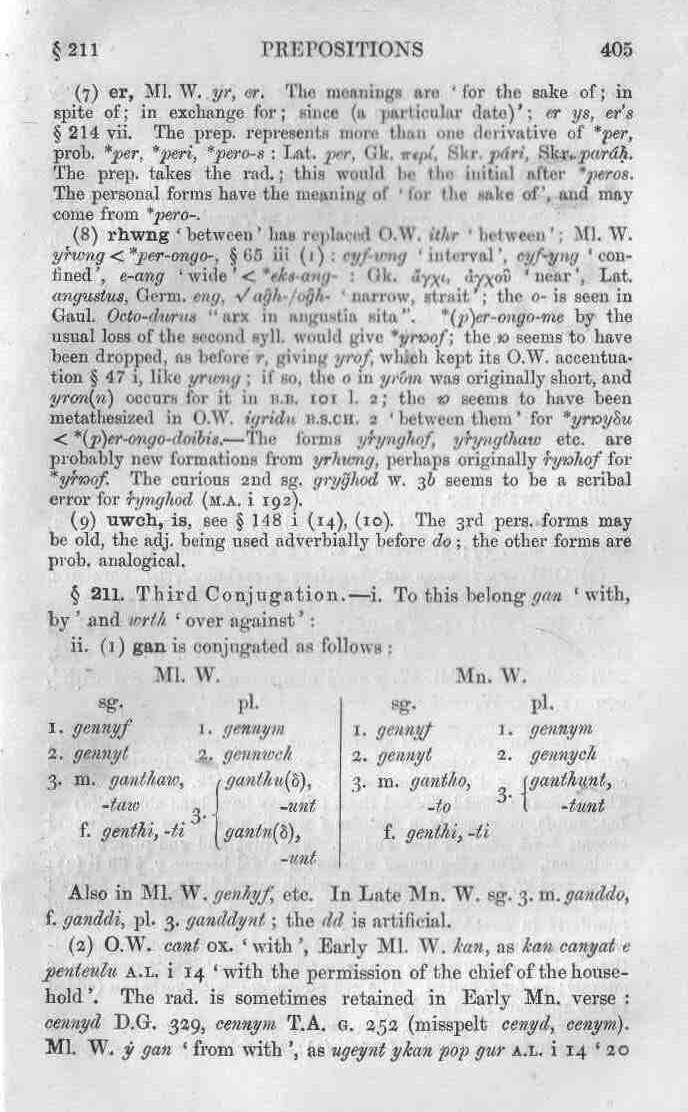
§ 211 Prepositions 405 (7) er, Ml. W. yr, er. The meanings are ‘for the sake of; in spite of; in exchange for; since (a particular date)’; er ys, er’s § 214 vii. The prep. represents more than one derivative of *per, prob. *per, *peri, *pero‑s: Lat. per, Gk. περί, Skr. pári, Skr. paráḥ. The prep. takes the rad.; this would be the initial after *peros. The personal forms have the meaning of ‘for the sake of’, and may come from *pero‑. (8) rhwng ‘between’ has replaced O.W. ithr ‘between’; Ml. W. yr̔wng < *per-ongo‑, § 65 iii (1): cyf-wng ‘interval’, cyf-yng ‘confined’, e‑ang ‘wide’ < *eks-ang‑: Gk. ἄγχι, ἀγχοῦ ‘near’, Lat. angustus, Germ- eng, √ag̑h‑/og̑h- ‘narrow, strait’; the o- is seen in Gaul. Octo‑durus “arx in angustia sita”. *(p)er-ongo-me by the usual loss of the second syll. would give *ỿrŋof; the ŋ seems to have been dropped, as before r, giving yrof, which kept its O.W. accentuation § 47 i, like yrwng; if so, the o in yróm was originally short, and yron(n) occurs for it in b.b. 101 l. 2; the ŋ seems to have been metathesized in O.W. igridu b.s.ch. 2 ‘between them’ for *yrŋyẟu < *(p)er-ongo-doibis.—The forms yr̔ynghof, yr̔yngthaw etc. are probably new formations from yrhwng, perhaps originally r̔yŋhof for *yr̔ŋof. The curious 2nd sg. gryg̃hod w. 3b seems to be a scribal error for r̔ynghod (m.a. i 192). (9) uwch, is, see § 148 i (14), (10). The 3rd pers. forms may be old, the adj. being used adverbially before do; the other forms are prob. analogical. § 211. Third Conjugation.—i. To this belong gan ‘with, by’ and wrth ‘over against’: ii. (1) gan is conjugated as follows:
Also in Ml. W. genhyf, etc. In Late Mn. W. sg. 3. m. ganddo, f. ganddi, pl. 3. ganddynt; the dd is artificial. (2) O.W. cant ox. ‘with’, Early Ml. W. kan, as kan canyat e penteulu a.l. i 14 ‘with the permission of the chief of the household’. The rad. is sometimes retained in Early Mn. verse: cennyd D.G. 329, cennym T.A. g. 252 (misspelt cenyd, cenym). Ml. W. ẏ gan ‘from with’, as ugeynt ykan pop gur a.l. i 14 ‘20 |
||||||||||||||||||||||||||||||||||||||||||||||||||||||||||||||||||
|
*** |
|
|
||||||||||||||||||||||||||||||||||||||||||||||||||||||||||||||||||
|
|
|
406 Accidence § 211 from every man’, became gan already in Ml. W., as attep ny chavas ef genthi hi w.m. 10 ‘he got no reply from her’; Mn. W. gan ‘from’. (3) genhiw (≡ genhyf) b.b. 101 ‘with me’, genhyf w.m. 55, gennyf do. 18, genhid b.b. 10, gennyt w.m. 11, ganthaw do. 9, genthi do. 10, 15, genti do. 28, y gennym do. 12 ‘from us’, genhwch do. 57 ‘with you’, gennwch ib., r.m. 40, s.g. 92, ganthut (‑t ≡ ‑ẟ) m.a. i 258, gantu w.m. 57, ganthunt b.t. 65, w.m. 16, s.g. 1, gantunt Ỻ.A. 69. There is also in Early Ml. verse what appears to be a 3rd pl. genhyn B.T. 13 (twice), 15, 1 6 (twice), 17, 77, nyd ant y kenhin B.B. 49 ‘they will not go back’; also a form y genhyẟ b.t. 75, in an obscure passage. (4) gan with the verb ‘to be’ expresses ‘have’: y mae gennyf ‘there is with me’, i.e. I have, y mae gennyt ‘thou hast’, etc.; nid oes gennyf ‘I have not’, etc. (5) On gennif, gennit, wrthif, wrthit, see § 77 iv. iii. (1) wrth: sg 1. wrthyf w.m. 10; 2. wrthyt ib.; 3. m. wrthaw do. 2; f. wrthi do. 10; pl. 1. wrthym Ỻ.A. 155; 2. wrthywch w.m. 39; 3. wrthu Ỻ.A. 113, wrthunt do. 119. (2) O.W. gurt paup ox. ‘against everybody’, gl. consistes. gurthdo juv., gl. obstitit, seems to be a verb, § 193 v (3). Ml. W. ẏ wrth ‘from beside’, as ywrthywch ac yrvrth ych tei Ỻ.A. 157 ‘from you and from your houses’, Mn. W. oddi wrth, oddi wrthyf, etc.; Ml. W. y wrth also means ‘compared with’, w.m. 11, Mn. W. wrth b.cw. 5 ‘compared with’. iv. (1) gan, O.W. cant (Corn, gans, Bret. gant, Ir. prefix cēt‑, ceta‑) has the meanings of *kom, of which it is a derivative. Thus cann < cant < Brit. *kanta < Ar. *km̥-ta = Gk. κατά < *km̥‑ta. The pronoun suffixed affected the a; it may have been abl. *mī(d) = Lat. mē(d), or possibly a loc. *moi which as a mere suffix would become *‑mī. So for the 2nd sg. The first and 2nd pl. are prob. analogical. The affection of a before a labial became ɥ, § 69 ii (4); hence gennyf, gennym, gennywch, which caused the sg. 2. to follow; thus the distinction kept in Corn. between genef and worthyf (similarly in Bret.) is lost in W. Between vowels ‑nt- > ‑nnh- > ‑nn- regularly. In the 3rd pers. *do is used, as after other prepositions, taking of course the same case; hence *cant-ẟaw > ganthaw or gantaw, so for f. and pl. The 3rd pl. genhyn, with verbal ‑n (added to the apparent stem genhy‑?). (2) wrth, O.W. gurt(h), Corn. worth, arth, Bret. ouz, oz, implies some such form as *u̯ertō § 66 iii (1); Ir. frith ‘against’ < *u̯r̥t‑: |
||||||||||||||||||||||||||||||||||||||||||||||||||||||||||||||||||
|
*** |
|
|
||||||||||||||||||||||||||||||||||||||||||||||||||||||||||||||||||
|
|
|
§ 212 Prepositions 407 Lat. red‑, re- < Ital. *u̯red- < Ar. *u̯ret‑; cf. Lat. versus ‘against’, part. of verto: √u̯er‑ ‘turn’. wrthyf < *u̯ertó-mī, etc. The 3rd sg. wrthaw < *wrth-ẟaw, the ‑ẟ- merged in the ‑th-; so for the f. and pl. 212. i. The prep. i ‘to’, Ml. W. y, O.W. di is inflected anomalously; the 1st sg. is ɥm, or with the affixed pron. ɥmi or ɥmɥ; for ɥ‑, i- is common in Ml. W., and became the usual form in Mn. W. The inflexion is as follows:
Examples: ym Ỻ.A. 98, l. 4, ymi w.m. 20, 22, im do. 46; ytt Ỻ.A. 95, ytti r.m. 5, yti w.m. 4, itt do. 3, 8, 9, it do. 20, itti ib.; yni do. 29, inni do. 139, ychwi r.m. 7, iwch chwi w.m. 11, ywch do. 50, utut (≡ uẟuẟ) b.b. 49–50, uẟu b.t. 74; uẟunt § 77 viii; iẟaw, iẟi passim. The Late Mn. W. spelling iddynt is artificial; see § 77 viii. ii. Forms with y survive in Early Mn. verse, in which the rhymes show that the sound of the y is ɥ. Dafydd ap Gwilɥm, ɥmɥ Y bu fraw am na bai frɥ.—G.Gr. (m. D.G.) f.n. 1. ‘Dafydd ap Gwilym—to me there was dismay because he was no longer [alive] there.’ Arglwydd gw̯ɥnn, nid oes ɥnni Un tad oil onid tydi.—M.R., p 93/56. ‘Holy Lord, there is to us no father at all but Thee.’ Ni all angel penfelɥn Na llu o saint ddim lies ɥn.—G.I.Ỻ., f. 8, m 130/470 r. ‘No golden-haired angel or host of saints can [do] us any good.’ iii. The affixed pron. is often accented; in that case it is usually written separately, i mi, i ti, etc., Ml. W. y mi w.m. 8. As ínni has undoubtedly a double n the form yni w.m. 20 must mean ɥnī́ (the double consonant being simplified before the accent § 27 ii). Gwell i mī́ golli ’mýwyd Na chan boen nychu ’n y byd.—T.A., a 14866/201. ‘It is better for me to lose my life than in pain to pine in the world.’ Rarely in poetry i mỿ́fi D.G. 53, i nynī́ H.S. 22, etc.; thus: |
||||||||||||||||||||||||||||||||||||||||||||||||||||||||||||||||||
|
*** |
|
|
||||||||||||||||||||||||||||||||||||||||||||||||||||||||||||||||||
|
|
|
408 Accidence § 212 Mwya ofn yw i mỿ́fi Ofn y paid ar f’anap i.—I.D., a 14997/28. ‘The greatest fear to me is the fear that my trouble will end.’ iv. When dydd da ‘good day’ and nos da ‘good night’ are followed by ɥd ‘to thee’ and ɥwch ‘to you’, da ɥd is contracted to dā́ɥd written daed (§ 29 ii (2)) and da ɥwch to dā́ɥwch, dā́ewch, now reduced to dā́wch § 30. “Nos daewch” i’r ferch nis dichon; “Nos daed ti” nis dywaid hon.—D.E., a 14967/18 (g. 118). ‘[To say] “good night to you” to the maid avails not; she will not say “good night to thee”.’ Breiniawl wyt o’r barẃnwaed; Barwn Ystepltwn, nos daed.—L.G.C. 141; see 127, 480. ‘Noble art thou of the blood of barons; Baron of Stepleton, good night to thee.’ O’r cyff hwn a’r Cyffinwaed Y cawn was dewr. Can’ nos daed!—T.A., a 14975/102. ‘Of this stock and the blood of Kyffin we have a brave youth. A hundred good nights to thee.’ Dydd daed D.E. p 83/103, dyddiau daed G.Gl., m 146/203, D.G. 381. Nos dâwch is still in common use; but daed is not now generally known. Silvan Evans quotes L.G.C. 141 (see above) and D.G. 381 under daed eqtv. of da. v. oe ‘to his, to her, to their’ § 160 ii (1); yw, i’w ‘to his, to her, to their’ ib., § 160 iv (2). vi. y, i ‘to’, O.W. di < Brit. *do is equivalent to the prefix dy- § 65 iv (2), § 156 i (13). It is strange that this prep. whose 1st sg. is the only one in Ir. which has certainly a single ‑m (= W. *‑f) is the only one in W. with ‑m (≡ ‑mm). The ‑m is due, like the usual ‑mm in Ir., to the Kelt. doubling of the initial of an unacc. word following an accented monosyll., § 217 iv (1); thus ym < *dó‑mmī < *dó moi. The corresponding form of the 2nd sg. would be *yth, cf. yth ‘to thy’; but the form that survived was yd (id w.m. p. 279), as in daed; by late analogical doubling this gave ytt (d‑d > tt § 111 ii (1)). It may be conjectured that the 3rd pers. forms were orig. *daw, *di, *du; as these were mere suffixes in the conjugation of other preps. it is probable that *ẟɥ was prefixed here to represent the prep.; ɥ would be assimilated to a following i or u, and perhaps iẟaw takes its i from iẟi, O.W. didi l.l. 120. But the prep. *dī § 156 i (11) may have been prefixed, with an intensive force, as befoie *do- in di-ẟawr § 195 i. |
||||||||||||||||||||||||||||||||||||||||||||||||||||||||||||||||||
|
*** |
|
|
||||||||||||||||||||||||||||||||||||||||||||||||||||||||||||||||||
|
|
|
§213 Prepositions 409 § 213. i.
The prepositions a [spirant], ag, Ml. W. a, ac ‘with’
and wedi [rad.], Early Mn. and Ml. W. (g)wedy may
be followed by independent pronouns; thus â mi ‘with
me’, â thi ‘with thee’; â mỿfi, â m’fi, â thỿdi, â th’di § 159 ii
(3); ag ef, ag efo ‘with him’; etc.; gueti
ef l.l. 120 ‘after him’, gwydi ny b.b. 44
‘after us’. Ac ni bydd
oherwydd hyn Gwedy ef gwiw dy ofyn.—I.G. 312 (m.
D.G.). ‘And therefore
it will be of no avail after him to ask for thee’ (i.e. for a cywydd). Y Deheu
feirdd wedy fo Sydd wannach
eu swydd yno.—Gut.O., m 146/398. ‘The bards of
the South after him are weaker in their performance there’ (m. G.G1.). Da oedd
cyffion Huw Conwy, A da yw Huw wedy hwy.—L.G.C. 463. ‘Good were the
ancestors of H.C., arid good is H. after them.’ In Late Mn. W.
the use of a pron. as above after wedi is rare. ii. (1) a is
now generally circumflexed to distinguish it from a ' and '.
When it is accented it is of course long, but when unaccented it is short.
The same is true of a ‘and’. (2) wedi has
late ‑i owing to the frequency of its use, cf. § 16 ii
(3). In Early Ml. W. where it rhymes it has ‑ɥ; see e.g. L.G.C. 15, 66. In Ml. W. it
has ‑y in MSS. in which i and y are
distinguished. iii. (1) a, ag <
*aggós; it has two distinct meanings, and may therefore have a double
origin: (a) ' together with ' < *ad‑g‑: Ir. ac, oc, occ <
*ad-go‑s: Lat. ad, Goth. at, E. at,
Brugmann² II ii 793; this is the prep. used after cyf- and ym‑,
as cyf-arfod â ‘to meet with’; and is the same as â, ag ‘as’
after the equative;—(b) ‘by means of’, as O.W. ha crip ox.
‘with a comb’, Mn. W. â phyg Gen. vi 14 ‘with pitch’ < *ab‑g‑: o § 209 vii
(5). For ag, a [spir.] in this sense o [soft]
is used in Gwent: taro ci o asgwrn ‘to
strike a dog with a bone’ Seren Gomer, Mai 7 1814; cf. kymynynt o ẟur r.p. 1042 for k. a dur b.b. 72
‘they hewed down with steel’; conversely, after a spv. ag is
used for o before a relative, as yn oreu ac y
gellynt c.m. 54, gyntaf ac y
gallawẟ s.g. 408, Y glanaf ag a luniwyd, A’r goreu
oll o’r gwŷr wyd.—T.A., a 14971/53. ‘The handsomest
of [all] that have been created, and the very best of men art thou.’ In Ml.
W. this is o before the demonst. ’r, as goreu … o ’r
a vu r.m. 82 ‘best of those that were’; rarely a,
as o bop … a’r a vei Ỻ.A. 141; Mn. W. a’r a.
The common origin and |
||||||||||||||||||||||||||||||||||||||||||||||||||||||||||||||||||
|
*** |
|
|
||||||||||||||||||||||||||||||||||||||||||||||||||||||||||||||||||
|
|
|
410 Accidence § 214 overlapping use of a ‘by means of’ and o ‘of, from’ prob. conduced to the formation of the analogical oc § 209 vii (5).—The last element in Brit. *ag-gós is the same as that of the orig. form of a ‘and’ § 222 i (3). (2) gwedy (: Bret. goude) ‘after’ is also an adv. ‘afterwards’ § 220 ii (9). As a prep. it is largely used before verbal nouns, and in periphrastic conjugation it forms the equivalent of a perfect. For its origin see l.c.; it has the same final element as a, ag. iv. The above are the only prepositions which may govern personal pronouns, except mal, megys § 215 iv. § 214. The following prepositions are of more or less restricted use: i. ach is used only in ach law ‘near at hand’; ach fy llaw ‘near me’, etc. § 209 vii (5). A trace of a wider use is seen in ym ach mur Kaer Loyw r.m. 131 ‘beside the wall of Gloucester’; ym = am < *m̥bhi § 156 i (4). ii. ger [rad.] ‘near’, Ml. kir, ker, gyr, ger, geir, geyr, gar, is used chiefly in gerlláw, ger llaw ‘at hand’, gerbrŏ́n, ger bron ‘before’ (ger fy llaw ‘near me’, ger dy law di Ỻ.A. 125 ‘near thee’, ger fy mron ‘before me’), but may occur before any noun denoting a place. The radical initial is k‑, as kir llaw b.b. 10, ker llaw r.p. 1246, m.a. i 230, cer bron do. 206, ker tir Tyssilẏaw do. 341, Mn. W. a cher bron Dat. iii 5. The origin of the word is uncertain; it seems to form the prefix in cyr-haeddaf ‘I reach’, Mn. v.n. cyrr‑aedd: haeẟaf ‘I reach’; possibly allied to cwrr ‘edge’, √(s)qer- ‘cut’; both ‑ei- and ‑y- may be affections of ‑a- or ‑o- before ‑rr‑, and ‑e- may be a variant of y § 16 iv (2); gar w.m. p. 281 may have unaffected a. iii. tra is used only in drachéfn ‘backwards, again’ (cefn ‘back’); with infixed pronouns kilẏa drathgefɏn c.m. 41 ‘withdraw!’ and sg. impv., draechefɏn r.m. 177 ‘behind her’. In Late Ml. and Mn. W. by a wrong division of drachefn we have drach dy gevɏn s.g. 275 ‘behind thee’, drach ’ỿ nghefn D.G. 274 ‘behind me’, drach ei chefn Gen. xix 26. Tra mar tra Brython b.t. 76 ‘beyond the sea, beyond [the borders of] the Britons’ and tra r̔un b.b. 49 ‘beyond Rhun’ preserve the remains of a wider use. trachéfn for *tarchéfn < *tarós kebn- < Ar. *tₑrós: Ir. tar: Skr. tiráḥ < *tₑrós; allied to trwy § 210 x (5); see § 156 i (22). iv. pw (py) is used only in the phrase pwy gilydd ‘to its fellow’, as o ben bwy gilydd ‘from end to its fellow’ i.e. from end |
||||||||||||||||||||||||||||||||||||||||||||||||||||||||||||||||||
|
*** |
|
|
||||||||||||||||||||||||||||||||||||||||||||||||||||||||||||||||||
|
|
|
§ 214 Prepositions 411 to end. For examples see § 166 ii (3). A trace of a wider use survives in awr py awr r.b.b. 107 ‘[from] hour to hour’. pw: Ir. co ‘to’. Initial gemination after the latter is secondary, according to Thurneysen, Gr. 456, who compares O.Bulg. kŭ ‘to’ (< *qom: Skr. kám after the dative). The Kelt, form would be *qu̯o; this may be the pron.-stem *qu̯o‑, seen in e-grade in *qu̯e ‘and’ (Lat. ‑que, Gk. τε, etc.): Lat. ūs-que < *ud‑s ‘out’ + *qu̯e ‘to’. v. eithr [rad.] ‘without, except’, § 99 v (4), is used before verbal nouns, as eithɏr bot yn well kyweirdeb y bwyt w.m. 227 ‘except that the preparation of the food was better’; hence it came chiefly to be used as a conjunction. But it occurs also before nouns and pronominalia: eithɏr moẟ c.m. 2 ‘beyond measure’; eithɏr y r̔ei a oeẟynt w.m. 227 ‘except the ones who were’. Eithr Morfudd ni’m dihudd dyn.—D.G. 51. ‘Except Morfudd no one will appease me.’ vi. O.W. ithr m.c. ‘between’ seems to occur only once; it was obsolete in Ml. W. ithr, Corn. inter, yntre, Bret. entre, Ir. etar, eter: Lat. inter, Skr. antár. vii. ỿs, es [rad.], Ml. W. ys ‘for … past’ is used before a noun denoting a period of time. er ys with a past verb: yr ys pell o amser r.m. 130 ‘[I came] a long time ago’, cf. Ỻ.A. 106, 107; er ỿs mis W.Ỻ. g. 293 ‘for a month past’; contracted er’s. Ys guers yẟ wyf yn keissaw a olchei vyg cleẟyf w.m. 487 ‘for some time I have been seeking one who would burnish my sword.’ Ofnus fyth fu’r fynwes fau Es deufis hyd nos Difiau.—G.Gl. p 103/193. ‘My heart was constantly afraid for two months till Thursday night.’ ys ‘for the space of’, perhaps < *en‑s: Gk. εἰς, § 215 iii (1). If oed w.m. 123 l. 2 (omitted in r.m. 197) is oeẟ ‘was’ for yr ys p 14/185 it shows ys taken for ‘is’, cf. Bret. zo, Fr. il y a; but yr ys is old, and implies ys prep. viii. Ml. W. annat [rad.] ‘before, in preference to’ is used before neb, dim, and other expressions in which ‘any’ is expressed or implied. In Ml. W. yn began to be used before it; and in Mn. W. it became yn anad, the nn being simplified owing to the word being unaccented, cf. canys § 222 iv (1): yn anad nḗb. |
||||||||||||||||||||||||||||||||||||||||||||||||||||||||||||||||||
|
*** |
|
|
||||||||||||||||||||||||||||||||||||||||||||||||||||||||||||||||||
|
|
|
412 Accidence § 215 Or clywy ẟiaspat dos wrthi, a diaspat gwreic annat diaspat o’r byt r.m. 195 ‘if thou hearest a cry go towards it, and a woman’s cry before [any] cry in the world’; w.m. 120 has anat, but other nn’s are simplified in the same col.; heb ymgyfarvot ac ef yn annat neb s.g. 34 ‘without meeting him of all men’, lit. ‘rather than anybody’; cf. s.g. 142; yn anad neb D.G. 35, 107; Mor llygredig oedd ei wedd yn anad neb, a’i bryd yn anad meibion dynion Es. lii 14. It is also used adverbially: ac yn annat llawen oeẟ Arthur s.g. 10 ‘and A. was especially glad’. annat < *anta-tos an adv. formed from *anta ‘before’: Goth. anda‑, Gk. ἄντα, a doublet of *anti: Gk. ἀντί, Lat. ante. ix. myn [rad.] ‘by’ (in oaths); in N. W. sounded mỿ́nn; Ml. W. mynn, myn. myn llaw vyg̃hyveillt w.m. 458 ‘by the hand of my friend’; so r.m. 105, mynn ll. etc. do. 170; myn vy fyẟ c.m. 57 ‘by my faith’; myn Duw r.m. 115, myn Dyw w.m. 473 ‘by God’; myn f’enaid D.E. c 49/15 r. ‘by my soul’; myn einioes Pharaoh Gen. xlii 15. Nid oes ym, myn Duw,[1] o swydd Ond olrhain anwadalrhwydd.—D.G. 33. ‘I have, by God, no task but studying fickleness.’ Cf. w.m.l. 41. mynn: Gael. mionn ‘oath’, Ir. mind ‘oath’: √mendh- extension of √men- ‘thought’; cf. W. adduned ‘vow’ < *ad-moni- § 100 v. Macbain connects Ir. mind ‘oath’ with Ir. mind ‘holy relic’ and this, with less probability, with Ir. mind ‘diadem’, O.W. minn gl. sertum (: Lat. monile, see Walde s.v.). x. ym [rad.] ‘by’ (in oaths). Gwell ym ym Padric! r.p. 1277 ‘It is better for me, by Patrick!’ Ym Sant Grigor! L.G.C. 183 ‘by Saint Gregory!’; ym Beuno! G.G1. m 146/188; ym Iesu! T.A., g. 229. The origin of the word is obscure (? ym ‘to my’). § 215. Nominal Prepositions.—i. Some of the above prepositions are of substantival or adjectival origin. Others are—from adjectives: (1) cyn (cɥn) [rad.] ‘before’, in time: kin lleith b.b. 22 ‘before death’, kin myned do. 30 ‘before going’, kin braud do. 41 ‘before the judgement’. In Ml. W. it is followed by no ‘than’ before pronouns pers. and demonst., and thus remains an adv.: kyn noc ef w.m. 178 ‘before him’, kynn no hynny do. 11 ‘before that’. In Mn. W. it is no longer used before pers. pronouns, and has become a prep, before demonstratives: cyn hynny ‘before that’. It is in common use before nouns.
|
||||||||||||||||||||||||||||||||||||||||||||||||||||||||||||||||||
|
*** |
|
|
||||||||||||||||||||||||||||||||||||||||||||||||||||||||||||||||||
|
|
|
§ 215 Prepositions 413 cyn is the adv. cynt ‘sooner’, an obl. case of the cpv. adj. cynt § 148 i (3). (2) nes [rad.] ‘until’, used before verbal nouns; as, ny chysgaf hun lonyẟ nes gwybot w.m. 167 ‘I shall not sleep comfortably until I know’; nês ei orfedd T.A. g. 237 ‘until his lying (low)’, i.e. ‘until he lay (low)’; rarely before abstract nouns: nes henaint L.G.C. 445 ‘till old age’. Galw am ddyfod diodydd, Gwyliaw tân nes gweled dydd.—L.G.C. 430. ‘Calling for drinks to be brought, watching the fire till day is seen.’ The construction survives in Late Mn. W.: nes i mi ddyfod Es. xxxvi 17 ‘until my coming’, cf. b.cw. 83, 115; but a new construction, nes before a noun-clause beginning with y, arose, e.g. nes y dêl y dydd c.c. 211 (end of 17th cent.) ‘until the day comes’. In the dialects the y is omitted and nes becomes a conjunction; but nes with v.n. is still in common use. nes (≡ nēs, though now sounded nĕs § 51 vi) = nēs ‘nearer’, § 148 i (1); ‘nearer than’ > ‘this side of’ > ‘until’; cf. nys caffaf‑i efo yn nes dioẟef llawer s.g. 291 ‘I shall not get him before suffering much’. ii. Nominal preps, from nouns are used not only simply, as cylch ‘about’, but with a preceding prep., as o gylch ‘about’; the latter forms may be called composite nominal prepositions. When a pers. pron. is required to be the object, it takes the form of an infixed pron. in the composite prep., as o’th gylch ‘about thee’; o’th achos D.G. 101 ‘on thy account, because of thee’. The simple nom. preps. are the following, all taking the [rad.] except hyd: (1) achos ‘because of’; compos. o achos id.: noun achos ‘cause’. o achaws w.m. 12 ‘on account of’; o’th achaws di r.m. 233; pa achaws r.b.b. 112 ‘why?’ achos gwenfun i.mss. 239. (2) cylch, amgylch ‘about’; compos. ynghylch, o gylch, o amgylch, o amgylch ógylch ‘round about’: cylch ‘circle’. Yn bwhwman gan annwyd Cylch drws dy dŷ, Lleucu Llwyd.—Ỻ.G., br. ii 171. ‘Shivering with cold about the door of thy house, Ll. Ll.’, i.e. around thy grave; (v.l. Ynghylch dy dŷ f.n. 29); cylch dolydd Dwylais |
||||||||||||||||||||||||||||||||||||||||||||||||||||||||||||||||||
|
*** |
|
|
||||||||||||||||||||||||||||||||||||||||||||||||||||||||||||||||||
|
|
|
414 Accidence § 215 L.G.C. 202, gylch y Ddôl g. 91; yg̃kylch y ty w.m. 47 ‘about the house’. cylch is believed to be derived from Lat. circulus; but the latter gives O.W. circhl cp. ‘cycle’ regularly; and cylch, Bret. kelc’h, may well be Kelt. < *qu̯u-qu̯lio- (by met.): Gk. κύκλος, κύκλιος: E. wheel, etc. (3) eisiau ‘wanting, without’; compos. o eisiau ‘for want of’, o’th eisiau, etc.: eisiau ‘want’, prob. orig. an adj. < Lat. exiguus (noun eissywet < exiguitas). Mis haf oedd i ferch Ddafydd, Ac eisiau hwn gaea’ sydd.—T.A., g. 245. ‘It was a summer month to the daughter of Dafydd, ami without him [her dead husband] it is winter.’ (4) erbyn ‘by’ (a certain time or event), ‘in readiness for’; compos. yn erbyn ‘against’ (a person or thing); yn fy erbyn Matt. xii 30 ‘against me’; also i’m herbyn Matt. xviii 21 ‘against me’. Hid im pen un brin erbin eu barnu b.b. 42 ‘to the summit of one hill to be judged’, lit. ‘for the judging of them’. erbyn is itself originally a composite prep. < Kelt. *ari qu̯ennōi, made up of the prep. *ari § 156 i (6), and the dat. of *qu̯ennos ‘head’: Corn. erbyn, Ir. ar chiund (in Ir. there is ar chend also, with chend acc.). The orig. construction with a pron. was Corn. er dhe byn ‘against thee’, Ir. ar do chiund ‘in front of thee’. The improper compound erbyn was mistaken for a proper in W., whence yn erbyn etc.; but it did not become an ordinary noun though treated as such in this construction. (5) herw̯yẟ ‘according to, in the manner of’, and ‘by’ (as in lead ‘by’ the hand); gervyẟ in Late Ml. W. in the last sense, Mn. W. gerfydd; compos. o herwydd ‘on account of’, o’m herwydd ‘on my account’, o’r herwydd ‘on that account’, yn herwydd ‘according to’, yn ol yr herwydd ‘on the average’, pa herwydd ‘why?’ herwyẟ y dyyll [read dyall] … a roẟes Duw y’r neb ae troes Ỻ.A. 160 ‘according to the understanding that God has given to him who translated it’; herwit guir in gueini b.b. 44 ‘in the manner of men in service’; herwyẟ ẏ afwyneu w.m. 142 [lead the horse] ‘by his reins’; gervyẟ ẏ avwyneu c.m. 47 ‘by his reins’; erwyẟ ẏ traet w.m. 55 [grasped the boy] ‘by his feet’; oherwydd hyn § 213 i; o’i herwyẟ D.G. 498 ‘on her account’; yn herwyẟ gueledigaeth w.m. 34 ‘as regards appearance’; (y)r iaith Gymraec yn ei herwydd |
||||||||||||||||||||||||||||||||||||||||||||||||||||||||||||||||||
|
*** |
|
|
||||||||||||||||||||||||||||||||||||||||||||||||||||||||||||||||||
|
|
|
§ 215 Prepositions 415 M.K. [vii] ‘the Welsh language in general’; Ba herwydd na bai hiraeth T.A. ‘why should there not be longing?’—O.W. heruid duiutit juv. ‘according to divinity’; hihi erguid ox. ‘in general’ (?). herwyẟ: Corn. herwydh; Bret. hervez; the h- though appearing in all (as opposed to W. and Corn. erbyn) can only be explained as accentual, cf. henw̯, Bret. hano, Corn. hanow; the rest seems to be < *ari-u̯id‑ ‘*appearance, manner’, √u̯eid- ‘see’; erwyẟ also occurs without h- in O. and Ml. W.; and gervyẟ is a variant due to another treatment of e‑, see § 112 ii (2). (6) hyd [soft] ‘the length of’, § 148 i (8), in two senses, (a) ‘as far as’, (b) ‘along’; compos. ar hyd [rad.] ‘along’, ar dy hyd ‘along thee’, also ‘at thy full length’ (on the ground). o lost irinis hit bronn ir alt l.l. 73 ‘from Llost yr Ynys as far as the breast of the Allt’; o hynny hyt trannoeth w.m. 6 ‘from that [time] till the morrow’; hyt yr amser do. 19 ‘till the time’; often followed by yn § 216 ii (1);—ar hit taf l.l. 258 ‘along the Taff’; ar-i-hit do. 159, ar-y-hit do. 143 ‘along it’, n‑i-hit do. 43, 78, etc., yn-y-hit do. 146 ‘along it’. In the dialects hɥd developed an inflected 3rd sg. hɥ́dẟo, hɥ́dẟi (the ɥ, instead of ỿ, shows it to be late); this is sometimes met with in Late Mn. W.: ar hyd-ddi Gen. xxviii 12. O.W. bihit cp., bichet ib., beheit ox., behit l.l. 73, behet do. 73, 122, bet juv., l.l. freq., e.g. 146 (7 times), 155 (11 times) ‘as far as’; cehit l.l. 73 ‘along’, cihitan do. 122 bis ‘along’, cihitun ox. ‘along’; Ml. W. vet (misprinted ver) r.m. 144 (see w.m. 201) ‘as far as’; Gwentian ved h.g. 23, 52 ‘till’. bi- < Ar. *bhi (: *obhi) ‘on (to)’: Goth. bi, Skr. abhí (Lat. ob may be from *obhi or *opi); ‑het may represent acc. *‑sitm̥; the unique form ‑heit may be due to heiham which follows it; bet is generally regarded as a contraction of behet, but such a contraction is doubtful so early; cf. also Bret. bet, bete, beteg; can it be an adv. direct from bi‑? cehit = eqtv. cyhyd § 148 i (8); cihitan an adv. like guotan etc., from *ko-si-tan‑; ‑un error for ‑an? (7) llwrw̯ ‘in the track or direction of, after, with, as regards’; compos, yn llwrw id., ar llwrw id., adv. ‘forward’; S.W. dial. lwrw i ben ‘head foremost’; also Ml. W. llwry. llwrw essiwet ket r.p. 1351 ‘after dearth of largess’, llwrw alaeth…digrawn…deigɏr do. 1206 ‘with grief the tear flows’; yn llwrw llwyth elvyt dovyt a’n dyd yn llawr P.M. m.a. i 306 ‘following earth’s tribe the Lord will place us in the ground’; dos heb |
||||||||||||||||||||||||||||||||||||||||||||||||||||||||||||||||||
|
*** |
|
|
||||||||||||||||||||||||||||||||||||||||||||||||||||||||||||||||||
|
|
|
416 Accidence §215 argysswrw ar llwrw ẏ’r lle do. do. 292 ‘go without fear forward to the place’. llwrw: Corn. lerch ‘track’, war lerch ‘after’, Bret. lerc’h ‘track’, Gael. lorg ‘track’, Ir. lorg; all < Kelt. *lorg- < *plorg- dissim. for *pro‑rg‑, √reg̑- § 193 x (8): Lat. pergo, perrēxi < *per-reg̑‑; etc. (8) parth, parthed ‘towards, as regards’; compos. o barth, o barthret g.c. 108 ‘as regards’; imparthred b.b. 26 ‘in the region of’; parth is oftenest followed by â § 216 ii (2). parth espyt r.p. 1226 ‘as regards strangers’. parth ‘part’ < Lat. part‑; parthed is by dissim. for parthred with ‑red as in gweithred § 143 iii (22). (9) plith ‘in the midst of’; compos. ymhlī́th ‘among’, yn eu plith ‘among them’, o blith ‘out of the midst of’, o’ch plith ‘from your midst’, i blith ‘into the midst of’, i’w plith ‘into their midst’, plith dráphlith § 47 iii. plith from Lat.; perhaps < Brit. *plikt‑ for Lat. plicit‑: W. plygu ‘to fold’ < Lat. plic‑o. iii. Many composite nominal prepositions have no corresponding simple form (i.e. the noun alone is not used as a prep.). All are followed by the [rad.]. The most important are— (1) mewn, Ml. W. ẏ mywn, mywn ‘in’ (though apparently a simple form, mywn is a mere phonetic reduction of ẏmýwn); o fewn ‘within’; with inf. pron. i’w mewn hi Num. v 24; o’ch mewn Luc xvii 21; also in Mn. W. i fewn y llys Marc xv 16; adv. i mewn, oddimewn. (y)mywn ‘in the middle of’ has come to be used for ‘in’ before indefinite, yn being restricted to definite, objects; thus ẏmywn ty w.m. 53 ‘in a house’ yn y ty do. 54 ‘in the house’; in Ml. and Early Mn. W. mywn, mewn is sometimes used before the latter. i < *ens: Gk. εἰς < ἐνς < *en ‘in’ + ‑s as in *ek̑s. i mewn, ymywn = Ir. inmedōn, immedōn; Ir. medōn ‘middle’. The W. form has lost ẟ § 110 iv (2), and was therefore orig. disyllabic *my|wn < *myẟwn, which most probably represents *myẟ‑w͡yn § 78 i (2). Both this and Ir. medōn would be regular from Kelt. *medi̯oknō: Lat. mediocris, spv. medioximus. If this equation is right, mediocris can hardly be ‘*middle-hill’ (: ocris, Sommer 488, Walde s.v.) but may be an adj. in ‑ri- (cf. ācri‑, sacri‑) from *medioque formed from medio- like prope (for *proque) from pro, as the spv. medioximus beside proximus suggests. The Kelt. would be a noun in ‑no- from the same (It.-Kelt.) extd. stem.—Orig. stem *medh(i)i̯o‑: Skr. mádhya‑ḥ, Gk. μέσο‑ς. |
||||||||||||||||||||||||||||||||||||||||||||||||||||||||||||||||||
|
*** |
|
|
||||||||||||||||||||||||||||||||||||||||||||||||||||||||||||||||||
|
|
|
§ 215 Prepositions 417 (2) er mwyn ‘for the sake of, on account of, in order to’; er fy mwyn ‘for my sake’, etc. Er dy fwyn yr ydwyf fi Mewn eira yma ’n oeri.—D.G. 107. ‘It is on thy account that I am shivering here in snow.’ As a noun mwyn meant ‘value, enjoyment’, but except in the above phrase was generally replaced by mwynẏant in Ml. W.; thus in r.b. 963, Ni wybyẟir mwyn (v.l. mwynẏant 1076) fynnawn yny el yn yspiẟ (ẟispyẟ 1076) ‘the value of a well will not be known until it goes dry’. As an adj. mwyn means ‘gentle, kind, dear’, and is still in use; cf. E. dear ‘costly’ and ‘loved’. mwyn ‘value’ < *mei-no‑, √mei- ‘exchange, barter’: Lat. mūnus, mūnia. (3) ymysg (ỿmɥ́sg) ‘in the midst of; yn eu mysg ‘in their midst’; o’n mysg ‘out of our midst’; i’ch mysg ‘into your midst’; emysc hynny w.m. 33 ‘in the midst of that’ i.e. those happenings; o fysg, i fysg. mysg: W. mysgu § 96 iii (5). The idea is ‘mixed up with’; and there seems no need for Henry’s attempt, s.v. emesk, to connect the word with *medhi̯o‑. (4) yn w͡ysg ‘in the track of, after’, Ml. W. yn eu hwysc see below, yn wysc ẏ benn w.m. 55 ‘after his head’, i.e. head foremost. Mn. W. yn wysg fy mhen, yn wysg dy drwyn, yn wysg i gefn, etc. Mae yr aniveileit yẟ aethawch yn eu hwysc? w.m. 86 ‘Where are the animals which you went after?’ w͡ysg ‘*track’ implies *ei..sk‑, and seems like a case of metath. of i̯ § 100 v (? *ped-ski̯o‑: Gk. πεδά ‘μέτα’, Lat. pēs ‘foot’, etc.). (5) yn ethryb ‘because of’, o ethryb id. J.D.R. [xiv]. Pellynnic vyg khof yg̃ kyntevin Yn ethrip caru Kaerwys vebin.—G., w. 7b. ‘My mind is far away this Spring, on account of loving the maid of Caerwys.’ ethryb ‘causa, occasio’ D.D. s.v. seems to contain *‑əqu̯- affected § 69 ii (4); perhaps as a noun-suff. added to *n̥ter- (*enter § 214 vi); ‘circumstance’ (?). (6) yn ôl ‘after’, yn dy ôl ‘after thee’; ar ôl ‘after’, ar eu hôl or ar eu holau ‘after them’; o’m hôl ‘behind me’, i’th ôl ‘after thee’. All in common use. ôl § 149 i. |
||||||||||||||||||||||||||||||||||||||||||||||||||||||||||||||||||
|
*** |
|
|
||||||||||||||||||||||||||||||||||||||||||||||||||||||||||||||||||
|
|
|
418 Accidence § 215 (7) yngŵyẟ ‘in the presence of’, yn fy ngŵydd ‘in my presence’, i’th ŵydd ‘into thy presence’, o’i gŵydd ‘from her presence’, etc. gŵyẟ § 63 iv. (8) o blegid ‘on account of’, o’th blegid ‘on thy account’; ym plegyd m.a. i 306 ‘on account of’. plegid (i for y after g, § 77 ii) < Lat. placitum. (9) ar gyfair (now misspelt ar gyfer) ‘opposite’, ar fy nghyfair ‘opposite me’; ynghyfair ‘opposite, against, instead of’; Ml. W. ar gyveir, yngkyveir, etc.; y gyveir w.m. 449 ‘the direction’. O.W. ar cyueyr l.l. 141, ar ciueir do. 196; Ml. W. ar gyfeir w.m. 250; yg̃hyveir do. 449, yg̃kyveir r.m. 293 ‘opposite’, yn ẏ gyveir r.m. 141 ‘in front of him, straight ahead’, Mn. W. ar gyfair D.G. 189 (rh. with leddf‑air). The reason for the misspelling is partly the dialectal pronunc., § 6 iii; and partly perhaps the form cyfer- in cyf-erbyn etc. All the derivatives, cyfeiriad ‘direction’, cyfeirio ‘to direct’, etc., are from cyfair. cyfair < *kom-ari̯o‑, a compound of *kom- and *ari̯o- < *pₑri̯‑o‑, a noun formed from the prep. *pₑri: Lat. prae, etc. § 156 i (6). (10) o flaen ‘in front of’, ymlaen id., o’m blaen ‘in front of me’, dos yn dy flaen ‘go in front of thee’, i.e. go on, ymlaen llaw ‘beforehand’. dyvot ymlaen llu Ynys y Kedyrn w.m. 54 ‘to come in front of the host of the Isle of the Mighty’; yn ẏ vlaen ac yn ẏ ol r.m. 149 ‘before him and after him’; kerẟet oe blaen do. 49, w.m. 68 ‘to walk before them’. blaen, O.W. blain: Corn. blyn ‘tip’, Bret. blein, blin ‘bout, extrémité’. The meanings of the noun in W. are 1. ‘source’ (of a river) frequent in l.l., and common later, 2. ‘point’ (of a needle, blade, epear, twig, etc.), 3. pl. blaenau in place-names ‘outlying parts where valleys are hemmed in by mountains’. The orig. meaning seems to be therefore ‘discharge, project’; hence prob. √ɡu̯elē‑: Gk. βάλλω ‘I throw’, βλῆμα, βολή, βόλος ‘a throw’, βολίς ‘arrow’, O.H.G. quellan ‘to well, to gush’, O. Norse kelda ‘source’, Gk. βελόνη ‘needle’, Lith. gélti ‘to prick’, gelonìs ‘needle’, etc. The formation is not quite clear; the Corn. and Bret. forms seem to imply Brit. *blani̯- (< *ɡu̯ə‑ni̯‑: cf. Lith. gelonìs); and the W. may represent the same with met. of i̯, § 100 v; *ai > *oi > ae after the labial. blaenaf § 149 i. |
||||||||||||||||||||||||||||||||||||||||||||||||||||||||||||||||||
|
*** |
|
|
||||||||||||||||||||||||||||||||||||||||||||||||||||||||||||||||||
|
|
|
§ 215 Prepositions 419 (11) heb amlaw r.m. 179 ‘besides, in addition to’, hebláw or heb law Matt. xv 38, rarely amlaw gre. 327 id. llaw ‘hand’ in the sense of ‘side’; heb law ‘out-side’, am law ‘be-side’; heb i llaw D.G. 148 ‘beside her’. (12) o ran ‘on account of’, e.g. W.Ỻ. 173; o’m rhan i ‘for my part’, etc.; o waith ‘because of’. rhan ‘share, part’, § 63 vii (2). gwaith ‘deed’ § 193 x (4). (13) ynghyfyl s.g. 35 ‘near’, ar gyfyl id.; yn i chyfyl br. iv 427 ‘near her’. is cil ‘behind’; is ẏ gil r.m. 151 ‘behind him’. cyf-yl: ym‑yl ‘edge’ § 101 iv (2). cil § 59 vi. (14) ach law § 214 i; gerlláw, ger llaw do. ii; gerbrŏ́n, ger bron ib.; drachefn do. iii, trachefɏn y ẟor w.m.l. 32 ‘behind the door’; ar draws § 210 x (6); ymrón c.c. 34 ‘on the point of, nearly’, in Late Mn. W. bron. iv. (1) Ml. W. mal, val, Mn. W. mal, fal, fĕl ‘like’, and Ml. W. megys, Mn. W. megys, megis ‘like’, are followed by a noun, a verbal noun, or a noun-clause introduced by y. They generally stand in an oblique case, and are therefore prepositional. But sometimes they qualify nouns, as Pan êl y gwallt hir-felyn A’i frig fal y caprig gwyn.—D.G. 441. Lit. ‘When the long yellow hair goes with its tips like white cambric’. Y ddyn fegis Gwen o’r Ddôl, Rywiog araf ragorol.—D.G. 379. ‘The woman like Gwen of the Dale, gentle, patient, peerless.’ (2) fel and megis may be followed by independent pers. pronouns, as mal ef r.p. 1403 ‘like him’, fel myfi, etc., or by demonstratives as fel hyn. (e)fel hyn (Corn. evel henn) though still surviving by reformation, became (e)fell hyn, whence efélly yfélly, felly ‘so’, § 110 v (2). In Gwent fell hýn became llýn, and subsequently yn llyn with adverbial yn, bar. i 376, 378. Ni fwriadwn fawr rodiaw A gŵr fell hýn gar fy llaw.—T.A., c. i 338. ‘I did not intend much to roam with a man like this near me.’ ac evelly a.l. i 6 ‘and similarly’; Ay yvelly y gwnaethant wy? w.m. 41 ‘is it so that they did?’ (3) val, O.W. amal (: Ir. amal) is a weak form of hafal < *sₑmₑl- § 94 i; Ml. W. mal may represent an early elision of the first |
||||||||||||||||||||||||||||||||||||||||||||||||||||||||||||||||||
|
*** |
|
|
||||||||||||||||||||||||||||||||||||||||||||||||||||||||||||||||||
|
|
|
420 Accidence § 216 syllable, thus *s’mₑl‑; the e in Mn. W. may come from forms like felly where the a is affected by the y; but Bret. has evel also. Ir. amal governs the acc. case. megys seems to be a spv. (eqtv.?) of the same word corresponding to comparatives in ‑ach (< *‑āk-son); thus *s’m‑āk‑istó- > megys; *sam‑āk‑istó- > Ml. W. yvegys g.c. fac. i. The use of megys as a noun, as yn y megys hwnn c.m. 39 ‘in this manner’, does not prove it an orig. noun; cf. Mn. W. yr un fel ‘in the same way’. 216. Compound Prepositions.—This term may be used to denote expressions in which the last element is a preposition, to distinguish them from composite prepositions, in which the last element is a noun. They fall into two classes: i. prep. + prep.; ii. noun, adv. or pron. + prep. i. (1) Ml. W. ẏ am ‘from about; besides’, § 209 v; ẏ ar ‘from on’; ẏ gan ‘from with’; ẏ wrth ‘from by’; Mn. W. oddi am ‘from about’; oddi ar ‘from on’; gan ‘from’ § 211 ii (2), more rarely oddi gan, see oddi gennyf § 194 v (3); oddi wrth, now mostly oddi̯ẃrth; Ml. W. oẟ is r.m. 151, 172. Inflected: oddi amdano Gu.O. g. 193, oẟy uchtaw r.m. 141, etc. Ml. W. ẟi-eithɏr s.g. 8 ‘except’, o‑ẟi‑eithɏr Ỻ.A. 143 ‘outside’; Mn. oddíeithr ‘except’, dial. corruption oddígerth. oddi is itself a compound of o + ẟi; in Ml. W. it is comparatively rare before vowels: oẟyarnati Ỻ.A. 159, but occurs before adverbial expressions as oẟyyma s.g. 7, 40, in which, however, it is generally oẟ- before a vowel, as oẟymma s.g. 4, oẟyna w.m. 19; this is also the usual spoken form. The ‑i (mostly i̯ before a vowel) is taken in Late Ml. and Early Mn. W. from forms in which a consonant follows, as oddi draw, Ml. W. oẟydraw c.m. 46. (oddíeithr is for o ddíeithr.) In the Gwentian dial. oẟ was taken from these connexions, and used for o before a vowel, and iẟ for i was made on its analogy. These forms occur in late Gwentian writings; and Pughe made a determined but unsuccessful attempt to substitute in the written language the new Gwentian oẟ y ‘from the’, etc., for the ancient o’r, etc., in order to avoid the apostrophe! (2) Mn. W. er ys, er’s § 214 vii; er cyn, as in er cyn cof ‘from before memory’ i.e. from time immemorial. (3) gor-uwch, gor-is § 45 iv (2); cyf-rwng § 210 viii (4). (4) The forms odan, amdan, ohonof, § 209, are compound prepositions, and are often written o dan, etc.; § 209 vii. (5) The combinations a chan ‘having’, heb gan ‘without having’ are not compound prepositions, because each prep. has its own |
||||||||||||||||||||||||||||||||||||||||||||||||||||||||||||||||||
|
*** |
|
|
||||||||||||||||||||||||||||||||||||||||||||||||||||||||||||||||||
|
|
|
§ 216 Prepositions 421 object; thus in heb ganddynt fugail Matt. ix 36 the obj. of heb is bugail, and the obj. of gan is the suffix, so that the phrase may also take the form heb fugail ganddynt, lit. ‘without a shepherd with-them’. Similarly cyn i, wedi i, er i, etc., before verbal nouns; the first prep. governs the v.n., as in cyn i mi ddyfod, which may also be expressed by cyn dyfod ohonof lit. ‘before the coming of me’, i.e. before I come. ii. (1) hyd yn, hyd ar, hyd at ‘as far as, up to, till, to’. hyt ym penn y vlwyẟyn w.m. 4 ‘till the end of the year’; hid attad b.b. 3 ‘to thee’; diaspad … hid ar duu y dodir do. 106 ‘the cry—to God is it raised.’ hyd yn oed ‘as far as, even’. In Ml. W. it has two meanings: (a) ‘up to but not including’ i.e. all except: a cafael cubel hyt enoet un keẏnẏauc a.l. i 100 ‘and all is had except one penny’; (b) ‘up to and including’: hyt ynn oet eu pechawt Ỻ.A. 34 ‘even their sin’. The latter is the meaning in Mn. W.: hyd yn oed Marc ii 2 ‘even’. The phrase is in common coll. use. The origin of oed or ynoed here is quite uncertain; as no pref. or inf. pron. is used with it, it would seem to be an adv. ‘even’ (? noet < *nai‑t‑, variant of neut ‘indeed’ § 219 i (1)). (2) tu a(g), tua(g) ‘towards’, tuag at id., parth a(g) id., parth ag at id.; Ml. W. ẏ gyt a(c), gyt a(c), Mn. W. gyd a(g), gyda(g), ynghyd a(g) ‘together with’, gyferbyn a(g) ‘opposite’, gyfarwyneb a(g) id., ynglŷn a(g) ‘in connexion with’, etc. tu ha l.l. 272 ‘towards’; tu ath wlat Ỻ.A. 125 ‘towards thy country’; y tu ac attaw c.m. 47 ‘towards him’; tu ac at Ỻ.A. 158; parth a’r berth w.m. 69 ‘towards the bush’; parth ac attunt do. 38 ‘towards them’; aros … hyt parth a diweẟ y dyẟ do. 70 ‘to wait till towards the end of the day’; ẏgyt ac ef w.m. 7 ‘together with him’; ẏ gyt ac wynt do. 5 ‘with them’; gyverbyn a' hi r.m. 293 ‘opposite her’, gyvarwyneb ac wynt w.m. 185 ‘opposite them’; tu‑ag‑at am M.K. [xi] ‘with regard to’. tu ‘on the side’, like parth, is definite without the article—an old construction which survived in a few idioms; the tendency to use y before tu, as y tu ac above, is shown by the early tu ha to be a Ml. W. neologism, which did not become general. (3) Ml. and Early Mn. W. vi a, ti a, ef a, efo a, hi a, before vowels vi ag, etc. ‘with, together with’, literally ‘I with’, ‘thou with’, etc. The pronoun had lost its pronominal force, and its antecedent was frequently a pronoun of the same person coming immediately before it. Thus: |
||||||||||||||||||||||||||||||||||||||||||||||||||||||||||||||||||
|
*** |
|
|
||||||||||||||||||||||||||||||||||||||||||||||||||||||||||||||||||
|
|
|
422 Accidence § 217 A minheu vi a’r morynẏon a wiscaf ymdanaf inheu w.m. 99 ‘and
I with the maids will dress myself’. kysgeist di ti
a Lawnslot s.g. 302 ‘thou didst
sleep with Lancelot.’ bwyt a llynn … ẏ’th neithawr di ti a ’m merch i r.m. 120
‘food and drink for thy nuptials with my daughter’. Sef a
wnaeth ynteu ef ae lu y nos honno r.b.b. 76
‘this is what he did with his host that night’. A rhif
gwlith o fendithion A fo i Huw ef a hon.—L.G.C.
463; cf. 4, 308. ‘And blessings
numerous as the dew be to Huw with her.’ Yr oedd
Esyllt urddaswawr Draw hi a’i mab Rhodri Mawr.—L.G.C., m 146/140. ‘Esyllt the
noble was there with her son Rhodri Mawr.’ Y nef i hwn efo a hi.—T.A., a 14975/107. ‘Heaven [be] to
him with her.’ efo a(g) was contracted to efo(g),
as the metre requires in the last example; see efo honn, efo hi S.V. c.c. 361.
In Gwynedd efo(g) came to be used for ‘with’ irrespective
of the person of the antecedent; this is noted by Simwnt Vychan as a
grammatical fault, P.Ỻ. xcvi. His example is Mi efo Siôn ‘I
with Siôn’, literally ‘I, he-with Siôn’, which should obviously be Mi vi
a Siôn ‘I, I-with Siôn’, and may have been so written by
the author of the line, as it yields equally good cynghanedd. [Ab Ithel,
knowing efo only as a dial. word meaning ‘with’, entirely
misses the point in his translation, and italicizes Mi and Siôn,
as if ‘I with John’ could be ungrammatical in any
language!] (4) tu
… i forms a numerous class of prepositional expressions, as tu
yma i ‘this side of’, tu draw i ‘beyond’, tu
hwnt i id., tu cefn i ‘behind’, tu uchaf i ‘above’,
etc. tu ‘side’, Corn., Bret. tu,
Ir. tōib, Gael. taobh < Kelt. *toibo‑;
origin uncertain; Macbain² 359 gives √steibh/p- ‘stiff,
erect’, which seems far‑fetched from the point of view of meaning. Adverbs 217. Negative
Particles.—i. The forms of negative particles are as follows: (1) Before
verbs: in a direct sentence, Ml. W. ny, nyt, Mn.
W. ni, nid; in an indirect sentence, Ml. W. na, nat,
Mn. W. na, nad; in a relative sentence usually the
first form, sometimes the second, see § 162 v
(1); in commands, na, nac |
||||||||||||||||||||||||||||||||||||||||||||||||||||||||||||||||||
|
*** |
|
|
||||||||||||||||||||||||||||||||||||||||||||||||||||||||||||||||||
|
|
|
§ 217 Adverbs 423 (≡ nag); in answering a question, na, nac (≡ nag). The forms nid, nad, nac are used before vowels only; the forms ni, na before consonants, and a mutated g, as ny wnn … ny allaf w.m. 21 ‘I do not know … I cannot’, na at > nād § 201 ii (2) ‘let not’ (nid allaf is not in accordance with traditional usage).—With infixed pronouns: ni’m, na’m, ni’s, nyw etc. The initial mutation after ny na in Ml. W. is as follows: p‑, t‑, c- spir.; b- rad.; m‑, ll- rad. or soft; d‑, g- soft; r̔- not shown (r- may be r̔- or r‑). But na (nac) takes the soft of b‑, m‑, ll‑. In Mn. W. ll- is always softened; b‑, m- are generally softened, though the rad. remained also in the Early Mn. period, and persists in ni bu etc. beside ni fu; p‑, t‑, c- spir. In Early Ml. W. ny relative softens the tenues. Examples:—Ml. W.: p‑, ny forthint b.b. 34 ‘they cherished not’; t‑, ny thykẏa w.m. 14 ‘avails not’; c‑, ny chan b.b. 31 ‘he sings not’; b‑, ny byẟ w.m. 4 ‘he will not be’, ac na bo b.b. 54 ‘and that there may not be’; m‑, ny mynneis w.m. 18 ‘I would not’, ny mynn Ỻ.A. 148, na meẟ do. 147, but ny vynhei w.m. 58 ‘would not’; ll‑, ny lluit r̔euuet (‑t ≡ ‑ẟ) b.b. 8 ‘wealth avails not’, ny llesseint do. 63 ‘were not slain’, but ni laẟaf i di w.m. 8 ‘I will not kill thee; g‑, ny wnn, ny allaf above; d‑, ny tiuuc (≡ ny ẟiw(y)g) b.b. 8 ‘makes no amends’. Relative: corph ni glivit (‑t ≡ ‑ẟ) b.b. 20 ‘body that hearest not’; ny bara r.p. 1175.—Mn. W.: ni mynnaf I.F. p 97/179 ‘I will not’, ni feddodd W.Ỻ. C.Ỻ. 105 ‘he possessed not’; ni bu T.A. g. 251, ni fu T.A. § 37 iii (1). (2) Before a noun, adj., pron., adv. or prep.: Ml. W. nyt, Mn. W. nid [rad.] ‘it is not’, used before vowels and consonants; indirect nat, nad [rad.]. Nyt gwaratwyẟ gwelláu b.b. 962 ‘it is no disgrace to reform’; Nid cur llavur urth din [read dim] da b.b. 7 ‘it is not pain to labour at anything good’. ii. (1) The negative adverb na ‘no’ may answer any question introduced by a or ai; it may be used alone, but is generally followed by a neg. part., as na, nid hynny ‘no, not that’. (2) A question introduced by a is answered in the negative by na, nac (≡ nag) with the verb; as A ddaw ef? Na ddaw ‘Will he come? No’; but if the verb is in the aor. (or perf.) the answer is nā́ ddo, sometimes written naddo, but wrongly, for the a is long, not medium as in a penult; thus A aeth ef? Nā́ ddo ‘Did he go? No’. Na ẟo w.m. 425. (3) A question introduced by ai is answered in the negative |
||||||||||||||||||||||||||||||||||||||||||||||||||||||||||||||||||
|
*** |
|
|
||||||||||||||||||||||||||||||||||||||||||||||||||||||||||||||||||
|
|
|
424 Accidence § 218 by Ml. W. nac
ef, Mn. W. nā́g e (often written nage)
‘not so’, as Ai tydi a’i gwnaeth? Nā́g e ‘Is it
thou that didst it? No.’ More rarely thus: Ae guell …? Na well w.m. 85. iii. A
negative part. is frequently supplemented by ẟim ‘at all’; see § 170 v
(3). iv. (1)
Ml. W. ny < Kelt. *ne < Ar. *ne.—Ar.
*ne was ordinarily accented, and the verb unacc. § 179 i.
In Kelt, the initial of the unacc. word seems to have been doubled after the
accented vowel; in Ir. gemination occurs after nī ‘not’
and the preverbs ro, no. Thus Brit. *né
kkarāme gives Ml. W. ny charaf. Hence the spir. of
tenues after ni. So *bb- > b‑, *mm- > m‑,
*ll- > ll‑. The soft ẟ- may be due to late simplification of
double d § 93 iii
(1); lenition of g- may have spread from gw- <
*u̯‑, which even
if doubled would prob. give w̯- after a vowel. From these and the
relatival form, lenition spread to b‑, m‑, ll‑, rh‑.
The neg. rel. lenited because it was orig. unacc., and the verh accented, so
that the regular softening took place after the vowel, § 162 vi
(3). (2) Ml.
W. nyt was orig. ‘there … not’ < *n(e) ita § 189 iii
(3): and was used before consonants as well as before vowels, as O.
W. cen nit boi (prob. b- ≡ v‑) cp. ‘though
there be not’. The difference in meaning between ny ‘not’
and nyt ‘there … not’ was lost, and both are used in the two
senses, ny before consonants and nyt before
vowels. (3) Ml.
W. nyt ‘it is not’ before a noun, etc., may come from *ne
tod ‘it [is] not’, where *tod ‘it’ is the neut. sg. nom.
of *so, *sā, *tod > Gk. ὁ, ἡ, τό, § 159 iv
(1). It is improbable that nyt contains the verb ‘to be’
as Strachan assumes, Intr. 98. (4) Though
the vb. was unacc. after *né in direct sentences in Ar., it was
accented in dependent clauses; this may have led to a reduced unacc. *nₑ giving Kelt. *na, W. na. If so, the mutation
after na and the form nat followed the
analogy of ny, nyt; but this is probable in any case. (5) W. na, nac before
the impv. may be referred to Kelt. unacc. na + a particle
beginning with k‑, possibly cognate with Lith. ‑ki,
a particle suffixed to imperatives. (6) W. na, nac in
answering questions. In na ddo (: Ir. na-thō)
we have simple na; in nac ef ‘it [is] not so’
the ‑c may represent some form of the *ke- pronoun. §
218. Interrogative Particles.—i. The interrogative particles are: (1)
before verbs, a [soft]; before nouns, etc., Ml. W. ae, Mn. ai [rad.]
‘is it?’ (2) before verbs, O.W. anit, Ml. W. pony(t),
pany(t), Mn. poni(d), pani(d), pond, pand, oni(d), ond ‘nonne?’;
before nouns etc., Ml. ponyt [rad.], Mn. ponid, pond, pand, onid, ond ‘is
it not?’ The initial mutation after pony etc. |
||||||||||||||||||||||||||||||||||||||||||||||||||||||||||||||||||
|
*** |
|
|
||||||||||||||||||||||||||||||||||||||||||||||||||||||||||||||||||
|
|
|
§ 218 Adverbs 425 is the same as after ny; so the use of ‑t before verbs. (3) Mn. W. ai ê ‘is it so?’, onid ê, onitê ‘is it not so?’ dial. N.W. ai ḗ? ỿn’t ḗ? S. W. ai ḗf e? ī́ ef e? on’t ḗf e? Examples: (1) Ml. W. A wẟost ti b.t. 27 ‘Dost thou know?’ ae ti a eirch vy merch w.m. 479 ‘is it thou that seekest my daughter?’—(2) O. W. anit arber bit juv. gl. num vescitur? Ml. W. Pony welwch chwi r.p. 1418 ‘do you not see?’ Pany chredwch chwi ib. ‘do you not believe?’ Ponyt ydym ni yn kredu Ỻ.A. 83 ‘do we not believe?’ Ponyt llygoden a welaf i ẏ’th law di w.m. 78 ‘is it not a mouse that I see in thy hand?’ Pand hir na welir ond nos? Pe byr, hir yw pob aros.—I.F., m 148/59. ‘Is it not long that only night is seen? Though short, all waiting is long.’ Ond hir yr wyd yn tario?—W.Ỻ., g. 293. ‘Is it not long that thou art tarrying?’ Onid oes dinistr i’r anwir? Job xxxi 3. Ond rhaid i trâd fyw? b.c. 119 ‘must not trade live?’ Preverbal a may be followed by an infixed pron. in Ml. W.: a’m dywedyẟ Ỻ.A. 134 ‘wilt thou tell me?’ ae gwẟost di s.g. 4 ‘dost thou know it?’ In Late Mn. W. the p- forms are obsolete; the forms used are oni, onid, more rarely ond. Wm.S. has ani, anid, which may have been dial. forms in the 16th cent. ii. These particles originated in indirect questions: Ac amovyn a Pheredur a welsei y kyfryw varchawc w.m. 138 ‘and inquiring of Peredur whether he had seen such a knight’; ny wnn a glyweist ywrthaw do. 166 ‘I know not whether thou hast heard about it’; a gofyn a oruc Owein ae dyn bydawl r.m. 187 ‘and Owein asked whether it was a living man’. The point of transition is represented by Dywet… a weleisti w.m. 118, which may be rendered ‘say whether thou hast seen’ or ‘say, hast thou seen?’ ae…ae ‘whether…or’: A wẟosti peth wyt…ae corff ae cneit b.t. 27 ‘dost thou know what thou art, whether body or soul?’ ẏ roẟi dewis uẟunt ae gwrhau iẟaw ae ymwan ac ef, see § 222 ii (2). iii. a [soft] ‘whether’ may represent unacc. Brit. *ā ‘if’ instr. sg. f. of the pron. *o‑: cf. Gk. ἠ ‘if’ which however is from *ē, variant of *ō instr. sg. m.; for the instr. f. as adv. cf. Lat. eā, quā. See § 222 v (1). ae [rad.] is a contraction of a and a vocable *y, which orig. ended in a cons., and may be from *id ‘it’, so that ae may be lit. ‘whether it [is]’; cf. nyt § 217 iv (3). po-ny, pa-ny < Brit. *qu̯ā ne ‘whether not’; *qu̯ā instr. sg. f. as *ā above; if unacc. in Brit, it would give pa‑; if uuacc. later, po‑; see § 71 i (2). |
||||||||||||||||||||||||||||||||||||||||||||||||||||||||||||||||||
|
*** |
|
|
||||||||||||||||||||||||||||||||||||||||||||||||||||||||||||||||||
|
|
|
426 Accidence § 219 ai ê < ai ḗf ‘is it so?’ yn’t ê for *an’d hḗf ‘is it not so?’: (h)ef < *semo‑s, ‑d ‘that, it, so’ § 159 iv (1). The S. W. second e repeats the pron. of ae. Mn. W. ai comes from ai ḗ, which is easier than ae (aɥ) ḗ. § 219. Affirmative Particles.—i. (1) Ml. W. neu, neut before verbs, the former before consonants and with the same mutations as ny, the latter before vowels; with infixed pron. neu’m, neu’s etc.; with the perfective particle neur. Before nouns, adjs. etc. neut [rad.] ‘it is’; with neg. part. neut na(t). neu cheint b.t. 19 ‘I have sung’; neut atwen nat yr vy lles r.p. 1039 ‘I know that it is not for my good’; neu’m duc i Elffin b.b. 67 ‘E. brought me’; neu’s r̔oẟes w.m. 20 ‘he has given it’; neur vum b.b. 7 ‘I have been’ (also in full neu ry do. 74, w.m. 80); neut kyntevin, neut r̔uẟ r̔ych, neut crych egin r.p. 1036 ‘it is spring, the furrow is red, the sprouts are curly’; neut na’m dawr do. 1227 ‘I care not’; neut nat r̔yẟ ib. In Early Mn. W. neu is a rare survival: E fu amser—neu dderyw— Och fi! ban oeddwn iach fyw.—D.G. 425. ‘There was a time—it is past—ah me! when I was alive and well.’ (2) neu for *nwy, § 78 iii, < Brit. *nei loc. sg. m. of the pron. *no‑: Gk. ναί, Lat. nae ‘indeed’ (ei/ai § 63 v (2)), Gk. νή, Lat. nē ‘indeed’, instr. sg. m. of the same. The mutations after neu and the two uses of neut are to be explained like those of the parallel ny, nyt § 217 iv. ii. (1) Ml. W. y, e, yẟ, eẟ; yd, ed, yt; yd‑, yt(t)‑; Mn. W. y, yẟ, yr, yd‑, yt‑. In Mn. W. these are used almost exclusively before the pres. and impf. of the verb ‘to be’. yd- was agglutinated to these tenses early, and ytt- spread from yttynt and yttoeẟ § 189 iii (1), § 180 ii (3). The compounds ýd-wyf etc. were used like the simple forms, and might take other preverbs before them, as neut yttiw dros amser w.m. 182 ‘it is past the time’, nit yttoyẟwn i do. 8 ‘I was not’, a yttiw Lawnslot yma s.g. 1 ‘is Lancelot here?’ Even yr yd- is common; yr ýdwyf § 191 ii (2). In answers and denials the yd- forms only are used in the pres., except in the 2nd sg., as ydwyf ‘I am!’ ydych ‘you are!’ but wyt ‘thou art!’ Ml. W. Yd wele(i)s‑e Guendoleu b.b. 53 ‘I have seen Gwendoleu’. Y r̔oẟet y march ẏ’r mab, ac y deuth hi … W.M. 33 ‘The horse was given to the boy, and she came…’ Ac y dyvu Glewlwyt ẏ’r neuaẟ do. 457 ‘And G. came to the hall’. Pan ẟoeth ẏti y peir? E doeth im… do 45 (cf. 46) ‘Whence came the caldron to thee? It came to |
||||||||||||||||||||||||||||||||||||||||||||||||||||||||||||||||||
|
*** |
|
|
||||||||||||||||||||||||||||||||||||||||||||||||||||||||||||||||||
|
|
|
§ 219 Adverbs 427 c|me…’ Na wir, yẟ ym wyrda r.m. 105, w.m. 458 ‘No, indeed, we are goodmen’. Yt oet (≡ yẟ oeẟ) in ẏ diffrid… Ysprid Glan b.b. 45 ‘The Holy Ghost was protecting her.’—Mn. W.: Ac y dyweit Iwl Kesar {{sc|y.l.h.]] [8] ‘And Julius Caesar says’; yr wyf, yr wyt, yr oedd, yr ydym, yr ydoedd, etc. (2) These particles are adverbial forms similar to the forms of the oblique relative § 162 vi (2); but the base of these was probably the pron. stem *i- or *e‑. If the suffixes survived in Kelt., there is no reason to suppose that they were added to only one base. iii. (1) Early Ml. W. ef. This is found not only (a) before the 3rd sg., but also (b) before the impersonal, and (c) before the 1st sg. The initial following is usually rad., sometimes soft (ef laẟhei b.a. 37, ef enir below); d- is ambiguous. (a) Ac ew dybit (≡ ag ef dybyẟ) b.b. 61 ‘and it will come’. Ef diodes gormes, ef dodes fin b.a. 10 ‘He repelled invasion, he set a boundary’. Ef dyfu dreic llu P.M. r.p. 1419 ‘The dragon of the host came’.—(b) Ef molir pawb wrth ẏ weith r.p. 1056 ‘Everybody is praised according to his work’. Ef gwenit b.a. 22 ‘There was an attack’.—(c) Ew kuynhiw iny wuiw (≡ Ef cw͡ynif ynɥ fw͡yf) b.b. 100 ‘I shall complain while I am’. Ef gwneif beirẟ byt yn llawen b.t. 63 ‘I will make the bards of the world merry’. It might be preceded by the negative nyt or another preverb: (a) Nyt ef eisteẟei en tal lleithic b.a. 10 ‘He would not sit at the end of a bench’.—(b) Nid ew rotir new i’r neb nuy keis b.b. 86 ‘Heaven will not be given to him who does not seek it’. Nyt ef enir pawb yn ẟoeth r.p. 1056 ‘Everybody is not born wise’.—(c) Nyt ef caraf amryssonyat b.t. 8 ‘I love not strife’; kyt ef mynasswn do. 65. It is probably an accident that it is not found before other persons. (2) The pronouns mi, ti, hi etc. might come before the verb, agreeing in person with the subject. They might be preceded by nyt or another particle. O. W. Ti dicone(i)s[1] a di(ar) a mor juv. sk. ‘Thou madest both land and sea’. Early Ml. W. A mi ẟysgoganaf‑e b.b. 48, 49 ‘And I predict’. Pan esgynnei baub, ti ẟisgynnut b.a. 31 ‘When everybody ascended, thou descendedst’.—Nyt mi wyf kerẟ vut b.t. 31–2 ‘I am not mute of song’. Neu vi erthycheis do. 62 ‘I groaned’. Pei mi ganwn b.a. 26 ‘If I sang’. (3) In Ml. W. the rel. a was inserted after ef and mi etc. in the above constructions; examples occur as early as the last
|
||||||||||||||||||||||||||||||||||||||||||||||||||||||||||||||||||
|
*** |
|
|
||||||||||||||||||||||||||||||||||||||||||||||||||||||||||||||||||
|
|
|
428 Accidence § 219 pages of the b.b., but are not found in the b.a. It may have arisen partly as a support to an infixed pron., as Mi ae dywedaf yt Ỻ.A. 4 ‘I will tell it thee’; hi ay gwelei ef w.m. 251 ‘she saw him’; Ni ay provwn do. 66 ‘We will try it’, cf. iv below; and partly mi a wn may be a confusion of mi wn ‘I know’ with mi a ŵyr r.p. 1227 = Bret. mé a oar ‘[It is] I that know’. The a is often written where the metre shows that the author did not use it, as in hi a vu several times in r.p. 1365 for hi vu. (4) In Mn. W. ef a, mi a etc. remain in use, as Mi a euraf § 38 ix, Ef a borthes yr Iesu D.N. f.n. 94 ‘Jesus fed [the multitude]’. In the Bible ef a becomes efe a, except where it is clearly a particle, when it is written fe or fe a, as fe allei Gen. xvi 2, fe a allei 1 Bren. xviii 27, or fo as fo’m lleddir Diar. xxii 13. But the natural Mn. forms seem to be ef, e, fo, f’, fe; mi, ti etc.; as Ef aeth D.G. 374, 527, E fu amser i (1), E gaeodd Mai § 129 ii (1), Fo ddaw D.G. 175, fo’m cafodd do. 177; Mi wn do. 501, Mi welwn T.A. g. 238. Tra fo gwlith mewn tref a gwlad Fo sôn dynion am danad.—W.Ỻ. 18. ‘While there is dew in town and country men will talk of thee.’ F’ aeth anwir ar faeth ennyd; F’ aeth y gwir ar feth i gyd.—I.F. f. 42. ‘Untruth has prospered for a season; truth has wholly failed.’ Fe wna hon a fynno hi.—D.G. 516. ‘She will do as she pleases.’ Note fe with fem. subject. The form was prob. fo, as fe is late; it occurs in the 16th cent.: ve golhid yr hen lyfreu y.l.h. [8] ‘the old books would be lost’. In the spoken lang., in S. W. i (for fi, mi?) and fe are heard; but in some parts the pron. of the same person as the subj. is used, as chi welwch ‘you see’, nw ân’ ‘they will go’. In N. W. mi alone is used for all persons, having ousted fo, which survives only in parts of Powys. In Sweet’s specimens of N. W. dialect TPS. 1882–4, 477 many assertions begin with the verb, with rad. initial, which is utterly impossible in pure dialect. Every such verb is introduced by an affirmative particle, except in answers and denials consisting of single words, as Clywaf ‘Yes, I hear’. (5) Ml. W. ef as in (1) above is the same as the ef in nac ef ‘not so; no’, ai ê ‘is it so?’ and i‑ef ‘it is so’. The construction mi ganaf may be originally ‘as for me, I will sing’, which explains the |
||||||||||||||||||||||||||||||||||||||||||||||||||||||||||||||||||
|
*** |
|
|
||||||||||||||||||||||||||||||||||||||||||||||||||||||||||||||||||
|
|
|
§ 219 Adverbs 429 oblique mi instead of the nom. i. Undoubtedly later the pronoun was identified with the subject, though ef largely retained its character of a particle. iv. (1) The rel. a is used in Early Ml. W. to support an infixed pron. before a verb; thus A’th kivarchaw b.b. 98 ≡ A’th gyfvarchaf r.p. 578 ‘I greet thee’. A’th vendiguis-te Awraham b.b. 35 ‘Abraham blessed thee.’ Ac a’wch bi wynnẏeith b.t. 12 ‘And there will be vengeance upon you’. A’s attebwys Dofyẟ do. 24 ‘The Lord answered him’. A’s kynnull gwenyn do. 40 ‘Bees gather it’. It is used not only in affirmative sentences, but also before the subjunctive to express a wish; as A’m bo forth b.b. 34 ‘May there be a way for me’. A’n eirolve ne (≡ eirolwy ny) Mihangel do. 32 ‘May Michael intercede for us’. (2) This form prob. arose where the subject was expressed, as in A’s attebwys Dofydd, the a anticipating Dofydd; and is perhaps a survival for a particular purpose of the habit of putting the rel. clause first, which prevails in Skr. (Whitney 512 a), and may have been primitive. v. (1) Ml. W. ry, the perfective particle, with the past makes it perf. in sense, as pawb ry gavas ẏ gyvarws w.m. 470 ‘everybody has had his gift’; with the pres. subj., makes it perf. subj., as kanys ry gaffo o arall do. 453 ‘though he may not have had him from another’; with the impf. subj., makes it plup., as kyn nys ry welhei eiroet do. 454 ‘though he had never seen her’; with the plup., causes no modification of meaning, y r̔yn (≡ yr hyn) ry aẟawsei do. 453 ‘that which he had promised’. See Strachan, Intr. 57–60. It is sometimes reduced to r after neu i (1); ny, as nyr ẟarffo w.m. 230; a, as ar ẟoethoeẟ do. 123. In Early Mn. verse ry is a rare survival: Annoethwas a’i rhy-wnaethoedd D.G. 509 ‘A booby had made it’. It is prefixed to a verbal noun giving it a perfect sense; and is mostly found redundantly after gwedy, as yẟ oeẟ kawat o eira gwedy ry-odi … a gwalch wyllt gwedy ry-laẟ hwyat w.m. 140 ‘a shower of snow had fallen, and a wild hawk had killed a duck’; this is reduced to (g)wedyr s.g. 53, which survives in Early Mn. W. verse, as gwedy r’ odi D.G. 27 quoted from the above; wedy r’ euraw L.G.C. 363 ‘having been ennobled’. It is seen from the first example above that the rel. a was not used with ry, which may contain the rel. without alteration of form. But |
||||||||||||||||||||||||||||||||||||||||||||||||||||||||||||||||||
|
*** |
|
|
||||||||||||||||||||||||||||||||||||||||||||||||||||||||||||||||||
|
|
|
430 Accidence § 220 in the Late Ml. period a began to be inserted before it, as ac a ry-wnaethoeẟ w.m. 30 (§ 151 ii (2)). The mutation after it was orig. the same as after ny; thus in direct statements r̔y chedwis detɏf b.b. 14 ‘he kept the law’; relatival, pawb ry gavas above. The lenition of the relatival form was generalized. (2) Ml. W. ry = Ir. ro < *pro‑: Lat. pro, etc., § 156 i (21). The relatival use may be due to the analogy of ny, though it is not impossible that rel. ry may have been formed like ny itself, by contraction, thus r̔y < *r(i̯)o < *pr(o) i̯o. vi. (1) Positive answers: to questions introduced by a, the answer is the verb repeated, or its equivalent, as gwnaf ‘I will do [so]’, except when it is aor. or perf., in which case the answer is do ‘yes’. To questions introduced by ai the answer is Ml. W. ief, ieu, Mn. W. ī́‑e; indirect, Ml. W. mae ef r.m. 29 ‘that it is’, Mn. W. mai ḗ. In Ml. W. the verb may be repeated in the aor. also: A ovynneist ti a oeẟ gerẟ ganthunt? Govynneis w.m. 487 ‘Didst thou ask whether they had a craft? I did.’ Whether ef w.m. 42 corresponding to mae ef r.m. 29 is a scribal error, or a shorter form of reply, is not clear. (2) do: Ir. tō ‘yes’. Thurneysen, Gr. 492, derives the latter from Ar. *tod ‘that’; but W. d- is inconsistent with this. Rhys, LWPh.² 242, assumes that it is the preverb *do, the verb being omitted so that do became a generalized past verb meaning ‘he (I, we, etc.) did’; *do- survives in Welsh only as the prefix dy‑: Ir. to‑, do- Vendryes Gr. 239; there are survivals in Ir. of do used as a perfective particle: mligid ‘milks’, perf. sg. 1. do-ommalg, tongid ‘swears’, perf. du-cui-tig, Thurneysen Gr. 322. The alternation t‑: d- occurs in this, cf. § 196 i (3); and the answer expected is a verb. ī́-ef < *ī semo‑s ‘that [is] so’. *ī: Gk. οὑτοσ‑ῑ́, Umbr. ‑ī: Goth. ja, O.H.G. ia, E. yea. mai ḗ ‘that it is so’; mai § 222 x (2), ē as in ai ē, see § 218 iii. § 220. Adverbs of Time, Place, Manner and Measure.—i. (1) In Ar., adverbs or words which were later used as adverbs had the following forms: (a) Bare stems, as *ne § 217 iv (1), *pro > Gk. πρό § 210 x (1).—(b) Cases of noun, adj. and pron. stems, including the nom. sg., as Lat. versus § 211 iv (2).—(c) Stems with special adverbial suffixes; see (3) below. (2) (a) A demonstrative or similar adj. forming with a noun in an oblique case the equivalent of an adverb was often compounded with it as Lat. ho-diē.—(b) A preposition with its |
||||||||||||||||||||||||||||||||||||||||||||||||||||||||||||||||||
|
*** |
|
|
||||||||||||||||||||||||||||||||||||||||||||||||||||||||||||||||||
|
|
|
§ 220 Adverbs 431 object generally forms an adverb equivalent, and many such expressions became improper compounds, as Gk. ἐκ-ποδών. (3) The special adverbial suffixes were (a) forms with a dental, see § 162 vi (2);—(b) forms with g̑h- as Gk. δί-χα; see § 222 i (3);—(c) forms with r, as Lat. cūr, W. pyr ‘why?’—(d) forms with a nasal, as Lat. superne, see § 209 vii;—(e) the suffix ‑s, as in Gk. δίς, Lat. bis.—See Brugmann² II ii 728–738. ii. The following W. adverbs represent old adverbial forms: (1) Early Ml. W. nu ‘now’, as Nu ny’m car‑i Guendit b.b. 50 ‘Now Gwenddydd loves me not’. The sound was doubtless nw (: Ir. nu), and the Late Ml. nu e.g. w.m. 413, instead of *nw, is a mechanical transcript of the earlier spelling, the word having become obsolete. nu < Ar. *nu bare stem, beside *nū: Gk. νύ, O.H.G., O.E. nū̆, Skr. nú, nū́. (2) Early Ml. W. moch ‘soon, early, quickly’ e.g. b.b. 2. moch, Ir. mos ‘soon’ < *moks = Lat. mox, prob. nom. of a cons. stem like vix (: vinco) Brugmann² II ii 679: Skr. makṣū́ ‘quickly, soon’. (3) doe ‘yesterday’. doe = Lat. heri both from *ghði̯esei: Gk. χθές § 75 vii (2), § 98 i (3). (4) yrháwg, rhawg ‘in future, for a long time to come’, Ml. W. yr̔awc r.p. 1034. yrháwg < *perā́-ko‑(s) formed from *perā like *prokos (> Lat. ‑procus, W. rhag) from *pro: Gk. πέρᾱ, *πρᾱκο- in Ion. πρήσσω (Brugmann² II i 481). (5) hwnt ‘hence, yonder’, as Ef hwnt, ef yma b.t. 37 ‘It (the wind) [is] there, it [is] here’. Saf hwnt Gen. xix 9 ‘stand back’. Dos hwnt m.e. i 125 ‘go away’. hwnt, Bret. hoñt < *som-tos consisting of the demonst. stem *som- ‘this’, § 164 vi, and the suffix *‑tos ‘from’ as in Lat. in-tus § 162 vi (2). (6) yno ‘there, thither, then’, yna ‘then, there (near you)’, Early Ml. W. ynoeth b.b. 66 ‘thither’, inaeth do. 58 ‘then’, oẟ-ynoeẟ b.t. 19 ‘then, thereafter’, oẟ-ynaeth r.p. 581 id. yn ‘there, thither’ before the rel. y, yẟ, yd ‘where’, as yn‑y tereu tonneu tir b.b. 63 ‘there where waves beat the shore’; en |
||||||||||||||||||||||||||||||||||||||||||||||||||||||||||||||||||
|
*** |
|
|
||||||||||||||||||||||||||||||||||||||||||||||||||||||||||||||||||

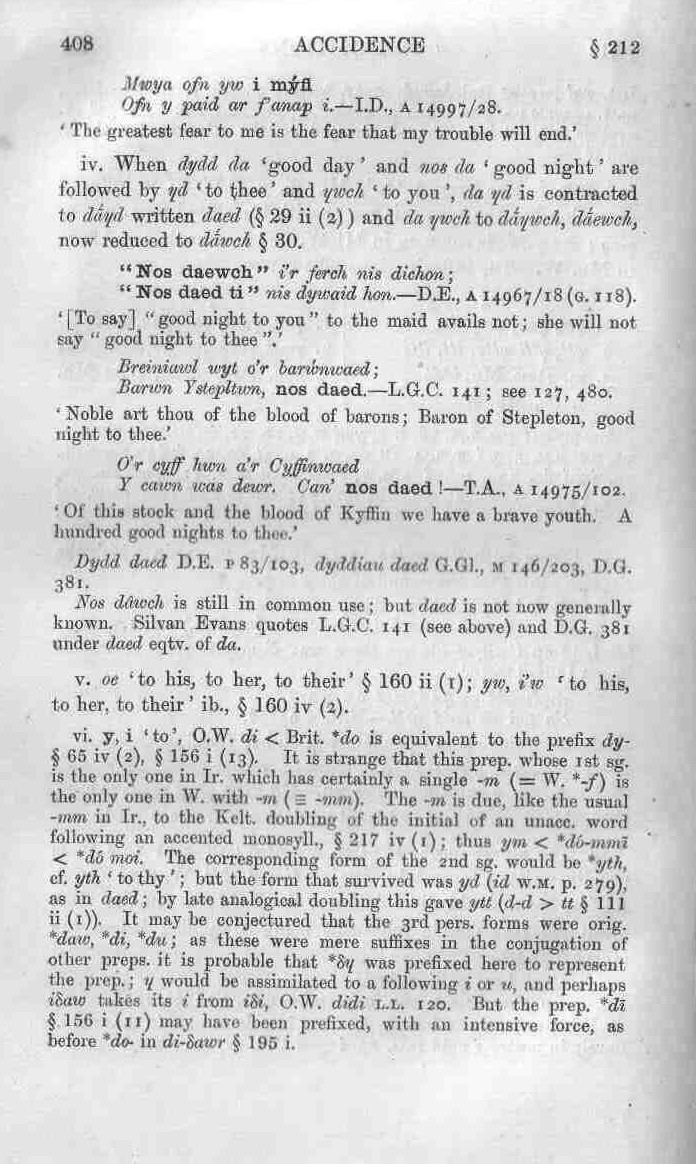
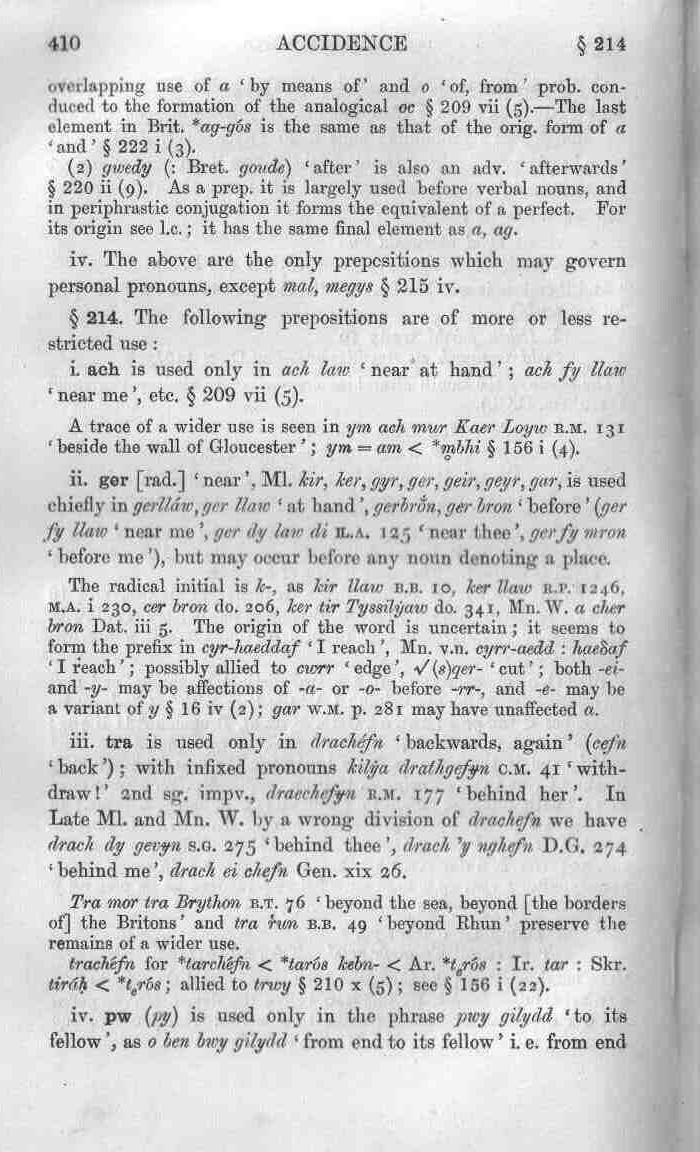
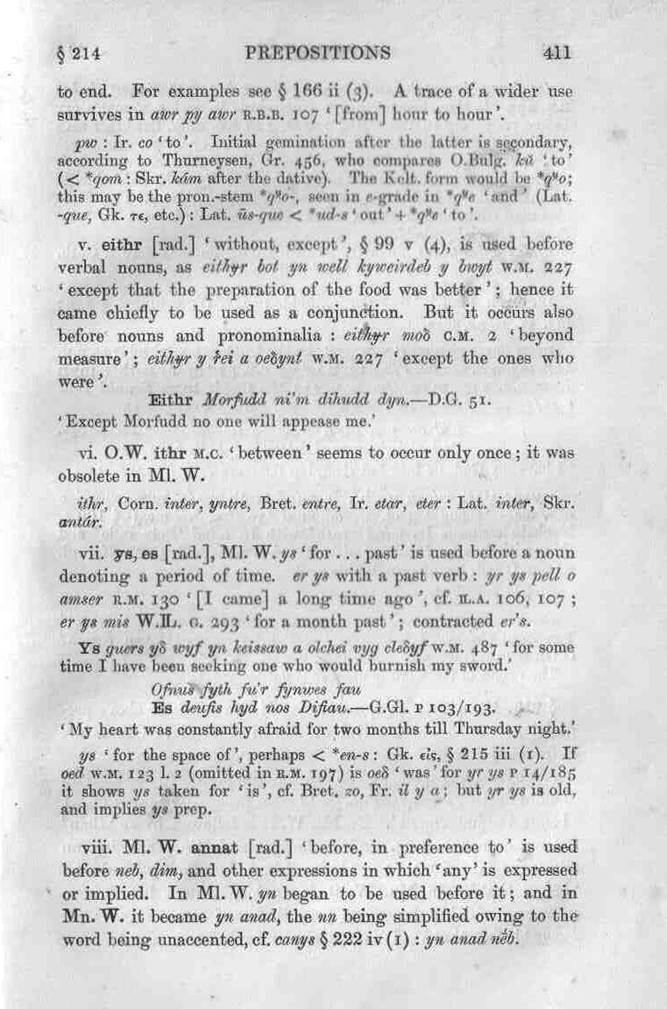

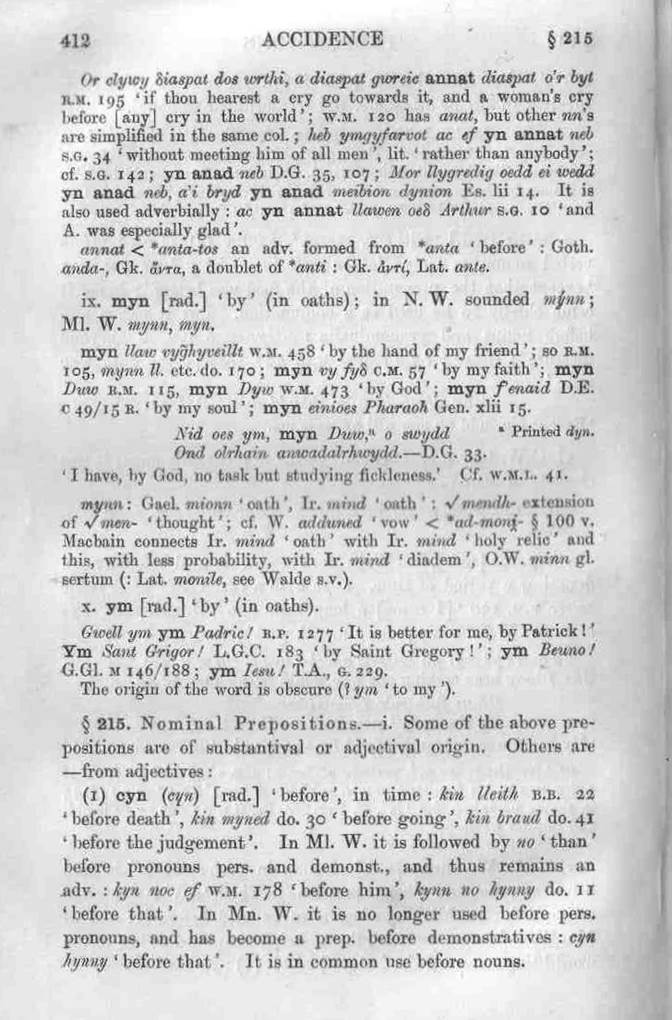
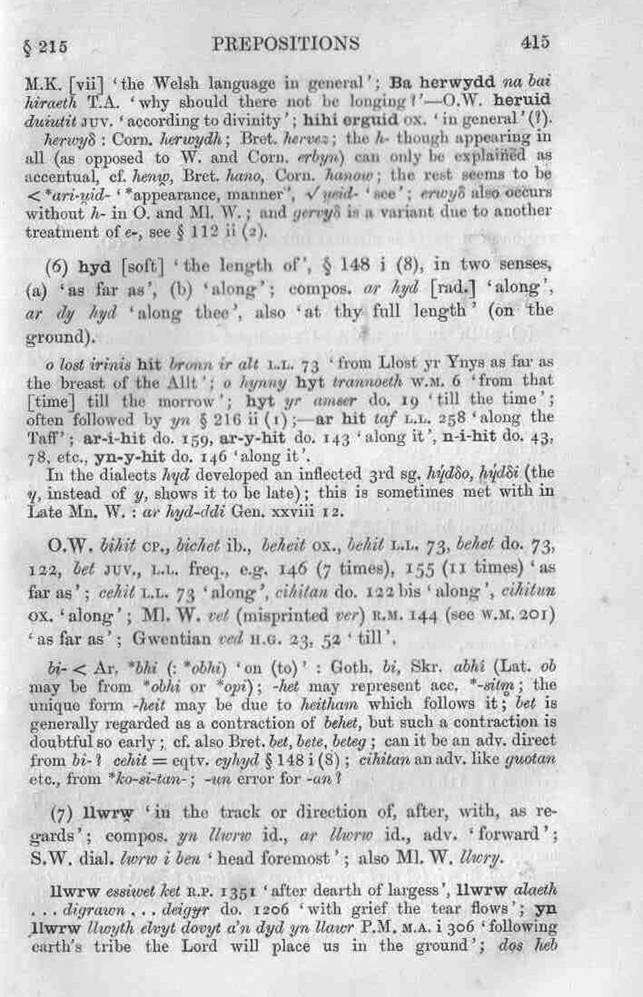

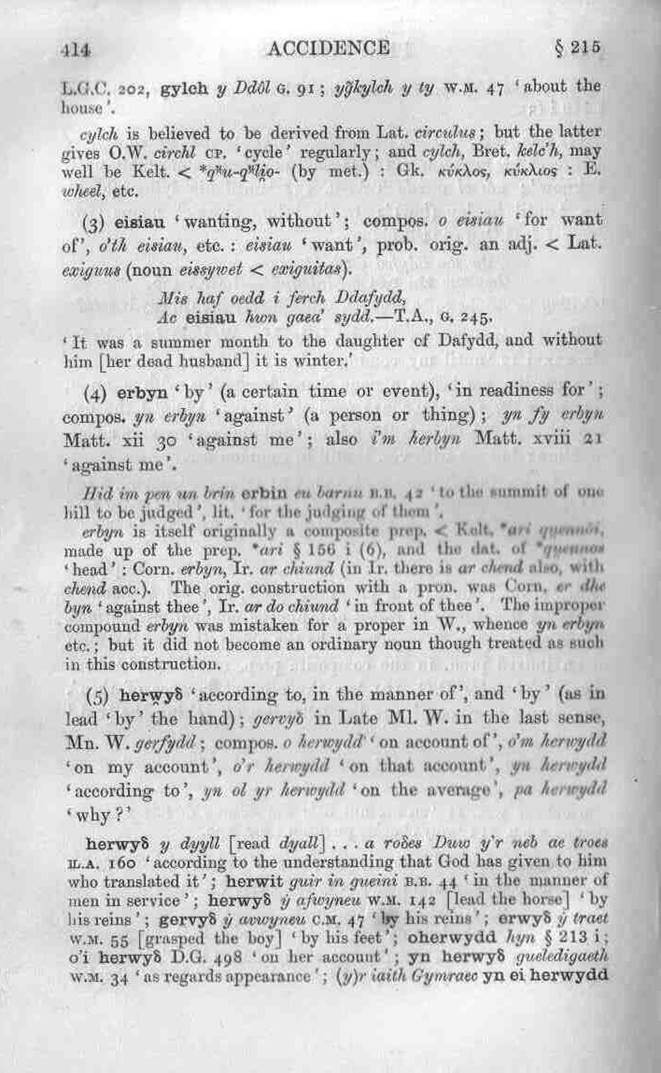


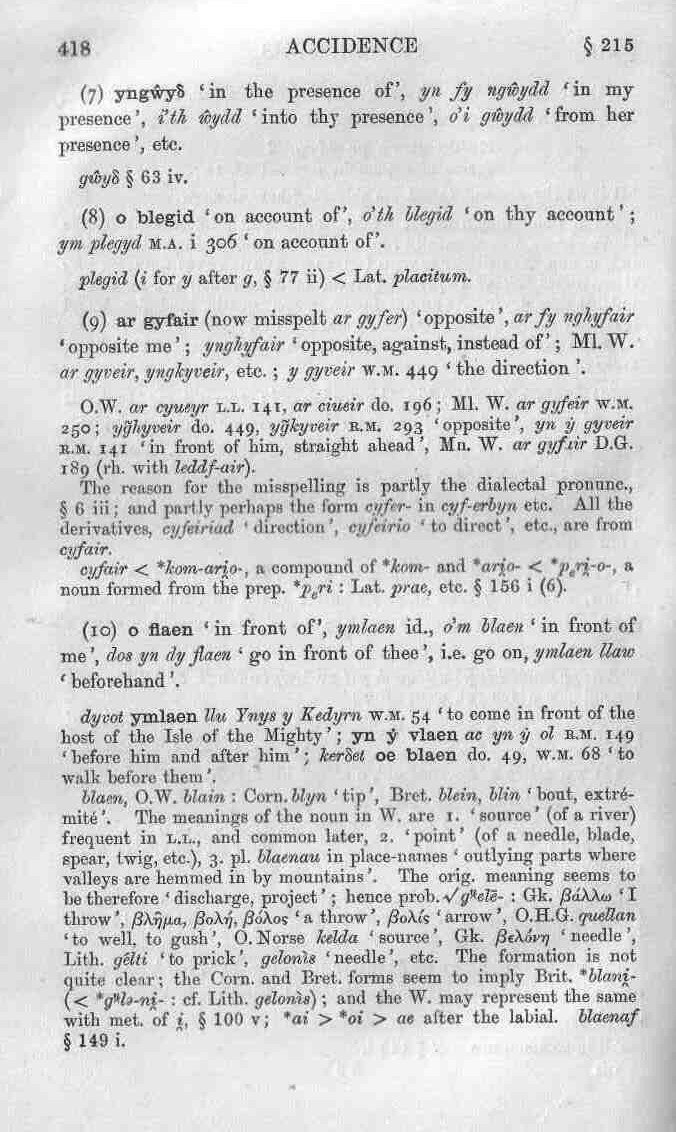


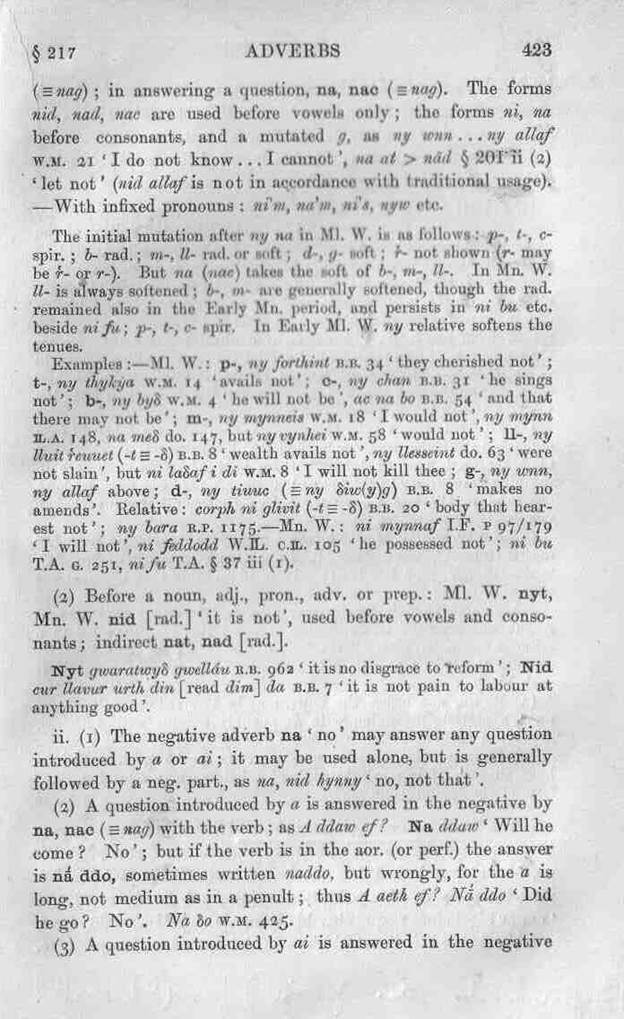
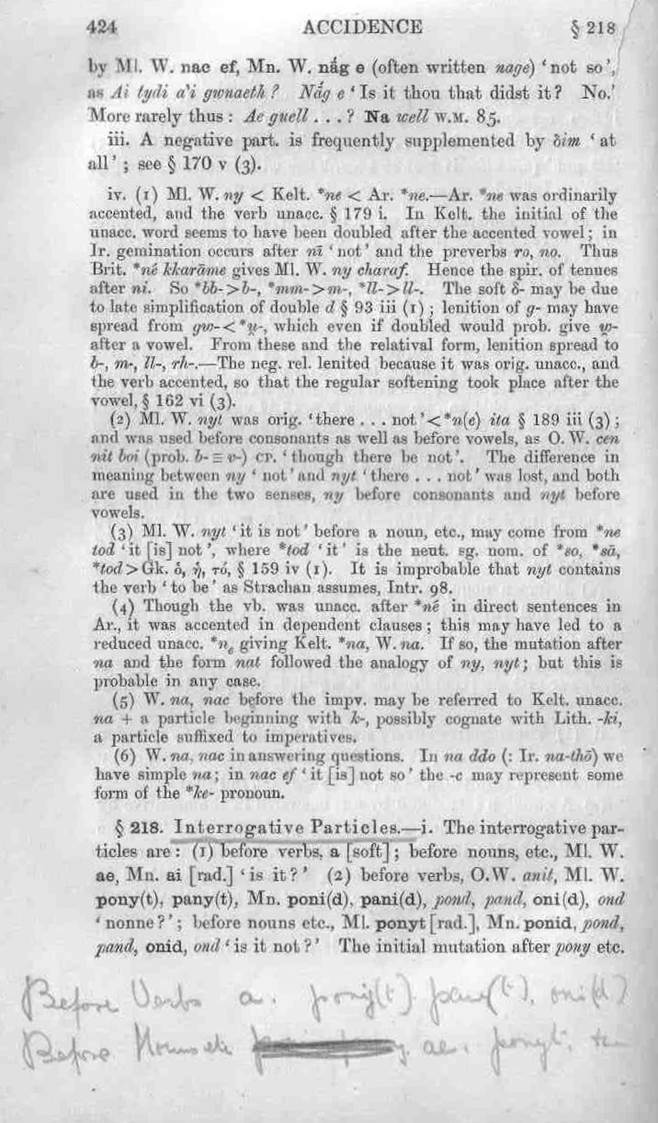
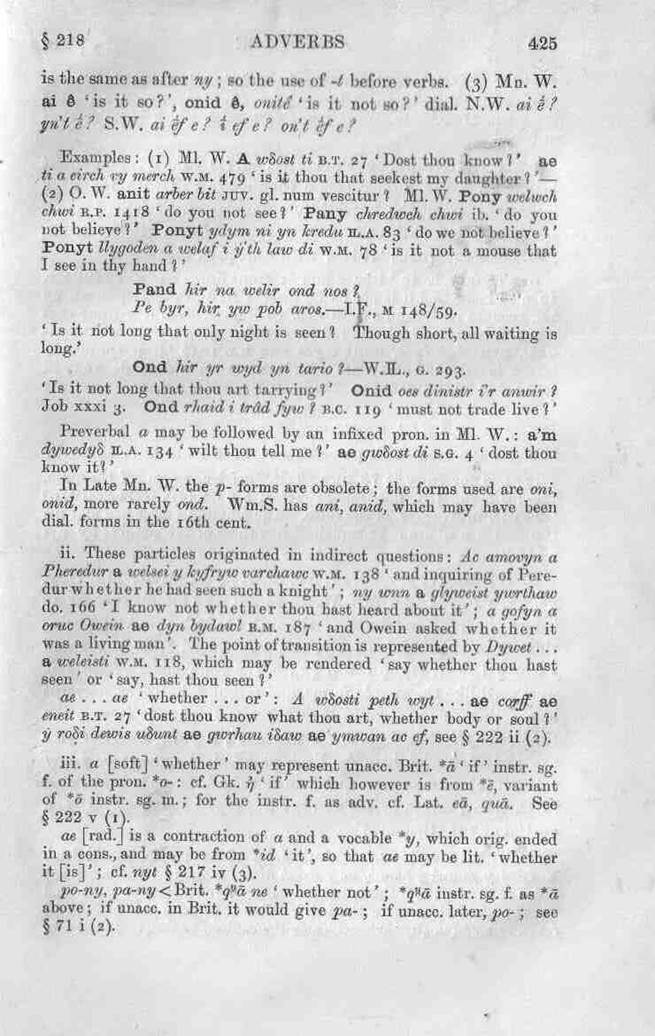
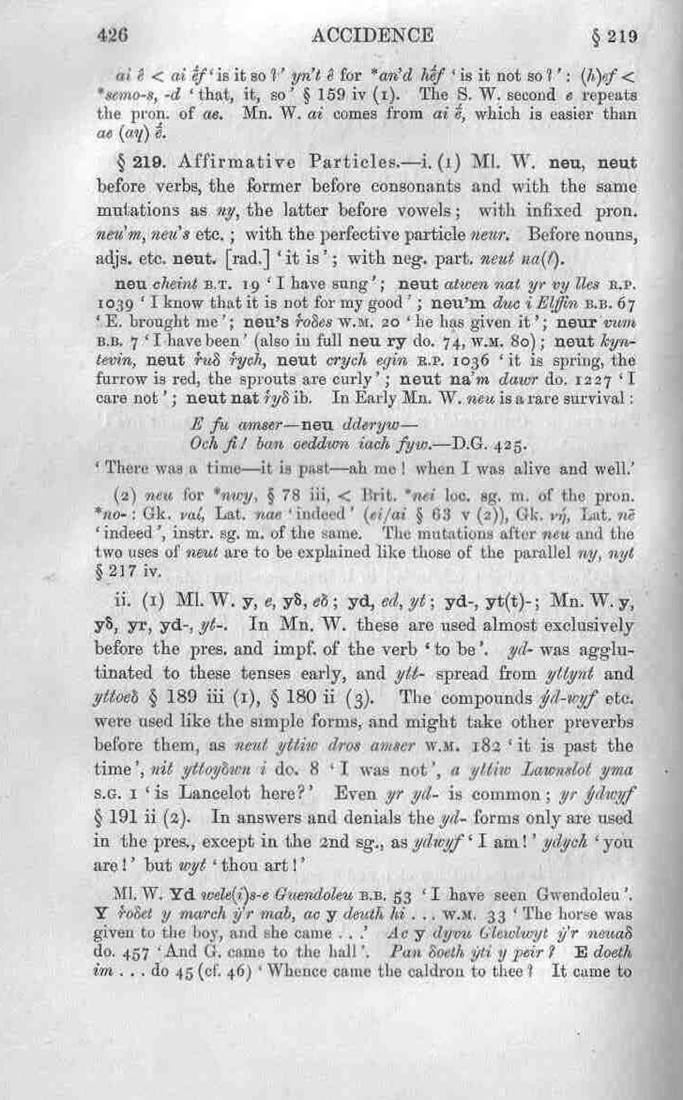
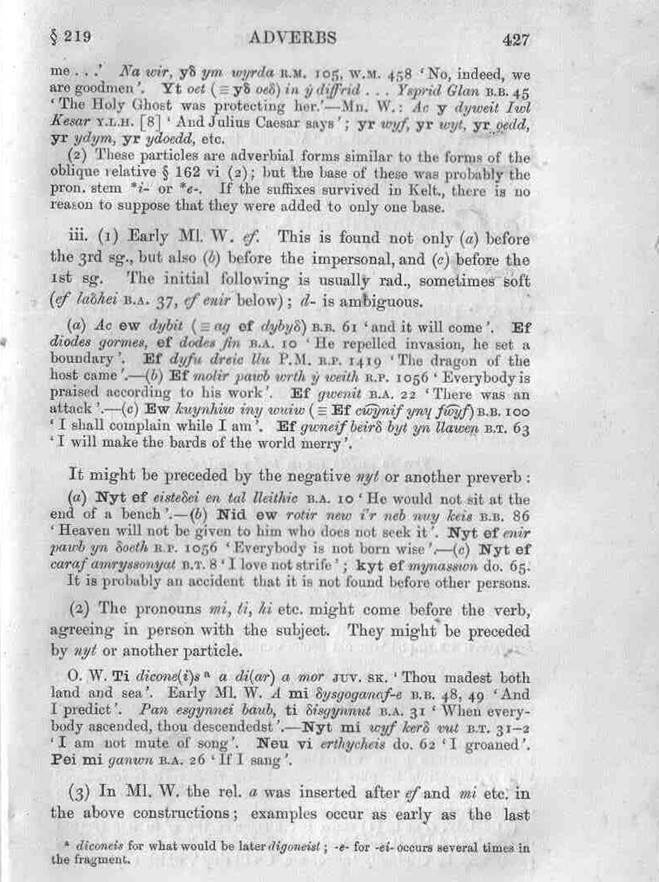
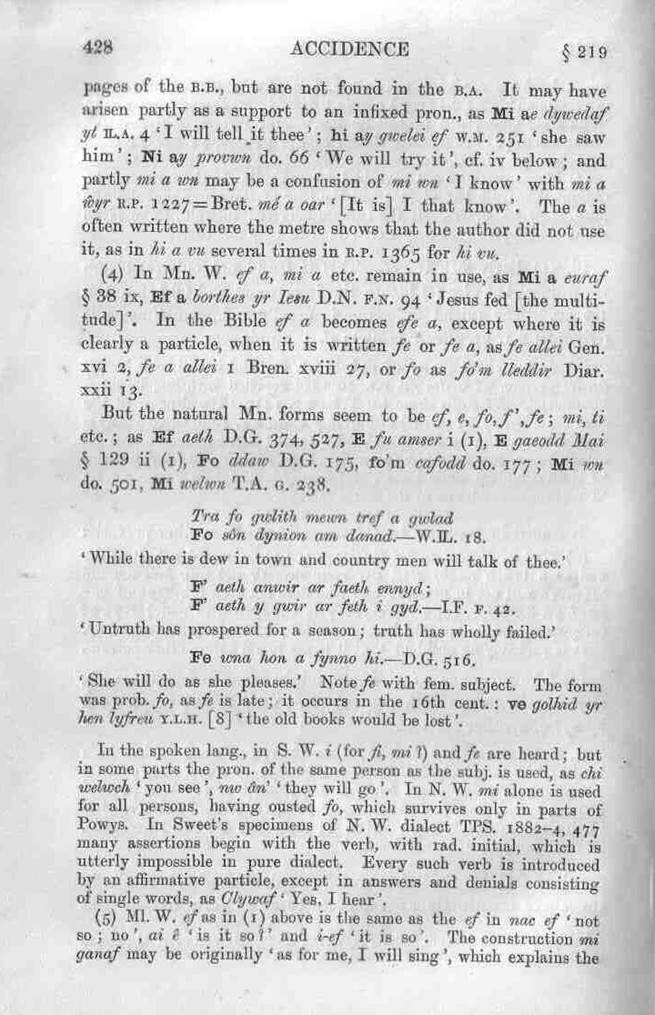

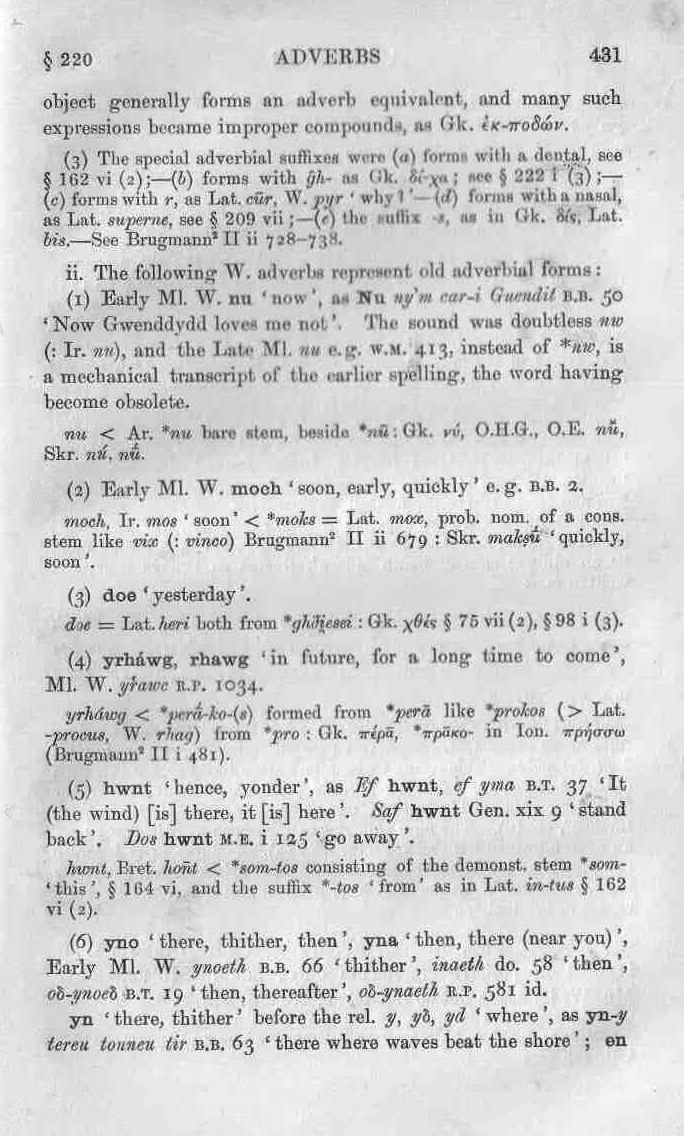
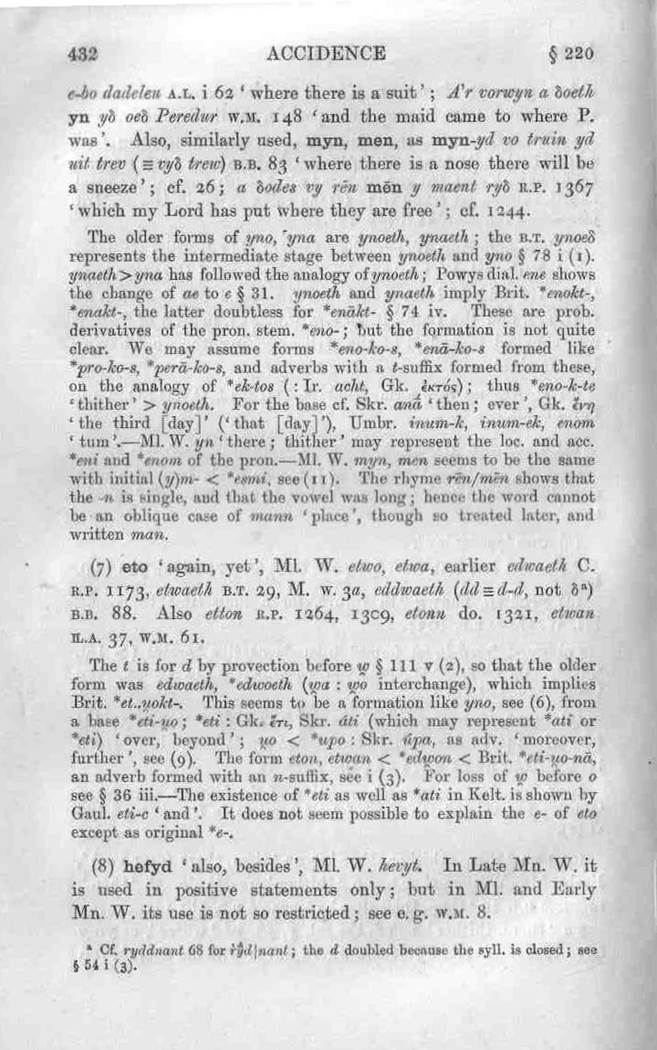
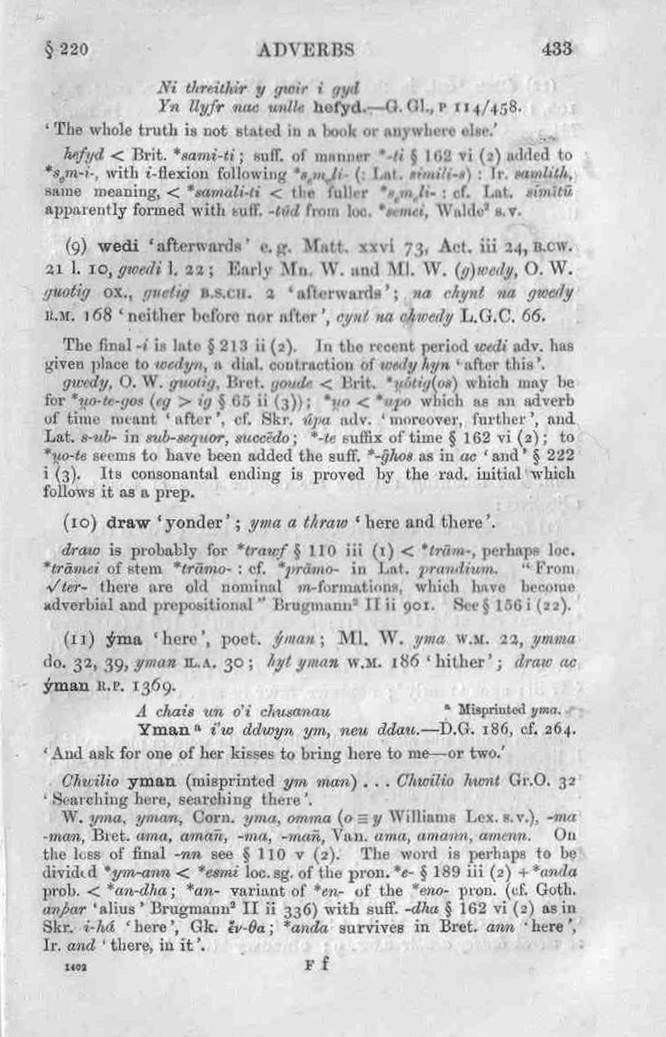
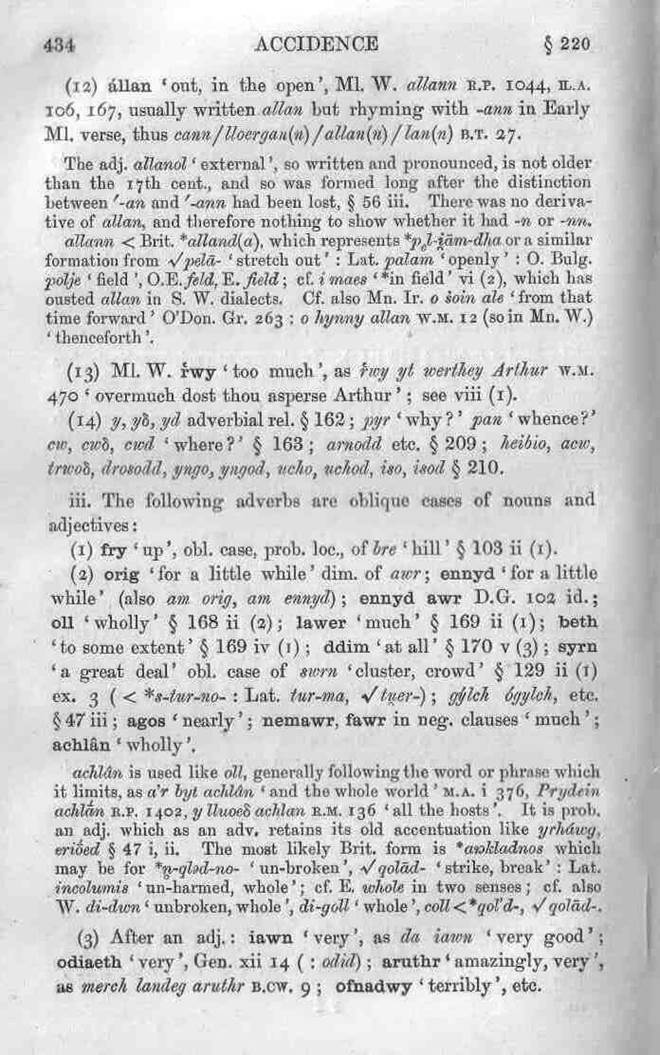


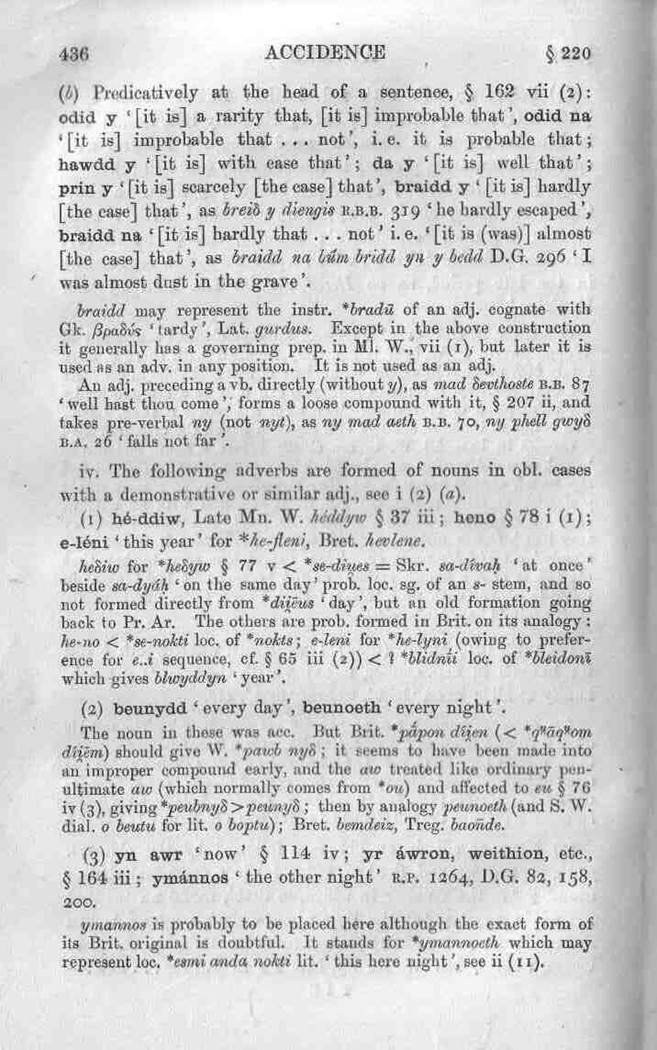
|
|
|
|
|
|
|
$$ |
|
*** |
|
|
|
|
|
$$ |
|
*** |
|
|
|
|
|
$$ |
|
*** |
|
|
|
|
|
$$ |
|
*** |
|
|
|
|
|
$$ |
|
*** |
|
|
|
|
|
$$ |
|
*** |
|
|
|
|
|
$$ |
|
*** |
|
|
|
|
|
$$ |
|
*** |
|
|
|
|
|
$$ |
|
*** |
|
|
|
|
|
$$ |
|
*** |
|
|
|
|
|
$$ |
|
*** |
|
|
|
|
|
$$ |
|
*** |
|
|
|
|
|
$$ |
|
*** |
|
|
|
|
|
$$ |
|
*** |
|
|
|
|
|
$$ |
|
*** |
|
|
|
|
|
$$ |
|
*** |
|
|
|
|
|
$$ |
|
*** |
|
|
|
|
|
$$ |
|
*** |
|
|
|
|
|
$$ xxxxx dyweit yr ystori/a do. 165 'as the story says ' ; megys na E.B.B. 186 ' as if . . . not '. (2) Similarly an adverb, or noun in an adverbial case, with the obi. rel. and forming its antecedent, as pryd y ' at the time when ', 220 iii (7) (a). In the recent period, in imitation of these, y is sometimes written after conjunctions, as pan y delo or osy daw instead of pan ddelo or o(s) daw. INTERJECTIONS 223. i. (i) The following interjections proper occur in Ml. W. : a passim ; ha R.M. 235 ; oy a W.M. 57, oi a do. 147, wy a w. 1200 ; oian a B.B. 52 if., hoian a do. 61-2 ; och B.B. 50, 91, W.M. 20; och a do. 170; ub do. 473; gwae R.P. 1150 1. 31, generally followed by the dat. ; haha W.M. 123 ; tprue ( = tprwy ?) K.P. 1277-8, Mn. W. trw (used in calling cattle). (2) Many others occur in Mn. W. : o ; ust ' hush ' ; ffl ' fie ' (whence ff'iaidd ' loathsome '), later ffei, foil, by o, see ex. ; wflt ' fie ' ; hu, huw D.G. D. 148, used to lull a baby to sleep, later hwi (short proper diphth.), hwi\an ; dyt 'pooh', dyflyt D.N. j 9/230 (the /s in the MS., and the accent implied in the cynghanedd). D. 148 gives, in addition, hys, ho, he, hai, ochan, w, 'wb, wlan wfavb, waw, wew y ffw, whw, wi, haihow, haiwhw, hoho, Iw, oio, wichwach. Other forms are ow, pw t wchw, hai wchw, hwt, heng ; also twt ' pshaw ! ' ach, ych ' ugh ! ' and others. Ffei o ieuenctid am ffo ; Ni ffy henaint, flfei 'hono. S.T. p 313/2 12. ' Fie upon youth for fleeing ; old age will not flee, fie upon it.' [The MS. has o-ffei in line i and ohono in line 2.] (3) gwae 78 ii (2). och 51 iii exc. (3) ; *-h, rounded after o- may have given the -ch, 26 vi. The diphthong oi does not appear elsewhere in Ml. W., and may be a survival of O. W. oi < *ai; the doublet wy < *di : Gk. a?. Interjections, like the forms of child- speech, are liable to continuous re-formation ; and a may be from original a (: Lat. a, etc.), which ought regularly to give *aw. ii. Some interjections are followed by nouns or pronouns, expressed or implied, in the dat., as gwae vi K.M. 40 ' vae mihi ' ; Guae agaur a graun maur verthet B.B. 31 ' woe to the miser who
|
|
*** |
|
|
|
|
|
$$ xxxxx hoards great riches' ; Gwae a gcfowy uw R.P. 1150 ' woe [to him] who offends God '. So, och ft D.G. 435 ; Och flnnau F.N. 90 ; also Och imi ib., Och ym D.G. 21 ; Ochan fi do. 38 ; dial, och a fl. Also, of course, by the vocative : Och Dduw G. 255, etc. iii. An interjection proper is sometimes preceded by a numeral, as naw-och IL.G. R.P. 1306 ; wyth w&ejinnau G. 229 ; can' och ; naw wfft. 224. As in other languages, utterances of an interjectional character are made from other parts of speech, and from phrases and sentences, often mutilated. i. Nouns, with or without adjuncts : (i) Duw e.g. W.HJ. 232 last line, Duw an(n)wyl Gr.O. 39 ; later by euphemism dyn and dyn annwyl. (2) dydd da ' good day ', nos da ' good night ', etc. 212 iv. (3) hawS amor R.P. 1310 ' good luck ! '; gwynfyd i . . Gr.O. 88 'joy to . . I'; gwyn fyd na . . D.W. 71 'would to heaven that . . !' (na on the anal, of na 171 ii (2)); diolch ' thanks ! ' haw8 amor /tor C. M.A. i 2056 shows that havodd-amawr I.G. 624 is a false archaism, amor < *ad-smor-, Vsmer- 'part' ( 156 i (13)), hence ' destiny, luck ' : Gk. /j.6po<;, pmpa ' lot, destiny ', Horn. Kara [Afjiolpav (/*ft- < *sm-), Kctcr/x.o/305 ' Svonyvos Hes. < *KaT-oyAopos. (4) rhad arno ' a blessing upon him ! ' (usually sarcastic) ; yr achlod iddynt Gr.O. 200 ' fie upon them ! ' yr achlod iddo T. ii 1 94 ; druan ohono ' poor thing ! ' ; etc. ii. Adjectives used adverbially, and other adverbial expres- sions: (i) da 'good!'; purion 'very well!'; truan 'alas!'; da di, da dithau, da chwi, da chwithau ' if you will be so good '. (2) yn iach 'farewell 1 s e.g. 166 i; yn llawen W.M. 19 ' gladly ! with pleasure ! ' ; yn rhodd B.CW. 80, P.G.G. 17 ' pray ! ' (3) ymaith ' away ! ', adref D.G. 165 ' home ! ' hwnt 'avaunt! ' Ml. W. nachaf W.M. 73, 225 ' behold ! ', enachaf (e- =$-) M.A. ii 302, ynackaf do. 170; later written nycha D.G. 135. ynachaf, perhaps ' *yonder ! ' a spv. of the stem from which yna is made, thus from *ena-Jc-s e mo- ; see 220 ii (6). (4) er Mair D.G. 18; er Duw ib. ; ar f'enaid L.G.C. 223 ' by my soul ' ; etc. myn . . . / ym . . . / 214 ix, x.
|
|
*** |
|
|
|
|
|
$$ xxxxx iii. Verbs : aro ' stop ! ', late aros ; adolwg ' pvay ! ', atolwg Ps. cxviii 25, for which the v.n. adolwyn 203 iv (2) is sometimes found. Paid,- lor nefol, adolwyn, fyd yn danllyd am dwyn. S.C. I.MSS. 291. ' Do not, heavenly Lord, I beseech thee, take me away in flames from the world '. iv. Sentences : (i) henffych well 'hail' 190 i (i). (2) Contracted into single words, and sometimes corrupt: dioer 34 iii ' by heaven ! ' for Duw a wyr ' God knows ' ; Late Mn. wele ' behold ! ' for a wely di ' dost thou see ? ' 16 iv (i), also wel 173 iii (3) ; llyma ' voici ' etc. 221 iv ; dyma ' voici ' for wely dy yma, etc., see ib. ; ysgwir ' truly ! ' do. iii ; ysywaeth etc. do. i. Ysowaeth, nos o ayaf Tm sy hwy no mis o haf. D.E. p 76/29, c 7/649. ' Alack ! a night of winter is longer to me than a month of summer.'
|
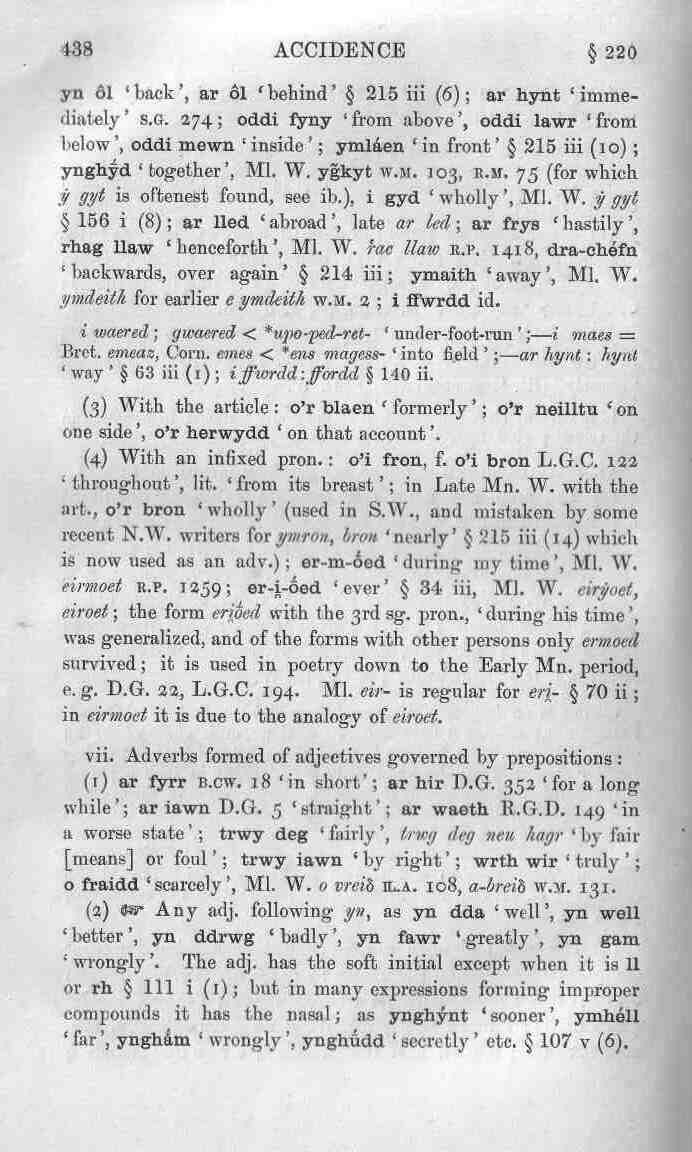
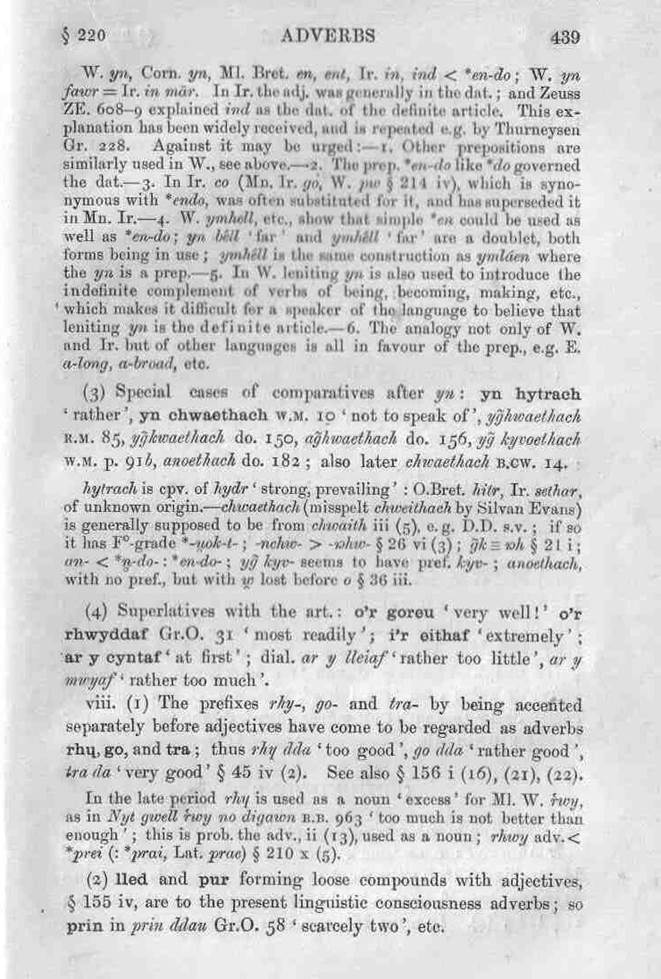
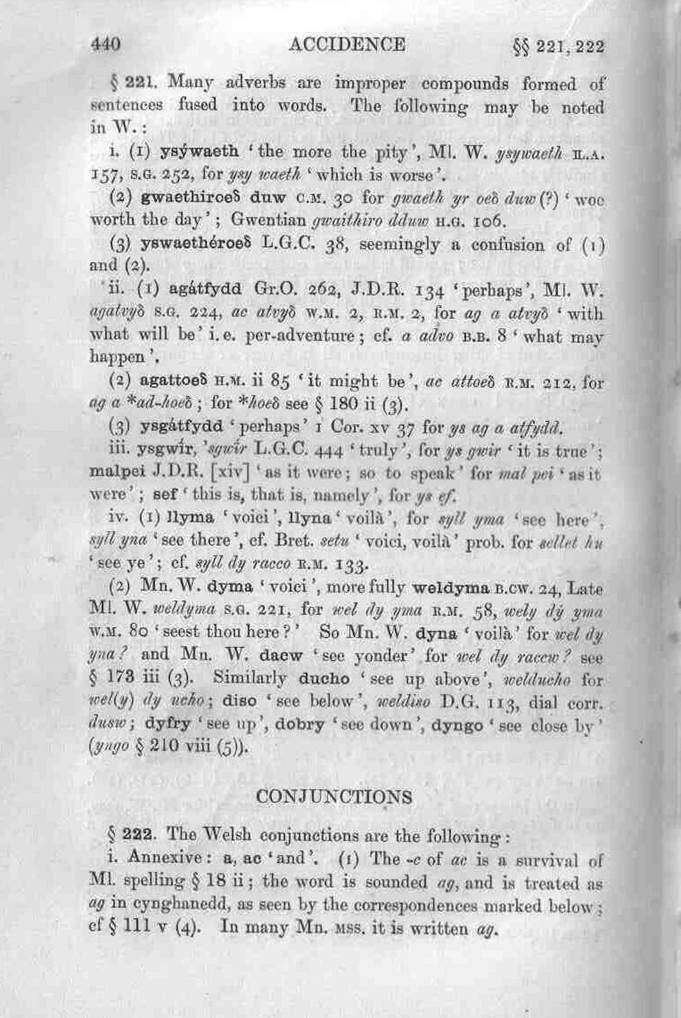
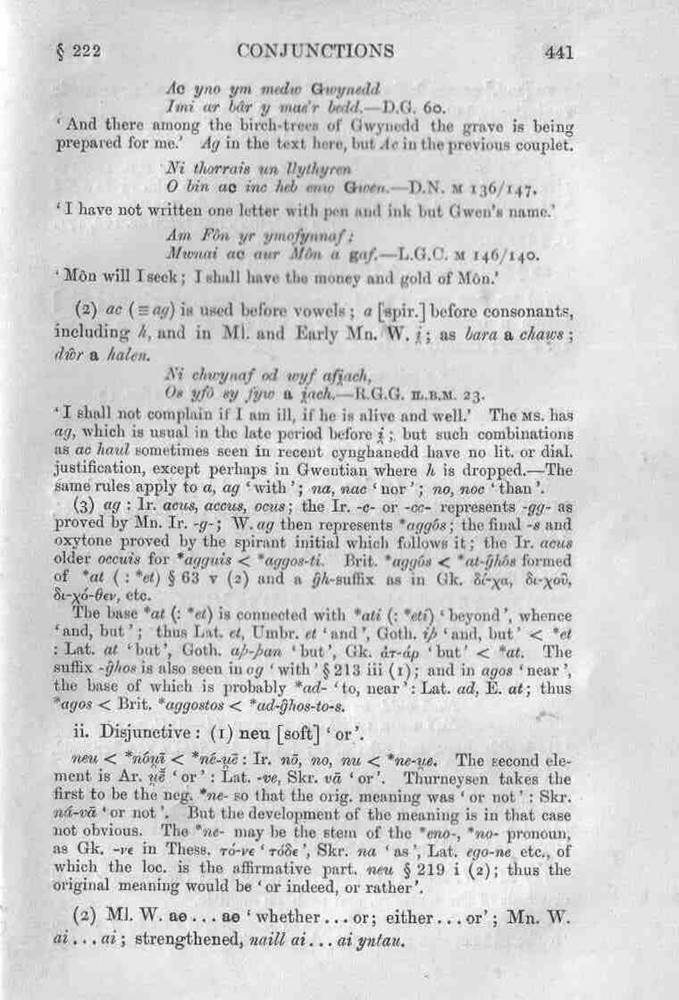

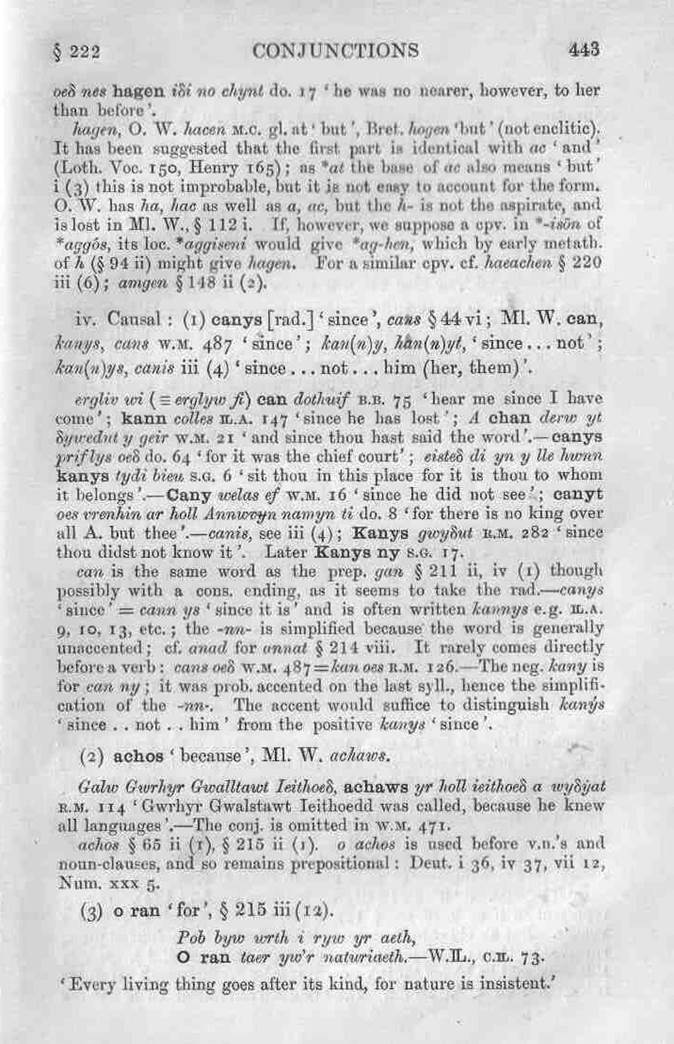
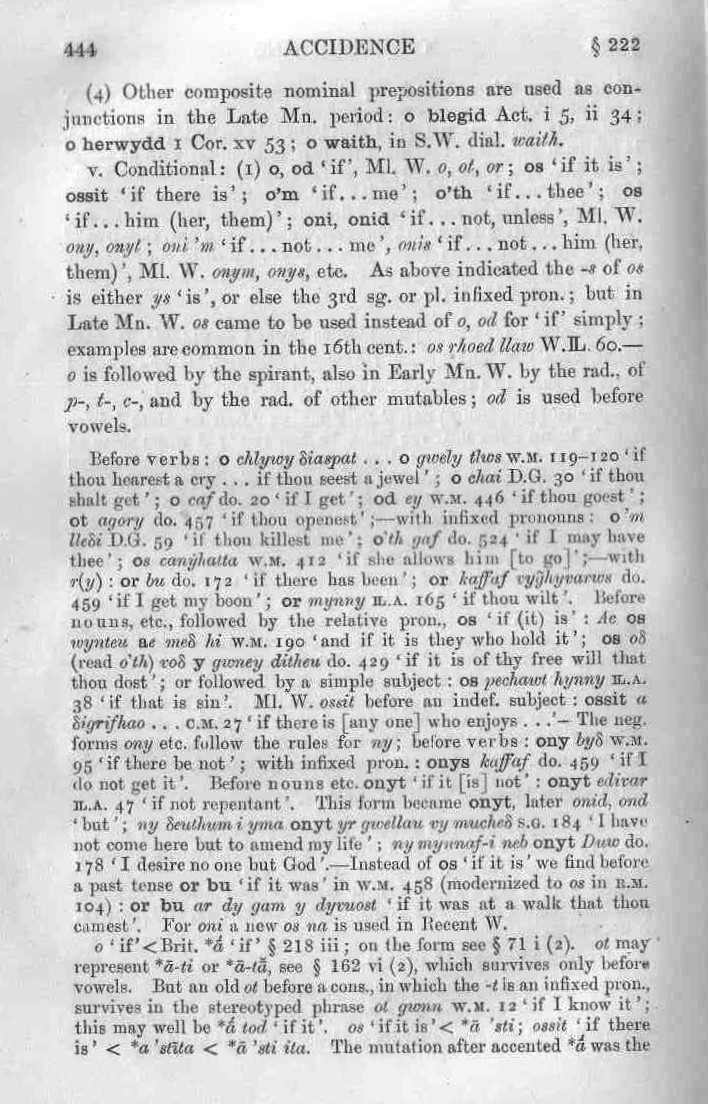
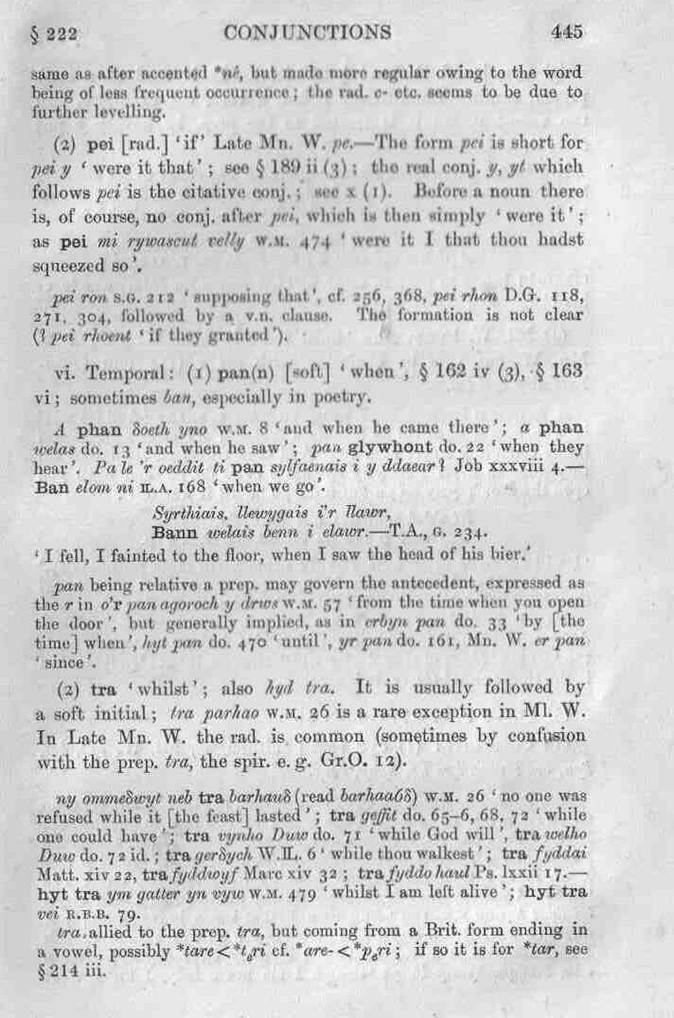
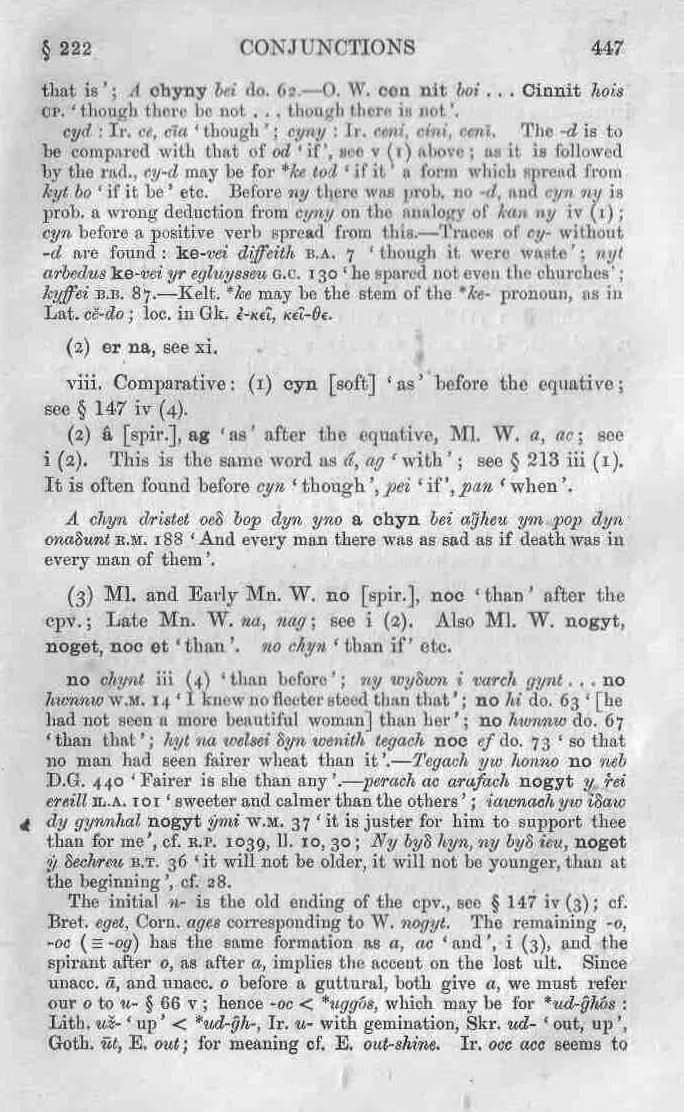

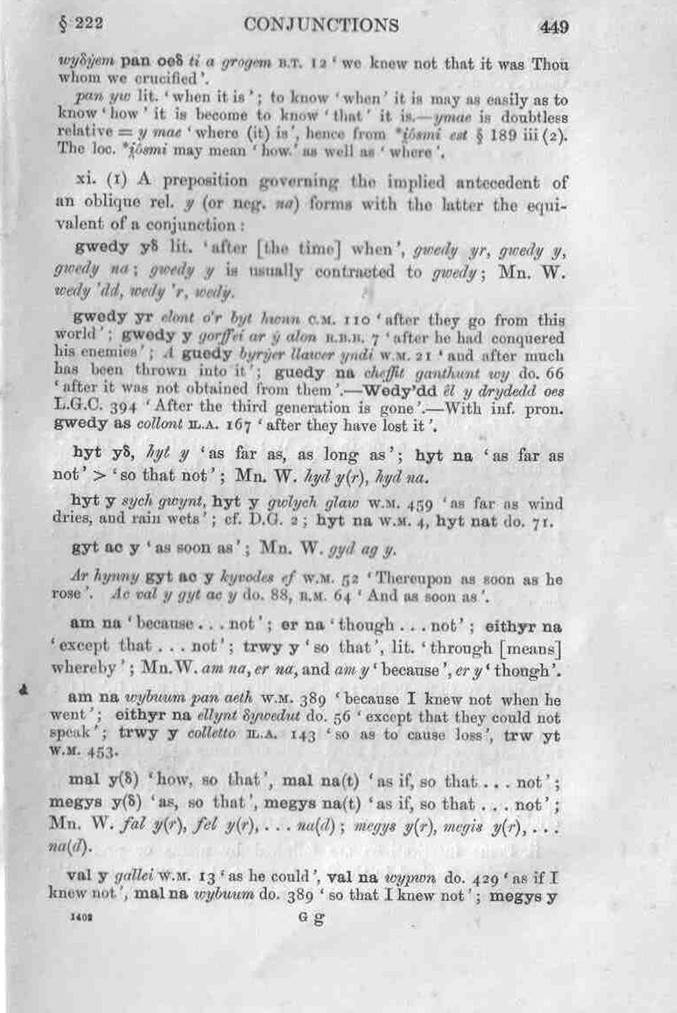

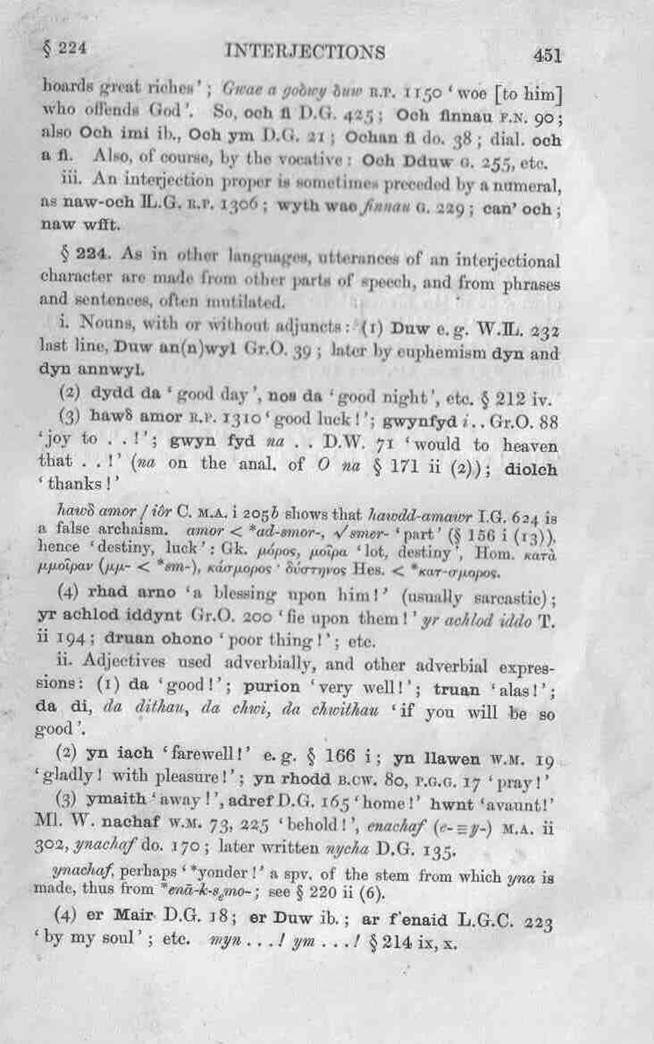
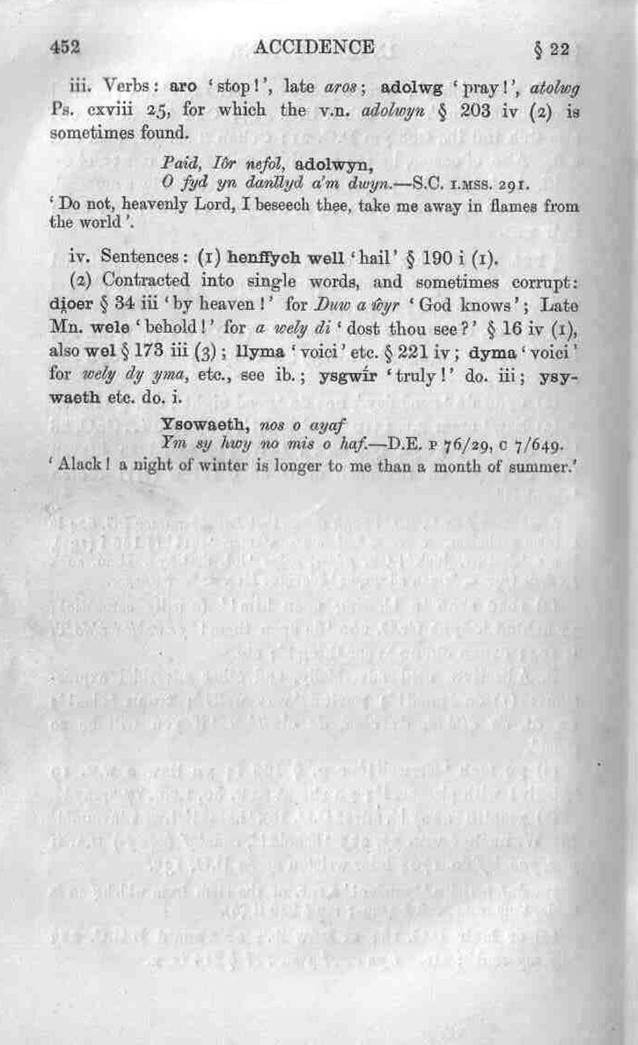
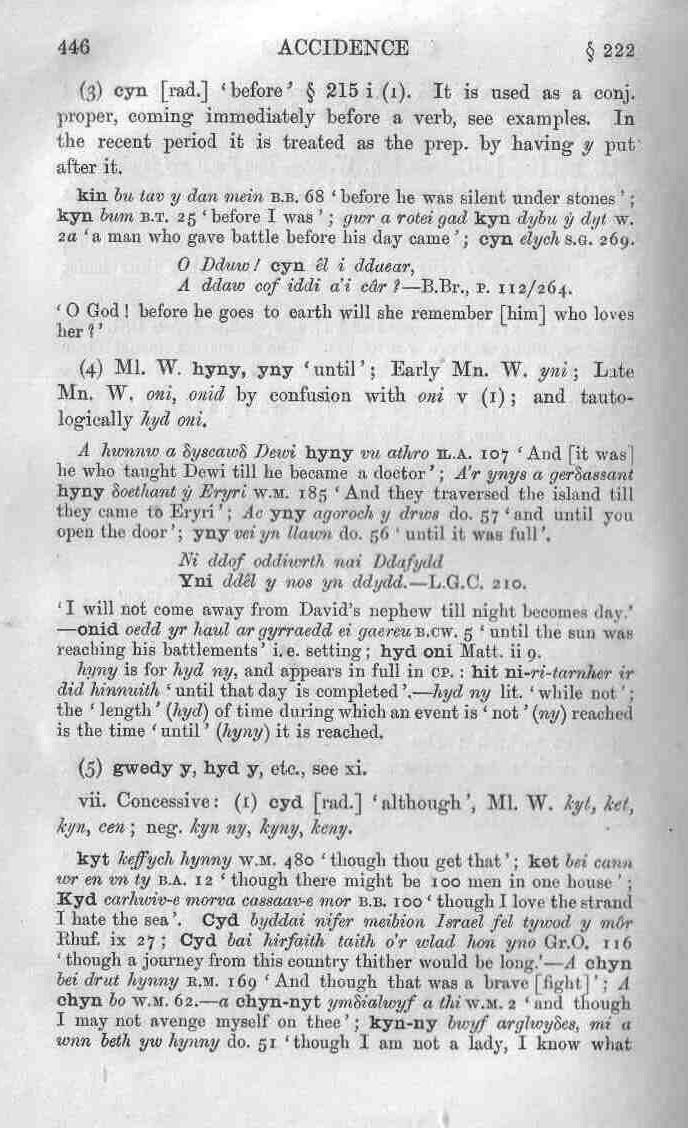
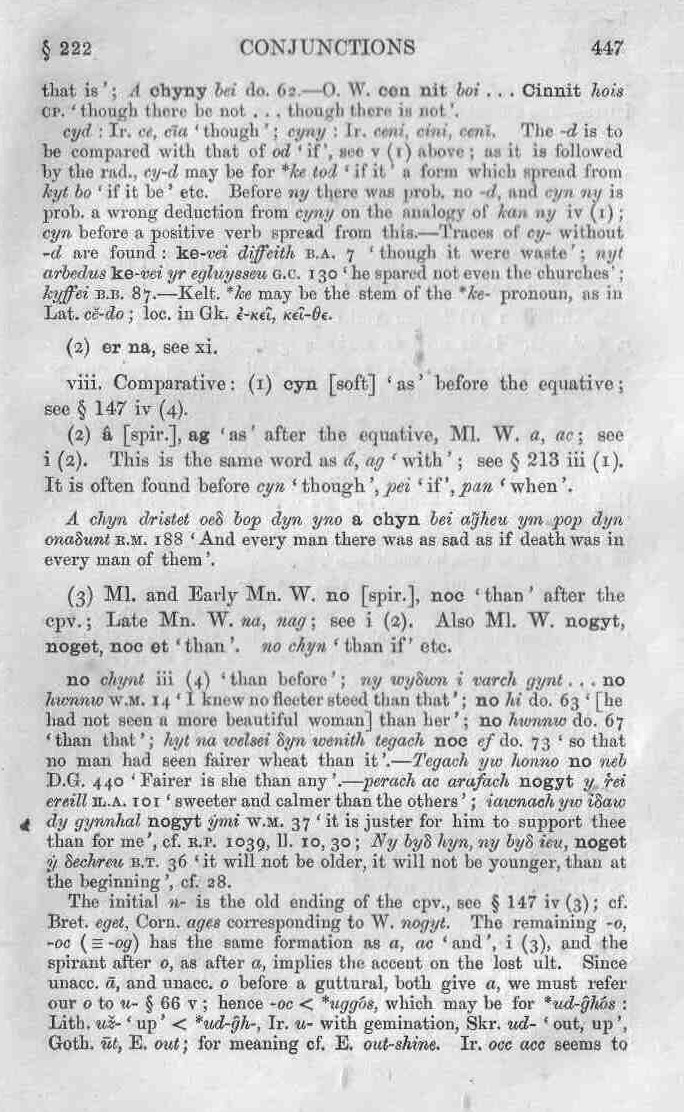
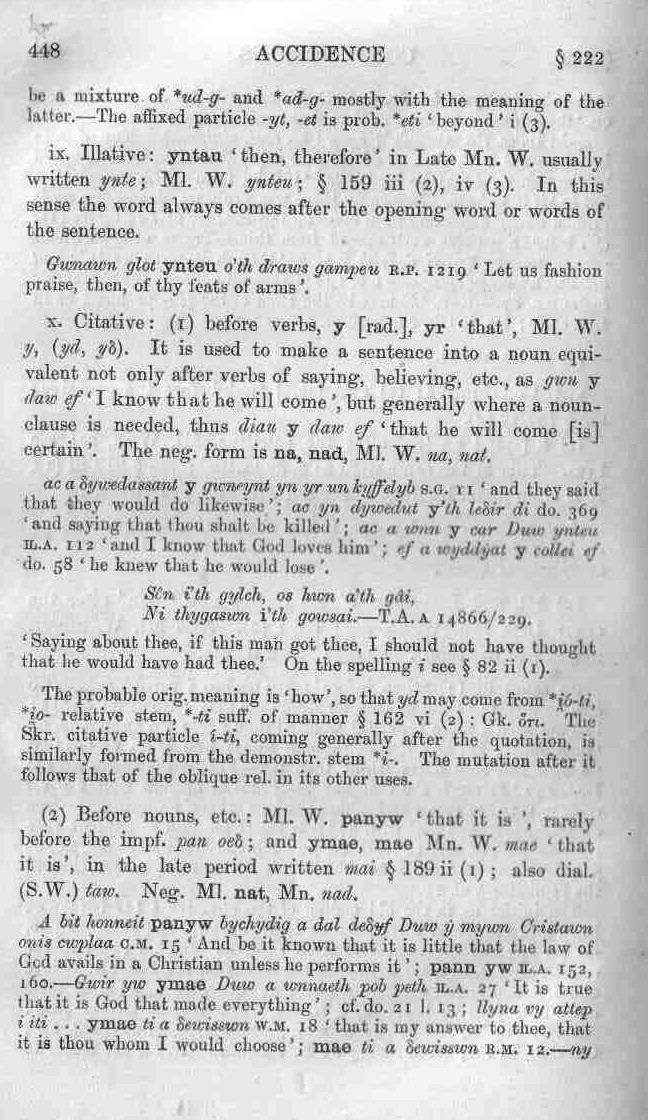
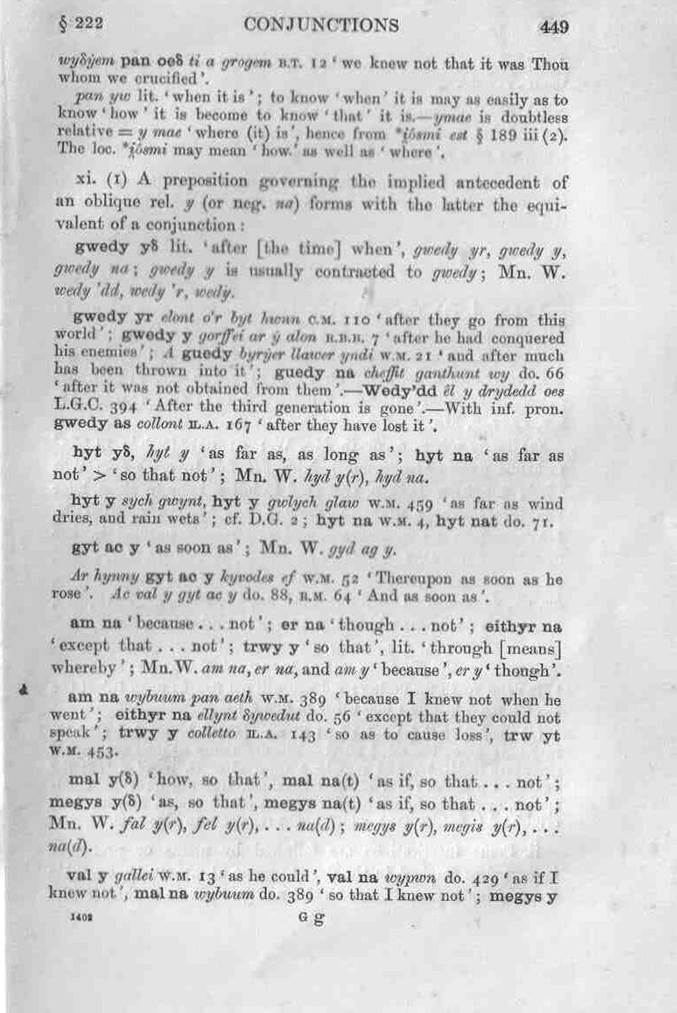
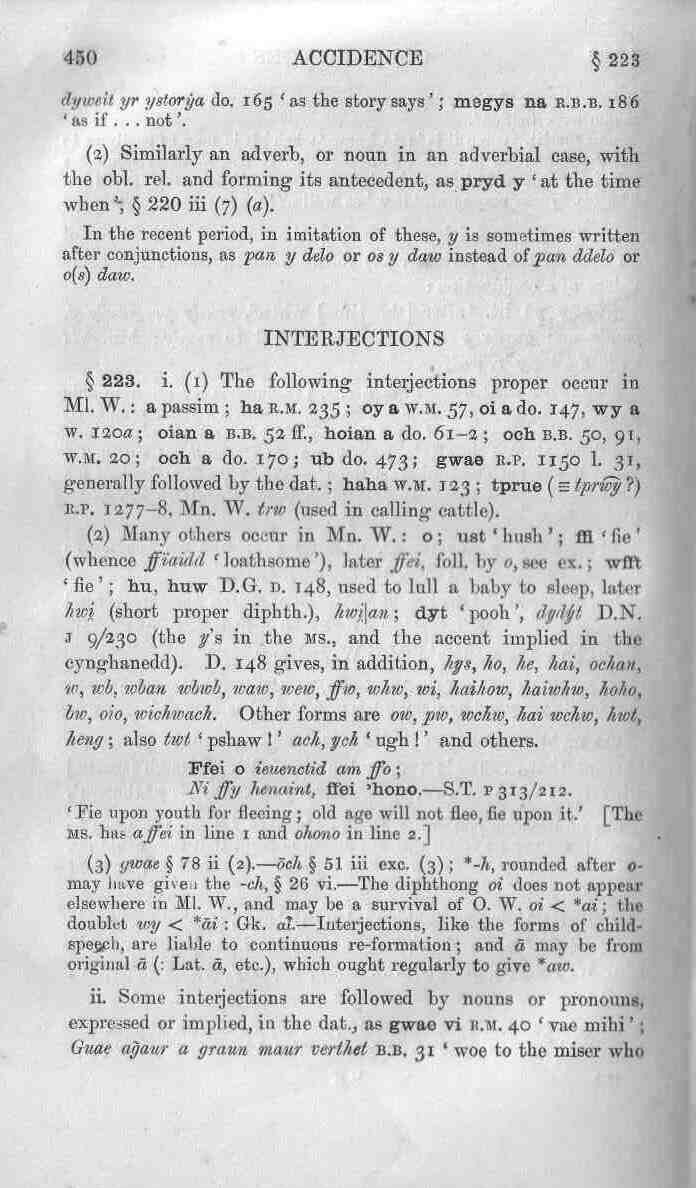
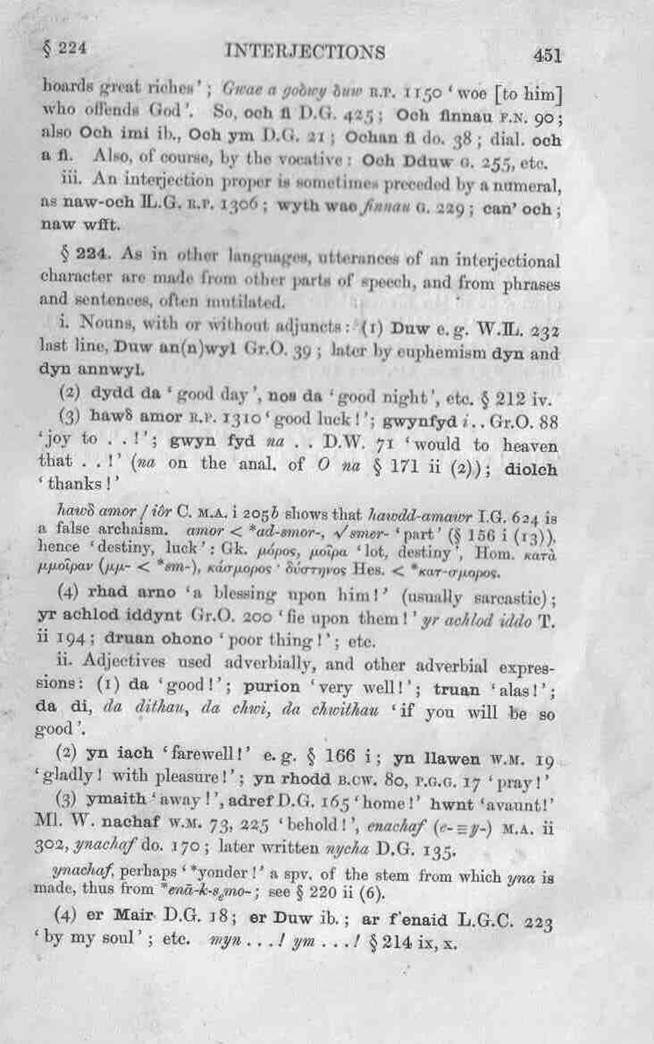
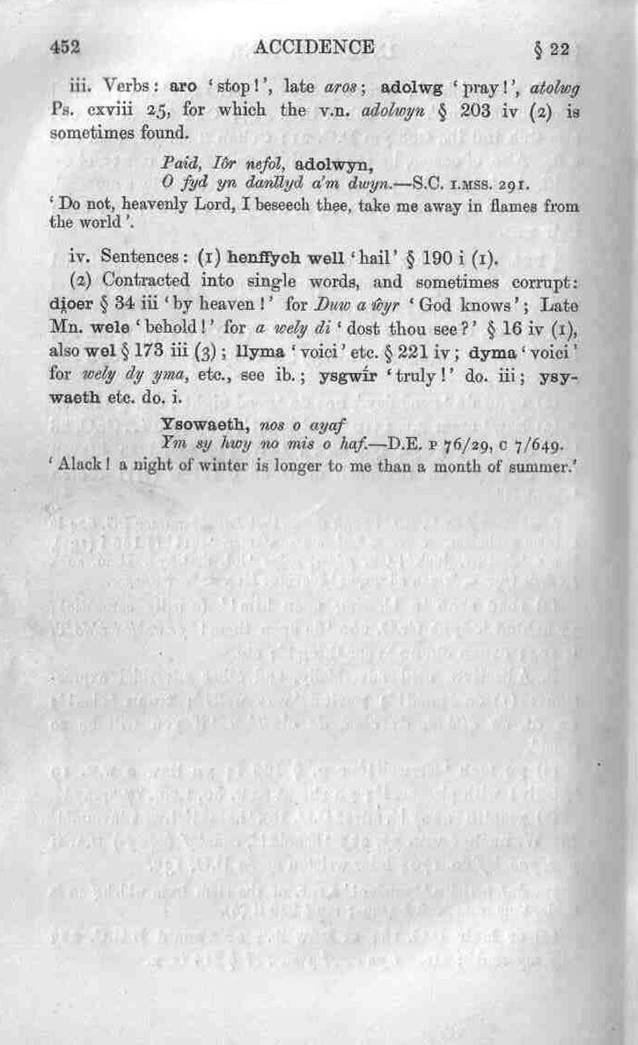
![[1]](https://en.wikisource.org/wiki/Page:Morris-Jones_Welsh_Grammar_0412.png#cite_note-1)
![[1]](https://en.wikisource.org/wiki/Page:Morris-Jones_Welsh_Grammar_0427.png#cite_note-1)
Y DUDALEN NESAF: 2654e
____________________________________
Sumbolau:
a A / æ Æ / e E / ɛ Ɛ / i
I / o O / u U / w W / y Y /
…..
…..
MACRON: ā Ā / ǣ Ǣ /
ē Ē / ɛ̄ Ɛ̄
/ ī Ī / ō Ō /
ū Ū / w̄ W̄ / ȳ Ȳ /
MACRON + ACEN DDYRCHAFEDIG: Ā̀ ā̀ , Ḗ ḗ,
Ī́ ī́ , Ṓ ṓ , Ū́
ū́, (w), Ȳ́ ȳ́
MACRON + ACEN DDISGYNEDIG: Ǟ ǟ , Ḕ ḕ,
Ī̀ ī̀, Ṑ ṑ, Ū̀
ū̀, (w), Ȳ̀ ȳ̀
MACRON ISOD: A̱ a̱ , E̱ e̱ , I̱ i̱ ,
O̱ o̱, U̱ u̱, (w), Y̱ y̱
BREF: ă Ă / ĕ Ĕ / ĭ Ĭ / ŏ Ŏ / ŭ Ŭ
/ B5236:  B5237:
BREF GWRTHDRO ISOD: i̯, u̯
CROMFACHAU: ⟨ ⟩ deiamwnt
A’I PHEN I LAWR: ∀, ә, ɐ (u+0250) https:
//text-symbols.com/upside-down/
…..
…..
ˡ ɑ ɑˑ aˑ a: / æ æ: / e eˑe:
/ ɛ ɛ: / ɪ iˑ i: / ɔ oˑ o:
/ ʊ uˑ u: / ə / ʌ /
ẅ Ẅ / ẃ Ẃ / ẁ Ẁ / ŵ Ŵ /
ŷ Ŷ / ỳ Ỳ / ý Ý / ɥ
ˡ ð ɬ ŋ ʃ ʧ θ ʒ ʤ /
aɪ ɔɪ əɪ uɪ ɪʊ aʊ ɛʊ əʊ / £
ә ʌ ẃ ă ĕ ĭ ŏ ŭ ẅ ẃ
ẁ Ẁ ŵ ŷ ỳ Ỳ
…..
…..
Hwngarwmlawt: A̋ a̋
g yn
yn  aith δ δ
…..
…..
ә ʌ ẃ ă ĕ ĭ ŏ ŭ ẅ ẃ
ẁ ŵ ŷ ỳ
Ә Ʌ Ẃ Ă Ĕ
Ĭ Ŏ Ŭ Ẅ Ẃ Ẁ Ẁ Ŵ Ŷ Ỳ Ỳ
…..
….
Hwngarwmlawt: A̋ a̋
g yn
yn  aith δ δ
…..
…..
ʌ ag acen ddyrchafedig / ʌ with acute accent: ʌ́
|
Shwa ag acen ddyrchafedig Xwa amb accent agut Schwa with acute |
|
|
DejaVu Serif |
…..
wikipedia,
scriptsource.[]org
https://[ ]en.wiktionary.org/wiki/ǣ
…..
Y TUDALEN HWN /THIS PAGE / AQUESTA PÀGINA:
http://
[]www. []kimkat.org/amryw/1_gramadegau/gramadeg_2_1913_jmj_welsh_grammar_07_250-299_2653e.htm
____________________________________
Adolygiadau diweddaraf: Dÿdd
Mawrth 2005-11-20; Iau 2007-04-12
Sumbolau
arbennig: ŷ ŵ
Ble’r wyf i? Yr ych chi’n ymwéld ag un o dudalennau’r Gwefan
“CYMRU-CATALONIA”
On sóc? Esteu visitant una pàgina de la Web “CYMRU-CATALONIA” (=
Gal”les-Catalunya)
Weør àm ai? Yùu àar vízïting ø peij
fròm dhø “CYMRU-CATALONIA” (= Weilz-Katølóuniø) Wéb-sait
Where am I? You are visiting a page from the
“CYMRU-CATALONIA” (= Wales-Catalonia) Website
CYMRU-CATALONIA
o ymwelwyr i’r Adran Gramadeg oddi ar 1 Medi
2005
Edrychwch
ar fy Ystadegau / View My Stats