kimkat2650k A Welsh Grammar - Historical and
Comparative. 1913. John Morris-Jones
(1864-1929). Gwefan
Cymru-Catalonia.
21-11-2025

|
(delwedd 003) |
Gwefan Cymru-Catalonia |
|


.....
.....
|
2644e Tudalennau |
Rhan 2: Tudalennau |
Rhan 3: Tudalennau §41- §75 |
Rhan 4: Tudalennau §75- §99 |
Rhan 5: Tudalennau §99- §120 |
Rhan 6: Tudalennau §120- §148 |
Rhan 7: Tudalennau §148- §165 |
Rhan 8: Tudalennau §165- §189 |
Rhan 9: Tudalennau §189- §209 |
Rhan 10: Tudalennau §209- §224 |
Rhan 11: Tudalennau (y mynegai) |
|
Secció 1: Pàgines |
Secció 2: Pàgines |
Secció 3: Pàgines §41- §75 |
Secció 4: Pàgines §75- §99 |
Secció 5: Pàgines §99- §120 |
Secció 6: Pàgines §120- §148 |
Secció 7: Pàgines §148- §165 |
Secció 8: Pàgines §165- §189 |
Secció 9: Pàgines §189- §209 |
Secció 10: Pàgines §209- §224 |
Secció 11: Pàgines (index) |
|
Part 1: Pages |
Part 2: Pages |
Part 3: Pages §41- §75 |
Part 4: Pages §75- §99 |
Part 5: Pages §99- §120 |
Part 6: Pages §120- §148 |
Part 7: Pages §148- §165 |
Part 8: Pages §165- §189 |
Part 9: Pages §189- §209 |
Part 10: Pages §209- §224 |
Part 11: Pages (index) |
Gweler hefyd / Vegeu també / See also: https://en.wikisource.org/wiki/A_Welsh_Grammar,_Historical_and_Comparative
|
|
|
|||||||||||||
|
|
|
250 Accidence § 149 ii. The following have defective comparison: (1) Spv. eithaf ‘uttermost’ < *ektₑmos: Lat. extimus, § 109 iv (1) (to cpv. eithr ‘except, but’, Ir. echtar < *ektro‑s: Lat. extrā § 99 v (4); to positive eh- ech- < *eks‑: Lat. ex). (2) Cpv. amgen ‘other; better’; also a later amgenach s.g. 200, D.N. f.n. 91. Ac amgen ledɏr no hwnnw ny phrynei ef w.m. 67 ‘And other leather than that he did not buy’. amgen is a cpv. of similar form to hagen § 222 iii (4), and may be neg. in a(n)- of the cpv. corresponding to the spv. megys § 215 iv (3) ‘like’; thus *n̥‑sm‑āk-is-en- > *amgi̯en > amgen § 100 vi. (As the 2nd syll. drops ‑is- remained and gave i̯ not h.) (3) prif ‘chief’ < Lat. prīmus is not felt as a spv. in W.; it always forms the first element of a compound: § 155 iii (1). iii. Equatives with the prefix cỿ- may have before this the prefix go‑, as gogymaint, gogyfuwch etc. Thus— A’r llall a oeẟ yn kynẟuet ac yn ogymeint a bran s.g. 99 ‘and the other was as black and as large as a crow’. yn ogyfuwch â Duw, Phil. ii 6. This form is sometimes predicated of both the things compared: Nid gogyhyd esgeiriau y cloff Diar. xxvi 7. § 149. i. Many nouns take the endings of comparison, and thereby become adjectives of the respective degrees. (1) The following are in common use in Mn. W.: rhaid ‘need’; eqtv. cɥn rheitied D.G. 299 ‘as necessary, as fitting’; cpv. Ml. r͑eidẏach r.p. 1249, Mn. rheitiach ‘more necessary, more fitting’; spv. Ml. r͑eittaf r.p. 1148, Mn. rheitiaf. rhaid < Kelt. *(p)rat-i̯o- ‘due, due share’ < *prət‑, √perō- ‘dispose’: W. rhad see below, rhann ‘share’, Lat. part- § 63 vii (2), W. barn § 101 iii (2). elw ‘profit’; cpv. elwach ‘profiting more, better off’, as (pa) faint elwach fyddi di? ‘how much better off wilt thou be?’ elw is properly helw, still so pronounced in Gwynedd in phrases like ar dy helw ‘in thy possession’; helw = Ir. selb ‘possession’ both < *sel-u̯o‑, √sel- ‘take’: Ir. selaim ‘I take’, Gk. ἑλεῖν, Goth. saljan, O.E. sellan, E. sell. blaen ‘point, front’; also adj. as troed blaen ‘fore-foot’; spv. blaenaf, ‘foremost, first’; § 215 iii (10). ôl ‘rear, track’, as yn ôl ‘after, according to’ § 215 iii (6), ôl troed ‘foot-print’; also adj. as troed ôl ‘hind foot’; spv. olaf ‘last’ < *ol‑isₑmos: Lat. ultimus < *ol-tₑmos. |
||||||||||||
|
|
|
|||||||||||||
|
|
|
§ 149 Adjectives 251 pen(n) ‘head’; spv. pennaf ‘chief’; also in Ml. and Early Mn. W. cpv. pennach Ỻ.A. 89, G.Gl. p 83/58 ‘higher, superior’; § 89 iii. rhad ‘gift, grace’, having become an adj. ‘cheap’ from the phrase yn rhad ‘gratis’, is compared regularly. rhad < *prət‑: rhann, Skr. pūrtám ‘reward’; see rhaid above. diwedd ‘end’; spv. diwaethaf ‘last’ Ỻ.A. 7, r.p. 1195, 1249, 1298, p 16/19 r., 1 Petr i 5 by R.D. (in Wm.S.); diwethaf Ỻ.A. 43, 59, p 14/11 r., a.l. i 4, 48, 50, Matt. xx 8 Wm.S.; so in Es. ii 2, xlviii 12, Jer. xxiii 20 in 1620; but generally in 1620, and everywhere in late bibles, diweddaf. a.l. i 48 dẏuedaf does not imply ẟ, as we have pemdec for pymtheg on the same page. The form diweddaf seems to come from Wm.S.’s dyweddaf Matt. xxvii 64; and as it seemed to be “regular” it ousted the traditional forms in the written lang. of the 19th cent.; but the spoken forms are dw̯aetha’ (Powys), dw͡ytha’ (Gwyn.), and dw̯etha’ (S.W.). Caned dy feirdd—cyntaf fûm, A diwaethaf y deuthum.—T.A., a 14901/26. ‘Let thy bards sing—I was the first [of them], and I have come last’. The O.W. diued b.s.ch. 2 and Bret. divez, Corn. dewedh, Ir. diad, dead show that the noun diwedd cannot be for *diwaedd; on the other hand diwaethaf cannot well be for diwethaf. The explanation of the former seems to be that it comes from an intensified form with *‑u̯o‑, which survived only in the spv.; thus diwaethaf < *diw̯oeẟ-haf < *dī-u̯o-(u̯)ed-isamo‑s, cf. gwaethaf (5) above. diwedd is ‘end’ in the sense of ‘close, conclusion’, not a geometrical term; hence from *dī- ‘out’ + u̯ed‑, √u̯edh- ‘conduct, lead’: Lith. vedù ‘I conduct, lead’, E. wed, etc., cf. W. gor-ẟiw̯eẟaf ‘I overtake’. (2) Many other cases occur in Ml. W.: gurhaw (≡ gwrhaf) b.b. 41 ‘most manly’; amserach w.m. 9, r.m. 6 ‘more timely’; llessach w.m. 17, r.m. 11 ‘more beneficial’ (lles ‘benefit’); dewissach c.m. 11 ‘preferable’ (dewis ‘choice’ noun); pennadurẏaf do. 8 ‘most princely’; ky vawhet R.M. 149 ‘as cowardly’, bawaf r.p. 1278 ‘most vile’ (baw ‘dirt’). ii (1) Equative adjectives are formed from many nouns by prefixing cỿf‑, cỿm‑, (as cyfled, cymaint); thus kyfliw r.b.b. 179 ‘of the same colour’; kyvurẟ w.m. 75 ‘of the same rank’; |
||||||||||||
|
|
|
|||||||||||||
|
|
|
252 Adjectives §§ 150, 151 kymoneẟ ib. ‘as noble’ (boneẟ ‘nobility’); kyvoet do. 27 ‘of the same age’; cyfryw ‘of the same kind, such’. (2) In one or two cases the second element no longer exists in its simple form either as a noun or adj.: cyfred ‘as swift’ (rhedeg to run’); cyfref ‘as thick’ (rhefedd ‘thickness’). (3) Compounds of un- ‘one’ also form the equivalents of equative adjectives: unlliw a D.G. 17 ‘of the same colour as’; neb un fodd § 148 i (6), ‘any one like’ (modd ‘manner’), unwedd a ‘like’, etc. § 150. Most adjectives may be compared regularly, including— i. Many derivatives in ‑aidd, ‑ig, ‑in (not denoting substance), ‑og, ‑us; as peraidd ‘sweet’, eqtv. cyn bereiddied, cpv. pereiddiach, spv. pereiddiaf; so pwysicaf ‘most important’, gerwinaf ‘roughest’, cyfoethocaf ‘richest’, grymusaf ‘mightiest’. But those containing more than two syllables are mostly compared periphrastically. Verbal adjectives in ‑adwy, ‑edig are not compared (except periphrastically), though caredig ‘kind’, no longer felt as a verbal adj., is, e.g. caredicaf ‘kindest’. Adjectives in ‑ol are rarely compared; those in ‑aid, ‑in denoting material, and in ‑lyd are not compared. ii. Compounds in which the second element is an adjective; as gloyw-ẟúaf Ỻ.A. 93 ‘of a most glossy black’, llathɏr-wýnnaf ib. ‘most lustrously white’, klaer-wýnnaf ib. ‘most brilliantly white’, cyn vlaen-llýmet…blaen-llýmaf w.m. 176 ‘as sharply pointed…most sharply pointed’. Dwy fron mor wynion a’r ōd, Gloyw̯-w̯ýnnach na gwylanod.—D.G. 148. ‘Two breasts as white as snow, more luminously white than sea-gulls.’ But when the second element is an adj. compared irregularly, the compound cannot be compared, as maléis-ddrwg, troed-lýdan, pen-úchel, etc. A few of these may, however, be compared by adding the endings to derived forms, as gwerth-fawr ‘valuable’, spv. gwerthvawrussaf Ỻ.A. 80, or gwerthfawrocaf; clód-fawr ‘celebrated’, spv. clodforusaf. (G.M.D. has gwerthvoraf r.p. 1195, an unusual form.) Adj. compounds with noun final as ysgafn-droed ‘light-footed’ can only be compared periphrastically. § 151. i. Adjectives which cannot take the endings of comparison as above may be compared periphrastically, by placing before the positive mor, mwy, mwyaf, to form the eqtv., cpv., spv. |
||||||||||||
|
|
|
|||||||||||||
|
|
|
§ 151 Adjectives 253 respectively. mor softens the initial of the adj. except when it is ll or rh; but mwy and mwyaf take the radical; thus mwy dymunol Ps. xix 10, Diar. xvi 16 ‘more desirable’. mwy and mwyaf are of course the cpv. and spv. of mawr. As they do not cause lenition, they represent Brit. forms ending in consonants. mwy may come directly from the neut. nom-acc. form *māis < *mā- + ‑is as in Lat. mag-is; the corresponding form of the spv. would be *māisamon (cf. Lat. plūrimum, Gk. πλεῖστον), which would give mwyaf ‘with the rad., since the nasal mutation of mediae survived only after fy, yn and numerals § 107 i. mor is probably the pos. mawr unaccented, forming a loose compound with the adj., thus representing Brit. *māro‑; and so causing lenition. For o instead of aw see § 71 i (2). It is now generally accented, and pronounced mŏ́r; D.D. gives it as mòr (≡ mŏ́r), but mṓr (cf. pōb § 168 i (3)) may sometimes be heard, when it is emphatic. It was first used as an exclamative, thus OW. mortru ox. gl. eheu, morliaus do. gl. quam multos. The transition from the literal meaning ‘*greatly sad’ of the compound mor-dru, through ‘*very sad!’ to ‘how sad!’ is easy; and as the last meaning is equivalent to that of the exclamative eqtv., the form mor dru naturally came to be regarded as a periphrastic eqtv., and was used later with a ‘as’ and the compared noun. See examples below. ii. (1) mwy and mwyaf are only used to compare compounds and derivatives where inflexional comparison is not feasible. mwy da, mwy drwg, etc., are not used by adult speakers; Wms.’s enw mwyaf mawr 750 is a childish expression called forth by the exigencies of rhyme. (2) On the other hand forms with mor are, as shown above, different in origin from the equative, and have had a separate existence from the outset. Hence mor is used freely before all adjectives at all periods. Thus: Exclamative: mortru gl. eheu!—Mor truan genhyf mor truan a ẟeryv b.b. 1 ‘How sad to me, how sad [is] what has happened.’—Poet emendigeit y gof ay digones…mor dost yw w.m. 477 ‘Accursed be the smith that made it, so painful is it.’—mor ẟyrys yw r.m. 120 ‘so tangled is it.’—mor hagɏr y gwelei y ẟelw ry oed arnaw w.m. 251 ‘so ugly did he perceive the appearance that he bore.’—mor ẟirẏeit…mor dec r.p. 1385 ‘how bad…how fair.’ Wylo’r wyf lawer afon Drosti hi, mor drist yw hon.—Gut.O., a 14967/119. ‘I weep many a river for her, so sad is she.’ Truan, mor wann yw’r einioes, Trymed yw tor amod oes!—T.A., j 17/201. ‘Alas, how weak is life, how sad is the breaking of life’s promise.’ |
||||||||||||
|
|
|
|||||||||||||
|
|
|
254 Accidence § 152 Equative: am gyflavan mor
anweẟus ac a rywnaethoeẟ w.m. 30
‘for so horrible a murder as [that] which she had committed.’—pryf mor
ẟielw a hwnnw do. 78 ‘so vile
a reptile as that.’—peth mor ag̃hywir a hynny r.m. 177
‘so wrong a thing as that’. Ni bu fyd i neb o Fôn Mor oer ag y mae’r awron.—H.K. ‘There has not been to any man of Môn so cold a
world as it is now.’ (3) mor with a noun forms the
equivalent of an eqtv. adj., as O. W. morliaus gl. quam
multos; Ml. W. mor eisseu r.p. 1428 ‘how necessary’.
The construction is not common, and is now obsolete, but several examples
occur in the Early Mn. bards. The construction arises naturally from the
original meaning of mor as explained above, for mor-liaws ‘*great
host’ could as easily as mor-luosog ‘*greatly numerous’ come
to mean as an exclamative ‘how numerous!’ Nid mor
ddihareb nebun I’n gwlad ni a hi i hun.—D.G. 440. ‘No one is so proverbial in our land as she
herself.’ I dad, mor wrda ydoedd!—L.G.C.
93. ‘His father, how noble he was!’ Nid marw ef, nid mor ofud.—T.A., a 14879/20. ‘He is not dead, it is not so sad [as that].’ Curiais yr ais mor resyn.—S.T., Ỻ 133/170a. ‘I suffered [in] my heart so sorely.’ (4) mor with the cpv. occurs
in O mor well Diar. xvi 16 ‘Oh how much better!’ The usual
construction is cymaint gwell! but the above may be a stray
example of an idiom once in use. It is quite consistent with the explanation
of mor adopted above. (5) In S.W. dialects mor is
sometimes used instead of cyn before the eqtv., as mor
laned for cyn laned or mor lân. (6) The m- of mor is
never mutated, but remains in all positions: thus after f. sg. nouns: gyflavan
mor anweẟus (2) above; arch mor
drahaus r.m. 227 ‘so insolent a request’. This may be due to
its exclamative origin. § 152. i. A positive adjective is sometimes
repeated to enhance its meaning. As a rule the iteration forms a loose
compound, the second element having its initial softened, as A da
dda hyd i ddiwedd W.Ỻ. 62 ‘and very good till his death’.
Very rarely it forms a strict compound, as |
||||||||||||
|
|
|
|||||||||||||
|
|
|
§ 153 Adjectives 255 Péll-bell, ar draws pob hýll-berth, Po bellaf, gwaethaf yw’r gwerth.—G.Gl. m 146/154. ‘Very far, across every horrid bush [I have driven my flock]; the further, the less is their worth.’ In some cases the initial of the second adj. is not softened, so that the two do not constitute a formal compound; as Da da fu o grud hyd fedd W.Ỻ. 40 ‘very good was she from the cradle to the grave’; Drwg drwg Diar xx 14. Where the adj. begins with a vowel or an immutable consonant, there is, of course, no indication of the construction; e.g. isel isel Deut. xxviii 43. ii. A cpv. is compounded with itself to express progressive increase in the quality denoted by the adj. When the cpv. is a monosyllable the compound is generally strict, as gwáeth-waeth ‘worse and worse’, lléi-lai ‘less and less’, lléd-led ‘wider and wider’, nés-nes ‘nearer and nearer’, mwy-fwy Phil. i 9 ‘more and more’. In present-day speech the compound is oftener loose, as llái lái. When the cpv. is a polysyllable, the compound is necessarily loose; see the ex. below. Ef â afon yn fẃyfwy Hyd y môr, ac nid â mwy.—L.G.C. 357. ‘A river goes increasing to the sea, and goes no more.’ Gŵr a wella’r gwŷr 'wéllwell, A gwŷr a wna’r gŵr yn well.—D.N., f. 4, g. 161. ‘A master who betters the men more and more, and men who make the master better.’ A Dafydd oedd yn myned gryfach gryfach, ond tŷ Saul oedd yn myned wannach wannach. 2 Sam. iii 1. The combination always forms a compound, for the second cpv. has always its soft initial. mwy na mwy ‘excessive’, understood as ‘more than more’, is doubtless originally ‘more and more’, the n- of na being the final ‑n of the cpv. § 147 iv (3). Derivative Adjectives. § 153. Derivative adjectives are formed from the stems of nouns, adjectives and verbs by the addition of the following suffixes: (1) ‑adwy, ‑ediw, ‑edig, ‑awd verbal adjective suffixes, see § 206. Ml.W. ‑awdɏr seems to be ‑awd with excrescent ‑r § 113 i (1): |
||||||||||||
|
|
|
|||||||||||||
|
|
|
256 Accidence § 153 annẏoẟeivẏawdɏr Ỻ.A. 53 ‘intolerable’, teimlẏawdɏr do. 42 ‘sensitive’, r͑eolawdyr c.m. 14 ‘regular.’ (2) ‑aid, Ml.W. ‑eit: Ir. ‑the participial; as in cannaid D.G. 64, Marc ix 3 ‘bright’; llathraid D.G. 386 ‘shining’; euraid do. 13, 64, 88, 220, 372–3, Ml.W. eureit w.m. 180 ‘golden’; ariannaid, Ml.W. arẏanneit r.m. 83 ‘silvern’; it may represent Brit. *‑at-io‑s, a ‑i̯o- derivative of the participial ‑ət‑. It is distinct from ‑aidd; euraidd is a late bungle (not in D.D.). (3) ‑aidd, Ml.W. ‑eiẟ: Ir. ‑de; added to nouns, as teyrneiẟ w.m. 20 ‘kingly’, Mn.W. gwladaidd ‘rustic’, gwasaidd ‘servile’; to the v.n. caru in karueiẟ w.m. 145, Mn.W. carúaidd ‘lovable, loving’; to adjectives as peraidd ‘sweet’, puraidd ‘pure’, often modifying the sense, oeraidd ‘coldish’, tlodaidd ‘poorish’; it represents Kelt. *‑adi̯os, a ‑i̯o- derivative of the adj. suffix *‑ado‑s: cf. Lat. ‑idius in proper names beside adj. ‑idus which may be from *‑ado‑s, and cf. Gk. ‑αδ- in μιγάς ‘mixed’, etc. Also ‑ḯaidd in arglwyddḯaidd D.G. 450 ‘lordly’, ‑onḯaidd in barddonḯaidd do. 449 ‘poetic’. (4) ‑ar < Kelt. *‑aro- < *‑ₑro- in byddar ‘deaf’, Ir. bodar: Skr. badhirá‑ḥ; cynnar ‘early’, diweddar ‘late’; cf. ‑ro- in mawr < *mā-ro‑s, etc. (5) Ml.W. ‑awc, Mn.W. ‑awg, ‑og: Ir. ‑ach < Kelt. *‑āko‑s; Lat. ‑ācus, Gk. ‑ηκος, ‑ᾱκος, Skr. ‑āka‑ḥ, Lith. ‑ókas; added to nouns, as arvawc r.m. 270, Mn.W. arfog ‘armed’, llidẏawc w.m. 51, Mn.W. llidiog ‘angry’, gw̯lanog ‘woolly’, gw̯resog ‘hot’, pwyllog ‘deliberate’, etc.; many of these adjectives have become nouns: marchog, swyddog, etc. § 143 iv (6), v (4). The suffix is sometimes added to adjectives, as trugarog: trugar ‘merciful’; duog, Ml.W. duawc r.m. 172: du ‘black’; geuawc: gau ‘false’. The cpv. of the derivatives ended in *‑āk’son > ‑ach, which was taken for the cpv. of the simple adj., and spread to all adjs., § 147 iv (3); hence added to ‑og itself, Mn.W. gwerthfawrocach. (6) Ml.W. ‑awl, Mn.W. ‑awl, ‑ol < Kelt. *‑ālos: Lat. ‑ālis in līberālis, etc.; an exceedingly common suffix; added to nouns, as nefol ‘heavenly’; to adjectives, as estronol ‘foreign’; and to verb stems, as symudol ‘movable, moving’, dymunol ‘desirable’. (7) ‑ẟe; occurring in Ml.W. verse: tanẟe, eurẟe P.M. m.a. i 292b ‘fiery’, ‘golden’. It seems to be the Ir. ‑de (≡ ‑ẟe: W. ‑aiẟ, see (3) above) borrowed daring the 12th cent. bardic revival which drew its inspiration from Ireland. It does not seem to occur in prose. (8) ‑gar < *‑āk-aro‑s < *‑āq-ₑro‑s; thus hawẟ-gar ‘comely’ < Brit. *su̯ā́dakaros < Kelt. *su̯ā́d(u̯)‑āk-aro‑s § 148 i (6); a combination of (5) and (4) above: added to nouns, as epilgar ‘prolific’ (epil ‘offspring’), dialgar ‘revengeful’, enillgar ‘gainful, lucrative’ (ennill ‘gain’); added to adjectives, as meistrolgar ‘masterful’, trugar ‘merciful’ (tru ‘miserable’, for meaning cf. Lat. misericordia); added to verb stems, as den-gar ‘alluring’ (denu ‘to allure’), beiddgar ‘daring’. |
||||||||||||
|
|
|
|||||||||||||
|
|
|
§ 153 Adjectives 257 The idea that ‑gar means ‘loving’ (caru ‘to love’), which clearly cannot be the case in epilgar, enillgar, dengar, etc., has resulted in the formation in the late period of new adjectives in which it bears that meaning; as gwladgar ‘patriotic’, ariangar ‘money-loving’. But many new formations in the dialects preserve the original force of the suffix, as sgilgar ‘skilful’ from E. skill. It need hardly be added that Stokes’s implied explanation of trugar as ‘loving the wretched’ Fick⁴ ii 138 is fanciful, as also the popular explanation of hawddgar as ‘easy to love’. (9) ‑ig, Ml.W. ‑ic < Kelt. *‑īkos: Skr. ‑īka‑ḥ, Lat. ‑īc‑, Gk. ‑ῑκ‑; as unig ‘only, lonely’, deheuig ‘dexterous’, lloerig ‘lunatic’, bonheddig ‘gentle‑’, etc.; O.W. cisemic juv. gl. primus. (10) ‑in < Kelt. *‑īnos: Skr. ‑īna‑ḥ, Gk. ‑ῑνος, Lat. ‑īnus, Lith. ‑ynas (y ≡ ī); it is added to names of materials, as in derwin m.a. i 191 ‘oaken’, lletrin b.t. 9 ‘leathern’, meinin E.P. ps. xviii 29 ‘of stone’, daeerin, heyernin § 75 vi (3); and to adjectives as gerwin ‘rough’ (garw ‘rough’), gwerthefin ‘highest’, cysefin ‘primitive’ § 95 iii (3), cf. O.W. cisemic above. (11) ‑lawn, Mn.W. ‑lawn, ‑lon ‘‑ful’ = llawn ‘full’, § 63 vii (2); as ffrwythlon ‘fruitful’, prydlon ‘punctual’, heddychlon ‘peaceful’, bodlon § 111 vii (1), etc. (12) ‑lyd, after n or r ‑llyd, Ml.W. ‑lyt, ‑llyt ‘covered with’ < *(p)l̥t‑, √plethē- § 63 viii (1); as llychlyt r.m. 145 ‘dusty’, dysdlyt chweinllyt do. 146 ‘dusty flea-infested’, seimlyd ‘greasy’, rhydlyd ‘rusty’, creulyd, gwaedlyd ‘bloody’, tomlyd ‘dungy’, tanllyd ‘fiery’. When added to adjectives it is the equivalent of lled‑ ‘rather’: Ir. leth ‘half’, which is ultimately from the same root (‘*stretch out > *surface > *side > half’); as gwanllyd ‘rather weak’, oerllyd ‘coldish’. (13) ‑us < Lat. ‑ōsus; originally in Lat. derivatives as dolurus ‘sore’ < Lat. dolōrōsus, llafurus, Ml.W. llafurẏus < Lat. labōriōsus; as the nouns dolur, llafur had also been borrowed the adjectives seemed to be formed from these by the addition of an adj. suff. ‑us, which was subsequently added to W. forms, gweddus ‘seemly’ (gwedd § 63 iv), clodus, clodforus ‘renowned’, grymus ‘strong’, etc. Note.—melus is a late misspelling; melys ‘sweet’ has y, as melis (i ≡ y § 16 ii (2)) b.b. 83, 101, melys b.a. 3, Ỻ.A. 42, 70, r.b.b. 208, melyster Ỻ.A. 129, 149, r.b.b. 44. The error is due to the late levelling of u and ɥ, § 15 i, and the false notion that the word is formed from mêl ‘honey’ by the addition of ‑us. In derived forms the sound is ỿ as melỿsach, as opposed to grymusach, and the v.n. is melỿsu D.W. 112, as opposed to grymuso, see § 202 iii, iv (Pughe’s meluso is a fiction). melys is cognate with Ir. milis, and is clearly a direct derivative of Ar. base *meleit- § 87 ii, and so is many centuries older than any form in ‑us, a suffix borrowed from Lat. |
||||||||||||
|
|
|
|||||||||||||
|
|
|
258 Accidence § 154 Numerals § 154. i. (1) The cardinal numbers are as follows : 1, un.—2, m. dau, Ml. deu, O. dou; f. dwy.—3, m. tri; f. tair, Ml. teir.—4, m. pedwar; f. pedair, Ml. pedeir.—5, pump, pum, Ml. pump, pymp, O. pimp.—6, chwech, chwe.—7, saith, Ml. seith.—8, wyth.—9, naw.—10, deg, dêng, Ml. dec, deng.—11. un ar ddeg.—12, deuddeg, deuddeng, Ml. deuẟec, O. doudec.—13, tri (f. tair) ar ddeg.—14, pedwar (f. pedair) ar ddeg.—15, pymtheg, Ml. pymthec.—16, un ar bymtheg.—17, dau (f. dwy) ar bymtheg.—18, deunaw or tri (f. tair) ar bymtheg.—19, pedwar (f. pedair) ar bymtheg.—20, ugain, Ml. ugeyn, ugeint.—21, un ar hugain.—30, deg ar hugain.—31, un ar ddeg ar hugain.—40, deugain.—41, un a deugain or deugain ac un.—50, deg a deugain, Early Ml. W. pym(h)wnt.—60, trigain, Ml. trugein(t).—80, pedwar ugain.—100, cant, cann.—101, cant ac un.—120, chwech ugain, chweugain.—140, saith ugain, etc.—200, deucant or dau cant.—300, trỿchant, Late W. trichant.—1000, mil.—2000, dwyfil.—3000, teirmil or tair mil.—10,000, dêng mil, myrdd.—1,000,000, myrddiwn, miliwn. tri (or tair) ar bymtheg is used in counting (i.e. repeating the numerals in order); otherwise rarely, r.b.b. 404. The usual form is deunaw c.m. 59, m.a. iii 45, Gen. xiv 14, 2 Cron. xi 21, Ezra viii 9, etc. So in all combinations: deunaw ar hugain ‘38’.—pymwnt b.a. 2, 9 from something like *pempontes for Kelt. *qu̯eŋqu̯-onta (: Ir. cōica) for Ar. *penqu̯ē̆k̑omtə: Gk. πεντήκοντα. For the history of the other forms consult the Index. Forms like deuddeg, pymtheg, deunaw, deugain may be called “compound numbers”, forms like un ar ddeg, un ar hugain, “composite numbers”. (2) Some of the cardinal numbers have pl. forms: deuoedd, deuwedd, dwyoedd ‘twos’, trioedd ‘threes’, chwechau ‘sixes’, degau ‘tens’, ugeiniau ‘scores’, cannoedd ‘hundreds’, miloedd ‘thousands’, mỿrddi̯ỿnau ‘myriads’. In the spoken lang. un-ar-ddegau, un-ar-bymthegau, etc., are in use for ‘£11 each’, ‘£16 each’, etc. ii. (1) The ordinal numbers are as follows: 1, cyntaf.—2, ail, Ml. eil.—3, trydydd, f. trydedd.—4, pedwerydd, Ml. pedweryẟ,—pedwyryẟ; f. pedwaredd, Ml. pedwareẟ, pedwyreẟ, O. petguared.—5, pumed, Ml. pymhet, O. pimphet.—6, chweched, Ml. chwechet, |
||||||||||||
|
|
|
|||||||||||||
|
|
|
§ 154 Numerals 259 huechet.—7, seithfed, Ml. seithvet.—8, wythfed.—9, nawfed.—10, degfed, Ml. decvet.—11, unfed ar ddeg, Ml. unvet arẟec.—12, deuddegfed, Ml. deuẟecvet.—13, trydydd (f. trydedd) ar ddeg.—15, pymthegfed.—16, unfed ar bymtheg.—17, ail (or eilfed) ar bymtheg.—18, deunawfed.—20, ugeinfed.—30, degfed ar hugain.—40, deugeinfed.—41, unfed a deugain.—100, canfed.—1000, milfed. (2) cyntaf § 148 i (3);—ail § 100 iii (3);—trydydd, trydedd § 75 iv (1); pedweryẟ < *qu̯etuₑríi̯os; pedwyryẟ (later pedwrydd h.g. 54, § 66 ii (2)) has ‑w̯ỿ- < *‑u̯u- re-formed for u < u̯ₑ § 63 viii (1). W. pymhet, Ir. cōiced come from a Kelt. *qu̯eŋqu̯etos, which, like Skr. pan̑catha‑ḥ, implies the addition of the ordinal suffix ‑t(h)o‑s to the full form *penqu̯e, thus *penqu̯e-to‑s, as opposed to Lat. quīntus, Gk. πέμπτος, O.H.G. finfto, which imply Ar. *penqu̯-to‑s. In Pr. Kelt. by the side of *qu̯eŋqu̯eto‑s there arose *su̯eksetos which gave Ir. sessed, W. chweched; and thus ‑eto‑s came to be regarded as the ordinal suffix. Added to *sektam ( < *septm̥) it gave *sektam-eto‑s, which gave Ir. sechtmad, W. seithfed; added to *dekam it gave *dekameto‑s, which is seen in Gaul.-Lat. petru-decameto (ablative) ‘fourteenth’, and gave Ir. dechmad, W. degfed; similarly *kn̥tom-eto‑s > Ir. cētmad, W. canfed. Then ‑ameto‑s or ‑meto‑s was used to form ordinals for 8, 9, and 20, though the cardinals did not end in ‑m; thus W. nawfed, Ir. nōmad, may come directly from *nou̯ameto‑s; but *oktameto‑s would give W. *oeth-fed, so that wyth-fed was again re-formed from wyth; so ugein-fed. iii. (1) Multiplicatives are formed by means of gwaith, Ml. gweith f. ‘fois’, preceded by cardinal numbers, the two generally compounded, but sometimes accented separately ; as unwaith or un waith ‘once’, Ir. ōenḟecht; dwywaith ‘twice’, teirgwaith ‘thrice’, pedair gwaith ‘four times’, pum waiih ‘five times’, chwe gwaith, seithwaith Lev. iv 6, 17, saith waith do. viii 11, wythwaith, nawwaith c.c. 227, dengwaith, ugeinwaith, canwaith, milwaith. (2) But before a comparative the m. cardinal only is generally used, the two sometimes compounded; pum mwy D.W. 146 ‘five [times] more’ i.e. five times as many, saith mwy Lev. xxvi 18, 21 ‘seven times more’; déuwell r.p. 1271, D.G. 157 ‘twice as good’, dau lanach c.c. 60 ‘twice as fair’; yn gant eglurach s.g. 10 ‘a hundred times as bright’. Moes ugeinmil, moes gánmwy, A moes, O moes im un mwy.—Anon., m.e. i 140. ‘Give me twenty thousand [kisses], give a hundred times as many, and give, Oh give me one more.’ |
||||||||||||
|
|
|
|||||||||||||
|
|
|
260 Accidence § 155 Tristach weithian bob cantref; Bellach naw
nigrifach nef.—G.Gr. (m. D.G.), f.n. 4. ‘Sadder now is every cantred; henceforth nine
times happier is heaven.’ (3) A m. cardinal is also used before
another cardinal, as tri t(h)rychant b.b. 18
‘3 × 300’, tri phumcant gre. 166 ‘3 × 500’, dau
wythgant ib. ‘2 × 800’, naw deg a saith ib. ‘9 × 10
+ 7’. This method is now commonly used to read out
numbers in the arabic notation; thus 376, tri chant, saith deg a
chwech. iv. Distributives are formed by
putting bob before a cardinal, the initial of which is
softened; thus bob un, bob ẟeu r.m. 132 ‘one by one, two by two’, Ir. cach ōin, cach
dā; bob ddau I.G. 180, L.G.C. 381, 436; bob
dri L.G.C. 148 ‘three by three’; also bop un ac un c.m. 49
‘one by one’, bob un a dau f. 26; and bob
gannwr L.G.C. 383 ‘in hundreds’, lit. ‘every hundred-man’, cf.
Ir. cach cōic-er ‘every five-man’. Similarly bob
ail ‘every other’, pob eilwers w.m. 181
‘alternately’. In Late Mn. W. yn is inserted
after bob; as bob yn ddau…bob yn dri 1 Cor. xiv 27; bob yn un ac un Es. xxvii 12, Marc
xiv 19; bob yn ddau a dau Marc vi 7; bob yn ail ‘every
other’. As pob in other constructions is followed by the
radical, the yn may have been introduced because it was
felt that something was required to explain the lenition. But the reason for
the lenition is that the original form of bob here was an
oblique case ending in a vowel. v. Fractions: 1/2, hanner; 1/3, traean; 1/4, pedwaran, chwarter; 1/8, wythfed; 1/100, canfed; 2/3 deuparth; 3/4, Mn. tri chwarter; 3/8, tri wythfed. R͑ann truan: traean r.b. 973 ‘the share of the weakling:
one-third’. deuparth…trayan w.m. 130. Compound nouns and adjectives § 155. i. Either of the elements of a
compound may be a noun (n) or an adjective (a); thus we have four possible types:
1. n-n; 2. a-n; 3. a-a; 4. n-a. The formation of compounds of these types is
an ordinary grammatical construction, and any elements may be combined if
they make sense, whether the combination is in general use or not. The
relation to one another of the elements |
||||||||||||
|
|
|
|||||||||||||
|
|
|
§ 155 Compounds 261 and the meaning of the resulting compound must be left to be dealt with in the Syntax; here, only the forms of compounds can be considered. ii. (1) The second element of a compound has its initial softened; thus: n‑n háf-ddydd ‘summer’s day’; a‑n háwdd-fyd ‘pleasure’; a‑a gw̯ýrdd-las ‘greenish blue’; n‑a pén-gam ‘wry-headed’. The reason is that the first element in Brit, ended in a vowel, as in Brit. Maglo-cunos > W. Mael-gwn; so *samo-díi̯ē(u)s > W. haf-ddydd; *katu-markos > W. cad-farch, etc. In these, as generally in the Ar. languages, the first element is the stem. In Kelt. when the stem ended in a consonant an ‑o- was added to it; thus the stem *kun- ‘dog’ is in compounds *kuno‑, as Brit. Cuno-belinos > W. Cyn-felyn; W. cyn-ddaredd ‘rabies’ < *kuno-daŋgu̯ríi̯ā < *‑dhn̥ɡu̯hri-: Lat. febris < *dheɡu̯hri‑s, √dheɡu̯h- § 92 iii, cf. aren § 106 ii (1). This explains the suffix ‑ioni § 143 iii (21); it is a compound of a derivative in ‑i̯on- with *gnīmu‑; now *druki̯on-gnīmu- should give *drygni by the usual loss of stem endings; but *druki̯ono-gnīmu- > *drygion-ᵹnif > drygioni (since nᵹn > n § 110 ii (1)). When the second element began with a vowel, contraction took place; thus *altro + au̯ō > *altrāuō § 76 v (5), cf. Gk. Dor. στρατᾱγός ‘leader of an army’ < *str̥to + ag̑‑, Brugmann² II i 79. (2) When the first element ends in n or r, and the second begins radically with ll or rh, the latter is not softened: gwin-llan, per-llan, pen-rhyn see § 111 i (1); so gwen-llys L.G.C. 8, eurllin D.G. 13, etc.; similarly, though less regularly, in loose compounds: hên llew, hên llys, pur llawn § 111 i (1). When a compound is consciously formed both ll and l are found thus ysgafn-llef D.G. 37 ‘light-voiced’, but eur-len D.G. 109 ‘cloth of gold’, geir-lon do. 110 ‘of merry word’; ir-lwyn do. 504, per-lwyn do. 518. iii. The following adjectives generally precede their nouns, and so form compounds, mostly loose, with them: (1) prif ‘chief’, as prif lys w.m. 1, prif-lys r.m. 1 ‘chief court’, prif ẟinas w.m. 179 ‘chief city’, prif gaer ib. ‘chief castle’; y prif ddyn ‘the chief man’. It cannot be used as an ordinary adj.; such a phrase as *dyn prif does not exist. (2) hên, as hên ŵr or hén-wr ‘old man’; hên ddyn id., also hén-ddyn whence E. quoth Hending; Hén-llan Ỻ.A. 105, Hén-llys etc., hên ŷd Jos. v 11, yr hên ffordd Job xxii 15, yr hên derfyn Diar. |
||||||||||||
|
|
|
|||||||||||||
|
|
|
262 Accidence § 155 xxii 28, yr hên bobl Es. xliv 7, etc. In the comparatively rare cases where hen follows its noun, some antithetic emphasis is generally implied, as Ieuan Tew Hên ‘Ieuan Tew the Elder’. Er daëd draw, rai llawen, Mae gwae rhai am y gŵr hên.—W.Ỻ. ‘However good [they may be] yonder, genial [young] people, the lament of some is for the old master.’ (3) gwir ‘true, genuine’, as gwir grefydd ‘true religion’. As an ordinary adjective it means ‘true to fact’, as hanes gwir ‘a true story’; so as the second element of a compound: géir-wir ‘truthful’. gwir is also a noun ‘truth’; compounded, cás-wir ‘unpalatable truth’. (4) gau ‘false’, the antithesis of gwir, as geu ẟwyeu Ỻ.A. 43 ‘false gods’, gau broffioyd ‘false prophet’. As an ordinary adjective ‘lying’; as a noun ‘falsehood’ W.M. 29. (5) cam ‘wrong, unjust’; as cam farn ‘false judgement’, cam ran ‘wrongful portion’, i.e. injustice. As an adj. ‘crooked’, as ffon gam ‘a crooked stick’; as a noun ‘injustice’. Tasgu bu twysog y byd Gam ran i Gymru ennyd.—S.T., c. ii 209. ‘The prince of this world has inflicted wrong on Wales awhile.’ (6) unig ‘only’; yr unig beth ‘the only thing’. As an ordinary adj. it means ‘lonely’, as dyn unig ‘a lonely man’. Cf. Fr. seul. (7) y naill, rhyw, y rhyw, amryw, cyfryw, unrhyw, holl, cwbl, y sawl, ychydig, ambell, aml, lliaws, etc., §§ 165, 168, 169. iv. The following words precede adjectives, and are compounded with them: (1) lled ‘half’ § 153 (12), as lléd-wac b.b. 49 ‘half-empty’, lled-ffer m.a. ii 586 ‘half-wild’, lléd-ffol ‘half-silly’, lled-ffrom ‘half-frowning’. Nid mawr well nad meirw i wŷr, Lléd féirw̯ pan golled f’éryr; Nid byw am enaid y byd, Lléd-fyw yngweddill ádfyd.—T.A., a 14874/127. ‘It is not much better that his men are not dead, [they were] half- dead when my eagle was lost; they were not alive for [want of him who was] the soul of the world, [but] half-alive in the dregs of adversity.’ |
||||||||||||
|
|
|
|||||||||||||
|
|
|
§ 156 Compounds 263 In the example llḗd féirw is a loose, llĕ́d-fyw a strict, compound. In Late Mn. W., lled usually forms loose compounds and means ‘rather’. lled is also compounded with nouns, as lléd-ran ‘half-share’, lléd-wyl ‘half-holiday’, lléd-fryd ‘listlessness’, lléd-i̯aith ‘brogue, foreign accent’, lled ymyl ‘border near edge’. (2) pur ‘very’, as pur-ẟu, pur-wynn r.m. 151, pur-goch 154; pur-iawn ‘very well’, now púri̯on. It now forms loose compounds mostly, as pur dda ‘very good’. Used after its noun as an ordinary adj. it means ‘pure’. 156. i. The first element of a compound may be a prefix, which was originally an adverb or preposition. Some other vocables of adj. or noun origin have become mere prefixes; for convenience of reference these are included in the following list. Where the mutation of the initial after the prefix is fairly regular, it is noted in square brackets. Most of the prefixes form verb-compounds also, and some are oftener so used; hence it is convenient to include verbal nouns and verbs in the examples. (1) ad- [soft] < Brit. ate‑: Gaul. ate- < Kelt. *ati‑: Skr. ati ‘over, beyond’; ati- ‘very’; § 222 i (3). Three distinct meanings occur in W.: (a) ‘very’, át-gas § 111 v (1) ‘hateful’; (b) ‘second’, át-gno ‘chewing the cud’, ád-ladd ‘aftermath’, hence ‘bad’ as ád-flas ‘after-taste, ill taste’; (c) ‘over again, re‑’, ád-lam ‘a leap back’, áteb (< *ad-heb) ‘reply’, ád-lais ‘echo’. (2) aẟ- before a vowel or f (from m) < Brit. *ad‑: Lat. ad; intensive; ádd-oer ‘very cold’, ádd-fwyn, ádd-fain § 93 ii (3). Before a tenuis it is a- followed by the spirant mutation, as áchas § 93 ii (2), áthrist ‘very sad’: trist ‘sad’. Before a media it is a- followed by the radical, ágarw ‘very rough’: garw § 93 ii (3); but before d- it is a- followed by ẟ, as a-ẟef § 93 iii (1), a-ẟail, etc. With initial s- it gives as‑, as in as-gloff ‘lame’ < *ad-skloppos < vulg. Lat. cloppus *sclopus: W. cloff ‘lame’. Before l- or r- followed by ī̆ it gives ei- as in eirif § 104 iv (3); eiẟil ‘feeble’, met. for *eiliẟ § 102 iv (2) < *ed-līd- < *ad-lēd‑, √lēd-: Lat. lassus, Gk. ληδεῖν ‘to be fatigued’ Hes., § 204 i. In aberth, aber § 93 ii (3) it means ‘to’ (or is aber < *n̥-bher‑?; cf. Gael. Inver‑). (3) all- < Brit. *allo‑: Gaul. allo- ‘other’ § 100 iii (2); áll-fro ‘foreigner’; áll-tud ‘exile’. (4) am‑, ỿm- [soft] < Brit. ámbe‑, ambí‑: Gaul. Ἀμβί-: Gk. ἀμφί, Lat. amb‑, ambi- § 63 v (2);—(a) ‘around’: ám-gorn ‘ferrule’, ám-gylch ‘circuit’, ám-do ‘shroud’, am-ddiffyn ‘defence’; hence (b) ‘on each side, mutual’, ým-ladd ‘battle’, ým-drech ‘struggle’, ym-gýnnull ‘a gathering together’; hence (c) reflexive, as ym-olchi |
||||||||||||
|
|
|
|||||||||||||
|
|
|
264 Accidence § 156 ‘to wash oneself’; (d) ‘round’ > ‘different, changeable’ as ám-ryw ‘of various kinds’, ám-yd ‘corn of different kinds mixed’, am-liwiog ‘parti-coloured’, amheu w.m. 186 ‘to doubt’, Mn. ámeu, vb. am-héu-af < *m̥bi-sāg‑, √sāg‑: Gk. ἡγέομαι, Dor. ᾱ̔γ- ‘I think, believe’, Lat. sagax.—am‑c- < *am‑χ- by dissim. of continuants, as ám-can ‘design, purpose, guess’ < *am-χan < *ambi-sk̑ə‑n‑, √sk̑hē(i̯)‑: Lat. scio, Skr. chyáti ‘cuts off’; and amkawẟ w.m. 453 ‘replied, said’ < *am-χ‑awẟ § 96 iii (4). (5) an‑, en‑, etc., neg. prefix < Ar. *n̥- (R-grade of neg. *ne); àmhárod ‘unprepared’: parod ‘ready’; ámraint ‘breach of privilege’: braint; athrúgar, ànhrugárog § 99 vi (1); àn-nédwyẟ ‘unhappy’: dedwyẟ ‘happy’; àngharédig ‘unkind’: caredig ‘kind’; én-wir ‘untrue, evil’ < *an-u̯īro‑s, re-formed án-wir in Mn. W.; án-fwyn ‘unkind’: mwyn; án-fad: mad § 99 iv (1); óf-les § 86 i (4): lles ‘benefit’; áf-raid ‘needless’ < *am-(p)rat-i̯o- < *n̥-prati̯o‑: rhaid ‘need’ § 149 ii; so áfrad, áfryw;—before orig. l‑, àn-llygrédig;—an + glân should give *alan § 106 ii (1); this is re- formed in two ways, án-lan, áf-lan ‘unclean’;—b often follows the analogy of m, as àn-fonhéddig: bonhéddig ‘gentlemanly’. The prefix when not bearing the principal accent has often a strong secondary accent; this might become a separate accent, as in an allu (≡ án állu) Ỻ.A. 33 ‘want of power’; hence án háwdd § 148 i (6), án áml § 164 i (2). (6) ar‑, er- [soft] ‘fore‑’ < Brit. *are- (< *ari‑): Gaul. are- (in Ἀρη- the η marks the quality rather than the quantity of the e) < *pₑri‑: Lat. prae, Gk. περί; ar-for (in arfór-dir ‘maritime land’) < *are-mor‑: Gaul. Are-morica; ár-gae ‘dam’: cae (: E. hedge); ár-dreth ‘chief rent’, etc.—Exceptional mutation: ér-myg ‘admired’ < *are-smi-ko‑, like éd-myg ‘admired’ < *ate-smi-ko‑, √smei- ‘smile’: Lat. admīro, mī-ru‑s (‑ro- suffix), Skr. smáyati ‘smiles’, Gk. μειδάω, E. smile, O. Bulg. směchŭ ‘smile’; cf. dirmyg § (12) below; ar-merth, see dar-merth § (13) below.—Possibly Brit. *ar‑: Lat. per, in ártaith ‘pang’, by dissim. for *ar-thaith < *ar-stik-tā, √steiɡ-: Lat. instīgo, Gk. στίγμα, Skr. tiktá‑ḥ ‘sharp, bitter’; and ár-choll ‘wound’ < *ar-qol’d‑, √qolād- ‘strike’: Lat. clādēs, W. cleddyf ‘sword’, coll ‘destruction, loss’. (7) can(nh)- [soft] ‘with, after’ < Brit. *kanta- < *kn̥ta: Gk. κατά; cán-lyn v.n. ‘following’; canh-órthwy § 103 ii (1) now spelt cỿnhorthwy; can-hébrwng ‘funeral’; hebrwng § 99 vi (1); cán-llaw ‘balustrade; assistant in law-court’. (8) cyd- [soft] ‘together, common’, is not, as is often assumed, identical with cỿf‑, but is the noun cɥd as in i gɥd ‘to-gether’, also used as an adj. in tir cɥd ‘common land’. A few of the compounds which it forms are strict, as cỿtûn < *cỿd-ẟúun ‘united’, cỿ́d-fod ‘concord’, cỿd-ẃybod ‘conscience’; but the bulk of those in use are loose compounds in which the form of the prefix is cŷd § 45 ii (2); in this form it is still fertile; cɥd ddinesydd ‘fellow-citizen’, cɥd genedl ‘kindred’, etc. The word seems to be a verbal noun *ki-tu- from √k̑ei̯- ‘lie’, cf. Ml. W. kyt gwr Ỻ.A. 136, c.m. 21 ‘cohabitation |
||||||||||||
|
|
|
|||||||||||||
|
|
|
§ 156 Compounds 265 with a man’: Gk. κεῖται ‘lies’, O. E. hǣman ‘lie with, espouse’, O.H.G. hīwo ‘husband’, E. home, W. cu, Lat. cīvis § 110 iii (1). (9) cỿf- before vowels and i̯, l, r, n; cỿ- before w̯‑, chw̯‑, h‑; with following s‑, cỿs‑; elsewhere cỿ(m)‑, cỿn‑, cy(ng)- [nasal]; < Kelt. *kom‑: Lat. com‑; (a) ‘com‑’, often followed by â ‘with’, cỿ́f-ar ‘co-tillage’; cỿ́f-liw, cỿ́f-urẟ, etc. § 149 ii; cỿ́f-ran ‘share’: rhan ‘part’; cỿ́mod ‘concord’: bod ‘be’; cỿ́n-n(h)wrf ‘commotion’: twrf; cỿngháneẟ ‘harmony’: cân ‘song’; cystal § 148 i (4).—(b) Intensive (‘together’ > ‘fully’); cỿflawn ‘complete’: llawn ‘full’; cyf-lym ‘fleet’: llym ‘keen’. A few irregular forms are found, which are due to false analogy, as cỿ́f-ẟyẟ ‘dawn’, formed after cýf-nos ‘evening’. The form *ko- (beside *kom‑) goes back to Italo-Kelt. It occurs before u̯- as W. cýwir, Ir. coïr < *ko-u̯īros; before m‑, as W. cof ‘memory’, Ir. cuman < *ko-men‑, √men- ‘mind’ (but later *kom- as in W. cymysg (m ≡ mm)); sometimes before sq‑, squ̯‑, s‑, as W. cy-húddo ‘to accuse’: Icel. skúta, skúti ‘a taunt’, O.Bulg. kuditi ‘to revile’, Gk. κυδάζειν 'to reproach', √(s)qeud‑; see § 96 iii; cy-háfal ‘co-equal’: hafal § 94 i. cỿfr- [soft] < *kom-(p)ro- § 113 i (2); intensive, as cỿ́fr-goll ‘utter loss, perdition’; cỿ́fr-w̯ɥs (generally mis-pronounced cỿ́fr-w͡ys) ‘trained, cunning’: gwɥ̂s ‘known’; cỿ́fr-gain (kywrgein b.b. 10) ‘very fine’.—cỿfr‑r- > cỿfrh- > cyffr as in cyffrédin ‘common’ < *cỿfr-red-in; amgýffred ‘comprehend’ < *am-gyfr-red: rhedeg ‘run’; the O.W. amcibret may represent the stage amgyfr͑ed. (10) cyn(nh)- [soft] ‘former, preceding’ < Brit. *kintu- § 148 i (3); cỿnh-áeaf ‘autumn’: gaeaf ‘winter’; cỿ́n-ddail ‘first leaves’, cỿ́n-ddelw̯ ‘prototype’; the t is kept before h § 106 iii (3), as cỿ́ntaid for *cynt-haid ‘first swarm’ (of bees); in the form cɥ̆n it is used to construct new loose compounds as cɥ́n fáer ‘ex-mayor’, etc. (11) di- [soft] < Kelt. *dī- < *dē‑: Lat. dē. Two meanings: (a) ‘outer, extreme, off’, as dí-ben ‘end, aim’: pen ‘head, end’; dí-dol, Ml. dí-dawl ‘cut off, separated’, see below; di-nóethi v.n. ‘de-nude’; (b) ‘without’, as dí-boen or dí bóen ‘painless’, dí-dduw or dí ddúw ‘godless’, etc. In this sense it is freely used to form new compounds, mostly loose, by being put before any noun or v.n., or even a v.n. phrase, as di alw am dano ‘un-called-for’; but, though loose, the expression is still a compound, thus di gefn wyf c.c. 184 ‘helpless am I’, exactly like gwan wyf ‘weak am I’, as opposed to heb gefn, yr wyf ‘without help am I’, the un-compounded phrase heb gefn, requiring yr after it. The compound is an adj. made from a phrase in which the prep. dī governs the noun; the formation is old, and gave rise at an early period to the idea that dī was a negative prefix, which therefore might be compounded with adjectives; thus dí-og ‘lazy’, O.W. di-auc: *auc ‘quick, active’: Gk. ὠκύς, Lat. ōcior; so dí-brin ‘not scarce’, dí-drist ‘not sad’, dí-wael ‘not mean’, etc.—Lat. dē- seems to have been identified in Brit. with the |
||||||||||||
|
|
|
|||||||||||||
|
|
|
266 Phonology § 156 native prefix, and gives W. di‑, as díffyg ‘defect’ < dē-fic‑.—Exceptional mutation: dí-chell ‘wile’ < *dē-sqel(p)tā, √sqelep‑: W. celfyddyd ‘craft’ etc. § 99 ii (2); dí-chlyn ‘exact, cautious, circumspect’, as v.n. ‘to choose, discriminate’ < *dē-sql̥‑n‑, √sqel- ‘split, separate’; dí-chlais ‘break (of day)’ < *dē-s-qləd-ti- or *dē-kkl- for *dē-kl- § 99 v (4), √qolād- ‘strike, break’: W. clais ‘bruise’, archoll (6) above; díchon, dígon § 196 ii (2); W. dídawl, dídol for *dí-ẟawl (ẟ…l > d…l § 102 iii (2)): gwá-ẟawl ‘endowment’, Ir. fo-dāli ‘deals out' < *dōl‑: W. ethol < *dol‑, see § 97 ii. dis- before t- < dē‑s‑, where s is the initial of the second element, often lost in the simple form: dí-stadl § 96 ii (3); distrych ‘foam’ < *dē-str̯k‑, √stereq‑: W. trwyth ‘wash, lye’ § 99 v (3); dí-staw ‘silent’: taw ‘be silent’ < *stuu̯- < *stup‑, √steup/bh‑: Ger. stumm ‘dumb’, Lat. stupeo: E. dumb, √dheubh- (dh/st- alternation). Before other consonants < *dē-eks‑, as in dísglair § 201 iii (6). Also from Lat. dē‑s- as in disgyn(n) < dē-scend‑. (12) dir- [soft] ‘vehemently’ Richards, ‘truly’ < *dēru-: dīr ‘true’, Ar. base *dereu̯- ‘hard’ § 137 ii; dír-boen or dī́r bóen ‘great pain’, dír-fawr ‘very great’, dír-gel ‘secret’.—Exceptional mutation: dír-myg ‘contempt’ < *dēru-smi‑k‑, √smei- ‘smile’; here dir- is not necessarily neg. for beside ‘admiration’ as in ermyg, edmyg § (6) above, we have ‘mockery’ from the same root, as in W. tre-myg ‘insult’, O.H.G. bi-smer ‘mockery’; nor in dir-west ‘abstinence’, which is literally ‘hard diet’, cf. E. fast. (13) dỿ- [soft] ‘to, together’, often merely intensive < Brit. *do‑; dỿ́-fɥn ‘summons’: mỿnnu ‘to will’; dỿ-gỿ́nnull v.n. ‘gather together’, dỿ-gỿfor w.m. 1 ‘muster’; dỿ-wéddi ‘fiancée’. In a few cases it interchanges with ty-, as Ml. W. dy-wallaw v.n. ‘to pour (into)’: Mn. W. týwallt ‘pour’; dỿ́-ret ‘come!’: tỿ́-red ‘come!’; very rarely tỿ- alone is found, as tỿ-wỿsog ‘prince’. Except. mut.: dỿ‑ch- < *do-sk- or *do-kk- before r, l; as dỿ́-chryn ‘fright’: crynu ‘tremble’, yscrid b.b. 31 ‘trembles’, Bret. skrija ‘to tremble from fear’; dỿ́-chlud: cludo ‘to carry’. Hence dỿch- in dỿch-lámu ‘to leap up’.—In old compounds the o of do- was retained when the vowel of the root was lost § 65 iv (2), and might in that case be affected to e, as dé-dw̯‑ɥẟ § 100 ii (1). dad- [soft] < *d(o)-áte- see (1) above: (a) intensive; dát-gan v.n. ‘proclaim’: canu ‘sing’; (b) ‘un‑’ (as in ‘un-do’); dàd-lẃytho v.n. ‘to unload’, etc. The unacc. o of *do- was elided before a vowel. dam- [soft] < *d(o)-ambe‑, see § (4); dám-sang ‘to trample’: sengi ‘to tread’; dám-wain ‘accident’: ar-wain ‘to lead’: √u̯eg̑h‑. Also dỿm‑; Ml. damunet, Mn. dymúniad ‘desire’ for *dym-fun‑: ar-o-fun ‘intend’ § 100 v. The m usually remains unchanged, but seems to have become n by dissimil. in dan-waret § 63 vii (5), unless the prefix here is dan- below. dan- [soft] < *d(o)-ando‑; dán-fon, see § ii (1) below. dar- [soft] < *d(o)-are- < *do-pₑri‑; dár-fod ‘to have happened’ § 190 i; dar-óstwng ‘to subdue’: go-stwng ‘to suppress’ < *u̯o(s)- |
||||||||||||
|
|
|
|||||||||||||
|
|
|
§ 156 Compounds 267 ‘under’ + *stong-: Goth. stiŋqan ‘to thrust’. The irregular mutation in dármerth ‘provision’ (of food, etc.) is due to -sm- > -mm‑; *do-are-smer‑t‑, √smer‑: Lat. mereo, Gk. μέρος, μερίς. In dárbod, dárpar, the prefix had the form *d(o)-aros‑, see § 196 i (3). This form may also account for the preservation of -st- in dár-stain ‘to resound’, thus *d(o)-aros-stani̯‑: W. sain ‘sound’, √sten‑. dos- < *d(o)-u̯o(s)- + initial s‑; dósbarth ‘division, arrangement, system’: gosparth b.b. 11 ‘rule, government’, √sper- § 101 iv (2). dỿr- (also written dry‑) in dyrcháfel ‘to raise’ < *do-(p)ro‑, see § 188 iv; cf. cyfr- (9). It is now generally held that the original form of the prep. is *to, and that *do- is a pretonic or proclitic form, like W. ti ‘thou’, proclitic dy ‘thy’. But pretonic softening, though it occurs in W. and Ir. cannot be proved to be primitive, and is obviously in most cases comparatively late. The facts in this case are as follows: (α) In Ir. the prep. is do, du, always with d‑ (as opposed to tar, mostly with t‑); the pref. is to‑, tu‑, at first both accented and pretonic, later pretonic do‑, du‑. (β) In W. pretonic d- for t- as in dy ‘thy’ is not mutated further (i.e. does not become *ẟ‑); but the prep. was *ẟỿ (written di in O.W.) giving Ml. W. ẏ, Mn. W. i; it starts therefore from Brit. *do, and agrees in form with the Ir.; the pref. is dy‑, rarely ty‑.—There is no trace of t- in the prep, proper in W. or Ir.; and the supposed original *to equates with no prep. in the Ar. languages. But in Pr. Kelt. the possibility of t- for d- is proved by W. tafod, Ir. tenge, so that *to‑, which occurs only in composition, may be for *do‑. Pr. Kelt. *do: E. to, Ger. zu, Lat. en-do‑, in-du‑, O. Bulg. do, Av. ‑da ‘to’. Cf. W. ann- ii (1) from *n̥-do‑, which places *do beyond doubt. (14) dỿ- ‘bad’ < *dus‑: Gk. δυσ‑; dỿ́chan ‘lampoon’ < *dus-kan-: cân ‘song’; reduced to *du- on the analogy of *su‑, (19) below, in dỿ́-bryd ‘shapeless, ugly’, Ir. do-chruth < *du-qu̯r̥-tu : W. pryd, Ir. cruth ‘form’. (15) eb- < *ek-u̯o‑; in épil for *eb-hil § 89 iii, ébrwydd ‘quick’: rhwydd ‘easy’ § 143 iii (22). e‑, eh‑, ech- < *eks- § 96 iii (6); é-ofn, Ml. W. eh-ofɏn ‘fearless’: Ir. esomun, Gaul. Exobnus; é-ang ‘wide, extensive’: *ang ‘narrow’. ech- developed before vowels, but spread by analogy: éch-nos ‘night before last’, éch-doe ‘day before yesterday’. But the regular form before an explosive is es- (ỿs‑) as in és-tron ‘stranger’ < Lat. extrāneus; éstyn ‘extend’ < ex-tend‑, etc.; és-gor ‘to be delivered’ (of young), √(s)qer- ‘separate, cut’. (16) go‑, gw̯o‑, gw̯a- [soft] ‘sub-’ < Kelt. *u̯o- < *upo‑: Skr. úpa, Gk. ὑπό, Lat. s‑ub, § 65 v (1); gwo‑br ‘prize’ < *u̯o‑pr‑: prynu ‘to buy’ § 201 i (4); gwá-stad ‘level’ § 63 vi (1); go-fúned, ‘desire’, ar-ó-fun (13) above. In Mn. W. go- freely forms loose compounds with adjectives § 220 viii (1). gos- < *u̯o‑s- + initial s‑; gósgorẟ ‘retinue’, Ml. W. gwoscorẟ b.b. 10 < *u̯o-skor‑d‑, √sqer‑: dósbarth (13) above. (17) gor‑, gw̯or‑, gw̯ar- ‘super-’ < *u̯or- for *u̯er < *uper: Skr. |
||||||||||||
|
|
|
|||||||||||||
|
|
|
268 Accidence § 156 upári, Gk. ὑπέρ, Lat. s‑uper § 65 v (3); gór-ffen(n) ‘finish’: penn ‘end’; gór-fod ‘conquer’: bod ‘be’; gwár-chadw̯ ‘guard’: cadw ‘keep’, etc. etc. (18) gwrth- [soft] ‘contra-’ § 66 iii (1); gẃrthun, Ml. W. gwrthvun ‘hateful’: dymuniad (13) above; gẃrth-glawẟ 'rampart': clawẟ ‘dyke’, etc. (19) hỿ- [soft] ‘well, ‑able’ < *su‑: Gaul. su‑, Ir. su‑, so‑: Gk. ὑ- (in ὑ-γιής), Skr. su- (? from the base *eu̯eseu̯- ‘good’ with V-grade of the first two syllables); hỿ́-gar ‘well-beloved, lovable’: caraf ‘I love’; hỿ́-dyn ‘tractable’: tynnaf ‘I draw’; Hý-wel ‘*conspicuous’: gwelaf ‘I see’; hỿ́-fryd ‘pleasant’: bryd ‘mind’, etc. (20) rhag- [soft] ‘fore-’ < *prako‑, by § 65 ii (1) < *pro-qo- (i.e. *pro- with suffix ‑qo‑): Lat. reci-procu‑s < *reco-proco‑s; rhág-farn ‘prejudice’: barn ‘judgement’; rhág-fur ‘contramure’: mur ‘wall’; rhág-ddor ‘outer door’; rhag-lúniaeth ‘providence’, etc. (21) rhỿ- [soft] ‘very, too’: Ir. ro‑: Lat. pro‑, Gk. πρό, Skr. prá, Goth, fra‑; rhỿ́-wyr ‘very late’: hŵyr ‘late’, cf. Gk. πρό-κακος ‘very bad’; rhỿ́-gyng, Ml. W. r͑ygig̃ ‘ambling pace’ < *(p)ro-k̑enɡh- § 101 iii (2). In Mn. W. it forms loose compounds with adjectives § 65 iv (2), § 220 viii (1). (22) tra- [spirant] ‘over, very, excessive’ < *tar- < *tₑrós‑, § 214 iii: Ir. tar‑, Skr. tirás‑; trá-chwant ‘lust’; trá-chas ‘very hateful’; trá-serch ‘great love, adoration’; trá-chul ‘very lean’; trắmor ‘oversea’ i.e. trammor for *tarmmor < *tₑrós mari.; trachw̯res b.t. 30: gw̯res § 92 iii. It forms loose compounds by being placed before any adj., § 220 viii (1). The metathesis could have taken place when the accent was on the ult.; cf. § 214 iii. traf‑, as in traf-lýncu ‘to gulp’ (: llyncu ‘to swallow) < *tram‑: Ir. trem‑, tairm‑, an m-formation from the same base: cf. Lat. tarmes, trāmes; see § 220 ii (10). There seems to have been some confusion of the two prefixes: tramor above and trắmwy ‘to wander’ < ‑*mou̯i̯- (: Lat. moveo) may have either. This would help to spread tra- for *tar‑. tránnoeth ‘over night’ cannot be from *tram- which would become traf- before n; trénnyẟ ‘over the day’ i.e. ‘next day but one’ is probably re-formed after trannoeth. traws‑, tros- § 210 x (6); Ml. W. traws-cwyẟ w.m. 83, 85, ‘transaction’; in Mn. W. leniting, traws-feddiant ‘usurpation’, prob. owing to sc > sg etc. § 111 vi (2), as in traws-gwyẟ r.m. 60, 61. (23) trỿ- [soft] ‘through, thorough’; trỿ́-dwll ‘perforated’; trỿ́-loyw ‘pellucid’; trỿ́-fer ‘javelin’: bêr ‘spear’. It seems to imply Brit. *tri‑, weak form of *trei > trwy ‘through’ § 210 x (5). ii. Some prefixes occur only in rare or isolated forms, and are not recognized as such in the historical periods. The following may be mentioned: (1) 'a(n)- < *n̥- ‘in’; áchles § 99 vi (1), anmyneẟ § 95 ii (3); ánglaẟ ‘funeral’ < *n̥-qlad- (claddu ‘to bury’) √qolād- § 101 ii (3). |
||||||||||||
|
|
|
|||||||||||||
|
|
|
§ 157 Compounds 269 ann- [soft] < *ando- <
*n̥‑do‑: Lat. en-do‑, in-du‑,
E. in-to; ánnedd § 63 ii; ánnerch ‘greeting’ < *n̥d(o)‑erk‑, √ereq- ‘speak’ § 63 iii; én-byd ‘dangerous’ (enbyd! ‘beware!’ in
Festiniog quarries) < *n̥do-pit‑: pyd ‘danger’ < *qu̯i‑t‑, √qou̯ēi̯- ‘be ware’: Lat. caveo,
Grk. κοέω: W. rhý-buẟ ‘warning’
< *pro-qu̯ei‑d‑; án-rheg ‘gift’: rheg ‘gift’
< *prek‑, án-rhaith ‘prize, booty; *bride,
dear one’ < *n̥do-prek‑t‑, √pereq- ‘acquire,
buy’: Lith. perkù, ‘I buy’,
Gk. πιπράσκω (*‑pr̥q-sqō), extension of √per- in
Gk. πέρνημι; án-fon <
*n̥do-mon- § 100 iv; ani̯an ‘nature’ < *n̥do-g̑ₑn‑: Lat. in-genium. dann- [soft] < *d(o)-ando‑; dánfon: anfon above; dán-gos ‘to
show’ (S. W. dáŋ-gos; in N. W. with late assim. of ‑g‑, dáŋŋos)
< *d(o)-ando-kons‑, √k̑ens‑: Lat. censeo, Skr. s̑ąsati ‘recites, praises, reports, shows’. y‑, e- [nasal] < *en- ‘in’; emhennyẟ m.m. 23
(from r.b.) ‘brain’, cf. m.a. ii 107, 337, emennyẟ r.b.b. 54, s.g. 270
< *en-qu̯enníi̯o‑: Bret. em-penn, Corn. empinion, ympynnyon; mh- persisted
in Mn. W., see m.m. 140, o ’mhoen (read o’m
hun)/ymhennydd D.G. 501; the usual form yménnydd with
abnormal loss of ‑h- before the accent may be due to
early contamination with a form containing *eni‑; the form in
Ir. is in-chinn < *eni-qu̯enn‑. (2) he- < *sem‑; hebrwng § 99 vi. (3) han- < *sani‑:
Ir. sain ‘separate’, W. gwa-han-u, Lat. sine,
E. sun-der, Skr. sanitúr ‘besides, without’;
in hán-fod ‘being from, coming from, origin, essence’. § 157. i. No compound has more
than two elements; but any element may itself be a compound.
Thus anhyfryd ‘unpleasant’ is compounded not of an + hy + bryd but
of an + hyfryd, though hyfryd itself
is a compound of hy + bryd; similarly hardd-deg
ymdrech 1 Tim. vi 12 is a loose compound, each of whose
elements hardd-deg and ym-drech is itself a
compound. All compounds must be so analysed by successive bisections. Deurúddloyw̯ fis dewisaf, Dyred a’r haul daradr haf.—G.Gr., p 51/49. ‘Most exquisite bright-cheeked month, bring the
sun of summer ray.' Deurúẟloyw fis is a loose compound; its first element is a compound of deuruẟ and gloyw, deuruẟ itself being
compounded of dau ‘two’ and gruẟ ‘cheek’. ii. (1) In compounds of three syllables in
which the first element is a compound, as pengrỿ́ch-lon D.G. 74 ‘curly-headed [and] merry’, a strong secondary accent on
the first syllable often becomes a separate accent, and the syllable breaks
loose, resulting in an illogical division; thus hī́r
féin-wyn D.G. 16, for hirféin-wyn, a compound of hír-fain ‘long
slender’ and gwyn ‘white’; téw góed-allt do.
328 for tewgóed-allt < téw-goed (do.
157) ‘thick trees’ and (g)allt ‘copse’; gárw̯ flóedd- |
||||||||||||
|
|
|
|||||||||||||
|
|
|
270 Accidence § 158 i̯ast do. 82 < gárw̯-floeẟ ‘rough-voiced’ + gast ‘bitch’ § 103 ii (1); mýdr ddóeth-lef do. 293 < mýdr-ẟoeth + llef ‘of rhythmical voice’; mā́n sérliw g. 129 < mán-ser + lliw ‘of the colour of small stars’; pén sáer-wawd do. 297 < pén-saer ‘architect’ + gwawd ‘song’ meaning ‘of masterly song’. Y wawr dlós-ferch ry dlýsfain Wrm ael a wisg aur a main.—D.G, 110. ‘Dawn-bright maid, too beautifully slender, of the dark brow, that wearest gold and [precious] stones’; gwawr dlosferch < gwáwr-dlos ‘dawn-beautiful’ + merch ‘maid’;—rɥ dlỿsfain is a loose compound of rhy and tlýs-fain, so that its accentuation is normal;—gẃrm áel is a loose bahuvrīhi (or possessive) compound ‘possessing a dark brow’. (2) The same accentuation occurs when a compound number is compounded with a noun, as dáu cánn-oen G.G1. m 146/313 ‘200 lambs’; sáith ugéin-waith L.G.C. 421 ‘seven score times’. The separated syllable has the un-mutated (un-combined) form of its diphthong dau, saith (not deu, seith) § 45 ii (2). iii. Strict compounds are inflected by inflecting the second element, as gwindy pl. gwindei § 117 iii, hwyl-brenni, canhwyll-brenni § 122 ii (2), claer-wỿnnẏon etc. § 145 ii (4), an-wariaid etc. § 145 vi, an-hawsaf § 148 i (6), gloyw-ẟuaf etc. § 150 ii. But in loose a-n compounds the adj. is often made pl., as nefolẏon wybodeu etc. § 145 ii (3). Indeed these formations are so loose that the second element may be suspended, as in nefolion- a’r daearolion- a thanddaearolion- bethau ibid. An eqtv. or cpv. adj. before a noun is not compounded with it, but the noun has always its rad. initial. A spv. adj. may or may not be compounded; see Syntax. Pronouns Personal Pronouns. § 158. The Welsh personal pronouns are either independent or dependent. Of these main classes there are several sub-divisions, containing a form for each person sg. and pl., including two, m. and f., for the 3rd sg. The use of the 2nd pl. for the 2nd sg., so common in modern European languages, appears in W. in the 15th cent. There are numerous examples in T.A. (e.g. § 38 vi), who mixes up sg. and pl. in addressing the same individual: |
||||||||||||
|
|
|
|||||||||||||
|
|
|
§ 159 Pronouns 271 Meined dy wasg mewn y tant, Chwi a ’mdroech i’m dau rychwant.—T.A. a 14866/105. ‘So slender is thy waist in the girdle, you would turn round in my two spans.’ § 159. The independent personal pronouns are the forms used when the pronoun is not immediately dependent on a noun, a verb or an inflected preposition. They occur (a) at the beginning of a sentence, see § 162 vii (2);—(b) after a conjunction or uninflected preposition, including fel, megis;—(c) after ys ‘it is’, mae (mai) ‘that it is’, panyw id., pei ‘if it were’, etc., and after the uninflected heb y ‘said’ (heb y mi § 198 i). Independent personal pronouns are either simple, reduplicated or conjunctive; thus: i. Simple: sg. 1. mi, 2. ti, 3. m. ef, f. hi; pl. 1. ni, 2. chw̯i, 3. Ml. wy, wynt, Mn. hŵy, hŵynt (also occasionally in Late Ml. W.). The h- of the Mn. 3rd pl. forms comes from the affixed forms; thus gwelant wy ≡ gwelant‑h wy mutated to gwelann‑h wy, see § 106 iv; the ‑h was transferred to the pronoun, cf. § 106 iii (2); and the independent forms borrowed the h- from the affixed. ii. Reduplicated: (1) Ml. W., sg. 1. mivi, myvi, myvy, 2. tidi, tydi, 3. [m. efo], f. hihi; pl. 1. nini, 2. chw̯ichw̯i, chwchw̯i, 3. wyntwy, hwyntwy.—Mn. W. sg. 1 mỿfi, 2. tỿdi, 3. [m. efo, fo (later fe, efe see below)], f. hỿhi; pl. 1. nỿni, 2. chw̯ỿchw̯i (often pronounced but rarely written chwchw̯i), 3. hwynt-hwy. mivi, tidi w.m. 4, myfi (see vyvi § 160 iii (1)), chwichwi r.b.b. 67, chwchwi s.g. 164, hwyntwy r.m. 132, wyntwy s.g. 165. (2) These pronouns are usually accented on the ultima: mỿfī́, tỿdī́, hwynt-hw̄́y, etc.; but they were formerly accented on the penult also, and this accentuation survives in certain phrases used in Powys. Examples of penultimate accentuation: Du serchog yw’th glog mewn glyn, A mỿ́fi sy’n d’ ymófyn.—D.G. 521. ‘Of a lovely black is thy coat in the glen, and it is I who call thee.’—To the blackbird.’ Nid dídolc onid tỿ́di; Nato Duw bod hebot ti.—S.M., Ỻ 133/261. ‘There is none faultless but thee; God forbid [that we should] be without thee.’ |
||||||||||||
|
|
|
|
||||||||||||
|
|
|
272 Accidence § 159 Thus accented they also appear as mýfɥ, týdɥ, etc.: Mawr oedd gennyd dy fryd fry, Mẃyfwy dy sôn na mỿ́fɥ.—G.Gr., d.g. 246. ‘Greatly didst thou boast thy intention yonder; more and more noisy [art thou] than I.’ (3) The forms mỿfī́, tydī́ sometimes lose their unaccented ỿ after a, na or no, giving a m’fī́, a th’dī́, etc.; as megys yẟ ymydawssam ath ti Ỻ.A. 148 ‘as we forsook thee’, cf. 121, l. 6. Duw a’th roes, y doeth ryswr; A th’di a wnaeth Duw yn ŵr.—W.Ỻ. 8. ‘God gave thee, wise hero; and thee did God make a man.’ (4) In the spoken language efṓ, hỿhī́ became ỿfṓ, ỿhī́; and the others followed, thus ỿfī́, ỿthdī́ (in Gwynedd ỿchdī́ by dissim.) ỿnī́, ỿchī́, ỿnhw̄́(y). These may sometimes be seen written y fo etc. in the late period, e.g. c.c. 273, 340. (5) Beside efṓ the reduced form fō appears in the 14th cent. The inconvenience of having different vowels in fo and ef was overcome in two ways: in N.W. fō replaced ēf (except in a few stereotyped phrases, as yntḗ? for onid hēf? ‘is it not so?’, ai ḗ? ‘is it so?’); in S. W. ē(f) remained, and fō was changed to fē. From the S.W. fe Wm.S. made his new efe 2 Thess. ii 16, which, however, he uses very rarely. Dr. M. adopted this form, and used it throughout his Bible for the nom. case, independent and affixed—a remarkable observance of a self-imposed rule; that the rule was arbitrary is shown by the fact that efe is used where W. idiom expresses ‘he’ by an oblique case, as am fod yn hoff ganddo efe y hi Gen. xxix 20, o herwydd ei farw efe 2 Sam. xiii 39. In Ml. W. the only form is efo, see iv (2), which is rare compared with the simple ef. The bards also use efo, accented éfo and efṓ, see examples; but where it does not rhyme, late copyists often change it to efe; thus in A fo doeth efe a dau g. 144, the ms. actually used by the editor of g. has efo tr. 87.—efe s.g. 53 is ef in the ms., p 11/35b; and eue c.m. 87 is euo (i.e. evo) in the ms., r.b. 474. The form éfo survives in dial. efo ‘with’ for éfo a § 216 ii (3). Nid oes offrwm, trwm yw’r tro, Oen Duw úfydd, ond éfo.—R.R., f. 7. ‘There is no sacrifice—sad is the case—except Him, the obedient Lamb of God.’ Iarll Penfro, efṓ rydd fárch.—L.G.C. 355. ‘The Earl of Pembroke, he will give a horse.’ iii. Conjunctive: (1) Ml. W., sg. 1. mynheu, minheu, minneu, 2. titheu, 3. m. ynteu, f. hitheu; pl. 1. nynheu, ninheu, ninneu, 2. chwitheu, 3. wynteu.—Mn. W. sg. 1. minnau, 2. tithau, 3. m. yntau, f. hithau; pl. 1. ninnau, 2. chwithau, 3. hwyntau, hwythau. |
||||||||||||
|
|
|
|
||||||||||||
|
|
|
§ 159 Pronouns 273 (2) A pronoun of this series is always set against a noun or pronoun that goes before (or is implied): Dioer, heb ef.… A unben, heb ynteu w.m. 2 ‘By heaven, said he.... Ah! prince, said the other.’ The series is in common use in Mn. W.; sometimes the added meaning is so subtle as to be untranslatable: chwi a minnau ‘you and I’, but as a rule minnau signifies ‘I too’, ‘even I’, ‘I for my part’, ‘but I’, ‘while I’, etc. The first term of the antithesis may be implied: Wel, dyma finnau ’n marw Ceiriog o.b. 110 ‘Well, now even I am dying’ [not somebody else this time; this is not said, but finnau implies it]. A conj. pron. often stands in apposition to a noun: Ynteu Pwyll wm. 11, cf. 12, 14 ‘he also, [namely] Pwyll’ i.e. Pwyll also; a gwyr Troea wynteu r.b.b. 20 ‘and the men of Troy on their part '. The 3rd sg. ynteu answers naill in the expression naill ai…ai ynteu ‘on the one hand either……or on the other hand’. From its unaccented use as ‘on the other hand’ it became a conjunction ‘then’: Paham, ynteu Ỻ.A. 13 ‘why, then?’ Pwy, ynteu do. 27 ‘who, then?’ Nyt oes un wreic, ynteu a.l. i 176 ‘there is no woman, then’. In Ml. W. pronouns of other persons are used instead of ynteu after ae, as kymer vedyẟ…ae titheu ymlaẟ c.m. 13 ‘receive baptism…or else fight’; as the subject of an impv. cannot come before it, titheu here replaces ynteu in ae ynteu ymlaẟ ‘or else fight’ under the influence of ymlaẟ ditheu ‘fight then!’ iv. Origin of the independent pronouns: (1) mi, Ir. mē < acc. *mē̆: Skr. mā, Gk. με (the Ir. mē seems to be *me lengthened, as original ē > Kelt. ī);—ti, Ir. tū < *tū: Lat. tū, Av. tū, Gk. τῡ́-νη, O.H.G. dū; ti partly also from Ar. acc. *t(u̯)e;—ef, O.W. em, Corn. ef, nom. ‑e, Ml. Bret, eff, Ir. ē, hē; f. hi, Corn. hy, Bret. hi, Ir. sī. The 3rd sg. pron. in Kelt. as in Germ. seems to have been *es or *is, f. *sī; thus O.H.G. er < *es: Ir. ē or hē < *es (: Umbr. es-to- ‘iste’); the Corn. nom. postfixed e may represent this; but in "W". it has been replaced by ef; W. ef < *emen < *em-em = O.Lat. em-em, redupl. acc. of *es, cf. Skr. im-ám < *im-em. As hi kept its h‑, it is unlikely that ef is for *hef, since the parallel could hardly fail to have been preserved; but in phrases where ef means ‘so’ there are traces of h‑, as in N.W. yntḗ, S.W. ontḗf e ‘is it not so?’ for onid hḗf (ef); here ef may be from *semo‑s ‘same’ = Skr. samáḥ ‘like, same’. W. hi < Ar. *sī: Goth. si, O.H.G. sī, si, Gk. ῑ̔́ (Sophocles); *sī is an ablaut variant of *s(i)i̯ā § 122 iv (1), f. of the pron. *s(i)i̯os, *s(i)i̯ā, *t(i)i̯od (Skr. syáḥ, syā́, tyád) a derivative of *so, *sā, *tod (Skr. sá, sā́, tát, Gk. ὁ, ἡ, τό).—Pl. nī, chwī, Ir. snī, sī < *s‑nēs, *s‑u̯ēs: Lat. nōs, vōs, Skr. naḥ, vaḥ (or, as the ē-grade is not certain elsewhere, < *snī, *su̯ī with nom. pl. ‑ī after o-stems);—w͡y, Ir. ē < *ei nom. pl. of *es; w͡ynt with ‑nt from the 3rd pl. of verbs (so Ml. Ir. īat). (2) The redupl. forms are the simple forms repeated, originally as separate words: mi-vi < Brit. *mī́ mī́, etc. As ef seems itself to be a redupl. form it is natural that it is not found reduplicated (efe being a figment ii (5)); the emphatic form is efo. In Ml. W. this is chiefly |
||||||||||||
|
|
|
|
||||||||||||
|
|
|
274 Accidence § 160 an affixed accusative § 160 iii (1): llyma efo w.m. 160 ‘see him here’; mostly following other pronouns: gwassanaetha di evo r.m. 185 ‘serve thou him’, cf. 164, 168, 170, 198, 280; the transition to the indep. use is seen in a thra guẟẏych ti evo, evo a’th guẟ ditheu r.m. 173 ‘and while thou hidest it, it will hide thee’. The form efo is prob. for *efoeẟ § 78 i (1); this implies *émii̯o‑, and may be acc. *em-ei̯om: cf. Lat. gloss im-eum “τὸν αὐτόν” < *im-ei̯om. (3) The conj. pronouns are re-formations based upon yntau which is for *hynn-teu (loss of h- on the anal. of ef) < Brit. *séndos tou̯os ‘this other, the other’; *tou̯os < *tuu̯os: Skr. tvaḥ, tuaḥ ‘other’, mostly repeated tvaḥ…tvaḥ ‘the one…the other’; the word is always unaccented in Skr.; this is also the condition to give eu in W. § 76 iii (2). The origin is seen clearly in naill…yntau from *sendod álli̯od…séndod tou̯od; cf. Skr. tvad…tvad ‘at one time…at another’ or with tvad after the second member only. When *hynn teu came to mean ‘he too’ a fem. *hih teu was formed giving hitheu; then followed *mim teu > mynheu, minneu; *tīt teu > titheu; and on these are modelled the pl. forms. § 160. Dependent personal pronouns are either prefixed, infixed or affixed. i. Prefixed pronouns, (1) The following stand in the genitive case immediately before a noun or verbal noun; the mutation following each is given after it in square brackets. For the aspiration of initial vowels see § ii (5). Sg. 1. fỿ, f’, ’ỿ, ’, [nasal], 2. dỿ’, d’ [soft], 3. Ml. y, Mn. i, late misspelling ei [m. soft, f. spirant]; pl. 1. Ml. an, ỿn, Mn. ỿn, late misspelling ein [rad.], 2. Ml. awch, ỿch, late misspelling eich [rad.], 3. eu (sometimes Ml. y, Mn. i) [rad.]. These pronouns are always proclitics, and are never accented; when emphasis is required an affixed auxiliary pronoun is added to receive it; thus dy ben dī́ ‘thý head’. Before a vowel fỿ ‘my’, dy ‘thy’ tend to lose their ỿ, and f’, d’ occur frequently in poetry: f’annwyl § 38 vi, f’erchwyn § 38 ix, f’annerch § 136 ii, f’w͡yneb § 38 iv; d’eos § 110 iii (2), d’adwyth D.G. 35, d’adnabod do. 147. fỿ often becomes ’ỿ, see § 110 iii (2). This occurs only when the initial of the noun is nasalized, i.e. when its radical is an explosive (or m- in f. nouns: ’ỿ mam § 110 iii (2), ’ỿ modryb b.cw. 13 ‘my aunt’), for otherwise ’ỿ could not be distinguished from the article y; as it is, it cannot be distinguished from unaccented yn ‘in’ (’ỿ mhénn ‘my head’, ỿmhenn ‘at the end [of]’), except by the context.—When the f- vanishes as above, the ỿ is liable to be lost after a vowel, leaving only the following nasal initial to represent the pronoun: |
||||||||||||
|
|
|
|
||||||||||||
|
|
|
160 Pronouns 275 Darfu ’r ieuenctid dirfawr; O dewr fu ’nydd darfu ’n awr.—D.G. 529. ‘Mighty youth is spent; if brave was my day, it is spent now.’ Llongwr wyfi yn ddioed; Ar ben yr hwylbren mae ’nhroed.—H.D., p 101/259. ‘At once I am a sailor; my foot is on the top of the mast.’ See also yw ’myd § 38 vi, yw 'mron § 146 ii (1). Ml. y ‘his, her’ > Mn. i § 16 ii (3). Occasionally i is already found in Ml. W., as o achaws i drigiant ef w.m. 12 ‘on account of his residing’. The spelling ei is due to Wm.S., § 5 (4), who also changed yn b.b. 108, ych do. 79 to ein, eich; there is no evidence of the earlier use of these forms; and in the spoken language the words are i, ỿn, ỿch, as in Early Mn. W. It is doubtful whether the correct spelling can now be restored, as the misspelling is distinctive, enabling ei ‘his’ to be distinguished from i ‘to’, and i ‘I’, as in gwelais i dŷ; and ein ‘our’ from yn ‘in’; but the written ei, ein, eich should be read i, ỿn, ỿch. eu ‘their’ is a Ml. form preserved artificially in lit. W. Already in the 14th cent. y appears for it as ytat Ỻ.A. 117, l. 13 ‘their father’, ypenneu, ytavodeu do. 152 ‘their heads, their tongues’. In Early Mn. MSS. it is generally i, distinguished from the sg. only by the rad. initial which follows it. (2) Before hun, hunan ‘self’, § 167 i (3), the following forms occur in Ml. W.: sg. 1. vy, vu, my, mu, 2. dy, du, 3. e; pl. 1. ny, 2. ?, 3. e. a minneu vy hun w.m. 88 ‘and I myself’; am laẟ o honaf vu hun vy mab do. 35 ‘because I myself slew my son’; namyn my hun do. 88 ‘except myself’; buw mu hunan r.p. 1045 ‘I myself [am] alive’; dy anwybot dy hun w.m. 2 ‘thine own ignorance’; du hun do. 29 ‘thyself’; ae ẟwylaw ehun Ỻ.A. 10 ‘with His own hands’; ehun Ỻ.A. 77 ‘herself’; arnam ny hunein w.m. 29 ‘on ourselves’; ar yn llun ny hun r.p. 1368 ‘on Our own image’; a gewssynt e hun w.m. 59 ‘what they had had themselves’; yryg̃thunt e hun w.m. 421, y ryngtunt ehunein r.m. 272 ‘between themselves’. In Mn. W. the forms do not differ from those of the gen. given in § (1); but ny persisted in the sixteenth cent.; i’n pechod nyhun a.g. 17 ‘to our own sin’; i ni nyhun do. 35 ‘for ourselves’. Before numerals the forms are Ml.W. pl. 1. an, yn, 2. (awch, ych), 3. yll, ell, Mn. W. 1. ỿn (misspelt ein), ’n, 2. ỿch (misspelt eich), ’ch, 3. ill. ni an chwech w.m. 29 ‘us six’, yn dwy Ỻ.A. 109 ‘we two’ f., yll pedwar w.m. 65 ‘they four’; arnaẟunt wy yll seith s.g. 33 ‘on the |
||||||||||||
|
|
|
|
||||||||||||
|
|
|
276 Accidence § 160 seven of them’; ae ẟwylaw yll dwyoeẟ do. 39 ‘with both his hands’; uẟunt ell deu w.m. 182 ‘to them both’. In Mn. W. ni ’n dau ‘we two’, chwi ’ch tri ‘you three’, hwy ill tri ‘they three’, etc. ii. Infixed pronouns, (1) The following stand in the genitive case before a noun or verbal noun; mutation is noted as before: Sg. 1. ‑m, now written ’m [rad.]; 2. ‑th, ’th [soft]; 3. Ml. W. ‑e, ‑y, Mn. W. ‑i, now written ’i [m. soft; f. spir.]; pl. 1. ‑n, ’n [rad.]; 2. ‑ch, ’ch [rad.]; 3. Ml. ‑e, ‑y, Mn. ‑i, ’i, late misspelling ’u [rad.]. Also 3rd sg. and pl. ‑w, ’w after Ml. y, Mn. i ‘to’; see below. The Ml. 3rd sg. and pl. ‑e or ‑y represents the second element of a diphthong; thus oe or oy ‘from his’ is simply o y contracted. The Mn. sound is ṓi (unacc. oi), and the late spelling o’i rests on the false assumption that the full form of the pronoun is ei. This contraction may take place after any word ending in a vowel, see § 33 v, and often occurs after final ‑ai and even ‑au. Similarly ’n, ’ch may occur after any final vowel or diphthong, as Duw ’n Tad, Duw ’n Ceidwad D.G. 486 ‘God our Father, God our Saviour’, since this is only the ordinary loss of unaccented ỿ, see § 44 vii. But ’m, ’th stand on a totally different basis; these are not for *ym, *yth, which do not exist in the genitive.[1] But a’m, a’th are properly a m’, a th’ for *a my, *a thy with the old spirant mutation after a as in a mam, a thad; hence we find that in Ml. W. they occur only after a ‘and’, a ‘with’ (including gyt a, tu a, etc), na ‘nor’, no ‘than’, all of which cause the spirant mutation, and after ẏ ‘to’, o ‘from’, which caused gemination of the initial of a following unacc. word in Kelt., thus W. i’m, ym ‘to my’ = Ir. domm ‘to my’; see iv (2). In biblical Welsh this tradition is strictly followed. But in D.G. we already find yw ‘is’ added to the above monosyllables (if the readings are to be trusted), as yw’m serch 498, yw’m Selyf 522, yw’th gân 137, yw’th wên 497. After other words ’m and ’th are rare in D.G., and are possibly misreadings, as iddi’m traserch 498, yno’th ddwyn 478. After neu ‘or’ and trwy ‘through’, fy and dy are always used: neu dy ladd 264, trwy dy hoywliw 180, Dyro dy ben drwy dy bats 107. So after all ordinary words ending in vowels; the only non-syllabic forms of the pronouns being f’, d’ or the nasal mutation, see § i (1) above; as hwde f’anfodd 114 (not hwde’m anfodd), mae d’ eisiau 19 (not mae’th eisiau), mae d’ wyneb 107 (not mae’th wyneb), colli ’na 303 (not colli ’m da), gwanu ’mron 502 (not gwanu ’m bron). The insertion of ’m, ’th after all vocalic endings is a late misuse of these forms. The converse practice of using fy and dy after a, o, i, na (as o fy for o’m, i dy for i’th etc.) appears first in hymns to fill up the line, and is usual in the dialects; but it is a violation of the literary tradition. One or two apparent examples (as yth effeirẏat c.m. 57) seem to be scribal errors. |
||||||||||||
|
|
|
|
||||||||||||
|
|
|
§ 160 Pronouns 277 After the prep. i ‘to, for’ the
form w is used for the 3rd sg. and pl. with the mutations
proper to the usual forms, as i’w dŷ ‘to his
house’, i’w thŷ ‘to her house’, i’w tŷ ‘to
their house’. The combination appears in b.ch. as yu,
as pan el e brenẏn yu estavell a.l.
i 48 ‘when the king goes to his chamber’; later yw voli c.m. 49
lit. ‘for his praising’, yw swper do. 43 ‘for
their supper’; it is prob. a metathesis of *w͡y[W 1] § 78 iv (1) from *(d)oi, an early contraction of *do ĭ ‘to
his’, *do being the orig. form of the prep. § 65 iv (2). A later but still old contraction gives oe, as A ẟoei hi ẏ gyt ac ef oe wlat? Ỻ.A. 125 ‘would she come with him to
his country?’ In the 16th cent. oi ‘to his’ was still used
in Carnarvonshire, G.R. [129], But oe, Mn. o’i also
means ‘from his’; as this is an obvious meaning (o being
‘from’), oe ‘to his’ became obsolete. A third form of the
combination is ẏ, a contraction of ẏ ẏ ‘to his’; this is a re-formation, with the prep. taken from other
connexions after it had become ẏ; it is the usual
form in Ml. mss., as y brenhin a aeth ẏ ystavell c.m.
43 ‘the king went to his chamber’, Ynteu Pwyll…a ẟoeth ẏ gyvoeth ac ẏ wlat w.m.
11 ‘Pwyll too came to his dominions and to his country’. In b.b. we
find ẏ eu 66 l. 5 ‘to their’, a rare form.
The form ī ‘to his, to her, to their’ survives in Gwyn.
dial.; but the usual Mn. form is i’w, which is the least ambiguous,
and represents the oldest contraction. ’u is quite a
late spelling; it is sounded i̯ in natural speech, and thus has
the same form as the 3rd sg., but takes the same mutation as eu.
In Ml. W. there is no trace of *au, *ou; rarely we have o
eu as in p 6/ii r., and often ac eu, oc
eu, e.g. w.m. 89; where these are not employed, the forms met with
are ae, oe or ay, oy like
the sg.; in Early Mn. W. ai, oi. “Pro ’u pl.
post istas particulas [a, na, o], &
scribitur & pronunciatur ’i, vt, a’i carodd,
pro a’u carodd, &c.” D. 177. The 1620 Bible always has ’i both
gen. and acc.: iachâodd hwynt, ac a’i gwaredodd o’i dinistr Ps.
cvii 20. The forms m and i̯ occur after er in
Ml. W. eirmoet ‘during my time’, eirẏoet ‘in his time’, Mn. W. er-m-ṓed, er-i̯-ṓed; the latter became the stereotyped
form for all persons, and is the usual expression for ‘ever’. But ermoed survived
in Early Mn. W., see L.G.C. 194. (2) The following stand in the accusative
case before verbs; all take the radical initial of the verb except ’th,
which takes the soft. Sg. 1. ‑m, now written ’m;
2. ‑th, ’th; 3. Ml. W. ‑e ‑y, ‑s, ‑w,
Mn. W. ‑i, ’i, ‑s; pl.
1. ‑n, ’n; 2. ‑ch, ’ch;
3. Ml. W. ‑e ‑y, ‑s, ‑w,
Mn. W. ‑i, ’i (recent ’u), ‑s. ’m, ’th, ’n, ’ch are
used after the relatives a and y, and
where y is lost after a vowel, as lle for lle
y ‘where’, yno for yno y ‘it is
there that’, etc.; after the affirmative particles neu, a, ef
a, e, fo, fe; the negative
particles ni, na; the conjunctions o ‘if’, oni ‘unless’, y ‘that’,
and pe ‘if’, Ml. pei, which is for pei y ‘were
it that’; and in Ml. W. the tense particle ry. Thus: On p. xxvii the author deletes the asterisk here. |
||||||||||||
|
|
|
|
||||||||||||
|
|
|
278 Accidence § 160 Ni’th wŷl drem i’th wâl dramawr; E’th glyw mil, nyth y glaw mawr.—D.G. 133. ‘No eye sees thee in thy vast lair; a thousand hear thee, [in] the nest of the great rain.’—To the Wind. a’th eura di § 7 ii; lle’th fagwyd D.G. 323 ‘where thou wast reared’; am ssuinassei-e douit b.b. 24 ‘the Lord created me’; ef a’m llas G.Gl. § 175 iv (6) ‘I was killed’; o’m lleddi D.G. 59 ‘if thou killest me’; o’th gaf do. 524 ‘if I may have thee’; oni’th gaf do. 29 ‘if I have thee not’; beith leẟit r.p. 1255 ‘if thou wert killed’; rym gelwir b.t. 36 ‘I am called’; see § 171 iii (2). The 3rd sg. and pl. ‑e or ‑y, Mn. ‑i, ’i (’u) is used after the relative a and the affirmative particles a, ef a, e, fo, fe; as pawb ay dyly w.m. 8 ‘everybody owes it’; e’i gwelir D.G. 524 ‘it will be seen’. It also follows the relative y, and is contracted with it to y (= y y ‘that…it’); as llyma yr weẟ y keffy r.m. 2 ‘this is the way that (= in which) thou shalt have it’; sef val y gwnaf w.m. 3 ‘this is how I will do it’; val y herchis c.m. 89 ‘as he commanded them’ (val is followed by y ‘that’). In Early Mn. W. this is written i, later ei or eu; recently it has been written y’i and y’u in order to show the construction; but there is no authority for this, and the traditional sound appears to be i (not ỿi̯). The 3rd sg. and pl. ‑s is used after ni, na, oni ‘unless’ and o ‘if’; as Ae eiẟaw nys arvollassant Ỻ.A. 161 ‘and his own received him not’; onis cwplaa oe weithretoeẟ c.m. 15 ‘unless he fulfils it in his works’; os myn L.G.C. 187 ‘if he desires it’. It often serves to save the repetition of the object in the second of two negative sentences: ny mynneis inheu un gwr…ac nys mynnaf r.m. 11 ‘I did not want a husband, and do not want one’; nyd enwaf neb ac ny’s gwradwyddaf J.D.R. [xvii] ‘I name no one, and disgrace him not’; and often refers to a noun or pronoun placed absolutely at the head of a sentence, as ond ef nis gwelsant Luc xxiv 24 ‘but [as for] him, they saw him not’; Safnau’r môr nis ofnir mwy D.W. 271 ‘the mouths of the sea—one no longer fears them’. The form ‑s is also used after pe, thus Mn. W. pes for pei y‑s ‘were it that…it’, as pei ys gwypwn w.m. 42; in Ml. W. generally written pei as, as pei as mynhut w.m. 142 ‘if thou wishedst it’. Similarly gwedy as gwelych c.m. 83 ‘after thou hast seen it’. After affirmative neu, as neus r͑oẟes w.m. 20 ‘he has given it’; rarely after affirmative a, as As attebwys dofyẟ b.t. 24 ‘the Lord answered him’.—In Late Mn. W. nis is sometimes treated as if the s meant nothing; such a misuse is rare in Ml. W. and, where it occurs, is probably a scribal error, as Nys gwelas llygat eiroet y sawl ẟynẏon Ỻ.A. 117 with nys repeated from the previous line. On os for o ‘if’ see § 222 v (1). In Early Ml.
verse we sometimes find nuy (≡ nw͡y)
in relative sentences corresponding to nis in direct statements
(nwy from an old contraction of *no i̯,
cf. *wy (1) above, *no being the
orig. form of the neg. rel., see § 162 vi (3));
as nis guibit ar nuy g(u)elho b.b. 7
‘he |
||||||||||||
|
|
|
|
||||||||||||
|
|
|
§ 160 Pronouns 279 will not know it who has not seen it’; cf. do. 8 ll. 1, 13. Later by metathesis this appears as nyw, as nyt kerẟawr nyw molwy r.p. 1400 ‘there is no minstrel who does not praise him’; nyw deiryt do. 1273 ‘which do not belong to him’. Later nyw is used in direct statements, as ac nyw kelaf r.p. 1244 ‘and I will not conceal it’. In b.ch. occurs enyu (≡ ỿnɥw) teno tranoeth 14 (misprinted eny in a.l. i 32) ‘until he removes it the following day’, formed analogically. We also find rwy rel., as rwy digonsei b.t. 24 ‘who had made him’. (3) After pan ‘when’ and Ml. kyt ‘since’ syllabic accus. forms are used: ym, yth, y, yn, ych, y. In Late Mn. W. these are written y’m, y’th, ei, y’n, y’ch, eu; the apostrophe is incorrect, see iv (2). But even in Ml. W. after pan and other conjunctions ending in consonants, an affixed ace. pron. after the verb is preferred to the infixed; see iii (1). yr pan yth weleis gyntaf w.m. 156–7 ‘since I saw thee first’; pan i’m clywai clust Job xxix 11; kid im guneit b.b. 23 (≡ cɥd ym gw̯nëɥẟ) ‘since thou makest me’. In the early period also after nid ‘there…not’, as nid ann-vyẟ b.b. 90 ‘there will not be to us’ (ann dat. see below). (4) In Ml. and Early Mn. verse the forms in (2) and (3) are also used in the dative. Dolur gormo8 am doẟyw r.g. 1127 ‘too much grief has come to me’; car a’m oedd, ny’m oes G. m.a. i 201 ‘a friend there was to me, there is not to me’ (i.e. I had but have not); Am bo forth b.b. 34 ‘may there be a way for me’; pan im roted par do. 23 (t ≡ ẟ) ‘when existence was given to me’; E’m rhoddes liw tes lw teg D.G. 136 ‘[she of] the hue of summer gave me a fair pledge’; Cerdd eos a’m dangosai ’Y mun bert do. 499 ‘the nightingale’s song would show me my comely maid’. (5) Initial vowels are aspirated after the following prefixed and infixed pronouns: all the forms of the gen. 3rd sg. fem., and gen. 3rd pl.; all the infixed forms of the acc. 3rd sg. m. and f. and 3rd pl., except s. oeẟ liw ẏ hwynneb Ỻ.A. 81 ‘was the colour of her face’; oc eu hamsser do. 119 ‘of their time’; mi a’i hadwaen ef Gen. xviii 19. After ’m, ’n and yn gen. and ace. both aspirated and unaspirated initials are found. om hanvoẟ r.m. 11, w.m. 18, om anvoẟ r.m. 30, w.m. 43 ‘against my will’; yn harglwyẟ ni Ỻ.A. 165, yn arẟerchogrwyẟ ni do. 168 ‘our majesty’. So in Early Mn. W.: A’m annwyl D.G. 219, a’m edwyn ibid. ‘knows me’, o’m hanfodd D.E. g. 113, i’m oes S.T. f. 29, |
||||||||||||
|
|
|
|
||||||||||||
|
|
|
280 ACCIDENCE §160 i’m hoed D.G. 498. In Late Mn. W. the h- is always used, and often written superfluously after eich, ’ch. iii. Affixed pronouns are substantive and auxiliary. (1) Substantive affixed pronouns are used in the accusative after verbs as sole objects; they are identical with the independent pronouns simple, reduplicated and conjunctive, with the initials of the 1st and 2nd sg. softened. They occur where there is no preverb to support an infixed pronoun, as when the vb. is impv.; where the preverb ends in a consonant, as pan, etc.; and in some other cases where there is no infixed pronoun; for the details see Syntax. dygwch vi oẟyma w.m. 8 ‘bear me hence’; hualwyd fi D.G. 47 ‘I have been shackled’; clyw fyfy do. 100 ‘hear me’; pann welsant ef Ỻ.A. 114 ‘when they saw him’; ny roẟassit hi do. 122 ‘she had not been given’. They often follow auxiliary affixed pronouns, as Pan geissych di vyvi r.m. 224 ‘when thou seekest me’. They are also used in the dative after interjections, as gwae fi! ‘vae mihi!’ (2) Auxiliary affixed pronouns serve as extensions of other pronominal elements; they are appended to words which already have either personal endings, or prefixed or infixed pronouns. The form of the 1st sg. is i, in Early Ml. W. ‑e (≡ ɥ); in Late Mn. W. it is written fi after ‑f, but this is an error, though sometimes found in Ml. W.; the 2nd sg. is di, after ‑t ti, Early Ml. ‑de; 3rd sg. m. ef, efo, f. hi; pl. 1. ni, Early Ml. ‑ne, 2. chwi, 3. wy, wynt, later hwy, hwynt. There are also conjunctive forms, innau, dithau, etc. Supplementing (a) the personal form of a verb: gueleis-e b.b. 71 ‘I saw’, arẟuireav-e do. 36 ‘I extol’; pan roddais i serch D.G. 134 ‘when I set [my] affection’, andau-de b.b. 61 ‘listen thou’, Beth a glywaist ti? D.G. 335 ‘what didst thou hear?’ y dêl hi § 136 iii, etc. (b) the personal ending of a preposition: irof-e b.b. 23 ‘for me’, arnat ti D.G. 136 ‘on thee’, iẟaw ef w.m. 5 ‘to him’, etc. (c) a prefixed or infixed pronoun, gen., acc. or dat.: wi-llav-e b.b. 50 (≡ vỿ-llaw-ɥ) ‘my hand’, f’enaid i D.G. 148 ‘my soul’; am creuys-e b.b. 82 ‘who created me’; nym daw-e do. 62 ‘there comes not to me’; dyn ni ’m cred i D.G. 173 ‘a woman who does not believe me’. Ni cheisiwn nef na’i threvi Be gwypwn nas kai hwnn hi.—H.S., p 54/i/257 r. ‘I would not seek heaven and its abodes if I knew that he would not attain it. |
||||||||||||
|
|
|
|
||||||||||||
|
|
|
§ 160 Pronouns 281 iv. Origin of dependent pronouns: (1) Prefixed.—fy < Ar. *mene § 113 ii; dỿ ‘thy’ < Brit. *to(u) proclitic form of *tou̯e < Ar. *teu̯e;—ỿ ‘his’ < Ar. *esi̯ó: Skr. asyá; y ‘her’ < Ar. *esi̯ās: Skr. asyā́ḥ, § 75 vii (2);—an ‘our’, Bret. hon, hor, all for *anr, which (like Ir. ar n- for *anr n‑) represents regularly (§ 95 ii (3)) Kelt. *n̥sron < *n̥s-rōm: Goth. unsara, with suff. ‑(e)ro‑: cf. Lat. nostrum with suff. ‑t(e)ro‑;—ny before hun < *nes or *nos: Skr. naḥ acc., gen., dat.;—awch ‘your’, formed from chwi on the analogy of an: ni;—eu ‘their’, O.W. ou, Bret. ho, is probably for *w͡y unaccented, and so from *eison < Ar. *eisṓm: Skr. eṣā́m ‘their’ < *eisṓm, Osc. eisun‑k; for the weakening of unaccented w͡y to eu see § 78 iii;—yn, ych before numerals < *esnes, *esu̯es: Goth. izwis ‘you’ acc. < *esues;—yll is a form of an l-demonstrative § 165 vi, perhaps < acc. pl. *ollōs < *óli̯o- or *olno‑: Lat. ollus. (2) Infixed.—Gen.— ‑m, ‑th see § ii (1); Brit. *men caused the rad. of tenues, the nas. of mediae § 107 iv, and as the latter was generalized for fy, the former was for ’m;— ‑e or ‑y is merely the prefixed y contracted with the preceding vowel;— ‑n, ‑ch are the prefixed forms with the vowel elided;— ‑e or ‑y ‘their’, originally only after o ‘from’ and *do ‘to’; thus oe or oy ‘from their’ < o *w͡y contracted; similarly the rarer oe ‘to their’; ay ‘and their, with their’ is formed on the analogy of oy, instead of the orig. ac eu which also survived, as oc eu ‘from their’ was formed on the analogy of the latter, instead of orig. oy (o ‘from’ had no ‑c);—i’w ‘to his’, etc., Ml. W. yw met. for *w͡y < *do ĭ ‘to his’ contracted after *esi̥ó ‘his’ had become *i̯, but early enough for *oi to become *w͡y, see § ii (1); the metathesis is actually attested in nuy (≡ nw͡y) > nyw, see below. Acc. (dat.).— ‑m, ‑th <
*mm‑, *tt‑ from acc. *me, *te,
dat. *moi, *toi, originally used after the neg. ny,
the tense part. ry, etc., which caused gemination of the
initial; in Ir. also the forms after nī, ro, no, do,
etc., are ‑mm‑, ‑t- (≡ tt);
see § 217 iv (1);
after the rel. a which causes lenition, ‑m, ‑th must
be analogical; the rad. initial after ‑m is due to
the analogy of ‑m gen.;— ‑n (Ir. ‑nn‑)
< *nes, see § (1); ‑ch by
analogy; the syllabic forms prob. developed thus: *pann m cl- >
*pann m̥ cl- > pan
ym clywai; so n > n̥ > ỿn; ỿth, ỿch by
anal.; cf. heb ỿr § 198 iii;
on the whole this is more probable than that ỿ- represents
the vocalic ending of pann lost elsewhere, which is the
explanation of the corresponding Ir. forms generally assumed (Thurneysen
Gr. 246, Pedersen Gr. ii 145); in any case the y- is not the
rel. y, which is not used after pan § 222 xi (2),
so that the form pan y’m is misleading and wrong;— ‑e, ‑y,
in ae, ay ‘who…him’, for ai *ĭ contracted; syllabic y <
*ĭ; *ĭ < *en < *em ‘him’;
the nasal ending caused the rad. of tenues, which was generalized; ‑s from
the fem. acc. *sīm ‘her’, *si̯ās ‘them’, with the initial
doubled as in *mm‑, *tt‑, so that it gives ‑s (not
*h‑); in Ir. ‑s- is f. sg. only; in Corn.
it is f. sg. and pl.; in W. extended to the m. because the m. *ĭ was
lost after ni; thus *ni caf ef became nis caf
ef on the anal. of nis caf hi; so ae ‘who…her’ |
||||||||||||
|
|
|
|
||||||||||||
|
|
|
282 Accidence § 161 instead of as on the anal. of ae ‘who…him’;—rel. nyw < nuy (≡ nw͡y) < *no ĭ, see ii (2). (3) Affixed.—The substantive forms are the same as the independent forms. Auxiliary: i, b.b. ‑e (≡ ɥ) < *iᵹ < *egō: Lat. ego, Gk. ἔγω, etc.; originally used as subject after a verb, it came to supplement a 1st sg. pron. in other cases;—di, b.b. ‑de < *tu;—ni, b.b. ‑ne < *nes or *nos (which may have become nom. like nōs in Lat.). ¶ For pronouns suffixed to prepositions see §§ 208–212. Possessive Adjectives. § 161. i. A possessive adjective was placed after its noun, which was usually preceded by the article, as y tŷ tau D.G. 18 ‘thy house’, sometimes by a pref. or inf. pron., as ẏ’th wyndut teu r.p. 1202 ‘to thy paradise’; rarely it was added to an indefinite noun, as Ac i wneuthur mesurau O benillion mwynion mau.—D.G. 289. ‘And to make measures out of sweet verses of mine.’ The above adnominal use is common as a poetical construction; in prose it survived only in one or two phrases like y rei eiẟaw Ỻ.A. 20 “suos”. Ordinarily the possessive adjective stands as the complement of the verbs ‘to be’, ‘to become’, etc., as malpei teu vei r.m. 127 ‘as if it were thine’; or is used substantially preceded by the article, as arnaf i ac ar y meu s.g. 268 ‘on me and on mine’. ii. (1) The forms of the possessive adjectives in use in Ml. W. are the following-:
In Mn. W. the first three forms became mau, tau, eiddo, by the regular change of final syllables; and new forms of the 1st and 2nd persons arose; see iii. See Ml.W. einym r.m. 132, eiẟunt do. 26, eiẟi w.m. 476; einwch etc. see below. The form eiẟẏaw Ỻ.A. 129 shows i̯ after ei § 35 ii; but the present N.W. sound is euddo with no trace of ‑i̯- before ‑o, and the intrusion is only sporadic in Ml. W. (2) The above forms are sometimes extended by the addition of auxiliary affixed pronouns; thus meu i or meu inneu, teu di or |
||||||||||||
|
|
|
|
||||||||||||
|
|
|
§ 161 Pronouns 283 teu ditheu, eiẟaw ef or eiẟaw efo, etc. In Mn. W. the 1st sg. takes the form mau fi or mau finnau. Pa ẟarpar yw yr einwch chwi? r.m. 292 ‘what preparation is yours?’ By ryw neges yw yr eiẟaw ef? w.m. 40 ‘what business is his?’ ẏ’r meu i s.g. 34 ‘to mine’, y teu di w.m. 84 ‘thine’, y meu inneu s.g. 251; A’r cwyn tau di…yw’r cwyn mau finnau I.G. 392 ‘and thy plaint is my plaint’; the f- is attested by the cynghanedd in I.G. 318 q.v. iii. In the 15th century new forms of the 1st and 2nd sg. and pl. sprang up. Siôn Cent has A’i natur…ysy eiddom ẏ’n soddi c 7/86 ‘and its [the earth’s] nature is ours to sink us’. T.A. has eiddoch a31102/121. We also find eiddod: Gwŷr glân a gai air o glod; Gorau oedd y gair eiddod.—G.I.Ỻ.F., c 7/110. ‘Fine men got a word of praise; the best was the word [spoken] of thee.’ H.R. uses the curious 2nd sg. einwyd D. 185. G.R. (1567) gives einofor eiddof, eiddot,einom p. [123]; einom in A.G. 52. J.D.R. gives eiddof, eiddol, eiddom, eiddoch 69. These are the forms used in Late W., though mau and fan persisted in poetry. Wm.S. used mau and tau in his N.T., which were mostly changed into eiddof and eiddot by the translators of the Bible, see e.g. Ioan xvii 6, 9, 10. The forms of the 3rd sg. and pl. remain unchanged, except that eiddunt is misspelt eiddynt in Late W. iv. (1) It is generally assumed that meu is a new formation after teu, and that the latter comes from the Ar. gen. *teu̯e: Skr. táva. But Ir. mui shows that the formation is not very new; it goes back at least to Pr. Kelt. The Ir. mui occurs as a gloss, but *tui is not found, and neither form occurs in construction. It is probable therefore that the predicative and substantival constructions so common in W. are secondary; for if original they might be expected to survive in Ir. on account of their convenience. Hence we may conclude that meu and teu were originally postfixes, a construction which disappeared in Ir. and only survived in poetry in W. They may therefore be derived directly from the Ar. enclitic genitives *moi, *toi: Gk. μοι, τοι (σοι), Skr. me, te (e < *ai < *oi), Lat. mī (< *moi), see § 75 viii (2). (2) The Ar. 3rd sg. corresponding to *moi, *toi was *soi: Gk. οἱ, Av. hē, šē; this gives W. *(h)eu. Beside y meu and y teu, there must have been yr *heu, which gives rheueẟ ‘property, wealth’ (r͑eueẟ m.a. i 244a); and yr *(h)eu ‘his property’ became ‘the |
||||||||||||
|
|
|
|
||||||||||||
|
|
|
284 Accidence § 162 property’ whence *(h)eu ‘property’. When *(h)eu became obsolete as an enclitic it was replaced in the sense of ‘property’ by meu, which gives meueẟ ‘property’ (meuet m.a. i 361b). It was followed by i ‘to’ and a pronoun: Ae meu ẏ minneu dy verch di weithon? Meu heb ynteu r.m. 142, lit. ‘is thy daughter property to me now? Property [i. e. Yes] said the other’; vy merch inneu a geffy yn veu itt do. 125 ‘and my daughter thou shalt have as property to thee’, i.e. for thine own; yn veu iẟaw e hun do. 207 ‘as property for himself’. In its orig. form the last expression would be *eu iẟaw; of this eiẟaw is an obvious contraction; similarly eiẟi for *eu iẟi; eiẟunt for *eu iẟunt. On the analogy of eiẟaw ef (for *eu iẟaw ef) arose meu i, teu di. In eiẟaw ef the ef is of course the ordinary affixed pron. supplementing the personal ending of iẟaw, see § 160 iii (2) (b). (3) The use of yn *eu for the later yn veu is attested in the O. W. nou glossing genitives in m.c.; as nouirfionou gl. rosarum = (y)n *eu yr ffioneu ‘as the property of the roses’, i.e. that of the roses (n- representing yn before a vowel is common, e.g. ny l.l. 120 ‘in its’ § 107 ii). It is found before the 1st pl. pron.: nouni gl. nostrum = (y)n *eu (y)nny; later *eu ynny became einym on the analogy of the prepositional form of eiẟaw, and of gennym ‘(belonging) to us’ (mae gennym ‘we possess’); einwch was evidently formed from einym on the analogy of gennwch. The processes which produced these forms have repeated themselves at later periods: eiẟo ‘his’ (like the old *eu ‘his’) became a noun meaning ‘property’; it began to be used with a dependent genitive in the 14th century: a vu eiẟaw dy vam di s.g. 270 ‘was thy mother’s property’; eiẟaw nep Ỻ.A. 35; eiddo’r Arglwydd 1 Cor. x 26; thus O. W. n‑ou-ir-fionou would now be yn eiddo’r ffïon. From eiddo were formed the new 1st and 2nd sg. and pl. forms eiddof (fi), eiddot (ti), eiddom (ni), eiddoch (chwi), carrying further the analogy of eiddo (ef). Lastly, there is a recent tendency, instead of yn eiddo (ef), to say yn eiddo iddo (ef), which exactly reproduces yn *eu iẟaw (ef), which is the origin of yn eiẟo (ef). The Relative Pronoun. § 162. i. The forms of the relative pronoun are—nom. acc. a [soft]; adverbial cases, before vowels Ml. yd, yẟ, Mn. yr, before consonants Ml. yd [soft], Ml. and Mn. y [rad.]; in the genitive and in cases governed by prepositions both a and yẟ (yr), y are used. Nom.: gyrru yr erchwys a laẟyssei y carw eymdeith w.m. 2 ‘to send the pack that had killed the stag away’; Gwyn ei fyd y dyn a wnelo hyn Es. lvi 2 ‘Blessed is the man that doeth this’.—Acc.: o ymgael a’r gwr a ẟywedy di w.m. 4 ‘to find the man whom thou |
||||||||||||
|
|
|
|
||||||||||||
|
|
|
§ 162 Pronouns 285 mentionest’; Ai dyma’r ympryd a ddewisais? Es. lviii 5 ‘Is this the fast that I have chosen?’—Adv.: o’r lle yẟ oeẟ w.m. 39 ‘from the place where he was’; e korn eẟ euo e brenhẏn a.l. i 76 ‘the horn from which the king drinks’.—Nom. and adv.: Af a mawl a fo melys O’r tud yr wyf i’r tad Rys.—G.S. p 55/31. ‘I will go with praise that is sweet from the land where I am to Father Rhys.’ The gen. rel. is supplemented by a prefixed personal pronoun to point out the case: Mab…a ẟylivas Iẟas ẏ leith b.b. 87 ‘the Son whose death Judas plotted’; Ol…a ẟucpwyd moch ẏ dat w.m. 469 ‘Ol, whose father’s pigs were stolen’; brawt ẏ’r gwr y buost neithwyr yn ẏ lys do. 130 ‘brother of the man in whose court thou wast last night’; y neb y maddeuwyd ei drosedd Ps. xxxii 1 ‘he whose transgression is forgiven’.—Similarly a preposition takes a personal ending to show the gender and number of the relative: ẏ’r neb a welei newyn a sychet arnaw Ỻ.A. 126 lit. ‘to the one whom he saw hunger and thirst on him’; nyt amgen no’r prenn y dibynnawẟ yr arglwyẟ arnnaw do. 61 ‘no other than the tree on which the Lord was crucified’.—Dat. y followed by i with suff.: y rhai y rhoddwyd iddynt Matt. xix 11 ‘they to whom it is given’; also without the prep.: Ieuan deg a’i onwayw dur Y perthyn campau Arthur.—G.Gl., p 83/58. ‘Fair Ieuan with his spear of ash and steel to whom belong the qualities of Arthur.’ Rhywia’ dyn y rhoed enaid T.A. a 14967/29 ‘the most generous man to whom a soul was [ever] given’. The form ae in E betev ae gulich y glav b.b. 63 ‘The graves which the rain wets’ may be an echo of O.W. ai with the rad. after the acc., see vi (1). By the elision of unaccented syllables a is often lost in Mn. W. verse, as Y ddraig coch ’ ddyry cychwyn D.I.D. g. 177 ‘[it is] the red dragon that gives a leap’. Y gŵr llên ’ gâr holl Wynedd Gut.O. g. 204 ‘the learned man whom all Gwynedd loves’. The soft initial remains to represent it. In Ml. W. it may be lost before initial a‑. The frequent dropping of the rel. a is a characteristic of much of the slipshod writing of the present day. ii. (1) The usual adverbial form before a vowel in Ml. W. is yẟ; but yr, though rare, appears in the 14th cent., as yno yr adeilawẟ Beuno eglwys Ỻ.A. 123 ‘[it was] there that Beuno built a church’; hyt y seneẟ yr oeẟit yn ẏ aros do. 114 ‘as far as the synod where he was awaited’. In Mn. W. yr became the usual form, but yẟ remained as a poetical form, the bards using both indifferently according to the demands of the cynghanedd, as |
||||||||||||
|
|
|
|
||||||||||||
|
|
|
286 Accidence § 162 O erw i gant yr â gwr: O ddwy i un ydd â anwr.—I.D., tr. 150. ‘[It is] from an acre to a hundred that a man goes, [and] a churl from two to one.’ (2) Between vowels yẟ or yr may become ’ẟ or ’r, e.g. wedi ’dd êl L.G.C. 394 ‘after [the time] when it goes’; but before a consonant it is always y; unlike the article, it cannot appear as ’r after a vowel if a consonant follows. On the sound of the y in the word see § 82 ii (1). iii. In Early Ml. W. the adverbial rel. often appears as yd (≡ yd, not yẟ), later written yt; this occurs not only before vowels but before consonants also, the latter usually undergoing the soft mutation. Tec yd gan ir adaren b.b. 107 ‘[it is] sweetly that the bird sings’; myn yd vo truin yd vit trev do. 83 ‘[it is] there where a nose is that a sneeze will be’; yn Aber Cuawc yt ganant gogeu r.p. 1034 ‘[it is] at Aber Cuawg that cuckoos sing’. In the b.b. the soft occurs after yd twelve times; the rad. occurs four times (id p- 41, 53, id k- 85, 95), and in each case may be due to provection. Before t‑, d‑, g‑, ff‑, s‑, m- n‑, only y [rad.] occurs; before k‑, gw‑, b‑, ll‑, both y [rad.] and yd [soft] appear; before p‑, r- only yd‑; before a vowel, yẟ, rarely yd. iv. (1) The pres. ind. of the verb ‘to be’ has a relatival form sydd, sy, Ml. W. yssyẟ, yssy, in the b.b. often issi (i ≡ y). The full form ysydd is also used in Mn. W., and is generally wrongly divided y sydd, because the accent is on the second syllable. The suffixed rel. is the subject of the verb, which always means ‘who is’, ‘who am’, etc. Although originally 3rd sg., the rel. may have a noun or pron. of any number or person as antecedent; thus Diau mat chwychwi sy bobl Job xii 2 ‘Doubtless it is you who are people’. (2) In the verb pieu the interrogative element pi came to be used as a relative; see § 192 ii (2), (3). (3) pan, originally interrogative, is mostly relative in Ml. and Mn. W. It is used for ‘when’, chiefly where no antecedent is expressed; see § 222 vi (1).—In questions and answers it expresses ‘whence’, as o py wlat…pan henwyt c.m. 33 ‘from what country [is it] that (= whence) thou art sprung?’ Ae o bysgotta pan deuy di do. 53 ‘is it from fishing that thou comest?’ In these cases yẟ may be used, and yr supplants pan in Mn. W. On pan in answers see § 163 i (6). |
||||||||||||
|
|
|
|
||||||||||||
|
|
|
§ 162 Pronouns 287 v. (1) The negative relative is nom.
acc. ni, nid, Ml. W. ny, nyt; this form
is also used in the gen., in the loc. after lle, and in cases
governed by prepositions; but the adverbial form generally (e.g. after pryd, modd, fel, megis, paham, pa
fodd, etc., and adverbs like braidd, odid, etc.)
is na, nad, Ml. W. na, nat. In Late W.
there is a tendency to use the a form everywhere. Nom.: Nyt oes yndi neb ny’th
adnapo r.m. 3 ‘there is in it no one who will not
know thee’. Gwyn ei fyd y gŵr ni rodia Ps.
i 1.—Acc.: yr hynn ny welsynt Ỻ.A. 12 ‘that which they
had not seen’; cenedl nid adweini Es.
lv 5; also with a redundant ‑s: llyna beth ny‑s gwrthodaf-i c.m. 42
‘that is a thing which I will not refuse (it)’.—Gen.: y drws ny ẟylywn ny ẏ agori b.m. 41 ‘the door which we ought not to
open’, lit. ‘whose its opening we ought not’.—Loc.: lle ny wyper Ỻ.A. 26 ‘[in] the
place where it is not known’. After a prep.: ny roẟei hi…iẟaw r.m. 33 ‘to whom she did not
give’. Adv.: pryt na Ỻ.A. 26, w.m. 183, r.m. 85, pryd na Jer.
xxiii 7, D.G. 29, g. 297; mal na c.m. 20; braidd na D.G.
50. (2) The perfective particle ry may
introduce a rel. clause; see § 219 v. vi. (1) The relative pron. a probably comes
from the Ar. relative *i̯os, *i̯ā, *i̯od: Skr. yá‑ḥ, yā́, yád, Gk. ὅς, ἥ, ὅ. It was a proclitic in Brit., and
pretonic *i̯o might become *i̯a § 65 vi (2); this was metathesized to ai the oldest attested form,
as in hai-oid b.s.ch. 2 ‘which was’, ai torro
hac ay dimanuo y bryeint hunn l.l. 121
‘who breaks and who dishonours this privilege’, hai bid cp.
‘which will be’; and ai was reduced to a, a
trace of ae occurring in Ml. W., see i.—To explain the soft mutation after it we have to assume that in Kelt.
the nom. sg. m. was *i̯o like that of *so, *sā,
*tod: Gk. ὁ, ἡ, τό (forms without ‑s are older,
and *i̯o might be a survival).—The
verb syẟ, yssyẟ represents regularly *estíi̯o = *estí i̯o; it differs from yssit ‘there
is’, which sometimes precedes it, as yssit rin yssyẟ vwy b.t. 28 ‘there is a secret which is greater’, § 189 iii (3). The acc. a (< *i̯om) prob. had a radical initial after it at first, cf. ae gulich i above, and a gulich…‘which…moistens’ four times
in b.b. 46. (2) In Ar. adverbs were formed from pronominal and other stems by adding various suffixes, many of which began with a dental: thus, denoting place, *‑dhi (Gk. πό-θι ‘where?’ ὅ-θι ‘where’), *‑dhe, *‑dha (Skr. i-há ‘here’, Gk. ἰθα-γενής), *‑ta (Gk. κατά, W. gan < *km̥-ta); whither, *‑te (Gk. πό-σε? < ‑τε, Goth, hvaþ ‘whither?’); whence, *‑dhem (Gk. ‑θεν), *‑tos (Skr. yá-taḥ ‘whence’, Lat. in-tus, W. hwn‑t ‘hence’); manner, *‑ti (Skr. í-ti ‘thus’, Lat. iti-dem), *‑thā (Skr. ka-thā́ ‘how’, yá-thā ‘as’, Lat. ita < *i-tā); time, *‑dā (Skr. ya-dā ‘when’), *‑te (Gk. ὅ-τε ‘when’); Brugmann² II ii 728–734. To these may be added the adj. of number formed with *‑ti (Skr. ká-ti ‘how many?’ W. pe‑t id., Lat. quo‑t, Skr. yá-ti ‘as many’). |
||||||||||||
|
|
|
|
||||||||||||
|
|
|
288 Accidence § 162 The W. adverbial forms of the rel. prob. represent several of these derivatives of the rel. *i̯o‑; accented o would remain, and, becoming unacc. later, would give y § 65 iv (2). Distinctions of meaning were lost, and the forms were adapted to the initials which followed them.—yẟ before a vowel may represent *i̯ó-dhi ‘where’ or *i̯ó-dhem ‘whence’; possibly in id thrice before aeth in b.b. 3, 97 (marg. bis) an old distinction is reflected: id < *i̯ó-te ‘whither’.—yd [soft] denoting manner as kelvit id gan b.b. 15 ‘[it is] skilfully that he sings’ < *i̯ó-ti or *i̯ó-thā; denoting number, as pop cant id cuitin do. 95 ‘[it was] by the hundred that they fell’ < *ió̯-ti, cf. Ml. W. pet ‘how many?’—y [rad.] prob. has two sources: 1. yd [soft] before t- gives *yd d- which becomes y t‑, i. e. y [rad.], afterwards extended to other initials; 2. yẟ must have been orig. used before consonants as well as vowels, and might take the rad. (yẟ ‘whence’ < *i̯ó-dhem); the ‑ẟ would be lost before the consonant § 110 iv (3).—As yr is not known to occur before the 14th cent. it is improbable that it represents an old r-derivative. It is most probably for Late Ml. yr as in val yr lygryssit…ẏ grofdeu w.m. 75 ‘the way that his crofts had been ruined’, from y ry, as pob gwlat o’r y ry fuum do. 144 ‘every country of those where I have been’. (Earlier, ry is used without y as Huchof re traydhassam a.l. i 58.) The analogy of the art. y: yr might help to spread yr rel. before a vowel. (3) The neg. rel. ny may be < *no < *ni̯o < *ne i̯o. It caused lenition because orig. unaccented, see § 217 iv; later the mutation after it was assimilated to that following ordinary ny ‘not’; probably nyt rel. is also analogical. na is probably the same as indirect na, see ib. vii. (1) The relative in all cases comes immediately before the verb of the rel. clause (only an infixed pron. can intervene); and is often preceded by the demonstratives yr hwn, yr hon, yr hyn, ar as well as y sawl, y neb, yr un, y rhai. In translations these, which are properly antecedents or stand in apposition to the antecedent, are often attracted into the relative sentence, producing a confused construction; see Syntax. Before the adverbial forms there occur similarly y lle ‘[in] the place’ (the rel. meaning ‘where’), modd, mal, megis ‘[in] the manner’ (the rel. meaning ‘in which’), pryd ‘the time’ (the rel. meaning ‘when’), etc. (2) In
sentences beginning with a noun or adverb followed by a rel., the noun or
adv. is the predicate and the rel. clause the subject. Thus Dafydd a
welais i means ‘[it is] David whom I saw’ or ‘[the man] whom I saw
[is] David’; yma y ganed Dafydd means ‘[it is] here that D.
was born’. In the spoken language the noun or adv. is always emphatic and
predicative, and the literal meaning is not |
||||||||||||
|
|
|
|
||||||||||||
|
|
|
§ 163 Pronouns 289 departed from. But in lit. W. sentences of the above form are used rhetorically where the noun or adv. is not emphatic; hence some scholars have doubted that a and yẟ are relatives. It seems clear however that the sense preserved in the spoken language is the literal one. This is confirmed by the use of the rel. verbs sydd, pieu, see iv (1), § 192 ii (3); cf. § 163 v. Interrogative Pronouns, Adjectives and Adverbs. § 163. i. The interrogative pronouns, adjectives and adverbs are the following (the form of the interrogative is the same whether the question be direct or indirect): (1) Ml. and Mn. W. pwy ‘who?’ Puy guant cath paluc b.b. 96 ‘who wounded P.’s cat?’ Ac ny wnn i pwy wyt ti w.m. 3 ‘and I know not who thou art’; ẏ bwy y r͑oẟit w.m. 402 ‘to whom it should be given’; Pwy a osododd ei mesurau hi, os ywyddost? neu pwy a estynnodd linyn ami hi? Job xxxviii 5. Bwy W.Ỻ. 44, 59. In Ml. W. pwy is also used for ‘what is?’ as dayar, pwy ẏ llet neu pwy ẏ thewhet b.t. 20 ‘the earth, what is its breadth or what is its thickness?’ pwy enw y teir kaer do. 35 ‘what is the name of the three forts?’ Cf. r.p. 1054. It is also found later with enw, as Pwy dy henw D.G. 365 ‘what is thy name?’ This may be for py *wy where *wy is an older form of yw ‘is’ § 78 iv (1); if so, in pwy yw dy enw Ỻ.A. 128 the yw is redundant. The use of pwy before a noun is rare: Pwy ystyr yw gennyt ti kelu…w.m. 454 ‘what reason hast thou to conceal…?’ Probably the yw here is redundant as above, and the construction was originally that in Pwy ystyr nas agory ti do. 456 ‘what is the reason that thou wilt not open it?’ This type of phrase might give rise to the adjectival use of pwy, which occurs more frequently later, and is common in the dialects: pwy wr Ỻ 30/103, pwy ryw fyd do. 480, cf. pwy un § ii (1) below. (2) Ml. W. pa, py, ba, by, Mn. W. pa, ba (rarely pỿ) ‘what…?’ adjectival. It causes the soft mutation (b.b. pa gur ≡ pa ᵹwr). Pa gur yv y porthaur b.b. 94 ‘what man is the porter?’ Pa gyvarwydd a vyẟ ẏmi w.m. 4 ‘what indication will there be to me?’ ẏ edrych pa veẟwl yw yr eiẟunt do. 39 ‘to see what thought is theirs’; ym mha ddinasoedd y maent yn preswylio Num. xiii 19.—Py ẟrwc yw hynny r.m. 178 ‘what evil is that?’ i.e. what does that matter? py le pan ẟeuei w.m. 132, r.m. 204 ‘whence he came’.—Ba beth |
||||||||||||
|
|
|
|
||||||||||||
|
|
|
290 Accidence § 163 see (3), by ẟyn bynnac r.p. 1256. Forms with b- are common in Early Mn. verse. In Early Ml. W. pa, py is also used for ‘what?’ substantival, as pa roteiste oth olud b.b. 20 ‘what didst thou give of thy wealth?’ Pa ẟarvu w.m. 58, r.m. 41 ‘what happened?’ Pa wnaf r.p. 1045 ‘what shall I do?’ Py gynheil magwyr dayar yn bresswyl b.t. 28 ‘what supports the wall of the earth permanently?’—It is also used for ‘why?’ as Py liuy (≡ livy or liwy) di w.m. 454 ‘why dost thou colour?’ Duw reen py bereist lyvwr r.p. 1032 ‘Lord God, why hast thou made a coward?’ (3) Ml. W. peth ‘what?’ substantival, usually beth, also pa beth, ba beth: Mn. W. beth, pa beth. A wẟost ti peth wyt b.t. 27 ‘dost thou know what thou art?’ Na wn, heb ynteu, peth yw marchawc w.m. 118 ‘I do not know, said he, what a knight is’; Peth bynnac see iv. beth yw dy arch di w.m. 20 ‘what is thy request?’ beth yw hynny do. 28, 42 ‘what is that?’ beth yssyẟ yn y boly hwnn do. 54 ‘what is in this bag?’ beth yssyẟ yma ib. ‘what is here?’ Beth a ẟarvu yn y diweẟ iẟaw ef Ỻ.A. 16 ‘what happened in the end to him?’ beth am y r͑ei bychein do. 41 ‘what about the little ones?’ Beth…pei ‘what if’ 12 times in Ỻ.A. 67–8. Beth a gawn g. 228 ‘what shall we have?’ Beth a wnawn i’n chwaer? Can. viii 8. Papeþ bi juv. gl. quid; papedpinnac m.c. gl. quoduis; ba beth oreu rac eneid b.b. 84 ‘what [is] best for the soul’; Pa beth a wnnant wy Ỻ.A. 66 ‘what do they do?’ Pa beth yw dŷn i ti i’w gofio? Ps. viii 4. (4) Early Ml. W. pet [soft] ‘how many…?’ (In Late Ml. W. and Mn. W. this gave place to pa sawl ii (4).) pet wynt, pet ffreu, pet avon b.t. 20 ‘How many winds, how many streams, how many rivers’; Gogwn…pet ẟyẟ ym blwyẟyn, pet paladɏr yg̃ kat, pet ẟos yg̃ kawat do. 21–2 ‘I know how many days [there are] in a year, how many spears in an army, how many drops in a shower’. (5) Early Ml. W. pyr ‘why?’ pir deuthoste b.b. 23 ‘why hast thou come?’ pyr na’m dywedyẟ b.t. 27 ‘why dost thou not tell me?’ pyr na thr(a)ethwch traethawt do. 19 ‘why do you not make a statement?’ pyr y kyverchy di w.m. 486 (in r.b. 126 Py rac…) ‘why dost thou accost [me]?’ A form pyt occurs once, and may be an error for pyr:—pyt echenis drwc b.t. 27 ‘why did evil arise?’ (6) Ml. W. pan ‘whence?’ also ban b.b. 102. It is generally repeated before the verb in the answer. |
||||||||||||
|
|
|
|
||||||||||||
|
|
|
§163 Pronouns 291 pan ẟoy di, yr yscolheic? Pan ẟoaf, arglwyẟ, o Loygɏr w.m. 76 ‘Whence comest thou, clerk? I come, lord, from England.’ In the answer pan has become a relative, so that the original meaning would be ‘whence I come, lord, [is] from England’. pan is similarly used in the answer when it occurs as a relative (for yẟ) in the question; o ba le pan ẟeuy di? Pan ẟeuaf, heb ynteu, o’r dinas r.m. 275 ‘from what place [is it] that thou comest? I come, said he, from the city’. On pan rel., see § 162 iv (3). (7) Early Ml. W. cw, cwd (cwt), cwẟ ‘where?’ ‘whence?’ ‘whither?’ mor, cv threia cud echwit…Redecauc duwɏr…cvd a…cv treigil, cv threwna(?), pa hid a, nev cud vit b.b. 88 ‘The sea, whither it ebbs, whither it subsides…Running water, whither it goes, whither it rolls, where it settles (?), how far it goes, or where it will be’. kwt ynt plant y gwr w.m. 453 ‘where are the children of the man?’ (in the r.m. 101 ble mae for kwt ynt). Neu nos cwt ẟyuyẟ, kwẟ ẟirgel r͑ac dyẟ b.t. 41 ‘or night, whence it comes, whither it recedes before day’; cwẟ vyẟ nos yn arhos dyẟ do. 28 ‘where the night is, awaiting the day’. Ny wtant cwt (t ≡ ẟ) ant P.M. m.a. i 284 ‘they know not where they go’. (8) pi-eu ‘to whom belongs?’ See § 192. ii. Many interrogative expressions are formed by combining pa, py with nouns and adjectives; thus (1) pa un, pl. pa rai ‘which?’ (followed by o ‘of’), pwy un is also found. Am ba un o’r gweithredoedd hynny yr ydych yn fy llabyddio i? Ioan x 32. gwraig i bwy un o honynt yw hi? Luc xx 33. Pa rei vu y r͑ei hynny Ỻ.A. 17 ‘which were those?’ pa un is also used sometimes for ‘who?’ as dywet titheu..pa un wyt ti s.g. 57 ‘and do thou say who thou art’. pa un and pwy un are sometimes contracted to p’un and pwy’n; thus pun wyt r.m. 222 ‘who thou art’ (for w.m. 154 pwy wyt); Brig kŵyr, pwy ni ŵyr pwy’n yw S.Ph. c 19/274 ‘(Maid of) the waxen hair, who knows not who she is?’ (2) pa le, ple, ble ‘where?’ ‘whither?’ o ba le, o ble ‘whence?’ i ba le, i ble ‘whither?’ pa du ‘where?’ ‘whither?’ (These forms supplanted cw, cwd, cwẟ in Late Ml. and Mn. W.) Pa le y bu Babel Ỻ.A. 44 ‘where was Babel?’ ble mae plant y gwr r.m. 101, see i (7) above; Pa le yẟ aeth Aẟaf yna Ỻ.A. 13 “quo ivit tunc Adam?” Ble’dd ân’ rhaig blaidd o Wynedd T.A. a 14966/57 |
||||||||||||
|
|
|
|
||||||||||||
|
|
|
292 Accidence § 163 ‘whither will they go from the wolf of
Gwynedd?’ O ba le y daw breuẟwydon Ỻ.A. 57 ‘whence come dreams?’ I ble y tyn heb
weled tir T.A. a 14979/143 (D.G. 296) ‘whither will it
(the ship) make for without seeing land?’ Pa du Ỻ.A. 19 ‘whither?’ py tu w.m. 484
‘where’. (3) pa ẟelw, pa weẟ, pa ffurɏf, pa voẟ, late pa
sut ‘how?’ Pa ẟelw y daw yr arglwyẟ ẏ’r vrawt Ỻ.A. 61 “qualiter veniet Dominus ad
judicium?” Pa weẟ do. 15 “quali modo?” Pa ffurɏf do. 4; pa voẟ do. 21. pa bryd ‘when?’ pa
awr (pa hawr § 112 i (2)), pa ẟyẟ, etc., ‘what hour?’ ‘what day?’ (4) pa faint ‘how much? how many?’
followed by o ‘of, pa hyd ‘how long?’ pa
sawl [rad.] ‘how many?’ ny ẟiẟory pa veint o wyrda Ffreinc a ẟivaer c.m. 78 ‘thou carest not how many of the nobles of France are
destroyed’. Pa faint o gamweddau…? Job xiii
23. Pa hyd arglwydd y’m anghofi? Ps. xiii
1. Bysawl nef ysyẟ Ỻ.A. 128 ‘how many heavens are
there?’ Pysawl pechawt a oruc Aẟaf do. 131 ‘how many sins did Adam commit?’ Pa sawl llyfr, pa
sawl bedd…a welsoch b.cw. 70 ‘How many books, how
many graves have you seen?’ maint and hyd are
equative nouns § 148 i (12), (8). pa may also be put before any equative adj. with cyn;
as py gybellet oẟyma yw y cruc w.m. 154 ‘how far from here is the mound?’ It is also used in
Mn. W. with mor and a pos. adj. pa mor ẟa, etc. (5) pa gyfryw [soft] ‘what
manner of…?'’ Mn. W. pa ryw fath [soft], pa fath [soft]
id. Py gyfryw wr yw awch tat chwi pan allo lleassu pawb velly w.m. 152
‘what manner of man is your father when he can kill everybody so?’ Pa
ryw fath rai a.g. 36.—cyfryw is the
equivalent of an equative § 149 ii (1). (6) pa ryw [soft] ‘what…?’
adjectival. Sometimes pa ryw means ‘what
kind of?’ as Pa ryw lun yssyẟ ar yr engylẏon Ỻ.A. 9 “qualem formam habent angeli?” But generally it means ‘what
particular (thing, etc.)?’ or ‘what class of (things etc.)?’ preserving the
older meaning of ryw § 165 vi; as pa ryw lu sy’n poeri i lawr D.G. 409
‘what host is spitting down [the snow]?’ ynteu a ofynnwys pa
ryw ẟynẏon oeẟ y r͑ei hynny c.m. 14 ‘and he asked what
class of men those were.’ pa ryw became pa rỿ (cf. amrỿ- § 165 iv (9)) wrongly written pa ’r y, as pa ’r y ddyfnder M.Ỻ. i 212 ‘what depth?’ This is again reduced to pa r’ (wrongly written pa ’r), as pa r’ ofid waeth T.A. a 14866/201 ‘what sorrow [could be] worse?’ Perygl i wŷr, pa ’r |
||||||||||||
|
|
|
|
||||||||||||
|
|
|
§ 163 Pronouns 293 glwy waeth L.M. d.t. 145 ‘dangerous to men, what disease [is] worse?’ a pha ’r gledi sydd arno ’rŵan b.cw. 73 ‘and what hardship does he suffer now?’—pa ryw un ‘which (particular) one?’ becomes pa r’un M.Ỻ. i 182, which is very common in Gwynedd, and is sometimes further reduced to p’r’un. iii. pa or py might have a postfixed preposition, § 47 iv. Of the expressions so formed only pahám ‘why?’ survives; often contracted to pam which is at least as early as w.b. Others in use in Ml. W. are pa-har and pa rac or py rac; for references see § 47 iv. Pam y kymerwn inheu hynny gan y tayogeu lladron w.m. 68, cf. 73 ‘why should we take that from the thievish villains?’ Ml. W. paẟiw, pyẟiw ‘to whom?’ seems to belong to this class, but its formation is obscure; see vi. O.W. padiu ox. ‘for what?’ glossing quid in “Quid tibi Pasiphae pretiosas sumere vestes?” issit padiu itau gulat juv. lit. ‘there-is to-whom-it-is that-comes lordship’ (?) glossing est cui regia in “Cunctis genitoris gloria vestri laudetur celsi thronus est cui regia caeli”.—Ml. W. geẏr eu ẏ eẏr [ef] paẟẏu ẏ r͑oẟes [pyẟiw nys r͑oẟes] a.l.ms. a. [ms. d.] i 108 ‘his (the donor’s) word is word (i.e. decides) to whom it is that he gave it, to whom it is that he did not give it’. gwynn ẏ vyt pyẟiw y r͑oẟir kerennyẟ Duw r.p. 1056 ‘Blessed is he to whom is given the grace of God’. Later with a redundant ẏ ‘to’: ẏ byẟiw y bo gorẟerch dec iẟaw c.m. 32 ‘[we shall know] to whom it is that there will be a fair leman’. iv. The forms pwy bynnag, peth bynnag, beth bynnag, pa beth bynnag, pa..bynnag, etc., have lost their interrogative meaning, and are used as “universal” relatives, meaning ‘whosoever’, ‘whatsoever’, ‘what … soever’. Pwybynnac a vynnho Ỻ.A. 138 “Quicunque vult”. Peth bynnac o garueiẟrwyẟ a vei yrungthunt w.m. 6 ‘whatsoever of blandishment there was between them.’ A Duw a vyẟ ẏ gyt a thi bethbynnac a wnelych Ỻ.A. 105–6 ‘And God will be with thee whatever thou doest’. By ẟyn bynnac vych, by gerẟ a vettrych r.p. 1256 ‘what man soever thou art, what craft [soever] thou art skilled in’. pa ddaioni bynnag a wnelo pob un Eph. vi 8. In S.W. dialects bynnag loses its final ‑g, and in late S.W. mss. it sometimes appears as bynna or benna. We also find in Late Mn. W. bynnag put before pa, peth, as Bynnag beth sydd mewn creadur Wms. 294 ‘whatsoever is in a creature’; bynnag pa ’r fodd m.l. i 82, 97 ‘however’; though used here by W.M., it does not seem to be a N.W. construction. A dialectal form in S.W. of bynnag is gynnag, |
||||||||||||
|
|
|
|
||||||||||||
|
|
|
294 Accidence § 164 and gynnag pwy, gynnag beth are found in some lesser writings of the late period; more recently they appear in the corrupt and curiously meaningless forms gan nad pwy, gan nad beth. v. As the interrogative is always predicative it is followed regularly in Ml. and Mn. W. by the relative on the analogy of affirmative sentences; thus pwy a ŵyr ‘who [is it] that knows?’ on the analogy of Duw a ŵyr ‘[it is] God that knows’, § 162 vii (2). But this appears to be an innovation in the case of the interrogative, as the oldest examples omit the relative, as puy guant i (1), pa roteiste i (2), pir deuthoste i (5). vi. The stems of the interrogative in Ar. were *qu̯o‑, *qu̯e‑, f. qu̯ā‑, also *qu̯i‑, *qu̯u- the last in adverbs only (Brugmann² II ii 348).—W. pwy < nom. sg. mas. *qu̯o‑i: Lat. quī < *qu̯o‑i.—W. pa, pỿ adj. < stem *qu̯o- compounded with its noun and so causing lenition; o after the labial becomes a, or remains and becomes ỿ, cf. § 65 iv (2).—W. pa, pỿ subst. < nom., ace. sg. neut. *qu̯o‑d, *qu̯i‑d: Lat. quod, quid; lenition is perhaps due to the analogy of the adj. pa, py.—W. peth < *qu̯id-dm̥ § 91 ii; already in Brit. the word had become indef., meaning ‘something, thing’, hence pa beth ‘what thing?’ beth is not necessarily a shortening of this, as pa is not omitted in such phrases in Ml. W.; but beth is for peth (= Ml. Bret. pez ‘quid?’) which occurs in Ml. W., see i (3), with b- as in ba, by i (2), ban b.b. 55, 56.—Ml. W. pet ‘how many?’ Bret. pet < *qu̯e-ti § 162 vi (2).—Ml. W. pyr ‘why?’ < *qu̯o‑r: Goth., O.E. hwar ‘where?’ < *qu̯o‑r, Lat. cūr < *qu̯ō‑r.—W. pan < *qu̯an-de < *qu̯ām-de: cf. O. Lat. quamde, Umbr. ponne § 147 iv (4) p. 245.—Ml. W. cw, cwd, cwẟ represent different formations of *qu̯u- (qu̯ > k before u § 89 ii (3)) by the addition of more than one of the suffixes named in § 162 vi (2); the different forms have been confused, and can no longer be disentangled; similar formations are Skr. kú-ha (h < dh), Gathav. ku-dā ‘where?’ Lat. ubi < *qu̯u‑dh‑, O. Bulg. kŭ-de ‘where?’ W. pam, pahám < *pa(ẟ)am < *qu̯od m̥bhi ‘what about?’ paẟiw or pyẟiw is obscure; no dative form seems possible; an analogical *pod-do might give *pyẟ (as d‑d > d § 93 iii (1)) and iw may be yw ‘is’ § 77 v; so ‘to whom it is’ or ‘for what it is’. W. bynnag, Bret. bennak, bennag, seems to be from some such form as *qu̯om-de ‘when’ + ac ‘and’, so that in meaning it is the literal equivalent of Lat. cum-que, and is, like it, separable (Lat. quī cumque lit. ‘who and when’). Demonstrative Pronouns and Adjectives. § 164. i. (1) The demonstratives hwn ‘this’, hwnnw ‘that’ are peculiar in having a neuter form in the singular. Both are substantival and adjectival. The adjectival demonstrative is placed after its noun, which is preceded by the article; thus y gŵr |
||||||||||||
|
|
|
|
||||||||||||
|
|
|
§ 164 Pronouns 295 hwn ‘this man’. The different forms are—sg. mas. hwn, hwnnw, fem., hon, honno, neut. hyn, hynny, pl. m. and f. hyn, hynny. The following forms occur in O.W.: hinn m.c., juv., cp. ‘hyn’; hunnoid ox., hunnuid m.c. ‘hwnnw’; hinnoid ox. ‘hynny’; hirunn juv. ‘yr hwn’, ir hinn m.c. ‘the one’, m., see iv (1); hunnuith cp. f. hinnuith ib. m., hinnith ib. neut. and pl. (2) hwnnw means ‘that’ person or thing out of sight, ‘that’ in our minds. To indicate objects in sight, adverbs are added to hwn; thus hwn yna ‘that (which you see) there, that near you’, hwn acw, Ml. W. hwnn racko ‘that yonder’. So hwn yma ‘this here’. But yma and yna are also used figuratively; hwn yma ‘this’ which I am speaking of, hwn yna ‘that’ which I have just mentioned. Hence we can have the abstract hyn before these; but not before acw which is always used literally of place. Vy arglwyẟes i yw honn racko r.m. 175 ‘that (lady) yonder is my mistress’. Guttun Ywain a ysgrivennodd hwnnyma Gut.O. auto. Ỻ 28/33 r. ‘Guttun Owain wrote this’. An-áml yw i hwn yma Nag ystôr nag eisiau da.—I.D., tr. 149. ‘It is rare for this one to store or to want wealth.’ These expressions are sometimes used adjectivally as y wreic weẟw honn yman Ỻ.A. 114 ‘this widow’; o’r byt hwnn yma do. 117 ‘from this world’; y vorwyn honn yma s.g. 143 ‘this maiden’. But for this purpose the adverb alone is generally used: yn y byt yma Ỻ.A. 102, 155 ‘in this world’; o’r esgobawt yma r.p. 1272 ‘from this diocese’; y vyẟin burwenn racco r.m. 151 ‘the white army yonder’. Any other adverb of place may be similarly employed: y fan draw, y tu hwnt, etc. In the spoken language hwn ýna, hon ýna, hɥn ýna are commonly contracted to hẃ|na, hó|na, hɥ́|na (not hwnna, etc.); and these forms occur in recent writings. (3) The neut. sg. hyn, hynny always denotes an abstraction; it means ‘this’ or ‘that’ circumstance, matter, thought, statement, precept, question, reason, etc.; or ‘this’ or ‘that’ number or quantity of anything; or ‘this’ or ‘that’ period or point of time. Hynny, hep ef, ansyberwyt oeẟ w.m. 2 ‘that, said he, was ungentlemanliness’ (meaning ‘that’ conduct); Pater noster…sef yw pwyll hynny yn tat ni Ỻ.A. 147 ‘Pater noster…the meaning of that is our Father’. A wnelo hyn nid ysgogir yn dragywydd Ps. xv 5; wedi hyn ‘after this’. |
||||||||||||
|
|
|
|
||||||||||||
|
|
|
296 Accidence § 164 Nid wylais gyda’r delyn Am ’y nhad gymain a hynn.—I.D. tr. 151. ‘I have not wept with the harp for my [own] father as much as this.’ ii. (1) The neut. hyn or hynny is substantival, not adjectival. In Mn. W. it is sometimes used adjectivally after certain nouns; but as the construction is unusual in Ml. W., it must be a neologism: yn y kyfrwg̃ hynny r.b.b. 11 for yg̃ kyfrwg̃ hynny do. 319, 320, 321. The examples show that it is added to nouns expressing ideas for which substantival hyn stands. o’r chwedl hir hyn H.A. Ỻ 133/164 ‘of this long story’; A’r peth hyn S.Ph. e.p. 275 ‘and this thing’ [which thou knowest]; y peth hyn Dan. iii 16 ‘this matter’; ein neges hyn Jos. ii 14, 20 ‘this our business’; y pryd hynny 1 Sam. xiv 18; ai’r pryd hyn Act. i 6.—This use of hyn, hynny never became common, but seems to have been more or less local. In Gwent hyn adj. has spread, and is now used with all nouns.—O.W. hinnith after ir loc guac in cp. 6 seems to be an error for hinnuith as in 9, 11, 14, 15, a form of hwnnw, with ỿ for w in the penult, cf. § 66 ii (1). (2) The pl. hyn or hynny is both adjectival and substantival. The former use is extremely common. The latter is comparatively rare; examples are— ny thebygaf i ẏ un o hyn vynet w.m. 35 ‘I do not imagine any of these will go’, a hene (≡ hỿnnɥ) a elguyr goskorth e brenyn a.l. i 8 ‘and those are called the king’s guard’. Ni phalla un o hyn Es. xxxiv 16 ‘No one of these shall be missing’. The reason that this use is rare is that hyn or hynny pl. was liable to be confused with hyn or hynny neut. sg.; thus hyn ‘these’ might be taken for hyn ‘this (number)’. To avoid the ambiguity ‘these’ and ‘those’ substantival were expressed by y rhai hyn and y rhai hynny, literally ‘these ones’ and ‘those ones’. Though still commonly written in full, these expressions were contracted, early in the Mn. period, to y rhain G.G1. c. i 198 and y rheiny do. do. 194, or y rheini T.A. a 24980/85. Angeu Duw fu ’Nghedewain O’i trysor hwy ’n treisiaw ’r rhain.—L.G.C. 175. ‘The death [angel] of God has been at Cedewain, robbing these [i.e. the people there[1]] of their treasure.’ Cf. Θεμιστοκλῆς φεύγει ἐς Κέρκυραν, ὢν αὐτῶν εὐεργέτης, Thuc. i 136. “Massiliam pervenit, atque ab iis receptus urbi praeficitur,” Caes. B.C. i 36.—Paul-Strong 163. |
||||||||||||
|
|
|
|
||||||||||||
|
|
|
§ 164 Pronouns 297 Mae’r henwyr? Ai meirw ’r rheini? Hynaf oll heno wyf i.—G.Gl., p. 100/411. ‘Where are the elders? Are those dead? Eldest of all to-night am I.’ iii. Adjectival hwn and hon form improper compounds with nouns of time; thus yr awr hon > yr áwron (§ 48 iv), yr áwran; y waith hon > Ml. W. e weẏthẏon a.l. i 242 (ms. b) usually wéithon, Mn. wéithi̯on, wéithi̯an (§ 35 ii (1)); y pryd hwn > y prýtwn w.m. 102; y wers hon > y wérshon w.m. 128; all the above mean ‘now’. So y nos hon > y nóson ‘that night’, and y dydd hwn > y dýthwn, y dẃthwn § 66 ii (1) 'that day'. The form dỿthwn was still in use in the 17th cent.; see Silvan Evans, s.v. dwthwn. Arwydd ydyw yr awron Wreiddiaw Rhys o’r ddaear hon.—L.G.C. 206. ‘It is a sign now that Rhys is sprung from this land.’ Ar bob allawr yr awran Y gwneir cost o’r gwin a’r cann.—D.N., g. 149. ‘On every altar now provision is made of wine and white [bread].’ Bardd weithian i Ieuan wyf.—L.G.C. 275. ‘I am now a bard to Ieuan.’ By dissimilation yr awran (pron. yr owran § 81 iii (2)) became yr owan, and is now sounded in N.W. yrŵan. The loss of the r goes back to the 15th cent.: :O bu draw ’r bywyd ar ran, Mae’r Eos yma ’r owan.—G.I.H. p 77/384. ‘If his life has been spent partly away, the Nightingale is here now.’ As ‘this day’ and ‘this night’ were expressed by heẟiw and heno, the forms y dỿthwn and y noson were used for ‘this day’ or ‘this night’ of which we are speaking, i.e. ‘that day’ or ‘that night’. When the composition of the words was forgotten hwnnw and honno were added for clearness’ sake; thus in a.l. i 142, where ms. a. has ni ẟele y dithun kafail ateb ‘he is not to have an answer that [same] day’, the later ms. e. has y dythwn hunnw. This is the Biblical construction; see y dwthwn hwnnw Jos. iv 14, vi 15, viii 25, ix 27, etc.; y noson honno Dan. v 30, vi 18. Later, noson and dwthwn were wrested from this context, and taken to mean simply ‘night’ and ‘day’; e.g. a dreuliodd y dwthwn yn sanctaidd rh.b.s. 215 translating “who has spent his day holily”. iv. (1) The forms yr hwn, yr hon and yr hyn (but not *yr hwnnw etc.) are used before the relative, meaning, with the latter, ‘the one who’ or ‘he who’, ‘she who’, and ‘that which’; in the pl. |
||||||||||||
|
|
|
|
||||||||||||
|
|
|
298 Accidence § 164 y rhai ‘the ones’ is used, which is more strictly the pl. of yr un ‘the one’; the latter is similarly employed, as are also y neb, y sawl and definite nouns like y gŵr Ps. i 1, etc. O. W. ir hinn issid m.c. ‘he who is’ gl. ille; ir hinn issid Christ juv. ‘he who is Christ’; hirunn juv. gl. quem. The first two glosses show that ir hinn might be mas. in O. W. (2) The above forms may be qualified by superlatives: o’r hynn odidockaf a wypych r.m. 163 ‘of the rarest that thou knowest’; o’r hyn goreu a gaffer w.m. 428 ‘of the best that is to be had’. When so qualified a rel. clause need not follow: o’r hyn lleiaf Act. v 15 ‘at least’; taled o’r hyn goreu yn eifaes ei hun etc. Ex. xxii 5. So with adverbial expressions: yr hwnn y tu a Chernyw w.m. 59 ‘the one towards Cornwall’. (3) In the 16th cent. yr was often omitted before hwn in this construction: hwn a fedd fawredd W.Ỻ. g. 292 ‘he who possesses greatness’; Hwn a wnaeth nef E.P. ps. cxxi 2 ‘He who made heaven’; i hwn a’th wahoddodd Luc xiv 9; i hyn a weddiller Act. xv 17. In Gwyn. dial. yr hwn has been replaced by hwnnw. v. Before relatives we also have in Ml. W. the form ar, which is sg. and pl. Iolune ar a beir b.b. 88 ‘let us praise Him who creates'; yno kyrcheist ar a gereist o rei goreu G.M.D. r.p. 1202 ‘there thou broughtest those whom thou lovedst of the best’; ar ny ẟel yn uvyẟ kymmeller o nerth cleẟyveu w.m. 8 ‘let him who will not come obediently be compelled by force of arms’; ac a vynnwys bedyẟ o’r Sarascinẏeit a adwys Charlys yn vyw, ac ar nys mynnwys a laẟawẟ c.m. 3 ‘and [those] who would be baptized of the Saracens Charles left alive, and those who would not he slew.’ It is chiefly found in the form ’r after o ‘of’. Ac o’r a welsei efo helgwn y byt, ny welsei cwn un lliw ac wynt w.m. 1 ‘and of those that he had seen of the hounds of the world he had not seen dogs of the same colour as these’; o’r a ẟelei ẏ’r llys w.m. 34 ‘of those who came to the court’; pob creadur o’r a wnaethpwyt Ỻ.A. 4 ‘every creature of those that have been created’; bob awr o’r ẏ hoetter c.m. 86 ‘every hour of those during which it is delayed’. In Mn. W. this construction survives with o replaced by a § 213 iii (1) na dim a’r sydd eiddo dy gymydog Ex. xx 17. Pob peth byw a’r sydd gyda thi Gen. viii 17, see ix 16. ym mhob dim a’r y galwom arno Deut. iv 7. dim a’r a wnaethpwyd Ioan i 3. vi. hwn and hon come in the first instance from Brit. *sundos, *sundā; the neut. hyn from *sindod, and the pl. hyn from either |
||||||||||||
|
|
|
|
||||||||||||
|
|
|
§ 165 Pronouns 299 *sundī or *sindī.
The ‑u- and ‑i- are undoubtedly
for ‑o- and ‑e- before ‑nd- § 65 iii (1); we arrive, therefore, at *sondos, *sondā for hwn, hon,
*sendod for hyn neut., and *sondī or
*sendī for hyn pl. (In the Coligny
Calendar sonno and sonna occur, Rhys CG. 6,
but the context is obscure or lost.) The most probable explanation of the above forms
seems to be that they are adjectives formed from adverbs of place, which
were made by adding a ‑d(h)- suffix, § 162 vi (2), to *sem‑, *som‑:
Skr. samá‑ḥ ‘same’, Gk. ὁμός,
Ir. som ‘ipse’. The form of the adverb would be similar to
that of Skr. sa-há ‘in the same place together’ < *sm̥-dhe;
but the Kelt. formations have the full grades *sem‑, *som- (instead
of the R‑grade *sm̥‑) and the demonstrative meaning
(‘in this place, here’). For the formation of an adj. *sendos from
an adv. *sende cf. Lat. supernus: superne,
and cf. the transference of the flexion to the particle ‑te in
Lat. is-te, etc. It is probable that coming after its noun the form
of the adj. was m. *sondos, f. *sondā, neut. *sondod,
pl. m. *sondī giving W. m. and neut. hwn,
f. hon, pl. hyn. This agrees with the fact that neut.
adj. hyn after a noun is an innovation ii (1).—Before a noun the form would be *sendos etc.,
whence the Ir. article (s)ind. This survives in only a few
phrases in W.—The substantival form would also be m. *sendos, f. *sendā,
neut. *sendod, pl. m. *sendī which would give W.
m. hyn, f. *hen, neut. hyn, pl. hyn.
We have seen above, iv (1), that ir hinn was m. in O.W.,
but was already beginning to be ousted by hirunn (for *ir
hunn), as *henn had perhaps been already replaced by honn,
for in Corn. the forms are m. hen (= W. hynn),
f. hon (= W. honn). The result is that hyn remains
as the neut. subst.; but the m. and f. substantives hynn, *henn were
changed to hwnn, honn on the analogy of the
adjectives. The form hwnnw comes from a
derivative in ´‑ii̯o- of the adj. *sondos;
thus *sóndii̯os > hunnoiẟ § 75 iv (2) > hunnuiẟ > hwnnw § 78 i (1), (2). The fern. *sóndii̯ā would
also give the same form, which actually occurs as f.: ir bloidin
hunnuith cp. ‘that year’; honno is therefore a
re-formate on the analogy of hon; so the last syll. of hynny § 78 i (1). ar is prob. formed in a similar manner from an
adv. with the suffix ‑r which was mostly locative,
Brugmann² II ii 735. The stem might be *an‑ § 220 ii (11); thus *an-ro‑s > *arr > ar. Pronominalia. § 165. i. Pronominalia expressing
alternatives are substantival and adjectival, definite and indefinite. Subst. def.: y naill … y llall ‘the
one … the other’; pl. y naill … y lleill ‘these … the
others’. In Ml. W. the first term is y neill or y
lleill, thus y lleill … y llall ‘the one …
|
||||||||||||
|
|
|
|
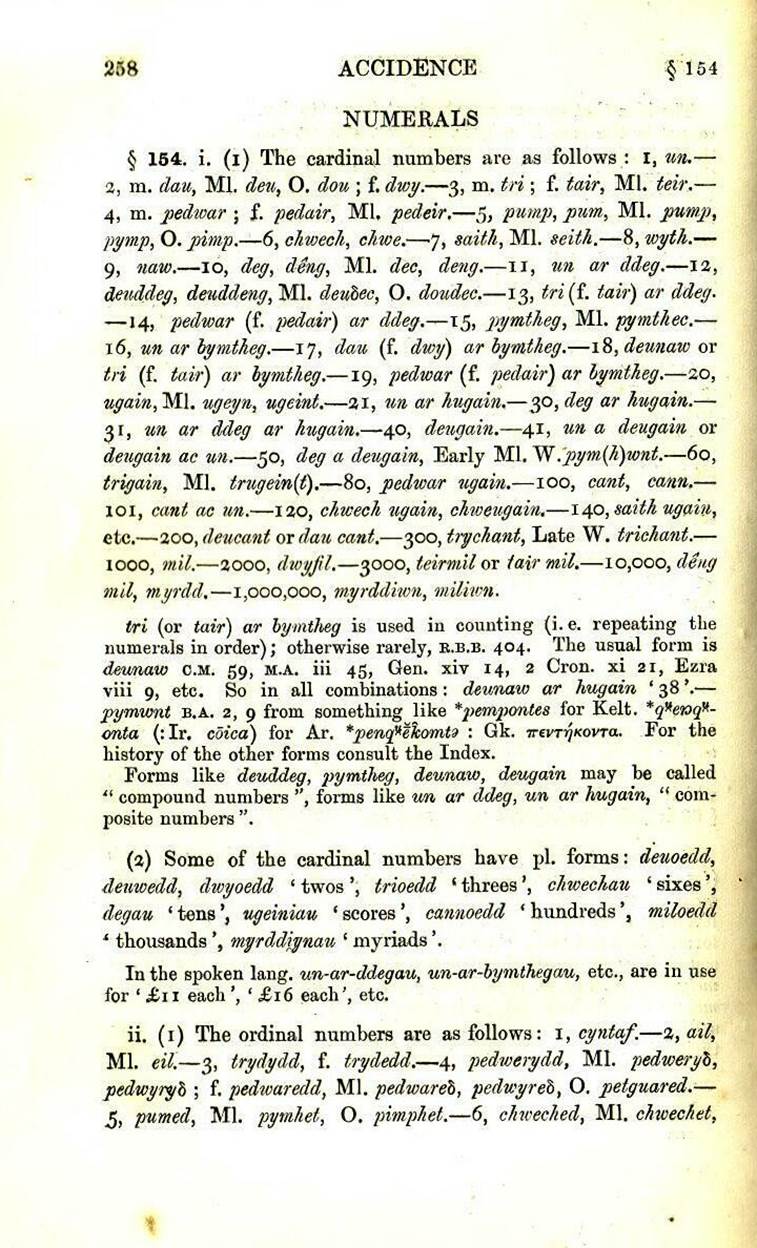
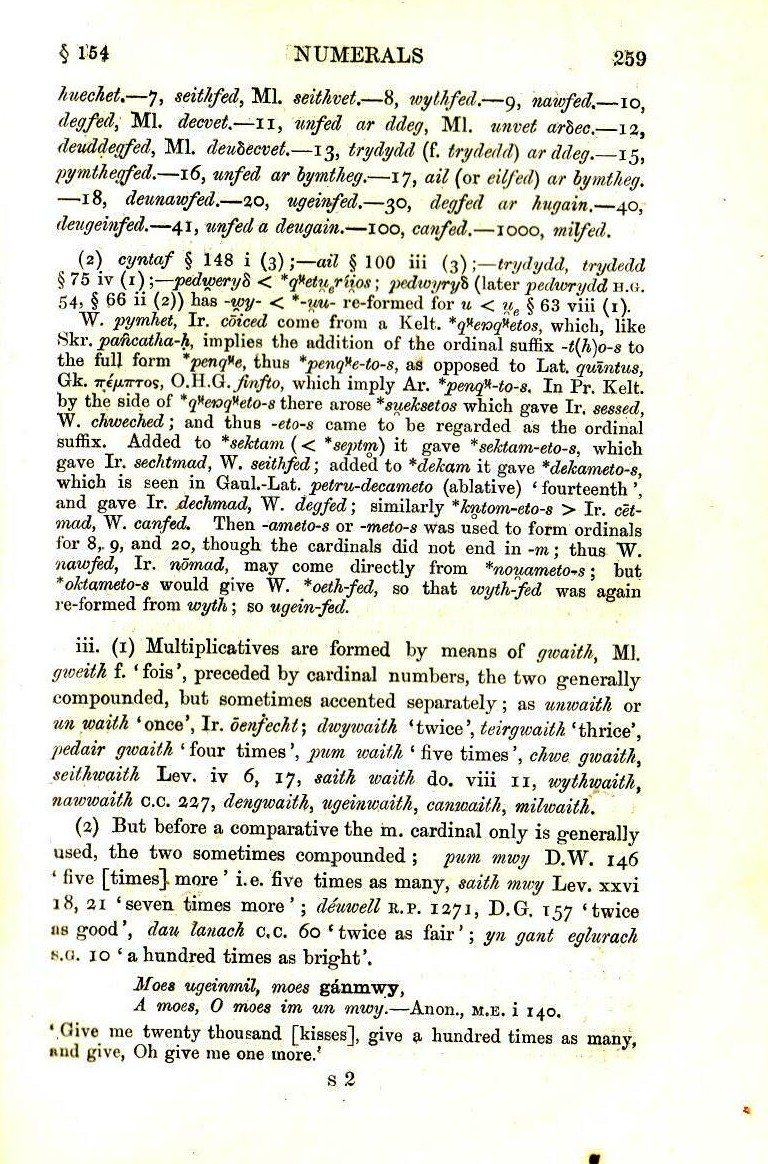

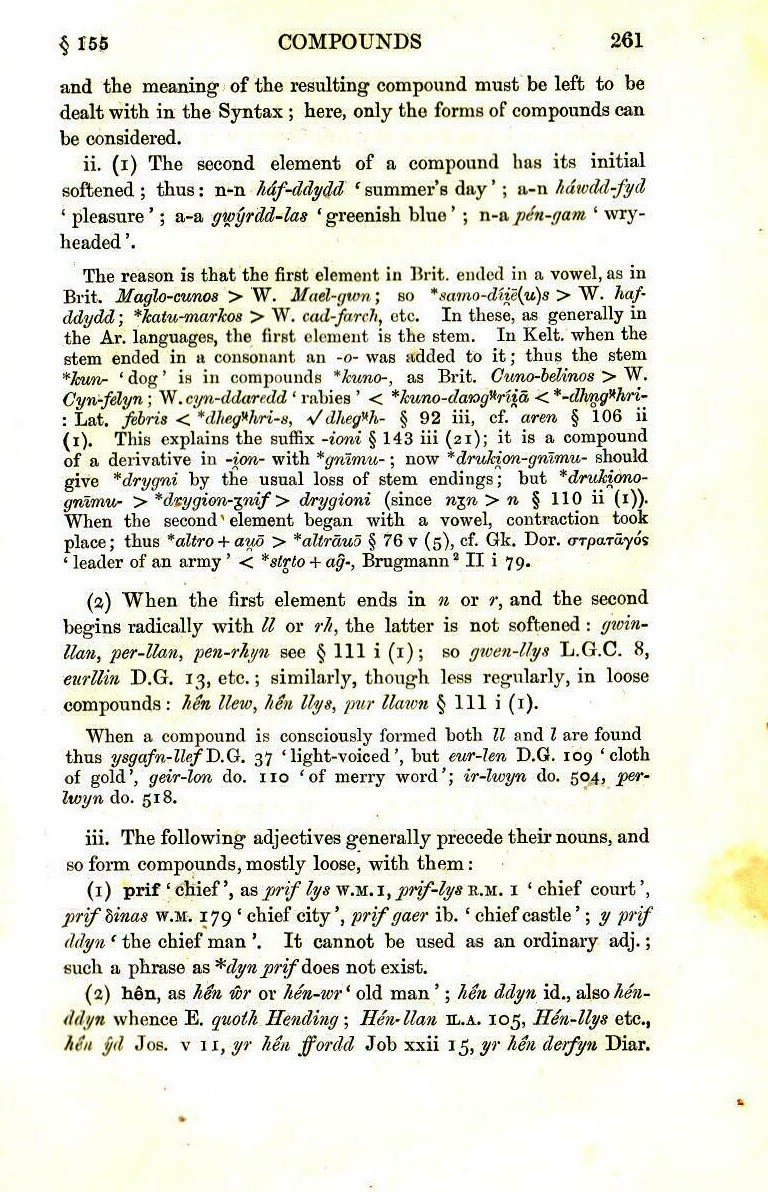
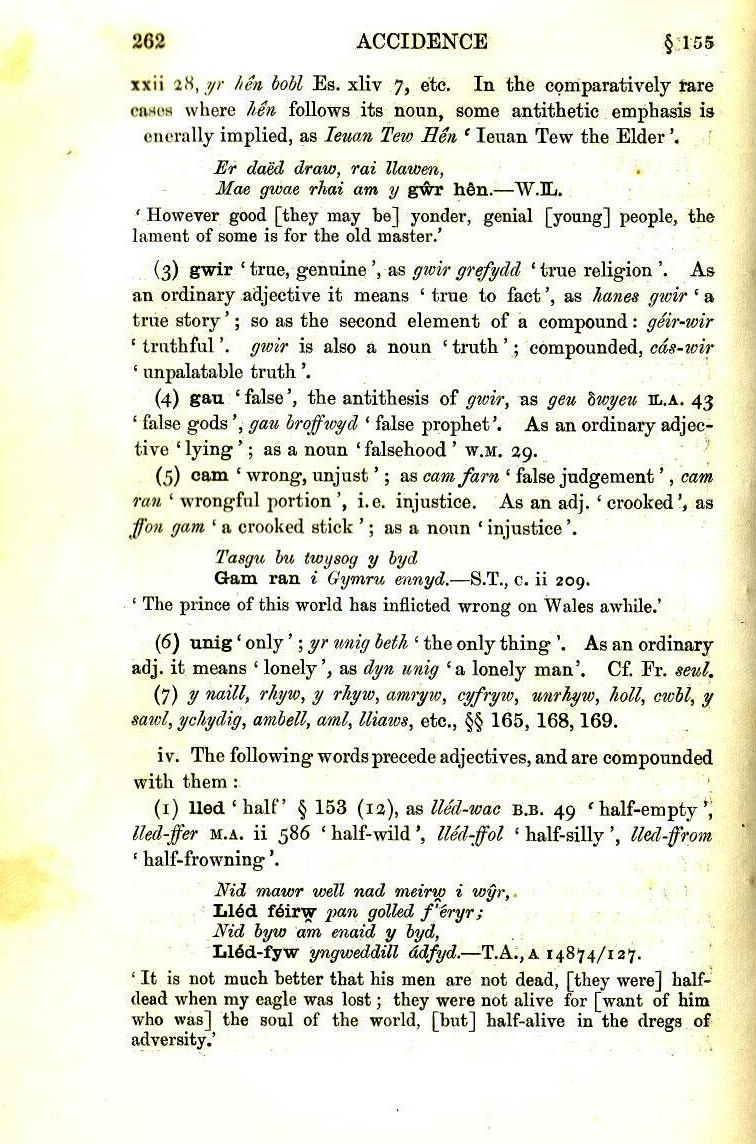
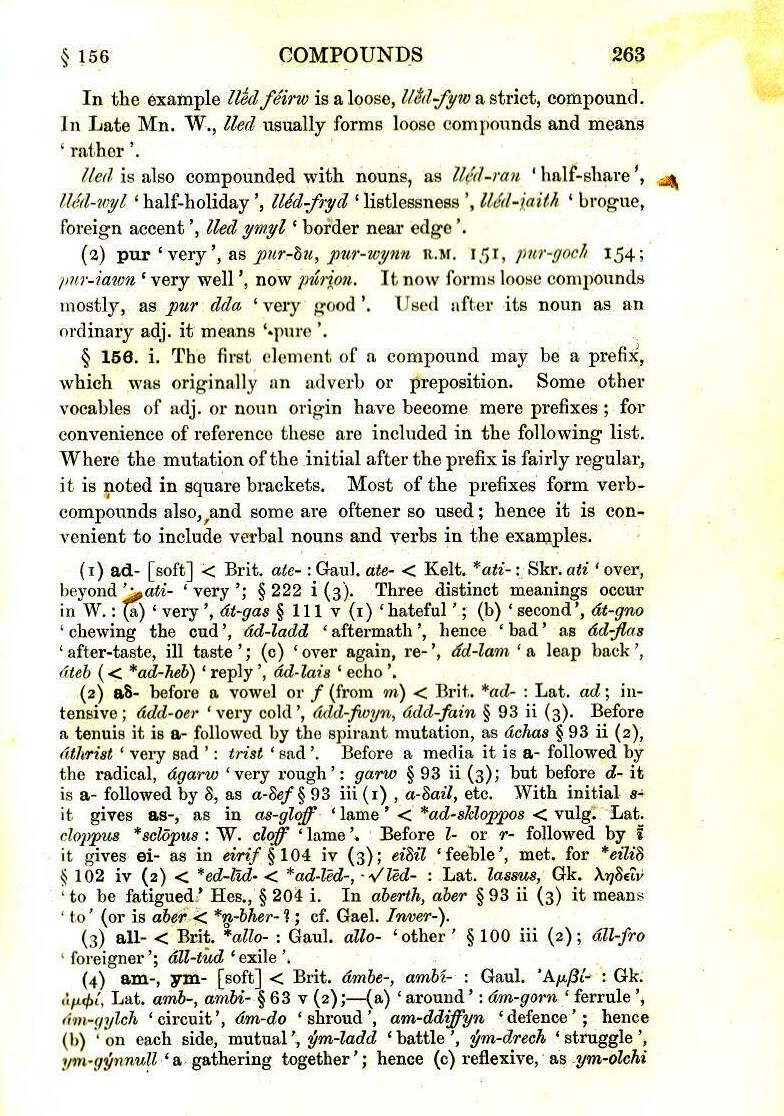
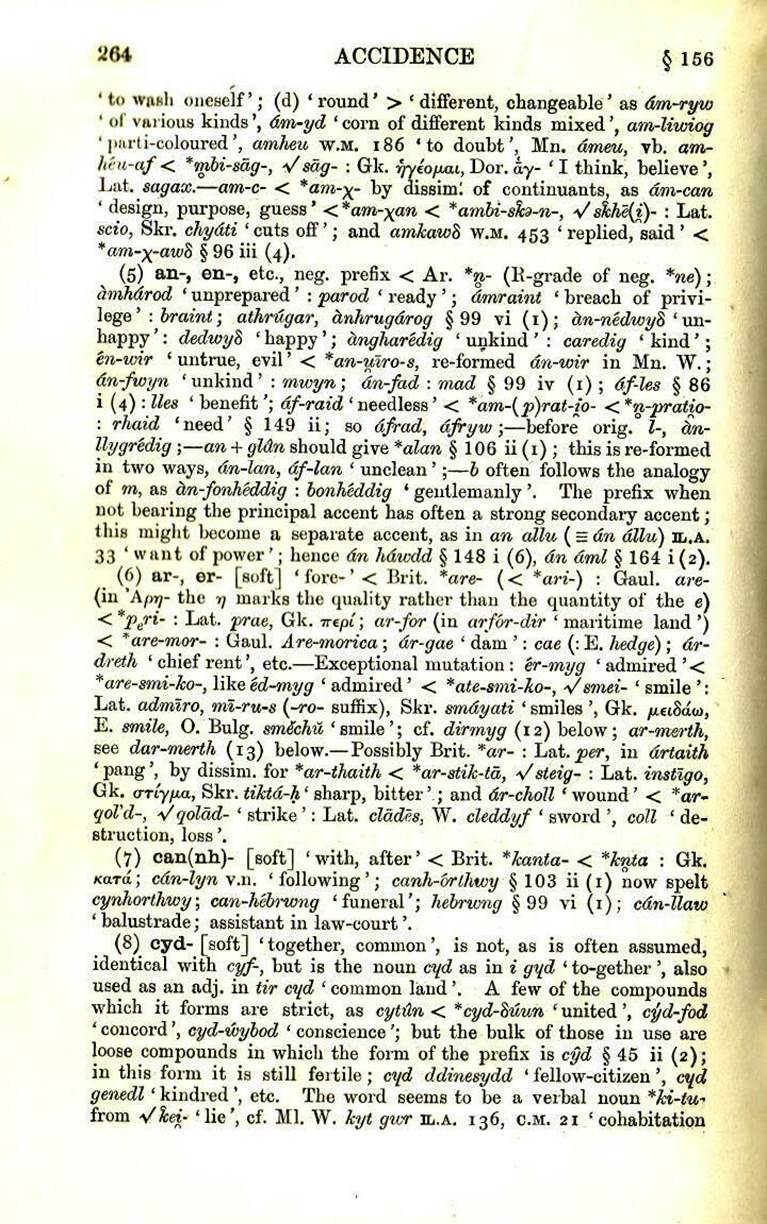

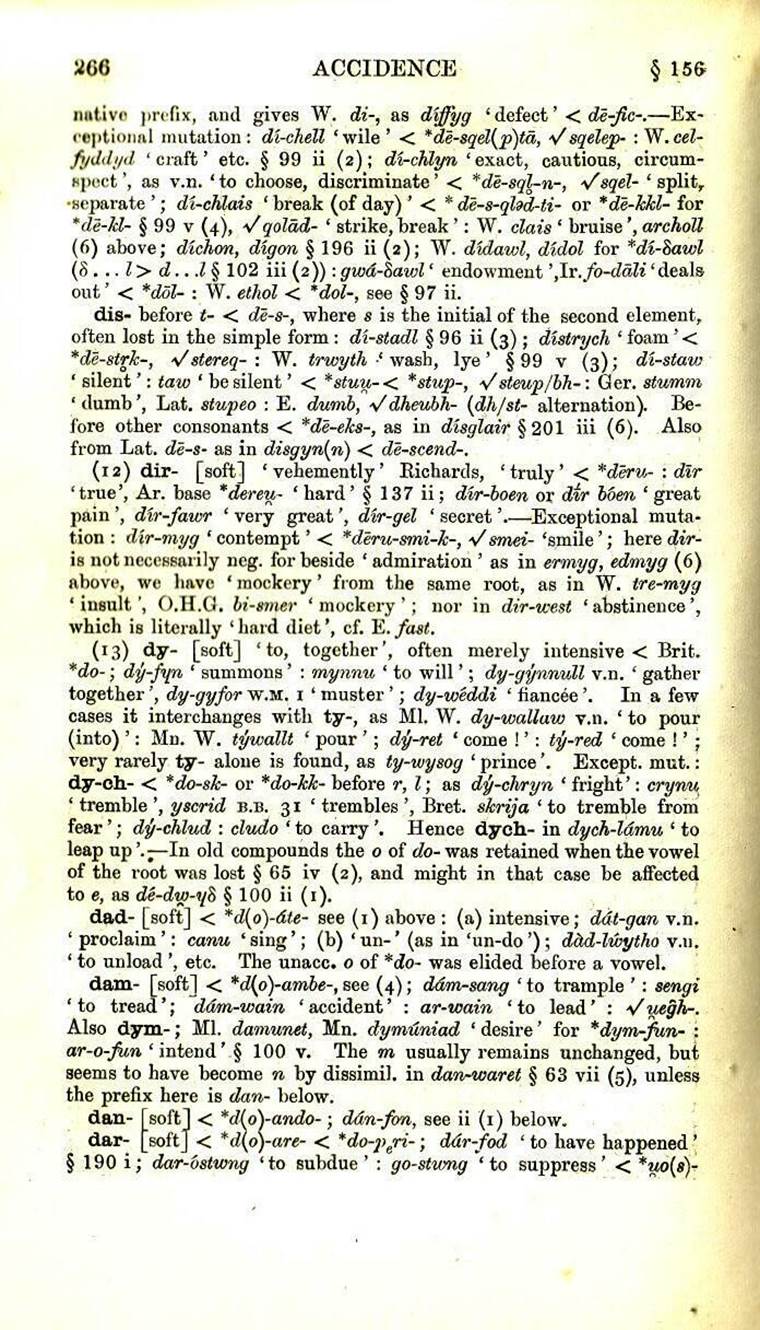
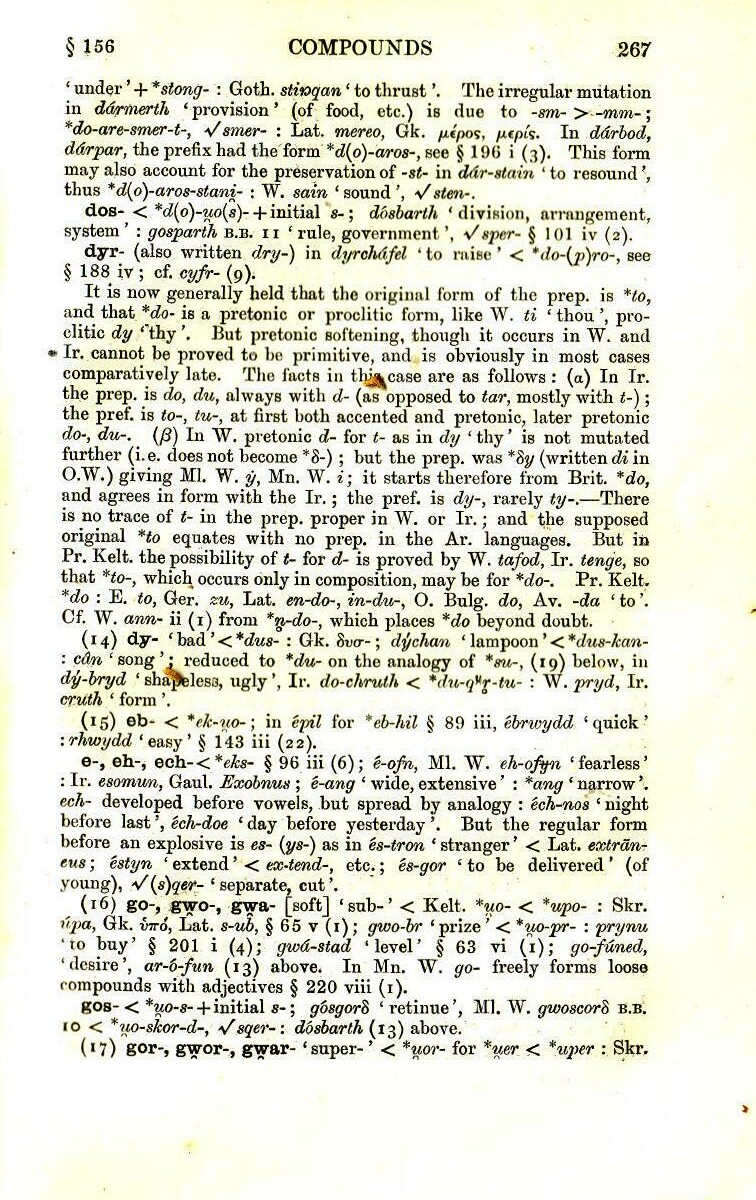

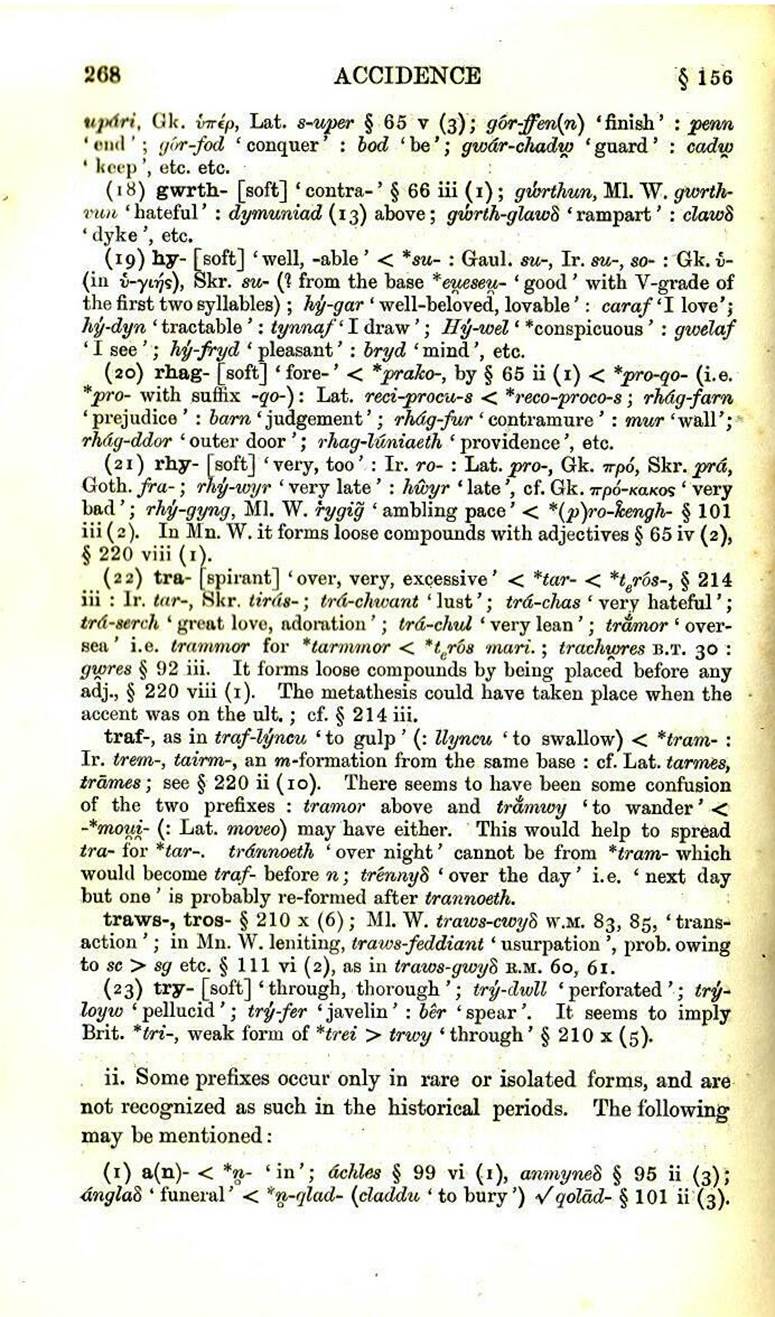
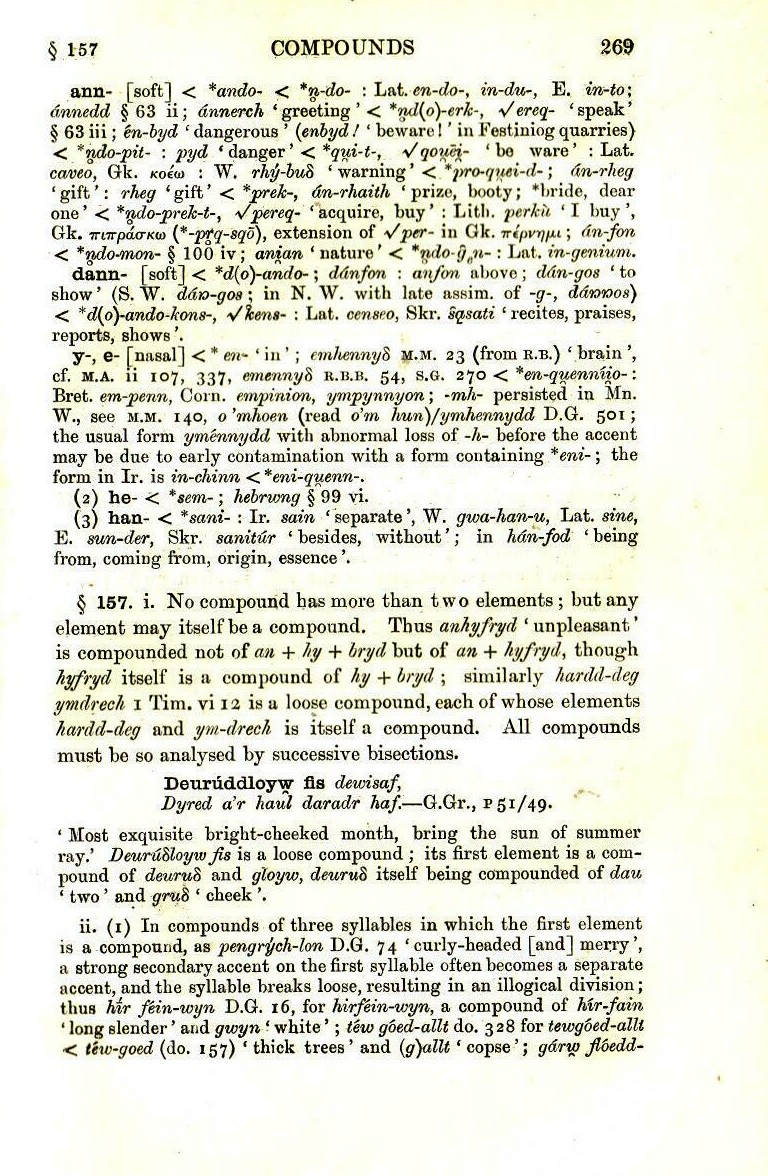

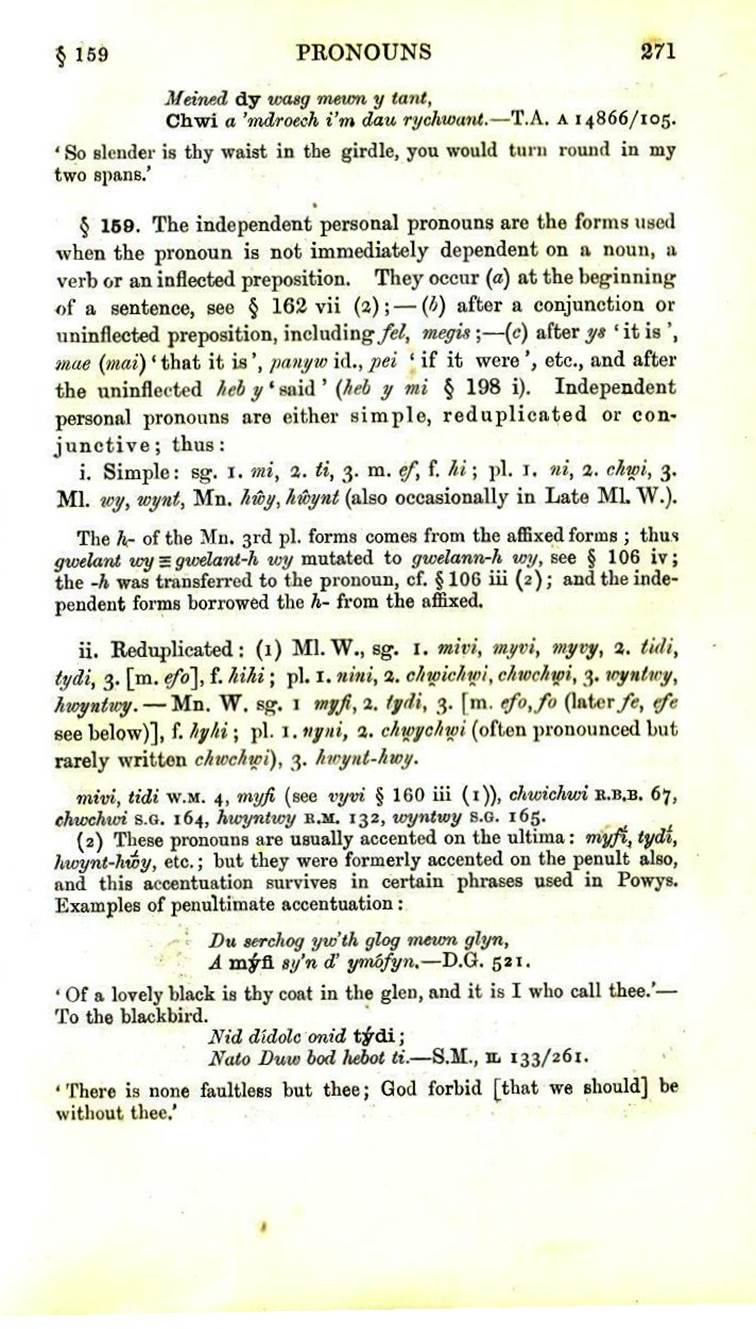
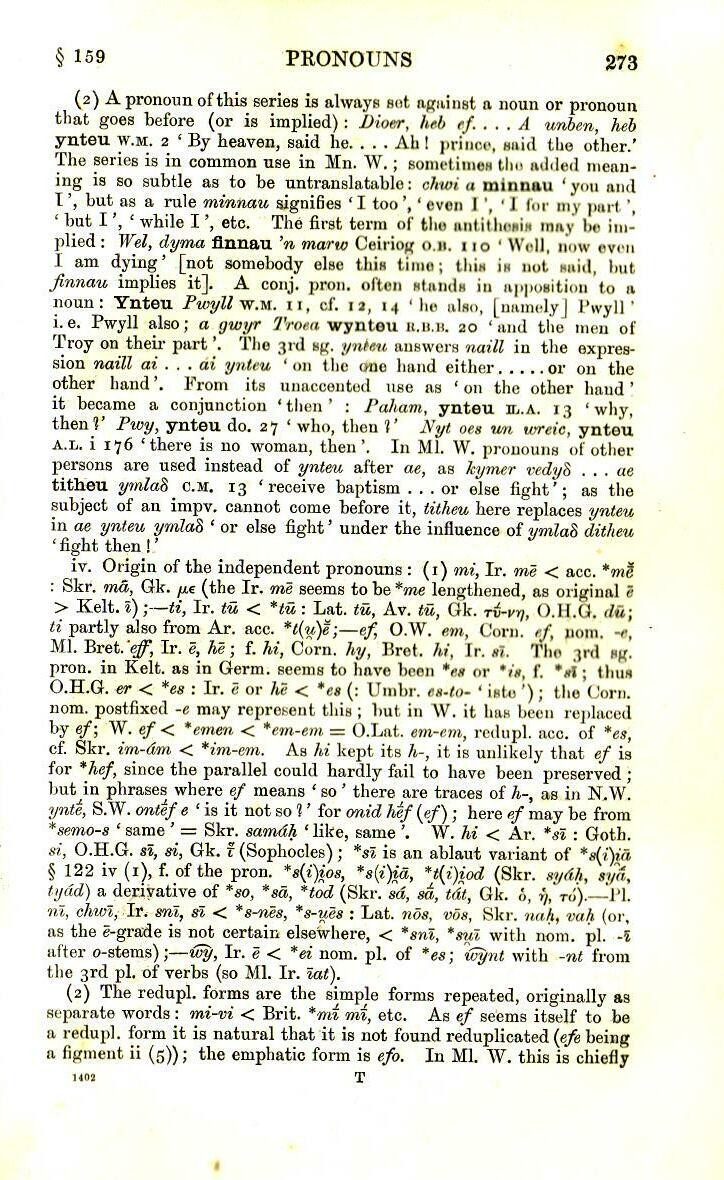
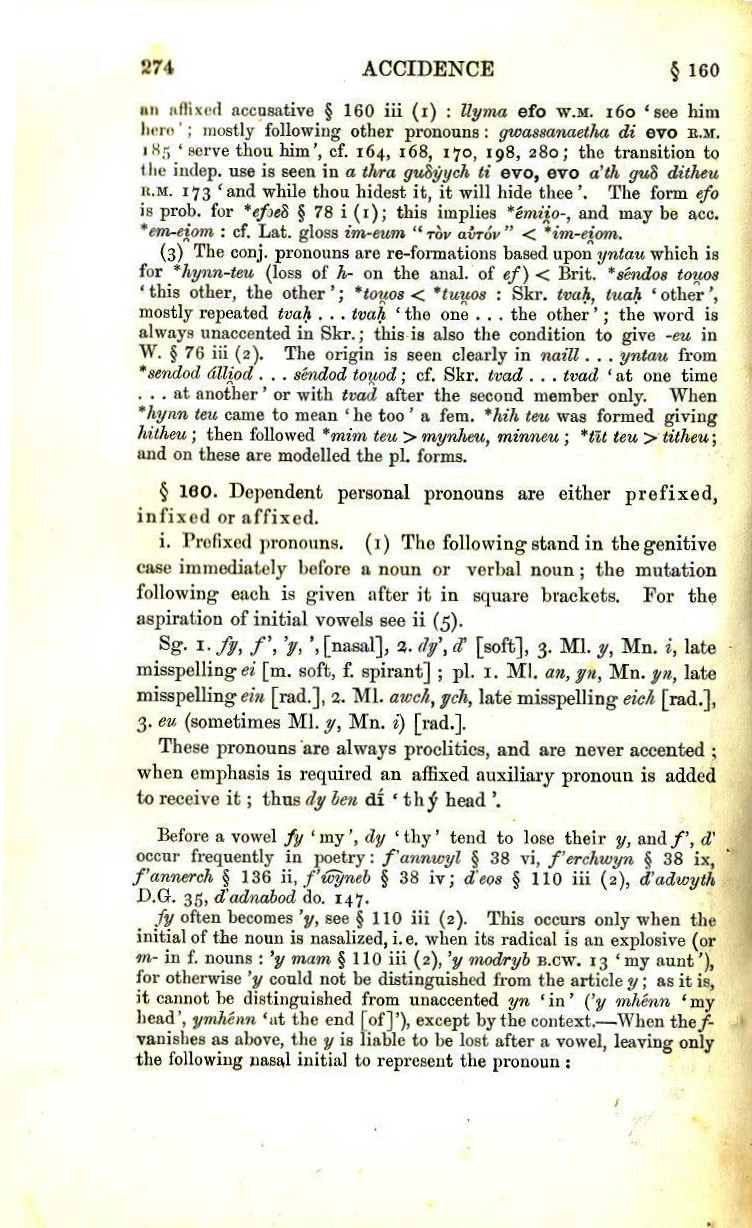

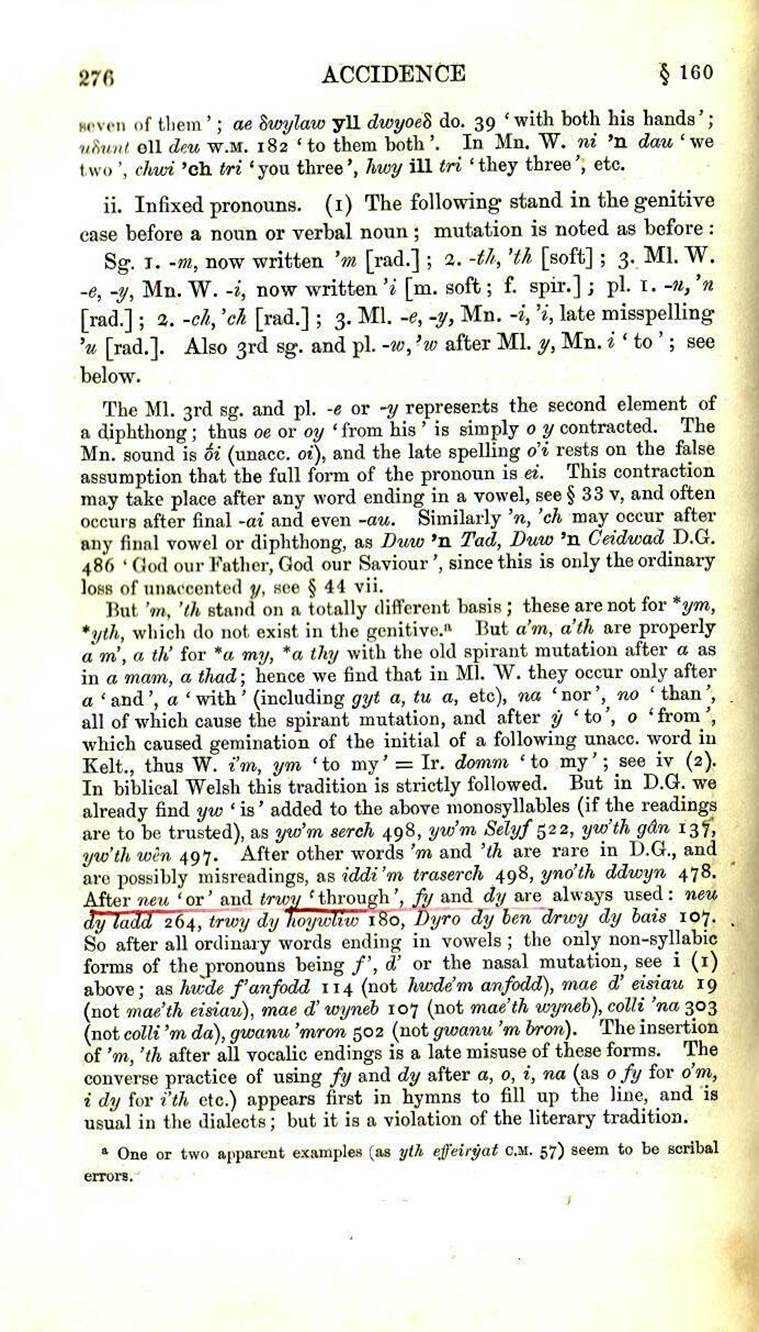


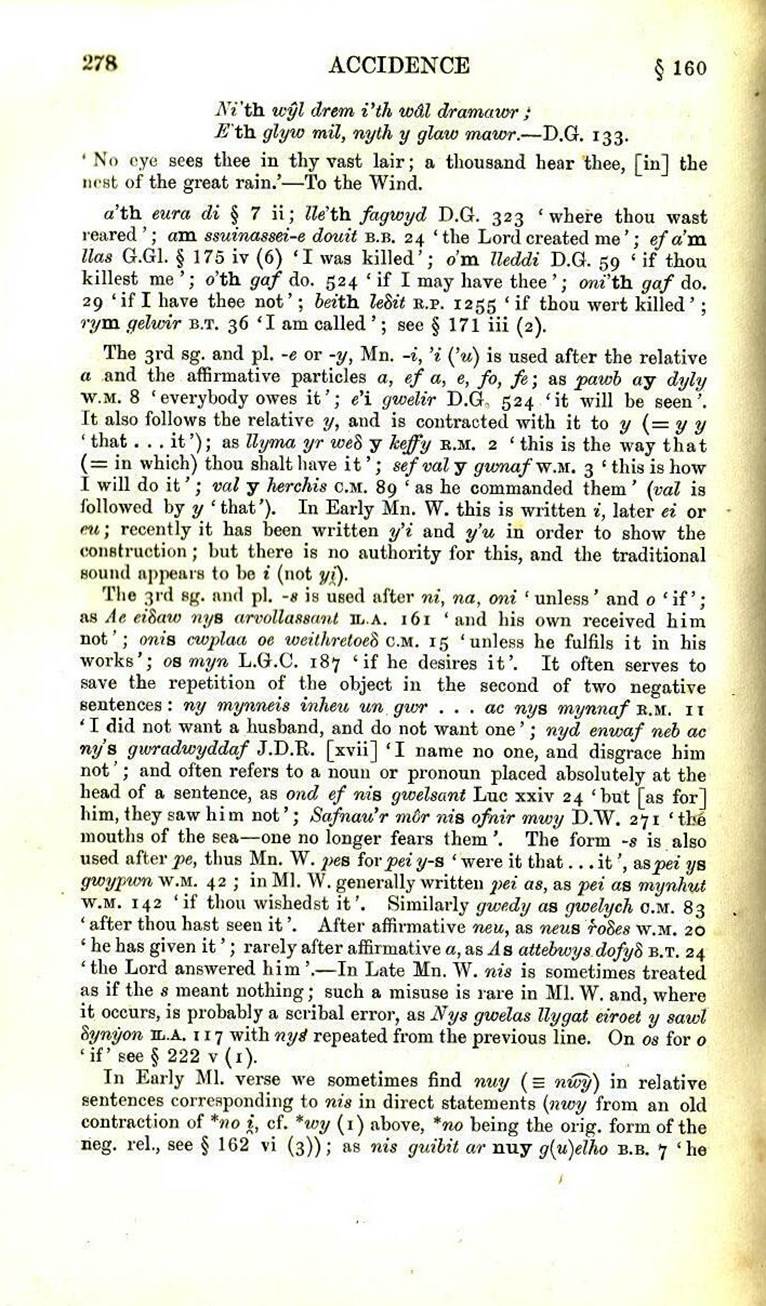
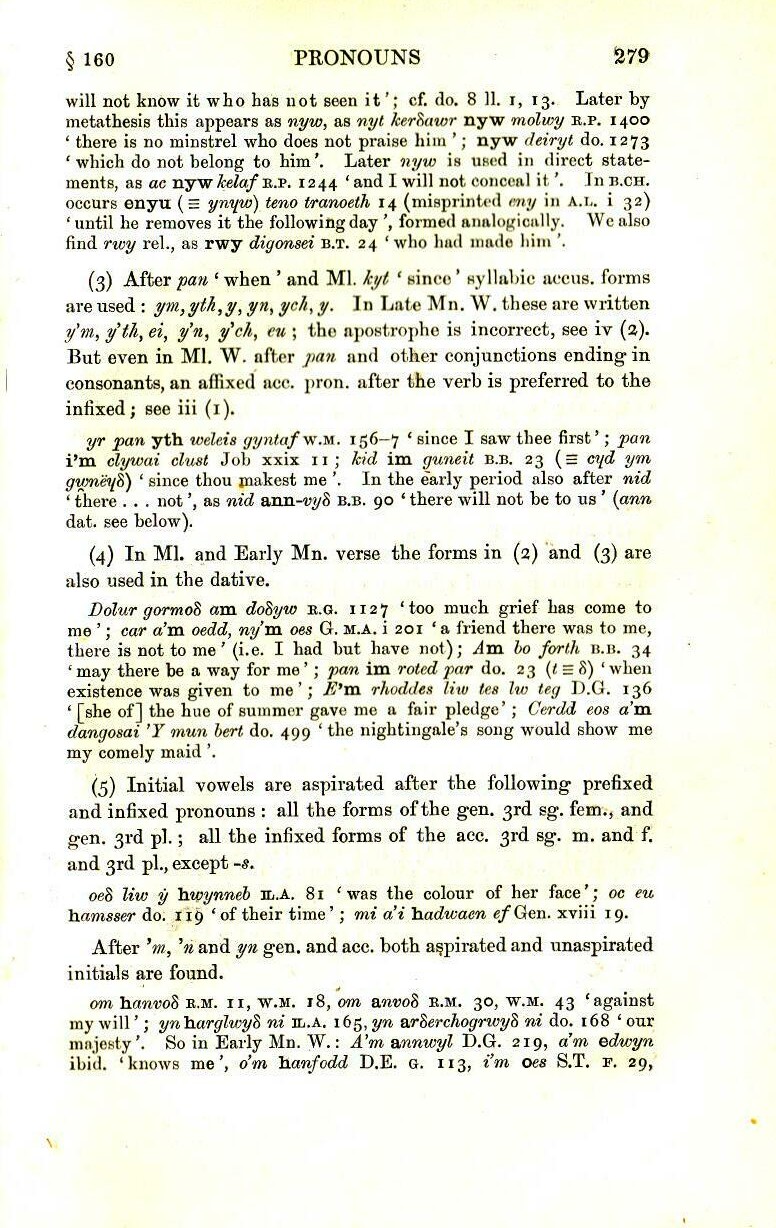

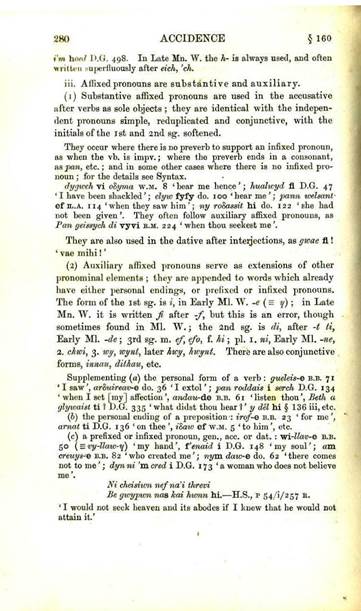






![[1]](https://en.wikisource.org/wiki/Page:Morris-Jones_Welsh_Grammar_0276.png#cite_note-1)
![[W 1]](https://en.wikisource.org/wiki/Page:Morris-Jones_Welsh_Grammar_0277.png#cite_note-1)

![[1]](https://en.wikisource.org/wiki/Page:Morris-Jones_Welsh_Grammar_0296.png#cite_note-1)
Y RHAN
NESAF: 2551e
Sumbolau:
a A / æ Æ / e E / ɛ Ɛ / i
I / o O / u U / w W / y Y /
…..
…..
MACRON: ā Ā / ǣ Ǣ /
ē Ē / ɛ̄ Ɛ̄
/ ī Ī / ō Ō /
ū Ū / w̄ W̄ / ȳ Ȳ /
MACRON + ACEN DDYRCHAFEDIG: Ā̀ ā̀ , Ḗ ḗ,
Ī́ ī́ , Ṓ ṓ , Ū́
ū́, (w), Ȳ́ ȳ́
MACRON + ACEN DDISGYNEDIG: Ǟ ǟ , Ḕ ḕ,
Ī̀ ī̀, Ṑ ṑ, Ū̀
ū̀, (w), Ȳ̀ ȳ̀
MACRON ISOD: A̱ a̱ , E̱ e̱ , I̱ i̱ ,
O̱ o̱, U̱ u̱, (w), Y̱ y̱
BREF: ă Ă / ĕ Ĕ / ĭ Ĭ / ŏ Ŏ / ŭ Ŭ
/ B5236:  B5237:
BREF GWRTHDRO ISOD: i̯, u̯
CROMFACHAU: ⟨ ⟩ deiamwnt
A’I PHEN I LAWR: ∀, ә, ɐ (u+0250) https:
//text-symbols.com/upside-down/
…..
…..
ˡ ɑ ɑˑ aˑ a: / æ æ: / e eˑe:
/ ɛ ɛ: / ɪ iˑ i: / ɔ oˑ o:
/ ʊ uˑ u: / ə / ʌ /
ẅ Ẅ / ẃ Ẃ / ẁ Ẁ / ŵ Ŵ /
ŷ Ŷ / ỳ Ỳ / ý Ý / ɥ
ˡ ð ɬ ŋ ʃ ʧ θ ʒ ʤ /
aɪ ɔɪ əɪ uɪ ɪʊ aʊ ɛʊ əʊ / £
ә ʌ ẃ ă ĕ ĭ ŏ ŭ ẅ ẃ
ẁ Ẁ ŵ ŷ ỳ Ỳ
…..
…..
Hwngarwmlawt: A̋ a̋
g yn
yn  aith δ δ
…..
…..
ә ʌ ẃ ă ĕ ĭ ŏ ŭ ẅ ẃ
ẁ ŵ ŷ ỳ
Ә Ʌ Ẃ Ă Ĕ Ĭ Ŏ Ŭ Ẅ
Ẃ Ẁ Ẁ Ŵ Ŷ Ỳ Ỳ
…..
….
Hwngarwmlawt: A̋ a̋
g yn
yn  aith δ δ
…..
…..
ʌ ag acen ddyrchafedig / ʌ with acute accent: ʌ́
|
Shwa ag acen ddyrchafedig Xwa amb accent agut Schwa with acute |
|
|
DejaVu Serif |
…..
wikipedia,
scriptsource.[]org
https://[ ]en.wiktionary.org/wiki/ǣ
…..
Y TUDALEN HWN /THIS PAGE / AQUESTA PÀGINA:
http://
[]www. []kimkat.org/amryw/1_gramadegau/gramadeg_2_1913_jmj_welsh_grammar_07_250-299_2650e.htm
____________________________________
Adolygiadau diweddaraf: Dÿdd
Mawrth 2005-11-20, 2006-06-07
https://en.wikisource.org/wiki/Index:A_Welsh_Grammar,_Historical_and_Comparative
Sumbolau
arbennig: ŷ ŵ
Ble’r wyf i? Yr ych chi’n ymwéld
ag un o dudalennau’r Gwefan “CYMRU-CATALONIA”
On sóc? Esteu visitant una pàgina de la Web “CYMRU-CATALONIA” (=
Gal”les-Catalunya)
Weør
àm ai? Yùu àar vízïting ø peij fròm dhø “CYMRU-CATALONIA” (= Weilz-Katølóuniø)
Wéb-sait
Where am I? You are visiting a page from the “CYMRU-CATALONIA” (=
Wales-Catalonia) Website
CYMRU-CATALONIA
o ymwelwyr i’r Adran hon (Gramadegau Cymraeg) oddi ar 1 Medi 2005
Edrychwch
ar fy Ystadegau / View My Stats