kimkat1580e A Welsh to English Dictionary in
scroll-down format. Geiriadur Cymraeg a Saesneg ar fformat sgrolio-i-lawr.
23-05-2024





|
|
|
Gwefan Cymru-Catalonia |
|

...
|
|
|
|
|
|
|
|
|
|
|
|
|
|
|
|
|
|
|
|
|
|
|
|
|
|
|
|
|
|
|
|
|
|
|
|
|
|
|
|
|
|
|
|
|


a1
A, a <<aa>> feminine noun
1) first letter of the twenty-six letter Roman alphabet
...1 a, 2 b, 3 c, 4 d 5 e, 6 f, 7 g, 8 h, 9 i, 10 j, 11 k, 12 l, 13 m, 14 n, 15 o, 16 p, 17 q, 18 r, 19 s, 20 t, 21 u, 22 v, 23 w, 24 x, 25 y, 26 z
2) first letter of the twenty-nine letter Welsh alphabet
...1 a, 2 b, 3 c, 4 ch, 5 d, 6 dd 7 e, 8 f, 9 ff, 10 g, 11 ng, 12 h, 13 i, 14 j, 15 l, 16 ll, 17 m, 18 n, 19 o, 20 p, 21 ph, 22 r, 23 rh, 24 s, 25 t, 26 th, 27 u, 28 w, 29 y
:_______________________________.
a2
a
The letter <<a>> in Welsh
words:
This can represent the long vowel <<aa>> in certain environments; in unusual envirionments it tis written with a
circumflex “â”.
1 As a consequence of the long vowel shift in English of
the 1400s, <<aa>> ultimately gave rise to the <<ei>> in the English of today. Many loans from English took place before the
sound shift and have <<aa>> in Welsh, spelt “â”or “a”
plât <<plaat>> (= plate) ← English “plate” <<plaat>>, now <<pleit>>
pâl <<paal>> (= pole) ← English “pale” <<paal>>, now <<peil>>
ras <<raas>> (= race, stream) ← English “race” <<raas>>, now <<reis>>
An “a” in a tonic syllable is sometimes written “y” to represent a dialect
pronunciation - <<a>> loses its quality to become an obscure vowel <<ə>>
:_______________________________.
a3
à
1 the grave
accent indicates a
short vowel where in a long vowel environment
The ‘a’ in monosyllables in Welsh with final –b, -d, -g is long
mag <<maag>> (North) fry of fish, tiny fish
mab <<maab>> son
tad <<taad>> father
However English words taken into Welsh with the same pattern (monosyllables,
final consonant g, b, d) but with a short vowel retain the short vowel in
Welsh.
bàg bag
càb (crane) cab, enclosed part where
a crane operator controls the movements of the machine
fflàg flag
:_______________________________.
a4
a
1 tonic a >> y i.e. /a/ ← /ə/
Calan Gaeaf (= All Saints, “(the)
calend (of) winter”)
>> C’langaea / Clangaea
>> Clyngaea <<kləng-gei-a>>
2 final -a in certain words in
southern Welsh is from an original -gh;
in northern Welsh there is no -a
British *kalg- >> Welsh *calgh- >> cala (south), cal (north) (= penis)
British *kolg- >> Welsh *colgh- >> cola (south), col (north) (= beard of corn; spike,
point)
British *bolg- >> Welsh *bolgh- >> bola (south), bol (north) (= belly)
3 a in a final syllable ← e.
This e can be original (halen = salt), or a reduction of the
diphthong au (pethe ← pethau = things), ai (cader ← cadair = chair), ae (chware ← chwarae = to play)
It is typical of three areas
1) South-east Wales
2) North-west Wales
3) in North-East Wales - northern Sir Ddinbych and Sir y Fflint
:_______________________________.
a5
a – this is a north-western and south-eastern equivalent of final-syllable
‘e’, either original (seren) or as a reduction of -ae- / -ai- / -au-
Thus bachgen (= boy) >> bachgan
The e might be a reduction of ae, ai, au in final syllables. This too will be a in these areas.
noswaith (= evening) >> nosweth >> noswath
gwasanaeth (= service) >> gwasaneth >>
gwasanath
gorau (= best) >> gore >> gora
As can be seen on the map, the –e occurs along a broad south-west to north-east axis.
The vowel change e >> a in the final
syllable of a word is found in three areas – south-east Wales, north-west
Wales, and (apparently) the coastal strip of the counties of Dinbych and Y
Fflint (marked with a dotted line).
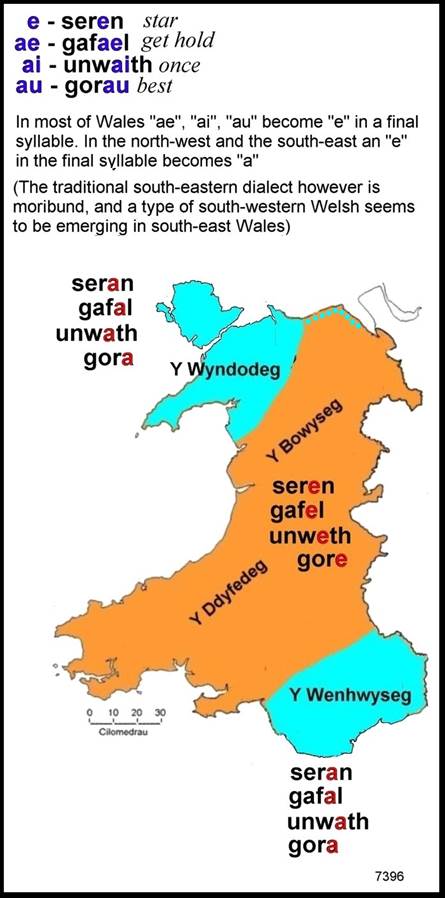
(delwedd 7396)
In many cases –a corresponds to the plural suffix –au :
pethau (things) >> pethe
>> petha
South–east Wales: esgidiau (= shoes) >> sgitsha
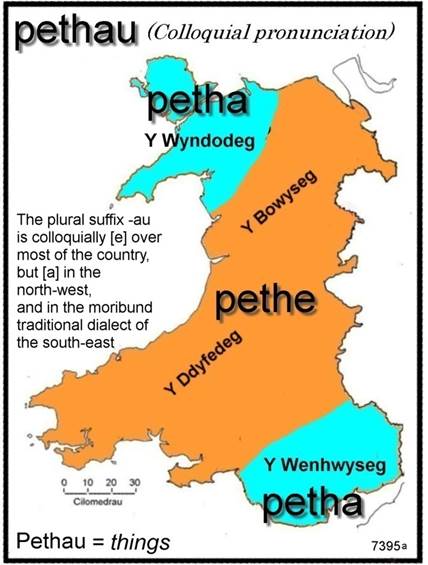
(delwedd 7395a)
1 Examples of final a
place names in North Wales:
..a/ Acaryforwyn
Street name in Dinbych, north-east Wales (written as “Accar-y-Forwyn”)
“(the) acre (of) the maid” = “Virgin
Mary’s acre”
(acer) + soft mutation + (y definite article) + (morwyn = maid; maiden; the Virgin Mary
)
..b/ Alafowlia, from ala fowliau
(= bowling alley, skittle alley)
In Dinbych, north-east Wales there is a street called Parc Alafowlia (Post Code LL16 3HZ)
(ala = alley) + soft mutation + (bowlia, a form of bowliau = bowls, plural of bowl
= bowl)
2
Examples of final -a
in place names in South-east Wales:
(in many cases it corresponds to the plural suffix –au)
..a/ Y Blaena
The south-eastern pronunciation of blaenau [ˡbləinai] (= upland; sources of streams) is blaena [ˡbləina] . The English spelling of the town’s name is Blaina [ˡblainə] , which might in fact be a Welsh spelling to suggest a local pronunciation [ˡblaina]
..b/ Y Brynna
The south-eastern form of bryniau (= hills) is brynnau, without
the semi-consonant i- at the start of the final syllable, a general feature of
the Welsh in this part of the country. The colloquial pronunciation is Brynna.
..c/ Y Bwlcha
The Gwentian pronunciation of bylchau (“passes, gaps”), the plural form
of bwlch (= pass, gap”).
It occurs in the place name Pen Bwlcha east of Pont-y-gwaith ST0897 pen
y bylchau “(the) top / end (of) the passes / gaps”
..d/ Y Caia <<ə kai-a>> farm in Sain Nicolas, county of Bro Morgannwg y caeau <<ə kei-ai>> = the fields
..e/ Y Castella <<ə ka-STE-lha>> [ə kaˡstɛɬa] place by Llantrisant, Rhondda Cynon Taf ← y castellau <<ə ka-STELH-ai>> [ə kaˡstɛɬaɪ] = the castles. Nowadays spelt with -au
A Topographical Dictionary of Wales / Samuel Lewis / 1849:
(Llantrisant) To the north of the town the appearance of the country becomes
more rugged, and assumes a wilder aspect, which is in some degree enlivened by
the pleasing appearance of Castella, an ancient seat, that forms a lively and
cheerful object in a landscape, of which the prevailing character is that of
sombre magnificence.
..f/ Y Cefan
From Y Cefen ← Y Cefn, the short form of names with cefn (= hill) as the first element
1 Cefncoedycymer (also Y Ciefan, with a palatalised c)
2 Cefncribwr
..g/ Y Cwarra
Clos y Cwarra street name in Llanbedr y Fro (“(the) close (of) the
quarries”) ← cwarrau (= quarries)
..h/ Y Cymar
Y Porth in Dyffryn Rhondda (The Rhondda Valley) was originally known as Y
Cymer (the confluence), a short form of Cymer-rhondda (the
confluence of the Rhondda river, where the Rhondda Fach river joins the Rhondda
Fawr river). Y Cymer now forms part of Y Porth. The local pronunciation is (or
was) Y Cymar.
..i/ Y Darran
(various places)
Tarren is a rocky slope.
a,/ Name of a public house in Rhisga.
b,/ Name of a farm.
|
Excerpt from a comment (retrieved 18-10-2008) in the
forum at: http://www.bbc.co.uk/wales/southeast/sites/walks/pages/twmbarlwm.shtml |
..j/ Y Felindra
In Caer-dydd.
A house name noted by John Hobson Matthews (Mab Cernyw) 'Cardiff Records'
(1889-1911)
VELINDRE, Y Felindre (the mill hamlet), often inaccurately spelt
"Velindra." A copyhold tenement consisting of a house and garden in
the manor of Llystalybont and parish of Llanishen. In 1700 it was devised* by
Gabriel Lewis. In 1902 it was purchased from the Booker family by the
Corporation, for the purposes of an Asylum.
*willed to, transferred to the benificiary of a will
..k/ Llambad <<LHAM-bad>> [ˡɬambad]
1 A local form of Llanbedr
(“(the) church (of) (Saint) Peter”).
Iit is used for example for Llanbedr y
Fro ST0876 (county of Bro
Morgannwg)
(English name: Peterstone-super-Ely)
“the Llanbedr which is in Y Fro (= the Lowland)”
Y Fro is a short form of Bro Morgannwg “(the) lowland (of)
Morgannwg”
..l/ Llanedarn <<lhan-EE-darnd>>
(“(the) church (of) Edern”).
A Topographical Dictionary of Wales / Samuel Lewis / 1849:
LLANEDARN (LLAN-EDEYRN), a parish, in the poor-law union of Cardiff, hundred of
Kibbor, county of Glamorgan, South Wales, on the banks of the Romney, 4 miles
(N. E. by N.) from Cardiff; containing 354 inhabitants. This parish, which lies
on the eastern confine of the county, comprises about 2550 acres of land,
partly arable and partly pasture.
http://www.british-history.ac.uk/report.aspx?compid=47848#s2
The current name is is the incorrect Llanedeyrn, where it has been altered to
suggest some connection with the Welsh word teɥrn (in early Welsh names, ‘king, ruler’; though in modern Welsh it means
‘tyrant’).
The local form was Llanetarn, with the devocing of the consonant
at the head of the final syllable, a typical feature of the historical
south-eastern dialect
..m/ Y Llwɥna <<ə LHUIN-a>>
Name of a farm in Llantrisant by Brynbuga, county of
Mynwy (“the bushes”)
..n/ Y Mynydda
<<ə mə-nə-dha>>
South-eastern form of Y Mynyddau, the uplands of the
old territories of Morgannwg and Gwent (more or less the uplands of the
present-day counties of Castell-nedd ac Aberafan, Pen-y-bont ar Ogwr, Rhondda
Cynon Taf, Caerffili, Merthyrtudful, Blaenau Gwent, Torfaen) .
In English these areas were known by the English translation 'The Hills'. The
name referred to the areas at the heads of the valleys where the first
ironworks and coalmines were situated.
Later on, as coal mines opened down in the valleys, the
bulk of the population became were valley dwellers, and so the industrial area
became known Y Cymoedd (the Valleys), though whether this expression
first took hold in English, and so Y Cymoedd is the translation of an English
expression; or the English name is a translation of the Welsh expression; or
both came about concurrently still needs to be investigated.
In modern Welsh the plural of mynydd (= upland; mounatain) is mynyddoedd,
but historically the plural termination was -au.
..o/ Y Panta ST4999
in Y Dyfawden / Devauden, near The Cot, west of Dindyrn / Tintern (Mynwy) seems
to be Y Pantiau (hollows)
http://www.geograph.org.uk/photo/491838 Y Panta - arwydd /
sign
http://www.geograph.org.uk/photo/301254 Y Panta - ffermdy /
farmhouse
..p/ Y Snawdra <<ə snau-dra>> feminine noun
Local form of Ynɥsawdre, a locality in the county of Pen-y-bont ar Ogwr
NOTE:
..1/ transposition of the n so that
it occurs after the s;
..2/ the a instead of e in a final syllable is a normal
feature of South-eastern Welsh
“ynys Hafdref”, “(the) meadow (of the place called) Hafdre”; apparently hafdre
(= summer homestead), with a later changer of [v] >> [w] hawdre, but older forms suggest that im fact
it was cynhaef (an obsolete variant of modern cynhaeaf = autumn;
(cyn- suffix = pre) + unusual mutation + (gaef - an obsolete variant of modern gaeaf = winter).
CYNHAEF + soft mutation + TREF >> *CYNHEUFDREF?, *CYNHEUFDRE? >> *HEUFDRE, and perhaps the element
*HEUF confused with HAF?
..q/ Y Tircalad
A house name noted by John Hobson Matthews (Mab Cernyw) 'Cardiff Records'
(1889-1911) “TIR-CALAD (the hard land.) A free tenement in the parish of Roath
and manor of Roath-Keynsham (1702.) A ruined house and land named in the Heath
Enclosure Award of 1809. In 1840 it was called Coed Tir Caled, hard-land wood.”
“y tir caled” (y definite article) +
(tir = land) + (caled = hard).
..r/ Y Tonna
The village of Tonnau (“pastures, pasture lands, meadowlands”) in
Castell-nedd ac Aberafan county is pronounced locally Tonna, which is in
fact the offical form of this community.
..s/ Tredegar
Tredegyr (settlement of Tegyr) >>
Tredeger >> Tredegar
t/ Y Tyla
....1/ In Dyffrynrhondda (county of Castell-nedd ac Aberafan) there
is a street called Heol y Tyla (“(the) street (of) Y Tyla”) . Y Tyla =
the hill
.....2/ Y Tyla is the name of a farm ST2482 (“Tyla Farm”) by
Llanfihangel y Fedw (“Michaelston-y-Fedw”), in Casnewydd / Newport county
..u/ Y Tyla-gwyn SS9188 hamlet south of Pont-yr-hyl
(county of Pen-y-bont ar Ogwr) (“white hill”) (tyle = hill)
Hypercorrection:
Some words / names with ‘a’ are supposed to be original ‘e’. Thus an incorrect
explanation of the place name Dolwyddelan (actually a personal name Gwyddelan =
(little) Irishman) in the 1800s was ‘Dolydd Elen’, the meadows of Elen, or
Helen.
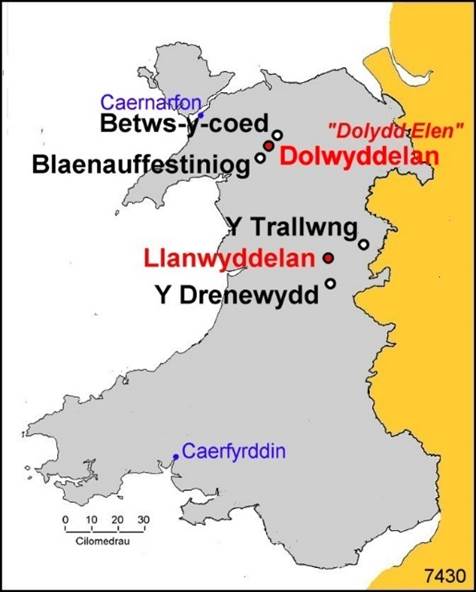
(delwedd 7430)
:_______________________________.
a6
a >> o
An original a has
become o in a final syllable in
certain words
Examples from standard Welsh:
Amrath >> Amroth (SN1607, place name, Penfro county)
Lleisian >> Lleision man’s name, from llais (= voice) + suffix -an
sbectal >> sbectol (= spectacles, glasses)
Other instances occur in COLLOQUIAL WELSH , and are not standard:
(1) adladd (aftermath, aftergrass =
a second crop of grass which grows in the same season after the first mowing)
>> adlodd
(2) afal (= apple) >> afol
(3) (an- negating prefix) + (gras = grace) >> anras >> andras >> andros
(North Wales, = ‘great, great big, enormous’ in qualifying a noun – andros o ffŵl = a great fool)
(4) crochan (= cooking pot,
cauldron) >> crochon
(5) dafad (= sheep)
Studies in Welsh Phonology / Samuel J. Evans / 1909 / t19 “In Anglesey and
Carnarvonshire dafad is regularly pronounced dafod.”
(6) gofal (= care) >> gofol
(7) hóspital (= hospital) >> hóspitol
(8) neuadd (= hall) >> neuodd
(9) penwag (= herring) >> *penwog >> pennog
(10) gleuad (= cow pats) >> gluod (North Wales)
Llyn Safaddan (a lake by Llan-gors, Sir Frycheiniog / Breconshire) has a
variant Llyn Safaddon.
ALSO:
(a + wy) has become (o + wy)
Older Welsh marthwyl >> modern
Welsh morthwyl (= hammer) (from
Latin MARTELLUS = hammer)
Older Welsh nadwydd >> modern
Welsh nodwydd (= needle)
:_______________________________.
a7
a ← o
An a has
replaced an original o in a final
syllable in certain words
..a/ Bedwas (village name, Caerffili
county, south-east Wales) ← bedwos (small birch trees)
..b/ ofan (South Wales) ← ofon ← ofn (= fear)
..c/ Wernas-deg locality in
Beddgelert (county of Gwynedd): y wernas
deg ← y wernos deg (“fair small alders”)
..d/ rwân (North Wales) (= now) ← yr awron ← yr awr hon (=
this hour, “the hour this”)
...e/ Llantarnam (= place in Sir Fynwy / Monmouthshire) ← Nant Teyrnon
...f/ tywod (= sand). Colloquial forms are tŵod <<TUU-od>>, tŵad <<TUU-ad>> and towod <<TOU-od>>
According
to John Hobson Matthews (Mab Cernyw) in ‘Cardiff Records’ (1889-1911),
tŵad occurred in 1731 and in 1744 in the name Rhyd y Tŵad, for Rhyd y Tywod:
RHYD-Y-TYWOD, "Rhyd y twad" (the ford of the sand.) Across the river
Taff, from Whitchurch to Pentyrch (1731.) (Note:
Probably Ryd y Tŵad – aspiration wsa absent in the regional dialect)
(11) Aberddawan (= village in Bro Morgannwg / the Vale of
Glamorgan) >> Aberddawon
:_______________________________.
a8
-a
1 verb suffix,
especially in verbs with the sense of ‘gathering (something)’, the suffix being
added to the noun which is the material being gathered
gwlân (= wool)
gwlana ← gwlán-ha (= to gather wool; South-east: also, to daydream)
See -ha
:_______________________________.
a9
-a
1 -a is added to the stem of certain verbs to
form the second person singular imperative both in the colloquial language and
in the literary language
hola! ask! enquire!
gwena! smile!
2 in colloquial Welsh –a,
the second person singular imperative of certain verbs, has been generalised to
most other verbs
Though it is added to the stem of certain
verbs to form the second person singular imperative in colloquial Welsh, in
the literary language however the stem serves as the imperative
cana sing! (literary Welsh: cân = sing!)
creda fi! <<kree-da
vii>> Believe me (literary form: cred fi <<kreed
vii>>)
caea dy ben! shut your mouth! (literary
form: cae dy ben)
siarada! speak (literary
form, siarad)
Bachan, siarada sens, w. Talk sense, mun! (bachan = man. boy, not translated into
English)
:_______________________________.
a10
-a
1 suffix for making a female name from a male name (a
practice which began in nineteenth century when recognisably Welsh names began
to be popular)
Eifion (m) <<EIV yon>>, Eifiona (f) <<eiv YOO na>>
Ifan (m) <<II van>>, Ifana (f) <<i VAA na>>
Illtyd, Illtyda (although Illtud is in fact
the correct form rather than Illtyd, and would give *Illtuda)
Iŏlo (m) <<YO lo>>, (pet form of Iorwerth), Iŏla (f) <<YO-la>>
Meirion (m) <<MEIR yon>>, Meiriona (f) <<meir YOO na >>
:_______________________________.
+a11
+-a
1 (child language) diminutive suffix in titles of relations
ewa ← ewythr (= uncle)
bopa ← modryb (= aunt)
neina ← nain (= grandmother)
teida ← taid (= grandfather)
:_______________________________.
a12
a <<AA, A>> (conjunction)
1 and;
Aberystwyth a Dolgellau = the towns
of Aberystwyth and Dolgellau;
before a vowel, ac;
Dolgellau ac Aberystwyth; the towns of Dolgellau and Aberystwyth.
With a determiner - for example,
a’ch <<akh>> and your
(contraction of “a” + “eich”)
2 used in linking two
qualifying adjectives where in English it is absent
ci da a ffyddlon a good faithful dog
(“a good and faithful dog”)
cwm cul a dwfn a deep narrow valley
(“a valley narrow and deep”)
3 in forming linking adverbials (ac <<aag>> before a vowel)
..1/ a bod yn onest to be honest
..2/ a chysidro all things
considered, considering the circumstances, in view of the situation
..3/ a defnyddio'r hen air Cymraeg to
use the old Welsh word
Mae yna lawer o bobl yn cael trafferth i
dyfu persli neu bersyll, a defnyddio'r hen air Cymraeg
A lot of people have trouble growing parsley or “persyll”, to use the old Welsh
word
..4/ ac ystyried yr amgylchiadau all
things considered, considering the circumstances, in view of the situation
:_______________________________.
a13
a <<A>> interrogative particle
a oeddech chwi <<a OI dhe khi>> were you?
a oedd ef <<a OIDH e; OO dhe>> was he?
a oedden ni <<a OI dhe ni>> were we?
a oeddet ti <<a OI dhe ti>> were you?
a oedd hi <<a OIDH hi; OO dhi>> was she?
a oeddwn i <<a OI dhe ni>> was I?
a oeddynt hwy <<a OI dhint hui>> were they?
:_______________________________.
a14
a <<A>> relative pronoun; with
a determiner - for example, y wraig a’ch (= a + eich) gwelodd - the woman who
saw you
Used without a subject in sayings;
The subject is understood:
(y neb a... y sawl a...) = (the person) who; whosoever, whoever;
(y peth a...) = (the thing) that , whatsoever, whatever, what
A fyn Duw a fydd (motto) What God wills shall be
:_______________________________.
â
1 for comments on words with “a” plus circumflex (plât,
tân, mâs, etc) see “a”
:_______________________________.
â 1 <<A>>
1 he goes, she goes, it
goes (literary Welsh) in COLLOQUIAL WELSH , aiff (South Wales), eith
(North Wales)
:_______________________________.
â 2 <<A>> (preposition)
1 as
Comparisons:
..a) â’r graig (“as the rock”)
bod mor sefydlog â’r graig be as steady as a rock
..b) â'r nant i'r afon (“as the stream to the river”)
mor sicr â'r nant i'r afon no doubt about it “as sure as the stream to
the river”
..c) â’r oen (“as the lamb”)
bod mor fwynaidd â’r oen be as gentle as a lamb
...d) â mynach [a ˡmənax]
1 (in comparisons) bod mor
ddifrifol â mynach be deadly serious
Tybiai ei frawd a’r
gweinidog mai cellwair oedd, ond yr oedd Ifan mor ddifrifol â mynach His brother and
the minister thought that he was joking, but Ifan was deadly serious (“as serious as a
monk”)
-------------------------------------------------------------------
â 3 <<AA>> preposition
1 with (should have a circumflex accent - often omitted in
the popular press of the late 1800s, early 1900s)
gwneud cyfiawnder â’r dasg rise to
the occasion, be up to the job (“do justice to the task”)
-------------------------------------------------------------------
â 4
Latin “â” - words in Welsh of Latin origin
1 Latin “â” >> British “â” >> Welsh “aw”.
..1/ fâg-us >> *ffaw >> ffawydden
(ffaw = beech) + (gwydden = tree) (= beech tree)
..2/ In a final syllable in modern Welsh this has been reduced to “o”
cauitât-em >> ceudawd >> ceudod
(= cavity)
diurnât-a >> diwrnawd >> diwrnod
(= day)
Februâr-ius >> Chwefrawr >> Chwefror
(= February)
fontân-a >> ffynnawn >> ffynnon
(= well)
excûsât-io >> esgusawd >> (esgusod)
>> esgusodi (= to excuse)
extrân-eus >> estrawn >> estron
(= foreign)
Mariân-us >> Meiriawn >> Meirion
(= Marian – man’s name)
parât-us >> parawd >> parod
(= ready)
-------------------------------------------------------------------
“aa” <<->>
1 used in this
dictionary to represent the simplification (mostly in monosyllables, and mostly
in southern Welsh) of the diphthong “ae” <<aai>> into a long vowel <<aa>>
For example, blaen >> blaan
The usual way of representing this is either with a circumflex (blân) or (nowadays the recommended
form) with an apostrophe (bla’n).
The use of “aa” though has advantages
...(1) it is immediately apparent that the vowel is long
...(2) since a double vowel is not ordinarily used in Welsh, it is immediately
apparent that the word so spelt is a dialect form
...(3) In south-east Wales, <<aa>> is modified to a long ‘open e’ sound, which can be represented as “ää”.
Usually in popular texts the sound is written as “ê” and in more scientific
texts as a+e ligature, but these obscure the relationship with the underlying <<aa>>.
blaen >> blaan >> blään
The disadvantages of “a’” are
...(1) it is not immediately clear that the vowel is long
ma’n <<maan>> ← maen = stone
...(2) because of frequent syllable ommissions and contractions in popular
Welsh, the apostrophe is overworked.
The disadvantages of “â’” are
...(1) It is not immediately apparent that a word is a local form
These are local forms:
blân (blaen = top, end),
mân (maen = stone),
dâr (daer, southern for fox’s earth)
But the following are standard forms, and so are not phonological variants:
tân = fire,
mân = small,
dâr = oak tree.
See also “oo”(coed >> co’d / côd / cood)
Examples of words in aa
aath ← aeth (= he / she went)
baadd ← baedd (= boar)
blaan ← blaen (= tip, end) (See also in this list: ’mlaan)
caa ← cae (= field)
caa <<dy ben>>! ← cae <<dy ben>>! (= shut <<your mouth>>!)
caal ← cael (= to get)
caar ← caer (in place names) (= hillfort) e.g. Y Gaar ← Y Gaer,
daath ← daeth (= she / he came)
daar ← daear (= earth) (via a monosyllabic form “daer”)
draan ← draen (= thorns)
graan ← graen (= grain <<of
wood>> ; appearance)
gwaad ← gwaed (= blood)
gwaath ← gwaeth (= worse)
haan ← haen (= stratum, layer)
llaath ← llaeth (= milk)
maan ← maen (= stone)
maa ← mae (= is, there is)
maas ← maes (= field)
’maas ← i maes (= outside)
’mlaan ← ymláen (= forward) (see: blaan)
naath ← gwnaeth / wnaeth (= he
/ she / it did; he / she / it made)
saar ← saer (= carpenter)
saath ← saeth (= arrow)
traad ← traed (= feet)
traath ← traeth (= beach)
South-east Wales:
ääth (= he / she went) / bäädd (= boar) / blään (= tip, end) / (See also in this list: ’mlaan) / cää (= field) /
caa <<dy ben>>! ← cää <<dy ben>>! (= shut <<your mouth>>!) / cääl (= to get) / cäär (in place names) / (= hillfort) / e.g. Y Gäär / dääth (= she / he came) / dääar
(= earth) / drään (= thorns) / grään (= grain <<of wood>>; appearance) / gwääd (= blood)
/ gwääth (= worse) / hään (= stratum, layer) / llääth (= milk) / mään (= stone) / mää (=
is, there is) / määs (= field) / ’maas ← i määs (= outside) / ymláen
(= forward) / (see: blaan) / gwnääth / wnääth (= he / she / it did; he / she / it made) / säär (= carpenter) / sääth (= arrow) / trääd (= feet) / trääth
(= beach)
:_______________________________.
aa <<aa>> [ɑː]
..1/ In many loan words from English, Welsh has <<aa>>
[ɑː] “â”, “a” from medieval English <<aa>> [ɑː] , corresponding to modern English <<ei>> [ɛi]
As a consequence of the long vowel shift in English of the 1400s, <<aa>>
[ɑː] ultimately gave rise to the [ɛi] in the English of today. Many
loans from English occurred before this change in the vowel, and maintain the <<aa>>
[ɑː] in Welsh.
pâl <<paal>> [pɑːl] (= pole) ← English “pale” <<paal>> [pɑːl] , now <<peil>> [pɛil]
plas <<plaas>> [plɑːs] (= mansion) ← English “place” <<plaas>> [plɑːs] , now <<pleis>> [plɛis]
plât <<plaat>> [plɑːt] (= plate) ← English “plate” <<plaat>> [plɑːt] , now <<pleit>> [plɛit]
ras <<raas>> [rɑːs] (= race, stream) ← English “race” ras <<raas>> [rɑːs] , now ras <<reis>> [rɛis]
..2/ Certain Welsh words (generally place names) with <<aa>>, first used in
English before the sound change took place, have become <<ei>> in their
English form
..a/ Iâl >> “Yale”. The name
of an upland in the north-east, and the name of a local landowning family;
origin of the name Yale in the United States (university)
..b/ Y Clas <<klaas>> in Llangyfelach (county of Abertawe) is “Clase” <<kleiz>> in English
:_______________________________.
aa <<aa>>
1 British aa <<aa>> (also spelt as â) >> modern Welsh aw <<au>>
The corresponding words in Irish have <<aa>>
..a/ dawn (= talent) ← British *daan- (Corresponds to Irish dán
= poetry, formerly gift)
..b/ llawr (= floor) ← British *laar- (Corresponds to Irish lár
= ground, floor; middle, centre)
:_______________________________.
aath << aath
>>
1 southern form of aeth (= he /
she / it went)
Usually spelt âth / a’th
See aa
:_______________________________.
ääth << ääth
>>
1 south-eastern form of aeth (=
he / she / it went)
Usually spelt êth / æth
See aa / aath
:_______________________________.
ab <<ab>>
[ab] in patronymics,
a form of “mab” = son; used before a vowel
ab
Emwnt <<ab E-munt>> [ab ˡɛmʊnt] = son of Edmond
ab Iorwerth <<ab YOR-werth>> [ab ˡjɔrwɛrθ] son of Iorwerth
ab Edward <<ab-ED-ward>> [ab ˡɛdward] son of Edward
ab
Ifan <<ab-II-van>> [ab ˡiˑvan] son of Ifan / John
ab
Owain <<ab-O-wain, wen>> [ab ˡɔʊaɪn, ˡɔʊɛn] son of Owain
In theory is should be used in all circumstances in modern Welsh. The form ‘ap’
does not represent [ap], but is a Middle Welsh spelling of ab [a:b, ab].
John Howell, in his 1824 work ‘Blodau Dyfed’, uses as his bardic name ‘Ioan ab
Hywel’.
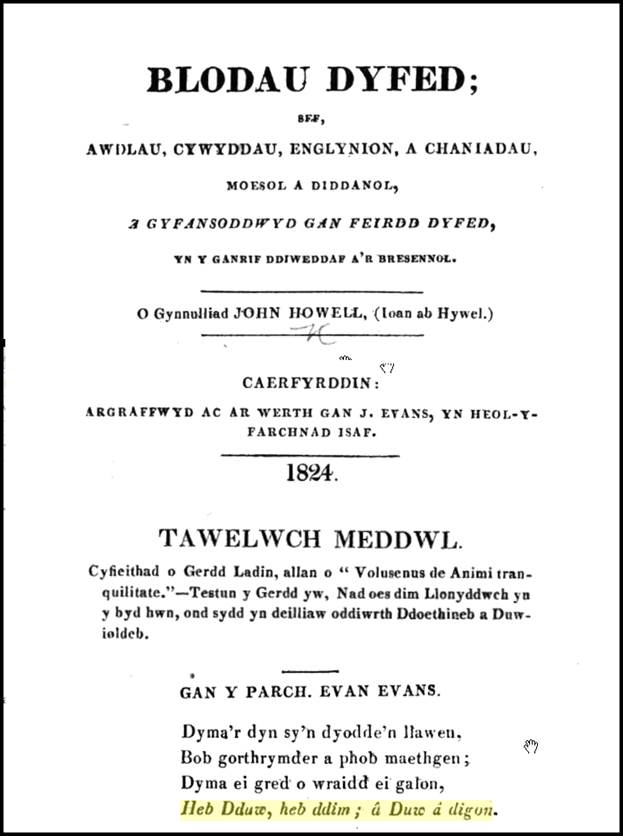
Blodau Dyfed / John Howell / (Ioan ab Hywel) / 1824
:_______________________________.
abad <<AA-bad>> [ˡɑˑbad] masculine noun
PLURAL abadau <<a-BAA-dai,
-de>> [aˡbɑˑdaɪ, -ɛ]
1 abbot = head of an abbey
ETYMOLOGY: Welsh ← Latin abbas, abbât- ← Aramaic abba (= father), a
title given to bishops in the Coptic, the Ethiopian and the Syrian Churches.
This is a learned borrowing from Latin directly into early Welsh - regular
borrowing in the British period would have given *afawd >> *afod
From the same British root: Breton abad
(= abbot).
:_______________________________.
a
ballu <<a BA-lhi>> [a ˡbaɬɪ]
1 North Wales
and so on, et cetera, and suchlike, and things like that
Mi eish i i brynu siampw a sebon a ballu
I went to buy shampoo and soap and things like that
ETYMOLOGY: Form of “a rhywbeth felly” =
“and something like this”;
(1) In north-west Wales, an ‘e’ in a final syllable becomes ‘a’; thus rhywbeth >> rhywbath. Colloquially this is reduced to rwbath (loss of the aspiration in rh, simplification of yw
>> w <<u>>
[ʊ]
(2) A number of two-syllable words drop the accented first syllable in
COLLOQUIAL WELSH
(yma >> ma, yna >> na, acw >> cw, etc; and in the same way felly
>> lly)
(3) So a rhywbeth felly >> a
rwbath felly >> a (rw)ba(th)
(fe)lly / ’ba’ ’lly
>> a ballu
NOTE: Sometimes written as a single word aballu
:_______________________________.
abaty
<<a-BA-ti>> [aˡbatɪ] masculine noun
PLURAL abatai <<a-BA-tai>> [aˡbataɪ]
1 abbey = monastery headed by an abbot
2 abbey church = church which was formerly an abbey
ETYMOLOGY: (abad = abbot) + soft
mutation + (ty = house) abad-dy >> abaty (d + d) = (t)
:_______________________________.
*Abaty-nedd
<<a-BA-ti
NEEDH>> [aˡbatɪ ˡneːð]
1 incorrect form for Mynachlog-nedd
(qv) (‘monastery by the river Nedd’ – a district in Castell-nedd).
Mynachlog Nedd, the name of the
monastery, is “Neath Abbey” in English – either a tranlsation from Welsh, or a
name which came about independently in English.
ETYMOLOGY: Apparently some Welsh-speakers, unaware of the correct Welsh form,
use a translation of the English name, with ‘abaty’ to translate
“abbey”.
:_______________________________.
ábdomen
<<AB-do-men>> [ˡabdɔmɛn] masculine noun
1 abdomen
:_______________________________.
aber <<AA-ber>> [ˡɑˑbɛr] feminine noun
1 estuary, rivermouth (as in the place name Aberystwyth -
mouth of the river Ystwyth)
2 (inland) confluence, meeting place of a streams, of a stream and a river,
as in the name Abercynon - the Cynon stream flows into the river Taf at this
point
3 (North Wales) stream
Yr oedd asyn un tro yn croesi aber
fechan Once upon a time an ass was crossing a small stream
Aber-las (“Aber Las”)
Street name in Y Fflint
aber las “blue stream” (aber) + soft mutation + (glas = blue)
NOTE: In place names, where aber is followed by the name of a stream or
river, or by some other element, the vowel becomes short <<A-ber>> [ˡabɛr]
:_______________________________.
Aberdyfi
<<a-ber-DƏ-vi>> [abɛrˡdəˑvɪ]
1 place name (estuary of the river Dyfi)
Ffoto: http: //www.bangor.ac.uk/ysgolion/aberdyfi/gem.htm
:_______________________________.
Aber
Dyfrdwy <<a-ber DƏVR-dui>> [abɛr ˡdəvrdʊɪ]
1 The estuary of the river Dyfrdwy. English name: The
Dee Estuary
http://www.geograph.org.uk/photo/217891 SJ1886 Aber Dyfrdwy
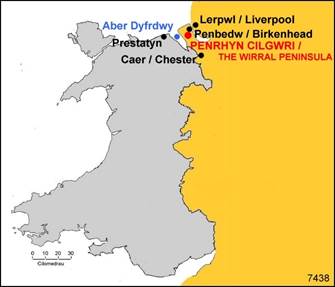
(delwedd 7438)
:_______________________________.
Aberaeron
<<a-ber-EI-ron>> [abɛrˡəɪrɔn] feminine noun
1 place name (estuary of the river Aeron)
:_______________________________.
Aberangell
<<a-ber-A-ngelh>> [abɛr ˡaŋɛɬ]
1 (SH8410) locality in Meirionnydd (Gwynedd)
ETYMOLOGY: (aber = confluence) + (Angell = river name). It is where the
Angell river joins the Dyfi river
:_______________________________.
Aber-cwm-sgwt
<<a-ber-kum-SKUT>> [abɛrkʊmˡskʊt]
1 name of a non-existent village used in reply to
questions such as ‘Where have you been’ (Ble rwyt ti wedi bod?) or ‘Where are
you going (Ble rwyt ti’n mynd?) in order to reply without giving the true
answer.
:_______________________________.
Aber
Eiddon <<a-ber-EI-dhon>> [abɛrˡəɪðɔn]
1 Confluence in Rhyd-y-main, a village north-east of
Dolgellau (Gwynedd)
“(the) confluence (of) (the) Eiddon (and the river Wnion)”
2 Abereiddon street name in the village of Rhyd-y-main (“Aber Eiddon”)
3 Abereiddon a grange of Cymer Abbey
Aber Iddon Folk tune name mentioned in “The Cambrian Quarterly Magazine
and Celtic Repertory” (1830). English name appended: The Efflux of the Iddon
:_______________________________.
Abérffraw
(colloquial form: Y Berffro) <<a-BER-frau / ə-BER-fro>> [aˡbɛrfraʊ / ə ˡbɛrfrɔ)] feminine noun
1 place name (estuary of the river Ffraw)
:_______________________________.
Abergafenni
<<a-ber-ga-VE-ni>> [abɛrgaˡvɛnɪ] feminine noun
1 (History) a cwmwd (kúmmud) of the cantref (kántrev) of
Gwent Uwch Coed, South-east Wales
2 name of a town here – the “English” name of the town is Abergavenny; in Welsh
however the name has become Y Fenni <<ə VE-ni>> [ə ˡvɛnɪ]
ETYMOLOGY: “confluence (of the river) Gafenni (and the river Wysg)” (aber = confluence) + (Gafenni, a river name)
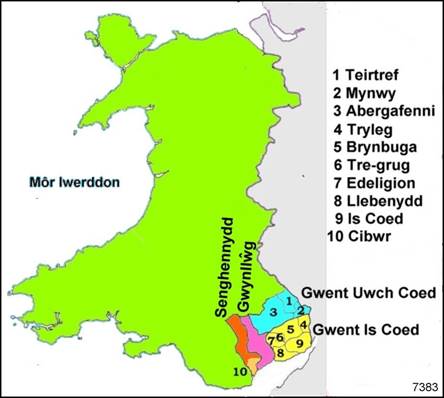
(delwedd 7383)
:_______________________________.
Aber-gwaun
<<a-ber-GWAIN>> [abɛrˡgwaɪn]
1 (town in the south-west) “(estuary of the river Gwaun”)
The local pronunciation is Aber-gweun <<a-ber-GWEIN>> [abɛrˡgwəɪn]
:_______________________________.
Aber-gweun
<<a-ber-GWEIN>> [abɛrˡgwəɪn] settlement name
1 local pronunciation of Aber-gwaun
:_______________________________.
Abergwenffrwd
<<a-ber-GWEN-ffrud>> [abɛrˡgwɛnfrʊd]
1 SO5306 A village in the county of Mynwy / Monmouth.
English name: Whitebrook.
The Gwenffrwd stream is mentioned in Llyfr Llan-daf / The Book of Llandaff c.
1125
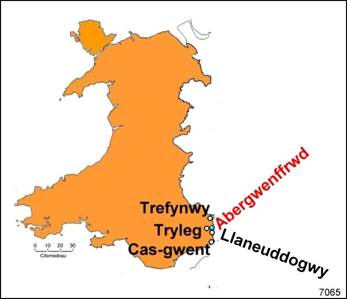
(delwedd 7065)
http://www.geograph.org.uk/photo/493354 Abergwenffrwd
ETYMOLOGY: “aber Gwenffrwd” “(the) confluence (of the) Gwenffrwd (stream) (and
the river Gwy / Wye”)
Gwenffrwd is “white torrent” (gwen, feminine form of gwyn =
white) + (ffrwd = torrent, hillside stream)
:_______________________________.
Abergwyngregyn <<a-ber-gwən-GREE-gin>> [abɛrgwənˡgreˑgɪn] 1 SH 6572 original name of the village of Aber (county of Conwy)
ETYMOLOGY: “aber Gwyngregyn” the mouth of the Gwyngregyn stream (here it
enters Afon Menai, the strait between the mainland and the island of Môn)
:_______________________________.
Aberhafesb <<a-ber-HAAV-esp>> [abɛrˡhɑˑvɛsp]
1 (SH0792) locality in the county
of Powys, (in the district of Maldwyn) 4km west of Y Drenewydd
2 The stream name is to seen in
the name Bedo Hafesb (fl. 1567-85), a poet from this area
http://www.geograph.org.uk/photo/540188 Eglwys Wynnog /
Gwynnog’s Church
http://www.geograph.org.uk/photo/540375 Afon Hafren / River
Severn
(“The Geograph British Isles project aims to collect
geographically representative photographs and information for every square
kilometre of Great Britain and Ireland…”)
ETYMOLOGY: “the confluence of the
Hafesb stream (and the river Hafren)”
(aber = confluence) + (Hafesb).
The name Hafesb means “dry in summer”;
hafesb, feminine form of hafysb ← haf-hysb “dry in summer’,
(haf = summer) + (hysb = dry).
The Hafesb stream joins the river Hafren below the parish church.
NOTE: The spelling used in English Aberhafesp is from an incorrect Welsh
spelling (with final p instead of final b)
:_______________________________.
Aberhonddu
<<a-ber-HON-dhi>> [abɛrˡhɔnðɪ] feminine noun
1 place name (“(the) confluence (of the river) Honddu”
(– the affluent - and the Wysg – the main river at this place)
(aber = confluence) + (Honddu = river name)
:_______________________________.
Aber
Mynwy <<a-ber-MƏ-nui>> [abɛrˡməˑnʊɪ] non-settlement name
1 confluence of the river Mynwy (English name: Monnow) and
the river Wysg (English name: Usk).
Here the town of Trefynwy is
situated (English name: Monmouth) .
Monmouth is in fact an early direct English translation of Aber Mynwy
It is (‘Monnow’ English form of the river name Mynwy) + (‘mouth’, translation
of aber = confluence, river-mouth)
The use of ‘mouth’ in English to denote a confluence of a streams is very
unusual – normally it refers only to the place a river enters the sea
Although Monnow [ˡmɔnou] appears to be very different from
the Welsh name Mynwy [ˡməˑnui] , it is probably a
fairly good representation of the local Welsh pronunciation when Welsh was the
language of the area.
Final –wy [ui] in colloquial Welsh is generally reduced to –w [ʊ] . Hence Mynwy [ˡməˑnʊ] .
ETYMOLOGY: (aber = river mouth,
confluence) + (Mynwy river name)
:_______________________________.
Aber-nant
<<a-ber NANT>>
[abɛrˡnant]
1 SO0103 District name, Aber-dÂr
http://www.geograph.org.uk/photo/680074 Aber-nant
Apparently from a farm name Aber-nant-y-groes, from the
name of a confluence. Aber Nant y Groes, “(the) confluence (of) Nant y Groes
[and Afon Cynon]”. Nant y Groes is “(the) stream (of) the cross” (nant =
stream) + (y = the) + soft mutation + (croes = cross)
:_______________________________.
yr
Aber-oer <<a-ber OIR>>
[abɛrˡɔɪr] feminine noun
1 SJ2849 Na,e of a farm by Y Bers / Bersham, Wrecsam
http://www.geograph.org.uk/browse.php?p=314466 map
ETYMOLOGY: “the cold stream” (yr definite article) + (aber =
stream (North Wales)) + (oer = cold)
:_______________________________.
Aberpandy
<<a-ber-PAN-di>> [abɛrˡpanðɪ] feminine noun
1 fictional (and most
unlikely!) Welsh name for a pit village in the Morgannwg coalfield
ETYMOLOGY: aber pandy ← aber y pandy “(the) confluence (of) the fulling
mill” (aber = river mouth,
confluence) + (y definite article) + (pandy fulling mill).
The name occurs in the play “Change” (1913) by the English-language
playwright J. O. Francis (John Oswald Francis) (1882 Dowlais – 1956 London).
Y Pandy is a well-known element in the area, as it is the name of a
district in Merthyrtudful; and names in aber abound (Aber-dâr, Aberaman,
etc).
Although Aberpandy was probably coined for its euphonious effect, using
two common place name elements which are easy for English-speakers to recognise
and pronounce, this combination of elements sounds in fact very unnatural since
Aber names are almost invariably followed by the name of a lesser stream
when it means “confluence of a tributary with a main stream or river”, or the
name of the river when it means “confluence with the sea”.
(Interestingly, in middle age J. O. Francis, though by now living in London,
learned to speak Welsh fluently, and his plays have been translated into
Welsh).
The action of the Play takes place in the living-room of the Prices' Cottage
on the Twmp, Aberpandy... “I remember
Aberpandy before ever the Powell-Griffiths sank the first pit, and the sheep of
Pandy Farm were grazing quiet where the Bryndu Pit is now.”
Club.
:_______________________________.
Abertawe
<<a-ber-TAU-e>> [abɛrˡtaʊɛ] feminine noun
1 City in south-east Wales.
Called Swansea by the English – a name
of Norse origin..
Ymddiriedolaeth Brifysgol
y Gwasanaeth Iechyd Gwladol Abertawe Bro Morgannwg
<<əm-dhi-ri-e-DOO-laith briv-ə-skol ə gwa-SAA-naith YEE-khiid GwLAA-dol a-ber-TAU-e BROO
mor-GA-nug>>
[əmðɪrɪɛˡdoˑlaɪθ brɪvˡəskɔl ə gwaˡsɑˑnaɪθ jeˑxɪd gwlɑˑdɔl abɛrˡtaʊɛ broː morˡganʊg]
The Abertawe Bro Morgannwg National Health Service Trust
ETYMOLOGY: “(the) estuary (of
the river) Tawe (aber = estuary /
confluence) + (Tawe).
:_______________________________.
aberth
<<AA-berth>> [ˡɑˑbɛrθ] masculine noun
PLURAL aberthau, ebyrth <<a-BER-thai,
-e, EE-birth>> [aˡbɛrθaɪ, -ɛ, ˡeˑbɪrθ]
1 sacrifice = an offering of a victim to a god to appease
the god
2 victim = the person or animal who is sacrificed in a
religious rite
3 sacrifice = symbolic offering to a god
Lefiticus 7:11 Dyma hefyd gyfraith
yr ebyrth hedd a offryma efe i’r
Arglwydd... (7:18) Ac os bwyteir dim
o gig offrwm ei ebyrth hedd ef o fewn y trydydd dydd, ni byddir bodlon i’r hwn
a’i hoffrymo ef, ac nis cyfrifir iddo, ffieiddbeth fydd; a’r dyn a fwyty ohono,
a ddwg ei anwiredd.
Leviticus 7:11 And this is the law of the sacrifice of peace offerings,
which he shall offer unto the Lord... (7:18) And if any of the flesh of the
sacrifice of his peace offerings be eaten at all on the third day, it shall not
be accepted, neither shall it be imputed unto him that offereth it: it shall be
an abomination, and the soul that eateth of it shall bear his iniquity.
aberth hedd, peace offering
Numeri 7: 88 A holl ychen yr aberth hedd
oedd bedwar ar hugain o fustych, trigain o hyrddod, trigain o fychod, trigain o
hesbyrniaid
Numbers 7: 88 And all the oxen for the sacrifice of the peace offerings
were twenty and four bullocks, the rams sixty, the he-goats sixty, the lambs of
the first year sixty
Also: hedd-aberth peace offering
Leviticus 7: 13 Heblaw’r teisennau,
offrymed fara lefeinllyd, yn ei offrwm, gyda’i hedd-aberth o ddiolch
Leviticus 7: 13 Besides the cakes, he shall offer for his offering leavened
bread with the sacrifice of thanksgiving of his peace offerings
Hedd-aberth Street name in the
village of Onllwyn (county of Castell-nedd ac Aberafan), South-east Wales
4 sacrifice = the act of giving something at great
personal cost (love, attention, time, money, etc) in order to benefit somebody
else
5 sacrifice = death in a war;
Eu haberth nid â’n angof =
inscription on war memorials (“their sacrifice shall not be forgotten”)
<<eu
= their, aberth = sacrifice, nid = not, aa = will go, yn = “in”
(linking particle), angof = no-memory, state of forgetting, oblivion>>
6 mynd yn aberth i
fall victim to
myned yn aberth i’w
drachwant be the victim of his greed / thirst (e.g. die from drinking too much in
a drinking session)
7 yr aberth, the
host, the bread consecrated in the Eucharist (the English word “host” is from
Old French “oiste” from Latin “hostia” = victim) Also: aberth yr offeren (‘the host of the mass’)
8 hunan-aberth self sacrifice
ETYMOLOGY: Welsh ← British ← Celtic, based on bher- (= to carry); the element ‘bher-’ is to be found in other Welsh words, such
as aber (= estuary), cymer (= confluence)
:_______________________________.
aberthu
<<a-BER-thi>> [aˡbɛrθɪ] verb
1 sacrificar
2 aberthu eich bywyd
er mwyn... (rhywbeth) sacrifice your life for (something)
:_______________________________.
Aber-wysg
<<a-ber-UISK>> [abɛrˡʊɪsk]
1 place name (estuary of the river Tawe), Casnewydd /
Newport. District south of the city; it forms the western part of the village
of Trefonnen / Nash.
English: Uskmouth.
http://www.geograph.org.uk/photo/356135
ETYMOLOGY: “(the) mouth (of the river)
Wysg / Usk. Here it flows into Môr Hafren / the Severn estuary
(aber = estuary / confluence) +
(Wysg = river name). The
Welsh name is a translation of the English name, which in all likelihood is the
translation of Aber-wysg in an earlier period, and the Welsh name was
subsequently lost.
:_______________________________.
abid <<AA-bid>> [ˡɑˑbɪd]
feminine noun
PLURAL abidau <<a-BII-dai,
-e>> [aˡbiˑdaɪ, -ɛ]
1 habit = clothes of a monk, nun
ETYMOLOGY: 1300-1400 from English habit,
now [hábit], but formerly [abit] - the initial h was at first silent in this words in English) ← Old French habit (silent h) ← Latin habitus ← habêre (= to
have).
It may however though have come directly from French into Welsh.
:_______________________________.
abl <<AA-bal>> [ˡɑˑbal] adjective
1 able, capable
2 wealthy
NOTE: In the English dialect of
Llanidloes: ABLE, having property or wealth. “An able man” is a man that is
well off, wealthy. “He is very able” he is rich, or wealthy. (Parochial Account
of Llanidloes / Edward Hamer / Chapter X / Folk-lore. Page 278 Collections
Historical and Archeological Relating to Montgomeryshire and its Borders /
1877).
:_______________________________.
abl.
1 abbreviation (in a dictionary
entry) = abladol ablative
:_______________________________.
abladol
<<ab-LAA-dol>> [abˡlɑˑdɔl] adjective
1 ablative
Abbreviation: abl.
:_______________________________.
Ábraham <<A-bra-ham>> [ˡabraham] masculine noun
1 man's name
2 (Hen Déstament / Old Testament) Abraham = the first of the patriarchs, father
of Isaac, and progenitor of the Hebrews
mynwes Ábraham Abraham’s bosom, the place of rest after death for those
who have led a just life
Luc 16:22 A bu, i’r cardotyn farw, a’i ddwyn gan yr angylion i fynwes
Abraham. A’r goludog hefyd a fu farw, ac a gladdwyd.
Luke 16:22 And it came to pass, that the beggar died, and was carried by the
angels into Abraham’s bosom: the rich man also died, and was buried.
:_______________________________.
Abram
<<A-bram>> [ˡabram] masculine noun
1 Abraham
:_______________________________.
abred
<<A-bred>> [ˡabrɛd] masculine noun
1 (obsolete) delivery, release
2 diabred
withheld, held back, refused, denied
In the north of the county of Powys, between Caer-sŵs and Llandinam, there is land originally called Rhos Ddiabred (literally “moor which
has been held back”, apparently referring to ownership). Nowadays the name is Rhos Ddiarbed (the result of confusion
with the word diarbed = ceaseless,
relentless, unrelenting)
3 (South-east Wales) disorder
yn abred gwyllt in wild confusion
(“in wild disorder”)
ETYMOLOGY: Welsh ← British *ad-brit-â (= 'that which is carried to
the outside')
cf the etymologies of aber (= estuary), aberth (= sacrifice)
:_______________________________.
absen <<AB-sen>> [ˡabsɛn] masculine or feminine
noun
1 absence, being away
Angof pob absen Out of sight, out of mind (“(it-is) oblivion every absence”)
2 slander, malicious talk of someone
in their absence
diabsen of one who refrains from speaking badly of others (“without
slander”)
ETYMOLOGY:
Earliest example in Welsh 1300-1400; a learnèd borrowing from Latin absentia
(= absence)
:_______________________________.
absennol
<<ab-SE-nol>>
[abˡsɛnɔl] adjective
1 absent
:_______________________________.
absenoldeb <<ab-se-NOL-deb>> [absɛˡnɔldɛb] masculine noun
1 absence
yn f’absenoldeb in my absence
2 cennad absenoldeb leave of absence
ETYMOLOGY: (absenol-
← absennol = absent) + (-deb suffix
for forming abstract nouns)
:_______________________________.
abwth
<<AA-buth>> [ˡɑˑbʊθ] masculine noun
1 (South-east Wales) injury
cääl abwth ar ei arddwrn injure his
wrist
2 (South-east Wales) shock, fright
3 (county of Preseli) ca’l
lo’s ac abwth be hurt and shocked
4 (county of Preseli) abwth
iddo stuff him!
ETYMOLOGY: abwth, possibly a variant
of the dialect form adwth ← adwyth (=
illness, misfortune)
:_______________________________.
abwyd
<<AA-buid>> [ˡɑˑbʊɪd] masculine noun
1 bait
2 deintio’r abwyd nibble the bait
:_______________________________.
ac <<AAG, AG>> [ɑːg, ag] (conjunction)
1 and (before a vowel)
:_______________________________.
ac.
1 abbreviation (in a
dictionary entry)
acen accent
aceniad accentuacion
acennog stressed, accented
:_______________________________.
academaidd
<<a-ka-DE-maidh, medh>> [akaˡdɛmaɪð, -ɛð] adjective
1 academic
:_______________________________.
ac
ati <<ag-A-ti>> [ag ˡatɪ] phrase
1 and so on
:_______________________________.
ACCENT
SHIFT:
Certain place names have undergone accent shift to a preceding syllable—
1 *Bryn-croes >> Bryncroes (i.e.
the pronunciation is “Brýncroes”)
SH2231 in Gwynedd
2 Llan-bedr >> Llanbedr (i.e. the pronunciation is Llánbedr, or colloquially Llambed / Llambad,
according to area) in most cases of this
common place name, though the village of this name in Sir Fynwy / Monmouthshire retains the stress on the final syllable (Llan-bedr)
3 Llan-dduw >> Llandduw (i.e. the pronunciation is
“Llándduw”) << LHAN-dhiu
>> [ˡɬanðɪʊ]
SO0561 ancient
name of Llandrindod, a town in the county of Powys.
ETYMOLOGY: “church (of) God”, church dedicated to God.
(llan = church) + soft mutation + (Duw = God)
Although one might think that Llandduw is an erroneous spelling for
Llan-dduw (with the accent on the final syllable), the name is an example of accent shift to a
preceding syllable, and so as such
the spelling Llandduw correctly indicates the pronunciation.
4 Llan-fair >> Llanfair (i.e. the pronunciation is Llánfair) in most cases of this common place name, though the
village of this name in the count of Rhnodda Cynin Taf retains the stress on the final syllable (Llan-fair)
5 Llan-y-cil >> Llanycil (i.e. the pronunciation is Llanýcil) << lhan-Ə-kil>>
a village SH9134 and parish in Gwynedd, by Llyn Tegid,
south-west of Y Bala, about 20 km south-west of Corwen and 24 km to the
north-east of Dolgellau
5 Pen-y-goes >> Pen-e-goes >>
Penegoes (i.e. the pronunciation is “Penégoes”)
6 Tref-y-clawdd >> Trefyclo (i.e.
the pronunciation is
“Trefýclo”) (English name: Knighton)
:_______________________________.
acen,
PLURAL: acenion <<A-ken, a-KEN-yon>> [ˡakɛn, aˡkɛnjɔn] feminine noun
Abbreviation: (in a dictionary
entry) ac.
1 accent = emphasis or stress on a syllable of a word
acen bwys <<a-ken-BUIS>> [ˡakɛn ˡbʊɪs] stress accent (“accent (of) stress / weight”)
2 accent = a
mark over a letter, usually a vowel, to show or vowel quality or stress
acen ddisgynedig <<A-ken dhi-skə-NEE-dig>> [ˡakɛn ðɪskəˡneˑdɪg] grave accent (“descending accent”)
acen ddyrchafedig <<A-ken dhər-kha-VEE-dig>> [ˡakɛn ðərxaˡveˑdɪg] acute accent (“rising accent”)
acen drom <<a-ken DROM>> [ˡakɛn ˡdrɔm] grave accent (“heavy accent”)
acen grom <<a-ken GROM>> [ˡakɛn ˡgrɔm] circumflex (“hunched accent”)
acen lem <<a-ken LEM>> [ˡakɛn ˡlɛm] acute accent (“sharp accent”)
3 sound, note, song
Acen Colomen “(the) note
(of) (a) dove”. Folk tune name mentioned in “The Cambrian Quarterly Magazine
and Celtic Repertory” (1830). English name appended: The Cooing of the Dove
:_______________________________.
aceniad
<<a-KEN-yad>> [aˡkɛnjad] masculine noun
1 accentuation
Abbreviation: (in a dictionary entry) ac.
:_______________________________.
acennog
<<a-KE-nog>> [aˡkɛnɔg] adjective
1 stressed, accented
Abbreviation: (in a
dictionary entry) ac.
:_______________________________.
acennu
<<a-KE-ni>> [aˡkɛnɪ] verb
1 to stress, to accent
:_______________________________.
acer <<A-ker>> [ˡakɛr] feminine noun
1 acre
2
Acaryforwyn
Street name in Dinbych (incorrectly spelt as “Accar-y-Forwyn”)
“acre / field (of) the Virgin (Mary)”
(acer) + soft mutation + (y definite article) + (morwyn = maid; maiden; the Virgin Mary
)
:_______________________________.
ach, PLURAL: achau <<AAKH, AA-khai, -khe>> [ɑːx, ˡɑˑxaɪ, -ɛ] feminine noun
1 genealogical relationship
2 remove = a degree of separation in kinship
Mae e’n gefnder imi o fewn dwy ach
He’s my cousin at two removes (= the grandson of my cousin) (“a cousin to me
within two relationships”)
:_______________________________.
-ach <<AKH>> [ax] suffix
(also –iach)
1 diminutive suffix added to collective nouns or singular
nouns
..1/ arian (= money), ariannach (USA: float) (Englandic:
petty cash)
..2/ darn (= part), dernyn (= fragment), dernynnach (= small fragments)
..3/ gwlân (= wool), gwlaniach (= fine wool, scraps of
wool); gwlaniach ysgall (= thistle
down) (“fluff (of) thistle”)
..4/ gwydr (= glass), gwydrach (= bits of broken glass, small
pieces of broken glass, fragments of glass)
..5/ tamaid (= fragment), tameidiach (= tiny fragments)
2 diminutive suffix sometimes added to a singular noun
instead of the usual plural suffix
(South-east Wales) peth (= thing), pethach (= things). Standard pethau (= things).
3 sometimes with a hint of contempt, suggesting
unimportance, smallness
.....(1) baw (= dirt), bawiach or bawach (= (people) riff-raff, trash, low-life, scum)
.....(2) cagl sheep droppings, caked
dirt; caglach (= cakes of dirt;
dirty people)
...(3) cig (= meat), cigach (= bad pieces of meat)
.....(4) crachen (= blood clot,
scab; crachach (= (South Wales)
contemptous for well-to-do middle-class people)
.....(5) dimai (= ha’penny,
halfpenny); dimeiach (= small copper
coins, worthless small change)
.....(6) dynion (= men), dynionach (= vile men)
.....(7) gêr (= gear, equipment), geriach (= bits of gear)
.....(8) gwellt (= straw), gwelltach (= remnants of straw, useless
bits of straw)
.....(9) manionach insignificant
finer points, unimportant demands
.....(10) pobl >> y bobl (= the people, the general
public; y boblach (= the common
people, the people with no importance)
.....(11) pryfed (= insects), pryfetach (= creepy-crawlies)
The idea of contempt also expressed by prefixing hen (literally ‘old’; followed by soft mutation):
Be di’r hen weiriach ’ma sy hyd dy gôt
di? (example from Geiriadur Prifysgol Cymru / University of Wales
Dictionary, page 1622)
What are these wisps of straw all over your coat?
ETYMOLOGY: Welsh ← British *-akkos
:_______________________________.
â'ch <<AAKH>> [ɑˑx]
1 “with your”
See the following phrases:
â’ch pen yn eich plu dejected
â’ch cynffon yn eich gafl dejected
â’ch pen yn y cymylau with your head
in the clouds
:_______________________________.
acha
(= ar uchaf) <<A kha>> (preposition) (South-east Wales)
1 on
:_______________________________.
achau
<<AA-kha>> [ˡɑˑxa] (plural noun)
1 lineage
:_______________________________.
â’ch
cynffon yn eich gafl <<aakh KƏN-fon ən əkh GAA-fal>> [ɑˑx ˡkənfɔn ən əx ˡgɑˑfal]
1 dejected, miserable, unhappy, crestfallen, with your
tail between your legs, cowed
ETYMOLOGY: (“with your tail in your crotch / between your legs”)
(â’ch = with your) + (cynffon = tail) + (yn = in) + (eich = your)
+ (gafl = crotch; colloquially gafal)
:_______________________________.
Achil
<<AA-khil>> [ˡɑˑxɪl] masculine noun
1Achilles (Əkíliz), a noted Greek
warrior in the Trojan war and hero of Homer's Iliad. Achilles was killed by
Paris, who wounded him in his heel, his vulnerable spot
sawdl Achil Achilles heel
gwäell y ffêr / gweyllen y ffêr
Achilles tendon
:_______________________________.
achles
<<AKH-les>> [ˡaxlɛs] masculine or feminine
noun
PLURAL achlesau <<akh-LE-se>> [axˡlɛsaɪ, -ɛ]
1 refuge, protection, shelter
rhoi achles i give shelter to, give
protection to
2 support, help
Bu yn achles i ddyheadau ein cenedl It
was a help for the aspirations of our nation
3 (South Wales) manure (the sense development is
“protection, support” >> “help, aid” >> “aid for the land, manure”)
4 achlysur ( =
“occasion” in modern Welsh, but “shelter” in older Welsh); ← *achlesur ← (achles = refuge, protection) + (suffix –ur)
ETYMOLOGY: Welsh ← British ← Celtic *ad-klissâ, from the root *kel (= to hide, as in modern Welsh celu = to hide)
:_______________________________.
achlesu <<akh-LE-si>> [axˡlɛsɪ] (verb amb objecte)
1 to protect, to shelter
2 to support, to help, to encourage
3 (South Wales) to manure
ETYMOLOGY: (achles = help, aid;
manure) + (-u suffix for forming
verbs)
:_______________________________.
achlod
<<AKH-lod>> [ˡaxlɔd] feminine noun
1 disgrace, dishonour
2 Yr achlod i ti
Shame on you! (“the disgrace to you”)
3 Rachlod
(expression of suprise) My God! (contraction of yr achlod = the disgrace)
4 Rachlod fawr! My God!
(yr = the) + (achlod) + soft mutation + (mawr
= big) (“the great disgrace”)
ETYMOLOGY: literally “dis-praise, un-praise” (a- = negative prefix) + spirant mutation + (clod = praise)
:_______________________________.
achludd
<<AKH-lidh>> [ˡaxlɪð] verb
1 obsolete hide,
conceal
2 obsolete
(masculine noun) hiding, concealment
3 survives in modern Welsh in the verb machlud (= (sun) to set, go down), and
the noun phrase machlud haul (=
sunset)
Origin: (ym- prefix for forming
reflexive verbs + achludd)
>> ymachludd
>> machludd (loss of the
pretonic syllable)
>> machlud (change of dd <<dh>>
[ð] >> d <<d>>
[d]
For similar changes see the entries y
and d
ETYMOLOGY: achludd ← British ← Latin occlûdere (= to close), (ob- intensifying prefix) + (claudere = to close)
:_______________________________.
achlust
<<AKH-list>> [ˡaxlɪst] masculine noun
PLURAL achlustiau <<akh-LIST-yai, -ye>> [axˡlɪstjaɪ, -ɛ]
1 rumour
cael achlust o get to know of
gwrando’n astud am achlust keep your
ear close to the ground, listen out for any rumours (“listen intently for a
rumour”)
2 tip-off
rhoi achlust i (rywun) give
(somebody) a tip-off, tip somebody off
ETYMOLOGY: (ad- intensifying prefix)
+ spirant mutation + (clust = ear)
*ad-chlust >> a’chlust >> achlust
:_______________________________.
achlysur
<<akh-LƏ-sir>> [axˡləsɪr] m
PLURAL achlysuron <<akh-lə-SII-ron>> [axləˡsiˑrɔn]
1 occasion = the time when something takes place
2 occasion = circumstance, the combination of time and place and other
factors which can influence an event
Ar ba achlysur fydde chi'n fodlon dweud
celwydd? On what occasion would you be willing to tell a lie?
3 bod yn deilwng o’r achlysur be equal to the occasion, rise to the
occasion (“be worthy of the occasion”)
4 event
Ers rhai blynyddoedd bellach tyfodd y
rasus marathon enfawr yn achlysuron
blynyddol poblogaidd iawn. Over the past few years mass marathon races have
become very popular annual events
ETYMOLOGY: ( = “occasion” in modern Welsh, but “shelter” in older Welsh); ← *achlesur ← (achles = refuge, protection) + (suffix –ur)
:_______________________________.
achlysurol
<<akh-lə-SII-rol>> [axləˡsiˑrɔl] adj
1 occasional, sporadic, happening now and then
ETYMOLOGY: (achlysur = occasion) + (-ol suffix for forming adjectives)
:_______________________________.
achos
(1), PLURAL: achosion <<AA-khos, a-KHOS-yon>> masculine [ˡɑˑxɔs] noun
1 cause = origin, the reason for the existence of
something,
a thing which causes an effect
2 cause = movement advancing a principle or belief
bradychu’r achos betray the cause
3 fault
nid + cael achos yn / mewn not
find any fault in
Sant Ioan 18:38 Peilat a ddywedodd
wrtho, Beth yw gwirionedd? Ac wedi iddo ddywedyd hyn, efe a aeth drachefn at yr
Iddewon, ac a ddywedodd wrthynt, Nid wyf fi yn cael dim achos ynddo ef.
John 18:38 Pilate saith unto him, What is truth? And when he had said this, he
went out again unto the Jews, and saith unto them, I find in him no fault at
all.
4 charge, accusation
Sant Mathew 27:37 A gosodant hefyd uwch
ei ben ef ei achos yn ysgrifenedig, HWN YW IESU, BRENIN YR IDDEWON
Matthew 27:37 And set up over his head his accusation written, THIS IS JESUS
THE KING OF THE JEWS.
5 Llwyddiant i'r achos! Good luck! (“success for the cause”)
6 case
Uned Ddamweiniau ac Achosion Brys Accident
and Emergency Unit (section of a hospital) (“unit (of) accidents and urgent
cases”)
:_______________________________.
achos
(2) <<AA-khos>> masculine [ˡɑˑxɔs] (conjunction)
1 (= o achos) because
:_______________________________.
achosi
<<a KHO si>>
<<a-KHO-si>> [aˡxɔsɪ] verb
1 to cause
2 achosi cost i rywun cause somebody to go to great expense, cause
somebody great expense (“cause cost to somebody”)
achosi i rywun wneud rhywbeth cause somebody to do something
achosi marwolaeth drwy
yrru'n beryglus cause death by
dangerous driving
Beth sy'n achosi newid hinsawdd?
What causes climate change?
:_______________________________.
â’ch
pen yn eich plu <<akh PEN
ən əkh
PLII>> [ax ˡpɛn ən əx pliː]
1 dejected, miserable, unhappy, crestfallen
ETYMOLOGY: (“with your head in your feathers”)
(â’ch = with your) + (pen = head) + (yn = in) + (eich = your)
+ (plu = feathers)
:_______________________________.
â’ch
pen yn y cymylau <<akh PEN
ən ə kə-MƏ-lai, -e>>
[ax ˡpɛn ən ə kəˡməlaɪ, -ɛ]
1 Mae â’i ben yn y
cymylau He lives in a dream world (“he is with his head in the clouds”)
:_______________________________.
achub
<<AA-khib>> [ˡɑˑxɪb] verb
1 to save
achub rhàg angau save from death
2 (Christianity) save, deliver, redeem = preserve
from sins
3 bad achub <<baad AA-khib>> [bɑːd ˡɑˑxɪb] masculine noun lifeboat
ETYMOLOGY: Welsh achub (= to save, rescue, seize) ← *ochub ← British ← Latin occupâre (= grab hold of ); (ob- = intensifying prefix) + (capere = take)
:_______________________________.
achubydd
<<a-KHII-bidh>> [aˡxiˑbɪð] masculine noun
PLURAL achubwyr <<a-KHIB-wir>> [aˡxɪbwɪr]
1 saviour
Deuteronomium 22:27: Oblegid yn y maes y
cafodd efe hi; gwaeddodd y llances oedd wedi ei diweddïo; ac nid oedd achubydd
iddi
Deuteronomium 22:27: Deuteronomy 22:27 For he found her in the field, and the
betrothed damsel cried, and there was none to save her. (“there was not a
saviour to her”)
ETYMOLOGY: (achub = to save) + (-ydd = agent suffix)
:_______________________________.
achwyniad
<<a-KHUIN-yad>> [aˡxʊɪnjad] masculine noun
PLURAL achwyniadau <<a-khwuin-YAA-dai, -e>>
[axwʊɪnˡjɑˑdaɪ, -ɛ]
1 complaint, denunciation
dwyn achwyniad (yn erbyn) present /
lodge a complaint (against)
gwneud achwyniad (yn erbyn) present
/ lodge a complaint (against)
ETYMOLOGY: (achwyn = to complain) +
( -i-ad abstract noun-forming
suffix)
:_______________________________.
Acipenseridae
1 styrsiynod sturgeons
:_______________________________.
act PLURAL: actau <<AKT,
AK-tai, -e>> [akt, ˡaktaɪ, -ɛ] feminine noun
1 act (of a play)
:_______________________________.
actifadu
<<ak-ti-VAA-di>> [aktɪˡvɑˑdɪ] verb
1 activate
Meddalwedd wedi ei actifadu gan lais Voice-activated
software
Mae ffôn arbennig y gellir ei actifadu
trwy fotwm larwm There is a special phone which can be activated by means
of an alarm button
Maent yn cael eu hactifadu gan lygoden y
cyfrifiadur They are activated by the computer mouse
ETYMOLOGY: adaptation of the English verb activate.
First example 1988
:_______________________________.
actio
<<AKT-yo>> [ˡaktjɔ] verb
1 to act
:_______________________________.
actor,
PLURAL: actorion <<AK-tor, ak-TOR-yon>> [ˡaktɔr, akˡtɔrjɔn] masculine noun
1 actor
:_______________________________.
actores,
PLURAL: actoresau <<ak-TOO-res, ak-to-RE-sai, -e>> [akˡtoˑrɛs,aktɔˡrɛsaɪ, -ɛ] feminine noun
1 actress, actor (female)
:_______________________________.
acw <<A-ku>> [ˡakʊ] (adverb)
1 here
2 yma ac acw <<Ə-ma ag A-ku>>
[ˡəma ag ˡakʊ] (adverb) here and there
:_______________________________.
Acwin
<<A-kwin>> [ˡakwɪn] masculine noun
1 Sant Tomos o
Acwin Saint Thomas Aquinas, Italian theologian and philosopher (1225-1274)
:_______________________________.
+ad Soft-mutated form -
the radical form has initial g-
mae wedi’i adael yn y car he’s
left it in the car ← gadael
:_______________________________.
ad- <<AD>> [ˡad] prefix
NOTE: causes soft mutation of the following consonant.
There are nine soft mutations in Welsh:
c >> g,
p >> b,
t >> d,
g >> (gh) >> zero,
d >> dd,
b >> f,
m >> f,
ll >> l,
rh >> r
..1/ Before an original b- the
prefix ad- has the form at-
(ad + p) >> (ad-b)
>> (atb...)
(plygu = fold, atblygol = reflexive, etc)
..2/ Before an original c-, the
prefix ad- has the form at-
(ad + c) >> (ad-g)
>> (atg...)
(cof = memory, atgof = memory, etc)
..3/ Before chw- the prefix ad- has the form at-
(chwel- = turn; obsolete as an
independent element; atchweliad =
reversion, etc)
..4/ Before an original d-, the
prefix ad- has the form at-
(ad + d) >> (ad-dd)
>> (att) >> (at...)
(dodi = put, atodi = append, etc)
..5/ Before s- the prefix ad- has the form at-
(sain = sound, atsain = echo, etc)
..6/ in some words ad + c- >> ach-
achanu (obsolete) to murmur (ad + canu- = to sing)
acharu (obsolete) to love (ad + caru- = to love)
achlust rumor / rumour, tip-off (ad + clust- = ear)
achlwm tight knot (ad + clwm = knot)
achre shivering (ad + cre- = shiver)
achudd (obsolete) seclusion (ad + cudd = hidden)
1 intensifier: “very”
..1/ cas = odious; atgas = detestable
..2/ cof = memory; atgof = memory (something remembered)
..3/ dal = to hold, “ád-ddal”
>> atal = to stop
..4/ dodi = to place, “ad-ddodi”
>> atodi = to append
2 denotes repetition: similar to the prefix re- in English
..1/ argraffu = print; adargraffu = reprint
..2/ byw = live, adfywio = resuscitate
..3/ cyfodi (codi) = get up; atgyfodi = resurrect
..4/ cyweirio = rectify, atgyweirio = repair
..5/ ennill = win; adennill = regain
..6/ “heb” obsolete element = say; ateb = answer
..7/ lladd = cut, adladd = aftermath, second crop of hay
in the same season after the first is cut
..8/ llais = voice; adlais = echo
..9/ llofnodi = sign ; adlofnodi = countersign
..10/ porthi = feed, adborthi = to feed back
..11/ print = print, adbrint = off-print
..12/sain = sound, atsain = reverberation
..13/ talu = pay; ad-dalu = repay
..14/ ysgrif = written document; adysgrif = transcription
3 bad
..1/ blas (= taste), adflas (= aftertaste)
..2/ byd (= world, situation); adfyd (= adversity)
..3/ dyn (= man), adyn (= scoundrel)bad
ETYMOLOGY: Welsh ad ← British -ate
From the same Celtic root: Irish ath-
= re-, for a second time
:_______________________________.
+adael Soft-mutated form
- the radical form has initial g-.
See gadael = to leave
:_______________________________.
adain
<<aden>> <<AA-den>> [ˡɑˑdɛn] feminine noun
1 wing
2 gosod gwynt o dan
adenydd (rhywun) give an impulse to somebody (in some enterprise) (“put
wind under the wings of (someone)”)
:_______________________________.
adar <<AA-dar>> [ˡɑˑdar]
1 birds; plural of aderyn
= bird
:_______________________________.
adara
<<a-DAA-ra>> [aˡdɑˑra] verb
1 catch birds
ci adara (also ci adar) gundog, one trained to work with hunters who shoot birds
ETYMOLOGY: (adar = birds) + (-a suffix for forming verbs, especially
with the sense of collecting, hunting)
:_______________________________.
adarwr
<<a-DAA-rur>> [aˡdɑˑrʊr] masculine noun
PLURAL adarwyr <<a-DAR-wir>> [aˡdarwɪr]
1 birdcatcher, fowler
Diarhebion 6:5 Gwared dy hun fel yr
iwrch o law yr heliwr, ac fel aderyn o law yr adarwr.
Proverbs 6:5 Deliver thyself as a roe from the hand of the hunter, and as a
bird from the hand of the fowler.
2 ornithologist
ETYMOLOGY: (adar = birds) + (-wr suffix = man)
:_______________________________.
Adar-y-môr <<AA-dar ə MOOR>> [ˡɑˑdar
ə ˡmoːr]
1 house name, Y Barri (county of Bro Morgannwg) (“Adar y Môr”)
ETYMOLOGY: “(the) birds (of) the sea”,
“sea birds”
(adar = birds) + (y = definite article) + (môr = sea):
:_______________________________.
+adawiad Soft-mutated
form - the radical form has initial g-.
See gadawiad =
:_______________________________.
Adda <<AA-dha>> [ˡɑˑða] masculine noun
1 Adam
2 bod yn hen fel Adda to be as old as the hills (“be old like Adam”)
:_______________________________.
addas <<AA-DHAS>> [ˡɑˑðas] adjective
1 appropriate, suitable, adequate
anaddas inappropriate,
unsuitable
2 goroesiad yr addasaf survival of the fittest
3 pennu cosb addas
i’r trosedd make the punishment fit the crime (“set an adequate punishment
for the crime”)
ETYMOLOGY: Old Irish adas
(= worthy, apt) ← (*ad- = to organise)
:_______________________________.
addasu <<a-DHA-si>> [aˡðasɪ] verb
1 to adapt
:_______________________________.
addef
<<adde>> <<AA-dhev
/ AA-dhe>> [ˡɑˑðɛv / ˡɑˑðɛ] verb
1 acknowledge, admit
2 cymal addef
concessive clause
:_______________________________.
addef
<<AA-dhev>> [ˡɑˑðɛv] masculine noun
1 (obsolete) home, abode, dwelling
ETYMOLOGY: Corresponds to Irish adhbha
(= dwelling, abode)
NOTE: A variant of addef (= abode,
dwelling, home.) is haddef
The reason for the initial h is
unclear. It could be
..a/ from the use of the word in a phrase such as “yn ei haddef” (“in her
home”),
..b/ an initial h which has occurred
before an accented first syllable in certain words (hun, hunan = self; un ar hugain “one on twenty”;
..c/ from the intensifying prefix hy-
(hy-addef >> h’addef) – there’s an example in Old
Irish of a form with initial so-
which corresponds to Welsh hy-.
Modern Irish has adhbha (= dwelling,
abode; a literary word). The Old Irish form would be in modern Irish *soadhbha
Haddef is found as a house name in
Ffordd Llanberis, Caernarfon (county of Gwynedd) (in the list of members in
“The Transactions of the Honourable Society of Cymmrodorion” 1961 / Part 1)
:_______________________________.
addewid,
PLURAL: addewidion
<<a-DHEU-id, a-dheu-ID-yon>> [aˡðɛʊɪd,
aðɛʊˡɪdjɔn] (masculine or feminine noun)
1 promise
2 tor addewid breach of promise
:_______________________________.
ad-drefnu
<<ad-DREV-ni>> [adˡdrɛvnɪ] verb
1 to reorganise, to rearrange
:_______________________________.
addo <<AA-dho>> [ˡɑˑðɔ] verb
1 to promise
2 addo môr a mynydd <<AA-dho
MOOR a MƏ-nidh>> [ˡɑˑðɔ ˡmoː r a ˡməˑnɪð] verb to promise the earth (lit: promise sea and mountain)
In some districts addo has been
mistaken for a soft-mutated form, and a radical form gaddo is used
:_______________________________.
addoldy
<<a-DHOL-di>> [aˡðɔldɪ] masculine noun
PLURAL addoldai <<a-DHOL-dai>> [aˡðɔldaɪ]
1 place of worship, chapel, church
Sometimes seen denoting the denomination of a chapel on chapel signs
Addoldy y Bedyddwyr = (the) Baptist
Chapel
ETYMOLOGY: (addol-, stem of the verb addoli
= to worship) + soft mutation + (ty
= house)
:_______________________________.
addoli
<<a-DHOO-li>> [aˡðoˑlɪ] verb
1 to worship
:_______________________________.
addoliad
<<a-DHOL-yad>> [aˡðɔljad] masculine noun
1 worship
:_______________________________.
addolwr,
PLURAL: addolwyr <<a-DHOO-lur, a-DHOL-wir>> [aˡðoˑlʊr, aˡðɔlwɪr] masculine noun
1 worshipper
:_______________________________.
adduned,
PLURAL: addunedau <<a-DHII-ned, a-dhi-NEE-dai-ai, -e>> [aˡðiˑnɛd, aðɪˡneˑdaɪ, -ɛ] feminine noun
1 vow
:_______________________________.
addurniad,
PLURAL: addurniadau
<<a-DHIRN-yad, a-dhirn-YAA-dai, -e>> [aˡðɪrnjad,
aðɪrnˡjɑˑdaɪ, -ɛ] masculine noun
1 decoration
:_______________________________.
addurno
<<a-DHIR-no>> [aˡðɪrnɔ] verb
1 decorate
:_______________________________.
addysg
<<AA-dhisk>> [ˡɑˑðɪsk] feminine noun
1 education
:_______________________________.
Addysg
Grefyddol <<AA-dhisk gre-VƏ-dhol>> [ˡɑˑðɪsk grɛˡvəˑðɔl] feminine noun
1 Religious Instruction (RI), Religious Education (RE)
:_______________________________.
ad-drefniant
<<ad-DREVN-yant>> [adˡdrɛvnjant] masculine noun
PLURAL ad-drefniannau <<ad-drev-ni-A-nai, -e>> [ad drɛvnɪˡanaɪ, -ɛ]
1 rearrangement
ad-drefniant cábinet cabinet
reshuffle; a reorganisation of ministers in a government, generally as a result
of a crisis
ad-drefniant y cábinet the cabinet
reshuffle
ETYMOLOGY: (ad-drefn- stem of ad-drefnu = reform, rearrange) + (-iant suffix for forming nouns)
:_______________________________.
ad-drefnu
<<ad-DREV-ni>> [adˡdrɛvnɪ] verb
1 reorganise, restructure
2 ad-drefnu’r cábinet (verb) to
reshuffle the cabinet; (masculine noun) cabinet reshuffle; a reorganisation of
ministers in a government, generally as a result of a crisis
ETYMOLOGY: (ad- prefix = re-, for a
second time) + soft mutation + (trefnu
= to organise)
:_______________________________.
adeg,
PLURAL: adegau <<AA-deg, a-DEE-gai, -e>> [ˡɑˑdɛg, aˡdeˑgaɪ, -ɛ] feminine noun
1 period, occasion
:_______________________________.
adeilad,
PLURAL: adeiladau <<a-DEI-lad, a-dei-LAA-dai, -e>> [aˡdəɪlad, adəɪˡlɑˑdaɪ, -ɛ] masculine noun
1 building
:_______________________________.
adeiladu
<<a-dei-LAA-di>> [adəɪˡlɑˑdɪ] verb
1 to build
llain adeiladu building plot
:_______________________________.
adeiladwr,
PLURAL: adeiladwyr
<<a-dei-LAA-dur, -a-dei-LAD-wir>> [adəɪˡlɑˑdʊr,adəɪˡladwɪr] masculine noun
1 builder
:_______________________________.
adeiniog
<<a-DEIN-yog>> [aˡdəɪnjɔg] adjective
1 winged
2 (Swimming) strôc adeiniog butterfly stroke
(“winged stroke”)
3
nyten adeiniog wingnut
:_______________________________.
aden,
PLURAL: adenydd <<AA-den, a-DEE-nidh>> [ˡɑˑdɛn, aˡdeˑnɪð] feminine noun
ALSO: adain
1 wing
2 naill adain
one-winged
Used of a man whose wife has died or a woman whose husband has died;
bod yn naill adain = be at a real
loss, find it hard to live alone, be all alone
(Geiriadur Prifysgol Cymru / University of Wales Dictionary, tudalen / page
2550): Druan fach, naill aden fydd hi
nawr, wedi colli’i gŵr
The poor thing, she’ll find it hard now / she’ll be at a loss now after losing
her husband
:_______________________________.
adennill
<<ad-E-nilh>> [adˡɛnɪɬ] verb
1 win back
2 (plural noun) adenillion
returns
Deddf Adenillion Lleihaol Law of
Diminishing Returns
:_______________________________.
aderyn,
PLURAL: adar <<a-DEE-rin, AA-dar>> [aˡdeˑrɪn,ˡɑˑdar] masculine noun
1 bird
2 aderyn ysglyfaethus bird of prey
3 esgidiau dala adar =
sneakers, rubber-soled shoes (“shoes (of) catching birds”)
4 ci adar (“dog (of) birds”) gundog, one
trained to work with hunters who shoot birds
Also ci adara (“dog (of)
bird-hunting”)
5 Mae eisiau aderyn glân i ganu
Don’t accuse others of faults which you yourself have (“there is need of a
clean bird to sing”)
Deryn Glân i Ganu novel title (Sonia Edwards)
6 aderyn and adar are
found in certain names of houses and streets
In the following street names:
..1 Sŵnyradar (“(the) sound (of) the birds”)
….a/ Pen-y-fai (county of Pen-y-bont ar Ogwr) (“Swn yr Adar”)
..2 Sŵnyraderyn (“(the) sound (of) the bird”)
….a/ Mynyddcynffig (county of Pen-y-bont ar Ogwr) (“Swn yr Aderyn”)
..3 Cân yr Aderyn house name, Caernarfon “(the) song (of) the bird”,
birdsong
7 Adar o’r unlliw a hedant i’r unlle birds of a feather flock together
(“birds of the same colour fly to the same place”)
NOTE: Often only the first part used of the saying is used: Adar o’r
unlliw..., the rest being understood
8 Gwell aderyn mewn llaw na dau yn y llwyn A bird in the hand is worth
two in the bush (“[it is] better a bird in a hand than two in the bush”)
NOTE: Often only the first part used of the saying is used: Gwell aderyn
mewn llaw..., the rest being understood
9 Mae e’n dipyn o deryn (said of someone who is no quite reliable or not
very responsible, someone who is carefree and mischievous but is likeable and
amusing) He’s a bit of a lad
NOTE: A very common phenomenon in Welsh is the loss of a pretonic syllable,
hence colloquially aderyn >> ’deryn
The singular form was ederyn, with vowel affection (a >> e caused
by the y in the final syllable) extending over two syllables; but the plural
form adar has influenced the singular form; ederyn >> aderyn
:_______________________________.
aderyn
drycin, PLURAL: adar
drycin <<a-DEE-rin DRƏ-kin>> [aˡdeˑrɪn ˡdrəkɪn] masculine noun
1 storm petrel
:_______________________________.
aderyn
du, PLURAL: adar duon <<a-DEE-rin DII, AA-dar DII-on>> [aˡdeˑrɪn ˡdiː, ˡɑˑdar ˡdiˑɔn] masculine noun
1 blackbird
:_______________________________.
aderyn
y bwn <<a-DEE-rin-ə-BUN>> [aˡdeˑrɪn ə ˡbʊn] masculine noun
1 bittern
(Bitterns form a monophyletic subfamily in the heron family, or the Botaurinae.)
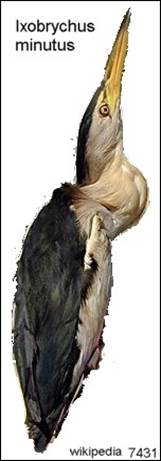
:_______________________________.
aderyn
y to, PLURAL: adar y to <<a-DEE-rin ə TOO>> [aˡdeˑrɪn ə ˡtoː] masculine noun
1 house sparrow
ETYMOLOGY: (aderyn = bird) + (definite article y) +
(to = thatch; thatched roof; roof)
In the English dialect of Llanidloes:
THATCH-BIRD, the house-sparrow. (Parochial Account of Llanidloes / Edward Hamer
/ Chapter X / Folk-lore. Page 308 Collections Historical and Archeological
Relating to Montgomeryshire and its Borders / 1877)
:_______________________________.
+adewir Soft-mutated form
- the radical form has initial g-.
See gadewir =
:_______________________________.
adfail
<<AD-vail>> [ˡadvaɪl] masculine noun
PLURAL adfeilion <<ad-VEIL-yon>> [adˡvəɪljɔn]
1 ruin
ETYMOLOGY: (ad-) + (bel- = unknown element) + (probably a
suffix –i which has caused the diphthongisation of the preceding vowel)
>> ad-fel-(i) >> adfeil >> adfail
:_______________________________.
adfeilion
<<ad-VEIL-yon>> [adˡvəɪljɔn]
1 ruins; plural of adfail
:_______________________________.
adfer
<<AD-ver>> [ˡadvɛr] verb
1 to restore
:_______________________________.
adferiad
<<ad-VER-yad>> [adˡvɛrjad] masculine noun
PLURAL adferiadau <<ad-ver-YAA-dai, -de>>
[advɛrˡjɑˑdaɪ, -ɛ]
1 recovery (of health)
Gobeithiai gael adferiad hyd y ddau ddiwrnod olaf y bu
fyw
He hoped to recover from his illness (“hoped to get recovery”) until the last
two days he was alive
2 y tu hwnt i adferiad irredeemable, beyond help, beyond redemption
(“beyond restoration”)
:_______________________________.
adfyd <<AD-vid>> [ˡadvɪd] masculine noun
1 adversity, distress, affliction
2 adfyd a loes pain and distress, pain and anguish
yn ei hadfyd a'i loes in her pain and anguish
ETYMOLOGY: (ad-
prefix = bad ) + soft mutation + ( byd = situation, condition; world)
:_______________________________.
adlach
<<ad-LAKH>> [adˡlax] feminine noun
PLURAL adlachiau <<ad-LAKH-yai, -ye>> [adˡlaxjaɪ, -ɛ]
1 backlash
ETYMOLOGY: (ad- prefix = re-, for a
second time) + soft mutation + (llach
= whiplash)
:_______________________________.
adladd
<<AD-ladh>> [ˡadlað] masculine noun
1 aftermath, second growth of grass after mowing
:_______________________________.
adlam
<<AD-lam>> [ˡadlam] masculine noun
PLURAL adlamau <<ad-LA-mai,
-me>> [adˡlamaɪ, -ɛ]
1 rebound
2 recoil (gun)
3 clo adlam spring lock
ETYMOLOGY: (ad- prefix = re-, for a
second time) + soft mutation + (llam
= jump)
:_______________________________.
adloniant
<<ad-LON-yant>> [adˡlɔnjant] masculine noun
1 entertainment
:_______________________________.
adnabod
<<ad-NAA-bod>> [adˡnɑˑbɔd] verb
1 know
O’r braidd ’mod i’n ei nabod I hardly know her
O’r braidd rw i’n ei nabod I hardly
know her
2 meet
Dywedir i Dafi a Siemsyn adnabod eu gilydd am y tro cyntaf mewn ffair
ddefaid
It is said that Dave and Jum first met (“knew each other for the first
time) in a sheep fair
3 (Bible) know = have sexual intercourse with
Samuel-1 1:19 A hwy a gyfodasant yn
fore, ac a addolasant gerbon yr Arglwydd; ac a ddychwelasant , ac a daethant
i’w tŷ i Rama. Ac Elcana a adnabu Hanna ei wraig; a’r Arglwydd a’i cofiodd hi. (1:20) A bu, pan ddaeth yr amser o amgylch, wedi
beichiogi o Hanna, esgor ohoni ar fab; a hi a elwodd ei enw ef Samuel...
[ Samuel-1 1:19 And they rose up in the morning early, and worshipped before
the LORD, and returned, and came to their house to Ramah: and Elkanah knew
Hannah his wife; and the LORD remembered her. (1:20) Wherefore it came to pass,
when the time was come about after Hannah had conceived, that she bare a son,
and called his name Samuel... ]
NOTE: Colloquially the clipped form ’nabod is used (the first syllable
is lost)
:_______________________________.
adnabyddadwy <<ad-na-bə-DHAA-dui >> [adnabəˡðɑˑdʊɪ] adjective
1 recognisable
ETYMOLOGY: (adnabydd-,
stem of adnabod = to know) + (-adwy adjectival suffix equivalent
to English ‘-able’)
:_______________________________.
adnabyddiaeth
<<ad-na-BƏDH-yaith, -yeth>> [adnaˡbəðjaɪθ, -ɛθ] feminine noun
1 knowledge, acquaintance
colli nabyddieth ar (rywun) forget
who (someone) is (“lose acquaintance on somebody”)
Ma blynydde lawer er pan weles i Dai, a
wi wedi braidd colli nabyddieth arno
It’s many years since I saw Dai, and I wouldn’t really know him now
2 hunan-adnabyddiaeth self-knowledge
ETYMOLOGY: (adnabydd-, stem of adnabod = to know) +(-i-aeth suffix for forming nouns)
NOTE: the colloquial form of adnabyddiaeth
és nabyddieth, with the loss of the
first syllable and simplification of final ae
>> e
:_______________________________.
adnabyddus
<<ad-na-BƏ-dhis>> [adnaˡbəˑðɪs] adjective
1 well-known
Roedd yn adnabyddus drwy Gymru gyfan
he was well known through the whole of Wales
Yr oedd William Griffith yn adnabyddus
am ei ddoethineb
William Griffith was well-known for his wisdom
Nid yw’r planhigyn hwn mor adnabyddus yng Nghymru
This plant is not so well-known in Wales
2 well-known (used preceding a name)
Ei gyd-letywr yn y stafell yn y cartref
i’r henoed oedd yr adnabyddus John Hughes, Y Wern
His fellow resident in the room in the old people’s home was the well-known
John Hughes, Y Wern...
3 anadnabyddus unknown
ETYMOLOGY: (adnabydd-, stem of adnabod = to know (somebody)) + (-us, suffix for forming adjectives)
:_______________________________.
adnau
<<AD-nai,
-ne>> [ˡadnaɪ, -ɛ] masculine noun
PLURAL adneuon <<ad-NEI-on>> [adˡnəɪɔn]
1 (Hire Purchase) deposit
2 (Banking) deposit
adneuon bancwyr banker’s deposits
adneuon arbennig special deposits
3 cyfrif adnau
= (American: savings account) (Englandic: deposit account) an account in which
money cannot be withdrawn except after an agreed period, and which yields
interest, unlike a current account in which interest is not given and money may
be withdrawn at any time
4 ar adnau = on
deposit, in one’s bank account
ETYMOLOGY: Welsh ← British ← Celtic; cf Irish aithne
(= acquaintance, knowing)
:_______________________________.
adneuo
<<ad-NEI-o>> [ˡadˡnəɪɔ] verb
1 deposit (money)
2 deposit (documents)
adneuo’r gweithredoedd eiddo deposit
the title deeds
ETYMOLOGY: (adnau = deposit) + (-o, suffix for forming verbs)
:_______________________________.
adnod,
PLURAL: adnodau
<<AD-nod, - ad-NOO-dai, -de>> [ˡadnɔd, adˡnoˑdaɪ, -ɛ] feminine noun
1 verse (from the Bible)
:_______________________________.
+ado Soft-mutated form -
the radical form has initial g-.
See gado =
:_______________________________.
adran,
PLURAL: adrannau <<A-dran, -a-DRA-nai, -ne>> [ˡadran, aˡdranaɪ, -ɛ] feminine noun
1 department
2 department = division of a local council
yr adran addysg the education
department
yr adran lanháu the cleansing
department
:_______________________________.
adrannol
<<a-DRA-nol>> [aˡdranɔl] (adjective)
1 department (attributive), departmental
siop adrannol department store
ETYMOLOGY: (adran = department) + (-ol = suffix for forming adjectives)
:_______________________________.
adref
/ adre <<A-drev, A-dre>> [ˡadrɛv, ˡadrɛ] adverb
1 home = towards home
2 talu’r echwyn adref give tit for tat
(“pay the loan home”)
:_______________________________.
adrodd <<A-drodh>> [ˡadrɔð] verb
1 recite
2 ailadrodd <<ail-A-drodh>> [aɪlˡadrɔð] repeat
:_______________________________.
adroddiad,
PLURAL: adroddiadau
<<a-DRODH-yad, -a-drodh-YAA-dai, -de>> [aˡdrɔðjad, adrɔðˡ jɑˑdaɪ, -ɛ] masculine noun
1 report
:_______________________________.
+adu Soft-mutated form -
the radical form has initial g-.
See gadu =
:_______________________________.
aduniad
<<ad-IN-yad>> [adˡɪnjad] masculine noun
PLURAL aduniadau <<ad-in-YAA-de>> [adɪnˡjɑˑdaɪ, -ɛ]
1 reunion = bringing together again
2 reunion = social gathering for old friends or work
colleagues to renew acquaintance and friendship
aduniad cyn-ddisgyblion school
reunion = gathering of ex-pupils of a school
aduniad cyn-ddisgyblion Ysgol Tregaron
school reunion for ex-pupils of Ysgol Tregaron
aduniad cyn-fyfyrwyr university reunion
= gathering of ex-students of a university
ETYMOLOGY: (adun- stem of the verb aduno
= reunite, become reunited) + (-iad,
suffix for forming nouns)
:_______________________________.
aduno
<<ad-II-no>> [adˡiˑnɔ]
verb with an object
1 reunite = cause to come together
verb without an object
2 reunite = come together, meet
ETYMOLOGY: (ad- prefix = again) + (uno = unite, become reunited)
:_______________________________.
-adur
<<AA-dir>> [ˡɑˑdɪr]
1 suffix which forms nouns (noun-forming suffix,
indicating an implement or a book)
(a) kind of book, reference book
1 (a) kind of book, reference book
..1/ blwyddiadur yearbook
..2/ bywgraffiadur biographical
dictionary
..3/ cyfeiriadur directory
..4/ digwyddiadur events list
(concerts, lectures, films, religious services, etc)
..5/ geiriadur dictionary
..6/ gigiadur list of gigs,
performances by a singer or group
..7/ gwyddoniadur encyclopedia
..8/ gwyliadur calendar of religious
festivals
..9/ holiadur questionnaire
..10/ newyddiadur newspaper
..11/ odliadur rhyming dictionary
..12/ orgraffiadur spelling
dictionary
..13/ swyddiadur job directory
..14/ teithiadur itinerary,
guidebook for travelers
..15/ treigladur mutation handbook
(one showing the circumstances in which mutations are used, i.e. the phonetic
changes of initial consonants in Welsh),
(b) kind of device (sometimes words with this meaning are adaptations of
English words with -ator)
..1/ carpiadur shredder
..2/ cyfrifiadur computer
..3/ cylchdroadur revolution counter
..4/ teipiadur typewriter
..5/ gwniadur thimble
..6/ percoladur coffee percolator
..7/ pladur scythe ← paladur (palu = to dig) + (adur noun-forming suffix)
..8/ rheiddiadur radiator
..9/ generadur generator
(c) person
..1/ cofiadur recorder (= clerk who
records details of meetings, etc)
..2/ curadur museum curator
..3/ procuradur procurator
..4/ penadur chief, leader
ETYMOLOGY: Detached from a word of Latin origin with final -adur and used as a suffix.
Cf Welsh pechadur ← British ← Latin peccât-ôr-(em) (= sinner)
NOTE: sometimes -i-adur
:_______________________________.
adwaith
<<AD-waith>> [ˡadwaɪθ] m
PLURAL: adweithiau <<ad-WEITH-yai, -ye>> [adˡwəɪθjaɪ, -jɛ] verb
1 reaction
cael adwaith gwael i suffer / have an adverse reaction to
ETYMOLOGY: (ad- prefix = re-, for a
second time) + soft mutation + (gwerthu
= to sell)
NOTE: Colloquially no reduction of ai >> e (occurs along the
country’s south-west to north-east axis) or ai >> e >> a (north-west,
and vestigially in the south-east) as this is a literary word
:_______________________________.
adwerthu
<<ad-WER-thi>> [adˡwɛrθɪ] verb
1 to retail, to sell direct to the customer
ETYMOLOGY: (ad- prefix = re-, for a
second time) + soft mutation + (gwerthu
= to sell)
:_______________________________.
adwerthwr
<<ad-WER-thur>> [adˡwɛrθʊr] masculine noun
PLURAL adwerthwyr <<ad-WERTH-wir>> [adˡwɛrθwɪr]
1 retailer = person or business that sells directly to a
customer
ETYMOLOGY: (adwerth-, stem of the
verb adwerthu = to retail) + (-wr,
suffix for forming nouns, = ‘man’)
:_______________________________.
adwy,
PLURAL: adwyau <<AA-dui, a-DUI-ai, -e>> [ˡ ɑˑdʊɪ, aˡdʊɪaɪ, -ɛ] feminine noun
1 gap, breech
dod i'r adwy come to the rescue,
save the day (“come to the breech / come to the gap”)
camu i'r adwy come to the rescue, save
the day (“step into to the breech / step into the gap”)
Dyma hi i’r adwy eto She came to the
rescue yet again (“you-see-here her to the breech / to the gap again”)
neidio i'r adwy come to the rescue
(“jump into the breech / jump into the gap”)
taflu eich hun i ganol yr adwy rush
to help (“throw yourself into the middle of the breech”)
2
gap between hills
Adwy-wynt (“Adwy Wynt”)
Street name in Y Fflint
“gap (of) wind”
(adwy) + soft mutation + (gwynt = wind)
Equivalent to the English name ‘Windy Gap’
Yr Adwy-ddu
Name of a housing estate in Penrhyndeudraeth, Gwynedd
“the black gap”
(yr definite article) + (adwy = gap) + soft mutation + (du = black)
:_______________________________.
ae
Has become wy in the final syllable
in:
clogwyn [KLOG-win] cliff,
precipice ← *clogwwyn [KLOG-wuin] ← *clogfwyn [KLOG-vuin] ← clogfaen [KLOG-vain]
:_______________________________.
ael <<AIL>> [aɪl] (f)
PLURAL: aeliau <<EIL-yai, -e>> [ˡəɪljaɪ, -ɛ]
1 = eil, eiliau aisle (church,
chapel, cinema, theatre)
ETYMOLOGY: English aisle ← Middle English ele
← Old French ← Latin ala (=
âla)
:_______________________________.
Aeleg Soft-mutated form - the radical form has initial g-.
See Gaeleg = Scottish, Scottish
Gaelic, Gaelic
:_______________________________.
aelod,
PLURAL: aelodau <<EI-lod, ei-LOO-dai, -e>> [ˡəɪlɔd, əɪˡloˑdaɪ, -ɛ] masculine noun
1 member
2 aelod seneddol member of
parliament (“parliamentary member”) (abbreviation: A.S.) (= M.P.)
:_______________________________.
aelodaeth
<<ei-LOO-daith, -deth>> [əɪˡloˑdaɪθ, -ɛθ] feminine noun
1 membership
tâl aelodaeth membership fee
ETYMOLOGY: (aelod = member) + (-aeth noun suffix)
:_______________________________.
Aelwen
<<EIL-wen>> [ˡəɪlwɛn] feminine noun
1 woman’s name (“fair brow”)
ETYMOLOGY: feminine form of aelwyn (= fair-browed)
NOTE: The name Eilwen <<EIL wen>> is possibly a spelling variant of this name. The pronunciation remains the
same, at least in Southern Welsh
(Penult ae is pronounced “eu” <<eɨ>> [əɨ] in the North and “ei” <<ei>> [əɪ] in the South)
:_______________________________.
aelwyd,
PLURAL: aelwydydd <<EI-luid, ei-LUI-didh>> [ˡəɪlʊɪd, əɪˡlʊɪdɪð] feminine noun
1 hearth
:_______________________________.
aelwyn
<<EIL-win>> [ˡəɪlwɪn] adj
1 fair-browed
ETYMOLOGY: (ael (f) = brow) + soft mutation + (gwyn = white; fair,
attractive)
:_______________________________.
aer
(1) <<AIR>> [ai̯r] masculine noun
1 air
:_______________________________.
aer
(2) aerion <<AIR, EIR-yon>> [ai̯r, ˡəɪri̯ɔn] masculine noun
1 heir
:_______________________________.
aer
(3), aerau, aeroedd <<AIR,
EI-ai, EI-roidh>> [ai̯r, ˡəɪri̯ɔn] feminine noun
1 battle
From from Proto-Celtic
*agros = slaughter. Cognate with Greek ᾰ̓́γρᾱ (ágrā) /ˈa.ɣra/ (nf) = hunting; Irish ár /ɑːɾˠ/
= slaughter.
See aerfa (= battlefield), Aeron (= name of goddess),
:_______________________________.
aeres,
PLURAL: aeresau <<EI-res, ei-RE-sai, -e>> [ˡəɪrɛs, əɪˡrɛsaɪ, -ɛ] feminine noun
1 heiress
:_______________________________.
aerfa
PLURAL: aerfâu,
aerfaoedd <<EIR-va, eir-VAI, eir-VAA-oidh>> [ˡəɪrva,
əɪrˡvaɪ, əɪrˡva·ɔi̯ð] feminine noun
1 (obsolete) battlefield
AER = battle, -FA = place
Cognate with Irish ármhá (older spelling
ÁRMHAGH)
:_______________________________.
Aeron
<<EI-ron>> [ˡəɪrɔn] feminine noun
1 river name
2 (History) in names of two medieval districts or kántrevs
in Ceredigion - (kántrev = cantref, literally: one hundred trêvs)
..a/ Ceredigion Is Aeron “Ceredigion
below (the river) Aeron”, that is, “the main part of Ceredigion, where the
court is, bounded by the river Aeron”.
..b/ Ceredigion Uwch Aeron
“Ceredigion above (the river) Aeron”, “the far part of Ceredigion”
:_______________________________.
Aerona
<<ei-ROO-na>> [əɪˡroˑna] feminine noun
1 woman’s name
:_______________________________.
Aeronwen
<<ei-RON-wen>> [əɪˡrɔnwɛn] feminine noun
1 woman’s name
ETYMOLOGY: Based on the name of the river Aeron in Ceredigion.
‘the river Aeron’ (Aeron) + (suffix –wen (qv), used to form
female forenames)
:_______________________________.
Aeronwy
<<ei-ROO-nui>> [əɪˡroˑnʊɪ] feminine noun
1 woman’s name
ETYMOLOGY: Based on the name of the river Aeron in Ceredigion.
‘the river Aeron’ (Aeron) + (suffix –wy, meaning river)
However, an interesting footnote can be added to this.
There was a tendency in the 1800s for some literati to ‘correct’ the names of
rivers by adding the suffix -wy (the soft-mutated form of gwy),
which they presumed had been part of the river name but had been worn away over
the passage of time.
Indeed, the fact that other river names end in -wy (Elwy, Conwy,
Mynwy, etc) and that one important river was actually called simply Gwy
(in English, the Wye) led them to believe that all river names had had it,
but not all had maintained it.
William Owen-Pughe’s dictionary published from 1797 onwards was to a great
extent to blame for this misconception, as he included the word gwy (said
by him to mean fluid or water, but really the product of his imagination) in
his Dictionary of Welsh and English dictionary published gradually from 1797
onwards and into the first decade of the 1800s. .
Though many river names do end in –wy, there are a variety of
explanations, depending on the particular name, and indeed it may be some kind
of suffix in some names, but it certainly does not mean ‘fluid’ or ‘water’.
In his dictionary, on page 195, under gwy, which William Owen-Pughe
marks as a masculine noun with the plural gwyon, he states that it is: A
fluid, or liquid; water. This word, and Aw, are in the composition of a great
number of terms, which relate to fluidity; and especially the names of rivers;
as Dyfrdonwy, Edwy, Efyrnwy, Llugwy, Mawddwy, Mynwy and Tredonwy.
Dyfrdonwy is his entirely fanciful correction for Dyfrdwy (Dee in
English), and Tredonwy is a mystery – or at least, to me.
But since there was a general conception amongst many that there was a suffix –wy
meaning ‘fluid’, ‘water’, and hence ‘river’, it is not incorrect to say
that Aeronwy means ‘river Aeron’ (Aeron) + (suffix -wy meaning
river)
:_______________________________.
aerwy
<<EI-rui>> [ˡəɪrʊɪ] masculine noun
PLURAL aerwyau, aerwyon <<ei-RUI-ai,
-e, ei-RUI-on>> [əɪˡrʊɪaɪ, -ɛ, əɪˡrʊɪɔn,]
1 collar, torque
2 (South-west Wales) eirw
buwch neck-chain, cow collar, cow-house yoke
ETYMOLOGY: British *ad-reig-o ← Celtic
Breton ere (= link)
Irish árach (= bond, i.e. fetter;
and bond, i.e. security; advantage)
NOTE: Penult ae is pronounced “eu”
in the North (“eurwy”) and “ei” in the South (“eirwy”).
A final “–wy” <<ui>> [ʊɪ] in the South regularly becomes “w”
<<u>> [ʊ]
Hence aerwy >> eirw
:_______________________________.
yr Aes <<ər-AIS>> [ər ˡaɪs]
1 street in the centre of Caer-dydd
English name: The Hayes
According to John Hobson Matthews (Mab Cernyw) in ‘Cardiff Records’
(1889-1911): “le heys. A part of the town near the east wall. To describe it
in terms of the present day, it is a street running from south to north, from
the north end of Bute Street to the Free Library. In 1550-1610 the Hayes (as
its name implies) was open ground, largely consisting of gardens, with small
detached tenements interspersed; yet it lay within the town wall. The name was
applied particularly to one cottage and piece of ground (1817), approach to
which was by a footpath and a stone stile (1820.) The Hays Close is named in a
document of 1786. These premises were situate about where is now the Batchelor
statue.”
Cf “The Hayes”, farm by Reynoldston (county of Abertawe / Swansea)
ETYMOLOGY: English haye ← Old English haga
= hedge
:_______________________________.
aeth <<AITH>> [aɪθ] verb
1 he / she / it went
:_______________________________.
aethnen
<<EITH-nen>> [ˡəɪθnɛn] feminine noun
PLURAL aethnennau, aethnenni <<eith-NE-nai, -ne, -ni>> [əɪθˡnɛnaɪ, -ɛ, -ɪ]
1 aspen, trembling poplar (Populus tremula) tree of the
genus Populus
pa bryd bynnag y gelwid arno i wneud hyny crynai fel aethnen
whenever he was called upon to do it he would shake like a leaf (“like an
aspen”)
2 Cwrtaethnen street in Y Barri (Bro Morgannwg) (spelt as ‘Cwrt
Aethnen’)
‘aspen court, ‘(the) court (of) (the) aspen’
cwrt aethnen ← cwrt yr aethnen (cwrt
= court) + (yr = the) + (aethnen = aspen)
ETYMOLOGY: Welsh aethn- ← British *aktn-
:_______________________________.
aethnen
ddu <<EITH-nen
DHII>> [ˡəɪθnɛn ˡðiː] feminine noun
PLURAL aethnenni duon <<eith-NE-nai,
-ne, -ni DII-on>> [əɪθˡnɛnaɪ, -ɛ, -ɪ ˡdiˑɔn]
1 black poplar (Populus nigra)
ETYMOLOGY: (aethnen = aspen) + soft
mutation + (du = black)
:_______________________________.
-af <<AV, A>> [av, a]
superlative ending for adjectives; as in English -est
1 Colloquially the final <<v>> [v] in polysyllables is not pronounced
cyntaf = primer >> cynta
2 –est, the most...
Often the superlative form is found in Welsh in a comparison between two, where
in English the comparative form would be used.
As an attributive adjective, the superlative form corresponds to the English
comparative form -er, more..
..1/ y rhyw wannaf (= women) the
weaker sex (“the weakest sex”)
..2/ y tu clytaf i’r clawdd on the
sheltered side of the hedgebank
(“the cosiest side to the hedgebank”)
..3/ Uchaf / Isaf in farm names or village names, literally “highest /
lowest”, corresponds to English upper, higher / lower
Y Wern Uchaf Upper Wern farm
Y Wern Isaf Lower Wern farm
(wern ← gwern, = alder swamp)
..4/ pen praffaf y ffon the thicker end of the stick, the thick end of
the stick
..5/ y wefus uchaf the upper lip, y wefus isaf the lower lip
3 (am + definite article and
superlative adjective)
cystadleuaeth am y cryfaf a
competiton to see who’s the strongest, a trial of strength
4 Since -af was
originally -haf, final consonants b d g are devoiced by the following ‘h’
which is now lost
gwlyb >> gwlypaf wet >> wettest
caled >> caletaf hard >> hardest
gwag >> gwacaf empty >> emptiest
The comparative forms which have -ach
have imitated the superlative forms in modern Welsh
gwlybach is now gwlypach (= wetter)
caledach is now caletach (= harder)
gwagach is now gwacach (= emptier)
ETYMOLOGY: -af ← -haf (qv)
:_______________________________.
+afael Soft-mutated form -
the radical form has initial g-.
See gafael =
:_______________________________.
+afaelgar Soft-mutated form -
the radical form has initial g-.
See gafaelgar =
:_______________________________.
+afaeliad Soft-mutated form -
the radical form has initial g-.
See gafaeliad =
:_______________________________.
Afagddu
<<a-VAG-dhi>> [aˡvagðɪ] (f)
1 The nickname (exact meaning unknown, though it seems to be based on du
= black) of Morfran eil Tegid, the son of Ceridwen, referring to his
terrible ugliness.
Utter darkness at night came to be compared to the extreme ugliness of Morfran,
tywyll fel Afagddu, with the first syllable of the name becoming the
obscure vowel (as has happened with several place names in Wales), and then
understood as the definite article – tywyll fel y fagddu.
Cf Aber-ffraw >> Abérffro >> Y Beffro, Aber-mawdd >>
Abérmaw >> Y Bermo
2 complete darkness, pitch blackness
yn dywyll fel y fagddu pitch dark
mor dywyll â’r fagddu pitch dark
Job 10:22 Tir tywyllwch fel y fagddu, a chysgod angau, a heb drefn; lle y
mae y goleuni fel y tywyllwch.
Job 10:22 A land of darkness, as darkness itself; and of the shadow of death,
without any order, and where the light is as darkness.
Eseia 59:9 Am hynny y ciliodd barnedigaeth oddi wrthym, ac ni’n goddiweddodd
cyfiawnder: disgwyliasom am
oleuni, ac wele dywyllwch; am ddisgleirdeb, ac yn y fagddu yr ydym yn rhodio.
Isaiah 59:9 Therefore is judgment far from us, neither doth justice overtake
us: we wait for light, but behold obscurity; for brightness, but we walk in
darkness.
Eseia 60:2 Canys wele, tywyllwch a orchuddia y ddaear, a’r fagddu y bobloedd: ond amat ti y cyfyd yr ARGLWYDD, a’i
ogoniant a welir arnat.
Isaiah 60:2 For, behold, the darkness shall cover the earth, and gross darkness
the people: but the LORD shall arise upon thee, and his glory shall be seen
upon thee.
3 hell
:_______________________________.
afal,
PLURAL: afalau <<AA-val, a-VAA-lai, -e>> [ˡɑˑval,
aˡvɑˑlaɪ, -ɛ] masculine noun
1 apple
pren afalau apple tree (also: afallen)
2 apple (in particular Malus domestica)
3 calon afal apple core (calon
= heart)
craidd afal apple core (craidd
= centre, nucleus)
4 cael yr afal a’i fwyta have your cake and
eat it (“get the apple and eat it”)
cael eich afal i chwarae ac i’w fwyta
have your cake and eat it (“get your apple to play and to eat it”)
Chewch chi mo’ch afal i chwarae ac i’w
fwyta You can’t have your cake and eat it
NOTE: Colloquially afalau >> ’fale
pren ’'fale apple tree
pwys o ’fale a pound of apples
5 afal sur (PLURAL: afalau surion, afalau sur) a sour
apple
afal sur (PLURAL: afalau surion) (Malus sylvestris) crab
apple
afal sur bach (PLURAL: afalau surion bach) (Malus
sylvestris) crab apple
Afal-sur (‘crab apple’) street name in Y Barri (Bro Morgannwg) (spelt as
‘Afal Sur’)
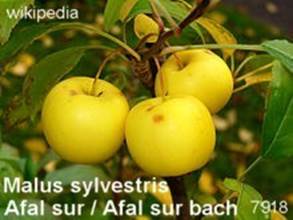
(delwedd 7918)
:_______________________________.
afal
Adda <<AA-val AA-dha>> [ˡɑˑval
ˡ ɑˑða] masculine noun
1 Adam’s apple
ETYMOLOGY: “(the) apple (of) Adam” (afal = apple) + (Adda = Adam)
:_______________________________.
afallen,
afallennau <<a-VA-lhen, a-va-LHE-nai, -e>> [aˡvaɬɛn, avaˡɬɛnaɪ, -ɛ] feminine noun
1 apple tree (Malus domestica)
Yr Afallennau (“the apple trees”) name of a series of penillion
in the Llyfr Du Caerfyrddin / The Black Book of Carmarthen c.1250 beginning
with the refrain "Afallen beren" (= sweet-apple tree; that is, not an
afallen sur = crab-apple tree)
Yr Afallenchwerw SN9854 Farm near Cilmeri, Powys (= crab-apple tree,
“bitter + apple tree”)
(Though the derivation could be another, since the farm is by Afon Chwerfri –
the farm name may have something to do with the name of the river)
http://www.geograph.org.uk/browse.php?p=228996
ETYMOLOGY: Welsh (afall = apple tree) + (-en diminutive suffix); afall
← British ← Celtic
From the same British root: Breton avalenn
(= apple tree)
:_______________________________.
Afallon
<<a-VA-lhon>> [aˡvaɬɔn] feminine noun
1 Afallon ('Avalon') = the paradise of the Celts, in the
form of an island in the western sea
Also Ynys Afallon
2 The Isle of Glastonbury, in Somerset (England). According to one legend,
Arthur, the king of the British retreated to Afallon to recover from a wound
sustained in battle against the invading English.
Twelfth-century authors sought to place Afallon in the west of the island of
Britain and made an erroneous identification with Glastonbury (which was an
island in fenland at the time)
3 (figurative) Paradise
Byw yn Llundain yr oeddwn ar y pryd, ond roedd gen i Afallon bell, sef fferm
Nhaid ym Meirionnydd
I was living in London at the time, but I had my own distant Paradise (“i had a
distant Paradise”), my grandad's farm in Meirionydd
Uwchaled oedd bro fy mebyd. Ddeugain mlynedd yn ôl ymadewais â’r Afallon hon
o Gymreictod a symud i Gaerdydd
Uwchaled was the district of my younger days. Forty years ago I departed
from that Paradise of Welshness and moved to Caer-dydd / Cardiff.
4 house name
..a/ House in Clydach, Abertawe
ETYMOLOGY: Possibly “abundant in apples” (afal = apple) + soft mutation
+ (llawn = full) >> *afal-lawn >> afallawn
>> afallon
:_______________________________.
afal
pob (North Wales) <<AA-val
POOB>> [ˡɑˑval
ˡpoːb] masculine noun
1 cooking apple
ETYMOLOGY: “cooked apple” (afal = apple) + (pob = cooked, baked; stem of the verb
pobi = to cook. In Welsh, the verb stem often serves as a past
participle)
:_______________________________.
afal
sur <<AA-val SIIR>> [ˡɑˑval
ˡsiːr] masculine noun
1 crab apple
afallen sur crab-apple tree
:_______________________________.
afal
taffi <<AA-val TAA-fi>> [ˡɑˑval
ˡtɑˑfɪ] masculine noun
1 toffee apple
ETYMOLOGY: “(the) apple (of) toffee” (afal = apple) + (taffi = toffee)
:_______________________________.
Afan <<AA-van>> [ˡɑˑvan] feminine noun
1 river name
Aberafan = mouth of the river Afan
:_______________________________.
Afan <<AA-van>> [ˡɑˑvan]masculine noun
1 man’s name
:_______________________________.
afanc,
PLURAL: afancod <<AA-vangk, a-VANG-kod>> [ˡɑˑvaŋk, aˡvaŋkɔd] masculine noun
1 beaver
NOTE:
Some Points of Similarity in the Phonology of Welsh and Breton,
T. H. Parry-Williams, 1913
“In W[elsh], however, the interchange of f and dd is quite common,
especially in the dial[ect]s…”
One example given by T. H. Parry-Williams of the change f >> dd
is afanc (= a beaver) >> addanc
:_______________________________.
afanen,
PLURAL: afan (South Wales) <<a-VAA-nen,
AA-van>> [aˡvɑˑnɛn, ˡɑˑvan] feminine noun
1 raspberry
:_______________________________.
afanen
goch, PLURAL: afan cochion
(colloquially pronounced “afan cochon”)
<<a-VAA-nen GOOKH, AA-van KOKH-yon>> [aˡvɑˑnɛn ˡgoːx, ˡɑˑvan ˡkɔxjɔn] feminine noun
(South Wales)
1 raspberry
:_______________________________.
affliw
<<A-fliu>> [ˡaflɪʊ] masculine noun
1 (North Wales) particle, fragment
2 dim affliw not
the least bit
dim affliw o (rywbeth) no
(something) at all
Doedd dim affliw o syniad gen i I
didn't have the least idea, I had no idea at all
3 affliw o ddim
nothing at all
Doedd affliw o ddim ar ôl There
wasn’t a morsel left
Dyw’r wasg Seisnig yn gwybod affliw o
ddim am Gymru a’i hiaith
The English-language press knows nothing at all about Wales and its language
Does wnelo'r peth affliw o ddim ag arian
The matter has nothing at all to do with money
ETYMOLOGY: possibly affliw ← arlliw (=
tint, shade), with the substitution of ‘ff’ for ‘r’ due to the influence of affaith (= effect)
:_______________________________.
Affrica
/ yr Affrig <<A-fri-ka, ər A-frig>> [ˡafrɪka, ər ˡafrɪg] feminine noun
1 Africa
:_______________________________.
afiach
<<AV-yakh>> [ˡavjax] adjective
1 unhealthy; sick
Yr iach a gach y bore,
Yr afiach a gach yr hwyr,
Yr afiach a gach bob yn dipyn bach
A'r iach a gach yn llwyr.
The healthy person shits in the morning
The unhealthy person shits in the evening
The unhealthy person shits little by little
And the healthy person shits completely
ETYMOLOGY: (af- negative prefix) + (iach
= healthy)
:_______________________________.
afiechyd
<<av-YEE-khid>> [avˡjeˑxɪd] masculine noun
1 sickness
:_______________________________.
+afl Soft-mutated form -
the radical form has initial g-.
See gafl = crotch
:_______________________________.
aflan
<<AV-lan>> [ˡavlan] adjective
1 unclean
gweithred aflan a dirty deed
mochyn aflan a dirty pig
:_______________________________.
aflendid
<<av-LEN-did>> [avˡlɛndɪd] masculine noun
1 uncleanliness
Traethawd byr yn erbyn meddwdod, aflendid, ofer-dyngu, a chelwydd
(“Traethawd byrr yn erbyn meddwdod, aflendid, ofer-dyngu, a chelwydd”) (= an
essay against drunkenness, uncleanliness, swearing in vain, and lying”
(literally “lie”))
William Jones. 1675. (Translation of a text by Thomas Gouge (1605-1681)
:_______________________________.
aflêr
<<a-VLEER>> [aˡvleːr] adjective
1 (obsolete) gluttonous
2 (North Wales) untidy, shabby, messy, scruffy
(development of sense 1, because a glutton makes a mess while eating)
3 (North Wales) dirty
ETYMOLOGY: aflêr ← aflerw
(af- = privative prefix) + soft
mutation + (llerw = weak)
NOTE: Also: blêr ← flêr ← aflêr.
(the first syllable is dropped; the [v] is taken to be a soft mutation of [b],
and a radical form is created with this [b])
Cf southern bradu (= to waste) ← fradu ← afradu
:_______________________________.
afles
<<AV-les>> [ˡavlɛs] masculine noun
1 detriment, disavantage, hurt
er afles i to the detriment of
Gweithredodd y sustem addysg er afles
i’r iaith Gymraeg
The education system functioned to the detriment of the Welsh language
ETYMOLOGY: (af- = negative prefix )
+ soft mutation + (lles = wellbeing)
:_______________________________.
aflesol
<<av-LE-sol>> [avˡlɛsɔl] adjective
1 unwholesome
bwyd aflesol unwholesome food
:_______________________________.
afliwio
<<av-LIW-yo>> [avˡlɪwjɔ] verb
1 (vi) lose colour, fade
2 (vi) (page of a book) fox
(AF- = negative suffix) + soft mutation + (LLIWIO = to colour)
:_______________________________.
afloyw
<<av-LOI-u>> [avˡlɔɪʊ] adjective
1 opaque
:_______________________________.
aflwydd,
PLURAL: aflwyddau,
aflwyddion <<AV-luidh, av-LUI-dhai, -e, av-LUIDH-yon>> [ˡavlʊɪð, avˡlʊɪðaɪ, -ɛ, avˡlʊɪðjɔn] masculine noun
1 (North Wales) defect
Fe gafodd fy nghar ryw aflwydd My
car broke down (“my car got some defect”)
bod aflwydd ar not work, not
function
Mae rhyw aflwydd ar y peth The
thing’s not working, It’s not working
Mae rhyw aflwydd arno It’s not
working
:_______________________________.
aflym
<<AV-lim>> [ˡavlɪm] adjective
1 retuse = (leaf) with a rounded apex and central depression
aflymddail retuse-leaved
helygen aflymddail(Salix retusa)
retuse-leaved willow
ETYMOLOGY: (af- = negative prefix )
+ soft mutaiton + ( llym = sharp)
:_______________________________.
afon,
PLURAL: afonydd <<AA-von, a-VOO-nidh>> [ˡɑˑvɔn, aˡvoˑnɪð]
feminine noun
1 river
2 isafon
tributary – minor river flowing into a main river
(is = lower, inferior) + (afon = river)
3 Examples of river names with soft mutation after the
element afon
(In most cases there is no such mutation in modern Welsh, but a handful of
examples occur, survivals from older Welsh)
..1/ (SH8449) Afon Conwy / Afon Gonwy
river in Conwy county, north-west Wales
..2/ (SH8227) Afon Dyfrdwy /Afon
Ddyfrdwy river in the north-east
..3/ (SH5167) Afon Menai / Afon Fenai = straits in Gwynedd,
between Môn and Arfon, north-west Wales
4 mor sicr â'r nant i'r afon no doubt about
it “as sure as the stream to the river”
5 troi afon o’i chwrs divert a river
6 Names of houses and streets
..1/ Tremyrafon / Trem yr Afon “view
(of) the river”, river view
..2/ Tremafon / Trem Afon “view (of
the) river”, river view
(The linking definite article is often omitted in place names)
House name, and also a street name in a number of places
..3/ Gwelafon river view (gwêl = view) + (afon = river)
..4/ Sŵnyrafon (“(the) sound (of) the river”)
Street name in
....a/ Llangefni (county of Môn) (“Swn yr Afon”)
....b/ Mynyddcyffig (county of Pen-y-bont ar Ogwr) (“Swn yr Afon”)
....c/ Y Gelli, Pentre (county of Rhondda Cynon Taf) (“Swn yr Afon”)
....d/ Treorci (county of Rhondda Cynon Taf) (“Swn-yr-Afon”)
....e/ Aberdulais (county of Castell-nedd ac Aberafan) (“Swn-y-Nant”)
....f/ Llanfechain (county of Powys)
..5/ House name: Llais yr Afon / Llaisyrafon (“(the) sound /
voice (of) the river”)
Street name: Llaisafon Ffair-fach, Llandeilo (county of Caerfyrddin)
(“Llais Afon”)
6/ Minafon ← Minyrafon riverside, river’s edge (“(the) edge (of) the
river”) (as “Min Afon”)
Houise name; street name in Y Rugos, Aber-dâr
7 (adverb of place) yn is ar
yr afon downstream, downriver
8
rhedai y dagrau yn afonydd i lawr ei gruddiau the tears ran in rivers down her cheeks
9 helygen yr afon (Salix fluviatilis) river willow
10 yr Afon Benwaig jocular name for “the sea” (“(the) river (of)
herrings”, the Herring River)
mynd dros yr Afon Benwaig go over
the sea
11 (Lampetra fluviatilis) llysywen bendoll yr afon (f), llysywod
pendoll yr afon river lamprey
12 min afon riverside
caffi min afon riverside café
rhodfa fin afon a riverside walk,
riverside walkway
:_______________________________.
Afon
Braint <<AA-von BRAINT>> [ˡɑˑvɔn ˡbraɪnt] feminine noun
1 river in Môn
:_______________________________.
Afon
Conwy <<AA-von KOO-nui>> [ˡɑˑvɔn ˡkoˑnʊɪ] feminine noun
1 river in North-west Wales
:_______________________________.
afonlan <<a-VON-lan>> [aˡvɔnlan]
1 (literary) riverside, riverbank
Afonlan House name in Y
Cae-gwyn, Caernarfon
ETYMOLOGY: (afon
= river) + soft mtuation + (glan =
riverside, riverbank)
:_______________________________.
Afon
Fach <<AA-von VAAKH>> [ˡɑˑvɔn ˡvɑːx] feminine noun
1 river in Patagonia
:_______________________________.
Afon
Llynfi <<AA-von LHƏN-vi>> [ˡɑˑvɔn ˡɬənvɪ]
1 name of two rivers in the south
..a/ SS 8983 A river rising north of the town of Maes-teg, runs southwards
through the town and flows into the Ogwr 4 km north of Pen-y-bont ar Ogwr
Cwm Llynfi the valley of the Llynfi river which passes through Y Caerau,
Cymfelin, Llangynwyd and Y Ton-du
..b/ SO1738 A river rising 1km north of Y Bwlch (Powys), between Aberhonddu and
Crucywel, which flows north into the lake known as Llyn Syfaddan; it leaves the
lake flowing northwards and joins the river Gwy at Aberllynfi, near Y Clas ar
Wy
Aberllynfi village 3km north of
Talgarth (“(the) confluence (of) Llynfi (and Gwy)”)
English name: Three Cocks
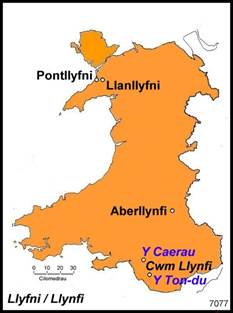
(delwedd 7077)
ETYMOLOGY: Llynfi ← Llyfni (llyfn = smooth) + (suffix -i)
Metathesis <<nv>> [nv] >> <<vn>> [vn]
In the north there is a river with the original form of this name - Afon Llyfni SH4852 flowing west from
the lake Llyn Nantlle Uchaf into the Bay called Bae Caernarfon, 4km south-west
of Llandwrog
:_______________________________.
Afon
Mynach <<AA-von MƏ-nakh>> [ˡɑˑvɔn ˡmənax] feminine noun
1 SN7576 Afon Mynach river in Ceredigion, formed
by the junction of the Myherin and Rhuddnant streams, and flowing west to join
the river Rheidol north of Pontarfynach (Ceredigion)
2 SH9041 Afon Mynach river in the district of Meirionnydd
which flows south into the river Tryweryn, 4km north-west of the town of Y Bala
ETYMOLOGY: “(the) river (of the) monk”; (afon
= river) + (mynach = monk)
:_______________________________.
Afon-wen
<<AA-von WEN>> [ˡɑˑvɔn ˡwɛn]
1 SJ1371 Village in the county of Y Fflint,
south-east of Caerwys
http://www.geograph.org.uk/photo/996798 map
ETYMOLOGY: yr afon wen “(the) white river”; (afon = river) + soft mtuation + (gwen, feminine form of gwyn = white)
:_______________________________.
+afr Soft-mutated form -
the radical form has initial g-.
See gafr = goat
:_______________________________.
afradlon
<<a-VRAD-lon>> [aˡvradlɔn] adjective
1 prodigal = wasteful, spendthrift
:_______________________________.
afrad <<AV-rad>> [ˡavrad] adjective
1 wasteful
byw yn afrad live extravagantly
2 Afrad pob afraid What is
not really essential is a waste
(“(it is) wasteful every unnecessary thing”)
3 Afrad pob ynfyd Fools are extravagent, i.e
sensible people are thrifty (“wasteful each fool”)
ETYMOLOGY: afrad =
extravagance, originally (adjective) evil, (noun) evil; (af- = privative
suffix ) + soft mutation + ( rhad = grace)
:_______________________________.
afradu
<<av-RAA-di>>
[avˡrɑˑdɪ] verb
1 waste, squander
afradu arian waste money, throw
money down the drain
afradu arian ac amser ar waste time
and money on
afradu arian a enillwyd mor galed to waste hard-earned money (“money that
was earned so hard”)
afradais agos flwyddyn a hanner yno
I wasted almost a year and a half there / in that place
:_______________________________.
afraid <<AV-raid>> [ˡavraɪd] adjective
1 unnecessary
mynd yn afraid become unnecessary
afraid dweud bod it goes without saying that...
2 superfluous
3 (masculine noun) Plural: afreidiau
something unnecessary
4 Cadw’ch afraid erbyn eich rhaid be thrifty, keep what you don't need now for
possible future use; put something away for a rainy day; waste not, want not =
if you do not waste things, you won't be poor
“keep your unneeded against your need” (cadw = keep) + (’ch ← eich = your) + (afraid (adjective)
unnecessary, (noun) unnecessary things) + (erbyn = against) + (eich
= your) + (rhaid necessity)
5 Afrad pob afraid What
is not really essential is a waste
6 rhoi o'ch afraid give
away what you don’t need (“give of your unneccessary [things]”)
ETYMOLOGY: Welsh
(af- = privative suffix) + soft mutation + (rhaid = necessity)
:_______________________________.
afrwydd
<<AV-ruidh>> [ˡavrʊɪð] adj
1
difficult
Afrwydd pob gorchwyl ar y cyntaf (saying)
Every task is difficult at the outset (“difficult every task on the first”)
yn araf
ac afrwydd y
troai yr olwynion the wheels
turned slowly and with difficulty
2 hard to understand
3 unsuccesful
ETYMOLOGY: (af- = negative prefix) +
soft mutation + (rhwydd = easy)
:_______________________________.
afrwyddo
<<av-RUIDH-o>> [avˡrʊɪðɔ]
(verb with an object) (not in common usage)
1
hinder, obstruct, make difficult
Nid yw y byd hwn ond yn wlad y mae eich ffordd yn myned drwyddi i dir
Immanuel; fel hyny ewch trwyddo fel deieithriaid (sic) a phererinion; heb
ymyraeth a’i drafferthion, i afrwyddo eich taith
This world is but a country that your road passes through to the land of
Emmanuel; so go through as strangers and pilgrims, without interfering in its
troubles, to hinder your journey
Pedwar Cyflwr Dyn (“the four states of man”), published in 1821 by John
Parry (1775-1846), a translation, probably by Ieuan Glan Geirionydd (Evan
Evans, 1795-1855) of “Human Nature in its Fourfold State”, by Scottish Puritan
Thomas Boston (1676-1732), first published in 1720
ETYMOLOGY: (afrwydd = difficult) + (-o suffix for forming verbs)
:_______________________________.
afu, PLURAL: afuau <<AA-vi, a-VII-ai, -e>> [ˡɑˑvɪ, aˡviˑaɪ, -ɛ]
masculine noun
1 liver (South Wales).
In the North it is iau
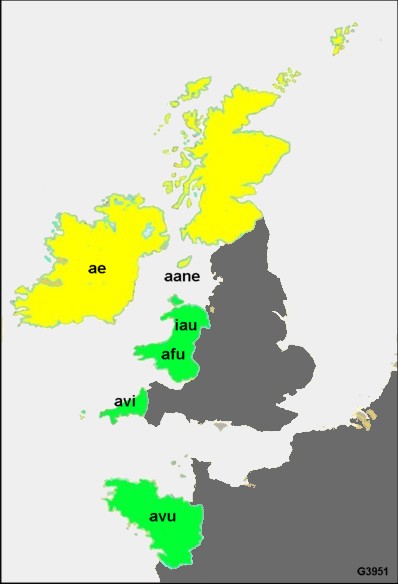
(delwedd 3951)
:_______________________________.
ag =
â <<ag>> [ag]
1 with (= â before a vowel)
:_______________________________.
ag a
1 as (+ conjugatd verb)
Nid yw cynddrwg ag a ddywedoch chi He isn’t as bad you said / as you
made him out to be
:_______________________________.
agen,
PLURAL: agennau <<AA-gen, a-GE-nai, -e>> [ˡɑˑgɛn, aˡgɛnaɪ, -ɛ] feminine noun
1 split, crevice
2 yr agen rhwng y bronnau cleavage between
a woman's breasts (“the cleavage / split between the breasts”)
NOTE: Historically this was gagen,
but the soft-mutated form (loss of intial g-) has become the radical form.
Irish has gág (f) (= crack, chink,
crevice)
:_______________________________.
agenda,
PLURAL: agendâu <<a-GEN-da, a-gen-DAI>> [aˡgɛnda, agɛnˡdaɪ, -ɛ] feminine noun
1 agenda
:_______________________________.
agerbeiriant
<<a-ger-BEIR-yant>> [agɛrˡbəɪrjant] masculine noun
PLURAL agerbeiriannau <<a-ger-beir-YA-nai, -e>>
[agɛrbəɪrˡjanaɪ, -ɛ]
1 (literary word) (railway)
steam engine
ETYMOLOGY: (ager = steam) + soft
mutation + (peiriant = engine)
:_______________________________.
agendor <<a-GEN-dor, >> [aˡgɛndɔr] masculine or feminine
noun
1 gap
2 abyss
1620 Bible: Luc 16:26 Ac heb law hyn
oll, rhyngom ni a chwithau y sicrhawyd gagendor mawr: fel na allo y rhai a fynnent, dramwy oddi yma atoch chwi: na’r rhai oddi yna, dramwy attom ni
(In twentieth century editions, agendor
is the form used - y sicrhawyd agendor.)
Luke 16:26 And beside all this, between us and you there is a great gulf fixed:
so that they which would pass from hence to you cannot; neither can they pass
to us, that would come from thence.
Historically this was gagen, but the
soft-mutated form (loss of intial g-) has become the radical form. See gagen (see above).
:_______________________________.
-agh-
1 British -ag-
>> Old Welsh “-agh-” >>
modern Welsh -ae-
..a/ CAE
Celtic >> British *kag-
>> Old Welsh “kagh” >>
modern Welsh cae (“hedge”; now
generally “field”)
..b/ DRAEN
Celtic >> British *dragn-
>> Old Welsh “draghn” >>
modern Welsh draen (= thorn)
..c/ HAEL
Celtic >> British *sagl-
>> Old Welsh “haghl” >>
modern Welsh hael (= generous)
..d/ MAEL
Celtic >> British *magl-
>> Old Welsh “maghl” >>
modern Welsh mael (in old forenames,
= chieftain, lord)
..e/ MAEN
Celtic >> British *magn-
>> Old Welsh “maghn” >>
modern Welsh maen (= stone)
:_______________________________.
Agnatha (Genus)
1 (pysgodyn
di-ên) jawless fish
:_______________________________.
agor <<AA-gor>> [ˡɑˑgɔr] verb
1 to open
2 ar agor open (eg sign in a shop window)
:_______________________________.
agored
<<a-GOO-red>> [aˡgoˑɛd] adj
1 obert
2 cadw drws agored keep open
house, be very hospitable, welcome all and sundry “keep (an) open door”
:_______________________________.
agoriad,
PLURAL: agoriadau <<a-GOR-yad, a-gor-YAA-dai, -e>>
[aˡgɔrjad, agɔrˡjɑˑdaɪ, -ɛ] adjective
1 opening
:_______________________________.
agoriadol
<<a-gor-YAA-dol>> [agɔrˡjɑˑdɔl] adjective
1 opening, inaugural
:_______________________________.
agos <<AA-gos>> [ˡɑˑgɔs] adjective
1 near
2 intimate
3 see agosaf =
nearest
4 quasi-prefix nowhere near
Nid yw hon agos gymaint This is
nowhere near as big (also: agos cymaint)
agos gystal â almost as good as
(also: agos cystal)
5 Mae hi agos yn sicr It’s fairly certain
:_______________________________.
agosaf
<<agosa>> <<a-GO-sav,
a-GO-sa>> [aˡgɔsav, aˡgɔsa] adjective
1 nearest (colloquiall clipped form: ’gosa)
ffordd ’gosa improvised, makeshift,
impromptu (“(the) nearest way”)
pryd ffordd ’gosa an improvised meal
2
bu + agosaf erióed has never been closer
(“to have been closest ever”)
“Fan hon,” ychwanegai, gan gerdded yn ôl a blaen yn y set
fawr, “y bu y nefoedd a’r ddaear agosaf erioed.
“Here,” he said, pacing to and fro by the big pew, “heavven and earth have
never been closer”
:_______________________________.
agosáu
<<a-go-SAI>> [agɔˡsaɪ] verb
1 to approach
agosáu at (rywun) approach (someone)
:_______________________________.
agosrwydd
<<a-GOS-ruidh>> [aˡgɔsrʊɪð] masculine noun
1 nearness, proximity
:_______________________________.
agwedd <<A-gwedh>> [ˡagwɛð] (f)
PLURAL agweddau <<a-GWEE-dhai,
-e>> [ aˡgweˑðaɪ, -ɛ]
1 attitude
2 aspect
ETYMOLOGY: Welsh agwedd ← *angwedd (an- = intensifying prefix) + nasal
mutation + (gwedd = aspect, appearance)
:_______________________________.
agweddi <<a-GWEE-dhi>> [ aˡgweˑðɪ] (m)
PLURAL agweddïau <<a-gwe-DHII-ai,
-e>> [agwɛˡðiˑaɪ, -ɛ]
1 dowry
tŷ agweddi dower house
(Wikipedia 2009-04-27: A dower house is usually a moderately
large house on an estate which is occupied by the widow of the late owner. The
widow, often known as the “dowager” (“a widow who holds a title or property, or
dower, derived from her deceased husband”) usually moves into the dower house,
from the larger family house, on the death of her husband, the new heir
occupies the now vacated principal house.)
:_______________________________.
ag y <<AAG ə, AG ə >> [ˡɑˑg
ə, ˡag ə]
1 as (after an equative form of
the adjective)
gynted fyth ag y gellir as soon as possible, as soon as you possibly can
(“as-soon / ever / as / it-can-be (done)”)
ETYMOLOGY: (ag
← â = with) + (y relative particle)
:_______________________________.
a
hefyd <<aa / a HEE-vid>> [ɑˑ / a ˡheˑvɪd]
1 and also...
Sometimes found incorrectly as ac hefyd
:_______________________________.
a hi <<aa HII>> [ɑˑ ˡhiː] conjunction
1 when it is / was, and it being
Genesis 15:17 A bu, pan fachludodd yr
haul, a hi yn dywyll, wele ffwrn yn mygu, a lamp danllyd yn tramwyo rhwng y
darnau hynny.
Genesis 15:17 And it came to pass, that, when the sun went down, and it was
dark, behold a smoking furnace, and a burning lamp that passed between those
pieces.
ETYMOLOGY: (a = and) + (hi = it)
:_______________________________.
-ai-
1 In a final syllable, generally it is reduced to e; in the
north-west e >> a, and in the south-east this ai is often i
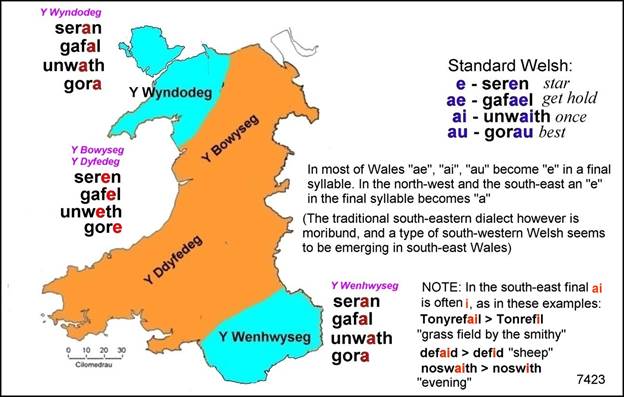
(delwedd 7423)
:_______________________________.
ai <<ai>>
1 Some words which have
<<ai>> [aɪ] in English have <<ii>> [iː] in Welsh
1/ Words taken from English <<ii>> which have conserved the <<ii>> in Welsh, but have undergone the long vowel shift in English c. 1500 <<ii>> >> <<ai>>
..a/ Brid [BRIID] name of Irish
saint; English “Saint Bride’s” [seint BRAIDZ]
2/ Words with English <<ii>> [iː] taken from Welsh into English which have undergone the long vowel shift in
English c. 1500 <<ii>> [iː] >> <<ai>> [aɪ]
..b/ Y Pil <<ə-PIIL>> [ə ˡpiːl], village in the county of Pen-y-bont ar Ogwr; English “Pyle” <<pail>> [paɪl]
..c/ Rhys [HRIIS] >> English
surname “Rice” <<RAIS>> [raɪs]
:_______________________________.
ai
In non-standard spellings of place names in the
south-east, possibly represents [ai] instead of the expected [ei] within the
colloquial Welsh of the area
Another possiblity is that it is an attempt to spell the sound <<ei>> [əi] a l’anglaise, as
in ‘paint, saint, main, wait’ etc
..a/ BLAENAU
Y Blaena
The south-eastern pronunciation of blaenau <<BLEI-nai, -e>> [ˡbləinai, - ɛ] (= upland; sources of streams) is <<BLEI-nai,
-e>> blaena [ˡbləina].
The English spelling of the town’s name is Blaina <<BLAI-nə>> [ˡblainə], which might in fact be a Welsh spelling to suggest a local pronunciation [ˡblaina]
..b/ CAEAU
Y Caia <<ə-KAI-a>> [əˡkaɪa] farm in Sain Nicolas, county of Bro Morgannwg ← y caeau <<ə-KEI-ai,
-e>> [əˡkəɪaɪ, -ɛ] = the fields
..c/ DRAENEN
A farm marked on maps as Pantyddrainan, near
Coedelái, Rhondda Cynon Taf
Standard Welsh would be Pantyddraenen. The “a” in the final syllable is
a typical feature of south-eastern Welsh.
:_______________________________.
aiatola
<<ai-a-TOO-la>> [aɪaˡtoˑla] masculine noun
PLURAL <<ai-a-TOO-laz>> [aɪaˡtoˑlaz]
1 ayatollah = Shiite leader, member of the religious
hierarchy who has an expert knowledge of Islamic law
ETYMOLOGY: Persian ← Arabic “sign of Allah / God” (âyat =
sign) + (Allah = God)
:_______________________________.
-aid <<AID, ED>> [aɪd, ɛd] suffix
1 has the sense of 'full', 'the contents of'; similar to
the use of the English suffix -ful; the amount a container will hold
bagaid o bapur a bagful of paper
barilaid o gwrw a barrelful of beer
basgedaid o flodau a basketful of
flowers
blychaid o bils a box of pills
casgenaid o gwrw a cask of beer
llwyaid o halen a spoonful of salt
pocedaid o ddarnau arian a pocketful
of coins
potaid o ddŵr a pot of water
potelaid o ddŵr a bottle of water
sachaid o dywod a sackful of sand
sosbanaid o ddw^r a saucepan full of water
tyaid o blant a houseful of children
2 In the north, normalment -aid
>> -ied (North-east) >> -iad (North-west)
potaid (= potful) >> potied / potiad
:_______________________________.
a i ddim <<AA-i-DHIM>> [ɑˑ ɪ ˡðɪm] verb
1 A i ddim o’ ’ma (= ni
af fi ddim oddi yma) I won’t go from here, I won’t leave here
ETYMOLOGY: (ni
negative particle) + (af = I shall go) + (fi = I) + (ddim
= not)
:_______________________________.
aiff <<AIF>> [aɪf] verb
1 colloquial form of the form â
= she, he will go
Does gen i ddim aiff amdanoch chi
I’ve got nothing in your size, nothing that’ll fit you (“that will go around
you”)
:_______________________________.
yr
Aifft <<ər-AIFT>> [ər ˡaɪft] feminine noun
1 Egypt
2 Eifftiwr
Egyptian
3 adjective Eifftaidd Egyptian (people, country)
4 (noun and adjective) Eiffteg Egyptian (language)
5 rhoi’r Aifft ar
dân (“set Egypt on fire”) set the Thames on fire = do something wonderful
and remarkable which will come to everybody’s attention (said of something
unlikely to happen)
ETYMOLOGY: Welsh Aifft ← Eifft ← Ë’ifft ← *Eghifft ← British *egipt-
← Latin egyptus (= Egypt)
:_______________________________.
ail <<AIL>> [aɪl] (m), (adjective)
1 second
cyfeilio to second = give support to
(a motion)
(cyf- prefix = together, eil- ← ail = second, -io
verbal suffix)
2 semblance, likeness, counterpart
Welas i mo’i hail hi rioed! I’ve not
seen anybody like her ever before!
3 yr ail orau second best
bodloni ar yr ail orau settle for
second best
4 nid oes ail i there's nothing
that can compare with
5 am yn ail (+ noun) very
second...
am yn ail ddydd Iau every second
Thursday, every other Thursday
am yn ail (adverb) alternately, in
turn
chwerthin a llefain am yn ail laughing and crying one
after the other
am yn ail â alternating with
yfed diodydd di-alcohol am yn ail â diodydd alcoholig
alternating alcoholic drinks with non-alcoholic drinks
Mae'r ddogfen hon yn ddwyieithog gyda
thudalennau am yn ail yn y
Gymraeg a Saesneg This document is bilingual with alternate pages in Welsh
and in English
6 bob yn ail (+ noun) very
second...
bob yn ail ddydd Iau every second
Thursday, every other Thursday
cael ei gyhoedd bob yn ail fis be
published every two weeks
bob yn ail (adverb) alternatively,
in turn
Ar ôl llifio’r boncyff, fe welid
cylchoedd amlwg yn y pren, rhai
tywyll a golau bob yn ail After sawing the tree trunk, distinct rings
were to be seen, dark ones alternating with light ones
7 bob yn ail (+ noun) very second...
bob yn ail ddydd Iau every second
Thursday, every other Thursday
cael ei gyhoedd bob yn ail fis be
published every two weeks
ar yn ail (adverb) alternatively, in
turn
Canwyd rhai penillion yn Sbaeneg ac yn y
Gymraeg ar yn ail
Some verses were sung alternately in Castilian and in Welsh
Trechwyd y Sais gan y Cymro, am y
rheswm, fe ddywedir, fod Thomas Dafydd yn gallu taro ar yn ail â’r llaw chwith
pan fyddai y llaw ddeheu wedi blino. The Englishman was beaten by the
Welshman because, it is said, that Thomas Dafydd could strike alternatively
with the left hand when the right hand was tired
8 gorfod derbyn yr ail orau have to take second best, have to make do with second
best
son ← second, like, similar
to
9 heb ei hail = incomparable, be
far ahead of any other (“without his second”)
Crydd heb ei ail oedd Sam yn ol barn ei
gwsmeriaid
Sam was a shoemaker who far outshone any other, the opinion of his customers
Other shoemakers weren’t a patch on Sam in the opinion of his customers
10 (obsolete) son ← second, like, similar to
Dylan Ail Don = Dylan son of the
wave - sea god in the 'Mabinogi'.
..a/ Dylan ← dylanw (dy- intensifying prefix) + soft mutation + (llanw = tide)
..b/ ail = second; in older Welsh, used
with the sense of ‘son’
..c/ + soft mutation + Ton = sea
11 am yr eildro per segona vegada
12 the second (of a prince / primcess / king / queen etc with the same name
as a previous monarch)
Ar Ragfyr 11 ryn ni'n dathlu Dydd Gŵyl Llywelyn yr Ail
On December the eleventh we celebrate the festival of Llywelyn II
ETYMOLOGY: Celtic *aljos
Gaulish al- (= other); Breton eil, Irish eile (= other)
The same as Latin alius (= other)
:_______________________________.
ail <<AIL>> [aɪl] (m)
1 (obsolete) son ← second, like, similar to
Dylan Ail Don a sea god in the
'Mabinogi'
“Dylan son of Wave / son of Sea “
..a/ Dylan literally “great tide” ← dylanw (dy- intensifying prefix) + soft
mutation + (llanw = tide)
..b/ ail = second; used as a noun in
older Welsh, with the sense of ‘son’
..c/ + soft mutation + ton (= sea)
:_______________________________.
ailadrodd
<<ail-A-drodh>> [aɪlˡadrɔð] verb
1 repeat
:_______________________________.
ailagor
<<ail-AA-gor>> [aɪlˡ ɑˑgɔr] verb
1 reopen
:_______________________________.
ailargraffiad, PLURAL: ailargraffiadau <<ail-ar-GRAF-yad, ail-ar-graf-YAA-dai, -e>>
[aɪlarˡgrafjad, aɪlargrafˡjɑˑdaɪ, -ɛ] masculine noun
1 reprint
:_______________________________.
ailasio
<<ail A sho>> verb reset (a broken bone)
:_______________________________.
ailddechrau
<<ail DHEKH re>> verb
1 recommence, begin again
:_______________________________.
ailddosbarth
<<ail DHO sparth>> adjective
1 second-class
:_______________________________.
ailddyfodiad
<<ail-dhə-VOD-yad>> masculine noun
PLURAL ailddyfodiadau <<ail-dhə-vod-YAA-de>>
1 return, reappearance
2 Yr Ailddyfodiad
the Second Coming, the Second Advent, the return of Jesus Christ to the world
according to Christian belief
ETYMOLOGY: (ail = re-, for a second
time) + soft mutation + (dyfodiad =
coming)
:_______________________________.
aildroedio <<ail- droid -yo>> verb
1 walk again
aildroedio’r un llwybr retrace one’s
steps, go back the way one has come (“retread the same path”)
ETYMOLOGY: (ail = re-, for a second
time) + soft mutation + (troedio =
tread, walk)
:_______________________________.
ailfeddwl
<<ail VEE dhul>> verb
1 rethink, think again
:_______________________________.
ailfodelu
<<ail vo-DEE-li>> verb
1 (building) remodel, refurbish
Yn ystod yr hydref eleni ailfodelwyd
Siop y Siswrn
this autumn (the shop called) Siop y Siswrn has been remodelled
ETYMOLOGY: (ail = re-) + soft
mutation + (modelu = to model, to
shape)
:_______________________________.
ailfagu
<<ail- vaa -gi>> verb
1 regain
ailfagu archwaeth regain one’s
appetite
ETYMOLOGY: (ail = re-, a second time
) + soft mutation + (magu = to
raise, to develop, to produce)
:_______________________________.
ailfywiocâd
<<ailviu-o-kaad>> masculine noun
1 reanimation
ETYMOLOGY: (ailfywiog-, stem of ailfywiocáu reanimate, revive) + (-had suffix for forming nouns)
:_______________________________.
ailfywiocáu
<<ail-viu-o-KAI>> verb
1 reanimate
ETYMOLOGY: (ail = re-) + soft
mutation + (bywiog = lively) + (-hau suffix for forming nouns from
adjectives)
:_______________________________.
ailgartrefu
<<ail gar TREE vi>> verb
1 rehouse
:_______________________________.
ailglafychiad
<<ailgla-vəkh-yad>> masculine noun
PLURAL ailglafychiadau <<ailgla-vəkh- yaa-de>>
1 relapse
ETYMOLOGY: (ailglafych- stem of the
verb ailglafychu = suffer a relapse) + (-iad suffix for forming nouns)
:_______________________________.
ailglafychu
<<ailgla-və-khi>> verb
1 suffer a relapse
ETYMOLOGY: (ail = re-, for a second
time) + soft mutation + (clafychu =
fall ill)
:_______________________________.
ailgyfanheddu
<<ail gə va NHE dhi>> verb
1 repopulate
:_______________________________.
ailhyfforddiant
<<ail hə FORDH yant>> verb
1 retraining
:_______________________________.
ail
law <<ail LAU>> adjective
1 second-hand
:_______________________________.
ail
orau <<ail oo-re>> adjective
1 second best, good but not of the highest quality
Rhoddodd ei ffrog ail orau amdani
She but on her second-best frock
ETYMOLOGY: (ail = second) + soft
mutation + (gorau = best)
:_______________________________.
ailwaeledd
<<ail wei -ledh>> m
1 (Medecina) relapse = deterioration in the health of a
sick person after an improvement
ETYMOLOGY: (ail = second) + soft
mutation + (gwaeledd = sickness)
:_______________________________.
ailwaelu
<<ail wei -li>> m
1 (Medicine) relapse = (health) deteriorate after an
improvement
ETYMOLOGY: (ail = second) + soft
mutation + (gwaeledd = become sick)
:_______________________________.
+aing Soft-mutated form -
the radical form has initial g-.
See gaing = chisel, wedge
:_______________________________.
+air Soft-mutated form -
the radical form has initial g-.
See gair = word
:_______________________________.
aitsh
<<aich>> feminine noun
PLURAL aitshus <<ai
-chis>>
1 name of the letter aich (H, h)
colli’ch aitsh drop your h’s (not
pronounce an ‘h’ which is present in the standard language; a feature of the
COLLOQUIAL WELSH of south-east Wales)
2 name of the letter aich (H) as the initial letter of a
name
John Herbert Jones (Je Aitsh) a wnaeth
waith mor nodweddiadol fel golygydd ‘Y Brython’
John Herbert Jones (J H) who did a notable job as editor of (the magazine) ‘Y
Brython’
ETYMOLOGY: from English ‘aich’, from the French name of the letter (modern
French = ache <<ash>>)
:_______________________________.
a
laddo a leddir <<aa LAA–dho
aa LEE-dhir>>
1 he who lives by the sword will die by the sword
ETYMOLOGY: (a = (it is) the person
who) + soft mutation + (laddo =
kills, third person singular subjunctive of lladd = to kill) + (a
(who is) the person who) + soft mutation + (lleddir it / she / he is killed / will be killed, impersonal form
of the PRESENT-FUTURE CLASSICAL WELSH tense of lladd)
:_______________________________.
ala <<AA-la >> (f)
1 alley
Yr Ala name of a street in Pwllheli
:_______________________________.
ala fowlia <<AA-la VOUL-ya>>
1 bowling alley, skittle alley
The modern expression for a bowling alley is alai fowlio (also as ala /
ale / ali fowlio)
In Dinbych there is a street called Parc
Alafowlia (Post Code LL16 3HZ)
ETYMOLOGY: (ala = alley) + soft
mutation + (bowlia, a form of bowliau = bowls, plural of bowl = bowl)
:_______________________________.
+alanas Soft-mutated form
- the radical form has initial g-.
See galanas =
:_______________________________.
+alanastra Soft-mutated form -
the radical form has initial g-.
See galanastra =
:_______________________________.
+alar Soft-mutated form -
the radical form has initial g-.
See galar =
:_______________________________.
alarch, PLURAL: elyrch/alarchod <<AA-larkh,
EE-lirkh / a-LAR-khod>> masculine noun
1 swan
2 golchi traed alarch try
to do the impossible (“wash (the) feet (of) (a) swan”)
3 Cwmalarch name of a street in Aberpennar (county of Rhondda Cynon
Taf)
(“Cwm Alarch” on maps)
“cwm yr alarch” (the) valley (of) the swan
Alarch Dof Cygnus olor Mute swan (= “tame swan”)
Alarch Du Cygnus atratus Black swan (Australia,and introduced in
New Zealand to replace an extinct native black swan Cygnus (atratus)
sumnerensis) (= “black swan”)
Alarch Gyddfddu Cygnus melanocoryphus Black-necked swan (South
America) (= “black-necked swan”)
Alarch y Gogledd Cygnus cygnus Whooper swan (migrates to
temperate Europe and Asia in winter, breeds in Iceland and subarctic Europes
and Europe and Asia) (=
“sawn (of) the north”)
Alarch Utganol Cygnus buccinator Trumpeter swan (North America)
(= “trumpeting swan”)
Alarch Chwibanol, Cygnus (columbianus) columbianus Whistling swan
(small northern North America) (= “whistling swan”)
Alarch Bewick Cygnus (columbianus) bewickii Bewick’s swan –
a Eurasian bird similar to the North American whistling swan which migrates
from Arctic Russia in the winter to western Europe and eastern Asia (Japan,
China) (= “swan (of) Bewick”)
:_______________________________.
+alarnad Soft-mutated
form - the radical form has initial g-.
See galarnad =
:_______________________________.
+alaru Soft-mutated form -
the radical form has initial g-.
See galaru =
:_______________________________.
+alarus Soft-mutated form -
the radical form has initial g-.
See galarus =
:_______________________________.
alaw,
PLURAL: alawon <<A lau, a LAU on>> feminine noun
1 melody
:_______________________________.
alaw
werin, PLURAL: alawon
gwerin <<a lau WE rin, a LAU on GWE rin>> feminine noun
1 folk song
:_______________________________.
yr
Alban <<ər al
-ban>> feminine noun
1 Scotland
Eglwys Esgobol yr Alban Church of
Scotland (“episcopal church of Scotland”)
ETYMOLOGY: Welsh ← British ← Celtic
Scottish Alba (= Scotland)
:_______________________________.
Albaneg
<<al BA neg>> feminine noun
1 Albanian
:_______________________________.
Albania
<<al BAN ya>> feminine noun
1 Albania
:_______________________________.
álbatros,
PLURAL: albatrosiaid
<<AL ba tros, Al ba TROS yed>> masculine noun
1 albatross
:_______________________________.
alcam
<<al
-kam>> masculine noun
1 tin = metal
gwaith alcam stannary, tin mine,
tinworks
NOTE: also alcan (influenced by the
word can = white)
ETYMOLOGY: Middle English alcamy (=
tin)
:_______________________________.
álcohol <<AL ko hol>> masculine noun
1 alcohol
:_______________________________.
alcoholaidd
<<al-ko- hoo -ledh>> adjective
1 alcoholic
Dywedodd y meddyg wrth y claf
alcoholaidd fod hwisgi yn niweidiol iddo
The doctor said to the alcoholic patient that whisky was harmful to him
ETYMOLOGY: (alcohol = alcohol) + (-aidd suffix for forming adjectives)
:_______________________________.
alcoholig
<<al-ko- hoo-lig >> m
PLURAL alcoholigion, alcoholics <<al-ko-ho- lig-yon, al-ko- hoo-liks>>
1 alcoholic = person addicted to alcohol
Alcoholigion Anhysbys Alcoholics
Anonymous
plentyn bychan ac alcoholig o fam a
small child with an alcoholic mother
ETYMOLOGY: English alcoholic, with
change of final c to g
:_______________________________.
Aled <<aa-led>> feminine noun
1 SH9260 Afon Aled river in the county of Conwy
Dyffryn Aled the valley of the river Aled
http://www.geograph.org.uk/photo/379114 Dyffryn Aled
2 Until its abolition in 1974, name of an administrative district (rural
district) in the county of Dinbych
Dosbarth Gwledig Aled Aled Rural
District
3 Is Aled <<iis aa-led>> History neighbourhood (cwmwd) of the hundred (cantref) of Rhufoniog (in the country of
Gwynedd Is Conwy) “place on this side of the river Aled” (is = lower; below ) + (Aled)
4 Uwch Aled <<iukh aa-led>> History neighbourhood (cwmwd) of the hundred (cantref) of Rhufoniog (in the country of
Gwynedd Is Conwy) “place on the other side of the river Aled” (uwch = higher; above, beyond) + (Aled)
5 Llyn Aled <<lhin aa-led>> SH9157 lake south of the village
of Llansannan, in the county of Conwy (llyn
= lake)
6 Bro Aled <<broo aa-led>> the area around Llansannan, a village in the county of Conwy on the river
Aled
Eisteddfod Bro Aled, Llansannan, Dydd
Sadwrn Hydref 20fed 2001
Eisteddfod of Bro Aled, (in the village of) Llansannan, 20 Octuber 2001
ETYMOLOGY: Welsh ← British
From the same British root: Cornish Aled
in the place name: Lannaled (English
name = Saint Germans)
:_______________________________.
Aled <<A led>> masculine noun
1 man’s name (from the river name)
:_______________________________.
+alfanedig Soft-mutated
form - the radical form has initial g-.
See galfanedig = galvanised
:_______________________________.
+alfaneiddio Soft-mutated
form - the radical form has initial g-.
See galfaneiddio = to galvanise
:_______________________________.
alga <<al-ga>> masculine noun
PLURAL algâu <<al-gaai>>
1 alga
algâu algae = unicellular or
multicellular freshwater or saltwater plants
“Mae algâu gwyrddlas yn wenwynig” yw’r
neges ar arwyddion o gwmpas y llyn
“Green algae is poisonous” is the message on signs around the lake
ETYMOLOGY: English alga ← Latin, of unknown origin
:_______________________________.
+all Soft-mutated form -
the radical form has initial g-.
See gall = he / she / it can
:_______________________________.
all- <<alh>> prefix
1 other
allfudo (qv) emigrate
allfwrw (qv) exorcise
ETYMOLOGY: Welsh all- ← British *all-
← Celtic *all-
From the same Celtic root: Irish all-
(allúrach = stranger)
Cf Greek allos (= other, differen)t,
and specialist words in many languages coined with Greek elements – as in
English allotropy, allomorph, allophone, etc
:_______________________________.
+alla Soft-mutated form -
the radical form has initial g-.
See galla >> gallaf = I can
:_______________________________.
+allaf Soft-mutated form
- the radical form has initial g-.
See gallaf = I can
:_______________________________.
+alla i ddim <<aa-lhai dhim>> verb
1 I can’t
Alla i ddim deall eich meddwl chi I
don’t know what you’re getting at, what you mean, what you want to say (“I
can’t understand your mind”)
Alla i mo’i
wneud I can’t do it
ETYMOLOGY: literary form ni allaf (ni = negative particle) + soft mutation
+ (gallaf = I can); colloquial form alla i ddim, with the loss of the
particle ni, and the final f <<v>> of gallaf, and the addition of (i = I) + (ddim = not). Before a possessive determiner (my, your, her. his,
its, etc) , ddim o (= nothing of)
>> mo
NOTE: Colloquially, in rapid speech, there is a tendency
for the first syllable to be dropped – ’lla
i ddim
:_______________________________.
+alla i mo... <<a-lhai moo...>> verb
1 I can’t + verb + direct object
alla i mo’i ddeall (matter,
situation – maesculine noun) I can’t figure it out, I just don’t get it;
(person) I can’t understand him
ETYMOLOGY: (literary form) ni allaf ei
ddeall “not I-can its understanding” >> (basis of the colloquial
form) ni allaf fi ddim o’i ddeall
“not I-can I anything of its understanding” >> (colloquial form) alla i mo’ ddeall
:_______________________________.
+alla i yn fy myw <<a-lhai
ən və miu>> verb
1 I can't for the life of me
Alla i yn fy myw
weld beth ydi'r dileit mewn rhedeg dros chwe milltir ar hugain mewn cylch
I can’t for the life of me see what the fun is in running over twenty-six miles
in a circle
NOTE: More colloquially, ’y instead
of fy – yn ’y myw
:_______________________________.
all-alaethol
<<alh a- lei -thol>> adjective
1 extragalactic = from outside the galaxy
ETYMOLOGY: (all-, prefix = outside)
+ soft mutation + (morio = galactic)
:_______________________________.
allan
<<A-lhan>> [ˡaɬan] (adverb)
1 out
2 y tu allan i <<ə tii A lla ni>> (preposition) outside
y tu allan i’r ty outside the house
3 o hyn allan from now on, henceforward
(o = from) + (hyn this (time)) + (allan
= out)
4 (a) rhedeg allan
run out
(South) rhedeg maas
(b) (commodity) rhedeg allan run out
(South) rhedeg maas
Mae’r llaeth wedi rhedeg allan The
milk’s run out
(c) rhedeg allan o rywbeth run out
of something
(South) rhedeg maas o rywbeth
Ryn ni wedi rydeg maas o de We’ve
run out of tea
5 codi allan
..1/ (North Wales) be out and about after an illness
..2/ turn out = come out of one's house, go onto the stret (to see a
procession, etc)
Mi glywson ni'r 'band' yn y dre heddiw.
Yr oedd yno gantoedd o bobl wedi codi allan i'w clywed nhw
We heard the band in the town today. Hundreds of people had turned out to
listen to them
6 dod allan ohoni get out of a difficulty
(“get out of it”)
7
(North Wales) dysgu
allan learn off by heart; learn Bible verses off by heart
Addysgid y plant i ddarllen y Beibl
Cymraeg a dysgu allan Gatecism
yr Eglwys The children were taught to read the Welsh Bible and learn by
heart the Church (of England) Catechism
Sticker in a book advertised for sale on ebay, 2005-12-29 (Cyfres Ffynnon Loew
/ Hau a Medi sef nifer o hanesion dyddorol ac addysgiadol i blant ac eraill.
Gan Edward Thomas, Llanrhaiadr. Hughes a'i Fab, Cyhoeddwyr, Gwrecsam, 1908):
"Ysgol Sabothol, Milner Road. -
Cyflwynedig i Gwladys Owen am ffyddlondeb a dysgu allan. 1913. H. Trevor
Williams. Ysg."
Sunday School, Milner Road: <<this
book was>> Presented to Gwladys Owen for regular attendance and for
learning <<Bible verses>> by heart. 1913. H. Trevor Williams. Secretary."
:_______________________________.
allanfa,
PLURAL: allanféydd
<<a LHAN va, a lhan VEIDH>> feminine noun
1 exit
allanfa dân, alllanféydd tân fire exit (sometimes seen on signs as
“allanfa tân”, but this is incorrect)
ETYMOLOGY: (allan = outside) + (-fa suffix, = place)
:_______________________________.
allanol
<<a-
lhaa -nol>> adjective
1 exterior, outside, external; situated on the outside
2 trwydded allanol off licence =
a permit which allows a shop to sell alcohol if it is taken away for
consumption; a shop with this permit
cylch allanol outer circle
2 yn allanol -
outwardly, on the face of it; in the eyes of the public
mi roedd hitha’n ddynas neis iawn – yn
allanol she was a very nice woman – outwardly
ymddangos yn allanol yn gwbl hyderus
appear outwardly very confident
3 (patient) not staying in a hospital
claf allanol outpatient
cleifion allanol outpatients
(Sign) Cleifion Allanol Outpatients,
Outpatients’ Department
adran y cleifion allanol the
outpatients’ department
4 barnu (rhywun) ar
yr olwg allanol judge (somebody) by his appearance (“judge (somebody) on
the external appearance”)
ETYMOLOGY: (allan = out) + (-ol suffix for forming adjectives)
:_______________________________.
alldaith
<<alh
-daith>> feminine noun
PLURAL alldeithiau <<alh- deith
-ye>>
1 expedition; See alltaith
:_______________________________.
allddodyn
<<alh- dhoo-din>> masculine noun
PLURAL allddodion <<alh- dhod-yon>>
1 substitute, substance which takes the place of another
allddodyn siwgr sugar substitute
ETYMOLOGY: (alldod-, stem of the
verb allddodi = substitute) + (-yn,
suffix)
:_______________________________.
allech chi
1 allech chi...? could you..? (requesting a favour)
Allech chi ddangos imi’r ffordd i’r orsaf? Could you show me the way to
the station?
2 could you? would you
be able to?
3 could you? were you able to?
ETYMOLOGY: a allech chi
(a interrogative particle) + soft
mutation + (gallech = you could) + (chi = you) (in COLLOQUIAL WELSH the
particle a is dropped but the
mutation remains)
:_______________________________.
allech
chi ddim <<a-lhekh khii dhim>> verb
1 you couldn’t, you could not, you would not be able to
2 you couldn’t, you could not, you weren’t able to
ETYMOLOGY: a allech chi (a interrogative particle) + soft
mutation + (gallech = you could) + (chi = you) (in COLLOQUIAL WELSH the
particle a is dropped but the
mutation remains)
:_______________________________.
allforio
<<alh-vor-yo>> verb
1 export = send goods to another country
toll allforio export duty
ETYMOLOGY: (allfor-, stem of the
verb allforio = to export) + (-io, suffix for forming nouns)
:_______________________________.
allforion
<<alh- vor-yon>> plural noun
1 exports
allforion anweledig = invisible
exports, exports of services and payment abroad of incomes
ETYMOLOGY: (allfor-, stem of the
verb allforio = to export) + (-io,
suffix for forming nouns)
:_______________________________.
allfro
<<ALH-vro>> feminine noun
PLURAL allfroydd <<alh-VROO-idh>>
1 (poetic) foreign land
2 masculine noun foreigner
a phob un o’r trigolion bron, boed
frodor neu allfro...
and every one of the inhabitants, whether native or foreigner...
ETYMOLOGY: (all- prefix = out) +
soft mutation + (bro = land);
Cf Gaulish allo-brog-es, name of a
Gaulish tribe
:_______________________________.
allfudiad
<<alh- vid -yad>> masculine noun
PLURAL allfudiadau <<alh-vid- yaa
-de>>
1 outmigration, emigration
ETYMOLOGY: (allfud-, stem of the
verb allfudo = emigrate) + (-i-ad
suffix for forming nouns)
:_______________________________.
allfudo
<<alh- vii -do>> verb
1 emigrate
ETYMOLOGY: (all-, prefix = outside)
+ soft mutation + (mudo = move, move
house)
:_______________________________.
allfudwr
<<alh- vii -dir>> masculine noun
PLURAL allfudwyr <<alh- vid
-wir>>
1 emigrant
ETYMOLOGY: (allfud-, stem of the
verb allfudo = emigrate) + soft mutation + (gwr = man)
:_______________________________.
allfwriad
<<alh- vur -yad>> masculine noun
PLURAL allfwriadau <<alh-vur-yaa-de>>
1 exorcism
ETYMOLOGY: (allfwr-i- stem of the
verb allfwrw = exorcise) + (-i-ad
suffix for forming nouns)
:_______________________________.
allfwriwr
<<alh- vur -yur>> masculine noun
PLURAL allfwrwyr <<alh- vur
-wir>>
1 exorcist
ETYMOLOGY: (allfwr-i- stem of the
verb allfwrw = exorcise) + soft mutation + (gwr = man)
:_______________________________.
allfwrw
<<alh-VUU-ru>> verb
1 exorcise
ETYMOLOGY: (all-, prefix = outside)
+ soft mutation + (bwrw = throw)
:_______________________________.
allor,
PLURAL: allorau <<A-lhor, a-LHOO-rai, -e>> feminine noun
1 altar
:_______________________________.
allt,
PLURAL: elltydd <<ALHT, ELH tidh>> feminine noun
1 hill
2 Y Felallt (SJ5458) Welsh name for the
village of Beeston, Cheshire, England; 4km south of Tarporley
(y = definite article) + soft
mutation + (melallt = honey hill):
(mêl = honey) + (allt = hill)
3 Rallt place name. This is Y Rallt, a wrong division of Yr Allt (= the hill) with the loss of
the definite article
Pen-rallt (qv) (the top of the hill)
place name and street name ← pen-yr-allt
....................................................
Pen-rallt Fach SN1942 Farm in Cilgerran (Penfro) (“Penrallt Fach”)
Pen-rallt Hywel SN1841 Farm in Cilgerran (Penfro) (“Penrallt Howel”)
http://www.geograph.org.uk/photo/430125
....................................................
Pen-rallt SH6343 Farm by Croesor, Gwynedd (“Penrallt”)
http://www.geograph.org.uk/photo/1043872
....................................................
Pen-rallt SH3735 district of Pwllheli (Gwynedd)
http://www.geograph.org.uk/photo/1152921
....................................................
Y Rallt SS5294
Farm south-west of Llanmorlais, Abertawe
http://www.geograph.org.uk/browse.php?p=175042
....................................................
Rallt-goch (“Rallt Goch”) (“the red
hill”) name of a street in Llanberis (county of Gwynedd)
....................................................
Tan-rallt house name (“below the hill”)
....................................................
In the South allt has been mistaken
for a soft-mutated form, and a radical form gallt is used (and it has developed the additional meaing of “wood;
wood on a hillside”)
4 moelallt <<MOIL-alht>> [ˡmɔɪlaɬt] bare hill
(moel = bare, treeless) + (allt = hill)
There is a Pen Moelallt SO0009 (“Penmoelallt”) north-west of Cefncoedycymer
“(the) peak (of) (the hill called) Moelallt”
http://www.geograph.org.uk/browse.php?p=188494
Pen Moelallt
See Allteisteddfod, Alltwalis, Allt-y-gog
5 garwallt <<GAR-wallt>> [ˡgarwaɬt] rough hill
(garw = rough) + (allt = hill)
Yr Arwallt “the rough hill” SO3318, south of Llanfihangel Crucornau
(Mynwy)
(on the Ordnance Survey map as “The Arwallt”)
http://www.geograph.org.uk/browse.php?p=196561
:_______________________________.
alltaith
<<alh
-taith>> feminine noun
PLURAL allteithiau <<alh- teith
-ye>>
1 expedition = organised journey for military purposes
arweinydd yr alltaith Seisnig anfonwyd i
Gymru i geisio darganfod Owain Glyndwr
the leader of the English expedition sent to Wales to try and find Owain
Glyndwr
ETYMOLOGY: (all- = ex, outside) +
soft mutation + (taith = journey)
>> alldaith >> alltaith
:_______________________________.
Allteisteddfod << alht- ei- stedh -vod>>
1
street name, Gwynfryn, county of Wrecsam (“Allt
Eisteddfod”)
ETYMOLOGY: allt yr eisteddfod “(the) hill (of) the eisteddfod”, with the
omission of the linking definite article, a frequent phenomenon in place names
:_______________________________.
yr
Allt-goch <<ər alht GOOKH>>
1
house west of Biwmaris / Beaumaris (On Ordnance Survey
map as “Red House”)
http://www.geograph.org.uk/browse.php?p=337935
map
RED HILL (YR ALLT GOCH). To those who love the shade in the blaze at noon, the
foot-way to the Red Hill will be found a complete Ruralia — the centre of a
Westphalian forest, where every object but foliage is excluded.
“Beaumaris Bay: The Shores of the Menai, and the Interior of Snowdonia; Scenery
Unrivalled in its Comprehensive Variety, The Interesting Objects which it
includes, and the Sublime Prominence of its Features.” Richard Llwyd. 1832
ETYMOLOGY: “the red hill” (yr definite
article, the) + (allt = hill) + soft mutation + (coch = red)
:_______________________________.
alltud
<<alh
-tid>> adjective
1 exiled
2 Cymry alltud
Welsh people in exile, those from Wales who have left their country to seek a
living elsewhere, especially outside the island of Britain
pobl alltud exiles, emigrés
3 banned, banished
oherwydd ei gamweddau mae ef yn alltud o
neuadd y pentre
because of his transgressions he is banned from the village hall
ETYMOLOGY: See alltud (noun)
:_______________________________.
alltud <<alh -tid>> masculine and feminine noun
PLURAL alltudion <<alh-tid-yon>>
1 obsolete foreigner, alien,
non-tribesman
2 exile = a person forced to abandon her or his country for political
reasons
3 exile = a person who has left her or his country to make a better living
4 troi’n alltud become an exile
5 Found in bardic names / pseudonyms. E.g. Eisteddfod Porthmadog. Seren Cymru.
16 Hydref 1851.
Robert Vaughan Williams (Alltud Meirion).
ETYMOLOGY: Welsh alltud ← British *allo-touto, corresponding to modern
Welsh all-dud (all- = out) + soft mutation + (tud
= people), with unvoiced [ll] devoicing the following [d] and thus undoing the
soft mutation [t >> d].
:_______________________________.
alltudio <<alh TID yo>> verb
1 to exile, to send into exile
2 ymalltudio go into exile (ym- = reflexive prefix ) + (alltudio = to exile) ‘exile oneself’
:_______________________________.
Alltwalis <<alht-wa -lis>>
1 SN4431 hamlet 12km north of the
town of Caerfyrddin (county of Caerfyrddin)
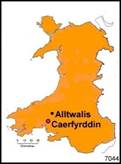
rhegi’r maer ar ben Alltwalis
criticise from a safe distance (“swear at the mayor (of Caerfyrddin) on top of
(the hill called) Alltwalis”)
http://www.geograph.org.uk/photo/551530 Yr Ysgol Gynradd /
The Primary School
ETYMOLOGY:(allt = hill, wood) + ??
:_______________________________.
Allt-y-gog <<alht ə goog >>
1 street name in the town of Caerfyrddin
ETYMOLOGY: “(the) hill / wood
(of) the cuckoo”
(allt = hill / wood) + (y
definite article) + soft mutation + (cog
= cuckoo)
:_______________________________.
+allu Soft-mutated form -
the radical form has initial g-.
See gallu =
:_______________________________.
+alluog Soft-mutated form -
the radical form has initial g-.
See galluog =
:_______________________________.
+alluogi Soft-mutated form -
the radical form has initial g-.
See galluogi =
:_______________________________.
+allwch chi ddim <<aa-lhukh khii dhim>> verb
1 you can’t
Allwch chi ddim gwrthod ei gynnig
You can’t refuse his offer
ETYMOLOGY: literary form ni allwch (ni = negative particle) + soft mutation + (gallwch = you can); colloquial form allwch chi ddim, with the loss of the particle ni and the addition of (chi
= you ) + (ddim = not)
:_______________________________.
allwedd, PLURAL: allweddau <<ALH
wedh, alh WE dhe>> feminine
noun
1 key
Allwedd pob cist yw cwrw (“(it-is) (the) key (of) every chest
that-is beer”, beer is the key to every chest). Meaning: In vino veritas (“in
wine (there is) truth”). A person is more likely to tell the truth when drunk.
2 allwedd Mair ashkey = winged seed of an
ash tree (“(the) key (of) (the Virgin) Mary”)
:_______________________________.
yr Almaen, PLURAL: <<ə RAL main>> feminine noun
1 Germany
Yn yr Almaen in Germany
:_______________________________.
Almaenaidd <<al MEI
nedh>> adjective
1 German
:_______________________________.
Almaeneg <<al MEI
neg>> f,adj
1 German (language)
:_______________________________.
Almaenes <<al MEI
nes>> feminine noun
1 German woman
:_______________________________.
Almaenwr, PLURAL: Almaenwyr <<al MEI nur, al
MEIN wir>> masculine noun
1 German (man)
:_______________________________.
Almaenwyr <<al MEIN
wir>> plural noun
1 German people
:_______________________________.
Alosa alosa
1 herlyn (m), herlynod allis shad
:_______________________________.
Alosa fallax
1 gwangen (m), gwangod twaite shad
:_______________________________.
Alpau, PLURAL: Yr <<ə RAL pe>> plural noun
1 The Alps
2 helygen yr Alpau (Salix hegetschweileri) Alpine willow
:_______________________________.
Als <<als>> feminine noun
1 (obsolete name) a form of Alice
Capel Als An Independent (Congregational) chapel in Llanelli, Sir Gaerfyrddin
/ Carmarthenshire, founded in 1780. The name is said to be that of a woman
(Als) whose cottage stood on the site of the chapel. Literally: (“(the) chapel
(of) Als”)
https://cy.wikipedia.org/wiki/Capel_Als
ETYMOLOGY: from English Als
← Alice
:_______________________________.
Alun (1) <<A lin>> feminine noun
1 river name
..a/ Afon Alun SS9076 river west of Ewenni, Bro Morgannwg, which flows
into Afon Ewenni
On the west bank is a farm called Pontalun SS8976 (“bridge (over the
river) Alun”)
:_______________________________.
Alun (2) <<A
lin>> masculine noun
1 man’s name
:_______________________________.
+alwad Soft-mutated form - the radical form has initial g-.
See galwad = call
:_______________________________.
+alwedigaeth Soft-mutated form -
the radical form has initial g-.
See galwedigaeth = vocation,
occupation
:_______________________________.
+alwedigaethol Soft-mutated form -
the radical form has initial g-.
See galwedigaethol = vocational,
occupational
:_______________________________.
Alwen <<AL wen>> feminine noun
1 woman’s name
:_______________________________.
Alwena <<al WE
na>> feminine noun
1 woman’s name
:_______________________________.
Alys << a-lis>> feminine noun
1 Alice
Alys yng Ngwlad Hud Alice in
Wonderland
ETYMOLOGY: from English Alice ← Old French Adelais ← Latin Adalheidis ← Germanic Adalheid. Modern German Adelhaid,
whence English Adelaide. The deminutive form of the German name is Heidi.
(Germanic adal = noble, cf German edel = noble), (heit = form, shape; kind, type)
:_______________________________.
am <<am>> (preposition)
1 basic meaning: around; more usually corresponds to “for, at, about”, etc
am un o’r gloch <<am IIN or
GLOOKH>> at one o’clock
siarad am y ffilm <<SHAA rad am ə FILM>> to talk about the
film
2 for = for the price of
gwerthu rhywbeth am ei gost sell something at cost price (“sell
something for its cost”)
am bumpunt <<am BIM
pint>> for five pounds
3 rhoi eich esgidiau
am eich traed put on your shoes (“give your shoes around your
feet”)
4 (price) for = in exchange for
codi crocbris am rywbeth charge the earth for something (“raise / charge
a hanging price for”)
talu crocbris am rywbeth pay through the nose for something, pay the
earth for something (“pay a hanging price for”)
am brisiau is o lawer at greatly reduced
prices
5 mynd am (clothes) to fit
Does gen i ddim aiff amdanoch chi
(clothes) I’ve got nothing in your size, nothing that’ll fit you
(nid oes gennyf ddim a â amdanoch “that will go around you”)
6 (with definite article and superlative adjective)
cystadleuaeth am y cryfaf a
competiton to see who’s the strongest, a trial of strength (“a competition for
the strongest”)
7 cadw golwg am look out for
something
8 dwyn dial (ar rywun) (am rywbeth) take revenge (on somebody) (for
something), revenge oneself (on somebody) (for something)
9 sefyll eich prawf am be tried for,
stand trial for (“stand your trail for”)
10 anghofio’r cwbl am completely forget
about (“forget the totality about”)
11 around (body, part
of the body)
Faint ych chi am eich cluniau?
What’s your hip size? (“how much are you around your hips”)
Taflodd ei breichiau
am wddf Mrs Jenkins She threw her arms around Mrs. Jenkins’s neck
12 (clothing) wearing,
on
het fach las am ei phen a menyg lledr am
ei dwylo a little blue hat on her head and leather gloves on her hands
Do’s dim pilyn sych amdano! She
hasn’t got a dry stitch of clothing on her
:_______________________________.
am <<am>>
1 (obsolete) with
patronymics, before names beginning in “M”, a form of ab = son (of)
am Meurig son of Meurig / Morris
(One (unlikely) explanation for the origin of the name America is that is is so
called after Richard Americk, Chief Customs Officer at Bristol, who invested in
John Cabot’s 1497 voyage of exploration. Americk is an Englished form of am Meurig)
:_______________________________.
am- <<am>> prefix
also occurs as ym-
There is soft mutation after am- / ym-
1 around
to (= roof, covering), amdo (= shroud)
cau (= to close), amgáu (= to enclose)
cylch (= circle), amgylch (= circumference)
2 various, different
rhyw (= some), amryw (= various)
3 intensifier
mwys (= ambiguous), amwys (= ambiguous)
trech- (root of trechu) (= to defeat), ymdrech
(= effort)
4 (Modern Welsh ym) from two
sides; each other, one another
lladd (= cut, kill), ymladd (= fight)
5 (Modern Welsh ym) (reflexive)
oneself
golchi (= wash), ymolchi (= wash oneself)
ETYMOLOGY: Welsh am- and ym- ← British ambi ← Celtic;
Other Celtic languages:
(1) British: Cornish am- and om-, Breton am and em-,
(2) Hibernian: Irish im-, Scottish im-
(3) Gaulish ambi-,
Other Indo-European languages: Latin ambi-
(= on both sides), ← ambo (= both) (as in ‘ambidextrous’
etc);
Greek amphi- (= on both sides, at
both ends, of both kinds) (as in ‘amphitheatre’, etc)
:_______________________________.
amaeth <<a -maith>> masculine noun
1 agriculture = the practice of cultivating the land
Coleg Amaeth Glynllifon Glynllifon
Agricultural College
2 (obsolete) husbandman, ploughman
3 rhodfa amaeth farm trail (trail
for tourists in the countryside)
4 Y Weinyddiaeth Amaeth the
Ministry of Agriculture
ETYMOLOGY: Celtic amb(i)-akt-os (ambi = modern Welsh am
around), akt ← *ag; equivalent to Latin ago (= to move forward, to do); actus (= action)
Cf Gaulish ambakt- (= serf) (taken
into Latin as ambactus). From Latin,
..a/ German der Amt (= the
official),
..b/ English ambassador, from the
French word ambassador
:_______________________________.
..1 amau <<a -me>> verb
1 (verb with an object) (verb without an object) doubt = be inclined to
disbelieve, regard as untrue
Ych chi’n amau? Don’t you believe
me?
amau gair rhywun doubt somebody’s
word, not accept the truth of what is said
Dy’ chi ddim yn ame ’ngair i, y’ chi?
You don't doubt my word, do you?
2 doubt = be uncertain about the existence of
Rw i’n amau yn fawr eu doethineb a'u
synnwyr cyffredin
I greatly doubt his wisdom and common sense, I have great doubts about his
wisdom and common sense,
3 diamau undisputable
diamheuol undisputable
4 roeddwn i'n rhyw amau... I half
suspected, I somehow imagined
roeddwn i'n rhyw amau braidd I half
suspected it, I somehow imagined it
5 amau dim be in no doubt, not be
a bit surprised
rw i’n amau dim nad yw e wedi mynd yno
wedi’r cwbl I have no doubt that he hasn’t gone there after all :
ETYMOLOGY: (am = around) and an element heu (apparently = to turn); the same
element is found in yn ddiau (=
without any doubt) and dihéu (= to
long for)
:_______________________________.
..2 amau <<a -me>> masculine noun
PLURAL amheuon <<a-mhei-on>>
1 doubt
In modern Welsh normally as a plural - amheuon
(a) taflu amheuon ar (= cast doubt
on),
codi amheuon ynghylch (rhywbeth) (=
call <<something>> into question)
2 occurs in the adverb yn ddiamau (= doubtlessly)
:_______________________________.
ambell <<AM belh>> adjective
1 an occasional (thing)
2 ambell waith <<AM belh
waith>> (adverb) sometimes
:_______________________________.
am ben <<am BEN>> (preposiiton)
1 over the head of; onto (a person)
2 taflu dŵr oer am ben (rhywun) = throw
/ pour cold water over (somebody); taflu dŵr oer am ben (syniad) pour cold water on (an idea) = criticise an idea and
make it less appealing
:_______________________________.
am
bensiwn <<am BEN-shun >>
1 for all the tea in China, for anything in the
world
wnawn i mohoni am bensiwn I wouldn’t do it for all the tea in China
ETYMOLOGY: (“for a pension”) (am = for) + soft mutation + (pensiwn =
pension)
:_______________________________.
ambi
<<am-bi>>
1 preposition in British; in modern Welsh this is am (preposition and prefix)
In other Indo-European languages, equivalents are:
(1) Latin ambi- (= on both sides), ← ambo (= both) (as in 'ambidextrous'
etc);
(2) Greek amphi- (= on both sides,
at both ends, of both kinds) (as in 'amphitheatre', etc)
See the Welsh am
2 The modern Welsh prefix dym- is
from British *do-ambi
dymchwel = to overturn, to upset
dymuno = to wish
:_______________________________.
ámbiwlans <<am -biu-lans>> masculine noun
PLURAL ambiwlansiau <<am-biu- lans -ye>>
1 ambulance
gwasanaeth ámbiwlans ambulance
service
gyrrwr ámbiwlans ambulance driver
dyn ámbiwlans ambulance man (member
of an ambulance crew)
ETYMOLOGY: English ambulance <<ámbyələns, ámbyuləns>> ← French (ambul + -ance, ← {hôpital}
ambul{ant}, walking hospital) ← Latin ambulâre (= to walk, to
stroll)
:_______________________________.
am bris yn y byd <<am briis ən ə biid
>> adverb
1 even if you paid me to
Chymerwn i mohono am bris yn y byd
I wouldn’t take it even if you paid me to, I wouldn’t take it even if you gave
it to me
(“I would take anything of it for a price in the world”)
ETYMOLOGY: (am = for) + soft mutation + (pris = price) + (yn y byd = in the world)
:_______________________________.
amdani
(preposition) about it / about her
1 rwyt ti amdani! you’re for it! you’re pay
dearly for this!
:_______________________________.
amdano <<am DAA
no>> (preposition)
1 about it / about him
:_______________________________.
amddifaty
<<am-dhi-VA-ti>> masculine noun
PLURAL amddifatai <<am-dhi-VA-tai>>
1 orphanage = house where orphans are cared for
ETYMOLOGY: (amddifad = orphaned) + soft mutation + (-ty = house); amddifád-dy
>> amddifaty
:_______________________________.
amddifedi
<<am-dhi-VEE-di>> masculine noun
1 orphanhood = the state of being an orphan
ETYMOLOGY: (amddifad = orphaned) + (-i suffix for forming abstract
nouns) (causes change in the penultimate vowel a >> e –
vowel affection)
:_______________________________.
amddiffyn <<am DHII
fin>> verb
1 to defend
2 Gorau amddiffyn, ymosod The
best form of defence is attack (“best defending, attacking”)
:_______________________________.
am ddim <<am DHIM>>
1 free of charge, for free
cludiad am ddim / danfoniad am ddim carriage paid; post
free; delivery free
:_______________________________.
amdo <<am-do>> masculine noun
PLURAL amdoeau <<am-dooi-e>>
1 shroud, winding-sheet = piece of cloth in which a dead body is wrapped
ETYMOLOGY: (am- prefix = around) + soft mutation +
(to ceiling, covering)
:_______________________________.
amdói <<am-doi>> verb
1 put (a corpse) in a shroud, enshroud
bod wedi eich amdói = be covered by
a shroud
2 shroud = cover with something as if covering with a shroud
bod wedi eich amdói = be covered by
something as if by a shroud
yr oedd y bibell ddwr wedi ei hamdói mewn
crystyn o rew
the hosepipe was shrouded in a covering (a crust) of ice / frost
ETYMOLOGY: (amdo = shroud) + (-i = suffix for forming verb s)
:_______________________________.
am dro
1 mynd am dro <<mind am
DROO>> go for a walk
:_______________________________.
amén <<a-MEN>> f
1 amen
2 bod yn amen ar rywun to have had it, to be the end of someone
Mae'n rhaid i chi fod yn garcus bob amser wrth fynd ar hyd glan y nant hwnnw
neu mae'n amen arnat ti
You need to be careful every time you go along the bank of that stream or
it’ll be goodbye and amen.
:_______________________________.
amenio <<a-MEN-yo>> v
1 say amen
2 approve
3 agree, concur
Mi wn y buasai Siôn yn cytuno ac yn amenio I know Siôn would agree and
concur
Ni ellir ond amenio hynny One can only agree to that
amenio barn rhywun go along with somebody, concur with somebody, agree with
somebody’s opinion
NOTE: Also amenu
ETYMOLOGY: (amen = amen) + (-io verb suffix)
:_______________________________.
amenio <<a-ME-ni
v
See amenio
:_______________________________.
America (= América), also: Yr Amerig <<a MEE ri ka, ər a MEE rig>> feminine noun
1 America
Unol Daleithiau America the United States of America
2 Caeamerica street name in
Llanfairfechan (county of Conwy) (“Cae America”)
Apparently “(the) field (of) America” (cae
= field) + (América = America)
:_______________________________.
América Fach <<a MEE ri ka VAAKH>> feminine noun
1 place in Y Porth, Rhondda
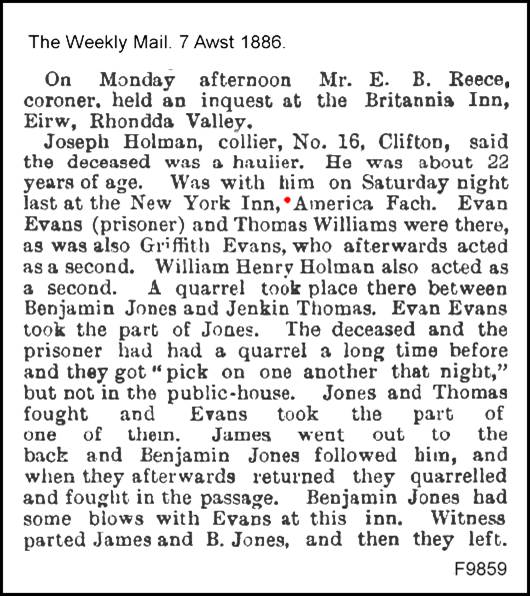
(delwedd 9859)
The Weekly Mail. 7 Awst 1886.
On Monday afternoon Mr. E. B. Reece, coroner held an inquest at the Britannia
Inn, Eirw, Rhondda Valley, Joseph Holman, collier, No. 16, Clifton, said the
deceased was a haulier. He was about 22 years of age. Was with him on Saturday
night last at the New York Inn, America Fach. Evan Evans (prisoner) and Thomas
Williams were there, as was also Griffith Evans, who afterwards acted as a
second. William Henry Holman also acted as a second. A quarrel took place there
between Benjamin Jones and Jenkin Thomas, Evan Evans took the part of Jones.
The deceased and the prisoner had had a quarrel a long time before and they got
“pick on one another that night,” but not in the public-house. Jones and Thomas
fought and Evans took the part of one of them. James went out to the back and
Benjamin Jones followed him, and when they afterwards returned they quarrelled
and fought in the passage. Benjamin Jones had some blows with Evans at this
inn. Witness parted James and B. Jones, and then they left.
:_______________________________.
Americanaidd <<a me ri NAN edh>> adjective
1 American
2 marchlyffant Americanaidd (Rana catesbeiana) American bullfrog
:_______________________________.
Americanes, PLURAL: Americanesau <<a me ri KAA nes, a me ri ka NE
se>> feminine
noun American woman
:_______________________________.
Americanwr PLURAL: Americanwyr <<a me ri KAA nur, a me ri KAN
wir>> [amɛrɪˡkaˑnʊr, amɛrɪˡkaˑnwɪr] masculine
noun
1 American (man)
2 Americanwyr Americans
:_______________________________.
am faint? <<am VAINT>> [am ˡvaint] interrogative
1 for
how long?
2 for how much money?
:_______________________________.
amffétamin, PLURAL: amffetaminau <<am FE ta min, am fe ta MII
ne>> masculine
noun [amˡfɛtamɪn, amfɛtaˡmiˑnai, - ɛ] masculine
1 amphetamine
:_______________________________.
amffibiad, PLURAL: amffibiadau <<am FIB yad, am
fib YAA de>> [amˡfɪbjad, amfɪbˡjaˑdai, -ɛ] masculine noun
1 amphibian
:_______________________________.
amffibus <<am FII bis>> [amˡfiˑbɪs] adjective
1 amphibious
:_______________________________.
amffitheatr <<am-fi-
THEE -atr>> [amfɪˡθeˑatər] masculine noun
PLURAL amffitheatrau <<am-fi-the-a-trai, -e>> [amfɪθɛˡatrai, -ɛ]
1 (American: amphitheater) (Englandic: amphitheatre)
= circular building with tiered seats around an arena
Amffitheatr Caerllion the Caerllion
Amphitheatre, the Roman amphitheatre to the south-east of the village
ETYMOLOGY: Welsh ← English amphitheatre
← Latin
(amphi- = on both sides, ←
Greek) + (Latin theâtrum ← Greek theatron
place for looking / watching / seeing / viewing ← theastai = to look).
In Y Drysorfa 1846 there appears a Welsh equivalent: amddrychfa
(“around-looking-place”). Not in general use.
:_______________________________.
am ffortiwn <<am FOR-tjun
>>
[am ˡfɔrtjʊn]
1 for all the
tea in China, for anything in the world, if you paid me
Wnawn i mohoni am ffortiwn I wouldn’t do it for all the tea in China,
I wouldn’t do it if you paid me
ETYMOLOGY: (“for a fortune”) (am
= for) + soft mutation + (ffortiwn = fortune)
:_______________________________.
amgaeëdig <<am gei EE dig>> [amgəɪˡeˑdɪg] adjective
1 enclosed
:_______________________________.
amgáu <<am GAI>> <<am-GAI>> [amˡgaɪ] verb
1 to enclose
:_______________________________.
amgen <<AM gen>> [amˡgɛn] adjective
1 different
2 dweud
yn amgen say otherwise (“say differently”)
a phwy bynnag a ddywedo yn amgen, dyweud
celwydd y mae
and anybody who says otherwise is a liar
3 neb amgen na none other than (“nobody
different than”)
Roedd y gadair yn perthyn i neb amgen na Iolo Morgannwg ei hun The chair belonged to none
other than Iolo Morgannwg
4 alternative
ETYMOLOGY: (?am = around) + soft
mutation + (cên, form of cyn = before)
:_______________________________.
amgenach <<am GEEN akh>> [amˡgeˑnax] adjective
1 better, more appropriate, more fitting
Ni allem gael ysgolháig amgenach i draethu ar y pwnc
We couldn’t have a better scholar to talk about this subject
Ar y peiriant gosodwyd rhybudd ffwrdd-â-hi yn Saesneg ac yn Gymraeg.Yn
Saesneg mae'n dweud, 'Not in use', ond yn Gymraeg gwelir 'Nid yw'n bod'. Yr
oeddwn yn meddwl bod cyfieithiad amgenach yn bosibl!
On the machine a slapdash sign had been placed, in English and in Welsh. In
English it says, ‘Not in use’, but in Welsh ‘Nid yw’n bod [it doesn’t exist’]
is to be seen. I though a more approriate translation was possible.
Gellir efnyddio olewau eraill i'r un diben ond cyfrifir olew olewydd yn
amgenach nag
unrhyw olew arall
Other oils can be used for the same purpose but oilive oil is considered
better than any other oil
2 other
Nid ydym yn rhan o genedl arall, a rhaid gwrthod unrhyw awgrym amgenach.
We are not part of another nation and we should reject any other notion.
3 nid + bod yn ddim amgenach na (be)
little more than, (be) no more than; (be) nothing more than, (be) merely
I’n teulu ni nid yw’r teledu yn ddim amgenach na rhywbeth wedi ei barcio
ar ben bwrdd bach yn y lolfa i edrych ar y newyddion o bryd i’w gilydd.
For our family the TV is nothing more than something parked on top of a
little table
in the lounge for looking at the news from time to time.
Nid oedd bara brith y siop honno yn ddim amgenach na thorth fach o fara gwyn
ag ambell gyrensen ynddi
Their ‘bara brith’ (‘speckled bread ‘= currant loaf) in that shop was
nothing more than a loaf of white bread with an occasional currant in it.
ETYMOLOGY: ‘more different’ (amgen =
different) + (-ach suffix to form
the comparative degree of an adjective)
:_______________________________.
amguedd <<am-GII-edh>> [amˡgiˑɛð] masculine
noun
1 obsolete
things held dear; property, wealth, treasure
A dyna fu fy hanes innau, fel eraill o’m
cydweithwyr sy’n fawr eu dyled i gynheiliaid traddodiad diwylliedig yng
Nghymru. Darganfod y trysor sydd o’n cwmpas - ein ‘hamguedd’. Ac wedi darganfod
trysor o’r fath, ein braint a’n dyletswydd yw ei ddiogelu (“Llafar Gwlad”,
Rhif 60, Haf 1998)
[And that has been my story, like others of my fellow workers who are greatly
indebted to the upholders of our cultural tradition in Wales. To discover the
treasure which is around us - our ‘amguedd’. And after finding a treasure of
this sort, our privilege and duty is to protect it (“Llafar Gwlad” (‘folk
speech’), Number 60, Summer 1998) ]
ETYMOLOGY: (1) (am- = prefix,
literally “around”) + soft mutation + (cuedd
= affection, love);
(2) cuedd is (cu adjective = dear, loved) + (-edd = suffix for forming abstract
nouns)
:_______________________________.
amgueddfa <<am-gi-EDH-va>> [amgɪˡɛðva] feminine noun
PLURAL amgueddféydd <<am-gi-edh-VEIDH>> [amgɪɛðˡvəið]
1 museum
ETYMOLOGY: (amguedd = treasure) + (-fa, suffix = place); a word coined by
the lexicographer William Owen-Pughe, found in his 1793 dictionary (“A Welsh
and English Dictionary”)
:_______________________________.
amgueddfaol <<am-gi-edh-VAA-ol>> [amgɪɛðˡvaˑɔl] adjective
1 (qualifier) museum
Pam maent hwy wedi gadael i reolaeth
prif sefydliadau amgueddfaol Cymru fynd i ddwylo rhai mor ddibrys o’n hiaith?
Why have they let the control of the major museum institutions in Wales fall
into the hands of people so contemptuous of our language?
ETYMOLOGY: (amgueddfa = museum) + (-ol = suffix for forming adjectives)
:_______________________________.
amgueddfa werin <<am-gi-EDH-va WEE-rin>> [amgɪˡɛðva ˡweˑrɪn] feminine noun
PLURAL amgueddféydd gwerin <<am-gi-edh-VEIDH GWEE-rin>> [amgɪɛðˡvəɪð ˡgweˑrɪn]
1 folk museum
ETYMOLOGY: (amgueddfa = museum) +
soft mutation + (gwerin = common
people, ordinary people, folk)
:_______________________________.
Amgueddfa Werin Cymru <<am-gi-EDH-va WEE-rin KƏM-ri>> [amgɪˡɛðva ˡweˑrɪn ˡkəmrɪ] feminine
noun
1 the Museum of Welsh Life (formerly the
English name was ‘The Welsh Folk Museum’) (at Sain Ffagan, Caer-dydd)
ETYMOLOGY: (“(the) ‘amgueddfa werin’ (of) Wales”).
:_______________________________.
am gydol y flwyddyn <<am
gəə-dol ə vlui-dhin>> [am ˡgədɔl ə ˡvluiðɪn] feminine noun adverb
1 all year round
ETYMOLOGY: “during (the) whole (of) the year” (am = around; during, for) + soft mutation + (cydol = whole) + (y =
the) + soft mutation + (blwyddyn =
year)
:_______________________________.
amgyffred <<am- gə-fred>> [amˡgəfrɛd]
verb with an object
1 comprehend, take in the significance of
a thing
:_______________________________.
amgyffred <<am- gə-fred>> [amˡgəfrɛd] masculine noun
PLURAL amgyffredion <<am-gə-fred-yon>> [amgəˡfrɛdjɔn]
1 grasp, comprehension, understanding
ETYMOLOGY: (am- = prefix) + soft
mutation + (cyffred = course), (cyfr- = complete) + soft mutation + (rhed = run)
:_______________________________.
amgylch <<am -gilkh>> [ˡamgɪlx] masculine noun
PLURAL amgylchoedd, amgylchion <<am- gəl –khoidh, -odh; am-gəlkh-yon>> [amˡgəlxɔi̯ð, -ɔð; amˡgəlxjɔn]
1 obsolete
circumference
2 amgylchoedd
surroundings
Brehinoedd-2 23.5 yn ninasoedd Jwda, ac
yn amgylchoedd Jerwsalem
Kings-2 23.5 in the cities of Judah, and in the places round about Jerusalem
Adgofion (= atgofion) am Donyrefail a’r Amgylchoedd
Reminiscences of Tonyrefail and the places around it / and the surrounding area
(article in “Tarian y Gweithiwr” 1888)
3 o
amgylch around
ETYMOLOGY: (am- = prefix) + soft
mutation + (cylch = circle)
:_______________________________.
amgylchiad << am- gəlch -yad>> [amˡgəlxjad] m
PLURAL amgylchiadau <<am-gəlch- yaa -de>> [amgəlxˡjaˑdai, -ɛ]
1
circumstance
amgylchiadau dirgel ei marwolaeth
the mysterious circumstances of her death
2
incident, event
amgylchiad mewn oes once in a
lifetime event
Gofiwch chi’r amgylchiad? Do you
remember the event? Do you remember it?
3 ac ystyried yr amgylchiadau all things
considered, considering the circumstances, in view of the situation
dan yr amgylchiadau all things
considered, considering the circumstances, in view of the situation
4 condition, state
amgylchiadau conditions = circumstances
Roedd y gwaith yn galed a'r amgylchiadau'n
arw iawn, gan ei fod yn gweithio hyd at y canol mewn dŵr yn
y pwll The work was hard and the
conditions were bad since he was working up to his waist in water in the pit
5 pregnancy
Er mai yn y Rhyl y maged ef nid
yn y dref honno y ganed ef. Gwelodd olau dydd gyntaf yn Rhos-lan, Eifionydd,
yng nghartref ei daid a'i nain oedd. Adeg ei eni, aeth ei mam adref dros yr
amgylchiad Though he was brought up in Rhyl he wasn’t born in the town. He
first saw light of day in Rhos-lan, Eifionydd, in the home of his grandfather
and grandmother. At the time of his birth, his mother had gone home during her
pregnancy.
ETYMOLOGY: (amgylch- <<ə>> ← amgylch
<<i>> = circumference) + (-i-ad noun-forming suffix)
:_______________________________.
amheuaeth <<a-mhei-aith, -eth>> [amˡhəiaiθ / amˡhəiɛθ]
feminine noun
1 doubt
2 bwrw amheuaeth ar (rywbeth) cast doubts on (something), throw (something) into doubt , call (something) into question
3 y
tu hwnt i bob amheuaeth beyond doubt (“beyond all doubt”), beyond question,
beyond dispute
:_______________________________.
amheuon <<am-HEI-on>> [amˡhəiɔn]
1 plural of the noun amau (= doubt)
:_______________________________.
amheus <<a-MHEIS>> [amˡhəis] adjective
1 doubtful
2 helygen
amheus (Salix ambigua) ambiguous willow
:_______________________________.
amhlantadwy <<am-hlan-TAA-dui>> [amhlantˡaˑdui] adjective
1 barren, unable to conceive
Genesis 11:30 A Sarai oedd amhlantadwy,
heb blentyn iddi.
Genesis 11:30 But Sarai was barren; she had no child
ETYMOLOGY: (an- negative prefix) +
nasal mutation + (plantadwy = able to
produce children)
:_______________________________.
amhosibl (amhosib’) <<am HO sibl, -sib>> [amˡhɔsɪbl, amˡhɔsɪb] adjective
1 impossible
2 yr amhosibl (m) the impossible = something which cannot
be done
ceisio gwneud yr amhosib’ try to do the impossible
:_______________________________.
amhreswyliadwy <<a-mhres-uil-yaa-dui>> adjective
1 uninhabitable
ETYMOLOGY: (an- negative prefix) +
nasal mutation + (preswyliadwy =
habitable)
:_______________________________.
aml (amal) <<A mal>> adjective
1 often
2 (before a noun) many a
Mae aml lwyth wedi troi yn y porth
Don’t count your chickens before they’re hatched / There’s many a slip ’twixt
cup and lip
(“many a cartload has rolled over / turned over at the (city) gate”)
:_______________________________.
amldra <<A məl-dra>> adjective
1 plenty, abundance
Genesis 41:53 Darfu'r saith
mlynedd o amldra
And the seven years of plenteousness.... were ended
:_______________________________.
amlen, PLURAL:
amlenni <<AM len, am LE ni>> feminine noun
1 envelope
:_______________________________.
amlgymharus <<a-məl-gə- mhaa -ris>> adj
1 promiscuous
ETYMOLOGY: (aml-, prefix = multi ) +
soft mutation + (cymharus);
cymharus: (cymhar- penultimate
syllable stem ← cymar = pair)
+ (-us suffix for forming
adjectives)
:_______________________________.
amlosgiad <<am-losk-yad>> masculine
noun
PLURAL amlosgiadau <<am-losk-yaa-de>>
1 cremation = act of burning the body of
a dead person
ETYMOLOGY: (amlosg-, stem of amlosgi = cremate) + soft mutation + (-iad, suffix for forming nouns)
:_______________________________.
Amlwch <<AM lukh>> feminine noun
1 place name: (the) edge (of) (the) lake
:_______________________________.
amlwreiciaeth
<<a-mal-WREIK-yaith, -yeth>> [ˡamalˡwreikjaɪθ, -jɛθ] adjective
1 bigamy
Dygwyd David Jones, Abergwaen, o flaen y llys ynadol yn Hwlffordd, ddydd
Iau, ar y cyhuddiad o amlwreiciaeth. Wedi gwrandaw y gwahanol dystioliaethau,
traddodwyd y carcharor i sefyll ei brawf yn y frawdlys nesaf yn Abertawe.
Baner ac Amserau Cymru. Dydd Mercher, 22 Ebrill 1885.
David Jones, of Aber-gwaun / Fishguard, was brought before the magistrate’s
court in Hwlffordd / Haverfordwest on Thursday accused of bigamy. After hearing
the evidence (‘various evidences’), the prisoner was remanded in custody (‘was
delivered; was sent [to prison]) to stand trial in the next assize court
session in Abertawe / Swansea.
Baner ac Amserau Cymru. Dydd Mercher, 22 Ebrill 1885.
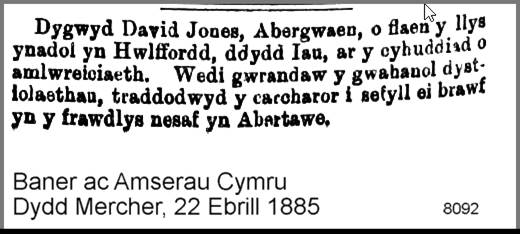
(delwedd 8902)
ETYMOLOGY: amlwraig (aml = frequent, many) + soft mutation + (gwraig = wife); + (-i-aeth = abstract suffix)
:_______________________________.
amlwg <<AM-lug>> [ˡamlʊg] adjective
1 evident, clear
2 anamlwg
inconspicuous
(an- = negative prefix) + (amlwg = obvious )
:_______________________________.
amneidio <<am-NEID-yo>> [amˡnəɪdjɔ] verb
1 to nod
2 amneidio
ar rywun i wneud rhywbeth signal to somebody (with a nod of the head) to do
something (“to nod on somebody to do something”)
:_______________________________.
amnewidyn <<am-neu-II-din>> [amnɛʊˡiˑdɪn] masculine noun
PLURAL amnewidynnau <<am-neu-i-DƏ-nai, -ne>> [amnɛʊɪˡdənaɪ, -ɛ]
1 substitute replacement, substance which
takes the place of another
amnewidyn llaeth milk substitute
ETYMOLOGY: (amnewid-, stem of the
verb amnewid = substitute) + (-yn,
suffix)
:_______________________________.
amod PLURAL: amodau <<A-mod, -a-MOO-dai, -de>> [ˡamɔd, aˡmoˑdaɪ, -ɛ] masculine or feminine noun
1 condition
2 cymal
amod conditional clause
:_______________________________.
amor <<A-mor>> [ˡamɔr] masculine
noun
1 (obsolete) fate, fortune, success
Occurs in the expression Hawddamor!
Good fortune! Good luck! May fortune smile on you! May fortune come your way!
Used in the University of Wales graduation ceremony
Hawddamor, wrda Good luck, worthy
man
Hawddamor, wreigdda Good luck,
worthy woman
2 (obsolete) farewell
canu hawddamor i say farewell to
(“sing success to”)
ETYMOLOGY: Origin unknown. Possibly the word ‘hawddamor’ with the first element
detached, rather than ‘hawddamor’ = hawdd + amor.
(hawdd = easy; but formerly = pleasant, happy).
:_______________________________.
amrant <<AM-rant>> [ˡamrant] masculine
noun
PLURAL amrantau, amrannau <<am-RA-nai, -e, am-RAN-tai,
-te>> [amˡran aɪ, -ɛ, amˡrantaɪ, -ɛ]
1 eyelid
2 llid yr amrant
conjunctivitis, inflammation of the conjunctiva (= transparent membrane over the eyeball and under the surface of the
eyelid)
(“inflammation (of) the eyelid”)
3 ar drawiad amrant / ar
darawiad amrant instantly
(“on (a) bat (of a) eyelid”)
Syrthiodd carreg fawr yn union ar ei
gefn, a llethwyd ef i farwolaeth ar darawiad amrant.
A large stone fell right onto his back, and he was crushed to death instantly
ETYMOLOGY: Welsh ← British
From the same British root: Breton abrant
(= eyelid)
:_______________________________.
amrantiad, PLURAL: amrantiadau <<am-RANT-yad, am-rant-YAA-dai, -de>> [amˡrantjad,amrantˡjɑˑdaɪ, -ɛ] masculine noun
1 “(the) (movement) (of) (an) eyelid”,
wink / blink of the eye
2 ar
amrantiad <<a ram RANT yad>> (adverb) instantly “on (the) (movement) (of) (an) eyelid”
:_______________________________.
amrwd <<AM-rud>> [ˡamrʊd] adjective
1 raw
cig
amrwd raw meat
:_______________________________.
amrydedd <<am-RƏ-dedh>> [amˡrəˑdɛð] masculine
noun
1 crudity = lack of refinement
2 (cooking) rawness = lack of cooking,
insufficient cooking
ETYMOLOGY: (amryd-, penult form of amrwd = raw) + (-edd suffix for forming abstract nouns)
:_______________________________.
amryfal <<am-RƏ-val>> [amˡrəˑval] adjective
1 various
:_______________________________.
amryw <<AM-riu>> [ˡamrɪʊ] (adverb)
1 some
2 (quantifier) amryw o =
various, several, a number of, many
Fel plentyn yr oeddwn yn gwrthod bwyta nionod a madarch a ffa ac amryw o
bethau yr wyf, erbyn hyn, yn eu hoffi'n fawr
When I was little I refused to eat onions and mushrooms and beans and many
things that now I’m very fond of
Roedd efo ni Gwerfyl, y ddau hogyn, ac amryw o'r teulu
Gwerfyl was there, (and) the two boys, and various family members
Gyda llaw, yr oedd amryw o Gymry yn byw yn Judson, ond dim ond tri ohonynt a
fedrai siarad iaith ein gwlad yn hwylus
By the way, there were several Welsh people living in Judson, but only three of
them were able to speak the language of our country without difficulty
3 amryw byd
o very many
Mae gen i amryw byd o bethe i’ neud heddi I’ve got hundreds of things to
do today
:_______________________________.
amrywiaeth PLURAL: amrywiaethau <<am-RIU-yaith, -yeth, am-riu-YEE-thai, -the>> [amˡrɪʊjaɪθ, -jɛθ, amrɪʊˡjeˑθaɪ, -ɛ] feminine noun
1 diversity
undeb mewn amrywiaeth unity in
diversity
:_______________________________.
amrywio <<am-RIU-yo>> [amˡrɪʊjɔ] verb
1 vary
:_______________________________.
amrywiol <<am-RIU-yol>> [amˡrɪʊjɔl] adjective
1 various
:_______________________________.
amsang PLURAL:
amsangau <<AM-sang>> [ˡamsaŋ, amˡsaŋaɪ, -ŋɛ] masculine noun
1 tread, step
·
“Yn
Amsang y Tadau / The
Antiquaries' Column” (= in the footsteps of our forefathers, “in [the] tread
[of] the fathers”)).
AM- prefix = around; SANG-, root of
SENGI = to trample, to tread
_______________________________.
amser, PLURAL:
amserau / amseroedd <<AM-ser, am-SEE-rai, -e,
am-SEE-roidh, -rodh>> [ˡamsɛr, amˡseˑraɪ, -ɛ, amˡseˑrɔɪð, -ɔð] masculine noun
1 time
2 Dyna fuan yr â’r amser
heibio How time passes / flies!
Dyna fynd y mae’r amser How time passes / flies!
3 bwrw'r
amser heibio while away the time
4 colli
amser lose time
heb golli gormod o amser without spending too much time (doing it)
Carwn eu gweled, os gallaf, ar fy nhaith
tua Chymru, heb golli gormod o amser.
I’d like to see them, if I can, on my way to Wales, without losing too much
time
5 bod yn eich oed a’ch amser
be well on in years, be well on in life, be of advanced years, be of mature
years (“be in your age and your time”)
Mae e yn ei oed a’i amser He’s well on in years
6 yn nhrefn amser with the passage of
time, over time (“in (the) order (of) time”)
gydag amser with the passage of
time, over time (“with time”)
7 cyfyngiad amser caeth strict time-limit
8 ar amserau at times
:_______________________________.
amser hamdden <<<<AM-ser HAM-dhen>> [ˡamsɛr ˡhamðɛn] masculine noun
1 leisure time
:_______________________________.
amseriadur <<am-ser-YAA-dir>> [amsɛrˡjɑˑdɪr] masculine
noun
PLURAL amseriaduron <<am-ser-ya-DII-ron>> [amsɛrjaˡdiˑrɔn]
1 timer = a clock that measures an
interval of time and emits a signal when this interval is over
2 timer = regulator that switches on or off
a mechanism at stipulated times
ETYMOLOGY: (amser-, atem of amseru = to time) + (-i-adur noun-forming suffix, indicating
a device)
:_______________________________.
amserlen, PLURAL:
amserlenni <<am-SER-len, am-ser-LEE-ni>> [amˡsɛrlɛn, amsɛrˡleˑnɪ] feminine
noun
1 timetable
:_______________________________.
amserol <<am-SEE-rol>> [amˡseˑrɔl] adjective
1 timely
:_______________________________.
amwyll <<A-muilh>> [ˡamʊɪɬ] adjective
1 (literary
Welsh) mad, foolish
Llidiog, amwyll, digymod ydyw dyn...
(it is) angry, foolish, uncompromising (that) mankind is (“Camwedd” T. Twynog
Jeffreys, 1912)
ETYMOLOGY: (am- negative prefix) +
nasal mutation + (pwyll = sense)
>> ám-mhwyll >> amwyll
:_______________________________.
amwys <<A-muis>> [ˡamʊɪs] adjective
1 ambiguous
2 diamwys
unambiguous
ETYMOLOGY: amwys ← *amfwys (am- intensifying prefix) + soft mutation + (mwys = ambiguous, ← Latin mênsa
= table)
:_______________________________.
Amwythig <<a-MUI-thig>> [aˡmʊɪθɪg] feminine noun
1 Shrewsbury - a town in Shropshire,
England
:_______________________________.
am y...
1 am y gwelwch chi as far as the eye can see
:_______________________________.
amynedd <<a-MƏ-nedh>> [aˡmənɛð] masculine noun
1 patience
2 Caffed amynedd! Be
patient!
(from the New Testament Caffed amynedd ei pherffaith waith = let
patience have her perfect work)
Epistol Iago yr Apostol 1.4 Ond caffed amynedd ei pherffaith waith; fel y
byddoch berffaith a chyfan, heb ddiffygio mewn dim.
Epistle of James the Apostle 1.4 But let patience have her perfect work,
that ye may be perfect and entire, wanting nothing.
i.e. achieving perfection requires
patient effort
3 diffyg
amynedd impatience
:_______________________________.
amyneddgar <<a-mə-NEDH-gar>> [aməˡnɛðgar] adjective
1 patient
:_______________________________.
am yr eildro <<am ər EIL dro>> [am ər ˡəɪldrɔ] adverb
1 for a second time, for the second time
also: yr eildro
priodi am yr eildro / priodi’r eildro
get married for the second time
NOTE: Also: am yr eiltro
:_______________________________.
..1 an- <<AN>> [an] prefix
1 negative prefix, which caues a spirant
mutation of initial letters p t c d in the base word
P parod (= ready, prepared); amharod (= unprepared)
T trugarog (= merciful), anhrugarog (= unmerciful)
C caredig (= kind), angharedig (= unkind)
D democrataidd (= democratic), annemocrataidd (= undemocratic)
2 the
prefix an causes no mutation with ll rh
LL llythrennog (= literate), anllythrennog (= illiterate)
RH rhamantus (= romantic), anrhamantus (= unromantic)
3 soft mutation with intial consonants b g m
G gobeithiol (= hopeful), anobeithiol (= hopeless)
B bodlon (= satisfied), anfodlon (= dissatisfied), barddonol (= poetic), anfarddonol (= unpoetic)
M mantais (= advantage), anfantais (= disadvantage)
4 sometimes used in a way similar to the
English prefix ‘non-’ with adjectives or nouns;
(a) equivalent to English ‘non-’ as a negative
anfodolaeth non-existence
anfolcanig non-volcanic
(b) equivalent to English ‘non-’ meaning ‘forming part of a specified category’
ieithoedd an-Ewropeaidd non-European
languages
anymladdwr = non-combatant
ETYMOLOGY: Welsh ← British ← Celtic ← Indoeuropean *n;
Cornish an-, Breton an-; Irish in-;
Corresponds to Latin in-
:_______________________________.
..2 an- <<AN>> [an] prefix
1 equivalent to English “in”; followed by
nasal mutation. The following may date from British, but they are shown with
their constituent parts in modern Welsh
(1) angladd (= funeral)
(an- = in) + (cladd = burial)
(2) anian (= nature, disposition,
temperament)
Of British origin (*eni-gen-), equivalent to modern Welsh (an- = in) +
soft mutation + (gan- as in ganwyd = was born ← geni
= to be born) (“something inborn”)
Cf Latin ingenium (= inborn character), from which English
ingenious derives – this is (in = in, inside) + (gen-,
root of past participle genitus of the verb gignere = to
engender, to bring into being) ← Indo-European gen- (= to give birth, to
give birth to), found in very many words in English. Others are:
(i) From Germanic: king, kin, kind (= type), kind (= warm-hearted),
kindergarten;
(ii) Ultimately from Greek: gene, gonad, genealogy, genocide, heterogeneous,
genesis
(iii) From Latin: gender, general, generate, generous, genre, generous,
degenerate, engender, genius, indigenous, genune, germ.gentle, genteel, gentry,
jaunty, genital, congenital, genitive, progeny, nature, naive, cognate, naal,
renaissance, nation, benign, malign
(3) Annwfn (= Hell)
(an- = in) + nasal mutation + (dwfn = deep)
(4) ansawdd (= quality)
(an- = in) + (sawdd)
sawdd is possibly a form of
Indo-European *stâ, as in English stand, Latin stâre, status, Catalan estar
(= to be); or from Indoeuropan *sed-
(= sit)
ETYMOLOGY: an ←
British *eni; cf Latin in-
:_______________________________.
an- <<AN>> [an] prefix
1 intensifying prefix (+ soft mutation)
..1/ anad (= in preference to) ← án-ghnad (an-) + soft mutation + (gnad)
In modern Welsh in the preposition yn
anad... (= more than (something), above (something))
..2/ anfon (= to send)
..3/ angerdd (= passion) (modern
a-ngerdd, but historically an-gerdd) (cerdd
= craft)
..4/ anchwant (obsolete; = pleasant;
greedy) (chwant = desire)
..5/ annedd (= dwelling)
..6/ anrheg (= present)
..7/ anial (= desert) (iâl =
upland)
2 no mutation (or the mutation has been
lost) with ll-, rh-;
..1/ anllad = lewd, unseemly
(related to the word llawd = heat
(of a sow))
..2/ anrheg = present
3 also as en- if there is i or y in the following syllable
(enbyd, enfys, enllib, enllyn, enwyn)
the result of vowel affection
..1/ enbyd (= danger)
(an-) + soft mutation + (pyd) >> *anbyd >> enbyd.
Obsolete Welsh pyd ( = danger),
apparently from Latin puteus (=
hole, well) The same word puteus has
also given pydew (= well) in Welsh.
..2/ enfys = (rainbow)
(an-) + soft mutation + (bys = finger); Cf Breton envez (= ring)
..3/ enllib (= calumny, libel,
slander) (= an-) + soft mutation + (llib = element aparently with the sense of ‘to catch’) >> *enlib >> enllib (loss of the mutation)
..4/ enllyn (= something eaten with
bread (eg butter, cheese, meat), something to make plain food more palatable)
(an = intensifying prefix) + soft
mutation + (llyn = liquid) >> *enlyn >> enllyn (loss of the mutation)
..5/ enwyn = buttermilk
‘very white’ (an- = intensifying
prefix) + soft mutation + (gwyn =
white)
ETYMOLOGY: British *an- ← Celtic ande-
← Proto-Indo-European *h₁n̥dó.
Gaulish also had ande- (Anderoudos) (“very red”)
From Celtic *roudos (= red) ← IE *roudho- (= red)
Corresponds to Cornish an- (=
intensifying prefix), Breton an- (=
intensifying prefix);
:_______________________________.
..4 an- <<AN>> [an]
1 (an-
+ vowel) is sometimes a misspelling for (an
+ n- + vowel)
i.e. although the general rule is that a doubled letter can only occur in a
tonic syllable in polysyllabic words (glan
= riverbank, glannau = riverbanks),
when the prefix an- alters an
initial consonant or procedes an original n, the resulting double consonant is
kept, although pronounced as a single consonant in modern Welsh
datod untie
annatod that cannot be untied (not *anatod)
naturiol natural
annaturiol unnatural (not *anaturiol)
:_______________________________.
..1 -an <<AN>> [an] suffix
1 diminutive suffix. A non-productive
suffix - not used spontaneously in modern Welsh to produce new words.
Many words with -an are literary
words and not generally used in the spoken language.
The suffix does not change the gender of the root word.
arth (bear) >> arthan (bear cub) (obsolete) (it
is also a proper name Arthan)
awel (breeze) >> awelan (gentle breeze) (obsolete)
awr (hour), awran (hour) (obsolete)
baril (barrel), barilan (keg) (obsolete)
croes (cross) >> croesan (little cross) (obsolete)
din (fort) >> dinan (little fort) (in the place name
Llandinam ← llan y dinan) (obsolete)
dyn (man) >> dynan (little man) (obsolete)
gwraig (woman) >> gwreigan (little woman) (in use)
heol (road) >> heolan (lane) (obsolete)
hun (oneself) >> hunan (oneself) (in general use)
2 diminutive suffix with adjectives
*bych (small), bychan (small, tiny)
3 names from the British period
(apparently only male names)
Arthan (arth = bear),
Brychan (British: *Brokk-agn-) (broch = badger)
Cïan (ci = dog, warrior),
Corfan (British: *Korb-agn-) (place
names: Cwm Carfan, Llancarfan)
Cynan (cyn-, form of ci = dog,
warrior)
Dyfnan (dwfn = deep; it must also have meant
“world” in British. This meaning is conserved in Irish – domhan (= world), domhain (= deep). The Irish common noun domhán (= little world) is equivalent to this Welsh name.
Lleisian (now Lleision,
surviving as a surname, anglicised as “Leyshon”), (llais = voice)
Maelan (British: *Magl-agn-) (mael = lord, great man)
Rheithan (place name: Llanrheithan) (rhaith = law)
4 names in recent periods (male and
female):
Dafydd (David) >> Dei >>
Deian
Elísabeth (Elizabeth) >> Betsi
(Betsy) >> Betsan
Elísabeth (Elizabeth) >> Bèth
>> Bethan
Gwen (= Gwenllian) >> Gwennan
Margred (Margaret) >> Mèg >>
Megan
Saran (Sarah) >> Saran
5 In place names (these are archaic forms which have been
preserved in names):
carnan (f)
(= little cairn)
(carn = cairn, pile of
stones, grave marker) + (-an diminutive suffix added to nouns)
Pencarnan, county of Penfro SM7225
........................................................
cilan (m) (= recess, nook; cove, small bay; creek,
inlet of sea)
(cil = nook, recess, creek) + (-an diminutive suffix added to
nouns)
........................................................
crugan (m)
(= little mound)
There is a “Crugan Avenue” (which would be Coedlan
y Crugan / Coedlan Crugan or Rhodfa’r
Crugan in Welsh) in Baecinmel (SH9880) (county of Conwy). Crugan is
“little mound”
(crug = mound, tumulus) + (-an diminutive suffix added to nouns)
........................................................
dinan (m) (=
little fort): Llandinam (Powys)
........................................................
ffrydan <<FRƏ-dan>> [ˡfrədan] (f) (= small stream)
Ffrydan name of a stream by Y Bala
(ffryd- penult form of ffrwd = torrent) + (-an diminutive suffix)
........................................................
maenan (m)
(= little stone)
........................................................
gogerddan (=
little slope): Gogerddan (Ceredigion)
........................................................
rhosan (f)
(= little moor) Y Rhosan ar Wy (Welsh name of Ross on Wye)
........................................................
6 The suffix is also added to adjectives
to form nouns:
Cledan ← Caledan (caled = hard; strong,
swift-flowing) + (-an diminutive
suffix added to adjectives). Name of a stream “little / fast-flowing /
(stream)”
tegan (= toy, plaything)
(teg = beautiful, fair) + (-an
diminutive suffix added to adjectives).
ETYMOLOGY: . Welsh -an ← -a’n
← -aghn ←
British -agn ←
Celtic *-a-gno-
From the same British root: Cornish -an,
Breton -an;
From the same Celtic root: Irish -án
:_______________________________.
anabl (= anábl) <<an-AA-bal>> [anˡɑˑbal] adjective
1 disabled, incapacitated
gweithwyr anábl disabled workers
ETYMOLOGY: (an- = negative prefix) +
(abl = able)
:_______________________________.
anabledd <<an-A-bledh>> [anˡablɛð] masculine noun
1 disability, disablement;
anabledd corfforol physical
disability
anabledd difrifol serious disability
anabledd parhaol permanent disability
2 pensiwn
anabledd disabilty pension = allowance paid to people unable to work
because of a disablity
Also: lwfans
anabledd disablity
allowance
lwfans anabledd difrifol serious disablity allowance
3 bathodyn
anabledd disability badge, disability sticker; car badge with a wheelchair
symbol which indicates that the driver is disabled and so may park the car in
places reserved for disabled drivers only
4 chwaraeon anabledd disability sport
ETYMOLOGY: (anabl = unable, incapable) + (-edd abstract noun suffix)
:_______________________________.
anachronistaidd <<a-na-khro-NI-staidh, -stedh>> [anaxrɔˡnɪstaɪð, -ɛð] adjective
see anacronistaidd
:_______________________________.
anacronistaidd <<a-na-kro-NI-staidh, -stedh>> [anakrɔˡnɪstaɪð, -ɛð] adjective
1 anachronistic = incorrect for a certain
time period, being in the wrong position in a sequence or chronology
2 anachronistic = seeming to belong to an earlier time, belonging to a past
time and out of place in the present time
Mae'n siŵr gen i bod pawb yn gwybod bod baner Jac yr
Undeb yn fflag anacronistaidd
I’m sure everybody knows that The Union
Jack is an anachronistic flag
ETYMOLOGY: adaptation of the English word anachronistic
(ənakrənístik), ← Latin ← Greek anakhronismos
= mistake in a time sequence or chronology, from the verb anakhronizein = be mistaken about the
time ← (ana =
negative prefix) + (khronos = time);
(anacronist-) + (-aidd)
:_______________________________.
anacronistiaeth <<a-na-kro-NIST-yaith, -yeth>> [anakrɔˡnɪstjaɪθ, -ɛθ] feminine noun
PLURAL anacronistiaethau <<a-na-kro-nist-YEI-thai, -the>> [anakrɔnɪstˡjəɪθaɪ, -ɛ]
1 anachronism = something which belongs to
a past time and is out of place in the present time
Anacronistiaeth yw Ty’r Arglwyddi
The House of Lords is an anachronism
ETYMOLOGY: (anacronist-, from the
adjective anacronistaidd =
anachronistic) + (-i-aeth)
:_______________________________.
anad <<AA-nad>> [ˡɑˑnad] preposition
1 before, more than, rather than
yn anad neb more than anyone else
yn anad dim above all
yn anad un more than anything else
arferer geiriau gwir Gymráeg yn anad pob
rhyw air alltud
use (“let there be used”) proper Welsh words rather than all kinds of foreign
words
2 obsolete;
adjective special
ETYMOLOGY: anad ← *anghnad
(an- = intensifying prefix) + soft
mutation + (gnad = ??);
Breton has anat (= evident, obvious
).
This is British *ate-gnat- >>
Breton aznat >> (a’nat with
the loss of the “z”) >> anat
:_______________________________.
anaddas <<an-AA-dhas>> [anˡɑˑðas] adjective
1 inappropriate, unsuitable, unfit,
unseemly, unworthy
atal pobl anaddas rhag gweithio gyda phlant a phobl ifanc
preventing unsuitable people from working with children and young people
ETYMOLOGY: (an- = negative prefix) +
(addas = appropiate)
:_______________________________.
anadferadwy <<an-ad-ve-RAA-dui>> [anadvɛˡrɑˑdʊɪ] adjective
1 irreparable, beyond repair, written
off, unmendable
Achosodd hyn rwyg anadferadwy rhyngddo
â’i ferch
This caused an irrevocable split between him and his daughter
2 chwalfa anadferadwy (marriage)
irretrievable breakdown , irremediable breakdown
TAW anadferadwy irrecoverable VAT, Value-Added Tax that cannot be
reclaimed from the tax authorities because an individual or institution was not
exempt from the tax, though meriting exemption from this tax; or the amount
should not have been paid by an individual, institution, etc, but the money
paid in is considered non-returnable by the tax authority
ETYMOLOGY: (an- = negative prefix) +
(adferadwy = mendable, repairable)
:_______________________________.
anadl <<AA-nadl>> [ˡɑˑnadl] masculine noun
1 breath
2 â’ch
anadl yn eich dwrn <<akh
AA-nadl ən əkh DURN>> [ax ˡɑˑnadl ən əx ˡdʊrn] out of breath, breathless (“with your breath in your
fist”)
3 Mae
gwynt drwg ar ei anadl He’s got bad breath, his breath smells (“there’s a
bad smell on his breath”)
Also: Mae gwynt cas ar ei anadl
(“there’s a nasty smell on his breath”)
NOTE: Southern anaddl >> ana’l <<AA-nal>> [ˡɑˑnal]
:_______________________________.
anadlu <<a-NAD-li>> [aˡnadlɪ] verb
1 to
breathe
iawndal i gyn-lowyr sy’n dioddef o
broblemau anadlu
compensation for miners with (“suffering from”) breathing problems
anadlu’n drwm breathe heavily
anadlu’n ddwfn breathe in deeply
2 anadlu i
lawr gwegil rhywun breathe down one's neck, be close in pursuit of someone
ETYMOLOGY: (anadl = breath) + (-u verbal suffix)
:_______________________________.
anaele <<a-NEI-le>> [aˡnəɪlɛ] masculine noun
1 pain,
suffering
2 (adj)
fatal
3 (adj)
dire, terrible
trychineb anaele terrible tragedy
poen anaele a terrible pain
4 extremely
(follows an adjective)
ETYMOLOGY: (an = intensifying
prefix) + (aele = pain, suffering);
aele = British *ad-le.
The second element is in modern Welsh lle
(= sad, heavy), though this word is no longer in use
NOTE: Also anaelau
:_______________________________.
anaf, PLURAL: anafau <<AA-nav, -a-NAA-vai,
-ve>> [ˡɑˑnav, aˡnɑˑvaɪ, -ɛ] masculine noun
1 injury, wound
1 cael anaf hurt oneself, injure
oneself
y rhai oedd wedi cael anaf neu'n mynd yn sâl
the people who had received an injury or had become ill
cael anaf i'r goes receive an injury to the leg
cael anaf i’ch asennau isaf receive an injury to your lower ribs
2 rhoi
sarhâd ym mhen anaf add insult to injury (“put an insult in the top of an
injury”)
3 dianaf uninjured, unhurt
ETYMOLOGY: From British. Irish has ainimh (= defect)
:_______________________________.
anafiad <<a-NAV-yad>> [aˡnavjad]
masculine noun
PLURAL anafiadau [anavˡjɑˑdaɪ, -ɛ]
1 injury, lesion
2 (Football) amser anafiadau
injury time
3 cael aniafiadau i'w ben
suffer head injuries
ETYMOLOGY: (anaf = injury) + (-i-ad noun-forming suffix)
:_______________________________.
anafu <<a-NAA-vi>> [aˡnɑˑvɪ] verb
1 to
injure, wound
:_______________________________.
-anaidd <<A-naidh, -nedh>> [ˡanaɪð, -ɛð]
1 (-an
+ -aidd) In adaptations od English adjectives with final -an
Affricanaidd African
Americanaidd American
Awstalianaidd Australian
cosmopolitanaidd cosmopolitan
Mecsicanaidd Mexican
:_______________________________.
anair <<AA-nair>> [ˡɑˑnaɪr] masculine noun
1 slander, calumny
rhoi anair i blacken the name of
(somebody), demonize (someone), give (someone) a bad name
dwyn anair ar (rywun) (“bring slander
on”) give (someone) a bad name
ETYMOLOGY:
Either:
..1 ( an- = negative prefix) + soft
mutation + ( gair = word),
án-ghair >> án-’air >> anair
or:
..2 if based on a British / Welsh equiavalent to the Irish word náire (= shame)
( an- intensifying prefix) + ( *nair = shame);
:_______________________________.
anallu <<an-A-lhi>> [anˡaɬɪ] masculine
noun
1 inability
2 anallu
rhywiol impotence, sexual impotence
ETYMOLOGY: (an- = negative prefix) +
soft mutation + (gallu = ability)
:_______________________________.
anamlwg <<an-AM-lug>> [anˡamlʊg]
<<A-NAP>> [ˡaˡnap]
adjective
1 inconspicuous
ETYMOLOGY: (an- = negative prefix) +
(amlwg = obvious )
:_______________________________.
anap <<A
-nap>> [ˡɑˑnap]
masculine noun
1 (South-east Wales) accident
cael anap tost have a bad accident
ETYMOLOGY: southern colloquial pronunication of anhap (loss of the h
is a typical south-eastern feature)
“un-luck”(an- = negative prefix) + soft mutation + (hap = chance,
luck; happening)
NOTE: See anhap
:_______________________________.
anarwrol <<a-na-RUU-rol>> [anaˡruˑrɔl] adjective
1
unheroic
ETYMOLOGY: (an- = negative prefix) +
(arwrol = heroic)
:_______________________________.
anatod <<a-NA-tod>> [aˡnatɔd] adjective
1
undetachable, intrinsic
hanfodol ac anatod essential and intrinsic
ETYMOLOGY: (an- = negative prefix) +
nasal mutation + (datod = to detach,
to undo)
:_______________________________.
Andreas <<an-DREE-as>> [anˡdreˑas]
1 Andrew
:_______________________________.
andros <<AN-dros>> m
1 (North Wales) used to in qualify a noun
– ‘great, great big, enormous’ - or adjective – enormously
cael andros o sioc get a hell of a shock
cael andros o syndod get an enormous surprise
bod yn andros o bwysig be enormously important
bod yn andros o ddiolchgar (i rywun) be extremely thankful (to somebody)
bod yn andros o hwyl be great fun
andros o ffŵl a great fool
andros o ryfadd mighty strange, extremely odd (= north-western
form of rhyfedd)
andros o gostus extremely expensive
andros o forthwl mawr a massive hammer, a great big hammer
ETYMOLOGY: “misfortune; wickedness, evil”
(an- negating prefix) + (gras = grace) >> anras >> andras >> andros
The inclusion of a [d] in the
cluster –nr- occurs colloquially in some other words in Welsh;
the change of final a >> o is also a feature of colloquial Welsh
:_______________________________.
andwyol <<an-DUI-ol>> adjective
1 harmful, pernicious
effeithio’n andwyol ar have a harmful effect on (“affect harmfully on”)
cael effaith andwyol ar have a harmful effect on
:_______________________________.
anefelychadwy <<an-e-vel-əkh-aa -dui>> adjective
1 inimitable
ETYMOLOGY: (an- = negative prefix) +
(efelychadwy = imitable)
:_______________________________.
Aneirin <<a NEI rin>> masculine noun
1 man’s name; sixth-century
Welsh-language poet
:_______________________________.
anelu <<a NE li>> verb
1 aim
:_______________________________.
anerchiad <<a- nerkh -yad>> masculine
noun
PLURAL anerchiadau <<a-nerkh- yaa -de>>
1 address, speech (= formal talk given in
public)
Fu erioed y fath anerchiad! Yr oedd fel
chwa o awel iach
There was never a speech such as that! It was like a breath of fresh air.
rhoi anerchiad give a speech
2 announcement, pronouncement, message
Yr oedd gan brif weinidog Lloegr
anerchiad pwysig i’r wlad am 9 o’r gloch y nos
The Prime Minister of England had an important announcement for the country at
nine in the evening
ETYMOLOGY: (anerch-, penult form of
the verb annerch = make a speech) + (-iad,
suffix for forming nouns)
:_______________________________.
anesmwytho <<a-ne- smui
-tho>>
verb with an object
1 make uneasy, disturb, upset
Yr hyn sydd yn anesmwytho pobl yw’r
ffaith fod cymaint o arbenigwyr yn dweud fod y cemegyn hwn yn berygl
The thing which makes people uneasy is the fact that so many experts say that
this chemical is a danger
Verb without an object
2 become uneasy, become restless, become
discontented
Maent yn dweud y bydd pobol Gogledd
Lloegr yn anesmwytho nes cael cynulliad fel un Cymru
They say the people of Northern England will be discontented until they get an
assembly (parliament) like the one in Wales
ETYMOLOGY: (anesmwyth =
uncomfortable) + (-o = suffix for
forming verbs)
:_______________________________.
anfaddeuol << an-va-
dhei -ol>> adjective
1 unpardonable
ETYMOLOGY: (an- = negative prefix) +
soft mutation + ( maddeuol =
pardonable)
:_______________________________.
anfadwaith << an- vad
-waith>> masculine
noun
1 atrocity
2 evil deed, foul play, crime
3 abomination
Pam mae rhaid y fath anfadwaith
ieithyddol?
Why is such an abomination of language necessary?
4 bomb attack, bombing, shooting,
outrage, attentat
Bu'r gwledydd eraill yr Undeb Ewropeaidd
yn galw'n ar Lywodraeth Ffrainc i gollfarnu'r anfadwaith
The other countries called on the government of France to condemn the attack
5 vandalism, vandalistic act
ETYMOLOGY: (anfad = atrocious ) +
soft mutation + ( gwaith = act, work
)
:_______________________________.
anfanteisiol <<an-van-
teis -yol >> adjective
1 disadvantageous
bod yn anfanteisiol i be to the
detriment of, be disfavourable towards
ETYMOLOGY: (an- = negative prefix) +
soft mutation + (manteisiol =
advantageous)
:_______________________________.
anferth <<AN verth>> adjective
1 enormous
:_______________________________.
anffaeledigrwydd <<an-feil-e- dig -ruidh>> masculine noun
1 infallibility = condition of never
being wrong
bod yn sicr o anffaeledigrwydd eich barn
be convinced that you are dead right
(“be sure of (the) infallibility (of ) your opinion”)
anffaeledigrwydd y Pab the
infallibility of the Pope
ETYMOLOGY: ( anffaeledig =
infallible) + ( -rwydd suffix for
forming abstract nouns)
:_______________________________.
anffawd <<AN-faud>> [ˡanfaʊd] femenine noun
PLURAL anffodiau <<an-FOD-yai -ye>> [anˡfɔdjaɪ, -ɛ]
1 bad luck, mischance, misfortune,
misadventure, ill fortune, ill luck
2 mishap, accident misadventure; fate,
unlucky incident
marwolaeth trwy anffawd death
through misadventure (that is, by accident, not as a result of a crime or
negligence)
Gobeithio na ddigwyddiff dim anffawd
iddi I hope she doesn’t come to grief / have an accident
3 anffawd
ni ddaw ei hunan troubles never come singly (“a misfortune doesn’t come
alone”)
4 seren
anffawd unlucky star
ETYMOLOGY: (an- = negative prefix) +
(ffawd = fate)
:_______________________________.
anfferus <<an-FEE-ris>> [anˡfeˑrɪs] adjective
1 non-ferrous
metel anhaearnaidd non-ferrous metal
ETYMOLOGY: (an- = negative prefix) +
(fferus = ferrous)
:_______________________________.
anffodus <<an-FOO-dis>> [anˡfoˑdɪs] adjective
1 unfortunate
:_______________________________.
anffurfiad <<an-FIRV-yad>> [anˡfɪrvjad] masculine noun
PLURAL anffurffiadau <<an-firv-YAA-dai, -de>>
[anˡfɪrvjɑˑdaɪ, -ɛ]
1 deformation
ETYMOLOGY: (anffurf- stem of anffurfio = twist out of shape, bend
out of shape, deform) + (-i-ad
suffix for forming nouns)
:_______________________________.
anffurfiant <<an-FIRV-yant>> [anˡfɪrvjant] masculine noun
1 deformity
ETYMOLOGY: (anffurf- stem of anffurfio = twist out of shape, bend
out of shape, deform) + (-i-ant
suffix for forming nouns)
:_______________________________.
anffurfio <<an-FIRV-yo>> [anˡfɪrvjɔ] verb
1 disfigure, deform, distort, twist out
of shape
2 strain = (structure, material) cause to
deform through stress
3 (masculine noun) deformation
ETYMOLOGY: (an- = negative prefix) +
(ffurfio = to form)
:_______________________________.
anffyddlon <<an-FƏDH-lon>> [anˡfəðlɔn] adjective
1 unfaithful
ETYMOLOGY: (an- = negative prefix) +
(ffyddlon = faithful)
:_______________________________.
anffyddlondeb <<an-FƏDH-lon, an-fədh-LON-deb>> [anˡfəðlɔn, anfəðˡlɔndɛb] masculine
noun
1 infidelity
:_______________________________.
anfodd <<AN-vodh>> [ˡanvɔð] masculine noun
1 unwillingness, displeasure
2 o'ch
bodd neu o’ch anfodd whether you like it or not (“of your satisfaction or
of your dissatisfaction”)
(o = from) + (eich = your) + (bodd =
satisfaction) + (neu = or) + (o) + (eich) + (anfodd =
dissatisfaction)
:_______________________________.
anfoddog <<an-VOO-dhog>> [anˡvoˑðɔg] adjective
1 unsatisfied
:_______________________________.
anfoesgar <<an-VOIS-gar>> [anˡvɔɪsgar] adjective
1 impolite, discourteous
ETYMOLOGY: (an- = negative prefix) +
(moesgar = courteous, polite)
:_______________________________.
anfoesgarwch <<an-vois-GAAR-ukh>> [anvɔɪsˡgɑˑrʊx] masculine
noun
1 discourtesy
ETYMOLOGY: (anfoesgar =
discourteous, impolite) + (-wch noun suffix)
:_______________________________.
anfon <<AN-von>> [ˡanvɔn] verb
1 to send
anfon rhywbeth at rywun to send somebody something
2 Onis danfonir, dychweler at
yr anfonydd
If undelivered, please return to sender
anfon rhywun i’w gadw send somenbody to be jail, send somebody to be
locked up
:_______________________________.
anfonydd <<an-VOO-nidh>> [anˡvoˑnɪð] masculine noun
PLURAL anfonyddion <<an-vo-NƏDH-yon>> [anvɔˡnəðjɔn]
1 sender
Onis danfonir, dychweler at yr anfonydd
If undelivered, please return to sender
ETYMOLOGY: (anfon stem of the verb anfon = to send) + (-ydd
noun suffix for indicating a device or an agent)
:_______________________________.
ang- <<ANG>> [aŋ] prefix
1 a form of the negative prefix an- before c and g
an + nasal mutation + cof (=
memory) >> ang_nghof >> anghof >> angof = oblivion
an + nasal mutation + cytuno (= to agree) >> ang_nghytuno >> anghytuno = disagree
:_______________________________.
angau <<A-ngai, -nge>> [ˡaŋaɪ, -ɛ] masculine
noun
PLURAL angheuoedd <<a-NGHEI-oidh, -odh>> [aˡŋhəɪɔɪð]. -ɔð]
1 death = end of life
2 hyd
oni wahaner ni gan angau till death us do part
3 (South Wales) gwarged angau a pile of bones (“(a) remnant (of) death”)
Also: gwarged yr angau
4 gwared
rhàg angau save from death
arbed rhàg angau save from death
achub rhàg angau save from death
5 ciprys
ag angau dice with death
6 safn
angau the jaws of death (“(the) mouth (of) death”)
7 hyd
angau until death
Datguddiad 2:10 Bydd ffyddlon hyd angau,
ac mi a roddaf i ti goron y bywyd
Revelations 2:10. Be thou faithful unto death, and I will give thee a crown of
life.
The phrase is found used on gravestones.
8 yn
un yn yr angau united in death (eg of a married couple who have both died,
or a parent and a child who have died)
9 Angau
: Death; the Grim Reaper; personification of death; often a skeleton holding a
scythe as a symbol of death
Angau a’i Gleddau Glas the Grim
Reaper (“death with his grey sword”)
Angau y Gwastatäwr Mawr Death
the Great Leveller
10 the colour of death personified
yr Angau melyn Death (“the yellow
death”)
11 comparisons
(south-east) mor siwrad ag angau as
sure as death
12
(south-east) Ma fa'n trafeilu anga
He's near death
13 gwely
angau death bed
ar ei wely angau on his death bed
14 angheuol
deadly, fatal 15 Ni edrych angau pwy
decaf ei dalcen death is no respecter of persons (“ not + looks death who
(is) fairest his forehead”)
15 dod
i'w hangau to die (“come to his death”)
Daeth i'w angau o'r llwch ar ei frest He
died from dust disease (“from the dust on his chest”)
16 Glyn
Cysgod Angau the valley of the shadow of death
Salmau 23: 4 Ie, pe rhodiwn ar hyd glyn
cysgod angau, nid ofnaf niwed: canys
yr wyt ti gyda mi; dy wialen a’th ffon a’m cysurant.
Psalms 23:4 Yea, though I walk through the valley of the shadow of death, I
will fear no evil: for thou art with me; thy rod and thy staff they comfort me.
Gorweddai ar ei wely angau,
ond er hyny ni lwfrhaodd. Gwynebodd y glyn yn ddedwydd a digyffro
He lay on his death bed, but in spite of that he didn’t lose heart. He faced
death (“the Valley”) cheerfully and calmly.
ETYMOLOGY: Welsh ← British *ankow-
← Celtic ← Indo-European
From the same British root: Breton ankou
= (death), Cornish ankow (= death);
Hibernian Celtic: Irish éag (m) (=
death)
Other Indo-European languages:
..a/ Greek nekros (= corpse) (and
derived forms in English – necropolis
necrology, necrosis, etc),
..b/ Latin nex (= violent death,
murder, execution), necâre (= to
kill), from a root *nek-
:_______________________________.
angel, PLURAL:
angylion <<A-ngel, -a-NGƏL-yon>> [ˡaŋɛl, aˡŋəljɔn] masculine
noun
1 angel
:_______________________________.
Angell <<A-nghelh>> [ˡaŋɛɬ]
1 Afon Angell (SH8111) river in the
district of Meirionnydd (county of Gwynedd)
2 Aberangell (SH8410) locality in the
district of Meirionnydd (county of Gwynedd)
(aber = confluence) + (Angell = river name). It is where the
Angell river joins the Dyfi river
http://www.geograph.org.uk/photo/750790
3 Tremangell street name in
Aberangell ← “trem Angell” “(the) view (of the river) Angell
(Street names with no element denoting street or road are treated as habitative
names, and these in Welsh are spelt as a single word. Hence “Tremangell”. This
would seem to be the form in actual use too - at least the street name is spelt
correctly as a single word in street directories)
:_______________________________.
angel pen ffordd, a diawl pen pentan <<A-ngel pen FORDH a DYAUL pen PEN-tan>> [ˡaŋɛl pɛn ˡfɔrð aˡdjaʊl pɛn ˡpɛntan]
1 foul-tempered at home but sweet to
people in public; friendly to strangers but a real tyrant with the family
ETYMOLOGY: “angel (of) (the) head (of the) road, and (a) devil (of) (the) head
(of) (the) mantelpiece”
(angel = angel), (pen ffordd = head (of) road), (a = and), (diawl = devil), (pen =
head, end), (pentan = mantelpiece)
NOTE: South-east Wales angal pen ’ewl a jiawl pen pentan
:_______________________________.
angen <<A-ngen>> [ˡaŋɛn] masculine noun
PLURAL anghenion <<a-NGHEN-yon>> [aˡŋhɛnjɔn]
1 necessity, need = lack of something
Does mo'i angen It's not needed
(“there is nothing of its need”)
Does mo'i angen arna i I don’t need
it (“there is nothing of its need on me”)
ffeiliau nad oes mo’u hangen bellach
files which aren’t needed now / needed any more
hen offer nad oes mo’u hangen mwyach old tools which
aren’t needed any more
angen mawr great need, crying need
(= something needing attention)
Faint sydd ei angen arnoch? How much do you need? (“(it-is) how-much its
necessity on you”)
Mae arna i ’i angen fel angen pigyn yn y clust I need it like a hole in the head (i.e. I don’t
need it at all, it would not be pleasant to have it) (“I need it like a pain in
the ear”)
bod angen (gwneud rhywbeth) be
necessary (to do something)
Mae angen dangos y llythyr iddynt It
is necessary to show them the letter
gwneud y gwaith â mwyaf o'i angen do
the work which is most needed (“the work with most of its need”)
3 gwir angen real
necessity
Mae arnaf fi ei wir angen I really need it (“there-is on me its true
need”)
Byddwn yn gwario arian ar bethau nad oedd eu gwir angen arnaf
I used to spend money on things I didn’t really need (“I spent money on things
that-not there-was their true need on-me”)
4 yr union beth y
mae ei angen just what is needed, exactly what is required (“the very thing
that there-is its need”)
dyma’r union beth yr oedd ei angen
it’s just what we needed, it’s exactly what we had to have
5 anghenion
swyddfa office supplies
6 angen
a ddysg i hen redeg necessity can make people perform wonders (“need
teaches the old people to run”)
7 anghenrhaid
necessity, need
(anghen- penult syllable form of angen = need) + soft mutation + (rhaid) >> *anghenraid >> anghenrhaid
8 mae
angen llyfr tebyg i hwn arno i I need a book similar to this one
yr wyf wedi cael digon o gyngor - does
dim angen rhagor arnaf I have had enough advice – I don’t need any more
9 angen
yw mam dyfais necessity is the mother of invention
ETYMOLOGY: Welsh ← British ← Celtic;
In languages in the British branch of Celtic: Cornish anken (= misery, grief, trouble), Breton anken (= pain);
In the Hibernian branch: Irish éigean
(= need)
NOTE: in the north-west and the south-east (zones e >> a in the
final syllable) angen >> angan
:_______________________________.
angenfilod <<a-ngen-VII-lod>> [aŋɛnˡviˑlɔd]
1 monsters; plural form of anghenfil
:_______________________________.
angerdd <<A-ngerdh>> [ˡaŋɛrð] masculin noun
1 ardour, passion; = intense emotion
2 passion = great enthusiasm
Mae pawb yn cofio ei hangerdd dros
degwch cymdeithasol
Everybody remembers her great passion for social justice
3 angerdd
(obsolete) = craft; cerdd (obsolete) = craft;
4 obsolete
anger
5 obsolete
strength, force
Job 20:23 Pan fyddo efe ar fedr llenwi
ei fol, Duw a ddenfyn arno angerdd ei ddiogofaint; ac a’i glawia hi arno ymysg
ei fwyd
Job 20:23 Job 20:23 When he is about to fill his belly, God shall cast the fury
of his wrath upon him, and shall rain it upon him while he is eating.
Daniel 8:6 Ac efe a ddaeth hyd at y
hwrdd deugorn a welswn i yn sefyll wrth yr afon, ac efe a redodd ato ef yn
angerdd ei nerth
Daniel 8:6 And he came to the ram that had two horns, which I had seen standing
before the river, and ran unto him in the fury of his power
6 obsolete
violence
Hebreaid 11:33 Y rhai trwy ffydd a
oresgynasant deyrnasoedd, a wnaethant gyfiawnder, a gawsant addewidion, a
gaeasant safnau llewod, (11:34) A
ddiffoddasant angerdd y tân, a ddianghasant rhag min y cleddyf, a
nerthwyd o wendid, a wnaethpwyd yn gryfion mewn rhyfel, a yrasant fyddinoedd yr
estroniaid i gilio.
Hebrews 11:33 Who through faith subdued kingdoms, wrought righteousness,
obtained promises, stopped the mouths of lions, (11:34) Quenched the violence
of fire, escaped the edge of the sword, out of weakness were made strong, waxed
valiant in fight, turned to flight the armies of the aliens.
7 obsolete
steam, vapour, now ager
8 ar
ei angerdd (referring to a masculine noun) / ar ei hangerdd (referring to a feminine noun) at its worst, at
its most intense
Oodd y dolur ar ’i angardd nithwr
(south-eastern Welsh)
The pain was at its worst last night
ETYMOLOGY: Welsh angerdd (ang-erdd) ← angerdd (ang-gerdd)
(an- = prefix) + soft mutation + (cerdd = craft)
The change ang-g [aŋg] >> ang- [aŋ] is due to the influence of the words
angau (= death) <<A-ngai>> [ˡaŋɛ, ˡaŋaɪ]
angen (= need, necessity) <<A-ngen>> [ˡaŋɛn]
NOTE: North-west Wales angerdd [ˡaŋɛrð] >> angardd [ˡaŋarð] >> angar <<a-ngar>> [ˡaŋar]
:_______________________________.
anghaffael <<a- NGHAA
–fail, -fel>> [ aˡŋhaˑfaɪl, aˡŋhaˑfɛl] masculine noun
PLURAL anghaffaelion <<a-ngha-FEIL-yon >> [aŋaˡfəiljɔn]
1 breakdown, malfunctioning
Fe gafodd fy nghar ryw anghaffael My car broke down
lori anghaffaelion breakdown lorry
2 mishap
3 flaw, defect
ETYMOLOGY: (an- = negative prefix) + nasal mutation + (caffael = acquisition,
gain; to obtain, to get )
:_______________________________.
Angharad <<a-NGHAA-rad>> [aˡŋhɑˑrad] feminine
noun
1 woman’s name
:_______________________________.
angharedig <<a-ngha-REE-dig>> [aŋhaˡreˑdɪg] adjective
1 unkind
:_______________________________.
anghenfil <<a-NGHEN-vil>> [aˡŋhɛnvɪl] masculine
niun
PLURAL angenfilod <<a-ngen-VII-lod>> [aŋɛnˡviˑlɔd]
1 monster = grotesque being, part animal
(often with components from different animals) and part human
2 monster = grotesque being as above, but
with no human component
3 monster = freak, abnormal human or
animal
4 monster = something unnatural
5 monster = unpleasant person; wicked,
cruel person
6 monster = something huge
ETYMOLOGY: There are two possible derivations
..1/ (angen = giant) + soft mutation
+ (mil = animal)
angen ← (an- = in) + nasal mutation + (cen = kind, type)
Cf Latin ingens (= enormous)
..2/ a form of anghenedl (= monster)
with the final syllable changed to fil
← mil (=
animal) to give meaning to the word once the sense of its original form had
become obscured.
(an- = negative prefix ) + nasal
mutation + (cenedl = tribe, clan;
sort, kind)
A possible development is
anghenedl >> angheneddl >> anghene’l / anghenel
This development is typical of the south; compare
..a/ anadl (= breath) anaddl >> ana’l / anal;
..b/ boddlon (= content) >> bo’lon / bolon
..c/ banadl (= broom) >> banaddl >> bana’l / banal
Then anghenel >> anghyngel (n >> ng through the influence of the previous ng) >> anghyngyl (final e
>> y)
Later there was recomposition of the word using familiar elements
1) instead of anghyn, the form anghen- was used ← angen (= need)
2) the following syllable was perceived as being fil, from mil (= animal,
beast).
Cornish has enkénethel (= monster),
which corresponds to the Welsh original form anghenedl
:_______________________________.
anghenion <<a-NGHEN-yon>> [aˡŋhɛnjɔn]
1
(plural form) needs; see angen
:_______________________________.
angheuol <<a-NGHEI-ol>> [aˡŋhəɪɔl]
1
deadly
ETYMOLOGY: (angheu- stem of angau
= death) + (-ol suffix for forming adjectives)
:_______________________________.
anghofio <<a-NGHOV-yo>> [aˡŋhɔvjɔ] verb
1 to
forget
maddau ac anghofio forgive and
forget
gwell anghofio hynny it’s best to forget
about it / about that
hawdd ei anghofio (m), hawdd ei hanghofio (f) easy to forget
(“easy its / his / her forgetting”)
anghofio rhywbeth forget something
2 anghofio
am rywbeth forget about (something)
anghofio’r cwbl am rywbeth completely forget about (something)
:_______________________________.
anghofus <<a-NGHOO–vis
>> [aˡŋhoˑvɪs]
adjective
1 forgetful,
absent-minded
mynd yn anghofus become absent-minded, get forgetful
bod yn anghofus have a short memory, have a bad memory
ar eiliad anghofus in a moment of forgetfulness
ETYMOLOGY: (anghof- stem of anghofio = to forget) + (-us
suffix for forming adjectives)
:_______________________________.
anghyfannedd <<a-nghə-VA-nedh>> [aŋhəˡvanɛð] adjective
1 uninhabited, abandoned
tref anghyfannedd ghost town
● (an- negative prefix) + nasal mutation + (cyfannedd
(noun = inhabited place; (adjective = inhabited)) >> an-nghyfanedd
>> anghyfanedd
cyfanedd (obsolete word) is (cyf- prefix = together, con-) + (annedd
= house, dwelling)
:_______________________________.
anghyfforddus <<a-nghə-FOR-dhis>> [aŋhəˡfɔrðɪs] adjective
1 uncomfortable
:_______________________________.
anghyffredin <<a-nghə-FREE-din>> [aŋhəˡfreˑdɪn] adjective
1 unusual, extraordinary, remarkable =
not ordinary, beyond what is usual
2
extraordinary = terrible
Mi deimlais loes anghyffredin pan godais
i’r garreg ’na
I felt a terrible pain when I lifted that stone
3 cael blas anghyffredin really
enjoy it, have a wonderful time
cael blas anghyffredin ar really
enjoy (something)
4 anghyffredin o (+ soft
mutation + adjective) extremely, extraordinarily, unusually
afiechyd neu anabledd - mae yna bobl
anghyffredin o ddewr yn y wlad fach yma
illness or disability - there are some extraordinarily brave people in this
small country
glaw anghyffredin o drwm exceptionally
heavy rain
5 adjective + anghyffredin
extremely, extraordinarily, unusually
maen nhw yn eiddigeddus anghyffredin
they are terribly jealous
ETYMOLOGY: (an- = negative prefix) +
nasal mutation + (cyffredin =
common, general)
:_______________________________.
anghyfiaith <<a-NGHƏV-yaith>> [aˡŋhəvjaɪθ] adjective
1 foreign, alien
2 speaking another language
3 non-Welsh speaking, English-speaking
y dylifiad anferth o estroniaid
anghyfiaith sy’n symud i fyw i ardaloedd cwbwl Gymraeg
the enormous influx of non-Welsh-speaking foreigners who are moving into wholly
Welsh-speaking areas
ETYMOLOGY: (an- = negative prefix) +
nasal mutation + (cyfiaith = having
the same language)
cyfiaith: (cyf- prefix = together, con-) + (iaith =
language)
:_______________________________.
anghyfiawn <<a-NGHƏV-yaun>> [aˡŋhəvjaʊn] adjective
1 unjust, unfair
ETYMOLOGY: (an- = negative prefix) +
nasal mutation + (cyfiawn = just)
:_______________________________.
anghyfiawnder <<a-nghəv-YAUN-der>> [aŋhəvˡjaʊndɛr] masculine noun
1 injustice
2 defect, failing
Peth digon cyffredin yw clywed pobl Dyfed a Gwynedd yn difrïo iaith Morgannwg a
chyhoeddi ei hanghyfiawnderau a’i diffygion fel petae eu hiaith hwy yn safon
llên y genedl (Tafodieithoedd Morgannwg 1911)
It’s fairly usual to hear the people of Dyfed and Gwynedd maligning the
language of Morgannwg and exposing its failings and its defects as if their
language was the literary standard of the nation
ETYMOLOGY: (anghyfiawn = injustice)
+ (-der)
:_______________________________.
anghyfnewidiol <<a-nghəv-neu-ID-yol>> [aŋhəvnɛʊˡɪdjɔl] adjective
1 inalterable, immutable, irrevocable
ETYMOLOGY: (an- = negative prefix) +
nasal mutation + (cyfnewidiol =
alterable)
:_______________________________.
anghyfnewidioldeb <<a-nhəv-neu-id-YOL-deb>> [aŋhəvnɛʊɪdˡjɔldɛb] masculine
noun
1 inalterability
ETYMOLOGY: (anghyfnewidiol =
inalterable) + (-deb suffix for
forming nouns)
:_______________________________.
anghyfreithlon <<a-nghə-VREITH-lon>> [aŋhəˡvrəɪθlɔn] adjective
1 illegitimate, illegal
2 plentyn anghyfreithlon
illegitimate child
(an-
= negative prefix) + nasal mutation + (cyfreithlon
= legal)
:_______________________________.
anghymen <<a-NGHƏ-men>> [aˡŋhəmɛn] adjective
1 untidy
ETYMOLOGY: (an- = negative prefix) +
nasal mutation + (cymen = tidy)
:_______________________________.
anghymhleth <<a-NGHƏ-mhleth>> [aˡŋhəmhlɛθ] adjective
1
uncomplicated
defnyddio iaith anghymhleth a chystrawennau syml
to use uncomplicated language and simple sentence construction / simple
syntax (“simple constructions”)
ETYMOLOGY: (an- = negative prefix) +
nasal mutation + (cymhleth = complicat)
:_______________________________.
anghymréig <<a-nghəm-REIG>> [aŋhəmˡrəɪg] adjective
1 un-Welsh
Mewn un olygfa yn ffilm John Ford “How Green Was My Valley” gwelir y pentrefwyr
yn dawnsio jìg gwbl anghymreig
In one scene in John Ford’s “How Green Was My Valley” the inhabitants of
the village are seen dancing a completely un-Welsh jig
(an-
= negative prefix) + nasal mutation + (Cymréig
= Welsh)
:_______________________________.
anghymwys <<a-NGHƏ-muis>> [aˡŋhəmʊɪs] (adj)
1 unsuitable, unfitting
ymddygiad anghymwys unfitting behaviour
ceisaidau anghymwys unsuitable job applications
defnydd anghymwys unsuitable use
ETYMOLOGY: (an- = negative prefix) +
nasal mutation + (cymwys = suitable)
:_______________________________.
anghymwyso <<a-nghə-MUI-so>> [aŋhəˡmʊɪsɔ] masculine
noun
1 disqualify, deem unsuitable
anghymwyso rhywun i wneud rhywbeth disqualify
someone for something
Yr oedd wedi cael ei anghymwyso rhag gwneud cais i hawlio costau
He had been disqualified from making an application to claim expenses
Bydd canfasio o unrhyw fath yn anghymwyso'r ymgeisydd rhag apwyntiad
Canvassing of any kind will disqualify the candidate from appointment
ETYMOLOGY: (anghymwys = unsuitable)
+ (-o suffix for forming verbs)
:_______________________________.
anhywel <<an-HƏ-wel>> [anˡhəwɛl] adjective
1 (literary) invisible, imperceptible,
inconspicuous
2 Anhywel
House name in Aber-soch (county of Gwynedd)
(in the list of members in “The Transactions of the Honourable Society of
Cymmrodorion” 1961 / Part 1)
ETYMOLOGY: (an- = negative prefix) +
(hywel = prominent, visible)
:_______________________________.
anghywir <<a-NGHƏ-wir>> [aˡŋhəwɪr] adjective
1 incorrect
Rych chi’n gwbl anghywir
You’re quite wrong, you’re entirely wrong, you’re very much mistaken
:_______________________________.
angladd <<ANG-ladh>> [ˡaŋlað] masculine or feminine noun
PLURAL angladdau <<ang-LAA-dhe>> [aˡŋlɑˑðaɪ, -ɛ]
1 South
Wales funeral = ceremony for the burying or cremation of a dead person
2 South
Wales funeral procession, a group of mourners following the coffin of a
dead person from the home to the place where the burial or cremation will take
place
South-east Wales Pryd ma’r anglodd yn cwnnu? When does the funeral leave the house?
(“when does the funeral rise”)
3 trefnydd
angladdau funeral director
4 parlwr
angladdau (American: funeral home) (Englandic: funeral parlour, funeral
home) place where a body is prepared for burial or cremation and from where a
funeral procession or cortège leaves to the place of the funeral ceremony
5 South
Wales carden angladd funeral
card, card with a religious verse and the date of birth and death of the person
whose funeral is being performed which is given to mourners at the funeral
6 South
Wales heol angladd public right
of way (from the belief that a way became public if a funeral passed along it)
ETYMOLOGY: (an- intensifying prefix)
+ soft mutation + (cladd = burial)
<<
From the same British root: Cornish ankladhva
= cemetery. See cladd
NOTE: in the south-east anglodd (a >> o in the final syllable of some words). The northern equivalents
are: North-east claddedigaeth
>> cligeth; North-west cynhebrwng >> cnebrwng
:_______________________________.
angladdol <<ang-LAA-dhol>> [aˡŋlɑˑðɔl] adjective
1 belonging to a funeral
gorymdaith angladdol funeral
procession
:_______________________________.
anhreuliedig <<a-nhreil-YEE-dig>> [anhrəɪlˡjeˑdɪg] adjective
1 indigestible
2
undigested
3
imperishable
4
unspent
ETYMOLOGY: (an- negative prefix) +
nasal suffix + (treuliedig = worn,
digested)
:_______________________________.
angof <<A-ngov>> [ˡaŋɔv] masculine noun
1 oblivion, forgetting
2 gadael
(rhywbeth / rhywun) yn angof forget all about (somebody / something)
3 yn
angof ni chânt fod (inscription on war memorials)
we shall remember them (“in oblivion they shall not get to be”)
4 gollwng
yn angof forget (“drop into oblivion”)
5 mynd
yn angof become forgotten
gadael i'r gorffennol fynd yn angof
let bygones be bygones (“let the past become forgotten”)
6 na-ad-fi'n-angof
= (Myosotis scorpioides) forget-me-not, plant with small blue flowers
(“do not leave me forgotten”)
7 mynd
yn angof be forgotten, fall into oblivion
mynd yn angof gan forget
Gwelais rywbeth yno nad â byth yn angof
gennyf
I saw something there that I shall never forget
mynd bron yn angof have almost been
forgotten
Y mae enwau Cymraeg yr hen fro wedi mynd
bron yn angof
The Welsh names of the old district have almost been forgotten
8 angof
pob anwel out of sight, out of mind
angof pob absen out of sight,
out of mind (“oblivion every absence”)
ETYMOLOGY: angof ← anghof (an- negative prefix) + nasal mutation + (cof = memory)
:_______________________________.
angor, PLURAL:
angorau / angorion <<A-ngor, a-NGO-rai, -re, a-NGOR-yon>> [ˡaŋɔr, aˡŋɔraɪ, -ɛ, aˡŋɔrjɔn] masculine
noun
1 anchor
gollwng angor cast anchor, lower the
anchor, drop anchor
codi angor weigh anchor
gorwedd wrth angor lie at anchor
:_______________________________.
angorfa <<a-NGOR-va>> [aˡŋɔrva] f
1 anchorage
House name in Aber-soch (Gwynedd)
House name in Blaenau Ffestiniog (Gwynedd)
House name in Aberdyfi (Gwynedd)
House name in Machylleth (Powys)
House name, near Llangoed (Ynys Môn)
In Litchfield (Caerlwytgoed) in Stafaordshire in England there is a street
called Angorfa Close
ETYMOLOGY: (angor, stem of angoru = to anchor) + (-fa = place)
:_______________________________.
angori <<a-NGOR-i>> [aˡŋɔrɪ] f
1 anchor (vt) = to keep (a ship) from
moving off by putting out an anchor
2 anchor
(vi) = put out an anchor to keep a ship from moving off
3 anchor (vi) = to remain in a place secured by an anchor ENG-Z
Bydd hi’n helynt ar y llongau yn angori
draw yn y Rôd pan ddaw’r storm
The ships anchoring in the
Roadstead will be in trouble when the storm comes
:_______________________________.
anhaearnaidd << an-hei-
arn -edh>> adjective
1 non-ferrous
metel anhaearnaidd non-ferrous metal
ETYMOLOGY: (an- = negative prefix) +
(haearnaidd = ferrous)
:_______________________________.
anhapus <<an HA pis>> adjective
1 unhappy
:_______________________________.
anhawsa’ <<an HAU sa>> adjective
1 most difficult
:_______________________________.
anhawster, PLURAL: anawsterau <<an HAU ster, an au STE
re>> masculine
noun
1 difficulty
= something hard to overcome, snag, impediment, rub,
obstacle
ymgodymu ag anawsterau contend with difficulties, struggle with problems
2 goresgyn
anhawster overcome a difficulty
:_______________________________.
anheddau <<an-HEE-dhai - e>>
1 dwellings, residences, houses; plural
of annedd
:_______________________________.
anhepgor <<an-hep-gor>> adjective
1 indispensable
ETYMOLOGY: (an- = negative prefix) +
(hepgor = omit; omitted)
:_______________________________.
anhoffter <<an-hof-ter>> masculine
noun
PLURAL anhoffterau <<an-hof-tee-re>>
1 dislike
ETYMOLOGY: (an- = negative prefix) +
(hoffter = like, something liked)
:_______________________________.
anhuddo << an-HII-dho>>
1 (fire)
bank = cover a fire (cover with ashes or fuel at night
to cause it to burn slowly and last until the morning, rake up the fire; damp
down)
anhuddo’r tân / ’nhuddo’r tân / ’nuddo’r
tân bank up the fire
ETYMOLOGY: (an- = intensifying
prefix) + (huddo = cover, hide)
NOTE: Colloquially the first syllable is lost ’nhuddo, 'nuddo
The variant enhuddo is a form devised
by Wiliam Owen-Pughe c. 1800, who thought that
an- could only be a negative prefix;
:_______________________________.
anhyfryd <<an- hə -vrid>> adjective
1 unpleasant
gwên anhyfryd an unpleasant smile, a
nasty smile
2 (sound) unpleasant, grating, harsh,
unpleasant
ETYMOLOGY: (an- = negative prefix) +
(hyfryd = agreeable)
:_______________________________.
anhrefn <<A-nhrevn>>
<<A-NHREVN>> [ˡaˡnhrɛvn] masculine noun
1 disorder
2 anarchy
ETYMOLOGY: (an- = negative prefix) + nasal mutation + (trefn =
order)
:_______________________________.
anhrefnu <<a-NHREV-ni>>
<<A-NHREV-NI>> [ˡaˡnhrɛvnɪ]
verb
1 mess up,
leave (something) in a mess, disarrange
anhrefnu byddin throw an army into disarray
ETYMOLOGY: (anhrefn = disorder) + (-u suffix for forming verbs)
:_______________________________.
anhrefnus <<a-NHREV-nis>> [aˡnhrɛvnɪs] adjective
1 disordered
ETYMOLOGY: (an- = negative prefix) +
nasal mutation + (trefnus = ordered,
tidy)
:_______________________________.
anhrethadwy <<a-nhreth-AA-dui>> [anhrɛθˡɑˑdʊɪ] adjective
1 tax deductible
ETYMOLOGY: (an- = negative prefix) +
nasal mutation + (trethadwy =
taxable)
:_______________________________.
anhunanol <<an-hin-AA-nol>> [anhɪnˡɑˑnɔl] adjective
1 unselfish
:_______________________________.
Anhuniog <<an-HUN-yog>> [anˡhʊnjɔg] feminine noun
1 medieval territory (South-east)
:_______________________________.
anhyedd <<an hii -edh>> masculine noun
1 (obsolete) supplicating, beseeching,
request
ymnhedd (occurs in 1620 Bible) ← ymanhedd = beseech, implore (ym + anhyedd)
ETYMOLOGY: (an- = prefix intensificador)
+ (hyedd, element derived from the
root *seg = to entreat)
:_______________________________.
anhyfrydwch <<an-hə-vrə-dukh>> masculine noun
(In South-east Wales in the form nyfytwch)
1 dirt, filth
2 (food) disgusting mess, crap
ETYMOLOGY: (an- = negative prefix) +
(hyfrydwch = something agreeable,
pleasantness).
nyfytwch ← *nhyfrydwch ← anhyfrydwch = something disagreeable,
unpleasantness
The changes are
(1) loss of the first syllable (a characteristic phenomenon in Welsh)
(2) the change d >> t (the unvoicing of the consonant at
the beginning of a final syllable is typical of the language of the south-east)
(3) nh >> n loss of aspiration – typical of the language of the south-east
(4) loss of the ‘r ’
:_______________________________.
anhygoel <<an HƏ gol>> adjective
1 incredible
:_______________________________.
anhywedd <<an-hə-wedh>> adjective
1 wild, unruly, uncontrollable, difficult
to control
dau geffyl digon anhywedd two horses
fairly difficult to control
ETYMOLOGY: (an- = negative prefix) +
(hywedd = trained, domesticated)
:_______________________________.
anial <<AN yel>> masculine noun
1 wilderness, desert
pinwydden anial (Pinus pinea) stone
pine (“pine (of) wilderness”)
Yn y Dwyrain Canol, yn yr anial a elwir
Ras al Khaima In the Middle East, in the desert called Ras al Khaima
:_______________________________.
anialwch <<a ni AA lukh>> masculine noun
1 desert
2 helygen
yr anialwch (Chilopsis
linearis) desert willow or flowering willow
:_______________________________.
anifail, PLURAL:
anifeiliaid <<a NI vel, a ni VEIL yed>> masculine
noun
1 animal
2 brenin
yr anifeiliaid the king of beasts, the king of the animals, the lion
:_______________________________.
anifeiliaid <<a ni VEIL yed>>
1 animals; plural of anifail
:_______________________________.
anlynol <<an- lə -nol>> adjective
1 non-stick
padell anlynol, pl. padellau / padelli / pedyll anlynol
non-stick pan
ETYMOLOGY: (an = negative prefix) +
nasal mutation + (glynol = sticking)
ann-
The result of the negative prefix an- before a word beginning with d-
(an- causing the nasal mutation d >> n)
Similarly annh- the result of the negative prefix an- before a word
beginning with t- (an- causing the nasal mutation t >>
nh)
This double consonant is maintained even when it is not in the prepenult
syllable and thus seems to go against the spelling rule which disallows this,
and requires nn (double n) to become n (single n) in this position. But to
indicate that a word is preceded by this negative prefix, in this case the
double n is retained.
Thus
dibynnol (= dependent), annibynnol (= independent), rather than anibynnol
duwiol (= godly), annuwiol (= ungodly), rather than anuwiol
terfynol (= final), annherfynol (= endless), instead of anherfynol
:_______________________________.
Ann <<an>> feminine noun
1 Ann
:_______________________________.
annaearol << a-nei- aa -rol>> adj
1
(sound) unearthly, eerie
Clywais i sgrech annaearol hear an
unearthly shriek
2
(shape) eerie, weird
Fe welai ffurfiau annaearol yn ymddangos
yn y gwyll he could see unearthly figures appearing in the gloom
ETYMOLOGY: (an- = negative prefix) +
nasal mutation + (daearol earthly,
terrestrial)
:_______________________________.
annaele << a- nəi--le>> adj
1 poor
spelling for anaele = pain, grief
:_______________________________.
annarbodus <<a-nar-boo-dis>> adjective
1 improvident
ETYMOLOGY: (an = negative prefix) +
nasal mutation + (darbodus =
provident)
:_______________________________.
annedd <<A-nedh>> [ˡanɛð] (f)
PLURAL anheddau <<a-NHEEDH-ai, -e>> [aˡneˑðaɪ, -ɛ]
1
house, dwelling, abode, residence, (dwelling) place
tŷ annedd dwelling
house
Ar hyn o bryd nis oes angen caniatâd cynllunio i droi ty^ annedd yn
dy^haf. .
At present there is no need for planning permission to turn a dwelling
house into a holiday home
Yn y dyddiau hynny cynhelid y cyfarfodydd mewn tai annedd neu ysguboriau,
In those days the meetings were held in dwelling houses or barns
Tudalen 5 / Hanes Bywyd Siencyn Penhydd /Edward Matthews (1850)
annedd wag an empty dwelling
2 aneddfa dwelling place (anedd-
← annedd) +
(-fa = place)
aneddle dwelling place (anedd- ←
annedd) + (-le = place)
3 anghyfannedd uninhabited
(an- = negative prefix) + nasal
mutation + (cyfannedd = (noun) inhabited place; (adjective)
inhabited, occupied). Cyfannedd is (cyf- prefix =
together) + (annedd = dwelling)
4 yn yr anheddau on the premises
5 In house names:
Annedd name
of a care home in Llanybydder (Ceredigion)
Hafannedd
house name: "summer home" (haf = summer) + (annedd =
dwelling)
Maesannedd
..a/ house name in Llandanwg, Harlech (“Maes Annedd”)
..b/ street name in Derwen, near Corwen (county of Dinbych) (“Maes Annedd”)
maes yr annedd (maes = field) + (yr definite article) + (annedd
= dwelling)
Maesyrannedd street in
Treganna, Caer-dydd (“(the)
field (of) the abode”) (“Maes yr
Annedd”)
(maes = field) + (yr definite article) + (annedd =
dwelling)
Morannedd “dwelling / abode by the sea” (môr = sea) + (annedd = dwelling)
Tegannedd <<
teg- a-nedh>> house name, Corwen
“fair abode” (teg = fair) + (annedd =
abode)
See entries below with annedd as the first element
ETYMOLOGY: Welsh annedd ←
annhedd ← British
From the same British root: Cornish annedh, Breton annez
:_______________________________.
Annedd-bach <<A-nedh BAAKH>> [ˡanɛð ˡbɑːx]
1 house name SO3133 (Rockyfold Farm on
the Ordnance Survey map) in Llanfihangel / Michaelchurch Escley, Herefordshire
http://www.geograph.org.uk/photo/451645 map
ETYMOLOGY: yr annedd bach = “the little house / dwelling / residence /
home”
(yr = the) + (annedd = dwelling) + (bach =
small)
Probably a mistake, since one would expect yr annedd fach, with soft
mutation of the first consonant of the adjective
yr annedd fach (yr = the) + (annedd = dwelling) + soft mutation + (bach = small).
It should be said however that in North Wales, though not in the south, the
adjective bach does not mutate after a feminine singular noun. If the
name were to be found in the north it would not seem so unusual.
:_______________________________.
Annedd Dan Yr Eglwys <<A-nedh dan ər E-gluis>> [ˡanɛð dan ər ˡɛglʊɪs]
1 house name in Gilwern (county of Mynwy)
ETYMOLOGY: yr annedd dan yr eglwys “(the) home below the church”
(yr = the) + (annedd = dwelling) + (dan = under) + (yr eglwys = the church)
:_______________________________.
Annedd-deg <<A-nedh DEEG>> [ˡanɛð ˡdeːg]
1 house name
ETYMOLOGY: yr annedd deg = “the fair house / dwelling / residence / home”
(yr = the) + (annedd = dwelling) + soft mutation + (teg = fair, beautiful)
:_______________________________.
Annedd-glyd <<A-nedh GLIID>> [ˡanɛð ˡgliːd] 1 house name
ETYMOLOGY: yr annedd glyd = “the cosy house / dwelling / residence / home”
(yr = the) + (annedd = dwelling) + soft mutation + (clyd = cosy, sheltered)
:_______________________________.
Annedd-lon <<A-nedh-LON>> [ˡanɛð ˡlɔn]
1 house name
ETYMOLOGY: yr annedd lon = “the happy home / house / dwelling / residence”
(yr = the) + (annedd = dwelling) + soft mutation + (llon = merry, happy)
:_______________________________.
Annedd Ni <<a-nedh NII>> [anɛð ˡniː] noun
1
house name
ETYMOLOGY: “our abode of-us”, our place; a shortened form of ein hannedd ni
(ein
= our) + prefixed h triggered by the possessive determiner ein + (annedd = residence, abode) + (ni = of-us).
In fact, a name following the pattern of the common house name Tŷ Ni,
a short form of (ein = our) + (tŷ= house) + (ni =
of-us).
:_______________________________.
Annedd-wen <<A-nedh WEN>> [ˡanɛð ˡwɛn]
1 house 4km south-west of Crymych SN1833
(county of Penfro)
http://www.geograph.org.uk/photo/539331
2 house in Wern-ddu, Rhydaman (Caerfyrddin)
3 house in Llandrillo (county of Dinbych)
4 house in Bangor (Gwynedd)
ETYMOLOGY: yr annedd wen “the white house / dwelling / residence / home”
(yr = the) + (annedd = dwelling) + soft mutation + (gwen, feminine form of gwyn
= white)
:_______________________________.
Annedd-y-bryn <<A-nedh ə BRIN>> [ˡanɛð ə ˡbrɪn]
1 house in Llanhari, by Pont-y-clun
(county of Rhondda Cynon Taf) (“Annedd-y-Bryn”)
ETYMOLOGY: annedd y bryn = “(the) house / dwelling / residence / home (of) the
hill; hill house” (annedd =
dwelling) + (y = the) + (bryn = hill)
:_______________________________.
Annedd-y-graig <<a-nedh ə GRAIG>> [ˡanɛð ə ˡgraɪg]
1 house in Carmel, Llanelli (county of
Caerfyrddin) (“Annedd y Graig”)
ETYMOLOGY: annedd y graig = “(the) house / dwelling / residence / home (of) the
rock; rock house” (annedd =
dwelling) + (y = the) + soft
mutation + (craig = rock)
:_______________________________.
Annell <<A-nelh>> [ˡanɛɬ]
1 (SN6537) Afon Annell = river in the county of Caerfyrddin, at Caeo
ETYMOLOGY: Annell ← *Riannell ← Ariannell [arˡjanɛɬ]
(ariann- ← arian = silver) + (-ell suffix found in certain stream or river names)
The loss of a pretonic syllable is a common feature of Welsh
NOTE: See also Trerannell (locality
in Pen-y-bont ar Ogwr) ← tref +
Ariannell
:_______________________________.
annemocrataidd <<a-ne-mo-KRA-taidh, -tedh>> [anɛmɔˡkrataɪð, -ɛð]
1 undemocratic
ETYMOLOGY: (an- = negative prefix) +
nasal mutation + (democrataidd =
democratic)
:_______________________________.
annengar <<a-NEN-gar>> [aˡnɛngar] adjective
1 (offer) unattractive
ETYMOLOGY: (an- = negative prefix) +
nasal mutation + (dengar =
attractive)
:_______________________________.
anneniadol <<a-nen-YAA-dol>> [anɛnˡjɑˑdɔl] adjective
1 (offer) unattractive
ETYMOLOGY: (an- = negative prefix) +
nasal mutation + (deniadol = attractive)
:_______________________________.
Annes <<A-nes>> [ˡanɛs] feminine
noun
1 Agnes
:_______________________________.
annhêg <<a-NHEEG>> [aˡnheːg] adjective
1 unfair
:_______________________________.
annhrigiadwy <<a-nhrig-YAA-dui>> [anhrɪgˡjɑˑdʊɪ] adjective
1 uninhabitable
ETYMOLOGY: (an- negative prefix) +
nasal mutation + (trigiadwy =
habitable)
:_______________________________.
annhryloyw <<a-nhrə-LOI-u>> [anhrəˡlɔɪʊ] adjective
1 opaque
ETYMOLOGY: (an- negative prefix) +
nasal mutation + (tryloyw =
transparent)
:_______________________________.
annibengi <<a-ni-BEN-gi>> [anɪˡbɛngɪ] masculine noun
PLURAL annibengwn <<a-ni-BEN-gun>> [anɪˡbɛngʊn]
South Wales
1 scruff, scruffy person
ETYMOLOGY: (anniben = untidy,
scruffy) + soft mutation + (ci =
dog)
:_______________________________.
annibennu <<a-ni-BE-ni>> [anɪˡbɛnɪ] verb
(South Wales)
1 make a mess
of, make untidy, disarrange
ETYMOLOGY: (annibenn- stem of anniben = in disorder, messed up
) + (-u suffix for forming verbs)
:_______________________________.
annibynnol <<a-ni-BƏ-nol>> [anɪˡbənɔl] adjective
1 independent
:_______________________________.
anniddorol <<a-ni-DHOO-rol>> [anɪˡðoˑrɔl] adjective
1 uninteresting
:_______________________________.
annioddefgar <<a-ni-o-DHEV-gar>> [anɪɔˡðɛvgar] adjective
1 intolerant
anioddefgar tuag at intolerant of
ETYMOLOGY: (an- = negative prefix) +
aspirate mutation + (dioddefgar =
tolerant)
:_______________________________.
annoeth <<A-noith>> [ˡanɔɪθ] adjective
1 unwise, imprudent
ETYMOLOGY: (an- = negative prefix) +
aspirate mutation + (doeth = wise) >> án-noeth >>
annoeth
:_______________________________.
annoethineb <<a-noi-THII-neb>> [anɔɪθˡiˑnɛb] masculine noun
1 indiscretion, frailty, fault from human
weakness, folly
ETYMOLOGY: (an- = negative prefix) +
nasal mutation + (deothineb =
prudence, wisdom)
:_______________________________.
annog <<A-nog>> [ˡanɔg] verb
1 to
exhort
:_______________________________.
annorm.
1 abbreviation
(in a dictionary entry) = annormal
abnormal
:_______________________________.
annormal <<a-NOR-mal>> [aˡnɔrmal] adjective
1 abnormal
Abbreviation (in a dictionary entry) annorm.
:_______________________________.
Annwfn <<A-nuvn>> [ˡanʊvn] masculine noun
NOTE: Colloquially Annwn <<a-nun>>
1 the nether regions, the netherworld,
the otherworld, the underworld, hell - the mythical Celtic underworld; Hades
2 Preiddiau
Annwfn poem in the Book of Taliesin ('the spoils of Annwfn (the
Otherworld)') and written between 900-1000
(preiddiau, plural of praidd = booty) + (Annwfn = the nether world)
3 cŵn
Annwfn / cŵn Annwn (folk belief) the hounds of hell, hunting dogs which are supposed to cross
the sky at night
ETYMOLOGY: Welsh Annwn ← Annwfn ←
British *andubn-
If its elements are analysed as if a compound formed in modern Welsh we have:
(an- = in) + aspirant mutation + (dwfn = (obsolete word) world)
Loss of [v] in the consonant cluster. Cf cefn >> cen (Cefn-coed >>
Cen-coed; cefnder >> cender)
:_______________________________.
annwfn <<A-nuvn>> [ˡanʊvn] adj
1 shallow.
It occurs in this englyn in oral lore in the Menai area:
Pwll Ceris, pwll dyrys drud -- pwll yw hwn
Sy'n gofyn cyfarwydd;
Pwll annwfn yw, pwll ynfyd,
Pella o'i go' o'r pylla' i gyd.
Pwll Ceris (“The Whirlpool of Ceris”, possibly a personal name), a
confused violent whirlpool – this is a whirlpool
Which demands guidance (cyfarwydd also means knowledgeable person)
It is a shallow whirlpool (perhaps as a pun, because the related word Annwfn
(‘very deep’) is also the Celtic underworld, hell; hence it suggests too “a
pool of hell”), a mad pool
(The) furthest out of its mind (i.e. the maddest, the craziest) of all
the whirlpools.
ETYMOLOGY: ‘not deep’ (an- =
negative prefix) + aspirant mutation + (dwfn
= deep)
:_______________________________.
Annwn <<A-nun>> [ˡanʊn]
1 See: Annwfn
:_______________________________.
annwyd <<A-nuid>> [ˡanʊɪd] masculine
noun
1 a cold
mae annwyd arna i <<mai A-nuid arnai>> [maɪ ˡanʊɪd arnaɪ] I’ve got a cold
Annwyd gei di You’ll catch a cold
(“(it-is) (a) cold (that) you-will-get you”)
cadw rhag annwyd escape a cold
:_______________________________.
annwyl <<A-nuil>> [ˡanʊɪl] adjective
1 dear
2 (after
a name in addressing somebody) dear, beloved, favourite
Ymlaen, Llaneurwg anwyl Continue (with your
sermon), my dear Llaneurwg (= The Reverend David James, Llaneirwg)
(COFIANT A PHREGETHAU Y DIWEDDAR BARCH. DAVID JAMES LLANEURWG, THOMAS REES, A
D. M. PHILLIPS 1896 t59)
Note: anwyl with a single ‘n’ is a former spelling (until , but etymologically
incorrect.
:_______________________________.
anobaith <<an-OO-baith,
-beth>> [anˡoˑbaɪθ, -ɛθ] masculine
noun
1 desperation, despair
2 mewn dwfn anobaith in the depths of despair (“in (a) deep
despair”)
mewn anobaith dwfn in deep despair, plunged in despair
3 ymollwng
i anobaith sink into despair
ETYMOLOGY: (an- negative particle) +
soft mutation + (gobaith = hope)
:_______________________________.
anobeithio <<a-no-BEITH-yo>> [anɔˡbəɪθjɔ] verb
1 to
despair
:_______________________________.
anobeithiol <<a-no-BEITH-yol>> [anɔˡbəɪθjɔl] adjective
1 hopeless
:_______________________________.
anodd <<A-nodh>> [ˡanɔð] adjective
1 difficult
2 anodd
gan ‘difficult with’
bod yn anodd gan be difficult for
Mae’n anodd gen i gredu’r si I find
it difficult to believe the rumor
Bydd yn anodd gennych gredu hyn
You’ll find this hard to believe
Fe fydd yn anodd gennych ei gredu
You won’t believe it, You just won’t believe it (“it will be difficult with you
its believing”)
2 mentro
ar dir anodd tread on delicate ground, be in a delicate situation
3 2 Anodd pobi heb flawd “(it is) difficult baking without flour” No
bricks without straw, Even the Israelites could not make bricks without
straw, you can’t make bricks without straw
E. Cobham Brewer 1810–1897. Dictionary of Phrase and Fable. 1898. To attempt
to do something without having the necessary material supplied. The allusion is
to the Israelites in Egypt, who were commanded by their taskmasters so to do.
(Exodus v. 7.)
:_______________________________.
anodda’ <<a-NOO-dha>> [aˡnoˑða] adjective
1 (colloquial) the hardest, the most
difficult
Literary Welsh: anhawsaf
:_______________________________.
anoddun <<a-NOO-dhin>> [aˡnoˑðɪn] adjective
1 (obsolete) very deep, bottomless
2 (m) PLURAL: anoddunoedd
..a/ depth, abyss
..b/ vortex, bottomless pit
This word, with the loss of the first syllable (anoddun >> ’noddun), occurs in the place name Ffos Noddun (‘deep ditch’) near
Betws-y-coed SH7956 (county of Conwy); English name ‘Fairy Glen’ (!!)
Wrth y miloedd ânt / I annoddyn
llyngclyn llif duloes chwyrn
(Nicander = Morris Williams 1809-74 / “Yr Adgyfodiad” = The Resurrection /
1851)
In their thousands they go into (the) vortex (of) a whirlpool (with a) violent
flux of intense pain (“black-pained”)
ETYMOLOGY: equivalent to (obsolete) anoddyfn
(an = intensifying prefix) + soft
mutation + (go = intensifying
prefix) + soft mutation + (dyfn,
variant of dwfn = deep)
anoddyfn (“y” = <<i>> [ɪ]) >> (loss of the [v]) anoddy’n / anoddyn <<a-NOO-dhin>> [aˡnoˑðɪn] anoddun
<<a-NOO-dhin>> [aˡnoˑðɪn] (anoddyn = anoddun - same pronunciation)
Cf Cymry (= Welsh people), Cymru (= Wales), which are pronounced
the same (essentially Cymru is a respelling of Cymry, to denote the country,
taking advantage of the loss of the vowel u’s distinctiveness and its
convergence with the vowel y)
:_______________________________.
anoddyn <<a-NOO-dhin>> [aˡnoˑðɪn] adjective
1 poor spelling for anoddun (= very deep, bottomless; depth, abyss; vortex)
:_______________________________.
ánorac, PLURAL:
ánoracs <<A-no-rak, -A-no-raks>> [ˡanɔrak,ˡanɔraks] masculine
noun
1 anorac
:_______________________________.
anrheg, PLURAL: anrhegion
<<AN-hreg, -an-HREG-yon>> [ˡanhrɛg,anˡhrɛgjɔn] feminine noun
1 present
2 anrheg briodas
wedding present
:_______________________________.
anrheoledig <<an-hre-o-LEE-dig>> [anhrɛɔˡleˑdɪg] adjective
1 involuntary = not subject to the
control of the will
cyhyryn anrheoledig involuntary
muscle
ETYMOLOGY: (an- negative prefix) + (rheoledig = controlled)
:_______________________________.
anrhydedd, PLURAL: anrhydeddau <<an-HRƏ-dedh, an-hrə-DEDH-yon>> [anˡhrədɛð, anhrəˡdɛðjɔn] masculine noun
1 honor / honour
2 (title)
Eich Anrhydedd Your Honour, Your
Honours
Ei Hanrhydedd Her Honour
Ei Anrhydedd His Honour
:_______________________________.
ans.
1 abbreviation
(in a dictionary entry) = ansicr
uncertain
:_______________________________.
ansawdd <<AN-saudh>> [ˡansaʊð] masculine noun
PLURAL ansoddiau <<an-SODH-yai, -ye>> [anˡsɔðjaɪ, -ɛ]
1 quality
2 quality = good quality
o ansawdd = of good quality
dewis eang o ddodrefn o ansawdd
extensive choice / wide range of quality furniture
3 o
ansawdd da good-quality, of good quality
4 o’r
ansawdd gorau top-quality, of the best quality
5 o ansawdd uchel = of a high quality
Mae Coleg Menai yn Goleg Addysg Bellach
sydd yn darparu addysg a hyfforddiant o ansawdd uchel ar gyfer y gymuned mae’n
ei gwasanaethu
Coleg Menai is a further education college which provides education and
training of a high quality for the community it serves
6 ansawdd gwael poor quality, bad
quality
o ansawdd gwael bad-quality
tai o ansawdd gwael poor-quality housing
7 rheoli
ansawdd quality control
8 ansoddiad
obsolete structure (ansawdd) + (-iad)
cyfansoddiad constitution (cyf-) + (ansoddiad)
dadansoddiad analysis (dad- = prefix negatiu) + (ansoddiad)
ETYMOLOGY: (an- = Celtic eni ‘on, in’) + (sawdd, either from the Indoeuropean root *stâ- = to stand, or the Indo-European root *sed- = to sit)
NOTE: It can also be a feminine noun, e.g.
ansawdd da (= good quality) >>
ansawdd dda,
ansawdd gorau (= best quality)
>> ansawdd orau,
ansawdd gwael (= bad quality)
>> ansawdd wael
:_______________________________.
ansicr <<an-SI-kir>> [anˡsɪkɪr] adjective
1 uncertain
Abbreviation:
ans. (used for example in a
dictionary to indicate an uncertain derivation or base form, etc)
:_______________________________.
ansicrwydd <<an-SI-kruidh>> [anˡsɪkrʊɪð] masculine noun
1 uncertainty, indecision
Yr oedd ansicrwydd yn llais Rhiannon There was uncertianty in Rhiannon’s
voice
:_______________________________.
anterth <<AN-terth>> [ˡantɛrθ] masculine
noun
1 zenith
:_______________________________.
anthem, PLURAL:
anthemau <<AN-them, an-THE-mai, -me>> [ˡanθɛm, anˡθɛmaɪ, -ɛ] feminine noun
1 anthem
yr anthem genedlaethol the national anthem
:_______________________________.
anthem genedlaethol, PLURAL: anthemau
cenedlaethol <<AN-them ge-ned-LEI-thol,
an-THE-me-ke-ned-LEI-thol>> [ˡanθɛm gɛnɛdˡləɪθɔl, anˡθɛmaɪ, -ɛ kɛnɛdˡləɪθɔl] feminine noun
1 national anthem
:_______________________________.
antic <<AN-tik>> [ˡantɪk] masculine noun
PLURAL antics <<AN-tiks>> [ˡantɪks]
1 antics
= antics, absurd behaviour
chwarae eich antics / chwarae’ch antics
be up to one’s antics, be engaged in absurd behaviour
antics dau aelod o’r cynulliad sy’n
ganolbwynt y cómedi newydd
the antics of two members of the (Welsh) parliament are at the centre of the
new comedy
ETYMOLOGY: English antic ←
Italian antico grotesque thing ←
ancient thing (from the Roman sculptures and carvings found in Roman ruins) ←
Latin antîcus (= ancient) ← ante (= before)
:_______________________________.
antîc <<an-TIIK>> [anˡtiːk] masculine
noun
PLURAL antîcs <<an-TIIKS>> [anˡtiːks]
1 Englishism
antique (the standard expression is hen
beth = old thing)
ETYMOLOGY: English antique ←
French antique ←
Latin antîquus (= ancient), variant
of antîcus (= primitive) ← ante (= before)
:_______________________________.
anudon <<a-NII-don>> [aˡniˑdɔn]
masculine noun
1 false oath,
perjury
tyngu yn anudon swear falsely
Lefiticus 6:3 Neu
os cafodd beth gwedi ei golli, a dywedyd celwydd amdano, neu dyngu yn anudon;
am ddim o'r holl bethau a wnelo dyn, gan bechu ynddynt:
Leviticus 6:3 Or have found
that which was lost, and lieth concerning it, and sweareth falsely; in any of
all these that a man doeth, sinning therein:
ETYMOLOGY: (an- negative prefix) + (ud) + (-on),
(ud) = British *oit-
:_______________________________.
antur, PLURAL:
anturion <<AN-tir, -an-TIR-yon>> [ˡantɪr, anˡtɪrjɔn] masculine noun
1 adventure; venture, enterprise
2 cynnig ar antur shot in
the dark, wild guess (“attempt at random”)
dyfaliad ar antur shot in the dark, wild guess (“guess at random”)
3 Caer
Antur = caer yr antur “(the)
fort (of) the venture”. Town founded in 1865 by the Welsh settlers in the Welsh
settlement in Patagonia. The later Welsh name was Tre Rawson / Trerawson.
The Castilian name is Rawson, and is apparently taken from the Welsh name. The
town is now the administrative capital of the province of Chubut.
The name Tre Rawson commemorates Dr. Guillermo Rawson, the Argentine Minister
of the Interior of that time (born in Buenos Aires; his mother was from San
Juan province on the Chilean border and his father was from the USA). In 1862
he had met two of the promoters of a Welsh settlement, Captain Love-Jones Parry
and Lewis Jones, who were travelling to Patagonia to see if it was a suitable
place for such a venture. They came to an agreement about settling the area,
and Rawson was supportive of Welsh immigration to Patagonia.
Caer Antur is (caer = fort) + (yr definite article) + (antur = venture).
The linking defiite article is often omitted in place names.
There are numerous Welsh place names with caer
as the first element, where it usually indicates a Roman fort – Caer-dydd, Caerfyrddin, Caernarfon,
Caerffili, etc, in Wales, and Caer (Chester) in England. Possibly
the name was given in the hope that the settlement would have the prestige and
importance of these important Welsh towns with Caer.
According to the conventions of modern Welsh spelling for names of settlements
– farms, houses, villages - it would be a single word – Caerantur
4 cae antur adventure
playground
ETYMOLOGY: Middle English antur ← Middle English aventure
← Old French aventure
(in modern French it is also aventure). The form antur seesm to be an
example of a medial [v] being lost, a common phenomenon in English (two of
clock >> two o’ clock; heavd >> head; never-do-well >>
ne’er-do-well; Allhalloweven >> Hallowe’en; havs >> has; etc
In English the word antur was lost before 1600. It was replaced in
English by adventure, a reformation of aventure with the Latin
preposition ad-
:_______________________________.
anturiaeth <<an-TIR-yAITH, -yeth>> [anˡtɪrjaɪθ, -ɛθ] feminine noun
PLURAL anturiaethau <<an-tir-YEI-thai,
-the>>
[antɪrˡjəɪθaɪ, -ɛ]
1 adventure
ETYMOLOGY: (antur = venture) + (-i-aeth suffix for forming
nouns)
:_______________________________.
anwahaniaethol <<an-wa-han-YEI-thol>> [anwahanˡjəɪθɔl] adjective
1
nondiscriminatory
ETYMOLOGY: (an- = negative prefix) + soft mutation + (gwahaniaethol = discriminatori)
:_______________________________.
anwastad <<an-WA-stad>> [anˡwastad] adjective
1 uneven
llawr pridd anwastad an uneven earthern floor
ETYMOLOGY: (an- = negative prefix) +
soft mutation + (gwastad = flat, even)
:_______________________________.
anwedd <<AN-wedh>> [ˡanwɛð] m
PLURAL anweddau <<an-WEE-dhai,
-dee>>
[anˡweˑðaɪ, -ɛ]
1
water vapour, steam
anwedd dŵr
water vapour
anwedd fflamadwy, anweddau fflamadwy inflammable vapour
atalfa anwedd (f) atalfeydd anwedd vapour barrier
synhwyrydd anwedd vapour detector
echdynnydd anwedd vapour extractor
2 fumes
anwedd petrol petrol fumes
anwedd arian byw mercury fumes
3 (South Wales) condensation (= condensed water vapour).
In North Wales the corresponding word is angar <<ANG-gar>> [ˡaŋgar]
Mae lleithder anwedd yn achosi llwydni Condensation
dampness causes mould
4 evaporation
anwedd-drydarthiad (m) evapotranspiration.
5 (adj) evaporated
In fact, here anwedd is the stem of the verb anweddu (= to
evaporate) used as a past participle adjective.
llaeth anwedd evaporated milk
See anweddu
ETYMOLOGY: Celtic *wed ← *we (= to blow)
Related words: gwynt (= wind), awel (= wind, breeze)
English wind, German Wind [vint] (= wind)
:_______________________________.
anweddiad <<an-WEDH-yad>> [anˡwɛðjad] masculine
noun
1 evaporation
:_______________________________.
anweddu <<an-WEE-dhi>> [anˡweˑðɪ] v
1 evaporate
2 (m) evaporation
3 anwedd (adj) evaporated (stem of the verb anweddu used as a
past participle adjective).
llaeth anwedd evaporated milk
See anweddu
:_______________________________.
an-wedd <<an-WEEDH>> [anˡweːð] adj
(North-east Wales)
1
extraordinary
2 extraordinarily,
exceedingly, extremely
Mae hi’n oer an-wedd It’s extremely
cold
ETYMOLOGY: (an- = negative prefix) +
soft mutation + (gwedd = yoke)
:_______________________________.
Anwen <<AN-wen>> [ˡanwɛn] feminine noun
1 woman’s name
:_______________________________.
anwiredd <<an-WII-redh>> [anˡwiˑrɛð] masculine noun
PLURAL anwireddau <<an-wi-REE-dhai, -dhe>> [anˡwɪˡreˑðaɪ, -ɛ]
1 lie, untruth, falsehood
clamp o anwiredd a whopping lie
profi anwiredd (rhywun) give the lie
to (somebody), show that (somebody) is lying (“to prove the untruth of
someone”)
coelio ei anwireddau ei hun to
believe his own lies
Peidiwch â dweud ych anwiredd Don’t
lie (“don’t say your untruth”)
Job 13:7 A ddywedwch chi anwiredd
dros DDUW? ac a ddywedwch chwi dwyll er ei fwyn e?
Job 13:7 Will ye speak wickedly for God? and talk deceitfully for him?
2 iniquity = absence of correct
behaviour, of spiritual values; wickedness, sin, evil act
Lefiticus 7:18 (Ac os bwyteir dim o gig
offrwm ei ebyrth hedd ef o fewn y trydydd dydd, ni byddir bodlon i’r hwn a’i
hoffrymo ef, ac nis cyfrifir iddo, ffieiddbeth fydd; a’r dyn a fwyty ohono, a
ddwg ei anwiredd.)
Leviticus 7:18 And if any of the flesh of the sacrifice of his peace offerings
be eaten at all on the third day, it shall not be accepted, neither shall it be
imputed unto him that offereth it: it shall be an abomination, and the soul
that eateth of it shall bear his iniquity .
Genesis 4:13 Yna y dywedodd Cain wrth yr
ARGLWYDD , Mwy yw fy anwiredd nag y gellir ei faddau.
Genesis 4:13 And Cain said unto the LORD, My punishment is greater than I can
bear.
Amos
1:3 Fel hyn y dywed yr ARGLWYDD;
Oherwydd tair o anwireddau Damascus, ac oherwydd pedair, ni throaf ymaith ei
chosb hi: am iddynt ddyrnu Gilead ag
offer dyrnu o heyrn.
Amos 1:3 Thus saith the LORD; For three
transgressions of Damascus, and for four, I will not turn away the punishment
thereof; because they have threshed Gilead with threshing instruments of iron:
ETYMOLOGY: (anwir = false) + (-edd suffix for forming abstract nouns)
:_______________________________.
anwybodaeth <<an-ui-BOO-daith,
-deth>> [anʊɪˡboˑdaɪθ, -ɛθ] adjective
1 ignorance
Nid yw anwybodaeth o’r gyfraith yn esgus
Ignorance of the law is no excuse / no defence
Rhieni yn codi eu plant mewn anwybodaeth
hollol o’u mamiaith
Parents who raise their children in total ignorance of their mother tongue
ETYMOLOGY: (an- = negative prefix) +
soft mutation + (gwybodaeth =
knowledge)
:_______________________________.
+anwyd Soft-mutated form
- the radical form has initial g-.
See ganwyd = he / she / it was born
:_______________________________.
anwylyd, PLURAL:
anwyliaid <<a-NUI-lid, a-NUIL-yaid>> [aˡnʊɪlɪd, aˡnʊɪljaɪd / - ɛd] masculine noun
1 darling, dear
:_______________________________.
anwyw <<an-UI-u>> [anˡʊɪʊ] adjective
1 non-fade
2 evergreen
derwen anwyw (Quercus ilex) holly oak,
holm oak, Mediterranean oak
ETYMOLOGY: (an- = negative prefix) +
soft mutation + (gwyw = withered,
faded)
:_______________________________.
anymladdol <<an-əm-LAA-dhol>> [anəmˡlɑˑðɔl] adjective
1 non-combatant
Fe’i gonsgriptiwyd yn aelod anymladdol o
Gorfflu’r Arloeswyr
He was conscripted into the Pioneer Corps as a non-combatant member
ETYMOLOGY: (an- = negative prefix) +
(ymladdol = fighting)
:_______________________________.
anymladdwr <<an-əm-LAA-dhur>> [anəmˡlɑˑðʊr] feminine noun
PLURAL anymladdwyr <<an-əm-LADH-wir>> [anəmˡlaðwɪr]
1 non-combatant, member of a military
formation who does not take part directly in battles
ETYMOLOGY: (an- = negative prefix) +
(ymladdwr = fighter)
:_______________________________.
anymwybodol <<an-əm-UI-boo-dol>> [anəmˡʊɪboˑdɔl] adj
1
unconscious
Cafodd ei daro’n anymwybodol gan garn reiffl un o’r milwyr
He was struck unconscious with the butt of a rifle of one of the soldiers
ETYMOLOGY: (an- = negative prefix) +
(ymwybodol = conscious)
:_______________________________.
anynad <<a-NƏ-nad>> [aˡnənad] adjective
1 peevish, irritable, petulant
gwraig o natur anynad a woman of an
irritable temperament
Diarhebion 21:9 Gwell yw bod mewn congl
yn nen tŷ, na bod gyda gwraig anynad mewn tŷ
eang.
Proverbs 21:9 It is better to dwell in a corner of the housetop, than with a
brawling woman in a wide house .
ETYMOLOGY: (an- = negative prefix) +
(ynad, yngnad)
:_______________________________.
anystywallt <<an-ə-STƏ-walht>> [anəˡstəwaɬt] adjective
1 unmanageable, difficult, unruly
plant anystywallt unruly children
ETYMOLOGY: anystywallt ← anystywall ← anystywell
This could be
..1/ (an- negative prefix) + (ystywell) + (-t,
excrescent consonant sometimes occurring after final [t] word no longer existing independently, if it ever did, though
William Owen-Pughe has “ystywell” in his dictionary of 1803 (“steady,
steadfast, manageable”).
..2/ The likehood, however, is that the situation is the reverse, and that anystywell(t)
(= unmanageable) came first, and ystywell(t) has been deduced from
it.
:_______________________________.
ap <<ap>> /ap/
1 an archaic spelling of ab (= son (of)).
In archaic spelling a final “p” in monosyllables represented the voiced
consonant [b].
A very strict application of Welsh spelling rules would have “àb” (the grave
accent indicates that a vowel which is in an environment where a long vowel is
to be expected (such as a monosyllable with a single vowel and “b” as a final
consoant”) is in fact short. However, this spelling “àb” is never used.
Used in patronymics.
1/ The form ab /ab/ (qv)
is used before vowels (ab Ifan)
2/ The form ap (which should
represent /ab/ but is now /ap/ due to spelling pronunciation) is generally used
before all consonants (ap Gwilym, ap Siôn), though in the late nineteenth
century and early twentieth century “ab” was also in use (ab Gwilym, ab Siôn).
3/ The spelling ap is used before
an aspirate – names with h (Harri, Henri, Hwmffre, etc), and rh (Rhobert, Rhys, Rhoser, etc) (ap
Harri, ap Rhys) (with the spelling pronunciation /ap ˡhari, ap ˡʃo:n/).
A more “correct” (i.e. conservative) form would be “ab Harri, ab Rhys”;
however, the aspirate devoiced the final “b” to give “a-Parri, a-Prys”, though
such a spelling is never found unless a similar written form in documents (e.g.
wills, parish registers, deeds, conttracts, etc) from the 1500s or 1600s where
a patronymic is written as it sounds (either by a Welsh-speaker or a
non-Welsh-speaker).
This “a-” /a/, or more likely pronounced as a schwa /ə/, would have been dropped (a very common phenomenon in
spoken Welsh is the loss of a prepenult syllable e.g. adnabod >> nabod (=
to know), nid oes >> does (= there is not), ysgubor >> sgubor (=
barn).
Thus a-Parri >> Parri (hence, with a more English spelling, or an
antiquated Welsh spelling) Parry, the spelling used in English for this name;
a-Prys >> Prys (in English as Preece, or reflecting the vowel development
/i:/ >> /ai/ in Middle English /pri:s/ >> /prais/ - Price, Pryce,
Pryse.
2 “am”
(obsolete) with patronymics, before names beginning in “M”.
Thus ab Meurig ( = son (of Meurig /
Morris) >> “am Meurig >>
a-Meurig
3 Some examples of +the use of “ap” in modern Welsh:
..1/ ap Dafydd <<ap DAA vidh>> masculine
noun son of Dafydd, anglicised
as the surname “David, Davies”
..2/ ap Gwilym <<ap GWI lim>> masculine
noun son of Gwilym, anglicised
as the surname “William, Williams”
..3/ ap Harri <<ap HA ri>> masculine
noun son of Harri, anglicised as
the surname “Harry, Parry, Harris”
..4/ ap Henri <<ap HEN-ri>> [ap ˡhɛnrɪ] masculine noun son of Henri, anglicised
as the surname “Penry”
..5/ ap Hopcyn <<ap HOP-kin>> [ap ˡhɔpkɪn] masculine noun son of Hopcyn, anglicised
as the surname “Popkin, Hopkin, Hopkins”
..6/ ap Huw <<ap HIU>> [ap ˡhɪʊ] masculine
noun son of Huw, anglicised as the surname “Puw,
Hugh, Hughes”
..7/ ap Hwmffre <<ap HUM-fre>> [ap ˡhʊmfrɛ] masculine noun son of Hwmffre, anglicised
as the surname “Pumphrey, Humphrey,
Humphries”
..8/ ap Hywel <<ap HƏ-wel>> [ap ˡhəwɛl] masculine noun son of Hywel, anglicised
as the surname “Howell, Howells, Powell”
..9/ ap Iwan <<ap IW-an>> /ap ˡɪu̯.an/ masculine noun son of Iwan
..10/ ap Lewis <<ap LEW-is>> [ap ˡlɛu̯ɪs] masculine noun son of Lewis, anglicised
as the surname “Lewis”
..11/ ap Lleision <<ap LHEI-shon>> [ap ˡɬəɪʃɔn] masculine noun son of Lleision, anglicised
as the surname “Leyshon”
..12/ ap Llywelyn <<ap lhə-WEE-lin>>
[ap ɬəˡwe·lɪn] masculine noun son of Llywelyn, anglicised
as the surname “Llewellyn”
..13/ ap Madog <<ap MAA-dog>> [ap ˡmɑˑdɔg] masculine noun son of Madog, anglicised
as the surname “Madock”
..14/ ap Maredudd / ap Meredydd <<ap ma-REE-didh, ap
me-REE-didh>>
[ap maˡreˑdɪð,ap mɛˡreˑdɪð] masculine noun son of Maredudd, anglicised
as the surname “Meredith”
..15/ ap Meurig <<ap MEI-rig>> [ap ˡməɪrɪg] masculine noun son of Meurig, anglicised
as the surname “Meyrick”
..16/ ap Morgan <<ap MOR-gan>> [ap ˡmɔrgan] masculine
noun son of Morgan, anglicised as the surname “Morgan”
..17/ ap Rhisiart <<ap HRI-shart>> [ap ˡrhɪʃart] masculine
noun son of Rhisiart, anglicised as the surname “Pritchard, Richards”
..18/ ap Rhoser <<ap HRO-ser>> [ap ˡhrɔsɛr] masculine noun son of Rhoser, anglicised
as the surname “Rosser, Prosser; Proger,
Rogers”
..19/ ap Rhys <<ap HRIIS>> [ap ˡhriːs] masculine noun son of Rhys, anglicised
as the surname “Reece, Price, Preece;
Price”
..20/ ap Siencyn <<ap SHEN-kin>> [ap ˡʃɛnkɪn] masculine
noun son of Siencyn, anglicised as the surname “Jenkins”
..21/ ap Siôn <<ap SHOON>> [ap ˡʃoːn] masculine
noun son of Siôn, anglicised as the surname “Jones / John / Shone”
..22/ ap Tomos <<ap TO-mos>> [ap ˡtɔmɔs] masculine noun son of Tomos, anglicised
as the surname “Thomas”
..23/ ap Watcyn <<ap WAT-kin>> [ap ˡwatkɪn] masculine noun son of Watcyn, anglicised
as the surname “Watkin” or Watkins”
The following is a text adapted from entries in wikipedia 30-06-2016 /
23-10-2023:
A curious use of “ap” in the United States is in the name of Thomas ap Catesby Jones (24 April
1790–30 May 1858), a United States Navy officer during the War of 1812 and the
Mexican-American War. He was born in Westmoreland County, Virginia to Catesby
and Lettice Turberville Jones.
The Jones family had
originated in Wales and the middle name "ap Catesby" was a
gesture to the patronymic surnames traditionally used in Wales;
The name Catesby was originally a surname taken from a place name, that of the
village of Catesby in Northamptonshire.
The use of Catesby as a forename might from acquaintance with Mark Catesby, an
English naturalist, with a connection to Virginia.
Mark Catesby (24 March 1682/83 – 23 December 1749) was from Holgate, in
Sudbury, Suffolk, England.
Between 1729 and 1747 Catesby published his Natural History of Carolina,
Florida and the Bahama Islands, the first published account of the flora and
fauna of North America. It included 220 plates of birds, reptiles and
amphibians, fish, insects, and mammals, as well as plants.
He had studied natural history in London before going to stay with his sister,
Elizabeth Catesby Cocke, in Williamsburg, Virginia in 1712; he visited the West
Indies and returned home to England in 1719.
Thomas ap Catesby Jones’s brother was Major General Roger ap Catesby Jones.
Roger Jones’s son was given his grandfather’s name, and was called Catesby ap Roger Jones (Fairfield,
Virginia April 15, 1821 – June 20, 1877). He was an officer in the U.S. Navy
who became a commander in the Confederate Navy during the American Civil War.
He assumed command of CSS Virginia during the Battle of Hampton Roads and
engaged the USS Monitor in the historic first battle of the two iron clads.
:_______________________________.
aped <<A-ped>> [ˡapɛd] masculine noun
1 form of ateb = answer
mynd i’w aped meet his death (“go to
his answering”, i.e. answering for one’s actions during life at the Day of
Judgement)
ETYMOLOGY: aped ← abed ← abet ← ateb
NOTE: South-east Wales (a “e-in
the-final-syllable is-a” area) aped >>
apad
:_______________________________.
apelio <<a-PEL-yo>> [aˡpɛljɔ]
verb
1 appeal
apelio at rywun appeal to somebody
:_______________________________.
ap Hwmffre <<ap HUM-fre>> [ap ˡhʊmfrɛ]
1 patronymic = “son of Hwmffre”
2 The Anglicised forms (Pumphrey, Humphrey, Humphreys) are used as fixed surnames,
and as such have come to mean “(descendent of) the son of Hwmffre”
ADAPTATION OF THE WELSH FORM:
ap Hwmffre >> Pwmffre
>> Pumphrey
ap Hwmffre >> Hwmffre >> Humphrey
TRANSLATION OF THE WELSH FORM:
ap Hwmffre (“son (of) Humphrey”) >> Humphrey’s son” >> Humphrey’s
>> Humphreys
More correctly in Welsh as ab Hwmffre <<ab HUM-fre>> [ab ˡhʊmfrɛ]
ETYMOLOGY: “son of Hwmffre” (ap = son, ← ab ← fab, soft-mutated form of mab = son) + (Hwmffre)
:_______________________________.
ap Rhydderch <<ap HRƏ-dherkh>> [ap ˡhrəðɛrx]
1 patronymic = “son of Rhydderch”
2 The Anglicised forms (Protheroe, Protherough) are used as a fixed surname.
The spelling th represents [dh], as in this, that, the other
ap Rhydderch >> Prydderch >>
Protheroe, Protherough
More correctly in Welsh as ab
Rhydderch <<ab HRƏ-dherkh>> [ab ˡhrəðɛrx]
ETYMOLOGY: “son of Prydderch” (ap = son, ← ab ← fab, soft-mutated form of mab = son) + (Prydderch)
:_______________________________.
apostol <<a-PO-stol>> [aˡpɔstɔl] masculine noun
PLURAL apostolion <<a-po-STOL-yon>> [apɔˡstɔljɔn]
1 apostle
y deuddeg apostol the twelve
apostles
apostol y cenhedloedd the apostle to
the Gentiles (name given to Saint Paul)
ETYMOLOGY: apostol ← abóstol ← *abostól ←
British ← Latin apostolus
Apostol (with p) shows the influence
of the Latin word on the original Welsh form
:_______________________________.
apwyntiad, PLURAL: apwyntiadau <<a-PUINT-yad, a-puint-YAA-dai, -de>> [aˡpʊɪntjad, apʊɪntˡjaˑdaɪ, -ɛ] masculine noun
1 appointment
·····
Sumbolau:
Gwyddor
Seinegol Ryngwladol
ˡ ɑ ɑˑ aˑ a: / æ
æ: / e eˑe: / ɛ ɛ: / ɪ iˑ i: / ɔ oˑ o: / ʊ uˑ u: / ə / ʌ /
ˡ ð ɬ ŋ ʃ ʧ θ ʒ ʤ / aɪ ɔɪ əɪ uɪ ɪʊ aʊ ɛʊ əʊ /
·····
LLAFARIAID: a A / æ Æ / e E / ɛ Ɛ / i I / o O / u U / w W / y Y / ɥ ɥ /
·····
MACRON: ā Ā / ǣ Ǣ / ē Ē / ɛ̄ Ɛ̄ / ī Ī / ō Ō / ū Ū / w̄ W̄ / ȳ Ȳ /
MACRON + ACEN DDYRCHAFEDIG: Ā̀ ā̀ , Ḗ ḗ, Ī́ ī́ , Ṓ ṓ , Ū́ ū́, (w), Ȳ́ ȳ́
MACRON + ACEN DDISGYNEDIG: Ǟ ǟ , Ḕ ḕ, Ī̀ ī̀, Ṑ ṑ, Ū̀ ū̀, (w), Ȳ̀ ȳ̀
MACRON ISOD: A̱ a̱ , E̱ e̱ , I̱ i̱ , O̱ o̱, U̱ u̱, (w), Y̱ y̱
·····
BREF: ă
Ă
/ ĕ Ĕ / ĭ
Ĭ
/ ŏ Ŏ / ŭ
Ŭ
/ Ў B5236:  B5237:
BREF GWRTHDRO ISOD: i̯, u̯
·····
BACHAU: ⟨ ⟩ bachau deiamwnt; « » bachau onglog
dwbl; { } bachau crych, cyrliog; [ ]
bachau sgwâr, petryal; ( ) cromfachau; ← >> bachau onglog
·····
SUMBOL / SÝMBOL Y BUNT: £
·····
Hungarumlaut: A̋ a̋
·····
DOT ISOD:
U+1EA0 Ạ U+1EA1 ạ
U+1EB8 Ẹ U+1EB9 ẹ
U+1ECA Ị U+1ECB ị
U+1ECC Ọ U+1EED ọ
U+1EE4 Ụ U+1EE5 ụ
U+1E88 Ẉ U+1E89 ẉ
U+1EF4 Ỵ U+1EF5 ỵ
·····
A’I PHEN I LAWRː ∀, ә, ɐ (u+0250) httpsː //text-symbols.com/upside-down/
·····
Y WENHWYSWEG: ɛ̄ ǣ æ
…..
ʌ ag acen ddyrchafedig / ʌ with acute accentː ʌ́
|
Shwa ag acen ddyrchafedig / Schwa with acute |
·····
AMRYW:
g yn
yn  aith δ δ £ U+2020 DAGGER †
·····
wikipedia, scriptsource. org
https://en.wiktionary.org/wiki/ǣ
---------------------------------------
Y TUDALEN HWN: www.[]
kimkat.org/amryw/1_vortaroy/geiriadur_cymraeg_saesneg_BAEDD_a_1580e.htm
---------------------------------------
Creuwyd: ?-
Ffynhonnell:
Adolygiad diweddaraf - latest update: 2009-04-11, 2009-03-03, 2008-10-22
2008-10-01, 2003-10-27, 2003-11-04, 2003-11-13, 2003-11-24, 2003-12-13,
2003-12-20 , 2004-02-13, 2004-06-24 , 2004-08-01, 2004-10-23,
2005-07-01, 2006-03-21
Delweddau:
|
Freefind. |
|
|
|
|
Ble'r wyf i? Yr ych chi'n ymwéld ag un
o dudalennau'r Gwefan "CYMRU-CATALONIA"
On sóc? Esteu visitant una pàgina of the Web "CYMRU-CATALONIA" (=
Galles-Catalunya)
Where am I? You are visiting a page from the "CYMRU-CATALONIA" (=
Wales-Catalonia) Website
Weər äm ai? Yüü äär víziting ə
peij fröm dhə "CYMRU-CATALONIA" (= Weilz-Katəlóuniə)
Wébsait
CYMRU-CATALONIA

Edrychwch ar fy ystadegau / View My Stats
Adolygiadau diweddaraf – darreres actualitzacions - latest updates: 2009-04-11,
2009-03-03, 2008-10-22 2008-10-01,
2003-10-27, 2003-11-04, 2003-11-13, 2003-11-24, 2003-12-13, 2003-12-20 ,
2004-02-13, 2004-06-24 , 2004-08-01, 2004-10-23, 2005-07-01, 2006-03-21