


|
|
|
Gwefan
Cymru-Catalonia |
|


...
|
|
|
|
|
|
|
|
|
|
|
|
|
|
|
|
|
|
|
|
|
|
|
|
|
|
|
|
|
|
|
|
|
|
|
|
|
|
|
|
|
|
|
|
|


Cybi <KƏ-bi> [ˡkəbɪ] (masculine noun)
1 Celtic saint (male) (occus in place names: Caergybi,
Ynys Cybi, Llangybi)
2 revived
as a man’s name c. 20c.
:_______________________________.
cybolfa <kə-BOL-va> [kəˡbɔlva] (feminine noun)
1 mess (North)
y gybolfa = the mess
:_______________________________.
cyboli <kə-BOO-li> [kəˡboˑlɪ] (verb)
1 say stupid things (North)
:_______________________________.
cybolwr, cybolwyr
<kə-BOO-lur,
kə-BOL-wir> [kəˡboˑlʊr, kəˡbɔlwɪr] (masculine noun)
1 (North) person who botches things
:_______________________________.
cybôl <kə-BOOL> [kəˡboːl] (masculine noun)
1 (North Wales) nonsense
:_______________________________.
cybydd,
cybyddion <KƏ-bidh, kə-BƏDH-yon> [ˡkəbɪð, kəˡbəðjɔn] (masculine noun)
1 miser
Hen gybydd, dyna wyt ti An old miser, that’s what you are
Tipyn o gybydd oedd e He was a
bit of a miser
gwledd y cybydd the miser’s feast (a potato, onion and bacon stew)
ETYMOLOGY: Latin cupīdus
(= desirous) < cupīdō (= desire)< cupere (= to desire)
:_______________________________.
cybydd-dod <kə-BƏDH-dod> [kəˡbəðdɔd] (masculine noun)
1 miserliness
:_______________________________.
cybydd-dra <kə-BƏDH-dra> [kəˡbəðdra] (masculine noun)
1 miserliness
:_______________________________.
cychod <KƏ-khod> [ˡkəxɔd] (plural noun)
1 boats (plural of cwch)
:_______________________________.
cychwyn <KƏKH-win> [ˡkəxwɪn] (verb / masculine noun)
1 (vi) start,
have as its origin
Mae Cwm Cadlan yn cychwyn rhwng mynyddau y
Cadlan a’r Glog, yn Sir Frycheiniog
Cwm Cadlan (valley of the Cadlan stream)
begins between the hills of Y Cadlan and Y Glog, in the county of Brycheiniog
2 (vi) (journey, race) to begin, to set off
arwydd cychwyn starting signal
rhoi’r arwydd cychwyn to give the starting signal
bloc cychwyn starting block
llinell gychwyn starting line
cychwyn cam false start
cychwyn i’r môr set out to sea (“begin to the sea”)
cychwyn am
adre set off for home, set off
home
cychwyn ar dramp set off on a
wander, start out on an excursion
...cychwyn
ar dramp i wlad tramor set off on a journey to a
foreign country
cychwyn ar
gyflymdra set off at speed, speed
off
...cychwyn ar gyflymdra o’r goleuadau traffig set
off at speed from the ttraffic lights
cychwyn ar ôl rhywun set off after
somebody, begin to follow somebody
postyn
cychwyn (horse racing) starting post (“post (of) starting”)
gadael (ceffyl) wrth y postyn cychwyn
(in a horse race) - to leave (a horse) standing, rush ahead before another
horse has, or other horses have, started to move off
cychwyn ar eich taith i set off on one's journey to / towards
ar gychwyn about to
start
Mae’r gystadleuaeth dynnu rhaff ar gychwyn The tug-of-war competition is about to begin
cychwyn tua make for =
begin to walk in the direction of
Cychwynnodd tua'r drws He made for the door
3 (vi) start = begin to function
Bydd y gwasanaeth newydd yn cychwyn ar y
cyntaf o Fehefin
The new service will begin
on the first of June
Bydd Cwrs Hyfforddi llawn amser yn cychwyn
ym mis Tachwedd
A full-time training course
will begin in November
4 (vi) cychwyn ar eich gwaith begin a job, undertake a task
Bydd y gweithgor yn cychwyn ar ei waith y mis nesaf The executive committee will begin its work next
month
cychwyn ar
eich gyrfa begin one's career, begin
one's working life
Dywedir iddo gychwyn ar ei yrfa fel prentis yn Ffowndri Glaslyn
It is said that he began his
working life as an apprentice in the Glaslyn Foundry
5 (vt) start, begin, set up, establish, set in motion
Cychwynnodd Cangen Merched
y De i hyrwyddo'r achos dirwestol
He began the South Wales
Women’s Branch to promote the cause of teetotalism / abstinence from alcohol
Bu’n obaith ganddo ers amser i gychwyn siop
newydd yn y pentref
It had been a
long-time hope of his to start a new shop in the village
cychwyn busnes set up a business
cychwyn
terfysg start a riot
gychwyn
gwely winwns start an onion bed, prepare
a small patch of land to grow onions
5 (vt) set (somebody) on a path
cychwyn (plentyn) i’w wely get
(a child) off to bed (“start a child to his bed”)
cychwyn (rhywun) ar lwybr dinistr set somebody off on the road to ruin
6 (m) beginning = start, outset
7 (m) start
= place where a journey, a race begins
8(m) leap, jump
Y ddraig
goch ddyry cychwyn The red dragon
gives a leap Welsh motto; see “draig”. The probable reference is to a bull
mounting a cow.
Cf English start which has the senses of “jump”
and “begin” (a word of Scandinavian origin with “jump” as the original meaning)
9 (m) go = energy, iniciative, impetus
(in a person)
(North Wales) Does cychwyn arno He’s
got no go in him (“there’s no starting / initiative on him”)
digychwyn lacking impetus or
initiative
Un digychwyn ’di o He’s got no go in
him
10 (m)
(Welsh Laws) movable goods
11 ar y cychwyn at
first, at the beginning
Meddyliais ar y cychwyn fod y
llwynog wedi dianc trwy’r drws
At first I thought the fox had escaped through the door
ETYMOLOGY: (cy- prefix) + (chwyn).
The element chwyn (< British < Celtic) is from Celtic *skwin.
Cf Irish scinn (= start, spring; dart, rush; escape, depart
suddenly)
Cf Latin ascendere (= to climb up), (a-
= prefix) + (-scendere; a form of scandere = to climb).
This has given Welsh esgyn (= ascend), and also English ascend.
Scandere is also “scan verse” , as in Welsh sganio (from
English scan)
NOTE: Page 46 / A Welsh Grammar - Historical and Comparative /
John Morris-Jones (1864-1929) /1913:
The following words may be
mentioned as those most commonly mispronounced: wy is the
falling diphthong in cer n ‘vat’, disgl, ‘look, expect’, G
 nedd ‘Venedotia’, Gndid, id., morn ‘maiden’, tern ‘ fervent’; it is the rising diphthong in oher
 dd ‘because of’, cych
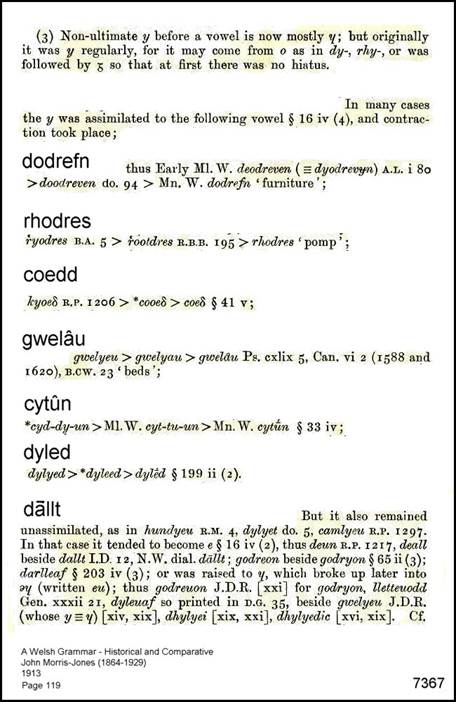 n, ‘rise, start’, erchn ‘protector, [bed]-side’, deddd ‘happy’
:_______________________________.
cychwynfa <kə-KHWƏN-va> [kəˡxwənva] feminine
noun
PLURAL: cychwynféydd <kə-khwən-VEIDH> [kəxwənˡvəɪð]
1 start, starting place
ETYMOLOGY: (cychwynn- stem of
cychwyn = to begin) + (-fa suffix = place)
:_______________________________.
cychwyniad
<kə-KHWƏN-yad> [kəˡxwənjad] masculine
noun
PLURAL: cychwyniadau <kə-khwən-YAA-dai, -de> [kəxwənˡjɑˑdaɪ,
-ɛ]
1 start, beginning
2 origin,
birth
gwlad eich cychwyniad your country
of origin (“(the) country (of) your beginning”)
ETYMOLOGY: (cychwynn- stem of cychwyn = to begin) + (-i-ad abstract noun-forming suffix)
:_______________________________.
cychwynnydd
<kə-KHWƏ-nidh> [kəˡxwənɪð] masculine
noun
PLURAL: cychwynwyr <kə-KHWƏN-wir> [kəxˡwənwɪr]
1 starter (person who gives the signal to begin a race)
gwn cychwynnydd starting pistol (“gun (of) (a) starter”)
gwn y cychwynnydd the starting pistol (“(the) gun (of) the starter”)
:_______________________________.
cyd- <kiid> [kiːd] (prefix)
1 “together”, con-
In modern coinings, used as an equivalent of the Latin prefix con-
(= with) (see below cytref, cytsain, cytser)
2 (cyd + t) > (cyd-d) > (cyt-)
..a/ cytew (North Wales)
..........(adj) (liquid) thick, stiff;
.......... (m) egg batter (flour, eggs, milk)
cytew < cyd-dew (cyd- prefix =
together) + soft mutation + (tew =
fat; thick)
..b/ cytir common land (wood,
pasture or waste)
cytir < cyd-dir (cyd- = joint) +
soft mutation + ( tir = land)
..c/ cytref conurbation
cytref < cyd-dref (cyd- prefix =
together) + soft mutation + (tref =
town)
3 (cyd + s) > (cyt-s-)
cytsain (=
consonant),
cytser (=
constellation)
:_______________________________.
cyd-adrodd <kiid-A-drodh> [kiːdˡadrɔð] (verb)
1 recite together
:_______________________________.
cyd-daro <kiid-DAA-ro> [kiːdˡdɑˑrɔ] v
1 coincide
2 cyd-drawiad
(qv) coincidence
ETYMOLOGY: “hitting together” (cyd- prefix =
together) + soft mutation + (taro = to hit, to strike)
:_______________________________.
cyd-ddweud <kiid-DHWEID> [kiːdˡðwəɪd] verb
1 say to each other
Hebryngwyd ef at ei dadau i fynwent plwyf Llanbrynmair,
gan dyrfa fawr o wŷr bucheddol, mewn
teimladau drylliog; a phawb yn cyd-ddyweud fod “tywysog a gŵr mawr wedi cwympo yn Israel." (Cofiant y Tri
Brawd / E Pan Jones / 1892 / t11)
He was taken to lie with his forefathers in the cemetery of the parish of
Llanbrynmair, by a great crowd of non-chapel people, overcome with emotion;
everybody said to each other that a ‘prince and a great man had fallen in
Israel’.
ETYMOLOGY: (cyd = together) + soft mutation + (dweud = to say)
:_______________________________.
cyddwyso <kə-DHUI-so> [kəˡðʊɪsɔ] verb
1 condense = change from gas
to liquid in contact with a cold surface
ETYMOLOGY: (cy- intensifying prefix, form of cyf-) + soft mutation + (dwyso = intensify)
Cf. cywasgu (= to compress) < gwasgu (= to press, to
squeeze)
:_______________________________.
cyddwysydd <kə-DHUI-SIDH> [kəˡðʊɪsɪð] masculine noun
PLURAL: cyddwysyddion <kə-DHUI-sədh-yon> [kəðʊɪˡsəðjɔn] 1 condenser = apparatus for converting vapour into
liquid
ETYMOLOGY: (cyddwys- stem of cyddwyso = to condense) (-ydd noun suffix for
indicating a device or an agent)
:_______________________________.
cyd-drawiad <kid-DRAU-yad> [kɪdˡdraʊjad] masculine
noun
PLURAL: cyd-drawiadau <kid-drau-YAA-dai, -e> [kɪddraʊˡjɑˑdaɪ, -ɛ]
1 coincidence
Nid
cyd-drawiad yw bod… it’s no
coincidence that
ETYMOLOGY: (cyd-draw- stem of cyd-daro = to coincide) +(i-ad noun suffix)
:_______________________________.
cyd-drefnedig
<kid-drev-NEE-dig> [kɪddrɛvˡneˑdɪg] adj
1
co-ordinated
ETYMOLOGY: (cyd-drefn- stem of cyd-drefnu = coordinar) + (-edig suffix for forming a past
participle adjective)
:_______________________________.
cyd-enwadol <kiid-en-WAA-dol> [kiːdɛnˡwɑˑdɔl] (adjective)
1 interdenominational
:_______________________________.
cyd-hyd <kiid-HIID> [kiːdˡhiːd] masculine
noun
1 of the same length
bod gyd-led gyd-hyd be as long as it
is broad
(bod = to be) + soft mutation + (cyd-led = co-length) + soft mutation +
(cyd-hyd = co-width). There is soft
mutation of an initial consonant in adverbial phrases. hence cyd > gyd
:_______________________________.
cydio <KƏD-yo> [ˡkədjɔ] (verb)
1 cydio mewn (+ indefinite noun) get hold of
cydio yn (+ definite noun) get hold of; pick up
cydio yn rhywun gerfydd ei goler
grab someone by the collar
cydiais mewn cylchgrawn oedd ar y bwrdd I picked up a magazine that was on the
table
cydia yn hwnna get hold of that
cydiodd yn y pysgodyn gerfydd ei gynffon he
picked up the fish by its tail
South Wales: citsho
Parry-Williams, Thomas Herbert; Some points of similarity in the
phonology of Welsh and Breton (1913): “In S[outh]. W[ales]. a palatalised d
has become dsh
or dj, or even tsh, citsio or citsho (cydio)
[= get hold of], sgidje, or sgitshe (esgidiau) [= shoes].
Cf. jawl for diawl [= devil]”
citsha yn'o fa (south-east Wales) catch hold of it (=
cydia ynddo fe)
North Wales: also cydiad
2 (fire) catch = start to burn
dyw’r tân ddim yn cydio – mae’r pren yn rhy wlyb the fire’s not catching
– the wood’s too wet
3 (mechanism) catch = take hold
dyw clo’r drws ddim yn cydio – rhaid imi ei oelio the door lock isn’t
catching – I’ll have to oil it
4 cydio wrth stick to, get stuck to
mae’r omled wedi cydio wrth y ffrimpan the omelette’s got stuck to the
frying pan
:_______________________________.
cyd-led <kiid-LEED> [kiːdˡleːd] masculine
noun
1 of the same width
bod gyd-led gyd-hyd be as long as it
is broad
(bod = to be) + soft mutation + (cyd-led = co-length) + soft mutation +
(cyd-hyd = co-width). There is soft
mutation of an initial consonant in adverbial phrases. hence cyd > gydd
:_______________________________.
cydlynu <kəd-LƏ-ni> [kədˡlənɪ] verb
1 cohere =
stick together in a mass
2
co-ordinate
Fe fydd yn gyfrifol am gyd-lynu
gweithgareddau marchnata'r coleg
He’ll be the one responsible for co-ordinating the colleges’s marketing
activities
ETYMOLOGY: 'stick together' (cyd-
prefix = together) + soft mutation + (glynu
= to stick) Calque on English cohere
< Latin cohaerêre (= stick
together), (co- = together) + (haerêre = adhere)
:_______________________________.
cydlynus <kəd-LƏ-nis> [kədˡlənɪs] adj
1 coherent
fframwaith cydlynus coherent
framework
strategaeth gydlynus
coherent strategy
ETYMOLOGY: (cydlyn- stem of cydlynu = cohere) + (-us suffix for forming adjectives)
:_______________________________.
cydnabod <kəd-NAA-bod> [kədˡnɑˑbɔd] (verb)
1 to recognise
:_______________________________.
cydnabyddedig <kəd-bə-DHEE-dig> [kədnabəˡðeˑdɪg] (adj)
1 recognised
cymhares gydnabyddedig (f), cymaresau cydnabyddedig common-law
wife (“recognised wife”)
ETYMOLOGY: (cydnabydd- stem of cydnabod
= recognise) + (-edig past
participle suffix, equivalent to English -ed)
:_______________________________.
cydol <KƏ-dol> [ˡkədɔl] masculine
or feminine noun
1 totality, whole (in use only in a number of set
expressions)
trwy gydol y nos all night long
am gydol y flwyddyn all year long
ETYMOLOGY: noun ‘the whole’ < adjective ‘total, entire, whole’;
(cyd < cy’yd < cyhyd = so
long, as long) + (-ol suffix for
forming adjectives)
:_______________________________.
cyd-orwedd
<kiid-OR-wedh> &[kiːdˡɔrwɛð] verb
1 cyd-orwedd
â to lie together with, to lie alongside
:_______________________________.
cydradd [KƏD-radh] [ˡkədrað] (adjective)
1 of equal rank
2 cymal
cydradd co-ordinating clause
:_______________________________.
cydran, cydrannau <KƏ-dran, kə-DRA-nai,
-e> [ˡkədran, kəˡdranaɪ, -ɛ] (feminine noun)
1 component (for a car)
y gydran = the component
:_______________________________.
cydrannol
<kə-DRA-nol> [kəˡdranɔl]
1 shared
2 wal gydrannol party wall
ETYMOLOGY: (cyd prefix = together) + soft mutation + (rhannol =
partial)
:_______________________________.
cyd-synio <kiid-SƏN-yo> [kədˡsənjɔ] (verb)
1 to agree with
cyd-synio â rhywun to agree with somebody
:_______________________________.
cydweddiad, cydweddiadau <kəd-WEDH-yad, kəd-wedh-YAA-dai,
-e> [kədˡwɛðjad, kədwɛðˡjɑˑdaɪ, -ɛ] (masculine noun)
1 analogy
2 camgydweddiad false analogy
:_______________________________.
cyd-weithfa, cyd-weithféydd <kiid-WEITH-va,
kiid-weith-VEIDH> [kiːdˡwəɪθva, kiːiˑdwəɪθˡvəɪð] (feminine noun)
1 cooperative
y gyd-weithfa = the cooperative
:_______________________________.
cyd-weithio <kiid-WEITH-yo> [kiːdˡwəɪθjɔ] (verb)
1 to cooperate
:_______________________________.
cyd-weithredu <kiid-weith-REE-di> [kiːdwəɪθˡreˑdɪ] (verb)
1 to collaborate
:_______________________________.
Cydweli <kəd-WEE-li> [kədˡweˑlɪ] (feminine noun)
1 village, south-west; see Cedweli
:_______________________________.
cydymaith, cymdeithion <kə-DƏ-maith,
-meth, kəm-DEITH-yon> [kəˡdəmaɪθ, -ɛθ
kəmˡdəɪθjɔn] (masculine noun)
1 travelling companion
:_______________________________.
cyfaddasiad
<kə-va-DHAS-yad> [kəvaˡðasjad] masculine
noun
PLURAL cyfaddasiadau <kə-va-dhas-YAA-dai, -e> [kəvaðasˡjɑˑdaɪ, -ɛ]
1 adaptation
2 abbreviation (in
a dictionary entry) = cfdds.
ETYMOLOGY: (cyfaddas-, stem of cyfaddasu = to adapt) + (-i-ad abstract noun-forming suffix)
:_______________________________.
cyfaddef <kə-VAA-dhev, kə-VAA-dhe> [kəˡvɑˑðɛv, kəˡvɑˑðɛ] (verb)
Colloquially; cyfadde’
1 to
confess
:_______________________________.
cyfadran, cyfadrannau <kə-VA-dran, kə-va-DRA-nai,
-e> [kəˡvadran, kəvaˡdranaɪ, -ɛ] (feminine noun)
1 university faculty
y gyfadran= the faculty
:_______________________________.
cyfagos <kə-VAA-gos> [kəˡvɑˑgɔs] (adjective)
1 nearby
:_______________________________.
cyfaill <KƏ-vailh, -velh> [ˡkəvaɪɬ, ˡkəvɛɬ] masculine
noun
PLURAL cyfeillion <kə-VEILH-yon> [kəˡvəɪɬjɔn]
1 friend
cwrdd â hen gyfeillion meet old
friends
cyfeillion bore oes childhood
friends (“friends (of) morning (of) life”)
cyfaill mynwesol bosom friend
cyfaill calon bosom friend (“friend
(of) heart”)
cyfaill ysgol school friend
cyfaill tywyllodrus a false friend,
a friend who deceives (“a deceitful friend”)
2 some phrases with cyfaill i (friend + to)
bod yn gyfaill i mi be a friend of
mine, be friends with me, be my friend (“be a friend to me”)
Dyw e ddim yn gyfaill i mi He’s not
my friend, He’s no friend of mine
bod yn hen gyfaill i mi be an old
friend of mine
mynd yn gyfaill i mi become my
friend, become friends with me
cyfaill i’r teulu a friend of the
family (“(a) friend to the family”)
cyfaill o artist i mi an artist
friend of mine (“(a) friend of artist to me”)
3 Cyfaill ynteu
gelyn? (Soldier on watch duty challenging someone unknown) Friend or foe?
4 friend = patron, sponsor, benefactor
cyfaill i’r tlodion a friend of the
poor
As cyfeillion ‘friends’ in titles of
support groups for some cause or instituion
Cyfeillion yr Amgueddfa Friends of
the Museum (society to raise funds for a museum)
5 bod â
chyfeillion yn y llys to have friends at court, to know people in an
influential position who can help
6 Y cyfaill gwir
yn yr ing fe’i gwelir A friend in need is a friend indeed
(“the true friend, in the anguish he is seen” - i.e. he will appear when you
are in an anguished situation)
7 Cyfaill
Friend, Quaker
Cymdeithas Grefyddol y Cyfeillion
The Religious Society of Friends or Cymdeithas
y Cyfeillion The Society of Friends - the proper designation of the
Christian body founded by George Fox (1624-91) known popularly as the Quakers
8 as part of the title of certain books, almanacs,
magazines in the 1800s
Cyfaill Defnyddiol “Useful Friend”
Cyfaill yr Aelwyd (“(the) friend
(of) the fireplace / hearth”) magazine 1881-1894
9 Christianity
y Cyfaill gorau gaed said of Jesus
(“the best friend that was ever had”)
10 Christianity
Cyfaill Duw The Friend of God =
Abraham, a patriarch of the Old Testament and founder of the Hebrew people
Iago 2:23 A chyflawnwyd yr ysgrythur yr
hon sydd yn dywedyd, Credodd Abraham i Dduw, a chyfrifwyd iddo yn gyfiawnder: a
Chyfaill Duw y galwyd ef
James 2:23 And the Scripture was fulfilled which saith, Abraham believed God,
and it was imputed unto him for righteousness: and he was called the Friend of
God
11 (in addressing a friend or friends),
gyfaill, friend!, gyfeillion! friends
(in Welsh there is generally soft mutation of the initial in vocative forms)
Einion, gyfaill da My good friend
Einion (in beginning a letter)
ETYMOLOGY: cyfaill < cyfaillt
(cyf- prefix) + (aillt) < British *kom-alt-jos (= joined together; joined
in friendship)
The element alt is to be seen
(1) in obsolete Welsh cyfalle (=
union, joining together; spouse) < cyfalledd
< British *kom-alt-ijâ
(2) in Cornish kevals (= joint,
articulation) (British kom-alt),
(3) and in the Irish words alt (=
joint, articularion); comhalta (=
foster brother, foster sister; member);
and comhaltas (= association)
NOTE: cyfeilles (= female friend) (cyfaill + -es, suffix denoting a
female);
y gyfeilles the (female) friend
:_______________________________.
cyfaint <KƏ-vaint> [ˡkəvaɪnt] masculine noun
PLURAL: cyfeintiau <kə-VEINT-yai, -ye> [kəˡvəɪntjaɪ, -ɛ]
1 volume = space in a container occupied by a liquid
or gas
space holding cubical content
ETYMOLOGY:
(cy- < cyf- prefix = ‘together’) + soft mutation + (maint
= size)
:_______________________________.
cyfair <KƏ-vair
-ver> [ˡkəvaɪr, ˡkəvɛr] masculine noun
PLURAL: cyfeiriau <kə-VEIR-yai, -ye> [kəˡvəɪrjaɪ, -ɛ]
1 (obsolete) direction
2 region, place, spot
From this sense is the preposition ar gyfer (= opposite; ar “facing” + soft mutation + cyfer
/ cyfair (= direction, place). Cf Scottish fa chomhair
(= opposite, literally: “under” + “direction” )
3 acre = measure of land, 4,840 square yards
4 acre = land measuring an acre
ETYMOLOGY: Welsh < British.
From the same British root: Breton keñver, keñver-douar (= acre)
From the same Celtic root: Irish comhair in the preposition phrase faoi
chomhair (= for, intended for); Scottish fa chomhair (= opposite)
:_______________________________.
cyfalaf <kə-VAA-lav> [kəvˡɑˑlav] masculine
noun
1 capital = wealth used for the production of more
wealth
2 capital = a person’s savings
byw ar eich cyfalaf live off one’s
capital (“live on one’s capital”)
3 capital, = money invested
croniad cyfalaf capital accumulation
(“accumulation / gathering (of) capital”)
cyfalaf cyfrandaliadau share capital
(“capital (of) shares”)
cyfalaf gweithredol working capital
(“capital + working, operative”)
dibrisiad cyfalaf capital
depreciation (“depreciation (of) capital”)
enillion cyfalaf capital gains
(“gains / earnings (of) capital”)
gwariant cyfalaf capital expenditure
(“expenditure (of) capital”)
treth ar enillion cyfalaf capital
gains tax (“tax on earnings (of) capital”)
4 Capital = the capitalist class and its interests (cf Llafur = labour)
cyfalaf a llafur
capital and labour
ETYMOLOGY: (cyf-,
prefix = together) + (alaf (obsolete) =
herd of cattle)
:_______________________________.
cyfalafiaeth
<kə-va-LAV-yaith
-yeth> [kəvaˡlavjaɪθ, -ɛθ] feminine
noun
1 capitalism = economic system where wealth used for
production is owned by individuals and not the state
ETYMOLOGY: (cyfalaf = capital) + (-i-aeth, suffix to form abstract nouns)
:_______________________________.
cyfalafol <kə-va-LAA-vol> [kəvaˡlɑˑvɔl] adjective
1 capitalist
ETYMOLOGY: (cyfalaf = capital) + (-ol = suffix to form adjectives)
:_______________________________.
cyfalafwr <kə-va-LAA-vur> [kəvaˡlɑˑvʊr] masculine
noun
PLURAL: cyfalafwyr <kə-va-LAV-wir> [kəvaˡlavwɪr]
1 capitalist = person who owns capital; private owner,
as opposed to a a state (as an agent of public ownership)
2 capitalist = supporter of capitalism
ETYMOLOGY: (cyfalaf = capital) + (-wr, suffix = man)
:_______________________________.
cyfan <KƏ-van> [ˡkəvan] (adjective)
1 whole, total, all
mentro’r cyfan go for broke (“venture the whole lot”)
2 y cyfan o,
the whole of, all
bron y cyfan o almost
all, nearly all
Mae e’n treulio bron y cyfan o'i amser hamdden yn y tafarn
He spends nearly all of his leisure time in the pub
y cyfan bron o almost
all, nearly all
:_______________________________.
cyfandir, cyfandiroedd <kə-VAN-dir, kə-van-DII-roidh,
-rodh> [kəˡvandɪr, kəvanˡdiˑrɔɪð -ɔð] (masculine noun)
1 continent
:_______________________________.
cyfandirol <kə-van-DII-rol> [kəvanˡdiˑrɔl] (adjective)
1 continental
:_______________________________.
cyfanfor <kə-VAN-vor> [kəˡvanvɔr] masculine
noun
PLURAL: cyfanforoedd <kə-van-VOO-roidh, -rodh> [kəvanˡvoˑrɔɪð -ɔð]
1 ocean
Dros Gyfanfor a Chyfandir
(‘over ocean and continent’) title of a book by William Davies Evans (Aberystwyth
1883) relating his travels in the USA in 1881-2
There is an on-line edition of this book
in our website: Type kimkat, gyfanfor
into Google search box
ETYMOLOGY: (cyfan = entire,
complete) + soft mutation + (môr =
sea)
:_______________________________.
cyfannedd <kə-VA-nedh> [kəˡvanɛð] masculine
noun
PLURAL: cyfanheddau <kə-va-NHEE-dhai, -e> [kəvaˡnheˑðaɪ, -ɛ]
1 dwelling place
Habacuc 1:6 Canys wele fi yn codi y
Caldeaid, cenedl chwerw a phrysur, yr hon a rodia a r hyd lled y tir, i
feddiannu cyfanheddoedd nid yw eiddynt
Habakkuk 1:6 For, lo, I raise up the Chaldeans, that bitter and hasty nation,
which shall march through the breadth of the land, to possess the
dwellingplaces that are not theirs
ETYMOLOGY: (cyf- = together) + (annedd = dwelling)
:_______________________________.
cyfannol <kə-VA-nol> [kəˡvanɔl] adj
1
integrated
Rheoli Ansawdd Cyfannol
Integrated Quality Management
cylched gyfannol (f) plural cylchedau cyfannol
integrated circuit
Rhaglen Ymchwil Gyfannol Integrated Research Programme
cludiant cyfannol integrated
transport
trafnidiaeth gyfannol integrated
transport
ETYMOLOGY: (cyfann- penultimate
syllable form of cyfan = complet) (-ol = suffix for forming adjectives)
:_______________________________.
cyfansoddi
<kə-van-SOO-dhi> [kəvanˡsoˑðɪ] (verb)
1 to compose
:_______________________________.
cyfansoddiad
<kə-van-SODH-yad> [kəvanˡsɔðjad] (masculine noun)
PLURAL: cyfansoddiadau <kə-van-sodh-YAA-dai,
-e> [kəvansɔðjɑˑdaɪ, -ɛ]
1 constitution
2 composition
:_______________________________.
cyfanswm, cyfansymiau <kə-VAN-sum, kə-van-SƏM-yai,
-e> [kəˡvansʊm, kəvanˡsəmjaɪ, -ɛ] (masculine noun)
1 total amount
:_______________________________.
cyfar <KƏ-VAR> [ˡkəvar] masculine noun
1 (obsolete) joint ploughing,
co-tillage
ETYMOLOGY: (cyf- prefix = co-, together) + (âr = tillage)
Cornish kevar (= joint tillage ), Breton keñver (= direction;
arpent – unit of length)
Cf Irish: comhar (= combined work, co-operation)
:_______________________________.
cyfarch <KƏ-varkh> [ˡkəvarx] verb
1 greet = say hello to
2 cyfarch ei
gilydd say hello to each other, greet each other
ni chyfarchodd yr un o’r ddau ei gilydd
neither of the two greeted the other
3 cyfarch (rhywun) fel “chi” use the “chi”
form with someone (the polite way of saying “you”, equivalent in use to French
“vous”, Catalan “vos”, as distinct from the familiar form “ti”, equivalent to
French “tu”, Catalan “tu”)
4 cyfarch gwell
i to greet
cyfarch gwell i’w gilydd to greet
each other
ETYMOLOGY: the verb is from the noun cyfarch
= greeting
:_______________________________.
cyfarch <KƏ-varkh> [ˡkəvarx] masculine
noun
PLURAL: cyfarchion <kə-VARKH-yon> [kəˡvarxjɔn]
1 greeting
cyfarchion oddi wrth... greetings
from...
cyfarchion y tymor (in Christmas
cards, etc) compliments of the season, season’s greetings
2 attributive
complimentary = given free as a courtesy;
copi cyfarch complimentary copy
ETYMOLOGY: (cyf-, prefix = each
other) + (-arch = order)
:_______________________________.
cyfarchfa <kə-VARKH-va> [kəˡvarxva] feminine
noun
PLURAL: cyfarchféydd <kə-varkh-VEIDH> [kəvarxˡvəɪð]
1 (obsolete) reception place
y gyfarchfa =
the reception place
2 possibly “hailing place, place on a riverbank to call
a ferry boat from the other bank”
Cyfarchfa Lost place name in
Caer-dydd
According to John Hobson Mathews (Mab Cernyw) in 'Cardiff Records' (1889-1911):
“CYFARCHFA (the hailing-place.) An old thatched cottage on the east bank of the
river Taff, a little south of Llandaff bridge.”
If this interpretation is correct (hailing place, hallowing point, place on a
riverbank to call a ferry boat from the other bank) it is equivalent to the
American place name “Hallowing Point”, which George R. Stewart, in “American
Place-Names” 1970 notes as occuring in Maryland and Virginia, and defines it as
“a place at one end of a ferry passage... where a person had to stand and
“hallow”, i.e. halloo or shout to gain the attention of the ferryman on the
other side.”
ETYMOLOGY: (cyfarch, stem of the
verb cyfarch = greet; call, hail,
summon) + (-fa suffix = place)
:_______________________________.
cyfarchiad, cyfarchion <kə-VARKH-yad, kə-VARKH-yon> [kəˡvarxjad, kəˡvarxjɔn] (masculine noun)
1 greeting
:_______________________________.
cyfardir <KƏ-VAR-dir> [ˡkəvarˡdɪr] masculine
noun
1 (obsolete) joint ploughland
ETYMOLOGY: (cyfar = co-tillage) + soft mutation + (tir = land)
:_______________________________.
cyfarfod <kə-VAR-vod> [kəˡvarvɔd] (verb)
1 to meet
:_______________________________.
cyfarfod, cyfarfodydd <kə-VAR-vod, kə-var-VOO-didh> [kəˡvarvɔd, kəvarˡvoˑdɪð] (masculine noun)
1 meeting
:_______________________________.
cyfartal <kə-VAR-tal> [kəˡvartal] (adjective)
1 equal
bod yn gyfartal
â’r gofynion be equal to the occasion (“be equal to the
requirements”)
2 (football match) drawn
:_______________________________.
cyfarth <KƏ-varth> [ˡkəvarθ] (verb)
1 to bark
2 gwaeth
eich cyfarth na’ch brath your
bark is worse than your bite;
(she) gwaeth ei chyfarth na’i
brath her bark… her bite
(he) gwaeth ei gyfarth na’i
frath his bark… his bite
Gwaeth ei gyfarth na’i frath is said of a man whose angry words are worse
than any action he may do, that is, of man who can be very angry but who won’t
really carry out any threats he makes
(gwaeth = worse) + (eich = your) + (cyfarth = bark) + (na = than) + (eich) + (brath
= bark)
:_______________________________.
cyfarthiad
<kə-VARTH-yad> [kəˡvarθjad] masculine
noun
PLURAL: cyfarthiadau <kə-varth-YAA-dai, -e> [kəvarθˡjɑˑdaɪ,
-ɛ]
1 bark; barking
cyfarthiad ci ar y lleuad the barking
of a dog at the moon – said of some action which has no effect whatsoever
Ni effeithia fwy arnynt na chyfarthiad
ci ar y lleuad
It won’t effect them any more than the barking of a dog at the moon
ETYMOLOGY: (cyfarth-, stem of cyfarth = to bark) + (-iad prefix for forming nouns)
:_______________________________.
cyfarwydd <kə-VAA-ruidh> [kəˡvɑˑrʊɪð] (adjective)
1 familiar
:_______________________________.
cyfarwyddiadau <kə-va-ruidh-YAA-dai, -e> [kəvarʊɪðˡjɑˑdaɪ,
-ɛ] (plural noun)
1 instructions
:_______________________________.
cyfarwyddo <kə-va-RUI-dho> [kəvarˡʊɪðɔ] (verb)
1 instruct, advise, guide
2 clinig cyfarwyddo
plant child guidance clinic
:_______________________________.
cyfarwyddwr
<kə-va-RUI-dhur> [kəvarˡʊɪðʊr] masculine
noun
PLURAL: cyfarwyddwyr <kə-va-RUIDH-wir> [kəvarˡʊɪðwɪr] 1
director
Cyfarwyddwr Gwasg Prifysgol Cymru
The director of the University of Wales
cyfarwyddwr addysg director of
education
cyfarwyddwr gweithredol executive
director
cyfarwyddwr ariannol financial
director
2 supervisor = tutor supervising the research work of a
student
3 guide
cyfarwyddwr ysbrydol spiritual guide
ETYMOLOGY: (cyfarwydd- stem of cyfarwyddo = direct; advise; instruct)
+ (-wr suffix = man)
:_______________________________.
cyfatal <kə-VA-tal> [kəˡvatal] (adjective)
variable (weather)
:_______________________________.
cyfathrach <kə-VATH-rakh> [kəˡvaθrax] (feminine noun)
1 intercourse
y gyfathrach =
intercourse
2 sexual intercourse
cyfathrach rywiol sexual intercourse
cyfathrach eneuol oral sex
cyfathrach refrol anal sex
:_______________________________.
cyfathrebu <kə-va-THRE-bi> [kəvaˡθreˑbɪ] (verb)
1 to communicate
:_______________________________.
cyfeb <KƏ-veb> [ˡkəvɛb] adjective
1 pregnant (mare, ewe); in foal; in lamb
ETYMOLOGY: “with horse” (cyf- =
with) + (eb = horse)
:_______________________________.
Cyfeiliog <kə-VEIL-yog> [kəˡvəɪljɔg] (feminine noun)
1 locality, north-east
:_______________________________.
cyfeillgar <kə-VEILH-gar> [kəˡvəɪɬgar] adjective)
1 friendly
:_______________________________.
cyfeillion <kə-VEILH-yon> [kəˡvəɪɬjɔn] (plural noun)
1 friends; plural of cyfaill
:_______________________________.
cyfeiliorn <kə-VEIL-yorn> [kəˡvəɪljɔrn] masculine
noun
1 stray
buwch gyfeiliorn PLURAL: buchod cyfeiliorn stray cow
ETYMOLOGY: cyfeiliorn < cyfeiriorn < British *kom-are-org-n;
Dissimilation of the sequence r-r,
which becomes l-r
(kom = modern Welsh cym-, cf Latin cum = with),
(are = in front of, modern Welsh ar);
as regards the element org-n cf dilorni < dyfal-orni (dyfal- < dyfalu = mock) + (orn = blame)
+ (-u suffix for forming verbs)
:_______________________________.
cyfeilydd, cyfeilyddion <kə-VEI-lidh, kə-vei-LƏDH-yon> [kəˡvəɪlɪð, kəvəɪˡləðjɔn] (masculine noun)
1 accompanyist
:_______________________________.
cyfeiriad, cyfeiriadau <kə-VEIR-yad, -kə-veir-YAA-dai,
-de> [kəˡvəɪrjad, kəvəɪrˡjɑˑdaɪ,
-ɛ] (masculine noun)
1 direction, address
i gyfeiriad croes i’r cloc in an
anti-clockwise direction
:_______________________________.
cyfeirio <kə-VEIR-yo> [kəˡvəɪrjɔ] (verb)
1 to refer
2 to direct
cyfeirio’ch ymdrechion tuag at (ryw nod)
direct your efforts towards (some goal)
arwydd cyfeirio direction sign
:_______________________________.
cyfelin <kə-VEE-lin> [kəˡveˑlɪn] feminine
noun
PLURAL: cyfelinau <kə-ve-LII-ne> [kəvɛˡliˑnaɪ, -ɛ]
1 ell, the length between the elbow and the hand
y gyfelin the ell
ETYMOLOGY: (cyf-, prefix = together)
+ (elin = elbow)
:_______________________________.
cyfenw, cyfenwau <kə-VEE-nu, kə-VEN-wai,
-we> [kəvˡeˑnʊ, kəvˡɛnwaɪ, -ɛ] (masculine noun)
1 surname
ETYMOLOGY: (cyf-, prefix = together)
+ (enw = name)
:_______________________________.
cyferbyniol <kə-ver-BƏN-yol> [kəvɛrˡbənjɔl] (adjectiu)
1 cyferbyniol i opposed to, contrary to
yr oll sydd gyferbyniol i ryddid, dyna
yw Toriaeth
everything that goes against freedom, that’s what Toryism is
:_______________________________.
cyff, cyffion <KIIF, KƏF-yon> [kiːf, ˡkəfjɔn] (masculine noun)
1 stump of tree;
2 cyffion =
shackles
:_______________________________.
cyffaith, cyffeithiau <KƏ-faith / KƏ-feth,
kə-FEITH-yai, -ye> [ˡkəfaɪθ / ˡkəfɛθ, kəˡfəɪθjaɪ,
-ɛ] (masculine noun)
1 toffee
:_______________________________.
cyffes, cyffesau <KƏ-fes, kə-FE-sai,
-se> [ˡkəfɛs, kəˡfɛsaɪ, -ɛ] (masculine noun)
1 confession
:_______________________________.
cyffesu <kə-FE-si> [kəˡfɛsɪ] (verb)
1 confess
2 cyffesu’ch pechodau confess your sins
:_______________________________.
cyffin <KƏ-fin> [ˡkəfɪn] masculine
noun
PLURAL: cyffiniau <kə-FIN-yai, -ye> [kəˡfɪnjaɪ, -ɛ]
1 boundary
2 cyffiniau
bounds, confines
cyfyngu i gyffiniau’r ysgol restrict
to the area of the school, to within the bounds of the school
3 y cyffiniau =
the area, the locality, the surrounding district
Tir Iarll a’r Cyffiniau Tir Iarll
and the surrounding district
4 Y Gyffin SH7776 (‘the frontier’) locality in the
county of Conwy (a suburb on the south side of the town of Conwy)
ETYMOLOGY: Welsh < British < Latin confînium
(con- = with, finis = limit, boundary, end)
:_______________________________.
cyffiniwr <kə-FIN-yur> [kəˡfɪnjʊr] masculine
noun
PLURAL: cyffinwyr <kə-FIN-wir> [kəˡfɪnwɪr]
1 borderer, border dweller, one who lives on the border
2 Cyffinwyr De
Cymru South Wales Borderers, name of a Welsh regiment based in Aberhonddu /
Brecon since 1873 (in the former county of Sir Aberhonddu / Breconshire, in
south-eastern Wales, bordering on England)
ETYMOLOGY: (cyffin = frontier) + (-i-wr suffix = ‘man’)
:_______________________________.
cyffordd <KƏ-fordh> [ˡkəfɔrð] feminine
noun
PLURAL: cyffyrdd <KƏ-firdh> [ˡkəfɪrð]
1 (railway) junction
y gyffordd = the junction
Wedi i’r trên gyrraedd cyffordd y
Gaerwen
after the train reached Gaerwen junction
2 (railway) junction = station where
railway lines come together
Cyffordd Llandudno (qv) station on
the North Wales coastal railway route;
English name: Llandudno Junction
3 road junction
Ym Maes y Frenhines y mae Capel y Morfa,
ar gyffordd Heol Portland a Morfa Mawr, gyferbyn â Neuadd y Dref
Morfa Chapel is in (the square called) Maes y Frenhines, at the junction of
(the road called) Heol Portland and (the road called) Morfa Mawr, opposite the
town hall
4 motorway junction, place where one can join or leave
a motorway
Mae yn hawdd ei gyrraedd o gyffordd 48
yr M4
It’s easy to reach from Junction 48 on the M4 motorway
ETYMOLOGY: (cy- prefix = together) +
(ffordd = road)
:_______________________________.
Cyffordd Llandudno
<KƏ-fordh
lhan-DID-no> [ˡkəfɔrð ɬanˡdɪdnɔ]
1 station on the North Wales coastal railway route.
English name: Llandudno Junction
2 locality in the county of Conwy, by Cyffordd Llandudno railway station.
English name: Llandudno Junction
(If the general rule for settlement names were to be applied, of spelling them
as a single word wherever possible, Cyfforddllandudno
would be the form)
ETYMOLOGY: “(the) junction (for) Llandudno” i.e. the junction formed by a
branch line off the main Chester to Caergybi (Holyhead) railway line which goes
in a northerly direction to the town of Llandudno (cyffordd = junction) + (Llandudno
= name of the town to which the branch line goes).
The Welsh name is a direct translation of the English name.
:_______________________________.
cyfforddus <kə-FOR-dhis> [kəˡfɔrðɪs] (adjective)
1 comfortable
:_______________________________.
cyffredin <kə-FRE-din> [kəˡfreˑdɪn] (adjective)
1 usual, common, general, frequent
2 Dibarch rhy gyffredin Familiarity breeds content (“(it-is)
without-respect (a thing) (which-is) too common”)
Ni bydd hybarch rhy
gyffredin Familiarity breeds contempt (“It is not venerable
(the thing) too usual”)
3 canfod tir
cyffredin find common ground
4 metel cyffredin base metal
:_______________________________.
cyffredinol <kə-fre-DII-nol> [kəfrɛˡdiˑnɔl] (adjective)
1 general
ETYMOLOGY: (cyffredin = common, general) + (-ol adjectival
suffix)
:_______________________________.
cyffro <KƏ-fro> [ˡkəfrɔ] (m)
1 excitement, commotion, uproar, furore
Aeth yn gyffro trwy’r ystafell
pandemonium broke out in the room
2 cyffro
meddyliol mental disturbance
:_______________________________.
cyffroi <kə-FROI> [kəˡfrɔɪ] (v)
1 excite, stir
Er hyn oll prin y
cyffry neb;
In spite of all this almost
nobody stirs
(Nicander = Morris Williams 1809-74 / “Yr Adgyfodiad” = The Resurrection / 1851)
ETYMOLOGY: (cyffro = excitement) + (-i verbal
suffix)
:_______________________________.
cyffrous <kə-FROIS> [kəˡfrɔɪs] (adjective)
1 exciting
ETYMOLOGY: (cyffro = excitement) + (-us adjectival
suffix)
:_______________________________.
cyffty <KƏF-ti> [ˡkəftɪ] masculine
noun
PLURAL: cyfftai <KƏF-tai> [ˡkəftaɪ]
1 log cabin, log house
ETYMOLOGY: (cyff- < cyff = stump,
log) + soft mutation + (tŷ= house) > cýff-dy > cyffty (mutation
annulled through the influence of preceding voicelss consonant)
:_______________________________.
cyffur, cyffuriau <KƏ-fir, kə-FIR-yai,
-ye> [ˡkəfɪr, kəˡfɪrjaɪ, -ɛ] (masculine noun)
1 drug
2 tawddgyffur
suppository (tawdd-,
stem of toddi = to melt) + soft mutation + (cyffur
= drug)
:_______________________________.
cyffurgi <kə-FIR-gi> [kəˡfɪrgɪ] masculine
noun
PLURAL: cyffurgwn <kə-FIR-gun> [kəˡfɪrgʊn]
1 junkie, drug addict
ETYMOLOGY: (cyffur = drug) + soft
mutation + (ci = dog)
:_______________________________.
cyffurio <kə-FIR-yo> [kəˡfɪrjɔ] verb
1 drug (somebody)
ETYMOLOGY: (cyffur = drug) + (-io suffix for forming verbs)
:_______________________________.
cyffwrdd (â) <KƏ-furdh> [ˡkəfʊrð] (verb)
1 to touch
:_______________________________.
cyffylog <kə-FƏ-log> [kəˡfəlɔg] (m)
PLURAL cyffylogod <kə-fə-LOO-god> [kəfəˡloˑgɔd]
1 Scolopax rusticola, woodcock
ETYMOLOGY: cyffylog < ceffylog (noun) < ceffylog (adj,
‘horse-like’, ‘resembling a horse’) (ceffyl = horse) + (-og adjectival suffix) < British *kappilâk-
From the same British root; Breton kefeleg
NOTE: In Penfro county cwffwlog
:_______________________________.
cyffyrddiad
<kə-FƏRDH-yad> [kəˡfərðjad] masculine
noun
PLURAL: cyffyrddiadau <kə-fərdh-YAA-dai, -de> [kəfərðˡjɑˑdaɪ,
-ɛ]
1 touch = act of touching
2 touch = light contact
Teimlodd gyffyrddiad ar ei ysgwydd
He felt a touch on his shoulder
3 y cyffyrddiad
touch = sense of touch, sensation by which contact is felt
4 touch = application of gentle pressure
Roedd y maen chwyf yn siglo gyda’r
cyffyrddiad lleiaf
The rocking stone moved with the lightest touch
5 touch = (art) stroke with a pen, pencil or brush
cyffyrddiad ysgafn a light touch, a
light stroke
6 touch = contact
cadw mewn cyffyrddiad â keep in
touch with, keep in contact with
7 cyffyrddiad
olaf finishing touch
8 touch = small detail which improves an object
Dyma wneud wyneb ar dop y pwdin â
cheirios siwgwr. Ac yn wir roedd y cyffyrddiad bach yno yn fodd i wneud y pwdin
bach dinod yn llwyddiant mawr
Then I made a face on top of the pudding with glacé cherries. And indeed this
little touch was a means to make the insignificant little pudding into a great
success
cyffyrddiad bach chwithig an
unfortunate touch, small detail which spoils something
Mae’r parc wedi eu gweddnewid, ond mae
pob arwydd yn uniaith Saesneg. Cyffyrddiad bach chwithig y dylai’r cyngor
feddwl amdano o ddifri
The park has been transformed, but all the signs are in English only. An
unfortunate touch that the council should give serious consideration to
ETYMOLOGY: (cyffyrdd- penult stem of
cyffwrdd = to touch) + (-iad suffix for forming nouns)
:_______________________________.
cyffyrddus <kə-FƏR-dhis> [kəˡfərðɪs] = cyfforddus
:_______________________________.
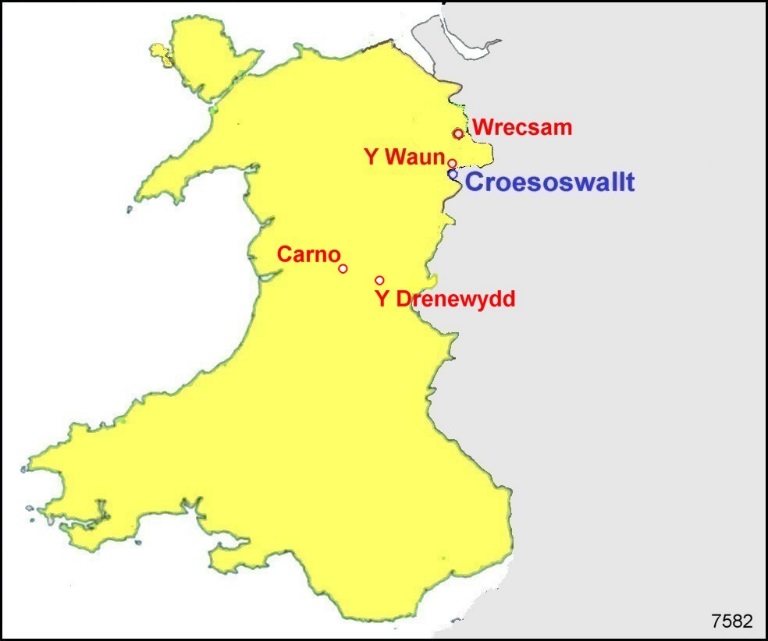
cyfiau <KƏV-yai> [ˡkəvjaɪ]
1 (obsolete) joint field, field in the ownership of more than one person.
Common in old field names in Wrecsam and Y Waun, north-east Wales
2 Cyfiau name
of a farm in Carno, Caer-sŵs, Powys

(delwedd 7582)
ETYMOLOGY: “joint plough(land)” (cyf- prefix
= together, joint) + (iau = a
plough)
Cf Old English “PLOG”, which meant both “plough” (the implement) and
“ploughland” (a measure of land; probably based on “the amount of land that can
be ploughed in one day”)
:_______________________________.
cyfiawn <KƏV-yaun> [ˡkəvjaʊn] (adjective)
1 just
ETYMOLOGY: (cyf- prefix = together,
joint) + (iawn = right, just)
:_______________________________.
cyfiawnder <kəv-YAUN-der> [kəvˡjaʊndɛr] (masculine noun)
1 justice
2 gwneud
cyfiawnder â’r dasg rise to the occasion, be up to the job (“do justice to
the task”)
ETYMOLOGY: (cyfiawn = just) + (-der noun suffix)
:_______________________________.
cyfiawnháu <kəv-yaun-HAI> [kəvjaʊnˡhaɪ] (verb)
1 justify
2 Mae’r diben yn
cyfiawnháu’r modd The end justifies the means
ETYMOLOGY: (cyfiawn = just) + (-háu suffix for forming verbs from
adjectives)
:_______________________________.
cyfieithiad, cyfieithiadau <kəv-YEITH-yad, kəv-yeith-YAA-de> [kəvˡjəɪθjad, kəvjəɪθˡjɑˑdaɪ,
-ɛ] (masculine noun)
1 translation
2 camgyfieithiad mistranslation
3 cyfieithiad rhydd a loose translation,
a rough translation (“free translation”)
ETYMOLOGY: (cyfieith-, stem of cyfieithu = translate) + (-i-ad
noun suffix)
:_______________________________.
cyfieithu <kəv-YEI-thi> [kəvˡjəɪθɪ] (verb)
1 to translate
2 camgyfieithu mistranslate
:_______________________________.
cyfieithydd, cyfieithyddion <kəv-YEI-thidh, kəv-yei-THƏDH-yon> [kəvˡjəɪθɪð,
kəvjəɪˡθəðjɔn] (masculine noun)
1 translator
ETYMOLOGY: (cyfieith-, stem of cyfieithu = translate) + (-ydd
noun suffix denoting an agent)
:_______________________________.
cyflafar <kəv-LAA-var> [kəvˡlɑˑvar]
1 noisy
2 (m) speaking together, parley, conference
ETYMOLOGY: (cyf-, prefix = together)
+ soft mutation + (llafar = loud,
noisy; spoken)
:_______________________________.
cyflafaredd
<kəv-la-VAA-redh> [kəvlaˡvɑˑrɛð] masculine
noun
1 (obsolete) conversation
2 discussion, conferring, settling differences,
reconciliation, parley, arbitration
ETYMOLOGY: (cyflafar-, stem of cyflafareddu = discuss together,
confer, arbitrate) + (-edd suffix
for forming abstract nouns)
:_______________________________.
cyflafareddiad
<kəv-la-va-REDH-yad> [kəvlavarˡɛðjad] masculine
noun
1 arbitration
ETYMOLOGY: (cyflafaredd-, stem of cyflafareddu = discuss together,
confer, arbitrate) + (-i-ad abstract
noun-forming suffix)
:_______________________________.
cyflafareddu
<kəv-la-va-REE-dhi> [kəvlavarˡeˑðɪ] verb
1 arbitrate
2 (m) arbitration
cyflafareddu rhyngwladol
international arbitration
llys cyflafareddu court of
arbitration
cymal cyflafareddu arbitration
clause
ETYMOLOGY: (cyflafaredd = dicussion)
+ (-u suffix for forming verbs)
:_______________________________.
cyflafareddwr
<kəv-la-va-REE-dhur> [kəvlavarˡeˑðʊr] masculine
noun
PLURAL: cyflafareddwyr <kəv-la-va-REDH-wir> [kəvlavarˡɛðwɪr]
1 arbitrator
ETYMOLOGY: (cyflafaredd-, stem of cyflafareddu = discuss together,
confer, arbitrate) + (-i-ad abstract
noun-forming suffix)
:_______________________________.
cyflaith <KƏV-laith -leth> [ˡkəvlaɪθ, -ɛθ] masculine
noun
1 toffee, treacle toffee; a sweet made of black
treacle, sugar and butter
cyflaith du treacle toffee
ETYMOLOGY: (cyf-, prefix = together)
+ soft mutation + (probably llaith =
humid, damp, wet)
NOTE: cyflaith – literary
pronunciation <KƏV-laith> [ˡkəvlaɪθ]
In the “e-final” districts and in standard colloquial pronunciation cyfleth <KƏV-leth> [ˡkəvlɛθ],
In the “a-final” districts cyflath <KƏV-lath> [ˡkəvlaθ]
:_______________________________.
cyflawni <kəv-LAU-ni> [kəvˡlaʊnɪ] (verb)
1 commit
2 cyflawni
trosedd commit a crime
3 cyflawni hunanladdiad commit suicide
4 cyflawni
hunanddistryw gwleidyddol commit politicial suicide
5 cyflawni
pechod commit a sin, to sin
:_______________________________.
cyfle <KƏV-le> [ˡkəvlɛ] masculine
noun
PLURAL: cyfleoedd <kəv-LEE-oid,, -odh> [kəvˡleˑɔɪð, - ɔð]
1 opportunity, chance, occasion, break (= opportunity)
y cyfle cyntaf a gewch chi at the earliest opportunity, as soon as ever you
can
Fe’i gwnaeth y cyfle cyntaf a gafodd
He did it at the first opportunity he had
cael digon o gyfle have plenty of
opportunity (“get plenty of opportunity”)
Trueni na fuaset ti’n setlo lawr i wneud
rhyw waith pendant. Rwyt ti wedi cael digon o gyfle
It’s a pity you haven’t settled down to do some definite job. You’ve had plenty
of opportunity
bod â’ch llygad ar
eich cyfle be on the lookout for your chance (to do
something), have an eye on the main chance
y cyfle gorau
a fu erióed (it was) the chance of a
lifetime
ar y cyfle
cyntaf at the first opportunity, the first opportunity you
get (to do something)
2 cyfle euraid golden
opportunity = a very advantageous opportunity
3 achub ar
gyfle seize an opportunity
bachu ar gyfle seize an opportunity
dal ar gyfle seize an opportunity
4 cael y cyfle i
get the chance to, get the opportunity to
5 cael cyfle i
get a chance to
Os ca i gyfle If I get the chance,
If I get the opportunity
6 gwneud yn fawr
o’r cyfle make the most of the opportunity (“make greatly of the
opportunity”)
7 cyfle coll
lost opportunity
8 obsolete place
9 (in the district of Dwyfor, North-west Wales)
caethgyfle fix (eg inability to get
down from a tree, cliff), predicament
(caeth = restricted) + soft mutation
+ (cyfle = position, place)
bod wedi mynd i gaethgyfle end up in
a blind alley, end up in a real fix
mewn caethgyfle in a fix
y caethgyfle yr oedd Ffrainc ynddo yn
ddiweddar the difficult situation that France was in recently
10 neidio ar y
cyfle jump at the chance = seize an opportunity with enthusiastically
neidio ar y cyfle i (wneud rhywbeth)
jump at the chance (to do something)
11 Chaiff e fawr
o gyfle He won’t get much of a chance
ETYMOLOGY: Welsh (cyf-, prefix = intensifier)
+ soft mutation + (lle = place)
:_______________________________.
cyflenwad, cyflenwadau <kəv-LEN-wad, kəv-len-WAA-dai,
-de> [kəvˡlɛnwad, kəvlɛnˡwɑˑdaɪ, -ɛ] (masculine noun)
1 supply
2 atal y cyflenwad
dŵr cut off the water supply
:_______________________________.
cyflenwr <kəv-LEN-ur> [kəvˡleˑnʊr] masculine
noun
PLURAL: cyflenwyr <kəv-LEN-wir> [kəvˡlɛnwɪr]
1 supplier = person or company providing a product or
service
2 cyflenwr adeiladwyr builders’ merchant
(“supplier (of) builders”)
3 cyflenwr llongau ship’s chandler
(“supplier (of) ships”)
ETYMOLOGY: (cyflenw-, stem of cylenwi = provide, supply) + (-wr, suffix = agent)
:_______________________________.
cyfléus <kəv-LEIS> [kəvˡləɪs] adj
1 convenient
2 cyfléus
gan convenient for
os bydd hi'n gyfléus gennyt ti if
it's convenient for you
anghyfléus inconvenient
ETYMOLOGY: (cyfle = oportunity) + (-us suffix for forming adjectives)
:_______________________________.
cyfleuster, cyfleusterau <kəv-LEI-ster, kəv-lei-STEE-re> [kəvˡləɪstɛr, kəvləɪsˡteˑraɪ,
-ɛ] (masculine noun)
1 convenience
2
cyfleusterau cyhoeddus ‹kəv lei STE re kə HOI dhis›
(plural noun) <kəv-lei-STE-rai, -re kə-HOI-dhis> [kəvləɪsˡteˑrai -ɛ
kəˡhɔɪðɪs]
public convenience
:_______________________________.
cyfliw <KƏV-liu> [ˡkəvlɪʊ] adjective
1 obsolete of
the same colour, homochromous
2 pan fo gyfliw
gŵr a llwyn
at nightfall, at dusk (“when man and bush are the same colour”)
ETYMOLOGY: (cyf- = together) + soft
mutation + (lliw = colour)
:_______________________________.
cyflo <KƏF-lo> [ˡkəflɔ] adjective
1 (cow) in calf
buwch gyflo, PLURAL: buchod cyflo cow in calf, cows in calf
ETYMOLOGY: (cyf- = together) + soft
mutation + (llo = calf)
cf Breton kevleue = in calf
:_______________________________.
cyflog <KƏV-log> [ˡkəvlɔg] masculine
and feminine noun
PLURAL: cyflogau <kəv-LOO-gai, -ge> [kəvˡloˑgaɪ, -ɛ]
North Wales - masculine noun y cyflog
South Wales - feminine noun y gyflog
1 salary = payment for one’s work or service
Fe’i penodwyd yn athro cynorthwyol am
gyflog o £20,000 y flwyddyn
He was appointed as an assistant teacher at a salary of £20,000 a year
2 cyflog mwnci
= derisory pay, peanuts (“salary (of) (a) monkey”)
cael cyflog mwnci be paid peanuts
talu cyflog mwnci pay peanuts
3 reward
Rhufeiniaid 6:23 Canys cyflog pechod yw
marwolaeth; eithr dawn Duw yw bywyd tragwyddol, trwy Iesu Grist ein Harglwydd
Romans 6:23 For the wages of sin is death; but the gift of God is eternal life
through Jesus Christ our Lord
Pedr-2 2:13 Ac a dderbyniant gyflog anghyfiawnder
Peter-2 2:13 And shall receive the reward of unrighteousness
4 South Wales
employment agreement, terms for hiring, engagement for service (an agreement
made between a farmhand / servant / maid, and a master or mistress)
torri ar eich cyflog (employee)
break one’s agreement
South Wales gwneuthur cyflog gwas take on a servant, hire a servant (“make (an)
agreement (of) servant”)
South Wales gwneuthur eich cyflog hire onself out as a servant, enter into an
agreement as a servant (“make your agreement”)
5 adjective =
hired, employed
gwas cyflog = hired servant
Dw i ddim ond gwas cyflog I’m only
doing my job (“I’m just a hired servant” – i.e. I can only do what I’ve been
told to do)
morwyn gyflog = hired maid
6 isafswm
yr Isafswm Cyflog Cenedlaethol the
National Minimum Wage, the minimum salary which employers must pay workers in
in the English state
(isaf = lowest) + (swm = sum, total, quantity
ETYMOLOGY: (cyf- = together) + soft
mutation + (llog = profit, wage)
:_______________________________.
cyflogadwy
<kəv-lo-GAA-dui> [kəvlɔˡgɑˑdʊɪ] adjective
1
employable
ETYMOLOGY: (cyflog-, stem of cyflogi = to employ) + (-aeth = adjectival suffix)
:_______________________________.
cyflogaeth
<kəv-LOO-gaith
-geth> [kəvˡloˑgaɪθ, -ɛθ]
feminine noun
1 employment
2 cyflogaeth
lawn full employment
3 gorgyflogaeth
overemployment - the situation of people having to work too many hours for a
subsistence income
4 tangyflogaeth
underemployment - the situation of people working only partially or being
overqualified for a low-paying job
ETYMOLOGY: (cyflog-, stem of cyflogi = to employ) + (-aeth = suffix for forming abstract
nouns
:_______________________________.
cyflogai <kəv-LOO-gai> [kəvˡloˑgaɪ] masculine
noun
PLURAL: cyflogeion <kəv-lo-GEI-on> [kəvlɔgˡəɪɔn]
1 (USA: employe) (Englandic: employee)
ETYMOLOGY: (cyflog-, stem of cyflogi = to employ) + (-ai = suffix, person who is the object
of an action
:_______________________________.
cyflog clir
<KƏV-log-KLIIR> [ˡkəvlɔg ˡklɪr] masculine
noun
1 take-home pay, net salary
ETYMOLOGY: ‘clear salary’
:_______________________________.
cyflogedig
<kəv-lo-GEE-dig> [kəvlɔˡgeˑdɪg] adjective
1 (person) stipendary, receiving a salary
ynad cyflogedig stipendary
magistrate
2 (work, employment) gainful = paid
gwaith cyflogedig = paid work,
gainful employment
3 hunan-gyflogedig
self-employed
4 masculine noun
: Bible hired person
Malachi 3:5 A mi a nesâf atoch chwi i
farn; a byddaf dyst cyflym yn erbyn yr hudolion, ac yn erbyn y godinebwyr, ac
yn erbyn yr anudonwyr, ac yn erbyn camatalwyr cyflog y cyflogedig
Malachi 3:5 And I will come near to you to judgment; and I will be a swift witness
against the sorcerers, and against the adulterers, and against false swearers,
and against those that oppress the hireling in his wages
ETYMOLOGY: (cyflog-, stem of cyflogi = to employ) + (-edig = suffix, past participle,
passive)
:_______________________________.
cyflogi <kəv-LOO-gi> [kəvˡloˑgɪ]
verb with an object
1 employ = make use of a person’s labour in return for
payment
2 take on, hire = engage a person to work
Gwn am ysgolion sy’n ei chael yn
wirioneddol anodd cyflogi staff
I know of schools which are finding it a real problem to hire staff
3 hire
= give payment for borrowing something
Yr unig ffordd i deithio yn Wisconsin y pryd hwnnw ydoedd cyflogi gwedd neu
gerdded
The only way to travel in Wisconsin in those days was to hire a pair (of oxen
and a cart) or to walk
verb without an object
4 hire servants for the year
ffair gyflogi hiring fair (where
farm labourers and servants would go in the hope of being taken on for a year
by a farmer) (until the early 1900s)
5 engage oneself as a servant / farmhand / maid, enter
service with
Mi gyflogodd o efo Jôs Pen-bryn am
flwyddyn
He hired himself out to Jones of Pen-bryn
farm for a year
6 Adran Gyflogi
Department of Employment (government department)
7 swyddfa gyflogi employment agency; employment office
NOTE: a colloquial form is clogi /
c’logi <KLO-gi> [ˡklɔgɪ]
ETYMOLOGY: (cyflog = salary) + (-i suffix to form verbs)
:_______________________________.
cyflogwr <kəv-LOO-gur> [kəvˡloˑgʊr] masculine
noun
PLURAL: cyflogwyr <kəv-LOG-wir> [kəvˡlɔgwɪr]
1 employer
2 y cyflogwyr
the employers
ETYMOLOGY: (cyflog-, stem of cyflogi = to employ) + (-edig = agent suffix)
:_______________________________.
cyflói <kəv-LOI> [kəvˡlɔɪ] verb
1 (cow) calve
‘Myswynog’ neu ‘byswynog’ a ddywedir am
fuwch heb gyfloi, ac o ganlyniad ddim yn llaetha
‘Myswynog’ or ‘byswynog’ is the word used for a cow which has
never calved, and so does not give milk
2 impregnate (bull impregnating a cow)
Job 21:10 Y mae eu tarw hwynt yn cyfloi,
ac ni chyll ei had; ei fuwch ef a fwrw lo, ac nid erthyla
Job 21:10 Their bull gendereth, and faileth not; their cow calveth, and casteth
not her calf.
ETYMOLOGY: (cyflo = in calf) + (-i suffix for forming verbs)
:_______________________________.
cyfluniad <kəv-LIN-yad> [kəvˡlɪnjad] masculine
noun
PLURAL: cyfluniadau <kəv-lin-YAA-dai, -e> [kəvlɪnˡjɑˑdaɪ,
-ɛ] 1 configuration
= form given to a programme or computer system so that it is appropriate for
specific purposes
ETYMOLOGY: (cyflun-, stem of cyflunio = configure) + (-iad = suffix for forming nouns)
:_______________________________.
cyflunio <kəv-LIN-yo> [kəvˡlɪnjɔ] verb
1 configure = insert information to shape a program or
computer system
Nid yw'r porwr wedi ei gyflunio i fedru
anfon post-e The browser isn’t configured to send e-mail
2 cyflunio yn
shape into, transform into, make into
ETYMOLOGY: (cyf- = intensifying
prefix) + soft mutation + (llunio =
to shape, to form)
:_______________________________.
cyflusg <KƏV-LISK> [ˡkəvˡlɪsk] masculine noun
PLURAL: cyflusgion <kəv-LƏSK-yon> [kəvˡləskjɔn]
1 (music) slur
ETYMOLOGY: (cyf- prefix = together) + soft mutaiton + (llusg =
dragging)
:_______________________________.
cyflusgo <kəv-LƏ-sko> [kəvˡləskɔ] verb
1 (music) slur
cyflusgo dau nodyn slur two notes
ETYMOLOGY: (cyf- prefix = together) + soft mutation + (llusg =
to drag)
:_______________________________.
cyflwr <KƏV-lur> [ˡkəvlʊr] masculine
noun
PLURAL: cyflyrau <kəv-LƏ-rai, -re> [kəvˡləraɪ, -ɛ]
1 condition = situation, state, existing circumstances
mewn cyflwr gwael in a bad state, in a bad way, serious condition
Yr oedd y ty newydd ar y pryd
mewn llawer gwaeth cyflwr nag yr hen
dy
At the time the new house was in a far worse state then the old house
Mae pryder
am gyflwr y coedwigoedd hyn
There is concern about the condition of these woods
2 (health) condition, state
mewn cyflwr gwael in a serious condition, very poorly, in a pretty bad way,
in quite a bad state,
3 (grammar) case
cyflwr meddiannol genitive case
cyflwr traws o’r gair hwn an oblique
case of this word
4 condition = ailment
cost y cyffuriau a ragnodir yn fynych
gan feddygon ar gyfer cyflyrau fel arthritis rhiwmatoid
the cost of the drugs often prescribed by doctors for conditions such as
rheumatoid arthritis
bod yn fodlon i’ch cyflwr be satisfied with your lot in life
(Apocrypha) Eccelsiasticus 40:18 Melys yw buchedd yr hwn a weithio, ac a fyddo bodlon
i'w gyflwr; gwell na'r ddau yw yr hwn a gaffo drysor.
(Apocrypha) Eccelsiasticus 40:18 To
labour, and to be content with that a man hath, is a
sweet life: but he that findeth a treasure is above them both.
ETYMOLOGY: (1400-; cyflwr < cyflwrw (cyf-, prefix, ‘together’) + soft mutation + (llwrw = path, form)
:_______________________________.
cyflwyno <kəv-LUI-no> [kəvˡlʊɪnɔ] (verb)
1 to present
2 cyflwyno
(rhywun i rywun arall) introduce (somebody) to (someone else)
Cyflwynodd ei frawd i’r offeiriad. He
introduced his brother to the vicar
:_______________________________.
cyflychwyr <kəv-LƏKH-uir> [kəvˡləxʊɪr] (m)
1 twilight, dusk
Yn llwydni'r cyflychwyr ddiwrnod talu'r
rhent t25 Plant y Gwrthrwm / Gwyneth Vaughan / 1908 In the greyness of the
dusk of the rent payment day
ETYMOLOGY: cyflychwyr < cyflychwr (cyf- prefix = together) + soft mutation + (llychwr = (obsolete) daylight, light, brightness).
wr > hwyr under the influence of the word hwyr (= evening).
:_______________________________.
cyflymder <kəv-LƏM-der> [kəvˡləmdɛr] (m)
1 speed
2 pace
gosod y cyflymder to set the pace
pennu’r cyflymder to set the pace
ETYMOLOGY: (cyflym- < cyflym
= fast, quick, rapid) + (-der noun
sufix)
NOTE: Also cyflymdra
:_______________________________.
cyflymdra <kəv-LƏM-dra> [kəvˡləmdra] (m)
1 speed
2 pace
gosod y cyflymdra to set the pace
pennu’r cyflymdra to set the pace
ETYMOLOGY: (cyflym- < cyflym
= fast, quick, rapid) + (-dra noun
sufix)
NOTE: Also cyflymder
:_______________________________.
cyflymu <kəv-LƏ-mi> [kəvˡləmɪ] (verb)
1 to go quicker, to accelerate; to make go quicker, to
accelerate
:_______________________________.
cyflym <KƏV-lim> [ˡkəvlɪm] (adjective)
1 quick, rapid, fast
:_______________________________.
cyfnerthedig
<kəv-ner-THEE-dig> [kəvnɛrθˡeˑdɪg] adjective
1 reinforced
concrid cyfnerthedig reinforced concrete
ETYMOLOGY: (cyfnerthu = strengthen)
+ (-edig = past participle passive
suffix)
:_______________________________.
cyfnewid <kəv-NEU-id> [kəvˡnɛʊɪd] (m)
1 exchange
cyfnewid teg fair exchange
ETYMOLOGY: (cyf- prefix = together)
+ (newid = to change)
:_______________________________.
cyfnewidfa <kəv-neu-ID-va> [kəvnɛʊˡɪdva] (m)
PLURAL: cyfnewidféydd <kəv-neu-id-VEIDH> [kəvnɛʊɪdˡvəɪð] (m)
1 interchange = highway intersection
Cyfnewidfa’r Gabalfa the Gabalfa Interchange ST1679
http://www.geograph.org.uk/photo/39500
ETYMOLOGY: (cyf- prefix = together)
+ (newid = to change)
:_______________________________.
cyfnewidiol <kəv-neu-ID-yol> [kəvnɛʊˡɪdjɔl] (adjective)
1 (weather) changeable
ETYMOLOGY: (cyfnewid-i- stem of cynewid
= to change, to exchange) + (-ol = adjectival suffix)
:_______________________________.
cyfnither, cyfnitheroedd <kəv-NII-ther, kəv-ni-THEE-roidh,
-rodh> [kəvˡniˑθɛr, kəvnɪˡθeˑrɔɪð,
-rɔð] (feminine noun)
1 female cousin
y gyfnither = the cousin
Often reduced colloquially to c’nither /
y g’nither
:_______________________________.
cyfnod, cyfnodau <KƏV-nod, -kəv-NOO-dai,
-de> [ˡkəvnɔd, kəvˡnoˑdaɪ, -ɛ] (masculine noun)
1 period
:_______________________________.
cyfnodol <KƏV-NOO-DOL> [ˡkəvˡnoˑdɔl] adjective
1 periodic
2 staggered = arranged in a
series of time periods instead of all at once
mynediad cifnodol staggered entry
ETYMOLOGY: (cyfnod = period) + (-ol suffix for forming
adjectives)
:_______________________________.
cyfoethog <kə-VOI-thog> [kəˡvɔɪθɔg] (adjective)
1 rich
:_______________________________.
cyfoglyn <kə-VOG-lin> [kəˡvɔglɪn] masculine
noun
PLURAL: cyfoglynnoedd, cyfoglynnau <kə-vog-LƏ-noidh -nodh, -nai, -ne> [kəvɔgˡlənɔɪð
-ɔð, kəvɔgˡlənaɪ, -ɛ]
1 emetic = a medicine to induce vomiting
ETYMOLOGY: (first recorded example: 1708) (cyfog-
stem of cyfogi = to vomit) + soft
mutation + (llyn = liquid )
:_______________________________.
cyfr- <KƏVR> [kəvr] prefix
1 intensifying prefix = completely, very
cyfrwys cunning (cyfr- + unknown
element gwys <gwiis> [gwiːs] )
cyfrgoll completely lost
amgyffred (= to understand) (am = around) + (cyfr = complete) + rhed- =
to run) > (cyffred-)
cyffredin (= general) (cyfr = complete) + (rhed- = to run) + (-in adjectival suffix)
ETYMOLOGY: British *kom-ro < *kom-pro
Cf Latin cum (= with), pro (= for)
:_______________________________.
cyfradd <KƏV-radh> [ˡkəvrað] feminine
noun
PLURAL: cyfraddau <kəv-RAA-dhai, -dhe> [kəvˡrɑˑðaɪ, -ɛ]
1 rate = price, charge per unit;
y gyfradd = the rate
cyfradd gyfnewid = rate of exchange;
cyfradd unffurf = flat rate
2 rate = comparative amount, proportional measure
cyfradd genedigaethau birth rate
3 rate = price with reference to a standard
cyfradd llog rate of interest
4 rate = relative speed of change of a variable
cyfradd trydarthu = transpiration
rate
5 cyfradd
wahaniaethol differential rate
ETYMOLOGY: (cyf- prefix = together) + soft mutation + (gradd = degree)
:_______________________________.
cyfradd adennill <KƏV-radh
ad-E-nilh> [ˡkəvrað adˡɛnɪɬ] feminine
noun
PLURAL: cyfraddau adennill <kəv-RAA-dhai, -dhe ad-E-nilh> [kəvˡrɑˑðaɪ -ɛ
adˡɛnɪɬ]
1 rate of return = the amount of profit generated
y gyfradd adennill = the rate of
return
ETYMOLOGY: (cyfradd = rate) + (adennill earn again)
:_______________________________.
cyfradd benodol
<KƏV-radh
be-NOO-dol> [ˡkəvrað bɛˡnoˑdɔl] feminine
noun
PLURAL: cyfraddau penodol <kəv-RAA-dhai –dhe pe-NOO-dol> [kəvˡrɑˑðaɪ -ɛ
pɛˡnoˑdɔl]
1 set rate
y gyfradd benodol = the set rate
ETYMOLOGY: (cyfradd = rate) + soft
mutation + (penodol = fixed)
:_______________________________.
cyfradd cyfnewid
<KƏV-radh
kəv-NEU-id> [ˡkəvrað kəvˡnɛʊɪd] feminine
noun
PLURAL: cyfraddau cyfnewid <kəv-RAA-dhai –dhe kəv-NEU-id> [kəvˡrɑˑðaɪ -ɛ
kəvˡnɛʊɪd]
1 rate of
exchange
y gyfradd cyfnewid = the rate of
exchange
ETYMOLOGY: (cyfradd = rate) + (cyfnewid = change)
:_______________________________.
cyfraddiad
<kəv-RADH-yad> [kəvˡraðjad] masculine
noun
PLURAL: cyfraddiadau <kəv-radh-YAA-dai, -de> [kəvraðˡjɑˑdaɪ, -ɛ]
1 rating = process of establishing a rate
2 rating = score
:_______________________________.
cyfradd leol
<KƏV-radh
LEE-ol> [ˡkəvrað ˡleˑɔl] feminine
noun
PLURAL: cyfraddau lleol <kəv-RAA-dhai –dhe ɬeˑɔl> [kəvˡrɑˑðaɪ -ɛ
ɬeˑɔl]
1 local rate = price for making a local telephone call
y gyfradd leol = the local rate
ETYMOLOGY: (cyfradd = rate) + soft
mutation + (lleol = local)
:_______________________________.
cyfraith, cyfreithiau
<KƏV-raith,
-reth, kəv-REITH-yai, -ye> [ˡkəvraɪθ / ˡkəvrɛθ,
kəvˡrəɪθjaɪ, -ɛ] (feminine noun)
1 law
y gyfraith = the law
2 gweithredu’r
gyfraith apply the law, enforce the law
rhoi’r gyfraith mewn grym apply the
law, enforce the law
parch at y gyfraith respect for the
law
3 cymryd y
gyfraith yn eich dwylo eich hunan take the law into your own hands
4 rhoi’r
gyfraith ar (rywun) take (someone) to court, prosecute (someone)
5 yn enw’r
gyraith in the name of the law
6 cyfreithiwr
lawyer / cyfreithiol
legal / cyfreithlon legal / anghyfreithlon illegal
7 cyfreithiau
gorthrymus repressive laws
cyfreithiau gormesol repressive laws
:_______________________________.
cyfranc <KƏV-rangk> [ˡkəvraŋk] feminine
or masculine noun
PLURAL: cyfrangau <kəv-RANG-ai, -e> [kəvˡraŋaɪ, -ɛ]
1 (obsolete) tale, history, story.
y gyfranc / y cyfranc = the story
It occurs in the name of the seventh tale in the Mabinogion compilation,
Cyfranc Lludd a Llefelys <KƏV-rank LHIIDH a
lhe-VEE-lis> [ˡkəvraŋk ˡɬiːð a ɬɛˡveˑlɪs] (‘the tale of Lludd {and his
brother} Llefelys”)
ETYMOLOGY: cyfranc = (1) tale <
(2) history of a battle < (3) battle.
(cyf- prefix = ‘together’) +
soft mutation + (the obsolete element *rhanc
= satisfaction < Celtic *ro-ank-, probably meaning ‘reaching,
attaining’).
*Rhanc is the basis of the verb in the expression rhyngu bodd (=
to gratify, to please)
There is a corresponding word in Irish: comhrac
(= battle, encounter)
:_______________________________.
Cyfranc Lludd a Llefelys
<KƏV-rank
LHIIDH a lhe-VEE-lis> [ˡkəvraŋk ˡɬiːð a ɬɛˡveˑlɪs]
1 tale in the Mabinogion (‘the tale of Lludd {and his
brother} Llefelys”)
:_______________________________.
cyfrandaliwr, cyfrandalwyr <kəv-ran-DAL-yur, kə-vran-DAL-wir> [kəvranˡdaljʊr, kəvranˡdalwɪr] (masculine noun)
1 shareholder
:_______________________________.
cyfraniad, cyfraniadau <kəv-RAN-yad, kəv-ran-YAA-dai,
-de> [kəvˡranjad, kəvranˡjɑˑdaɪ, -ɛ] (masculine noun)
1 contribution
:_______________________________.
cyfrannedd <kəv-RA-nedh> [kəvˡranɛð] masculine
noun
1 proportion
mewn cyfrannedd gwrthdro â inversely
proportional to (“in an inverse proportion with”)
mewn cyfrannedd union â directly
proportional to (“in an direct proportion with”)
ETYMOLOGY: (cyfrann- = penult form
before a vowel of cyfran = portion)
+ (-edd suffix)
:_______________________________.
cyfrannu <kəv-RA-ni> [kəvˡranɪ] (verb)
1 contribute
:_______________________________.
cyfrdy <KƏVR-di> [ˡkəvrdɪ] m
1 (obsolete) beerhouse, tavern
ETYMOLOGY: cyfrdy < cyrfdy (penult form of cwrf = beer) + soft mutation + (tŷ = house). Modern Welsh cwrw (= beer) < cwrwf < *cwryf < cwrf
:_______________________________.
cyfredol <kəv-REE-dol> [kəvˡreˑdɔl] adjective
1 current
yn ystod y flwyddyn ariannol gyfredol during the
current financial year
:_______________________________.
cyfrei <KƏV-rei> [ˡkəvrəɪ] masculine
noun
PLURAL: cyfreion <kəv-REI-on> [kəvˡrəɪɔn]
1 (obsolete) leash = a rope or chain for restraining a
dog, etc
fel cŵn ar gyfreion straining
at the leash (“like dogs on leashes”): eager to begin some task
ETYMOLOGY: Possibly a variant of cyfrwy
(qv) (= saddle).
Breton has kevre (= leash, tether)
:_______________________________.
cyfreithiol <kəv-REITH-yol> [kəvˡrəɪθjɔl] (adjective)
1 legal
:_______________________________.
cyfreithiwr, cyfreithwyr <kə-VREITH-yur, kə-VREITH-wir> [kəˡvrəɪθjʊr,
kəˡvrəɪθwɪr] (masculine noun)
1 lawyer
:_______________________________.
cyfreithlon <kəv-REITH-lon> [kəvˡrəɪθlɔn] (adjective)
1 legal
:_______________________________.
cyfres, cyfresi <KƏ-vres, kə-VRE-si> [ˡkəvrɛs, kəˡvrɛsɪ] (feminine noun)
1 series
y gyfres = the series
2 drama
gyfres <DRA-ma GƏV-res> [ˡdrama ˡgəvrɛs] (feminine noun)
drama which is part of a series (on radio, TV)
:_______________________________.
cyfrif (‘cyfri’) <KƏV-ri> [ˡkəvrɪ] (verb)
1 to count
2 Peidiwch â
chyfri’r cywion cyn iddyn nhw ddeor
Don’t count your chickens before they are hatched
(“cease with counting the chickens before to-them them hatching”)
:_______________________________.
cyfrif, cyfrifon <KƏV-ri, kəv-RII-von> [ˡkəvrɪ, kəvˡriˑvɔn] (masculine noun)
1 account
2 ar sawl cyfrif
in many respects
ar lawer cyfrif in many respects
3 ar
gyfrif yn y byd on any account
:_______________________________.
cyfrifiad <kəv-RIV-yad> [kəvˡrɪvjad] masculine
noun
PLURAL: cyfrifiadau <kəv-riv-YAA-dai, -de> [kəvrɪvˡjɑˑdaɪ,
-ɛ]
1 census = a count of a population
2 census = information from a count of the population,
with additional information such as place of birth, age, sex, occupation, (and
in Wales, ability to speak Welsh) and so on
3 census = any official count (eg traffic census)
4 computation, counting, reckoning
ETYMOLOGY: (cyfrif-i = stem of cyfrif = to count) + (-ad, suffix for forming nouns)
:_______________________________.
cyfrifiadur
<kəv-riv-YAA-dir> [kəvrɪvˡjɑˑdɪr] masculine
noun
PLURAL: cyfrifiaduron <kəv-riv-ya-DII-ron> [kəvrɪvjaˡdiˑrɔn]
1 computer
ETYMOLOGY: “counter”, “computer”, “reckoner” (cyfrif-i = stem of cyfrif
= to count, to compute, to reckon) + (-adur
= suffix indicating a machine)
:_______________________________.
cyfrifiadureg <kəv-riv-ya-DII-reg> [kəvrɪvjaˡdiˑrɛg] (feminine noun)
1 computer science
:_______________________________.
cyfrifol <kəv-RII-vol> <kəvˡriˑvɔl> (adjective)
1 responsible
:_______________________________.
cyfrifoldeb <kəv-ri-VOL-deb> [kəvrɪˡvɔldɛb] (masculine noun)
1 responsibility = obligations
2 responsibility = liablity, ability to be responsible
for one’s conduct
cyfrifoldeb lleihaëdig dimished
responsibility
3 Bonedd a ddwg
gyfrifoldeb Noblesse oblige, to be born into the nobility implies just
behaviour and the need to act according to high moral principles
(“(it is) nobility which brings responsibility”)
:_______________________________.
cyfrifydd <kəv-RII-vidh> [kəvˡriˑvɪð] masculine
noun
PLURAL: cyfryddion, cyfrifwyr <kəv-RƏDH-yon, kəv-RIV-wir> [kəvˡrəðjɔn, kəvˡrɪvwɪr]
1 accountant = person who maintains and audits the
accounts of businesses
2 cyfrifydd
siartredig chartered accountant
ETYMOLOGY: (cyfrif- stem of cyfrif = to count) + (-ydd agent suffix)
:_______________________________.
cyfrinach, cyfrinachau <kə-VRII-nakh, -kə-vri-NAA-khai,
-e> [kəˡvriˑnax, kəvrɪˡnɑˑxaɪ, -ɛ] (feminine noun)
1 secret
y gyfrinach = the secret
2 Rw i ar fy llw
i gadw’r gyfrinach I’ve sworn not to tell the secret, I’m sworn to secrecy
(“I’m on my oath to keep the secret”)
3 gollwng
cyfrinach let out a secret, reveal a secret, let a secret slip out, let
slip a secret
datgelu cyfrinach (i rywun) reveal a
secret (to someone), let (someone) into a secret
4 cael cyfrinach o groen rhywun prise /
wheedle a secret out of somebody (“get a secret from the skin of someone)”
5 Nid
cyfrinach ond rhwng dau, rhwng tridyn, cannyn a’i clyw tell a secret to
more than one person and it becomes everybody’s secret (“(it is) not a secret
except between two; between three people, one hundred people will hear it”)
Rhin deuddyn, cyfrin yw; rhin tridyn,
cannyn a’i clyw tell a secret to more than one person and it becomes
everybody’s secret (“secret of two people, (it is) (a) secret that-it-is;
secret of three people, one hundred people will hear it”)
6 chapel society meeting
Un noson digwyddodd fod yno gyfrinach anarferol o faith
One night there happened to be a meeting there [that was] unusually long
:_______________________________.
cyfrinachedd <kə-vri-NAA-khedh> [kəvrɪnˡɑˑxɛð] (masculine noun)
1 secrecy
perygl i gyfrinachedd security risk
(“(a) danger to secrecy”)
:_______________________________.
cyfrinachgar <kə-vri-NAKH-gar> [ˡkəvrɪnˡaxgar] adjective
1 secretive
ETYMOLOGY: (cyfrinach = secret) + (-gar suffix for forming
adjectives, meaning ‘fond of’, < car-, the root of caru = to
love)
:_______________________________.
cyfrinair, cyfrineiriau <kə-VRII-nair, kə-vri-NEIR-yai,
-e> [kəˡvriˑnaɪr, kəvrɪˡnəɪrjaɪ,
-ɛ] (masculine noun)
1 password
:_______________________________.
cyfrol, cyfrolau <KƏ-vrol, -kə-VRO-lai,
-e> [ˡkəvrɔl, kəˡvrɔlaɪ, -ɛ] (feminine noun)
1 volume (= book)
y gyfrol= the
volume
:_______________________________.
cyfrwy, cyfrwyau <KƏ-vrui, kə-VRUI-ai,
-e> [ˡkəvrʊɪ, kəˡvrʊɪaɪ, -ɛ] (masculine noun)
1 saddle = leather seat for a horse rider
lliain cyfrwy saddle-cloth ("cloth (of) saddle")
bod yn y cyfrwy be in the saddle =
be in a commanding position, in control, in power
2 saddle = seat on a bicycle
3 (landscape) saddle = saddle-shaped hill, col (=
saddle-like formation, dip between two higher parts of a ridge), pass between
hills
(See Y Cyfrwy below)
ETYMOLOGY: (cyf- prefix = together)
+ soft mutation + (rhwy)
Cf modrwy
(= ring), aerwy (in Breton the corresponding word is kevre = leash, tether, tie, bond)
NOTE: Variants are:
1/ (SouthWales) final wy reduced to –w (a typical development in southern Welsh),
cyfrwy > cyfrw
Allsech chi ddim dishgwl i ddyn nag o’dd yn gwbod... pwy ben i'r cyfrw
ddylse fod yn mla’n a ph'un yn ôl i fishtrioli pob gwybodeth am geffyl ar
unweth
(spelling and form amended) “Profiad Par Ifanc”. Papur Pawb. 16 Medi 1899.
You can’t expect a man who didn’t know what end of a saddle should be the front
(“should be forward”) and which one should be the back (“should be back”) to
learn eveything about horses (“to master every knowledge about a horse”) at
once
2/ (South-west
Wales) [v] becomes [w], and the obscure vowel becomes “o”. Cf taflu (= to throw) > towlu in the south
cyfrw > cowrw
3/ cyfrwydd <KƏ-vruiɪdh> [ˡkəvrʊɪð] (county
of Ceredigion) -dd is added at the end;
Plural cyfrwyddi <kə-VRUI-dhi> [kəˡvrʊɪðɪ]
:_______________________________.
Y Cyfrwy <KƏ-vrui> [ˡkəvrʊɪ] (masculine noun)
1 “the saddle” SH7013 a mountain in Gwynedd (Height: 811 metrres)
http://www.geograph.org.uk/photo/358687
(here the saddle shape is clearly seen)
http://www.geograph.org.uk/photo/358653
http://www.geograph.org.uk/photo/1025875
ETYMOLOGY: “The saddle”. See previous entry
:_______________________________.
cyfrwydd,
cyfrwyddi <KƏ-vruɪdh, kə-VRUIDH-i, -e> [ˡkəvrʊɪð, kəˡvrʊɪðɪ] (masculine noun)
1 See cyfrwy
:_______________________________.
cyfrwysgall <kə-VRUIS-galh> [kəˡvrʊɪsgaɬ] adjective
1 crafty, wily, cunning
ETYMOLOGY: (cyfrwys = wily, cunning)
+ soft mutation + ( call = sensible)
:_______________________________.
cyfrwyso <kə-VRUIS-o> [kəˡvrʊɪsɔ] verb
1 become crafty, wily, cunning
2 make crafty, wily, cunning
ETYMOLOGY: (cyfrwys = astute,
cunning, wily, crafty) + (-o suffix
for forming verbs)
:_______________________________.
cyfryngol <kə-VRƏ-ngol> [kəˡvrəŋɔl] adj
1 media (qualifier)
y cwmnïau cyfryngol blaenllaw yng
Nghymru the leading media companies in Wales
ETYMOLOGY: (cyfryng- < cyfrwng = medium, cyfryngau = media) + (-ol
suffix for forming adjectives)
:_______________________________.
cyfuchlin <kə-VIKH-lin> [kəˡvɪxlɪn] m
PLURAL: cyfuchlinau <kə-vikh-LIN-yai, -e> [kəvɪxˡlɪnjaɪ, -ɛ]
1 contour line
map cyfuchlin = contour map
ETYMOLOGY: (cyfuch- = equal height)
+ soft mutation + ( llin = line )
:_______________________________.
cyfun <KƏ-vin> [ˡkəvɪn] adjective
1 comprehensive = including everything
ysgol
gyfun comprehensive school (school for pupils of all
abilities, instead of the traditional English model of a ‘grammar school’ ysgol ramadeg for academically
competent students who are expected to stay at school until the age of 18 and
enter tertiary education, and the ‘secondary modern’ school (ysgol uwchradd fodern) for students who
are prepared for work at 16.
2 combined, united
(Teyrnas Gyfun Prydain Fawr a Gogledd
Iwerddon – translation of the official English name for the English state
‘The United Kingdom of Great Britain and Northern Ireland’)
Y Deyrnas Gyfun “the United Kingdom”
= a short title for the English state, sometimes as an initialism – y D.G. (ə dee eg)
3 prefix = integrat, combinat
(a) trefn = order, cyfundrefn = system
(b) rhif = number, cyfunrhif = combination, number of a
combination lock (of safe, etc)
ETYMOLOGY: (cyf- prefix = together)
+ (un = one)
:_______________________________.
cyfundrefn <kə-VIN-drevn> [kəˡvɪndrɛvn] feminine
noun
PLURAL: cyfundrefnau <kə-vin-DREV-nai, -e> [kəvɪnˡdrɛvnaɪ, -ɛ]
1 system
y gyfundrefn nerfol the nervous
system
y gyfundrefn heulol the solar system
2 organisation
Cyfundrefn y Cenhedloedd Unedig (CCU)
the United Nations Organisation (UNO)
ETYMOLOGY: (cyfun = joint ) + soft
mutation + (trefn = order)
:_______________________________.
cyfuno <kə
-VII-no> [ˡkəˡviˑnɔ] verb
1 (verb with an object) join
together, combine, bring together
cyfuno busnes â phleser combine business with pleasure
2 (Chemistry)
(verb without an object) combine = to come together and form a new compound
(verb with an object) combine = to cause to come together and form a new
compound
ETYMOLOGY: (cyf- = prefix, ‘together’) + (uno = combine,
unite)
:_______________________________.
cyfunol <kə-VII-nol> [kəˡviˑnɔl] adjective
1 collective
fferm gyfunol collective farm (farm organised
on the the principle of collectivism – the political theory that the means of
production belong to every individual; or the practical application of this by
placing a workplace under government control, though supposedly it is in the
ownership of the workers who work there )
ETYMOLOGY: (cyfun = united) + (-ol suffix for forming adjectives); or
(cyf- prefix = together) + (unol = united)
:_______________________________.
cyfunrhywiol <kə-vin-HRIU-yol> [ˌkəvɪnˡhriujɔl] adjective
1 homosexual, gay
ETYMOLOGY: (cyfunrhyw = same sex) +
(-iol, suffix for forming
adjectives)
:_______________________________.
cyfuwch <KƏV-iukh> [ˡkəviux]
NOTE: colloquially cuwch <KII-ukh> [ˡkiˑux]
1 so high, as high, of equal height
cyfuwch â as high as, the same height as, equal in height to
2 cuwch ysgwydd
shoulder high
Y diwetha' welais i ar Jack oedd ei weld
e'n cael ei gario cuwch ysgwydd trwy'r stryd (Hen Wlad fy Nhadau / Jack
Jones, translated into Welsh by Kitchener Davies (1902–1952) / 1938 t74)
The last thing I saw of Jack was that he was being carried shoulder high
through the street
ETYMOLOGY: (cyf- prefix indicating
equality) + (uwch = higher, < uchel = high)
:_______________________________.
cyfweld (â) <kəv-WELD> [kəvˡwɛld] (verb)
1 to interview
ETYMOLOGY: cyfwéld < cyfwel’d < cyfweled
“see together” (cyf- prefix, =
together) + soft mutation + (gweled = to see)
:_______________________________.
cyfweliad, cyfweliadau <kəv-WEL-yad, kəv-wel-YAA-dai,
-e> [kəvˡwɛljad, kəvwɛlˡjɑˑdaɪ, -ɛ] (masculine noun)
1 interview
:_______________________________.
cyfwelydd, cyfwelwyr <kəv-WEE-lidh, kəv-WEL-wir> [kəvˡweˑlɪð, kəvˡwɛlwɪr] (masculine noun)
1 interviewer
:_______________________________.
cyfwlch <KƏ-vulkh> [ˡkəvʊlx] adj
1 (obsolete) complete, entire, whole
2 Cyfwlch old
Welsh personal name
3 cyfylchi
(qv) (in place names) circular fort
ETYMOLOGY: cyfwlch is (cyf- prefix = together) + (an unknown
element wlch, with a possible meaning of ‘circle’)
:_______________________________.
cyfylchi <kə-VƏl-xi> [kəˡvəlxɪ] (feminine noun)
1 round fort, circular fort
There are three places in Wales where the name appears:
..a/ In the south-east, by Pont-rhyd-y-fen in Castell-nedd ac Aberafan county:
Y Gyfylchi
(= the fort), Bwlch y Gyfylchi
(= the pass of Y Gyfylchi), Craig y
Gyfylchi
(= the rock of Y Gyfylchi), Capel y
Gyfylchi
(= the chapel of Y Gyfylchi)
..b/ In the south-east, in the county of Mynwy / Monmouth, between Llaneuddogwy
and Tryleg:
Y Gyfylchi
..c/ In
the north-west there is Dwygyfylchi [dui gə vəl khi] Village (SH7377) in Conwy, between Penmaen-mawr and Penmaen-bach
Thers is mention of the place in the 1500s as y
ddwy gyfylchi
“the two forts” (y definite article) + soft
mutation + (dwy = two) + soft mutation + (cyfylchi
= fort)
..d/ Gyfylchau, farm near Llanerfyl, Powys
http://www.geograph.org.uk/photo/314131
map

(delwedd 7012)
ETYMOLOGY: cyfylchi < (cyfylch- < cyfwlch
= complete, perfect; circle) + (-i noun suffix)
Cyfwlch is (cyf- prefix = together) + (an unknown element wlch,
with a possible meaning of ‘circle’)
NOTE: Is –i a pluralising suffix? Possibly the meaning is ‘(two) concentric
circles’ or ‘(two) circles side by side’.
Gwynedd O. Pierce, in”Ar Draws Gwlad – Ysgrifau ar Enwau Lleoedd” (‘across
(the) country – writings on place names’) / Gwasg Carreg Gwalch / 1997, -
although he gives no explanation of the name cyfylchi - suggests that the soft
mutation here is one that occurred in older Welsh after the definite article to
denote a dual form.
The soft mutation was formerly used in dual plurals – that is, to indicate that
a plural form was referring to ‘two only; no more than two’
There is a vestige of this old dual plural in the plural form gefelliaid
(twins) from gefell (= twin)
<GEE-velh, ge-VELH-yaid,
-yed> [ˡgeˑvɛɬ, gɛˡvɛɬjaɪd,
-jɛd]
Although after the definite article the expected form
“y gefeilliaid” is generally used, “yr efelliaid”, with soft mutation of the
initial ‘g’, occurs too,.
:_______________________________.
cyfyng <KƏ-ving> [ˡkəvɪŋ] masculine noun
1 hardship, distress
2 (obsolete) strait; narrow place
Place names examples:
..1/ Y Cyfyng narrow passage by Yr Wybrnant
in the parish of Dolwyddelan; name of a house here (SH 77609 53292)
…2/ Pont y Cyfyng > Pont Cyfyng (bridge of Y Cyfyng)
(SH73415719)
https://www.geograph.org.uk/photo/2879911
Pontcyfyng (SJ7357) (name of the hamlet here, between Capelcurig and
Betws-y-coed, North-west Wales)
…3/ Y Cyfyng, Ystalyfera (SN7608);
here there is “Cyfyng Road” (which would be Heol y Cyfyng in Welsh) (SN 76311
08366) between Ystalyfera and Pant-teg to the south
https://www.geograph.org.uk/photo/6458347
…4/ Y Cyfyng, Pont-y-pant, Conwy (SH7753)
https://www.geograph.org.uk/photo/5480433
ETYMOLOGY: from the adjective cyfyng
(= narrow)
:_______________________________.
cyfyngedig <kə-və-NGEE-dig> [kəvəˡŋeˑdɪg] (adjective)
1 limited, restricted
:_______________________________.
cyfyng-gyngor <KƏ-ving-GƏ-ngor> [ˡkəvɪŋ ˡgəŋɔr] (masculine noun)
1 tight spot, problem
bod ar gyfyng-gyngor <bood ar GƏ-ving-GƏ-ngor> [boːd ar ˡgəvɪŋ ˡgəŋɔr] be in a fix, be in a bit of a
fix
:_______________________________.
cyfyngiad, cyfyngiadau <kə-VƏNG-yad,
-kə-vəng-YAA-dai, -e> [kəˡvəŋjad, kəvəŋˡjɑˑdaɪ,
-ɛ] (masculine noun)
1 restriction
2 cyfyngiad
amser time limit
cyfyngiad amser caeth strict time
limit
:_______________________________.
cyfyngol <kə-VƏ-ngol> [kəˡvəŋɔl] (adjective)
1 restrictive
:_______________________________.
cyfyngu <kə-VƏ-ngi> [kəˡvəŋɪ] (verb)
1 to restrict
:_______________________________.
cyfyrder, cyfyrdyr
<kə-VƏR-der,
kəv-VƏR-dir> [kəˡvərdɛr, kəˡvərdɪr] (masculine noun)
1 second cousin (male)
:_______________________________.
cyfyrderes, cyfyrderesau <kə-vər-DEE-res,
-kə-vər-de-RE-sai, -e> [kəvərˡdeˑrɛs, kəvərdɛˡrɛsaɪ,
-ɛ] (feminine noun)
1 second cousin (female)
:_______________________________.
cyhoedd <KƏ-hoidh> [ˡkəhɔɪð] (m)
1 public
y cyhoedd the public
nueadd y cyhoedd public hall
:_______________________________.
cyhoeddi <kə-HOI-dhi> [kəˡhɔɪðɪ] (verb)
1 to publish
2 to make public
ni + cyhoeddi’ch gwarth eich hun not
cry stinking fish (= to speak unfavourably of one’s efforts or achievements; to
belittle oneself – i.e. fishmongers would not say that their fish weresemlling
bad or stinking as this woyld lose them business) (“not make public your own
shame”)
3 cyhoeddi rhywun yn
euog declare somebody guilty
:_______________________________.
cyhoeddiad, cyhoeddiadau <kə-HOIDH-yad, -kə-hoidh-YAA-dai,
-e> [kəˡhɔɪðjad, kəhɔɪðˡjɑˑdaɪ,
-ɛ] (masculine noun)
1 publication
ETYMOLOGY: (cyhoedd-, stem of cyhoeddi = to make public, to publish)
+ (-iad noun suffix)
:_______________________________.
cyhoeddus <kə-HOI-dhis> [kəˡhɔɪðɪs] (adjective)
1 public = not private
2 public = for the benefit of the public, available to
the public (for example, provided by a local or central administration)
cerbyd cyhoeddus public service
vehicle
y farn gyhoeddus public opinion
llyfrgell gyhoeddus public library
trafnidiaeth gyhoeddus public
transport
siarad yn gyhoeddus (n) public speaking; (v) speak in public
ETYMOLOGY: (cyhoedd-, stem of cyhoedd = the public) + (-us adjectival suffix)
:_______________________________.
cyhoeddwr <kə-HOI-dhur> [kəˡhɔɪðʊr] masculine
noun
PLURAL: cyhoeddwyr <kə-HOIDH-wir> [kəˡhɔɪðwɪr]
1 publisher = a person who produces and distributes
periodicals or books
2 publisher = a firm in the publishing business;
publishing house, publishing firm, publishing company
Hughes a’i Fab, Cyhoeddwyr, Gwrecsam
Hughes and Son, Publishers, Wrecsam (imprint in the book ‘Perlau Awen Islwyn’,
1909)
3 announcer = person who makes the announcements (about
forthcoming
services and visiting preachers, chapel activities, etc) in a Nonconformist
chapel
Cyhoeddwr ym Methania oedd William Jones
William Jones was an announcer in Bethesda chapel
ETYMOLOGY: (cyhoedd-, stem of cyhoeddi = to publish) + (-iad agent suffix, = ‘man’)
:_______________________________.
cyhuddiad <kə-HIDH-yad> [kəˡhɪðjad] masculine
noun
PLURAL: cyhuddiadau <kə-hidh-YAA-dai, -e> [kəhɪðˡjɑˑdaɪ,
-ɛ]
1 accusation = an assertion that someone has done wrong
2 charge = formal accusation that a person is is guilty
of an offence or crime
taflu pob
cyhuddiad at throw the book at (“throw every accusation at”)
ETYMOLOGY: (cyhudd-, stem of cyhuddo = to accuse) + (-iad suffix for forming abstract nouns)
:_______________________________.
cyhuddo <kə-HII-dho> [kəˡhiˑðɔ] (verb)
1 to accuse
2 cyhuddo (rhywun) o fod yn (gwneud rhywbeth)
accuse (somebody) of (doing something)
:_______________________________.
cyhydedd <kə-HƏ-dedh> [kəˡhədɛð] m
PLURAL: cyhydeddau <kə-hə-DEE-dhai,
-e> [kəhəˡdeˑðaɪ, -ɛ]
1 equator
2 equinox
Gwyl Fair y Cyhydedd 25 March, Lady
Day “feast (of) Mary (at) the equinox”
ETYMOLOGY: Welsh (cyhŷd = of
the same length) + (-edd) + (-edd suffix for forming abstract nouns)
Cf Breton keheder
:_______________________________.
cyhydeddol <kə-hə-DEE-dhol> [kəhəˡdeˑðɔl] adj
1 equatorial
Gini Gyhydeddol = Equatorial Guinea
ETYMOLOGY: (cyhydedd = equator) + (-ol suffix for forming adjectives)
:_______________________________.
cylch, cylchoedd <KILKH, KƏL-khoidh,
-khodh> [kɪlx, ˡkəlxɔɪð, -ɔð] (masculine noun)
1 circle = geometric shape
2 circle, group of people who meet for a specific
purpose
cylch trafod discussion group
3 trogylch (tro= turn, turning ) + soft mutation +
( cylch = circle )
..1/ (USA: traffic circle, roundabout) (Englandic: roundabout) = central island
at a road junction around which traffic circulates in one direction; junction
with such an island
..2/ circus = circular area where streets converge
4 theatr
gylch theatre in the round
5 orbit (but the usual word is trogylch)
:_______________________________.
cylched <KƏL-khed> [ˡkəlxɛd] (feminine noun)
PLURAL: cylchedau <kəl-KHEE-dai, -e> [kəlˡxeˑdaɪ, -ɛ]
1 circuit = path of an electric current
y gylched = the circuit
2 cylched
gyfannol (f) plural cylchedau cyfannol integrated circuit
ETYMOLOGY: (cylch- [ə] penultimate-syllable form of cylch [ɪ] = circle) + (suffix -ed
:_______________________________.
cylchfa, cylchféydd <KƏLKH-va, kəlkh-VEIDH> [ˡkəlxva, kəlxˡvəɪð] (feminine noun)
1 zone
y gylchfa = the
zone
2 cylchfa ragod
buffer zone
:_______________________________.
cylchfan <KƏLKH-van> [ˡkəlxvan] masculine or feminine noun
PLURAL: cylchfannau <kəlkh-VA-nai, -e> [kəlxˡvanaɪ, -ɛ]
1 (USA: traffic circle) (Englandic: roundabout) =
central island at a road junction around which traffic circulates in one
direction; junction with such an island
y cylchfan / y gylchfan = the
roundabout
Also: trogylch
ETYMOLOGY: (cylch- [ə], penult
form of cylch [ɪ] = circle ) + soft mutation +
( man = place)
:_______________________________.
cylchffordd
<KƏLKH-fordh> [ˡkəlxfɔrð] feminine
noun
PLURAL: cylchffyrdd <KƏLKH-firdh> [ˡkəlxfɪrð]
1
(American: beltway) (Englandic: ring road) road around the periphery of a town
or city
y gylchffordd = the beltway
ETYMOLOGY: ("circle-road", circular road)
(cylch- [ə], penult
form of cylch [ɪ] = circle ) + ( ffordd = road)
:_______________________________.
cylchgrawn, cylchgronau <KƏLKH-graun, kəlkh-GROO-nai,
-e> [ˡkəlxgraʊn, kəlxˡgroˑnaɪ, -ɛ] (masculine noun)
1 magazine, journal, periodical
ETYMOLOGY: ("circle-hoard / treasure") (cylch- [ə], penult form of cylch
[ɪ] = circle ) + soft mutation +
(crawn = hoard / store /
accumulation / treasure). i.e. circulating collection of articles
:_______________________________.
cylionen, cylion [kəlˡjoˑnɛn, ˡkəljɔn] (feminine noun)
1 fly
y gylionen the fly
wedi
ei chwythu gan gylion fly-blown = full of
eggs or larvae of flies, full of maggots
â chwyth
cylion arno fly-blown
:_______________________________.
cyll <KILH> [kɪɬ] plural
1 hazel trees; plural of collen
llwyn cyll hazel grove
coed cyll hazel wood
:_______________________________.
cyll <KILH> [kɪɬ] verb
1 (he / she) will lose < colli to lose
Third person singular indicative present-future (literary form – the colloquial
form would be colliff / collith)
Rhy lawn, a gyll Grasp all, lose all (“too full, he will-lose”)
:_______________________________.
cyllell, cyllyll <KƏ-lhelh, KƏ-lhilh> [ˡkəɬɛɬ, ˡkəɬɪɬ] (feminine noun)
1 knife (colloquially: cylleth, cyllyth)
y gyllell =
the knife
blaen y gyllell the thin end of the wedge,
a small beginning of a process which will lead to worse things (“the tip of the
knife”)
cyllell lem a sharp knife
2 cyllell boced, cyllyll poced <KƏ-lhelh-BO-ked, KƏ-lhilh
PO-ked> [ˡkəɬɛɬ ˡbɔkɛd, ˡkəɬɪɬ
ˡpɔkɛd] (feminine noun)
pocket knife
3 bod â’ch cyllell yn
(rhywun) have your knife in somebody,
be constantly hostile or unfair towards somebody
Mae e â’i gyllell ynof
o hyd He’s always getting at me
(“He has his knife in me constantly”)
4 Cystal bys a bawd â chyllell a fforc
Fingers were made before forks (in excusing oneself for not eating with a knife
and fork) (“(it-is) as-good (a ) finger and thumb as (a) knife and fork”)
:_______________________________.
cyllid, cyllidau <KƏ-lhid, kə-LHII-dai,
-e> [ˡkəɬɪd, kəˡɬiˑdaɪ, -ɛ] (masculine noun)
1 budget
:_______________________________.
cyllido <kə-LHII-do> [kəˡɬiˑdɔ] (verb)
1 to finance
2 cwmni cyllido
finance company, one which finances HP (higher-purchase) sales
:_______________________________.
cylltyrau <kəlh-TƏ-rai,
-e> [kəɬˡtəraɪ, -ɛ] (plural noun)
1 coulters; see cwlltwr
:_______________________________.
cyllyll <KƏ-lhilh> [ˡkəɬɪɬ] (plural noun)
1 knives; see cyllell
:_______________________________.
cymain <KƏ-main> [ˡkəmaɪn] masculine
noun
1 a form of cymaint
= so much, as many
cymain un everyone, all without
exception
Ephesiaid 5:33 Ond chwithau hefyd cymain un, felly cared
pob un ohonoch ei wraig, fel ef ei hunan; a'r wraig edryched ar iddi berchi ei
gŵr
Ephesians 5:33 Nevertheless let every one of you in particular so
love his wife even as himself; and the wife see that she reverence her husband.
:_______________________________.
cymaint <KƏ-maint, KƏ-mint> [ˡkəmaɪnt, ˡkəmɪnt] (masculine noun)
1 as much, so much
cymaint â as big / much / many as
cymaint arall <KƏ-mint AA-ralh> [ˡkəmɪnt ˡɑˑraɬ] as much again
cymaint arall (o rywbeth) the same
amount again (of something)
2 hanner cymaint half as big / much / many
Rhowch
hanner cymaint imi eto
Give me half as much again
hanner cymaint â half as big / much / many as
hanner cymaint eto half as big / much / many again
3 dwywaith cymaint twice as big
bod ddwywaith cymaint â be twice as
big as
teirgwaith cymaint â
three times as big as
teirgwaith cymaint o (bobl) three
times as many (people)
bod deirgwaith cymaint o (bobl)
three times as many (people)
pedair gwaith cymaint â four times
as big as
bod bedair gwaith cymaint â four
times as big as
pum gwaith cymaint â five times as
big as
bod bum gwaith cymaint â
be five times the size of
bod bum gwaith cymaint o (bobl) be
five times as many (people)
bod bum gwaith cymaint o (hylif) be
five times as much (liquid)
chwe gwaith cymaint â six
times as big as
bod chwe gwaith cymaint o (bobl) six
times as many (people)
4 y tri chymaint a quantity three times as much
mae ef yn mynnu cael mwy na'r tri chymaint ag a roes i mi
he wants to have more than three times what he gave me
5 cymaint ddwywaith twice as
big
bod cymaint ddwywaith â be twice as
big as
bod cymaint ddwywaith arafach â be
twice as slow as
cymaint deirgwaith â
three times as big as
cymaint deirgwaith o (bobl) three
times as many (people)
cymaint bedair gwaith â four times
as big as
cymaint bedair gwaith o (bobl) four
times as many (people)
cymaint bum gwaith â five times as
big as
cymaint bum gwaith o (bobl) five
times as many (people)
cymaint chwe gwaith â six times as big as
cymaint chwe gwaith o (bobl) six
times as many (people)
6 yn
gymaint â insomuch as, but rather
Nid tref yw Wrecsam, yn gymaint
â phentre mawr
Wrecsam isn’t a town insomuch as a large village
7 cymaint fyth a fynnoch chi as much /
many as you like
Cymaint ag
y gall e wneud fydd (gwneud rhywbeth)
He’ll find it hard to, he’ll find it an effort to, he’ll find it a job to,
he’ll have his work cut out to..., it’ll be one helluva job for him to...
(“it’ll be as much as he can do to...”)
8 lawn cymaint just as much, to the same
extent
Rw i’n hoffi’r darlun bach ‘ma – ond rw
i’n hoffi’r darlun arall lawn cymaint
I like this small picture – but I like the other picture just as much
(lawn fully < llawn = full) + (cymaint so much, the same quantity). There is soft mutation of an
initial consonant in adverbial phrases, hence dydd > ddydd (d > dd)
9 so much
There is soft mutation of an initial consonant in adverbial phrases, hence cymaint > gymaint (c > g)
(= so often) Pam mae e gymaint ar ei ben
ei hunan? Why is he alone so much?
y naill gymaint â’r llall one as
much as the other, equally
Rwy i’n hoffi’r naill gymaint â’r llall
I like them both equally, I like one as much as the other
:_______________________________.
cymal <KƏ-MAL> [ˡkəmal] masculine
noun
PLURAL: cymalau <kə-MAA-lai, -le> [kəˡmɑˑlaɪ, -lɛ]
1 (anatomy) joint = place
where two bones meet
cymal y glun hip
joint
2 knuckle
3 cymal cyflafareddu arbitration clause
4 (plant stem) joint = part of stem from which a
branch or leaf grows
5 (mechanical device) joint = articulation, place
where two parts are joined, either rigidly or allowing movement
6 (meat) joint = portion of a carcass of a size
suitable for cooking
7 (grammar) clause
cymal addef concessive clause
cymal amod conditional clause
cymal canlyniad consecutive clause
cymal cydradd co-ordinating clause
cymal isradd subordinating clause
cymal perthynol relative clause
8 (legal document) clause
9 (car) part
10 cryd cymalau rheumatism (“fever (of) joints”)
11 (South Wales) dod i’ch cymal get into one’s stride (in some task)
cael eich cymal get into one’s stride (in some task)
12 (North Wales) hel eich chymalau walk, get moving
13 limb, branch
torri’n gymalau dismember
14 (county of Penfro) ymladd
cymalau fight with the bare fists
15 ystwytho cymalau bestir oneself (“flex joints”)
16 trwy bob
cymal cynhaliaeth
“by that which every joint
supplieth”, (the nerves and ligaments in ancient medical science were
considered to give life)
Epistolau Sant Paul at y Effesiaid 4:16 O'r hwn y
mae'r holl gorff wedi ei gydymgynnull a'i gydgysylltu, trwy bob
cymal cynhaliaeth,
yn ôl y
nerthol weithrediad ym mesur pob rhan, yn gwneuthur cynnydd y corn, i'w adeiladu ei hun mewn cariad
Ephesians 4:16 From whom the whole body fitly
joined together and compacted by that which every joint supplieth, according to
the effectual working in the measure of every part, maketh increase of the body
unto the edifying of itself in love
ETYMOLOGY: (cym- < cyn = together) + (*mal = member);
*mal < British < Celtic *mel-so <
mel- (member; to join)
Cornish mell (=articulation; link of a chain; vertebra), Breton mell
(= articulation; vertebra),
cf Greek mélos (= song)
:_______________________________.
cymalwst <kə
-MAA-lust> [ˡkəˡmɑˑlʊst] masculine noun
1 gout = inflamation of the big toe from uric acid
deposited in the joint
ETYMOLOGY: (cymal = joint, articulation ) + soft mutation + (gwst
= pain)
:_______________________________.
cymanfa <kə-MAN-va > [kəˡmanva] (feminine noun)
PLURAL: cymanfaoedd <kə-man-VAA-oidh, -odh> [kəmanˡvɑˑɔɪð,
-ɔð]
1 assembly, convention, meeting, congress
y gymanfa the
assembly
Cymanfa'r Cenhedloedd Unedig (qv) United Nations Assembly
Deuteronomium 9:10 ççA rhoddes yr
Arglwydd ataf y ddwy lech faen, wedi eu hysgrifennu â bys Duw; ac arnynt yr
oedd yn ôl yr holl eiriau a lefarodd yr Arglwydd wrthych yn y mynydd, o ganol y
tân, ar ddydd y gymanfaççç
Deuteronomy 9:10 And the LORD delivered unto me two tables of stone written
with the finger of God; and on them [was written] according to all the words,
which the LORD spake with you in the mount out of the midst of the fire in the
day of the assembly.
2 district assembly of representatives of the Baptist Church
3 district assembly of representatives of the Congregational Church
4 cymanfa ganu, cymanfaoedd canu (qv)
<kə-MAN-va
GAA-ni, kə-man-VAA-oidh, -odh, KAA-ni> [kəˡmanva ˡgɑˑnɪ,
kəmanˡvɑˑɔɪð, -ɔð, ˡkɑˑnɪ] hymn-singing festival. See
the separate entry below
5 cymanfa
garolau (qv) <kə-MAN-va ga-ROO-lai, -e> [kəˡmanva gaˡroˑlaɪ,
-ɛ] carol service
6 cymanfa ysgolion (qv) <kə-MAN-va ə-SKOL-yon> [kəˡmanva əˡskɔljɔn] school-choir festival
5 profusion
Daw’r ffiwsia yn wreiddiol o Dde America ac y mae iddi gymanfa o flodau
piwsgoch The fuchsia comes originally from South America and it has a
profusion of purplish-red flowers
ETYMOLOGY: (cyman = society) + (-fa suffix = place)
NOTE: Some Points of
Similarity in the Phonology of Welsh and Breton,
T.H. Parry-Williams, 1913
In W[elsh], however, the interchange of f and dd is quite
common, especially in the dial[ect]s…
One example given
of the change f > dd is cymanfa (a congregation, convention) >
cymandda
:_______________________________.
cymanfa bwnc <kə-MAN-va BUNGK> [kəˡmanva ˡbʊŋk] (feminine noun)
PLURAL: cymanfaoedd pwnc <kə-man-VAA-oidh,
-odh, PUNGK> [kəmanˡvɑˑɔɪð, -ɔð, ˡpʊŋk]
1 a gathering of Sunday schools for discussing parts of Scripture previously
studied
See also: cymanfa holi, cymanfa ysgolion
ETYMOLOGY: (cymanfa = assembly)
+ soft mutation + (pwnc = subject, theme, matter)
:_______________________________.
cymanfa ddirwest <kə-MAN-va
DHIR-west> [kəˡmanva ˡðɪrwɛst] (feminine noun)
PLURAL: cymanfaoedd dirwest <kə-man-VAA-oidh,
-odh, DIR-west> [kəmanˡvɑˑɔɪð, -ɔð, ˡdɪrwɛst]
1 temperance
meeting = gathering with speeches and hymn-singing in order to support the
cause of abstinence from alcoholic drink
Also as cymanfa ddirwestol <kə-MAN-va
dhir-WEST-ol> [kəˡmanva ðɪrˡwɛstɔl]
Cymanfa d[d]irwest yn Nefyn a Sais yn gofyn i hen gymeriad beth oedd ar fynd
yn y capel, ac yntau'n ateb: 'O it is a sing-song against the beer.' Llafar
Gwlad, 1986, Rhif 10
A temperance meeting in Nefyn and an Englishman asks an old character what was
going on in the chapel, and the latter answers, 'Oh, it is a
sing-song against the beer.’
ETYMOLOGY: (cymanfa = assembly)
+ soft mutation + (dirwest = teetotalism, abstinence from alcoholic
drink)
:_______________________________.
cymanfa ganu <kə-MAN-va
GAA-ni> [kəˡmanva ˡgɑˑnɪ] (feminine
noun)
PLURAL: cymanfaoedd canu <kə-man-VAA-oidh,
-odh, KAA-ni> [kəmanˡvɑˑɔɪð, -ɔð, ˡkɑˑnɪ]
1 hymn-singing festival, community singing (= gathering to sing hymns)
In the United States a cymanfa ganu is referred to in English by
non-Welsh-speaking Welsh descendants in the soft-mutated form, gymanfa ganu,
resulting in the unfortunately incorrect title of the organisation promoting
this kind of event as the WNGGA, the Welsh National Gymanfa Ganu Association,
when it should be the WNCGA, the Welsh National Cymanfa Ganu Association.
http://www.wngga.org/ (2008-12-06)
“The Welsh National Gymanfa Ganu Association, North American Welsh cultural
organization. Promotion of everything Welsh, particularly the Gymanfa Ganu
(Guhmonva Gonee) or Welsh Singing Festival.”
ETYMOLOGY: (cymanfa = assembly)
+ soft mutation + (canu = singing)
:_______________________________.
cymanfa garolau <kə-MAN-va
ga-ROO-lai, -e > [kəˡmanva gaˡroˑlaɪ, -ɛ] (feminine
noun)
PLURAL: cymanfaoedd carolau <kə-man-VAA-oidh,
-odh, ka-ROO-lai, -e > [kəmanˡvɑˑɔɪð, -ɔð, kaˡroˑlaɪ,
-ɛ]
1 carol service
Ar nos Sul, Rhagfyr 5ed 1993, cynhaliwyd Cymanfa Garolau yng Nghapel
Gwynfil, Llangeitho
On Sunday night, 5 December 1993, a carol service was held in Gwynfil
Chapel, Llangeitho
ETYMOLOGY: (cymanfa = assembly)
+ soft mutation + (carolau = carols, plural of carol = carol)
:_______________________________.
cymanfa gyffredinol <kə-MAN-va gə-fre-DII-nol
> [kəˡmanva gəfrɛˡdiˑnɔl]
(feminine noun)
PLURAL: cymanfaoedd gyffredinol <kə-man-VAA-oidh,
-odh, gə-fre-DII-nol > [kəmanˡvɑˑɔɪð,
-ɔð, kəfrɛˡdiˑnɔl]
1 general assembly = supreme governing body (of the Presbyterian Church in
Wales, formerly the Calvanistic Methodists)
Cymanfa Gyffredinol yr Eglwys
Bresbyteraidd the general assembly
of the Presbyterian Church
ETYMOLOGY: (cymanfa = assembly)
+ soft mutation + (cyffredin = general)
:_______________________________.
cymanfa holi <kə-MAN-va HOO-li
> [kəˡmanva ˡhoˑlɪ] (feminine
noun)
PLURAL: cymanfaoedd holi <kə-man-VAA-oidh,
-odh, HOO-li> [kəmanˡvɑˑɔɪð, -ɔð, ˡhoˑlɪ]
1 gathering of Sunday schools
for discussing parts of Scripture previously studied
See also: cymanfa bwnc, cymanfa ysgolion
ETYMOLOGY: (cymanfa = assembly)
+ (holi = to ask; to catechise)
:_______________________________.
cymanfa’r Cenhedloedd
Unedig <kə-MAN-var
ken-HED-loidh, -odh, i-NEE-dig > [kəˡmanvar kɛnˡhɛdlɔɪð, -ɔð, ɪˡneˑdɪg]
(feminine noun)
PLURAL: cymanfaoedd y Cenhedloedd Unedig <kə-man-VAA-oidh,
-odh, ə ken-HED-loidh, -odh, i-NEE-dig > [kəmanˡvɑˑɔɪð,
-ɔð, ə kɛnˡhɛdlɔɪð, -ɔð, ɪˡneˑdɪg]
1 United Nations Assembly
ETYMOLOGY: (cymanfa = assembly)
+ (Y Cenhedloedd Unedig = The United Nations)
:_______________________________.
cymanfa ysgolion <kə-MAN-va
ə-SKOL-yon> [kəˡmanva əˡskɔljɔn] (feminine noun)
PLURAL: cymanfaoedd ysgolion <kə-man-VAA-oidh,
-odh, ə-SKOL-yon > [kəmanˡvɑˑɔɪð, -ɔð, əˡskɔljɔn]
1 a gathering of Sunday schools for discussing parts of Scripture previously
studied
See also: cymanfa bwnc, cymanfa holi
ETYMOLOGY: (cymanfa = assembly)
+ (ysgolion = schools, plural of ysgol = school), ysgol being uderstood as meaning Ysgol
Sul (= Sunday school)
:_______________________________.
cymantoledd <kə-man-TOO-ledh> [kəmanˡtoˑlɛð] (m)
1 equilibrium
cymantoledd economaidd economic equilibrium
:_______________________________.
cymanwlad <kə-MAN- ulad> [kəˡmanwlad] (feminine noun)
PLURAL: cymanwledydd <kə-man-uLEE-didh > [kəmanˡwleˑdɪð]
1 commonwealth = group of countries united for certain common purposes
2 commonwealth =
federation of states and territories with certain responsibilities carried out
by a central government, and others by the smaller governments
ETYMOLOGY: (cyman = society) + soft mutation + (gwlad = country)
:_______________________________.
Cymanwlad Awstralia <kə-MAN- ulad au-STRAL-ya> [kəˡmanwlad aʊˡstralja] (feminine noun)
1 the Australian Commonwealth, the title of the federation of Australian states
seren y Gymanwlad commonwealth
Star = the Australian seven-pointed star, approved 1908
ETYMOLOGY: (cymanwlad = commonwealth) + (Awstralia = Australia)
:_______________________________.
Cymanwlad Lloegr <kə-MAN- ulad LHOI-ger> [kəˡmanwlad ˡɬɔɪgɛr] (feminine noun)
1 the English Commonwealth,
a loose alliance of the English state (United Kingdom) and its dependencies and
ex-colonies
ETYMOLOGY: (cymanwlad = commonwealth) + (Lloegr = England)
:_______________________________.
cymar <KƏ-mar> [ˡkəmar] masculine or feminine noun
PLURAL: cymheiriaid <kə-MHEIR-yaid, -yed> [kəˡmhəɪrjaɪd, -ɛd]
1 companion
2 spouse, marriage partner,
husband
3 spouse, marriage partner, wife
4 counterpart
5 (animal, bird) mate
6 equal
7 partner in a dance
Roedd yn gymar perffaith iddi yn y
ddawns
He was a perfect partner for her in the dance
8 amlgymharus
promiscuous
(aml-, prefix = multi ) + soft
mutation + (cymharus)
cymharus: (cymhar- penultimate
syllable stem < cymar = pair) + (-us suffix for forming adjectives)
9 Mae i
bob celwydd ei gymar One lie leads to another (“there is to every lie its
partner”)
ETYMOLOGY: cymar < cymhar < British *compar- < Latin compar-em (< adjective = equal to
each other) < (com- together) + (par equal);
cymheriaid < (cymhar- penultimate syllable stem) + (-iaid sufix plural)
:_______________________________.
cymaroldeb
<kə-ma-ROL-deb> [kəmaˡrɔldɛb] masculine
noun
1 comparability
ETYMOLOGY: (cymarol- / cymharol
= comparative) + (-deb suffix for
forming abstract nouns)
:_______________________________.
cymdeithas, cymdeithasau <kəm-DEI-thas, kəm-dei-THA-sai,
-e> [kəmˡdəɪθas, kəmdəɪˡθasaɪ,
-ɛ] (feminine noun)
1 society
y gymdeithas = the society
2 Cymdeithas Dafydd
ap Gwilym <kəm-DEI-thas DAA vidh ap GWII-lim>
[kəmˡdəɪθas ˡdɑˑvɪð
ap ˡgwiˑlɪm]
‘the society of Dafydd ap Gwilym’, a Welsh literary society formed in the late
1800’s by Welsh students at the University of Oxford, England. Dafydd ap Gwilym
was the foremost medieval Welsh poet
3 Cymdeithas yr Iaith Gymráeg <kəm-DEI-thas ər yaith gəm-RAIG> [kəmˡdəɪθas ər
jaɪθ gəmˡraɪg]
‘the society for the Welsh language’ - a pacificist direct-action organisation
founded in the 1960’s to campaign for the linguistic rights of Welsh-speakers http://www.cymdeithas.com/cartref.htm
4 cymdeithas rieni ac athrawon PLURAL cymdeithasau rhieni ac athrawon parent-teacher association
:_______________________________.
cymdeithas tai
<kəm-DEI-thas-TAI> [kəmˡdəɪθasˡtaɪ] feminine
noun
PLURAL: cymdeithasau tai <kəm-dei-THA-se TAI> [kəmdəɪˡθasɛ ˡtaɪ]
1 housing association = non-profit organisation
providing rented housing for a community
ETYMOLOGY: “association (of) houses” (cymdeithas
= association) + (tai = houses,
plural of ty = house)
:_______________________________.
cymdogaeth, cymdogaethau <kəm-DOO-geth, -kəm-do-GEI-thai,
-e> [kəmˡdoˑgaɪθ, -ɛθ kəmdɔˡgəɪθaɪ,
-ɛ] (feminine noun)
1 neighborhood (Englandic: neighbourhood)
y gymdogaeth the neighborhood
plismona cymdogaeth
to police a neighbourhood
:_______________________________.
cymdogion <kəm-DOG-yon> [kəmˡdɔgjɔn] (plural noun)
1 neighbors (Englandic: neighbours); see cymydog
:_______________________________.
cymell <KƏ-melh> [ˡkəmɛɬ] (verb)
1 to urge
:_______________________________.
cymedrol <kə-ME-drol> [kəˡmɛdrɔl] (adj)
1 moderate
2 unadventurous
Rhywbeth cymedrol
iawn yw hi, ynte
She's very unadventurous, isn't she?
:_______________________________.
cymen <KƏ-men> [ˡkəmɛn] (adj)
1 tidy
2 anghymen untidy
(an- = negative prefix) + nasal
mutation + (cymen = tidy)
:_______________________________.
cymer <KƏ-mer> [ˡkəmɛr] masculine
noun
PLURAL: cymerau <kə-MEE-rai, -e> [kəˡmeˑraɪ, -ɛ]
1 confluence
2 a
frequent element in place names;
..1/ Pentrellyncymer (“village by the lake of the confluence”),
..2/ Pontycymer (“bridge by the confluence”),
..3/ Rhydcymerau (“ford of the confluences”) etc
ETYMOLOGY: British *kom-ber (kom = together) + (ber = carry, take; flow).
This is also the basis of the Welsh verb cymeryd
/ cymryd (= to take).
From the same British root: Cornish kemmer
(= confluence), Breton kember (=
confluence), and the Breton place name Kemper
(called by the French “Quimper”).
Besides cymer and cymeryd, the element ber occurs too in the following words
in Welsh:
(a) aber (= confluence, river mouth,
estuary),
(b) adfer (= restore),
(c) arfer (= practise),
(d) diabred (= withheld, held back,
refused),
(e) diferu (= to drip),
(f) gofer (= run-off, ditch,
stream).
It is related to
(a) Irish beir (= carry),
(b) English to bear (= to carry),
(c) Greek pherein (= to carry, to
bring, as in the English word of Greek origin “paraphernalia” – miscellaneous
items, but originally ‘personal property of a married woman’; para = alongside, beyond)
NOTE: in South-west Wales the plural cymerau
is colloquially cwmere ‹ku-mê-re›
:_______________________________.
Y Cymer <ə KƏ-mer> [ə ˡkəmɛr]
1 locality in the county of Castell-nedd ac Aberafan (SS 8696)
...1961: population: 4,551; proportion of Welsh-speakers: 17%
...1971: population:
4,470; proportion of Welsh-speakers: 9%
2 (SH 7219) monastery in Llanelltud
(district of Meirionnydd in the county of Gwynedd)
3 (ST 0290) locality in the county of
Rhondda-Cynon-Taf <HRON-dha KƏ-non TAAV> [ˡhrɔnða ˡkənɔn ˡtɑːv]
Also: Cymer Rhondda
:_______________________________.
cymêr <kə-MEER> [kəˡmeːr] masculine
noun
North Wales
1 character, real character = a person with an
interesting eccentric personality
Collwyd cymêr pan fu farw Stan Bevan
(Phylip Hughes) yng Nghwmderi
Cwmderi
(fictional village in a long-running drama series on
Welsh-language TV) saw the loss of a real character with the death of Stan Bevan (played
by Phylip Hughes) (“it was lost a character when Stan Bevan died...”)
ETYMOLOGY: short form of cymeriad =
character
:_______________________________.
cymeradwyaeth <kə-me-ra-DUI-aith -eth> [kəmɛraˡdʊɪaɪθ,
-ɛθ] (feminine noun)
1 approval, recommendation
y gymeradwyaeth the approval
:_______________________________.
cymeradwyo <kə-me-ra-DUI-o> [kəmɛraˡdʊɪɔ] (verb)
1 approve, recommend
:_______________________________.
cymeriad, cymeriadau <kə-MER-yad, kə-mer-YAA-dai,
-e> [kəˡmɛrjad, kəmɛrˡjɑˑdaɪ, -ɛ] (masculine noun)
1 character
Mae hynny’n groes i’w gymeriad It’s
out of character for him (“that is contrary to his character”)
2 (North Wales) tenancy, agreement, lease,
contract
Mae Robert Gruffudd wedi’i droi allan
o’r Hafodolau a mae John Thomas, y Siop Goch, wedi cael y cymeriad
Robert Gruffudd has been turned out of / evicted from Hafodolau and John
Thomas, from Siop Goch (i.e. red shop of the carpenter), has got the tenancy
:_______________________________.
cymeryd <kə-MEE-rid> [kəˡmeˑrɪd] (verb)
1 to take, variant of cymryd
:_______________________________.
cymesur <kə-ME-sir> [kəˡmɛsɪr] (adjective)
1 cymesur â commensurate
with, in proportion to, in proportion with
heb fod yn gymesur â out of
proportion to, out of proportion with
Nid yw’r gyflog yn gymesur ag urddas y
swydd The salary is not commensurate with the importance (“dignity”) of the
job
:_______________________________.
cymesuredd <kə-me-SII-redh> [kəmɛˡsiˑrɛð] masculine
noun
1 proportion = correct relationship
colli’ch synnwyr cymesuredd lose
your sense of proportion
colli pob amcan am gymesuredd lose
all sense of proportion
2 symmetry
ETYMOLOGY: (cymesur = equitative,
symmetrical) + (-edd, suffix)
:_______________________________.
cymesurol <kə-me-SII-rol> [kəmɛˡsiˑrɔl] adjective
1 proportional
ETYMOLOGY: (cymesur = equitative,
symmetrical) + (-ol, suffix for
forming adjectives)
:_______________________________.
cymhedrol <kəm-HE-drol> [kəmˡhɛdrɔl] (adjective)
1 moderate
:_______________________________.
cymhleth <KƏ-mhleth> [ˡkəmhlɛθ] (adjective)
1 complicated
:_______________________________.
cymdda <KƏM-dha> [ˡkəmða] masculine
noun
South-east Wales
1 For more information on the following place names see
cimdda (= common land) (of which cymdda is a variant)
(1) Y Cymdda-bach – formerly the
name of a cottage in Llan-daf (Caer-dydd).
(2) Y Cymdda-bach - formerly the
name of a small thatched house blown down in a storm in 1895 on the south side
of Parc y Rhath (Caer-dydd).
(3) Nant Cymdda Bach (= nant y
cymdda bach) stream between Llantrisant and Beddau (county of Rhondda Cynon
Taf)
(4) Coed y Cymdda name of a wood
east of Gwenfô (county of Bro Morgannwg)
(5) Y Cymdda SS9183 common land
south of Y Sarn (county of Pen-y-bont ar Ogwr)
A street by this place has the same
name: Y Cymdda

:_______________________________.
cymhares <kəm-HAA-res> [kəmˡhɑˑrɛs] feminine
noun
PLURAL: cymaresau <kə-ma-RE-sai, -e> [kəmaˡrɛsaɪ, -ɛ]
1 companion
y gymhares =
the companion
2 wife
cymhares gydnabyddedig (f), cymaresau cydnabyddedig common-law
wife (“recognised wife”)
3
counterpart
4 (animal,
bird) mate
5 peer,
equal
6 (dance)
partner
ETYMOLOGY: (cymhar-, a form of cymar (= partner)
before a final element of one syllable) + (-es
noun suffix indicating a female)
:_______________________________.
cymhariaeth
<kə-MHAR-yaith
-yeth> [kəˡmharjaɪθ, -ɛθ] feminine
noun
PLURAL: cymariaethau <kə-mar-YEI-thai, -e> [kəmarˡjəɪθaɪ,
-ɛ]
1 comparison
y gymhariaeth the comparison
2 cymariaethol
comparative
ETYMOLOGY: (cymhar- < cymharu = to compare)
+ (-aeth suffix for forming nouns)
:_______________________________.
cymharol <kə-MHAA-rol> [kəˡmhɑˑrɔl] adj
1 comparative
gradd gymharol (adjectives)
comparative degree
2
comparatively, fairly
cymharol fychan comparatively small
cymharol fyr fairly small
3 cymaroldeb comparability
ETYMOLOGY: (cymhar- < cymharu = to compare)
+ (-ol suffix for forming
adjectives)
:_______________________________.
cymharu <kə-MHAA-ri> [kəˡmhɑˑrɪ] verb
1 (verb with
an object) compare
2 mate, pair off
Mae ysgyfarnogod yn cymharu rhwng
Chwefror a Medi gan esgor ar dri neu bedwar torllwyth
Hares mate between February and September and produce three or four litters
ETYMOLOGY: (cymhar-, a form of cymar ‹= partner›
before a final element of one syllable) + (-u
suffix for forming verbs)
:_______________________________.
cymharus <kə-mhaa-ris> [kəmhɑˑrɪs] adj
1 compatible
ieuo’n gymharus (of a man and woman)
make a good match (“yoke compatibly”)
ETYMOLOGY: (cymhar-, a form of cymar ‹= partner›
before a final element of one syllable) + (-us
suffix for forming adjectives)
:_______________________________.
cymhedrol <kəm-HE-drol> [kəmˡhɛdrɔl] adjective
1 erroneous form of cymedrol. Etymologically there is no ‘h’. Influenced by similar
words where the ‘h’ is indeed present –
cymhelliad (= motive) < cymell (= urge)
cymhennu (= tidy up) < cymen (= tidy)
cymhlethu (= to complicate) < cymhleth = complex, complicated)
cymhwyso (= adapt) < cymwys (= suitable)
cymhorthdal (= subsidy, literally
‘help payment’) < cymorth (=
help) etc
:_______________________________.
cymla <KƏM-la> [ˡkəmla] masculine
noun
1 (Place names, South-east Wales) common land. Variant
of cimla (qv)
:_______________________________.
cymod <KƏ-mod> [ˡkəmɔd] masculine noun
PLURAL: cymodau <kə-MOO-dai, -e> [kəˡmoˑdaɪ, -ɛ]
1 atonement
gwneud cymod am (rywbeth) make
atonement for
2 reconciliation
3 Cymdeithas y Cymod <kəm-DEI-thas ə
KƏ-mod> [kəmˡdəɪθas ə ˡkəmɔd] Fellowship of Reconciliation
4 Dydd y
Cymod Day of Atonement (Jewish festival)
ETYMOLOGY: (cym- prefix = together)
+ soft mutation + (bod = being) >
*cymfod > cymod
:_______________________________.
cymodi <kə-MOO-di> [kəˡmoˑdɪ] verb
1 reconcile = cause to leave aside a dispute
2 become reconciled, make it up, make up, patch
up one’s differences with
3 dygymod
â reconcile oneself to, resign oneself to, come to terms with, accept and
be content with, come round to
(dy- intensifying prefix ) + soft
mutation + (cymod = to reconcile , a variant of cymodi = reconcile)
ETYMOLOGY: (cymod = reconciliation)
+ (-i suffix for forming verbs)
:_______________________________.
cymoedd <KƏ-moidh -modh> [ˡkəmɔrð, ˡkəmɔð] (plural noun)
1 valleys; see cwm
:_______________________________.
cymorth, cymhorthau <KƏ-morth, kə-MHOR-thai,
-e> [ˡkəmɔrθ, kəˡmhɔrθaɪ, -ɛ] (masculine noun)
1 help, aid
:_______________________________.
Cymraeg (“Cymráeg”) <kəm-RAIG> [kəmˡraɪg] (feminine noun)
1 Welsh
y Gymraeg =
the Welsh language
gwraig Gymraeg ei hiaith a Welsh-speaking woman, a woman whose language
is Welsh (“Welsh her language”)
see Cymraeg eich iaith below
2 in broken Welsh, in bad Welsh, in halting Welsh
mewn Cymraeg
bratiog (= ragged) <kəm-RAIG
BRAT-yog> [kəmˡraɪg ˡbratjɔg]
mewn Cymraeg drylliog (= shattered)
mewn Cymraeg clapiog (= lumpy) <kəm-RAIG KLAP-yog> [kəmˡraɪg ˡklapjɔg]
mewn Cymraeg
cerrig calch (= “Welsh (of the)
limestone (quarries)”) <kəm-RAIG
KE-rig-KALKH> [kəmˡraɪg ˡkɛrɪg ˡkalx] - from the Welsh spoken by
limestone quarry workers in the south-east in the 1700s, 1800s who were
immigrants to Wales from Somerset)
Cymráeg ceffylau <kəm-RAIG ke-FƏ-lai, -e> [kəmˡraɪg kɛˡfəlaɪ,
-ɛ] bad Welsh, poor Welsh, broken Welsh ( = “Welsh (of)
horses”. i.e. (query) ?Welsh like the neighing of horses)
3 Cymraeg
carbwl garbled Welsh, mangled Welsh
siarad Cymraeg carbwl speak bad
Welsh
4 Does
fawr o Gymráeg rhyngddyn nhw They’re not speaking to each other, They’ve
fallen out, They’re not on good terms with each other (“there’s not much Welsh
between them”)
:_______________________________.
Cymraeg (“Cymráeg”) <kəm-RAIG> [kəmˡraɪg] adjective
1 Welsh
yr Iaith Gymraeg the Welsh language
2 Welsh-speaking = (territory) having Welsh as its
language
Maelor Gymraeg medieval division
('cwmwd') of the country (‘gwlad’) of Powys
“(the part of the district called) Maelor (which is) English-speaking /
inhabited by English people”
:_______________________________.
Cymraeg eich iaith (“Cymráeg”) <kəm-RAAIG əkh YAITH> [kəmˡrɑˑɪg əx
ˡjaɪθ] adjective
1 Welsh-speaking = (person) able to speak Welsh
pobl ifainc Cymráeg eu hiaith young
Welsh-speakers
2
Welsh-speaking = (community) using Welsh as the usual language
Rhaid sicrháu mai’r Gymráeg yw’r unig gyfrwng dysgu yn yr ardaloedd Cymráeg eu
hiaith
We must ensure that Welsh is the sole medium of instruction in Welsh-speaking
areas
ETYMOLOGY: Cymraeg eich iaith =
“Welsh your language”. See eich for
other examples of this construction
:_______________________________.
Cymraeg Patagonia (“Cymráeg”) <kəm-RAAIG
pa-ta-GON-ya> [kəmˡrɑˑɪg pataˡgɔnja] feminine
noun
1 the Welsh of Patagonia - the variant of the language
spoken by the descendents of the Welsh immigrants who arrived in 1865 and
after, characterized originally by a phonology resembling northern Welsh
(apparently through the influence of Welsh teachers and chapel leaders mostly
from the North), but nowadays with a heavily Castilianised phonology amongst
the youngest speakers; with a lexis including a few words which are nowadays
obsolete in the Welsh of modern Wales, some neologisms from the nineteenth century
which gained currency here but did not gain acceptance in the ordinary language
in Wales, and loan words from Castilian; for examples of this latter category,
see hecterw (= hectare), tshacra (= farm), naffta (= petrol)
:_______________________________.
Cymraes (“Cymráes”) <kəm-RAIS> [kəmˡrɑɪs] feminine
noun
PLURAL: Cymraësau, Cymryesau <kəm-ra-E-se, kəm-ri-E-sai, -e> [kəmraˡɛsaɪ, -ɛ, kəmrɪˡɛsaɪ,
-ɛ]
1 Welshwoman
= woman born in Wales;
y Gymráes =
the Welsh woman
cyd-Gymráes = fellow-Welshwoman
Cymráes iaith cyntaf = a Welshwoman
whose first language is Welsh, native Welsh speaker
2
Welshwoman = woman of Welsh descent (parents, grandparents, great-grandparents,
etc)
Nid Saesnes go iawn mohoni. Cymráes yw
hi o dras - cafodd ei thad-cu ei eni yn Llangynwyd
3
Welshwoman = a person who speaks Welsh
4
Welshwoman = a person who lives in Wales and considers herself Welsh even
though she was not born in Wales and is not of Welsh descent
5
Welshwoman = inhabitant of the ‘Hen Ogledd’ - the Old North, Welsh territories
before the invasion of the Anglians around the 900s, especially Ystrad Clud
(now Strathclyde, Scotland) and Rheged (now Cumbria, England)
6 Cymráes lân a thorough Welshwoman (“a
pure Welshwoman”)
Cymráes lân loyw a thorough
Welshwoman (“a pure and clear Welshwoman”)
Cymráes o waed coch cyfa a thorough
Welshwoman (“a Welshwoman of complete red blood”)
7 ...o Gymráes = Welsh (“of (a) Welshwoman”)
mam o Gymráes a Welsh mother
8 Cymráes o’r De a southerner
(“Welshwoman from the south”)
9 Cymráes uniaith Welshwoman who speaks
only Welsh, monoglot Welshwoman
Cymráes ddi-Gymraeg
non-Welsh-speaking Welshwoman, a Welshwoman who doesn’t know the language of
her own country
10 Cymráes Gymraeg Welsh-speaking
Welshwoman - an expression which reflects the state of the Welsh language
today, after centuries of official policy to eradicate it, where four out of
five inhabitants of Wales are unable to speak the language of their country.
The same expression applied to the English would sound odd in the extreme - an
English-speaking Englishwoman
11 Cymráes Llundain one of
the London Welsh, London Welshwoman
Cymráes Patagonia a Welshwoman from
Patagonia
ETYMOLOGY: British *kom-brog-issâ
> Welsh Cym|râ|es > Cym|ráes.
For the meaning of *kom-brog- see Cymro
NOTE: in the South, the form Cymreiges is common instead of Cymráes
:_______________________________.
Cymreig (“Cymréig”) <kəm-REIG> [kəmˡrəɪg] (adjective)
1 Welsh
(people, country; not the language, which is Cymraeg)
pabi Cymréig (Meconopsis cambrica)
Welsh poppy
2 pro-Gymréig
pro-Welsh
gwrth-Gymréig anti-Welsh
3 ffug-Gymreig pseudo-Welsh
4 helygen
Gymreig (Salix fragilis var decipiens) Welsh willow
:_______________________________.
Cymreigaidd
<kəm-REI-gaidh
-gedh> [kəmˡrəɪgaɪð, -ɛð] adjective
1 Welsh in language and character, not Anglicised
siroedd Cymreigaidd fel Ceredigion,
Dinbych a Chonwy, a rhai Seisnigaidd fel Casnewydd, Caerffili a Rhondda Cynon
Taf
Welsh (non-Anglicised) counties such as fel Ceredigion, Dinbych and Conwy,
and English (Anglicised) ones like Casnewydd, Caerffili and Rhondda
Cynon Taf
ETYMOLOGY: (Cymreig adjective = Welsh) + (-aidd suffix for forming adjectives)
:_______________________________.
Cymreigedig
<kəm-reig-EE-dig> [kəmrəɪgˡeˑdɪg] adjective
1 Welshified
ETYMOLOGY: (Cymreig-i-, stem of Cymreigio = to Cymricise, make Welsh) +
(-edig, suffix for forming
adjectives with a passive past particle meaning)
:_______________________________.
Cymreigeiddiad
<kəm-rei-GEIDH-yad> [kəmrəɪˡgəɪðjad] masculine
noun
PLURAL: Cymreigeiddiadau <kəm-rei-geidh-YAA-dai, -e> [kəmrəɪgəɪðˡjɑˑdaɪ,
-ɛ]
1 Cymricisation, Welshification, Wallicisation
ETYMOLOGY: (Cymreigeidd-i-, stem of Cymreigeiddio = to Cymricise, make
Welsh) + (-ad, suffix for forming
nouns)
:_______________________________.
Cymreigeiddio
<kəm-rei-GEIDH-yo> [kəmrəɪˡgəɪðjɔ] verb
1 Cymricise
Nid enw Cymraeg mo ‘Rhyl’ yn y bôn ond
gair Saesneg wedi ei Gymreigeiddio
‘Rhyl’ isn’t a Welsh name in origin but an English word that has been
Cymricised
ETYMOLOGY: (Cymreigaidd = Welsh) + (-io suffix for forming verbs)
:_______________________________.
Cymreiges <kəm-REI-ges> [kəmˡrəɪgɛs] feminine
noun
PLURAL: Cymreigesau <kəm-rei-GE-sai, -e> [kəmrəɪˡgɛsaɪ,
-ɛ]
South Wales
1 Welshwoman
y Gymreiges = the Welsh woman
ETYMOLOGY: (Cymreig adjective =
Welsh) + (-es noun suffix to
indicate a female)
:_______________________________.
Cymreigiad
<kəm-REIG-yad> [kəmˡrəɪgjad] masculine
noun
PLURAL: Cymreigiadau <kəm-reig-YAA-dai, -e> [kəmrəɪgˡjɑˑdaɪ,
-ɛ]
1 Cymricisation, adaption = giving a Welsh form to a
foreign word
Prin y gellid disgwyl gweld y gair
Cymraeg am “prion” yn ein geiriaduron. Efallai y byddai “preion” yn gystal
Cymreigiad â’r un
You’re hardly likely to find the Welsh word for “prion” in our
dictionaries. Maybe “preion” would be as good an adaptation as any
2
Cymricisation; Cymricised form; a word which has been adapted into Welsh from
another language
3
translation into Welsh
Cyhoeddodd Gymreigiad gan Dyfed o rai o
emynau Sankey, dan y teitl Y Tlws Cerddorol
(The poet) Dyfed published a Welsh translation of some of Sankey’s hymns,
under the title “Y Tlws Cerddorol” (the musical treasure)
ETYMOLOGY: (Cymreig-i-, stem of Cymreigio = to Cymricise, make Welsh) +
(-ad, suffix for forming nouns)
:_______________________________.
Cymreigio <kəm-REIG-yo> [kəmˡrəɪgjɔ] verb
1 translate into Welsh
2 Cymricise
= (visually) introduce Welsh on signs, etc; (socially) encourage Welsh society
to use the Welsh language
ymgyrch i Gymreigio siopau’r dref
a campaign to Cymricise the town’s shops
3
(institution, administration, business) adopt a Welsh-language policy
ETYMOLOGY: (Cymreig = Welsh) + (-io = suffix for forming verbs). The
adjective Cymreig however means
‘Welsh but without reference to the Welsh language’ (with the meaning of
‘Welsh-language’ the adjective is the same as the name of the language, Cymráeg)
:_______________________________.
Cymreigiwr
<kəm-REIG-yur> [kəmˡrəɪgjʊr] masculine
noun
PLURAL: Cymreigwyr <kəm-REIG-wir> [kəmˡrəɪgwɪr]
1 person skilled in Welsh, Welsh scholar
2 person
who has great love for the Welsh language and Welsh literature
3 Welsh
speaker
4
‘Cymriciser’, person who seeks to introduce the Welsh language into ambits from
which it has been excluded, person who seeks to make an institution or
community Welsh in sentiment and language
Cymreigiwr y gyfraith. Ym marw Syr
William Mars-Jones, collodd Cymru un o’r gwyr cyfraith mwyaf ei ymroddiad i
Gymreigio’r system gyfreithiol yng Nghymru (Cymro 20 01 99)
Cymriciser of the law. With the death of Sir William Mars-Jones Wales has lost
one of the lawyers with the greatest dedication / commitment to Cymricising the
legal system in Wales
ETYMOLOGY: (Cymreig- stem of Cymreigio = to Cymricise) + (-i-wr = agent suffix)
:_______________________________.
Cymreigrwydd
<kəm-REIG-ruidh> [kəmˡrəɪgrʊɪð] masculine
noun
1 Welshness = (person) characteristics which show a
person to be Welsh - such as knowledge of the Welsh language, always using the
language in Wales, loyalty to one’s district and country, identification with
the people of Wales, interest and involvement in Welsh cultural life, or
religious life, or Welsh politics
Yr oedd rhai o’r modelau’n ‘priodi’n
dda’ chwedl hwythau. Bronwen Pugh yn priodi’r Arglwydd Astor cefnog (ac
anghofio’i Chymreigrwydd yn llwyr) (Cymro 27 04 94)
Some of the models ‘married well’ as they put it. Bronwen Pugh married the rich
Lord Astor (and forgot her Welshness completely)
Sawl gwaith a ydym ni wedi gweld
cyd-Gymry oedd yn bleidiol i’r iaith yn ei hieuenctyd yn diosg eu Cymreigrwydd
cyn gynted ag yr oedd gwneud hynny yn fantais i’w gyrfa?
How many times have we seen fellow Welsh people who were supporters of the
language in their youth divesting themselves of their Welshness as soon as
doing so was advantageous to their career?
2 Welshness
= Welsh language and culture
rhaid achub ar bob cyfle i hybu
Cymreigrwydd
we must seize every opportunity to promote Welshness
3
(community) Welsh-speaking, Welsh in character and outlook
Ac yntau’n lle mor Seisnig erbyn heddiw,
mae’n syndod sylweddoli Cymreigrwydd Cwm-bach Aber-dâr yr adeg honno
With it being such an English place today, it’s surprising to realise the
Welshness of Cwm-bach (by) Aber-dâr at that time
ETYMOLOGY: (Cymreig = Welsh) + (-rwydd, suffix for forming abstract
nouns)
:_______________________________.
Cymreigydd
<kəm-REI-gidh> [kəmˡrəɪgɪð] masculine
noun
PLURAL: Cymreigyddion <kəm-rei-GƏDH-yon> [kəmrəɪˡgəðjɔn]
1 person
with great knowledge of Welsh, Welsh scholar
2 person
who has great love for the Welsh language and Welsh literature; devotee
Cyhoeddwyd “Ystên Sioned” yn 1882 gan
Silvan Evans. Gwnaeth y Cymreigydd hylon hwn wasanaeth mawr i’r wlad trwy
gyhoeddi’r gyfrol glodwiw hon
“Ystên Sioned” was published in 1882 by Silvan Evans. This cheerful devotee of
the Welsh language did the country a great service by publishing this
commendable book
3 (nineteenth
century) Y
Cymreigyddion a Welsh literary and historical association (“the
Welshmen / the Welsh scholars”)
Mae yn y brif-ddinas lawer o gannoedd o
Gymry, ond nid oes dros ugain, un amser, yn ymgyfarfod yn ystafell y Cymreigyddion
Seren Gomer 1835. Diffyg
Gwladgarwch yn Mhlith y Cymry, ac Adfeiliad y Gymraeg.
There are in the capital city (= London) many hundreds of Welsh people, but
there are no more at any one time than twenty who meet in the room of the
Cymreigyddion
Seren Gomer 1835 (“The Lack of Patriotism among the Welsh, and the Decay of the
Welsh Language”)
Cymdeithas Cymreigyddion y Fenni
Abergavenny Welsh Society, established in 1833 (“(the) society (of) (the) Welsh
scholars (of) Y Fenni”)
Neuadd y Cymreigyddion Cymreigyddion
Hall, a meeting place for members of a Cymreigyddion society; such a place is
mentioned as being above the Llew Gwyn (White Lion Inn) in Merthyrtudful in
1846
ETYMOLOGY: (Cymreig
adjective, = Welsh) + (-ydd = suffix
for forming nouns)
:_______________________________.
CYMRICISED FORMS OF ENGLISH PLACE
NAMES
(INCLUDING PLACE NAMES IN WALES OF ENGLISH ORIGIN):
Bryste Bristol, England (from the older English form
Bristow).
Ednob <ED-nob> [ˡɛdnɔb] Locality
in England near the Welsh border; a village 9km north-west of Colunwy (Clun),
in the parish of Mainstone (SO2787) (county of Shropshire). English name:
Edenhope
Efsam <EV-sam> [ˡɛvsam] Evesham
(Worcestershire, England)
Einsiob <EIN-shob> [ˡəɪnʃɔb] Evenjobb (SO2662), village in Powys, 6km
south-east of Llanandras.
Henffordd <HEN-fordh> [ˡhɛnfɔrð] Hereford,
England. The English name means ‘army road’; the Welsh form is a
reinterpretation of the name as “old road”.
Lerpwl Liverpool, England (from an older English form
Lerpool).
Llwydlo
Ludlow, England
Llundain London, England.
Prestatyn (county of Flint, Wales).
Y Rhyl (county of Dinbych, Wales).
:_______________________________.
Cymro <KƏM-ro> [ˡkəmrɔ] masculine
noun
PLURAL: Cymry <KƏM-ri> [ˡkəmrɪ] 1
Welshman = man born in Wales; (archaic,
facetious: Cambrian)
cyd-Gymro = fellow-Welshman
Cymro iaith gyntaf = a Welshman
whose first language is Welsh, native Welsh speaker
Nid oes ond un o’r pedwar tiwtor ar ddeg
yn Gymro iaith gyntaf
Only one of the fourteen tutors is a native Welsh-speaker
cenedl y Cymry “(the)
nation (of) the Welsh”, the Welsh nation, Wales
2 Welshman = man of Welsh descent (parents,
grandparents, great-grandparents, etc)
Nid Sais go iawn mohono. Cymro yw e o
dras - cafodd ei dad-cu ei eni yn Llangynwyd
He’s not a real Englishman. He’s a Welshman by descent - his grandfather was
born in Llangynwyd
3 Welshman = a person who speaks Welsh
4 Welshman = a person who lives in Wales and considers
himself Welsh even though he was not born in Wales and is not of Welsh descent
5 Welshman = inhabitant of the ‘Hen Ogledd’ - the Old
North, Welsh territories before the invasion of the Anglians around the 900s,
especially Ystrad Clud (now Strathclyde, Scotland) and Rheged (now Cumbria,
England)
6 Sais-Gymro
anglicised Welshman, English Welshman, Welshman ignorant of the language of his
people
(Sais = Englishman) + soft mutation
+ (Cymro = Welshman)
y Sais-Gymry the English Welsh
7 Cymro
di-Gymraeg (“Welshman without Welsh”) anglicised Welshman, English
Welshman, non-Welsh-speaking Welshman, Welshman ignorant of the language of his
people
8 Cymro glân
a thorough Welshman (“a pure Welshman”)
Dewch Gymry glân / I wrando ar ein cân /
Fel bu y fordaith rownd yr Horn
Come fellow-Welsh (“you thorough Welsh people, you fine splendid Welsh
people, you true Welsh people”) / To listen to our song / How the voyage was
around the Horn (= tip of South America) (from the folk song “Rownd yr Horn”)
Cymro glân gloyw a thorough Welshman
(“(a) pure (and) clear Welshman”)
Cymro o waed coch cyfa a thorough
Welshman (“a Welshman of complete red blood”)
9 Name
often given to a dog (just as dogs in England have typical names cf Fido,
Rover)
10 Name often given to a horse
‘Hwntw’ a ‘Cymro’ oedd enwau ceffylau
Llwyn-brith
The horses at Llwyn-brith farm were called ‘Hwntw’ (= southern Welshman)
and ‘Cymro’ (= Welshman)
11...o Gymro =
Welsh (“of (a) Welshman”)
tad o Gymro a Welsh father
tad a mam o Gymry a babi o Sais a
Welsh father and a Welsh mother and an English child (= English-speaking, who
doesn’t know Welsh)
yr actor o Gymro the Welsh actor
Y mae deng mlynedd ar hugain neu fwy ers
i mi weld yr actor o Gymro, Hugh Griffith, yn y ffilm ‘Tom Jones’
It’s thirty years or more since I saw the Welsh actor, Hugh Griffith, in the
film ‘Tom Jones’
12 tri chynnig i
Gymro = third time lucky (“three
tries for a Welshman”)
13
(vocative) Gymry = Welsh people, my
fellow Welsh people
A chofiwch, Gymry, gwlad yw Cymru â
thraddodiad a iaith ar wahân i unrhyw wlad arall
And remember, my fellow Welsh people, that Wales is a country with a tradition
and language different to any other country
14 yr hen Gymry,
the British = the ancestors of the Welsh people, before the Germanic conquest
circa 500-800
Fe ddaethom ni wedyn i Gaer Gorun yr hen
Gymry - ‘Corinium’ y Rhufeiniaid neu ‘Cirencester’ y Saeson
After we arrived in Caer Gorun of the British - ‘Corinium’ according to the
Romans or ‘Cirencester’ according to the English
15 yr hen Gymry,
the old Welsh, the Welsh in days gone by, our Welsh forefathers, our ancestors
gwin yr hen Gymry facetious name for
spring water (“the wine of the old Welsh, the ancient Welsh”)
Trysorid y ‘glain nadroedd’, fel y’i
gelwir gan rai, gan lawer o’r hen Gymry.
The ‘adder stones’ (a kind of amulet) as they called them were regarded
as a treasure by many of the Welsh in days gone by
16 Cymro o’r De
a southerner (“Welshman from the south”)
Cymry o’r De southerners, Southern
Welsh, Welsh people from the south, South Walians
Cymry o’r De oedd y rhan fwyaf o
drigolion y pentref hwnnw ym Mhennsylfania
Most of the inhabitants of that village in Pennsylvania were southern Welsh
people
17 Gymro the
Welshman, or Welsh-speaker.
(soft mutation of Cymro = Welshman;
epithets had soft mutation of the first consonant)
Found as an epithet sometimes in parish registers, rolls, registers, etc. It
seems strange that a Welshman should have such a name within Wales, but it may
be that it occured in predominantly English environments such as fortified
towns, or in bilingual social groups, such as the gentry families which began
to abandon their native language and become English following the annexation of
Wales to England in 1536.
An individual who was unable to speak English may have been called this by
other Welsh-speakers to distinguish him from somebody of the same name who did
not speak Welsh, or who was bilingual in Welsh and English
(Welshmen able to speak English, or who perhaps had lived in England, sometimes
had the epithet Sais = Englishman; English-speaker, which has given rise
to the surname Sayce).
Examples of Gymro are:
(1)
Dafydd Gymro name of an individual in the year 1326 in the village
of Cas-bwnsh (county of Penfro) (i.e. near the southern English-speaking area
of the county of Penfro)
(2) Siôn ap Rhys Gymro
in Aberhonddu in the year 1538 (i.e. in a Norman-English castletown)
(3) Gerallt Gymro Gerald the
Welshman, translation of “Giraldus Cambrensis”, (Gerald of Wales), the name
used by the Latin writer Gerald de Barri (c1146-1223), a Welshman of a mixed
Norman settler and native Welsh background
18 Gymro - in
the county of Penfro this in used in the sense of ‘home-made’, in reference to
agricultural implements. Here it has the form Gimro
arad Gimro home-made plough (= aradr
Gymro, if written in standard Welsh)
19 Cymro uniaith
Welshman who speaks only Welsh, monoglot Welshman
Cymro di-Gymraeg non-Welsh-speaking
Welshman, a Welshman who doesn’t know the language of his own country
20 Cymro Cymraeg
Welsh-speaking Welshman - an expression which reflects the state of the Welsh
language today, after centuries of official policy to eradicate it, where four
out of five inhabitants of Wales are unable to speak the language of their
country. The same expression applied to the English would sound odd in the
extreme - an English-speaking Englishman
Cymry Cymraeg - Welsh-speaking Welsh
people
21 Y Cymro (=
the Welshman) name of a Welsh-language weekly newspaper (see separate entry)
22 Cymru (qv)
Wales - a spelling variant of Cymry
= Welsh people
23 Y Cymry ar
wasgar the Welsh diaspora, the Welsh people scattered all over the world
24 Cymry
Llundain the Welsh people who live in London, the London Welsh
Cymry Patagonia the Welsh of
Patagonia, the Patagonian Welsh
25 Bro’r Cymry
Welshry, district occupied by the Welsh (im medieval times, in a territory
divided between Welsh and English inhabitants)
ETYMOLOGY: Literally ‘compatriot, fellow countryman’.
Cymro < British kom-brog- = person from the same
country, compatriot; (kom- =
together) + (brog- = country)
(in modern Welsh kom- survives as
the prefixes cy-, cym-, cyn-;
related to the Latin prefix co-, com-,
con-)
In modern Welsh it is equivalent to the elements
(cym- prefix) + soft mutation + (bro = district, country) > *Cymfro > Cymro (with the loss of [v]).
Breton: kenvroad, kenvroiz (=
compatriot, compatriots)
NOTE:
(1) Sometimes in South-east Wales Cymro
> Cwmro. <KUM-ro> [ˡkʊmrɔ]
This seems to be on the analogy of various southern words where the y in
standard Welsh indicates an underlying w, as in derivatives of words
with an original w – and possibly in particular the word cwm (=
valley); the plural is cymoedd (= valleys); southern cwmo’dd
(2) In the county of Penfro in the south-west Cymro > Cimro. <KIM-ro> [ˡkɪmrɔ]
(3) The name of the country - Cymru
(= Wales) - is an adapted spelling from the 1500s of Cymry (= the Welsh
people). Cymru is pronounced <KƏM-ri> [ˡkəmrɪ],
exactly the same as Cymry.
(4) The Welsh name for ‘France’ (Ffrainc)
is also a plural noun referring to the inhabitants - literally it is ‘the
Francs’, from Ffranc (= a Frank).
:_______________________________.
Y Cymro <ə-KƏM-ro> [ə ˡkəmrɔ] masculine
noun
1 A weekly Welsh-language newspaper published since
1932 (“the Welshman”)
:_______________________________.
Cymroaidd <kəm-ROO-aidh
-edh> [kəmˡroˑaɪð, -ɛð] (adj)
1 (archaic) Welsh in character or behaviour; Cymric
Ar ei ddyfodiad atom yn América yr oedd
yn ei holl berson yn berffaith Gymroaidd
On his coming to us in America he was in all his person perfectly Welsh
Y mae rhywbeth digon Cymreig neu
'Gymroaidd', fel y byddai'r Arglwyddes Llanofer yn ei ddweud, ynghylch y ffordd
y mae trigolion di-Gymraeg Blaenau’r Cymoedd yn byw
There is something quite Welsh or ‘Cymric”, as Lady Llanover would say,
about the way the English-speaking inhabitants of the Heads of the Valleys live
2 (obsolete) Welsh = of the Welsh people
Seren Gomer 1836, tudalen 340
Sefydliad Cymdeithas Gymroaidd yn y
Casbach
Mr. Gomer - Gan fod yn ddywenydd o'r mwyaf genych glywed, yn nghyd â'ch plant
gwasgaredig, am y Cymdeithasau Cymroaidd sydd yn cael eu sefydlu, o bryd i
bryd, gan feibion Gomer, yr ydym ni, tua Mynwy, wedi bod yn hir megys yn cysgu
mewn llonyddwch a difaterwch am ein Hiaith a'n cenedl, pan oedd canwyllau yn
cael eu goleuo mewn amryw fanau ar hyd y Dywysogaeth, a thrwy fod y cyfryw
ganwyllau yn taflu ychydig ddefnynau o'r goleu hyd atom ni, trwy gyfrwng y
Cyhoeddiadau clodwiw, deffrowyd rhai o honom er ys tymmor hir yn nghylch codi
Cymdeithas Gymroaidd,
The founding of a Welsh Society in Cas-bach
(NOTE: In English, Castleton. Cas-bach
was originally yn Sir Fynwy / Monmouthshire; now administratively part of
Caer-dydd / Cardiff).
Mr. Gomer, As you, as well as your
children scattered about, are very happy to hear aboput Welsh Societies being
founded, from time to time, by the sons of Gomer (NOTE: Welsh people), we,
in Monmouthshire, have long been as it were sleeping in peacefulness and
indifference to our language and nation, when candles were being lighted in
various places throughout the Principality, and since those candles have been
casting glimmers of light towards us, by means of praiseworthy publications,
for quite some time now some of us have been awakened in the matter of founding
a Welsh Society.
:_______________________________.
cymrodedd <kəm-ROO-dedh> [kəmˡroˑdɛð] (m)
1 compromise, agreement
Rhyw fath o gymrodedd rhwng y gramadegwr
a'r llenor yw Cymraeg safonol
Standard Welsh is a kind of compromise between the grammarian and the writer
ETYMOLOGY: cymrodedd < *cymrawdedd < *cymfrawdedd
(cym- = together) + soft mutation +
(brawd = judgement, verdict) + (-edd suffix for forming abstract nouns)
:_______________________________.
Cymro di-Gymraeg
<KƏM-ro
dii-gəm-RAIG> [ˡkəmrɔ diˑgəmˡraɪg] masculine
noun
PLURAL: Cymry di-Gymraeg <KƏM-ri...> [ˡkəmrɪ...] 1
English Welshman, non-Welsh-speaking Welshman, Welshman who doesn’t know the
language of his country
2 Cymry
di-Gymraeg English Welsh people, non-Welsh-speaking Welsh people,Welsh
people who don’t know the language of their country
NOTE: Welsh became a minority language within Wales around 1900. Nowadays the
English Welsh, English immigrants, and English-speaking immigrants from other
countries form over 80% of the population of Wales. Slightly less than twenty
per cent are Welsh-speaking (Welsh people and assimilated immigrants).
(Recently (2007) there are indications of a modest increase in the percentage
of the inhabitants of Wales who have at least some ability in the language)
Before this unusual situation arose and when the majority of the inhabitants of
Wales were Welsh-speaking (many of them monoglot Welsh), there was no special
term for Welsh people ignorant of the language of the country, and they were
referred to simply as ‘Saeson’ (English people, English speakers). In
colloquial Welsh, this is often still the case.
ETYMOLOGY: (Cymro = Welshman) + (di-Gymraeg = ‘Welsh-less’)
:_______________________________.
Cymru <KƏM-ri> [ˡkəmrɪ] feminine
noun
1 Wales, Cambria
A Celtic nation in the mountainous and hilly western
part of south central Britain. (‘Celtic’ is a linguistic term – meaning
‘speaking a language derived from the Common Celtic of the Continent’ and is
not an ethnic term).
The Welsh, like the Cornish and Bretons, are the surviving remnants of the
British-speaking peoples (in a sense ‘island Gauls’, being identical with the
Gauls who lived in what is present-day France, Northern Italy and Belgium).
These ‘island Celts’ are probably pre-Celtic peoples who adopted the Celtic
language (for whatever motive) which had its origins in middle or eastern
Europe. In Britain, it was probably adopted from newcomers who had settled
among the existing population: Modern Celts (i.e. peoples speaking a Celtic
language until the present era) are unlikely to be the the descendents of
invaders who replaced an existing pre-Celtic population.
The British (i.e. these speakers of the British language) populated the whole of
the island until around 400 AD when waves of invaders came from the east, this
time Germanic peoples who began a centuries-long conquest and settlement.
Eventually these newcomers (after some three hundred years) were in possession
of most of the territories of the British in the southern portion of the island
of Britain. A united kingdom, England, emerged.
The British language underwent a profound change around the time of this
invasion – in the 500s – and became recognisably today’s language, and is
referred to as Old Welsh.
(The British / Welsh territories of the
north of the island were overrun by the Scots, who had come over from Ireland
moving southwards and eastwards, and the Anglian English, moving northwards)
Again, much of the Germanic conquest may have been through subjugation and
assimilation, or merely sharing territory which resulted in the new arrivals
eventually assimilating the Welsh-speakers (British became Welsh at the time of
this conquest), rather than through killings or expulsion.
In spite of the loss of most of their territory, the independent Welsh were
able to resist foreign domination for over eight hundred years in the part of
the island which is today Wales – a broad mountainous western peninsula,
difficult for an invader to overrun and retain.
England was conquered by the Normans in 1066, who within a few years had
already secured a foothold in Wales, but it took two hundred years before the
English Normans managed to penetrate this last portion of land occupied by the
native British and bring it under their control.
The English Crown claimed the territory as its own through conquest, and under
the Statute of Rhuddlan (1284) (a castletown in the north-west of Wales), the
Welsh rulers recognised English domination of their lands.
Two hundred and fifty years later, between 1536 and 1542, the Welsh lands were
formally annexed to England (though the laws enacted were not laws of
annexation as such, but ones of extending English customs and adminstrative
practices into Wales)
Although now part of the English state, the territory of the Welsh retained the
name (‘Wales’) by which they had been known for centuries in English, though
this area was now regarded as a regional appendage to England.
(The Scottish portion of the English state is simply ‘Scotland’. The English
portion of it called officially “England and Wales”, although this does not
imply any kind of co-federation of equals, or any recognition of Wales as being
a country apart from England).
From the time of this annexation there was no government to represent Wales as
a whole; only local government was allowed to the Welsh, being a replica of the
local government system in England. (In fact, the territory in the more
troublesome western coastal fringe had already been divided into English-type
counties after 1284, some two hundred and fifty years before).
Wales is often referred to as a ‘principality’ though this is a meaningless
term administratively – it merely reflects an arrangement within the royal
family where the heir to the throne is known as the ‘Prince of Wales’, a title
dating from 1301 to indicate English supremacy over Wales after the military
defeat of the surviving independent Welsh leaders.
The English name “Wales” is literally “(the) foreigners”, from an obsolete
English word with the radical form “wal-”. The name has developed a locative
meaning “(the land of) (the) foreigners”.
The sense is more exactly “people who are not Germanic like us” and it may have
referred to “people who speak a Celtic language”. However since it was not used
to describe the Irish, it may be that the name did not refer to the difference
in language but to the fact that these non-Germaninc tribes were “people of the
Roman Empire”.
At any rate “wal- ” did not have the connotation that ‘foreigners’ may have in
modern English.
The same word is used in modern German – in Switzerland, ‘Welsch’ [velsh] refers to the
French-speaking Swiss - and also to Romansch speakers.
The word though does not seem to apply to any language they may have spoken,
but to their non-Germanic Romanised society, though it may have been first
applied to them when they were Celtic speakers (Gaulish). They later adopted
Latin after the conquest by the Romans of the Gauls and the incorporation of
their lands into the Roman Empire.
The element “wal-” occurs in English “walnut” (the foreign nut, the nut from
the south of Europe), and in numerous place names in England “Walton” (the
village of the Welsh people), from the time of the gradual English occupation
of Welsh lands. (In some cases, though, “wal-“ may be “wall, fence”)
Under the terms of the 1536-42 annexation, the Welsh were allowed to continue
to live in their home territory, but were discriminated against if they did not
adopt English language and culture. Welshmen could become administrators in
Wales only if they spoke English.
In reality, these prohibitions had little effect. Welsh was excluded from the
law courts and administration, but the people continued to speak their own
language outside these specialised ambits. Wales now posed no military threat
to England, and was not of any real concern for the English state, which had
other ‘domestic’ preoccupations – such as the subjugation of the Scots and the
Irish, and later on the establishment of an Empire across the globe.
Although the Welsh gentry had become progressively English in outlook and
language after the annexation (and some gentry families long before this), the
mass of the people remained monolingual Welsh.
Welsh identity was not seriously threatened until the latter half of the 1800s,
when the government of England embarked on a course of linguicide or cultural
genocide and began to apply measures aimed at eradicating Welsh (and the Scots
language, and Scottish) from what was considered to be English territory
(although the policy was presented as one of ‘enlightening’ the non-English
peoples of the islands.
This destruction of Celtic languages as a form of ‘civilisation’ is still the
general English perception of the process; very few English people would accept
that it is cultural genocide). Many Welsh people, who could not see this policy
for what it was, were in favour of this extension of English in Wales – perhaps
not understanding that the state intended it to replace rather then complement
the native language.
As a result of this systematic eradication of the language – a process which
many Welsh people, both non-Welsh-speakers and Welsh-speakers, have come to
accept and even encourage in the belief that it represents ‘progress’ – there
are today no monoglot Welsh people (apart maybe from infants, and some adults
with diseases of senility who have lost competence in their second language,
English).
All Welsh people can speak English, and only one out of five of the population
of Wales is able to speak Welsh at all. (However, considering the massive
influx of outsiders into Wales in modern times, the percentage of
Welsh-speakers as a proportion of those born in Wales would be somewhat higher.
According to the 2001 Census, around a quarter of the population is
foreign-born, the vast majority being English people)
Indeed, to most Welsh people today it seems monstrous to suggest that anyone
should be monoglot Welsh, though the existence of monoglot English people, and
in surrounding countries monoglot Norwegians, Danes, Dutch, French, Icelanders,
or Germans is regarded as being completely natural! (There are though some
Welsh speakers in Patagonia who also speak Castilian but have no knowledge of
English. This is considered by English people in general to be exotic in the
extreme, since Welsh is always seen as secondary to the English language, and
Welsh bilingualism in another language is incomprehensible to them)
For many of these incomers, Wales is a part of Greater England, and the
language and culture of the native people are held in contempt (“Why do I have
to learn another language to live in my own country?” is a usual question). At
present, assimilation of English and other immigrants is very unusual – so
unusual as to be newsworthy in Welsh-language newspapers and magazines.
Another problem is that many Anglicised Welsh people also view with contempt
their native culture, or at least have no desire to see it being any other than
a folkloric vestige.
In part it can be explained a feeling of inferiority caused by their lack of
acceptance by the English as equals. Showing their dislike of their own language
endears them to the English, they believe. However the very fact of being Welsh
– even though an individual may be enthusiastically pro-English – is enough to
prevent one’s acceptance as being ‘just as English’ as the English themselves.
For in spite of their Anglophilia, often they are suspected by the English as
being crypto-Welsh speakers or secret Welsh patriots anyway, however much they
may profess their contempt for or indiffernce to the language of their own
country and its separate identity.
It seems that attitudes are beginning to change however, and prejudice against
the language is not as virulent today amongst native Welsh people (both
monoglot English and even bilinguals!) and long-established immigrants as it
was in the 1970s and 1980s. Recent immigrants (the great majority are English
people) tend to be the most aggressively anti-Welsh-language segment of the
inhabitants of Wales.
Continuing immigration of English-speaking people, especially into the
heartlands of the country which until now have resisted the imposition of
English language, culture, and values, and the exodus of Welsh-speakers partly
as a result of this influx, and partly due to the political and economic
policies of the English state which are neglectful of Wales, and rural Wales in
particular, remain a grave problem, and there is a great deal of pessimism in
these areas that Welsh will cease to be a community language (and hence a
‘normal’ language) within the next two decades (i.e. by 2020).
2 y Gymru Rydd
Free Wales, the future independent and free Wales, Wales free of English
overlordship
gwlad ffraegar a chynhennus iawn fydd y
Gymru Rydd (Cymro 24 06 92)
Free Wales will be a very quarrelsome and contentious country
Cymru Rydd slogan, graffito – Free
Wales (i.e. “(We want a) free Wales”, we want to be free from foreign
domination)
3 y Gymru
Gymraeg, Welsh-speaking Wales, Welsh-speaking people; the parts of the
country or those in Welsh society who have resisted the imposition of the
language and culture of England
4 Cymru gyfan the
whole of Wales
drwy Gymru gyfan throughout Wales
Roedd yn adnabyddus drwy Gymru gyfan
He was well known through the whole of Wales
5 yng Nghymru i
gyd in all Wales
6 Cymru am byth
Wales for ever (patriotic slogan)
7 gollwng
deigryn dros Gymru see a man about a dog, have a pee (“to shed a tear for
Wales”)
8 Cumru
Name of a township in Berks County, Pennsylvania.
The first landowner was Hugh Jones, who bought 1,000 acres of land in
Cumru Township in Lancaster County in the year 1732. (Berks County was formed
out of Lancaster County in 1752)
The name is a form of Cymru (=
Wales), with the spelling of the vowel of the first syllable changed to “u”.
..a/ Although “y” is the obscure vowel (“mid central unrounded vowel”) , which
also exists in English of course, there is no special symbol for it in English.
Since the letter “u” in English can represent the half-open unrounded vowel
between back and front (phonetic symbol - an inverted “v”) (as in run, sun,
hunt, etc) has almost the same sound, in Anglicising spellings of Welsh place
names it is often seen.
Examples from Wales are Crymlyn >
“Crumlyn” (curved valley), Dyffryn
> “Duffryn” (= valley).
..b/ The final u of “Cymru / Cumru”,
pronounced as [i]
in South Wales (and a variant [i] sound in
the north) has been misunderstood as an English “u”. If this place name
“Cumru" had been spelt “Cumri” in English it would have retained more of
the original Welsh pronunciation.
9 USED AS AN ATTRIBUTE
..a/ Welsh, of Wales, belonging to Wales, representing Wales, situated in
Wales; for Wales or the Welsh people (Note: no soft mutation after a feminine
noun)
..1/ Canolbarth Cymru (= Central
Wales)
..2/ Gardd Cymru (“(the) Garden
(of) Wales”), an epithet for Bro Morgannwg, the coastal lowland west of Caer-dydd
..3/ Llyfrgell Genedlaethol Cymru
“(the) national library (of) Wales”, (llyfrgell
is a feminine noun)
..4/ Plaid Cymru = 'the party of
Wales', name of the nationalist party
(plaid (= political party)
is a feminine noun)
..5/ plant ysgol Cymru Welsh
schoolchildren
..6/ Prifysgol Cymru “(the)
government (of) Wales”, the Welsh government (prifysgol is a feminine noun)
..b/ When it is
used with the meaning “made in Wales, produced in Wales, characteristic of
Wales / according to Welsh practice / of the type found in Wales” rather than
“belonging to Wales” the soft-mutated form Gymru is found after
singular feminine nouns
biff Cymru
...tramorwyr yn canu clodydd biff Cymru
people from abroad singing the praises of Welsh beef
cwrw Cymru Welsh beer, beer made in Wales
cynnyrch Cymru product or products made in Wales (“(a) product (of) Wales”)
gwlanen Gymru Welsh flannel (i.e. made in Wales, or
resembling the type found in Wales)
menyn Cymru Welsh butter
ETYMOLOGY: Cymru < Cymry = Welsh people. The spelling
change was introduced in the 1500s to differentiate the two senses of “Welsh
population” and “Welsh territory”
Cornish: Kembri (= Wales), Breton: Kembre (= Wales); (these are probably
late forms).
Note that Irish has An Bhreatain Bheag
“Little Britain” = Wales,
and An Bhreatainn Mhór “Big Britain”
(= the island of Britain). Brittany is An
Bhriotáin in Irish. Scottish has Cuimridh
(= Wales), an adaptation of the Welsh name Cymru.
NOTE:
(1) The name is a respelling of Cymry, literally “Welsh people”, used
in the sense of “Gwlad y Cymry” (the land of the Welsh). By the
1500s “u” and “y”, originally
representing different sounds, were both pronounced as “y”. The use of ‘u’ was a useful spelling
differentiation to indicate the country rather than its inhabitants.
(2) The Welsh word for France - Ffrainc
has a similar origin - ‘Franks’, the plural of Ffranc ‘a Frank’,
(3) Also Welsh Sweden < English Sweden < Scandinavian Sweden (= ‘the Swedes’)
(4) Cymru, like all names of
countries and towns in Welsh, is a feminine noun, and so there is soft mutation
of the initial consonant of a following adjective
rhydd = free; Cymru Rydd (qv) free Wales
Cymraeg = Welsh (in language); Cymru Gymraeg = Welsh-speaking Wales
:_______________________________.
Cymru a Lloegr
<KƏM-ri
a LHOI-ger> [ˡkəmrɪ a ˡɬɔɪgɛr]
1 England and Wales (literally: Wales and England).
:_______________________________.
Cymru Coch
<KƏM-ri
KOOKH> [ˡkəmrɪ ˡkoːx] masculine
noun
1 Y Cymru Coch
popular name for the magazine Cymru (1891-1927)
ETYMOLOGY: “the red Cymru” (from the colour of its cover). Cymru is a feminine noun, but since here Cymru is the magazine (cylchgrawn, a masculine noun), there is
no soft mutation after Cymru. See Cymru Goch
:_______________________________.
Cymru Goch
<KƏM-ri-GOOKH> [ˡkəmrɪˡ goːx] feminine
noun
1 name of a Welsh Socialist organisation
ETYMOLOGY: “Red Wales” (Cymru =
Wales) + soft mutation + (coch =
red)
:_______________________________.
Cymry <KƏM-ri> [ˡkəmrɪ] (plural noun)
1 Welshmen; Welsh people. See Cymru = Wales
:_______________________________.
cymryd <KƏM-rid> [ˡkəmrɪd] (verb)
1 take
- cymryd diddordeb mewn <KƏM-rid di-DHOR-deb
meun> [ˡkəmrɪd dɪˡðɔrdɛb mɛʊn] (verb) take an interest in
2 cymryd arnoch ddiofryd tlodi take a vow
of poverty
3 cymryd hynny a wnaiff hi (container, receptacle)
take as much as it can hold
4 cymryd clap (actor at the end of a
performance) take a bow
5 cymryd trugaredd ar (rywun) take pity
on someone
6 Cymer e neu
beidio Take it or leave it (“take
it or refrain”)
7 cymryd gormod o gegaid bite off more
than you can chew (“take (an) excess of mouthful”)
8 cymryd cam ffôl do something rash
(“take (a) foolish step”)
9 cymryd y gyfraith yn eich dwylo eich hunan
take the law into your own hands
:_______________________________.
cymudo <kə-MII-do> [kəˡmiˑdɔ] verb
1 commute = travel regularly between two points, as
between home and a place of work
ETYMOLOGY: adaptation of the English word commute
(from Latin commutâre). Cymudo is
based on the verb mudo (= to move),
from British < Latin mutâre (= to
change).
(cym- Welsh prefix corresponding to
the Latin prefix com-) + (mud-) + (-o, suffix for forming verbs)
:_______________________________.
cymudwr <kə-MII-dur> [kəˡmiˑdʊr] masculine
noun
PLURAL: cymudwyr <kə-MID-wir> [kəˡmɪdwɪr]
1 commuter, a person who commutes
ETYMOLOGY: (cymud-, stem of cymudo = to commute) + (-wr suffix denoting an agent for
forming nouns)
:_______________________________.
cymun <KƏ-min> [ˡkəmɪn] masculine
noun
PLURAL: cymunau <kə-MII-nai, -e> [kəˡmiˑnaɪ, -ɛ]
1 Y Cymun
(in full Y Cymun Bendigaid)
Communion, Holy Communion = the celebration of the Eucharist, commemoration of
the Last Supper with the consecration of bread and wine
derbyn eich cymun cyntaf receive
first communion
2 Holy Communion - name of a religious service
Eglwys Sant Eleth (Amlwch). 8am. Cymun
Bendigaid (Saesneg)
Saint Eleth’s Church (Amlwch). 8am. Holy Communion (English-language service)
(advert in Yr Herald, 06 08 94)
3 cwpan cymun
communion cup
4 bwrdd cymun
communion table; South Wales bord gymun communion table
5 Sul y Cymun
Communion Sunday = any Sunday on which communion takes place
ETYMOLOGY: Latin commûniô (= general
participation) < commûnis (=
common)
:_______________________________.
Cymun Bendigaid <KƏ-min ben-DII-gaid
-ged> [ˡkəmɪn bɛnˡdiˑgaɪd, -ɛd] masculine
noun
1 Holy Communion. See cymun = communion
:_______________________________.
cymundeb, cymundebau <kə-MIN-deb, kə-min-DEE-bai,
-e> [kəˡmɪndɛb, kəmɪnˡdeˑbaɪ, -ɛ] (masculine noun)
1 communion
:_______________________________.
cymuned <kə-MII-ned> [kəˡmiˑnɛd] feminine
noun
PLURAL: cymunedau <kə-mi-NEE-dai, -e> [kəmɪˡneˑdaɪ, -ɛ]
1 community
y gymuned = the community
rhan o gymuned Gymraeg Llundain
part of the London Welsh community
“Cymuned”, mudiad a ffurfiwyd yn y
flwyddyn 2001 i amddiffyn y cymunedau Cymraeg
“Cymuned” (= community), a movement which was formed in the year 2001 to defend
the Welsh-speaking communities
http://www.cymuned.org/
2 gofal yn y
gymuned community care (for example, help for people with mental illness
who are able to live within a community instead of being confined to a
hospital)
3 community = administrative unit created in 1974
ETYMOLOGY: adaptation of the English word community;
cym- = com(m)-, uned = unit(y)
:_______________________________.
cymwys <KƏ-muis> [ˡkəmʊɪs] (adjective)
1 apt, suitable
ymgeledd cymwys helpmate = helpful wife or husband, ‘help meet’
The English word ‘helpmate’ results from a misunderstanding of
'an helpe meet (= suitable) for him'
In Genesis 18:20
Hefyd yr Arglwydd Dduw a ddywedodd,
Nid da bod y dyn
ei hunan; gwnaf iddo ymgeledd cymwys
iddo...
(18:20) Ac Adda a enwodd enwau ar yr
holl anifeiliaid, ac
ar ehediad y nefoedd ac ar holl
fwystfilod y maes;
ond ni chafodd efe i Adda ymgeledd cymwys
iddo
Genesis 18:20 And the Lord God said, It is not good that the
man should be alone; I will make him an help meet for him...
(18:20) And Adam gave names to all cattle, and to the fowl of the air,
and to every beast of the field; but for Adam there was not
found an help meet for him
Yn y flwyddyn 1797, yn mhen dwy flynedd wedi ei urddiad, efe a gymerodd Mary
Brees y Coed, yn ymgeledd cymwys
iddo ei hun (Cofiant y Tri Brawd / E Pan Jones / 1892 / t12 )
In the year 1797, two years after his ordination, he took Mary Brees from Y
Coed as a wife (“suitable help”)
2 straight
mor gymwys â saeth (“as straight as
an arrow”) as straight as an arrow, as straight as a ramrod Also: mor gymwys â'r saeth (“as straight as
the arrow”)
In the South: mor gwmws...
:_______________________________.
cymydau <kə-MƏ-dai,
-e> [kəˡmədaɪ, -ɛ] (plural noun)
1 See: cwmwd
:_______________________________.
cymydog, cymdogion <kə-MƏ-dog, kəm-DOG-yon> [kəˡmədɔg, kəmˡdɔgjɔn] (masculine noun)
1 neighbor
:_______________________________.
cymylau <kə-MƏ-lai,
-e> [kəˡməlaɪ, -ɛ] (plural noun)
1 clouds; see: cwmwl
:_______________________________.
cymylog <kə-MƏ-log> [kəˡməlɔg] (adjective)
1 cloudy
:_______________________________.
cymynrodd <kə-MƏN-rodh> [kəˡmənrɔð] feminine
noun
PLURAL: cymynroddiau, cymynroddion <kə-mən-RODH-yai, -ye, -yon> [kəmənˡrɔðjaɪ, -jɛ,
-jɔn]
1 legacy,
bequest
Gadawodd gymunroddion mewn arian i’w
wasanaethyddion yn y Friog er cof am eu gwasanaeth cywir iddo (Plant y
Gorthrwm / 1908 / Gwyneth Vaughan (= Anne Harriet Hughes 1852-1910 t166)
He left bequests in money to his servants in the Friog in appreciation of (“in
memory of”) their honest service to him
ETYMOLOGY: cymynrodd < cymunrodd (cymun = communion ) + soft mutation + ( rhodd = gift, donation)
:_______________________________.
cymysgu <kə-MƏ-ski> [kəˡməskɪ] (verb)
1 mix up
:_______________________________.
cymysg <KƏ-misk> [ˡkəmɪsk] (adjective)
1 mixed up
2 (South-east) cymysg trachymysg mixed together thoroughly
cyfuno dau beth gymysg trachymysg mix two things together thoroughly
:_______________________________.
cyn <KIN> [kɪn] (preposition)
1 before
cyn cinio <kin KIN-yo> [kɪn ˡkɪnjɔ] before dinner
codi pais cyn piso first things
first (“lift a petticoat before pissing”)
2 equative comparisons = as
cyn ddistawed â’r bedd as silent as
the grave
cyn dloted â... <kin-DLO-ted> [kɪn ˡdlɔtɛd] (adjective)
as poor as
cyn gynted ag y... <kin-GƏN-ted
ag ə> [kɪnˡgəntɛd
ag ə] (phrase) as soon as
cyn lleied â... <kin-LHEI-ed
a> [kɪnˡɬəɪɛd
a] (adverb) as little as, as few as
cyn wynned â’r eira = as white as snow
3 cyn y <kin ə> [kɪn ə] (conjunction) before
:_______________________________.
..1 cyn- <KIN> [kɪn] prefix
1 pre-
clinig cyn geni ante-natal clinic
:_______________________________.
..2 cyn- <KƏN> [kən]
1 first element in compound words or derivatives with
the sense of ‘dog / warrior’.
Cf the modern word cŵn (= dogs), the plural form of ci (= ‘dog, hound’; formerly also
‘warrior’)
1/ cyndyn (= stubborn)
‘dog tight’ (cyn-) + soft mutation +
(tyn = tight)
2/ cynddaredd (= rage, rabies)
‘dog dizziness’ (cyn-) + soft
mutation + (dâr = ?giddy, dizzy) + (-edd suffix for forming nouns)
3/ cynffon (= tail)
‘dog stick’ (cyn-) + (ffon = stick)
4/ cynllyfan (literary word; dog’s leash,
dog’s lead)
‘dog rope’ (cyn-) + (llyfan = rope)
5/ cyndy (obsolete; = kennel)
‘dog house’ (cyn-) + soft mutation +
(ty = house)
6/ cyna (also cwna) be in heat (said of a bitch)
(“dog-seeking”)
7/ Cynon (man’s name)
(cyn- = warrior) + (-on = suffix used in names of deities)
:_______________________________.
-cyn <KIN> [kɪn]
1 diminutive suffix
bryncyn
hillock (bryn = hill)
Y Twyncyn (“the hillock “) district in Dinaspowys, county of Bro Morgannwg,
South-east Wales (twyn = hill)
:_______________________________.
cyna <KƏ-na> [ˡkəna] verb
NOTE: also: cwna
1 North Wales
(bitch) be in heat; mae’r ast yn cwna
the bitch is in heat
ETYMOLOGY: (cyn-, historical stem of
the word ci = dog) + (-a)
:_______________________________.
cynadledda
<kə-nad-LEE-dha> [kənadˡleˑða] verb
1 confer, talk
ETYMOLOGY: (cynadledd-, stem of cynhadledd = conference, debate, talk)
+ (-a)
:_______________________________.
cynadleddau
<kə-nad-LEE-dhai,
-e> [kənadˡleˑðaɪ, -ɛ]
1 plural form of cynhadledd
= conference
:_______________________________.
cynadleddfa <kə-nad-LEDH-va> [kənadˡlɛðva] feminine noun
PLURAL: cynadleddféydd
<kə-nad-ledh-VEIDH> [kənadlɛðˡvəɪð]
1 conference room
ETYMOLOGY: (cynadledd-, stem of cynhadledd = conference, debate, talk) + (-fa suffix =
place
:_______________________________.
cynadleddwr <kə-nad-LEEDH-ur> [ˡkənadˡleˑðʊr] masculine noun
PLURAL: cynadleddwyr
<kə-nad-LEDH-wir> [kənadˡlɛðwɪr]
1 person attending a conference, conference-goer
(USA: conferee)
Bydd llety ar gael yng Ngwesty
Glan-y-môr ar gyfer
y cynadleddwyr Accommodation will be available un the Glan-y-môr
guest house for those attending the conference
ETYMOLOGY: (cynadledd-, stem of cynhadledd = conference, debate, talk) + (-wr suffix =
person, man)
:_______________________________.
cynaeafu <kə-nei-AA-vi> [kənəɪˡɑˑvɪ] (verb)
1 to harvest
2 cynaeafu tra bo’n dywydd deg make hay
while the sun shines, make the most of an opportunity
(tywydd is usually masculine; in
some places, however, it is feminine)
:_______________________________.
cynaeafwr <kə-nei-AA-vur> [kənəɪˡɑˑvʊr] masculine
noun
PLURAL: cynaeafwyr
<kə-nei-AV-wir> [kənəɪˡavwɪr]
1 (person) harvester
2 cynaeafwr gwair haymaker
ETYMOLOGY: (cynaeaf-, penult forma
of cynhaeaf = harvest) + (-wr agent suffix, ‘man’)
:_______________________________.
cynalath <kə-NAA-lath> [kəˡnɑˑlaθ] feminine
noun
South-east Wales
1 maintenance See: cynhaliaeth
:_______________________________.
cynal-i- <kə-NA-li> [kəˡnalɪ]
1 a stem of cynnal
= uphold, maintain, sustain
:_______________________________.
cynaliadwy
<kə-nal-YAA-dui> [kənalˡjɑˑdʊɪ] adjective
1 sustainable, tenable, supportable;
datblygiad cynaliadwy sustainable development
ETYMOLOGY: (cynal-i-, prepenult form
of cynnal = to maintain) + (-adwy)
:_______________________________.
cynaliadwyaeth
<kə-nal-ya-DUI-aith,
-eth> [kənaljaˡdʊɪaɪθ, -ɛθ] feminine
noun
1 sustainability
y gynaliadwyaeth = the
sustainability
ETYMOLOGY: (cynaliadwy =
sustainable) + (-aeth, suffix for
forming nouns)
:_______________________________.
cyn-amserol
<kin-am-SEE-rol> [kɪnamˡseˑrɔl] adjective
1 premature, untimely;
Ers ei farwolaeth gyn-amserol ym mis
Tachwedd... since his untimely death in November
:_______________________________.
Cynan <KƏ-nan> [ˡkənan] masculine
noun
1 man’s name
ETYMOLOGY: Equivalent to the elements in modern Welsh (cyn- = dog / warrior) + (-an,
diminitive suffix). Welsh < British *kun-agn-o-.
From the same British root: Cornish Konan,
Breton Kenan .
In the Hibernian branch of Celtic, the equivalent is Irish Conan
:_______________________________.
cynaniad <kə-NAN-yad> [kəˡnanjad] masculine
noun
PLURAL: cynaniadau <kə-nan-YAA-dai, -e> [kənanˡjɑˑdaɪ, -ɛ]
1 pronunciation
ETYMOLOGY: (cynan-, stem of cynanu = to pronounce) + (-iad)
:_______________________________.
cynaniadol
<kə-nan-YAA-dol> [kənanˡjɑˑdɔl] adjective
1 geiriadur
cynaniadol pronouncing dictionary
ETYMOLOGY: (cynaniad =
pronunciation) + (-ol)
:_______________________________.
cynanu <kə-NAA-ni> [kəˡnɑˑnɪ] verb
1 verb with an
object to pronounce
ETYMOLOGY: from the obsolete adjective cynnan
= eloquent: (cynan-) + (-u)
:_______________________________.
Cynarfon <kə-NARV-ron> [kəˡnarvrɔn]
1 a colloquial form of Caernarfon
:_______________________________.
cyn belled <kin BE-lhed> [kɪn ˡbɛɬɛd]
1 cyn belled â as distant as...
2 cyn
belled â on condition that, so long as, provided that
cyn belled â’n bod ni’n dallt ein gilydd
so long as we understand each other
:_______________________________.
cyn belled ag y cyfarthodd ci
<kin
BE-lhed ag ə kə-VAR-thodh KII> [kɪn ˡbɛɬɛd ɑg
ə kəˡvarθɔðˡ kiː] adverbial
1 mynd cyn
belled ag y cyfarthodd ci to go far from home (“to go as far as a dog
barked”)
:_______________________________.
cyn belled ag yr wyf fi yn y cwestiwn
<kin
BE-lhed ag ər uiv VII ən ə KWES-tyun> [kɪnˡ bɛɬɛd ɑg
ər ʊɪv ˡviː ən ə ˡkwɛstjʊn]
adverbial
1 as far as I’m concerned
Wel, dyma fi o’r diwedd ar ffiniau
Rwsia, pen draw’r byd cyn belled ag yr oeddwn i yn y cwestiwn Well, at last
I reached the border with Russia, the far end of the earth as far as I was
concerned
:_______________________________.
cyn boethed â moryn
<kin
BOI-thed a MOO-rin> [kɪn ˡbɔɪθɛd ɑ moˑrɪn]
See: cyn boethed â marworyn
:_______________________________.
cyn boethed â marworyn
<kin
BOI-thed a mar-WOO-rin> [kɪn ˡbɔɪθɛd ɑ marˡwoˑrɪn]
1 red hot (“as hot as an ember”)
:_______________________________.
cyn bo hir
<kin
boo HIIR> [kɪn boˑ ˡhiːr] adverbial
1 before long (“before it-be long”)
:_______________________________.
Cyn-coed <kin KOID> [kɪnˡkɔɪd]
1 district of Caer-dydd (official spelling: Caerdydd,
English Cardiff)
A Survey had and made of the said Lordshipp or
Roth Kensam on the seventh day of May in the yeare of our Lord God one thousand
six hundred and fiftye...
for the lands late of David John William, [be]ing in
Kenkoed in the said parish of Lanederne, formerlie in the tenure of Wenllian
[He]rbert
( /
ETYMOLOGY: cefn y coed (“(the) hill (of) the wood”). the wooded hill
Note: The usual spelling is Cyncoed, although this represents a pronunciation <KƏN-koid>
KOID> [ˡkənkɔɪd]. Spelt
according to the rules for such names with a stressed final monosyllabic
element (Cyn-coed) there is no doubt about the pronunciation of this name. But
more correctly still it would be Cin-coed, or even more correctly Cín-coed, as
the vowel needs to be marked as short – it is usually long in this envioronent
(blin, ffin, min, hin, tin)
Examples
of Cincoed / Cin-coed:
The History of the Parish of Llangurig. By Edward Hamer,
Esq., and H. W. Lloyd, Esq. 1875
CIN-COED, cin may be a corruption of Cefn, ce'n; in which case the word would mean the ridge of the
wood. It is the name of a hill in
the t.p. [township] of Glyn-Brochan, and also of several small f[arm]s. and tenements on its slopes.
See Cìn-coed.
:_______________________________.
cyndadau <kən-DAA-dai, -e> [kənˡdɑˑdaɪ, -ɛ] (plural noun)
1 forefathers, ancestors
:_______________________________.
Cyndaf <KƏN-dav> [ˡkəndav] (masculine noun)
1 man’s name
:_______________________________.
cyndda <KƏN-dha> [ˡkənða] masculine
noun
1 (Place names, South-east Wales) common land.
2 Cyndda. According to John
Hobson Mathews (Mab Cernyw) in ‘Cardiff Records’ (1889-1911): “Cyndda,
or Cymdda, or Cymla Bach. A small thatched house which stood on the side of
Pen-y-waun Road, on the corner of Ninian Road, by Roath Park. The name is Welsh
and means “The Common.” In 1653 the house was described as a messuage and land,
partly common, in the manor of Llystalybont. It was blown down in a storm
(1895.)”
ETYMOLOGY: Variant of cimdda (qv)
:_______________________________.
cynddaredd
<kən-DHAA-redh> [kənˡðɑˑrɛð] feminine
noun
1 rage, anger
y gynddaredd = the rage
...ebe fo, â’i wyneb yn goch gan
gynddaredd
...he said, with his face red with rage
Sylweddolodd mai dal yr oedd y meistr yn
ei gynddaredd
He realised that the master was still in a rage (“in his rage”)
2 y gynddaredd
= rabies
ETYMOLOGY:
(1) (cyn- = hound, dog) + soft
mutation + (dâr = ?giddy, dizzy) + (-edd noun suffix)
(2) In Breton the equivalent word is kounnar
(= rage)
(3) The element dâr is also to be
seen in the (obsolete) Welsh word penddaredd
(= dizziness, giddiness)
(pen = head) + soft mutation + (dâr = ?giddy, dizzy) + (-edd noun suffix)
:_______________________________.
cynddilywaidd <kən-dhi-LƏU-aidh,
-edh> [kənðɪˡləʊaɪð,
-ɛð] adjective
1 antediluvian, before the
Flood
yn y byd cynddilywaidd
in the world before the
Flood
ETYMOLOGY: (cyn- = before) + soft mutation + (dilyw) + (-aidd
suffix for forming adjectives)
:_______________________________.
cyn ddistawed â'r bedd
<kin
dhi-STAU-ed ar BEEDH> [kɪn ðɪˡstaʊɛd ar ˡbeːð]
1 as quiet as the grave
ETYMOLOGY: (“ as silent as the grave”) (cyn
= as) + soft mutation + (distawed,
equivative form – addition of the termination -ed – of the adjective distaw
= silent) + (â = with, as) +
(definite article y, after a vowel ’r) + (bedd = tomb, grave)
:_______________________________.
cynddrwg <KƏN-dhrug> [ˡkənðrʊg] adjective
1 as bad, so bad
Nid yw cynddrwg â’i olwg
He isn’t as bad as he looks (“not as bad as his look / appearance”)
Nid yw cynddrwg ag
a ddywedoch chi He isn’t as bad you said / as you made him out to
be
ETYMOLOGY: (cyn- < cyn = as, so) + soft mutation + (drwg = bad)
:_______________________________.
cynefin, cynefinau <kə-NEE-vin, kə-ne-VII-nai,
-e> [kəˡneˑvɪn, kənɛˡviˑnaɪ, -ɛ] (masculine noun)
1 habitat
2 sheep
pasture
3 familiar
surroundings
bod yn ôl yn yn eich cynefin be back in familiar surroundings (“in your
familiar surroundings”)
:_______________________________.
cynfab <KƏN-vab> [ˡkənvab] masculine
noun
PLURAL: cynfeibion <kən-VEIB-yon> [kənˡvəɪbjɔn]
1 (obsolete) first-born son
Salmau 89:26 Efe a lefa arnaf, Ti yw fy
Nhad, fy NUW, a Chraig fy iachawdwriaeth. (89:27) Minnau a’i gwnaf yntau yn gynfab, goruwch brenhinoedd y ddaear.
Psalms 89:26 He shall cry unto me, Thou art my father, my God, and the rock of
my salvation. (89:27) Also I will make him my firstborn, higher than the kings
of the earth.
Genesis 46:8 A dyma enwau plant Israel, y rhai a ddaethant i'r
Aifft, Jacob a'i feibion Reuben, cynfab Jacob.
Genesis 46:8 And these are the names of the children of Israel, which came into
Egypt, Jacob and his sons: Reuben, Jacob's firstborn.
ETYMOLOGY: (cyn- = before,
first) + soft mutation + (mab = son)
:_______________________________.
Cynfab <KƏN-vab> [ˡkənvab] masculine
noun
1 man's name
2 ■ Capelcynfab (Capel Cynfab)
Name of a chapel of rest in Cynhordy, on the road from Llanymddyfri to
Llanwrtud. A former name for the area was Llangynfab.
(llan = church, + soft mutation + Cynfab).
2 Ysgol Capel Cynfab. Name
of a primary school here, established in 1848
See the website for the school http://bsd.satproj.org.uk/~capelcyc/,
where there is an englyn by Arwyn Evans:
.....Yn ei hiard yng Nghynghordy - onid da
..........Gweld bod hwyl, bod Cymry,
..........A gweld bod hen ysgoldy
..........Yno'n dal heb droi yn dŷ?
(“In its yard in Cynhordy – is it not good
To see that there is fun / good atmosphere, that there are Welsh people
And to see that there is an old schoolhouse
There not converted into a house? (there continuing without turning into a
house)”)
ETYMOLOGY: see preceding entry
NOTE: ■ Capelcynfab unofficial
spelling
Officially Capel Cynfab, but if
written strictly according to the recommendations for place name
spelling it would be Capelcynfab
(one word) for the locality and Capel
Cynfab (separated elements) for the chapel by which the settlement grew.
:_______________________________.
Cynfael <KƏN-VAIL> [ˡkənvaɪl] masculine
noun
1 man's name
ETYMOLOGY: (cyn- < ci = dog; warrior; chieftain) + soft
mutation + (mael = chieftain)
The second element is from British magl- (= big) < Celtic.
It existed as a personal name in British Maglos; and in Gaulish names
the element maglo- is to be found;
In Irish mál (= prince);
Cf Latin magnus (= big); Lowlandic (English language of Scotland) mickle
(= gran)
NOTE: Corresponds to the forename Maelgwn which is made up of the same
elements but reversed
:_______________________________.
Cynfal <KƏN-VAL> [ˡkənval]
1 Afon Cynfal (SH7241) river in Meirionnydd
2 locality SH6101 in the district of Meirionnydd,
county of Gwynedd
3 house name in
..a/ Bangor (county of Gwynedd), and
..b/ Galbalfa (county of Caer-dydd) (in the list of members in “The
Transactions of the Honourable Society of Cymmrodorion” 1961 / Part 1)
ETYMOLOGY: ??
:_______________________________.
cynfardd, cynfeirdd <KƏN-vardh,-KƏN-veirdh> [ˡkənvarð, ˡkənvəɪrð] (m)
1 early poet, Welsh poet from the early period (500s to
1100)
2 gogynfardd Welsh poet from the 1100s to the 1300s (go- prefix,
quite) + soft mutation + (cynfardd = early poet) “quite early poet”
(i.e. not the earliest poet)
ETYMOLOGY: (cyn- = previous) + soft mutation + (bardd = poet)
:_______________________________.
Cynffig <KƏN-fig> [ˡkənfɪg] (feminine noun)
1 forename
Mynyddcynffig Kenfig
Hill “(the) upland (of) the (borough of) Cynffig”
ETYMOLOGY: A personal name. (cyn- =
dog; warrior) + (ffig unknown
element)
:_______________________________.
cynffon, cynffonau <KƏN-fon, kən-FOO-nai,
-e> [ˡkənfɔn, kənˡfoˑnaɪ, -ɛ] (feminine noun)
1 tail
y gynffon = the tail
2 â’ch cynffon yn eich gafl dejected,
miserable, unhappy, crestfallen, with your tail between your legs, cowed (“with
your tail in your crotch”)
Also: fel ci â’i gynffon rhwng ei afl (“like
a dog with its tail in its crotch / between its legs”)
3 blingo’r gath i’r gynffon
spend wildly, spend every last penny, spend the lot (“skin
the cat to the tail”)
:_______________________________.
cyn-filwr <kin-VII-lur> [kɪnˡviˑlʊr] masculine
noun
PLURAL: cyn-filwyr <kin-VIL-wir> [kɪnˡvɪlwɪr]
1 ex-soldier, former soldier, ex-serviceman (American:
vet, veteran)
ETYMOLOGY: (cyn-, prefix = ex-) +
soft mutation + (milwr = soldier)
:_______________________________.
cyn-fyfyriwr <kin-və-VƏR-yur> [kɪnvəˡvərjʊr] masculine
noun
PLURAL: cyn-fyfyrwyr <kin-və-VƏR-wir> [kɪnvəˡvərwɪr]
1 ex-student
ETYMOLOGY: (cyn-, prefix = ex-) +
soft mutation + (myfyriwr = student)
:_______________________________.
cyngerdd, cyngherddau <KƏNG-erdh, kəng-HER-dhai,
-e> [ˡkəŋɛrð, kəŋˡhɛrðaɪ, -ɛ] (masculine noun)
1 concert
cyngerdd roc (m)
cyngherddau roc rock
concert
:_______________________________.
cyngherddau <KƏNG-erdh, kəng-HER-dhai,
-e> [ˡkəŋɛrð, kəŋˡhɛrðaɪ, -ɛ] (plural noun)
1 concerts; plural of cyngerdd
:_______________________________.
cynghori <kəng-HOO-ri> [kəŋˡhoˑrɪ] verb
1 advise,
to give advice, to give words of advice, to give a word of advice
cynghori rhywun i beidio â advise
somebody not to
2 counsel
Y mae yn gof genyf, pan oeddwn yn hogyn,
glywed Isaac yn cynghori yn y “Society”...
I remember, when I was a boy, hearing Isaac counselling in the Fellowship
Society / chapel meeting
3 ymgynghori
â’i gilydd confer with each other, consult each other
(ym- = reflexive prefix ) + soft
mutation + (cynghori = to consult)
ETYMOLOGY: (cynghor- penult syllable
form of cyngor = advice) + (-i suffix for forming verbs)
:_______________________________.
cynghrair, cynghreiriau <KƏNG-hrair, kəng-HREIR-yai,
-e> [ˡkəŋhraɪr, kəŋˡhrəɪrjaɪ,
-ɛ] (feminine noun; also masculine)
1 alliance
y gynghrair or
y gynghrair
= the alliance
2 Y Cynghrair
Sanctaidd / Y Gynghrair
Sanctaidd The Holy Alliance, document
signed in 1815 by Russia, Prussia and Austria agreeing to government based on
Christian principles
3 Y Cynghrair Triphlyg The Triple
Alliance
:_______________________________.
cyngor, cynghorion <KƏNG-or, kəng-HOR-yon> [ˡkəŋɔr, kəŋˡhɔrjɔn] (masculine noun)
1 counsel, advice
gael cyngor gan rywun get
advice from somebody
rhoi cyngor i rywun give
advice to somebody, give somebody advice
gair o gyngor a word of advice
cymryd gair o gyngor gan rywun to take somebody’s
advice (“to take somebody’s word of advice”)
2 piece of advice = one of a number of recommendations
Mae yntau'n rhoi dau gyngor
- rhwbio'r ddafaden efo taten, neu ei rhwbio hi efo'r llefrith sydd mewn coesyn
dant y llew
He for his part gives two pieces of advice – to rub the wart with a potato, or
to rub it with the milk which is in the stem of a dandelion
3
“counsel”, the divine plan
tywyllu cyngor
..1/ (Bible) “darken counsel”, cast into doubt God’s purpose (by questioning
the fact that the wicked can be rich and the good reduced to poverty)
Job 38:2 Pwy yw hwn sydd yn tywyllu
cyngor ag ymadroddion heb wybodaeth?
Job 38:2 Who is this that darkeneth counsel by words without knowledge?
..2/ to cloud the issue
rhag tywyllu cyngor for the sake of
clarity, for clarity’s sake
Fel y soniwyd uchod, Gwyddeleg oedd
iaith yr ymfudwyr, ond rhag tywyllu cyngor cyfeirir at Wyddeleg yr Alban o hyn
ymlaen fel Gaeleg (Ieithoedd Celtaidd Prydain (= the Celtic languages
of Britain) / Brynley F. Roberts (article in “Y Gymraeg yn ei
Disgleirdeb”, 1997, Golygydd / Editor: Geraint H. Jenkins t. 427)
As was mentioned above, Irish was the language of the invaders (= the people
who settled Scotland), but for the sake of clarity the Irish language of
Scotland from now on will be referred to (in this article) as Gaelic
ETYMOLOGY: Welsh cyngor
< British kom-kor- (*kom- = together, *kor- = put, go) < Celtic
From the same Celtic root: Irish cogar (= whisper, plot), Scottish
(Gaelic) cagar
The sense development in Irish is (to put together) > (to confer) > (to
plot) > (to whisper)
:_______________________________.
cyngor, cynghorau <KƏNG-or, kəng-HOO-rai,
-e> [ˡkəŋɔr, kəŋˡhoˑraɪ, -ɛ]
(masculine noun)
1 council = an elected or appointed body of people
which administers or legislates
2 council = governing authority of a town or city, or a county (Wales is
divided into 22 counties since 1996)
cyngor y
dre the town council
cyngor y
ddinas the city council
Swyddfa'r Cyngor The
Council Office
Ble mae swyddfeydd
y Cyngor?
Where are the Council offices?
3 council = association
Cyngor Llyfrau
Cymru Welsh
Books Council
The 22 county councils are (2001 figures):
1 Abertawe
Title: Cyngor Dinas a Sir Abertawe ‹KƏ
ngor DI nas a siir a ber TAU e›
(= Abertawe city and county council) (English name: Swansea)
Administrative centre: Abertawe
Size: 37,700 hectares.
Fourteenth in size of the 22 counties, being a sixth of the size of Powys,
Population: Fourth
of the 22 counties in population size 230,626; after Casnewydd, Caer-dydd,
and Rhondda Cynon Taf
2 Blaenau Gwent
Title: Cyngor Bwrdeisdref Sirol Blaenau Gwent ‹KƏ
ngor bur DEI strev SI rol blei ne GWENT› (=
Blaenau Gwent county borough council)
Administrative centre: Glynebwy
Size: 10,900
hectares.The smallest in size of the 22 counties,
Population: Nineteenth
of the 22 counties in population size 73,600; about of quarter of the
population of the most populated, Casnewydd.
3 Bro Morgannwg
Title: Cyngor Bro Morgannwg ‹KƏ
ngor broo mor GA nug›
(= Bro Morgannwg county borough council) (English name: Vale of Glamorgan)
Administrative centre: Y
Barri
Size: 33,500
hectares. Fifteenth in size of the 22 counties, being one seventeenth of the
size of Powys,
Population: Twelfth
of the 22 counties in population size 119,500;
4 ●Caer-dydd (Caerdydd)
Title: Cyngor Sir Caerdydd ‹kə-ngor
shiir kâir-diidh›
(= Caer-dydd County
Council) (English name: Cardiff)
Administrative centre: Caer-dydd
Size: 13,900
hectares. Twentienth in size of the 22 counties,
Population: Second
of the 22 counties in population size 309,400; after Casnewydd
5 Caerffili
Title:
Cyngor
Bwrdeistref Sirol Caerffili ‹KƏ ngor bur DEI strev SI rol kair FI li›
(= Caerffili county borough council) (English name: Caerphilly)
Administrative centre: Ystradmynach
Size: 28,000
hectares. Seventeenth in size of the 22 counties,
Population: Fifth
of the 22 counties in population size 230,626; after Casnewydd, Caer-dydd,
Rhondda Cynon Taf, and Abertawe 171,000;
6 Caerfyrddin
Title: Cyngor Sir Gaerfyrddin ‹KƏ
ngor siir gair VƏR dhin›
(= Caerfyrddin county council) (English name: Carmarthen )
Administrative centre: Caerfyrddin
Size: 239,800
hectares. Third-largest of the 22 counties,
Population: Sixth
of the 22 counties in population size 169,000; after Casnewydd, Caer-dydd,
Rhondda Cynon Taf, Abertawe, and Caerffili. Just over half the populatioj of
Casnewydd.
7 Casnewydd
Title: Cyngor Bwrdeistref Sirol Casnewydd ‹KƏ
ngor bur DEI strev SI rol kas NEU idh›
(= Casnewydd county borough council)
(English name: Newport)
Administrative centre: Casnewydd
Size: 19,056
hectares. Eighteenth in size of the 22 counties,
Population: This
is the county with the largest population - 317,700;
8 Castell-nedd Port Talbot
Title: Cyngor Bwrdeistref Sirol Castell-nedd Port Talbot ‹KƏ
ngor bur DEI strev SI rol ka stelh NEEDH a be RA van›
(= Castell-nedd and Port Talbot county borough council) (English name: Neath
and Port Talbot)
Administrative centre: Aberafan
Size: 44,000
hectares. Eleventh in size of the 22 counties,
Population: Eighth
of the 22 counties in population size 140,100; after Casnewydd, Caer-dydd,
Rhondda Cynon Taf, Abertawe, Caerffili, Caerfyrddin, Y Fflint
9 Ceredigion
Title: Cyngor Sir Ceredigion ‹KƏ
ngor siir ke re DIG yon›
(= Ceredigion county council)
Administrative centre: Aberaeron
Size: 179,400
hectares. Fourth-largest of the 22 counties, being a third the size of Powys,
the largest
Population: Twentieth
of the 22 counties in population size 69,700; similar to Blaenau Gwent and Ynys
Môn; about of quarter of the population of the most populated, Casnewydd.
10 Conwy
Title: Cyngor Bwrdeistref Sirol Conwy ‹KƏ
ngor bur DEI strev SI rol KO nui›
(= Conwy county borough council)
Administrative centre: Conwy
Size: 112,995
hectares. Sixth-largest of the 22 counties,
Population: Fifteenth
of the 22 counties in population size 110,700; About a third of the population
of the most populated county, Casnewydd
11 Dinbych
Title: Cyngor Sir Ddinbych ‹KƏ
ngor siir DHIN bikh›
(= Dinbych county council) (English
name: Denbigh)
Administrative centre: Rhuthun
Size: 83,875
hectares. Eighth in size of the 22 counties
Population: Seventeenth
of the 22 counties in population size 89,200;
12 Y Fflint
Title: Cyngor Sir y Fflint ‹KƏ
ngor siir ə
FLINT›
(= Fflint county council) (English name: Flint);
Administrative centre: yr
Wyddgrug
Size: 43,500
hectares. Twelfth in size of the 22 counties,
Population: Seventh
of the 22 counties in population size 145,300; after Casnewydd, Caer-dydd,
Rhondda Cynon Taf, Abertawe, Caerffili and Caerfyrddin
13 Gwynedd
Title: Cyngor Gwynedd ‹KƏ
ngor GWI nedh›
(= Gwynedd county council)
Administrative centre: Caernarfon
Size: 254,600
hectares. Second-largest of the 22 counties, being half the size of Powys, the
largest
Population: Thirteenth
of the 22 counties in population size 118,000;
14 ●Merthyrtudful (Merthyr Tudful)
Title: Cyngor Bwrdeistref Sirol Merthyr Tudful ‹KƏ
ngor bur DEI strev SI rol mer thir TID vil›
(= Merthyrtudful county borough council) (English name: Merthyr Tydfil)
Administrative centre: Merthyrtudful
Size: 11,054
hectares. The second-smallest in size of the 22 counties (Blaenau Gwent is the
smallest),
Population: Smallest
of the 22 counties in population size 60,000; less than a fifth of the most
populated, Casnewydd.
15 Mynwy
Title: Cyngor Sir Fynwy ‹KƏ
ngor siir VƏ
nui›
(= Mynwy county council) (English
name: Monmouth)
Administrative centre: Cwm-brân
Size: 85,100
hectares. Seventh in size of the 22 counties, being a sixth of the size of
Powys, the largest
Population: Eighteenth
of the 22 counties in population size
84,200;
16 Penfro
Title: Cyngor Sir Benfro ‹KƏ
ngor siir BEN vro›
(= Penfro county council) (English name: Pembroke )
Administrative centre: Hwlffwrdd
Size: 158,800
hectares. Fifth-largest of the 22 counties,
Population: Fourteenth
of the 22 counties in population size 117,700;
17 Pen-y-bont ar Ogwr
Title: Cyngor Bwrdeistref Sirol Pen-y-bont ar Ogwr ‹KƏ
ngor bur DEI strev SI rol pe nə BONT a RO gur› ;
(= Pen-y-bont ar Ogwr county borough council) (English name: Bridgend)
Administrative centre: Pen-y-bont
ar Ogwr
Size: 28,500
hectares. Sixteenth in size of the 22 counties,
Population: Ninth
of the 22 counties in population size 130,900; after Casnewydd, Caer-dydd,
Rhondda Cynon Taf, Abertawe, Caerffili, Caerfyrddin, Y Fflint, Aberafan a
Chastell-nedd
18 Powys
Title: Cyngor Sir Powys ‹KƏ
ngor siir POU is›
(= Powys county council)
Administrative centre: Llandrindod
Size: 519,700
hectares. Largest of the 22 counties (almost fifty times as big as the
smallest, Blaenau Gwent)
Population: Tenth
of the 22 counties in population size 124,200; after Casnewydd, Caer-dydd,
Rhondda Cynon Taf, Abertawe, Caerffili, Caerfyrddin, Y Fflint, Aberafan a
Chastell-nedd, Pen-y-bont ar Ogwr
19 Rhondda Cynon Taf
Title: Cyngor Bwrdeistref Sirol Rhondda Cynon Taf ‹KƏ
ngor bur DEI strev SI rol RHON dha KƏ non TAAV›
(= Rhondda-Cynon-Taf county borough council)
English name: Rhondda Cynon Taff (!) (Not now used – the correct Welsh spelling
with Taf is now used)
Administrative centre: Cwmclydach
Size: 42,600
hectares. Thirteenth in size of the 22 counties, being a sixth of the size of
Powys,
Population: Third
of the 22 counties in population size 240,117; after Casnewydd and
Caer-dydd ;
20 Torfaen
Title: Cyngor Bwrdeistref Sirol Torfaen ‹KƏ
ngor bur DEI strev SI rol TOR vain›
(= Torfaen county borough council)
Administrative centre: Pont-y-pŵl
Size: 16,600
hectares. Nineteenth in size of the 22 counties,
Population: Sixteenth
of the 22 counties in population size 90,700;
21 Wrecsam
Title: Cyngor Bwrdeistref Sirol Wrecsam ‹KƏ
ngor bur DEI strev SI rol WREK sam›
(= Wrecsam county borough council) (English name: Wrexham )
Administrative centre: Wrecsam
Size: 50,000
hectares. Tenth in size of the 22 counties, being a one tenth of the size of
Powys,
Population: Eleventh
of the 22 counties in population size 123,500; after Casnewydd, Caer-dydd,
Rhondda Cynon Taf, Abertawe, Caerffili, Caerfyrddin, Y Fflint, Aberafan a
Chastell-nedd, Pen-y-bont ar Ogwr and Powys
22 Ynys Môn
Title: Cyngor Sir Ynys Môn ‹KƏ ngor siir Ə nis MOON›
(= Ynys Môn county council) (English name: Isle of Anglesey)
Administrative centre: Llangefni
Size: 72,000 hectares. Ninth in size
of the 22 counties, being a sixth of the size of Powys,
Population: Second smallest, above
Merthyrtudful, of the 22 counties in population size 69,194
:_______________________________.
cyngor bwrdeistref, cynghorau
bwrdeistref ‹kə nghor bur DEI strev, kə
NGHO re bur dei STRE vi› (masculine noun)
1 borough council
:_______________________________.
cyngor dinas ‹KƏ
ngor DI nas› (masculine noun)
1 city council
:_______________________________.
cyngor dosbarth ‹KƏ
ngor DO sparth› (masculine noun)
1 district council (administrative unit 1972-1996)
:_______________________________.
cyngor sir ‹KƏ
ngor SIIR› (masculine noun)
1 county council
:_______________________________.
cyngor tref ‹KƏ
ngor TREE› (masculine noun)
1 town council
:_______________________________.
cynhadledd ‹kən-had-leD› feminine noun
PLURAL: cynadleddau
‹kə-nad-le-De›
1 conference = meeting for exchange of information
and discussion
y gynhadledd the conference
cynhadledd ar leiafrifoedd
Ewrop a conference on European
minorities
cynadleddfa conference room
trafodion cynhadledd conference proceedings
ystafell gynhadledd conference room
2 conference = a meeting, usually annual, of the
members of a political party to discuss matters of policy
3 conference = an assembly of the clergy, or of the
clergy and laymen, in many denominations, to discuss policies
cynhadledd Fethodistaidd Methodist conference
4 cynhadledd
undydd one-day conference
5 uwchgynhadledd summit conference
6 cynadledda go to conferences
7 cynadleddwr conference-goer
8 cynhadledd
i'r wasg press conference = (esp
politicians, police) meeting with the press or other mass media to give
information
ETYMOLOGY: (cynhadl, penult form of cynnadl = debate) + (-edd suffix for forming
abstract nouns)
:_______________________________.
cynhaeaf, cynaeafau ‹kə
NHEI a, kə nei
A ve› (masculine noun)
1 harvest
2 cynhaeaf llafur corn harvest
3 cynaeafu to harvest
4 cynaeafwr harvester
:_______________________________.
cynhaliaeth ‹kə
NHAL yeth› (feminine noun)
1 sustenance
2 trwy bob cymal cynhaliaeth “by that which every joint supplieth”, (the nerves
and ligaments in ancient medical science were considered to give life)
Epistolau Sant Paul at y Effesiai) 4:16 O'r hwn y
mae'r holl gorff wedi ei gydymgynnull a'i gydgysylltu, trwy bob
cymal cynhaliaeth,
yn ôl y
nerthol weithrediad ym mesur pob rhan, yn gwneuthur cynnydd y corn, i'w adeiladu ei hun mewn cariad
Ephesians 4:16 From whom the whole body fitly
joined together and compacted by that which every joint supplieth, according to
the effectual working in the measure of every part, maketh increase of the body
unto the edifying of itself in love
:_______________________________.
cynhemlad ‹kə-
nhem -lad› masculine noun
1 (Christianity) contemplation = concentration of the
mind and soul on God
ETYMOLOGY: (20th century) (cynheml-,
stem of cynhemlu = to contemplate) +
(-ad suffix for forming abstract
nouns)
:_______________________________.
cynhemlol ‹kə-
nhem -lol› adjective
1 (Christianity) contemplative = concentrating the mind
and soul on God
ETYMOLOGY: (20th century) (cynheml-,
stem of cynhemlu = to contemplate) +
(-ol suffix for forming adjectives)
:_______________________________.
cynhemlu ‹kə-
nhem -li› verb
1 (Christianity) contemplate = concentrate the mind and
soul on God
ETYMOLOGY: (20th century) learnèd borrowing from Latin contemplor (= contemplate, examine)
:_______________________________.
cynhemlwr ‹kə-
nhem -lur› masculine noun
PLURAL: cynhemlwyr
‹kə-
nheml -wir›
1 (Christianity) contemplative = person who
concentrates the mind and soul on God
ETYMOLOGY: (20th century) (cynheml-,
stem of cynhemlu = to contemplate) +
(-wr suffix = man)
:_______________________________.
cynhennau ‹kə NHE
ne› (plural noun)
1 disputes; see cynnen
:_______________________________.
cynhwynol ‹ kən- nhui -nol› adj
1 congenital
anffurfiad cynhwynol congenital
malformation
2 innate
gwybodaeth cynhwynol innate
knowledge
3 hereditary
4 native
siaradwyr cynhwynol yr iaith Lydaweg
native speakers of the Breton language
ETYMOLOGY: (cannh- / cynnh-) + (unknown element ?wyn) + (-ol suffix for forming adjectives)
:_______________________________.
cynhwysfawr ‹kən
HUIS vaur› (adjective)
1 comprehensive
:_______________________________.
cyn
hyned â Methwsela ‹kin hə-ned aa me-thu-se-la›
1 (usually used in a
derogatory sense) as old as Methuselah, as old as the hills
Genesis 5:25 Methwsela hefyd a fu fyw saith mlynedd
a phedwar ugain a chant, ac a genhedlodd Lamech. (5:26) A Methwsela a fu fyw wedi iddo genhedlu Lamech, ddwy flyneddd
a phedwar ugain a saith gan mlynedd, ac a
genhedlodd feibion a merched.
(5:27) A holl ddyddiau
Methwsela oedd, naw mlynedd a
thrigain a naw can mlynedd, ac
efe a fu farw.
Genesis 5:25 And Methuselah lived an hundred eighty and seven years, and begat
Lamech:(5:26) And Methuselah lived after he begat Lamech seven hundred eighty
and two years, and begat sons and daughters: (5:27) And all the days of
Methuselah were nine hundred sixty and nine years: and he died.
ETYMOLOGY: (cyn = as) + (hyned = so old, < hen = old) + (â =
with, as) + (Methuselah = Genesis 5:27, one of the patriarchs, said to
have lived 969 years)
:_______________________________.
cynhyrchiant
‹kə-nhərkh-yant
› masculine noun
1 productivity
ETYMOLOGY: (cynhyrch- penult stem of
cynhyrchu = to produce) + (-i-ant suffix for forming nouns)
:_______________________________.
cynhyrchion ‹kə NHƏRKH
yon› (plural noun)
1 products; see cynnyrch
:_______________________________.
cynhyrchu ‹kən HƏR
khi› (verb)
1 to produce
:_______________________________.
cynhyrfiad, cynhyrfiadau ‹kən HƏRV
yad, kən hərv
YA· de› (masculine noun)
1 excitement, agitation
cynhyrfiad rhywiol
sexual excitement
:_______________________________.
cynhyrfu ‹kən HƏR
vi› (verb)
1 excite; get excited
2 cynhyrfu
ynghylch y pethau lleiaf get excited about the least thing, get excited
over nothing
:_______________________________.
cynhyrfu'r dyfroedd
‹kə- nhər-vir
də-vroidh›
verb
1 set the cat among the pigeons, cause a bit of
trouble, cause an upset, stir things up
ETYMOLOGY: “agitate the waters” (cynhyrfu
= agitate) + (y = definite article)
+ (dyfroedd, plural of dŵr = water)
:_______________________________.
cyni <KƏ-ni> [ˡkənɪ] masculine
noun
1 distress, difficult circumstances, straitened
circumstances, hardship, deprivation
mewn cyni badly off
ETYMOLOGY: (?cy-) + (?ni). The second syllable of cyni is likely to be related to Welsh nyddu (= to spin wool)
Cf Irish sníomh (= spinning, strain,
anxiety).
:_______________________________.
cynifer <kə-NII-VER> [kəˡniˑvɛr] pronom
1 so many
cynifer â hynny the same amount, as many as that
Yr oedd sôn mawr drwy’r wlad i gyd am y sawl ddybennai ei gynhaeaf
gyntaf, a chedwid ei enw yn fyw am flwyddyn, o leiaf. Tybiwch fod deg neu bymtheg
o ddynion ar y
llethr yr ochr hyn, a’r cwbl yn gwaeddi’n unsain – “Yn
fore mi godes i, / Yn hwyr mi dilynes
hi, / O’r diwedd mi ces hi.” Atebid hwy gan gynifer
â hynny drachefn ar y llethr yr ochr arall, y rhai
a berthynent i fferm arall – “Beth a ge’st ti?” A dyna floedd fel taran – “Pen medi!”.
(Yn Nyffryn Tywi Sef, Brasluniau o Fywyd Gwledig. Gan y Parch. D. Rhagfyr
Jones, Pontargothi. Cyfaill yr Aelwyd a’r Frythones. Cyfrol III (cyfres Newydd)
1894. Tudalen 335. Spelling amended)
There was talk throughout the countryside about whoever who finished the
harvest first, and his name was remembered all year (“kept alive for a year”).
Suppose that ten or fifteen men are on the slope this side, and all of them
shout in unison – “I got up early / I followed her late / In the end I got
her”. They would be answered by as many men (“by as many as that again”) on the
slope on the other side, who belonged to another farm – “What did you get?” And
there comes a shout (“and there you have shout”) like a peal of thunder – “the
last tuft of corn” (Note: the reapers would set it up in the field and throw
their reaping hooks at it)
:_______________________________.
cynilo <kə-NII-lo> [kəˡniˑlɔ] (verb)
1 to save
2 cynilo ar
gyfer eich henaint save for your old age
:_______________________________.
Cynin <KƏ-NIN> [ˡkənɪn]
1 (SN2622) Afon Cynin = river in the county of Caerfyrddin, west of the
town of Caerfyrddin; it rises north of Tre-lech and flows south through Dinas,
Gelli-wen, and Castellgorfod, and into the Taf at Sanclêr
:_______________________________.
cynjar ‹KƏN-jar› [ˡkənʤar]
PLURAL cynjars ‹KƏN-jars› [ˡkənʤars]
1 village sorceror, ‘conjurer’(standard Welsh: dyn hysbys)
See: cynsierwr
:_______________________________.
Cynllaith <KƏN-lhaith,
-lheth> [ˡkənɬaɪθ, -ɛθ] (masculine noun)
1 man’s name (obsolete);
2 occurs in the town name Machynlleth < Mynchynllaith ‘plain of
Cynllaith’
:_______________________________.
Cynllo <KƏN-LHO> [ˡkənɬɔ]
masculine noun
1 (obsolete) man's name
2 saint’s name
..a/ Llangynllo (SN3543) locality in Ceredigion
..b/ Llangynllo (SO2171) locality in the district of Maesyfed
(county of Powys)
ETYMOLOGY: ??
:_______________________________.
cynllun, cylluniau <KƏN-lhin, kən-LHIN-yai,
-e> [ˡkənɬɪn, kənˡɬɪnjaɪ, -ɛ] (masculine noun)
1 plan
2 cynllun drafft
draft plan
:_______________________________.
cynllunio <kən-LHIN-yo> [kənˡɬɪnjɔ] (verb)
1 to plan
2 clinig cynllunio
teulu family-planning clinic
:_______________________________.
cynllunydd <kən-LHII-nidh> [kənˡɬiˑnɪð] masculine
noun
PLURAL: cynllunwyr <kən-LHIN-wir> [kənˡɬɪnwɪr]
1 planner
2 cynllunydd
dinesig town planner
3 cynllunydd tai
interior designer
ETYMOLOGY: (cynllun-, stem of cynllunio = plan) + (-ydd agent suffix)
:_______________________________.
cynllwyn <KƏN-lhuin> [ˡkənɬʊɪn] masculine
noun
PLURAL: cynllwynion <kən-LHUIN-yon> [kənˡɬʊɪnjɔn]
NOTE: (1) The colloquial form is cynllwyn
> cynllwn <KƏN-lhun> [ˡkənɬʊn] with wy > w; this reduction of the final diphthong wy is usual in spoken Welsh
1 plot, conspiracy
2 gwneud cynllwyn hatch a plot, plot,
conspire
3 (in
criticism of others) rogue, devil, bugger, bastard, shit;
(The sense development is probably “person waiting to ambush or commit some
crime” > “rogue”)
yr hen gynllwn bach drwg the evil
bastard
Pwy oedd y cynllwyn a luniodd salwch y
môr, dywedwch?
Who was the devil who invented seasickness?
4 With soft mutation used as an emphatic after question
words:
gynllwyn (but colloquially in fact gynllwn) on earth, in Heaven’s name, the
hell, the devil, etc,
Beth gynllwn wna i nawr? What the
hell will I do now?
Beth gynllwn wyt ti’n feddwl wrth
hyn’na? What do you mean by that?
Pam gynllwn...? Why on earth...?
Pwy gynllwn...? Who in God’s
name...?
ETYMOLOGY: (cyn prefix = in front
of) + soft mutation + (llwyn = bush,
wood);
cynlwyn > cynllwyn
Cf Latin (em = in) + (busc- < Late Latin bosc = wood) < Germanic;
origin of
..1/ Catalan emboscada (= ambush)
< Latin;
..2/ English ambush < medieval
French embusc- < Latin; (modern
French embuscade = ambush)
:_______________________________.
cynllwyn <KƏN-lhuin> [ˡkənɬʊɪn] verb
1 plot, conspire
2 ambush, lie in wait for
Galarnad Jeremeia 4:19 Buanach yw ein
herlidwyr nag eryrod yr awyr; y maent yn ein herlid ni ar y mynyddoedd, yn ein cynllwyn yn yr anialwch
Lamentations 4:19 Our persecutors are swifter than the eagles of the
heaven: they pursued us upon the mountains, they laid wait for us in the
wilderness.
Diarhebion 1:11 Os dywedant, Tyred gyda
ni, cynllwynwn am
waed, ymguddiwn yn erbyn y gwirion yn ddiachos
Proverbs 1:11 If they say, Come with us, let us lay wait for blood, let us lurk
privily for the innocent without cause
Deuteronium 19:11
Ond os bydd gŵr yn casáu ei
gymydog, ac yn cynllwyn
iddo, a chodi yn ei erbyn, a’i ddienyddio fel y byddo farw, a ffoi i un o’r
dinasoedd hyn:
Deuteronomy 19:11 But if any man hate his neighbour, and lie in wait for
him, and rise up against him, and smite him mortally that he die, and fleeth
into one of these cities:
Micha 7:2 Darfu am y duwiol oddi ar y ddaear, ac nid
oes un uniawn ymhlith dynion; cynllwyn y maent oll am waed; pob un sydd yn hela ei frawd â
rhwyd.
Micah 72: The good man is perished out of the earth: and there is none
upright among men: they all lie in wait for blood; they hunt every man his
brother with a net.
Josua 8:4 Ac efe a orchmynodd iddynt,
gan ddywedyd, Gwelwch, chwi a gynllwynwch yn erbyn y ddinas;, o’r tu cefn i’r ddinas: nac ewch
ymhell iawn oddi wrth y ddinas, ond byddwch bawb oll yn barod.
Joshua 8:4 And he commanded them, saying, Behold, ye shall lie in wait against
the city, even behind the city: go not very far from the city, but be ye all
ready:
ETYMOLOGY: verb from the noun cynllwyn
(= ambush)
:_______________________________.
cynllyfan <kən-LHƏ-van> [kənˡɬəvan] masculine
noun
PLURAL: cynllyfannau <kən-lhən-VA-nai,
-e> [kənɬənˡvanaɪ, -ɛ]
1 (literary word) lead (of dog)
ETYMOLOGY: Welsh (cyn- = dog) + (llyfan = rope)
Corresponding to llyfan:
From the same British root: Cornish lovan
(= rope), Breton louan (= strip)
From the same Celtic root: Irish lomhain
(literary word; = leash, rope, halter)
:_______________________________.
cynnal <KƏ-nal> [ˡkənal] (verb)
1 hold
2 wal gynnal retaining wall
3 (piano) pedal cynnal loud pedal (“sustaining
pedal”)
4 (road) maintain, keep in good repair
cynnal heol maintain a road
cynnal ffordd maintain a road
5 cynnal
gwledd hold a feast
6 cynnal
traddodiad uphold a tradition
:_______________________________.
cynnar <KƏ-nar> [ˡkənar] (adjective)
1 early
2 marw
yn gynnar ar ei fywyd die young, die early in life
:_______________________________.
cynnau <KƏ-nai, -e> [ˡkənaɪ, -ɛ] (verb)
1 to light (a fire)
:_______________________________.
cynnen, cynhennau <KƏ-nen, kə-NHE-nai,
-e> [ˡkənɛn, kəˡnhɛnaɪ, -ɛ] (feminine noun)
1 dispute
y gynnen = the dispute
:_______________________________.
cynnes <KƏ-nes> [ˡkənɛs] adjective
1 warm
(In South Wales the word twym is more general)
cyn gynhysed
â neidr ym mol clawdd “as warm as a snake at the bottom of a hedgebank”
2 warm = affectionate
Gyda'm cofion cynnes (formula for ending a letter) Warmest regards
(“with my warm memories”)
3 warm = (clothing) conserving body heat
Rhaid gwisgo'n gynhesach yr
amser hyn o’r flwyddyn
You have to wear warmer clothes this tine of year
4 warm (welcome)
croeso cynnes warm welcome
bod yn gynnes
eich croeso i… to warmly
welcome
5 cynhesrwydd warmth, affection
cynhesu to warm, to warm up
ETYMOLOGY: Welsh cynnes < cynnhes< British *kon-tess-. Equivalent to modern
Welsh (cyn- form of the prefix cyf- before d / n / t/ = together) + (tes = heat)
:_______________________________.
...1 cynnig <KƏ-nig> [ˡkənɪg] (verb)
1 to offer
2 ymgynnig volunteer (“offer yourself”)
ymgynnig ar gyfer rhywbeth volunteer
for something
3 attempt, try;
rhoi cynnig ar = try, have a go
(“give a try on”)
rhoi cynnig ar rywbeth arall try something else
:_______________________________.
cynnig, cynigion <KƏ-nig, kə-NIG-yon> [ˡkənɪg, kəˡnɪgjɔn] (masculine noun)
1 offer
2 attempt
cynnig ar antur shot in the dark, wild guess (“attempt at random”)
3 codi cynnig
i’r gwynt fly a kite, test the weather = make a suggestion, start a rumour,
leak information, carry out part of a plan to see what kind of reaction is
caused (“raise an offer / a try to the wind”)
4 (South Wales) ddim
llawer o gynnig i not keen on, not like very much
(“not much offer for”)
Does gen i ddim llawer o gynnig
iddo
I’m not really keen on it
:_______________________________.
cynnil <KƏ-nil> [ˡkənɪl] (adjective)
1 thrifty
2 bod yn gynnil
ar geiniog look twice at every penny, be very careful with money
:_______________________________.
cynnwys <KƏ-nuis> [ˡkənʊɪs] (verb)
1 to contain
2 (North-west Wales) cynnwys rhywun i wneud rhywbeth get somebody to do something
:_______________________________.
cynnydd <KƏ-nidh> [ˡkənɪð] (masculine noun)
1 progess
:_______________________________.
cynnyrch, cynhyrchion <KƏ-nirkh, -kə-NHƏRKH-yon> [ˡkənɪrx, kəˡnhərxjɔn] (masculine noun)
1 product (mathematics); products (manufacturing)
:_______________________________.
Cynog <KƏ-nog> [ˡkənɔg] (masculine noun)
1 man’s name; Celtic saint’s name (as in the village of
Llangynog)
:_______________________________.
cynorthwywraig cartref <kə-north-UI-wraig
–wreg KAR-trev -tre> [kənɔrθˡʊɪwraɪg
-rɛg ˡkartrɛv –trɛ] f
PLURAL: cynorthwywragedd
cartref <kə-north-ui-wRAA-gedh...> [kənɔrθʊɪˡwrɑˑgɛð...]
1 home
help (woman employed by the social services department of a county coucil to do
domestic tasks for sick people or aged people)
(“help-woman (of) home”)
NOTE: More colloquially it would be cynorthwyreg cartre.
The spontaneous form is usually the expression “howm-hélp”
< English home help)
:_______________________________.
cynorthwy-ydd
<kə-north-UI-idh> [kənɔrθˡʊɪð] masculine
noun
PLURAL: cynorthwywyr <kə-north-UI-wir> [kənɔrθˡʊɪwɪr]
1 assistant
ETYMOLOGY: (cynorthwy-, stem of the
verb cynorthwyo = to help, to
assist) + (-ydd = agent suffix)
NOTE: According to spelling conventions in Welsh two ‘y’s cannot go together,
so they are separated by a hyphen
:_______________________________.
cyn pen ychydig o funudau
<kin
pen ə-KHƏ-dig o vi-NII-dai, -de> [kɪn pɛn əˡxədɪg
ɔ vɪˡniˑdaɪ -ɛ] adverbial
1 before a couple of minutes had passed / elapsed
ETYMOLOGY: ‘before (the) end (of) a few minutes’ (cyn = before) + (pen =
end) + (ychydig = a bit, a little) +
(o = of) + soft mutation + (munudau = minutes)
:_______________________________.
cynradd <KƏN-radh> [ˡkənrað] (adjective)
1 primary; ysgol gynradd
= primary school
:_______________________________.
Cynrhi <KƏN-hri> [ˡkənhrɪ] m
1 man's name (not in current
use)
ETYMOLOGY: Of British orgin, corresponding to the modern Welsh elements (cyn-
< ci = dog, warrior) + soft mutation + (rhi = king) > *Cynri
> Cynrhi
:_______________________________.
cynrhonaidd <kin-HROO-naidh, -nedh> [kənˡhroˑnaɪð -ɛð] adj
1 maggoty = resembling maggots
ETYMOLOGY: (cynrhon = maggots) + (-aidd = adjectival suffix)
:_______________________________.
cynrhoni <kin-HROO-ni> [kənˡhroˑnɪ] adj
1 be infested with maggots, be crawling with maggots
NOTE:
(North Wales) cyrnoni, cynthroni
(South Wales) cyndroni, cindroni
:_______________________________.
cynrhonllyd <kin-HRON-lhid> [kənˡhrɔnɬɪd] adj
1 full of maggots, crawling with maggots
ETYMOLOGY: (cynrhon = maggots) + (-llyd = adjectival suffix)
:_______________________________.
cynrhonyn <kin-HROO-nin> [kənˡhroˑnɪn] m
PLURAL cynron
<KƏN-ron> [ˡkənrɔn] m
1 grub, larva of insect, maggot, small caterpillar
cynrhonyn llyfr 1 (insect) bookworm; 2
bookworm = avid reader of books
Rydw i'n gnonyn llyfr, ac yn aelod y llyfrgell y sir a tri o glybiau llyfrau
I’m a bookworm, and a member of the county library and three book clubs
ETYMOLOGY: Welsh < British
Cornish kontronenn, Breton kontronenn
NOTE:
(North Wales) cynrhonyn > cnonyn; (PLURAL) cynron >
cynron, cyndron, cynthron
(South Wales) cynrhonyn > cyndronyn, cindronyn; (PLURAL) cynron
> cyndron, cindron
:_______________________________.
cynsail, cynseiliau <KƏN-sail, kən-SEIL-yai,
-e> [ˡkənsaɪl, kənˡsəɪljaɪ, -ɛ] (masculine noun)
1 rudiment
2 foundation
3 precedent
4 digynsail unprecedented
di gynsail (di- prefix = without) + soft mutation + (cynsail = rudiment, foundation, precedent)
sefyllfa ddigynsail an unprecedented
situation
:_______________________________.
cyn sythed â saeth <kin SƏ-thed a
SAITH> [kɪn ˡsəθɛd ɑ ˡsaɪθ] 1
as straight as an arrow, as straight as a ramrod (“as straight as an arrow”)
ETYMOLOGY: (cyn = as) + (sythed = as straight) + (â = with, as) + (saeth = arrow)
:_______________________________.
cyntaf / cynta’ <KƏN-tav, KƏN-ta> [ˡkəntav, ˡkənta] (adjective)
1 first
2 Pethau cyntaf ymláenaf / Pethe cynta ’mlaena First things first
3 dosbarth cyntaf first class
teithio yn y dosbarth cyntaf travel
first class
4 ar y cyfle cyntaf at the first
opportunity, the first opportunity you get (to do something)
5 am y tro cyntaf for the first time
:_______________________________.
cyntedd, cynteddau <KƏN-tedh, kən-TE-dhai,
-e> [ˡkəntɛð, kənˡtɛðaɪ, -ɛ] (masculine noun)
1 vestibule
:_______________________________.
cyntefig <kən-TEE-vig> [kənˡteˑvɪg] (adjective)
1 primitive
:_______________________________.
cynt <kint> [kɪnt] (adjective)
1 quicker , faster, speedier
bod ddwywaith yn gynt na be twice as
fast as
2 gynt before, previously
3 cyntun nap, short sleep, snooze,
forty-winks
This is literally “first sleep” (cynt-
= first) + (hun = sleep)
cael cyntun have a nap
:_______________________________.
cyntun <KƏN-tin> [ˡkənˡtɪn] masculine noun
1 nap, short sleep, snooze, forty-winks
cael cyntun have a nap
cymryd cyntun have a nap
ail-gydio yn
eich cyntun resume your nap
ETYMOLOGY: “first sleep” (cynt- = first) + (hun = sleep)
:_______________________________.
cytûn <kə-TIIN> [kəˡtiːn] (adj)
1 in agreement, in harmony, united
ETYMOLOGY: Welsh cytûn < cy|tú|un < cyt|ddú|un < cyd-ddú|un <
cyt-ddy|un (cyd- prefix = together) + soft mutation + (dy|un =
??)

(delwedd
7367)
:_______________________________.
cytuno <kə-TII-no> [kəˡtiˑnɔ] (verb)
1 agree
2 cytunwch chi
neu beidio whether you agree or not
:_______________________________.
cynulleidfa, cynulleidfaoedd <kə-ni-LHEID-va, kə-ni-lheid-VAA-odh> [kənɪˡɬəɪdva,
kənɪɬəɪdˡvɑˑɔɪð, - ɔð] (feminine noun)
1 audience
y gynulleidfa = the audience
:_______________________________.
cynulliad, cynulliadau <kə-NILH-yad, kə-nilh-YAA-dai,
-e> [kəˡnɪɬjad, kənɪɬˡjɑˑdaɪ,
-ɛ] (masculine noun)
1 assembly
gollwng cynulliad dismiss an
assembly
:_______________________________.
Cynwyd <KƏ-nuid> [ˡkənʊɪd]
1 village
SJ0541 in the county of Dinbych (formerly in Meirionydd)
2 Bala
Cynwyd a village in southeastern Pennsylvania, in Lower
Merion Township.
It was originally two separate towns, but it came to be regarded as a single
community after the US Post Office used a single office called “Bala Cynwyd” to
serve both towns. However the railway still has two separate stations, Bala and
Cynwyd.
The area was settled by Quakers from Meirionydd three hundred and twenty years
ago, in the 1680s. It forms part of the old Welsh Tract by the city of
Philadelphia. This American Cynwyd is generally pronounced as KIN-wid, and by
some as KIN-wud, as if the name were Kinwood. (Information:
wikipedia)

(delwedd
7062)
:_______________________________.
cynyddu <kə-NƏ-dhi> [kəˡnəðɪ] (verb)
1 to increase
2 cynyddu o lam i lam increase by leaps
and bounds
cynyddu bob yn llam increase by
leaps and bounds
:_______________________________.
cyplu <KƏ-pli> [ˡkəplɪ] (verb)
1 copulate
Aeth y ci a’r ast ati i gyplu’n hyglyw o
dan fwrdd y gegin
The dog and the bitch began to copulate noisily under the kitchen table
cyplu â copulate with
:_______________________________.
Cyprinidae
1 Scientific name for rhufelliaid roaches
:_______________________________.
Cyprinus carpio
1 Scientific name (genus + species) for cerpyn (m), carp
carp
:_______________________________.
cyrch, cyrchau <KIRKH, KƏR-khai,
-e> [kɪrx, ˡkərxaɪ, -ɛ] (masculine noun)
1 attack, raid
2 sortie
dwyn cyrch ar make a sortie against
(“carry a raid on”)
:_______________________________.
cyrchu <KƏR-khi> [ˡkərxɪ] (verb)
1 go and fetch
2 cyrchu at y nōd run
towards the finishing line
Philipiaid 3:14 Yr ydwyf yn cyrchu at y nōd, am
gamp uchel alwedigaeth Duw yng Nghrist Iesu.
Philippians 3:14 I press toward the mark for the prize of the high calling of
God in Christ Jesus.
:_______________________________.
cyrfau <KƏR-vai, -ve> [ˡkərvaɪ, -ɛ]
1 beers; a plural of cwrw (= beer); also cwrwau
:_______________________________.
cyrff <KIRF> [kɪrf]
1 bodies; plural of corff (= body)
:_______________________________.
cyrhaeddiad
<kər-HEIDH-yad> [kərˡhəɪðjad] masculine
noun
PLURAL: cyraeddiadau <kə-reidh-YAA-dai,
-de> [kərəɪðˡjɑˑdaɪ, -ɛ]
1 achievement, attainment
Nid oes unrhyw wahaniaeth rhwng
brodorion Awstralia a’r boblogaeth a ddaeth o Ewrop o ran maint yr ymennydd
na’r cyraeddiadau deallusol
There is no difference between the natives of Australia and the population
which came from Europe as regards the size of the brain nor intellectual
capacity (“intellectual attainments”)
ETYMOLOGY: (cyrhaedd, penult form of
the verb cyrraedd = to arriver, to
reach) + (-iad suffix for forming
nouns)
:_______________________________.
cyrion <KƏR-yon> [ˡkərjɔn] (plural noun)
1 corners, nooks; see cwr
:_______________________________.
Y Cyrion Celtaidd <ə-KƏR-yon-KEL-taidh
-tedh> [ə ˡkərjɔn ˡkɛltaɪð, -ɛð] (plural noun)
1 translation of “the Celtic Fringe” (dismissive term
used in England for the Celtic countries considered to be on its fringe -
Cornwall, Ireland, Scotland, Isle of Mann, Wales)
:_______________________________.
cyrlen <KƏR-len> [ˡkərlɛn]
feminine noun
PLURAL: cyrliau <KƏRL-yai, -ye> [ˡkərljai,
-jɛ]
1 curl = a coil of hair
y gyrlen =
the curl
gwallt du yn twmlo dros ’i dalcen yn
gwrle mân
black hair tumbling over his forehead in little curls
Y Gyrlen Gain (“the elegant curl”)
name of a hairdressing salon in Llan-rŵst, 1999
ETYMOLOGY: (cyrl-, penult form of cwrl = curl) + (-en, diminutive suffix) cwrl
is English curl, and maintains the
former English pronunciation <kurl> [kʊrl] ; the English word came 1400-
from Dutch
NOTE: South Wales cwrlen, plural cwrle, cwrls
-iau becomes –ie colloquially, and in the
south the semi-vowel –i- is lost; the reduction w > y
in the penult is disregarded in may words in the south. Hence cwrle instead of cyrlie.
This is true at least for the south-west. In the
south-east, -a replaces an –e in a final syllable. Hence cwrla.
:_______________________________.
cyrn <KIRN> [ˡkɪrn] feminine
noun
PLURAL: cyrnau <KƏR-nai, -ne> [ˡkərnaɪ, -ɛ]
1 small heap, small mound
In place names.
See curn
:_______________________________.
Cyrnarfon <kər NAR-von> [ˡkərˡnarvɔn] feminine
noun
1 a colloquial form of Caernarfon (qv)
:_______________________________.
cyrnen <KƏR-nen> [ˡkərnɛn] feminine
noun
PLURAL: cyrnennau, cyrnenni <kər-NE-nai, -ne, -ni> [kərˡnɛnaɪ -ɛ, kərˡnɛnɛnɪ]
1 small heap
2 stook,
sheaf
Cyrnen neu fwdwl o wair, sef tocyn o
wair wedi osod yn y fath fodd fel ei
fod yn dal dŵr a chadw'n sych (Llafar Gwlad 32 / 1991)
A “cyrnen” or stook of hay, that is a sheaf of hay placed in such a way that it
stops water getting in (“holds against water”)
and keeps dry
cyrnen ŷd stook of corn
Fe ddaeth yr arwerthydd i’r gadlas mewn
pryd,
··········A’i swyddog a’i lyfr yn ei ganlyn;
Y teisi gwair werthodd, a phob cyrnen ŷd,
··········Fe’u prynwyd oll gan y dyeithrddyn.
(BUGEILGERDD (1863). GAN MR. WILLIAM POWELL (GWILYM PENANT). “Yr Eisteddfod” /
1865 / tudalen 369)
The vendor came to the farmyard in time / with his official and his notebook
following him / He sold the stacks of hay and every sheaf of corn / They were
all bought by the stranger
(Pastoral poem 1863 by Mr. William Powell “Gwilym Pennant”)
“Yr Eisteddfod” / 1865 / page 369)
ETYMOLOGY: (curn = pile, heap) + (-en diminutive suffix added to nouns),
with change in the tonic vowel u <i> [ɪ] > y <ə> [ə]
:_______________________________.
cyrnos <KƏR-nos> [ˡkərnɔs] plural
1 small heaps, small mounds
With plural suffix -os (diminutives
with -os added to a feminine noun
behave as feminine singular nouns after the definite article – there is soft
mutation)
Found in place names in south Wales - cyrnos > Y Gyrnos
In Merthyrtudful, there is a
district marked on the Ordnance Survey map as “Gurnos” (i.e. Y Gurnos);
the farm to the north-west which gave its name to the district is marked
“Gyrnos Fm”, i.e. Y Gyrnos, which is the local form of Y Gurnos (the
reduction of a pretonic vowel or diphthong to the obscure vowel [ə] is a
common feature of Welsh)
ETYMOLOGY cyrnos < curnos (curn = pile, heap) + (-os
suffix for forming diminutives of collective nouns, especially those of certain
plants) with change in the tonic vowel u
<i> [ɪ] > y <ə> [ə]
:_______________________________.
cyrnu verb
South Wales
1 to shiver, to quake; see crynu
:_______________________________.
cyrnyn <KƏR-nin> [ˡkərnɪn] masculine
noun
PLURAL: cyrnynnau <kər-NƏ-nai, -ne> [kərˡnənaɪ, -ɛ]
1 small heap
ETYMOLOGY: (curn = pile, heap) + (-yn diminutive suffix added to nouns),
with change in the tonic vowel u <i> [ɪ] > y <ə> [ə]
:_______________________________.
cyrraedd <KƏ-raidh -redh> [ˡkəraɪð, -ɛð] (verb)
1 to arrive
Pwy a gyrraedd gyntaf? Who will arrive first? (Classical Welsh)
Pwy gyrhaeddiff gynta’? Who will arrive first? (Colloquial Welsh)
2 cyrraedd y
gwaelod eitha’ un reach rock
bottom, hit rock bottom (“reach the extreme bottom”)
3
(masculine noun) reach
o fewn cyrraedd (qv)
within reach
o fewn cyrraedd i within reach of
4 (masculine
noun) go = energy, iniatitive
(South Wales) Does dim cyrraedd ynddo
He’s got no go in him
5 cyrraedd
eithafnod dedwyddwch to reach the peak of happiness
ROOT: cyrhaedd- (penult), cyraedd- (prepenult),
THIRD PERSON SINGULAR PRESENT-FUTURE
CLASSICAL WELSH cyrraedd “arrives / will arrive”
COLLOQUIAL WELSH cyrhaeddĭff “will arrive”
IMPERATIVE - SINGULAR
CLASSICAL WELSH cyrraedd “arrive!”
COLLOQUIAL WELSH cyrhaedda “arrive!”
IMPERATIVE - PLURAL:
CLASSICAL WELSH cyrhaeddwch “arrive!”
COLLOQUIAL WELSH cyrhaeddwch “arrive!”
:_______________________________.
cyrri <KƏ-ri> [ˡkərɪ] (masculine noun)
1 curry
:_______________________________.
cyrri cyw iâr <KƏ-ri kiu YAAR> [ˡkərɪ kɪʊ ˡjɑːr] (masculine noun)
1 chicken curry
:_______________________________.
cyrri llysiau <KƏ-ri LHƏS-yai
–ye, LHƏ-she> [ˡkərɪ ˡɬəsjaɪ, ɬəsjɛ, ɬəʃɛ] (masculine noun)
1 vegetable curry
:_______________________________.
cyrsiau <KƏRS-yai –e, KƏR-she> [ˡkərsjaɪ, kərsjɛ,
kərʃɛ] (plural noun)
1 courses; see cwrs
:_______________________________.
cysawd <kə-SAUD> [kəˡsaʊd] masculine
noun
PLURAL: cysodau <kə-SOO-dai, -ai, -e> [kəˡsoˑdaɪ, -ɛ]
1 system
cysawd yr haul solar system
2 computer system
Newid dyddiad ac amser y cysawd (To) change (the) system
date and time
ETYMOLOGY: c1794. Word coined by Wiliam Owen-Pughe; cysawd < cys-sawd or cy-sawd,
which is a form imitating the word gosawd (“go + sawd”).
The lexicographer believed that the word gosod
(= to place) had an earlier form gosawd,
since a common phenomenon in Welsh is the reduction of a diphthong aw to o in a final consonant.
In fact, “-sod” is an element (corresponding to Latin sto / stâre (= to stand) and English stand) which had an etymological “o”, and was never originally “aw”.
:_______________________________.
cysegr <KƏ-segr> [ˡkəsɛgr]
PLURAL: cysegroedd, cysegrau <kə-SE-groidh,
-odh, kə-SE-grai, -e > [kəˡsɛgrɔɪð, -ɔð, kəˡsɛgraɪ, -ɛ,]
1 sanctuary, holy place, sacred place
Cysegr (“sanctuary”) name of a chapel in Brychdwn Newydd / New
Broughton, county of Y Fflint
2 Caniadaeth y Cysegr "(the)
singing (of the) holy place / sanctuary; chapel)”
Name of a radio programme of hymn singing, on BBC Radio Cymru; hymnody, the
singing of hymns
3 y cysegr
sancteiddiolaf the
most holy place
Exodus 26:34 Dod hefyd y
drugareddfa ac arch y dystiolaeth yn y cysegr sancteiddiolaf.
Exodus 26:34 And thou shalt put the mercy seat upon the ark of the
testimony in the most holy place.
4 chapel
Er mewn oedran teg dalia Mr Edwards i gymryd diddordeb mawr yn y cysegr a
bu'n hynod ffyddlon ar hyd y daith
Although he was well on in years Mr. Edwards continued to take an interst in
thr chapel and was very faithful throughout (“along the journey”)
ETYMOLOGY: Welsh < British < Latin : consecro
(consecrare, consecravi, consecratus) (=
dedictate, devote)
:_______________________________.
cysegru <kə-SE-gri> [kəˡsɛgrɪ] (verb)
1 consecrate
2 dedicate
3 ymgysegru
dedicate
ymgysegru i
astudio dedicate oneself to study
:_______________________________.
cysegr-ŵyl
<KƏ-se-gr
uil> [ˡkəsɛgr ʊɪl] feminine
noun
1 feast of dedication, feast of consecration
y gysegr-ŵyl = the feast of dedication
Ioan 10:22 Ac yr oedd y gysegr-ŵyl
yn Jerwsalem, a’r gaeaf oedd hi
John 10:22 And it was at Jerusalem the feast of the dedication, and it was
winter
ETYMOLOGY: (cysegr = sanctuary) +
soft mutation + (gŵyl = feast,
festival)
:_______________________________.
cysgadrwydd
<kə-SKA-druidh> [kəˡskadrʊɪð] masculine
noun
1 drowsiness, doziness, sleepiness, somnulence =
tendency to sleep
ETYMOLOGY: (cysgad- < cysgadur = dormidor) + (-rwydd suffix per formar substantius
abstractes)
:_______________________________.
cysglys <KƏSK-lis> [ˡkəsklɪs]
PLURAL: cysglysiau <kəsk-LƏ-syai –ye, kəsk-LƏ-she> [kəskˡləsjaɪ, -ɛ, kəskˡləʃɛ] 1
(Papaver somniferum) opium poppy
Also pabi gwyn, llysiau’r cwsg
ETYMOLOGY: (cysg- < cwsg = sleep) + soft mutation + (llys = plant)
NOTE: There is a less correct form cwsglys,
without the change w > y in the tonic syllable
:_______________________________.
cysgod, cysgodion <KƏ-skod, kə-SKOD-yon> [ˡkəskɔd, kəˡskɔdjɔn] (masculine noun)
1 shadow
2 shade
3 shelter
dan gysgod (adverb) under shelter
(preposition) under the shelter of, sheltered by
mynd i lawr dibyn serth dan gysgod Craig
y Widdon
go down a steep descent sheltered by Craig y Gwiddon (craig = crag, rock)
:_______________________________.
cysgodi <kə-SKOO-di> [kəˡskoˑdɪ] (v)
1 to shelter
2 llain
gysgodi shelter belt, belt of trees acting as a shelter for a field or
building from the wind
:_______________________________.
cysgodol <kə-SKOO-dol> [kəˡskoˑdɔ] (adj)
1 sheltered
llecyn cysgodol wrth odre’r
graig a sheltered spot at the foot of the rock
:_______________________________.
Cysgodydderwen <KƏ-skod ə DHER-wen> [ˡkəskɔd ə ˡðɛrwɛn]
1 house name, Bangor (Gwynedd) (“Cysgod y Dderwen”)
ETYMOLOGY: “(the) shade (of) the oak tree”
(cysgod = shade, shelter) + (y = definite article) + soft mutation +
(derwen = oak tree)
:_______________________________.
cysgu <KƏ-ski> [ˡkəskɪ] (verb)
1 to sleep
cysgu yng nghlais y clawdd sleep in the ditch, sleep out under the stars,
sleep rough (“sleep in the ditch of the hedgebank”)
2 cysgu ddydd
a nos sleep round the clock,
sleep day and night
3 cysgu-bei <KƏ-ski-BEI> [ˡkəskɪ ˡbəɪ] bye-byes (children’s word for
sleep)
mynd i gysgu-bei (child language) go to bye-byes = go to sleep
“go to sleep” (mynd = to go) + (i = to) + soft mutation + (cysgu = to sleep) + (bei, apparently English “bye-bye”)
4 cysgu yn hwyr <KƏ-skin HUIR> [ˡkəskɪn ˡhʊɪr] (masculine noun) oversleep,
sleep late
5 Similes:
cysgu fel ci bwtshwr pretend to be asleep
NOTE: [ Olde
Cheshire Dialecte. http://www.cheshirelittlefolk.co.uk/Old_dialect.htm
dogsleipin’: pretending to be asleep ]
cysgu fel craig yr oesoedd sleep
like a log (“sleep like the rock of ages”)
cysgu fel gwadd sleep like a log
(“sleep like a mole”)
cysgu fel hoelen sleep like a log
(“sleep like a nail”)
cysgu fel maten sleep like a log
(“sleep like a turf sod“)
cysgu fel mochyn sleep like a log
(“sleep like a pig”)
cysgu fel pathew sleep like a log
(“sleep like a dormouse”)
cysgu fel twrch sleep like a log
(“sleep like a mole”)
cysgu fel y clawdd sleep like a log
(“sleep like the hedgebank”)
cysgu’n gordyn sleep like a log
(“sleep like a cord (measure of cut wood)”)
:_______________________________.
cysidro <kə-SI-dro> [kəˡsɪdrɔ] (verb)
1 (Englishism) consider (the standard word is ystyried)
a chysidro all things considered,
considering the circumstances, in view of the situation
:_______________________________.
cysodedig <kə-so-DEE-dig> [kəsɔˡdeˑdɪg] adjective
1 typeset
ETYMOLOGY: (cysod- stem of cysodi = compose, set) + (-iad past participle suffix)
:_______________________________.
cysodi <kə-SOO-di> [kəˡsoˑdɪ] verb
1 (type) typeset
2 masculine noun typesetting,
layout
ETYMOLOGY: Possibly a form of gosod
(= to put), (1) with a verbal suffix -i
added, and (2) with cy- taking the
place of go- in the first syllable,
maybe due to the influence of verbs such as cysoni (= reconcile, harmonize, arrange) or cyfansoddi (= constitute, compose).
William Owen-Pughe, in his dictionary of 1794 onwards, has cyssodi (= to constitute, compose), but as there is an example from
1595 of this verb and examples of derivative forms before the appearance of his
dictionary - cysodiad, 1600s, (=
composition), cysodwr 1707 (=
composer) - it cannot be an invention of his, like so many words in the
dictionary. Its inclusion however gave it currency in the modern language
See also cysawd
:_______________________________.
cysodiad <kə-SOD-yad> [kəˡsɔdjad] masculine
noun
PLURAL: cysodiadau <kə-sod-YAA-dai, -e> [kəsɔdˡjɑˑdaɪ,
-ɛ]
1 typesetting
ETYMOLOGY: (cysod- stem of cysodi = compose, set) + (-iad suffix)
:_______________________________.
cysodwr <kə-SOO-dur> [kəˡsoˑdʊr] masculine
noun
1 = cysodydd
:_______________________________.
cysodydd <kə-SOO-didh> [kəˡsoˑdɪð] masculine
noun
PLURAL: cysodyddion, cysodwyr <kə-so-DƏDH-yon, kə-SOD-wir> [kəsɔˡdəðjɔn, kəˡsɔdwɪr]
1 typesetter
ETYMOLOGY: (cysod- stem of cysodi = compose, set) + (-ydd agent suffix)
NOTE: also cysodwr, with the suffix
-wr instead of -ydd
:_______________________________.
cyson <KƏ-son> [ˡkəsɔn] (adjective)
1 constant
:_______________________________.
cystadleuaeth
<kə-stad-LEI-aith
-eth> [kəstadˡləɪaɪθ, -ɛθ] feminine
noun
PLURAL: cystadleuaethau, cystadlaethau
(or
cystadleuthau
) [kəstadləɪˡəɪθaɪ,
-ɛ, kəstadˡləɪθaɪ, -ɛ]
1 competition = rivalry, the act of competing;
y gystadleuaeth = the competition
2 contest = attempt by two rivals to
gain victory
3 competition = a contest for a
prize
cystadleuaeth harddwch beauty
contest
4 competition = rivalry between
commercial enterprises to win over customers and earn profits; cystadleuaeth annheg unfair competition
5 cystadleuaeth
am y cryfaf a competiton to see who’s the strongest, a trial of strength
ETYMOLOGY: First recorded use in 1838.
It is (cystadlu = to compete) + (-aeth, suffix); in imitation of dadleuaeth (= argument, debate) < (dadlau = discuss, dispute) + (-aeth, suffix)
NOTE: the plural form cystadlaethau is
the more common, wirh the double diphthong [əɪəɪ] reduced to one
[əɪ] cystadleuaethau
> cystadl’aethau / cystadlaethau
:_______________________________.
cystadleuaeth tynnu rhaff <kə-stad-LEI-aith,
–eth TƏ-ni HRAAF> [kəstadˡləɪaɪθ, -ɛθ ˡtənɪ
ˡhrɑː f]
feminine noun
1 tug-of-war contest (“competition (of) pulling (a)
rope”)
:_______________________________.
cystadleuol
<kə-stad-LEI-ol> [kəstadˡləɪɔl] adjective
1 competitive = characterised by competition; marchnad gystadleuol a competitive
market
2 cyfarfod cystadleuol “competitive
meeting” = event where people in a neighbourhood compete to win a prize for
solo singing, choral singing, solo recitations, group recitations, musical
groups, playing an instrument, toffee or cake making, painting, etc.
Ar un adeg bu yna dros saith o
“gyfarfodydd cystadleuol” yn cael eu cynnal mewn capeli bach o gwmpas Plwy
Llanuwchllyn... Mae’n rhoi cyfle i blant meithrin i fyny i oedolion ddangos eu
doniau.
At one time there were over seven ‘competitive meetings’ held in small
chapels around the parish of Llanuwchllyn ... It gives an opportunity
for nursery-school children (and everyone) up to adults to display their
talents
ETYMOLOGY: First recorded use in 1838. (cystadlu
= to compete) + (-ol, suffix); in
imitation of dadleuol = debatable
< (dadlau = discuss, dispute) + (-ol, suffix)
:_______________________________.
cystadleuwr
<kə-stad-LEI-ur> [kəstadˡləɪʊr] masculine
noun
PLURAL <kə-stad-LEI-wir> [kəstadˡləɪwɪr]
1 competitor, participant, contestant
2 competitor = rival
ETYMOLOGY: First recorded use in 1838. (cystadlu
= to compete) + (-wr, suffix); in
imitation of dadleuwr = arguer,
debater < (dadlau = discuss,
dispute) + (-wr, suffix)
NOTE: also cystadleuydd
:_______________________________.
cystadleuydd
<kə-stad-LEI-idh> [kəstadˡləɪɪð] masculine
noun
See: cystadleuwr
:_______________________________.
cystadlu <kə-STAD-li> [kəˡstadlɪ] verb
without an object
1 compete =
engage in a contest; take part in a competition
2 take part
in an eisteddfod;
Rhoddwyd ‘gwobr’ i bawb oedd yn cystadlu
yn Eisteddfod y Rhondda
A ‘prize’ was given to everybody who competed in the Rhondda Eisteddfod
3 cystadlu am compete for
Cyfrol am y rhai sydd wedi cystadlu am
Gadair a Choron yr Eisteddfod Genedlaethol er 1946...
A volume about the people who competed for the Chair and the Crown in the
National Eisteddfod since 1946
4 compete =
be engaged with a rival for a prize
5 compete =
(business) seek to secure customers and / or profit at the expense of rivals
6 gallu cystadlu â be able to compete
with = be able to equal (a rival) in quality, advantages, usefulness, etc
Nid oes yr un iaith wneud a all gystadlu
ag Esperanto o safbwynt bod yn ymarferol
There is no artificial language which can compete with Esperanto from the
standpoint of being practical
7 cystadlu yn erbyn = compete against
8 bod cystadlu ar be entries for a
competition (“be competing on”);
Ni fu cystadlu ar ugain o gystadleuaethau
yn yr eisteddfod eleni
There were no entries for twenty of the competitions in the eisteddfod this
year
ETYMOLOGY: (cystadl, an earlier form
of cystal = equivalent, comparable)
+ (-u, suffix for creating verbs)
:_______________________________.
cystal <KƏ-stal> [ˡkəstal] (adjective)
1 as good
Mae un gair cystal â chant imi I can
take a hint (“one word is as good as a hundred to me”)
2 cystal â
= as good as
esgus
cystal â dim an excuse as good as any
3 cystadlu to compete (from cystadl, an earlier form of cystal)
:_______________________________.
Cystal bys a bawd â chyllell a fforc <KƏ-stal BIIS a BAUD
a KHƏ-lhell a FORK> [ˡkəstal ˡbiː s a ˡbaʊd a ˡxəɬɛll
a ˡfɔrk] 1 Fingers
were made before forks (in excusing oneself for not eating with a knife and
fork)
ETYMOLOGY: (“(it-is) as-good (a ) finger and thumb as (a) knife and fork”)
:_______________________________.
Cystennin <kə-STE-nin> [kəˡstɛnɪn] masculine
noun
1 man's name = Constantine
Constantine (Flavius Valerius Aurelius Constantinus ?280-337. He converted to
Christianity after seeing a cross of light before a battle that he won in a a
war against his brother-in-law and co-emperor, Maxentius. Constantine later
became Roman emperor when he was 26 (306-337). He moved his capital from Rome
to Byzantium, which he renamed Constantinople after himself (nowadays Istanbul,
Turkey)
Caergystennin Constantinople (“(the)
fort (of) Constantine”)
2 Maescwstennin street name in Cyffordd
Llandudno, county of Conwy
(“Maes Cwstennin”)
(“(the) field (of) Constantine”)
(maes = field) + (Cwstennin < Cystennin = Constantine)
3 Llangystennin
‹lhan-gə-STE-nin› [ɬangəˡstɛnɪn] A village and parish in Conwy. According
to the wikipedia entry http://cy.wikipedia.org/wiki/Llangystennin
there is a variation of the name with “w” instead of “y”: Llangwstennin
The parish is south-east of the parish of Llan-rhos (in which Llandudno
is situated). Cyffordd Llandudno (Llandudno Junction) is in
Llangystennin parish.
4 Llangystennin
Garth Brenni ‹lhan-gə-STE-nin
garth BRE-ni› [ɬangəˡstɛnɪn ˡgarθ ˡbrɛnɪ]
Welsh
Bicknor, Herefordshire SO5917
“(the)
Llangystennin (which is at) Garth Brenni”
Garth
Brenni: (garth =
hill) + (Brenni?)
Llangystennin: (llan =
church) + soft mutation + (Cystennin = Constantine)

(delwedd 7079)
ETYMOLOGY: Cystennin < Cystennyn < Custennyn < British < Latin Constantînus,
a diminutive form of Constantius
< constans (= constant)
Cornish has Costentin (=
Constantine)
:_______________________________.
cystrawen, cystrawennau <kə-STRAU-en, kə-strau-E-nai,
-e> [kəˡstraʊɛn, kəstraʊˡɛnaɪ, -ɛ] (feminine noun)
1 sentence
y gystrawen = the sentence
:_______________________________.
cystuddiol
<kə-STIDH-yol> [kəˡstɪðjɔl] adjective
1 troubled
II Corinthiaid 4:8 Ym mhob peth yr ym yn
gystuddiol, ond nid mewn ing; yr ydym mewn cyfyng gyngor, ond nid yn ddiobaith
II Corinithians 4:8 We are troubled on every side, yet not distressed; we are
perplexed, but not in despair
ETYMOLOGY: (cystudd = affliction,
grief) + (-iol)
:_______________________________.
cysur, cysuron <KƏ-sir, kə-SII-ron> [ˡkəsɪr, kəˡsiˑrɔn] (masculine noun)
1 consolation
:_______________________________.
cysuro <kə-SII-ro> [kəˡsiˑrɔ] verb
1 console = lessen distress, sorrow, disappointment
2 comfort
(a crying baby, etc)
ETYMOLOGY: (cysur = consolation) + (-o = suffix for forming verbs)
:_______________________________.
cyswllt, cysylltau <KƏ-sulht, kə-SƏLH-tai,
-e> [ˡkəsʊɬt, kəˡsəɬtaɪ, -ɛ] (masculine noun)
1 connection
2 yn y
cyswllt hwn as regards this, in this context, in this regard
:_______________________________.
cysylltiad, cysylltiadau <kə-SƏLHT-yad,
kə-səlht-YAA-dai, -e> [kəˡsəɬtjad, kəsəɬtˡjɑˑdaɪ,
-ɛ] (masculine noun)
1 connection
:_______________________________.
cysylltu <kə-SƏLH-ti> [kəˡsəɬtɪ] (masculine noun)
1 to connect
cysylltu â to connect to; to contact
:_______________________________.
cýt <KƏT> [kət] masculine
noun
PLURAL: cytiau <KƏT-yai, -ye> [ˡkətjaɪ, -ɛ]
1 North Wales
a cut, a wound
2 a channel made by digging
Y Cýt ger Felin yr
Wyddfa, Porthmadog
the cut by Felin yr Wyddfa (“Snowdon Mill”)
(Y Cyt was a canal linking Tremadoc with Porthmadog)
3 ostentation, swagger
North Wales torri cýt to cut a dash
South Wales bod tipyn o cýt to yn rhywun have a swagger to him / her
ETYMOLOGY: English cut (= a wound made by cutting). The
:_______________________________.
cytew <KƏ-teu> [ˡkətɛʊ] adjective
(North Wales)
1 (liquid) thick, stiff
2 (masculine noun) egg batter (flour, eggs,
milk)
ETYMOLOGY: cytew < cyd-dew (cyd- prefix = together) + soft mutation + (tew = fat; thick)
:_______________________________.
cytgae <KƏT-gai> [ˡkətgaɪ] masculine
noun
1 common boundary, boundary hedgebank between two farms
2 agreement between neighbouring farmers to maintain
and repair a common boundary between their properties
ETYMOLOGY: cytgae < cýd-gae (cyd- < cyd- =
together) + soft mutation + ( cae =
hedge, hedgebank) (d-g > t)
:_______________________________.
cythlwng <KƏTH-lung> [ˡkəθˡlʊŋ] masculine
noun
1 hunger
2 yr wyf
(i) ar fy nghythlwng I’m hungry
yr wyt (ti) ar
dy gythlwng you’re hungry
y mae (ef) ar ei gythlwng he’s hungry
y mae (hi) ar ei chythlwng she’s hungry
yr ydym (ni)
ar ein cythlwng we’re hungry
yr ydych (chi)
ar eich cythlwng you’re hungry
y maent (hwy) ar eu cythlwng they’re hungry
Ni byddai un ohonynt yn cael mynd ymáith
ar ei gythlwng Not one of them would be
alllowed to leave without having a bite to eat
ETYMOLOGY: cythlwng < *cynthlwng < British *kintu-long- (= before eating)
Corresponds to Irish céalacan < céadlongadh (= morning fast).
Irish long (= eat, drink, consume) has a cognate llewa (= eat,
scoff, guzzle) in Welsh - that is, if we accept that llewa is from
Celtic long-; it may possibly however be formed from the noun llew
(= lion)
:_______________________________.
cythraul, cythreuliaid <KƏ-thrail / KƏ-threl
, kə-THREIL-yaid, -yed> [ˡkəθraɪl / ˡkəθrɛl,
kəˡθrəɪljaɪd, -jɛd]
(masculine noun)
1 devil
2 gythrel damned, bloody, goddam
yr ast gythrel that goddam bitch
3 cythraul o = intensifier
Mae e’n
gythraul o gelwyddgi He’s a hell of a liar
dod dros gythraul o annwyd get over
a hell of a cold
4 Cythraul o waith yw e It’s a devil of a job, It’s
one devil of a job (“(it-is”) (a)
devil of (a) job that-is it”)
5 tamaid y
cythraul (Succisa pratensis) devil's bit scabious
6 bod yn gythraul am eich tin be sex mad
(“be a devil for your (bit of) arse”)
bod yn gythraul am eich tamaid be
sex mad (“be a devil for your bit”)
7 I gythraul â (rhywun) Down with
(someone) (“to (a) devil with...”)
NOTE: In spoken Welsh, in the penultimate syllable au > e, with
a further development e > a in
the south-east and north-west - cythraul / cythrel /
cythral
:_______________________________.
cythreulig <kə-THREI-lig> [kəˡθrəɪlɪg] (adjective)
1 devilish
:_______________________________.
cythru <KƏ-thri> [ˡkəθrɪ] (verb)
1 to rush, charge
2 (North Wales) cythru i
(rywun) charge at (someone)
:_______________________________.
cythruddo <kə-THRII-dho> [kəˡθriˑðɔ] (verb)
1 to annoy
:_______________________________.
cytir <KƏ-tir> [ˡkətɪr] masculine
noun
PLURAL: cytiroedd <kə-TII-roidh, -rodh> [kəˡtiˑrɔɪð, kəˡtiˑrɔð]
1 common land (usually wood, pasture and waste)
..a/ Y Cytir (SH8715) farm in the
county of Gwynedd (Meirionnydd district)
..b/ Maescytir street in Caergybi
(appears as “Maes Cyttir”), county of Môn (= “maes y cytir” the field in / by
the common land)
..c/ The word is to be seen in a street name in Bangor (SH5872) – “Cyttir Lane”
on maps, which is presumably for Lôn y
Cytir / Lôn Cytir
ETYMOLOGY: cytir < cyd-dir (cyd- = joint) + soft mutation + ( tir = land)
The combination of (final d [d]) + (d [d] resulting from soft mutation of t
[t]) becomes t [t]
(d +d) > t
Cyttir, with a double t, is an erroneous nineteenth-century
Welsh spelling.
:_______________________________.
cytref <KƏ-trev> [ˡkətrɛv] feminine
noun
PLURAL: cytrefi <kə-TREE-vi> [kəˡtreˑvɪ]
1 conurbation
ETYMOLOGY: cytref < cyd-dref (cyd- prefix = together) + soft mutation + (tref = town)
:_______________________________.
cytser <KƏT-ser> [ˡkətsɛr] masculine
noun
PLURAL: cytserau <kət-SEE-rai, -e> [kətˡseˑraɪ, -ɛ]
1 constellation
ETYMOLOGY: (cyt- form of the prefix cyd- (= together) before the consonant s) + (sêr = stars)
:_______________________________.
cytundeb, cytundebau <kə-TIN-deb, kə-tin-DEE-bai,
-be> [kəˡtɪndɛb, kətɪnˡdeˑbaɪ, -ɛ] (masculine noun)
1 agreement
2 Cytundebau Genefa The Geneva
Conventions
3 Y Cytundeb Triphlyg The Triple Entente
4 Abbreviation
(for example, in a dictionary): ctn.
5 cytundeb
barn consensus, general agreement
cael cytundeb barn ar y mater reach
a consensus on the issue
:_______________________________.
cytuno <kə-TII-no> [kəˡtiˑnɔ] (verb)
1 to agree
cytuno â agree with
2 Cytuno yw tewi
Silence gives consent, not speaking out against an injustice is approving this
injustice (“(it is) agreeing that-is keeping quiet”)
:_______________________________.
cyw <KIU> [kɪʊ] masculine
noun
PLURAL: cywion <KƏU-yon> [ˡkəʊjɔn]
1 North Wales
the young of an animal
caseg â chyw a mare and foal
caseg drwm o gyw a mare heavy with
foal
cyw cwningen plural cywion cwningod = young rabbit
y cywion the young animals, the young ones, the young
Heol-y-cyw (qv)
village by Pen-y-bont ar Ogwr
2 chick,
young bird
cywion gwyddau goslings
cywion hwyaid ducklings
cywion ieir chickens
Gwyn y gwêl y frân ei chyw
“(it is) white that the crow
sees her chick”
Mothers can never believe
that their offspring may be less than honourable and angelic; a mother believes
her child can do no wrong
3 (person)
learner, apprentice = one learning a trade or profession
Cyw newyddiadurwr ar yr Herald Cymraeg
ydi o
He’s a trainee journalist on the Herald Cymraeg
Byddai amryw fathau o waith yn aros cyw
o golier
Many sorts of jobs awaited a collier learning the job
Mae ef yn ei ddisgrifio ei hun yn ‘gyw gŵr busnes’
He describes himself as an ‘apprentice businessman’
4 term of
address for a child, a partner (eg wife or husband): dear, darling
Eistedd yn fanna, cyw, i aros
Sit there, darling, and wait
5 kid,
baby, child
Does na’m syndod na chawson nhw ddim cyw
It’s not surprising they didn’t have children
rhoi cyw i ferch get a girl into
trouble (“give a girl a child / a young one”)
6 Mae naws y cyw yn y cawl
Like father like son (“there is the taste of the chicken in the soup”)
also: Mae natur y cyw yn y cawl
(“there is the nature of the chicken in the soup”)
Llygotwr da oedd yr hen gwrcath. Roedd
naws y cyw yn y cawl - maen nhw’n gweud taw llygotwraig dda oedd ei fam hefyd
The old tomcat was a good mouser - a chip off the old block. They say that his
mother was a good mouser too
7 lladd yr iâr a
cholli’r cywion to kill the goose that lays the golden eggs (“kill the hen
and lose the chicks”) – through greed, wanting everything at once, to destroy a
source of wealth
ETYMOLOGY: Welsh < British *kuw(os)
NOTE: In parts of South-west Wales, the plural form is cŵen < cywen
< cywain
:_______________________________.
cywain <KƏ-wain -wen> [ˡkəwaɪn, ˡkəwɛn] (verb)
1 gather in the harvest
Gruffydd oedd yn hau ac yn medi, yn cywain i’r
ysgubor, ac yn dyrnu, yn prynu ac yn gwerthu, ond Sam oedd yn gofalu am y
rhent.
Gruffydd was the one who sowed and reaped, who gathered in the harvest to the
barn, who bought and sold, but Sam was the one who took care of the rent
:_______________________________.
(1) cywaith <KƏ-waith, -weth> [ˡkəwaɪθ, -ɛθ] masculine
noun
PLURAL: cyweithiau <kə-WEITH-yai, -ye> [kəˡwəɪθjaɪ,
-ɛ]
1 project = planned undertaking
ETYMOLOGY: (cy- prefix = together) +
soft mutation + (gwaith = work)
:_______________________________.
(2) cywaith <KƏ-waith, -weth> [ˡkəwaɪθ, -ɛθ] masculine
noun
PLURAL: cyweithion <kə-WEITH-yon> [kəˡwəɪθjɔn]
1 (obosolete) companion, colleague
ETYMOLOGY: (cy- prefix = together) +
soft mutation + (gwaith) <
British.
The element gwaith (feminine noun)
is from a British root (*vekt-).
This is equivalent to Latin vehere
(= to carry), from which came vehiculum
(= vehicle), vector (= carrier), as
in modern English vehicle (= means
of transport), vector (= carrier
organism; also a mathematical term for a variable quantity).
In modern Welsh gwaith < *vekt means ‘time, occasion’ (as in unwaith = once, dwywaith = twice, teirgwaith
= three times, etc).
It is possible that gwaith (feminine
noun) (= time, occasion) is originally the same word as modern Welsh gwaith (masculine noun) (= work)
:_______________________________.
cywarch <KƏ-warkh> [ˡkəwarx] masculine
noun
1 (planhigyn) Cannabis sativa = hemp, the fibre of which is used for making
canvas and rope
edau gywarch hempen thread
pwll cywarch pool for treating hemp
siencyn cywarch (“Siencyn /
Jenkin (of) (the) hemp”) Another name for llinos
werdd (= greenfinch)
2 cannabis, marihuana, dope; narcotic drug from the
cannabis plant (in this sense usually cánabis
in Welsh)
NOTE: colloquial form: cwarch ‹ku-arkh›
ETYMOLOGY: Welsh < British. In Breton koarc’h
(= hemp)
:_______________________________.
Cywarch <KƏ-warkh> [ˡkəwarx] feminine
noun
1 Abercywarch SH8615 district in Gwynedd (“confluence (of the river)
Cywarch”), At this point, at Aber Cywarch, the Cywarch enters the river
Dyfi. The settlement is 1 km north-east of Dinas Mawddwy on the road to
Llanymawddwy.
(“Aber-Cywarch” on the map)
http://www.geograph.org.uk/gridref/SH8615
map
2 Afon Cywarch SH8517 river in Gwynedd
3 Craig Cywarch the rock (above) (the
river) Cywarch
4 Cwm Cywarch the valley of the Cywarch
5 Cywarch locality in Gwynedd SH8518
6 Glyncywarch SH6034 locality in the
district of Meirionnydd (county of Gwynedd) (“the valley of the
Cywarch”)
Short form: Y Glyn (“the valley”)
ETYMOLOGY: from the plant name cywarch
(Cannabis sativa = hemp). See the
previous entry
NOTE: The colloquial pronunciation of the name is Cwarch <KUU-arkh> [ˡkuˑarx]
:_______________________________.
cyweirio <kə-WEIR-yo> [kəˡwəɪrjɔ] verb
1 put right (Northern USA and Midland USA: to redd)
2 cyweirio corff lay out a body = prepare
a corpse for burial
3 cyweirio’r ford lay the table
4 cyweirio’r gwely (1) make the bed
Job 17:13 Os disgwyliaf, y bedd sydd fedd
i mi: mewn tywyllwch y cywieirias fy ngwely
Job 17:13 If I wait, the grave is mine house; I have made my bed in the
darkness
cyweirio ei wely ‘make its bed’ -
said of snow falling which it seems will remain on the ground for a long time;
to settle
Mae arna i ofn ’i fod o’n cyweirio ’i
wely
(said of snow) I’m afraid it’s settling (“I’m afraid it’s making its bed”)
5 cyweirio ffordd repair a road;
(figurative) change one’s behaviour
Jeremeia 2:33 Paham yr wyt ti yn
cyweirio dy ffordd i geisio cariad?
Jeremiah 2:33 Why trimmest thou thy way to seek love?
6 county of Penfro cyweirio ty give gifts to newly-weds: (colloquially cwiro ty)
7 (musical
instrument) tune
8 (voice)
modulate, vary the pitch
trawsgyweirio = modulate
9 cyweirio eich gwallt to dress one’s
hair, to arrange one’s hair
10 repair (a
net)
Mathew 4:21 Ac wedi mynd rhagddo oddi
yno, efe a welodd ddau frodyr eraill, Iago fab Sebedeus, ac Ioan ei frawd, mewn
llong gyda Sebedeus eu tad, yn cyweirio eu rhwydau...
Matthew 4:21 And going on from thence, he saw other two brethren, James the son
of Zebedee, and John his brother, in a ship with Zebedee their father, mending
their nets..
11 South Wales darn (a hole in stocking)
cyweirio twll mewn hosan
> (colloquially) cwiro twll miwn
hosan darn a hole in stocking
12 South Wales mend (clothes)
cyweirio dillad
> (colloquially) cwiro dillad
repair clothes
13 South Wales mend (shoes)
cyweirio esgidiau
> (colloquially) cwiro sgitsha
repair shoes
14 South Wales repair, do up (a building)
cyweirio adeilad > (colloquially)
cwiro adeilad
repair a building
Cronicl-2 24:5 Ac efe a gynullodd yr
offeiriad a’r Lefiaid, ac a ddywedodd wrthynt, Ewch i ddinasoedd Jwda, a
chesglwch gan holl Israel arian i gyweirio ty eich Duw, o flwyddyn i
flwyddyn...
Chronicles-2 24:5 And he gathered together the priests and the Levites, and
said to them, Go out unto the cities of Judah, and gather of all Israel money
to repair the house of your God from year to year
15 South Wales (wound) treat, dress, see to
cyweirio’r anaf treat the wound
16 South Wales (building) make hay
cyweirio gwair > (colloquially) cwiro gwair make hay
17 (South Wales) hull (oats) = remove the seed
covering
cyweirio ceirch > (colloquially) cwiro cyrch
Yr oedd, er ys
blynyddoedd
yn ôl, lawer o gyrchu
tua’r felin i gyweirio cyrch,
neu yn iaith y
plwyf i ‘gwyro’
Llanwynno (1888) Glanffrwd
(William Thomas 1843-1890)
There was, many years ago, much going to the mill to hull (‘cyweirio’) oats, or
in the language of the parish (of Llanwynno) ‘cwyro’
18 South-west
Wales brew (drink)
19 South Wales cyweirio llaeth coagulate (add rennet to cause coagulation) >
(colloquially) cwiro llaath
20 South Wales cyweirio ymenyn work (butter) = wash, take out the water and milk,
and mix in salt, make (butter) > (colloquially) cwiro menyn
21 South Wales make (cheese)
cyweirio caws > (colloquially) cwiro caws
22 (food)
preserve (through salting or smoking)
23 cyweirio â halen to salt
Eseciel 16:4 Ac am dy enedigaeth, ar y
dydd y’th anwyd ni thorrwyd dy fogail, ac mewn dwfr ni’th olchwyd i’th
feddalhau: ni’th gyweiriwyd chwaith â halen, ac ni’th rwymwyd â rhwymyn
Ezekiel 16:4 As for thy nativity, in the day thou was born thy navel was not
cut, neither wast thou washed in water to supple thee; thou wast not salted at
all, nor swaddled at all
24 South Wales dress (skin, hide), treat
(leather)
cyweirio lledr > (colloquially) cwiro lletar treat leather
25 South Wales castrate
26 North Wales beat up. The spoken form is
always cweirio
From cweirio comes the noun cweir (= a beating-up, a going-over)
rhoi cweir i rywun beat someone up,
give someone a going-over
27 (Welsh
Laws) cyweirio galanas compensate
the relatives of a murder victim
28 atgyweirio (qv) to repair (ad + soft mutation + cyweirio)
ETYMOLOGY: (cyweir- < cywair = good condition, proper
condition) + (-io suffix for forming
verbs)
Cf Irish cóirigh (= arrange, mend,
repair)
NOTE: North Wales cyweirio > cweirio; South Wales cyweirio > cweiro > cwiro
:_______________________________.
cyweithas <kə-WEI-thas> [kəˡwəɪθas] masculine
noun
1 obsolete society
2 used in the phrase cyweithas y cenhedloedd
comity (of nations) (= mutual understanding and acceptance of laws, and
customs;
friendly recognition of a state of the usages and laws of another)
ETYMOLOGY: (cywaith = companion,
friend) + (-as suffix) < British
From the same British root: Cornish kowethas
(= association)
:_______________________________.
cywestach <kə-WE-stakh> [kəˡwɛstax] masculine
noun
1 orgy
ETYMOLOGY: (cywest = sleeping place)
+ (-ach suffix for forming abstract
nouns);
if not (cy- = together) + soft
mutation + (gwestach = to lodge)
:_______________________________.
cyw iâr, cywion ieir <kiu YAAR, kəu-yon
YEIR> [kɪʊ ˡjɑːr, kəʊjɔn ˡjəɪr] (masculine noun)
1 chick, chicken
:_______________________________.
cywilydd <kə-WII-lidh> [kəˡwiˑlɪð] (masculine noun)
1 shame =
painful feeling from having done something wrong or foolish
bod yn gywilydd
i gyd be throughly embarrassed
Mae'n amlwg nad oedd yn teimlo
dim cywilydd
It’s evident that he felt no shame
bod cywilydd ar be ashamed
Fe ddylai fod
cywilydd arnat ti You should be ashamed of
yourself (“there should be shame on you”)
codi cywilydd ar to shame
2 Gwell angau na chywilydd <gweelh-A-nge-na-khə-WI-lidh> [gweːɬ ˡaŋai na xəˡwiˑlɪð]
(on monuments to the war dead) ‘(it is) better death than shame’
3 o ran cywilydd out of shame, in shame
Er nad oedd ganddo ran flaenllaw yn y
trosedd, yr oedd wedi ffoi i America, o ran cywilydd
Although he didn’t have a prominent part in the crime, he had fled to America
in shame
(o ran = from + part) + (cywilydd = shame)
4 Mae’n gywilydd
gwlad It’s a downright disgrace
(It’s a disgrace (of) country”)
5 bod yn destun cywilydd i’ch teulu be a
disgrace to your family
6 teimlo
cywilydd o be ashamed of / about, feel ashamed of / about
7 bod â chywilydd o be ashamed of /
about, feel ashamed of / about
8 bod gywilydd o (colloquial) be ashamed
of / about, feel ashamed of / about
9 bod arnoch gywilydd o be ashamed of /
about, feel ashamed of / about
(less idiomatic) bod gennych gywilydd o
be ashamed of / about, feel ashamed of / about
10 gwneud cywilydd ar (rywun) (literary
Welsh) to shame (someone)
(“make shame on (someone)”)
11 digywilydd
shameless, impudent, insolent
(di- prefix = without) + soft
mutation + ( cywilydd = shame)
Colloquial form, three syllables > two syllables: cwilydd
:_______________________________.
cywilyddo <kə-wi-LƏ-dho> [kəwɪˡləðɔ] verb
1 feel ashamed
2 shame (someone), put (someone) to shame
cywilyddo (rhywun) i wneud (rhywbeth)
shame (someone) into doing (something)
ETYMOLOGY: (cywilydd = shame) + (-o suffix for forming verbs)
:_______________________________.
cywir <KƏ-wir> [ˡkəwɪr] (adjective)
1 correct
:_______________________________.
cywiriad <kə-WIR-yad> [kəˡwɪrjad] masculine
noun
PLURAL: cywiriadau <kə-wir-YAA-dai, -de> [kəwɪrˡjɑˑdaɪ,
-ɛ]
1 correction, rectification
ETYMOLOGY: (cywir-, stem of cywiro = correct) + (-i-ad suffix for forming nouns)
:_______________________________.
cywiro <kə-WII-ro> [kəwiˑrɔ] (verb)
1 to correct
:_______________________________.
cywrain <KIU-rain -ren> [ˡkɪʊraɪn, ˡkɪʊrɛn] (adjective)
1 skilful; curious, odd
:_______________________________.
cywreinrwydd <kiu-REIN-ruidh> [kɪʊˡrəɪnruɪð] (nm)
1 curiosity
i foddio cywreinrwydd to satisfy my curiosity (“to drown curiosity”)
:_______________________________.
cywydd <KƏ-widh> [ˡkəwɪð] masculine
noun
PLURAL: cywyddau <kə-WƏ-dhai,
-e> [kəˡwəðaɪ, -ɛ]
1 One of the twenty-four traditional verse forms in
Welsh poetry - seven-syllable rhyming couplets,
2 a poem using this metre
3 obsolete -
story, tale (in this sense until about a hundred years ago in North Wales)
ETYMOLOGY: Welsh < British; related to Irish cuibhiúil (= decent, seemly, decorous)
Sumbolau: ā ǣ
ē ī ō ū / ˡ ɑ æ ɛ ɪ ɔ ʊ ə
ɑˑ eˑ iˑ oˑ uˑ ɑː æː eː iː
oː uː / ɥ / ð ɬ ŋ ʃ ʧ θ ʒ
ʤ / aɪ ɔɪ əɪ ɪʊ aʊ ɛʊ əʊ
/ ә ʌ ŵ ŷ ẃ
Y TUDALEN HWN /THIS PAGE / AQUESTA PÀGINA: www.kimkat.org/amryw/1_vortaroy/geiriadur_cymraeg_saesneg_BAEDD_s_1070e.htm
---------------------------------------
Creuwyd / Created / Creat: ??
Adolygiadau diweddaraf / Latest updates / Darreres actualitzacions: 06-04-2017,
2008-11-14 00.35 2008-10-21 12.00 :: 22 09 2002 :: 02 11
2002 ::24 12 2002 :: 28 01 2003 :: 17 03 2003 :: 16 06 2003 :: 23 07 2003 :: 01
08 2003 :: 2003-10-15 :: 2003-10-30 :: 2003-10-30 :: 2003-11-24 :: 2003-12-13
:: 2004-02-09 :: 2004-06-24
Delweddau / Images / Imatges:
---------------------------------------
Ble'r wyf i? Yr ych chi'n ymwéld ag un o dudalennau'r Wefan
CYMRU-CATALONIA
On sóc? Esteu visitant una pàgina de la Web CYMRU-CATALONIA (=
Gal·les-Catalunya)
Where am I? You are visiting a page from the
CYMRU-CATALONIA (= Wales-Catalonia) Website
Weə-r äm ai? Yüu äa-r víziting ə peij fröm dhə CYMRU-CATALONIA
(= Weilz-Katəlóuniə) Wébsait
CYMRU-CATALONIA
Edrychwch ar fy ystadegau / View My Stats