kimkat1073e A Welsh to
English Dictionary in scroll-down format. Geiriadur Cymraeg a Saesneg ar
fformat sgrolio-i-lawr.
08-08-2021
19.00
● kimkat0001 Yr Hafan /
Home Page www.kimkat.org
● ● kimkat2001k Y Fynedfa
Gymraeg / Welsh-language Gateway www.kimkat.org/amryw/1_gwefan/gwefan_arweinlen_2001k.htm
● ● ● kimkat1798k Geiriaduron a Geirfaon / Dictionaries and
Vocabularies www.kimkat.org/amryw/1_vortaroy/geiriaduron_yn_ol_y_seiliaith_1798k.htm
● ● ● ● kimkat1818e Cyfeirddalen y geiriadur hwn /
Index to the online dictionary http://www.kimkat.org/amryw/1_vortaroy/geiriadur_cymraeg_saesneg_BAEDD_mynegai_1818e.htm
● ● ● ●
● kimkat1073e This page / Y tudalen hwn
|
|
|
Gwefan
Cymru-Catalonia |
|

...
|
|
|
|
|
|
|
|
|
|
|
|
|
|
|
|
|
|
|
|
|
|
|
|
|
|
|
|
|
|
|
|
|
|
|
|
|
|
|
|
|
|
|
|
|


pl- ‹-›
1 contraction of (p + vowel + l) especially in colloquial Welsh
..1 pileru (= to pillar) > p’leru / pleru (colloquial Welsh)
..2 pa le (= what place) > p’le / ple; b’le / ble
..3 Modern Welsh pladur (=
scythe) was historically paladur
2 a word showing the reverse of this process is palasty used erroniously in literature in the 1800s with the
meaning of ‘mansion’.
(1) Mansion is plas (from English ‹plaas› ‘place’ = mansion; modern-day English ‹pleis› ‘place’ = position, residence).
(2) There is also a compound form (plas =
mansion) + soft mutation + (ty =
house) > plasdy > plasty (= mansion) (the soft mutation is lost through
the influence of the ‘s’)
(3) It was thought wrongly that plasty was
in fact p’lasty, that is, a reduced
from of palasty with palas (= palace) as the first element
:_______________________________.
pla ‹PLAA› [pla:] masculine noun
PLURAL plâu ‹plAAi›
1 plague = highly infectious disease which kills many people
y pla du the bubonic plague, the
great plague (“the black plague”)
2
(Bible) pestilence or affliction sent by God as a punishment for human sin
3
(person) nuisance
Mae'n bla ar f'enaid i He's the bane
of my life (“he’s a plague on my soul”)
Am bla yw'r plentyn na!, also Dyna bla yw'r plentyn na! What a plague
that child is! That child's a real plague!
bod fel pla be a nuisance (“be like
a plague”)
Mae e fel pla He’s a damn nuisance (“he’s
like a plague”)
4 plague = said of something unpleasant, undesired which is
widespread
Mae lladrata'n bla yn ein hardal ni ers
iddyn nhw gau gorsaf heddlu'r pentre
Burglary / theft is a plague in our area since they closed the village police
station
5
plague = obsession
mynd yn bla ar, become an obsession
with
ETYMOLOGY: Welsh pla < “plagh” < British < Latin plâga (= blow, wound)
:_______________________________.
pladres,
pladresi ‹PLA dres, pla DRE si› [ˡpladrɛs, plaˡdrɛsɪ] (feminine noun)
1 big hefty woman
y bladres the big hefty woman
:_______________________________.
pladur ‹PLAA-dir› [ˡplɑˑdɪr] feminine noun
PLURAL pladuriau ‹pla-DIR-yai, -ye› [plaˡdɪrjai, -jɛ]
1 scythe
y bladur the scythe
2
llafn y bladur bog asphodel (Narthecium
ossifragum) (“blade of the scythe”)
3
cawell pladur cradle for a scythe
4
coes pladur handle of a scythe (USA:
“snathe”)
ETYMOLOGY: pladur < paladur (palu = to dig) + (-adur
noun-forming suffix, indicating an implement or a book).
Cf Scottish (Gàidhlig) falaid (=
reaping hook)
:_______________________________.
pladuro ‹pla-DII-ro› [plaˡdɪˑrɔ] verb
1 (verb with an object) to scythe
2 (verb without an object) to scythe
ETYMOLOGY: (pladur = scythe) + (-o suffix for forming verbs)
:_______________________________.
pladurwr
‹pla-DII-ro› [plaˡdɪˑrʊr] masculine noun
PLURAL pladurwyr ‹pla-DIR-wir› [plaˡdɪrwɪr]
1 mower, one who cuts with a scythe; reaper
ETYMOLOGY: (pladur = scythe) (-wr suffix = man)
:_______________________________.
plaen ‹PLAIN› [plain] (adjective)
1 plain
2 clear, leaving no room for doubt, forthright
yn blwmp ac yn blaen in a forthright
manner (“directly and plainly”)
siarad yn blwmp ac yn blaen straight out, frankly (“speak directly and
plainly”)
dweud eich meddwl yn blwmp ac yn blaen speak
your mind, say what you are thinking, speak without mincing words
plwmp a phlaen (North Wales)
plainspoken, forthright, blunt
3 unequivocal
ateb â “na” plaen to answer with a
clear “no
:_______________________________.
plaengan
‹plein-gan› feminine noun
PLURAL plaenganau
‹plein-gAA-ne›
1 plainsong = unaccompanied vocal music sung in unison characteristic of
the medieval Church (such as Gregorian chant)
y blaengan the plainsong
ETYMOLOGY: plaen gân (plaen = plain)
+ soft mutation + (cân = song)
:_______________________________.
plaid, pleidiau ‹PLAID, PLEID-yai, -ye› [plaɪd, ˡpləɪdjaɪ, -ɛ] (feminine noun)
1 political party
y blaid the party
:_______________________________.
Plaid
Cymru <plaid KƏM-ri> [plaɪd ˡkəmrɪ] (feminine noun)
1 name of the Welsh national party
ETYMOLOGY: (the)
Party (of) Wales
:_______________________________.
plaid
geidwadol, pleidiau ceidwadol <plaid geid-WAA-dol, pleid-yai, -ye,
keid-WAA-dol> [plaɪd gəɪdˡwɑˑdɔl,
ˡpləɪdjaɪ, -ɛ, kəɪdˡwɑˑdɔl] (feminine noun)
1 conservative party
Y Blaid Geidwadol the Conservative
Party
:_______________________________.
plaid
genedlaethol, pleidiau cenedlaethol <plaid ge-ned-LEI-thol, pleid-yai, -ye,
ke-ned-LEI-thol> [plaɪd gɛnɛdˡləɪθɔl, ˡpləɪdjaɪ,
-ɛ, kɛnɛdˡləɪθɔl] (feminine noun)
1 nationalist party
:_______________________________.
Plaid
Genedlaethol Cernyw <plaid ge-ned-LEI-thol KER-niu> [plaɪd gɛnɛdˡləɪθɔl ˡkɛrnɪʊ] (feminine noun)
1 the Cornish Nationalist Party
:_______________________________.
Plaid
Genedlaethol Cymru <plaid ge-ned-LEI-thol KƏM-ri> [plaɪd gɛnɛdˡləɪθɔl ˡkəmrɪ] (feminine noun)
1 the “National Party of Wales” - former name of Plaid Cymru
:_______________________________.
Plaid
Genedlaethol yr Alban ‹plaid ge-ned-LEI-thol ər AL-ban › [plaɪd gɛnɛdˡləɪθɔl ər ˡalban] (feminine noun)
1 Scottish National Party, SNP
:_______________________________.
plaid
lafur, pleidiau llafur <plaid LAA-vir, PLEID-yai, -ye LHAA-vir>
[plaɪd ˡlɑˑvɪr,
ˡpləɪdjaɪ, -ɛ, ˡɬɑˑvɪr] (feminine noun)
1 labour party
Y Blaid Lafur the Labour Party
:_______________________________.
plaid
ryddfrydol, pleidiau rhyddfrydol <plaid ridh-VRƏ-dol, pleid-yai, -ye, hridh-VRƏ-dol> [plaɪd rɪðˡvrədɔl,
ˡpləɪdjaɪ, -ɛ, hrɪðˡvrədɔl] (feminine noun)
1 liberal party
:_______________________________.
plaladdwr
<pla-LAA-dhur> [plaˡlɑˑðʊr] masculine noun
PLURAL plaladdwyr <pla-LADH-wir> [plaˡlaðwɪr]
1 pesticide
ETYMOLOGY: (pla = plague) + soft
mutation + (lladdwr = killer,
substance for killing)
:_______________________________.
planedol
<pla-NEE-dol> [plaˡneˑdɔl] adjective
1 planetary
ETYMOLOGY: (planed = planet) + (-ol suffix for forming adjectives)
:_______________________________.
planedydd
<pla-NEE-didh> [plaˡneˑdɪð] masculine noun
PLURAL planedyddion <pla-ne-DƏDH-yon> [planɛˡdəðjɔn]
1 astrologer
Deuteronomium 18:10 Na chaffer ynot a wnelo
i’w fab, neu i’w ferch, fyned trwy y tân; neu a arfero ddewiniaeth, na
phlanedydd, na daroganwr, na hudol,
Deuteronomy 18:10 There shall not be found among you any one that maketh his
son or his daughter to pass through the fire, or that useth divination, or an
observer of times, or an enchanter, or a witch,
ETYMOLOGY: (planed = planet) + (-ydd noun suffix for indicating a
device or an agent)
:_______________________________.
planhigfa
<plan-HIG-va> [planˡhɪgva] feminine noun
PLURAL planhigfaoedd <plan-hig-VEIDH> [planhɪgˡvəɪð]
1 plantation
y blanhigfa the plantation
planhigfa gotwm cotton plantation
planhigfa binwydd pine plantation
planhigfa ffawydd beech plantation
planhigfa gonwydd conifer plantation
ETYMOLOGY: (planhig-, stem of planhigyn = plant) + (-fa
noun-forming suffix, indicating a place)
:_______________________________.
planhigfa
rwber <plan-HIG-va RUU-ber> [planˡhɪgva ˡruˑbɛr] feminine noun
PLURAL planhigféydd
rwber <plan-hig-VEIDH RUU-ber> [planhɪgˡvəɪð
ˡruˑbɛr]
1 rubber plantation
:_______________________________.
planhigyn
<plan-HII-gin> [planˡhiˑgɪn] masculine noun
PLURAL planhigion <plan-HIG-yon> [planˡhɪgjɔn]
1 plant;
planhigion blodeuog flowering
plants,
planhigion gwyllt wild plants
ETYMOLOGY: planhig-, secondary form
of *plannig = plant)
+ (-yn diminutive suffix added
to nouns).
Plannig is (plant- < British < Latin planta
= plant) + (-ig suffix)
Cf Welsh plant (= children) <
Latin planta (= plant)
:_______________________________.
plannu <PLA-ni> [ˡplanɪ] (verb)
1 to plant
coed newydd eu plannu newly-planted
trees
y
cedrwydd blannodd yr
Arglwydd yn Libanus (Salm Cant a Phedwar / Psalm 104)
ETYMOLOGY: (plann- < plant- a plant) + (-u
verb suffix)
:_______________________________.
plant <PLANT> [plant] (plural noun)
1 children; see plentyn
:_______________________________.
plas <PLAAS> [plɑːs] masculine noun
PLURAL plasau <PLA-sai,
-e> [ˡplasaɪ, -ɛ]
1 mansion = residence of a nobleman or noblewoman;
2 mansion, as the residence of local gentry (in the 1800s the
gentry, even if descended from old Welsh nobility, tended to be Anglican in
religion, English in speech, and supporters of the English Conservative Party;
and often wealthy landowners, exploiting their tenantry.)
3 Yr Henblas <ər HEN-blas> [ər ˡhɛnblas] (“the old mansion”)
.....(1) SH9837 mansion in
Llandderfel, county of Gwynedd (“Hen-blas”)
http://www.geograph.org.uk/gridref/SH9837 map
.....(2) SH4272 mansion in Llangristiolus, county of
Môn
http://www.geograph.org.uk/gridref/SH4272
4 merch plas girl who is the
daughter of a family living in a mansion, woman who was brought up in a
mansion;
merch y plas the daughter of the
family in the mansion
Merch plas yn Sir Drefaldwyn oedd fy mam
My mother was brought up in a mansion in the county of Trefaldwyn
(“(it is) (the) daughter (of) (a) mansion in (the) county (of) Trefaldwyn
that-was my mother”)
mab plas boy who is the son of a
family living in a mansion, man who was brought up in a mansion;
mab y plas the son of the family in
the mansion
5 house names - for a terraced house, semi-detached house, detached
house, etc in a village or town or city
Plas-hedd (“(the) mansion (of)
peace”)
6 in names of buildings housing offices
Concordia Cyf, Plas-gwynt, Clos Sophia,
Caer-dydd Concordia Ltd (name of a company), (“(the) mansion (of) (the)
wind”), Clos Sophia (street name), Caer-dydd (city name)
7 as an element in street names - the name usually commemorates a
nearby mansion or a former mansion on the site or in the vicinity; often with
an element indicating a road
Heol Plasnewydd street in Caer-dydd
by the old mansion called Plasnewydd (“new mansion / place”)
8 street names - often as an equivalent of English 'place'
Plas Croeso street in Casllwchwr
(“(the) place (of) welcome”, “Welcome Place”)
Plas y Delyn street in Caer-dydd
(“(the) place (of) the harp”)
Plas Taliesin street in Penárth
(“(the) place (of) Taliesin”)
Plas Heddwch street in Y Pil (“(the)
place (of) peace”)
9 Many mansion names
are defined by affixing yn (= in) and the name of a district, or other
defining element
....a/ Plas yn Dinas <plaas ən DII-nas> [plɑːs ən ˡdiˑnas], SS2218 Powys
y plas yn y dinas (“the mansion at Y
Dinas”)
dinas is ‘[hill-]fort’, and
refers to earthworks on the site of the mansion
http://www.geograph.org.uk/photo/568121
Also the name of an
inn in nearby Llanfechain SJ1820 (“Plas-Yn-Dinas Inn”)
http://www.geograph.org.uk/photo/750162 Gwesty Plas yn Dinas
....b/ Plas yn Dre
<plaas ən DREE> [plɑːs ən
ˡdreː], Dolgellau (“Plas yn Dre”)
y plas yn y dref (“the mansion in
the town”)
http://www.geograph.org.uk/photo/328291 Ffordd Plas yn Dre
….c/ Plas yn Iâl
<plaas ən YAAL> [plɑːs ən
ˡjɑːl], SJ1749 y plas yn Iâl (“the mansion in Iâl”) (“Plâs yn Yale” according
to the Ordnance Survey map)
A mansion near
Bryneglwys (county of Dinbych); the house and estate were formerly in the
possession of the Yale family. (Elihu Yale, Wrecsam, who donated funds to the institution that became
Yale College in the USA , was from this family)
….d/ Plas yn Llan (see
entry below)
….e/ SJ1261 Plas
yn Rhos <plaas ən HROOS> [plɑːs ən ˡhroːs], south of Y Rhos,
county of Dinbych. (“Plâs-yn-rhôs” according to the Ordnance Survey map )
y plas yn Y Rhos (“the mansion at
Y Rhos”) (rhos = moorland)
http://www.geograph.org.uk/browse.php?p=309065 map
….f/ SJ2943 Plas
yn Wern <plaas ən WERN> [plɑːs ən ˡwɛrn],, west of Rhiwabon.
(“Plas-yn-Wern”)
y plas yn Y Wern (“the mansion at
Y Wern”) (gwern = alder-swamp)
http://www.geograph.org.uk/browse.php?p=309065 map
10 Plas + the name of
the village in which it is situated
Plas Boduan
ETYMOLOGY: Welsh plas < English place (= town house; or a mansion and
its grounds) < Old French place
< Latin platea < Greek plateia (hodos) (= wide (road))
Sound changes: In Middle English a
in open syllables became aa, and
many words were borrowed from English into Welsh at this time.
Later on in English,
circa 1500 aa > ei
Old French “plas” (short vowel) > Middle English “plas” (short vowel) >
“plaas” (long vowel) > Welsh plas
<plaas> [plɑːs]
In English <plaas> [plɑːs] has since become <pleis> [pləɪs], though retaining
the French spelling
:_______________________________.
Plas-coch
<plaas-KOOKH> [plɑːs ˡkoːx]
1 (SH5168) mansion in Ynys Môn (Gwynedd)
"Plas-coch: this interesting house
has long been of importance. At the beginning of the twelfth century it was the
residence of Llywarch ab Bran {Brân},, Lord of Cwmmwd Menai... It was called
Porthamael till 1569 when Hugh Hughes, Esq, built the present house, which,
from the complexion of the stone, acquired the name of Plas Coch (Red Hall)”
(Parry's New Guide to Wales / Edward Parry / 1847)
2 SJ1162 Farm
south-east of Llanynys (county of Dinbych) (“Plas Coch”)
http://www.geograph.org.uk/browse.php?p=326183 map
ETYMOLOGY: y plas coch “(the) red mansion”
(y definite article) + (plas = mansion) + (coch = red)
:_______________________________.
plasebo,
plasebos <pla-SEE-bo,
pla-SEE-boz> [plaˡseˑbɔ, plaˡseˑbɔz] (masculine noun)
1 placebo
:_______________________________.
Plas-mawr <plaas-MAUR> [plɑːs ˡmaʊr]
1 mansion name, various places
..a/ ST1378 Heol
Plas-mawr, Caer-dydd (“Plasmawr Road”)
http://www.geograph.org.uk/photo/361893
..b/ mansion in Conwy
SH7877
http://www.geograph.org.uk/photo/913719
..c/ farm SJ1077 by
Pen-y-cefn, county of Y Fflint (on map as “Plâs-mawr”, with a circymflex
showing that the vowel is long, but according to Welsh spelling convention is
unnecessary in monosyllable words with a simple vowel ending in –s)
http://www.geograph.org.uk/photo/151619
..d/ modern building
in Brynbuga, county of Mynwy (“Plas Mawr”)
http://www.geograph.org.uk/photo/960744
..e/ House SN6109
near a farm called Y Plas, near Ty^-croes, county of Caerfyrfddin / Carmarthen
http://www.geograph.org.uk/browse.php?p=188533
..f/ SH6742 Town
house in Carnarfon, now Neuadd y Farchnad (the market hall)
http://www.geograph.org.uk/photo/367606
ETYMOLOGY: y plas mawr “(the) great mansion, (the) great hall”
(y definite article) + (plas = mansion) + (mawr = big, great)
:_______________________________.
plastig <PLAS-tig> [ˡplastɪg] masculine noun
PLURAL plastigau, plastigion <plas-TII-gai,
-ge, plas-TIG-yon,> [plasˡtiˑgaɪ,
-ɛ, plasˡtɪgjɔn,] 1 plastic = organic compound produced by
polymerization
2
(adj) plastic
bàg plastig plastic bag
clun blastig plastic hip,
replacement hip
ETYMOLOGY: English plastic <
Latin plasticus (= related
to moulding) < Greek plastikos < plastos
(= moulded) < plassein (= to form,
to mould)
:_______________________________.
Plasybiswail
<plaas ə BIS-wail,
-wel> [ˡplɑːs ə ˡbɪswaɪl,
-ɛl] masculine noun
1 Plasybiswail street name in
Llaneirwg (county of Caer-dydd) (spelt “Plas y Biswail” on the street signs)
ETYMOLOGY: (the) mansion (of) the cowdung”, cowdung mansion (plas = mansion) + (y definite article) + (biswail
= cattle dung)
NOTE: In the parish of Llaneirwg there is (or there was) a farm called Pwllybiswail (Pwll-y-Biswael, Kelly’s
Directory of Monmouthshire, 1901) (“pool of the dung”)
:_______________________________.
Plas-y-llan
<plaas-ə-LHAN> [ˡplɑːs
ə ˡɬan] masculine noun
1
Name noted by John Hobson Matthews (Mab Cernyw) 'Cardiff Records' (1889-1911)
“PLAS-Y-LLAN (the mansion by the church.) A house at Whitchurch, the residence
of Ignatius WILLIAMS, esq., J.P.”
ETYMOLOGY: “(the) mansion (by) the church”
(plas = mansion) + (y definite article) + (llan = church)
:_______________________________.
Plas yn
Llan <plaas-ən-LHAN> [ˡplɑːs ən ˡɬan]
1
place in Cilcain (Sir y Fflint)
2 place in Llanfair Talhaearn (county of Conwy)
3 SJ1155 house in Efenechtyd (county of Dinbych / Denbigh)
http://www.geograph.org.uk/photo/573403
(“The Geograph British Isles project aims
to collect geographically representative photographs and information for every
square kilometre of Great Britain and Ireland…”)
4 name of
a hotel in Llangurig (county of Powys)
5 place in Llansilin (county of Powys)
6 mansion by Llangynhafal church (county of Dinbych)
http://www.geograph.org.uk/photo/135338
ETYMOLOGY: y plas yn y llan “(the) mansion (in) the village”
(y definite article the) + (plas
= mansion) + (yn = in) + (y
definite article the ) + (llan
= parish church; village around the parish church)
:_______________________________.
Plasyresgob <plaas-ər-ES-gob> [ˡplɑːs
ər ˡɛsgɔb] masculine noun
1
Farm SJ1161 near Llanynys (county of Dinbych) (“Plas-yr-Esgob” on the Ordnance
Survey map)
http://www.geograph.org.uk/photo/135383
ETYMOLOGY: “(the) mansion (of) the bishop”
(plas = mansion) + (yr definite article) + (esgob = bishop)
:_______________________________.
plât,
platiau <PLAAT, PLAT-yai, -e> [plɑːt, ˡplatjaɪ,
-ɛ] (masculine noun)
1 plate; see plât rhif
:_______________________________.
platfform,
platfformau <PLAT-form, plat-FOR-mai, -e> [ˡplatfɔrm,
platˡfɔrmaɪ, -ɛ] (masculine noun)
1 platform
:_______________________________.
plât
rhif <plaat HRIIV> [plɑːt ˡhriˑv] masculine noun
PLURAL platiau
rhif <PLAT-yai, -ye, HRIIV> [ˡplatjaɪ,
-ɛ, ˡhriːv]
1 (USA: license plate) (Englandic: car number plate, number plate);
plaque with the registration number of a car usually carried at the front and
at the back;
plât y rhif = the number plate
:_______________________________.
pledio <PLED-yo> [ˡplɛdjɔ] (verb)
1 plead
2 pledio'n euog plead
gulity
:_______________________________.
pledren,
pledrenni <PLE-dren, ple-DRE-ni> [ˡplɛdrɛn,
plɛˡdrɛnɪ] (feminine noun)
1 bladder
y bledren the bladder
:_______________________________.
pledu <PLEE-di> [ˡpleˑdɪ] (verb)
1 (North) throw
:_______________________________.
plegid <PLEE-gid> [ˡpleˑgɪd] (masculine noun)
1 (obsolete) part; cause;
2 oblegid = because
:_______________________________.
pleidleisio
<pleid-LEI-sho> [pləɪdˡləɪʃɔ] (verb)
1 to vote
:_______________________________.
plennydd
<PLEE-nidh> [ˡpleˑnɪð] masculine noun
1 radiance, light
Occurs as a pseudonym in an eisteddfod in 1858
“Plenydd” being called upon, he emerged in the person of the Rev. John Williams
ab Ithel, one of the most profound scholars and antiquaries in this country
(Cambrian Journal p 276 – “Llangollen Eisteddfod”)
2 (adjective) fine, splendid (an example from the 1200s is quoted in Geiriadur
Prifysgol Cymru / The University of Wales Dictionary)
ETYMOLOGY: Occurs as plenydd in 1803 in Owen-Pughe’s Dictionary of the
Welsh Language as a noun (= radiance, light). Probably a variant of ysblennydd
(= splendid).
:_______________________________.
plentyn <PLEN-tin> [ˡplɛntɪn] masculine noun
PLURAL plant <PLANT> [plant]
1 child = baby, infant
cael plentyn have a child
2 child = young boy or young girl
blant (vocative form - has soft
mutation) dewch, blant! come here,
you children!
clinig cyfarwyddo plant child
guidance clinic
clinig lles plant child welfare
clinic
dalfa blant remand home = place of
detention for juvenile offenders aged from the age of 8 to 14
da 'mhlant i! well done, my children!
ni blant we children
...Rwy'n cofio Taid yn adrodd yr hanes
droeon wrthon ni blant
...I remember grandfather telling us the story many times to us children
plant mân little children
plentyn crwn, plant crynion child
(“round child”)
plentyn siawns illegitimate child,
bastard (“child (of) chance”)
NOTE: (1) [
Olde Cheshire Dialecte. http://www.cheshirelittlefolk.co.uk/Old_dialect.htm
chance-child,
chance-chilt : child born out of wedlock ]
rhoi rhaff i'r
plentyn let a child have too much of its own way (“give a rope to the child”)
yr hen blant the kids
y plantos the kids
wylo fel
plentyn cry like a child
3 child = minor, person having not yet reached the age of majority
plant a phobl ifanc children and
young people
na dyn mewn oed na phlentyn neither
adult nor child
Plant yn ni eto o dan ein hoed We're
still children at heart however old we may be (“(it) is children that we are
still under our age”)
plentyn ysgol, plant ysgol <plen-tin Ə-skol, plant Ə-skol> [ˡplɛntɪn
ˡəskɔl, ˡplant ˡəskɔl] schoolchild
4
son or daughter of any age
Mae ei phlant dros eu hanner cant erbyn
hyn His children are over fifty now
5
chwarae plant child’s play, kids’
stuff, something very easy
6
gofalwr plant (m) childminder
gofalwraig plant (f) childminder
8
plentyn anghyfreithlon illegitimate
child
plentyn siawns lovechild (“child
(of) chance”)
(South) plentyn serch lovechild
(“child (of) love / passion”)
(South) plentyn trwy’r llwyn
lovechild (“child through the bush”)
(North) plentyn llwyn a pherth
lovechild (“child (of) bush and thicket”)
ETYMOLOGY: plant < British <
Latin planta (= plant) + (-yn diminutive suffix added to nouns to
make a singular form out of a collective noun or plural noun) with a change of
vowel a > e under the influence of the yn
of the suffix
:_______________________________.
plentyndod
<plen-TƏN-dod> [plɛnˡtəndɔd] (masculine noun)
1 childhood
:_______________________________.
pleser <PLE-ser> [ˡplɛsɛr] masculine noun
PLURAL pleserau <ple-SEE-rai, -e> [plɛˡseˑraɪ,
-ɛ]
1 pleasure = state of being pleased, feeling of enjoyment
cael pleser wrth (wneud rhywbeth)
get pleasure from (doing)
cael pleser mawr wrth get great
pleasure from (doing)
cael pleser o find pleasure in
cael pleser yn (rhywbeth) take
pleasure in something, derive pleasure from something, find pleasure in
something
pleser neilltuol exceptional
pleasure, great pleasure
rhoi pleser i give pleasure to
Dymunwn gael pleser eich cwmni We
request the pleasure of your company (“we desire (the) getting (the) pleasure
(of) your company”)
2 Pa bleser sydd genyt i'm poenydio?
Why do you take pleasure in vexing me?
3 pleasure = an
activity giving enjoyment; a source of enjoyment
pêl-droed yw ei hoff bleser
football is his great pleasure (“his favoured pleasure”)
4 llong bleser pleasure boat = boat which makes short trips for holidaymakers
5
ffair bleser funfair
6
Mae'n bleser i fi... It gives me pleasure to...
7
cyfuno busnes â phleser combine business with pleasure
8 bod yn bleser to be a pleasure
Roedd yn bleser darllen ei erthygl It was a pleasure to read his article
9
gyda phleser <gii-da FLE-ser> [ˡgiˑda ˡflɛsɛr] (adverb) with
pleasure
ETYMOLOGY: English pleser (obsolete
variant of pleasure) < French,
use of the Latin infinitive plâcere
(= to please) as a noun
Modern French: plaisir (= pleasure)
:_______________________________.
pleserus
<ple-SEE-ris> [plɛseˑrɪs] (adjective)
1 pleasurable
:_______________________________.
plesio <PLE-sho> [ˡplɛʃɔ] (verb)
1 to please
2 Siôn plesio pawb a man who tries to please everybody (“John (of)
pleasing everybody”)
3 Does dim plesio arno He just can’t be pleased, There’s no pleasing
him
(i.e. he’s
dissatisfied whatever you do for him, he’ll complain no matter what you for
him)
(“there’s no pleasing
on him”)
:_______________________________.
pleth,
plethau / plethi <PLEETH, PLEE-thai, -the, PLE-thi> [pleˑθ, ˡpleˑθɛ, ˡpleˑθaɪ, ˡpleˑθɪ] (feminine noun)
1 plait, tress
y bleth the tress
:_______________________________.
plethu <PLEE-thi> [ˡpleˑθɪ] (verb)
1 plait
:_______________________________.
plicio <PLIK-yo> [ˡplɪkjɔ] (verb)
1 pluck
:_______________________________.
plisgyn <PLI-skin> [ˡplɪskɪn] masculine noun
PLURAL plisg <PLISK> [plɪsk]
1 (North
Wales) plisgyn cneuen nutshell
plisgyn ŵy eggshell = hard
protective layer of a bird's egg
2 (electron) shell
ETYMOLOGY: (plisg = shell) + (-yn diminutive suffix added to nouns)
plisg < British
From the same British
root: Cornish pliskenn (= husk,
pod), Breton: pluskenn (= bark)
From the same Celtic root in the Hibernian languages: Irish blaosc (= eggshell, nutshell,
seashell), escocès plaosg
NOTE: See also plisgen
In the south plishgyn, with sh
:_______________________________.
plisman,
plismyn <PLIS-man,
PLIS-min> [ˡplɪsman, ˡplɪsmɪn] (masculine noun)
1 policeman (South Wales)
:_______________________________.
plismon,
plismyn <PLIS-mon,
PLIS-min> [ˡplɪsmɔn, ˡplɪsmɪn] (masculine noun)
1 polieman (North Wales)
2 plismon plant <plis-mon PLANT> [ˡplɪsmɔn
ˡplant] truancy officer ('policeman for children')
:_______________________________.
plismona
<plis-MOO-na> [ˡplɪsmoˑna] (verb)
1 to do policing duties
plismona cymdogaeth to police a
neighbourhood
:_______________________________.
plismones,
plismonesau <plis-MOO-nes, plis-mo-NE-sai, -e> [plɪsˡmoˑnɛs,
plɪsmɔneˑsaɪ, -ɛ] (feminine noun)
1 policewoman
y blismones the policewoman
:_______________________________.
plismyn <PLIS-min> [ˡplɪsmɪn] (plural noun)
1 policemen; plural of plismon
:_______________________________.
ploryn <PLOO-rin> [ˡploˑrɪn] masculine noun
PLURAL plorynnod,
plorod <plo-RƏ-nod, PLOO-rod> [plɔˡrənɔd,
ˡploˑrɔd]
1 pimple = pustule from inflammation of the skin
2
mynd yn blorod come out in pimples
Roedd ei wyneb yn blastar o blorod a
phennau duon
His face was covered in (“was a plaster of”) pimples and blackheads
3
in referring to something unsightly
Roedd y bynglo newydd fel ploryn mawr
haerllug ar war y bryn
The new bungalow was like a large brazen pimple on the hillcrest
ETYMOLOGY: (plôr = (obsolete) dust,
pimples) + (-yn diminutive suffix
added to nouns to make a singular form out of a collective noun)
:_______________________________.
plotyn <PLO-tin> [ˡplɔtɪn] masculine noun
PLURAL plotau <PLO-tai,
-e> [ˡplɔtaɪ, -ɛ]
1 (South-east Wales) eyepatch
ETYMOLOGY: (plot = piece) + (-yn diminutive suffix); plot < English blot (unknown origin)
:_______________________________.
plu <PLII> [pliː] (plural noun)
1 feathers; a form of pluf. See plufyn
:_______________________________.
pluf <PLIIV > [pliːv] (plural noun)
1 feathers, See plufyn
:_______________________________.
pluen,
plu <PLII-en, -PLII> [ˡpliˑɛn, pliː] (feminine noun)
1 feather
2 lladd â phluen (“kill with (a) feather”) damn with faint
praise
:_______________________________.
plufyn,
pluf (plu') <PLII-vin, PLIIV, PLII> [ˡpliˑvɪn, pliːv, pliː] (masculine noun)
1 feather
2 â’ch pen yn eich plu (“with
your head in your feathers”) dejected, miserable, unhappy, crestfallen
3 mor ysgafn â phlufyn as light as a feather
4 Y Deryn Du A'i Blufyn Sidan the blackbird and its
silken plumage (“feather”) (name of a folksong)
Y Deryn Du A'i Blufyn Shitan
(south-eastern
form)
In North Wales
monosyllables with final [v] tend to lose this final consonant.
Thus pluf > plu,
cof (memory) > co, gof (smith) > go, haf (summer)
> ha
:_______________________________.
pluog <PLII-og> [ˡpliˑɔg] adjective
1 feathered
da pluog poultry (“featherd goods”)
gwerthwr da pluog poulterer
ETYMOLOGY: (plu = feathers) + (-og suffix for forming adjectives)
:_______________________________.
PLURAL SUFFIX +
SINGULATIVE SUFFIX
The simple singular
form of some words is abandoned in favour of a new singular form based on the
plural form
1 llyg > llygod (=
mice) > llygoden (= mouse)
llyg however is used
in the sense of ‘shrew’
2 pi > piod (= magpies) > pioden
(= magpie)
BUT for pysgod (=
fishes), pysgodyn (= a fish), see
pysgödyn
:_______________________________.
plwca <PLU-ka> [ˡplʊka] masculine noun
1 sludge, mud, mire; boggy place, miry place
2
(adjctive) muddy, miry;
dŵr plwca muddy water
3
(Place Names)
..a/ Plwca Halog (old field name, Caer-dydd) (“dirty mire”); Heol y
Plwca (“road of the mire”) (street name by this field, Caer-dydd, in
English “City Road”);
..b/ Plas Plwca house name, Cwmrheidol, Ceredigion
plas y plwca (“the mansion by Y Plwca / by the miry place”)
Pompren Plwca (“Pontbren Plwca) place by Pontarfynach / Devil’s Bridge (Ceredigion)
pompren y plwca (“the footbridge by Y Plwca / by the miry place”)
..c/ Plwcadafydd, farm in Tredodrij (Bro Morgannwg) (“mire of Dafydd /
David”)
..d/ Pwllyplwca place in Llaneirwg (“pool of the mire”) on Heol
Werngethin ("Pwll-y-plwcca" in Kelly’s Directory of Monmouthshire,
1901)
ETYMOLOGY: from English, probably plucky
(with the obsolete sense “heavy, clogging, adhesive”)
:_______________________________.
plwcan <PLU-kan> [ˡplʊkan] masculine noun
1 (South Wales) throb
ETYMOLOGY: (plwc = jerk, throb) + (-an = suffix for forming verbs)
:_______________________________.
plwg
clust <plug KLIST> [ plʊg ˡklɪst] masculine noun
PLURAL plygiau
clust <PLƏG-yai, -ye KLIST> [ˡpləgjaɪ,
-ɛ ˡklɪst] 1 ear plug
ETYMOLOGY: translation of English “ear plug”; (plwg = plug) + (clust =
ear)
:_______________________________.
plwm <PLUM> [plʊm] masculine noun
1 mor drwm â phlwm as heavy as
lead
2
lead = lead bullets
peledi plwm lead shot
llond ei gorff o blwm poeth his body riddled with hot lead
3
gwaith plwm lead mine
gwythïen blwm seam of lead
4
dalen blwm sheet of lead
dalennau plwm sheet lead
5
plwm coch red lead, red oxide of
lead
plwm gwyn white lead
6
di-blwm lead free
7
gwenwyno â phlwm lead poisoning
(“poisoning with lead”)
8
llinyn plwm plumb line = string with
a lead weight on one end for testing if a wall etc is perpendicular
9
plymen plummet (lead weight)
10
suddo fel plwm sink like a stone
(“sink like lead / like a lead weight”)
ETYMOLOGY: Welsh plwm < British
< Latin plumb-um
from the same British root:
Cornish plomm (= lead), Breton plom (= lead)
:_______________________________.
plwmp <PLUMP> [plʊmp] (adjective)
1 plainspoken, forthright, blunt
2 plwmp a phlaen (North Wales)
plainspoken, forthright, blunt
3 yn blwmp ac yn blaen straight
out, frankly (“say directly and plainly”)
dweud eich meddwl yn blwmp ac yn blaen speak
your mind, say what you are thinking, speak without mincing words
ETYMOLOGY: English plump (= blunt,
direct, forthright)
:_______________________________.
plwnsh <PLUNSH> [plʊnʃ] (m?)
1 plunge
The Treatment of English Borrowed Words in Colloquial Welsh / Thomas Powel / Y Cymmrodor Vol. VI 1883. / p132 The following paper is an attempt to give a general account of the use and treatment of English words in the colloquial Welsh of the present day. Most of the statements here made are applicable to the whole of Welsh-speaking Wales; but the paper treats more particularly of the dialect spoken, with slight variations, in the Counties of Brecon, Caermarthen, and the greater part of Cardigan.
(b.) G fìnal after n becomes sh: mansh (mange), plwnsh (plunge), ffrensh, (fringe, fr. M.E. ' frange'), spwnsh (O.E. spunge); challenge becomes shalens, by dissimilation.
:_______________________________.
plwyf, plwyfi <PLUIV, PLUI-vi> [plʊɪv,
ˡplʊɪvɪ] (masculine
noun)
1 parish
2 byw ar y plwyf live on charity (“live
on the parish”)
3 Pen-isa’r-plwyf
place name
pen isaf y
plwyf “(the) bottom end (of) the parish”
(pen =
head, end) + (isaf = bottommost)
..a/ Pen-isha-plwydd SO3423.
See comments on plwydd below
4 Pen-ucha’r-plwyf
place name
pen uchaf y
plwyf “(the) top end (of) the parish”
(pen =
head, end) + (uchaf = topmost)
..a/ Hamlet
SJ1772 by Bwcle, in the county of Y Fflint
http://www.geograph.org.uk/browse.php?p=335177
(On the map
spelt “Pen Uchar Plwyf”)
5
Colloquially it may also occur as plwydd
“pen isaf
y plwyf”
It is
also to be seen in the farm name Pen-isha-plwydd SO3423 by Y Pandy in
the county of Mynwy (Penishaplwydd on the Ordnance Survey map) (One might expect
“Penisharplwydd” with the definite article, but see below),
http://www.geograph.org.uk/browse.php?p=201060 map
..a/ pen isaf y plwyf “(the) lower end (of) the parish”, the
bottom of the parish > pen isa’r plwyf A final f [v] in
polysyllables is lost in spoken Welsh; the definite article yr is y
when it is between consonants, but reverts to yr after a vowel, and the
vowels ‘y’ is lost and the remaining conasonant coalesces with the preceding
word (isa + yr) > (isa’r)
..b/ pen isa’r plwyf > pen isha’r plwyf is South Wales an s preceded
by of followed by an i is palatalised: s > sh. Hence isa
> isha
..c/ pen isha’r plwyf > pen isha’r plwydd In South Wales, a dialect
variant of plwyf is plwydd. This change of f [v] > dd [ð]
occurs in some other words in Welsh. See the entry f > dd, on page F
..d/ pen
isha’r plwyf > pen isha plwydd In place names, the linking definite
article is often dropped.
NOTE: Some Points of Similarity in the Phonology of Welsh and Breton, T.H. Parry-Williams, 1913In W[elsh], however, the interchange of f and dd is quite common, especially in the dial[ect]s…One example given of the change dd > f is plwyf (parish) > plwydd :_______________________________.
plygain <PLƏ-gain, -gen> [ˡpləgaɪn,
-ɛn] masculine
noun
PLURAL plygeiniau <plə-GEIN-yai,
-e> [pləˡgəɪnjaɪ, -ɛ]
1
(obsolete) cockcrow
2
(obsolete) daybreak
ym mhlygain y bore drannoeth at dawn
the following day
3
pre-dawn matins on Christmas Day (the service began between three and six o’
clock)
also: gwasanaeth plygain
carol plygain matin song (sung on
Christmas morning)
4
plygeiniol very early
yn blygeiniol (adv) very early in
the morning
ETYMOLOGY: Welsh plygain < plygein < pylgein < British *pulkant-i-
< Latin pullkantio < pullikantio (= cockcrow), pullus (= chicken) + cantâre, frequentative form of canere (= to sing)
Breton pellgent (= cockcrow), oferenn ar pelgent (= midnight mass)
:_______________________________.
plygeiniol <plə-GEIN-yol> [pləˡgəɪnjɔl] adj
1
very early, at the crack of dawn
Gadewais Drefeca yn blygeiniol, am bump y gloch y bore I left Trefeca at the
crack of dawn, at five in the morning
ETYMOLOGY: (plygein- =
penult-syllable form of plygain =
cockcrow) + (-iol, suffix for forming adjectives)
:_______________________________.
plygu <PLƏ-gi> [ˡpləgɪ] (verb)
1 to fold
:_______________________________.
plymer <PLƏ-mer> [ˡpləmɛr] masculine noun
PLURAL plymeriaid <plə-MER-yaid,
-yed> [pləˡmɛrjaɪd, -ɛd]
1 plumber
Roedd Taid yn blymar yn Nolgellau ac yn
botsiwr o fri
My grandfather was a plumber in Dolgellau and an accomplished poacher
criw o blymars a group of plumbers
rhoi help llaw i Jôs y plymar give a
helping hand to Jones the plumber
ETYMOLOGY: English plumber <
French (cf modern French plombier =
plumber) < Latin plumbum (= lead)
NOTE: (1) also plymyr <PLƏ-mər> [ˡpləmər]; (2) in the
north-west plymar (in this zona a
final e becomes a; (3) in the south-east, plwmwr
<PLU-mur> [ˡplʊmʊr] (qv)
:_______________________________.
plymfomio
<pləm-VOM-yo> [pləmˡvɔmjɔ] verb
1 divebomb
ETYMOLOGY: (plym-, stem of plymio = plummet, drop like a lead
weight; dive) + soft mutation + (bomio
= to bomb)
:_______________________________.
plymio <PLƏM-yo> [ˡpləmjɔ] (verb)
1 to dive
2 plymio i’r ddaear (plane) crash (“plummet to the ground”)
:_______________________________.
plymiwr <PLƏM-yur> [ˡpləmjʊr] masculine noun
PLURAL plymwyr <PLƏM-wir> [ˡpləmwɪr]
1 diver
2 (sometimes) plumber (standard Welsh: plymer)
ETYMOLOGY: (plym-, stem of plymio = to dive) + (-i-o = suffix for forming verbs)
:_______________________________.
plwmwr <PLU-mur> [ˡplʊmʊr] masculine noun
PLURAL plymwyr <PLUM-wir> [ˡplʊmwɪr]
1 (South-east Wales) plumber (standard Welsh: plymer)
ETYMOLOGY: plwmwr < plymiwr (= plumber)
(plym-, stem of plymio = work with lead, work as a plumber) + (-i-wr = agent suffix)
NOTE: (1) in the south the semi-consonant i
at the beginning of the final syllable is lost; (2) and the change w > y in the penult does not occur
:_______________________________.
plymwyr <PLƏM-wir> [ˡpləmwɪr]
1 divers; plural of plymiwr (=
diver)
2 plumbers; plural of plwmwr
(= plumber), a south-eastern form (standard Welsh: plymer)
:_______________________________.
pnawn <PNAUN> [ˡpnaʊn] (masculine noun)
1 afternoon
< prydnawn
:_______________________________.
po <POO> [poː]
1 particle used before a superlative adjective in phrases of equative
increase (corresponding to the pattern “the more the merrier; the smaller the
better; the older he gets, the dafter he gets, etc in English)
It is followed by the
soft mutation and the superlative form of the adjective.
Po gryfaf yr arogl, wel, gorau oll
The stronger the smell, so much the better
Also in a number of fixed expressions:
Gorau i gyd po gyntaf The sooner the
better
Po ddyfnaf fo’r afon, lleiaf oll ei
thrwst Still waters run deep (“be it deepest that-is the river, all the
least its noise”)
Po dynnaf y llinyn, cyntaf y tyr the
tighter a string, the sooner it snaps
Po fwyaf y llanw, mwyaf oll y llai
The higher they go, the harder they fall (“be it greatest the incoming tide,
the greatest all the outgoing tide”)
Po lyfnaf y bo’r dŵr, dyfnaf fydd y
rhyd Still waters run deep (“be it smoothest that-is the water, the deepest
the ford will be”)
po hynaf
y dyn, gwaethaf ei bwyll > po
hyna’r dyn, gwaetha’i bwyll the older a man is, the less sense he has, no
fool like an old fool (“the older the man, worse his reason” )
Cofiant Matthews,
Ewenni, John James Morgan, 1922, p397
“A gymerwch chi
lasied o ddiod fain, Mr Matthews?”
“Goreu i gyd po
feina’ bo hi,” oedd ei ateb
“Will you have a glass of small beer (i.e. beer with a very low alcoholic
content), Mr Matthews?”
“The smaller it is,
the better,” was his answer (“all the better the thinner it may be”)
gorau po hwyred iddo
fod the later it is the better
ETYMOLOGY: A form of bo (= it might
be), third person present subjunctive of bod
(= to be) – the initial consonant b
has become unvoiced > p
:_______________________________.
pob <POOB> [poːb] (determiner)
1 each, every
2
gyda phob parch i chi with all due
respect (“with every respect to you”)
3
In sayings, with the pattern (qualifier) + (pob / every) + (subject)
Angof pob absen Out of sight, out of
mind (“oblivion every absence”)
Ffôl pob tlawd (“a fool every poor
man”) every poor man is foolish, poverty comes from foolishness
4 y tu hwnt i bob amheuaeth beyond doubt (“beyond all doubt”)
5
in phrases when wishing somebody something
Pob hwyl i ti! I wish you well !
(“every emotion for you / to you”)
Pob llwyddiant i ti! I wish you
success ! (“every success for you / to you”)
Pob dymuniad gorau i
chi I wish you all the best (“every good wish for you / to you”)
Pob bendith i chi I wish you every
blessing (“every blessing for you / to you”)
Pob bendith a
llwyddiant i chi I wish you every blessing and success (“every blessing and success for
you / to you”)
Pob lwc i chi Good luck to you! I wish you the best of luck!
(“every luck for you / to you”)
mae pob croeso i chi
gysylltu â ni you are very welcome to contact us
6 at the head of adverbial
phrases, pob > bob
(RULE: the initial consonant of the first word of an adverbial phrase undergoes
soft mutation)
pob bore every morning
Mae pob bore yn
wahanol Every morning is different
Bob bore (adverbial phrase)
every morning
Fe fyddwn i’n mynd
yno bob bore I used to go there every morning
7 ym mhob twll a
chornel in every nook and cranny (“in ever hole and corner”)
:_______________________________.
pob dim ‹poob DIM› (pronoun)
1 everything
2 eich boddháu ym mhob dim to satisfy your every wish (“satisfy you in everything”)
:_______________________________.
pobi ‹PO bi› (verb)
1 to bake
2 Anodd
pobi heb flawd “(it is) difficult baking without flour” it is difficult or
impossible to do something unless you have the necessary material
Equivalent expressions in English - No bricks without straw, Even the Israelites
could not make bricks
without straw, you can’t make bricks without straw.
(The origin of the English expressions is explained
by E. Cobham Brewer (1810–1897). Dictionary of Phrase and Fable. 1898.
To attempt to do
something without having the necessary material supplied. The allusion is to
the Israelites in Egypt, who were commanded by their taskmasters so to do.
(Exodus v. 7.))
See priddfaen (=
brick)
:_______________________________.
pobl,
pobloedd ‹PO bol, PO blodh› (feminine noun)
1 people = persons;
y bobl the people
2
people = tribe, nation
3 y
bobl gyffredin ‹ə BO bol gə FRE din› the general public
4
un o’r bobl brin hynny sydd... one
of the few people who...
NOTE: Often written to reflect its pronunciation - pobol
:_______________________________.
poblen ‹po-blen› feminine noun
PLURAL poblenni,
pobls ‹po-ble-ni, po-bəls›
South Wales (in the area of the rivers
Aman and Tawe)
1 pebble
y boblen the pebble
Nid ti yw’r unig boblen ar y traeth
You’re not the only pebble on the beach (there are plenty of other girls to
choose from)
Pwll y Boblen (“(the) pool (of) the
pebble”) a pool in the stream called Nant y Groes (the stream of / by the
cross), near Y Garnant SN6813
ETYMOLOGY: English pobble, variant
of pebble < Old English papolstaan (papol = ?pebble) + (staan
= stone)
NOTE: In the county of Penfro in the south-west, and in eastern Morgannwg, in
the south-east, the form in use is poplen,
popls and also poplisen, poplis
:_______________________________.
poblogaeth
‹po-blo-geth› feminine noun
PLURAL poblogaethau
‹po-blo-gei-the›
1 population = all the people of a country, city, etc
y boblogaeth the population
2
trwch y bobolgaeth the majority of
the population
Cyn hir bydd trwch poblogaeth Cymru yn
siarad yr iaith unwaith eto
Before long the great majority of the population of Wales will speak Welsh once
again
3
population = a number representing the total of a population
Yr oedd dros hanner can miliwn o
boblogaeth i'w rheoli o Fienna y pryd hwnnw
There were more than fifty million people governed from Vienna at that time
(“half a hundred million of population”)
4
Ecology population = group of the
same species in an area
5
Statistics population = total number
of items from which samples are taken
6
gorboblogaeth overpopulation, an
excessive population in regard to available resources, comfort, chances of
survival
7
tanboblogaeth underpopulation, an
inadequate population to ensure survival or to use available resources
efficiently
8
tenau eich poblogaeth
sparsely-populated (“thin your population”)
Camp nid bychan yw codi £180,000 i
gynnal Prifwyl yr Urdd a hynny mewn ardal denau ei phoblogaeth fel gogledd
Penfro
It is no easy effort to raise £180,000 to celebrate the eisteddfod of the Welsh
League of Youth in a sparsely-populated area like the north of Penfro
ETYMOLOGY: (poblog = populated) + (-aeth suffix for forming nouns)
:_______________________________.
pobman ‹POB man› (adverb)
1 everywhere
Ma fa â'i big miwn i bobman He's a
real busybody, He’s really nosy (“he’s with his beak/ nose in everywhere”)
:_______________________________.
pobun ‹POO bin› (pronoun)
1 everyone
dweud wrth bawb a phobun am (rywbeth)
to tell all and sundry about
:_______________________________.
pob peth
‹poob peeth›
1 every type of thing, all kinds of things
gwerthwr pob peth general dealer
ETYMOLOGY: (pob = every) + (peth = thing)
:_______________________________.
pobol ‹PO bol› (feminine noun)
1 see: pobl
:_______________________________.
pob peth
‹poob PEETH› (masculine noun)
1 everything
2 Mae pob peth wrth lygad
lleidr Opportunity makes the thief (“everything is in the eye of a thief”)
:_______________________________.
pob un ‹poob IIN› (pronoun)
1 everyone
2
pob un ohonynt ‹poob iin
o-ho-nint› every one of them,
every single one of them
Lladdwyd pob un ohonynt Every one of
them was killed
:_______________________________.
pobydd,
pobyddion ‹PO bidh, po BƏDH yon› (masculine noun)
1 baker
:_______________________________.
poced,
pocedau ‹PO ked, po KE de› (masculine noun)
1 pocket
2 pocket
- as the place where one carries one's money
Mae mwy yn ei boced nag yn ei ben
He’s got more money than sense (“there’s more in his pocket than in his
head”)
byw ym mhoced rhywun live by sponging off others (“live in (the)
pocket (of) someone”)
3
lleidr pocedi pickpocket
pigwr pocedi pickpocket
:_______________________________.
poen,
poenau ‹POIN, POI ne› (masculine noun)
1 pain
2
Roedd ei wyneb wedi ei ddirdynnu gan
boen His face was contorted with pain
3 Mae’n boen enaid imi ddweud hyn It grieves me to say this (“it is
pain (of) soul for me saying this”)
:_______________________________.
poeni ‹POI ni› (verb)
1 be worried
:_______________________________.
poenus ‹POI nis› (adjective)
1 painful
:_______________________________.
poeri ‹POI ri› (verb)
1 to spit
poeri ar
eich pilyn eich hun ‹poi-ri ar i bII-lin i hiin›
cut off your nose to spite your face (“spit on your own piece of clothing”)
:_______________________________.
poeriad ‹poir-yad› masculine noun
PLURAL poeriadau ‹poir-yAA-de›
1
spit = globule of spit, phlegm
poeriadau llysnafeddog slimy
globules of spit
2 spit
= act of spitting
3
(South Wales) bod yr un boerad â be
the spitting image of, be the spit and image of (“be the same spit as”)
Mae Gwilym yr un boerad â’i dad
Gwilym is the spitting image of his dad
Cf North Wales yn un ffunud â (“the
same form / shape as”)
Cf South Wales yr un sbit â (“the
same spit as”)
ETYMOLOGY: (South Wales) poerad (In
many words in the South the initial ‹y› of the
final syllable is lost)
:_______________________________.
poerwr ‹poi-rur› masculine noun
PLURAL poerwyr ‹poir-wir›
1
spitter, somebody who spits, somenbody who has spat
ETYMOLOGY: (poer- stem of poeri = to spit) + (-wr suffix = man)
:_______________________________.
poeth ‹POITH› (adjective)
1 hot
2 (South Wales) purboeth burning hot
(pur = pure) + soft mutation + (poeth = hot)
3 pan oedd y taro boethaf
when the battle was at its height, at its most intense (“when the striking was
hottest”)
4 burnt
(in hill and field names, poeth
probably has the sense of 'having a thin soil so that the grass is easily
scorched by the sun')
..a/ Y Foel Boeth “the burnt hill”
(SH7834) mountain in Gwynedd (or the former county of Meirionnydd) (between
Trawsfynydd and Llanuwchllyn)
(SH8642) mountain in Gwynedd (or the former county of Meirionnydd) (north of
Llyn Celyn)
..b/ Dôl-boeth “the burnt meadow”
street name (spelt “Dolboeth”) in Llanrhystud (county of Ceredigion)
5 Tre-boeth (place name)
“burnt trêv”
(tref = ‘trêv’, farmstead) + soft
mutation + (poeth = burnt). The
exact meaning in uncertain. It could refer either to the trêv (because at some
period the buildings burned) or to the warm soil of the trêv
Cf the English place
name Burnthouse (which refers to a house destoyed by fire)
..1/
(SS6596) locality in the county of Abertawe (Gorllewin Morgannwg)
Local form: Tre-booth (in South
Wales, oe ‹oi› in monosyllables regularly becomes a long ‘o’)
http://www.geograph.org.uk/gridref/SS6596 map
..2/ (SJ4165)
Handbridge; district of Chester, England, south of the River Dyfrdwy
http://www.geograph.org.uk/gridref/SJ4165 map
6 (place name) Pentre-poeth
(qv)
“pentre poeth” - a burnt area near the boundary of a township (Welsh Medieval
Society / T Jones Pierce / 1972 / p136)
(pentre / pentref village; formerly
‘edge of a trêv or township’) + (poeth
(older Welsh) = burnt; (modern Welsh) = hot)
7
chwilboeth (drink, food) burning
hot, piping hot
Roedd y te’n chwilboeth The tea was
burning hot
(chwil = reeling, turning, wild;
used as an intensifier before an adjective, meaning “extremely, very”) + soft
mutation + ( poeth = hot)
8 cochboeth red-hot (cooler than yellow-hot and white-hot)
(coch = red) + soft mutation + ( poeth = hot)
9 melynboeth
yellow-hot, orange-hot (the stage intermediate between red-hot and white-hot in
heating metals) (melyn = yellow) +
soft mutation + ( poeth = hot)
:_______________________________.
poethder
‹POITH der› (masculine noun)
1 heat
:_______________________________.
poethfan
‹poith-van› masculine noun
PLURAL poethfannau
‹poith-va-ne›
1 hot place, parched place
Jeremeia 17:6 Canys efe a fydd fel y
grug yn y diffeithwch, ac ni wêl pan ddêl daioni; eithr efe a gyfanhedda
boethfannau yn yr anialwch, mewn tir hallt ac anghyfanheddol
Jeremiah 17:6 For he shall be like the heath in the desert, and shall not see
when good cometh; but shall inhabit the parched places in the wilderness, in a
salt land and not inhabited.
ETYMOLOGY: (poeth = hot) + soft
mutation + (man = place)
:_______________________________.
poethlyn
‹poith-lin› m
1 (obsolete) alcohol; liquor; brandy which has been heated, hot
brandy
ETYMOLOGY: (poeth = hot) + soft
mutation + (llyn = liquid)
:_______________________________.
points ‹POINTS›
1 meeting, date
:_______________________________.
polan ‹po
l-an› masculine noun
PLURAL polaniaid ‹po-lan-yed›
1 (Coregonus autumnalis) pollan
ETYMOLOGY: English pollan < Irish
pollán (= Coregonus pollan) < (poll = lake) + (suffix -án)
:_______________________________.
polas ‹po-las› feminine noun
1 filly See: eboles
:_______________________________.
poles ‹po-les› feminine noun
1 filly See: eboles
:_______________________________.
poliad ‹pol-yad› masculine noun
1 (South-east Wales) polad
haircut
ETYMOLOGY: (pol- stem of polio to shave the head) + (-iad suffix for forming nouns)
NOTE: in the south-east, the ‹y› at the beginning of
a final syllable is usually lost poliad
> polad
:_______________________________.
polio ‹pol-yo› verb
1 shave the head
ETYMOLOGY: (English poll = to shave
the head, < poll = head) + (-io suffix for forming verbs)
:_______________________________.
polon ‹po-lon›
1 Southern form of polion (=
poles), plural of polyn (= pole)
NOTE: In the south, often the suffix -ion > -on (the initial ‹y› of the first syllable is generally lost in South Wales). Hence polion
> polon
In Gorseinon (county of Abertawe) there is a street called Rhydypolon
(“Rhyd y Polon”). This is possibly (not having looked at earlier forms of the
name) “(the) ford (of) the poles”
:_______________________________.
pôl
piniwn ‹pool pin-yun› masculine noun
PLURAL polau
piniwn ‹pô-le pin-yun›
1 opinion poll
gwneud pôl piniwn ar hela llwynogod
carry out an opinion poll on hunting foxes (“make an opinion poll on...)
ETYMOLOGY: pôl < English poll from a Low German word 1700-
‘counting of heads; person’s head’; piniwn
< opiniwn < English opinion; the expression pôl piniwn is a direct translation of
English opinion poll
:_______________________________.
polion ‹POL yon› (plural noun)
1 poles; see polyn
:_______________________________.
polîs ‹po LIIS› (masculine noun)
1 (colloquial) police
:_______________________________.
polyn,
polion ‹PO lin, POL yon› (masculine noun)
1 pole
2
polyn lamp, poliau lamp ‹po lin
LAMP, pol ye LAMP›
lamp post
NOTE: In the south, often the suffix -ion > -on (the initial ‹y› of the first syllable is generally lost in South Wales). Hence polion
> polon
In Gorseinon (county of Abertawe) there is a street called Rhydypolon
(“Rhyd y Polon”). This is possibly (not having looked at earlier forms of the
name) “(the) ford (of) the poles”
:_______________________________.
polyn
lein ‹pô-lin lein› masculine noun
PLURAL polion
lein ‹pol-yon lein›
1 clothes pole, pole for the clothes line
fel polyn lein (North Wales) thin
(“like a clothes pole”)
ETYMOLOGY: (polyn = pole) + (lein = line)
:_______________________________.
pom ‹pom›
1 a form of pont (= bridge) in
some local pronunciations of place names.
The change n > m can occur before p, b, ff ‹f›, f ‹v›
(1) Y Bont-faen (county of Bro
Morgannwg) > Pom-ffään
(2) Pont-y-pridd (county of Rhondda
Cynon Taf) > Pom-pridd
(3) Also: pónt-bren > pompren (=
footbridge)
:_______________________________.
Pom-ffään
‹pom-fään›
1 local name of Y Bont-faen
(county of Bro Morgannwg) (ää as the
vowel in English ‘fair, blare, wear and tear’, etc)
:_______________________________.
pompran ‹pom-pran› feminine noun
North-west Wales
South-east Wales
y bompran the
footbridge
See: pompren
:_______________________________.
pompren ‹pom-pren› feminine noun
PLURAL pomprennau ‹pom-pre-ne›
1 footbridge, plank bridge over a stream or river.
y bompren the
footbridge
It occurs in minor place names.
As a first element in place names, see entries below (Pomprenffeirad,
Pompren-llwyd, etc) .
Example as a second element in place names:
...(a) Penypompren (the) end (of)
the footbridge; dwelling in the parish of Llangynfelyn, Ceredigion (Source:
Census for the year 1851)
2 footbridge = bridge over railway tracks linking platforms in a
railway station
Sign indicating the footbridge in Casnewydd railway station, south-east Wales,
noted 24.08.2002 “Via Footbridge / Ar
Hyd y Bompren”
3 gangway, gangplank = portable bridge on a quayside for entering or
leaving a ship
4 South-east Wales pompren yr ysgwydd collar bone,
clavicle (“bridge of the shoulder”)
ETYMOLOGY: “bridge-tree”, a tree trunk serving as a bridge
(pont = bridge) + soft mutation + (pren = tree) > pónt-bren > pónt-pren > pón’pren > pompren.
The change of n > m before p or b occurs in other
words in Welsh (Llanbedr > Llambed = church of Saint Peter) and in
other languages too - for example, in Latin which has given English impose (in), compose (con), etc)
Cf /t-b/ > /p/ in motbren, mopren (=
stick for stirring) < ymopren
< ymot-pren < ymot-bren (ymod = stir) + soft mutation + (pren = wood)
NOTE: Generally it is a feminine noun although the main element is in fact pren (= tree, tree trunk), which is a masculine noun. This is
probably due to the influence of pont
(a feminine noun), so that any type of bridge is considered feminine. In some
dialects it remains as a masculine noun (hence y pompren instead of y
bompren)
In the south-east and the north-west a final ‘e’ is becomes ‘a’, hence pompran
:_______________________________.
Pomprenffeirad
‹pom-pren
fei-rad› feminine noun
1 locality in Ysbytycynfyn SN7579, county of Ceredigion
http://www.geograph.org.uk/photo/515007 y bont / the bridge
http://www.geograph.org.uk/photo/514983
Marked (inexplicably,
as this is a predominantly Welsh-speaking area) on English-language maps as
“Parson’s Bridge”
ETYMOLOGY: “pompren yr offeiriad”
“(the) footbridge
(of) the clergyman (priest, vicar, rector, parson, etc)”
NOTE: colloquially offeriad
> offeirad (southern Welsh form, with the typical loss of the
semiconsonant “i” at the head of the final syllable) > ’ffeirad (with
the loss of the pretonic syllable, a common feature of Welsh) > ’ff’irad
/ ffirad (the diphthong ei is
reduced to the half-long vowel i <ii> [iˑ]
:_______________________________.
Pompren-geifr
‹pom-pren
gei-vir› feminine noun
1 locality in Elerch, county of Ceredigion
ETYMOLOGY: “pompren y geifr” (the) footbridge (of) the goats
:_______________________________.
Pompren-llwyd
‹pom-pren
lhuid› feminine noun
Ordnance Survey map reference: SN9407
1 locality in the county of Rhondda Cynon Taf (South-east Wales),
2km north of Hirwaun.
Local form: Y Pompran
http://www.geograph.org.uk/gridref/SN9407 map
ETYMOLOGY: “y pompren llwyd” the grey footbridge
NOTE: The bridge itself (if it still exists) would be Pompren Llwyd, and
the habitative name – the village that takes its name from it – would be Pompren-llwyd.
In general, habiaitive names are spelt as a single word.
:_______________________________.
Pom-pridd
‹pom-priidh›
1 local name of Pont-y-pridd
(county of Rhondda Cynon Taf)
:_______________________________.
ponc ‹pongK› feminine
noun [pɔŋk]
PLURAL ponciau ‹pongk-yai
-e›
North Wales
1 hillock, mound
ponc tywod sand hill
3 bank in a stone or slate quarry
poncen chwarel quarry bank
Place names:
Boncan Dinas (qv) low seaside
cliff by Dinas Dinlleu
Pen-y-bonc (qv) locality in Amlwch, county of Ynys Môn (“(the) top /
(the) end (of) the bank”)
Ponc-y-fron (¨Ponc y Fron¨) street
name, Llangefni (Ynys Môn)
Stry^t y Bonc (‘the street of the
bank’) street name in Rhosllannerchrugog (county of Wrecsam)
Y Ponciau (qv)
Pen-y-bonc, 3km w of Caergybi SH2181Pen-y-bonc, Llanfechell, near Amlwch
NOTE: Guardian 23
January 2003: The distinctive dialect of the "Yam Yams" spoken in
towns like Wolverhampton, Sandwell, Tipton and Dudley… has an entirely
different verb "to be" which is conjugated "yam, you am, they
am"…and its own vocabulary such as…bonk (a small hill)…
Olde Cheshire Dialecte. http://www.cheshirelittlefolk.co.uk/Old_dialect.htm
bong, bonk : bank of a
river, lake, etc
deitshbonk : hedge bank running
up from a ditch (ditchbank)
:_______________________________.
poncan ‹pong-kan› feminine noun
PLURAL poncia ‹pongk-ya›
North-west Wales
1 hillock, mound; poncen,
plural ponciau
y boncan the hillock
ETYMOLOGY: poncan = poncen (in the
North-west final-syllable a > e)
poncia = poncie =
ponciau (standard Welsh final-syllable au > e in
the colloquial language; the North-west final-syllable a > e)
See poncen
:_______________________________.
poncen ‹pong-ken› feminine noun
PLURAL ponciau ‹pongk-ye›
North Wales
1 hillock, mound
poncen, poncie (North-east)
y boncen (North-east) the hillock
poncan, poncia (North-west)
y boncan (North-west) the hillock
Occurs also in field
names, such as Cae Boncan
cae’r boncen “(the) field (of)
the mound” (cae = field) + (y definite article) + soft mutation +
(poncen = mound)
The cliff above the beach at Dinas Dinlleu (“Dinas Dinlla”) near Caernarfon is
known as Boncan Dinas
“Y Boncan which is at
Dinas”
ETYMOLOGY: (ponc = hillock) + (-en diminutive suffix). See ponc
NOTE: in the north-east, poncen; in
the north-west poncen > poncan
:_______________________________.
Y
Ponciau ‹ə pong-kye›
1 locality in the county of Wrecsam
ETYMOLOGY: “the hillocks”, plural of ponc
(= hillock)
:_______________________________.
ponco,
poncos ‹PONG ko, PONG kos› (masculine noun)
1 omelette
:_______________________________.
pond ‹pond› masculine noun
PLURAL pondydd ‹pon-didh›
1
pond
2
Erw’r Pond (“the acre of the pond”,
pond acre). Field name. According to John Hobson Matthews (Mab Cernyw) in 'Cardiff
Records' (1889-1911): “ERW'R-POND An acre of land in the hamlet of Ely (1719)”
Geiriadur Prifysgol Cymru / The University of Wales Dictionary gives the first
recorded use as 1850
3
Pond yr Oerfa (“(the) pond (of) the
cold place”) SN7279 name of a lake in the county of Ceredigion, 3km north of
Pontarfynach
ETYMOLOGY: English pond < ponde (= pond, enclosure); related to pound < ‹puund› < late Old English pund
:_______________________________.
poni ‹POO ni› (interrogative adv)
1 (obsolete) not (used in asking a question in the negative)
Cofeb Gruffydd ab yr
Ynad Coch, y Talwrn SH4877, Ynys Môn
Gruffydd ab yr Ynad
Coch / Brodor o’r ardal hon / Bardd Llywelyn ap Gruffydd / (Tywysog Olaf Cymru)
/ “Poni welwch-chwi hynt y gwynt a’r glaw?”
Welsh-language
memorial to Gruffydd ab yr Ynad Coch (son of the Red Judge, or red-headed
judge), in Y Talwrn SH4877, Ynys Môn / Anglesey
Gruffydd ab yr Ynad
Coch / A native of this district / Poet to Llywelyn ap Gruffydd / (the last
prince of Wales) / “Do you not see the course of the wind and the rain?”
http://www.geograph.org.uk/photo/409064
NOTE: Modern literary
Welsh uses oni / onid where Middle Welsh had poni / ponid
:_______________________________.
pônio ‹POON yo› (verb)
1 to pawn
:_______________________________.
ponsiop ‹PON shop›
1 pawnshop (colloquial)
:_______________________________.
ponsyn ‹PON sin› (masculine noun)
1 (offensive) poofta, homosexual
:_______________________________.
pont,
pontydd ‹PONT, PON tidh› (feminine noun)
1 bridge
y bont the bridge
pont gerrig stone bridge
2 Y Bontnewydd ‹ə bont
NEU idh› (feminine noun) Place name – the new bridge
3 Many place names have pont + rhyd... (the bridge by the ford…), where a
bridge has at some time been built alongside an existing ford
Pontrhydfendigaid pont y rhyd fendigaid
“the
bridge at Y Rhyd Fendigaid” (the blessed ford, the ford on the way to Abaty
Ystrad Fflur / Strata Florida Abbey
Pont-rhyd-y-fen “the bridge at y Rhyd
y Fen” (the ford of the cart)
Pen-y-bont Rhyd y
Cleifion “the bridge at y Rhyd y Cleifion” (the ford of the lepers)
Pontrhydysaeson “the
bridge at y Rhyd y Saeson” (the ford of the Englishmen)
Pontrhydgaled pont y
rhyd fendigaid “the bridge at Y Rhyd Galed” (the hard
ford – probably referring to the force of the water)
Pont-rhyd-y-cyff “the bridge at Rhyd y
Cyff” (the ford of the tree trunks) (Pen-y-bont ar Ogwr)
Pont-rhyd-y-groes “the bridge at Rhyd y
Groes” (the ford of the cross)
Pont-rhyd-y-fro “the bridge at Rhyd y
Fro” (the ford of the [road to the] lowland)
4 Some bridge names
have pont + ar... (“bridge on…”) + the name of the river, where the
following prepositional phrase seems to act like a definite noun, as if the
preposition were not present. For example, we might expect Pont Dyfi (“Dyfi
Bridge”), but Y Bont ar Dyfi (“(the) bridge on (the river) Dyfi”), but what we
in fact have is “Pont ar Ddyfi”.
Names such as Y
Bontnewydd ar Wy are different, since “ar Wy” (“on the river Gwy/ Wye”) is here
uses as a distinguishing tag to distinguish the place from others of the same
name (Y Bont Newydd / Y Bontnewydd).
See the entries
below: Pont ar Daf, Pontardawe, Pont ar Ddyfi, Pont ar Elan, Pontarfynach,
Pontargothi, Pont ar Hydfer, Pont ar Ithon
If the elements are
spelt separately, it is used aas a non-habitative name, and refers to the
bridge itself (Pont r Elan, Pont ar Ithon); if the name is spelt as a single
word, it indicates that it is a habitative name, and is the name of a house or
village taken from the name of the bridge (Pontardawe, Pontarfynach,
Pontargothi).
:_______________________________.
pont ar...
A pattern used in
bridge names is pont (= bridge) + ar (= on).
One might have
expected the definite article before bridge, and so the soft mutation of the
initial consonant p > b, as in the pattern (pont + defining
adjective) (Y Bont Newydd the new bridge, Y Bont Gam the humped
bridge, Y Bont Fawr the big bridge).
Pont (or any onther noun) followed
by a definite noun does not admit a preceding definite article:
Pont y Pw^l the bridge by the
river-pool, Pont y Pant the bridge by the hollow, Pont Abram
Abraham’s bridge.
Names with pont
ar... conform to this second pattern, as if the defining element
(preposition + proper noun) were a simple definite noun.
(It seems to be
mainly a southern feature; most of these names are from South Wales).
South Wales: Pont
ar Daf, Pontardawe, Pont ar Ddyfi, Pont ar Elan, Pontarfynach, Pontargothi,
Pont ar Hydfer, Pont ar Ithon (= Pont ar Ieithon)
North Wales: Pont
ar Alwen, “Pont ar Filbrwg”
:_______________________________.
Pont ar
Alwen ‹pont ar AL-wen› feminine noun
1 SN9916 bridge
north-north-west of Cerrigydrudion
http://www.geograph.org.uk/browse.php?p=194795 map
ETYMOLOGY: (“bridge over (the river) Alwen”) (pont = pont) + (ar = on)
+ (Alwen = river name)
NOTE: On some maps
erroneously as Pont yr Alwen, with the definite article yr instead of
the preposition ar
:_______________________________.
Pont ar
Daf ‹pont ar DAAV› feminine noun
1 SN9916 bridge 8km
north of Y Nant-ddu, Brycheiniog, Powys
http://www.geograph.org.uk/browse.php?p=194795 map
ETYMOLOGY: (“bridge over (the river) Taf”) (pont = pont) + (ar = on)
+ soft mutation + (Taf = river name)
:_______________________________.
Pontardawe
‹pont ar dAU-e› feminine noun
1 SN7204 town in the
county of
Castell-nedd ac Aberafan
http://www.geograph.org.uk/photo/133637 map
ETYMOLOGY: (“bridge over (the river) Tawe”)
(pont = pont) + (ar = on)
+ soft mutation + (Tawe = river
name)
:_______________________________.
Pont ar
Ddyfi ‹pont ar dhə-vi› feminine noun
1 SH7401 bridge by the
town of Machynllaith (county of Powys)
http://www.geograph.org.uk/gridref/SH7401 map
ETYMOLOGY: (“bridge over (the river) Dyfi”) (pont = pont) + (ar = on)
+ soft mutation + (Dyfi = river
name)
:_______________________________.
Pont ar
Elan ‹pont ar ê-lan›
1
(county of Powys) SN9071, 6km west of Rhaeadr-gwy. A bridge in Cwm Elan (the
Elan Valley), at the head of Cronlyn Craig yr Allt Goch (Craig yr Allt Goch
Reservoir) one of a series of reservoirs constructed to supply water to
Birmingham in England in the 1890s (In the book “The Vale of Nantgwilt: a
submerged valley...” by Richard Eustace Tickell (1894) there is a sketch of the
bridge by the author)
http://www.geograph.org.uk/gridref/SN9071 map
ETYMOLOGY: ("bridge over (the river) Elan") (pont = pont) + (ar = on)
+ (Elan = river name)
:_______________________________.
Pont ar
Filbrwc ‹pont-ar-vIL-bruk › feminine noun
1 In Parochialia
being a Summary of Answers to Parochial Queries &c, Cambrian
Archaeological Association, 1909-11, in which Edward Llwyd’s parish
questionnaires were published, in the information dated 1699 referring to
Bangor Is-y-coed / Bangor-on-Dee, in the list of the parish’s bridges one is
named as:
Pont ar Vilbrook yn
Arch ar Fordh yr Eg¹ Wen
Pont ar Vilbrook, un
arch, ar Ffordd yr Eglwys Wen
= Millbrook Bridge,
one arch, on the Eglwys Wen Road (Eglwys Wen = white church)
However, rather than
a name it may just be a description, as in the same list there appears in
English the details of bridges:
Pont y Pedair Onnen
on Milbrook a small h. a mile above its fall. (h. = ??)
Pikilh bridge on
Klywedog a mile above its Fall.
Information from: http://www.bangor-on-dee.co.uk/bangor_parish_1699/index.htm
ETYMOLOGY:
("bridge over (the) Millbrook") (pont
= pont) + (ar = on) + soft mutation
+ (Milbrwc – Welsh spelling of Millbrook, brook by the mill)
:_______________________________.
Pontarfynach
‹pont-ar-və-nakh› feminine noun
1 SN7376 hamlet 16km east
of Aberystwyth
One of the bridges here is called “Pont y Gŵr Drwg” (“(the) bridge (of)
the bad man”, that is, devil's bridge, and this is the basis of the name which
the English give to the village “Devil's Bridge”)
http://www.geograph.org.uk/gridref/SN7376 map
http://www.geograph.org.uk/photo/52020
ETYMOLOGY: (“the bridge over the Mynach river”) (pont = bridge) + (ar =
on, over) + soft mutation + (Mynach,
river name)
:_______________________________.
Pontargothi
‹pont-ar-GOO-thi› feminine noun
1 SN5021 hamlet near
Nantgaredig, Ceredigion (spelt unusually Pont-ar-gothi on the Ordnance Survey
map)
http://www.geograph.org.uk/photo/21104 map
ETYMOLOGY: (“the
bridge over the Cothi river”)
(pont = bridge) + (ar =
on, over) + soft mutation + (Cothi,
river name)
:_______________________________.
Pont ar
Hydfer ‹pont ar HəD-ver› feminine noun
1 SN8627 name of a
bridge near Trecastell, Powys
http://www.geograph.org.uk/photo/146286
ETYMOLOGY: (“the bridge over the Hydfer river”)
(pont = bridge) + (ar =
on, over) + (Hydfer river name)
:_______________________________.
Pont ar
Ithon ‹pont-ar-II-thon› feminine noun
1 SO0257 name of a
bridge south of Y Bontnewydd ar Wysg
http://www.geograph.org.uk/browse.php?p=231692
ETYMOLOGY: (“the bridge over the Ithon river”)
(pont = bridge) + (ar =
on, over) + (Ithon / Ieithon river
name)
:_______________________________.
Pontbleiddyn
‹pont-BLEI-dhin›
1 SJ2760 village in
the county of Y Fflint
The form used in
English is Pontblyddyn
http://www.geograph.org.uk/photo/692218
ETYMOLOGY: Probably “(the) bridge (of) Bleiddyn”, if the current form of the
name is also the historical form
(pont = bridge) + (Bleiddyn man’s
forename; or a surname from th patronymic (ap) Bleiddyn, anglicised as
“Blethin”)
Bleiddyn is “wolf cub” (bleidd-
/ blaidd = wolf) + (-yn diminutive suffix)
:_______________________________.
Pontcanna
‹pont ka
na› feminine noun
1 ST1677 locality in
Caer-dydd; along with neighbouring Treganna, regarded as a middle-class
Welsh-speaking enclave or village within the city (although the proportion of
Welsh-speakers is probably much lower than 10%), since many Welsh-speakers who
have moved to the capital to work in education, the media, or administration
have settled in this area
http://www.geograph.org.uk/gridref/ST1677 map
ETYMOLOGY: “(the) bridge (of) (the stream named) Canna”
(pont = bridge) + (Canna)
:_______________________________.
pont
droi, pontydd troi ‹pont DROI, pon tidh TROI› (feminine noun)
1 swing bridge (“bridge (of) turning”)
:_______________________________.
pont gam
‹pont gam› feminine noun
1 humpback bridge = road bridge with a sharp incline and decline
2 Y Bont Gam name of the
bridge over the river Taf in central Pont-ty-pridd, South-east Wales (“the
humpback bridge”)
ETYMOLOGY: (pont = bridge) + soft
mutation + (cam = humpbacked)
:_______________________________.
pont garreg ‹pont ga-reg› feminine noun
PLURAL pontydd carreg ‹pon-tidh ka-reg›
1 stone-slab bridge, bridge made from a single
stone slab, broad flat thick piece of stone spanning a stream
There is a photo of such a bridge in North Wales, over the stream called Nant
Cadair, in Gwynedd, at the website “28th January 2001 - Cadair Idris”
www.hmallett.co.uk/28012001.html (link not working
2006-03-18)
ETYMOLOGY: (pont = bridge) +
soft mutation + (carreg = stone, slab of stone)
:_______________________________.
Pontgarreg ‹pont ga-reg› feminine noun
1 (SN3354) village in the county Ceredigion 3k east of Llangrannog
http://www.geograph.org.uk/gridref/SN3354 map
ETYMOLOGY: “stone-slab bridge”. See preceding
entry pont garreg
:_______________________________.
pont
godi ‹pont gô-di› feminine noun
PLURAL pontydd
codi ‹pon-tidh kô-di›
1 drawbridge
ETYMOLOGY: (pont = bridge) + soft
mutation + (codi = to raise, to lift
up)
:_______________________________.
pont
grog, pontydd crog ‹pont GROOG, po tidh KROOG› (feminine noun)
1 suspension bridge
Literally “hung bridge”
(PONT = bridge) + soft mutation + (CROG = hung; stem of the verb CROGI = to
hang. Here the stem serves as a past participle)
:_______________________________.
Pont
Hendre ‹pont hen-dre› feminine noun
1 locality in Dyffryn Camwy (Patagonia)
ETYMOLOGY: “Pont yr Hendre” (“(the) bridge (by) the Hendre”, the name of a
farm). Hendre in Wales is winter
farm / lowland farm / permanent homestead, usually with a counterpart in the
uplands for the summer months
:_______________________________.
Pontfadlen
‹pont VAD len› (feminine noun)
1 SM9414 Village by Hwlffordd / Haverfordwest in the county of
Penfro
http://www.geograph.org.uk/photo/925764
ETYMOLOGY:
“Magdalene's Bridge” (pont = bridge)
+ soft mutation + (Madlen = Magdalene). In English it is known as
“Merlin's Bridge”, an alteration of Magdalene’s Bridge (pronunced as Maudlin’s
Bridge). There is a Magdalene Street (“Maudlin Street”) here, which would be Heol
Madlen in Welsh
:_______________________________.
Pont-hir
‹pont HIIR›
1 ST3292 village in the south-west of the county of Torfaen, at its boundary
with the county of Casnewydd / Newport
http://www.geograph.org.uk/photo/398163
ETYMOLOGY: apparently “long bridge” (pont = bridge) + (hir =
long), though Y Bont Hir might have been expected if this is the case.
NOTE: In south-east Wales, the [h] is absent in the traditional dialect of
Welsh spoken here, so the local pronunciation would be Pont-’ir
This seems to be the pronunciation suggested in this entry in a burial
register:
Rosella? Hughes, Ponteer (died) 11 Jan 1838 (aged) 4 yrs
(Mentioned in Llantarnam Burials 1813-74) http://freepages.genealogy.rootsweb.ancestry.com/~monfamilies/llantarnbur1813-74.htm
:_______________________________.
Pont-llan-fraith
‹pont lhan VRAITH› (feminine noun)
1 ST1795 village, south east.
http://www.geograph.org.uk/photo/838140 map
ETYMOLOGY: Originally
with llan, not llyn;
the name was Pont-llyn-fraith “the
bridge by the dappled pool” (a pool in the river)
:_______________________________.
Pont
Pen-llyn ‹pont pen-HLIN › (feminine noun)
1 bridge SH5562 across Afon Rhythallt, at the point where it flows
into Llyn Padarn
http://www.geograph.org.uk/photo/316877
ETYMOLOGY: “(the)
bridge (at) (the hamlet called) Pen-llyn”
(pont = bridge) + (Pen-llyn)
Pen-llyn < pen y llyn “(the) end / head /
top part (of) the (lake)”
:_______________________________.
Pontrhydfendigaid
‹pont rhiid ven DI gaid, -ed› (feminine noun)
1 SN7366 village, south-west.
http://www.geograph.org.uk/gridref/SN7366 map
ETYMOLOGY: (the) bridge
(of) (the) blessed ford
:_______________________________.
Pont-rhyd-y-cyff
‹pont rhiid ə KIIF› (feminine noun)
1 SS8689 village in Cwm Llynfi, Pen-y-bont ar Ogwr
(south-east Wales)
http://www.geograph.org.uk/gridref/SS8789
ETYMOLOGY: (the)
bridge (of) (the) ford (of) the tree stumps
:_______________________________.
Pont-rhyd-y-fen ‹pont-hriid-ə-ven›
1 SS7994 locality in Castell-nedd ac Aberafan
http://www.geograph.org.uk/gridref/SS7994 map
ETYMOLOGY: “the bridge by the ford
called Rhyd y Fen” (pont = bridge). Rhyd y Fen is “(the) ford
(of) the cart” (rhyd = ford) + (y definite article) + soft
mutation + (ben = cart)
:_______________________________.
Pont-rhyd-yr-ynn
‹pont rhiid ə RIN› (feminine noun)
1 village, in Cwmbrân, county of Torfaen
http://www.geograph.org.uk/gridref/ST2997 map
ETYMOLOGY: (the)
bridge (of) (the) ford (of) the ash trees
NOTE: Misspelt on English-language maps as Pontrhydyrun
:_______________________________.
Pont-sarn
‹pont SARN› (feminine noun)
1 SO0409 south-east
http://www.geograph.org.uk/photo/56296
ETYMOLOGY: pont + y +
sarn (the) bridge (of) the causeway / Roman road
:_______________________________.
Pontsenni
‹pont SE ni› (feminine noun)
1 Village in Brycheiniog, Powys, south-east Wales
Called Sennybridge by
the English
http://www.geograph.org.uk/photo/450439
ETYMOLOGY: (the)
bridge (of) the river Senni
:_______________________________.
Pont-Siôn-Norton
‹pont shoon NOR tən›
1 Village in Pont-y-pridd, south-east Wales. The English name is
Norton Bridge, though it seems the Welsh name is now the usual name.
http://www.geograph.org.uk/photo/122956 map
ETYMOLOGY: “the
bridge of Siôn Norton”
:_______________________________.
Pontsticill ‹pont-STI-kilh›
1 village in
Merthyrtudful, SO0611
ETYMOLOGY: pont yr ysticill“(the)
bridge (with) the stile
(pont =
bridge) + (y definite article) + (sticill = stile).
:_______________________________.
Pont Tal-y-bont ‹pont
tal-ə-bont›
1 SH6841 bridge near Llan Ffestiniog, on the river Cynfal near where
it flows into Afon Dwyryd
http://www.geograph.org.uk/photo/596784 map
2 place in Llantrisant (Rhondda Cynon Taf)
3 locality in the county of Gwynedd (near Bangor)
Called by the English: Gipsy Corner
ETYMOLOGY: “(the) bridge (at)
Tal-y-bont”.
Tal-y-bont = “end (of) the bridge”, place by the entrance to the bridge
See following entry
:_______________________________.
Pont-tal-y-bont
‹pont-tal-ə-bont› settlement name
1 house in the county of Bro Morgannwg, south of the manor of
Meisgyn (county of Rhondda Cynon Taf)
ETYMOLOGY: (“(the) bridge (by the house called) Tal-y-bont”).
This is from the name of the bridge Pont
Tal-y-bont.
In habitative names, according to Welsh spelling rules, the elements form a
single word. Thus Pont-tal-y-bont is
the name of the house by this bridge.
Tal-y-bont is ‘bridge end, house
situated at the entrance to the bridge’
(tâl = forehead; place facing) + (y = the) + soft mutation + (pont = bridge).
In this name we can suppose that
(1) a house at the bridge end was known as Tal-y-bont.
(2) The bridge lost its earlier name, whatever that might have been, and became
known as Pont Tal-y-bont
(“bridge-end bridge”), after the house next to it..
(3) This house, or another, then became known by the name of the bridge
:_______________________________.
Pont-ty-pridd
‹pon-tii-pridh› feminine noun
1 See: Pont-y-pridd
:_______________________________.
Pontwilym
‹pont-wi-lim›
1
“Pontwillim Estate”, Aberhonddu (county of Powys) - this would be Stad Pontwilym in Welsh
ETYMOLOGY: (“(the) bridge (of) William”) (pont
= bridge) + soft mutation + (Gwilym
= William)
:_______________________________.
Ponty ‹pon-ti› -
1 nickname for the town of Pont-ty-pridd (county of Rhondda Cynon
Taf)
ETYMOLOGY: Welsh < English Ponty.
This is an English diminutive of the town's name (as in diminutives of personal
names in English, using the first syllable with the addition of the diminutive
suffix ‹i› –
Edward > Eddie, Jacqueline > Jacky, etc;
and some town names in England (Doncaster > Donny, Scunthorpe > Scunny)
and the USA (Philadelphia > Philly).
The traditional Welsh diminutive or short form of the name of this town is the
same as many other place names beginning with the element 'pont' - Y Bont = the bridge.
See also (1) Y Bont, (2) Pont-y-pridd
:_______________________________.
Pontypridd
‹pon-tə-pridh› feminine noun
1 See: Pont-y-pridd
:_______________________________.
Pont-y-pridd
‹pon-tə-pridh› feminine noun
ST0789
1 locality in the county of Rhondda Cynon Taf, south-east Wales
2
the parish of this place
3
electoral constituency for the Cynulliad (Welsh Assembly or parliament)
4
electoral constituency for the English parliament in London
5
the short name for the town traditionally is Y Bont = 'the bridge', as with many other places in Wales which
have pont as the first element in
the name
6
In recent years the name Ponty has
become popular in Welsh as the short form for this town, a name from English.
See the separate entry Ponty
7 Clic
y Bont (qv) (“(the) clique / crowd (of) the bridge / of Pont-y-pridd”) a
group of poets and musicians from the town and the surrounding area in the
second half of the 1800s
8
A colloquial form is Pom-pridd
(1) Pont-y-pridd > Pont-pridd (the loss of the linking
definite article is common in place names)
(2) Pont > Pon’
(3) before p, the n becomes m. Thus Pon-pridd > Pom-pridd
(south-eastern Welsh) Fuas i ariod
lawar gytta’r train, dim on diccyn o Gluttach i Bompridd (Ni’n Doi,
Glynfab, 1918)
Fuas i ariod lawar gyta’r train, dim
on’ dicyn o Glutach i Bom-pridd (south-eastern Welsh in tidier
spelling)
Ni fûm erioed lawer â’r trên, dim ond
dipyn o Glydach i Bont-y-pridd (standard Welsh)
(translation) I hadn’t been much on the train, only a bit from Clydach to
Pont-y-pridd
ETYMOLOGY: Pont-y-pridd < Pont-ty-pridd < Pont-y-ty-pridd < (pont
= bridge) + (yr = the) + (ty = house) + (pridd = earth, clay). This is (“(the) bridge (of) the house (of)
earth”) The name refers to a house built with cob (clay and chopped straw) next
to an original wooden bridge at the site of the present humpbacked stone
structure
NOTE: The present form of the name in Welsh is Pontypridd ‹pon-tə-priidh›. In the list of
place names spellings recommended by the University of Wales this form is given
as an exception to the usual spelling of such names. Pont-y-pridd, with hyphenation, would be expected in a name with a
stressed final monosyllable.
It seems though that the name was Pont-ty-pridd
‹pont-tii-priidh› in the 1800s, from Pont-y-ty-pridd, with the omission of
the definite article y which is
often found in names with this structure (main element + definite article +
qualifying element)
In John Hobson
Matthews (Mab Cernyw) in 'Cardiff Records' (1889-1911), there is in 1796 a
reference to the bridge: "[the] common public Stone bridge commonly called
Pontypridd situate and being in the several parishes of Llanwonno and
Eglwysilan…"
Pont-y-pŵl ‹pon tə PUUL› (feminine noun)
1 town, south-east (the) bridge (of) the pool (in the river)
:_______________________________.
pop <POP> [pɔp] (masculine noun)
1 pop = sugared carbonated water
:_______________________________.
popeth <PO-peth> [ˡpɔpɛθ] (pronoun)
1
everything
2 pac popeth holdall = a
capacious bag “bag (for) everything” (pac
= pack, bag) + (popeth = everything)
3
Nid aur popeth melyn All that
glitters is not gold (“(it is) not gold everything yellow”)
4
dianc rhag popeth get away from it
all (“escape from everything”)
gadael popeth o’ch ôl get away from
it all (“leave everything behind you”)
5
rhwng popeth all in all i.e. when
summarising and drawing a conclusion (rhwng
= between ) + (popeth = everything)
6
o ystyried popeth / ac ystyried popeth / gan ystyried popeth all things
considered, considering the circumstances, in view of the situation
7
erbyn ystyried come to think of it
:_______________________________.
poplen <PO-plen> [ˡpɔplɛn] feminine noun
PLURAL poplis /
poplys; popls <PO-plis, PO-pəlz> [ˡpɔplɪs;ˡpɔpəlz]
(poplen is a variant of poblen, plural poblenni and pobls)
1
(in the county of Penfro and in the contiguous lower part of the county
Ceredigion, and also in the eastern part of Morgannwg) pebble
y boblen the pebble
2
popls surface paved with pebbles
Y Popls name of a lane in Tyddewi,
county of Penfro, leading down to the cathedral. The bilingual sign here
curiously has an English spelling for the Welsh name “Y Popples / The Pebbles”
ETYMOLOGY: from an English dialect
form popples = pebbles
:_______________________________.
poplysen,
poplys <po-PLƏ-sen,
PO-plis> [pɔˡpləsɛn, ˡpɔplɪs] (feminine noun)
1 poplar tree
y boplysen the poplar tree
Rhes y Poplys street name in Aberystwyth, a translation of the English
name Poplar Row
poplysen ddu, poplys du / poplys duon black poplar (Populus nigra)
(native to Europe, southwest and central Asia, and northwest Africa)
planhigfa boblys, planhigféydd poplys poplar plantation
:_______________________________.
popty mícro-don, poptai mícro-don <POP-ti MI-kro-don, POP-tai MI-kro-don> [ˡpɔptɪ
ˡmɪkrɔdɔn, ˡpɔptaɪ ˡmɪkrɔdɔn] (masculine noun)
1 micro-oven
:_______________________________.
porc <PORK> [pɔrk] (m, adjective)
PLURAL pyrcs ‹pirKS› [pɪrks]
1 young pig
2 (South Wales) nakèd
person
stripo’n borc strip off (one
person)
stripo’n byrcs strip off (of more
than one person)
3 (South Wales) (adj)
nude, naked, in the altogether, in your birthday suit
bod yn borc be half nakèd
4 (South Wales)
(land) barren
mynd yn borc become barren
5 (South Wales) poor,
broke
bod yn borc glân be stone broke
ETYMOLOGY: (porc = young pig) < English (porc = pork)
:_______________________________.
porcen <PORK-en> [ˡpɔrkɛn] (m)
1 (South-east Wales) porcan sheared sheep
ETYMOLOGY: (porc = young pig) + (-en diminutive suffix)
:_______________________________.
porchell,
perchyll <POR-khelh, PER-khilh> [ˡpɔrxɛɬ,
ˡpɛrxɪɬ] (masculine noun)
1 piglet
porchell diddwyn weaner, piglet in the period after weaning and up to ten weeks old
:_______________________________.
porciad <PORK-yad> [ˡpɔrkjad] (m)
(South-east Wales) (as porcad)
1 a shearing
2 a scalding
ETYMOLOGY: (porc-, stem of the verb porcio = remove the bristles of a dead pig by
scalding and scraping) + (-i-ad = noun suffix)
:_______________________________.
porcio <PORK-yo> [ˡpɔrkjɔ] (m)
(South-east Wales) (as porco)
1 remove the bristles of a dead pig by scalding
and scraping
2 to scald; to scald
oneself
ETYMOLOGY: (porc = young pig, < English porc) + (-yn diminutive suffix) + (-i-o = verb suffix)
:_______________________________.
porcyn <POR-kin> [ˡpɔrkɪn] (m, adjective)
PLURAL pyrcs ‹pirKS› [pɪrks]
1 young pig
SO1735, Bradwys,
north-west of Talgarth, Brycheiniog, Powys. Field name: Cae Porcyn (“Cae
Porkyn”)
Apparently cae’r
porcyn “(the) field (of) the young pig”
http://www.powys.gov.uk/uploads/media/B_D_JGW_part__bi.pdf.
Records deposited by J G Williams & P M Beales, Solicitors of
Hay-on-Wye
2 (South-east Wales)
(plural: porcsach) beggar
3 (South Wales) (adj)
nude, naked, in the altogether, in your birthday suit
bod yn hanner porcyn be half nakèd
bod yn borcyn gwyllt be stark nakèd
ETYMOLOGY: (porc = young pig, < English porc) + (-yn diminutive suffix)
:_______________________________.
porfa,
porféydd <POR-va, por-VEIDH> [ˡpɔrva,
pɔrˡvəɪð] (feminine noun)
1 grass
y borfa the grass
2
pasture
cae porfa pasture
:_______________________________.
porffor <POR-for> [ˡpɔrfɔr] (masculine noun)
1 purple
porffor golau <POR-for GOO-lai, -le> [ˡpɔrfɔr
goˑlaɪ, -ɛ] light purple
2
helygen borffor (PLURAL helyg
porffor) (Salix daphnoides) violet willow
:_______________________________.
pori <POO-ri> [ˡpoˑrɪ] (verb)
1 to graze, to pasture
2
cae pori pasture (“field (of)
grazing”)
3
nid + bod yn pori yn un cae (“not +
be grazing in the same field”) be missing the point, be parking up the wrong
tree
Dwyt ti ddim yn pori yn yr un cae
You don’t get my point
:_______________________________.
pornograffaidd
<por-no-GRAA-fedh> [pɔrnɔˡgrɑˑfɛð] adjective
1 pornographic
ETYMOLOGY: pornograff- < pornógraffi (=
pornography) + (-aidd suffix for forming adjectives)
:_______________________________.
pornógraffi
<por-NO-gra-fi> [pɔrˡnɔgrafɪ] masculine noun
1 pornography
ETYMOLOGY: English pornography <
Greek pornographos (= something
written by a whore) < pornê (=
whore) + (graphein = to write)
:_______________________________.
(1) porth,
porthau <PORTH, POR-thai, -e> [pɔrθ, ˡpɔrθaɪ, -ɛ] (feminine noun)
1 port (modern Welsh prefers porthladd
for this meaning)
2
(place names) ferryboat place, ferrying place; landing beach, beach
y borth the ferrying place
Y Borth <ə BORTH> [ə ˡbɔrθ] SN6089 Coastal
village in Ceredigion; originally a short form - historically the name was Porthwyddno / Porth Wyddno (“port /
landing beach (of) Gwyddno”, man’s name)
http://www.geograph.org.uk/photo/689252 Y Borth
Y Borth Short name for Porthaethwy, on the island of Môn < Porthddaethwy
(“(the) ferry (of) the Daethwy tribe”)
4 llongborth (obsolete)
harbour
'ship port' (llong = ship) + soft
mutation + (porth = port);
Llongborth According to Geiriadur yr
Acádemi, this is the Welsh name of Portsmouth, a town on the south coast of
England (though it is not in current use)
Cf the Irish word longfort (= camp,
fortress), occurring also as a place name with this meaning. Formerly it meant
“river port, place upriver accessible to seagoing vessels”. The corresponding
word in Manx is lhongphurt
:_______________________________.
(2)
porth ‹porth› masculine noun
PLURAL pyrth ‹pirth›
1 entrance = large entrance
ym mhorth y stesiwn in the station
entrance
wrth enau porth y sínema at the
entrance to the cinema foyer
porth y
fynwent churchyard gate, churchyard entrance
...yn y tafarndy, yr hen Tyn-llan, sydd
wrth borth y fynwent
...in the tavern, the old Tyn-llan (“church farm”), which is at the churchyard
entrance
bod ym
mhorth y fynwent have one foot in the grave (“be in the cemetery gateway”)
porth yr eglwys church
porch
2
gate = city gate, town gate, etc; castle gate
Mae aml lwyth wedi troi yn y porth
Don’t count your chickens before they’re hatched
(“many a load has rolled over at the (city) gate”)
(Bible) cyfyng yw’r porth strait is the gate
Matthew 7:13 Ewch i mewn trwy’r porth
cyfyng: canys eang yw’r porth, a llydan yw’r ffordd sydd yn arwain i ddistryw;
a llawer yw’r rhai sydd yn myned i mewn trwyddi: (7:14) Oblegid cyfyng yw’r porth, a chul yw’r ffordd, sydd yn arwain i’r
bywyd; ac ychydig yw’r rhai sydd yn ei chael hi.
Matthew 7:13 Enter ye in at the strait gate: for wide is
the gate, and broad is the way, that leadeth to destruction, and many there be
which go in thereat:
(7:14) Because strait is the gate, and narrow is the way, which leadeth unto
life, and few there be that find it.
ceidwad porth plural ceidwaid pyrth gatekeeper
mynd trwy byrth y castell go through
the castle gates
porthdy gatehouse
porthor plural porthorion gatekeeper
Porth Senghennydd (formerly) a gate
in the now demolished city wall in Caer-dydd
“(the) gate (of) Senghennydd”
English name: North
Gate
The road to the North
went into the rest of Cibwr, the southern part of the lordship and former
kántrev (cantref) of Senghennydd
(delwedd 7064)
Porth Meisgyn (formerly) a gate in
the now demolished city wall in Caer-dydd
“(the) gate (of) Meisgyn”. English name: The West Gate.
Rice Merrick (A Booke
of Glamorganshire Antiquities, 1578, refers to it as Miskin Gate).
The road to the west
entered the lordship and former kúmmud (cwmwd) of Meisgyn
Porth y Llongau (formerly) a gate in
the now demolished city wall in Caer-dydd
“(the) gate (of) the ships”. English name: The South Gate.
Leland in 1536 called
it Portllongey
porth y dŵr the water gate
(city gate by a river)
Nehemeia 8:1 A'r holl bobl a ymgasglasant o un fryd i'r heol oedd o
flaen porth y dwfr, ac a ddywedasant wrth Esra yr ysgrifennydd, am ddwyn llyfr
cyfraith Moses, yr hon a orchmynasai yr ARGLWYDD i Israel.
Nehemiah
8:1 And all the people gathered themselves together as one man into the street
that was before the water gate; and they spake unto Ezra the scribe to bring
the book of the law of Moses, which the LORD had commanded to Israel.
ty porth gatehouse
4 pass between hills
Y Porth town in Rhondda, at the
entrance to the two Rhondda valleys
5 tollborth
..1/ (motorway) pay booth;
..2/ (History) tollgate, tollhouse; pay booth on a turnpike road
(toll = toll, payment) + soft
mutation + (porth = gate)
ETYMOLOGY: Welsh porth (masculine)
< porth (feminine) < British
< Latin porta (= door)
The change of gender is possibly from the influence of drws (masculine) (= door)
From the same British root: Breton porzh
(= town gate)
From the same Latin root: Manx purt
:_______________________________.
Porthaethwy
<porth-EI-thui> [pɔrθˡəɪθʊɪ] (feminine noun)
1 SH5571 village, county of Môn.
Short form - Y Borth
http://www.geograph.org.uk/gridref/SH5571
Pont y Borth Menai Bridge “(the)
bridge (by) Y Borth”
ETYMOLOGY: Porth
Ddaethwy “ferrying place of the Daethwy people”
:_______________________________.
Porthamal
<porth-A-mal> [pɔrθˡamal]
1 locality on the island of Môn > Porthamael
:_______________________________.
Porthamael
<porth-A-mail, porth-A-mal> [pɔrθˡamaɪl, pɔrθˡamal]
1 locality SH5873 on the island of Môn
http://www.geograph.org.uk/browse.php?p=331643
Plas-coch
http://www.geograph.org.uk/browse.php?p=330744
Plas Porthamel
Parry's New
Guide to Wales / Edward Parry / 1847:
“Plas-coch: this interesting house has
long been of importance. At the beginning of the twelfth century it was the
residence of Llywarch ab Bran { =
Brân}, Lord of Cwmmwd Menai... It was called
Porthamael till 1569 when Hugh Hughes, Esq, built the present house, which,
from the complexion of the stone, acquired the name of Plas Coch (Red Hall)”
A
Topographical Dictionary of Wales / Samuel Lewis / 1849:
Porthamel, or Porth-Aml, the only ferry between the Menai
suspension bridge and Carnarvon, is celebrated as the place where Suetonius
Paulinus, in the reign of the Emperor Nero, is thought to have crossed the
strait for the invasion of Mona. In this attempt he was opposed by the Druids,
who, having assembled an army of men and women arranged in all the mystic
terrors of their idolatrous superstition, and brandishing lighted torches, drew
up on the western shore to oppose his progress. But after spreading a momentary
panic through the Roman ranks, they were quickly repulsed by the rallying
troops, and many of them consigned to perish in their own sacrificial fires.
The sacred groves in which their rites were solemnized were cut down, and the
reign of Druidism, which had for ages been established in the Isle of Mona as
its principal seat, was finally destroyed. At a short distance from this place
is a field still called Maes Mawr Gâd, or "the plain of the great
army," supposed to have been occupied by the Roman forces under Julius
Agricola, in his successful expedition to regain possession of the island,
which Suetonius, by a general revolt of the British states in his rear, that
necessarily caused him to withdraw his forces, had been compelled to
relinquish.
http://www.british-history.ac.uk/report.aspx?compid=47848#s2
:_______________________________.
porthfeistr, porthfeistri <PORTH-veistr, -veis-tir,
porth-VEI-stri> [ˡpɔrθvəɪstr, -vəɪstɪr,
pɔrθˡvəɪstrɪ] (masculine noun)
1 harbourmaster
:_______________________________.
porthladd, porthladdau /
porthladdoedd <PORTH-ladh, porth-LAA-dhai, dhe, -dhoidh, -dhodh> [ˡpɔrθlað,
pɔrθˡlɑˑðaɪ, -ɛ, -ɔɪð, -ɔð] (masculine noun)
1 port
:_______________________________.
Y Porth Mawr <ə porth MAUR> [ə pɔrθ ˡmaʊr]
2 SM7326 beach north-west of Ty^ddewi / Saint Davids (county of Penfro,
south-west Wales)
Called “Whitesands
Bay” by the English.
ETYMOLOGY: (y = definite article) + (porth
= beach) + (mawr = big)
:_______________________________.
porthmon
<PORTH-mon> [ˡpɔrθmɔn] masculine noun
PLURAL porthmyn <PORTH-min> [ˡpɔrθmɪn]
1 cattle-drover = man who drives cattle to a market
2
cattle dealer
porthmon moch North Wales pig dealer, pigman
3
rhwng y porthmon a'r moch let them
sort it out themselves, don't interfere in the dispute ('(leave it') between
the pigman and the pigs)
4
ffordd borthmyn drovers' road
5
obsolete porthmon sanau hosier, itinerant stocking knitter
ETYMOLOGY: adaptation of English portman
(= burgher, citizen)
(port = borough) + (man).
(1) port assimilated to Welsh porth (= port);
(2) If not from English portman > portmon > Welsh portmon >
porthmon
then in Welsh *portman
/ *porthman the Welsh suffix mon
has replaced man.
The suffix is from the English word mon,
a dialect of man (in Cheshire, where
a midland dialect of English is spoken, mon was in use)
:_______________________________.
porthor ‹POR-thor › masculine noun
PLURAL porthorion ‹por-THOR-yon›
1 gatekeeper, porter
:_______________________________.
porthordy ‹ por-THOR-di› masculine
noun
PLURAL porthordy ‹por-THOR-dai›
1 gatehouse, porter’s lodge
Porthordy Parc Gwaunyterfyn Acton Park Lodge, Wrecsam
porthordy mynwent a cemetery lodge
porthordy’r fynwent the cemetery lodge
porthordy Nouaddwilym (“Noyadd Wilym”) the lodge of Nouaddwilym
http://www.geograph.org.uk/photo/447774
ETYMOLOGY: (porthor = gatehouse
keeper) + soft mutation + (ty^ =
house)
:_______________________________.
Porth y Cwrwgl ‹porth ə ku-ru-gəl›
1 Cove on the island of Môn. ‘(the) beach (of) the coracle’
English name: Freshwater Bay
ETYMOLOGY: (porth = beach) + (y
= definite article) + (cwrwgl = coracle)
:_______________________________.
Portiwgaleg
‹por tiu GA leg› (feminine noun)
1 Portuguese (= language)
y Bortiwgaleg the Portuguese
language
:_______________________________.
Pórtiwgal
‹POR tiu gal› (feminine noun)
1 Portugal
:_______________________________.
portread ‹por-trê-ad› masculine noun
PLURAL portreadau ‹por-tre-AA-de›
1
portrait = visual likeness of a face (drawing, painting, photograph)
portread o Gwyn Thomas a portrait of
Gwyn Thomas
portread Gwyn Thomas a portrait
belonging to Gwyn Thomas, in the possession of Gwyn Thomas
2 portrait,
portrait in words; = verbal description of a person
Y mae yn y gyfrol hon bortreadau byw o gymeriadau megis Ifan Bach Tyn-lôn a Wil
Shinc
In this volume there are penetrating portraits of characters such as Ifan Bach
Tyn-lôn and Wil Shinc
ETYMOLOGY: portread < portreiad < (portrei- stem of portreio
= to portray) + (-ad suffix for
forming abstract nouns)
portreio < (portrei- < English to
portray) + (-o suffix for
forming verbs)
portray < Old French portraire < (= to depict) < Latin
prôtrahêre (= to drag out), suffix pro- + trahêre (= to drag)
:_______________________________.
Port Talbot ‹port TAL bot› (feminine noun)
1 See: Aberafan
:_______________________________.
posibiliad, posibiliadau ‹po si BIL yad, po si bil YA
de› (masculine
noun)
1 possibility
:_______________________________.
posibl
¡¡(posib')¡¡¡ ‹PO sib› (adjective)
1 possible
:_______________________________.
post ‹POST› (masculine noun)
1 post (mail, letters)
post awyr air mail
glynyn post awyr, PLURAL glynion post awyr air mail sticker
2
fan bost plural faniau post post van
3
swyddfa bost post office
is-swyddfa bost sub-post office, branch
post office
post bach (colloquial) sub-post office, branch post office
(“little post (office)”)
4
post (colloquial) post office.
y post (South Wales) / y pōst (North Wales) the
post office
Standard is llythyrdy or swyddfa bost
There are various street names with ‘post office’ which could be translated
with post (though they might have
other names which are used in Welsh)
..1/ Post Office Lane in
Dinbych (county of the same name), and also in Treharris (county of
Methyrtudful) – a translation of this would be Lôn y Post
..2/ Post Office Row in
south-east Wales would be Rhestr y Post
(colloquially rester, restar) or Tai’r Post
...a/ Gwaelod-y-garth (county of Caer-dydd)
...b/ Tonypandy (Rhondda Cynon Taf)
...c/ Glangrwyne (Powys)
...d/ Cil-y-coed / Caldicot (county of Mynwy)
...e/ also “Post Office Terrace” in Pont-hir (county of Torfaen) > Rhestr y Post
..3/ “Post Office Terrace” in Trefnant (county of Dinbych) and in Pwllheli
(county of Gwynedd) would be Rhes y Pōst or Tai’r Pōst
4 gatepost
post iet, pyst ieti (South-west)
gatepost
post hongad, pyst hongad
(South-east) gatepost (“post for hanging (a gate)”)
bod yn
ddall bost be as blind as a bat (“be gatepost blind, as blind as a gatepost”)
:_______________________________.
Y Post
Brenhinol ‹ə post bre-nhî-nol› masculine noun
1 The Royal Mail – the English postal system
Post Brenhinol / Talwyd y Post / DG
= Royal Mail / Postage Paid / UK.
Welsh inscription which follows the English inscription on the postal indicia
of metered stamps in Wales. DG is Y Deyrnas Gyfun (“The United Kingdom”),
the short name for the title of the English state.
ETYMOLOGY: “The Royal Mail” - literal translation of the English name ‘Royal
Mail’ (post = post, mail) + (brenhinol = royal)
:_______________________________.
postfeistr,
postfeistri ‹POST vei stər, post
VEI stri› (masculine noun)
1 postmaster
:_______________________________.
postio ‹post-jo› verb
1
(verb with an object) post, mail
postio llythyr send a letter, post a
letter, (especially USA: mail a letter); = put a letter in a postbox or letter
box
2
post = take (a letter) to the post office or postbox
3
rhestr bostio mailing list
4
post = be transferred;
Mae Gwyn wedi ei bostio i'r Almaen
Gwyn has been posted to Germany
ETYMOLOGY: (post = post, mail) + (-io suffix for forming verbs), in
imitation of English to post (a letter)
NOTE: In South Wales the colloquial form is posto (the absence of the semi-vowel
[j] at the beginning of the final syllable is a general southern feature) ‹post-jo› > ‹poST-o›
:_______________________________.
postmon <POST-mon> [ˡpɔstmɔn] masculine noun
PLURAL postmyn <POST-min> [ˡpɔstmɪn]
North Wales
1 postman
Deudodd y postmon nad oedd yr un llythyr
i ni
The postman said there weren't any letters for us
2
(epithet) the Postman
Dyfed Williams, neu Dyfed Postmon i
drigolion y fro
Dyfed Williams, or Dyfed the Postman (according) to the inhabitants of the
district
ETYMOLOGY: English postman, with the
dialectal form mon formerly in use
in midland and northern England
:_______________________________.
post-mortem
<post MOR-tem> [ˡpɔst ˡmɔrtɛm] masculine noun
PLURAL post-mortemau
<post-mor-TE-mai,
-me> [ˡpɔst mɔrˡtɛmaɪ,
-ɛ]
1 post mortem
Bydd post-mortem yn cael ei gynnal gan y
crwner
A post mortem will be held by the Coroner
ETYMOLOGY: Welsh < English post
mortem < Latin “after death”
:_______________________________.
postyn, postiau
<PO-stin, -POST-yai, -ye> [ˡpɔstɪn,
ˡpɔstjaɪ, -ɛ] (masculine noun)
1 post
2
gwely pedwar postyn four-poster bed
3
postyn cychwyn (horse racing)
starting post (“post (of) starting”)
gadael (ceffyl) wrth y postyn cychwyn
(in a race): to leave (a horse) standing, rush ahead before the other horse has
even begun to move off
4
y postyn terfynol the winning post
:_______________________________.
pot,
potiau <POT, POT-yai, -ye> [ˡpɔt, ˡpɔtjaɪ,
-ɛ] (masculine noun)
1 pot
:_______________________________.
potel <PO-tel> [ˡpɔtɛl] feminine noun
PLURAL poteli <po-TEE-li> [pɔˡteˑlɪ]
1 bottle
y botel = the bottle
agorydd poteli bottle opener
banc poteli bottle bank, place to
leave discarded glass objects for recycling
cwrw potel (‘beer (of) bottle’)
bottled beer
gwddf potel bottle neck (North: gwddw potel, South: gwddwg potel)
peth agor poteli bottle opener
potel gwrw, plural poteli cwrw beer bottle
rhesel boteli, plural rheseli poteli bottle rack
Ysgydwer y botel (instruction on
medicine bottle, etc) Shake the bottle (‘let-be-shaken the bottle’)
2
baby’s feeding bottle
bwydo o’r botel bottle-feed (Cf rhoi’r fron breast-feed, give milk from
the breast, literally ‘give the breast’)
magu ar laeth potel / magu ar botel bottle-feed (cf. bwydo ar y fron breast-feed, raise on
mother’s milk)
a fagwyd ar botel who was bottle-fed
3 bod ar y botel to be on
the bottle, to be addicted to alcohol
ETYMOLOGY: potel (= bottle) < y botel (= the bottle) (it was thought
that the radical consonant ‘b’ was in fact a soft mutation of ‘p’) < English
bottle < French bouteille (= bottle) < Latin butticula (butta = butt, cask) + (-cula
diminutive suffix); butta < Greek
boûtis
:_______________________________.
potel <PO-tel> [ˡpɔtɛl] feminine noun
PLURAL poteli <po-TEE-li> [pɔˡteˑlɪ]
1 bundle (of straw)
y botel = the bundle of straw
potel o wair bundle of straw
ETYMOLOGY: Not connected with potel =
glass container.
potel (= bottle / bundle of straw)
< y botel (= the bottle / the
bundle of straw) (it was thought that the radical consonant ‘b’ was in fact a
soft mutation of ‘p’) < Middle English botel
(in Modern English bottle, a dialect
word) < French.
It is a word that was taken into French from Dutch bote (= bundle), to which was added the French diminutive ending –el.
Modern French botte (= bundle of
hay, bunch of carrots), boteller (=
to truss hay, tie up hay)
:_______________________________.
potelaid,
poteleidiau <po-TEE-laid, -led, po-te-LEID-yai, -ye> [pɔˡteˑlaɪd,
-ɛd, pɔtɛˡləɪdjaɪ, -ɛ] (feminine noun)
1 bottleful (potelaid o gwrw =
a bottle of beer; potel gwrw = a
beer bottle)
y botelaid the bottleful
:_______________________________.
potel ddŵr poeth <po-tel dhuur POITH> [ˡpɔtɛl ˡðuːr ˡpɔɪθ] (feminine noun)
1 hot-water bottle
:_______________________________.
potes <PO-tes> [ˡpɔtɛs] masculine noun
North Wales
1 soup
2
affairs, business, concerns (in phrases expressing meddling or interfering);
rhoi eich bys ym mhotes rhywun
stick one's nose into someone else's affairs (“put one's finger in the soup
(of) somebody”)
3
fel huddygl i botes without warning,
suddenly, unexpectedly; out of the clear blue sky (“like soot (falling from the
chimney) into the soup (i.e. in the cooking pot over the fire)”)
4
Fel y gwnei dy botes rhaid i ti ei fwyta
You’ve made your bed and you must lie on it (“as you make your soup you must
eat it”)
5 ei gadael hi rhwng rhywun a’i botes
to let somebody stew in their own juice = to leave somebody to deal unaided
with the unfortunate consequences of their actions (“to leave it between
somebody and his pottage”)
Gad hi rhyngddo a’i botes Let him stew in his own juice
ETYMOLOGY: English pottage
< French potage = soup; that
which is cooked in a pot, contents of a pot
:_______________________________.
potes
maip <PO-tes MAIP> [ˡpɔtɛs
ˡmaɪp] masculine
noun
North Wales
1 turnip soup
2
Esmwyth gwsg potes maip (it is)
untroubled (the) sleep (of) turnip soup
The meaning is that the poor who live on turnip soup do not have a troubled
conscience, but those who steal sheep or poach game to have a more varied diet
will live in fear of their thieving being discovered and having to suffer the
severe penalites for theft - even being hanged; it is better to live in poverty
but honestly than to thieve and be afraid of discovery
3
lol botes maip nonsense (“nonsense
(of) soup (of) turnips”)
:_______________________________.
pothell <POO-thelh> [ˡpoˑθɛɬ] feminine noun
PLURAL pothellau,
pothelli <po-THEE-lhai, -lhe, -lhi> [pɔˡθeˑɬaɪ,
-ɛ, -ɪ] 1 (skin) blister, weal
y bothell the blister
2
blister of paint
ETYMOLOGY: pothell (radical B
mistaken for lenition of P) < bothell
< Latin *bottelus; as in Latin, pothell was originally a masculine noun
in Welsh, but as Welsh nouns with a final -ell
tend to be feminine, pothell was
eventually included within this group of feminine nouns
NOTE: there is a colloquial form polleth,
with metathasis of th-ll > ll-th
:_______________________________.
potio <POT-yo> [ˡpɔtjɔ] verb
1 (verb without an object) drink (beer, etc)
Tair blynedd o botio fu ei gyfnod yn y
coleg
His time at college was three years of drinking
Potio ei hochr hi yr oedden nhw They
were drinking away, having as heavy drinking session, swilling it down (beer,
etc) drinking copiously, really knocking it back
Mae o'n potio drwy'r dydd He drinks
all day long
2
pot = put into pots
3
(snooker) pot a ball
ETYMOLOGY: (pot = pot) + (-io suffix for forming verbs)
:_______________________________.
potsho <po-CHO> [ˡpɔʧɔ] masculine noun
1 poach = to cook in simmering water, milk, stock
ETYMOLOGY: (potsh-) + (-io suffix for forming verbs).
potsh- < English poach < French pocher (= “put in a bag”, from the fact that the yolks are held in
the white of the egg) < poche (=
pocket).
The French word poche is from
Germanic, and related to English poke
(= bag) (‘buy a pig in a poke’) < Old English pocca.
Modern French pocher (= to poach), oeuf poché (= poached egg).
:_______________________________.
potsiwr <PO-chur> [ˡpɔʧʊr] masculine noun
PLURAL potswyr (potshwyr) <POCH-wir> [ˡpɔʧwɪr]
1 poacher
ci potsiwr lurcher (“dog (of)
poacher”)
ETYMOLOGY: (pots(h)- <poch> [pɔʧ] stem of potsio = to poach) + (-i-wr
suffix = man)
:_______________________________.
powan <POU-an> [ˡpɔʊan] masculine noun
PLURAL powaniaid <pou-AN-yaid,
-yed> [pɔʊˡanjaɪd, -jɛd]
1 (Coregonus clupeoides) powan, a species of freshwater whitefish found
only in Llyn
and Llumonwy / Loch
Lomond / Loch Laomainn in Scotland. Freshwater whitefishes are part of the
salmon family Salmonidae
2 (Coregonus lavaretus) powan = common
whitefish
ETYMOLOGY: English powan <
Lowlandic (Scotland) powan < pollan < Irish pollán (= Coregonus pollan) < poll (= lake)
:_______________________________.
powdr,
powdrau <POU-dwr, -POU-drai,
-dre> [ˡpɔʊdwr, ˡpɔʊdraɪ, -ɛ] (masculine noun)
1 powder
2 powdr burum <POU-dur-BI-rim> [ˡpɔʊdʊr
ˡbɪrɪm] yeast powder
3 powdr cwstard <POU-dur KU-stard> [ˡpɔʊdʊr
ˡkʊstard] custard powder
4 powdr cyrri <POU-dur KƏ-ri> [ˡpɔʊdʊr
ˡkərɪ] curry powder
5 powdr golchi <POU-dwr GOL-khi> [ˡpɔʊdwr
ˡgɔlxɪ] washing powder
:_______________________________.
powlen,
powlenni <POU-len, pou-LE-ni> [ˡpɔʊlɛn,
pɔʊˡlɛnɪ] (feminine noun)
1 bowl
y bowlen the bowl
2 powlen salad <POU-len SAA-lad> [ˡpɔʊlɛn
ˡsɑˑlad] salad bowl
ETYMOLOGY: powl
< bowlen (bowl < English bowl)
+ (-en diminutive suffix)
:_______________________________.
pownd <POUND> [pɔʊnd] (masculine noun)
PLURAL powndiau ‹POUND-jai, -e› [ˡpɔʊndjaɪ, -ɛ]
(South Wales)
1 pond, pool
2 pound, pinfold,
enclosure for stray animals
..a/ Pen-y-pownd
SO2914 (misspelt on maps as “Pen-y-Pound”, with an English spelling of pownd,
and an unnecessary capital P) district of Y Fenni, county of Mynwy.
The cricket ground of
Clwb Criced y Fenni / Abergavenny Cricket Club is situated here, in Heol
Pen-y-pownd / Penypound Road.
Stadiwm Pen-y-pownd / Penypound Stadium
Cwrt Pen-y-pownd / Penypound Court
(street name)
http://www.geograph.org.uk/gridref/SO2914 Y Fenni
..b/ Pen-y-pownd
SN9391 Road in Llawr-y-glyn, near Caer-sws, Powys
http://www.geograph.org.uk/photo/1906133 Llawr-y-glyn
..c/ Y Pownd-glas
SN2119 farm by Llanboudy / Llanboidy, county of Caerfyrddin (on the Ordnance
Survey map as “Pound-glas”)
http://www.geograph.org.uk/photo/961872 Y Pownd-glas
ETYMOLOGY: English pound (= pond; enclosure) < Old English pund-, found as the first element of
the Old English word pundfald (= in modern Englidh as
“pinfold”).
NOTE: A variant of pownd
is pown.
NOTE: Pownd is
often misspelt on English-language maps as pound
:_______________________________.
powys <POU-is> [ˡpɔʊɪs] masculine noun
1
(obsolete) rest
gorffwys to rest < gorphowys (gor- augmentative prefix) + spirant mutaiton + (powys = rest)
:_______________________________.
Powys <POU-is> [ˡpɔʊɪs]
1 gwlad (= statelet) in the medieval period
Before the English invasion of Britain, until about 655 it included most of
present-day Shropshire in England
Powys Fadog the half of Powys
belonging to Madog (Madog ap Grufudd ap Madog ap Maredudd) a great-grandson of
Maredudd, with its centre at Dinas Brân (near Llangollen)
Powys Wenwynwyn the half of Powys
belonging to Gwenwynwyn (d.1216), (Gwenwynwyn ab Owain ap Gruffudd ap
Maredudd), also a great-grandson of Maredudd, with its centre at Y Trallwng
2
A county in east central Wales, formed in 1974 in the first reorganisation of
counties by amalgamating three severely depopulated counties on the border with
England (Sir Drefaldwyn, Sir Faesyfed and Sir Frycheiniog). It was retained as
a county after the second reorganisation in 1996. It is the largest county in
Wales, being a quarter of the area of the country 5 077km2 out of 20
768km2 , with only 3% of the population (approximately 100 000
residents out of some 3 000 000)
It roughly coincides with the area of the old kingdom of Powys
Sir Powys the county of Powys
ETYMOLOGY: Welsh Powys < *poghwys < *pawghwys < British
< Latin pâgês-es < pâgêns-es (= country dwellers) < pâgus (= village).
Cf Welsh pagan < English pagan < Church Latin pâgânus (= civilian, a person who is
not a soldier of Christ) < (country dweller, villager) < pâgus (= village)
The exact sense of Powys is possibly
“inhabitants of the open country”, since it is an area of
uplands bounded by mountains to the north, west and south; or it referred to
the lower-lying ground to the east (e.g. the Shropshire plain) which was lost
by the Welsh with the arrival of the Anglian -English invaders
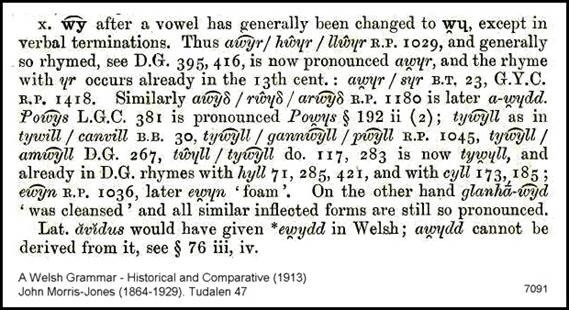
(delwedd 7091)
:_______________________________.
Powyseg <pou-I-seg> [pɔʊˡɪsɛg] (feminine noun,
adjective)
1 the dialect of Powys
y Bowyseg the dialect of Powys
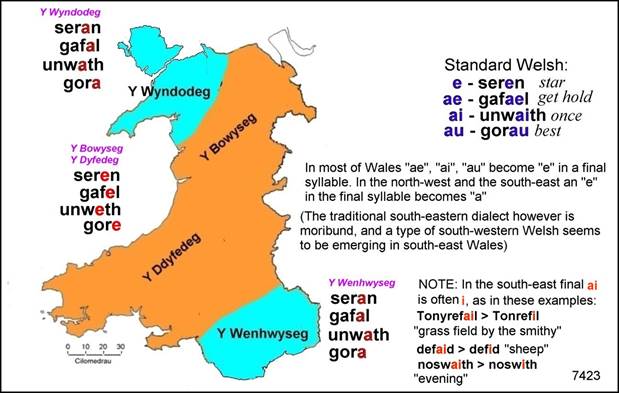
(delwedd 7423)
:_______________________________.
praff <PRAAF> [prɑːf] (adjective)
1 bod pen praffa’r ffon
gan... have the advantage, give the orders, have the last word (“have the
thickest end of the stick”)
Mae pen praffa’r ffon nawr gan y
masnachwyr a nhw sydd yn penderfynnu’r pris a gaiff y ffermwyr am y llaeth
The merchants now have the last word and they are the ones who decide the price
the farmers will get for their milk
:_______________________________.
praidd,
preiddiau ‹PRAIDH, PREIDH ye› (masculine noun)
1 herd, flock
praidd o ddefaid a flock of sheep
praidd o dri chant o
ddefaid a flock of three hundred sheep
praidd o eifr a herd of goats
2 flock = worshippers in a church
:_______________________________.
prawf,
profion ‹PRAUV, PROV yon› (masculine noun)
1 test
2
Mae’r eithriad yn brawf ar y rheol
The exception proves the rule (“the exception is a test on the rule”)
3
rhoi prawf ar allu rhywun put
somebody through his paces
(“put (a) test on (the) ability (of) somebody”)
4
maen prawf touchstone = siliceous
stone or kind of quartz, usually black, used
for testing alloys of gold and silver by rubbing them on the stone
and examining the colour of the streak left on the stone
5
trial
sefyll eich prawf am be tried for, stand trial for
6
cerdyn prawf test card - an image
broadcast by a television channel when the transmitter is active but there is
no programme being shown. It indicates what company is using the channel, and a
pattern on it serves for adjusting the TV set to obtain a correct setting.
:_______________________________.
pregeth,
pregethau ‹PREE geth, pre GEE thai
-the› (feminine noun)
1 sermon
y bregeth the sermon
2 dilyn eich pregeth eich hun
practise what you preach (“follow your own sermon”)
:_______________________________.
pregethu
‹pre GEE thi› (verb)
1 to preach
:_______________________________.
pregethwr,
pregethwyr ‹pre GEE thur, pre GETH wir› (masculine noun)
1 preacher
:_______________________________.
Preiddiau
Annwfn ‹preidh-ye a-nuvn›
1
poem in the Book of Taliesin which was written between 900-1000
ETYMOLOGY: "(the) spoils (of) Annwfn (‹= the Otherworld)
(preiddiau, plural of praidd = booty) + (Annwfn = the Netherworld, the Otherworld)
:_______________________________.
preifat ‹PREI vat› (adjective)
1 private
2 menter breifat private
enterprise
:_______________________________.
pren,
prennau ‹PREN, PRE nai , ne › (masculine noun)
1 wood (material)
2
(South Wales) tree
prennau’r goedwig the trees in the wood
3
mefusbren (Arbutus unedo) strawberry
tree
(mefus = strawberries) + soft
mutation + (pren = tree)
4
stiff fel pren (“stiff like wood”)
5
brenhinbren “the tree which is king”
brenhinbren y goedwig king of the
forest, the tree which is king of the forest, the oak (“(the) king-tree (of)
the forest”)
6
methu gweld y coed gan brennau not
see the wood for the trees
7
pren helyg (m) (prennau
helyg) (Salix) willow tree See: helygen
8 chwythbren woodwind
instrument
chwyth-
stem of chwythu = to blow) + soft
mutation + ( pren = wood)
9
(attributive) wooden, made of wood
tegan pren wooden toy
10 (in denoting something of little value)
eos bren (south-east) a terrible singer, somebody with no talent for
singing (“wooden nightingale”)
dimai bren ‹di-me-bren›
[ˡdɪmai / ˡdɪmɛ
ˡbrɛn] feminine
noun
South Wales brass farthing = the
least amount ("wooden halfpenny")
Dyw e ddim yn hidio dimai bren am...
He doesn’t care a fig for (he doesn’t heed a wooden halfpenny for...)
seren
bren something quite useless ("wooden star")
Dyw e ddim ond seren bren It's completely
useless (“it is not but a wooden star”)
(seren
= star) + soft mutation + (pren = wood)
11 ceubren ‹kei-bren› (m) PLURAL ceubrennau, ceubrenni ‹ kei-
bre -ne, -ni›
hollow tree (ceu- < cau = hollow, empty) + soft mutation +
(pren = tree)
12 impyn o’r un pren ‹im-pin or iin pren› South Wales
(said of someone who is from the same family)
("a shoot from
the same tree")
(impyn = shoot) + (o’r from the)
+ (un = one; same) + (pren = tree)
13 torbren nm torbrennau
off-cut (tor- stem of torri = to break) + soft mutation + (pren
= wood)
14 cambren nm cambrennau gambrel; frame, horizontal pole for hanging a pig from after slaughter;
butcher's tree, frame for hanging a pig’s carcass (it has the shape of a
horse's hind leg, hence the English word gambrel (= horse’s hind leg; butcher’s
tree) < Anglo-French gamberel < Northern French gambe = leg, < Latin
gamba = hoof) (Modern French has jambe = leg)
:_______________________________.
prendrig
‹pren-drig› adjective
1 tree-dwelling
ETYMOLOGY: (pren = tree) + soft
mutation + (trig-, stem of trigo = to inhabit )
:_______________________________.
pren
mesur, prennau mesur ‹pren ME sir, pre ne ME sir› (masculine noun)
1 measuring stick, yardstick
2 yardstick, criterion of comparison
ETYMOLOGY: (“wood (of) measuring”) (pren
= [piece of] wood) + (mesur = measuring)
:_______________________________.
Y
Pren-teg ‹pren-teeg› settlement name
1 SH 5841 locality in
Gwynedd, 3km north-east of Porthmadog
ETYMOLOGY: Apparently (if this is the original name, and not an adaptation of
some earlier name) ‘the fair tree’ (y
definite article) + (pren = tree) +
(teg = fair)
:_______________________________.
Pren-las
‹pren-LAAS › (but see note below)
1 Primlaws NO2401, near Town Yetholm, Scotland (south-west of Kelso)
(Prinlaws Road at the western end of Leslie; The Prinlaws – name of a public
house here)
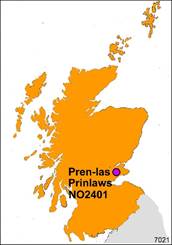
(delwedd 7021)
1861 Parochial Directory for Fife and Kinross: Leslie parish. This parish,
containing the Burgh of Barony of its own name and the contiguous village of
Prinlaws, lies at the southern base of the Lomond Hills, between them and the
river Leven, which traces its southern boundary, dividing it from Kinglassie.
It is bounded on the east by the parish of Markinch, on the north by Falkland,
and on the west by Portmoak in Kinross-shire
http://www.geograph.org.uk/photo/480871 Leslie from the west
ETYMOLOGY: Early forms of Primside show that it is a Welsh (Cumbric) name.
The meaning “green
tree” has been suggested
(pren = tree)
+ soft mutation + (glas = green).
In modern Welsh, pren is a masculine noun; in Cumbric it seems to have
been a feminine noun.
NOTE: The name
however seems somewhat odd, and does not correspond to naming patterns in
Wales, Cornwall or Brittany (“pren” is not a usual element – the type of tree
is always specified – oak, ash, birch, etc). Another suggestion is that it is
in fact the word corresponding to Welsh bryn (= hill), and it would be
“Bryn-las” in modern Welsh, although again the gender of the noun is at
variance with that of the modern Welsh word.
Bryn Glas, Glasfryn
are common name in Wales. There are no instrances of Pren-glas /
Glasbren.
:_______________________________.
Pren-wen
‹pren-WEN › (but see note below)
1 Primside NT8026, near Town Yetholm, Scotland (south-west of Kelso)
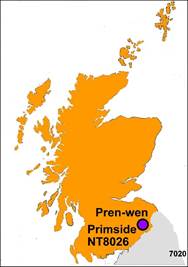
(delwedd 7020)
http://www.geograph.org.uk/photo/91777 Primside Farm
ETYMOLOGY: Early forms of Primside show that it is a Welsh (Cumbric) name. It
has been suggested that it is “white tree” (pren = tree) + soft mutation
+ (gwen. feminine form of gwyn = white).
In modern Welsh, pren is a masculine noun; if this is the word in
question, then in Cumbric it seems to have been a feminine noun.
NOTE: The name
however seems somewhat odd, and does not correspond to naming patterns in
Wales, Cornwall or Brittany (“pren” is not a usual element – the type of tree
is always specified – oak, ash, birch, etc). Another suggestion is that it is in
fact the word corresponding to Welsh bryn (= hill), and it would be “Bryn-wen”
in modern Welsh, although again the gender of the noun is at variance with that
of the modern Welsh word.
Bryn Gwyn, Gwynfryn
are common name in Wales. There are no instrances of Pren-gwyn /
Gwynbren.
:_______________________________.
prentis ‹pren-tis› masculine noun
PLURAL prentisiaid ‹pren-ti-shaid,
-ed›
1 apprentice = person who is learning a trade having agreed to work for a
certain number of years for an employer while learning
2
a learner of any craft or skill (apprentice + noun);
prentis gyrrwr learner driver
prentis prydydd an apprentice poet
ETYMOLOGY: English prentice (in
standard modern English it has reverted to the full form apprentice) < Old French aprentis
< aprendre (= to learn) <
Latin apprehendere (= grasp, get
hold of), < ad + pre + hendere
The clipped form still occurs in English as a surname PRENTICE
Other English clipped forms are in use in Welsh. The clipped form in English
may no longer be in use in some cases, since the full form has replaced it
Another example is Welsh sterics, (English hysterics)
:_______________________________.
prepiwr ‹prep-yur› masculine noun
PLURAL prepwyr ‹prep-wir›
North Wales
1 chatterbox
:_______________________________.
preri ‹pre-ri› masculine noun
PLURAL preris ‹pre-ris›
1 prairie (in the midwest of the United States)
NOTE: Not recorded as yet (2004-04-23) in existing Welsh dictionaries;
Geiriadur Prifysgol Cymru / the University of Wales Dictionary does not include
it.
Not included either in Geiriadur yr Acádemi (Welsh Academy English-Welsh
Dictionary), which has as the standard forms for “prairie” paith / peithdir / gwastatir
2 Preri
Bach (“little prairie”) Name of a location in Minnesota
“The late Humphrey Jones built his residence upon
the identical spot where his first cabin stood, and he and Thomas Y. Davis
loved to talk of the good old time when they first batched it together in
Judson, and many were the adventures they had to relate. Sunday, May 27 ‹1855›, the two took a walk into the terra incognito
further up the Minnesota river, as far as the western edge of the present town
of Cambria. There they discovered the bottom land known as the "Little
Prairie" (Prairie Bach), also
Cambria creek and the Little Cottonwood, and the long neck of upland prairie
between the two streams, where Horeb church now stands. This strip of prairie
from half a mile to a mile in width, wedged in between the two belts of timber,
was, they thought, the most beautiful spot they had ever seen. Large spreading
oak trees standing singly and in groups like lordly sentinels of the place,
clumps of hazel bushes and red-topped sumach,
{sumac, also sumach - any of several anacardiaceous shrubs or small trees of
the genus Rhus. Middle English < Medieval Latin < Arabic summâq.
Webster's Dictionary}
and small groves of the dainty poplar, were scattered over the prairie as if by
design, while the dovetailing of prairie and woodland and the deep indenturers
and recesses winding far into the forest like the avenues of a mighty
labyrinth, gave the appearance of a magnificent park.”
(History of the Welsh in Minnesota,
Foreston and Lime Springs, Iowa, gathered by the Old Settlers / Edited
by the Reverends Thomas E. Hughes and David Edwards, and Messrs. Hugh G.
Roberts and Thomas Hughes / 1895 / Page 31)
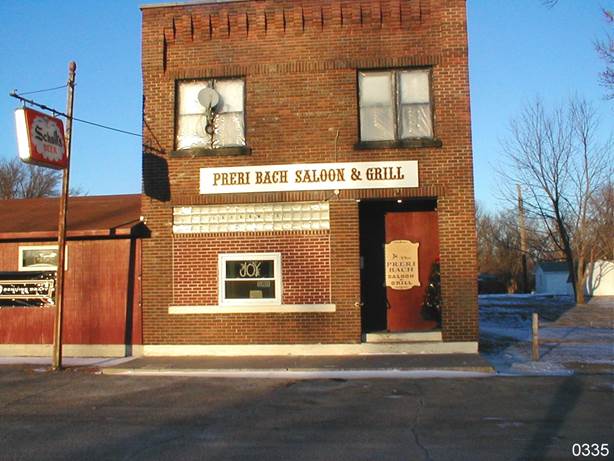 (((delwedd 0335)
Preri Bach Saloon and
Grill, Main Street, Cambria Township, Minnesota, MN16073, (Ionawr / January
2004)
(I have come across another photo on the following website: http://www.cheloniadesign.com/Baby/photo_album/month_8/1/943_preri_bach.jpg )

(2008-10-16 link no
longer working)
:_______________________________.
pres ‹PREES› (masculine noun)
1 brass
Band Pres Porthaethwy Menai Bridge Brass Band
2
(slang) money; dosh, dough, bread
Sgenti bres? (A oes gennyt ti bres?) Have you got any money?
NOTE: In the English dialect of Llanidloes:
BRASS,
copper coinage and the present bronze coinage. “Hast ee any brass?” Have you
any copper, or bronze coins? (Parochial Account of Llanidloes / Edward Hamer /
Chapter X / Folk-lore. Page 282 Collections Historical and Archeological Relating to Montgomeryshire and its Borders /
1877)
Olde Cheshire Dialecte. http://www.cheshirelittlefolk.co.uk/Old_dialect.htm
brass: copper coins
3 Coleg y Trwyn Pres Brasenose College, University of Oxford (“(the)
college (of) the nose (of) brass”)
:_______________________________.
Presbyteraidd
‹pres-bə-tê-redh› adjective
1 Presbyterian = (church) with a Calvanistic interpretation of
Christianity and governed by presbyters or lay elders (that is, not by clerics)
y Coleg Presbyteraidd yng Nghaerfyrddin
the Presbyterina College in Caerfyrddin
2
eglwys Bresbyteraidd Presbyterian
church (building for worship)
Yr Eglwys Bresbyteraidd Gymraeg,
Melbourne, Awstralia
The Welsh (= Welsh-language) Presbyterian Church, Melbourne, Australia
3
Eglwys Bresbyteraidd Cymru The
Presbyterian Church of Wales
Name of a denomination;
also known by their old description of Y
Methodistiaid Calfinaidd the Calvinistic Methodists, or Yr Hen Gorff = the Old Organisation
(“the old body”)
ETYMOLOGY: (presbyter = presbyter) +
(-aidd suffix for forming
adjectives)
:_______________________________.
preseb ‹pre-seb› masculine noun
PLURAL presebau ‹pre-sEE-bai,
be›
1 manger = trough for horses or cattle to eat from
2
(Bible) crib = manger in the stable of the inn at Bethlehem where the new-born
Jesus was placed
Luc 2:7 A hi a esgorodd ar ei mab
cyntaf-anedig, ac a'i rhwymodd ef mewn cadachau, ac a'i dododd ef yn y preseb;
am nad oedd iddynt le yn y llety
Luke 2:7 And she brought forth her firstborn son, and wrapped him in
swaddling clothes, and laid him in a manger, because there was no room for them
in the inn
3
fel ci yn y preseb (qv) like a dog
in the manger – said of someone in possession of something which he or she
won’t let another person have or use, though it is of no use to him or her.
The image is of a dog lying on the hay in a manger and so preventing hungry
cattle from eating the hay.
4
Y Preseb Praesepe = a cluster of
hundreds of stars in the constellation Cancer, visible to the naked eye in the
form of a hazy patch of light
ETYMOLOGY: Welsh < British < Latin *presep-
< praesep- < praesaep-
From the same British root: Cornish preseb
(= manger, crib), Breton prezeb (=
manger, crib)
:_______________________________.
presennol
‹pre SE nol› (adjective)
1 present
:_______________________________.
preserfio
‹pre-serv-yo› verb
1 preserve = cook in sugar to prevent deterioration
ETYMOLOGY: (preserf- < English to preserve) + (-io suffix for forming verbs)
:_______________________________.
Prestatyn
‹pre STA tin›
1 village in the north-east.SJ0682
http://www.geograph.org.uk/photo/724208
:_______________________________.
preswylfa
‹pre-suil-va› feminine noun
PLURAL preswylfaoedd,
preswylféydd ‹pre-suil-vAA-odh, pre-suil-veidh›
1 dwelling, abode
y breswylfa the abode
2 Preswylfa chapel name
(e.g. Methodist chapel in Cyffordd Llandudno, county of Conwy)
Salmau 26:8 ARGLWYDD, hoffais drigfan dy
dŷ, a lle preswylfa dy ogoniant.
Psalms 26:8 LORD, I have loved the habitation of thy house, and the place where
thine honour dwelleth.
3 Preswylfa (house name)
= Home (possibly a favourite house name partly as a result of its use in the
Bible for a ‘house of God’ as in the previous quotation).
4
street name (Preswylfa, Llanberis)
Also as a component in street names:
Heol Preswylfa, Caer-dydd
Cwrt Preswylfa, Pen-y-bont ar Ogwr,
South-east Wales
5 Preswylfa wrongly cited
as an explanation of Preseli, name
of an upland in the county of Penfro.
(Lewis' Topographical Dictionary of Wales (1833):
“Part of the Precelly mountain, which is the highest in South Wales, is within
its limits: the ancient Welsh name of this mountain is Preswylva, signifying “a
place of residence,” and is derived from its having been the resort of the
natives, as a place of security, in the intestine wars by which this part of
the principality was agitated during the earlier periods of its history.”)
This upland name is in fact Prys Selyf (woodland
of Selyf) (Selyf = Welsh form of
Solomon)
ETYMOLOGY: (preswyl, stem of the
verb preswyl = to reside) + (-fa = place)
:_______________________________.
Preswylva
‹pre-suil-va›
1 poor spelling for Preswylfa, with
English "v" ‹v› instead of Welsh
"f" ‹v› (though see the entry
for the letter v for the attempt to
promote this letter in Welsh in the nineteenth century) .
Sometimes spelt this way as a house name in the nineteenth-century.
This is the spelling found in "A Topographical Dictionary of Wales" (1833) (Samuel Lewis)
"Part of the Precelly mountain,
which is the highest in South Wales, is within its limits: the ancient Welsh
name of this mountain is Preswylva, signifying "a place of
residence," and is derived from its having been the resort of the natives,
as a place of security, in the intestine wars by which this part of the
principality was agitated during the earlier periods of its history."
(See the entry Preswylfa for the correct derivation of the name!)
:_______________________________.
preswylydd,
preswylwyr ‹pre-SUI-lidh, pre-SUIL-wir› (m)
1 inhabitant, dweller
preswylydd ogof cave
dweller; plural preswylwyr ogof (if
living in one cave) , preswylydd ogofâu
(if living in caves in general)
:_______________________________.
PRETONIC SYLLABLE
The loss of the pretonic syllable in Welsh is a very
common feature
Some examples:
Afon Naddawan > Afon Ddawan (In English, River Thaw, taken from the
clipped version of the name)
The loss of the linking definite article when it is a pretonic syllable also
occurs; this is especially noticeable in place names
Pen-y-bont > Pen-bont “Pem-bont” (“bridge end”)
Pen-y-cae > Pen-cae (“field end / side / edge”)
Glanyrafon > Glanrafon (“river side”)
:_______________________________.
prff.
1 abbreviation = perffaith (perfect tense)
:_______________________________.
pric ‹prik› masculine noun
PLURAL priciau ‹prik-ye›
1 stick
2
ox goad
3
priciau cynnau tân kindling,
firewood
4
stirring stick, stick for stirring
pric troi uwd porridge stirrer,
stick for stirring porridge
In the magazine Llafar Gwlad, number 73, Haf (summer) 2001 an article by Bobi
Owen on nicknames in Dinbych (‘Denbigh’ in English) mentions Dic Pric Troi Uwd (“Dic of the porridge
stick”), and states ‘enw sydd yn ein hatgoffa am yr arfer ers talwm o roi’r
plentyn ieuengaf yn y teulu i eistedd wrth y lle tân i droi’r uwd yn y crochan
rhag iddo geulo’ (a name which reminds us of the practice in the past of
sitting the youngest child in the family to sit by the fireplace and stir the
porridge in the cooking pot to stop it from congealing / going lumpy)
6
(South Wales) penis
Also as a disparaging expression for a person: prick
’En bric yw a (Hen bric yw ef) He’s
a prick
7
(North-east Wales) pric clust
earache
8
(North-east Wales) pric pwdin
..1/ stick placed across the mouth of a cooking pot from which a
pudding in a pudding cloth is suspended for boiling
..2/ laughing stock, object of derision,
..3/ stooge, person manipulated or used by another
9
(South-east Wales) shooting pain, sudden pain
10
pric cwyr taper = thin candle
11
pric edafedd yarn stick = stick used
in making yarn from strands of fibre
Mae ganddo goesau fel priciau ’dafedd
(said of someone with very thin legs) He’s got legs like spindles (literally
“like yarn sticks”)
12 pric coctel cocktail
stick
ETYMOLOGY: English prick (= ox-goad,
pointed stick) < Old English prica (= point); there are similar words
in Dutch and the Scandinavian languages
:_______________________________.
prid ‹PRIID› (adjective)
1 (South) expensive. Literary equivalent: drud ‹driid›
:_______________________________.
pridd ‹PRIIDH› (masculine noun)
1 earth
2 Mae e dan ddwylath o bridd
He’s dead and buried, He’s six foot under, He’s pushing up the daisies (“he’s
under two yards of earth”)
3
uwchbridd topsoil
uwch bridd (uwch = highest, top) + soft mutation + (pridd = earth, soil)
4 cob = a mixture of earth / clay and straw (for tensile strength) to make
blocks for building walls; other additional ingredients are sand / cow dung or
horse dung / horsehair / sheep’s wool
tŷ pridd a house build of blocks of cob
Occurs in the place name Pont-y-tŷ-pridd (“(the) bridge (by) the
cob house”), shortened in the mid 1800s to the rather meaningless Pont-y-pridd
(“(the) bridge (of) the cob / (of) the soil”),
:_______________________________.
priddlestr
‹pridh-lestr› masculine noun
PLURAL priddlestri ‹piridh-le-stri›
1 earthernware pot, piece of pottery )
ETYMOLOGY: pridd lestr (pridd = earth ) + soft mutation + (llestr = vessel )
:_______________________________.
priddbwll
‹pridh-bulh› masculine noun
PLURAL priddbyllau ‹pridh-bə-lhe›
1
clay pit
2
Priddbwll house name, Abergwyngregyn
SH 6572 (county of Conwy), mentioned in the 1851 Census
ETYMOLOGY: pridd bwll (pridd = earth, clay) + soft mutation +
( pwll = hole, pit)
:_______________________________.
prif ‹PRIIV› (adjective)
1 principal
2
(foremost in rank)
Prif Lyngesydd Admiral of the Fleet,
naval equivalent of an army general or field marshal
:_______________________________.
prifardd
‹pri-vardh› masculine noun
PLURAL prifeirdd ‹pri-veirdh›
1 chief poet, winner of the chair for the 'awdl' (strict-metre poem) at
the national eisteddfod
2
also as a title for the writer of the winning 'awdl'
y
Prifardd D. Lloyd Jenkins the principal poet D. Lloyd Jenkins
ETYMOLOGY: prifardd < príf-fardd
prif fardd
(prif = main, chief) + soft mutation + (bardd = poet)
:_______________________________.
prifathrawes,
prifathrawesau ‹pri va THRAU es, pri va thrau E se› (feminine noun)
1 school director (Englandic: headmistress)
y brifathrawes the headmistress
:_______________________________.
prifathro,
prifathrawon ‹pri VA thro, pri va THRAU on› (masculine noun)
1 school director (Englandic: headmaster)
:_______________________________.
prifddinas
‹priiv-dhî-nas› feminine noun
PLURAL prifddinasoedd ‹priiv-dhi-na-sodh›
1 capital city
y brifddinas the capital city
Caer-dydd prifddinas Cymru
Caer-dydd, capital of Wales
Y Brifddinas the Capital (=
Caer-dydd)
mewn gwahanol fannau o'r Brifddinas a'r
cylch
in different parts of the capital city and its environs
2
yn y brifddinas
(1) in the capital
(2) in the context of Wales, = in Caer-dydd (the city was proclaimed the
capital in 1955)
(3) formerly, in the context of Wales, = in the capital of the English state,
in London
Mae
yn y brif-ddinas lawer o gannoedd o Gymry (Seren Gomer, 1835) There are in the
capital (= London) many hundreds of Welsh people
3
capital = main centre of some activity
Bob blwyddyn y mae pentref bychan
Tregaron yn brifddinas rasus trotian y byd
Every year the little village of Tregaron is the world capital of trotting
races
ETYMOLOGY: prif ddinas (prif = main) + soft mutation + (dinas = city)
:_______________________________.
priffordd,
priffyrdd ‹PRI fordh, PRI fyrdh› (feminine noun)
1 main road
y briffordd the main road
:_______________________________.
prif
gwnstabl, prif gwnstablau ‹priiv GUN sta bəl, priiv gun STA ble› (masculine noun)
1 chief constable, head of a police force
:_______________________________.
prifio ‹PRIV yo› (verb)
1 grow
2 prifio’n ddyn grow up to be a man, become a man
:_______________________________.
priflythyren,
priflythrennau ‹priv lə THƏ ren, priv lə THRE ne› (feminine noun)
1 capital letter
y briflythyren the capital letter
:_______________________________.
prifswm,
prifsymiau ‹PRIV sum, priv SƏM ye› (masculine noun)
1 capital
:_______________________________.
prifwyl ‹priv-uil› feminine noun
1 y Brifwyl the national
eisteddfod
yn y Brifwyl ddilynol in the
following eisteddfod, in the eisteddfod after that
ETYMOLOGY: prif wyl (prif = main) + soft mutation + (gwyl = festival)
:_______________________________.
prifwythiennol
‹priv-wø-thi-E-nol› adj
1 arterial
strydoedd prifwythiennol o amgylch Parc y Rhath
arterial roads around Roath Park
ETYMOLOGY:
prifwythienn-, penult form of prifwythïen (= artery) + (-i-ol = adjectival suffix)
:_______________________________.
prifysgol,
prifysgolion ‹pri VƏ skol,
pri və SKOL yon› (feminine noun)
1 university
y brifysgol the university
:_______________________________.
prìn ‹PRIN› (adjective)
1 scarce
2
mynd yn brin ar (rywun) am (rywbeth)
run short of something (“become scarce on somebody around / for something”)
bod yn brin (o rywbeth) ar (rywun) be
running short of something (“be scarce of something on somebody”)
Mae hi’n brìn o de arno’ ni We’re running out of tea
3 Prìn chwedl, llawn chwedl No
news is good news (“scarce report, full report”)
4 un o’r bobl brin hynny
sydd... one of the few people who...
5
gydag eithriadau prin with few
exceptions
6
gorau po brinnaf the least the
better
Gorau po brinnaf cyfeirio at y pethau
hyn The least said about these things the better (“the least the better
referring to these things”
7
mor brin â chachu ceffyl pren (said
of something scarce) “as scarce as the shit of a wooden horse”
:_______________________________.
prìn
ddigon ‹prin dhî-gon›
1
Does gen i ond prin ddigon
I’ve only just got enough, I’ve none to spare
2 prin ddigon i scarcely enough to...
cyflog prin ddigon i fyw arno
a wage scarcely enough to live on, a subsistence wage
ETYMOLOGY: (prin = scarcely) + soft
mutation + (digon = enough,
sufficient)
:_______________________________.
prinder ‹PRIN der› (masculine noun)
1 scarcity
:_______________________________.
prìn
eich Saesneg ‹prin əkh Səs-neg› adjective
1 who doesn't speak much English, who didn't speak much English
(“scarce one's English”)
Aeth dyn prin ei Saesneg i ymweld â'r
meddyg...
A man who didn't speak much English went to the doctor's... (“to visit the
doctor”)
:_______________________________.
printiedig
‹print YE dig› (adjective)
1 printed
:_______________________________.
printio ‹PRINT yo› (verb)
1 to print
:_______________________________.
printiwr
‹print-yur› masculine noun
PLURAL printwyr ‹print-wir›
1 (computer) printer = machine for printing documents
ETYMOLOGY: (print- = stem of printio = to print) + (-i-wr suffix for indicating a device or
an agent; literally = man)
:_______________________________.
prìn un
o ‹prin iin oo› pronoun
1 scarcely a single one of...
prin un ohonyn nhw scarcely a single
one of them
ETYMOLOGY: (prin = scarcely) + (un = one) + (o = of)
:_______________________________.
priod ‹PRII od› (adjective)
1 married
2
gwraig briod, gwragedd priod ‹gwraig
BRI od, gwra gedh PRI od› (feminine noun)
married woman
3 gŵr
priod, gwyr priod ‹guur PRI od, gwiir PRI od› (masculine noun)
married man
:_______________________________.
priod ‹PRII od› (m)
1 spouse; husband or wife
O! ’m bachgen glwys a’m priod llon,
Oh, my pretty boy and
my cheerful wife
p. 29, Siencyn
Ddwywaith, 1872
:_______________________________.
priodas,
priodasau ‹priO das, pri o DA se› (feminine noun)
1 marriage
y briodas the marriage
2
priodas orfod PLURAL priodasau gorfod shotgun wedding
(“wedding of obligation”)
3
modrwy briodas PLURAL modrwyau priodas wedding ring
4
anrheg briodas PLURAL anrhegion priodas wedding present
5 gwledd briodas wedding feast
cynnal gwledd briodas hold a wedding
feast
cael gwledd briodas have a wedding
feast
:_______________________________.
priodas
fantais ‹pri-ô das van-tes›
PLURAL priodasau
mantais ‹pri-o-da –se man-tes›
1 marriage of convenience
ETYMOLOGY: (priodas = marriage) + soft mutation + (mantais = advantage)
:_______________________________.
priodfab,
priodfeibion ‹pri OD vab, priod VEIB yon› (masculine noun)
1 (wedding) bridegroom
:_______________________________.
priodferch,
priodferched ‹pri OD verkh, priod VER khed› (feminine noun)
1 (wedding) bride
y briodferch the bride
:_______________________________.
priodi ‹pri O di› (verb)
1 to marry; to get married
2 priodi am yr eildro /
priodi’r eildro get married for the second time
:_______________________________.
priodol ‹pri O dol› (adjective)
1 appropriate
:_______________________________.
prion,
p'rion ‹priI-on› adjective
1 South Wales fine, all
right; reduced form of purion
:_______________________________.
priordy,
priordai ‹pri OR di, pri OR dai› (masculine noun)
1 priory
:_______________________________.
pris,
prisiau ‹PRIIS, PRIS ye› (masculine noun)
1 price
2
am brisiau is o lawer at greatly reduced
prices, at much reduced prices (“for prices lower by-a-great-extent”)
3
gosod pris i rywun am rywbeth quote
a price for something (“set a price to someone for something”)
:_______________________________.
Prisiart
‹pri-shart›
1 patronymic – son of Rhisiart
2 surname (anglicised form: Prichard, Pritchard)
:_______________________________.
pro ‹proo› preposition
1 pro, in favor / favour of
pro-Seisnig pro-English
pro-Gymréig pro-Welsh
ETYMOLOGY: English pro < Latin pro
:_______________________________.
problem,
problemau ‹PRO blem, pro BLE me› (feminine noun)
1 problem
y broblem the problem
:_______________________________.
procer,
procerau ‹PRO ker, pro KEE re› (masculine noun)
1 poker
2 stiff fel procer (eg
the back after lifting heavy oblects) (as) stiff as a poker (“stiff like (a)
poker”)
:_______________________________.
profedigaeth
‹pro-ve-DII-gaith, -geth› (f)
PLURAL profedigaethau <pro-ve-di-GEI-thai, -e> [prɔfʊɪdɔlˡjəɪθaɪ,
-ɛ]
1
misfortune
2
bereavement
cael profedigaeth
lose somebody close to you, lose someone through death
lwfans
profedigaeth bereavement allowance
y rhai mewn
profedigaeth the breaved, those who have lost someone through death
3 temptation
:_______________________________.
proffes,
proffesau <PROO-fes, pro-FE-sai,
-e> [ˡprɔfɛs, prɔˡfɛsaɪ,
-ɛ] (feminine noun)
1 profession of faith
proffes o ffydd profession
of faith (Catholicism). A public statement of one’s acceptance of the
teachings of the Catholic Church.
2 religious faith
tor proffes apostasy (“breach of religious faith”)
:_______________________________.
proffesiwn,
proffesiynau <pro-FE-shun, pro-fe-SHƏ-nai, -e> [prɔˡfɛʃʊn,
prɔfɛˡʃənaɪ, -ɛ] (masculine noun)
1 profession
:_______________________________.
proffwyd,
proffwydi <PROO-fuid, pro-FUI-di> [ˡproˑfʊɪd,
prɔˡfʊɪdɪ] (masculine noun)
1 prophet
Sant Marc 6:4 Ond
yr Iesu a ddywedodd wrthynt, Nid yw proffwyd yn ddibris ond yn ei wlad ei hun,
ac ymhlith ei genedl ei hun, ac yn ei dŷ ei hun.
Saint Mark 6:4 But
Jesus said unto them, A prophet is not without honour, but in his own country,
and among his own kin, and in his own house.
:_______________________________.
proffwydol <pro-FUI-dol> [prɔˡfʊɪdɔl] adjective
1
prophetic = foretelling, giving a prediction
2 prophetic = relating to a prophet, or to prophecy
ETYMOLOGY: (proffwyd = prophet) + (-ol suffix for forming adjectives)
:_______________________________.
proffwydoliaeth
<prof-ui-DOL-yaith,
-yeth> [prɔfʊɪˡdɔljaɪθ, -ɛθ] feminine noun
PLURAL proffwydoliaethau <prof-ui-dol-YEI-thai,
-e> [prɔfʊɪdɔlˡjəɪθaɪ,
-ɛ]
1
prophecy
2
Drych Proffwydoliaeth: Neu Wiredd,
Dyben, A Deongliad Proffwydoliaethau Yr Ysgrythyrau Sanctaidd (Year of
publication: ?) by the Reverend John Hughes, Liverpool (1850-1932). “A mirror
of prophecy: or the truth, purpose and interpretation of the miracles of the
Holy Scriptures”.
ETYMOLOGY: (proffwydol =
prophetic) + (-i-aeth suffix for
forming nouns)
:_______________________________.
profi <PROO-vi> [ˡproˑvɪ] (verb)
1 test, try
2 prove to be
profi yn llond yr enw / profi'n llond yr enw turn out to be exactly
as the name suggests
Yn y flwyddyn 1797, yn mhen dwy flynedd wedi ei
urddiad, efe a gymerodd Mary Brees y Coed, yn ymgeledd cymwys iddo ei hun, yr
hon yn ol iaith traddodiad a brofodd yn llon’d yr enw.
In the year 1797, two years after his ordination, he
took Mary Brees from Y Coed as a wife (“suitable help”), who, according to
tradition, turn out to be exactly as the name suggests.
NOTE ON ymgeledd cymwys (= helpmate;
helpful wife or husband, literally ‘‘suitable help’)
Genesis 18:20
Hefyd yr Arglwydd Dduw a ddywedodd, Nid
da bod y dyn ei hunan; gwnaf iddo ymgeledd cymwys iddo...
(18:20) Ac Adda a enwodd enwau ar yr
holl anifeiliaid, ac ar ehediad y nefoedd ac ar holl fwystfilod y maes;
ond ni chafodd efe i Adda ymgeledd cymwys iddo
Genesis 18:20 And the Lord God said, It is not good that the man should be
alone; I will make him an help meet for him...
(18:20) And Adam gave
names to all cattle, and to the fowl of the air, and to every beast of the
field; but for Adam there was not
found an help meet for him
3
haeru cyn profi (“assert before
proving”) to beg the question / to beggar the question, "beg the
question, in the logical sense", give a circular argument = assume that
something not yet put to the test is already proved. The English expression “begging the
question” was originally “beggaring the question” as in “leaving it lacking
something, leaving it in need of something”, rather as if you have made it into
a beggar who is asking you for money or food.
Wikipedia
2008-09-20
Fallacy of Petitio Principii. The Latin term was incorporated into
English in the sixteenth century. The Latin version, Petitio Principii
(from peto, petere, petivi, petitus: attack, aim at, desire, beg, entreat,
ask (for), reach towards, make for; principii: genitive of principium:
beginning or principle), literally means "begging or taking for granted of
the beginning or of a principle." That is, the premise (the principle, the
beginning) depends on the truth of the very matter in question. The Latin
phrase comes from the Greek en archei aiteisthai in Aristotle’s Prior
Analytics II xvi:
Begging or assuming the point at issue consists (to take the expression in its
widest sense) in failing to demonstrate the required proposition. But there are
several other ways in which this may happen; for example, if the argument has
not taken syllogistic form at all […]. If, however, the relation of B to C is
such that they are identical, or that they are clearly convertible, or that one
applies to the other, then he is begging the point at issue.
:_______________________________.
profiad,
profiadau <PROV-yad, prov-YAA-dai,
-e> [ˡprɔvjad, prɔvˡjɑˑdaɪ,
-ɛ] (masculine noun)
1 experience
dibrofiad inexperienced
:_______________________________.
profion <PROV-yon> [ˡprɔvjɔn] (plural noun)
1 tests; see prawf
:_______________________________.
pro-Gymréig
<proo-gəm-REIG> [proˑ gəmˡrəɪg] adjective
1 pro-Welsh
Cf gwrth-Gymréig anti-Welsh
ETYMOLOGY: (pro = pro) + soft
mutation + (Cymréig = Welsh)
:_______________________________.
prom <PROM> [prɔm] (masculine noun)
1 = promenâd
Y Prom name of a street in
Cricieth (English name: The Esplanade)
:_______________________________.
promenâd,
promenadau <pro-me-NAAD, pro-me-NAA-dai, -de> [prɔmɛˡnɑːd,
prɔmɛˡnɑˑdaɪ, -ɛ] (masculine noun)
1 promenade = seaside walk
:_______________________________.
pro-Seisnig
‹proo-seis-nig› adjective
1 pro-English
Cf gwrth-Seisnig anti-English
ETYMOLOGY: (pro = pro) + (Seisnig = English)
:_______________________________.
proses,
prosesau ‹PRO ses, pro SE se› (masculine or
feminine noun)
1 process
y proses / y broses the process
2 proses symlach streamlined
process (“simpler process”)
:_______________________________.
prosesydd
bwyd, prosesyddion bwyd ‹pro SE sidh BUID, pro se SƏDH yon BUID› (masculine noun)
1 food processor, blender
:_______________________________.
protest ‹pro-test› masculine noun
PLURAL protestiadau ‹pro-test-yAA-de›
1 protest = expression
of disagreement, objection
Y mae mwy a mwy o'r farn mai'r unig
brotest effeithiol fyddai ymwrthod â'r papur
More and more people are of the opinion that the only effective protest
would be to refuse to buy the newspaper
2
act of protest = demonstration of dissent
ETYMOLOGY: English protest <
French protester < Latin prôtestârî / prôtestâtus = be a witness
before the public (prô = in front
of) + (testâri < testis =
witness)
:_______________________________.
Protestaniaeth
‹pro-te-stan-yeth› feminine noun
1 Protestantism = a division in Christianity dating from the
objection to the edict of Charles V in 1529 and the Diet of Spiers which
denounced the Reformation
ETYMOLOGY: (Protestannh- < Protestant) + (-i-aeth suffix for forming abstract nouns)
:_______________________________.
Protestannaidd
‹pro-te-sta-nedh› adjective
1 Protestant = of a church founded by the Protestant reformers
ETYMOLOGY: (Protestannh- < Protestant)
+ (-aidd suffix for forming
adjectives)
:_______________________________.
Prótestant
‹pro-te-stənt› masculine noun
PLURAL Protestaniaid
‹pro-te-stan-yed›
1 Protestant = one of the reformers of 1529 who protested against the
edict of Charles V and the Diet of Spiers which denounced the Reformation
2
Protestant = a member of a Protestant church
ETYMOLOGY: English protestant <
French protestant = a person who is
protesting; see Protestaniaeth
:_______________________________.
prudd ‹PRIIDH› (adjective)
1 gloomy, melancholic
:_______________________________.
prun? /
p'run? ‹PRIIN› (pronoun)
1 which one?
:_______________________________.
prun a
ych chi'n ei hoffi ai peidio ‹priin a ii khiin i hô-fi ai peid-yo›
1 whether you like it or not
ETYMOLOGY: (prun = which one) + (a ych chi = that you are) + (ei hoffi = liking it) + (ai = or) + (peidio = cease doing it, stopping)
:_______________________________.
..1
pryd, prydiau ‹PRIID, RPID ye› (masculine noun)
1
time, occasion
2
ar yr un pryd / yr un pryd at the same time, simultaneously
3
ar brydiau ‹ar BRƏD ye› (adverb) at time, on occasions
ar hyn o bryd ‹ar HIN o BRIID› (adverb) at the
present time, at present, now
ar yr un pryd ‹ar ər iin
PRIID› (adverb) at the same time
mae'n bryd ‹main BRIID› (adverb) it's time
mae'n hen bryd ‹nymain
heen BRIID› (adverb) it's about time
mewn pryd ‹meun PRIID› (adverb) in time
o bryd i'w gilydd ‹o BRIID iu GI lidh› (adverb) from time
to time
o bryd i bryd ‹o BRIID i BRIID› (adverb) from time
to time
pa bryd? ‹pa BRIID› (adverb) what time? when?
pryd? ‹PRIID› (adverb) when?
pryd (y) ‹PRIID ə› (conjunction) when
:_______________________________.
..2
pryd, prydau ‹PRIID, PRI de› (masculine noun)
1 meal (also: pryd o fwyd)
2 byrbryd snack
(byr- ‹ə› penult-syllable form of byr ‹i› = short) + soft
mutation + ( pryd = meal)
:_______________________________.
Prydain ‹PRƏ den› (feminine noun)
1 Great Britain
:_______________________________.
pryder ‹PRƏ der› (masculine noun)
1 worry
:_______________________________.
pryderu ‹prə DEE
ri› (verb)
1 to worry
:_______________________________.
pryderus
‹prə DEE
ris›
(adjective)
1 worried
:_______________________________.
prydferth
‹PRƏD
verth› (adjective)
1 beautiful
:_______________________________.
prydles ‹prəd-les› feminine noun
PLURAL prydlesi,
prydlesau ‹prəd-le-si,
prəd-le-se›
1 lease
y brydles the lease
eiddo ar brydles (“property on lease”)
leasehold property, house or land etc. rented out for a specified period
ETYMOLOGY: ‘contract (for a specific length of) time’
(pryd- < pryd = time)
+ (les = lease, rent contract )
:_______________________________.
prydlon ‹PRƏD lon› (adjective)
1 punctual
:_______________________________.
prydydd ‹prəd-idh› masculine noun
PLURAL prydyddion
‹prə-DøDH-yon ›
1 poet
prentis prydydd an apprentice poet
Cynddelw Brydydd Mawr (fl. ca. 1155-1200) ("Cynddelw (the) Great
Poet")
:_______________________________.
pryf,
pryfed ‹PRIIV, PRƏ ved› (masculine noun)
1 insect, animal
(the standard word
for insect is trychfilyn)
pryf hofran (“insect (of)
hovering”) hoverfly; Syrphus ribesii, and other flies of the Syrphidae family
pryf hedegog (m) pryfed hedegog
(colloquial) flying insect
2 Mae
o’n dipyn o bry’ He’s a crafty old devil (“he’s a bit of an animal”)
3 game animal,
especially a hare
codi pry to start a hare,
raise a hare - drive a hare from its hiding place in order to begin hunting it
Coed y Pry SH8829 “(the) wood (of) the hare”. Farm in Llanuwchllyn, Gwynedd
http://www.geograph.org.uk/photo/241684
NOTE: In North Wales
a final [v] ina monosyllable is generally lost, hence pryd <PRIIV> [priːv] > <PRII> [priː]
Other examples are gof / go’ (= smith), craf / cra’ (=
wild garlic), haf / ha’ (= summer)
:_______________________________.
pryf
cop, pryfed cop ‹priiv KOP, prə ved KOP› (masculine noun)
1 spider (North Wales)
:_______________________________.
pryf
copyn, pryfed copyn ‹priiv KO pin, prə ved KO pin› (masculine noun)
1 spider (North Wales)
:_______________________________.
pryf
genwair ‹priiv gen-wer› masculine noun
PLURAL pryfed
genwair ‹prə-ved gen-wer›
1 North Wales earthworm
ETYMOLOGY: “the creature of the fishing rod” (pryf = insect, animal) + (genwair
= fishing rod)
Colloquially pry genwar
(north-west), pry genwer
(north-east)
:_______________________________.
pryfysol
‹prəv-ə-sol› adjective
1 insectivorous, insect-eating
ETYMOLOGY: (pryf = insect) y = ‹i› + (-ysol = -eating); (ys- stem of ysu = consume) + (-ol
suffix for forming adjectives)
:_______________________________.
pryfysor
‹prəv-ə-sor› masculine noun
PLURAL pryfysorion ‹prəv-ə-sor-yon›
1 insectivore, insect-eating bird
ETYMOLOGY: (pryf = insect) y = ‹i› + (-ysor = -eater, animal
which eats);
(ys- stem of ysu = consume) + (-or suffix
for indicating a an agent; from Latin -ârius,
in words taken from Latin (canghellor (=
chancellor) < cancellârius;
afterwards used as a suffix with native words, as in telynor = harpist)
:_______________________________.
prynedigaeth
‹prə-ne-dII-geth› feminine noun
1 redemption = (Christianity) the act of saving from sinful ways or
from evil
ETYMOLOGY: (prynedig = saved) + (-aeth suffix for forming abstract
nouns)
:_______________________________.
prynháwn
‹prə-nhaun› masculine noun
PLURAL prynhawniau,
prynhawnau ‹prə-nhaun-ye, prə-nhau-ne›
NOTE: colloquial form: North pnawn,
South-east pyrnáwn ‹pər-naun›
1 afternoon 12.00 - 18.00
ar brynhawniau Gwener on Friday afternoons
bob prynháwn every afternoon
heddiw’r prynháwn (adverb) this
afternoon (North-east Wales)
yn y prynháwn in the afternoon
y prynháwn ddoe (adverb) yesterday
afternoon
y prynháwn heddiw (adverb) this
afternoon
y prynháwn hwnnw (adverb) that afternoon
(= on the afternoon I’m talking about)
y prynháwn ‘ma (adverb) this
afternoon
2 post meridiem, p.m., in the afternoon
am dri o'r gloch y prynháwn at 3
p.m.
3 oedfa’r prynháwn
afternoon service in a chapel or church
4 te’r prynháwn afternoon
tea
5 dangosiad prynháwn
(Cinema) afternoon showing of a film, matinée
6 perfformiad prynháwn
(Theatre) afternoon perfomance of a play, matinée
7 prynháwn da o pnawn da (greeting) good afternoon
ETYMOLOGY: (“period (of the) nones”)
prynháwn < pryd-náwn (pryd = time,
period) + (nawn = the nones, the
ninth hour in a monastery, three in the afternoon - originally the ninth hour
after sunrise).
In Irish there is a similar construction: trathnóna
(= afternoon)
(trath = period, nóna = ninth hour)
:_______________________________.
prynu ‹PRƏ ni› (verb)
1 to buy
2 gorchymyn prynu gorfodol compulsory
purchase order
3 gwerthu’r fuwch i brynu tarw
to rob Peter to bay Paul (“sell the cow to buy a bull”)
In the South pyrnu ‹PƏR-ni› [pərnɪ], a form showing
metathesis;
cf in the South cyrnu ‹KƏR-ni› [Kərnɪ] < crynu (=
to shake, shudder - from fear, cold, etc)
:_______________________________.
prynwr
hen heyrn ‹prə-nur
heen heirn› masculine noun
PLURAL prynwyr
hen heyrn ‹prən-wir
heen heirn›
1 scrap merchant
ETYMOLOGY: “buyer (of) old irons” (prynwr
= buyer) + (hen heyrn = old irons)
:_______________________________.
Prys ‹priis› masculine noun
1 patronymic = son of Rhys
2
surname = descendent of Prys (anglicised form: Price, Preece, Breeze)
3
Christian name
ETYMOLOGY: Prys < *yprýs < *aprýs < ap Rhys ‘son
(of) Rhys’
(ap = son < ab < fab,
soft-mutated form of mab = son)
NOTE: Also Preis ‹preis› as a surname colloquially, Cymricisation
of the English form Price ‹prais›. In loans from English, the English
diphthong ‹ai› becomes ‹ei›
:_______________________________.
prys ‹prIIS› masculine noun
PLURAL prysau ‹PRƏ-sai, -e›
1 copse, thicket, brushwood; USA: cripple (Cripple Creek, etc)
2 Y Prysau SJ1673
name of a farm in the county of Y Fflint, south-west of Brynffordd
http://www.geograph.org.uk/browse.php?p=336078 map
3 Prysiorwerth SH4072 Name of a farm in Capel-mawr, Ynys Môn
prys Iorwerth “(the) thicket (of) Iorwerth”,
Iorwerth’s thicket
http://www.geograph.org.uk/browse.php?p=335254
:_______________________________.
prysau ‹PRƏ-sai, -e›
1 See prys
:_______________________________.
prysg ‹prIsk› masculine
noun
PLURAL prysgau ‹PRƏSK-ai, -e›
1 copse, thicket, brushwood; USA: cripple (Cripple Creek, etc)
Moel Prysgau SN8061 moel y prysgau
“(the) [bare] hill (of) the thickets”
Hill in Ceredigion
http://www.geograph.org.uk/browse.php?p=235314
Pen-prysg SO2318 pen y prysg “(the)
end (of) the thicket”
(“Penprisk”) Farm
south-east of Crucywel / Crickhowell
http://www.geograph.org.uk/gridref/SO2318
2 scrub
prysg Mediteranaidd Mediterranean scrub
ETYMOLOGY: Welsh <
British < Celtic *kwrest-
Scottish Gaelic preas
(= bush, shrub, thicket) is probably a borrowing from Welsh
Irish spreasán (=
twig) is (spreas) + (diminutive suffix -án); spreas is
also probably a borrowing from Welsh
:_______________________________.
Y Prysg ‹prIsk› masculine noun
1 Locality in the county of Bro Morgannwg
On English-language
maps as “Prisk”
http://www.geograph.org.uk/gridref/ST0176 map
:_______________________________.
prysgliach
‹prəsk-lyakh› plural noun
1 stunted grove, stunted trees
:_______________________________.
prysglwyn
‹prəsk-luin› masculine noun
PLURAL prysglwyni ‹prəsk-lui-ni›
1 bush
2 copse, coppice, spinney
3 covert = thicket
providing shelter for game (pheasants, rabbits, etc)
ETYMOLOGY: (prysg = bush, spinney,
thicket) + soft mutation + (llwyn =
grove, spinney, wood, bush)
:_______________________________.
prysglwyno ‹prəsk-luiN-o› (v)
1 to coppice
ETYMOLOGY: (prysglwyn = copse,
coppice) + (-o verbal suffix)
:_______________________________.
prysglwynwr
‹prəsk-luiN-ur› masculine noun
PLURAL prysglwynwyr ‹prəsk-luiN-wir ›
1 coppicer
Mae'r hen draddodiad o gynhyrchu golosg wedi ei adfer gan Fenter
Coedwigaeth Cymru a Chymdeithas y Prysglwynwyr ym Mhenryn Gwyr The old tradition of producuing charcoal has been restored by the Welsh
Forestry Enterprise and the Association of Coppicers in the Gwyr Peninsula
ETYMOLOGY:
(prysglwyn = copse, coppice) + (-wr suffix = man)
:_______________________________.
prysgoed
‹prəs-goid› plural noun
PLURAL prysgoedydd ‹prəsk-GOID-idh› (double plural)
1 shrubs, bushes
2 grove, thicket
ETYMOLOGY: (prysg = bush, spinney,
thicket) + soft mutation + (coed =
trees; wood)
:_______________________________.
prysur ‹PRƏ sir› (adjective)
1 busy
2 (South) quick
:_______________________________.
publican
(= “públican”) ‹PƏ bli kan› (m)
PLURAL publicanod ‹pə-bli-KAA-nod›
1 publican (= Roman tax collector)
Publican is the spelling in the
1620 Welsh Bible; it is also the spelling given in Geiriadur yr Academi Cymreig
/ The Welsh Academy Dictionary (English-Welsh). Geiriadur Prifysgol Cymru / The
University of Wales Dictionary however has pyblican (= “pýblican”)
See pyblican
:_______________________________.
Pugh ‹piu› masculine noun
See Owen(-)Pughe, William
:_______________________________.
pum ‹pim› (masculine noun)
1 five (before a noun)
pum munud ‹pim MI nid› five minutes
:_______________________________.
pumed ‹PI med› (adjective)
1 fifth
:_______________________________.
Pumlumon
‹pim LI mon› [pɪmˡlɪmɔn]
1 highland east of Aberystwth ('the five peaks'), though apparently there are
six.
Llumon ‹LHI mon › [ˡɬɪmɔn] in earlier Welsh was chimney. Pump ‹pimp› [pɪmp] is five (pum ‹pim› [pɪm] before a noun), and Pumlumon is the ‘five chimneys’, possibly referring
to cairns on the five hilltops. If the name was put together in modern Welsh we
would have Pum Llumon, but the name is, for whatever reason, (pum =
five) + soft mutation + (llumon = chimney).
The same element is thought to be in the name of a loch in Scotland - Lomond –
in formerly the Welsh-speaking regions (until perhaps the eleventh century in
places) in what is now southern Scotland and Northern England. In Welsh it is Llyn
Llumonwy. ‹lhin
lhi MON ui› [ɬɪn ɬɪˡmoˑnʊɪ] If this is indeed llumon / chimney, it may be a reference for
some reason to the sixty or so islands in the lake, which make this lake
unusual and dsitinctive.
There is a possiblity that the Scots word lum (= chimney) is from the
Welsh llumon.
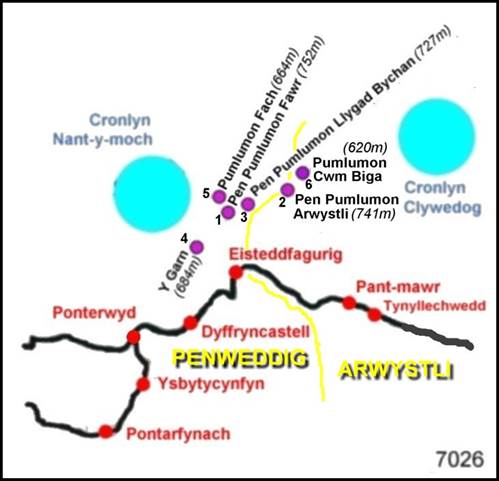
(delwedd 7026)
The numbers refer to
their order according to their height – 1 is the highest, and 6 is least in
height
Cronlyn Nant-y-moch [ˡkrɔnlɪn nant ə ˡmoːx] “reservoir by (the farm called) Nant-y-Moch / valley of the pigs”
Cronlyn Clywedog [ˡkrɔnlɪn kləˡweˑdɔg] “reservoir of (the) Clywedog (river)”
Pontarfynach [pont ar ˡvənax] “bridge on the Mynach river”
Ponterwyd [pont ˡeˑrʊɪd] (“bridge + ??”)
Dyffryncastell [ˡdəfrɪn ˡkastɛɬ] dyffryn y castell “the valley of the castle”
Ysbytycynfyn [əˡspətɪ ˡkənvɪn] “the hostel of Cynfyn”
Eisteddfagurig [əɪˡstɛðva ˡgiˑrɪg] “the seat of Curig”
Pant-mawr [pant ˡmaʊr] “big hollow”
Tynyllechwedd [tɪn ə ˡɬɛxwɛð] “the smallholding on
the hillside”
Penweddig [pɛnˡweˑðɪg] “head /
end + ??”
The
county boundary between Powys and Ceredigion traverses Pumlumon, and is in fact
the old boundary between the kingdom (gwlad) of Ceredigion and the
kingdom of Powys. The kingdoms were divided into kántrevs, and here the kántrev
of Arwystli in Powys borders on the cantref of Penweddig in Ceredigion (see
yellow line on the map).
There seem in fact to be six peaks, but if five are to be chosen to explain the
name of the mountain, we get different possibilities:
(1) If the five highest hilltops are taken to be the “five chimneys”, then Y
Garn is included and Pumlumon Cwm Biga is excluded. This would make
Pumlumon Fach (“little Pumlunon) the smallest of the five, which suggests that
Pumlumon Cwm Biga was not considered to be part of the five.
(2) The Wikipedia entry in Welsh has five peaks, including Y Garn, but
excluding Pen Pumlumon Llygad Bychan
(3) If the five hilltops which include Pumlumon in their name are
taken to be the five, then Y Garn is excluded
MEANINGS OF THE NAMES:
….......
Pen
Pumlumon Fawr ‹pen pim LI mon VAUR› [pɪmˡlɪmɔn ˡvaʊr] “(the) peak (of)
Great Pumlumon”
(Pumlumon) + soft mutation + (mawr = great; “greater” when paired
with bach = small / lesser).
The fact of this soft mutation suggests that Pumlumon is a feminine noun
(though in the case of forenames, in older Welsh, such epithets as Mawr (= big)
and Bach / Bychan (= small) could also have soft mutation after male forenames
– as shown by the epithet Fychan, (Dafydd Fychan = David Junior, David the
Younger), spelt Vaughan in English.
….......
Pen
Pumlumon Arwystli ‹pen pim LI mon ar UIST li› [pɛn pɪmˡlɪmɔn arˡʊɪstlɪ] (“the highest point
of Pumlumon which is in the cantref of Arwystli”). The other four peaks are in
the kántrev of Penweddig, in the country of Ceredigion; Pen Pumlumon Arwystli
is the only peak across the boundary lins, in the kántrev of Arwystli in the
counry of Powys (if we discount Pumlumon Cwm Biga as one of the five peaks,
since this too is in Arwystli)
(pen = peak) + (Pumlumon) + (Arwystli = name of a cantref
in the old kingdom of Powys)
The peak was in the kúmmud of Uwch Coed (“above the
forest”), one of the two divisions of Arwystli, the other being Is Coed (“below
the forest”).
Arwystli is “territory of Arwystl” (Arwystl [ˡarʊɪstl] = forename) + (-i suffix
to denote a territory)
The name itself is based on gwystl ‹GUISTL› [gʊɪstl] (hostage) – (ar intensifying prefix) + soft
mutation + (gwystl = hostage), possibly meaning ‘great hostage’,
whatever the significance this would have had for the people when it was
coined.
….......
Pen
Pumlumon Llygad Bychan ‹pen pim-LI-mon LHə-gad Bə-khan› [pɛn pɪmˡlɪmɔn ˡɬəgad
ˡbəxan]
(“the Pumlumon peak which has the Llygad Bychan – small spring”)
Llygad is eye, and also the source of a stream or a spring.
In South Wales, among many other examples, the river Rhymni
begins at a mountain spring called Llygad Rhymni.
On Pumlumon there is Llyn Llygad Rheidol ‹lhin LHə-gad HREI-dol › [ˌɬɪn ˡɬəgad
ˡhrəɪdɔl] (“the lake of the
spring which is the source of the Rheidol river”) or else (“the lake at Llygad
Rheidol”)
….......
Y Garn ‹ə GARN› [ə ˡgarn] (“the (burial) cairn”)
(y definite article) + soft mutation + (carn = cairn, a cairn
marking a grave). A feminine word, hence there is soft mutation after the
definite article.
….......
Pumlumon
Fach ‹ pim-LI-mon VAAKH› [pɪmˡlɪmɔn ˡvɑːx] (“Little Pumlumon”)
(Pumlumon) + soft mutation + (fach = small; or “lesser” when
paired with mawr = big / greater).
….......
Pumlumon
Cwm Biga ‹ pim-LI-mon kum BII-ga› [pɪmˡlɪmɔn kʊm ˡbiˑga] (“the part of Pumlumon where the Biga valley is”
“Pumlumon (of) Biga valley”)
Here there is a cairn called Carn Biga ‹karn BII-ga› [ˌkarn ˡbiˑga].
Below there is Cwmbiga farm at SN8589
The
comparative heights of the hilltops are shown below (each dot represents 10
metres; the height is rounded up or down to the nearest ten metres). The first
three incorporate pen (head, top, peak) in the name – possibly they are
more discernible as peaks or hilltops than Pumlumon Fach and Pumlumon Cwm Biga.
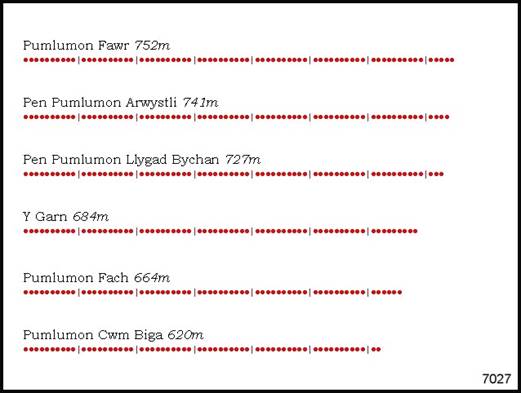
(delwedd 7027)
Difference in height:
Pen Pumlumon Fawr is
11m higher than Pen Pumlumon Arwystli
25m higher than Pen Pumlumon Llygad Bychan
68m higher than Y Garn
88m higher than Pumlumon Fach
121m higher than Pumlumon Cwm Biga
Discounting Pumlumon Cwm Biga as one of the five peaks, we see the difference in
height between Pumlumon Fawr (Great Pumlumon) and Pumlumon Fach (Little Pumlumon) is 88
metres
PHOTOS
1 Pumlumon
Fawr SN7886 HEIGHT: 752m or 2467ft
http://www.geograph.org.uk/photo/59259
http://www.geograph.org.uk/photo/34855
http://www.geograph.org.uk/photo/245572 trig pillar
2 Pen
Pumlumon Arwystli SN8187 HEIGHT: 741m or 2428ft
http://www.geograph.org.uk/photo/910669 y tair carn
3 Pen Pumlumon Llygad Bychan SN7987 HEIGHT: 727m or 2385ft
http://www.geograph.org.uk/photo/715591
4 Y Garn SN7785 HEIGHT: 684m or
2244ft
http://www.geograph.org.uk/photo/709088
5
Pumlumon Fach SN7887 HEIGHT: 664m or 2178ft
http://www.geograph.org.uk/photo/656625
6 Pumlumon
Cwm Biga SN8389 HEIGHT: 620m or 2008ft
http://www.geograph.org.uk/photo/289236 Afon Biga SN8589
The six
hilltops are to be seen at http://www.summitpost.org/mountain/rock/339694/Pumlumon-Fawr.html
:_______________________________.
pum
munud ‹pim mi-nid›
1
a five-minute break, a rest from working
cymryd pum munud have a break, have
a rest, take a breather
Roedd hi’n fy ngwylio’n gyson ac yn
gofalu na chawn i ddim pum munud
She was watching me constantly and making sure I didn’t have a rest
Mi gawn ni bum munud We’ll have a
rest, Let’s have a break
:_______________________________.
pump ‹PIMP› (masculine noun)
1 five
2
mor hir â mish pump (South Wales)
long in coming “as long as a month of five (Saturdays)” – the final Saturday of
the month was payday, but some months have five Saturdays rather than four if
the first Saturday is the first, second or third day of the month
(mor = as) + (hir = long) + (â = as) +
(mish, southern form of mis = month) + (pump = five)
:_______________________________.
pun? /
p'un? ‹PIIN› (pronoun)
1 which one?
pun ai… ai… which one, whether it
is… or….
Fe gewn i weld pun ai gwaith caled ai diogi dâl ore ar ddydd yr arholiad
On the day of the
examination we shall see which pays off the best (“pays best”), hard work or
laziness
:_______________________________.
punnau ‹PIN-ai, -e› (plural noun)
1 pounds; plural of punt
:_______________________________.
punnoedd
‹PIN-oidh, -odh› (plural noun)
1 pounds; plural of punt
:_______________________________.
punt,
punnau / punnoedd ‹PINT, PI ne / PI nodh› (feminine noun)
1 pound (money)
y bunt the pound
:_______________________________.
pupur,
pupurau ‹PI pir, pi PII re› (masculine noun)
1 pepper
2
pupur a halen ‹pi pir a HA len› salt and pepper
(“pepper and salt”)
3
pupur coch, pupurau coch / cochion ‹pi pir KOOKH, pi pi re KOOKH / KOKH yon›
red pepper
4
pupur du ‹pi pir DII› black pepper
5
pupur gwyn ‹pi pir GWIN› white pepper
6
pupur gwyrdd, pupurau gwyrddion ‹pi pir
GWIRDH, pi pi re GWIRDH / GWƏRDH
yon› green
pepper
7
pupur mâl ‹pi pir MAAL› ground pepper
8
pupur tshili ‹pi pir CHI li› chili pepper
:_______________________________.
pur <PIIR> [piːr] (adjective)
1 pure
2 pur dda <piir DHAA> [piːr ˡðɑː] (adverb) very well
:_______________________________.
purboeth <PIR-boith, -both> [ˡpɪrbɔɪθ,
-ɔθ] adjective
1 (South Wales) burning hot
ETYMOLOGY: (pur = pure) + soft
mutation + (poeth = hot)
:_______________________________.
purdan <PIR-dan> [ˡpɪrdan] masculine noun
1 purgatory = in some variants of Christianity (chiefly in Roman
Catholicism), a period after death when there is punishment to purify souls
destined for heaven for any minor sins committed on earth
2
purgatory = the place where these souls are punished
3
(figurative) purgatory = any experience of torment, especially if temporary
mynd trwy burdan go through hell,
suffer torment
4
(figurative) purgatory = a place where one experiences suffering and torment
ETYMOLOGY: (pur = pure) + soft
mutation + (tân = fire)
:_______________________________.
purdanaidd
<pir-DAA-naidh,
-nedh> [pɪrˡdɑˑnaɪð, -ɛð] adjective
1 purgatorial = relating to purgatory; purifying from sin; painful
ETYMOLOGY: (purdan = purgatory) + (-aidd suffix for forming adjectives)
:_______________________________.
purdanol
<pir-DAA-nol> [pɪrˡdɑˑnɔl] adjective
1 purgatorial = relating to purgatory; purifying from sin; painful
ETYMOLOGY: (purdan = purgatory) + (-ol suffix for forming adjectives)
:_______________________________.
Y Pureneau <ə
pi-re-NEE-ai, -e> [ə
pɪrɛˡneˑaɪ, -ɛ]
1 the Pyrenees
Maybe “Y Pirinéw”
would be a better Welsh name, that is, using the Catalan name (el Pirineu) for
the mountain range
2 helygen y
Pureneau (Salix pyrenaica) Pyrenean willow
NOTE: Here we have used “u” but in fact the standard
form is Pyreneau, with “y” supposedly representing [i], though this
violates a fundamental spelling convention that “y” can only be [i] in a
non-tonic syllable. Otherwise it represents the obscure vowel [ə]
:_______________________________.
purfa <PIR-va> [ˡpɪrva] feminine noun
PLURAL purféydd <pir-VEIDH> [pɪrˡvəɪð]
1 refinery = place where material is refined
y burfa the refinery
purfa siwgwr sugar refinery
purfa olew oil refinery
ETYMOLOGY: (pur-, stem of puro = to purify, to refine) + (-fa, suffix = place)
:_______________________________.
puriad <PIR-yad> [ˡpɪrjad] masculine noun
PLURAL puriadau <pir-YAA-dai,
-de> [pɪrˡjɑˑdaɪ, -ɛ]
1 Religion purgation,
purification; = act of purging from sin
2 Chemistry purification;
= act of removing contaminants
ETYMOLOGY: (pur-, stem of puro = to purify) + (-iad, suffix for forming nouns)
:_______________________________.
purion <PIR-yon> [ˡpɪrjɔn] adjective
1 OK, all right
I'r ffermwr, y cynhaeaf sy'n gwneud
blynyddoedd da, gwael neu burion
For the farmer, it’s the harvest which determines if a year has been good, bad
or indifferent (“it is the harvest which makes good, bad or (merely) all right
years”)
2
fine = without problems
Mi fydd hi'n burion yng ngofal Tomos.
Rwy'n siwr ei fod o'n nyrs dda
She'll be fine in Thomas's care. I'm sure he'll be a good nursemaid
3
fine, very well, O.K., all right; as a reply when one is asked about one's
health
-Sut ydych chi? -Purion
-How are you? -Fine
4
purion peth it's a good idea
Purion peth fyddai gadael iddo wneud
hynny
P’rion
peth fydde gadel iddo neud ’ny
It'd be a good idea to let him do it
5
purion peth it's a good thing
that...
Purion peth iddo ddod
It's a good thing he came
6
adverb O.K:, all right then
ETYMOLOGY: purion < pur iawn 'very well' (pur = very) + (iawn = well)
NOTE: South Wales: purion > p’rion > prion <PRII-on> [ˡpriˑɔn]
:_______________________________.
puro <PII-ro> [ˡpiˑrɔ] verb
1 purify, cleanse = free from something which contaminates
2
(language) purify = use forms considered standard rather than colloquialisms
Pam nad ydy penaethiaid y radio am buro
Cymraeg y darlledwyr iau?
Why don't the managers of the radio want to purify the Welsh of the younger
broadcasters?
3
cleanse, purify; = free from sin
A ddaw o'r tân wedi ei buro?
Will he come out of the fire cleansed? ("after his cleansing")
4
refine = purify, remove impurities (as from gold, sugar, petroleum)
ETYMOLOGY: (pur = pure) + (-o, suffix for forming verbs)
:_______________________________.
purwyn <PIR-win> [ˡpɪrwɪn] adjective
1 pure white
ETYMOLOGY: (pur = pure) + soft
mutation + (gwyn = white)
NOTE: feminine form: purwen
:_______________________________.
purydd <PII-ridh> [ˡpiˑrɪð] masculine noun
PLURAL puryddion
<pi-RƏDH-yon> [pɪˡrəðjɔn]
1 (language) purist, person who insists that the traditional view of what
is correct should be respected
:_______________________________.
putain <PI-tain,
-ten> [ˡpɪtaɪn, -ɛn] feminine noun
PLURAL puteiniaid <pi-TEIN-yaid,
-yed> [pɪˡtəɪnjaɪd, -jɛd]
1 prostitute, whore, streetwalker, fille de joie, strumpet, harlot, etc
y butain the prostitute
putain llys courtesan (“prostitute
(of) court”)
carn-butain arrant whore,
incorrigible whore
putain wryw male prostitute
2 (offensive) slag, tart, whore, scrubber = disparaging term for a
woman whom the speaker feels to have lax morals, almost as indiscriminate in
the selection and quantity of sexual partners as a prostitute
I feddwl dy fod ti wedi cynnig mynd â'r
buten ’na i Lunden!
To think you’ve offered to go to London with that whore!
3 (Bible) y butain fawr
the great whore (apparently a reference to the Roman Empire)
Datguddiad 17:1 A daeth un o’r saith
angel oedd â’r saith ffiol ganddynt, ac a ymddiddanodd â mi, gan ddywedyd
wrthyf, Tyred, mi a ddangosaf i ti farnedigaeth y butain fawr sydd yn
eistedd ar ddyfroedd lawr... 17:3 Ac efe a’m dygodd i i’r
diffeithwch yn yr ysbryd: ac mi a welais wraig yn eistedd ar fwystfil o liw
ysgarlad, yn llawn o enwau cabledd, a saith ben iddo, a deg corn. 17:4 A’r wraig oedd wedi ei dilladu â phorffor
ac ysgarlad, ac wedi ei gwychu ag aur, ac â main gwerthfawr, a pherlau, a
chanddi gwpan aur yn ei llaw, yn llawn o ffieidd-dra ac aflendid ei phuteindra.
17:5 Ac ar ei thalcen yr oedd enw ei
ysgrifennu. DIRGELWCH, BABILON FAWR, MAM PUTEINIAID A FFEIDD-DRA’R MAWR
Revelation 17:1 And there came one of the seven angels which had the seven
vials, and talked with me, saying unto me, Come hither; I will show unto thee
the judgment of the great whore that sitteth upon many waters:... 17:3 So he carried me
away in the spirit into the wilderness: and I saw a woman sit upon a scarlet
coloured beast, full of names of blasphemy, having seven heads and ten horns.
17:4 And the woman was arrayed in purple and scarlet colour, and decked with
gold and precious stones and pearls, having a golden cup in her hand full of
abominations and filthiness of her fornication: 17:5 And upon her forehead was
a name written, MYSTERY, BABYLON THE GREAT, THE MOTHER OF HARLOTS AND
ABOMINATIONS OF THE EARTH... 17:9... The seven heads are seven mountains, on
which the woman sitteth.
Datguddiad 19:2 Oblegid cywir a chyfiawn
yw ei farnau ef: oblegid ef a farnodd y butain fawr, yr hon
a lygrodd y ddaear â’i phuteindra, ac a ddialodd waed ei weision ar ei llaw hi
Revelation 19:2 For true and righteous are his judgments: for he hath judged
the great whore, which did corrupt the earth with her fornication, and hath
avenged the blood of his servants at her hand.
ETYMOLOGY: first example in Welsh 1200-1300;
From French putain (possibly a
direct loan into Welsh from French; if not, it has come via English from
French)
< French pute, the feminine form
of put, a shortened form from Latin putidus (= rotten, stinking).
Modern French has putain (=
prostitute, whore), and in argot la pute
(= the bitch)
:_______________________________.
puteindra
<pi-TEIN-dra> [pɪˡtəɪndra] (masculine noun)
1 prostitution
:_______________________________.
puteindy
‹pi-tein-di› [pɪˡtəɪndɪ] masculine noun
PLURAL puteindai
‹pi-tein-dai› [pɪˡtəɪndaɪ]
1 brothel, house of ill repute, whorehouse
(Englandic: also knocking-shop) (American: also honky-tonk, cathouse)
ETYMOLOGY: (putein- < putain = whore, prostitute) + soft
mutation + ( tŷ = house)
:_______________________________.
puteinfeistr,
puteinfeistri ‹pi TEIN vei stər, pi tein VEI stri› (masculine noun)
1 pimp, whoremaster
ETYMOLOGY: (putein- < putain = whore, prostitute) + (soft mutation m > f) + ( meistr = master)
:_______________________________.
puteiniaeth
‹pi-tein-yeth›
1 prostitution, (old-fashioned: harlotry)
heddlu puteiniaeth vice squad
(“police (of) prostitution”)
ETYMOLOGY: (putein-i-, stem of puteinio = to prostitute oneself) + (-aeth suffix for forming abstract
nouns)
:_______________________________.
puteinig
‹pi-tei-nig› adjective
1 whorish
Diarhebion 6:6 Oblegid y fenyw buteinig
y daw dyn i damaid o fara; a gwraig gŵr arall a hela yr enaid gwerthfawr.
Proverbs 6:6 For by means of a whorish woman a man is brought to a piece of
bread: and the adulteress will hunt for the precious life.
ETYMOLOGY: (putein-, penult form of putain = whore) + (-ig, suffix for forming adjectives)
:_______________________________.
puteinio
‹pi-tein-yo› verb
1 (verb without an object) go with prostitutes
2
(verb without an object) work as a prostitute, to prostitute oneself
Mae’r teuluoedd tlawd hyn yn anfon y
merched i buteinio
These poor families send their daughters to work as prostitutes
3
(verb with an object) prostitute = offer for unworthy purposes
puteinio eich dawn prostitute one's
talent = sell one's talent for an unworthy purpose
ETYMOLOGY: (putein-, penult form of putain = whore) + (-io, suffix for forming verbs)
:_______________________________.
puteiniwr
‹pi-tein-yur› masculine noun
PLURAL puteinwyr ‹pi-tein-wir›
1 fornicator, man who
frequents prostitutes
Hebreiaid 12:16 Na bu un puteiniwr, neu
halogedig, megis Esau, yr hwn am un saig o fwyd a werthodd ei enedigaeth-fraint
Hebrews 12:16 Lest there be any fornicator, or profane person, as Esau, who for
one morsel of meat sold his birthright.
ETYMOLOGY: (putein-, penult form of putain = whore) + (-i-wr, suffix = man)
:_______________________________.
pw ‹PUU› preposition
1 (obsolete) to
This seems to be the first part of the phrase pwy
gilydd
(pw = to) + (i
= his, equivalent to literary Welsh ei = his) + (soft mutation c >
g) + (cilydd = fellow) > pw i gilydd “to his fellow” > pwy
gilydd (qv) “from one (thing) to another (thing)”
ETYMOLOGY: British
< Celtic *kwu
Irish: co
NOTE: This would seem to be the derivation of pw in the phrase pwy gilydd, unless it is to be explained as a variant of po / bo (= may it be) from the verb bod
(= to be)
:_______________________________.
pwcs ‹PUKS› masculine
noun
1 (North-west Wales) yn bwcs at full
speed
Also: yn bwtsh, yn batsh
:_______________________________.
pwdin,
pwdinau ‹PU din, pu DI ne› (masculine noun)
1 pudding
2
originally, same as pwdin gwaed ('blood pudding')
(America: blood sausage) (Englandic: black pudding)
Gormod o bwdin dagiff gi
“Too much pudding
will choke a dog”. Saying, either “too much thing is a bad thing”, or used
literally to criticise somebody eating his food greedily or eating too much
food.
pwdin bara 'menyn ‹pu din BA ra ME nin› (masculine noun)
bread.and-butter pudding
pwdin crwst ‹pu din KRUST› (masculine noun)
crumble (kind of pudding)
pwdin cyrens ‹pu din KƏ rens› (masculine noun)
currant pudding
pwdin Efrog ‹pu din E vrog› (masculine noun)
Yorkshire pudding
pwdin ffrwythau ‹pu din FRUI the› (masculine noun)
fruit pudding
pwdin gwaed ‹pu din GWAID› (masculine noun) ('blood pudding')
(America: blood sausage) (Englandic: black pudding)
pwdin reis ‹pu din REIS› (masculine noun)
rice pudding
pwdin sbwng ‹pu din SPUNG› (masculine noun)
sponge pudding
pwdin stêc a lwlod ‹pu din STEEK a LU lod› (masculine noun)
steak and kidney pudding
pwdin bwthyn cottage pudding
ETYMOLOGY: Welsh <
English pudding < poding (= a suasage).
Seems to be of
Germanic origin, related to Old English puduc
(= a sore; possibly an earlier meaning was “a swelling”), Low German puddewurst black pudding. 
Alternatively English
pudding is from French boudin < Gallo-Latin botellinus <
Latin botellus (= intestines; sausage casing; sausage)
Modern French boudin = blood sausage,
black pudding
:_______________________________.
pwdr ‹puU-dur› adjective
Feminine form: podr (rare in modern
Welsh)
Comparative forms pydred, pydrach,
pydraf
1 rotten, corrupted
bwrdeistref bwdr (History) rotten
borough
2
syrthio’n bwdr rot away, diminish
and disappear through a rotting process
3
(fruit) rotten, decaying, no longer ripe, putrid
afal pwdr rotten apple
4 carreg bwdr hearthstone = soft
stone for whitening hearth, doorstep
5
(South Wales) lazy
6
(land) barren, poor
y Waun Bodr (place name) the barren
moorland meadow (podr = feminine
form of the adjective pwdr)
ETYMOLOGY: Welsh < British < Latin putr-is
< puter (= rotten)
From the same British root: Cornish poder
(= rotten)
:_______________________________.
pwdryn,
pwdrod ‹PU drin, PU drod› (masculine noun)
1 (south) lazy person
:_______________________________.
pŵer, pŵerau ‹PUU er, pu-EE-re› (masculine noun)
1 power
:_______________________________.
pẁl, pyliau ‹PUL, PƏL ye› (masculine noun)
1 fit, attack
pẁl o wallgofrwydd fit
of madness, attack of madness, moment of madness
pẁl o dymer fit of temper
cael pẁl o asthma have an asthma attack
cael pẁl o hiraeth get a feeling of longing (for old places, old
friends)
2
mynd i bẁl o ddagrau burst
into tears (“go to a fit of tears”)
:_______________________________.
pŵl ‹puul› adj
1
blunt (= lacking a sharp edge), blunted (= caused to have lost sharpness)
cryman pŵl a blunt sickle
mynd yn bŵl become blunt
2 thick,
stupid, dim, obtuse
3
dulled = having lost its brightness or shine or transparency
hela rhywbeth yn bŵl cause sth to
lose its shine
4
(sight) dim, dulled, weak
Yr oedd ei lygaid yn bŵl dan
effaith y ddiod
His eyes were dulled from the
effect of the drink
5 pylni dullness
pylu become dull
6
carbwl poor, clumsy, untidy
< carnbwl “very blunted” (carn = principal ) + (soft mutation p
> b) + (pŵl = blunt, blunted,
dull, lacklustre, pale)
Cymraeg carbwl garbled Welsh,
mangled Welsh
siarad Cymraeg carbwl speak bad
Welsh
ETYMOLOGY: unknown
NOTE: feminine pôl, plural pylion
:_______________________________.
pwll,
pyllau ‹PULH, PƏ lhe› (masculine noun)
1 pool
2 pit, mine
3 pwll o fudreddi
cesspool = filthy or corrupt place (“pool of filth”)
4 mawnbwll
peat bog
(mawn = peat) + (soft mutation p
> b) + (pwll = pool, hollow,
pit)
Usually: pwll mawn
5 grave
bod ar war eich pwll have one foot
in the grave (“be on the part overlooking your pit / grave”)
6
glasbwll blue pool
(glas = blue ) + (soft mutation p
> b) + (pwll = pool)
Glasbwll (SN7397) locality by
Machynllaith (district of Maldwyn, county of Powys)
7
priddbwll clay pit
Priddbwll house name, Abergwyngregyn
SH 6572 (county of Conwy), mentioned in the 1851 Census (pridd = earth, clay) + (soft mutation p > b) + (pwll = hole, pit)
:_______________________________.
Pwllbrochfael
‹pulh brokh-vail, -vel›
1 SO5301 village in Gloucestershire (England) near the abbey of Dyndyrn,
on the eastern bank of the river Gwy, 8km north of the town of Cas-gwent.
English name: Brockweir
ETYMOLOGY: “Brochfael’s pool” (pwll
= pool) + (Brochfael ‹q.v.› = man’s name)
:_______________________________.
pwll
clai ‹pulh KLAI› (masculine noun)
1 claypit
:_______________________________.
Y
Pwll-coch ‹puulh-kookh›
1 district in Caer-dydd
Ysgol Gynradd Pwll-coch name of a
Welsh-language school (USA: elementary school, grade school) (Englandic:
primary school) in this part of the city
:_______________________________.
Pwllcrochan
‹pulh KRO khan›
1 SM8836 bay in the county
of Penfro
http://www.geograph.org.uk/photo/896725 map, llun map, photo
ETYMOLOGY: pwll y
crochan “(the) pool (of) the cauldron
:_______________________________.
Y Pwll
Du ‹ə pulh DII›
1 SO2411 pool near Garnyrerw, county of Torfaen
http://www.geograph.org.uk/photo/504147
2 SO0244 pool east of
Cwmowen, Brycheiniog, Powys
http://www.geograph.org.uk/photo/442693
ETYMOLOGY: the black
pool
:_______________________________.
Y Pwll Glas ‹ə pulh GLAAS›
1 cove near Dinas (Sir Benfro)
http://www.geograph.org.uk/photo/536606
ETYMOLOGY: the blue
pool / cove
:_______________________________.
Y Pwll-glas ‹ə pulh GLAAS›
1 SJ1154 Village in Sir Ddinbych (Spelt “Pwll-glâs” on the Ordnance
Survey map)
http://www.geograph.org.uk/gridref/SJ1154 map
2 SN9789 farm near
Trefeglwys, Powys (Spelt “Pwllglas” on the Ordnance Survey map)
http://www.geograph.org.uk/gridref/SN9789 map
3 SN6055 farm in
Ceredigion, near Llwyn-y-groes. (Spelt “Pwllglas” on the Ordnance Survey map)
http://www.geograph.org.uk/gridref/SN6055 map
4 SN3151 farm in
Ceredigion, at Y Sarn. (Spelt “Pwllglas” on the Ordnance Survey map)
http://www.geograph.org.uk/gridref/SN3151
5 SN6055 farm in
Maldwyn, Powys near Abergwydol. (Spelt “Pwllglas” on the Ordnance Survey map)
http://www.geograph.org.uk/gridref/SH7802
:_______________________________.
pwll
glo, pyllau glo ‹pulh GLOO› (masculine noun)
1 coal mine
:_______________________________.
Pwllgwyngwyll ‹pulh-GWƏN-gilh› [pʊɬˡgwəngɪɬ,
pʊɬˡgwɪngɪɬ]
1 Name of a medieval township on the island of Môn / Anglesey
The church dedicated to Mary (Llanfair) situated in this township was
distinguished from others in Wales by the addition of the name of the township
– Llanfair Pwllgwyngyll
According to Samuel Lewis 'A Topographical Dictionary of Wales', third edition
1849):
“LLANVAIR-PWLLGWYNGYLL
(LLAN-FAIR-PWLL-GWYNGYLL), a parish, in the union of Bangor and Beaumaris,
hundred of Tyndaethwy, county of Anglesey, North Wales, 4 miles (W. by S.) from
Bangor; containing 617 inhabitants. The name of this parish is derived from the
dedication of its church to St. Mary, and the distinguishing adjunct from its
position nearly opposite to a whirlpool in the Menai strait, formed by the
Swelley rocks, which rages with impetuous violence, and of which the term
"Pwll Gwyngyll" is emphatically descriptive. The rocks, most of which
are visible at low water, obstruct the channel of the strait, and when the
lower rocks are covered, the tide, rushing between them with tremendous fury,
forms numerous vortices and strong eddies, exceedingly dangerous to vessels
navigating this part of the Menai, which are sometimes caught by the rapidity
of the current, and dashed against the rocks that appear above the surface. The
difficulty of avoiding this impending danger at certain states of the tide, and
the roaring noise and violent agitation of the waters, have obtained for this
part of the strait the appellation of the Scylla and Charybdis of Welsh
mariners, of similar import with its Welsh name Pwll Ceris. At high water the
agitation subsides, and the appearance of the surface is smooth and tranquil,
differing in no respect from the other parts of the strait.”
http://www.geograph.org.uk/photo/381455 Pwll Ceris
ETYMOLOGY:
(1) pwll Gwyngyll “(the)
whirlpool (of) Gwyngyll (= white hazels)”, that is, “the whirlpool by the place
called Gwyngyll”,
(2) or (less likely) pwll y gwyngyll “whirlpool (of) the white hazels)”
:_______________________________.
pwll
heli ‹pulh he li› masculine noun
PLURAL pyllau
heli
1
brine pool, salt pool
2
Pwllheli (SH3735) locality in the
county of Gwynedd (see following entry)
3
pwll heli oceanarium = large
aquarium for marine life
ETYMOLOGY: (pwll = pool) + (heli = salty water, brine)
:_______________________________.
Pwllheli
‹pulh-hEe-li›
1
(SH3735) locality in the county of Gwynedd
Llifai’r
llanw i’r man isel, y Gors, sydd rhwng Stryd King’s Head a Phentrepoeth, i roi
ini’r “pwll heli”
Ar Hyd Ben ‘Rallt / Elfed Gruffydd / Llyfrau Llafar Gwlad / Rhif 42 / Gwasg
Carreg Walch, Llanrwst / 1991 / tudalen 99
The tide flowed into the low-lying spot, Y Gors (“the marsh”), between King’s
Head Street and Pentre-poeth, to give us the “pwll heli” (brine pool)
ETYMOLOGY: (see preceding entry)
:_______________________________.
pwll
hwyaid ‹pulh hui-ed› masculine noun
PLURAL pyllau
hwyaid ‹pə-lhe hui-ed›
1 duck pond
fel pwll hwyaid (sea) as smooth as a
mill pond
Roedd y môr fel pwll hwyaid The sea
was as as smooth as a mill pond
Y Pwll Hwyaid SH4738
“the duck pond”
(Llantystumdwy, Gwynedd)
http://www.geograph.org.uk/photo/597868
See Pwllyrhwyaid
ETYMOLOGY: “pool (of)
ducks” (pwll = pool) + (hwyaid = ducks, plural of hwyaden =
duck)
:_______________________________.
Pwllmeurig
‹pulh MEI rig› (masculine noun)
1 place name
ETYMOLOGY: “pool (of)
Meurig”, “Meurig's pool” (pwll =
pool) + (Meurig = Mauritius)
:_______________________________.
pwll melin
‹pulh mEE-lin› masculine noun
PLURAL pyllau
melinau ‹pə-lhe
me-lî-ne›
1 mill pond
Pwllyfelin farm east of Glynogwr
(county of Pen-y-bont ar Ogwr)
ETYMOLOGY: “pool (of)
(a) mill” (pwll = pool, pond) + (melin = mill)
:_______________________________.
pwll
nofio ‹pulh NOV yo› (masculine noun)
1 swimmng pool
ETYMOLOGY: “pool (of)
swimming” (pwll = pool, pond) + (nofio = to swim)
:_______________________________.
pwll tro
‹puulh troo› masculine noun
PLURAL pyllau
tro ‹pə-lhe troo›
South Wales
1 whirlpool
2
Y Pwll Tro place name (now lost) in
Bedwas (county of Caerffili).
According to John Hobson Matthews (Mab Cernyw) in 'Cardiff Records'
(1889-1911):
“PWLL-TRO (the whirlpool.) A deep place in the river Rhymny, below Bedwas
bridge, in the hamlet of the Van in the parish of Bedwas (1755.)”
ETYMOLOGY: “pool (of) turning” (pwll
= pool) + (tro = turn, turning)
NOTE: in the north with the elements reversed – trobwll
:_______________________________.
Pwllybiswail ‹pulh ə bis-wail› -
1 place in Llaneirwg
(“pool of the dung”) (Pwll-y-Biswael, Kelly’s Directory of Monmouthshire, 1901)
ETYMOLOGY: “the dung pool” (pwll
= pool) + (y = definite article) + (biswail = dung)
:_______________________________.
pwll y
gaeaf ‹pulh ə GEI a› (masculine noun)
1 the darkest days of winter on either side of the solstice
ETYMOLOGY: “pit (of) winter” (pwll = pool, pond, pit) + (gaeaf = winter)
:_______________________________.
pwll y
gesail ‹pulh ə GE sel› (masculine noun)
1 armpit
ETYMOLOGY: “pit (of) (an) armpit” (pwll = pool, pond, pit) + (cesail = armpit)
:_______________________________.
Pwllygwichiad ‹pulh-ə-GWIKH-yad› [ˌpʊɬ ə ˡgwɪxjad]
1 A former farm in what is now the centre of Llandudno, said to be
where the Woolworth’s shop in Ffordd Mostyn / Mostyn Street now (2008-12-31)
is, and the area towards Rhodfa’r De / South Parade.
The farm was the birthplace of the artist Hugh Hughes (1790 - Great
Malvern, England 1860)
ETYMOLOGY: “(the) pool (of) the
periwinkle”, “periwinkle pool”
(pwll = pool) + (y = definite article) + (gwichiad =
periwinkle)
:_______________________________.
Pwllygrawys ‹pulh-ə-grau-is›
1 street name in the town of Dinbych; (English name: “Lenten Pool”)
ETYMOLOGY: (“(the) pool (of) the Lententide”) (pwll = pool) + (y =
definite article) + (Grawys = Lent,
Lententide) When meat had to be given up for Lent, fish were taken from this
pool for the inhabitants of the castle on the hill above. The pool no longer
exists – a traffic circle (roundabout) now occupies the site.
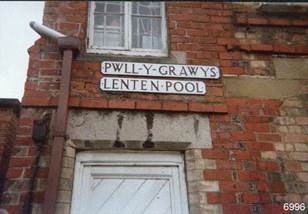
:_______________________________.
Pwll-y-pant ‹pull ə pant›
1 ST1588 locality in Caerffili county
ETYMOLOGY: (pwll = pool) + (y
= definite article) + (pant = hollow)
:_______________________________.
Pwllyplwca ‹pulh ə plu-ka›
1 place in Llaneirwg (“pool of the mire”)
(Pwll-y-plwcca, Kelly’s Directory of Monmouthshire, 1901)
ETYMOLOGY: (pwll = pool) + (y
= definite article) + (plwca = mire, mud)
:_______________________________.
Pwllyrhwyaid ‹pulh ər HUI-aid, -ed ›
1 SH4466 farm in Dwyran, Ynys Môn
(spelt “Pwll-yr-hwyaid” on the Ordnance Survey map)
http://www.geograph.org.uk/photo/850192
ETYMOLOGY: (pwll = pool) + (yr =
definite article) + (hwyaid = ducks, plural of hwyad = duck)
:_______________________________.
pwlman, pwlmans ‹PUL man,PUL mans›
(masculine noun)
1 (Patagonia) bus going between villages
:_______________________________.
pwlofer,
pwlofers ‹PU lo ver, PU lo vers› (masculine
noun)
1 jersey
:_______________________________.
pwmp ‹PUMP› masculine noun
PLURAL pympiau ‹pəMP-yai, -e›
1 pump
2 pwmpio (wv)
to pump
ETYMOLOGY: English pump
:_______________________________.
pwmpiad ‹PUMP--yad› masculine noun
PLURAL pympiadau ‹pəmp-YAA-dai, -e›
1 pumping
ETYMOLOGY: (pwmpi- stem of the verb pwmpio) + (-adwy adjectival
suffix, corresponding to English –able, -ible)
:_______________________________.
pwmpiadwy ‹pəmp-YAA-dui› (adj)
1
inflatable
arch
bwmpiadwy inflatable arch
bad
pwmpiadwy inflatable boat
ETYMOLOGY: “pumpable” (pwmpi- stem of the verb pwmpio) + (-adwy
adjectival suffix, corresponding to English –able, -ible)
:_______________________________.
pwmpio ‹pəMP-yo› (v)
1 to pump
ETYMOLOGY: (pwmp = pump) + (-i-o
verbal suffix)
:_______________________________.
pwn ‹pun› masculine noun
PLURAL pynnau ‹pə-ne›
1 pack, burden; especially saddle pack of a donkey
2 ceffyl pwn packhorse
ETYMOLOGY: Welsh < British < Latin pond(us)
(= weight), word related to pendere (=
to weigh; the English words to ponder,
ponderous are likewise from Latin pondus)
:_______________________________.
pwn, pynnau ‹PUN, PƏ ne›
(masculine noun)
1 pack
:_______________________________.
pwnc, pynciau ‹PUNGK, PƏNGK ye›
(masculine noun)
1 subject
2 gogor-droi o gwmpas pwnc beat about the
bush, not get straight to the point, skate around a subject, avoid getting to
the point
:_______________________________.
pwnc llosg ‹pungk lhosk› masculine
noun
PLURAL pynciau llosg ‹pəngk-ye
lhosk›
1 burning question, hot potato,
contencious subject
ETYMOLOGY: (pwnc = matter, question)
+ (llosg = burning)
:_______________________________.
pwnio ‹PUN yo› (verb)
1 beat, hit
2 pwnio (rhywbeth) i ben (rhywun)
get (something) into somebody's head, din (something) into somebody's head =
tell somebody something insistently so that it is remembered and learnt
:_______________________________.
pwnsh ‹punsh› masculine noun
PLURAL pwnshis, pynshiau ‹pun
–shis, pənsh-ye›
1 punch = A tool for making small round holes
ETYMOLOGY: English punch < puncheon < French ponçon < Latin punctiô (= puncture) < pungere
(= to prick)
Modern French: poinçon (= punch)
:_______________________________.
pwrcas, pwrcasau ‹PUR kas, pwr KA se›
(masculine noun)
1 purchase
2 hur-bwrcas hire purchase (HP)
prynu drwy hur-bwrcas to buy on HP
:_______________________________.
pwrcasu ‹pur-ka-si› (v)
1 to purchase
ETYMOLOGY: (purcas = purchase) + (-u
verbal suffix)
:_______________________________.
pŵr-dàb, pŵr-dàbs <puur-DAB, puur-DABZ> [puːr ˡdab, puːr ˡdabz] (m)
1 in the expression pŵr-dàb (qv) poor thing, poor fellow,
poor woman, poor boy, poor girl (expression of pity towards a person); Cambrian
English (South Wales): poor dab
y pŵr-dàb â fe! poor thing!
y pŵr-dàb ag e! poor thing!
Bydd e’n colli’r gêm, y pŵr-dàb He’ll
miss the game, poor dab
…ni gyd ... ond y cwrcyn.A pwr dab o hwnnw, 'odd e ddim dicon cwic, A dyma Matilda yn estyn cic..all of us, except for the tomcat.And the poor thing wasn’t quick enough,And Matilda gave him a kick (“extended a kick”)Abiah Roderick, “Matilda”, 1952
Ond ni fedrai y “poor
dab” sefyll heb ddwy ffon,
But the poor dab couldn’t stand without (the aid of) two (walking) sticks
Dyffryn Cynon (cyfres o
erthyglau yn y ‘Geninen’ 1900-1904). Jenkin
Howell
Pam na roddest ti
lifft i’r pŵr-dab? Why didn’t you give the poor dab a lift?
Mae e wedi cael sioc ofnadw, pw^r-dab. He’s had a terrible
shock, poor dab / the poor fellow
ETYMOLOGY: English poor dab. South-western
English dab (= insignificant person).
A Dialogue in the Devonshire Dialect, (in
three parts) by a Lady: to which is added a Glossary. James Frederick PALMER,
Mary Palmer. 1837: DAB, s[ubstantive]. a chit, an insignificant person, a
proficient in any feat or exercise : also a slight blow.
NOTE: Geiriadur Prifysgol Cymru had pŵr-dab.
In this dictionary we have marked the vowel as short: pŵr-dàb. Also
written variously in Welsh texts as pwr dab, poor dab
:_______________________________.
pwrs,
pyrsau ‹PURS, PƏR se› (masculine noun)
1 purse
:_______________________________.
pwrs y
wlad ‹purs ə WLAAD› (masculine noun)
1 (in certain sayings) the money of the state, the state coffers
('the purse of the country')
ETYMOLOGY: (pwrs = purse) + (y
definite article) + soft mutation + (gwlad = country)
:_______________________________.
Pwrtwe ‹purt-we› feminine noun
1
(History) portway, a road between boroughs (port has the sense of ‘market town
/ borough’ in this English expression)
Y Bwrtwe The name of the main road
from Caer-dydd to Castell-nedd. In fact, this is part of the Roman road from
Glevum, the present-day English city of Gloucester (Caerloyw in Welsh) to Nidum
(Castell-nedd, or ‘Neath’ in English). It connected the boroughs of Caer-dydd,
Y Bont-faen, Cynffig, Aberafan and Castell-nedd
There are many roads in England called ‘The Portway’, but the name for
the The Gloucester – Castell-nedd road seems to be the only instance in Wales
of this English name adapted into Welsh
..1 The Portway in Hampshire - a section of the Roman road which ran from
Silchester to Old Sarum
..2 Newport, Shropshire - the Latin name was Novo Burgo, i.e. “new town”.
Forton Road was originally called The Portway.
..3 The Portway, Elton, Derbyshire
In 'Cardiff Records' (1889-1911) John Hobson Matthews (Mab Cernyw) states for
Portway:
“The mediaeval name for the Roman road
which skirts the shore of South Wales and unites the ancient boroughs;
particularly from Cardiff westward through Cowbridge, Kenfig and Aberavon, to
Neath. In the vernacular this road was called Y Bwrtwe, by turning the English
word into a feminine Welsh noun. It occurs as late as 1763.”
The name is seen elsewhere in the ‘Records’, where Mab Cernyw notes a barn
called Ysgubor y Bwrtwe “(the) barn
(of) the portway”), in the parish of Sain Nicolas:
YSGUBOR-Y-BWRTWE
"Skybbor y Bwrtway" (the Portway barn.) In the parish of Saint
Nicholas (1763.)
ETYMOLOGY: English portway (= main
road, road between market towns).
(port = town) + (way = way)
As most nouns indicating roads are feminine in Welsh, pwrtwe has joined
this group:
beidr (= farm track), ffordd (= road), heol (= road), lôn (= lane), stryd (= street) - these are all feminine nouns
:_______________________________.
pẁs ‹pus› (masculine noun)
1 word for addressing or referring to a cat
2 Pẁs Esgid Uchel Puss in Boots (“Puss (of) High Boot”)
NOTE: Usually written pws, without
the grave accent, though monosyllables in -ws are long unless shown to
be short. Similarly bẁs <BUS> (= bus) (usually
written bws however, without the grave accent).
The long vowel is seen in drws <DRUUS> (= door), tlws <TLUUS> (= pretty; medal),
:_______________________________.
pwt,
pytiau ‹PUT, PƏT ye› (masculine noun)
1 stump, short piece
2
the least amount
Wela i ddim pwt o fai arno I don’t
blame him one bit (“I don’t see a least-bit of blame on him”)
3
pwt (o rywbeth) something small
pwt o ffenest' a small window
pwt o dennyn a short leash
rhyw bwt o bastwn garw a gariai ef yn
lle ffon fugail hHe carried a short rough stick instead of a shepherd’s
crook
pwt o ddyn a short man
pwt o ddyn bach tywyll oedd Ifan
Ifan was a short dark little man
derbyniais bwt o lythyr I received a
short letter
pwt o erthygl a short article
pwt o getyn a short (smoker’s) pipe
pwt o hanes y Fic a short history of
the Fic (Victoria) tavern
cael pwt o sgwrs â have a short chat
with
gweld pwt o raglen ddogfen ar... see
a short documentary about...
:_______________________________.
pwtsh ‹puch›
1 (North-west Wales) yn bwtsh at full
speed
Also: yn bwcs, yn batsh
:_______________________________.
pwy ‹PUI› (pronoun)
1 who
:_______________________________.
pwy
gilydd ‹pui gî-lidh› adverb
1 one to another
May occur with soft mutation p > b -
bwygilydd
..a/ o… pwygilydd / bwygilydd from
(one thing) to another, from (one thing) to the next
o’r môr
pwy gilydd from sea to sea (“from the sea to its fellow”)
o flwyddyn bwygilydd (obsolete) from one
year to the next (“from a year to its fellow”)
o law bwygilydd (obsolete) from one
hand to another (“from a hand to its fellow”)
..b/ am… pwygilydd / bwygilydd during
(hours, days, years, etc)
am oriau
pwy gilydd for hours on end, for hours and hours (“for [a period of] hours to its
fellow”)
am ddyddiau pwy gilydd for days on
end, for days and days (“for [a period of] days to its fellow”)
am flynyddoedd pwy gilydd for years
on end, for years and years (“for [a period of] years to its fellow”)
..c/ penbwygilydd from one end to another
o benbwygilydd (qv) from end to end,
from start to finish
ETYMOLOGY: This is not pwy (= who),
since the original form was pw i gilydd
“to its fellow”
(*pw, obsolete preposition = to,
< Celtic *kwu) + (i = his,
equivalent to literary Welsh ei = his) + (soft mutation c > g)
+ (cilydd = fellow)
NOTE: This would seem to be the derivation of pw in the phrase pwy gilydd, unless it is to be explained as a variant of po / bo (= may it be) from
the verb bod (= to be)
:_______________________________.
Pwyleg ‹PUI leg› (feminine noun)
1 Polish language
y Bwyleg the Polish language
Pwyleg eich iaith Polish-speaking
2 (adjective) Polish (= in the Polish language)
ETYMOLOGY: (Pwyl < Gwlad Pwyl = Poland, “land (of) Pol-”) + (-eg adjectival / noun suffix indicating
a language)
:_______________________________.
..1
pwyll ‹PUILH› (masculine noun)
1 discretion, prudence
cadw’ch pwyll keep your wits about
you, act prudently (“keep your prudence”)
2 reason, senses
Po hynaf
y dyn, gwaethaf ei bwyll / po
hyna’r dyn, gwaetha’i bwyll the older a man is, the less sense he has, no
fool like an old fool (“the older the man, worse his reason” )
:_______________________________.
..2
Pwyll ‹PUILH› (masculine noun)
1 man's name; first of the tales of the Mabinogi
:_______________________________.
pwylldrais
‹puilh-drais› (m)
1
brainwashing = the practice or technique of making someone believe that what is
not true is true
ETYMOLOGY: (pwyll = mind) + (soft
mutation t > d) + (trais =
violence, rape)
:_______________________________.
pwylldreisiad
‹puilh-drei-shad› (m)
PLURAL pwylldreisiadau ‹puilh-dreis-yAA-de›
1
brainwashing = an application of methods to make someone believe that what is
not true is true
ETYMOLOGY: (pwylldreis- stem of pwylldreisio = to brainwash) (-i-ad noun-forming suffix)
:_______________________________.
pwylldreisio ‹puilh-drei-sho› (v)
1 brainwash
ETYMOLOGY: (pwylldreis- stem of pwylldrais = brainwashing) + (-i-o verb-forming suffix)
:_______________________________.
pwyllgor ‹puilh-gor› masculine noun
PLURAL pwyllgorau ‹puilh-gô-re›
1
committee = group of people elected or appointed to carry out certain specified
duties
is-bwyllgor subcommittee
pwyllgor addysg education committee
pwyllgor dethol select committee;
group in the English parliament to investigate some matter made up of MPs from
the governing party and from the opposition parties
pwyllgor llywio steering committee
2
pronoun: ef (it) when the
institution is referred to, nhw
(they) when the members are referred to
3
pwyllgor pennau brains trust =
experts who discuss some issue on the radio, TV (“committee (of) heads”)
ETYMOLOGY: Word coined by the lexicographer Caerfallwch (Edward Thomas,
1779-1858)
(pwyll = mind, good sense, reason) + (soft mutation c
> g) + (cor = group)
:_______________________________.
pwynt,
pwyntiau ‹PUINT, PUINT-ye› (masculine noun)
1 point
2 point = land jutting out into the sea
Y Pwynt place south-west of
Biwmaris in Ynys Môn, former name Penrhyn Safnes.
English name: Gallows Point
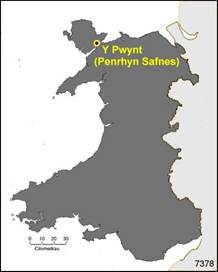
(delwedd 7378)
3 dod at y pwynt come to the
point
Der at y pwynt! Come to the point!
4 eithafbwynt furthest point,
ne plus ultra, uttermost point, ne plus ultra
(eithaf = the most extreme) + (soft mutation p
> b) + (pwynt = point)
:_______________________________.
pwyntiau
‹puint-ye›
1 plural form of pwynt = point
:_______________________________.
pwyntiwr
‹puint-yur› masculine noun
1 (Railway) pointsman
ETYMOLOGY: (pwynt = point) + (-i-wr suffix = man)
:_______________________________.
pwys,
pwysau <PUIS, PUI-sai, -se> [pʊɪs, ˡpʊɪsaɪ,
-ɛ] (masculine noun)
1 weight
2
importance
3
o bwys important
bod o bwys be important
Mae pob ceiniog o bwys Every penny
counts (“every penny is of importance”)
ni… o fawr bwys of little
importance
(ni = not)..... + (o = of) + (soft mutation m > f)
+ (mawr = big, great) + (soft
mutation p > b) + (pwys =
importance)
Nìd yw o fawr bwys It’s of little
importance (“it is not of great importance”)
ETYMOLOGY:
Welsh < British pē’s-
< Latin pēnsum
(= weight)
Cf 1250–1300; Middle English avoir de pois (= goods / property / posessions of weight) < French avoir du pois < Old French aver de peis.<
Latin:
habēre (= to have)
dē (= of, from)
pēnsum (= weight)
Cf Middle English peyse
< Old French < Latin
“peyse... A weight, used either foe a clock - or organ
bellows”, in an account book from Somerset, England:
Glossary, Church-wardens' accounts of
Croscombe, Pilton, Patton, Tintinhull, Morebath, and St. Michael's, Bath,
ranging from A.D. 1349 to 1560
:_______________________________.
pwysig <PUI-sig> [ˡpʊɪsɪg] (adjective)
1 important
ETYMOLOGY: (pwys = weight) + (-ig suffix)
:_______________________________.
pwyslais
<PUIS-lais> [ˡpʊɪslaɪs] (masculine noun)
1 emphasis = stress
rhoi gormod o bwyslais ar (rywbeth)
attach too much importance to (something)
ETYMOLOGY: “weighted voice” (pwys = weight) + (soft mutation ll
> l) + (llais = voice)
:_______________________________.
pwyso <PUI-so> [ˡpʊɪsɔ] (verb)
1 to weigh
2
to lean
pwyso allan o ffenest lean out of a
window
Agorodd y papur newydd a phwyso nôl yn ei sedd
He opened the newspaper and leaned back in
his seat
3
pwyso ar wynt rhywun pressurise
somebody (“weigh on the wind / breath of somebody”)
pwyso ar wynt tyst pressurise a
witness
ETYMOLOGY: (pwys = weight) + (-o =
verbal suffix)
:_______________________________.
pwyth <PUITH> [pʊɪθ] masculine noun
PLURAL pwythau <PUI-thai,
-e> [ˡpʊɪθaɪ, -ɛ]
1 (sewing) stitch = loop made by a thread when drawn by a needle
pwyth bras tack, loose stitch
2
stitch (for closing a wound)
3
North Wales pwyth drwy'r wal tie stone, one connecting two sides of a wall
4
talu'r pwyth get one's own back,
give someone tit for tat
talu'r pwyth yn ôl i rywun get one's
own back on someone
Blynyddoedd wedyn cafodd dalu'r pwyth yn
ôl i heddwas y pentref
Many years later he was able to get his own back on the village policeman
6
South Wales; obsolete wedding present (especially in the sense of a present
which is made in return for a present formerly received)
Plural: pwython (southern form of
the plural variant pwythion)
7
South Wales help
rho bwyth iddo help him
8
debt (obligation to return a favour or gift)
Fe af â chi yn y car. Rhaid i chi gofio,
ma’ arna i bwyth i chi
I'll take you in the car. Remember, I owe you a favour (“there is on me a
stitch to you”)
ETYMOLOGY: British *pukt- < Latin
*puct- < punctum (= point) < pungere
(= pierce).
English point < French < this
same Latin word punctum
:_______________________________.
pyblican
(= “pýblican”) ‹PƏ bli kan› (m)
PLURAL publicanod ‹pə-bli-KAA-nod›
1 publican (= Roman tax collector)
Publican is the spelling in the
1620 Welsh Bible; it is also the spelling given in Geiriadur yr Academi Cymreig
/ The Welsh Academy Dictionary (English-Welsh). Geiriadur Prifysgol Cymru / The
University of Wales Dictionary however has pyblican (= “pýblican”)
ETYMOLOGY: A learnèd borrowing from Latin pûblicânus,
and / or English publican.
English publican < French publicain<
Latin pûblicânus.
Pûblicânus (= tax collector) < pûblicum (= revenues of the
state) < pûblicus < pôplicus (adj, of the people) < populus
(= people)
:_______________________________.
pydew <PƏ-deu> [ˡpədɛʊ]
masculine
noun
PLURAL pydewau <pə-DEU-ai,
-e> [pəˡdɛʊaɪ, -ɛ]
1 well, spring, pit
y pydew diwaelod the bottomless pit
Datguddiad 20:3 Ac
a'i bwriodd ef i'r pydew diwaelod, ac a gaeodd arno, ac a seliodd arno ef, fel
na thwyllai efe'r cenhedloedd mwyach, nes cyflawni'r mil o flynyddoedd: ac ar
ôl hynny rhaid yw ei ollwng ef yn rhydd dros ychydig amser.
Revelation 20:3 And cast him into the bottomless pit, and shut him up, and set
a seal upon him, that he should deceive the nations no more, till the thousand
years should be fulfilled: and after that he must be loosed a little season.
2 (figurative of
depths of depravity, degradation) pit
codi meddwyn o’r pydew (“raise a
drunkard from the pit”, raise the drunkard from his pit) , cause an alcoholic
to reform his ways
ETYMOLOGY: Welsh pydew < British
< Latin puteus (= well, pit)
Cf English pit < Old English pytt < Latin puteus;
Catalan pou (= well, pit) < Latin
puteus
:_______________________________.
Y Pydew <ə PƏ-deu> [ə ˡpədɛʊ]
(m)
1 (SH8079) locality in the county of Conwy, 1km north-east of Cyffordd
Llandudno
http://www.geograph.org.uk/photo/1013836
Y Pydew
Brynpydew SH8179 locality here
bryn y pydew “(the) hill (by) Y Pydew”, or “(the) hill (of) the well”
(“Bryn Pydew” on the Ordnance Survey map)
There are roads here called
Pydew Road (which would be Ffordd y
Pydew in Welsh)
Brynpydew Road (which would be Ffordd Brynpydew in Welsh)
http://www.geograph.org.uk/photo/1013851 Brynpydew
ETYMOLOGY: y pydew “the well”
:_______________________________.
pydredig
<pə-DREE-dig> [pəˡdreˑdɪg] adjective
1 rotten, putrid, decayed
Yr oedd yr hen dŷ a'r hen ysgubor yn adfeilion
pydredig.
The old house and the old barn were decayed ruins
ETYMOLOGY:
(pydr- stem of pydru = decay, rot) + (-edig
suffix for forming a past participle adjective)
:_______________________________.
pydru <PƏ-dri> [ˡpədrɪ] verb
1 rot = cause to decay
pydru’n ddim rot away, diminish and
disappear through a rotting process
2
rot = to decay because of the action of bacteria
Mae'r hen wynwyn ’na wedi pydru
Those onions have rotted
3
rot, rot away, collapse, degenerate
Mae hen ganllawiau cymdeithas yn pydru
The old rules of society are collapsing / rotting away
4
rot = languish, become weak through being deprived of freedom and kept in
confinement
Bydd dwsinau o bobl ddieuog yn dal i
bydru mewn carchardai
There are dozens of innocent people who continue to rot in prison
5
pydru mynd, pydru dod, pydru ymlaen
plod along
Roedd yn rhaid i'r postmon bydru ’mlaen
gorau gallai ar hyd y llwybr serth oedd wedi ’i orchuddio yn yr eira mawr
The postman had to plod forward as best he could along the steep path covered
in snow
6
pydru byw rot = languish, stagnate,
have a boring life
ETYMOLOGY: (pydr-, penultimate form
of pwdr = rotten) + (-u suffix)
NOTE: South-east Wales the w of the final syllable is retained,
hence pwdru. In the south-east, the
intial consonants “d, b, g” of the final syllable become devoiced “t, p, c”
> pwtru
:_______________________________.
pỳg <PƏG> [pəg] (masculine noun)
1 pitch, tar
:_______________________________.
pyliau <PƏL-yai, -e> [ˡpəljaɪ, -ɛ] (plural noun)
1 fits, spasms; see pwl
:_______________________________.
pyllau <PƏ-lhai, -lhe> [ˡpəɬaɪ, -ɛ] (plural noun)
1 pools; coalpits; see pwll
:_______________________________.
pylni <PƏL-ni> [ˡpəlnɪ] masculine noun
1 (blade) bluntness
2 dimness
ETYMOLOGY: (pyl- penult syllable
form of pwl = blunt, dim) + (-ni suffix for forming abstract nouns)
:_______________________________.
pymtheg <PƏM-theg> [ˡpəmθɛg] (masculine noun)
1 fifteen
:_______________________________.
pymthegfed
<pəm-THEG-ved> [pəmˡθɛgvɛd] (adjective)
1 fifteenth
:_______________________________.
pynciau <PƏNGK-yai, -e> [ˡpəngkjaɪ, -ɛ] (plural noun)
1 subjects; see pwnc
:_______________________________.
pyncio <PƏNGK-yo> [ˡpəngkjɔ] (verb)
1 compose spontaneous verses (for example, in a traditional wedding
ceremony, Mari Lwyd ceremony)
:_______________________________.
pynnau <PƏ-nai, -e> [ˡpənaɪ, -ɛ] (plural noun)
1 packs; plural of pwn
:_______________________________.
pynshiau
<PƏNSH-yai,
-e> [ˡpənʃjaɪ, -ɛ]
1 plural of pwnsh (= punch,
tool for making small round holes)
:_______________________________.
Pŷr <PIIR> [piːr]
1 Peter (in certain place names)
..a/ Maenor-bŷr (“court of
Peter”) SS0697 locality in the county of Penfro
English name: Manorbier
http://www.geograph.org.uk/gridref/SS0697 map
..b/ Sain Pŷr ST5190 locality
in the county of Mynwy
English name: St. Pierre
http://www.geograph.org.uk/photo/69921 yr eglwys / the
church
..c/ Ynys Bŷr (“island of
Peter”) (SS1396) island in the county of Penfro
English name: Caldy Island
http://www.geograph.org.uk/gridref/SS1396 map
:_______________________________.
Y Pyreneau <Ə-PI-RE-NE-Ai, -e> [əpɪrɛˡneˑaɪ,
-ɛ]
1 the Pyrenees.
See Y Pureneau (a better spelling, though not standard)
(However, “Y Pirinéw” would be a better Welsh name, using the Catalan
name for the mountain range)
:_______________________________.
pyrsau <PƏR-sai, -e> [ˡpərsaɪ,
-ɛ] (plural noun)
1 purses; see pwrs
:_______________________________.
pyrth <PIRTH> [pɪrθ]
1 Plural form of porth = gate,
entrance
:_______________________________.
pysen,
pys <PƏ-sen, PIIS> [ˡpəsɛn, piːs] (feminine noun)
1 pea
y bysen the pea
2 pys hollt split peas
:_______________________________.
pysg <PISK> [pɪsk] (masculine noun)
1 fish (obsolete word) See pysgodyn
North Wales: py^sg <PIISK> [piːsk]
:_______________________________.
pyslo <PƏ-slo> [ˡpəslɔ] v
1 (dialect) puzzle The Treatment of English Borrowed Words in Colloquial Welsh / Thomas Powel / Y Cymmrodor Vol. VI 1883. / p133 (“The following paper is an attempt to give a general account of the use and treatment of English words in the colloquial Welsh of the present day. Most of the statements here made are applicable to the whole of Welsh-speaking Wales; but the paper treats more particularly of the dialect spoken, with slight variations, in the Counties of Brecon, Caermarthen, and the greater part of Cardigan.”)
Z. This letter is not known to Welsh, aud in borrowed words it becomes s. Sêl (zeal), dăslo (dazzle), pyslo (puzzle), ráser (razor), etc
:_______________________________.
pysgod <PƏ-skod> [ˡpəskɔd] (plural noun)
1 fish (plural)
See pysgodyn
:_______________________________.
pysgodyn,
pysgod <pə-SKOO-din, PƏ-skod> [pəˡskoˑdɪn, ˡpəskɔd] (masculine noun)
1 fish
pysgodyn cragen PLURAL pysgod cregyn shellfish
cragenbysgodyn PLURAL cragenbysgod shellfish
2
pysgod a sglodion <PƏ-skod a SGLOD-yon> [ˡpəskɔd
a ˡsglɔdjɔn] fish and chips
3 byrbysgodyn (Carrasius carassius) crucian carp
(byr- <Ə> [ə] penult-syllable form of byr <I> [ɪ] = short) + soft mutation + (pysgodyn =
fish)
ETYMOLOGY: (pysgod = fish, in a plural
sense i.e. fishes) + (yn = singulative suffix)
..a/ Latin piscor, piscari, piscâtus (= to go fishing, to
fish)
..b/ piscâtus is
a past participle (= fished)
As a noun piscâtus –us (m) 1 a catch of fish (literally,
something fished), 2 fishes.
..c/ Latin piscâtus > British *piskât- > Welsh pysgawd > pysgod
:_______________________________.
pysgodyn aur ‹pə-skOO-din air› [pəˡskoˑdɪn ˡaɪr] masculine noun
PLURAL pysgod aur ‹pə-skod
air› [ˡpəskɔd
ˡaɪr]
1 (Carrasius auratus) goldfish
ETYMOLOGY: ( pysgodyn = fish) +
(aur = gold)
:_______________________________.
pysgota <pə-SKO-ta> [pəˡskɔta] (verb)
1 to fish
2
cwch pysgota pl. cychod pysgota fishing boat
fflyd [fli:d] o gychod pysgota pl.
fflydoedd… fishing fleet
llynges bysgota pl. llyngesau pysgota fishing fleet
3
llinyn pysgota fishing line
lein bysgota fishing line
:_______________________________.
pysgotwr,
pysgotwyr <pə-SKO-tur, pə-SKOT-wir> [pəˡskɔtʊr,
pəˡskɔtwɪr] (masculine noun)
1 fisherman
pysgotwr selog a keen fisherman
:_______________________________.
pysgysol
<pəsk-Ə-sol> [pəskˡəsɔl] adjective
1 fish-eating
ETYMOLOGY: (pysg- < pysg =
fish) + (-ysol = -eating); (ys- stem of ysu = consume) + (-ol
suffix for forming adjectives)
:_______________________________.
pysgysor
<pəsk-Ə-sor> [pəskˡəsɔr] masculine noun
PLURAL pysgysorion <pəsg-ə-SOR-yon> [pəsgəˡsɔrjɔn]
1 fish-eating animal or bird
ETYMOLOGY: (pysg- < pysg =
fish) + (-ysor = -eater, animal
which eats);
(ys- stem of ysu = consume) + (-or suffix
for indicating a an agent; from Latin -ârius,
in words taken from Latin (canghellor (=
chancellor) < cancellârius;
afterwards used as a suffix with native words– telynor = harpist)
:_______________________________.
pythefnos,
pythefnosau <pə-THEV-nos, pə-thev-NO-sai, -e> [pəˡθɛvnɔs,
pəθɛvˡnɔsaɪ, -ɛ] (feminine noun)
1 (USA: two weeks) (Englandic: fortnight)
y bythefnos the fortnight
Celtic Religion in Pre-Christian Times / Author: Edward Anwyl / Year 1903 /
p.67: For the Celt the year began in November, so that its second half-year
commenced with the first of May. The idea to which Cæsar refers, that the Gauls
believed themselves descended from Dis, the god of the lower world, and began
the year with the night, counting their time not by days but by nights, points
in the same direction, namely that the darkness of the earth had a greater hold
on the mind than the brightness of the sky. The Welsh terms for a week and a fortnight,
wythnos (eight nights) and pythefnos (fifteen nights)
respectively confirm Cæsar’s statement.
Colloquially also pythewnos
[v > w] [pəˡθɛunɔs]
:_______________________________.
Q, q <KYUU> [kjuː] feminine noun
1) seventeenth letter of the twenty-six letter
Roman alphabet
..1 a, 2 b, 3 c, 4 d 5 e, 6 f, 7 g, 8
h, 9 i, 10 j, 11 k, 12 l, 13 m, 14 n, 15 o, 16 p, 17 q, 18 r, 19 s, 20 t, 21 u, 22 v, 23 w, 24 x, 25 y, 26 z
2)
(does not appear in the twenty-nine letter Welsh alphabet)
..1 a, 2 b, 3 c, 4 ch, 5 d, 6 dd 7 e, 8 f, 9 ff, 10 g, 11 ng, 12
h, 13 i, 14 j, 15 l, 16 ll, 17 m, 18 n, 19 o, 20 p, 21 ph, 22 r, 23 rh, 24 s, 25 t, 26 th, 27 u, 28 w, 29
y
QUALIFIER
In some place names,
an original qualifier is lost
..a/ Yr Orsedd
(qv) (anciently Yr Orsedd-goch) (county of Wrecsam) “the red tumulus”
Xxxxxxxxxxxxxxxxxxxxxxxxxxxxxxxxxxxxxxx
http://www.kimkat.org/amryw/1_vortaroy/geiriadur_cymraeg_saesneg_BAEDD_pl_1073e.htm
ʷ 0287 / ŷ 0177 / ŵ 0175
Ble'r wyf i? Yr ych chi'n ymwéld ag un o
dudalennau'r Gwefan "CYMRU-CATALONIA"
On sóc? Esteu visitant una pàgina de la Web "CYMRU-CATALONIA" (= Gal·les-Catalunya)
Weər äm ai? Yuu äär vízïting ə peij fröm dhə
"CYMRU-CATALONIA" (= Weilz-Katəlóuniə) Wéb-sait
Where am I? You are
visiting a page from the "CYMRU-CATALONIA" (= Wales-Catalonia)
Website
Edrychwch ar fy ystadegau / View My
Stats